



Abstract
The positive prosocial outcomes deriving from interpersonal synchronisation, as well as the contribution of social skills in attaining synchronisation with others in musical group interactions, are commonly explored independently, overlooking the possibility of a simultaneous bidirectional relationship between musical and social behaviour. This article focuses on the relationship between empathy and interpersonal synchronisation, critically reviewing each directionality of this intriguing link, namely, how empathy contributes to the socio-cognitive skills required to achieve synchronisation with others, and how this synchronised interaction lays the groundwork for the development of empathy. Following this review and building upon relevant research in music and social psychology, a theoretical framework is proposed, arguing that during a musical group interaction, empathy and interpersonal synchronisation create a positive feedback loop, enhancing one another in a reciprocal and simultaneous manner. The circumstances that encourage or obstruct this feedback loop, as well as its significant implications, are discussed. Finally, the present work highlights the importance of switching the research focus from unilateral to bidirectional relationships in order to gain a deeper understanding of the interrelation between musical and social behaviour.
Keywords
Introduction
Musical group interaction, an immensely social activity that involves joint music-making by two or more individuals, requires the ongoing alignment of intentions and actions in order to accomplish shared musical goals. As a fundamental aligning process of musical interactions, interpersonal synchronisation necessitates continual observation and subsequent adaptation to another's rhythmic actions, with the aim of achieving precise motor alignment (Keller, 2014; MacRitchie et al., 2017). These socio-cognitive processes of interpersonal synchronisation present strong similarities to the cognitive processes of empathy, a social skill involving attention to, resonating, and responding to others’ emotions and thoughts, thereby leading to cognitive and emotional alignment (Rabinowitch, 2017). Indeed, research has revealed a relationship between the processes of empathising and synchronising between individuals, with cognitive empathy facilitating interpersonal synchronisation, and synchronisation contributing to the role of musical group interactions in fostering empathy (Novembre et al., 2019; Rabinowitch et al., 2013). Although these parallels imply a possible bidirectional relationship between empathy and interpersonal synchronisation, this notion has been neither theoretically nor empirically explored. Hence, possible significant musical and social implications of this reciprocal relationship may have been overlooked.
The present theoretical article begins with a brief contextualisation of interpersonal synchronisation and empathy, highlighting important aspects that will contribute to the upcoming discussion of the concept of empathy-synchronisation interplay. A critical review of each directionality of the empathy-synchronisation link will follow, outlining the mechanisms underlying these processes and drawing attention to some significant knowledge gaps that require further investigation. A theoretical framework is subsequently proposed, examining the conditions under which empathy and interpersonal synchronisation enhance one another in a and simultaneous manner, thereby creating a positive feedback loop. Following that, a discussion of how this relationship can be empirically approached will take place, along with proposals for potential next steps and exploratory avenues for future research. Finally, the implications of this feedback loop are examined with regard to how musical interventions might utilize this reciprocal relationship to overcome group membership barriers. In addition, given the significant role of early musical and social interactions in the development of synchronisation and social skills respectively (Levy & Feldman, 2019; Phillips-Silver & Keller, 2012), the present article will also discuss how this positive feedback loop could facilitate the simultaneous development of musical and social skills in children's musical group interactions.
Contextualizing Interpersonal Synchronisation and Empathy
Interpersonal Synchronisation as a Social Bonding Mechanism
Interpersonal synchronisation, the temporal alignment of movements between two or more individuals, is an integral part of joint musical activities, requiring continuous monitoring and adapting to others’ subsequent rhythmic actions (Keller et al., 2014). This complex process has attracted significant research interest in social and music psychology due to its capacity to foster prosocial behaviour and group cohesion (Rennung & Göritz, 2016; Vicaria & Dickens, 2016). This section will integrate knowledge from studies using overlapping and often interchangeable terms to describe this phenomenon, namely interpersonal entrainment (Clayton et al., 2020), coordination (Keller et al., 2014), synchrony (Cirelli, 2018), and temporal and affective entrainment (Phillips-Silver & Keller, 2012), in order to illuminate aspects contributing to its connection with social behaviour. Here “interpersonal synchronisation” will be used as an umbrella term throughout the present article with other terms such as coordination and synchrony being used as synonyms.
Building on previous research, Keller (2008, 2014) proposed that attaining precise interpersonal synchronisation in a musical group requires three fundamental cognitive-motor skills: (a) attention, referring to monitoring one's own and others’ rhythmic movements; (b) anticipation, relating to the prediction of others’ upcoming actions; and (c) adaptation, characterized by timing variations that co-performers apply to mutually adjust to their partners’ music. Behavioural and neuroscience research investigating the mechanisms underpinning these skills has indicated a significant role of perception-action coupling and motor (or action) simulation in this process (Novembre & Keller, 2014). Similarly to other social interactions, a shared neural network responsible for perceiving and producing an action (perception-action mechanism – Keller et al., 2014) activates motor representations of observed actions as if they were produced by the observer (Gallese, 2019). This simulation process provides information about others’ actions in the brain, contributing to the integration of self- and other-generated actions (Novembre et al., 2012). This process, therefore, enables co-performers to create accurate temporal predictions and synchronize with their partners’ performance (Novembre et al., 2014).
In addition to the aforementioned cognitive-motor skills, establishing interpersonal synchronisation requires a shared understanding of the musical performance (Clayton et al., 2020), active collaboration, and shared intentionality to produce an aligned musical goal (Reddish et al., 2013). It also calls for flexibility in perceiving and responding not only to others’ rhythmic actions but also to their emotional states (Cross et al., 2012). These essential processes emphasize the importance of considering interpersonal synchronisation as a multi-level social phenomenon, significantly influenced by its social context and the communication between the interacting members (Clayton et al., 2020; Kirschner & Tomasello, 2009). For example, when assigned to lead a musical interaction, participants tend to reduce their timing variations, thereby increasing musical predictability for their followers (Novembre et al., 2019). In addition, spontaneous interpersonal synchronisation has been shown to decrease when individuals are asked to interact with a partner who has arrived late (Miles et al., 2010). Social dispositions such as prosocial orientation also seem to affect performers’ coordination capacities (Lumsden et al., 2012) and, as will be discussed in the following sections, trait empathy also plays a significant modulatory role in this process (Novembre et al., 2019).
Turning now to the social consequences of interpersonal synchronisation, this topic has attracted considerable research attention due to its significant social and educational implications. Moving, tapping, or playing music in synchrony with others encourages group cohesion (Vicaria & Dickens, 2016) and prosocial behaviour (Mogan et al., 2017; Rennung & Göritz, 2016), even at an early age when motor coordination abilities have yet to develop (Cirelli et al., 2014; Trainor & Cirelli, 2015). A few examples of the positive social outcomes of interpersonal synchronisation in adult and children's joint musical and non-musical actions are increased cooperation (Wiltermuth & Heath, 2009), feelings of closeness (Stupacher et al., 2017), enhanced affiliation (Hove & Risen, 2009), and increased perceived similarity (Rabinowitch & Knafo-Noam, 2015). Interpersonal synchronisation may also have the capacity to bridge intergroup boundaries (Miles et al., 2011; Reddish et al., 2016), contributing to interventions aimed at mitigating intergroup biases (Tunçgenç & Cohen, 2016).
Regarding how these positive social outcomes emerge, Tarr et al. (2014) argue that synchronisation's ability to blur the line between self and other, combined with the release of endorphins during exertive joint actions, might explain the social bonding effects of interpersonal synchronisation. Furthermore, Phillips-Silver and Keller (2012) point out that the emotion-sharing and affective entrainment during a joint musical action create strong bonds, laying the foundation for the development of both musical skills and prosocial behaviour. The latter mechanism will be further discussed in the following sections, elucidating how synchronisation may also enhance empathy (Koehne et al., 2016a; Rabinowitch et al., 2013). Before moving on to that discussion, however, it is essential to highlight some key aspects of empathy that will later contribute to our understanding of its relationship with interpersonal synchronisation.
The Complex Phenomenon of Empathy
Despite the numerous definitions and debates about its manifestations and underlying systems, empathy is recognized as a fundamental component of social interactions (Singer & Tusche, 2014), and practicing empathy with others can result in ample prosocial and educational outcomes (Feshbach & Feshbach, 2009). Some key aspects of the cognitive and affective processes, underlying mechanisms, and dispositional and situative manifestations of empathy will be introduced below, providing an informative context for the upcoming discussion of the links between empathy and interpersonal synchronisation.
Empathy refers to both the affective and cognitive processes of sharing and understanding others’ emotions and thoughts. Affective (or emotional) empathy enables a level of self-other overlap through a bottom-up process (Preston & Hofelich, 2012), allowing an individual to share the same emotions observed in another person (Singer & Lamm, 2009). Although the term “affective empathy” often overlaps with sympathy or compassion, the latter states are considered altruistic responses to someone's emotions, stemming from a preceding process of empathising (Eisenberg & Eggum, 2009). Regarding cognitive empathy, this concept is often presented as a synonym for perspective-taking, mentalizing, and theory of mind (Stietz et al., 2019), and involves the activation of representations of others’ mental states through a top-down process. Namely, the empathizer consciously suppresses their own perspective (Davis, 2015) in order to understand the perceptions and feelings of another (de Waal & Preston, 2017). Furthermore, during empathising, it is crucial for individuals to maintain a clear distinction between self- and other-generated emotions, as losing oneself in another's feelings might result in emotional distress (Decety & Lamm, 2006). This latter characteristic of empathy also differentiates it from emotional contagion, the automatic process of “catching” others’ emotional states (Hatfield et al., 2009).
Considering the mechanisms underpinning empathy, a similar perception-action coupling that was earlier discussed in the context of interpersonal synchronisation also seems to play a fundamental role in empathy. According to the perception-action model of empathy (PAM), proposed by Preston and de Waal (2002), observing or imagining the emotional expressions and behaviour of others activates automatic representations of similar states, allowing the empathizer to experience the same emotions as the empathic target. This indicates that a perception-action mechanism allows individuals to not only understand others’ motor actions (as in the case of interpersonal synchronisation) but also their feelings (Singer & Tusche, 2014). In addition to this process, de Waal (2007, 2008) argues that higher cognitive levels of empathy may be built upon automatic and affective empathic processes that rely on this core mechanism of perception-action coupling (the Russian Doll model). This implies that understanding another individual's thoughts (cognitive empathy) requires a preceding level of emotional engagement with them (affective empathy), which allows empathizers to consider and actively help their empathic targets (de Waal, 2007; de Waal & Preston, 2017). In the upcoming discussion of the empathy-synchronisation feedback loop, the role of perception-action coupling, which may lay at the core of this reciprocal relationship, will be further considered.
Focusing now on the neural substrates of empathy, its cognitive and affective processes seem to rely on separate but interacting brain areas (Dvash & Shamay-Tsoory, 2014). While brain networks associated with affective empathy activate representations of others’ emotional states in a bottom-up fashion, cognitive and top-down processes provide content and meaning to these representations, allowing individuals to imagine others’ emotions and thoughts based on their own previous experiences (de Waal & Preston, 2017). In the last few decades, there has been significant research interest in the role of the mirror neurons system (MNS) in empathy. These neurons, activated when an action is observed or executed, are proposed to also support the simulation of others’ emotional states (Iacoboni, 2009). Gallese (2003) argues that the MNS creates embodied representations of others’ intentions and actions, therefore enabling individuals to perceive others as similar to themselves and laying the groundwork for intersubjectivity, the process of aligning one's own mental states with others’ (Iacoboni, 2009). The MNS has also been proposed to facilitate the experience of affect in music listening. Molnar-Szakacs and Overy (2006) assert that individuals perceive music as a sequence of actions behind the musical signal, and the MNS contributes to representing and attributing affect to these actions. The mirror neurons, therefore, play a key role in linking perceived actions with emotional states, subsequently creating an emotional response to the music (Overy & Molnar-Szakacs, 2009).
A further important aspect of empathy requiring consideration concerns its manifestations. Empathy is often approached as a disposition (referred to as dispositional or trait empathy), with researchers often assessing inter-individual differences within the population using self-reported questionnaires (Singer & Tusche, 2014). As a personality trait, empathy presents gender and age differences, with women, for example, scoring higher than men on empathy questionnaires (Schulte-Rüther et al., 2008) and cognitive empathy declining with age (Stietz et al., 2019). There are, however, plenty of contextual or situational factors, such as the relationship between an empathizer and their empathic target, that might modulate an empathic response, hence indicating a more situation-specific manifestation of empathy (also referred to as situational empathy – Davis, 2015; de Vignemont & Singer, 2006). Individuals, for example, tend to empathize better with familiar others, such as family members and friends (Preston & de Waal, 2002), as well as those they perceive as similar and who they can identify with (de Vignemont & Singer, 2006). This latter tendency is evident in research examining correlations between empathy and group membership (Cikara et al., 2011), as it has been reported that empathy is more likely to lead to helping behaviour when the helper and target belong to the same cultural group (Stürmer et al., 2006). Altogether, these findings suggest that individuals appraise a given situation (Lamm et al., 2007) and exhibit empathy that does not only correspond to their empathic disposition but also depends on the context and the people involved in it (de Vignemont & Singer, 2006).
The aforementioned manifestations indicate that empathy is a flexible process that can be induced, experimentally manipulated and subsequently changed through practice (Allemand et al., 2015), leading to significant educational implications that, for example, contribute to children's moral development (Eisenberg et al., 2010; Feshbach & Feshbach, 2009). From a developmental perspective, precursors of empathy can be found in infancy (Cadinu & Kiesner, 2000; Zahn-Waxler & Radke-Yarrow, 1990), but empathy is thought to remain malleable throughout the lifespan (Stietz et al., 2019). Nonetheless, with childhood and adolescence being significant periods for fostering empathy (Allemand et al., 2015), research has utilized empathy's flexibility to design and apply interventions that encourage empathy-building and foster prosocial behaviour (Eisenberg et al., 2010). These interventions utilize techniques, such as storytelling, dialogues, and conflict-resolution (Batson & Ahmad, 2009), to induce empathy by encouraging individuals to intentionally adopt others’ perspectives (Davis, 2015). Such interventions (e.g., Roots of Empathy by Connolly et al., 2018; Gordon and Fullan, 2012) have been found to promote helping behaviour, reduce aggression and even improve attitudes toward outgroup members (Batson & Ahmad, 2009). As will be discussed in the following section, music-making and synchronisation may also have the capacity to modulate empathy, again potentially contributing to children's moral development (Rabinowitch, 2017).
The Relationship Between Empathy and Interpersonal Synchronisation
In the following sections, each directionality of the relationship between empathy and interpersonal synchronisation is separately reviewed, and research exploring a variety of coordinated rhythmic behaviour, ranging from mother-infant synchronous interactions to interpersonal coordination in musical groups, is discussed. These sections aim to provide an insight into the mechanisms that underlie the processes of empathising and synchronizing with others, highlighting significant knowledge gaps that require further investigation. This will subsequently illuminate the theoretical model of empathy and interpersonal synchronisation that is proposed and analyzed in the final section of the present article.
Direction 1: The Effect of Interpersonal Synchronisation on Empathy
Early-life synchronous interactions between parents and infants appear to play a significant role in the development of empathy. After monitoring children from the age of one to thirteen years old, Feldman (2007) found strong associations between mother-infant synchrony and empathy, suggesting that children's early experiences of synchrony can predict higher empathy in adolescence. Adopting a similar longitudinal approach, Levy et al. (2019) showed that mother-infant synchrony in the first decade of a child's life helps in the neural maturation of the empathy mechanisms required for responding to others’ distress (Levy & Feldman, 2019). These findings suggest that early synchronous interactions contribute to the plasticity of the empathic brain, paving the way for the development of social cognition.
Regarding the impact of synchronisation on empathy, also later in childhood, Rabinowitch et al. (2013) investigated the possibility of synchronous musical interactions enhancing empathy between primary school children. It was found that a nine-month-long music program incorporating elements of movement, imitation and synchronisation enhanced children's affective trait empathy. Although the specific effects of interpersonal synchrony on empathy were not investigated, synchronisation is considered a fundamental component of musical group interactions, enabling the practice of empathising with others (Cross et al., 2012). Indeed, during joint musical actions, the members of a group engage in a series of cognitive and affective processes, such as imitation, synchronisation and shared intentionality (Cross et al., 2012), which allow them to experience a sense of intersubjectivity, defined here by Rabinowitch et al. (2011) as “a fluid sharing of intentions, emotions and cognitive processes” (p. 111). Joint music-making, therefore, entails the practice of aligning one's own emotions with others’, fostering empathy in the long term (Cross et al., 2012), with interpersonal synchronisation contributing to this process by enabling emotion-sharing (Phillips-Silver & Keller, 2012) and self-other merging (Tarr et al., 2014). Nonetheless, to what extent interpersonal synchronisation alone gives rise to the enhancement of affective empathy-building, and what conditions may facilitate this role, have yet to be found.
Shifting the focus away from affective empathy, Baimel et al. (2015) argue that synchronisation engenders social cohesion and cooperation by enabling people to infer and reason about the mental states of others, hence fostering cognitive empathy. In order to explore this argument, the authors implemented a musical task with groups of participants rhythmically moving a cup while listening through headphones to a song at the same or different tempi from one another (Baimel et al., 2018). They found that, when synchronized, participants exhibited an increased tendency to consider the mental states of others; however, synchronisation did not enhance affective empathy. These results imply that interpersonal synchronisation might mediate situational cognitive empathy, but it may require a longer period of synchronized interaction to bring about changes in affective trait empathy, as observed in the music program by Rabinowitch et al. (2013). What remains unknown and warrants further investigation is whether interpersonal synchronisation can facilitate situation-specific affective empathy and foster cognitive trait empathy in the long term.
Further support for the role of synchronisation in facilitating access to others’ mental states can be found in research with people with autism spectrum disorder (ASD). In a study by Koehne et al. (2016a), participants with ASD and neurotypical individuals engaged in a Morse code task, undertaking either the role of the leader or the follower in a series of light signals exchanges. Leaders were asked to send sequences of light signals to their partners, with followers responding to light signals with finger-taps. In reality, all returning light signals were generated by a computer, manipulating the degree of synchrony. After every round, situational empathy was measured, with participants rating how much they understood the thoughts of their partners and shared their feelings. The results indicated that, when being followed by a synchronous partner, neurotypical leaders experienced higher situational cognitive empathy toward that partner, feeling like they could better understand their thoughts. Individuals with ASD, however, did not exhibit changes in cognitive empathy, despite being able to detect differences in their partner's synchronisation. Nonetheless, ASD participants with higher dispositional cognitive empathy were better able to synchronize with a partner. These results indicate that synchronizing with a partner may lay the groundwork for tuning into their mental states, and the link between empathy and interpersonal synchronisation may not be fully absent in people with ASD (Koehne et al., 2016a).
A further research field recognizing the contribution of interpersonal synchronisation to empathy enhancement is dance and movement therapy (DMT). DMT interventions often incorporate coordinated movements and imitation in order to strengthen the bond between client and practitioner and enhance empathy (Behrends et al., 2012). Empathy, in this context, is often referred to as kinesthetic, highlighting the embodied nature of simulating and understanding others’ mental and emotional states (Gallese, 2009; Praszkier, 2016). Based on existing DMT practices, Behrends et al. (2012) have proposed that the continuous practice of interpersonal synchronisation, along with imitation and cooperation, can modify the embodied representations of others’ motor actions, enhancing kinesthetic and subsequently cognitive and affective empathy which rely on the same perception-action mechanism for representing others’ emotional states (Preston & de Waal, 2002). Indeed, in a survey with music students, Cho (2019) observed that those who had ample experience in practicing synchronisation in music groups in childhood reported higher levels of trait empathy in early adulthood. What remains unclear, however, is the extent to which interpersonal synchronisation relies on imitation and mimicry to positively affect empathy and whether the temporal aspects of synchronisation, that is, being simultaneously “in time” with each other, contribute equally to this process (Phillips-Silver & Keller, 2012).
The evidence reviewed in this section suggests that interpersonal synchronisation may have the capacity to mediate and foster empathy; however, further work is required to clarify the exact role of synchronisation in this process. As highlighted above, future research is needed to determine whether interpersonal synchronisation can function as an independent mechanism for fostering empathy. To date, synchronisation has only been explored as a component of joint actions, interacting with and supporting other cognitive and affective processes occurring at the same time (Behrends et al., 2012; Cross et al., 2012; Rabinowitch et al., 2013). Future studies might explore whether mutual adaptivity, anticipation, and awareness of one another, all of which are components of intentional synchronized actions (Keller et al., 2014), are sufficient to trigger changes in the capacity to empathize with others. It may be found, however, that interpersonal synchronisation requires a shared understanding of group goals, and cooperation to achieve them, in order to motivate empathic processes (Clayton et al., 2020; Harris & Cross, 2021; Reddish et al., 2013). What should also be established is a timeframe required for a synchronized interaction to have a measurable impact on empathy. The prolonged practice of synchronisation in groups has been found to positively impact trait empathy later in life (Cho, 2019; Koehne et al., 2016b). However, the influence of shorter programs remains unclear. For example, although Rabinowitch et al. (2013) found a difference in emotional empathy following a nine-month-long music program, Cespedes-Guevara and Dibben (2021) did not observe any significant changes after a year of musical training in children. Identifying a timeframe will illuminate the implications of synchronisation in education and therapy and further elucidate its effectiveness in developing social skills and strengthening group cohesion (Mogan et al., 2017).
Another aspect requiring further investigation is the role of interpersonal synchronisation in triggering changes in situational empathy. It is recommended to further investigate state-specific changes in affective empathy following synchronous interactions, as this could shed light on the possibility of affective empathy mediating people's willingness to tune into others’ mental states (de Waal & Preston, 2017). Moreover, it would be interesting to examine whether the positive effects of synchronisation on empathy can be generalized toward people who are not part of the synchronous interaction. Relevant research with adult participants has shown that following a synchronous interaction, the prosocial effects can indeed be generalized to non-interactive members (Reddish et al., 2014), but this seems not to be the case in infants (Cirelli et al., 2014), indicating an age difference in the use of synchrony to direct prosociality. Future work in exploring the generalized effects of synchronisation on empathy would help us to further understand the mediating role of interpersonal synchrony in social interactions and behaviour.
Direction 2: The Impact of Empathy on Interpersonal Synchronisation
In the last decade, research in music psychology and neuroscience has sought to explore the inverse directionality of the synchronisation-empathy link, namely, how empathy affects the ability to synchronize with others. This research interest might stem from the realization that perception-action coupling supports both interpersonal synchronisation (Novembre & Keller, 2014) and empathic processes (Gallese, 2009; Preston & de Waal, 2002). In addition, the existing body of research suggests that a range of social-psychological factors, such as personality traits and social skills, can significantly influence interpersonal synchronisation (Keller et al., 2014). With empathy being an essential tool for effective communication and social competence, research has attempted to demonstrate how this fundamental social capacity influences synchronisation and gain a better understanding of the underlying mechanisms that support this relationship.
As already stated, both empathy and synchronisation have been associated with action (or motor) simulation, with a perception-action mechanism activating embodied representations of both observed actions and emotions in one's brain (Gallese, 2019). During a joint musical activity, one's own action histories and motor repertoire are relied on and action planning is activated, resonating with the observed actions of a co-performer. This process, therefore, facilitates the anticipation and prediction of these actions (Hadley et al., 2015; Timmers et al., 2020). While anticipating others’ movements is an essential skill for interpersonal synchronisation during a musical performance, highly empathic people appear to create stronger embodied representations of observed actions (Novembre et al., 2012). This implies that people with higher trait empathy have augmented predictive skills, allowing them to synchronize better with their music partners. Novembre et al. (2019) tested this hypothesis by implementing an innovative turntable-based musical device (E-music box – Novembre et al., 2015), enabling individuals with no previous musical training to produce music in synchrony with others. The results showed that individuals with higher empathic perspective-taking abilities were better at predicting and synchronizing with their partners’ temporal actions, leading the authors to the conclusion that motor simulation may be the mechanism underlying this link between empathy, predictive capacities, and synchronisation.
The role of motor simulation has been further explored in a Transcranial Magnetic Stimulation (TMS) study (Novembre et al., 2014) in which a double-pulse TMS (dTMS) was utilized to interfere with motor simulation in professional pianists’ brains. Pianists were asked to play the right-hand part of various piano pieces while listening to a recording of the left-hand part. The results showed that dTMS applied to the right hemisphere impaired pianists’ capacity to coordinate their playing with the recording when the left-hand part had been previously practiced, and this impairment was stronger in individuals with higher cognitive empathy. This highlights further the significance of motor simulation in perceiving others’ temporal actions in order to establish synchrony (Novembre & Keller, 2014). This view is further supported by Overy and Molnar-Szakacs (2009), whose model of Shared Affective Motion Experience (SAME) suggests that the mirror neurons system (MNS) is utilized to perceive and understand actions and emotions through music. In light of this model, Bamford and Davidson (2019) asked their participants to freely move their bodies to the music, adjusting to new music excerpts presented to them without previous notice. Individuals with higher dispositional empathy were found to be faster at readjusting their movements to the new music. This indicates that people with an enhanced disposition to empathize are also better at simulating and predicting temporal actions either through music (Bamford & Davidson, 2019) or others’ musical performance (Novembre et al., 2019), further highlighting the close connection between empathy and motor behaviour.
Considering how empathy enhances other aspects of interpersonal synchronisation, researchers have focused on musicians’ tendency to reduce the variability of their temporal actions, making their music more predictable for their partners (Vesper et al., 2011). During a joint finger-tapping task, Dai et al. (2018) observed that dyads of individuals with higher cognitive empathy maintained lower timekeeper variance, therefore increasing their predictability to preserve synchronisation. Conversely, Novembre et al. (2019) noticed that individuals who were assigned to lead a musical task increased their predictability regardless of their empathic levels. This suggests that assigning leadership roles may have a stronger effect than cognitive empathy on performers’ tendency to increase their predictability. Nonetheless, Novembre et al. (2019) also revealed that followers with higher cognitive empathy were better at utilizing the temporal information coming from their leaders, adapting more easily to their music. Indeed, higher empathy scores have been associated with increased adaptivity (Washburn et al., 2019), indicating that highly empathic individuals vary their temporal behaviour in order to adapt to their co-performers’ actions. Altogether, these findings suggest that empathy facilitates co-performers’ ability to adapt to their partners’ music playing; however, further work needs to establish whether empathy plays any mediating role in leaders’ tendency to make their performance more predictable.
The studies reviewed in this section have significantly furthered our understanding of how empathy supports the skills required to achieve interpersonal synchronisation. However, further research is required to determine the nature of the empathic processes involved in the enhancement of synchronisation. Research has primarily focused on cognitive empathy, perhaps because the voluntary empathic process of taking the perspective of another resembles the conscious process of predicting and adapting to others’ musical performance. Nonetheless, this approach fails to consider the possible mediating role of affective empathy, as higher cognitive levels of perspective-taking are thought to build upon an involuntary and affective basis of emotional contagion, according to the Russian doll model of empathy (de Waal, 2008). This implies that adopting the perspective of another person, and consequently predicting and synchronizing with their actions in this context, requires a certain level of automatic emotion-sharing that encourages stepping outside of oneself and understanding the others’ actions (de Waal, 2008). This process remains undefined and warrants investigation to elucidate the circumstances that allow empathic capacities to enhance synchronisation with others. For example, it remains unknown whether psychological distance or disagreements obstruct the emotion-sharing between the members of joint actions, subsequently interrupting the impact of cognitive empathy on interpersonal synchronisation.
Furthermore, there is a significant lack of developmental research in this direction, perhaps because children and adolescents have not yet fully developed their entrainment and empathic skills. Nonetheless, research is necessary to shed light on how the cognitive-motor skills involved in synchronisation mature across the lifespan, as well as the extent to which their development builds upon socio-psychological factors (Ilari et al., 2018). Investigating empathy in children's musical interaction would also complement developmental research in rhythmic perception and production (e.g., Drake et al., 2000), highlighting the possible interplay between musical training, social skills, and the motivation to synchronize with others (Kirschner & Tomasello, 2009). A suggested approach (also proposed by Wu and Lu (2021)) would be to collect comparable data over a range of ages that correspond to key milestones in the development of empathy and synchronisation, such as: (a) age five or six, when social interactions increase by attending school; (b) age ten, when the ability to synchronize with a rhythmic sequence reaches similar levels to adults (Drake et al., 2000); and (c) adolescence, when the brain regions involved in social cognition undergo dramatic changes (Blakemore, 2008). It is hypothesized that early engagement in synchronous interactions positively affects the development of empathy (Cho, 2019; Levy & Feldman, 2019), which subsequently enhances the development of cognitive-motor skills required for attaining interpersonal synchronisation. This hypothesis implies a bidirectional relationship between empathy and synchronisation that will be further discussed in the following section.
The Positive Feedback Loop of Empathy and Interpersonal Synchronisation: A Theoretical Framework
Having reviewed both directions of the empathy-synchronisation link, the findings suggest that the human capacities of synchronizing and empathising are bidirectional. While dispositional empathy enhances the skills required for a successful synchronized interaction (Novembre et al., 2019), this interpersonal synchrony has the potential to increase empathy between co-performers (Rabinowitch et al., 2013). Researchers have already postulated such a possibility, with Keller et al. (2014) and Novembre et al. (2019) arguing that social factors such as empathy function as both influences and consequences of interpersonal synchronisation. In addition, Levy and Feldman (2019) assert that the neural processes of empathy and synchronisation may be “intimately and biologically intertwined in a multifaceted way” (p.2). This is further supported by research related to the chameleon effect, the automatic mimicry of others’ movements and behaviours during social interactions. Chartrand and Bargh (1999) argue that perception-action coupling might serve as a mechanism for both processes of mimicking the observed actions of an interacting partner and subsequently empathising with them.
Despite these postulations, this bidirectional relationship has not yet been empirically investigated and it remains unknown whether empathy and synchronisation affect one another simultaneously. Based upon the evidence presented in the previous sections, a theoretical framework is proposed here, suggesting that during a musical interaction, empathy and interpersonal synchronisation create a positive feedback loop (Figure 1); namely, increasing one aspect of the loop results in the simultaneous enhancement of the other aspect and vice versa. The purpose of this framework is to support future empirical research, investigating (a) how and when this bidirectional link occurs, considering the inter-individual and contextual factors that modulate this link, and (b) its practical implications for musical and social development. This framework also hopes to inspire further research into the bidirectionality of musical and social behaviour, as such an approach could reveal aspects that may be overlooked when focusing only on unilateral relationships.

The positive feedback loop of empathy and interpersonal synchronisation along with its potential implications.
The present theoretical framework draws on ideas from relevant studies and models in music, empathy and social behaviour (Clarke et al., 2015; Overy & Molnar-Szakacs, 2009; Shamay-Tsoory et al., 2019), embracing the idea that empathy is a flexible process modulated by the environment of the interaction (Clarke et al., 2015). During a musical interaction, individuals’ cognitive and affective trait empathy skills are utilized to enhance their predictive capacities (Figure 1(a)), allowing them to synchronize better with their co-performers (Novembre et al., 2019). Furthermore, as individuals with higher trait empathy are more susceptible to the affiliative effects of synchronous movements (Figure 1(b); Stupacher et al., 2021), adopting an empathic perspective toward co-performers (situational empathy) might also moderate those social bonding effects of synchronisation (Figure 1(c); see also Cross et al., 2012 about the role of flexibility in musical group interactions). The attained interpersonal synchronisation between co-performers increases their perceived similarity (Rabinowitch & Knafo-Noam, 2015), contributing to an increase in subjective (or situational) empathy towards one another (situation-specific changes – Figure 1(d); Atherton & Cross, 2020; Koehne et al., 2016a). The repeated practice of synchronizing and empathising with others might also have longitudinal effects, generating cumulative changes in dispositional empathy (Figure 1(e)), as observed in interventions for children (Rabinowitch et al., 2013), as well as adults (Leppma & Young, 2016). This enhanced empathy, in turn, amplifies interpersonal synchronisation and its positive prosocial effects, thereby creating a positive feedback loop. Figure 1 illustrates the relationships “synchronisation-trait empathy” and “synchronisation-situational empathy” as two separate loops to facilitate its interpretation; however, the two processes are considered intertwined and part of the same positive feedback loop.
This bidirectional relationship between empathy and synchronisation is supported by the social alignment model, proposed by Shamay-Tsoory et al. (2019) who view motor synchrony, emotional contagion, and cognitive agreement as intertwined processes with shared neural underpinnings. According to this model, the coordination of movements and the emotion-sharing between individuals are “different manifestations of social alignment, influencing one another in a reciprocal manner” (p.174), “representing a core mechanism of connectedness” (p.176). Individuals align their motor movements, emotional states, and perceptions with others in a similar manner, activating three neural systems. The first, a gap-detection system, allows individuals to monitor the interaction and create predictions about their motor, emotional, and cognitive alignment with others, based on information from the environment and previous experiences. If the initial predictions are correct, a second system (reward system) informs individuals that the optimal alignment has been achieved. If a misalignment is detected, an observation-execution mechanism (the third system) enables individuals to regulate their actions in order to attain alignment and update the gap-detection system. Based on these three common mechanisms, motor, emotional, and cognitive alignment processes influence and complement each other in a bidirectional manner. This demonstrates both why people with higher empathy are better at synchronizing with others (Novembre et al., 2019) and why synchronisation may facilitate intersubjectivity (Rabinowitch et al., 2011) and lead to higher empathy (Koehne et al., 2016a).
The social alignment model and its core mechanisms are compatible with evidence from research in music and empathy, indicating that both empathy and interpersonal synchronisation rely on embodied representations of others’ actions and emotions. During a joint musical interaction, individuals observe their partners’ motor behaviour and create predictions based on their own representations in order to achieve precise temporal coordination (Keller et al., 2014). Individuals use the same mechanism to access others’ affective states, activating automatic representations of similar feelings (Preston & de Waal, 2002) and, hence, leading to higher perceived similarity and empathy (de Waal, 2008). Furthermore, according to the SAME model (Overy & Molnar-Szakacs, 2009), the mirror neurons system (MNS) enables listeners to perceive music as motor actions, activating affective representations of the performer's state. The activation of such embodied representations highlights the significance of the perception-action mechanism during empathising and synchronizing with others, furthering our understanding of their reciprocal relationship. Empathy enables stronger representations of others’ motor actions (Novembre et al., 2012), enhancing synchronisation with others and the music (Bamford & Davidson, 2019; Novembre et al., 2019). Simultaneously, the continuous practice of synchronous musical interaction and emotion-sharing may lead to stronger representations of others’ affective states, fostering empathy in the long term (Cho, 2019).
Contextual and Inter-individual Factors Affecting the Feedback Loop
Likely as a result of their being highly social processes, both empathy and interpersonal synchronisation appear to be influenced by similar social factors, further highlighting their intertwined nature (Shamay-Tsoory et al., 2019). For example, one may find it difficult to empathize and engage in a synchronized interaction with someone who has previously treated them poorly (Singer & Tusche, 2014). Such social factors may involve the context, characteristics and goals of an interaction (hereafter referred to as contextual factors), as well as the relationship between the interacting members (inter-individual factors). The most significant factors that might modulate the empathy-synchronisation feedback loop are discussed below (Figure 2), illuminating the circumstances that allow or prevent this loop from occurring and remaining positive.
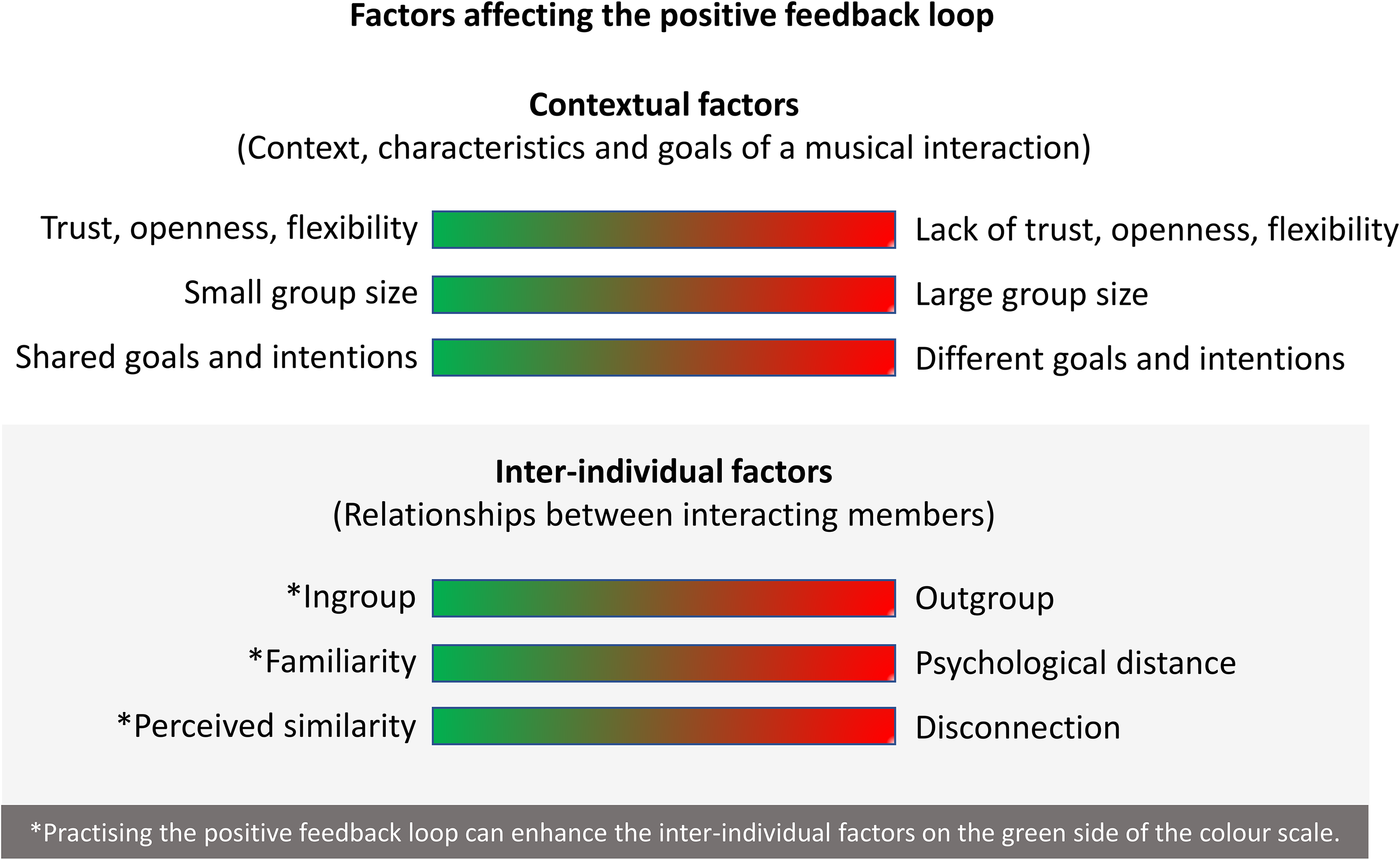
The contextual and inter-individual factors affecting the positive feedback loop of empathy and interpersonal synchronisation. The color scale ranges from red (factors obstructing the positivity of the loop) to green (factors allowing the loop to flourish). Practicing the feedback loop in musical interactions can reinforce the inter-individual factors on the green side of the scale.
Beginning with contextual factors, it could be argued that this feedback loop requires an environment of trust and openness to flourish. According to Cross et al. (2012), co-performers need to develop a level of flexibility which allows them not only to adapt to one another's rhythmic behaviour but also to shift their attention to others’ emotional states. If co-performers are unable to exhibit flexibility, empathic capacities may fail to support synchronisation or the synchronous interaction may not function as a channel for emotion-sharing and empathy. The group size may play an important role here, as smaller groups require attention to a smaller number of co-performers, leading to greater self-other merging (Mogan et al., 2017; Tarr et al., 2014). In addition to these factors, the feeling of pursuing shared goals and intentions within the group may be a prerequisite for positive social outcomes of interpersonal synchronisation (Clayton et al., 2020). Synchronisation combined with active cooperation to achieve shared goals has been reported to exhibit the strongest effects on social behaviour (Reddish et al., 2013). Working towards shared goals, therefore, increases the motivation for compromising on one's own goals (MacRitchie et al., 2018) in order to achieve an optimal synchronized interaction. The result of this attained alignment activates the reward system, making the environment of the interaction more predictable (Shamay-Tsoory et al., 2019). This may be an essential condition for co-performers to “openly and unrestrainedly…merge with others through the music” (Cross et al., 2012, p. 7), laying the groundwork for empathy.
Moving on to the relationship between co-performers, empathy and interpersonal synchronisation can be notably influenced by inter-individual factors, such as perceived similarity and group membership, familiarity and psychological distance (Cikara et al., 2011; de Vignemont & Singer, 2006; Main et al., 2017; Miles et al., 2010; Singer et al., 2006). Shamay-Tsoory et al. (2019) explain that such factors influence motor, emotional, and cognitive alignment as individuals create predictions about others based on their previous experiences. If, for example, previous interaction with an outgroup did not engender a positive outcome, this may influence predictions about outgroup members in future interactions with them. To date, studies examining the relationship between empathy and synchronisation have primarily investigated leadership. As mentioned, leaders self-report higher cognitive empathy towards their synchronized followers (Koehne et al., 2016a) and all leaders, regardless of their empathic level, make their music more predictable for their followers (Novembre et al., 2019). Other parameters also warrant investigation, for example, interacting with a familiar person such as a friend or playing music with a less experienced co-performer who struggles to synchronize. This would shed light on factors that may obstruct the positivity of the feedback loop and on how the loop may assist in overcoming such obstacles. As will be discussed below, one may initially empathize less with an outgroup member; however, their synchronized interaction might increase their perceived similarity, fostering empathy and subsequently improving synchronisation.
Future Research, Exploratory Avenues, and Implications of the Feedback Loop
The theoretical framework presented above aims to enhance future research that will empirically investigate the feedback loop between empathy and interpersonal synchronisation in musical group interactions. In the following section, some next steps for research are recommended, aspects requiring further attention are outlined, and three exploratory avenues that may inspire new intriguing approaches to this reciprocal relationship are proposed. Some significant implications of the feedback loop for musical and social development are also discussed in the final part of this article.
Empirical research on this bidirectional relationship would be significantly enlightened by first investigating the knowledge gaps identified in the separate review of each directionality. More specifically, future research would need to examine: (1) whether interpersonal synchronisation can function as an independent mechanism to enhance empathy; (2) the timeframe required for interpersonal synchronisation to exhibit measurable changes in trait empathy (Figure 1(e)); (3) the possible impact of synchronisation on situational empathy (Figure 1(d)); (4) whether such an increase in empathy could be generalized to non-interacting members of a musical interaction; (5) whether affective empathy also contributes to the enhancement of interpersonal synchronisation, and (6) the role of empathy in supporting synchronisation in children. Addressing these gaps would subsequently inform key aspects of the feedback loop, elucidating the circumstances that allow or prevent it from flourishing. Furthermore, amongst the numerous empirical approaches that can be applied to investigate this reciprocal relationship, it is suggested that a pretest-posttest intervention design is first implemented, whereby individuals with high and low levels of empathy are assigned to separate groups. This approach will allow monitoring of the extent to which different empathy levels amplify interpersonal synchronisation and of how this synchronisation subsequently improves these empathy levels. A natural progression of this research work would be to explore the contextual and inter-individual factors modulating the outcomes of this feedback loop (Figure 2). Future research could start by investigating the impact of group size and familiarity between co-performers, as these particular factors appear to be significantly influential upon interpersonal synchronisation and empathy respectively (Mogan et al., 2017; Preston & de Waal, 2002). Finally, the possibility of highly empathic people being more susceptible to the positive effects of synchronisation on empathy remains speculative, although Stupacher and colleagues (2021) have recently revealed such a mediating role of empathy in relation to feelings of closeness stemming from synchronisation. Future research on this topic would significantly enhance our understanding of the influence of social skills upon musical abilities and the social consequences of music.
Apart from the aforementioned suggested next steps for future empirical research, there are some key points that warrant further consideration prior to exploring this reciprocal relationship. It is important for future studies to clarify the nature of empathic processes involved in this feedback loop by exploring a variety of experimental methods that capture changes in both trait and situational empathy and investigate the potential interplay between cognitive and affective empathy. It is plausible, for example, that cognitive perspective-taking facilitating the prediction of others’ subsequent actions (Novembre et al., 2019) depends on the preceding activation of affective empathic processes (de Waal, 2008). This possibility could be explored by implementing a variety of measures for cognitive and affective empathy and monitoring any correlations. Another consideration is that the feedback loop may require a prolonged practice of its cognitive and affective processes to exhibit changes in musical and social behaviour (Figure 1(e)), and this could be addressed by comparing the effects of different timeframes (months or years). Prior to designing future empirical studies, such questions require attention in order to better inform appropriate methods and draw accurate conclusions.
Further to these important considerations, suggested below are three additional avenues for exploratory research that may enlighten not only the present theoretical framework but also future studies exploring the interplay between musical and social behaviour. The first suggestion concerns situational empathy and its ability to be experimentally manipulated (Allemand et al., 2015). So far, the vast majority of studies exploring empathy and interpersonal synchronisation has considered empathy primarily as a personality trait, investigating only inter-individual differences within the population. However, exploring the additional role of situational empathy and its impact following an experimental manipulation could open up possibilities that would further our understanding of the reciprocal relationship of empathy and synchronisation (Figure 1(c)). Similar research in music listening has shown that inducing empathy by asking participants to adopt either a neutral or emotional perspective can play a significant role in how emotions are perceived during music listening (Miu & Baltes, 2012; O’Neill & Egermann, 2020). Based on such examples, future research could examine how knowing about co-performers’ emotional states impacts interpersonal synchronisation and to what extent this correlates with co-performers’ trait empathy levels. Researchers might also instruct participants to either imagine how their co-performers feel or remain objective to these emotions, thereby exploring how this may modulate their interpersonal synchronisation and its subsequent impact on empathy.
Another suggested exploratory avenue involves the investigation of observed or imagined synchronisation, that is, watching or imagining a synchronized interaction without producing any movements. Stupacher et al. (2017) demonstrated that merely watching two stick figures walking in synchrony with the music and imagining being one of them can have a positive impact on feelings of closeness and affiliation toward the other stick figure. In line with these findings, participants in a non-musical study (Atherton & Cross, 2020) who imagined walking in synchrony with outgroup members exhibited increased subjective empathy and reduced negative attitudes towards these members. This evidence indicates that the processes of perceiving and actively attempting to achieve synchrony may be served by a common underlying mechanism (Prinz, 1997; Stupacher et al., 2017). Since empathy may arise even when the emotions of another person are only imagined (Stietz et al., 2019), future research could compare findings from produced and observed synchronisation, investigating how dispositional and situational empathy mediate the perception of synchronisation, as well as the affiliation-evoking effects stemming from an observed or produced synchronized interaction. The findings from this type of research could inform whether people with higher empathy are better at detecting asynchronies in an observed interaction and how this might influence the effects of synchronisation in fostering empathy.
A third suggested exploratory avenue draws attention to a developmental perspective on this feedback loop that could potentially reveal significant implications for music pedagogy, therapy, and children's moral development (a summary of all implications is included in Figure 1). Phillips-Silver and Keller (2012) have pointed out the strong associations between adult music ensemble skills and the practice of temporal and affective entrainment in early musical interactions. Considering this, the investigation of empathy and interpersonal synchronisation in children's music-making would complement not only existing music pedagogy techniques but also adult music group practices. In addition, looking into the link between empathy and synchronisation could inform research in motor coordination difficulties and emotion recognition (Cummins et al., 2005). Such research could further advance music-supported therapy interventions aimed at eliminating motor and emotional-processing difficulties in disorders such as autism and dyslexia (Bamford & Davidson, 2019). Finally, widening the scope of the research into children's joint musical actions would further our general understanding of how synchrony and empathy develop in childhood and to what extent motor simulation skills depend on musical training. These findings would contribute to the design of music programs that promote children's moral development, thereby highlighting music's role as a powerful means of connecting people and societies.
Focusing now on the implications of this relationship, applying the feedback loop in a musical context may have significant effects on shaping positive social attitudes towards others (Rabinowitch, 2020). Bringing together the positive effects of both empathy and synchronisation in bridging intergroup relations (Batson & Ahmad, 2009; Miles et al., 2010), the feedback loop may play an important role in transcending group membership barriers. According to the social alignment model (Shamay-Tsoory et al., 2019), the reciprocal system between motor, emotional, and cognitive alignment is a learning process that serves to enable connectedness between the interacting individuals. This implies that practicing this feedback loop may encourage liking and closeness. Music has been found to facilitate cross-cultural understanding (Clarke et al., 2015), reduce prejudice (Neto et al., 2016), overcome ethnic and socioeconomic boundaries (Good & Russo, 2016), but also influence moral judgement (Ziv et al., 2012). In light of these findings, future research could engineer a new musical intervention (Rabinowitch, 2020), based on the reciprocal empathy-synchronisation link, aimed at increasing similarity, closeness, and empathy across intergroup members. During such a musical intervention, interpersonal synchronisation would initially enhance similarity across intergroup members (Reddish et al., 2016). This increased similarity would subsequently promote empathy which would, in turn, amplify the experience of interpersonal synchronisation. The positive feedback loop would hence be established, giving further rise to its positive “generalized prosociality” effects (Reddish et al., 2016, p. 3). Future research will need to examine this possibility and explore the contextual factors that would enable or inhibit this process.
A further implication of the feedback loop concerns the possible simultaneous development of musical and social skills in children. It has been proposed that music education in groups and ensembles may contribute not only to shaping synchronisation and other musical skills but also to developing vital social skills for human interactions (Ilari et al., 2018; Phillips-Silver & Keller, 2012). Designing and applying music interventions that facilitate a reciprocal relationship between empathy and interpersonal synchronisation may give rise to the simultaneous enhancement of rhythmic and empathy skills, hence playing a significant role in children's musical and social development. This approach could also inform existing music education programs, encouraging the idea that group music-making is not merely a question of the ability to synchronize with peers, but rather a social interaction where empathy and interpersonal synchronisation engage in a continuous interplay. Applying this feedback loop could also encourage the exploration of other important social skills such as prosociality (Ilari et al., 2018) and effective communication that may also present a reciprocal relationship with synchronisation and music-making in groups.
Conclusion
The purpose of this theoretical article was to build upon existing knowledge in the research fields of empathy and interpersonal synchronisation and provide an informative framework that will further our understanding of the reciprocal relationship between these fundamental social processes. By providing promising exploratory avenues and highlighting aspects that require further attention, the discussion of this theoretical framework has laid the groundwork for future research on the mechanisms underlying the interplay between empathising and synchronizing. It is hoped that this theoretical work will encourage researchers to switch the focus from unilateral to bidirectional relationships, exploring further aspects of social cognition that might also present a reciprocal relationship with musical skills. Such work will open up new perspectives on how musical and social behaviours influence one another, providing a deeper understanding of music and its significance in our lives.
Footnotes
Acknowledgments
I would like to thank Prof. Renee Timmers, Prof. Nicola Dibben, and Dr. Jennifer MacRitchie for their expert advice and support, as well as the two anonymous reviewers for their valuable feedback.
Action Editor
Joel Krueger, University of Exeter, Department of Sociology, Philosophy and Anthropology.
Peer Review
Tal-Chen Rabinowitch, University of Haifa, The School of Creative Arts Therapies.
Jonna Vuoskoski, University of Oslo, Department of Musicology & Department of Psychology.
Contributorship
PT conceived of the original idea and wrote the manuscript.
Declaration of Conflicting Interests
The author(s) declared no potential conflicts of interest with respect to the research, authorship, and/or publication of this article.
Ethical Approval
This research did not require ethics committee or IRB approval. This research did not involve the use of personal data, fieldwork, or experiments involving human or animal participants, or work with children, vulnerable individuals, or clinical populations.
Funding
The author(s) disclosed receipt of the following financial support for the research, authorship, and/or publication of this article: This work was supported by the University of Sheffield, Faculty of Arts and Humanities Research Scholarship. For the purpose of open access, the work was also supported by the University of Sheffield Institutional Open Access Fund, and the author has applied a Creative Commons Attribution (CC-BY) licence to any Author Accepted Manuscript version arising.

Correction (August 2023):
Article updated to correct the complete details of reference Tunçgenç, B., & Cohen, E. (2016) in the text citation and in the reference list.