



Abstract
Musical taste is a complex phenomenon that has been researched primarily in breadth, revealing commonalities of musical preferences. Such research has led to the specifics of musical taste for different music being lost. To expand the research on musical taste in more depth, semi-structured interviews were conducted with listeners of two very different musical styles, namely 10 who have a strong preference for techno 10 ten who strongly like German Schlager. The participants reported on the development and functions, the values associated with their musical taste (i.e., the musical, personal, and social values they ascribe to their music), and social acceptance of their taste. The analysis revealed both style-specific similarities and differences between the two groups of listeners. For instance, Schlager listeners often develop their taste within the family, enjoy singing along, and favor German lyrics, whereas techno listeners develop their taste through peer influence, enjoy dancing to the music, and prefer its rhythm. Interestingly, the qualities that the participants themselves value most about their style are also the qualities they suspect might make it unappealing to others. These findings illustrate the variability in the interaction between judgments concerning musical value and the functions associated with music listening, dependent on the specific style or substyle. Hence, recognizing the distinctiveness of different musical styles allows for a deeper exploration of the intricacies of musical preference to gain a more nuanced understanding of the complexity of musical taste.
Research on musical taste has primarily focused on understanding why individuals enjoy listening to music in general, exploring functions such as mood management, movement stimulation, and intellectual engagement (Campbell et al., 2007; Hargreaves & North, 1999; Hennion, 2001; Lamont & Webb, 2010; Lonsdale & North, 2011). Indeed, studies have predominantly examined music in breadth, without a closer look at specific musical styles. Consequently, variations observed in quantitative studies may be attributed to differences in musical taste for particular musical styles, for example, in the functions attributed to music (Greb et al., 2017; Parzer, 2011; Rentfrow & Gosling, 2003; Schäfer & Sedlmeier, 2009). For instance, some studies describe electronic music as energetic and rhythmic (Rentfrow & Gosling, 2003), while others find it emotionally engaging and suitable for mind wandering, rather than motor synchronization (Greb et al., 2017; Parzer, 2011; Schäfer & Sedlmeier, 2009). To gain a deeper and more comprehensive understanding of musical taste, it is essential to investigate whether individuals’ favorite music consistently serves the same purposes, and if it is appreciated for identical reasons and consumed in similar contexts. In this study, we aim to build upon existing research by examining two distinct musical styles and exploring aspects of musical taste including how people become interested in certain music, what the functions of their specific music are, how they explain their taste, and how they react when faced with negative opinions of their music. By employing semi-structured interviews, we aimed to provide a nuanced exploration of musical taste, with a particular focus on how stylistic differences influence personal taste.
Note, the authors regard musical taste as a comprehensive concept encompassing attitudes towards music, comprising both preferences and listening behaviors. Preferences are thus interpreted as outcomes of specific situational decisions, inherently subordinate to and indicative of musical taste (Farnsworth, 1976; Hargreaves et al., 2015; Schulten, 1990).
Functions of Music Listening
Research has primarily focused on the functions of music in general rather than functions associated with certain styles of music. The most important functions identified include mood regulation and arousal, followed by intellectual stimulation (Campbell et al., 2007; Hargreaves & North, 1999; Hennion, 2001; Lamont & Webb, 2010; Lonsdale & North, 2011; North et al., 2000; Tarrant et al., 2000). Additionally, musical taste has a social component as it allows individuals to connect with others through shared musical experiences (Campbell et al., 2007; Laiho, 2004). The ability of music to evoke memories is also regarded as an important function (Chamorro-Premuzic & Furnham, 2007; Lonsdale & North, 2011; North et al., 2004). Other functions include fostering creativity and inspiration, seeking authenticity, and using music as a means of managing aggression (North et al., 2000; Schäfer et al., 2013; Schäfer & Sedlmeier, 2009; Tarrant et al., 2000).
Further, individual musical taste can largely be explained by the attainment of personal goals through music listening, for example to regulate mood, or to encourage social connections, which stems from a learning process (Bogt et al., 2011; Schäfer, 2016; Schäfer & Sedlmeier, 2009). The more frequently individuals find that certain goals are fulfilled by music, the more it becomes a habitual behavior, leading to increased enjoyment and a stronger preference for that music. Consequently, people actively select music that helps them achieve specific goals (Schäfer, 2016). Hence, the functions of music can vary depending on the individuals involved, the specific music being listened to, and the timing and location of the listening experience. The participants emphasized the importance of creating an appropriate or desired atmosphere while consuming music (Greb et al., 2017; Krause et al., 2016; North et al., 2004). Additionally, engaging in activities such as singing, dancing, or playing along with the music emerged as significant functions of music (Lonsdale & North, 2011).
Research has also identified correlations between musical functions and musical styles, which are often based on stereotypical descriptions of particular musical styles. For example, while some studies characterized electronic music as energetic and rhythmic (Rentfrow & Gosling, 2003), other studies characterized it as emotionally engaging and useful for mind wandering—and not motor synchronization as indicated above (Greb et al., 2017; Schäfer & Sedlmeier, 2009; see also Parzer, 2011).
Of course, when generalizing results, it is accepted that the specificities of an individual's taste get lost, but inconsistencies emerge based on stereotypical labels for musical styles as they lack differentiation—for example at the level of substyles—which avoids a deeper exploration of the reasons behind individual musical taste (Bogt et al., 2003, 2011; Brisson & Bianchi, 2020; Ferrer et al., 2013; van Eijck, 2001). This rather general approach has recently been criticized (Brisson & Bianchi, 2022; Vlegels & Lievens, 2017), which indicates a need to expand the scope of inquiry and utilize more nuanced questions to achieve a deeper understanding of the complexities of musical taste.
Musical Value Judgments
When discussing their musical taste, individuals provide value judgments that encompass various dimensions beyond specific functions and situations. These dimensions include (a) the subject dimension, which involves subjective judgments and personal preferences based on prior experiences, and emotional and psychological functions; (b) the object dimension, which focuses on judgments based on musical properties such as melody and rhythm, and includes the individually acquired notion of what constitutes so-called “good” music based on an individual's understanding; and (c) the social dimension, which pertains to judgments of musical taste in terms of social validity and considers the broader societal context as well as specific social groups (Ackermann & Merrill, 2022; Behne, 1986; Kunz, 1998).
Research focusing on popular music has explored the expectations and ideals that individuals hold regarding different qualities of music, primarily within the object dimension. These qualities encompass compositional qualities (lyrics, melody, etc.), interpretive qualities (voice, instrumentation, etc.), emotional qualities (energy, feeling), and other qualities such as originality and variety (Boyle et al., 1981; Finnäs, 1989; Greasley et al., 2013; Parzer, 2011; von Appen, 2007). Here, interpretive qualities describe the execution and shaping of musical ideas (von Appen, 2007). Davies and Sadie (2001), for example, highlight dual perspectives on interpretation: the performer's view of presentation (instrumentation and vocals) and the potential evolution of their interpretation, influencing the listener's perception. Authenticity, especially in artistic personas or solo performances, is seen as essential to interpretation.
Findings from research on popular music indicate variations in the evaluation and weighting of these qualities. For instance, compositional quality emerged as an important explanation for musical taste (von Appen, 2007), but these studies do not provide insights into how the weighting of individual qualities might differ when specific musical styles are considered. Research on classical music has revealed that contemporary classical and classical romantic music elicit distinct aesthetic experiences as these encompass various qualities and discourses (subject-related, music-structural, compositional, aesthetic, and social aspects) capable of evoking unique physical, affective, and cognitive states (Mencke et al., 2023; see also Daynes, 2011; Sloboda, 1991). Therefore, further investigation is warranted to examine the role of musical qualities in the formation of musical taste.
Notably, musical value judgments are used to explain not only an individual's preferred music but also their disliked music. For example, individuals dislike music because they judge musical properties as not aligning with their musical expectations (e.g., not being sufficiently melodic or being too dissonant); personal reasons refer to the music not fitting the individual's own beliefs or values, not meeting emotional expectations such as evoking displeasure, or having no effect on the listener (e.g., “the music does not do anything to me”); and social reasons refer to a mismatch between the individual and the people who listen to that music, or the music not being part of the experience of the individual's in-group (family or friends; Ackermann & Merrill, 2022; Merrill et al., 2023). While these studies focus on investigating the phenomenon of disliking, they do not explore the extent to which listeners are aware of other people's dislikes or how people respond to their preferred music being disliked. By taking into consideration the individual's views on the social acceptance of their preferred music, the role of social factors in the formation of musical taste can be investigated in a new light.
Further Factors Influencing Musical Taste and its Development
The influence of environmental factors and upbringing on musical taste has been a topic that is repeatedly discussed, especially in studies with a sociological approach. Previous theories have emphasized the notable variations in musical style preferences across different age groups (Behne, 2010; Jost, 1982). During adolescence, music assumes significant importance as a leisure activity, making this period critical for musical socialization. Preferences and listening habits developed between the ages of 10 and 20 tend to be adaptable but often endure throughout later stages of life (Behne, 1986; Delsing et al., 2008; Holbrook & Schindler, 1989; Mulder et al., 2010).
Significant factors in the socialization of musical taste include the early influence of the family, which diminishes over time and is gradually replaced by the impact of the media on musical perception and taste (Bourdieu, 2018; Kunz, 1998). Additionally, educational status, environmental conditions, and social interactions, such as peer contact and identification with specific peer groups through music, play influential roles in shaping musical taste and differentiating individuals from other groups (Boer et al., 2012; Bourdieu, 2018; Jost, 1982; Kloppenburg, 1987; Kunz, 1998; North et al., 2000). Music serves not only as a means of group identification but also as a way to differentiate oneself from other age groups, gender, social class, and ethnic groups (Bryson, 1996; Lizardo & Skiles, 2015), not only via stereotypical knowledge of a musical style but also individual aesthetic judgments regarding all aspects of the music, including single pieces, artists, and specific performances (Ackermann & Merrill, 2022).
However, such sociological approaches to musical taste are of limited relevance as they primarily focus on stereotypical evaluations and overlook individual aesthetics that go beyond the assessment of entire musical styles and their relationship to sociodemographic factors. Therefore, it was essential in the present study to investigate how the development of musical taste varies across different musical styles and to consider them within the framework of the functions and explanatory strategies of individual musical taste.
The Present Study
The aim of the current study was to explore how people become interested in certain music, what the functions of their specific musical taste are, how they explain their musical taste, and how they react when faced with negative opinions of their music, with a specific focus on two distinct musical styles: techno and German Schlager. These two styles were chosen based on prior research indicating that they are frequently strongly disliked (Ackermann & Merrill, 2022) and initially appear to differ significantly in terms of their musical characteristics.
Schlager (literally, hits) was originally the German word for all popular music but is now a specific style of German pop, partly mixed with traditional music with mainly German lyrics, which has its own historical traditions, social networks, and market segments (Mendívil, 2008). Schlager listeners are reported to orient themselves toward clearly defined recognizable characteristics, and they value German lyrics and catchy music that encourage active participation by singing along. Simple harmonies, and positive emotions such as love, friendship, and a sense of belonging are considered fundamental characteristics (Mendívil, 2008; Von Schoenebeck, 2018). These characteristics are often criticized in the media, but it remains unclear whether the listeners themselves are aware of this critique. With regard to techno, research on preferences and music theoretical analysis is limited. It has been suggested that, via simple rhythms in a 4/4 time signature (Jerrentrup, 2008), techno induces vigorous movement such as dancing (Papenburg, 2001, 2016) and stimulates positive mood.
To extend research on musical taste, we conducted semi-structured interviews with Schlager and techno listeners. We compared musical value judgments within and between the two styles by exploring relationships between the styles that have perhaps been overlooked and oversimplified hitherto, namely, between the characteristics and functions of music, and between external judgments of a style and its social functions as experienced by listeners.
Methods
Participants
The participants were primarily recruited via social networks, specifically Facebook and internet forums, focusing on techno and Schlager groups. The recruitment process targeted individuals who identified themselves as listeners of the respective styles and demonstrated active engagement, such as attending concerts or participating in specific groups. However, recruiting participants posed challenges due to limited personal connections within these groups and poor responsiveness on the designated platforms. Recruitment was concluded once 10 participants with comparable demographic characteristics had been recruited for each group, and sufficient data resulting in code saturation had been provided for analysis.
Table 1 shows demographic and other information for the 20 participants. The 10 Schlager listeners (5 female; mean age 37.2 years; SD = 10.6; range 25–55 years) were on average 4 years older than the 10 techno listeners (3 female; mean age 33.3 years; SD = 11.0; range 21–52 years). The Schlager group had slightly lower educational attainment in terms of their highest school degree, while the techno group had a higher proportion of students. Regarding musical engagement, a similar number of participants played an instrument in each group. Notably, one participant in the Schlager group and two in the techno group were professionally involved in music as club operators, DJs, and producers. Hence, a limitation of the study is the demographic mismatch between participants, particularly in gender and education levels, with the techno group having more male participants and higher education levels compared to the Schlager group.
Participant ID, interview length, and participant demographic information.

Most interviews were conducted in German and two in English (one with an English translation of the interview guide).
Ethics Approval Statement
All experimental procedures were approved by the Ethics Council of the Max Planck Society (No 2702–12) and were undertaken with the written informed consent of each participant.
Procedure and Choice of Research Method
In light of the COVID-19 pandemic, the interviews were conducted online using the Cisco WebEx video platform as a means of communication closely resembling face-to-face interaction. To ensure comparability of the data, all interviews were conducted by the first author. Prior to the interviews, the participants received an information sheet and a consent form, which they signed and returned. They were also verbally briefed on the purpose of the study before the interviews began and were given the opportunity to share any final comments on the topics discussed at the end of the audio recording (Legard et al., 2003; Misoch, 2019).
For the purposes of the study, the perspective that participants are experts in their own personal experiences and possess valuable knowledge on the subject matter was adopted (Holstein & Gubrium, 1995). That is, as the authors were not actively engaged in either the Schlager or techno community, the participants’ statements were considered without bias and understood in their own right as much as possible. Semi-structured interviews (Banister et al., 1994; Leech, 2002) were conducted using an interview guide that encompassed all relevant topics and issues without a fixed order of questions or predetermined answer options. This approach allowed the participants to respond freely to the questions and the researchers to ensure that all important areas were covered and that the data collected across the interviews would be comparable (Misoch, 2019). The development of the interview guide for this study was led by the three fundamental principles of qualitative research: openness, processuality, and communication (Misoch, 2019). As the primary objective of the study was to explore style-specific musical taste, the guide was structured according to the following topic areas: (a) development and influencing factors, (b) functions and situations, (c) musical value judgments, and (d) negative reactions. The interview guide can be found in the supplementary material.
At the end of the session, the participants were asked to quantitatively rate their mentioned musical qualities additionally to a list of predetermined musical qualities, as relevant, marginal, or irrelevant to their taste, and to state which of the musical qualities mentioned was considered the most important. This approach was chosen to ensure comparability between the two styles. The list of predetermined qualities (lyrics, melody, harmony, rhythm, voice, authenticity, instrumentation, production, emotion, complexity, simplicity, longevity, timelessness, and novelty) were developed on the basis of research on popular music discussed above (Boyle et al., 1981; Finnäs, 1989; Greasley et al., 2013; Parzer, 2011; von Appen, 2007).
The interview guide was piloted by carrying out two interviews on other styles of music (heavy metal and German hip-hop) with individuals who did not participate in the main study. Interviews lasted on average 30 min 52 s (Schlager: M = 29 m 02 s, range 15 m 52 s – 54 m 25 s; techno: M = 32 m 41 s, range 21 m 57 s – 63 m 33 s).
Analysis
The interviews were transcribed verbatim. Predefined rules were followed to ensure consistency of the transcriptions, including accurate representation of speech without dialect, adherence to written German punctuation, anonymization of personal data, notation of pauses with their duration, and inclusion of sounds such as laughter within parentheses. The first author transcribed the interviews manually using F5 Transcription PRO transcription software (version 7.0.1) and then imported the transcriptions into Atlas.ti software (version 4.5) for coding purposes. While interviews were coded in their original language, codes were first labeled in German and subsequently translated into English. Translations of codes and quotes (used in this report) were done by the first author with the help of DeepL and reviewed by a native English speaker fluent in German.
To capture the complexity and breadth of the content of each interview, a combination of deductive and inductive approaches to qualitative content analysis was employed (Kuckartz, 2014, 2016). Initially, a deductive approach was used to code all data according to the predefined categories derived from the main themes of the interview guide. Subsequently, new topics that emerged from the interview material were coded using an inductive approach, allowing for the formation of additional categories.
While the deductive categories remained consistent across both styles, the inductive categories were created separately for each style, starting with the Schlager interviews. This ensured that the inductive categories were derived directly from the data collected. To compare the styles quantitatively, the number of quotes was counted for all categories, and the ratings of the relevance of each of the qualities were compared descriptively. Supplementary material, including the coded data and original quotes with translations, is provided for each participant and category.
For the rating data on the relevance of musical qualities, sum scores were created for each quality (relevant, marginal, irrelevant), separately for each style. These counts were then triangulated with the qualitative data (Creswell & Plano Clark, 2018), so that the quantitative data would show how relevant a quality is, and the qualitative data would show why exactly it is relevant.
Results and Discussion
To illustrate the similarities and differences between Schlager and techno, the findings are presented chronologically along the main deductive categories, which were consistent for both styles: development and influencing factors, functions and situations, musical value judgments, and negative reactions. Inductively assigned categories are reported under the headings of the respective main categories. The results are substantiated by selected key quotations extracted from the interviews.
Development and Influencing Factors
The participants in the group of Schlager listeners mentioned that their exposure to Schlager music began in their childhood, as they grew up with it. Their initial encounter with this style was strongly influenced by their parents and grandparents, who played a significant role in their socialization. By contrast, the participants in the group of techno listeners reported that their affinity for techno developed during their adolescence and early adulthood, typically between the ages of 13 and 23. During this stage, their primary influences shifted from family to peer groups, particularly “friends who listen to techno” (T5) and the broader “social environment” (T8). These external factors played a prominent role in shaping their preference for techno. For most participants in both groups, music served as a means of identification with a social group. In addition to identification, two techno listeners stated that they consciously used their taste in music to distinguish themselves from others. Hence, social distinction is already an important function of music during development (Bryson, 1996; Neuhoff, 2001; Peterson, 1992; Peterson & Kern, 1996). Schlager listeners did not appear to have made such a conscious effort to differentiate themselves through their taste, although this sometimes resulted in exclusion by their peers. One mentioned that her liking for Schlager was not accepted by other young people during the 1980s because of the prevailing popularity of disco music and hip-hop.
Certain Schlager listeners noted the influence of the media in shaping their taste, although this was not the case for techno listeners because this style was only represented in the media to a limited extent. Other factors were more important in shaping the taste of techno listeners, including specific musical characteristics such as “the regularity of techno” (T6) and the evolution of the style in the German techno culture.
Common factors contributed to the musical taste of both Schlager and techno listeners, including the influence of various venues such as clubs and festivals, and the sense of community associated with their respective styles. Key experiences were particularly influential in shaping the participants’ musical tastes: “I went to the festival and there I experienced techno for three days in a row” (T5).
Our findings in relation to this category of developmental and influencing factors confirm those of previous research, in which age was identified as an important factor, with environment emerging as the most crucial variable in musical socialization (Behne, 1986; Boer et al., 2012; Delsing et al., 2008; Jost, 1982; Kunz, 1998; Mulder et al., 2010). In future research, it would also be worth exploring other factors such as musical-stylistic development, locality, the community, and the role of key experiences in forming musical taste.
Functions and Situations
Participants in both groups often talked about engaging in shared listening experiences with friends, thereby attributing a social dimension to their musical taste (Campbell et al., 2007; Schäfer & Sedlmeier, 2009). They both mentioned the car as the ideal setting for enjoying music, closely followed by their own home and social gatherings such as parties.
Consuming their music was important to both groups, with at least half the participants in each group indicating that they always engage with their preferred musical style (Table 2: situations: heard). However, their listening behavior was influenced by external factors. They reported listening to the styles less when others, who did not share their musical taste, were present, as they did not want to affect others’ “good mood” (T3) (Table 2: situations: not heard) and hence, appease those people. Thus, mood serves as a determining factor in one's listening behavior (Schäfer & Sedlmeier, 2009). In relation to this, Schlager listeners primarily took the taste of their partner or spouse into account when discussing their listening behavior, whereas techno listeners considered the influence of their entire social circle. Hence, the listening behaviors of both groups were contingent upon the situation and external factors as highlighted in previous research (Greb et al., 2017), here also shown for one's preferred music.
Reported situations when the style is heard and not heard.

Both Schlager and techno listeners referred to the positive emotional responses evoked in them by the music, which they used primarily to regulate their mood (Table 3). They unanimously emphasized the importance of achieving a “good mood” (T4, S8, S11), a sense of “happiness” (S10, T10), and “satisfaction” (S10). In addition, the techno listeners reported experiencing an “ecstatic state” (T5), especially in club settings, where listeners seek to attain a euphoric bodily sensation (Wicke, 2015). These findings confirm earlier findings insofar as music is used for mood regulation, with listeners of Schlager and techno primarily utilizing it to evoke positive emotions, when feeling down or upset (Campbell et al., 2007; Hennion, 2001; Lamont & Webb, 2010; Lonsdale & North, 2011; Schäfer, 2016; Schäfer et al., 2013; Schäfer & Sedlmeier, 2009; Tarrant et al., 2000).
Reported functions and reasons for music listening.
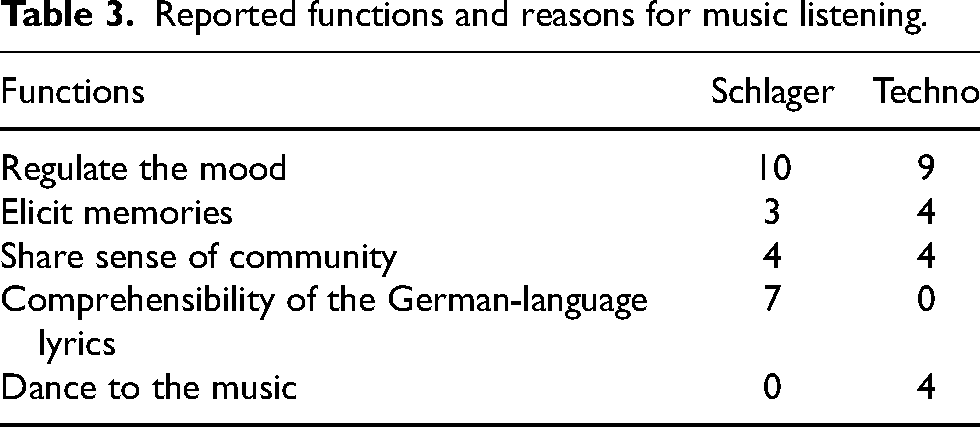
The role of music in facilitating participants in both groups to engage in reminiscing confirmed one of the functions of music, namely, to elicit memories (Chamorro-Premuzic & Furnham, 2007; Greb et al., 2017; Lonsdale & North, 2011; North et al., 2004; Parzer, 2011). Participants also emphasized the “sense of community” and described an inclusive listenership, excluding no-one (“You have this sense of community sharing, like you all love the same thing” (T6)), thereby validating the social component of music listening as a significant factor influencing musical taste (Campbell et al., 2007; Schäfer & Sedlmeier, 2009).
There were both differences and similarities between the two groups in terms of the functions and situations they reported in relation to their musical taste. Schlager listeners expressed a preference for German-language lyrics, while techno music does not have (many) lyrics, and the participants in the group of techno listeners did not mention them. They did, however, highlight the opportunity afforded them by techno music to dance, which in turn was not mentioned by the participants in the group of Schlager listeners (Lonsdale & North, 2011).
Musical Value Judgments
Specification of Musical Taste through Substyles
The participants specified their musical tastes via references to particular substyles and artists. The participants in the group of techno listeners identified a total of 63 preferred and disliked substyles. The range of dislikes ranged from the mild (“I don't like hardcore techno” (T4)) to the strongly aversive (“What I find really bad is hardcore and hardstyle there I could vomit.” (T7)), illustrating verbal articulations of intense dislike (Ackermann & Merrill, 2022). This supports the finding that substyles are effective in differentiating specific musical taste within the style of techno (Parzer, 2011). By contrast, the participants in the group of Schlager listeners identified only three substyles: old, modern, and party Schlager, aligning with the existing literature (Mendívil, 2008).
However, Schlager listeners named more performers (137) than techno listeners (24), indicating that they attach great importance to the artist. This was confirmed by their statements about consciously selecting the concerts they attend based on the artist. Techno listeners place more importance on sub-styles than artists, as confirmed by their reports about focusing on clubs that match their preferred sub-styles.
Emotional Qualities
In line with the findings in relation to the functions of musical taste discussed above, the participants reported that their chief motivation for listening was to experience the emotions evoked by the music; for example, six Schlager listeners highlighted feelings such as, in particular, “happiness” (S8) and a “good mood” (S8). Techno listeners also described a sense of “joy” (T1) and, in addition, the “feeling of community at a party” (T4), which was not mentioned by any Schlager listeners. Furthermore, one participant described himself as being “picky” (T7) in his taste, indicating a selective preference. He was the only participant who reported experiencing aggression when listening to non-preferred substyles or artists, suggesting that being a listener of a style does not necessarily mean liking all its associated substyles or artists.
Compositional Qualities
Lyrics
According to the quantitative ratings, the participants in the group of Schlager listeners prioritized lyrics as the most relevant aspect of their musical taste (Figure 1(a)). When discussing the content of the lyrics, listeners of old and modern Schlager highlighted recurring themes that are “not particularly profound” (S3), predominantly centered around love and portraying a “rose-colored world” (S3). These listeners appreciated emotional engagement with and active participation in the musical experience by singing along, facilitated by the simple, happy-go-lucky nature of the lyrics. Listeners of party Schlager also valued the simplicity of lyrics, finding them suitable for celebrations. Contrary to previous findings (von Appen, 2007), they did not criticize the simplicity of lyrics in party songs. The participants in this group sought lyrics that enhance the overall party atmosphere rather than emotional connection or identification. In connection with the native language of the German-speaking audience, such qualities are highly appreciated because of the absent language barrier (e.g., with English lyrics), which enable active participation in the musical experience, possibly also through the catchy lyrics (Mendívil, 2008).

Network plots of the number of participants who rated (a) the compositional qualities as relevant; (b) the interpretive qualities as relevant; (c) other qualities as relevant.
In contrast, lyrics are of marginal importance or even irrelevant to techno listeners, except for two who reported being attentive to them. This can be attributed to the repetitive nature of the lyrics (“a repetitive word or a phrase” (T6)) if they are present, or the general lack of attention paid to them, with some participants even finding them partially “annoying” (T4) to the listening experience. Given that lyrics are highly regarded in Schlager music due to their function in fostering identification and participation, it can be assumed that other musical qualities fulfill these functions in techno.
Melody
The participants in the group of Schlager listeners rated the melody as relevant to their musical taste, particularly emphasizing the importance of “simple, catchy” (S3) melodies (Figure 1(a)). They emphasized the “symbiosis” (S10) between lyrics and melody, where the melody is responsible for conveying the lyrics: “Without an appealing melody [the lyrics cannot be effectively] conveyed” (S4). In the context of party Schlager, the melody aims to bring a sense of “fun” (S5) and compensates for the lower quality of lyrics in some songs, explaining the relatively lower importance given to lyrical content.
Nine of the 10 participants in the group of techno listeners also rated the melody as relevant (Figure 1(a)) but characterized it in a different way to that described by the Schlager listeners. One professional musician highlighted the value of melody in their line of work. Another participant mentioned being able to differentiate between techno tracks on the basis of their melodies, as the absence of melody would make the songs “sound the same” (T2). A third noted that techno melodies often consist of short, repetitive sequences of notes resembling musical motifs. Some techno substyles rely heavily on rhythmic elements and minimize the presence of melody, leading this participant to consider melodies as not having an “essential” (T4) compositional quality.
Previous research highlighted the significance and particularly the effect (von Appen, 2007) of melody. It is much more important in Schlager, whose listeners value the unity of lyrics and melody (Mendívil, 2008). Yet in the present study, despite von Appen's findings, some techno listeners did engage in music-analytical discussions of melody, going beyond its effect.
Harmony
Our interviews largely confirmed von Appen’s (2007) observation that musical value judgments emphasize harmonic elements to a lesser extent. All but four participants in the group of Schlager listeners either described harmony superficially or rated it irrelevant, as the melody takes precedence over the harmony (see Figure 1(a)). One participant preferred a simple harmonic structure, while the other acknowledged the deliberate use of “purposeful disharmonies” (S4) to support the message conveyed by the lyrics. These two statements supported the findings of previous research on Schlager, assigning harmony a supportive role, subordinate to both the lyrics and the melody (Hess, 1972; Mendívil, 2008; Wicke et al., 2007).
The literature on techno discusses harmony in terms of the layering and sequencing of sounds while denying that techno involves changes of harmony (Jerrentrup, 2008; Volkwein, 2016). Harmony is far from irrelevant to techno, however, as seven participants in the group of techno listeners rated it as relevant to their taste (Figure 1(a)), with those involved in music professionally discussing it in detail. Participants without musical training perceived harmony as marginal to techno music, perhaps because they had insufficient musical knowledge.
Rhythm
Only three participants in the group of Schlager listeners rated rhythm as relevant to their preferred music, and then only in certain situations such as sports, where it has to be suitable for the activity being carried out. The remainder considered it, much like harmony, as “part of everything” (S9), consciously subordinated to melody and lyrics. By contrast, the literature on techno points out that rhythm is crucial for differentiating substyles (Wicke, 2015). This was confirmed by all the participants in the group of techno listeners, who considered rhythm to be the element of the music most relevant to their appreciation, as it is the “heart” and “soul” (T6) of the music (Figure 1(a)). Rhythm underlies the danceability of music, stimulating elevated mood and movement in discotheques and clubs (Jerrentrup, 2008). The tempo of the music must be suitable, however, as dancing is compromised if it is too fast. One participant referred to rhythm as causing them to lose “the sense of time” (T2), which can be understood as an experience of flow associated with altered perception of time (Csikszentmihalyi, 1990). Given the importance of (collective) dancing to listeners of techno, rhythm can be regarded as making a contribution to the participatory function of music.
Interpretive Qualities
Authenticity
Both groups of participants reported that their taste was influenced by the authenticity of the music, which was an important quality of the music interpreted by the listeners (Figure 1(b)). Listeners’ evaluations of performers’ authenticity is based on various factors (Moore, 2002; Weisethaunet & Lindberg, 2010), with a primary focus on personal rather than musical qualities (von Appen, 2007). In the present study, we identified four types of authenticity judgement: (1) comparing artists’ performances of the music and/or words with the feelings conveyed by the songs (these should be congruent, according to Moore, 2002); (2) comparing artists’ performances of the music and/or words with their biographies (these should be congruent, according to Meyers, 2009); (3) assessing artists’ interactions with their listeners (von Appen, 2007); this can give rise, however, to (4) “authentic inauthenticity” (Weisethaunet & Lindberg, 2010), whereby it is more important that the artist's identity is congruent with the aim of the performance (e.g., in party music, but it must enhance the party atmosphere) than their personal biography. This was raised by one of the participants in the group of techno listeners, a DJ who explained that he can really show who he is through his performances.
Voice
While the participants in the group of Schlager listeners rated the performer's voice as relevant to their taste (Figure 1(b)), one of them saying they “pay close attention to the voice” (S2) and others indicating they would not listen to an artist's music if they disliked their voice, they provided limited value judgments or definitions of what they would describe as a good voice. A study on disliked voices in popular music showed that the voice can have a strong influence on musical taste (Merrill & Ackermann, 2023). By contrast, “techno is without singing” (T4), and the voice is either integrated into the composition or used as an instrument (Wicke, 2015). In the present study, some participants in the group of techno listeners were “touched” (T5) by the voice (i.e., liked it); others reported finding it disturbing.
Instrumentation
There appeared to be a consensus among participants in the group of Schlager listeners regarding appropriate instrumentation (Figure 1(b)) such that the use of an orchestra was described as “fantastic” (S4), while guitars were considered reminiscent of rock music and therefore inappropriate. This underlines the traditional nature of Schlager, which has undergone minimal changes over time (Von Schoenebeck, 2018; Wicke, 2021; Wicke et al., 2007). By contrast, participants in the group of techno listeners liked the use of instruments “that are not common to techno” (T6), particularly acoustic instruments, and analog synthesizers because they produce “warmer [and] more aesthetically pleasing” (T4) sounds. The difference between the views of the two groups of listeners can be attributed to the relative novelty of techno, which is currently undergoing significant developments, allowing performers more choices in relation to instrumentation.
Production
Six of the participants in the group of Schlager listeners rated production quality relevant to their taste (Figure 1(b)), but listeners of old Schlager expressed a preference for “handmade [over computer-generated] electronic” (S3) songs and concerns about the poor sound quality of songs by lesser-known artists, in comparison with those produced by major record labels. It can therefore be inferred that high-quality production enhances the overall listening experience for the participating listeners of old Schlager. Yet half of the participants in the group of techno listeners rated production as a marginal criterion, suggesting that listeners may not discern the difference between well-produced and poorly produced tracks. Three did, however, rate production quality relevant to their taste (Figure 1(b)), reporting that they do pay attention to qualitative differences between tracks. The participants professionally involved in music production as a DJ and producer observed, for example, that “mistakes” are more apparent in techno than in pop music because of the latter's “very minimal sounds” (T6).
Other Qualities
Complexity and Simplicity
The extent to which participants in the group of Schlager listeners preferred the music to be complex or simple was mood-dependent or situation-dependent, varying from one substyle to another. Listeners of party Schlager valued simple compositions promoting high levels of participation. Listeners of old and modern Schlager preferred the music to be more complex. The group of techno listeners displayed a mixed range of opinions, with 5 out of 10 participants rating complexity as relevant (Figure 1(c)). They acknowledged the repetitive nature of techno, which non-listeners may find monotonous, while highlighting its “very variable” (T5) substyles. Those who preferred simplicity attributed their preference to the prevalence of drug use in the techno scene, while those who said they enjoyed partying sober preferred more complex music. According to the DJ participant, however, complex songs might be “exhausting” and “difficult” (T4) for the audience. Overall, listeners like what they perceive as simplicity in the music, particularly in the context of parties, but prefer complexity when they are focusing on the music rather than the situation.
Longevity, Timelessness, Novelty
Both groups of participants claimed that the longevity, timelessness, and novelty of their preferred music was relevant to if not decisive for their taste (Figure 1(c)). Schlager listeners, in particular, distinguished between longevity and timelessness. They described older songs that transport them “back in time” (S3) in terms of longevity but not timelessness, as their themes are rarely aligned with the present “zeitgeist” (S3). This implies that while these songs have stood the test of time, their themes or messages may not universally resonate across different eras in a timeless manner (“Longevity, n.”, 2023; “Timelessness, n.”, 2023). Nevertheless, such songs have the function of eliciting memories (Chamorro-Premuzic & Furnham, 2007; Greb et al., 2017; Lonsdale & North, 2011; Parzer, 2011). Participants in the group of Schlager listeners referred to novelty in relation to current songs, enjoying those oriented to other styles such as pop music but criticizing imitations of older songs. According to techno listeners, novelty is required if tracks are to be differentiated from each other, but the traditions of techno must be preserved and excessive commercialization resisted. The participant who was a producer observed that techno is composed of combinations of recurring motifs, which limits the possibility of complete novelty and justifies the use of existing material, as the style evolves and develops.
Negative Reactions
Social Environment
Participants in both groups described social environments in which their taste was accepted to varying degrees. Some Schlager listeners reported experiences of not being “accepted” (S2), particularly in childhood, while others reported broader acceptance such that they are “no longer laughed at today” (S3). Participants in both groups also referred to other people in their social environment who shared, and who had often influenced, their taste for Schlager or techno. Some participants mentioned local “bubbles” (T3), where they interact with fellow listeners in supportive, albeit exclusive, communities.
Negative Reactions and Their Possible Explanations
All the participants in both groups put forward explanations of other people's dislike for their preferred music, identifying 11 reasons (Figure 2), including preference for another style. Schlager listeners said that some people simply do not like German music and “English music is more popular among younger people” (S3); they also attributed dislike for Schlager to the simplicity of its lyrics. This finding reflects the relation identified by Mendívil (2008) between the musical characteristics both preferred by Schlager listeners and criticized by non-listeners, including simplicity and catchy lyrics. Thus Schlager listeners appear to believe that the same features of the music explain both their preference and others’ dislike. The negative reactions of others were explained by techno listeners in the same way: they derive pleasure from the “steady beat” (T5), while non-listeners are thought to find it “exhausting” (T5).
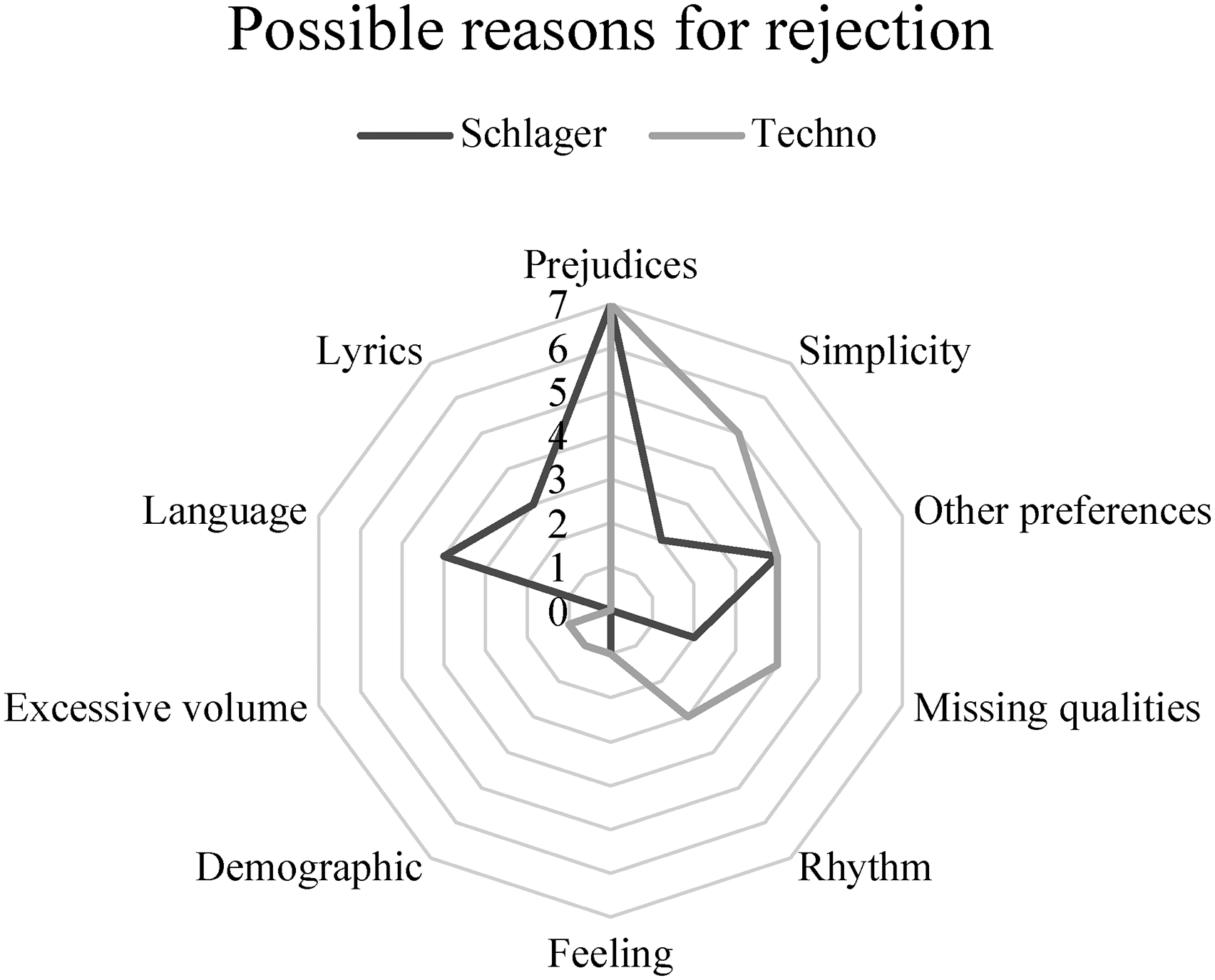
Network plots of the number of participants who rated the following qualities as possible reasons for rejecting the style.
Both groups of participants attributed dislike for their music to social prejudice; for example, party Schlager may be notorious because of its association with the “Ballermann” party strip in Mallorca (an island in the Mediterranean), and both old and modern Schlager may be judged as “old-fashioned” (S5) because they are associated with an older audience. Techno listeners explained others’ dislike by reference to simplicity, monotony, repetition, and the absence of words and singing. Both groups of participants referred, in addition, to negative emotional responses while listening and the desire for distinction from others. Techno listeners mentioned the demographic characteristics of listeners and the excessive loudness of the music. The explanations put forward by the participants support the findings of previous research on musical dislikes, which indicated that the key factors underlying dislike are excessive simplicity, insufficient quality, and uniformity (Merrill et al., 2023; Woodward & Emmison, 2001). It is worth noting that, in both groups, the participants believed others disliked their music due to features they themselves enjoyed. Specifically, in the case of Schlager, participants cited characteristics as reasons for dislike that non-listeners also mentioned in existing literature (Mendívil, 2008).
Notably, participants from both groups remained overall neutral regarding potential social reasons for rejection, and mainly drew on music-related factors causing a potential dislike of the music. The participants seemed to view the rejection of their music as less personal than feature-related. The social function of music, in the form of its acceptance by the in-group, seems more important to listeners than its rejection by the out-group.
As this study did not explore socio-psychological dynamics of in-group and out-group relationships or identity formation, the need for separate research focusing on young individuals integrating music into their identity formation process is suggested.
Conclusion and Outlook
This study contributes to research on musical taste by adopting a style-specific approach. By investigating two very different musical styles and their substyles, both similarities and differences between the functions and value judgments could be identified. This study lays out specifics of musical taste that can be the basis for mapping out musical taste in more detail than before.
Our findings align with prior research on the formation of musical taste, indicating age and social environment as primary influencing factors. However, through the style-specific approach, differences emerged. Notably, Schlager listeners were more influenced by close others such that they adapted their listening habits to align more closely with their partners. In contrast, techno listeners showed a stronger inclination toward peer-group influence during their formative years. Moreover, our study underscores the impact of specific musical experiences on the development of musical taste, emphasizing the need to explore key musical experiences in the future.
The methodology employed in our study illuminates that musical taste differentiation extends beyond styles and includes substyles as well as artists. Our findings, exemplified by the case of Schlager, suggest that artists themselves can wield a significant influence on such differentiation. Consequently, future research should not only explore variations in taste associated with styles and substyles but should also study distinctions and similarities in preferences for individual artists, or even specific songs within a given musical style.
Our research uncovered that Schlager and techno share similar social functions despite being evaluated differently based on the music and the performance. The findings indicate a contrast between the significance of German lyrics in Schlager and the rhythm-centric nature of techno. However, both these aspects fulfill crucial social functions for the participants in our study.
Exploring potential reasons for a negative reaction toward each considered style initially confirms known reasons from existing studies on disliked music. However, our study examines the listeners’ understanding of rejection by others, revealing that the attributes appreciated by listeners are assumed to be the reasons for others disliking the music. We note that the interpretation of the findings would benefit from more theoretical, musicological analyses of techno, as techno has less existing literature compared to Schlager music, leading to a less objective discussion and greater reliance on participant statements for interpretation.
Overall, the interplay between object-related judgments, the functions of music listening, and other value judgments varies depending on style and substyle, suggesting that differences between them account for the variability observed in previous quantitative research on musical taste. As we limited our study to only two styles that were chosen because of their pronounced differences, future research needs to explore how the results apply to styles with greater musical similarity as well as a wider range of styles, and perhaps even individual artists and songs. The goal would be the development of style-specific taste maps that could be used to deepen our understanding of the intricate relationships between musical taste and different musical styles.
Supplemental Material
sj-docx-1-mns-10.1177_20592043241268726 - Supplemental material for Schlager vs. Techno: Style-Specific Rationales for Musical Taste
Supplemental material, sj-docx-1-mns-10.1177_20592043241268726 for Schlager vs. Techno: Style-Specific Rationales for Musical Taste by Emily Gernandt and Julia Merrill in Music & Science
Supplemental Material
sj-docx-2-mns-10.1177_20592043241268726 - Supplemental material for Schlager vs. Techno: Style-Specific Rationales for Musical Taste
Supplemental material, sj-docx-2-mns-10.1177_20592043241268726 for Schlager vs. Techno: Style-Specific Rationales for Musical Taste by Emily Gernandt and Julia Merrill in Music & Science
Footnotes
Authors’ Contributions
EG and JM conceptualized the research; EG did the investigation and performed the analysis; EG and JM wrote the article.
Action Editor
Kelly Jakubowski, Durham University, Department of Music.
Peer Review
Alinka Greasley, University of Leeds, School of Music Jonathan Tang, University of Sheffield, Faculty of Arts and Humanities.
Declaration of Conflicting Interests
The authors declared no potential conflicts of interest with respect to the research, authorship, and/or publication of this article.
Ethics Approval Statement
All experimental procedures were approved by the Ethics Council of the Max Planck Society (No 2702–12) and were undertaken with the written informed consent of each participant.
Funding
The authors received no financial support for the research, authorship, and/or publication of this article.

Data Availability Statement
Data sharing not applicable to this article as no datasets were generated or analyzed during the current study.
Supplemental Material
Supplemental material for this article is available online.
References
Supplementary Material
Please find the following supplemental material available below.
For Open Access articles published under a Creative Commons License, all supplemental material carries the same license as the article it is associated with.
For non-Open Access articles published, all supplemental material carries a non-exclusive license, and permission requests for re-use of supplemental material or any part of supplemental material shall be sent directly to the copyright owner as specified in the copyright notice associated with the article.
