



Abstract
While the positive effects of music listening have received much attention, insights into the negative effects are rare, such as the experience of boredom. In two consecutive online surveys using qualitative (N = 266) and quantitative methods (N = 719), participants were asked to retrospectively report their experience of boredom while listening to music. The experience of boredom depends on a combination of factors, such as musical features or styles combined with a certain situation, or the dislike of that music. Boredom is also accompanied by feelings of high and low arousal such as annoyance, anger, fatigue, and listlessness. Notably, boredom in the context of music does not only refer to an emotional state but is also used as a disparaging judgment of music. The associated musical features of “boring” music, such as repetition and monotony, go along with a perceived simplicity and uniformity in specific musical styles (e.g., German schlager, pop, EDM, or rap). Overall, the prevalence of boredom during music listening was low in the current sample, where 77% never or rarely experience boredom, but 46% report experiencing it moderately to very severely when it occurs. Participants with higher musical perceptual abilities report experiencing boredom more frequently and intensely, while a higher active engagement with music and higher agreeableness seem to prevent one from “musical” boredom. The results align with typical aspects of general boredom and contribute to the understanding of the variety of factors that compose an averse form of an aesthetic experience with music.
Keywords
Introduction
A variety of feelings and reactions can occur when a person listens to music. While the positive effects of music listening have been studied quite well, studying negative effects has only recently gained more interest (Ackermann & Merrill, 2022; Merrill et al., 2023; Peltola & Vuoskoski, 2021). One of the reported “negative” effects when perceiving art is boredom (Coutinho & Scherer, 2017; Schindler et al., 2017), which is probably an often-occurring emotional state when engaging with art—or when disengaging from art. The current study set out to investigate the prevalence and situations of boredom occurring while listening to music. As coping with boredom is one function of music listening (Greb et al., 2018), the question arises what happens if music cannot fulfill this function anymore.
The Construct of Boredom in Psychology
Boredom is a common experience (Farmer & Sundberg, 1986), with some research estimating that between 18 and 50% of the population often feels bored (Eastwood et al., 2007; Klapp, 1986), and even 91% of respondents of a survey with North American youths reported to experience boredom (Eastwood et al., 2012). In light of this prevalence and the longstanding, historical interest in boredom and research on boredom (Van Tilburg & Igou, 2017), it seems surprising that a unified definition of boredom is still pending. Boredom has primarily been described as an overall negative experience, e.g., “as the aversive experience of having an unfulfilled desire to be engaged in satisfying activity” (Fahlman et al., 2013). This experience is often coupled with perceived monotony and repetition (Geiwitz, 1966; Hill & Perkins, 1985; O’Hanlon, 1981). Some common themes among the definitions of boredom include the stimulus to convey insufficient meaning to the appreciator, the perception of time passing slowly, and the pairing of low arousal with dissatisfaction. Further, boredom was reported to arise in an understimulating and, notably, an overstimulating environment, providing insufficient challenge or over-challenge (Vogel-Walcutt et al., 2012).
Boredom can occur in many situations, such as at work or school, but also at home during leisure time. The context, in which boredom is experienced, largely affects how well one can cope with boredom (Hamilton et al., 1984; Iso-Ahola & Weissinger, 1990), and how many options there are to escape the situation. It is commonly accepted to understand boredom as “the feedback to engage in a different task” (Fahlman et al., 2013), which indicates that boredom has an important function. As pointed out by Elpidorou, boredom has many positive aspects (“the bright side of boredom,” Elpidorou, 2014, and “the good of boredom,” Elpidorou, 2018a), presenting a regulatory theory of boredom (Elpidorou, 2018b).
Boredom has been described as a functional emotional state (Bench & Lench, 2013) and an emotion in its own right (Van Tilburg & Igou, 2012). There is a debate about how many dimensions the construct of boredom includes and how it overlaps with or separates from other emotions. Van Tilburg & Igou (2012) show a connection with feeling restless and unchallenged, and the situation serving no important purpose, and that boredom separates from further negative emotions such as sadness, anger, and frustration (Van Tilburg & Igou, 2017). Besides these aspects, assessments of state boredom comprise a range of factors and items. The Multidimensional State Boredom Scale (MSBS; Fahlman et al., 2013) consists of five dimensions that describe general boredom, that is, disengagement (e.g., being stuck in a situation that feels irrelevant, everything seems repetitive and routine), high arousal (feeling irritated, moody, agitated, impatient, annoyed), low arousal (feeling lonely, down, empty), inattention (to be easily distracted, it is difficult to focus one's attention), and time perception (time is passing slower than usual). With the MSBS, it was also demonstrated that state boredom occurs in response to both understimulating and overstimulating stimuli (here, either videos on beginner language instruction or computer graphics; Fahlman et al., 2013). A distinctive aspect of the MSBS is the inclusion of a high arousal factor (see also, Merrifield & Danckert, 2014), which is under debate in the context of boredom, being generally depicted as a state of low arousal.
Various explanations have been offered for the diverging unpleasant emotions from low arousal states during the experience of boredom. Vogel-Walcutt et al. (2012) propose that during state boredom, a (subjective) “psychological state” of dissatisfaction, frustration, or negativity is supposed to co-occur with a “neurological state” of (objective) low arousal during uninteresting, monotonous, or repetitive tasks/stimuli (the causal direction remains unclear). Bench & Lench (2013) propose that boredom occurs as the intensity of emotional responses fades during goal pursuit, acting as “an emotional signal that new goals should be actively selected and pursued.” For example, in case a goal is (temporarily) blocked, anger (high arousal) can occur, but as soon as this emotion fades, the feeling of boredom signals to move on to new goals. While Bench & Lench (2013) therefore suggest two alternating distinct emotions, a dynamic of boredom was proposed by Mills & Christoff (2018), where boredom might involve “both high (e.g., during escape attempts) and low (e.g., giving up or successfully escaping) arousal.” Similar interpretations come from Danckert et al. (2018), showing both sleepiness and restlessness occurring during reading boring texts under certain conditions. Hence, unpleasant emotions and low arousal might also depend on situational factors and might change over time (Eastwood et al., 2012). In an educational context, “unpleasant emotions” occurred during a task perceived as meaningless and preferring a different one, or when being confined to restrictive circumstances and having little power or control over it. “Low arousal” occurred in the context of dealing with abstract concepts or tasks, repetitive or monotonous tasks, tasks devoid of excitement, inappropriate difficulty level, and tasks lacking clear goals or focus (Vogel-Walcutt et al., 2012). Towards a solution for this discussion, Elpidorou (2021) argues that boredom does not necessarily require a specific kind of arousal. He proposes that the functional account of boredom (to engage in more satisfying activity) defines the characteristics of boredom and not specific features. Still, psychological research is particularly focused on these characteristics that trigger the aforementioned wish for change. The characteristics of boredom (and its development over time) should at least depend on the perceived features of a stimulus or task, the context in which boredom occurs, and the predisposition of the listener.
Notably, how susceptible people are to boredom was shown not only to be dependent on the situational context but also on certain traits. People lower in trait boredom or boredom proneness (which describes the tendency for individuals to experience boredom) can better cope with state boredom, have a higher ability to restructure their perception and change participation in boring activities, and/or maximize the opportunities for intrinsic enjoyment. Trait (and state) boredom were shown to be positively associated with negative affect, e.g., depression, anger and aggression, apathy, anxiety, and personality dimensions such as neuroticism and impulsivity, while negatively associated with conscientiousness, extraversion, agreeableness, and openness to experience (Culp, 2006; Fahlman et al., 2013; Vodanovich & Watt, 2016).
To conclude, the definition of boredom in psychology and the constitutive dimensions and its uniqueness in comparison to other emotional states is a matter of debate. The most consistent findings include a context, situation, or stimulus that is perceived as monotonous and repetitious as well as overstimulating or understimulating. The involvement of a high arousal dimension has been met with differing opinions. Nevertheless, understanding boredom as a functional emotion with different phases, high as well as low arousal phases can be expected. The next question is, how boredom relates to music listening. As there is no doubt that boredom can be experienced during music listening and music can be judged as “boring,” the exact relationship needs empirical investigation. Music seems a perfect stimulus to further investigate boredom as it evokes a large variety of feelings, provokes aesthetic judgments, and can be perceived as overstimulating (from heavy metal to contemporary classical music) and understimulating (from light pop to country).
Boredom in Art and as an Aesthetic Emotion
Boredom is part of assessments of the aesthetic experience, that is aesthetic emotions such as “I was bored” (Schindler et al., 2017), and music-evoked emotions such as the feeling of “indifferent/bored” (Coutinho & Scherer, 2017). In the context of disliked music, finding music boring was a reason for disliking it (Ackermann & Merrill, 2022). Therefore, boredom ranges in the context of art/musical judgments, emotions, and feelings, but its specific role in response to art has not been further investigated (Elpidorou, 2017; Moller, 2014). Of course, there is no such thing as “boring music,” as this judgment lies in the eyes of the beholder. Still, which features are ascribed to music perceived as boring and which emotions are associated with it, needs investigation.
One fascinating aspect of boredom in art is the use of “boring” as a disparaging judgment, which can reflect on the listener. Moller (2014) describes that the judgment of finding art boring and even uttering this judgment might make others think that the person is missing some understanding because of missing knowledge or education. Further, it may also devalue the artist, who is not able to create something interesting, perhaps being dull and boring, not having better ideas than what was produced. Hence, boredom as an aesthetic judgment seems to play a role in social distinction and identification processes through music, which depends on who finds what boring and if this judgment really disqualifies the piece or rather the judge. Presumably, this might particularly apply to so-called high culture (as opposed to popular culture; e.g., Adorno, 1938) such as classical music. Indeed, there is no item on boredom in the Geneva Emotion Music Scale (GEMS; Zentner et al., 2008), which was created in the context of classical music. Maybe, finding something boring and admitting to it, is not accepted—either to oneself or to others.
Boredom is also considered as counteracting flow and absorption (Vroegh, 2019) and might prevent a fulfilling engagement with art (Menninghaus et al., 2017b). Notably, boredom is not included in the Distancing-Embracing model by Menninghaus et al. (2017b). This was criticized by Elpidorou (2017) for not acknowledging the possible positive outcome of boredom (based on his regulatory theory), but Menninghaus et al. (2017a) opposed that this would still not lead to an inherently rewarding emotional episode (p. 48). They also pose that boredom is a less likely experience in response to art because of the dynamic change and emotional variety of positive and negative emotions leading to a more engaging, livelier, and richer experience (p. 47). To investigate this hypothesis, one would need to compare the prevalence of boredom during art perception with the prevalence of boredom in other everyday activities. A more feasible approach, though, is to investigate the prevalence of boredom within the context of, for example, music listening. Here, the dynamic changes are inherent to the stimulus itself and the perception of boredom is still context-dependent. For example, the regulatory function of boredom can only fully “work” if the listener has the power to change the music or to leave the situation, which is not (without loss or embarrassment; see Moller, 2014), for example, possible in a classical concert. Hence, the possibility to get bored, even in the context of music listening, is dependent on the situation in which music listening happens.
The experience of boredom was shown not only to depend on the situation but also on personality traits, which was likewise shown for the experience of music. Musical sophistication can be measured with the Gold-MSI (Müllensiefen et al., 2014), a self-assessment of musical sophistication, e.g., active engagement with music, musical perceptual abilities, and emotion perception in music. Aesthetics (a facet of Openness to Experience) was the strongest predictor of musical sophistication (the facet Ideas was negatively associated), followed by Assertiveness and Activity (facets of Extraversion), Altruism (facet of Agreeableness), and Depression (facet of Neuroticism; Greenberg et al., 2015). In sum, while depression was shown to only be a weak indicator of musical sophistication, it was a strong one of trait boredom, and while Openness was a strong predictor of musical sophistication, it was negatively associated with trait boredom. Extraversion and Agreeableness were negatively associated with boredom and (at least some facets) positively with musical sophistication. Because of the particular role that Neuroticism plays in boredom and Openness plays in musical sophistication, these personality dimensions seem to be of particular interest when investigating music-related boredom.
So far, the literature seems to suggest that when boredom occurs, no goal-relevant response linked to the aesthetic experience can be achieved. Still, boredom can be an inherent part of the aesthetic experience, purely by its existence and people reporting about it (Elpidorou, 2017). One can also assume that moments of engagement with music can alternate with moments of disengagement because it can be questioned whether people can fully engage with music in a one to three-hour concert. Further, music listening is a coping strategy for boredom (Greb et al., 2018), but no research has shown what happens if music as a coping strategy does not work (anymore). Taken together, boredom is a common experience during music listening and part of the aesthetic experience—even though it might indicate a failed aesthetic experience.
The Present Investigation
Even where music is not explicitly judged by its artistic quality, it is meant to be engaging, moving, interesting, or stimulating by fulfilling certain functions. Hence, people have certain expectations of music and the present study investigates what happens if these expectations are not met. One of the functions of music listening is coping with boredom, but what it means to be bored in the context of music listening or what boring music is supposed to be, needs investigation. The first aim of the current study was to investigate the conditions under which boredom occurs when listening to music (context, circumstances, situations), the feelings and emotions that occur, how people react under these conditions, and what they do if the music does not work as a coping strategy for boredom. Further, the features and reference points (e.g., the musical style, the lyrics) of boring music were investigated to define what people describe and perceive as “boring music” and which reasons people present for finding specific musical styles boring. A second aim was to investigate the frequency and intensity of experiencing boredom in the context of music listening and how these relate to personality traits and musical sophistication. To do so, two online surveys were conducted, the first focusing on free descriptions of boredom in the context of music listening using qualitative methods, and the second validating those findings with a larger group of participants, taking a quantitative approach.
Methods
Study 1
Participants
The open-ended questions were answered by 266 participants (41% female, 36.5% male, 0.8% non-binary, 21.8% not stated) with a mean age of 31.7 years (SD = 13.2). Of the sample, 31.8% had the German Abitur (A-levels) as the highest degree, 10.9% a Bachelor's degree, 10.1% a Master's degree, and 9.0% a high school diploma (after 9 and 10 years of school), 33.7% not stated. 37.8% were students, 27.0% were employed or self-employed, 34.1% not stated. Note that participants were not required to answer all questions about their demographics. Participants were included in the analyses who answered all open questions, even if the demographic data were not provided at the end of the survey.
Procedure
In both studies, participants provided written informed consent by checking a box that they accept the data collection and usage as described, i.e., data collection was anonymous and data usage was for scientific purposes only.
Participants were asked to “Please report on situations, in which you experience/have experienced boredom while listening to music. (Context, location/surroundings, in a community or alone, kind of music, duration, etc., please use keywords.)” This open-ended question was aimed at personal and general experiences. On the subsequent page, the participants were asked “Which feelings/emotions did the feeling of boredom while music listening in the above-described situation(s) evoke in you?” and on the following page “How did you react in the above-described situation(s)?” This was to emphasize the report of other feelings and reactions associated with the situation. The next question on the subsequent page focused on the music itself: “What defines boring music for you?” The study was conducted in German and the questions were translated into English for this report.
Finally, demographic data were acquired such as age, gender, highest school degree, and profession. The study took about 15 min and included further questionnaires which were not of further interest as they overlap with Study 2. Studies were run with LimeSurvey and advertised via social media platforms such as Facebook.
Study 2
Participants
The second online survey was completed by 719 participants (50.5% female, 49.4% male, 0.006% non-binary) with a mean age of 41.7 years (SD = 13.5). 28.1% had as the highest degree a German Abitur (A-levels), 17.1% a Bachelor's, 36.3% a Master's degree, 6.8% a Ph.D./M.D., 10.4% a high school diploma (after 9 and 10 years of school). Full-time employed were 39.8%, part-time 14.9%, self-employed 12.3%, students/trainees 19.5%, unemployed/not working 5.8%, retired 3.3%, other 4.0%.
Procedure
After questions on demographics, three questions were asked about the general experience of boredom while music listening: “How often do you experience boredom when listening to music?” on a 7-point scale from never (1) to always (7). “How strongly do you experience boredom when listening to music?” on a 7-point scale from not at all (1) to very strongly (7). “How often do you use music to cope with boredom?” on a 7-point scale from never (1) to always (7). If participants said they never experienced boredom, the following questions on the circumstances were skipped.
Twenty items were created based on the findings in Study 1 that describe the variety of situations and contexts in which participants reported experiencing boredom while listening to music. Participants rated each one based on the frequency they experience it on a 7-point scale from never (1) to always (7) (Fig. S1 and Table S1 in supplementary materials).
A list of 14 musical styles was presented (metal, techno, German schlager, German traditional music, pop, rap/hip hop, classical, rock, jazz, electronic dance music (EDM), house, reggae, country, blues; Merrill et al., 2023; schlager is literally defined as “hits”; originally, the German word for all popular music, now a specific style of German pop, partly mixed with traditional music with mainly German lyrics, which has its historical traditions, social networks, and market segments; Mendívil, 2008) and each one was rated according to how interesting or boring the participant found them on a 7-point scale from very interesting (1) to very boring (7) (Fig. S2 and Table S2 in supplementary materials). Based on these ratings, one style was chosen for further investigation that was found very boring and one that was found slightly boring. The selection criteria were as follows. A cut-off for both conditions was at 4 (i.e., the neutral point of the Likert scale). For each participant, the style with the highest rating was chosen for the very boring style (e.g., rating 7), and the style with the lowest rating was chosen for the slightly boring style (e.g., rating 5). If more than one style had the highest/lowest ratings, the style was randomly chosen by the presentation software (LimeSurvey), for example, two or more styles with a rating 7. If no style was rated higher than 4, none was selected as the highest boring style, and respectively for the slightly boring style. Data from four participants were excluded as no data for a very and a slightly boring style could be collected.
Next, the participants were presented first with the “strongly” boring style and then with the “slightly” boring style. To affirm the previous ratings, participants were asked to rate how boring the musical style was on a 7-point scale from slightly boring (1) to very boring (7). Then, 16 reasons for finding music boring were presented and rated on a 5-point scale from does not apply (1) to applies (5) (Fig. S3 in supplementary materials).
To collect data on trait aspects and musical experience, three factors from the Goldsmith Musical Sophistication Index (Gold-MSI; Müllensiefen et al., 2014) were used, that is self-reports about the Active Engagement with music (i.e., listening to music, reading about music), perceived Perceptual Abilities (i.e., cognitive musical ability and listening skills), and Emotion perception (i.e., emotional responses to music that describe active behavior). The BFI-10 was used to measure personality traits including item no 11, which is a third item on Agreeableness which enhances reliability (Rammstedt et al., 2013). Data from both studies are provided as supplementary material.
Analysis
Qualitative Text Analysis
In Study 1, each question was separately analyzed using Qualitative Text Analysis (Kuckartz, 2014), knowing that this would lead to overlapping codes between questions. A first coder went through the answers and created categories inductively out of the material. A second coder then independently coded parts of the data by using the categories created by the first coder. Results were compared and changes were applied to the category system where necessary so that a consensus was reached across the two coders.
Principal Component and Factor Analysis
To analyze the structure of the conditions in Study 2, the 20 items were subjected to a principal component analysis (PCA) with oblimin rotation using the principal() function from the psych package, performed using R statistics version 3.5.1. The number of components was determined with a parallel analysis.
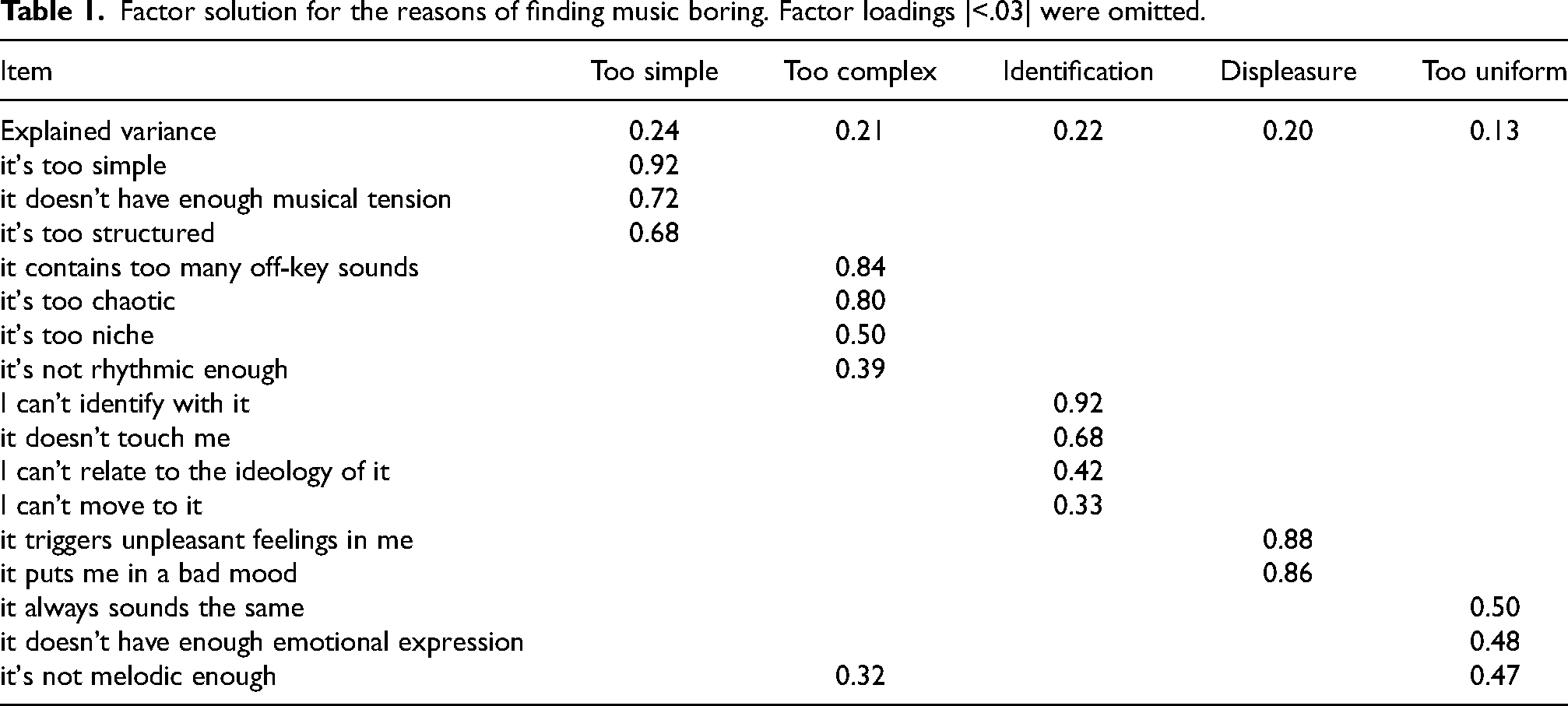
The 16 reasons for finding music boring were subjected to a factor analysis using the fa() function, again with oblimin rotation and with the number of factors determined with a parallel analysis. Five factors emerged from the reasons and, based on the factor scores, were used as latent variables in the following statistical models: Factor (1) Too Simple describes simplicity and deficiency in the music, (2) Too Complex describes music being too disharmonic, chaotic, special, and rhythmic, (3) Identification describes reasons related to identification and a missing impact, (4) Displeasure, and (5) Too Uniform describes uniformity and missing variety (Table 1).
Factor solution for the reasons of finding music boring. Factor loadings |<.03| were omitted.
The musical styles were also subjected to a factor analysis and four factors were chosen in correspondence to the STOMP and the MUSIC model (Rentfrow et al., 2011; Rentfrow & Gosling, 2003): Rhythmic (house, EDM, techno, rap), Sophisticated (jazz, blues, classical, reggae), Intense (rock, metal), and Unpretentious (German schlager, German traditional music, country, pop; Table 2).
Factor solution of musical styles.

Statistical Models
In Study 2, for each factor of reasons for finding music boring one linear mixed-effects model was fitted with the four musical style factors and degree as fixed effects and participant as random intercept. Additionally, each of these models was fitted with style (that is all 14 styles) and degree as fixed effects and participant as random intercept, which allowed for a more fine-grained picture of specific styles.
Results
Study 1
Each open-ended question was separately analyzed, leading to four aspects being presented in the following: context, feelings, reactions and coping strategies, and features and reference points of “boring” music.
Context
Four categories emerged from the analysis regarding the context in which boredom occurs while listening to music. These categories are the following: the music itself (with seven subcategories), certain locations (six subcategories), situations (four subcategories), and pre-existing aesthetic judgments (four subcategories). In detail, boredom is experienced in the context of certain musical styles, the music selection of a radio broadcaster, certain musical features, and if certain music is heard too often (Figure 1). Related to locations, participants report feeling bored while listening to music in the car, while traveling by bus or train, while somewhere else listening to music in the background, and at locations where music is played (concerts, bars, etc.). Related to the situation, participants feel bored when listening to music alone, when engaged in focused listening, during collective music listening, and when others choose the music. Aesthetic judgments also play a role when feeling bored, e.g., if the music is already disliked, if it does not fit the mood, or does not meet certain expectations. More generally, people get bored if the music or the respective situation is going on for too long (n = 30, not depicted; a full report and all numbers of quotes can be found in supplementary materials).
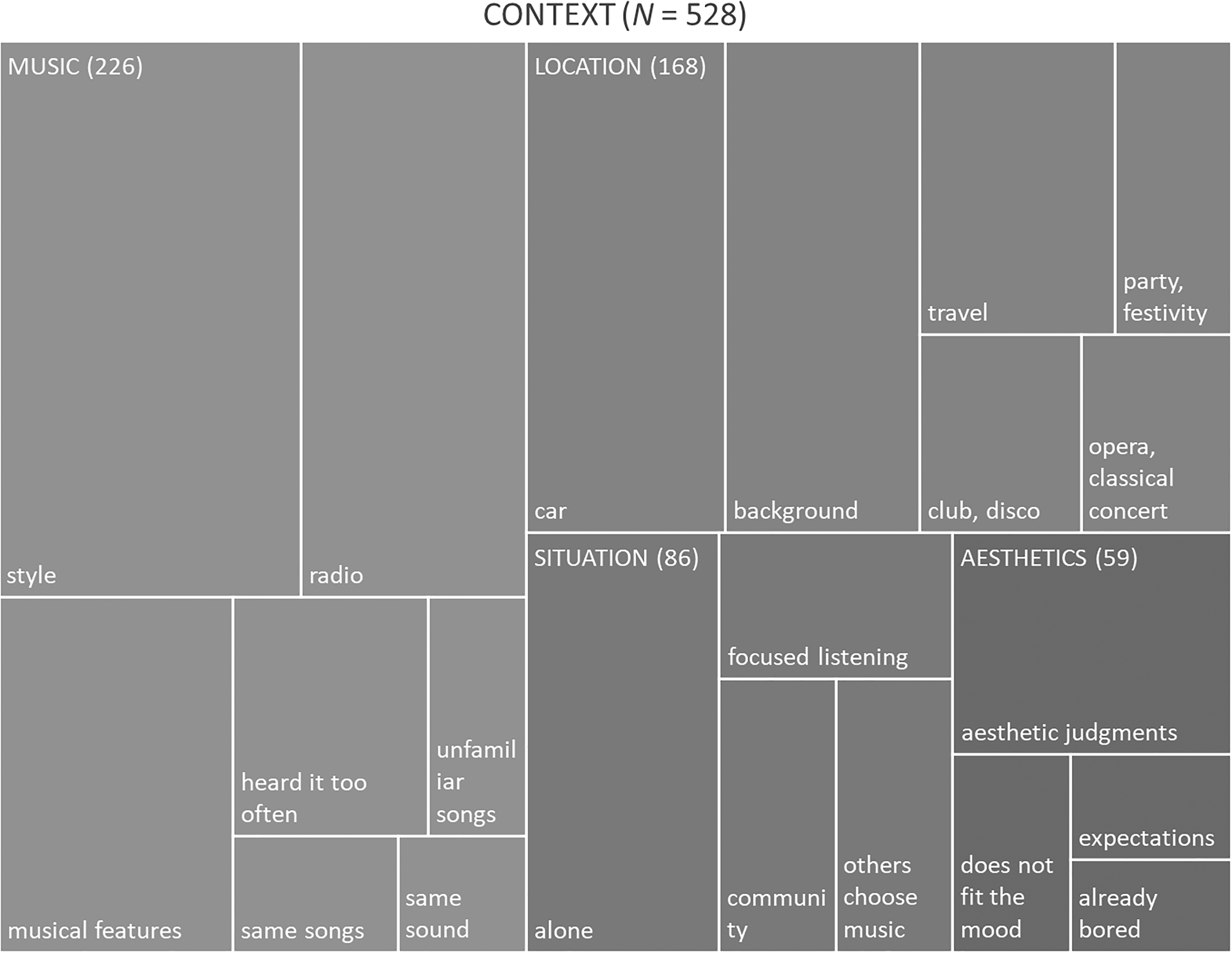
The context in which boredom is experienced while listening to music. Treemap of categories with numbers of quotes. Primary categories are in capitals, subcategories are in lower case.
Feelings
From the reported feelings, three categories referred to high arousal (with seven subcategories), low arousal emotions (five subcategories), and neutral and positive feelings (six subcategories, not depicted). High arousal emotions included annoyance, anger (rage, aggression), restlessness and nervousness, frustration, pain (in the ears) and disgust, and aversion (Figure 2). Low arousal feelings included fatigue (being tired), dissatisfaction and malaise (bad mood), depression and demotivation, listlessness, disinterest and indifference, sadness and melancholy. There are also neutral and positive evaluations, such as relaxed and calming down, “nothing is triggered,” curiosity and happiness, which relate to the feeling of being bored as a positive state of not having to do anything. Participants also report feelings related to escaping the situation (n = 21), which is reported in the section “reactions.”

Treemap of feelings emerging when listening to music perceived as boring (with numbers of quotes). Primary categories are in capitals, subcategories are in lower case.
Reactions and Coping Strategies
Two categories emerged from the analysis. The first category (with three subcategories) describes possibilities to escape and coping strategies, that is, listening to different music, escaping and turning off, or suggesting different music (Figure 3). The second category (three subcategories) comprises reactions when escaping is not an option, that is, distraction and engaging in other activity, suffering through and having patience, or ignoring the music. Hence, the reactions to feeling bored and the coping strategies depend on the possibilities afforded by the situation.
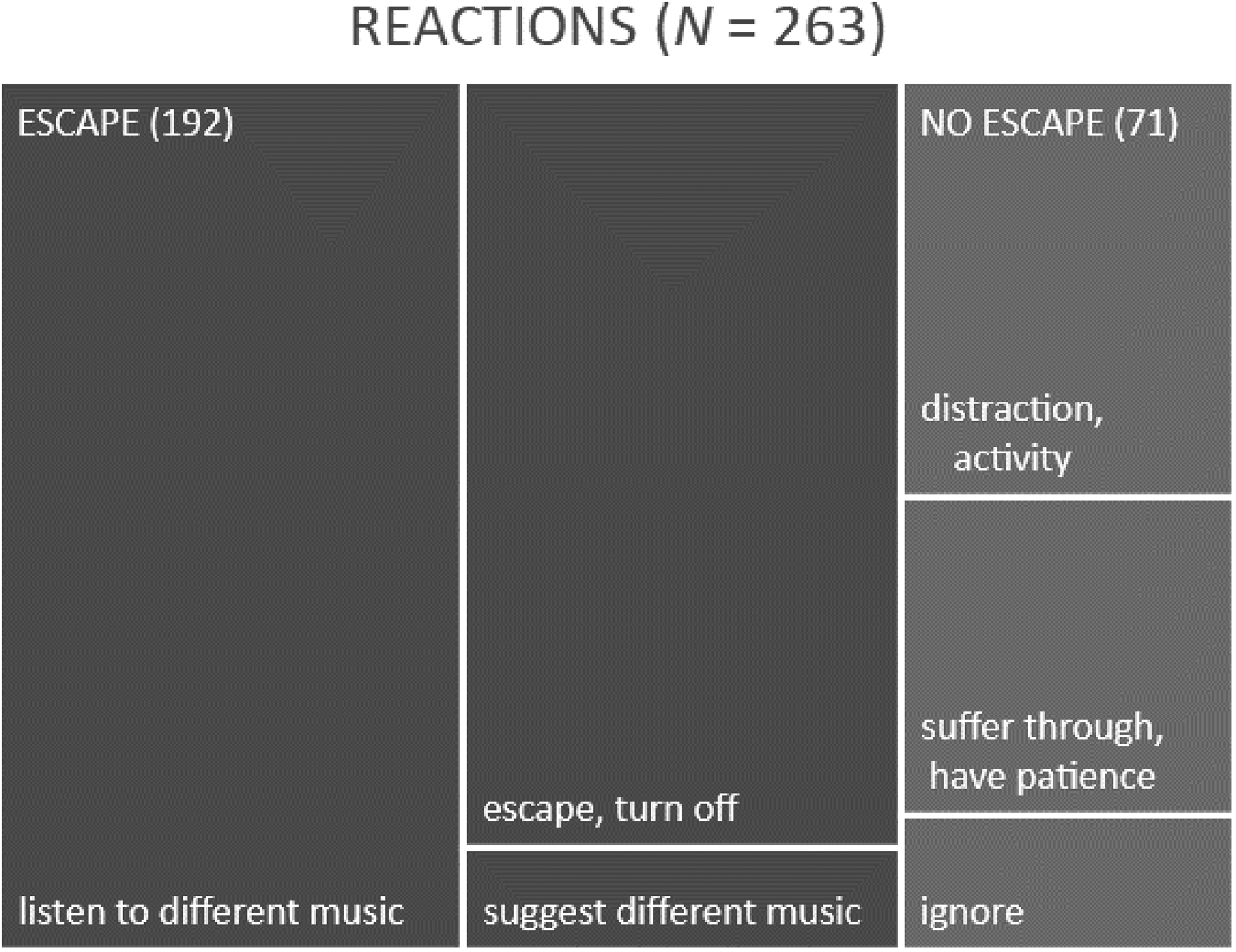
Treemap of reactions and coping strategies (with numbers of quotes). Primary categories are in capitals, subcategories are in lower case.
Features and Reference Points of “Boring” Music
Seven categories were found for the features of “boring” music. The largest category (with 11 subcategories) is monotony and repetition, which describes “boring” music as repetitive, monotonous, and dreary, as “always (sounds) the same,” without or not enough variety, none or too little changes, as predictable, too constant, or too similar (Figure 4).
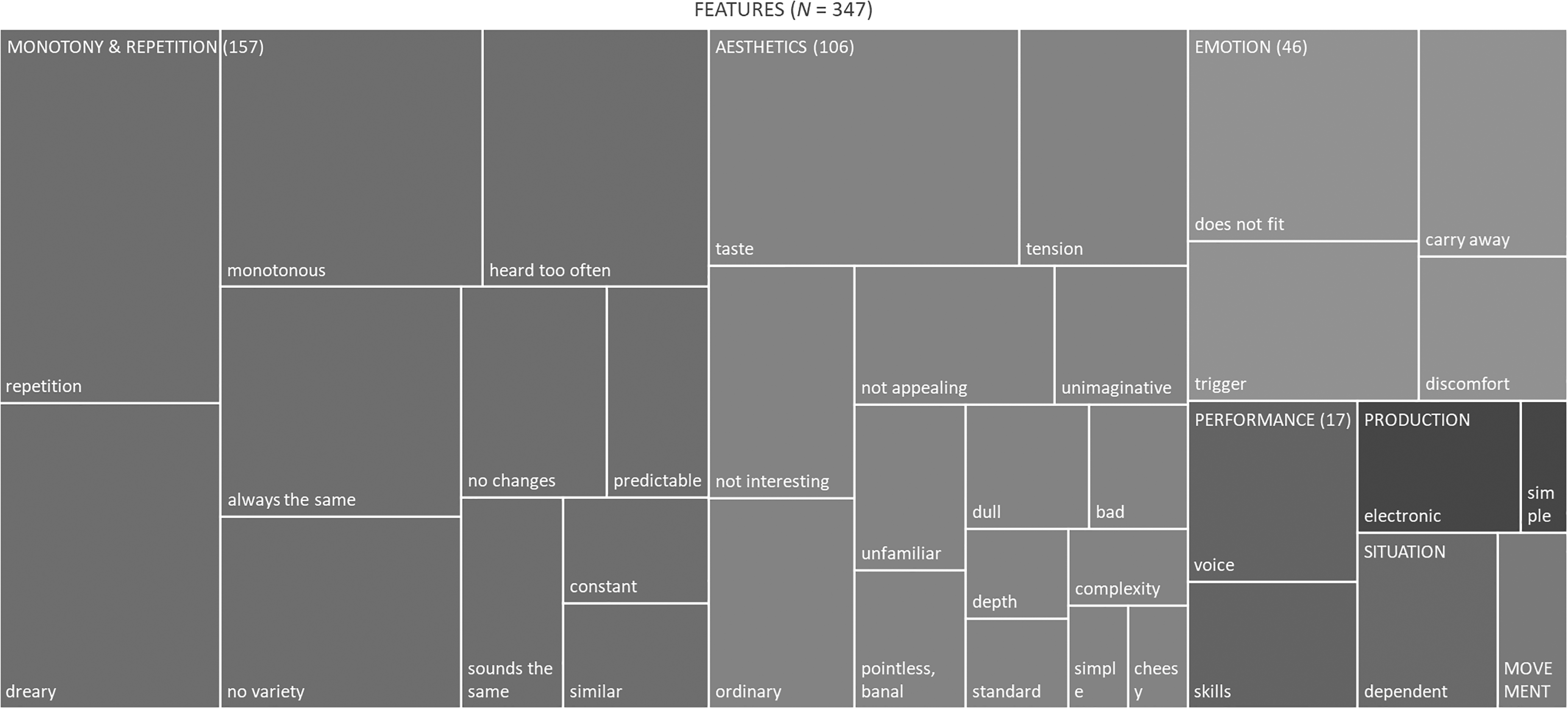
Treemap of features of “boring” music (with numbers of quotes). Primary categories are in capitals, subcategories are in lower case.
Aesthetic aspects (with 15 subcategories) include the explanation that music is boring if it does not fit one's musical taste, that tension (or excitement) is missing, is ordinary, and is not appealing. Further aesthetic aspects describe the music as unimaginative, pointless and banal, dull, bad, missing depth, and that it does not rise to a certain standard. Lack of complexity, simplicity, and “cheesy” are also used as descriptions for boring music. As already mentioned in the context category, unfamiliar music, or music one does not immediately relate to or understand, was found boring.
Concerning emotions (with four subcategories), music is perceived to be boring when it does not fit one's mood (or the situation altogether), does not trigger emotions, does not engross the listener, or causes discomfort. Performance aspects (two subcategories) include the voice not being outstanding or not triggering emotions, and missing skills of the performer (e.g., a “bad” interpretation). The production (two subcategories) can lead to boring music if it is electronically made and not using real instruments. Finally, “boring” music, which is noted to be dependent on the situation, does not trigger movement such as dancing and singing along, which reflects the failure to engage.
The findings show that these features described by the participants can refer to different reference points in the music (lyrics, style, melody, etc.). Eleven categories emerged for these reference points for the features. The lyrics are found boring when they are always the same, interchangeable, senseless, have no depth, or if the music does not have lyrics at all (Figure 5). Boring music is also associated with particular kinds of music (four subcategories), that is musical styles, certain types of music such as “mainstream” music and covers, “whiny” music, and a certain period such as 21st century or 60s/70s music. The melody is another important point of reference, which is found boring when it is monotonous or ordinary, likewise the rhythm and the beat, which is mainly repetitive, monotonous, and constant. Concerning the instruments, participants mention particular instruments or “too few” instruments, or the voice as reference points for boring music. The musical structure contributes to boring music when it follows a certain form or is too simple. The tempo mainly contributes when it is too slow, the harmonics, dynamics, and sounds when they do not vary, and the duration being “too long.”

Treemap of reference points of features of “boring” music (with numbers of quotes). Primary categories are in capitals, subcategories are in lower case.
Study 2
To identify the structure of the conditions under which boredom occurs during music listening, the 20 items were analyzed using a PCA. To investigate the relations of certain musical aspects with boredom, further analyses identified differences in reasons for finding certain musical styles boring. Next, the prevalence of experiencing boredom in the current sample was descriptively demonstrated with the frequency and intensity of boredom during music listening. Finally, the effects of personality and musical sophistication were analyzed to identify trait aspects associated with the experience of boredom in the context of music.
Conditions
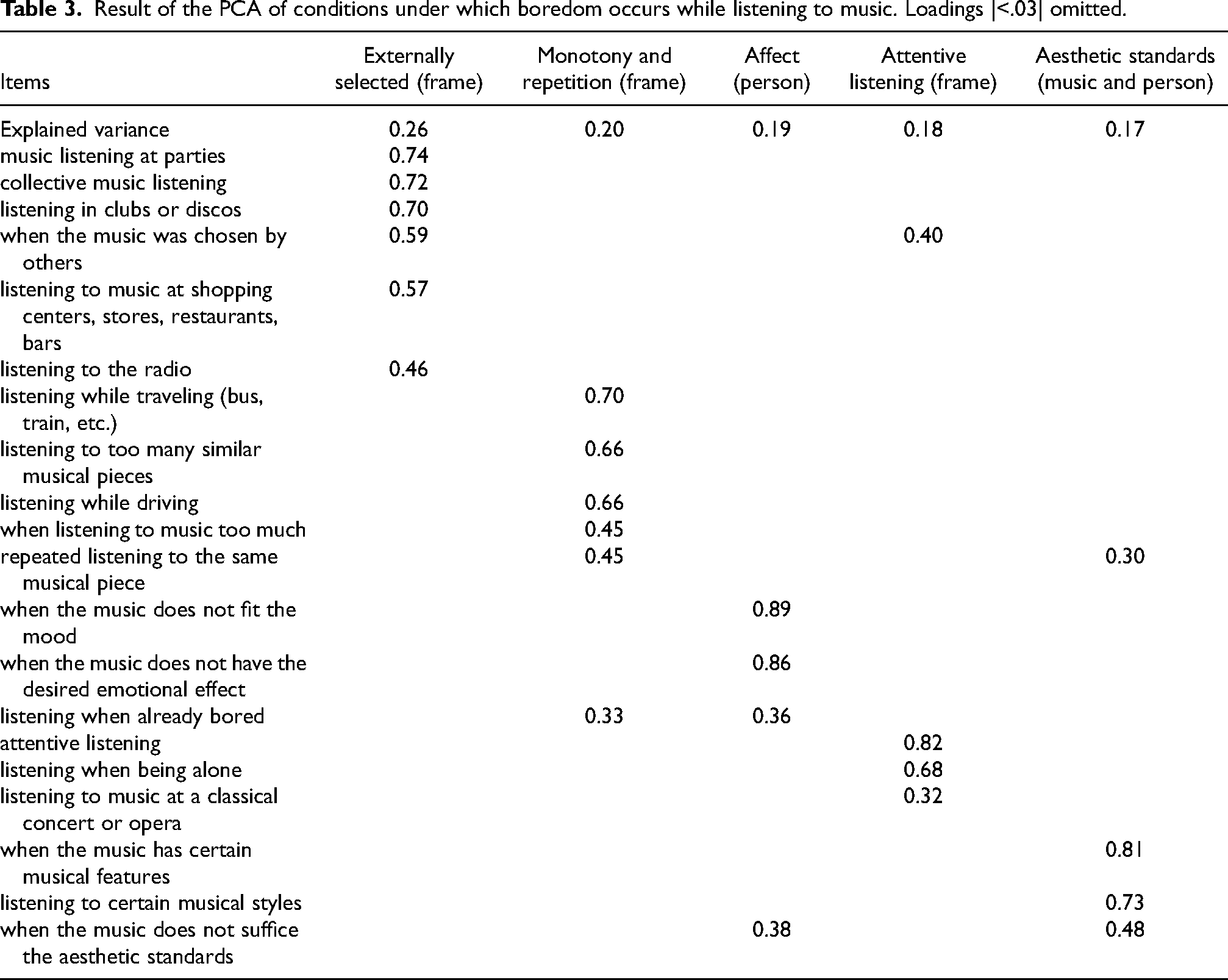
The PCA identified five components of conditions under which boredom occurs in the context of music listening, namely when the music (1) is externally selected (e.g., at parties or clubs), (2) is perceived as monotonous in respective situations (e.g., traveling), (3) does not have a desired emotional effect, (4) is heard during (forced) attentive music listening, and (5) has certain musical features that are not aesthetically appealing to the listener (Table 3). These components reflect main findings from boredom research as well as music research, showing that boredom occurs when the listener has no influence on the music selection, or is already in a boring situation, or when the music does not fulfill expected functions (regarding well-being etc.). Hence, finding music boring depends on the situation, and the emotional state the listener is in, as well as the expectations toward the music, and the personal taste. It is of note that the categories from the qualitative study differ from these components.
Result of the PCA of conditions under which boredom occurs while listening to music. Loadings |<.03| omitted.
Reasons for Finding Musical Styles Boring
In Study 2, the slightly as well as the strongly boring styles were rated on the reasons why they were found boring. The linear mixed-effects models reveal that all reasons (latent variables) were higher for the strongly boring than the slightly boring styles. Too Complex had a lower estimate than the other reasons (Table 4).
Results of the linear mixed models predicting factors of reasons for boring music with factors of music Styles.

The factor Too Simple increased with Unpretentious music (schlager, pop, traditional, country), and is therefore found boring because of simplicity, and decreased with Sophisticated music (predominantly classical and jazz; Fig. S4 in supplementary materials). Too Complex increased with Sophisticated music (predominantly jazz music) and decreased with Unpretentious music (schlager, traditional, country, pop). Identification decreased with Intense music (predominantly rock). Displeasure increased only marginally with Intense music (predominantly metal) and decreased with Sophisticated music (reggae, jazz, classical music). Too Uniform increased as a reason for finding Rhythmic music boring (EDM, techno, house, rap), and decreased with Sophisticated music (jazz, blues, classical, reggae).
Note that the explained variance in the model predicting Too Complex is by far the lowest of all models, and the variance explained by participant is the highest. The single style analysis (Fig. S4 in supplementary materials) shows only two styles with which Too Complex significantly increases as a reason for finding music boring, that is jazz and metal.
Frequency, Intensity, and Coping
Concerning frequency, 76.5% of the participants in the current study never or rarely experience boredom when listening to music, 14.9% sometimes, 8.6% often, and 0 always. Regarding intensity, 11% do not experience boredom in any intense way, 42.7% only mildly, 14.5% moderately, 26.4% (somewhat) severely, and 5.4% very severely. Regarding coping, 22.5% rarely and 8.8% never use music to cope with boredom
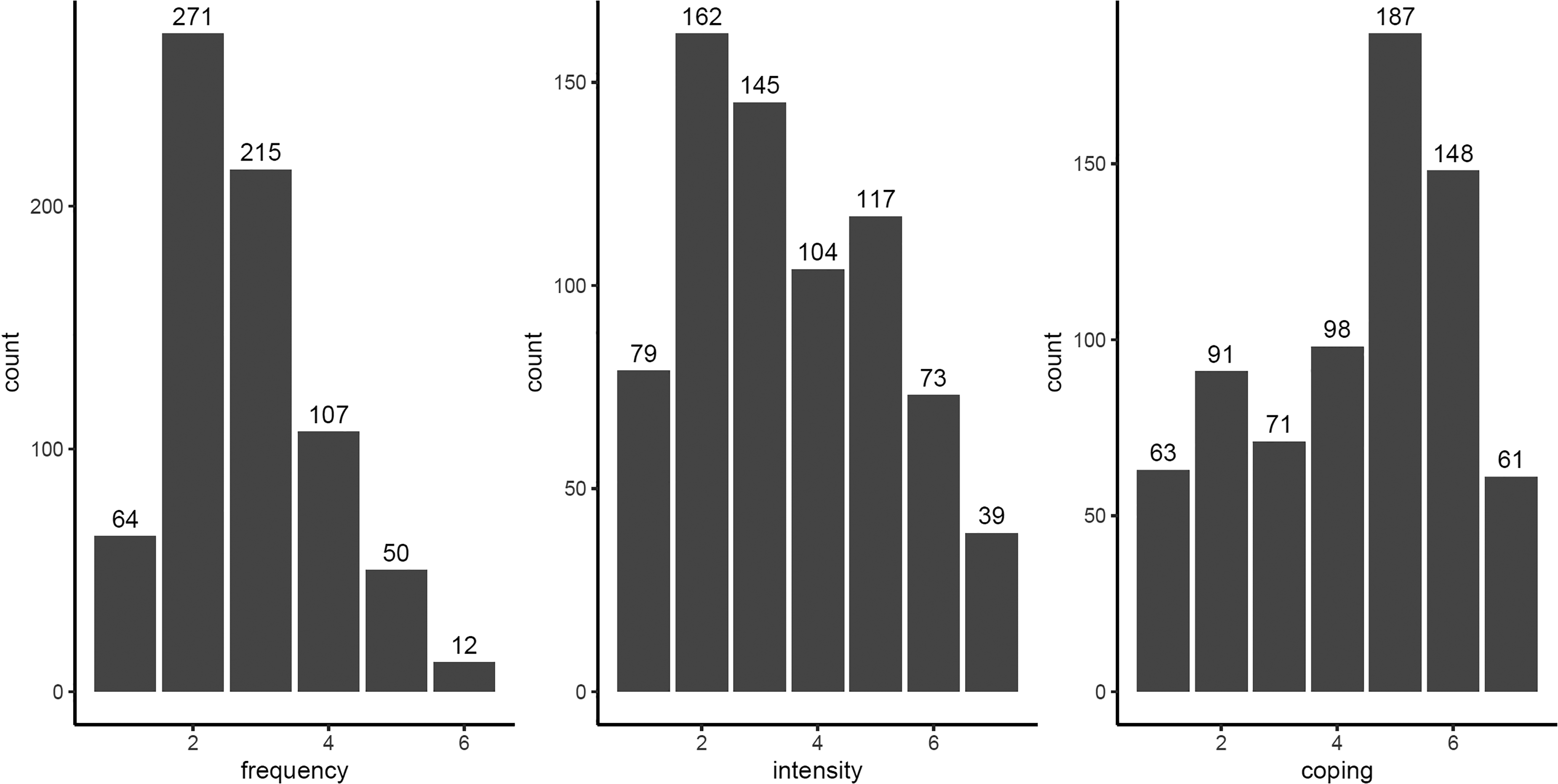
Histograms of frequency and intensity of experiencing boredom while listening to music and frequency of coping with boredom. Scales: Frequency and Coping: never (1) – always (7); Intensity: not at all (1) – very strong (7).
Effects of Personality and Musical Sophistication on “Musical” Boredom
The models with the personality dimensions as predictors produced very low R2 values. Intensity increased with Openness, which shows that participants higher in Openness experience a higher intensity of boredom, and decreased with Agreeableness, while frequency only decreased (slightly) with Agreeableness. Hence, participants high in Openness experience boredom more strongly (Table 5).
Results of the linear models predicting ratings of frequency and intensity of experiencing boredom while music listening, as well as the frequency of coping with boredom with music with dimensions of personality.

In the current sample, frequency increases with perceptual abilities and decreases with active engagement. Intensity also increases with perceptual abilities and decreases with active engagement. Coping increases with active engagement and emotion perception, and decreases with perceptual abilities (Table 6).
Results of the linear models predicting ratings of frequency and intensity of experiencing boredom while music listening, as well as the frequency of coping with boredom with music with factors of musical sophistication.

Discussion
The current studies provide empirical insight into boredom in the context of music listening. The findings reveal an interplay of boredom-specific and music-specific aspects. Key themes of boredom were reported in the context of music listening such as monotony and repetition, understimulation, low arousal, as well as overstimulation and high arousal, and hence line up with the existing literature. Interestingly, a proposed general framework of the aesthetic experience of music, that is, a frame-music-listener model (Wald-Fuhrmann et al., 2021), covers exactly the factors that are at play when boredom occurs during music listening: if the music contains certain features such as monotony and repetition, it can be perceived as boring, if the frame constitutes an already boring situation, music can likewise become boring, and lastly, if the person has certain personality traits, musical sophistication, and musical taste, they are more or less likely to experience “musical” boredom. This framework presents itself as a guide for the following discussion.
Influence of the Stimulus: Features of “Boring” Music
Participants associate typical aspects of boring activity with boring music, including monotony and repetition (Fahlman et al., 2013; Struk et al., 2017). Boredom can be caused by repetition within a piece (e.g., of verse and chorus, or single melodic lines or melodies) but also between pieces such as listening to one piece over and over or too many similar pieces (from one style or the same artist, etc.). Therefore, the main repeating elements in music (Margulis, 2014) are associated with boredom. In the same vein, people report about “it always sounds the same” or does not provide anything “new” regarding melody, harmony, or rhythm.
Similarly, missing variety and predictability also lead to the perception of a piece or type of music as boring. If the listener is not surprised anymore and “knows what's coming after two bars,” the stimulation fades away and boredom occurs (Bench & Lench, 2013; Mills & Christoff, 2018). Perceived monotony and repetition led to judgments of the music being unimaginative, pointless, banal, dull, and missing depth, and therefore does not align with an expected complexity of the music. The performer can be included in this judgment, who was not able to produce anything “better” (Moller, 2014), and hence, the music is ordinary and nothing special. The aesthetic dichotomy of finding music boring because of simplicity and missing complexity was also found as a reason for disliking music (Ackermann & Merrill, 2022).
These “boring” characteristics were associated with all aspects a piece of music consists of, that is, mainly musical features, but also the lyrics, the instruments, the voice, the performance, and the production (which includes the making and acoustical effects). The reference points of features of boring music are the lyrics, melody, style, and the rhythm. The melody is perceived as monotonous and ordinary, and the rhythm as repetitive and monotonous. Tempo is associated with boredom if it is too slow, or steady and calm. Music is a dynamic stimulus and if it does not go fast enough, time is dragging on or moving very slowly and one wishes for it to go by faster, which all represent items in the MDBS (Fahlman et al., 2013). The lyrics are described as always the same, interchangeable, senseless, and having no depth. Particularly for the lyrics, the relation between boredom and meaning comes into play as a lack of challenge and meaning, which are important for the definition of boredom (Van Tilburg & Igou, 2012; Van Tilburg & Igou, 2017).
Differences Between Musical Styles
The current study revealed different reasons for finding different styles boring that are related to understimulation and overstimulation. Rhythmic music such as EDM, techno, house, and rap/hip hop is found boring in the current sample because of uniformity. The impression that this music always sounds the same, does not have enough emotional expression, and is not melodic, probably refers to the rather monotonous and repetitious features of these styles. Simplicity was a reason for finding Unpretentious music boring, that is schlager, pop, traditional, and country. Perceiving this music as too simple, with not enough musical tension, and being too structured, probably refers to the harmonic and melodic aspects. Hence, melody and rhythm seem to be two reasons for finding certain styles boring, depending on the overall defining feature of the styles, for example, schlager focuses on the melody, while techno and rap focus on the rhythm.
Jazz and metal were the only styles that were found boring because of complexity, i.e., being too disharmonic, too chaotic, too niche, and not rhythmic enough. In contrast to the Rhythmic and Unpretentious styles, which are found boring because of a deficiency, these styles are found boring because of an overabundance of musical features. This result suggests that music can lead to both states of understimulating (through simplicity and uniformity) and overstimulating (through complexity) boredom (Fahlman et al., 2013).
Intense music, which is mainly metal, was found boring because of displeasure. This finding shows boredom in a combination with intensity and displeasure, which points toward a previously discussed issue on the combination of high arousal and boredom. Previous research has proposed that high arousal might occur together with high mental alertness or forced attention in combination with a monotonous task, or occurs in response to an overload of information (Fahlman et al., 2013; Thackray, 1981). Particularly metal is dominated by an overabundance of features, leading to high stimulation together with a perceived overload (Merrill et al., 2023), which might propose a perfect example of the combination of high arousal and boredom.
Interestingly, the results also show that various (single) styles are found boring by the current sample because of displeasure, including rap/hip hop, traditional, techno, EDM, and schlager. Hence, judging music as boring because of displeasure does not seem to be dependent on certain musical features, even though, the intensity seems to play a larger role. As the connection between perceived boredom and high arousal feelings is a matter of debate, the current results show that participants do feel displeasure in response to music they generally judge as boring. But, it needs to be considered that people might use “boring” as a general judgment for their overall disliked music (also in line with propositions by Moller, 2014). For example, if someone does not like metal, it is more likely that it is judged as boring, and hence, one criticizes the quality of the music overall. In line with boredom, this music is perceived to be dull and uninspired and in response, one gets frustrated or annoyed by the music which is then communicated as an overall feeling of displeasure. As the current reasons for boring music overlap with the reasons for disliked music (Ackermann & Merrill, 2022; Merrill et al., 2023), it can be suggested that boring as a judgment reflects one form of dislike.
Influence of the Frame: Conditions for Boring Music
The frame-music-listener model adopts the term “frame” from the sociologist Goffman (1974), which describes aspects of situations that have a bearing on music listening, that is, features perceived as essentially belonging to the situation and used by participants to understand and interpret it as well as to align their behavior accordingly (Wald-Fuhrmann et al., 2021). Three components have been found in the current studies that mainly relate to the frame: (i) music is externally selected during collective music listening, (ii) musical monotony and repetition in respective situations, and (iii) music and attentive listening. Situations in which the music is externally selected include certain locations such as parties, clubs/discos, and stores, and certain situations when others choose the music during collective music listening (first component). The situations described here are not necessarily boring in themselves, but bear the possibility that the music does not appeal to the listener. In situations where the focus is solely on the music (e.g., in a concert), the listener is often stuck in the situation. In the qualitative study, participants report that in these cases, they just suffer through, try to distract themselves with a cell phone or alcohol, engage in different thoughts and mind wandering, or tune it out. The escape reflex is reported to be strong and people go smoking while at a club, or home during the intermission of a concert. If possible, participants ask for changing the music or turning it down. Hence, this supports previous findings that coping with boredom is dependent on the context (Hamilton et al., 1984). Still, the wish to escape can also occur if the music is disliked for other reasons, which is therefore not a boredom-specific reaction (Ackermann & Merrill, 2022). Notably, in the case of asking for the music to be changed at someone else's party or home, participants are aware that this might lead to discussions and might even offend friends. Finding someone else's music boring, and therefore possibly implying someone being dull, can be perceived as a strong disparaging judgment that can have social consequences (Moller, 2014).
While the above situations are not boring in themselves, activities such as traveling and driving can be perceived as boring and then align with the perceived monotony and repetition of songs and musical styles (second component). Therefore, a monotonous and repetitious activity influences the perception of music (Geiwitz, 1966; Hill & Perkins, 1985; O’Hanlon, 1981). The co-occurrence of a boring situation and boring music demonstrates that both are interwoven in everyday life and complement each other as they are both perceived as understimulating. In those situations, music can lose its effect as a coping strategy for boredom (Greb et al., 2018). For example, when driving for too long and having listened to music “too much,” music can lose its ability to change the mood or the state of the listener.
Boredom can further occur in the case of attentive music listening and when being alone (third component). With a low loading, the component entails the location of a classical concert/opera, where attentive listening is the main reason for attending. It is of note that these items show low ratings (Fig. S1 in supplementary materials) and are therefore less frequent or important in the context of music listening. Interestingly, some participants mentioned that they are more likely to be bored by music if they actively have to listen to it and only focus on the music. This is probably related to the dimension of inattention (Fahlman et al., 2013), where boredom occurs when people have a hard time focusing on the music at a given moment. Maybe this is particularly true for people for whom music alone is not enough and who probably listen to music primarily in the context of other activities.
Influence of the Person: Musical Taste and Traits
Every person who listens to music brings their background, prior experiences, and traits (psychological, tastes, listener type, social demographics), which influence their aesthetic experiences (Wald-Fuhrmann et al., 2021). In the current study, participants report that their current emotional state and their musical taste influence the perception of boring music. The results provide another indication of how personality and musical sophistication can influence how often and how strongly people might experience boredom while listening to music.
Evoked Feelings and Missing Affect
Boredom can be experienced when music does not fit one's mood or does not have the desired effect (third component). In this case, understimulation is described on an emotional level and not, as above, as a result of perceived features (repetition and monotony). Nonetheless, both coincide with the experience of already being bored, connecting it to a predisposition of the listener. Further reports include feelings of low arousal such as tiredness, weariness, stagnation, sadness, depression, loneliness, aversion, and disinterest, as well as of high arousal, such as restlessness, nervousness, annoyance, and anger. With this, the dimensions of disengagement, and high and low arousal of the MSBS are reflected in peoples’ arguments (Fahlman et al., 2013). A missing evoked emotion is part of the participants’ definition of boring music, that is if the music does not fit the mood, triggers emotions, and does not carry away. Interestingly, these findings demonstrate that listeners expect music to have a (positive) effect on one's mood. If music does not fulfill this function (Greb et al., 2018; Schäfer et al., 2013), and if music is missing excitement as reported for boredom in general (Fahlman et al., 2013; Farmer & Sundberg, 1986; Vodanovich & Watt, 2016), it can be perceived as boring because it is useless to the listener. The function of boredom to engage in a different task, though, seems to be independent of the specific evoked arousal (as proposed by Elpidorou, 2021) as both high and low arousal were reported in the current study. A direct connection between arousal levels and understimulating or overstimulating musical features needs further investigation, but might depend on a personal attitude toward the music (a dislike or an indifferent attitude).
Aesthetic Standards and Musical Taste
While certain musical features can lead to boredom, musical styles can also trigger boredom if they do not meet one's aesthetic standards (fifth component). Experiencing music as boring is therefore dependent on one's musical taste (Ackermann & Merrill, 2022). The items on this component show high ratings (Fig. S1 in supplementary materials) and indicate great importance.
As musical taste is deeply rooted in a person, it seems that some music might always be found boring, independent of the context (which is typically very important for the perception of boredom). But, participants reported that even one's favorite music can be perceived as boring when it was listened to too often. This might be explained by the fading of emotions and novelty over time and when gone, boredom kicks in (Bench & Lench, 2013, 2019; Berlyne, 1960; Margulis, 2014).
Prevalence, Personality, and Musical Sophistication
In the current sample, participants only rarely experience boredom during music listening (76% never or rarely), but at least 24% experience boredom sometimes or often. Half of the participants experience the intensity of boredom as low or mildly (54%), 14% moderately, and 32% (somewhat) severely. As the experience of boredom was shown to vary with people's personalities, it was of interest to see how personality traits and musical sophistication relate to the experience of boredom in the context of music. While Openness was negatively associated with state and trait boredom (Culp, 2006; Fahlman et al., 2013), the current study shows that when music is involved, boredom is experienced more intensely by participants scoring higher on Openness. Openness was shown to relate to musical sophistication (Greenberg et al., 2015) and in the current study, particularly the dimension of musical Perceptual Abilities predicts a more frequent and more intense experience of boredom. Possibly, people higher in Openness and Perceptual Abilities have higher standards or demands, because they have already heard a lot of music, and need higher levels of variety to not get bored. In the Gold-MSI, the factor of Perceptual Abilities is a rather evaluative factor of music (e.g., judging others’ performances), which points to those people possibly criticizing music as being boring more often than others.
On the other hand, boredom is perceived less often and strongly by participants scoring higher on Agreeableness and higher on Active Engagement with music. The first group agrees with many situations and therefore also with situations in which music is listened to (and do not criticize it). People high on Active Engagement might have ways to engage differently with music and therefore perceive less boredom than others. This is in line with the current finding that participants higher in Active Engagement use music as a coping strategy, while those higher in Perceptual Abilities do not. Further, participants scoring higher on Emotions use music to cope with boredom. Interestingly, none of the personality traits predict coping with boredom using music.
Taken together, while Neuroticism was shown to be a strong predictor of general boredom, in the current study it was not related to boredom in the context of music, and while Openness was shown to be no predictor for boredom, in the current study it was related to the intensity of perceived boredom during music listening. While participants with higher Perceptual Abilities experience boredom more frequently and intensely, a higher Active Engagement with music and higher Agreeableness seem to prevent one from “musical” boredom.
Limitations and Outlook
The current study made statements on the prevalence of boredom in the context of music listening. Even though the sample entails people with somewhat different socioeconomic backgrounds, it is a convenience sample (with about a third of the participants in Study 1 not providing all demographic information as they did not finish the survey) and general conclusions about the prevalence of boredom cannot be made. In the same vein, statements on how personality or other trait aspects influence musical boredom need to be handled with care, as not all dimensions were equally present in the current study and need overall larger samples. The Gold-MSI includes more than the dimensions used in the current study, which could be researched more systematically in the future to answer questions such as how musical training might influence musical boredom.
The participants in both studies were asked to make retrospective evaluations of music listening. The limitation is that participants’ memories may not be as accurate as they thought, which probably led to perceptual distortions. Further studies could therefore include additional questions on the clarity of the memories and how long ago these tended to be, or investigate music and boredom during active music listening. The components revealed in Study 2 show the situations and circumstances one has to seek out to do so.
The role of overstimulation and understimulation as well as on high or low arousal in the experience of boredom is under debate in the literature. Music presents itself as a suitable stimulus to investigate this further, as future research could use music with certain features that can be considered either overstimulating or understimulating at least for certain taste groups (for example, Intense vs. Rhythmic vs. Unpretentious music). In psychological research, music can be used to investigate the time course of boredom, that is how emotional states such as high and low arousal moments alternate, and what they relate to, i.e., which musical features or a perceived overstimulation and understimulation. The current study indirectly revealed certain similarities between the dimensions of state boredom and the aesthetic experience of music, but a future study that investigates boredom while actively listening to music can make a direct comparison between the dimensions of state boredom with inventories evaluating aesthetic emotions (Coutinho & Scherer, 2017; Schindler et al., 2017).
Conclusion
The current findings show that boredom while music listening is linked to typical features, rationales, reactions, and trait aspects reported in psychological research on experiencing general boredom. At the same time, the factors at play when boredom occurs during music listening mirror the influencing factors of an aesthetic experience (Wald-Fuhrmann et al., 2021), that is the dependency on the conditions (frame), the current state of the listener and trait aspects (person), and the musical features and styles (stimulus) that can lead to musical boredom. If boredom occurs, one can say that the aesthetic experience fails. This failure is related to basic principles of aesthetics, which have been used to explain a successful aesthetic experience, such as a balanced interplay of liking, pleasure, arousal, complexity, and familiarity (Berlyne, 1960), but also a discussed prerequisite of beauty, that is a compound ratio of uniformity and variety (Gerhard, 2002; Hutcheson, 1726; Luko, 2008). Of course, in the context of boredom, it is not just the judgment of beauty that fails to appear, but also that of interest and fascination (and others to be determined). Notably, the relations between art and boredom do not end here as another aspect has to be considered, which is “good” boring art, that is art (possibly) meant to be boring (Elpidorou & Gibson, 2022). Overall, the results contribute to the understanding of the variety of factors that compose an averse form of an aesthetic experience with music.
Supplemental Material
sj-docx-1-mns-10.1177_20592043231181215 - Supplemental material for Music and Boredom: A First Insight Into an Unexplored Relationship
Supplemental material, sj-docx-1-mns-10.1177_20592043231181215 for Music and Boredom: A First Insight Into an Unexplored Relationship by Julia Merrill and Tristan Niedecken in Music & Science
Supplemental Material
sj-xlsx-2-mns-10.1177_20592043231181215 - Supplemental material for Music and Boredom: A First Insight Into an Unexplored Relationship
Supplemental material, sj-xlsx-2-mns-10.1177_20592043231181215 for Music and Boredom: A First Insight Into an Unexplored Relationship by Julia Merrill and Tristan Niedecken in Music & Science
Footnotes
Acknowledgment
We would like to thank Taren-Ida Ackermann for advice on the first study.
Action Editor
Kelly Jakubowski, Durham University, Department of Music
Peer Review
Anthony Chmiel, University of Sydney, Sydney Conservatorium of Music; One anonymous reviewer
Author Contributions
JM and TN conceptualized the research, TN collected the data, TN and JM analyzed the qualitative data, JM performed the statistical analyses, JM wrote the manuscript.
Declaration of Conflicting Interests
The author(s) declared no potential conflicts of interest with respect to the research, authorship, and/or publication of this article.
Ethical Approval
All experimental procedures were approved by the Ethics Council of the Max Planck Society (No 2702-12), and were undertaken with written informed consent of each participant.
Funding
The author(s) received no financial support for the research, authorship, and/or publication of this article.

Supplemental Material
Supplemental material for this article is available online.
References
Supplementary Material
Please find the following supplemental material available below.
For Open Access articles published under a Creative Commons License, all supplemental material carries the same license as the article it is associated with.
For non-Open Access articles published, all supplemental material carries a non-exclusive license, and permission requests for re-use of supplemental material or any part of supplemental material shall be sent directly to the copyright owner as specified in the copyright notice associated with the article.
