



Abstract
Research in music perception has typically focused on common-practice music (tonal music from the Western European tradition, ca. 1750–1900) as a model of Western musical structure. However, recent research indicates that different styles within Western tonal music may follow distinct harmonic syntaxes. The current study investigated whether listeners can adapt their harmonic expectations when listening to different musical styles. In two experiments, listeners were presented with short musical excerpts that primed either rock or classical music, followed by a timbre-matched cadence. Results from both experiments indicated that listeners prefer V-I cadences over bVII-I cadences within a classical context, but that this preference is significantly diminished in a rock context. Our findings provide empirical support for the idea that different musical styles do employ different harmonic syntaxes. Furthermore, listeners are not only sensitive to these differences, but are able to adapt their expectations depending on the listening context.
Like language, common-practice music (tonal music from the Western European tradition, ca. 1750–1900) follows a system of syntax that hierarchically arranges its constituent units into complex patterns. This syntax has been described in detail by music theorists (Lerdahl & Jackendoff, 1983), and a large body of empirical research indicates that this syntax is represented both cognitively (e.g., Bharucha & Stoeckig, 1986; Krumhansl, Bharucha, & Kessler, 1982; Tillmann, Bharucha, & Bigand, 2000) and neurally (e.g., Bigand, Poulin, Tillmann, Madurell, & D’Adamo, 2003; Janata, Birk, Horn, Leman, Tillmann, & Bharucha, 2002; Koelsch & Siebel, 2005; Maess, Koelsch, Gunter, & Friederici, 2001) by listeners.
Common-practice syntax has generally been assumed to apply to all forms of tonal Western music. Recently, however, researchers have argued that North American popular music might follow a syntax that is distinctive from that of common-practice music. For example, in common-practice music, the tonic chord (I) occurs most frequently, followed by the dominant (V) chord (Krumhansl, 1990; White, 2013). In contrast, a corpus analysis of rock music by De Clercq and Temperley (2011) showed that the subdominant (IV), not the dominant, is the second most common chord after the tonic. Taking an experimental approach, Craton, Juergens, Michalak, and Poirier (2016) asked participants to listen to a key-defining context, and then to provide surprise and liking ratings for 35 different target chords. These authors found that listeners liked and were unsurprised by the presentation of rock-typical chords, even when those chords were highly unexpected within the common-practice paradigm. Thus, listeners seem to be applying a flexible tonal schema that allows for the compositional conventions of both common-practice and rock.
Extending this research into the measurement of expectancy, Hughes (2011) presented listeners with style primes drawn from commercial recordings. Participants rated two-chord probes, constructed with Shepard tones, that included at least one primary triad (I, IV, or V) along with another chord drawn from the collection of 24 major and minor triads. When primed with a classical stylistic context, participants rated probes containing I and V chords significantly higher than probes containing IV chords. When primed with a rock context, the differences in ratings between primary triads were insignificant. Although the results of the study were suggestive, the effect size was small. This may have occurred, in part, due to the mismatch in timbre (sound quality) between the style primes (drawn from commercial recordings) and the chord progressions that the listeners were asked to rate (generated using Shepard tones). Further, the large number of chord progressions used made it difficult to infer meaning from the results beyond the overall interaction between musical style and primary triads.
The current study seeks to extend Hughes (2011) by using a similar experimental design, but with greater control over the experimental stimuli. In two experiments, listeners were presented with short composed excerpts that primed either the rock or classical (common-practice) style (“Style”), followed by two-chord progressions (V-I or bVII-I) in the same timbre. These progressions, which we will call “Cadence,” were either expected or unexpected, given the style, and listeners were asked to rate how well the progression fit with the style prime.
Deviating from Hughes (2011), we chose these progressions due to the differences in frequency across both styles. Hughes (2011) examined progressions that included primary triads, which are quite frequent in both common-practice and rock music. The progression from V to I is highly expected in common-practice music. This has been shown through numerous behavioral studies (Bharucha & Stoeckig, 1986; Bigand et al., 2003; Krumhansl, 1990), and this expectation serves as a foundation of past and current music theory pedagogy. Through computational analysis, Temperley (2009) has shown that V is the most common antecedent to I in a corpus of excerpts drawn from Kostka and Payne’s popular textbook Tonal Harmony (2013). Similarly, White (2013) reveals that, across five corpora spanning music written from 1650–1900, tonic and dominant chords occur more frequently than all other chords combined. In rock music, the V-I progression is also quite common. Doll (2017) refers to the V-I cadence as among the most common two-chord cadences in the rock era, and that V and I (along with IV) are the most common chords in the repertory. In their analysis of the Rolling Stone 500 corpus, Temperley and de Clercq (2011) found V-I to be the second-most common two-chord succession.
Conversely, the bVII-I progression is considerably rare in common-practice music. Temperley’s analysis shows that the bVII-I progression never occurs in the Kostka and Payne corpus (2009), and that the bVII chord root itself only appears in 0.7% of excerpts. Similarly, White (2013) shows that bVII has a frequency no higher than 4% across all five corpora.
Clendinning and Marvin (2011) suggest that bVII should only be used as a secondary dominant of bIII and make no mention of its potential resolution to I. Likewise, Gauldin (2004) refers to the bVII-I progression as “comparatively rare” in classical music. In rock music, bVII is the most common non-primary triad (Temperley & De Clercq, 2013), and bVII-I is a relatively common two-chord succession (De Clercq & Temperley, 2011). Many music theorists confirm the importance of bVII and the bVII-I progression as important to the rock repertory, referring to it as an important two-chord progression (Doll, 2017; Moore, 1992, 1995; Tagg, 2014), and to bVII as a possible substitute for the V chord (Gauldin, 2004; Snodgrass, 2015), or as part of the Aeolian cadence bVI-bVII-I, which is one of the most important three-chord schemas to emerge in the rock era (Doll, 2017). Therefore, in the classical style, we considered the V-I cadence to be congruent and the bVII-I cadence to be incongruent. In the rock style, we considered both cadences to be congruent.
We hypothesized that participants would apply style-appropriate tonal schemata in each context in accordance with these different patterns of congruence. Specifically, we predicted a main effect of Cadence, such that V-I was rated as better-fitting than bVII-I overall. However, we predicted that this main effect would be qualified by an interaction between Style and Cadence, such that listeners would rate V-I higher than bVII-I in the classical context, but not in the rock context. All hypotheses were pre-registered and are publicly posted at [https://osf.io/hfu84/].
Experiment 1
In the first experiment, we aimed to provide listeners with a maximally strong manipulation of style. Thus, the style primes were composed to include a rich and naturalistic array of compositional cues for rock and classical music, such as typical instrumentation, rhythm, and melodic and harmonic content.
Methods
Participants
Participants (n = 77) were recruited through the introductory psychology participant system at Skidmore College (n = 40) and through introductory music theory courses at the University of Lethbridge (n = 37). All participants were compensated for their participation with course credit. The Skidmore College sample reported a mean age of 18.53 years (s = 0.75). Twenty-five participants reported their gender as “Female,” 14 reported their gender as “Male,” and one participant reported their gender as “Neither/Other.” Thirty-five participants reported formal musical training, with a mean duration of 6.42 years (s = 3.61), and a mean age of onset of 7.88 years (s = 2.79). Thirteen participants reported currently playing music, with a mean time spent playing per week of 6.00 hours (s = 5.99). Demographic and music education data were not recorded for the University of Lethbridge sample.
Materials
Experimental stimuli consisted of block primes, trial primes, and cadences, produced in two musical styles: classical and rock. Primes were composed to exemplify the conventions of these two styles. Thus, classical primes contained the conventions of typical classical period composition and were played in a solo piano timbre, whereas rock primes contained the conventions of typical rock music and were played by a four-piece band (2 guitars, bass, and drums). Experimental trials were blocked by style. Block primes were longer excerpts that were presented at the beginning of each block to establish the style of the block. In both conditions, block primes were 29 seconds long (16 measures at 120 beats per minute; the classical excerpt was in simple triple meter, and the rock excerpt was in simple quadruple meter) and composed in C major (Figure 1(a)). Each experimental trial consisted of a trial prime followed by a cadence in the same key and style. Trial primes consisted of the last 4 bars of the block primes and were transposed into all 12 major keys. Each trial prime was 10 seconds in length. Cadences consisted of 2 chords, either V-I or bVII-I. Each chord within a cadence was 2 seconds long and was matched in timbre to the preceding prime (piano for classical, distorted electric guitar for rock) Figure 1 displays the musical notation for the experimental stimuli. Cadences were followed by 2 seconds of silence. Each experimental trial, therefore, was 16 seconds long. Crossing the factors of Cadence (V-I vs. bVII-I), and Key (12 major keys) produces 24 unique experimental trials in each Style (rock vs. classical). Each experimental trial was repeated twice, producing 48 trials per style block, and 96 trials in total. The experimental stimuli were presented on a computer running OpenSesame 3.1 (Mathôt, Schreij, & Theeuwes, 2012), and responses were collected via mouse click. The Skidmore College sample was tested in sound isolation booths, with sound presented in free field. The University of Lethbridge sample was tested in a quiet room, with sound presented using closed back headphones. All materials are publicly posted at [https://osf.io/hfu84/].
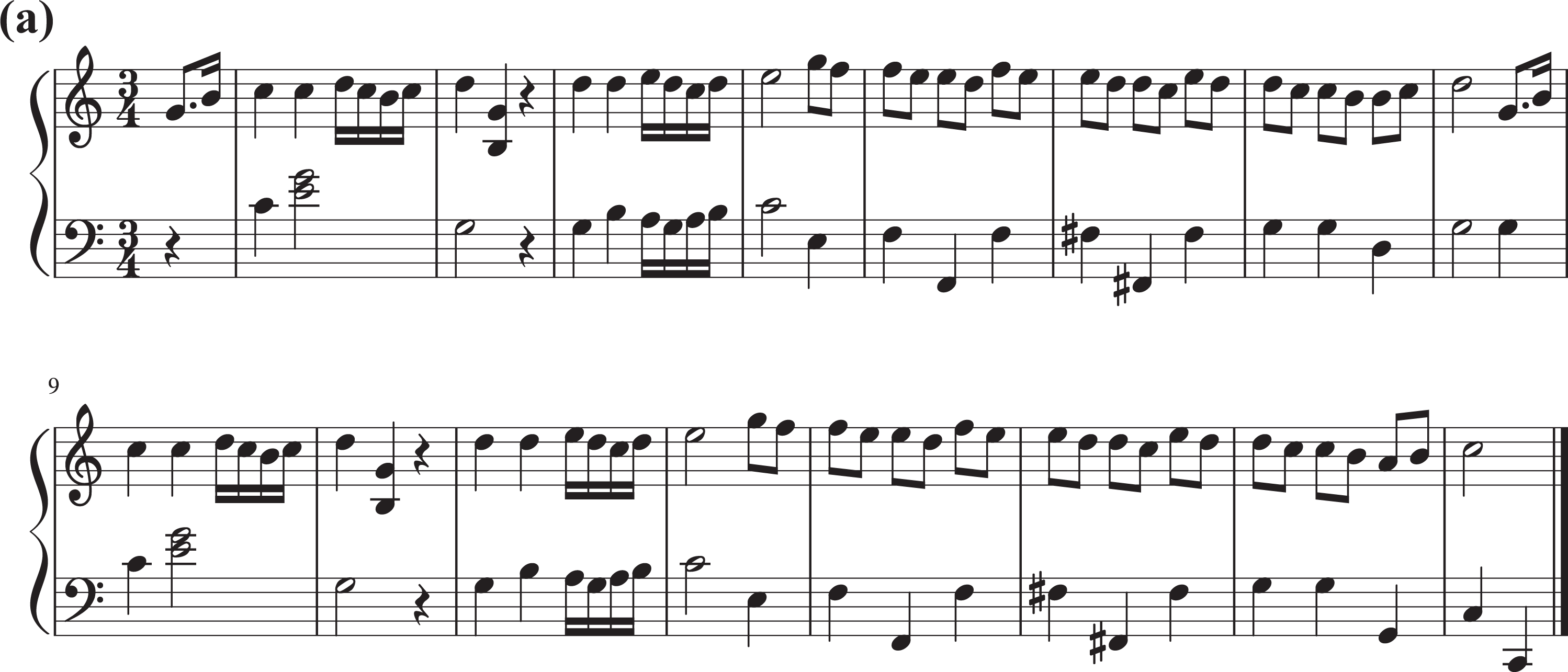
Experiment 1 stimuli. (a) classical style prime; (b) rock style prime (for both style blocks, trial primes consisted of the last four measures of the style prime); (c) Cadences.


Procedure
The experiment started with six practice trials (randomly drawn from the combined pool of 48 rock and classical trials) to help participants become familiar with the experiment. Next, experimental trials were presented in the classical and rock blocks, with block order randomly counterbalanced across participants. Each block started with a block prime to establish the block style, followed by the 48 experimental trials presented in random order. On each experimental trial, participants were asked to rate on a scale from 1–6 how well the cadence fit with the trial prime. Participants responded to each trial at their own pace. Each experimental session ran for 30–40 minutes.
Results
All data and analysis code is posted publicly at [https://osf.io/hfu84/]. Participant responses were collapsed across key and repetition and then submitted to repeated measures ANOVA with Style (rock vs. classical) and Cadence (V-I vs. bVII-I) as factors. There was a significant main effect of Style, F(1,76) = 4.33, p = .04, η G 2 = .01, with classical trials receiving higher ratings (M = 3.81, s = 1.50) than rock trials (M = 3.69, s = 1.44). There was a significant main effect of Cadence, F(1,76) = 99.74, p < .001, η G 2 = .17, with V-I trials receiving higher ratings (M = 4.08, s = 1.42) than bVII-I trials (M = 3.41, s = 1.44).
These main effects were qualified by a significant Style by Cadence interaction, F(1,76) = 97.40, p < .001, η G 2 = .15. This interaction was further investigated by planned paired comparisons assessing the effect of Cadence in each of the Style blocks. For the classical block, there was a significant effect of Cadence, t(76) = 12.52, p < .001, d = 1.42, with V-I trials receiving higher ratings (M = 4.45, s = 1.36) than bVII-I trials (M = 3.16, s = 1.35). In contrast, there was no effect of Cadence for the rock block, t(76) = 0.51, p = .61 (Figure 2).

Experiment 1 ratings. Error bars show standard error, normalized across subjects.
Finally, a series of covariate analyses assessed whether the pattern of results reported above was affected by Test Site (Skidmore College vs. University of Lethbridge) or musical training. A repeated measures ANCOVA with Style and Cadence as factors and Test Site as a covariate yielded significant main effects of Style, F(1,76) = 4.33, p = .04, η G 2 = .0003, and Cadence, F(1,76) = 99.74, p < .001, η G 2 = .01, and a significant Style by Cadence interaction, F(1,76) = 97.40, p < .001, η G 2 = .01. A repeated measures ANCOVA with Style and Cadence as factors and Musical Training (number of years) as a covariate was performed on the Skidmore College sample (for which we had musicianship data). This analysis yielded a significant main effect of Cadence, F(1,39) = 45.15, p < .001, η G 2 = .01 and a significant Style by Cadence interaction, F(1,39) = 47.70, p < .001, η G 2 = .01. Similarly, a repeated measures ANCOVA with Style and Cadence as factors and Musical Training (age of onset) as a covariate yielded a significant main effect of Cadence, F(1,39) = 45.15, p < .001, η G 2 = .01 and a significant Style by Cadence interaction, F(1,39) = 48.70, p < .001, η G 2 = .01. Thus, our predictions were not affected by differences in testing site or musicianship, with all covariate analyses confirming our main analysis (see Supplemental material online).
Experiment 2
Although the results from our first experiment confirmed our hypotheses, the decision to present evoke rock and classical conventions as strongly as possible in the style primes means that there was a large amount of acoustic variation between experimental blocks. In the second experiment, we aimed to provide listeners with a manipulation of style that controlled for acoustic variation as much as possible. As Gjerdingen and Perrott have shown (2008), listeners only require brief timbral cues to identify musical style, and potentially invoke stylistic schemata. Thus, the primes for our second experiment were composed identically between styles, with the only stylistic cue being timbre (piano for classical, distorted electric guitar for rock). As we did with our first experiment, we predicted a main effect of Cadence. Importantly, we again predicted an interaction between Cadence and Style, in accordance with the findings from our first study.
Methods
Participants
Participants were recruited through introductory music theory courses at the University of Lethbridge (n = 64). All participants were compensated for their participation with course credit. Before analysis four participants were discarded from the sample because they did not finish the study or did not consent to submitting their data. Thus, the final sample consisted of 60 participants. Participants reported a mean age of 21.18 years (s = 4.05). 54 participants reported their gender as “Female” and six reported their gender as “Male.” Forty-one participants reported formal musical training, with a mean duration of 10.28 years (s = 6.44), and a mean age of onset of 8.37 years (s = 3.22). Thirty participants reported currently playing music, with a mean time spent playing per week of 9.05 hours (s = 5.35).
Materials
Experimental stimuli for Experiment 2 were identical to Experiment 1, apart from the content of the primes. Primes from Experiment 1 were composed to elicit the desired musical style as strongly as possible, through a combination of timbre, instrumentation, and compositional cues. In contrast, the classical and rock trial primes in Experiment 2 were identical except for their timbre, to control acoustic information between the classical and rock primes while maintaining their evocation of the desired style. The same sequence of repeating chords was used as the prime in both style blocks, played on the piano in the classical block and on the distorted electric guitar in the rock block (Figure 3). Because the trial primes were so repetitive in this experiment, we did not present block primes. Again, each experimental trial consisted of a trial prime followed by a cadence in the same key and style. Crossing the factors of Cadence (V-I vs. bVII-I), and Key (12 major keys) produces 24 unique experimental trials in each Style (rock vs. classical). Each experimental trial was repeated twice, producing 48 trials per style block.

Experiment 2 primes and cadences.
The experimental stimuli were presented in a quiet room on a computer with closed back headphones running online survey software (Qualtrics, Provo, UT), and responses were collected via mouse click. All materials are publicly posted at [https://osf.io/hfu84/].
Procedure
The procedure was identical to Experiment 1, except that blocks simply began with experimental trials rather than block primes.
Results
All data and analysis code are posted publicly at [https://osf.io/hfu84/]. Participant responses were collapsed across key and repetition and then submitted to repeated measures ANOVA with Style (rock vs. classical) and Cadence (V-I vs. bVII-I) as factors. There was a significant main effect of Style, F(1,59) = 13.31, p < .001, η G 2 = .02, with classical trials receiving higher ratings (M = 4.54, s = 1.26) than rock trials (M = 4.31, s = 1.33). There was a significant main effect of Cadence, F(1,59) = 34.73, p < .001, η G 2 = .10, with V-I trials receiving higher ratings (M = 4.71, s = 1.24) than bVII-I trials (M = 4.14, s = 1.30). These main effects were qualified by a significant Style by Cadence interaction, F(1,59) = 13.95, p < .01, η G 2 = .01.
This interaction was further investigated by planned paired comparisons assessing the effect of Cadence in each of the Style blocks. For the classical block, there was a significant effect of Cadence, (t(59) = 7.16, p < .001, d = 0.92), with V-I trials receiving higher ratings (M = 4.92, s = 1.23) than bVII-I trials (M = 4.15, s = 1.27). There was also a significant, but comparatively smaller, effect of Cadence for the rock block, (t(59) = 3.14, p = .0027, d = 0.41), with V-I trials receiving higher ratings (M = 4.50, s = 1.31) than bVII-I trials (M = 4.13, s = 1.32) (Figure 4).
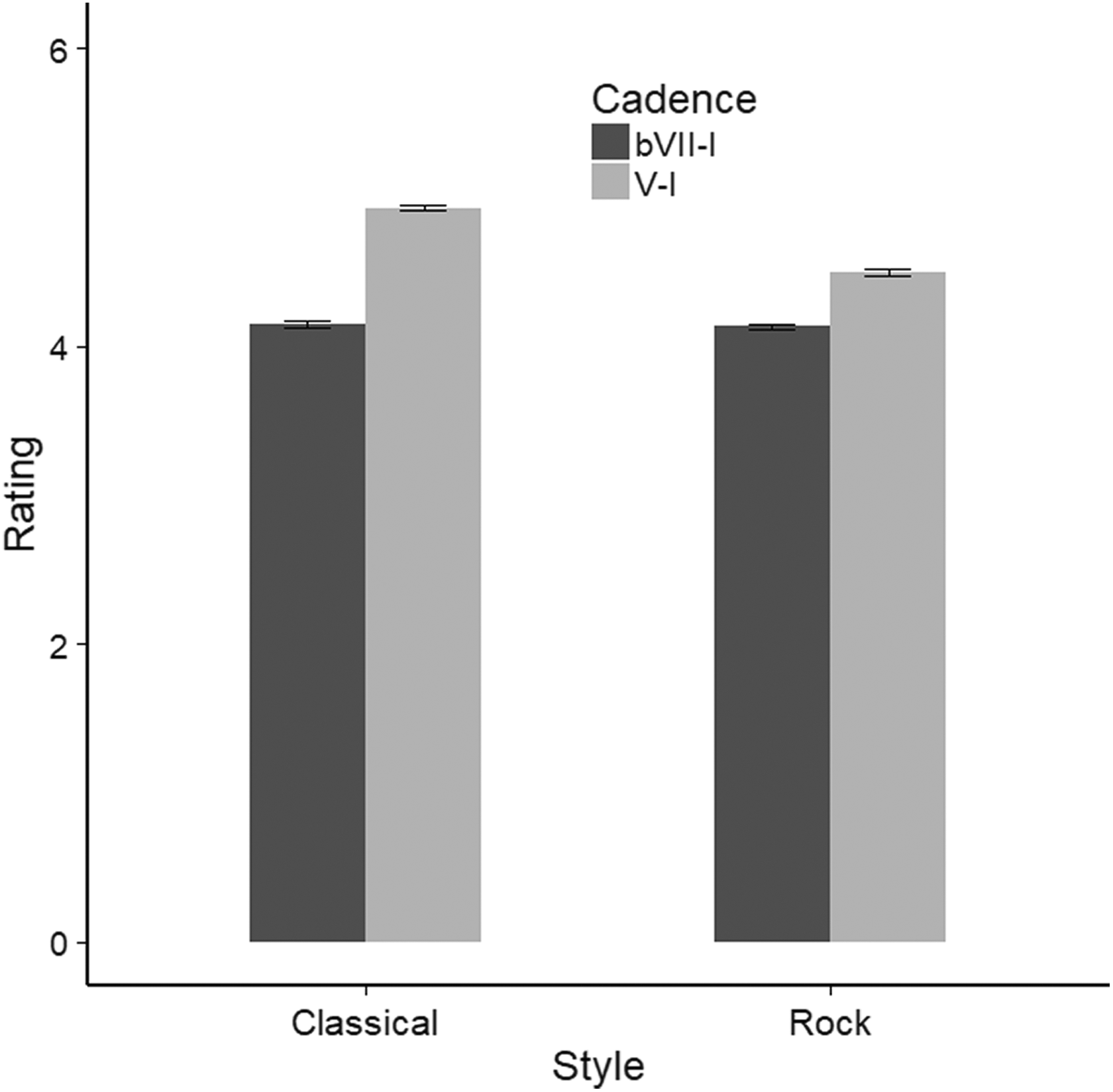
Experiment 2 ratings. Error bars show standard error, normalized across subjects.
Finally, a series of covariate analyses assessed whether the pattern of results reported above was affected by musical training. A repeated measures ANCOVA with Style and Cadence as factors and Musical Training (number of years) as a covariate was performed on data from 59 participants who reported for how many years they had been musically trained. This analysis yielded significant main effects of Style, F(1,58) = 13.23, p < .001, η G 2 = .02, and Cadence, F(1,58) = 34.59, p < .001, η G 2 = .11, and a significant Style by Cadence interaction, F(1,58) = 13.75, p < .001, η G 2 = .02. Similarly, a repeated measures ANCOVA with Style and Cadence as factors and Musical Training (age of onset) as a covariate was performed on data from 41 participants who reported the age at which they began their musical training. This analysis yielded a significant main effect of Style, F(1,40) = 8.98, p = .005, η G 2 = .02), and Cadence, F(1,40) = 36.73, p < .001, η G 2 = .17, and a significant Style by Cadence interaction, F(1,40) = 16.73, p < .001, η G 2 = .03. Thus, our predictions were not affected by differences in musicianship, with all covariate analyses confirming our main analysis (see Supplemental material online).
Discussion
The results of both experiments confirm our hypothesis that musical style affects harmonic expectation. Specifically, participants have stronger expectations for V-I cadences when these cadences are placed within a stylistic context that represents the norms of classical music. When this context is changed to another distinct style, such as rock, these expectations are weakened. Experiment 1, which used stylistically feature-laden stimuli (primes including idiomatic melodic, harmonic, rhythmic, and timbral content), revealed a large, significant effect of Cadence in a classical context, whereas Cadence had no effect in a rock context. Experiment 2 used stimuli stripped of almost all stylistic content. Context was created solely by an assumed association of timbre and style: piano representing the “classical sound” and electric guitar representing the “rock sound.” The results were largely the same: participants showed a strong effect of Cadence in a classical context, whereas there was a relatively smaller effect of Cadence in a rock context. Moreover, the results of Experiment 2 eliminate any concern of a possible confound due to subtle differences in acoustic information between prime and cadence in the rock context presented in Experiment 1. The main effects of Style and Cadence could be attributed to the vast reduction of the number of musical features present in the stimuli in Experiment 2. Nevertheless, the most important result of this experiment, the interaction between Style and Cadence, provides further support for our findings from Experiment 1.
The results of our experiments support the findings of Hughes’ (2011) study: The V-I cadence, and perhaps, more generally, the dominant-tonic relationship, may not exist alone at the top of the tonal hierarchy when presented in a non-classical stylistic context, such as rock. Given the “flat” ratings for rock chord progressions found in both Hughes (2011) and the current studies, one might surmise that harmonic expectations are weaker, or at least different, when music is presented in a rock context. Though further study of the impact of harmony would be beneficial, it would also behoove scholars to investigate whether other musical parameters (such as timing or voice leading) have a stronger impact on syntactic violations in non-classical contexts.
A comparison between Experiment 1 and Experiment 2 indicates that stylistic cues may have additive effects on the degree to which a listener will activate a specific style schema.
Specifically, In Experiment 1, when there were multiple strong stylistic cues, participants did not prefer V-I over bVII-I in the rock condition. In contrast, in Experiment 2, when there was only a single stylistic cue, participants did prefer V-I over bVII-I in the rock condition (but this preference was significantly reduced as compared with the classical condition). In previous work by Hughes (2011), cadences were constructed from Shepard tones. Since the timbre of the probes did not match the prime in that study, one could argue that the probes were presented in a weakened stylistic context, which might have affected participants’ ratings. These experimental differences suggest that future work should investigate whether the various stylistic cues are independent of one another (i.e., operate additively), or if certain cues might interact in the activation of style-based harmonic schemata.
This ability to shift expectations based on different combinations of musical cues depends on listeners’ ability to distinguish between highly similar tonal schemata and activate the context-appropriate representation. Previous research has shown evidence of listeners’ cognitive flexibility in common-practice settings. For instance, Vuvan and Schmuckler (2011) found that listeners were able to mentally scan a scale to transpose their tonal schemata. Furthermore, Vuvan, Prince, and Schmuckler (2011) found that participants have cognitively distinguishable representations of the three forms of minor scales that are deployed in response to the musical context. Tillman, Bigand, and Pineau (1998) showed that this flexibility extends to global harmonic contexts created by tonal center. Likewise, several scholars have shown that timing impacts perceptions of pitch (Prince, Schmuckler, & Thompson, 2009, Prince, Thompson, & Schmuckler, 2009) and phrasing (Palmer & Krumhansl, 1987).
More recently, researchers have begun to investigate the impact of training within a particular style on listeners’ representations. For instance, Przysinda, Zeng, Maves, Arkin, and Loui (2017) showed that, compared with classical musicians, jazz musicians prefer chord progressions that are unexpected within the common-practice system. This preference is mirrored by differences between jazz and classical musicians’ brain responses to unexpected progressions. Relatedly, Tervaniemi, Janhunen, Kruck, Putkinen, and Huotilainen (2016) showed that musical training in different genres led to enhanced neural responses (mismatch negativity and P3a) to deviations in tuning (classical musicians), timing (classical and jazz musicians), transposition (jazz musicians), and melodic contour (jazz and rock musicians). Most recently, Bianco, Novembre, Keller, Villringer, and Sammler (2018) showed that classical and jazz pianists differ in their responses to harmonic and fingering violations during performance. The current study extends this work, showing the deployment of different cognitive schemata based on context rather than training. Future work will investigate whether listeners’ brain responses are affected by context, as they have been shown to be by genre-specific training.
Another avenue of potential research lies in the investigation of the consequences of style-based shifts in expectancy. Previous research has shown that expectancy leads to changes in judgment accuracy and response time (e.g., Bharucha & Stoeckig, 1986; Tillmann, Bigand, & Pineau, 1998), liking (e.g., Loui & Wessel, 2008), and memory (e.g., Vuvan, Podolak, & Schmuckler, 2014). Future studies should explore the downstream processing effects of shifting patterns of musical expectancy.
One limitation of the current study is revealed by comparing the absolute ratings for the two cadences in rock and classical contexts. This comparison indicates that, contrary to our predictions, participants may have given lower belongingness ratings to the V-I cadence in the rock block than in the classical block and, in Experiment 2, that the bVII-I cadence belongs equally well in classical and rock styles. In the context of the current experiment, this finding is difficult to interpret because trials were blocked by style, with the goal of maximizing the impact of style on ratings. Thus, participants never rated cadences in a classical vs. rock context in close succession. This, as well as the fact that the rating scale is in arbitrary units, makes it difficult to interpret a direct comparison of cadence ratings between the style blocks. Thus, the focus of our analysis was to the relative difference in ratings for V-I vs. bVII-I in the classical context vs. the rock context. Future research should focus on more directly comparing absolute ratings of each cadence in each style, perhaps by using a task in which participants directly compare the same cadence in different styles, rather than rating one cadence at a time.
In sum, the results of the current study suggest that listeners have the cognitive flexibility to adapt their syntactic expectations based on the stylistic context. Ethnomusicologists have long believed that we possess the capacity to “speak multiple musical languages” (Hood, 1960), and the results from our studies contribute important empirical evidence in support of this claim.
Supplemental material
Supplementary_Material - Musical Style Affects the Strength of Harmonic Expectancy
Supplementary_Material for Musical Style Affects the Strength of Harmonic Expectancy by Dominique T. Vuvan, and Bryn Hughes in Music & Science
Footnotes
Contributorship
DV and BH designed the study and collected data. DV analyzed data and created figures. DV and BH wrote the manuscript.
Declaration of conflicting interests
The authors declared no potential conflicts of interest with respect to the research, authorship, and/or publication of this article.
Ethical Approval
This research received ethical approval from the Office of Research Ethics, University Of Lethbridge (Protocol Number: 2016-031) and the Institutional Review Board, Skidmore College (Protocol Number: 1701-573).
Funding
The authors received no financial support for the research, authorship, and/or publication of this article
Peer review
Psyche Loui, Wesleyan University, Department of Psychology.
One anonymous reviewer.
Supplemental material
Supplemental material for this article is available online.
References
Supplementary Material
Please find the following supplemental material available below.
For Open Access articles published under a Creative Commons License, all supplemental material carries the same license as the article it is associated with.
For non-Open Access articles published, all supplemental material carries a non-exclusive license, and permission requests for re-use of supplemental material or any part of supplemental material shall be sent directly to the copyright owner as specified in the copyright notice associated with the article.
