



Abstract
This scoping review investigates the status quo of the research on the role of music in old people's wellbeing, presenting the recent results and critically analyzing the conceptual clarity within the research fields. A search of peer-reviewed publications from January 2010 to December 2022 was conducted, regarding music's role in the wellbeing of this growing group of aging people. A total of 141 articles were included in an extensive screening. Through the analysis, we identified five main mechanisms, through which music may support wellbeing in this age group. These are (1) cognitive and physical rehabilitation through music, (2) social engagement in musical group activities, (3) individual's engagement with music for emotional support, self-connection, and meaning-making, (4) supporting the wellbeing of social environments around older adults, and (5) enhancing accessibility and age-related adaptation within musical activities. Also, we identified a considerable degree of inconsistency in conceptual clarity, methodology, and theoretical approaches used in researching this rather undefined topic. A compilation of research paradigms and recommendations for future research are presented.
Introduction and Background
Good quality of life, health, subjective feelings of wellbeing, and personally fulfilling social connections are likely to be the key aims for any person's life, especially during one's more mature years. In particular, engagement with creative activities can have a crucial role in later life, as learning and participation in peer groups seem to be strongly connected with subjective wellbeing and self-evaluated quality of life. Musical engagement, such as listening to music, singing, playing an instrument, or composing new music, has been considered one of the creative activities most effective for fostering wellbeing in a holistic way, since research-based evidence has shown its potential for creating and maintaining feelings of belonging (e.g., Schäfer & Eerola, 2020) and a sense of agency (e.g., Saarikallio, 2019), to affect regulation (e.g., Baltazar & Saarikallio, 2019), and to provide shared emotional experiences (e.g., Peltola, 2017). Musical engagement has the ability to activate widespread and complex networks and areas in the brain (e.g., Särkämö, 2018), and just listening to music can facilitate a relaxation response because of the intertwined ways musical information is being processed by the body and brain (Krout, 2007). All these reactions and responses to music have been associated with wellbeing. Because of the previous evidence, various kinds of musical activities and interventions have been conducted for the purpose of enhancing the wellbeing of older people in both societal and research settings. However, the diversity of these practices makes it challenging to grasp the essence of the scientific understanding regarding the role of music in the good quality of life for older adults. In this scoping review, we aim to investigate the status quo of current research on this issue.
Wellbeing, Musicking, and Quality of Life
Wellbeing is a multifaceted concept, and there are numerous definitions of it in the research literature. For instance, the theoretical concepts of wellbeing and good quality of life are closely intertwined, which makes it sometimes difficult to separate them from each other. In clinical research, health-related quality of life (HRQoL) is often used, which refers to a generic, self-assessed quality of life that can be evaluated with various measures. According to the definition by the WHO (1996, 1998), quality of life is divided into physical, psychological, social, and environmental dimensions, the last of which includes living conditions, public safety, and services provided by society. These dimensions can be used in conceptualizing wellbeing rather broadly, which is an approach widely used in medicine, sociology, and psychology (Cooke et al., 2016). This approach leans on studying and measuring objective wellbeing (Fabian, 2022). On the other hand, when defining wellbeing, a person’s own experience plays an important role, since it is difficult for an outsider to assess the experiential side of the components of quality of life. For this reason, the concept of subjective wellbeing is often emphasized. Subjective wellbeing stems from each person's individual ways of thinking and feeling, as well as their personal (and partly socially learned) values regarding the important things in life (Diener et al., 1998; Fabian, 2022). Subjective wellbeing can further be interpreted as something referring to hedonia, which covers feelings of happiness and the absence of sadness and distress, and to eudaimonia, which refers to feelings of meaningful actions and a fully functioning or satisfying life (e.g., Deci & Ryan, 2008).
Music in its various forms has been found to contribute to wellbeing in different stages of life through pain reduction, physiological arousal, enhanced social connections, supported self-esteem, empowerment and mood, decreased agitation (for people with dementia), and improved cognitive health (for a review, see Dingle et al., 2021). Within the theories on music and wellbeing, musical engagement is often considered to be a pragmatic, everyday practice and a psychological instrument, used for the pursuit of a change in a person's current conditions. For example, Small's (1998) concept of musicking embraces the myriad processes of meaning-making, experiencing and engaging with music. Stige (2002) has further developed this by introducing his concept of health musicking, which sees music as a subservient practice. Ruud (2002, 2013) defines music as a cultural immunogen, which helps a person to adapt their inner world to the circumstances they are in, as well as to regulate their psychological state with the demands and dynamics of one's surroundings. For Ruud, musicking is a profound enabler of life quality, as it provides vitality (emotional stimulation, regulation, expression and awareness), tools for developing agency and empowerment, resources in creating a sense of belonging, and means of achieving coherence and meaning in life (Ruud, 2013). DeNora (2007) describes music as a technology of self, an affordance and appropriation; music can only result in beneficial (or any) outcomes through afforded self-appropriation of its users.
However, when it comes to empirical studies, definitions of both music and wellbeing are more diverse. It has been acknowledged that research in this field lacks coherence, and that the heterogeneity of the approaches have built obstacles in theory building (MacDonald et al., 2012). This is partly due to the multidisciplinary nature of the field, which is constantly expanding from medicine and neuroscience to psychology and cultural studies. Given the diverse and wide spectrum of paradigms, practices, and contexts, it is easy to understand the lack of cohesion when it comes to theories and theoretical concepts (Stige, 2012), even though this incoherence might challenge the accumulation of evidence. Thus, in previous research, the concept of “music” can vary tremendously from study to study. As Dingle et al. (2021) suggest, music can refer to a range of activities, such as “personalized music listening for pain management in people with fibromyalgia (Linnemann et al., 2015); group singing for adults with chronic mental health conditions (Williams et al., 2019); a hip-hop project for sexual health promotion in Indigenous school students (McEwan et al., 2013); and dance for Parkinson's (Shanahan et al., 2015).”
So far, a solid theory, relevant for studying the interconnections between music and wellbeing within the reality of older adults, is still lacking. Investigating these key concepts is one of the aims of the present study, which is why we will explore the ways they have been applied in previous literature. For the purpose of this, we have a broad definition of wellbeing, including both objective and subjective aspects, as it was assumed that both of these approaches are existing in previous research on music and wellbeing among older adults. Furthermore, we will explore the way “music” has been conceptualized by including clinical and non-clinical intervention studies as well as other empirical investigations of music in the everyday life of older adults.
Growing Old
Definitions of old age vary depending on the context. “Elderly” has often referred to the chronological age of 65 years or older, although the origins of this definition are unclear (Orimo et al., 2006). In a review by Kydd et al. (2020), they found little consensus on both the actual age range for older age and the age stratifications used to define sub-categories for the elderly (such as the “oldest old” and “fourth age”). In gerontology, the term old age is often used interchangeably with longevity, and the diversity of colorful definitions can cause further confusion within and between fields (Sebastiani et al., 2016). Thus, considering our era of increasing health, better quality of life, and a healthy life expectancy of 70 to 80 years (e.g., Kpolovie et al., 2016), “the elderly” is a poorly defined and diverse population that can include, for example, healthy adults who have not yet retired, people in their early sixties with poor health who live with a full-time caregiver, or healthy individuals over the age of 80 who can still live independently but benefit from formal or informal help in their everyday lives.
Although the concept of old age still requires better definition, growing old comes with inevitable physiological and psychological changes. Biological aging includes progressive deterioration of function on the levels of cells, psychological and cognitive systems, and individuals as a whole, yet this decline does not automatically associate with changes in wellbeing or, for instance, social relations (Bousquet et al., 2015; Heikkinen et al., 2008). In addition to physical changes, older adults are more prone to suffer from loss of self-management, depression and loneliness, yet to a very high age they seem to report higher self-declared levels of wellbeing than middle-aged adults do (Carstensen et al., 1999; Steptoe et al., 2015). One interpretation of age-related positive changes derives from motivation and Carstensen's socioemotional selectivity theory (1999), which claims that the perceived limitation of time in later years could lead to a shift in motivation and goals that directs a person's attention to more emotionally meaningful things. Evidently, music has a strong potential to support these processes, yet investigating them might be challenging due to differing social and cultural values. Individuals of older generations might not be able to reflect on music-enhanced wellbeing or used to doing so, or they may not be familiar with the concepts included (e.g., Lindblad, 2021). Older adults might also have assumptions regarding music as a sign of an innate talent, instead of a competency accomplished by practicing or accessible to anyone (e.g., Barbeau & Cossette, 2019).
In this review, we decided not to set a specific age range, but to include literature that referred to “older adults” in general, in order to gain insights about how old age has been defined and approached in previous studies focusing on the beneficial effects of music on older people. Therefore, in the sample of this review, concepts such as “older people,” “older adults,” and “aging individuals” all refer to the population of people over the age of 50, since this seemed to be the age limit occurring in the previous literature.
Research Aims
In this review we investigate the previous evidence of how music is related to positive effects in older people's objective/measurable and subjective wellbeing. We are interested in mapping the potential mechanisms behind the positive changes in aging populations, as well as how the concepts of “music,” wellbeing,” and “older age” have been used in previous research.
Methods
Data Retrieval and Extraction
In this scoping study, we followed Arksey and O’Malley's (2005) five-stage framework of (1) identifying the research question, (2) identifying relevant studies, (3) study selection, (4) charting the data, and (5) collating, summarizing, and reporting the results. After identifying the initial research aims (see “Research Aims”), we conducted a search with the search terms of music AND “older people” or “older adults” or elderly or seniors or aging or ageing AND wellbeing or “well-being” or “well being” on the abstract, keyword or title level, in the following databases: Web of Science, Scopus, ProQuest, JSTOR, EBSCOhost (RILM, ERIC, Psycinfo, PsycArticles), PubMed, and MEDLINE. We reviewed peer-reviewed, full-text research articles that met the following criteria: (1) published in English; (2) published between January 2010 and December 2022; and (3) mentioned all of our search terms in the headings or the abstract and were investigating connections between music and wellbeing among older adults. The search and screening through titles and abstracts was done by both authors independently, after which we discussed and resolved our few conflicts about inclusion. We decided to include reviews, RCTs, and theoretical papers in addition to empirical studies, but to exclude protocols (as we were interested in results). We excluded all non-peer-reviewed conference papers, posters, and dissertations, and also peer-reviewed articles that mentioned the relevant keywords in the abstract but focused on some other subject or age group instead. For instance, studies investigating a broader age group (including adolescents, working age population, or people in general etc.), a specific diagnosis not related to the aging population in particular (such as cancer) or a broader scope of creative or arts-related research, from which the aspect of music was not extractable, were excluded. This condensed our sample from 1,103 potential articles to 141 included articles. The details and flow of our search is shown in Figure 1, and the final sample can be seen in Appendix 1.
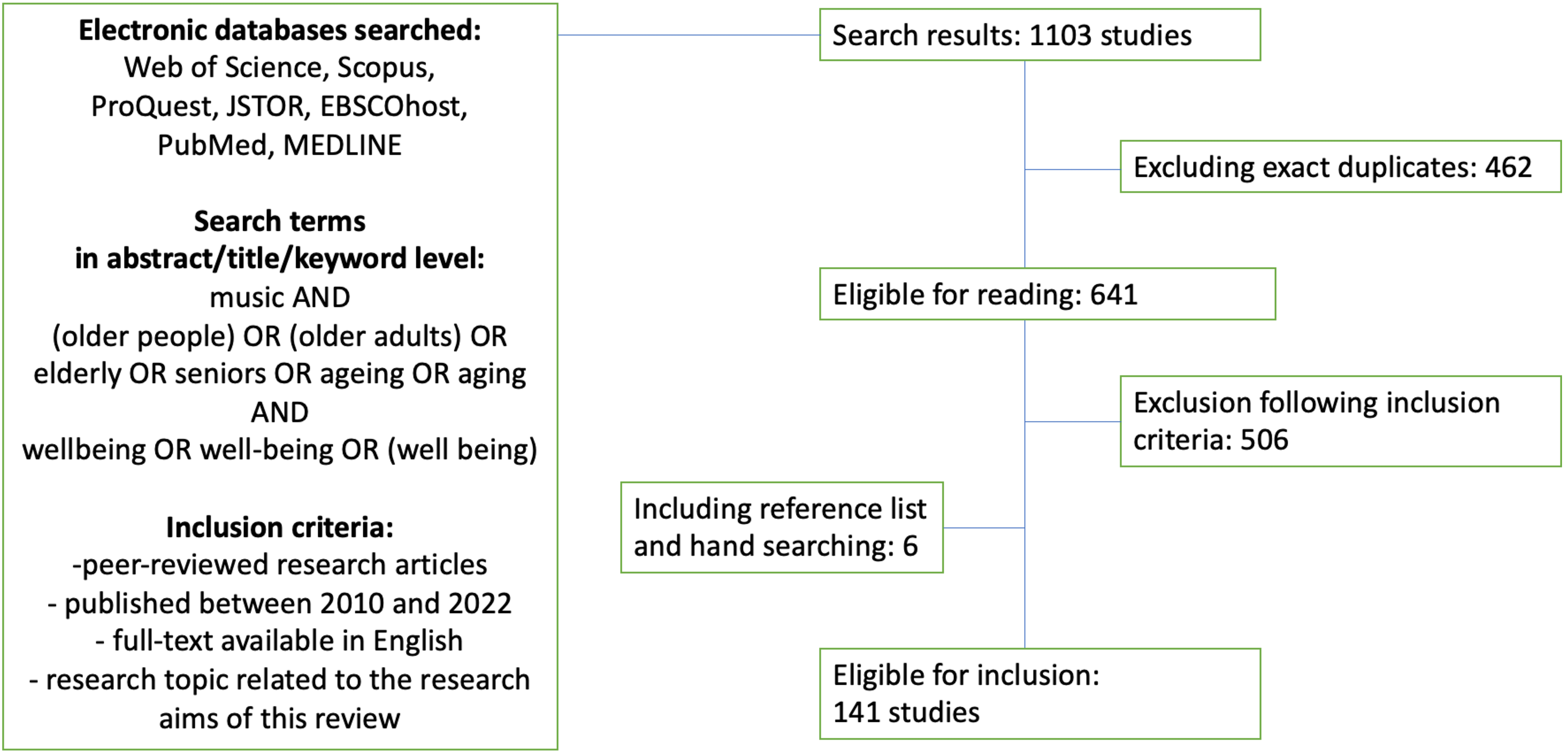
Search details and study extraction.
Data Analysis
Having read the included 141 articles in full, the first author entered details of each article into an Excel sheet. These included the authors, title and publishing details, country of origin, methodology/setting and possible measures, participants and sample size, the essential findings, and possible details regarding term definitions (wellbeing, music, older people). From this point on, the analysis was conducted in dialogue between both authors. As a first step in the analysis, we divided the sample roughly according to their approach, which led to three categories of clinical/rehabilitation studies, group musicking/group singing studies, and studies investigating music and subjective wellbeing of older individuals. Since we were interested in the existing evidence and especially psychosocial mechanisms supporting older adults’ wellbeing, we soon realized that the essential findings of these three categories overlapped and intertwined, leading to a variety of directions. After several rounds of re-reading, we reviewed, categorized, and combined the key findings to identify overarching themes and potential gaps in research. The analysis resulted in five categories of mechanisms relating to musical engagement, which are introduced in the substantive overview.
Findings
Descriptive Overview
Country of Origin and Methodological Approaches
The current sample of articles was published in 24 different countries, and quantitative research slightly outnumbered qualitative methods. The division of countries and methods can be seen in Table 1, where the category of other countries consisted of Singapore, Japan, Sweden, Ireland, Portugal, Netherlands, South Africa, Italy, Switzerland, Romania, Germany, Israel, Iran, Turkey, New Zealand, Norway, and France, with 1 to 3 results each (for further details, see Appendix 1).
Country of origin and division of methodological approaches of the sample.

Journals and Publishing Years
The 141 articles in our sample were published in 90 different journals. Twenty-two of the journals were in the research field of music or arts (49 articles) and altogether 50 journals were in the fields of medicine (38 articles) and geriatrics/gerontology (33 articles). As can be seen from Figure 2, the number of studies has risen significantly, from three studies published in 2010 to 22 studies published in 2021.
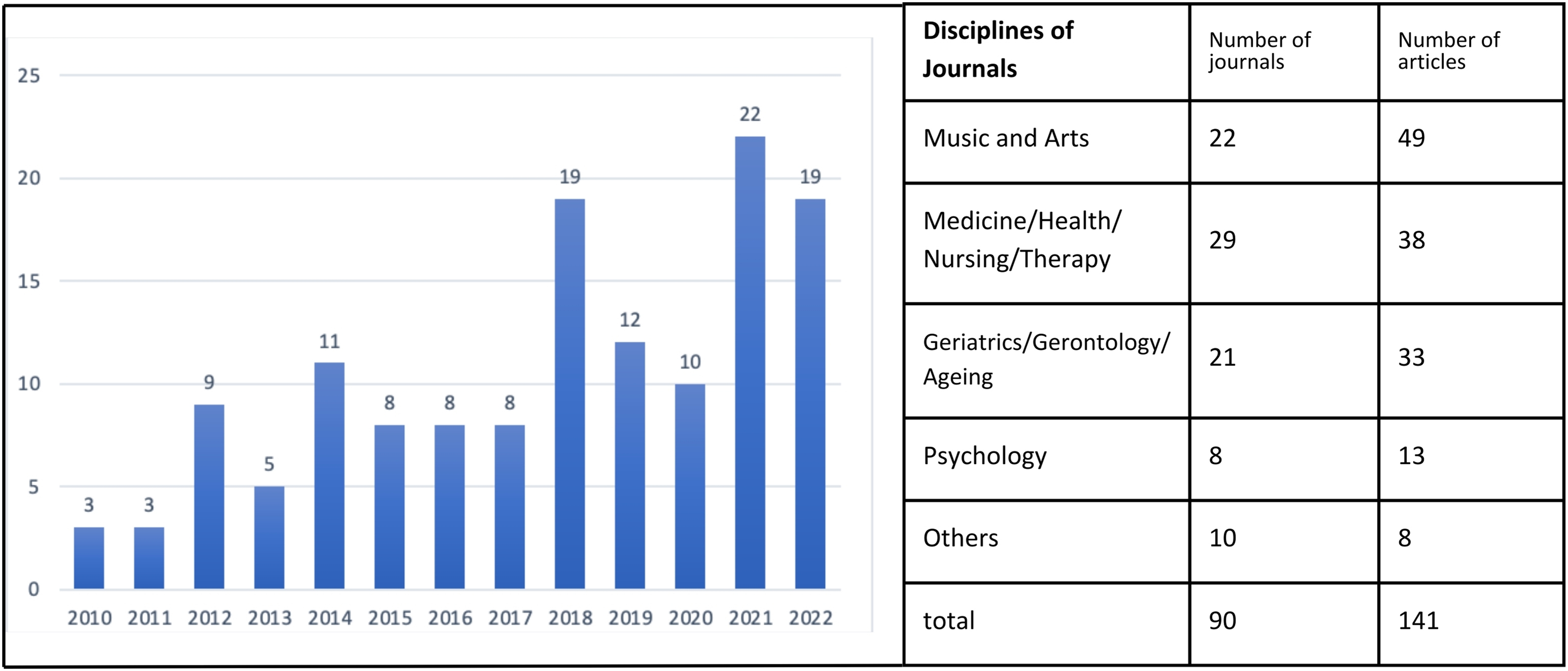
Publishing years and journals of the sample.
Research Interests and Characteristics
In this sample, we identified 51 interventions utilizing participatory group activities, most often group singing (e.g., Osman et al., 2016, who conducted a qualitative investigation of group singing's effects on people with dementia and their carers). Twenty-two studies in this sample were identified as medical/clinical interventions, typically including health-related measures (e.g., Särkämö et al., 2014; singing coaching group, music listening group and control group of people with dementia (n = 89), extensively assessed with neuropsychological measures and cognitive tests, mood, and QoL scales). Twenty-seven interventions focused on various matters, such as investigating nurses’ reflections on implementing music for the wellbeing of their patients (Batt-Rawden & Stedje, 2020). In 53 of the studies, a pre-post measurement was conducted, and 28 studies utilized interviews or surveys without an intervention. In 22 of the studies, wellbeing was approached primarily through health-related objective interpretations. Subjective wellbeing in its many forms exceeded this significantly, being the primary approach in 65 studies, investigated both in healthy and clinical populations. Fifty-four of the studies (reviews included) focused on both subjective and objective approaches.
In most of the studies, older adults themselves were the primary object, yet it was also popular to either include caregivers in the intervention or to elaborate on the effects of the interventions on them afterwards. A few studies focused on developing methods to introduce music into the lives of older adults (e.g., Engelbrecht et al., 2021). People with dementia or Alzheimer's were the main focus of 41 studies, and thus memory disorders were the most investigated topic in this sample. Dementia studies were diverse in form, varying from objective health and neurocognitive measurements to subjective and emotional research interests. The age range of people investigated in the studies of this sample was 52 to 101 years.
Similar to Dingle et al.'s (2021) notion regarding the diversity of the term music, our sample showed a large variety of musical activities used in previous studies. Group-based singing and music listening were the most popular activities in these studies, and mostly these were called “group singing” (e.g., Forbes, 2021), “music therapy” (e.g., Hsu et al., 2015), “music as therapy” (e.g., Lin et al., 2012), or “therapeutic use of music” (e.g., Engelbrecht et al., 2021), but also as “leisure activity” (e.g., Maury et al., 2022) or “inclusive participatory music activity” (Daykin et al., 2018). Music was also used to refer to singing, composing, musical training and performing, concert attendance, and discussion/reminiscence.
Substantive Overview
After analyzing the collected results of the current literature, we identified five main categories of mechanisms through which music may support wellbeing in this age group. These are (1) cognitive and physical rehabilitation through music; (2) social engagement in musical group activities; (3) individuals’ engagement with music for emotions, self-connection and meaning-making; (4) use of music for supporting the wellbeing of formal or informal caregivers and the social environment; and (5) enhancing accessibility and age-related adaptation. The main findings within these five categories are presented and discussed below.
Mechanism 1: Wellbeing Through Musical Interventions for Cognitive and Physical Rehabilitation
Music is commonly used for physical and cognitive rehabilitation within clinical populations, or to enhance the quality of life of people suffering from typically age-related diseases. The studies within this category emphasized quantitative measurements of both objective and subjective wellbeing, mostly focusing on “the oldest old” participants with specific diagnoses, and using various types of music interventions, such as group singing or receptive listening. People with memory disorders, such as dementia and Alzheimer's disease, were the most popular target groups within our sample.
Most of the musical interventions for treating dementia aimed at reducing negative symptoms. They were most often conducted in long-term or residential care settings, and the research design included the use of quantitative methods, external evaluations conducted by doctors or nurses, and neuro-psychiatric symptom measurements. The use of music was related to reducing depression symptoms and aggression, increasing sense of identity, improved mood and calmness, enhancing momentary lucidity, improving emotional state or wellbeing, supporting attention and executive function, providing novelty and learning opportunities, facilitating interpersonal relationships, and reducing risk of falling or need for antipsychotic drugs (Daykin et al., 2018; Murabayashi et al., 2019; Paolantonio et al., 2020, 2021; Popa et al., 2021; Ray & Götell, 2018; Särkämö et al., 2014). These interventions were most often executed in a (music) therapeutic context as active (singing, playing, dancing) or receptive (listening) engagement with music, with pre-post measurements. These results are in line with the conclusions presented in Elliott and Gardner's (2018) earlier review of dementia studies, where they identified music's influence on dementia patients through personhood in three key ways: (1) reduced agitation and disturbing behaviors such as verbal abuse or aggression, (2) improved cognition, and (3) enhanced social wellbeing (Elliott & Gardner, 2018). Some digital solutions were also offered, for example Cunningham et al. (2019) discovered positive changes in the behavior, ability, and routines of older adults with dementia as a result of using a music-related mobile app for promoting song–task association and reminiscing.
Some interventions did not achieve statistically significant differences. Of these, some failed to choose the right measures to make existing slight changes apparent, or they did recognize changes, but these vanished right after the musical activities were stopped (e.g., Castillejos & Godoy-Izquierdo, 2021; Cooke et al., 2010; Ho et al., 2019; Solé et al., 2014). Some stakeholders (nurses, children in intergenerational interventions) did not always have competence in interacting with people with dementia, who might tire out; get confused regarding times, places and artefacts; struggle with equipment or page turning; continually ask for absent people; wander around; or require constant eye contact to stay engaged (Davidson & Fedele, 2011; Shibazaki & Marshall, 2017). This might have affected the results of group-based activities, since dementia patients are likely to benefit most from activities in smaller groups or individually in more flexible settings (Galinha et al., 2021).
MacRitchie et al. (2020) reported that learning to play familiar songs on the piano seems to affect older individuals’ visuo-motor skills positively, but have a negative impact on more challenging executive skills, such as cognitive switching. Group-specific cohesion was also found to correlate with the results, suggesting that social relationships affect neurocognitive rehabilitation (MacRitchie et al., 2020). Jordan (2019) considered older people's music activities as social platforms that could lead to structural changes in the brain in long-term interventions, while also supporting cognitive abilities and emotional wellbeing with short-term initiatives. Hennessy et al. (2021) found that, after a choir-singing intervention with guided singing lessons, some positive neurophysiological changes were observed in older adults’ abilities of speech-in-noise perception based on the results of an active–passive syllable-in-noise task. However, when compared to a control group when, these improvements did not seem to have affected the adults’ wellbeing in quantitative measures (Ryff's Psychological Well-Being Scale, Dejong Giervald Loneliness Scale). In a live concert context, listening to chamber music reduced pain while increasing mood and energy, fostered connection and meaning, and created enjoyment and special moments with others within both cognitively intact and cognitively impaired older adults (Clements-Cortéz, 2017). The challenges in the field of music-related neurocognitive rehabilitation studies consist of publication and performance bias, small sample sizes, vagueness in duration and type of music activity, discrepancy in song selection, and general heterogeneity of methodology (Sihvonen et al., 2017; van der Steen et al., 2017).
In the rehabilitation context, music can be considered a tool to support patients’ own rehabilitative behavior, as it was, for instance, in Clark et al.'s study (2016), where older cardiac patients’ self-chosen playlists seemed to influence their exercise behavior in a positive way, and music led to both psycho-emotional and physical responses. Lin et al. (2012) noted that through physical changes such as respiration rate, adverse reactions and fingertip temperature, and social changes such as offering the patients a sense of participation in their own care and increasing interaction between patients and carers, it is possible to draw a correlation between music listening and the overall wellbeing of hemodialysis patients.
Mechanism 2: Wellbeing Through Social Engagement in Musical Group Activities
Social engagement as such might serve as a convincing indicator for wellbeing, with or without the significance of music. The results of this category came from studies focusing on group activities within non-clinical populations, but also from some clinical interventions that found improvement in communication and interaction after a music intervention. Many of the studies in this sample originated from English-speaking countries with mostly white female participants. Still, Corvo et al. (2020), for example, successfully transferred an English group-singing concept to Italy with encouraging results. In addition, Joseph and van Niekerk (2021) researched a South African upper-class retirees’ choir and found positive results regarding their wellbeing. Man et al. (2022) studied the wellbeing effects of active and passive engagement in Cantonese opera songs in a social context in China, and discovered active engagement to be more fruitful for the wellbeing and cognitive functions of the older adults involved. Studies conducted among racially and ethnically diverse choir singers had consistent results with prior studies on mostly white populations, yet a strong sense of cultural identity and multicultural appreciation was apparent in these more diverse groups (Allison et al., 2020; Johnson et al., 2020). The overall picture of research executed in different parts of the world seems to be unanimous in connecting group singing to positive wellbeing.
Attending regular and active group activities resulted in an increase of activated positive behaviors and wellbeing outcomes over time, with no statistically significant or music-specific differences to musical activity per se (see Maury & Rickard, 2018). On the other hand, especially choir participation can contribute to self-development and have a positive impact on encounters with challenges or illnesses, reported or subjective health, emotional states, sense of community, learning, fulfilment of life, reduction in social isolation, and increase in social connections of older adults (Joseph & Southcott, 2014; Southcott & Li, 2018; Teater & Baldwin, 2014). Choir singers report better ratings on quality of life and health when compared to older adults in general and with sociodemographic variables or leisure activity controlled for (Johnson et al., 2017).
Other forms of active engagement in music (playing, composing etc.) served as a place for learning, performing, and maintaining a sense of musicianship, instead of mere leisure. For instance, participation in songwriting groups provided experiences of a “pleasant life,” a life of engagement and possibilities for a deeper level of meaning-making (Baker & Ballantyne, 2013). Playing-learning groups also supported participants’ wellbeing by breaking down social isolation, enabling the enjoyment of the company of fellow participants, providing positive reinforcement and pleasure in learning and achievements, and supporting physical activity and autonomy (Ellis, 2018; Hallam & Creech, 2016). For these older participants, considering oneself to be an active agent in learning or making a musical contribution might have been a new experience. As a result, receiving validation and recognition from peers, the audience, and facilitators was seen as significantly increasing their subjective wellbeing (Habron et al., 2013; Hallam & Creech, 2016; Joseph & Southcott, 2018; Lamont et al., 2018). It seems essential that these activities are goal-oriented, since especially older musicians benefit from having the opportunity to actively rehearse, plan, prepare and perform (Joseph, 2021).
Musical social engagement appears to be strongly associated with positive impacts on wellbeing, with only a few exceptions. Facilitated online group singing resulted in many equivalent benefits for older people, but some digital exclusion was detected due to poor connections or challenges in using the equipment (Lee et al., 2021). In Lindblad's (2021) study, engaging in a regular music listening and conversation group did not correlate with social bonding or emotional expressions among a group of elderly men with loneliness issues and hearing impairment. Furthermore, socioeconomic factors might affect the possibilities to participate in these music learning groups and interventions, which can further have a biased effect on the research. For instance, Perkins and Williamon (2014) found that higher socioeconomic status correlated with more positive changes in experienced wellbeing and health choices in older adults after a music learning intervention. Throughout the current sample, white females and people on the higher end of the education and socioeconomic scale were more represented than other groups were in both the participatory activities and the research conducted within them. Information about the existence of singing groups, choirs and possibilities for attendance might not reach those people who are not already active (Hallam & Creech, 2016). They are therefore prevented from gaining the social benefits that the participation in musical group activities could provide.
Mechanism 3: Wellbeing Through Music-Evoked Emotions, Self-Connection, and Meaning-Making
The emotional impacts of musical engagement have repeatedly been associated with wellbeing (for a recent review, see Dingle et al., 2021). In our sample, this mechanism was also evident, and the amount of studies focusing on the emotional dimensions of wellbeing was significant. They were often approached through self-evaluation scales, interviews, and focus groups. In these studies, subjective wellbeing was emphasized over objective measures, and hedonic and eudaimonic aspects of wellbeing were intertwined with meaning-making processes and the sense of self-connection that various forms of musical engagement were supporting.
Jang and Kunde (2021) delivered a systematic review of music therapy interventions that addressed the emotional needs of older adults and calculated that 95% of their sample (n = 20) showed positive results. Musical engagement brought a sense of continuity, supported autonomous learning, and helped participants to reconnect with memories and sustain and re-discover their musical selves, thereby offering possibilities for older adults’ identity work and self-concept (Creech et al., 2013a, 2013b, 2014). Lindblad and de Boise (2020) found that among aging men, music seemed to provide means for filling deep psychological, social, and emotional needs—regardless of musical genres or the level of activity required in music engagement (listening, dancing, singing, or talking about music). Music had a supporting effect on their emotions, embodiment, adjusting to getting old, developing and maintaining friendships and maintaining contact as the caregiver to an ill spouse, all of which facilitated their subjective wellbeing (Lindblad & de Boise, 2020). Aging may also bring new needs for transcendence and spirituality; especially religious music can provide means to decrease the fear of death and gain a feeling of control over one's life (Bradshaw, 2015).
Active engagement with music, alone or in a group, can offer possibilities for individual growth and emotional labor. Music learning was found to have hedonic and eudaimonic meanings by bringing both short-term/immediate pleasure and long-term satisfaction, feelings of progression and enhancement (Perkins & Williamon, 2014). Intense piano training correlated with positive changes in domain-specific (i.e., musical) self-efficacy, which was seen as contributing to successful aging (Bugos et al., 2016). Group singing seemed to address the emotional wellbeing of many older singers by providing a more positive attitude to life and self-confidence, while helping them gain a sense of belonging and being part of a group, even a family. For immigrant singers, it was also a way to reconnect with their culture and language (Joseph & Southcott, 2014, 2015). Since music has the ability to evoke vibrant pictures and memories, reminiscing with music was described as supporting identity work, lifespan sketching, and successful aging (Dassa, 2018; Engelbrecht et al., 2021; Kruse, 2021). In Iran, music listening was connected to hedonic wellbeing via increased happiness dimensions such as life satisfaction and self-esteem (Hazratian & Motaghi, 2022).
Negative emotions were rarely reported, but Lamont et al. (2018) observed, through a 4-year longitudinal study with an aging choir, that even when group singing activities provided musical achievements, meaning to life, and a supportive and inclusive community, there was the presence of negative emotions after the rehearsal, with some participants left with a flat feeling afterwards (Lamont et al., 2018). Reminiscing also had risks of producing unsettling, troubling, or bittersweet emotional memories (Kruse, 2021). Hence an individual's or the environment's resources in confronting, managing and overcoming such natural emotions might be significant for their wellbeing.
Mechanism 4: Wellbeing Through Affluent Social Environments Supported by Music
The wellbeing of older adults is partly dependent on other people and the operational environments around them. Music can affect the wellbeing of these third parties, and thus have an indirect, positive effect on their patients’ or loved ones’ quality of life. This finding was repeated in several studies, also as a secondary or even unexpected result. The positive effects on caregivers’ wellbeing were often a result of being exposed to music or actively engaging with music in their operational environment, but indirect benefits were also gained when patients’ attitudes developed in a more favorable direction or when musical interventions were responsible for other positive changes in the atmosphere.
Lee et al. (2022) conclude that singing and music interventions can improve family carers’ social and emotional wellbeing and foster a coping and caring relationship towards spouses or parents with dementia, yet this under-researched area needs larger and more rigorous studies. Musical engagement, such as music listening or group singing together, with their loved ones can increase the caregiver's self-esteem, decrease loneliness, and ease their anxiety and agitation (Elliott & Gardner, 2018). Shared music-related actions can provide a refreshing moment of positive engagement, intimate quality time, and interaction between dementia patients and their caregivers, all of which support reciprocity and engagement in a way that was familiar to them from the time before dementia (Baker et al., 2012; Roy et al., 2019). Forbes (2021) highlights how important it is for caregivers to regularly see their spouse (or patient) in a positive light, as a person who is capable of enjoying, sharing and reconnecting with others, and how this could lead to encouraged mutual activity outside of the music classes as well. Belonging to a music group together with their ill spouses gave these caregivers a sense of purpose and agency, complemented by peer support (Forbes, 2021).
These effects are achieved through relatively light arrangements. For example, Bufalini et al. (2022) reported that, after weekly 5-song listening moments with the patient, there was a positive change in the interaction of patient–caregiver dyads and a decrease in caretakers’ illness-related frustration and feelings of being overwhelmed. Similar to helping formal caregivers, the burden of informal caregivers can also be lightened indirectly through music. In a 4-week intervention, Lewis et al. (2015) found that when dementia patients in everyday homecare settings listened to a personalized MP3 playlist by themselves, it had a calming effect, but even more, it decreased the stress levels of their family caregivers.
Intergenerational music-related interventions among younger and older participants, of which some were taking place online, were able to increase aspects of subjective wellbeing among the aging individuals, but they also succeeded in changing the attitudes of both age groups towards the other to a more positive tone (Belgrave & Keown, 2018; Chowdhury et al., 2022; de Vries, 2012). Presumably, more positive attitudes and mutual understanding between generations is likely to contribute to the wellbeing of the older adults.
On an organizational level, the positive impacts of music have been emphasized by doctors and professional carers (Daykin et al., 2018; Garrido et al., 2021). The carers have reported their patients benefiting from music and singing, as these activities reduced their “uneasiness,” increased comfort and joy, improved sleep, and had a potential for reducing accidents and the need for medication, which further contributed to the fluency of the staff's work (Batt-Rawden & Stedje, 2020). Both Sung et al. (2011) and Shibazaki and Marshall (2017) noticed that music interventions or concerts can alter the working environment and general atmosphere, even without any first-hand music exposure: both participants and nurses behaved in a more relaxed manner after music sessions, which seemed to decrease anxiety levels and calm the behavior of the whole unit, non-participants included.
A number of studies have reported that staff's working motivation is supported by seeing the capabilities, success and enjoyment of the patients, recognizing positive changes in their behavior and mood, and gaining personal pleasure from both music and from seeing these impacts in patients. Participating in musical activities together with older adults has also supported their interaction, self-expression, and person-centered care, benefited the psychosocial working climate, and enhanced favorable attitudes towards creative activities (Batt-Rawden & Stedje, 2020; Hsu et al., 2015). Still, many nurses reported they do not have the resources to continue musical activities as a part of their work after temporary interventions, and expressed the need for further training to help them embrace music as a part of holistic care, choose the right music, and recognize the signs of effects in patients (Garrido et al., 2021). The task of implementing music in the daily life of older patients could be eased by using music session models designed specifically for this age group. For instance, Davidson and Fedele (2011) have introduced a holistic group singing session plan with physical warm-up tasks, guidelines for individual interaction and repertoire choices, and practical notions such as hydration and rest pauses.
Mechanism 5: Wellbeing Through Accessibility and Adaptation to Age-Related Changes
Since aging comes with inevitable physiological and psychological changes, understanding the context, facilities, and often decreasing physical and mental abilities of older adults is crucial when designing musical activities and planning interventions. Many older participants struggle with cognitive functioning, standing, carrying an instrument, using fingers distinctively, overcoming technical tasks, conquering aches and arthritis, and seeing the notes or hearing correctly (Barbeau & Cossette, 2019; Dassa, 2018; Ellis, 2018). Moreover, in music listening interventions carried out in nursing homes, many of the participants were incapable of using music equipment due to sensory impairments and lack of mobility, which left them dependent on the help of nursing staff. The role of the facilitator and a safe and encouraging atmosphere is emphasized in order to overcome special needs, limitations or negative emotional experiences, and to feel safe and celebrated (Barbeau & Cossette, 2019; Krause & Davidson, 2021; Paolantonio et al., 2021; Perkins & Williamon, 2014). Music and sufficiently facilitated activities around music might be a soothing force for the range of changes encountered at this stage of aging, including health-related declines. According to Osman et al.'s (2016) group singing participants, group singing meetings with peers can help individuals to accept their dementia diagnosis and to adjust to this life-changing situation.
Attending choirs, even when the ability to sing has severely decreased, might provide opportunities for social contacts and foster feelings of agency, and thus increase wellbeing for older people (Southcott & Nethsinghe, 2019). In this way, musical engagement serves as a way of coping with aging. From the preventive point of view, musical training in earlier stages of life might help with age-related changes of declining grey matter, as musical training is significantly associated with the volume of several parts of the brain involved with function, memory, language, and emotion (Chaddock-Heyman et al., 2021). Musical training can also maintain complex listening and hearing abilities, since it might delay or even diminish declines in auditory perception, and thus counteract age-related changes (Alain et al., 2014).
Music-related interventions may also result in the enhancement of accessibility. For example, Hung et al. (2021) tested the feasibility of delivering music in a group context through silent disco headphones in a geriatric hospital unit. Even though the staff initially reported some reluctance to adopt any new practices that would increase their workload, they later felt their work was made easier by these practices. Wearing the headphones turned out to help patients overcome their physical impairments and interaction challenges, as they helped patients to hear the music correctly and encouraged them to truly participate in singing, dancing/moving and choosing songs (Hung et al., 2021). Shibazaki and Marshall (2017) noted that receptive musical engagement seemed to be one of the only activities where impaired and immobile individuals could participate “100 per cent.”
Discussion and Conclusions
In this article, we have provided an overview of the research investigating the uses of music for supporting older adults’ good quality of life and wellbeing. The results of this scoping review indicate a strong connection between music engagement and the subjective and objective wellbeing of older people, both within clinical populations and healthy older adults. In our sample, the diversity of the concept of wellbeing became evident, and both objective and subjective wellbeing were well represented (though not always defined), and were often intertwined in empirical studies. Subjective wellbeing was both a primary focus of the majority of the studies, and also an added value for many of the more clinical studies that focused on objective wellbeing. Furthermore, there was a large variety of musical activities used in the studies, which was not surprising considering the status quo of music and wellbeing research focusing on any age group (see Dingle et al., 2021; MacDonald et al., 2012).
Through our analysis, we first identified three types of research approaches, followed by the identification of five mechanisms through which music can support older adults’ wellbeing (see Figure 3). Musical engagement can be used for (1) achieving cognitive or physical rehabilitation, which might enhance the health and both objective and subjective wellbeing of an individual; (2) increasing social engagement and contacts through group activities and forums of common interests; (3) reinforcing subjective and emotional wellbeing through life satisfaction and self-connection; (4) supporting the wellbeing of the caregivers, staff members, and family members working in operational environments, which might contribute to the quality of life for both parties; and (5) enhancing accessibility and adaptation to age and health-related changes for the benefit of both older people and their surroundings. Mechanisms (1) and (3) have effects on an individual level, while (2) and (4) include other people and social relationships. The fifth mechanism could be seen as an underlying force, enabling the occurrence of music-related benefits. This dimension of accessibility and adaptation could be seen as a practical form of Ruud's (2002, 2013) conception of music as a cultural immunogen, where music and musical activities help an individual balance between their inner world and outer circumstances. We believe that by supporting participation, adaptation and accessibility, forums for individual appropriation and the affordances introduced by DeNora (2007) can be created and maintained.

Main research approaches and the identified mechanisms.
When comparing the results of our sample to the recent review by Dingle et al. (2021) of studies examining how different musical activities affect psychosocial mechanisms relevant for wellbeing, it is easy to find similarities between these two. Especially the mechanisms of emotion/mood, cognitive, self-esteem/achievement, and social connection (Dingle et al., 2021) were prevalent in the studies focusing on older adults’ wellbeing, but the age-specific differences stand out when it comes to the most suitable activities and realistic ways of participation. The strong emphasis on memory disorders and rehabilitation in our sample illustrates how old age includes various illnesses, and that music can be an effective way of treating them. In our sample, qualitative methods used to investigate subjective wellbeing resulted in highly positive results throughout the sample, whereas objective health measurements did not always result in statistically significant changes. Choosing the right measures and methods for each research interest seems to be crucial.
Considering the significant opportunity for cross-disciplinary collaboration between health and music research, there also seems to be a lack of consistency in methodological and theoretical approaches when researching this undefined topic, partly because of the fragmented or absent definitions of essential variables, such as wellbeing or aging—or even music. The five mechanisms recognized through our analysis reveal the variety of ways of defining (or sometimes the absence of a definition of) wellbeing. In this sample, indicators for wellbeing derived from hormonal changes in saliva (e.g., Bugos et al., 2016) or neurophysiological improvement (e.g., Hennessy et al., 2021) to subjective sensations of happiness and life satisfaction, social inclusion, self-esteem, and coping with aging. Wellbeing was, as expected, often intertwined with the term quality of life. Aging or old age were often not really defined variables, but informants were recruited based on a diagnosis, such as dementia or Alzheimer's, or life stage/ability-related issues, such as residential living instead. Although these conditions commonly occur among older people, they are still not age-specific. The studies focusing on subjective and emotional wellbeing tended to define aging as a phenomenon in a clearer manner, whereas the diagnosis-based studies focused less on aging and more on symptoms. Music, on the other hand, encompassed various activities with differing levels of participation, from receptive music listening to active instrument playing or social group singing.
Multiple studies focused on healthy attendants or on people who do not suffer from hearing loss or visual impairment, for example (e.g., Chaddock-Heyman et al., 2021; Man et al., 2022). While age-related physical and cognitive decline and health-related challenges are known to be common, this inclusion criterion might affect the results or generalizability, yet it is well understandable due to the practical execution of these interventions. In the future, it would be fruitful to conduct music-related research also among people with diverse age-related changes, such as sensory impairments. Extending musical interventions into more natural social environments would give a more realistic view of the needs of older people, also outside well-established choirs, bands, and homogenous populations. Understanding the needs of diverse older populations, as age groups and as individuals, and supporting their agency and accessibility are vital in implementing musical activities and research designs. Furthermore, acknowledging the effects of sociodemographic factors is crucial for accessibility if we want to promote more diverse participation and also reach those older adults who are not already active (see also Hallam & Creech, 2016). As it seems that the majority of music and wellbeing research is conducted in western, English-speaking countries, we must enhance the diversity in research as well. This might be accomplished through collaboration, and, yet again, via the clarification of concepts and methodology.
The limitations of this review also need to be addressed. Firstly, the inclusion/exclusion criteria of our dataset affected our findings. Since we initially searched only for studies focusing on wellbeing and not rehabilitation per se, multiple studies conducted within clinical settings might have been excluded from our investigation. The vast number of publications emphasized music's role in rehabilitation, so it is likely that even more evidence can be found based on the research conducted in the fields of health and medicine. The scope of this review is, furthermore, broad, since we included both studies on healthy aging and studies on older adults with health problems. There are previous literature reviews with a more specific focus (older adults with dementia, controlled trials etc.), so we could have excluded these medical and clinical studies altogether, and focused only on the non-clinical population. However, since a large part of the hits of our database searches were about rehabilitative studies, we found it important to include them, because it enabled us to illustrate the larger research perspective on music's role in aging. Secondly, the scoping review as a method does not focus on the quality of the literature under investigation (Arksey & O’Malley, 2005). On the other hand, focusing on the state of research activity instead of on the quality can also be seen as the strength of the method (see Levac et al., 2010). Finally, it is important to point out that our positions as researchers with backgrounds in music psychology and music sociology might have affected both the selection of our sample as well as our interpretations, despite our best intentions to maintain as objective an approach as possible.
The current review gives a convincing picture of music's positive effects on the wellbeing of older adults, yet it does not exhaustively guarantee these effects on the aging population in all its diversity. It is clear that musical activities should always be arranged for people on their own terms and by carefully considering multiple aspects regarding accessibility in these activities. However, more conceptual clarity is needed for future research if the field wishes to develop more rigorous research designs for understanding the effects of music engagement on older people's wellbeing. The current variety of methods and terms might diminish the comparability of the accumulating results. Nevertheless, we find it even more important to remember that growing old does not necessarily equal increasing decay and illnesses. In our current reality, where life expectancy is increasing and healthy aging is progressively more common, the role of music in older adults’ everyday life deserves more scientific attention.
Footnotes
Action Editor
Jörg Fachner, Anglia Ruskin University, Cambridge Institute for Music Therapy Research
Peer Review
Julie Kolbe Krøier, Aalborg University Two anonymous reviewers
Declaration of Conflicting Interests
The authors declared no potential conflicts of interest with respect to the research, authorship, and/or publication of this article.
Ethical Approval
This research did not require ethics committee or IRB approval. This research did not involve the use of personal data, fieldwork, or experiments involving human or animal participants, or work with children, vulnerable individuals, or clinical populations.
Funding
The author(s) disclosed receipt of the following financial support for the research, authorship, and/or publication of this article: This work was supported by the Research Council of Finland, Centre of Excellence in Music, Mind, Body and Brain, (grant number 346210).
Data Availability Statement
Data sharing not applicable to this article as no datasets were generated or analyzed during the current study.

Appendix 1

| Authors | Title |
|
|
|
|
|
|
|---|---|---|---|---|---|---|---|
| Alain, C., Zenddel, B. R., Hutka, S., Bidelman, G. M. | Turning down the noise: The benefit of musical training on the aging auditory brain | 2014 | Hearing research | Vol. 308, p. 162-173 | Canada | Review | 10.1016/j.heares.2013.06.008 |
| Allison, T. A., Nápoles, A. M., Johnson, J., Steward, A. L., Rodriguez-Sala, M., Peringer, J., Sherman, S., Ortez-Alfaro, J., Villero, O., Portacolone, E. | Multi-cultural perspectives on group singing among diverse older adults | 2020 | Geriatric Nursing | Vol. 41 (6), p. 1006–1012 | USA | Qualitative | 10.1016/j.gerinurse.2020.07.011 |
| Baker, F. A., Ballantyne, J. | “You’ve got to accentuate the positive”: Group songwriting to promote a life of enjoyment, engagement and meaning in aging Australians | 2012 | Nordic Journal of Music Therapy | Vol. 22 (1), p. 7–24 | Australia | Mixed | 10.1080/08098131.2012.678372 |
| Baker, F. A., Grocke, D., Pachana, N. A., Clair, A. A. | Connecting through music: A study of a spousal caregiver-directed music intervention designed to prolong fulfilling relationships in couples where on person has dementia | 2019 | The Australian Journal of Music Therapy | Vol. 23, p. 4–21 | Australia | Mixed | |
| Barbeau, A.-K., Cossette, I. | The effects of participating in a community concert band on a senior citizen's quality of life, mental and physical health | 2019 | International Journal of Community Music | Vol. 12 (2), p. 269–288 | Canada | Mixed | 10.1386/ijcm.12.2.269_1 |
| Batt-Rawden, K. B., Stedje, K. | Singing as health-promoting activity in elderly care: a qualitative, longitudinal study in Norway | 2020 | Journal of Research in Nursing | Vol. 25 (5), p. 404–418 | Norway | Qualitative | 10.1177/1744987120917430 |
| Batt-Rawden, K. B, Stoerlien, M. | Systematic Use of Music as an Environmental Intervention and Quality of Care in Nursing Homes: A Qualitative Case Study in Norway | 2019 | Medicines | Vol. 6 (12) | Norway | Qualitative | 10.3390/medicines6010012 |
| Belgrave, M. J., Kewon, D. J. | Examining cross-age experiences in a distance-based intergenerational music project: comfort and expectations in collaborating with opposite generation through “virtual” exchanges | 2018 | Frontiers in Medicine | Vol. 5, p. 1–9 | USA | Mixed | 10.3389/fmed.2018.00214 |
| Bradshaw, M., Ellison, C. G., Fang, Q., Mueller, C. | Listening to religious music and mental health in later life | 2015 | The Gerontologist | Vol. 55 (6), p. 961–971 | USA | Quantitative | 10.1093/geront/gnu020 |
| Bufalini, J., Eslinger, P., Lehman, E., George, D. R. | Effects of a personalized music intervention for persons with dementia and their caregivers | 2022 | Journal of Alzheimer's Disease Reports | Vol. 6 (1), p. 43–48 | USA | Mixed | 10.3233/ADR-210043 |
| Bugos, J. A., Wang, Y. | Piano training enhances executive functions and psychosocial outcomes in aging: results of a randomized, controlled study | 2022 | Journals of Gerontology Series | Vol. 88 (9), p. 1625–1636 | USA | Quantitative | 10.1093/geronb/gbac021 |
| Bugos, J. A., Kochar, S., Maxfield, N. | Intense piano training on self-efficacy and physiosociological stress in aging | 2016 | Psychology of Music | Vol. 44 (4), p. 611–624 | USA | Quantitative | 10.1177/0305735615577250 |
| Castillejos, C., Godoy-Izquierdo, D. | “Music makes my old heart beat”: A randomised controlled study on the benefits of the use of music in comprehensive care for institutionalised older adults | 2021 | Applied Psychology: Health and Well-being | Vol. 13 (1), p. 84–108 | Spain | Quantitative | 10.1111/aphw.12217 |
| Chaddock-Heyman, L., Loui, P., Weng, T. B., Weisshappel, R., McAuley, E., Kramer, A. F. | Musical training and brain volume in older adults | 2021 | Brain Sciences | Vol. 11 (1), p. 50 | USA | Quantitative | 10.3390/brainsci11010050 |
| Chen, X., Huang, F., Wang, Y. | The Integration and Development of Piano Art and Media Education and Its Influence on the Long-Term Care and Happiness of the Elderly People | 2021 | Frontiers in Psychology | Vol. 12 | China | Quantitative | 10.3389/fpsyg.2021.593835 |
| Cheong, C. Y., Tan, J. A. Q., Foong, Y.-L., Koh, H.M., Chen, D. Z. Y., Tan, J. J. C., Ng, C. J., Yap, P. | Creative music therapy in an acute care setting for older patients with delirium and dementia | 2016 | Dementia and Geriatric Cognitive Disorders Extra | Vol. 6 (2),p. 268–275 | Singapore | Quantitative | 10.1159/000445883 |
| Cho, H. K. | The effects of music therapy-singing group on quality of life and affect of persons with dementia: a randomised controlled trial | 2018 | Frontiers in Medicine | Vol. 5, p. 279 | USA | Quantitative | 10.3389/fmed.2018.00279 |
| Chowdhury, N., Latulipe, C., Young, J. E. | Music co-listening over video chat to support intergenerational connectedness: an exploratory study | 2022 | Gerontechnology | Vol. 21 (1) | Canada | Qualitative | 10.4017/GT.2023.21.1.778.03 |
| Clark, I. N., Baker, F. A., Taylor, N. F. | Older adults’ music listening preferences to support physical activity following cardiac rehabilitation | 2016 | Journal of Music Therapy | Vol. 53 (4), 364–397 | Australia | Qualitative | 10.1093/jmt/thw011 |
| Clemént, S., Tonini, A., Khatir, F., Schiatura, L, Samson, S. | Short and longer term effects of musical intervention in severe Alzheimer's disease | 2012 | Music Perception | Vol. 29 (5), p. 533–541 | France | Quantitative | 10.1525/mp.2012.29.5.533 |
| Clements-Cortéz, A. | Clinical Effects of Choral Singing for Older Adults | 2015 | Music and medicine | Vol.8 (4), p. 7–12 | Canada | Review | 10.47513/mmd.v7i4.437 |
| Clements-Cortéz, A. | Artful wellness: attending chamber music concert reduces pain and increases mood and energy for older adults | 2017 | The Arts in Psychotherapy | Vol. 52 p. 41–49 | Canada | Mixed | 10.1016/j.aip.2016.10.001 |
| Cooke, M., Moyle, W., Shum, D., Harrison, S., Murfield, J. | A randomised controlled trial exploring the effect of music on quality of life and depression in older people with dementia | 2010 | Journal of Health Psychology | Vol. 15 (5), p. 765–776 | Australia | Quantitative | 10.1177/1359105310368188 |
| Corvo, E., Skingley, A., Clift, S. | Community singing, wellbeing and older people: implementing and evaluating an English singing for health intervention in Rome | 2020 | Perspectives on Public Health | Vol. 140 (5), p. 264–269 | Italy/UK | Quantitative | 10.1177/1757913920925834 |
| Coulton, S., Clift, S., Skingley, A., Rodrigues, J. | Effectiveness and cost-effectiveness of community singing on mental health-related quality of life of older people: randomised controlled trial | 2015 | British Journal of Psychiatry | Vol. 207 (3), p. 250–255 | UK | Quantitative | 10.1192/bjp.bp.113.129908 |
| Creech, A., Hallam. S., McQueen, H., Varvarigou, M. | The Power of Music in the lives of Older Adults | 2013 | Research Studies in Music Education | Vol. 35 (1), 87–102 | UK | Review | 10.1177/1321103X13478862 |
| Creech, A., Hallam. S., Varvavrigou, McQueen, H., M., Gaunt, H | Active Music Making: a route to enhanced subjective well-being among older people | 2013 | Perspectives on Public Health | Vol. 133 (1), p. 36–43 | UK | Quantitative | 10.1177/1757913912466950 |
| Creech, A., Hallam. S., Varvavrigou, M., Gaunt, H., McQueen, H., Pincas, A. | The role of musical possible selves in supporting subjective well-being in later life | 2014 | Music Education Research | Vol. 16 (1), p. 32–49 | UK | Mixed | 10.1080/14613808.2013.788143 |
| Creech, A., Larouche, K., Generale, M., Fortier, D. | Creativity, music, and quality of later life: A systematic review | 2020 | Psychology of Music | Vol. 51 (4) | Canada | Review | 10.1177/0305735620948114 |
| Cunningham, S., Brill, M., Whalley, J. H., Anderson, G., Edwards, S., Picking, R. | Assessing wellbeing in people living with dementia using reminiscence music with a mobile app (Memory Tracks): A mixed methods cohort study | 2019 | Journal of Healthcare Engineering | Vol. 2019, p. 8924273–10 | UK | Mixed | 10.1155/2019/8924273 |
| Dassa, A. | Musical Auto-Biography interview (MABI) as promoting self-identity and well-being in the elderly through music and reminiscence | 2018 | Nordic Journal of Music Therapy | Vol. 27 (5), p. 419.-430 | Israel | Qualitative | 10.1080/08098131.2018.1490921 |
| Davidson, J., McNamara, B., Rosenwax, L., Lange, A., Jenkins, S., Lewin, G. | Evaluating the potential of group singing to enhance the well-being of older people | 2014 | Evaluating the potential of group singing to enhance the well-being of older people | Vol. 33 (2), p. 99–104 | Australia | Mixed | 10.1111/j.1741–6612.2012.00645.x |
| Davidson, J. W., Fedele, J. | Investigating group singing activity with people with dementia and their caregivers: Problems and positive prospects | 2011 | Musicae Scientiae | Vol. 15 (3), p. 402–422 | Australia | Mixed | 10.1177/1029864911410954 |
| Daykin, N., Parry, B., Ball, K., Walters, D., Henry, A., Platten, B., Hayden, R. | The role of participatory music making in supporting people with dementia in hospital environments | 2018 | Dementia | Vol. 17 (6), p. 686–701 | UK | Mixed | 10.1177/1471301217739722 |
| de Vries, P. | Intergenerational Music Making: a phenomenological study of three older Australians making music with children | 2012 | Journal of Research in Music Education | Vol. 59 (4), p. 339–356 | Australia | Qualitative | 10.1177/0022429411423581 |
| Dorris, J. L., Neely, S., Terhorst, L., VonVille, H. M., Rodakowski, J | Effects of music participation for mild cognitive impairment and dementia: A systematic review and meta-analysis | 2021 | Journal of American Geriatrics Society | Vol. 69 (9), p. 2659–2667 | USA | Review | 10.1111/jgs.17208 |
| Dowson, B., McDermott, O., Schneider, J. | What indicators have been used to evaluate the impact of music on the health and wellbeing of people with dementia? A review using metanarrative methods | 2019 | Maturitas | Vol. 127, p. 26–34 | UK | Review | 10.1016/j.maturitas.2019.06.001 |
| Eells, K. | The use of music and singing to help manage anxiety in older adults | 2018 | Mental Health Practice | Vol. 17 (5), p. 10–17 | UK | Review | 10.7748/mhp2014.02.17.5.10.e861 |
| Elliott, M., Gardner, P. | The role of music in the lives of older adults with dementia ageing in place: A scoping review | 2018 | Dementia | Vol. 17 (2), p. 199–213 | Canada | Review | 10.1177/1471301216639424 |
| Ellis, B. | Music learning for fun and wellbeing at any age! | 2018 | Australian Journal of Adult Learning | Vol. 58 (1) | Australia | Mixed | |
| Engelbrecht, B., Ciorciari, . | Music-Assisted Reminiscence Therapy with older adults: Feasibility, acceptability, and outcomes | 2022 | Music Therapy Perspectives | Vol. 41(1), 37–46. | Australia | Mixed | 10.1093/mtp/miac021 |
| Engelbrecht, R., Bhar, S., Ciorciari, J. | Planting a SEED: a model to describe the functions of music in reminiscence therapy | 2021 | Complementary Therapies in Clinical Practice | Vol. 44, p. 101441 | Australia | Qualitative | 10.1016/j.ctcp.2021.101441 |
| Ergin, E., Çinar Yüzel, S. | The effect of music on the comfort and anxiety of older adults living in a nursing home in Turkey | 2019 | Journal of Religion and Health | Vol. 58 (4), p. 1401–1414 | Turkey | Quantitative | 10.1007/s10943–019-00811-z |
| Forbes, M. | “We’re pushing back”: Group singing, social identity, and caring for a spouse with Parkinson's | 2021 | Psychology of Music | Vol. 49 (5), 1199–1214 | Australia | Qualitative | 10.1177/0305735620944230 |
| Fourie, C., Van Der Merwe, L., Swart, I. | Frontal lobe brain damage and the lived piano-playing experiences of an older adult | 2016 | Muziki | Vol. 13 (2), p. 108–129 | South Africa | Qualitative | 10.1080/18125980.2016.1182393 |
| Galinha, I. C., Fernandes, H. M., Lima, M. L., Palmeira, A. L. | Intervention and mediation effects of a community-based singing group on older adults’ perceived physical and mental health: the Sing4Health randomized controlled trial | 2021 | Psychology & Health | Vol. 38 (1), p. 1–21 | Portugal | Quantitative | 10.1080/08870446.2021.1955117 |
| Galinha, I. C., Fernandes, H. M., Lima, M. L., Palmeira, A. L. | Sing4Health: Randomised controlled trial of the effects of a singing group program on the subjective and social well-being of older adults | 2022 | Applied Psychology: Health and Well-Being | Vol. 14 (1), p. 176–195 | Portugal | Mixed | 10.1111/aphw.12297 |
| Garabedian, C. E., Kelly, F. | Haven: Sharing receptive music listening to foster connections and wellbeing for people with dementia who are nearing the end of life, and those who care for them | 2018 | Dementia | Vol. 19 (5), p. 1657–1671 | UK | Qualitative | 10.1177/1471301218804728 |
| Garrido, S., Markwell, H., Andreallo, F., Hatcher, D. | Benefits, Challenges and Solutions for Implementing Personalised Music Playlist Programs in Residential Aged Care in Australia | 2021 | Journal of Multidisciplinary Healthcare | Vol. 14, p. 1193–1204 | Australia | Qualitative | 10.2147/JMDH.S293764 |
| Gomaa, Y. S., Wittwer, J. E., Grenfell, R. J., Sawan, S. A., Morris, M. E. | Music Cued Exercises for People Living with Dementia: A Systematic Review | 2018 | International Journal of Physiotherapy | Vol. 5 (2) | Australia | Review | 10.15621/ijphy/2018/v5i2/170732 |
| Groarke, J. M., MacCormac, N., McKenna-Plumley, P., Graham-Wisener, L. | Music Listening Was an Emotional Resource and Social Surrogate for Older Adults During the COVID-19 Pandemic: A Qualitative Study | 2022 | Behaviour Change | Vol. 39 (3), p. 168–179 | Ireland | Qualitative | 10.1017/bec.2022.10 |
| Gulliver, A., Pike, G., Banfield, M., Morse, A. R, Katruss, N., Valerius, H., Pescud, M., McMaster, M., West, S. | The Music Engagement Program for people with Alzheimer's disease and dementia: Pilot feasibility trial outcomes | 2021 | Evaluation and Program Planning | Vol. 87, p. 101930 | Australia | Mixed | 10.1016/j.evalprogplan.2021.101930 |
| Habron, J., Butterfly, F., Gordon, I., Roebuck, A. | Being Well, Being Musical: Music Composition as a Resource and Occupation for Older People | 2013 | British Journal of Occupational Therapy | Vol. 76 (6), p. 308–316 | UK | Qualitative | 10.4276/030802213X13729279114933 |
| Hallam, S., Creech, A. | Can active music making promote health and well-being in older citizens? Findings of the music for life project | 2016 | London Journal of Primary Care | Vol. 8 (2), p.21–25 | UK | Mixed | 10.1080/17571472.2016.1152099 |
| Hallam, S., Creech, A., Varvarigou, M., McQueen, H., Gaunt, H. | Does active engagement in community music support the well-being of older people? | 2014 | Arts & Health | Vol. 6 (2), p. 101–116 | UK | Quantitative | 10.1080/17533015.2013.809369 |
| Hallam, S., Creech, A., Varvarigou, M., McQueen, H. | Perceived benefits of active engagement with making music in community settings | 2012 | International Journal of Community Music | Vol. 5 (2), p. 155–174 | UK | Mixed | 10.1386/ijcm.5.2.155_1 |
| Hazratian, S., Motaghi, M. | Investigation of the Effect of Music on Happiness in the Elderly Residing at the Retirement Homes in Kermanshah in 2019 | 2022 | Journal of Multidisciplinary Care | Vol 11 (1), p. 19–24 | Iran | Quantitative | 10.34172/jmdc.2022.04 |
| Hennessy, S., Wood, A., Wilcox, R., Habibi, A. | Neurophysiological improvements in speech-in-noise task after short-term choir training in older adults | 2021 | Aging | Vol. 13 (7), p. 9468–9495 | USA | Quantitative | 10.18632/aging.202931 |
| Herschel, E., Hennessy S., Cahn, B. R., Goldsworthy, R., Habibi, A. | Effects of Online Choir or Mindfulness Interventions on Auditory Perception and Well-Being in Middle- and Older-Aged Adults During the COVID-19 Pandemic | 2022 | Music & Science | Vol. 5 (2) | USA | Quantitative | 10.1177/20592043221140524 |
| Ho, R., Fong, T., Sing, C., Lee, P., Leung, A., Chung, K. Kwok, J. | Managing behavioral and psychological symptoms in Chinese elderly with dementia via group-based music intervention: A cluster randomized controlled trial | 2019 | Dementia | Vol. 18 (7–8), p. 2785–2798 | China | Quantitative | 10.1177/1471301218760023 |
| Hsu, M. H., Flowerdew, R., Parker, M., Fachner, J., Odell-Miller, H. | Individual music therapy for managing neuropsychiatric symptoms for people with dementia and their carers: a cluster randomised controlled feasibility study | 2015 | BMC Geriatrics | Vol. 15 (1), p. 84 | UK | Quantitative | 10.1186/s12877-015-0082-4 |
| Hung, L., Dahl, K., Peake, G., Poljak, L., Wong, L. | Implementing Silent Disco Headphones in a Hospital Unit: A Qualitative Study of Feasibility, Acceptance, and Experience Among Patients and Staff | 2021 | SAGE Open Nursing | Vol. 7 | Canada | Qualitative | 10.1177/23779608211021372 |
| Innes, K. E., Selfe, T. K., Khalsa, D. S., Kandati, S. | Effects of Meditation versus Music Listening on Perceived Stress, Mood, Sleep, and Quality of Life in Adults with Early Memory Loss: A Pilot Randomized Controlled Trial | 2016 | Journal of Alzheimer's Disease | Vol. 52 (4), p. 1277–1298 | USA | Quantitative | 10.3233/JAD-151106 |
| Istvandity, L. | Combining music and reminiscence therapy interventions for wellbeing in elderly populations: A systematic review | 2017 | COMPLEMENTARY THERAPIES IN CLINICAL PRACTICE | Vol. 28, p. 18–25 | Australia | Review | 10.1016/j.ctcp.2017.03.003 |
| Jang, S., Kunde, L. | A systematic review of music therapy interventions used to address emotional needs of older adults | 2021 | The Arts in Psychotherapy | Vol. 76, p. 101842 | USA | Review | 10.1016/j.aip.2021.101842 |
| Johnson, J. K., Louhivuori, J., Siljander, E. | Comparison of well-being of older adult choir singers and the general population in Finland: A case-control study | 2017a | Musicae Scientiae | Vol. 21 (2), p. 178–194 | Finland | Quantitative | 10.1177/1029864916644486 |
| Johnson, J. K., Stewart, A. L., Acree, M., Nápoles, A. M., Flarr, J. D., Max, W. B., Gregorich, S. E. | A Community Choir Intervention to Promote Well-Being Among Diverse Older Adults: Results From the Community of Voices Trial | 2017b | The Journals of Gerontology: Series | Vol. 75 (3), p. 549–559 | USA | Qualitative | 10.1093/geronb/gby132 |
| Jordan, C. | When I’m 64: A review of instrumental music-making and brain health in later life | 2019 | Experimental Gerontology | Vol. 123, p. 17–23 | Ireland | Review | 10.1016/j.exger.2019.05.006 |
| Joseph, D. | “The Potted Palms is bigger than each of us individually”: older musicians playing as community and for community | 2021 | CREATIVE INDUSTRIES JOURNAL | Vol. 15 (19, p. 40–57 | Australia | Qualitative | 10.1080/17510694.2021.1890378 |
| Joseph, Human, R. | “It Is More Than Just about Music”: Lifelong Learning, Social Interaction and Connection | 2020 | Muziki | Vol. 17 (1), p. 72–93 | Australia/South-Africa | Qualitative | 10.1080/18125980.2020.1855082 |
| Joseph, D., Southcott, J. | “The show must go on”: older entertainers making music in the community in Melbourne, Australia | 2014 | Australian Journal of Music Education | (1), p. 66–76 | Australia | Qualitative | |
| Joseph, D., Southcott, J. | Personal, musical and social benefits of singing in a community ensemble: Three case studies in Melbourne (Australia) | 2014 | The Journal for Transdisciplinary Research in Southern Africa | Vol. 10 (2) | Australia | Qualitative | 10.4102/td.v10i2.103 |
| Joseph, D., Southcott, J. | Singing and companionship in the Hawthorn University of the Third-Age Choir, Australia | 2015 | International Journal of Lifelong Education | Vol. 34 (3), p. 334–347 | Australia | Qualitative | 10.1080/02601370.2014.991951 |
| Joseph, D., Southcott, J. | Music participation for older people: Five choirs in Victoria, Australia | 2018 | Research Studies in Music Education | Vol. 40 (2), p. 176–190 | Australia | Qualitative | 10.1177/1321103X18773096 |
| Joseph, D., van Niekerk, C. | Particip-active Musical Performance: Quality of Life at a Seniors’ Village in South Africa | 2021 | Applied Research in Quality of Life | Vol. 16 (2), 723–737 | Australia/South-Africa | Qualitative | 10.1007/s11482-019-09790-5 |
| Krause, A. E., Davidson, J. W. | A Qualitative Exploration of Aged-Care Residents’ Everyday Music Listening Practices and How These May Support Psychosocial Well-Being | 2021 | FRONTIERS IN PSYCHOLOGY | Vol. 12 | Australia | Qualitative | 10.3389/fpsyg.2021.585557 |
| Kruse, N. B. | Reminiscence and Music Participation Among Older Adults | 2021 | Bulletin of the Council for Research in Music Education | (228), p. 40–58 | USA | Qualitative | 10.5406/bulcouresmusedu.228.0040 |
| Kuot, A., Barton, E., Tiri, G., McKinlay, T., Greenhill, J., Isaac, V. | Personalised music for residents with dementia in an Australian rural aged-care setting | 2021 | Australian Journal of Rural Health | Vol. 29 (1), p. 71–77 | Australia | Qualitative | 10.1111/ajr.12691 |
| Lamont, A., Murray, M., Hale, R., Wright-Bevans, K. | Singing in later life: The anatomy of a community choir | 2018 | Psychology of Music | Vol. 46 (3), p. 424–439 | UK | Qualitative | 10.1177/0305735617715514 |
| Lee, S., Allison, T, O’Neill, D., Punch, P., Helitzer, E., Moss, H. | Integrative review of singing and music interventions for family carers of people living with dementia. | 2022 | Health promotion international | Vol. 37, supplement_1, p. i49-i61 | Ireland | Review | 10.1093/heapro/daac024 |
| Lee, S., O’Neill, D., Moss, H. | Dementia-inclusive group-singing online during COVID-19: A qualitative exploration | 2021 | Nordic Journal of Music Therapy | Vol. 31 (4), p. 308–326 | Ireland | Qualitative | 10.1080/08098131.2021.1963315 |
| Lee, S. E., O’Neill D., Moss, H. | Promoting well-being among people with early-stage dementia and their family carers through community-based group singing: a phenomenological study | 2020 | Arts & Health | Ireland | Qualitative | ||
| Lehmberg, L. J., Fung, C. V. | Benefits of Music Participation for Senior Citizens: A Review of the Literature | 2010 | British Journal of Music Education | Vol. 34 (3), p. 338–341 | USA | Review | 10.1017/S0265051717000201 |
| Lewis, V., Bauer, M., Winbolt, M. Chenco, C., Hanley, F. | A study of the effectiveness of MP3 players to support family carers of people living with dementia at home | 2015 | International Psychogeriatrics | Vol. 27 (3), p. 471–479 | Australia | Mixed | 10.1017/S1041610214001999 |
| Li, S., Southcott, J. | The meaning of learning piano keyboard in the lives of older Chinese people | 2012 | International Journal of Lifelong Education | Vol. 34 (3), p. 316–333 | Australia | Qualitative | 10.1080/02601370.2014.999361 |
| Li, S., Southcott, J. | A place for singing: Active music engagement by older Chinese Australians | 2022 | International Journal of Community Music | Vol. 5, (1), p. 59–78 | China | Qualitative | 10.1386/ijcm.5.1.59_1 |
| Liddle, J., Parkinson, L., Sibbritt, D. | Painting pictures and playing musical instruments: Change in participation and relationship to health in older women | 2012 | Australasian Journal on Ageing | Vol. 31 (4), p. 218–221 | Australia | Quantitative | 10.1111/j.1741-6612.2011.00574.x |
| Lin, Y.-J., Lu, K.-C., Che, C.-M., Chang, C.-C. | The Effects of Music as Therapy on the Overall Well-Being of Elderly Patients on Maintenance Hemodialysis | 2012 | Biological Research For Nursing | Vol. 14 (3), p. 277–285 | China/Taiwan | Quantitative | 10.1177/1099800411413259 |
| Lindblad, K. | “No, I Guess it's kind of Sensitive” – Communication patterns in a music listening group with older men | 2021 | Nordic Journal of Music Therapy | Vol. 30 (5), p. 424–439 | Sweden | Qualitative | 10.1080/08098131.2020.1856171 |
| Lindblad, K., de Boise, S. | Musical engagement and subjective wellbeing amongst men in the third age | 2020 | Nordic Journal of Music Therapy | Vol. 29 (1), p. 20–38 | Sweden | Qualitative | 10.1080/08098131.2019.1646791 |
| Lyu, J., Zhang, J., Mu, H., Li, W., C., M., Xiong, Q., Gao, T., Xie, L., Jin, W., Yang, W. | The Effects of Music Therapy on Cognition, Psychiatric Symptoms, and Activities of Daily Living in Patients with Alzheimer's Disease | 2018 | Journal of Alzheimer's Disease | Vol. 64 (4), p. 1347–1358 | China | Quantitative | 10.3233/JAD-180183 |
| MacAulay, R K., Edelman, P., Boee, A., Sprangers, N., Halpin, A. | Group music training as a multimodal cognitive intervention for older adults | 2019 | Psychomusicology: Music, Mind, and Brain | Vol. 29 (4), p. 180–187 | USA | Mixed | 10.1037/pmu0000239 |
| MacRitchie, J., Breaden, M., Milne, A. J., McIntyre, S. | Cognitive, Motor and Social Factors of Music Instrument Training Programs for Older Adults’ Improved Wellbeing | 2020 | Frontiers in Psychology | Vol. 10, p. 2868–2868 | Australia | Mixed | 10.3389/fpsyg.2019.02868 |
| Mahendran, R., Gandhi, M., Moorakonda, R. B., Wong, J., Kanchi, M. M., Fam, J., Rawtaer, I., Kumar, A. P., Feng, L., Kua, E. H. | Art therapy is associated with sustained improvement in cognitive function in the elderly with mild neurocognitive disorder: findings from a pilot randomized controlled trial for art therapy and music reminiscence activity versus usual care | 2018 | Trials | Vol. 19 (1), p. 615 | Singapore | Quantitative | 10.1186/s13063-018-2988-6 |
| Man, D. W.-K., Lai, F.H.-Y., Yu, E. C.-S., Lee, G. Y.-Y. | Effects of traditional Cantonese opera songs on Cantonese-speaking, community-dwelling older adults’ cognitive and psychological function, well-being, and health | 2022 | Aging & Mental Health | Vol. 26 (5), p. 958–970 | China | Quantitative | 10.1080/13607863.2021.1871880 |
| Matherne, N. | Investigating well-being and participation in Florida New Horizons ensembles through the PERMA framework | 2022 | INTERNATIONAL JOURNAL OF COMMUNITY MUSIC | Vol. 15 (2), p. 283–311 | USA/Hawaii | Quantitative | 10.1386/ijcm_00064_1 |
| Maury, S., Rickard, N. | The Benefits of Participation in a Choir and an Exercise Group on Older Adults’ Wellbeing in a Naturalistic Setting | 2022 | MUSICAE SCIENTIAE | Vol. 26 (1), p. 144–171 | Australia | Qualitative | 10.1177/1029864920932633 |
| Maury, S., Vella-Brodrick, D., Davidson, J. Rickard, N. | Socio-emotional Benefits Associated with Choir Participation for Older Adults Related to Both Activity Characteristics and Motivation Factors | 2022 | Music & Science | Vol. 5 | Australia | Quantitative | 10.1177/20592043221137759 |
| Maury, S., Rickard, N. | A Comparison of the Effects of Short-term Singing, Exercise, and Discussion Group Activities on the Emotional State and Social Connectedness of Older Australians | 2018 | Music & Science | Vol. 1 | Australia | Quantitative | 10.1177/2059204318800607 |
| McCrary, J. M., Altenmüller, E., Kretschmer, C., Scholz, D. S. | Association of Music Interventions With Health-Related Quality of Life A Systematic Review and Meta-analysis | 2022 | Jama Network Open | Vol. 5 (3) | Germany | Review | 10.1001/jamanetworkopen.2022.3236 |
| Murabayashi, N., Akahoshi, T., Ishimine, R., Saji, N., Takeda, C., Nakayama, H., Noro, M., Fujimoto, H., Misaki, M., Miyamoto, K., Yamada, Y., Kohya, I., Kondo, M., Yamaguchi, H., Sasaki, D., Murai, Y. | Effects of Music Therapy in Frail Elderlies: Controlled Crossover Study | 2019 | Dementia and Geriatric Cognitive Disorders Extra | Vol. 9 (1), p. 87–99 | Japan | Quantitative | 10.1159/000496456 |
| Osman, S. E., Tischier, V., Schneider, J. | “Singing for the Brain”: A qualitative study exploring the health and well-being benefits of singing for people with dementia and their carers | 2016 | Dementia | Vol. 15 (6), p. 1326–1339 | UK | Qualitative | 10.1177/1471301214556291 |
| Paolantonio, P., Pedrazzani, C., Cavalli, S., Williamon, A. | Music in the life of nursing home residents | 2022 | ARTS & HEALTH | Vol. 14 (3), p. 309–325 | Switzerland | Qualitative | 10.1080/17533015.2021.1942938 |
| Paolantonio, P., Cavalli, S., Biasutti, M., Pedrazzani, C., Williamon, A. | Art for Ages: The Effects of Group Music Making on the Wellbeing of Nursing Home Residents | 2020 | Frontiers in Psychology | Vol. 11, p. 575161 | Switzerland/UK/Italy | Quantitative | 10.3389/fpsyg.2020.575161 |
| Park, A-La. | Can Musical Activities Promote Healthy Ageing? | 2015 | International Journal of Emergency Mental Health and Human Resilience | Vol. 17 (1), p. 258–261 | UK | Review | 10.4172/1522-4821.1000155 |
| Pavlicevic, M., Tsiris, G., Wood, S., Powell, H., Graham, J., Sanderson, R., Millman, R., Gibson, J. | The “ripple effect”: Towards researching improvisational music therapy in dementia care homes | 2015 | Dementia – International journal of social research and practice | Vol. 14(5), 659–679. | UK | Qualitative | 10.1177/1471301213514419 |
| Pentikäinen, E., Pitkäniemi, A., Siponkoski, S.-T., Jansson, M., Louhivuori, J., Johnson, J. K., Paajanen, T., Särkämö, T., Zamarian, L. | Beneficial effects of choir singing on cognition and well-being of older adults: Evidence from a cross-sectional study | 2021 | PLOS ONE | Vol. 16 (2), p. e0245666 | Finland | Quantitative | 10.1371/journal.pone.0245666 |
| Perkins, R., Williamon, A. | Learning to make music in older adulthood: A mixed-methods exploration of impacts on wellbeing | 2014 | Psychology of Music | Vol. 42 (4), p. 550–567 | UK | Mixed | 10.1177/0305735613483668 |
| Popa, L.-C., Manea, M. C., Velcea, D., Șalapa, I., Manea, M., Ciobanu, A. M. | Impact of Alzheimer's Dementia on Caregivers and Quality Improvement through Art and Music Therapy | 2021 | Healthcare | Vol. 9 (6), p. 698 | Romania | Review | 10.3390/healthcare9060698 |
| Quach, L., Lee, J.-A. | Do music therapies reduce depressive symptoms and improve QOL in older adults with chronic disease? | 2017 | Nursing | Vol. 47 (6), p. 58–63 | USA | Review | 10.1097/01.NURSE.0000513604.41152.0c |
| Ray, K. D., Götell, E. | The Use of Music and Music Therapy in Ameliorating Depression Symptoms and Improving Well-Being in Nursing Home Residents With Dementia | 2018 | Frontiers in Medicine | Vol. 5, p. 287 | USA | Quantitative | 10.3389/fmed.2018.00287 |
| Ronzi, S., Orton, L., Pope, D., Valtorta, N. K., Bruce, N. G. | What is the impact on health and wellbeing of interventions that foster respect and social inclusion in community-residing older adults? A systematic review of quantitative and qualitative studies | 2018 | Systematic Reviews | Vol. 7 (26) | UK | Review | 10.1186/s13643-018-0680-2 |
| Roy, M., Devroop, K., Bohn, Al. | The Positive Impact of African Drumming on Elderly Participants’ Mood and Demeanour | 2021 | Muziki | Vol. 16 (2), p. 113–125 | South Africa | Quantitative | 10.1080/18125980.2020.1794945 |
| Ruokonen, I., Ruismäki, H. | Lifelong Learning and Musical Interaction – Integrated Musical Activity Increases the Well-being of Older People | 2011 | Procedia – Social and Behavioral Sciences | Vol. 12, p. 340–345 | Finland | Quantitative | 10.1016/j.sbspro.2011.02.043 |
| Särkämö, T., Laitinen, S., Tervaniemi, M., Numminen, A., Kurki, M., Rantanen, P. | Music, Emotion, and Dementia: Insight From Neuroscientific and Clinical Research | 2012 | Music and medicine | Vol. 4 (3), p. 153–162 | Finland | Review | 10.47513/mmd.v4i3.317 |
| Särkämö, T. | Music for the ageing brain: Cognitive, emotional, social, and neural benefits of musical leisure activities in stroke and dementia | 2018a | Dementia | Vol. 17 (6), p. 670–685 | Finland | Review | 10.1177/1471301217729237 |
| Särkämö, T. | Cognitive, emotional, and neural benefits of musical leisure activities in aging and neurological rehabilitation: A critical review | 2018b | Annals of Physical and Rehabilitation Medicine | Vol. 61 (6), 414–418 | Finland | Review | 10.1016/j.rehab.2017.03.006 |
| Särkämö, T., Tervaniemi, M., Laitinen, S., Numminen, A., Kurki, M., Johnson, J. K., Rantanen, P. | Cognitive, Emotional, and Social Benefits of Regular Musical Activities in Early Dementia: Randomized Controlled Study | 2014 | The Gerontologist | Vol. 54 (4), p. 634–650 | Finland | Quantitative | 10.1093/geront/gnt100 |
| Schall, A., Haberstroh, J., Pantel, J. | Time series analysis of individual music therapy in dementia: Effects on communication behavior and emotional well-being | 2015 | GeroPsych: The Journal of Gerontopsychology and Geriatric Psychiatry | Vol. 28 (3), p. 113–122 | Germany | Quantitative | 10.1024/1662-9647/a000123 |
| Schlorff, J. | Understanding the impact of the “Fountains of Uke” Intergenerational Music Program on Long-Term Care Residents | 2022 | Music and medicine | Vol. 14 (3), p. 1 | Canada | Mixed | 10.47513/mmd.v14i3.877 |
| Seinfeld, S., Figueroa, H., Ortiz-Gil, J., Sanchez-Vives, M. V. | Effects of music learning and piano practice on cognitive function, mood and quality of life in older adults | 2013 | Frontiers in Psychology | Vol. 4 | Spain | Quantitative | 10.3389/fpsyg.2013.00810 |
| Sharma, M. | Neurological music therapy for physical and psychological well-being among older people in the USA | 2022 | Working with Older People | Vol. 26 (3), p. 187–195 | USA | Review | 10.1108/WWOP-05-2021-0026 |
| Shibazaki, K., Marshall, N. A. | Exploring the impact of music concerts in promoting well-being in dementia care | 2017 | Aging & Mental Health | Vol. 21 (5), p. 568–476 | Japan | Qualitative | 10.1080/13607863.2015.1114589 |
| Sihvonen, A. J., Särkämö, T., Leo, V., Tervaniemi, M., Altenmüller, E., Soinila, S. | Music-based interventions in neurological rehabilitation | 2017 | the Lancet Neurology | Vol. 16 (8), p. 648–440 | Finland | Review | 10.1016/S1474-4422(17)30168-0 |
| Smith, S. K., Innes, A., Bushell, S. | Music-making in the community with people living with dementia and care-partners – “I’m leaving feeling on top of the world” | 2022 | Health & Social Care in the Community | Vol. 30 (1), p. 114–123 | UK | Qualitative | 10.1111/hsc.13378 |
| Sole, C., Mercadal-Brotons, M., Galego, S., Riera, M. | Contributions of Music to Aging Adults’ Quality of Life | 2010 | Journal of Music Therapy | Vol. 47 (3), p. 264–281 | Spain | Quantitative | 10.1093/jmt/47.3.264 |
| Solé, C., Mercadal-Brotons, M., Galati, A., De Castro, M. | Effects of Group Music Therapy on Quality of Life, Affect, and Participation in People with Varying Levels of Dementia | 2014 | Journal of Music Therapy | Vol. 51 (1), p. 103–125 | Spain | Quantitative | 10.1093/jmt/thu003 |
| Sousa, L., Dowson, B., McDermott, O., Schneider, J., Fernandes, L. | Music-based interventions in the acute setting for patients with dementia: a systematic review | 2020 | European Geriatric Medicine | Vol. 11 (6), p. 929–943 | UK | Qualitative | 10.1007/s41999-020-00381-4 |
| Southcott, J., Joseph, D. | Singing in “La Voce Della Luna” Italian women's choir in Melbourne, Australia | 2015 | International Journal of Music Education | Vol. 33 (1), 91–102 | Australia | Qualitative | 10.1177/0255761414546244 |
| Southcott, J., Li, S. | “Something to live for”: Weekly singing classes at a Chinese university for retirees | 2018 | International Journal of Music Education | Vol. 36 (2), 283–296 | Australia | Qualitative | 10.1177/0255761417729548 |
| Southcott, J., Netsinghe, R. | Resilient Senior Russian-Australian Voices: “We Live to Sing and Sing to Live” | 2019 | Applied Research in Quality of Life | Vol. 14 (1), p. 39–58 | Australia | Qualitative | 10.1007/s11482-017-9580-1 |
| Sung, H. C., Lee, W. L., Watson, R. | A group music intervention using percussion instruments with familiar music to reduce anxiety and agitation of institutionalized older adults with dementia | 2012 | INTERNATIONAL JOURNAL OF GERIATRIC PSYCHIATRY | Vol. 27, (6), p. 621–627 | China/Taiwan | Quantitative | 10.1002/gps.2761 |
| Sung, H. C., Lee, W. L., Chang, S.-M., Smith, G. D. | Exploring nursing staff's attitudes and use of music for older people with dementia in long-term care facilities | 2011 | Journal of Clinical Nursing | Vol. 20 (11–12), p. 1776–1783 | China/Taiwan | Quantitative | 10.1111/j.1365-2702.2010.03633.x |
| Sutcliffe, R., Du, K. N., Ruffman, T. | Music making and neuropsychological aging: A review. | 2020 | Neuroscience and biobehavioral reviews | Vol. 113, 479–491 | New Zealand | Review | 10.1016/j.neubiorev.2020.03.026 |
| Tamplin, J., Clark, I. N., Lee, Y.-E. C., Baker F. A. | Remini-Sing: A Feasibility Study of Therapeutic Group Singing to Support Relationship Quality and Wellbeing for Community-Dwelling People Living With Dementia and Their Family Caregivers | 2018 | Frontiers in Medicine | Vol. 5, p. 245 | Australia | Mixed | 10.3389/fmed.2018.00245 |
| Teater, B., Baldwin, M. | Singing for Successful Ageing: The Perceived Benefits of Participating in the Golden Oldies Community-Arts Programme | 2014 | British Journal of Social Work | Vol. 44 (1), p. 81–99 | UK | Mixed | 10.1093/bjsw/bcs095 |
| van der Steen, J., van Soest-Poortvliet, M., van der Wouden, J., Bruinsma, M., Scholten, R., Vink, A. | Music-based therapeutic interventions for people with dementia | 2017 | Cochrane Database of Systematic Reviews | Vol. 5, p. Cd003477-CD003477 | Netherlands | Review | 10.1002/14651858.CD003477.pub3 |
| Waddington-Jones, C., King, A., Burnard, P. | Exploring Wellbeing and Creativity Through Collaborative Composition as Part of Hull 2017 City of Culture | 2019 | FRONTIERS IN PSYCHOLOGY | Vol. 10, p. 548 | UK | Mixed | 10.3389/fpsyg.2019.00548 |
| Wang, Q., Chair, S., Wong, E., Li, X. | The effects of listening to sedative music on depression in Chinese people aged 60 years or older: a randomised control trial | 2016 | The Lancet | Vol. 388, p. 577 | China | Quantitative | 10.1016/S0140-6736(16)32004-9 |
| Wijk, H., Neziraj, M., Nilsson, Å., Ung, E. J. | Exploring the use of music as an intervention for older people living in nursing homes | 2021 | Nursing Older People | Vol. 33 (6), p. 14–20 | Sweden | Qualitative | 10.7748/nop.2021.e1361 |
| Yap, A. F., Kwan, Y. H., Tan, C. S., Ibrahim, S., Ang, S. B. | Rhythm-centred music making in community living elderly: a randomized pilot study | 2017 | BMC Complementary and Alternative Medicine | Vol. 17 (1), p. 311 | Singapore | Quantitative | 10.1186/s12906-017-1825-x |