



Abstract
Listening to music has been shown to have positive impacts on mood and task performance, but there is little knowledge on such effects in school environments. This mixed-method study aimed to investigate the effects of self-selected music on students’ mood, motivation, concentration, and learning success in a real-life school context. Forty-eight secondary school students (age range: 15–19) completed the study, and both quantitative and qualitative data were collected. The study consisted of two phases: one week of regular lessons without music and a subsequent week in which students listened to self-selected music before each lesson. The results showed that listening to music had strong positive effects on mood, motivation, and concentration, and moderate effects on learning. Qualitative analysis of open-ended questions revealed that the beneficial effects were mostly perceived to be due to creating positive and energizing emotions, increasing attention, and providing routine and rest between lessons. The findings suggest that listening to self-selected music could be an effective and low-cost strategy for enhancing students’ emotional state, motivation, and concentration in a school context.
Introduction
Listening to music is an important part of many adolescents’ lives, acting not only as a source of emotional self-regulation, but also as a way of defining one's identity and expressing social relatedness (e.g., North et al., 2000; Schäfer et al., 2013). The positive effects of music extend beyond personal and emotional development, as previous studies have shown that listening to music can further have a positive impact on cognitive performance and learning, especially when it occurs prior to the task and when the music is familiar (e.g., Cansu et al., 2020; Cassidy & MacDonald, 2009; Pereira et al., 2011; Schellenberg, 2013). In the present study, we aimed to extend these findings to a school setting and determine whether listening to self-selected music before each lesson in secondary school for one week is associated with achieving better mood, higher motivation, concentration, as well as self-reported learning success compared to one week in a classroom setting without listening to music.
Music Transfer Effects
The positive effects of exposure to music on other domains have been extensively studied in previous literature, often referred to as transfer effects. Depending on the proximity of the domains to music, a distinction is made between near and far transfer, with near transfer effects being more consistently demonstrated than far transfer effects (see Bigand & Tillmann, 2022; for a meta-analysis). Overall, these studies mainly examined the effect of musical training in terms of active music making or the effect of innate musical talent on nonmusical abilities. Associations were observed, for example, with better memory skills (Talamini et al., 2017), better linguistic skills (Neves et al., 2022), or better academic achievement (dos Santos-Luiz et al., 2016). In addition to these findings on the effects of musical training, evidence suggests that listening to music can also have transfer effects, at least in the short term. Here, a distinction can be made between the effects of background music during the performance of different tasks and the effects of listening to music before a task.
Background Music
Findings on background music during task performance are mixed: While some studies emphasize facilitative effects (e.g., Cournoyer Lemaire, 2019; Lesiuk, 2005; Mammarella et al., 2007), others emphasize that the presence of music can hinder performance (e.g., Ferreri & Verga, 2016; Reynolds et al., 2014). The effects of background music on cognitive performance vary depending on the nature of the task, the complexity or salience of the music, and individual differences. For example, some research suggests that music can enhance performance on straightforward tasks, while potentially hindering performance on more complex tasks that require the allocation of attentional resources (e.g., Dolegui, 2013; Gonzalez & Aiello, 2019). Research further suggests that personality traits such as extraversion and boredom proneness may influence how music affects cognitive performance. Specifically, introverts may find music more disruptive to their performance compared to extroverts (Dobbs et al., 2011), and individuals with higher levels of boredom proneness may experience more disruptive effects of music when performing complex tasks (Gonzalez & Aiello, 2019). In summary, the effects of background music on cognitive performance can be both positive and negative, and are influenced by multiple factors.
Listening to Music Before a Cognitive Task
Fewer studies have looked at listening to music before cognitive tasks. The most prominent study concluded a “Mozart effect” in the sense that listening to a Mozart sonata before completing a spatial task led to better performance than relaxation instructions or silence (Rauscher et al., 1993). Although the study was carried out on university students, it has often been suggested that Mozart's music may have a positive effect on cognitive development, especially at a younger age, potentially boosting children's intelligence (e.g., Campbell, 2000). One study was carried out specifically with adolescent high school students and replicated the finding that Mozart's music led to higher spatial reasoning scores compared to silence in this group as well (Jones & Estell, 2007). However, the results of Rauscher's study were rather controversial, and were followed by not only results replicating the findings, but also by studies that reported lower effect sizes or found no effects at all (see Pietschnig et al., 2010 for a review). Replication studies have found that Mozart's music may not be superior to other types of music when it comes to improving spatial task performance: meta-analyses have found that the effect sizes are generally small and similar between the Mozart sonata that was used in Rauscher et al.'s (1993) study and other musical pieces (Hetland, 2000; Pietschnig et al., 2010). Furthermore, it appears that personal preferences for certain stimuli also contribute to the observed effects; for example, when a narrated story was favored over music, similar effects were also observed in this condition among undergraduates (Nantais & Schellenberg, 1999).
When applying these findings in a school context, it is important to consider that factors other than task performance, such as motivation to learn, creativity in problem-solving, concentration during lessons, and long-term retention of knowledge, also play a crucial role. Although research on the effects of music listening on these aspects is limited and there are a lot of moderating factors (e.g., listeners personality, individual learning history, mood, time of the day), some studies suggest that music can enhance attention (Mendes et al., 2021), creative thinking (Adaman & Blaney, 1995), and sustained attention (Baldwin & Lewis, 2017). Furthermore, music has been shown to reduce learning anxiety in primary school children and improve reading rates and comprehension (Su et al., 2017). A recent study additionally showed that listening to enjoyable music before learning was associated with higher scores in a learning task compared to a control group without music listening among university students (Cansu et al., 2020).
There are two main explanations for the positive effects of music listening before cognitive tasks. The first and often criticized explanation postulates that listening to (Mozart's) music is followed by a similar pattern of neural activation as when performing a spatial-temporal reasoning task, that is, an activation of neural cortical circuits related to attention and cognitive functions (e.g., Verrusio et al., 2015). The second and most commonly proposed explanation is that the Mozart sonata used by Rauscher et al. (1993) primarily elevated mood and arousal, which in turn facilitated task performance. The arousal and mood hypothesis thus suggests that the improvements in cognitive performance are not Mozart-specific or music-specific, but could be achieved by any arousal and positive mood-inducing activity (Thompson et al., 2001). In a further investigation of this hypothesis by Husain et al. (2002), the Mozart sonata was systematically varied to represent slow and fast tempos as well as major and minor modes. It was found that students’ task performance was significantly better when the music was played at a faster tempo, which was linked to higher levels of arousal, and in the major mode, which was associated with improved mood. The study also showed that the effect of music on task performance was substantially reduced when changes in mood and arousal were held constant in the analysis. The role of mood and arousal altering effects has been further demonstrated by studies showing better effects of pop music (Schellenberg & Hallam, 2005) or play-songs (Schellenberg, 2007) than music by Mozart in a sample of children, highlighting the importance of the target audience and their musical preferences.
Other findings suggest that the effect of music on cognitive performance doesn’t just dependent on the music itself, but also on the listener's mood. Thus, music that is congruent in valence and arousal can improve working memory performance in both children and adults: when the music matches the listener's emotional state, they tend to perform better on tasks that require working memory (Franco et al., 2014).
In summary, the existence of a definitive “Mozart effect” has not been consistently demonstrated. However, engaging in activities that enhance arousal and mood and match personal preferences may be associated with short-term improvements in cognitive performance. While there have been replications of the Mozart effect in adolescents (Jones & Estell, 2007), the majority of studies have primarily involved young adults, often university students, or younger children. Consequently, there remains a gap in the literature investigating how self-selected music affects learning, motivation and mood in adolescents.
Learning, Mood, and Music
The arousal and mood hypothesis emphasizes the effect of music on cognitive performance through its emotional impact. This is based on the close interplay between emotions and cognition, which can be considered as two sides of the same coin (Fischer & Bidell, 2006). Researchers have noted the centrality of emotions in several cognitive processes relevant to school education, including learning, attention, memory, and decision-making (Immordino-Yang & Damasio, 2007). Thus, emotions have been found to direct attention to the elements that trigger them, facilitating a state of flow in the learning context. Moreover, positive emotions, such as curiosity or joy, can increase interest and motivation and encourage the use of flexible, creative, or deep learning strategies (Pekrun, 2017). As a result, positive emotions and mood have been found to significantly predict school satisfaction, adaptive coping, and student engagement (Lewis et al., 2009; Reschly et al., 2008), as they expand thoughts and behaviors, facilitate adaptive responses to the environment, and create opportunities for learning (Fredrickson, 2001). Ultimately, they have been associated with higher learning success or academic achievement in the school context (Daniels et al., 2009; Steinmayr et al., 2019).
How does music create an emotional impact that contributes to better school functioning? One possible explanation for this effect is the musical structure itself. For instance, a fast tempo and a major key can evoke emotions such as joy, excitement, and triumph, whereas the same characteristics in a minor key can evoke emotions such as anger, tension, or anxiety (Gabrielsson & Lindström, 2016). Based on the mood-arousal hypothesis, it is suggested that activating and positive music, such as fast melodies in a major key, should be used before cognitive tasks or learning (Thompson et al., 2001). However, personal preferences also influence the emotional response to music, meaning that the same melody may not trigger the same effect in everyone (Nantais & Schellenberg, 1999). In terms of their emotional impact, self-selected music plays a particularly important role. For example, according to previous studies, self-selected music can lead to a stronger reduction of tension, anxiety and stress, and to higher enjoyment and positive emotions compared to experimenter-selected music (Cassidy & MacDonald, 2009; Helsing et al., 2016; Pereira et al., 2011).
Additionally, when students are allowed to listen to self-selected music, they may feel that their interests and everyday experiences are valued and taken seriously, which could increase their motivation to learn (Harackiewicz et al., 2016). In line with the concept of “student voice” (Robinson & Taylor, 2007), this could lead to students feeling that they can actively contribute to their lessons and bring in their own interests, which could promote their autonomy and support motivation (Alley, 2019).
Finally, listening to music before each school lesson could provide moments of rest between cognitive demands, potentially leading to improved learning outcomes. Previous research has shown that not only wakeful rest after a learning session, but also music, can contribute to improved recall of learned material (e.g., Martini et al., 2022; Ramstetter et al., 2010). For instance, in a study in an primary school setting, music, play, and games during music listening were shown to have a better effect on cognitive regeneration compared to a rest condition (Mezghani et al., 2022). It might therefore be expected that listening to music would also serve as an effective break for secondary school students.
The Present Study: Aim and Research Questions
With the present study, we aim to extend the findings on the beneficial effects of music on cognitive performance to a school setting. Using a mixed-methods approach that includes both quantitative and qualitative components, we seek to investigate whether students who listen to self-selected music before each lesson experience improved mood, motivation, concentration, and self-perceived learning outcomes compared to a week in which they did not listen to music. In addition, we will explore potential mechanisms underlying the effects of music on these outcomes by using open-ended questions. The following research questions and hypotheses were formulated:
RQ1: Is there an effect of music listening on self-reported mood, motivation, concentration and learning in a real-life school context? H1: Listening to music before each school lesson is associated with better mood and higher motivation, concentration, and learning outcomes compared to a standard setting without music listening. RQ2: What kind of music did the students listen to and is the perceived energy level of the music related to self-reported mood, motivation, concentration, and learning? H2: We hypothesize that the more energetic the music listened to, the higher the self-reported mood, motivation, concentration, and learning. Qualitative descriptions of the music were additionally explored. RQ3: In what ways do students think that music does (or does not) influence mood and learning outcomes, and would they like to include music listening in the school day also in the future? This was explored based on open-ended descriptions.
Method
Participants
Participants were students from a local Finnish high school within the Jyväskylä sub-region, and each grade level was invited to participate. Accordingly, participants were between 15 and 19 years old, although age was not again assessed in the survey. There were approximately 250 students in the high school, of whom 101 responded to the daily questionnaires at least once. In our analysis, we included 48 participants who completed the daily questionnaire at least once in both weeks, meaning that they responded to at least one questionnaire in both the week without music listening in class and the week with music listening in class. On average, these 48 participants took part 2.88 times (SD = 1.39, range = 1–5) in the week without music listening and 2.46 times (SD = 1.35, range = 1–5) in the week with music listening.
Measures
In this study, two types of questionnaires were administered: First, the daily questionnaires during the week with and the week without music listening at school (both 5 days), and second, a final questionnaire asking about the participants’ overall experience with single-choice and open-ended questions. Both types of questionnaires were implemented via the Webroprol platform and could be completed online on the participants’ own mobile devices.
Procedure
Prior to the start of the study, the participating high school was contacted and information materials were sent to the principal and teachers. Following this, it was mutually agreed that the experiment would be conducted in all classes and overseen by all teachers. During the first week (24/01/2022–28/01/2022), classes were held as usual, that is, without listening to music before each lesson. During the music listening week (01/31/2022–02/04/2022), students were instructed to listen to 5 min of self-selected music before each class. Given the findings discussed in the introduction that positive, self-selected, and upbeat music can be particularly beneficial, students were asked to choose music that was familiar, pleasant, and uplifting to them. This duration of five minutes of listening was chosen based on previous research in the field of musical emotion induction (as opposed to the study of perceived emotion or emotional priming), which typically involves durations of more than one minute (e.g., Völker, 2021; Warrenburg, 2020). Furthermore, previous research on adolescents has shown that a five-minute period of listening to self-selected music can effectively induce changes in emotional states (Randall et al., 2023). Headphones were used to listen to the music on their personal devices at a volume determined by each participant. Each day after school, students were prompted by their teachers to complete the daily questionnaire, ideally while still at school. Moreover, at the end of the study period, students were invited to participate in the final survey.
In accordance with the Finnish Advisory Council on Research Integrity (2012), students provided informed consent before participating in the study. Because all students were at least 15 years old, their caregivers did not need to provide additional consent for study participation. To minimize demand effects, participants and school staff were given detailed information about the conditions of study participation, but very broad information about the study's topic without revealing specific research questions. Students were informed that no personal information would be collected, and that data would be processed anonymously. They were also made aware that they could withdraw from the study at any time and without providing a reason.
Data Analysis
Data from this mixed-method study were analyzed quantitatively and qualitatively.
To answer RQ1, that is, to compare whether mood, motivation, concentration, and learning differed between the two weeks, we conducted a repeated measures MANOVA. Wilks’ Lambda was reported as the multivariate statistic. All subjects who participated at least once in both weeks were included (n = 48), and their multiple responses were averaged for each week. To verify that the selection of this sample did not lead to an over- or underestimation of the effects, we repeated the analysis for the smaller group of subjects who participated at least twice in both weeks (n = 29). To determine the necessary sample size, we conducted an a priori power analysis using G*Power (Faul et al., 2007). Our choice of a medium effect size was informed by the range of effect sizes observed in previous studies, ranging from small effects when examining the Mozart effect (Pietschnig et al., 2010), to moderate effects in the context of music and attention (Mendes et al., 2021), to strong effects associated with self-selected enjoyable music in memory tasks (Cansu et al., 2020). With the goal of achieving 95% statistical power for a repeated measures MANOVA, an alpha level of 0.05, and a medium effect size (f = 0.25), G*Power estimated that a sample size of 106 participants would be required. Considering that approximately 250 students were invited to participate from the selected school, we aimed to reach this target number of participants.
To address RQ2, and to examine whether higher perceived energy level of the music was associated with greater differences in the four outcomes between the two conditions, we calculated one-sided correlations between the average music energy per person and the difference scores on the four outcome variables. In addition, we explored the qualitative descriptions of the music listened to those provided by the students.
With RQ3, we aimed to include the students’ personal experiences of the effects of music on learning and mood. To do so, we employed content analysis to identify overarching themes in the responses to the open-ended questions. The process was carried out by a single coder from the team of authors, who began with an exploration of the data, grouping individual responses into relevant themes. While we had initial theoretical expectations based on previous research, we remained open to emerging themes, mixing inductive and deductive approaches. For example, we anticipated themes such as mood, emotions, and motivations would appear in the data, as suggested by existing theory, but we were open to identifying new themes and categories. After initial coding, categories and individual allocations were reviewed and confirmed through discussion among the team of authors. This collaborative approach ensured consensus and rigor in our qualitative analysis process. Through this analysis, we were able to identify overarching themes that contributed to music positively or negatively influencing learning experiences and mood. In addition, we analyzed whether listening to music would be something the students would like to continue in the future (in certain or all subjects).
Results
Effect of Music on Mood, Motivation, Concentration, and Learning (RQ1)
Based on a repeated measures MANOVA and visualized in Figure 1A, we observed a significant main effect of music listening in class, F(4,44) = 9.81, p < .001, ηp² = .47. This effect was found to be significant in all outcome variables, including mood, F(1,47) = 25.10, p < .001, ηp² = .35, motivation, F(1,47) = 28.56, p < .001, ηp² = .38, concentration, F(1,47) = 15.74, p < .001, ηp² = .25, and learning, F(1,47) = 5.37, p = .025, ηp² = .10. Across all Bonferroni-corrected pairwise comparisons, the values indicated were consistently higher in the week with music listening. This could be observed for mood (p < .001, Mdiff = 11.83, 95%-CI[7.08, 16.57]), motivation (p < .001, Mdiff = 10.89, 95%-CI[6.79, 14.99]), concentration (p < .001, Mdiff = 8.44, 95%-CI[4.16, 12.71]), and learning (p = .025, Mdiff = 5.68, 95%-CI[0.75, 10.62]).

Differences between the weeks in mood, motivation, concentration, and learning among participants that provided at least one questionnaire entry in both weeks (A) and participants that answered at least two questionnaires in both weeks (B).
Performing the same analysis again for a smaller sample of people who had participated at least twice in each week (n = 29) led to very comparable results (see Figure 1B). Thus, again we found a main effect of music listening, F(4,25) = 471, p = .006, ηp² = .43, that could be observed for mood, F(1,28) = 14.83, p < .001, ηp² = .35, motivation, F(1,28) = 14.18, p < .001, ηp² = .34, concentration, F(1,28) = 11.38 p = .002, ηp² = .29, and learning, F(1,28) = 12.98, p = .002, ηp² = .32. Again, in all pairwise comparisons the indicated values were higher in the week with music listening in class, namely mood (p < .001, Mdiff = 9.78, 95%-CI[4.58, 14.98]), motivation (p < .001, Mdiff = 9.99, 95%-CI[4.56, 15.43]), concentration (p = .002, Mdiff = 8.68, 95%-CI[3.41, 13.94]), and learning (p = .001, Mdiff = 9.68, 95%-CI[4.18, 15.19]).
The Type of Music and the Role of Music Energy (RQ2)
In the open-ended questions, 41 students reported the type of music they listened to. Regarding the energy of the music, 25 participants mentioned upbeat, happy, and energetic music, while 12 participants mentioned calm music and the others did not specify. The majority of students commented primarily on the music's energy level, but five of them went further and discussed the music's mood. All five reported listening to happy music that made them feel good. Genres that were mentioned multiple times were pop (n = 5), rap (n = 3), rock (n = 3), and classical music (n = 3). One student pointed out that the choice of music depended on the next tasks: “An energetic song helped to build up energy for the lesson and a calm one gave me a chance to calm down before a word test, for example” (P8).
Figure 2 shows the average energy of the music as reported by the participants, with low scores indicating calm music and high scores indicating energetic music. The average reported energy level was 57.38 (SD = 21.82, range = 0–100). We found weak to moderate correlations between the average energy level of the music and the difference in our outcomes, namely motivation (r = .378, p = .004), self-reported learning success (r = .354, p = .007), concentration (r = .251, p = .043), and mood difference (r = .147, p = .159). This suggests that the effect of music on these outcomes tended to be stronger when participants listened to energetic music.

Density plot of average music energy levels.
Students’ Self-Reports on the Impact of Music (RQ3)
In the final survey (n = 46), 73.9% of participants (n = 34) reported an overall positive effect of music on their school experience, while 15.2% reported both positive and negative effects (n = 7) and 10.9% could not notice any effect (n = 5). Furthermore, in the final survey 87% (n = 40) of participants reported that listening to music had a positive effect on their mood at school, while 6.5% reported both positive and negative effects (n = 3) and 6.5% reported no effect (n = 3).
Positive Effects of Music Listening
Upon reviewing the open-ended questions answered by individuals who reported that music had a positive effect on their learning in the final questionnaire (n = 34), a total of seven recurring themes were discovered, with some responses containing multiple themes. Three of these recurring themes concerned the emotional effects of music. As visualized in Figure 3, a majority of respondents (24) indicated that music enhanced their positive emotions and mood. Similarly, 13 participants reported feeling more energetic and refreshed after listening, while 7 participants reported feeling more calm and relaxed. One participant wrote: Listening to music actually puts a smile on my face every day. A good feeling came at the beginning of each class and helped me cope. Some days the feeling was very strong and on other days it could be weaker. However, the good feeling was clearly due to the music. (P9)
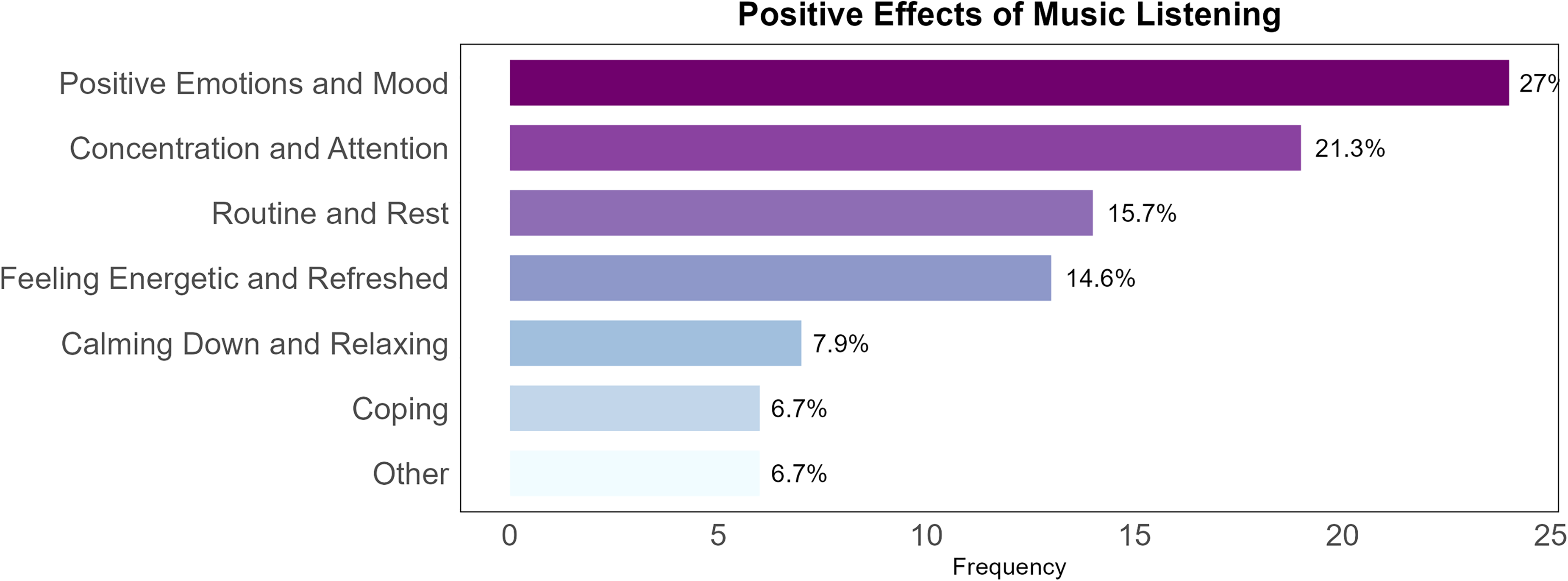
Themes emerging as positive effects of music listening before the lessons.
Other participants (14) mentioned that music listening was experienced as a new routine to start the lesson, associated with a break and a moment to rest alone, for example: By listening to music at the beginning of the lessons, you had a peaceful moment, which made it more pleasant to start the lesson. (P27), or The fact that at the beginning of the lesson there is a moment called “own time”, when no one is busy and the teachers are not teaching yet, has been good in my opinion, because it gives you time to relax for a while before the next lesson. (P32).
Additional responses that did not fall into the previously mentioned categories were grouped under the category “other”. These responses included topics such as stress reduction, meaningfulness, motivation, impression, and creativity. For instance, one respondent stated that music helped with creativity during their art class (P35), while another mentioned that calming music helped to alleviate stress after a difficult class (P14).
Both Positive and Negative Effects of Music Listening
Seven students indicated that listening to music had both positive and negative effects on their school experience. In their open answers, positive effects were largely the same as in the categories mentioned before. Negative effects were reported concerning challenges of concentration (4), and the emotions created by music (3). One participant reported: It was nice to be able to listen to music, and it was nice that there was such a relaxed moment at the beginning of class, on the other hand, I might have had a bit of a bad taste in music because it evoked so many emotions in me and didn’t really help to study. Now, this was a bit of a bad moment for me to somehow research something like this when my mood was such a roller coaster anyway. (P37)
No Effects of Music Listening
Five participants reported that the music had no effect on them. One participant explained this by the fact that there was not always the time to finish the piece of music and that the listening time was too short. Another participant pointed out that it was difficult to enjoy the music in the school environment.
Interest in Adopting the Music Listening to the Future School Setting
The final questionnaire revealed that 33% of the participants (n = 15) would like to incorporate music into their school day in all lessons, 28% (n = 13) in most lessons, 33% (n = 15) in some lessons, and only 7% (n = 3) indicated that they would not like to continue with music listening. Additionally, two students provided feedback on the impact of music in different lessons. One student stated that music was more beneficial before language and theoretical classes, but less so before natural science classes such as math, physics, and chemistry. Another student reported that music helped to reduce irritation in math class and increased creativity in art class. Finally, two other students reported that music was equally helpful in all subjects.
Discussion
This empirical study aimed to examine the effects of listening to self-selected music on students’ mood, motivation, concentration, and learning outcomes in a real-life school context. The study was conducted over two weeks, with students having a normal school setting during the first week and listening to self-selected music before each lesson during the second week. We found that listening to music was indeed beneficial for all outcomes, compared to the week without listening to music. In the following, we will discuss the main findings of the study and then focus on the implications for future research, practice, and education.
Music Impact on Mood, Motivation, Concentration, and Learning
Overall, both the daily questionnaires and the final survey indicate that listening to music had positive effects on all four outcomes measured, with strong effect sizes for mood, motivation, and concentration, and a moderate effect in the case of self-reported learning outcomes (Cohen, 1988). The strongest effects were found on mood and motivation, which is consistent with previous research suggesting that especially self-selected music with certain properties such as major mode or faster tempo can have positive effects on mood and energy level (e.g., Gabrielsson & Lindström, 2016; Helsing et al., 2016). Additionally, our results provide evidence for the arousal and mood hypothesis, which posits that engaging in activities that induce positive mood and arousal is linked to better cognitive performance (Thompson et al., 2001). Interestingly, correlation analysis showed that perceived music energy levels were moderately to strongly correlated with differences in motivation, learning, and concentration, but only weakly with differences in mood. These findings suggest that any type of music could be effective in enhancing mood state, but if the goal is to improve motivation, concentration, and learning, it would be advisable to listen to activating music.
Another explanatory mechanism for the positive effects we observed could be the positive effect of music on self-esteem, sometimes also referred to as empowering music. In a study conducted by Laukka and Quick (2011), athletes reported that music not only motivates and induces positive affect, but also enhances their self-efficacy and self-confidence. Similarly, Elvers and colleagues (2018) found that listening to “confident music” – in which singers express their own positive self-view and convey strength and self-assurance in the first person – led to higher explicit momentary self-esteem in individuals, especially when they enjoyed the music. In the present study, these mechanisms may have contributed to an improved ability to meet the demands of the next lesson due to increased self-confidence, resulting in higher reported motivation and learning success. Additionally, the fact that students choose their own music could have further boosted their self-confidence by increasing their sense of agency (Saarikallio et al., 2019).
The strong effect of music on one's mood was also evident in the participants’ open-ended responses. However, they also acknowledged other benefits of listening to music, including its ability to improve concentration and attention, as well as its potential to provide a new routine and a break between lessons. This last aspect can be linked to the literature on the optimal conditions for memory retention: previous research has demonstrated that wakeful resting, which involves reducing outward attention and utilizing cognitive resources for mind wandering activities such as thinking, dreaming, and imagining (Wamsley, 2019), is associated with better learning outcomes compared to immediately starting the next task. This has been observed not only in adults (e.g., Dewar et al., 2012), but also in children (Martini et al., 2019). Given that music, particularly activating heroic-sounding music, has been shown to facilitate mind wandering with positive, stimulating, constructive, and motivational thoughts (Koelsch et al., 2019), incorporating it as a break between lessons could be a useful way to reinforce the material learned.
One might question whether taking breaks with music is appropriate for everyone and before every class. Our participants had mixed opinions about the effectiveness of music breaks before different lessons, although most approved of listening to music before each or most of the lessons. This may be because positive and activating music has effects that can be beneficial for different tasks. As mentioned earlier, positive music with a high energy level can boost self-confidence, which could help students, especially before subjects in which they have difficulties. Similarly, music with high arousal and positive valence can also promote divergent thinking and creativity (e.g., Ritter & Ferguson, 2017), which could be beneficial for artistic subjects. Nevertheless, it would be interesting to find out in future studies whether certain types or genres of music are experienced as particularly helpful for certain school subjects, such as for example music with lyrics in a language that will be learned in the next lesson (Mizener, 2008). However, it is important to recognize that the emotional impact of music varies from person to person (Gerstgrasser et al., 2022), and individuals differ in their ability to select music that meets their emotional regulation goals (Carlson et al., 2015). In simpler terms, music can serve as an adaptive tool to promote emotional well-being, but it can also be used in maladaptive ways that can cause distress (e.g., Alluri et al., 2022). Success in reaching the desired emotional goals through music listening also depends on the initial mood state of the person and their self-perception of the emotional qualities of the music (Randall et al., 2023). Therefore, training students to create and test different playlists that are effective for their specific needs, such as waking themselves up in the morning or improving concentration before a demanding class, might increase the effectiveness of music listening in the classroom.
Given the results of our study, it is reasonable to ask why the effect of music on learning and concentration was not as substantial as on the other two outcomes measured. There could be several reasons for this. First, the self-assessment used in this study may not accurately reflect how much the participants learned on the same day or how much they will remember the content learned at a later time. Future studies could try to measure learning success more objectively to obtain a clearer picture of the relationship between music and learning. Second, the positive effects of music on learning and concentration may occur by enhancing the mood and motivation of the listener, as proposed in the arousal and mood hypothesis (Thompson et al., 2001). In this sense, mood serves not only as an outcome in itself, but also as a mechanism for learning. Thus, the impact on mood is likely to be more direct and stronger, while the impact on learning occurs as a second step in the process. Since we collected data on both general mood and learning outcomes at the same time, it is difficult to determine whether mood changes due to music listening led to higher self-reported learning success. To test the hypothesis more thoroughly, future research could use a repeated measures design in a school setting and conduct a mediation analysis to determine whether the effect of music on learning is partially or fully mediated by mood. This would allow for a more detailed understanding of the mechanisms underlying the effects of music on learning outcomes at school.
Practical Implications
The results of this study have several implications for research and educational settings. First, they provide strong motivation for incorporating self-selected music as a break between lessons into the school day. Although previous studies have already shown that music can improve both mood (Husain et al., 2002) and cognitive task performance (Rauscher et al., 1993), our study adds to this literature by including an ecologically valid context, that is, a real school setting and students’ self-reported experiences.
In terms of the type of music to include, based on our results, students should be instructed to choose positive music with a high energy level when the aim is to improve not only mood but also motivation and learning. However, it is important to remember that the effects of music can vary depending on the individual and their current mood (Gerstgrasser et al., 2022; Randall et al., 2023), so it may not be advisable to leave the students completely alone in selecting the music used. Instead, teachers could share general experiences with their students about the emotional effects of music and encourage them to create their own playlists for different purposes, such as one for more concentration, one for more creativity, or one for a better mood. An alternative approach could be to play music for all students during breaks between lessons. While self-selected and preferred music is likely to have the greatest impact, considering that genres such as pop and rock were frequently mentioned, a consensus could be reached among students to play the same music for everyone. Combined with discussions about the appropriate music for different school subjects or times of day, students would not only be empowered to choose more effective music, but could also learn more about themselves and their emotional regulation through music.
Additionally, the study raises the question of whether the observed effects are unique to music or whether similar benefits could be achieved through other activities, such as free drawing, taking a break without any activity, or playing games on a smartphone. For example, Mezghani et al. (2022) showed that children's cognitive performance regeneration after lessons was higher when they listened to music or played freely than when they did not engage in any particular activity. Comparing musical activities with other leisure activities in terms of general happiness and well-being has shown similar effects between making music and knitting (Lamont & Ranaweera, 2020) or between physical and creative leisure activities (Morse et al., 2021). Future studies could compare different activities and investigate whether music is a better alternative in school contexts than other activities. However, the findings of this study suggest that it is not just about taking a break, but rather the activating and mood-enhancing effects of music that make it particularly effective. Efficient use of time is also likely to be a practical requirement when implementing break activities in the school day. Based on the current findings, the positive impacts of listening to music are achieved by taking only relatively short breaks of 5 minutes. Therefore, incorporating music breaks into the school day could be a useful tool for teachers and students alike, providing a much-needed respite from the demands of the classroom while also improving academic performance.
Limitations
The strength of the study lies primarily in its high ecological validity and the willingness of teachers to implement music listening before each class. However, several limitations must also be considered when interpreting the results.
First, all outcomes, including learning success, were measured by self-reports on a visual analog scale. Therefore, it is unclear whether the students actually performed better on tests or remembered content more effectively after listening to music before class. Nevertheless, studies have demonstrated that self-reported learning progress is significantly correlated with examination results (Benton et al., 2013), suggesting that this type of measure can provide valuable insights into learning outcomes. Given that the current study has demonstrated subjective effects of music on both mood and learning, future research can further explore these effects with more rigorous designs.
Second, in an effort to reduce the measurement burden on students, we asked for their ratings of the different variables only once a day. Therefore, it is unclear whether music had different effects for specific subjects or at different times of the day. It is possible that there are interactions between music and these contextual factors, such as a different type of music being more beneficial in the morning before the first lesson compared to after a particularly challenging lesson or before a class that requires creativity, such as art. Furthermore, our efforts to conduct our study in an ecologically valid school setting resulted in less control over the conditions of music listening, in contrast to the environments typically found in laboratory studies. For example, even if teachers introduced a five-minute window of unrestricted music listening at the beginning of each lesson, we are not able to quantify the exact amount of music listened to due to unknown variables such as the amount of time students spent selecting music before actually listening or the number of song changes.
Third, the lack of comparison conditions limits the ability to attribute the observed effects solely to music listening. It is plausible that alternative interventions or changes in the school routine, such as incorporating physical exercise, silent meditation, or other engaging activities, could have produced similar results. In this context, it is worth noting that the mere introduction of a change in the school routine may have initiated certain improvements in students’ well-being. In order to establish a more precise causal relationship between listening to music and the observed effects, future studies could refine the research conditions. For example, they could counterbalance the conditions or alternate weeks with and without music listening over a longer period of time. Furthermore, our analysis assumed comparability between the two weeks, except for the introduction of music listening sessions in Week 2. However, because participants could respond on different days over the two weeks, it is uncertain to what extent uncontrolled variables and day-specific events may have influenced the participants’ responses. Additionally, the self-selection of the 48 participants may have introduced a demand characteristic bias that could have affected the outcomes.
A final limitation relates to the sample size. Although all students in the selected school were invited to participate in both the experiment and the online survey, only 101 students accessed the questionnaire at least once, and only 48 completed the survey at least once in both weeks. Notably, the observed effect sizes were relatively large, suggesting that the sample size recruited was sufficient to demonstrate the expected effects. However, it is worth noting that a larger sample size, along with more measurement points per participant, could have provided a more nuanced understanding, particularly in terms of qualitative insights.
These limitations suggest the need for cautious interpretation of the findings and for further controlled empirical research.
Conclusion
In conclusion, the results of this study suggest that self-selected music can have positive effects on students’ mood, motivation, concentration, and learning success in a school setting. The ecological validity of the study makes these findings particularly noteworthy, and they provide support for the implementation of short breaks with self-selected music before lessons in schools. However, some limitations, such as the use of self-report measures and the lack of an active control group, should also be considered. Future research could address these limitations and further explore the effects of music and other activities on learning outcomes. Overall, this study highlights the potential benefits of incorporating music into educational practices and provides a foundation for future studies in this area.
Footnotes
Action Editor
Kelly Jakubowski, Durham University, Department of Music
Peer Review
Thomas Schäfer, MSB Medical School Berlin GmbH, Department of Psychology
Dianna Vidas, University of Queensland, Faculty of Health and Behavioural Sciences, School of Psychology
Contributorship
MO-J and HS jointly created the study design with SK and then conducted the study. JV conducted the quantitative analyses and wrote the first version of the article with input from SK. MO-J and HS conducted the qualitative analysis. All authors contributed to finalize the article and approved the final version.
Declaration of Conflicting Interests
The authors declared no potential conflicts of interest with respect to the research, authorship, and/or publication of this article.
Ethical Approval
According to the guidelines of the local university ethics committee, this research did not require ethics committee or IRB approval. The study adhered to the ethical principles of the National Board on Research Integrity in Finland for research in the humanities and social and behavioral sciences. As the participating adolescents were aged 15 years or older and the study was conducted within regular school activities, it did not meet the criteria for ethical review as described in the guidelines (pp. 4 and 14).
Funding
The authors disclosed receipt of the following financial support for the research, authorship, and/or publication of this article: This work was supported by the Academy of Finland, (grant number 346210).

Data Availability Statement
The data from this study is available on the Open Science Framework (https://osf.io/8cdw9/?view_only=12a75351db22432e9997715fbc7f9a38; Vigl, 2023).