




Abstract
Music and visual mental imagery (VMI) are closely associated. The visual depiction of musical instruments and musical settings is central to music iconography and music-mediated visual culture. Music-evoked VMI, mediated by emotions, is another established field of study. Hindustani classical music (HCM) has a medieval musical pictorial tradition based on dhyanaslokas (meditative verses), which visually represent the ragas (musical modes) based on the evocation of their rasas or aesthetic emotion. This, incidentally, comes close to the contemporary understanding of music-evoked VMI. However, VMI evoked in response to music has received very little attention in studies on HCM, both for contemporary listeners and historically. In this context, we investigated whether HCM evoked VMI and whether its content was related to emotions, such as “calm” and “sad”, that dominate HCM. Additionally, the themes of the VMI in response to calm and sad clips were compared with corresponding VMI in Western music. Finally, medieval dhyanaslokas were analyzed for associated visual imagery (VI) that was compared with VMI generated in these contexts. Findings revealed that HCM evokes VMI, which is well differentiated for calm and sad clips. When the VMI for HCM was compared with Western VMI, though common themes emerged, cultural differences were identified. While VI in dhyanaslokas had similarities to VMI in response to HCM, marked differences also existed.
Introduction
Upholding Ganga, the crescent moon upon his brow, three-eyed, wrapped in the skin of an elephant and adorned with snakes, his scarf white, his garland of human skulls, armed with a burning trident—so triumphs Bhairava, the first of ragas.
Visual representation of raga Bhairava (Vijayalakshmi, 2007, verse 55)
Music resonates with emotions and has a strong influence on memory and imagination, often evoking strong visual mental imagery (VMI) (Day et al., 2020; Deil et al., 2022; Taruffi & Küssner, 2019). Visual mental imagery is also described as “seeing with the mind’s eye” (Kosslyn et al., 2001) and occurs in the absence of immediate stimuli and when perceptual information is accessible from memory. Listeners frequently report VMI while listening to music (Taruffi et al., 2017). The evocation of VMI in response to music has caught the interest of behavioral scientists since it is an important mechanism to induce emotions (Juslin & Västfjäll, 2008) and plays an integral role in the listening experience (Küssner & Eerola, 2019). Current research on VMI in response to music focuses on diverse issues, such as the antecedence of perceived and felt emotions to VMI, reaction time to VMI (Day et al., 2020), occurrence of VMI in live settings or concerts (Deil et al., 2022), level of emotional engagement and experience of VMI when listening to musical works (Presicce & Bailes, 2019), and influence of musical structure on VMI (Dahl et al., 2022; Herff et al., 2021).
The prevalence of VMI in music listening contexts shows that, in a representative sample, 77% of the participants experienced VMI during music listening. Similarly, Vuoskoski and Eerola (2015) report that around 80% of their participants (48 out of 60 individuals) experienced VMI after listening to evocative, instrumental film music combined with narrative descriptions regarding the context of the music pieces. In everyday listening contexts, VMI is the fourth most important cause of emotions, after emotional contagion, brain stem response, and episodic memory (Juslin et al., 2008). Reaction time studies demonstrate that VMI is formed after 2–3 s of music listening (Day & Thompson, 2019). However, all these studies focus on VMI in Western music, because of interest in cross-modality and the ease of availability of stimulus material (Morrison & Demorest, 2009; Schubert & Fabian, 2006). While many other cultures, including Indian, also have rich traditions exploring intermediate relationships between music and images or examples of VMI, studies that explore these empirically or historically in such cultures are minimal.
In the Indian context, the Indian classical music (ICM) tradition is a rich tradition going back more than two millennia. Ragas, the melodic framework in ICM, focus on structure, tones, and semitones and are associated with seasons, time, and emotions. One of the distinct branches of ICM, Hindustani classical music (HCM), addresses visual evocation through the concept of dhyanaslokas (meditative verses), which represent the visual contours of ragas, which can be roughly translated into musical modes (Bor et al., 2002; Vijayalakshmi, 2007). The epigraph illustrates a dhyanasloka that visualizes a raga as a human being in the midst of evocative attributes, including time of the day, nature, and animals (Ebeling, 1973; Ranade, 1992). However, while many recent studies on ICM, particularly HCM, have focused on the structural features of music-evoked emotion and emotions themselves (Mathur et al., 2015; Valla et al., 2017), work on VMI is distinctively absent. It is against this background that an exploration of VMI in contemporary listeners in response to HCM, and visual imagery (VI) associated with the dhyanasloka tradition, seem imperative.
Hindustani classical music consists of a host of stimuli, expressing and eliciting a range of emotions in listeners (Valla et al., 2017). Some pertinent emotions induced by HCM, reported in many studies, are sadness, calmness, happiness, longing, tenseness, and romanticism (Balkwill & Thompson, 1999; Mathur et al., 2015; Wieczorkowska et al., 2010). Among these emotion classes, two of the most dominant, and often related, emotions evoked are sad and calm (Dozio, 2016). However, there is hardly any systematic exploration of VMI for these emotions in the Indian context. Besides, no comparative study of VMI across different cultures is currently available.
In light of this, we explore the following research questions. (RQ1) Do HCM works induce VMI, and what are the contents of VMI evoked in response to calm or sad pieces? (RQ2) How does VMI evoked in this study relate to the VMI evoked in response to extracts of calm or sad music in Western music? (RQ3) How does the evoked VMI in our study relate to the traditional VI cited in dhyanaslokas of medieval Indian musicological texts?
Raga in HCM
Hindustani classical music originated in Northern India and is known by the framework of ragas. The term raga originated from the Sanskrit term “ranj,” meaning “color” or “mood” (Ranade, 2006). Many define raga as a melodic configuration, that is, a scale and melodic scheme, which can color or please the listeners’ minds. According to Pudaruth (2016), a raga is “a specific melodic configuration produced out of a group of notes rendered systematically and beautifully.” According to Saxena (2009), a raga is rendered in a “tranquil, yearning or ecstatic, and dignified manner,” generating a sublime and spiritual nature.
The construction of melody in a raga generally uses five or more notes on a fixed scale of seven notes. A raga rendition occurs at three tempi—vilambit, madhya, and drut. Vilambit laya is always rendered at an extremely slow tempo and is also the arrhythmic phase. In the vilambit phase, the tempo is slow; a rhythm instrument accompanies a compositional pattern known as gat or bandish. Finally, in the madhya and drut segments, medium and faster tempi are achieved in the compositional segment (Hegde et al., 2012). The dominant emotion evoked in a raga is known as rasa; in HCM, it is often the main aim of a concert artist to evoke this successfully with its accompanying emotions (Pudaruth, 2016).
Bhavas and Rasas in Ragas
Rasa, or the theory of aesthetics, was propounded by Bharata (first century BC to second century AD) in the Natya Shastra, a treatise on dramaturgy. Initially, Bharata proposed eight emotions, and a ninth emotion was added by Abhinava Gupta in the tenth century AD. The list is popularly known today as the navarasa (nine emotions). The nine rasas are supposedly expressed by all the Indian classical arts, such as poetry, drama, and music, and are experienced by the listeners. These nine rasas, as translated by Ghosh (1950), are sringara (eroticism), hasya (humor, karuna (sadness), raudra (fury), veera (valor), bhayanaka (fear), beebhatsa (disgust), adbhuta (wonder), and santa (calmness or peacefulness). Beebhatsa, or disgust, is labeled an atypical emotion or non-musical emotion, as it is rare and unusual in response to music (Zentner et al., 2008).
Rasa theory proposes that causes or antecedents (vibhavas) lead to effects or consequents (anubhavas) in a dramatic performance; this leads to the experience of emotions (bhavas) that later culminate in the aesthetic experience of these emotions—rasas (Pudaruth, 2016). While primarily expounded in the context of plays, the theory was later adopted in music. These emotions are (a) nine primary emotions or bhavas, (b) 33 accompanying fleeting emotions or sancaribhavas, and (c) nine physiological experiences or expressions, or sattwikabhavas. Rasa theory proposes that the audience, that is, the listeners, experience all three categories of emotion and physiological response in a dramatic performance, which is a combination of words and music (vachika), actions and dance (angika), dress and stage props (aharya), and physiological manifestations (sattwika) (Ghosh, 1950). Later, the theory was accepted in a musicological context, when music, as an independent mode of art, came into its own (Sharma, 1970). This establishes the significance of emotions in the context of listening to HCM.
Perception and Induction of Emotions by Music
Emotions in music are either perceived or induced (or experienced). Discussions and investigations concerning musical emotions are frequently based on two theories, a discrete theory (Ekman, 1992, 1999) and a dimensional theory, which constitutes such dimensions as arousal and valence (Russell, 1980). Most studies in music research contain presuppositions from these two theories (Hentschel & Kreutz, 2021). While the dimensional theory of emotion has mostly been applied in music induction studies (Girard & Wright, 2018; Grewe et al., 2007; Nagel et al., 2007), the discrete emotion model has been favored in studies on perceived emotions (Argstatter, 2016; Mohn et al., 2011; Schubert et al., 2013; Song et al., 2016). The music-specific Geneva Emotional Music Scale model also specifies music-induced emotions that are discrete (Zentner et al., 2008). The majority of VMI studies have used a discrete model of emotions; given the discrete framework of the Indian theory of nine emotions, this study also explores VMI using two discrete emotions, sadness and calmness.
The Indian theory of nine emotions makes a clear distinction between sad (karuna) and calm (santa) emotions, both in dramaturgy as well as in music. Empirical studies on emotions in HCM also identify these emotions using distinctive categories (Mathur et al., 2015; Valla et al., 2017). More recently, deep learning techniques have been applied to classify emotions, such as sad and calm, in HCM (Nag et al., 2022). They are also clearly differentiated in studies on emotions in a Western context, with sad music as a potential stimulus (Argstatter, 2016; Behrens & Green, 1993; Juslin & Laukka, 2004; Mohn et al., 2011; Song et al., 2016), as well as calmness (Juslin & Laukka, 2004; Laukka et al., 2013; Lindström et al., 2003; Thompson & Robitaille, 1992; Vieillard et al., 2008; Zentner et al., 2008). However, between these two emotions, sad music has attracted more researchers and has been used in numerous studies because of its paradoxical and complex nature in inducing positive emotions (Vuoskoski et al., 2011; Warrenburg, 2020a). In the context of VMI research, music stimuli with sad and happy emotions dominate, and a handful of studies are found on calm music (Dahl et al., 2022; Taruffi & Küssner, 2019).
In empirical music studies, calmness is considered to be low in the quality of arousal but positive in valence, and is usually paired as the opposite of exciting (Labbé et al., 2021). In Western music, a calm emotion is associated with a slow tempo (Gabrielsson, 2009). Terms associated with calm in studies are “relaxed,” “serene,” “peaceful,” “gentle,” “pleasant,” “sedative,” “soothed,” and “meditative” (Asmus, 1985; Chordia & Rae, 2008; Zentner et al., 2008). Investigation into calm music identify it as the fourth most important emotion to be expressed and experienced in music (Juslin & Laukka, 2004).
Sad music is generally low in arousal (Huron, 2011), and listeners report experiences of both positive and negative emotions in response to sad music. For example, positive experiences, such as comfort and sweet sorrow,1 can be associated with relief or joy, while negative experiences, such as grief-stricken sorrow, can be associated with loss-related events (Eerola & Peltola, 2016). Moreover, studies have demonstrated subtypes of sadness that can be induced by such contexts as the loss of a loved one or failure to achieve a goal (Shirai & Suzuki, 2016). Sadness in music is also considered a synthesis of two affective states, melancholia, and grief (Huron, 2015a; Warrenburg, 2020b). Despite sadness's multifaceted and paradoxical nature, most studies have demonstrated that it is a negative emotion. Some words associated with sadness are “sorrowful,” “melancholy,” “depressed,” “dreary,” “blue,” “gloomy,” “tragic,” “lonely,” “weary,” “sorrow,” “sadness,” “despair,” “isolation,” “suffering,” “grief,” “misery,” “unhappiness,” and “longing” (Asmus, 1985; Hevner, 1935; Namba et al., 1991; Zentner et al., 2008). These terms transcend the restrictive use of valence-arousal models (Collier, 2007) and justify the use of a discrete model of emotions in this study.
Cross-Cultural Studies on Music and Emotions
Cross-cultural studies on ICM and HCM have been carried out on emotion perception rather than music-induced emotions. The number of studies is sparse, most demonstrating universality in recognizing a few basic emotions. A study by Balkwill and Thompson (1999) examined the ability of Western listeners to identify the emotions of joy, peacefulness, anger, and sadness in HCM. Results showed that although Western listeners were unfamiliar with the music, they could correctly identify the emotions conveyed. The same experiment was repeated for Japanese listeners for three emotions. Results indicated that Japanese listeners could identify the music’s intended emotions. The findings also illustrated the sensitivity to acoustic cues—loudness, timbre, and tempo—that determined the recognition of emotions (Balkwill et al., 2004). In a similar study, Laukka et al. (2013) asked Swedish, Indian, and Japanese listeners to identify 11 emotions from different musical traditions—Swedish folk music, HCM, Japanese traditional music, and Western classical music. Listeners in the study successfully decoded such emotions as anger, fear, happiness, humor, peacefulness, and sadness in culturally unfamiliar music. However, listeners performed better in emotion-judgment tasks for culturally familiar music than for unfamiliar music. More recently, a study on emotions identified in HCM suggested that while Western listeners focused on rhythm and Indian listeners focused on tonality, both groups were still able to identify the emotions correctly (Midya et al. 2019).
This literature review suggests that different cultures perceive similar emotions in response to unfamiliar music. This provides grounds for an exploration of VMI in response to Indian music, as well as for a possible comparison of the type of VMI with the same emotions for other cultures.
VMI and Emotions
Visual mental imagery is one of the emotion induction mechanisms described in the BRECVEMA (brain stem reflex, rhythmic entrainment, evaluative conditioning, contagion, visual imagery, episodic memory, musical expectancy, and aesthetic judgment) framework (Juslin, 2013). In this framework, it is proposed that images are conjured (e.g., a beautiful landscape) while listening to music, and that this evocation induces emotions (Juslin & Västfjäll, 2008). Studies also suggest several underlying factors that influence the formation of VMI, such as environmental cues and shared cultural understanding and experiences of the listeners (Margulis & McAuley, 2022), auditory and visual information encountered in day-to-day life (Day & Thompson, 2019), individual attributes, such as empathy (Vuoskoski & Eerola, 2012), autobiographical memories (Jakubowski & Ghosh, 2021), and the valence of the music itself (Taruffi, 2017). Reaction time experiments on whether VMI precedes perception and induction of an emotion throw light on other mechanisms of the framework, such as brain stem reflexes and musical expectancies. Specifically, in the early stages of music processing, when the music unfolds temporally with various structural features (e.g., pitch, tempo), an emotional contour is given to the music, providing the basis of a visual narrative (Langer, 1957).
The contents of evoked VMI have a close relationship with the valence of the music stimuli. Any musical piece’s valence (positive or negative emotion) has been found to influence the content of VMI. Happy music resulted in positive VMI, such as dance imagery, and the frequency of experiencing VMI in happy music was higher than that in sad music (Day et al., 2020; Martarelli et al., 2016). Exceptions were found in sad music, as it evoked vivid images and comprised both positive and negative themes (Taruffi et al., 2017). In a concert environment, when listeners were exposed to stimuli validated as sad, types of VMI reported were negative, for instance, death, violence, war, or torture (Deil et al., 2022). Studies on musical characteristics and emotions showed that the tempo mediated the VMI response; faster beats induce positive VMI (Herff et al., 2021), and music with similar characteristic features (beats, rhythm) induced identical types of VMI, such as nature or water (Dahl et al., 2022).
Thus, the role of VMI in connection with music-induced emotions has been supported by various researchers. Although studies are sparse and investigations are still being pursued, studies that address VMI in response to emotions in musical works have emerged, showing distinctive trends of VMI based on emotions (Deil et al., 2022; Hashim et al., 2021; Küssner & Eerola, 2019). Moreover, the underlying factors that influence VMI make it a multifaceted concept. This calls for investigation into other repertoires of music, such as HCM, known to induce distinct emotions and bear a rich VI tradition known as the dhyanaslokas.
Visual Imagery in HCM
Visual imagery, as a method of music appreciation, has been documented in HCM since the thirteenth century AD. But its origins can be traced back to the eighth century AD, in the Raga Sagara by Dattila (or by Narada, the authorship is debatable), where the dhyanas (slokas) or prayer formulas depicted ragas in a personified or deified form. Later, in Sangita Ratnakara of Sarangadeva, in the first half of the thirteenth century AD, ragas and their patron deities were strongly established, along with the association of cries of certain animals with the sounds of individual notes (Ebeling, 1973). By this point in time, the ‘personhood’ of ragas was well-established, so that a whole system of a family of ragas—six ragas, each of their wives (six in total), and in some cases, their sons—was already in place (Gangoly, 2017). As the tradition evolved, the characteristics of the ragas were slowly linked to their personhood—perceptual components of specific ragas linked to the character traits, foibles, and emotions of specific types of person (Ebeling, 1973).
Historically, one might link the tradition of dhyanaslokas to the association of certain deities with certain ragas. But it is interesting to note that, as time passed, the perceived musical features of specific ragas were slowly embedded not only within the personhood of the ragas but the whole microcosmos of their environment. Thus, the dhyana of raga Bhairava—named after God Shiva—not only dealt with the iconography of Shiva but with the qualities of music linked to his personality, such as seriousness, calmness, detachment, and the evocation of dawn. The dhyanasloka for raga Bhairava unfolds, “Upholding Ganga, the crescent moon upon his brow, three-eyed, wrapped in the skin of an elephant and adorned with snakes, his scarf white, his garland of human skulls, armed with a burning trident—so triumphs Bhairava, the first of ragas” (Vijayalakshmi, 2007, verse 55). Another verse describes the same raga: “His limbs smeared with ashes (that lovely body), his brow lustrous with the cool rays of the moon, trident in hand and mounted on a bull, such is Bhairava, and so the sages tell.” (Vijayalakshmi, 2007, p. 13).
Similarly, the ragini (the feminine form of raga) Bhairavi, consort of Shiva, is described as in the act of prayer of her Lord, “Out in the lake, in a shrine of crystal, she worships Shiva with songs punctuated by the beat. This fair one, this bright one, is Narada Bhairava” (Bor et al., 2002). However, this deification, later embedding the attributes of the ragas into the visual (here, note the emphasis on “beat” and “brightness”), goes beyond word pictures to actual miniature paintings known as ragamalas (garland of ragas)—albums of collections of ragas and raginis. It is here that many of the other associated elements and evocations are depicted in visual form—late night or very early morning, the element of calmness, the contrast of dark blue and white, and so on (Figure 1). While the scope of the article does not allow the exploration of visual iconography, it is important to establish the tradition of visualization in HCM through this connection.

Bhairavi Ragini ( Manley Ragamala, an album painting. Amber, Rajasthan, India).
Dhyanaslokas (meditation verses) etymologically also point to another tradition of visualization—meditative visualization. Such verses are meant for deep reflection and contemplation. When linked to the musical tradition, such verses aim to guide the musician to identify the quintessential form of the specific raga, discovered earlier by sage-musicians who identified both the material and musical bodies of the ragas. As the musicologist Prajnanananda (1965, p 316) puts it: The supreme aim of music is to realize the essence that shines behind music […] The seers of music felt within themselves the necessity of animating the material structure of the ragas. They conceived the idea of the tonal forms possessed of flesh and blood like human beings and thus deified the ragas. Then the invisible ragas became visible in material forms […] Emotions or emotive feelings of the ragas were also conceived as material forms for easy grasp.
Thus, it was assumed that through deep contemplation, a musician could visualize the emotive personality of a raga—masculine or feminine, serious or playful, sad or happy, evocative of the nature around and conveying spring, summer, or winter. Thus, we look at a tradition here that suggests the visualization of music by a musician in the process of listening to experience the quintessence of that raga. The concerned ragas can encapsulate emotions and actions and are strongly influenced by various cosmic and natural aspects. Those aspects include the time of the day, season, gender, hierarchy, and activities (Gangoly, 2017). A short essay by Kaufman (1965) delineates dhyanaslokas, linking their descriptions with performance times of the day. Kaufman also prescribes rasas to the ragas based on the dhyanasloka descriptions, following ancient musicological texts. He also suggests that some modern musicians still practice this theory and tradition of dhyanasloka.
Kaufman's (1965) point about the contemporary practice of raga visualization and discovery by the musician is illustrated in examples of contemporary virtuosos, such as Desphande (2016) and Pandit Ajoy Chakraborty. Ajoy Chakraborty mentions being able to “see” the ragas during intense practice. These “discoveries” are not unique to the musician. In the HCM listening tradition, it is often considered that the journey in search of the raga is one where the musician and listeners are together, with the musician at the lead. Sometimes, the artist creates drawings or paintings, visualizing natural beauty, scenery, figures, shapes, geometrical patterns, or splashes of colors, while presenting a raga (Deshpande, 2016). Artists draw on these images to shape the individual meanings they intend to convey through a raga. Accompanying them are gestures and movements of hands or melodic actions that embody the sound or music, further strengthening the visual imagery communicated by the artist (Leante, 2009). This is backed by empirical evidence on VMI experienced by HCM artists in an electroencephalographic (EEG) study. Musicians of the HCM tradition imagined ragas during extemporization reflect strong responses in brain activity. The occipital and frontal-occipital regions are stimulated; activity in this region in the brain is associated with visualization (Ghosh et al., 2018).
In summary, the dhyanasloka tradition points to some fundamental aspects of visualization: (a) the visualization of the raga, often spontaneously by the musician, based on the raga’s musical features; (b) the tradition of the visualization being quintessential to musical experience through dhyanaslokas; (c) the creation of a whole visible microcosm of human forms surrounded by the elements of nature and habitat; and (d) a visible manifestation of the experience of ragas through ragamala paintings for listeners.
In this study, a few challenges were faced in categorizing the dhyanaslokas based on distinctive emotions, namely calmness and sadness. The major hurdles that have challenged Indian musicologists since the nineteenth century are (a) that most of the ragas mentioned in medieval texts are no longer performed, and so it is difficult to identify emotions linked to them, and (b) that, while they retain the original or modified names, the note structures in many of the contemporary ragas have changed, again making it almost impossible to identify related emotions (Massey & Massey, 1996; Bor et al., 2002). Addressing this challenge would necessitate recourse to the visual iconography of the ragamala paintings, which in itself is a fully fledged study and hence does not come within the scope of this work. This review points to an important tradition of music that explicitly refers to visualization of music. It is possible to examine whether the VMI documented for the dhyanas can be classified under the themes and subthemes identified under RQ1 and whether new themes emerge. Documenting visual images of a past musical tradition and comparing them with the contemporary context would also provide insights into continuity and discontinuity in the HCM tradition. Hence, such an effort is considered relevant to our study.
Aims and Objectives of the Study
Despite recent interest in VMI, there is a dearth of literature regarding the contents of music-evoked VI in other cultures, especially in HCM. Our review of the literature indicates that emotions like calmness and sadness are distinctly perceived and prevalent in HCM. Additionally, calm and sad emotions in response to music are common to Western and HCM music traditions. Moreover, cross-cultural research suggests that similar music—at least at the level of basic emotions—is interpreted similarly in different cultures. Finally, the HCM tradition is rich with a strain—the dhyanasloka tradition—that emphasizes the evocation of specific patterns of VI in response to specific ragas, with their underlying rasas or emotions. On the basis of these gaps, we have formulated three research questions, or objectives, for this study:
to examine whether HCM induces VMI and the images evoked in response to calm and sad music; to compare the VMI of Western music with the VMI obtained in response to HCM, to identify whether patterns of similarities exist; to compare the VMI derived from medieval Indian musicological texts with VI obtained for HCM.
To address the first objective, an online survey was conducted: participants were asked to listen to pieces of calm or sad HCM and respond by identifying dominant emotions and writing qualitative descriptions of the VMI evoked in response to the clips. A thematic analysis was conducted of the qualitative descriptions of VMI. The second objective was addressed by conducting a detailed review of Western literature, focusing on VMI to sad and calm music, and documenting the themes and subthemes identified. This was then compared with VMI themes and subthemes identified from the first objective. Finally, to address the third objective, relevant musicological texts that referred to dhyanaslokas were examined to identify generic themes and subthemes of VI indicated historically. Further, these were compared with VMI elicited from the study's first objective.
Method
Participants
This study included 117 participants, with an age range of 20–32 (M = 21.8, SD = 3.35) years. Of these 117 participants, 61 (52.1%) were women, and 56 (47.8%) were men. They were recruited through an online learning platform and came from different parts of India. Of all the participants, only 15 had received musical training, the average training period was 4.2 years. Seven (46.6%) had been taught to play musical instruments, seven (46.6%) were trained in vocal ICM, and one (6.6%) was trained in Western classical music.
Stimuli
The eight stimuli used in this study, as shown in Table 1, were taken from the khayal genre of HCM. The extracts were sung by a female vocal artist, trained in ICM for over 20 years. The artist sang the chosen pieces by retaining the important phrases of the raga. The passages were sung in “nom-tom” or meaningless syllables usually used in HCM in two tempi, vilambit (slow) and madhyalaya (medium). Extracts with the slow tempo were taken from the alaap portion of the ragas, which were unmetered. By contrast, the extracts with the medium tempo were metered. The choice of tempo of each extract was based on previous literature showing that calm and sad emotions were evoked by clips in slow and medium tempi (Gabrielsson, 2009; Hegde et al., 2012; Mathur et al., 2015). The use of nom-tom is a part of HCM vocal tradition where no verse is used; words were deliberately not used, so that verbal meanings would not influence the perception of the music. The extracts were selected for calm or sad emotions and were part of a study of Karambelkar (2016). In Karambelkar’s study, a larger number of items were evaluated by listeners for the prevalence of dominant emotions. The emotion labels used were “sad”, “happy,” “exciting,” “calm,” “angry,” “fear,” “wonder,” and “romantic”; a ninth option was “none of these.” The extracts used in this study had been reported to evoke feelings of sadness and calmness most distinctly. Vocal extracts were deliberately chosen, since singing is one of the most prevalent forms of presentation of ragas across all genres—dhrupad, khayal, thumri, tappa, and other modes. Moreover, historically, ragas were performed primarily by vocal artists, and instrumental renditions have come into use only since the latter part of the nineteenth century.
Stimuli used in the study.

Procedure
Data were collected online using a survey and poll platform. Participants were provided with instructions and a survey link via email. On clicking a link, participants were directed to the website, wherein they provided informed consent. Participants were then asked whether music-evoked VMI came to their minds, responding either “Yes” or “No.” Then the participants were presented with eight pieces of music in a random sequence with short breaks of 30 s in between. After listening to each item, participants were given a choice of eight discrete emotions. The emotions were sadness, happiness, excitement, calmness, anger, fear, wonder, and romanticism. The option to select none of these emotions was included. The eight discrete emotions used in the study pertain to the rasa theory and have been used extensively in earlier studies (Chordia & Rae, 2008; Mathur et al., 2015). Participants could select one emotion from the list of options provided as the most dominant or choose “none” if they felt that no emotion was conveyed. They were then asked to briefly describe any VMI that came to mind while listening to the music. After listening and responding to one item, the participants were allowed to proceed to the next, and this process was repeated for all eight stimuli.
Data Analysis
The chi-square distribution was estimated to examine whether a difference existed in the perceived emotions in calm and sad clips. As “calmness” and “sadness” were rated as dominant emotions (Table A1 in Appendix A) in the music presented, the corresponding qualitative responses were considered for further analysis. Of the responses from 117 participants, the responses of 106 participants were analyzed. Reponses from the remaining 11 participants were not considered, as these participants reported that they experienced no music-evoked VI. Thus, 167 responses for clips evoking sad emotions and 267 responses for clips evoking calm emotions were finally analyzed.
Thematic analysis was employed to identify, analyze, organize, describe, and report themes (Braun & Clarke, 2006; Nowell et al., 2017) of VMI evoked in the listeners’ minds while listening to each music extract. As a qualitative method, thematic analysis facilitates the exploration of various perspectives among participants, reveals commonalities and disparities, and generates unforeseen revelations, while also serving as an effective tool for condensing voluminous data sets and requiring a systematic data handling approach, leading to the production of a lucid and orderly final report (King, 2004).
Analysis began with the first two authors, acting as coders, working through the responses independently, at least three times, to familiarize themselves with the data and understand the contents of each response, to visualize the descriptions of the VI as experienced by the participants. Based on the content of the responses regarding image descriptions, “open codes” were assigned to each response. Then the authors independently categorized open codes with similar meanings using “axial codes.” All the axial codes were categorized using broader “selective codes.” Inter-coder agreement during axial and selective coding was more than 85%, and the codes on which agreement could not be reached were discussed and resolved. The authors then cross-checked their coding structures and discussed mismatches to achieve consensus. Finally, responses were closely examined concerning the complete coding process to analyze and present findings. The coding process is presented in Tables A2 and A3 in Appendix A, which includes the open codes, axial codes, and selective codes identified from the data. This part of the analysis serves as an illustration of the coding process and the analysis methodology.
Results
VMI Induced by HCM and Images Evoked in Response to Calm and Sad Music
To address the first objective, we examined whether HCM induced VMI and reported the nature of VMI evoked in response to calm and sad music, respectively. We found that 90% of participants could visualize images in response to the music. The chi-square results showed that the perception of emotions in response to calm and sad music was significant, χ2 = 180.62, p < 0.001. This suggests that the emotions were perceived differently in both types of music. Table A1 in Appendix A shows that 66% and 47.6% of participants were able to identify the intended emotions for calm and sad music, respectively. However, in the sad music, 30% of the participants reported calmness as a co-evoked emotion. The content of VMI showed differences in frequency and themes for calm and sad music, respectively. Six themes were featured in both sad and calm music. They are reported next.
Nature: Natural world phenomena include sunrise, stars, moon, and other objects such as plants, trees, lakes, and rivers, as well as natural locations, for example a beach or lakeside. Additionally, descriptions of time that are culturally perceived were included under this theme.
Music and musical instruments: Visualized imagery about musical instruments and human figures singing, rehearsing, or playing musical instruments were included here.
Spirituality and religiosity: Relaxing postures, such as sitting with closed eyes, and images of saints, Gods, or deities in a religious place of worship, such as a temple, were included under this theme.
Sense of relaxation: Visualizations of the music as relaxing, soothing and refreshing, taking rest or relaxing, and similar activities, were included under this theme.
Classical dance: Dancing and rehearsing to the accompanied music were included here.2
Pain and agony: This category comprised imagery of people in sadness in different situations and settings. Situations and life events, such as experiencing unmet goals or failures, upsetting consequences, death, funerals, or transitory periods of sadness, for example, separation and loneliness, were included.
The themes and subthemes are presented in Table 2. Out of six themes, two themes, “music and musical instruments” and “nature,” were common for the music for both emotions. The other three themes, namely “spirituality and religion” (19%), “a sense of relaxation” (5%), and “classical dance” (2%) figured extensively for calm music, and one major theme, “pain and agony” (78%), was identified for sad music. The frequency of recurrence of themes of VMI was higher for calm music than for sad music. The themes that revealed highest frequency were “nature” (42%), for calm music, and “pain and agony” (78%), for sad music.
Themes and subthemes of visual mental imagery in calm and sad music clips.

Note. Numbers in brackets indicate frequencies of occurrence of subthemes.
The VMI was grouped into subthemes, showing the details representing the larger theme of VMI. Subthemes for calm music included nature, with 11 subthemes, “music and musical instruments,” yielding 5 subthemes, “spirituality and religiosity,” with 4 subthemes, “a sense of relaxation,” with 2 subthemes, and “classical dance,” with 2 subthemes. In response to the sad clips, “nature” had 4 subthemes, “music and musical instruments” had 3 subthemes, and “pain and agony” had 7 subthemes. At the subtheme level, the context of representation differed, although the themes were combined into similar themes in sad and calm music. For example, subthemes in calm music bear positive connotations, such as relaxation, freshness, and beauty, while in sad music there were references to dryness, desolation, and dreariness in VMI descriptions. Table 2 summarizes the findings, and Table A4 in Appendix A gives examples of VMI descriptions in detail. Our findings showed a distinctive difference between the nature of images evoked and the frequency of evocation in response to the two emotions.
Comparison of VMI Evoked in Western Music and HCM
For the second objective, we examined whether VMI evoked in our study can be compared with VMI evoked in response to Western music. Our review of literature on Western VMI themes suggested that the frequency of studies conducted on VMI evoked by sad music was higher than that of studies conducted on VMI evoked by calm music. Despite this, the recurrence of VMI themes was higher for calm music than for sad music. This might be due to methodological difference in extracting themes from the participant responses. Table 3 shows VMI themes identified in Western literature that may help make the comparison more comprehensive. Fourteen VMI themes were extracted from different studies: “nature,” “literal or source references or music,” “movement,” “people,” “narratives or film,” “affects,” “darkness,” “death,” “time,” “places,” “abstract or colors,” “spirituality and religiosity,” “objects,” and “technology.”
Themes and examples of visual mental imagery evoked in response to calm and sad emotions in Western music and Hindustani classical music.
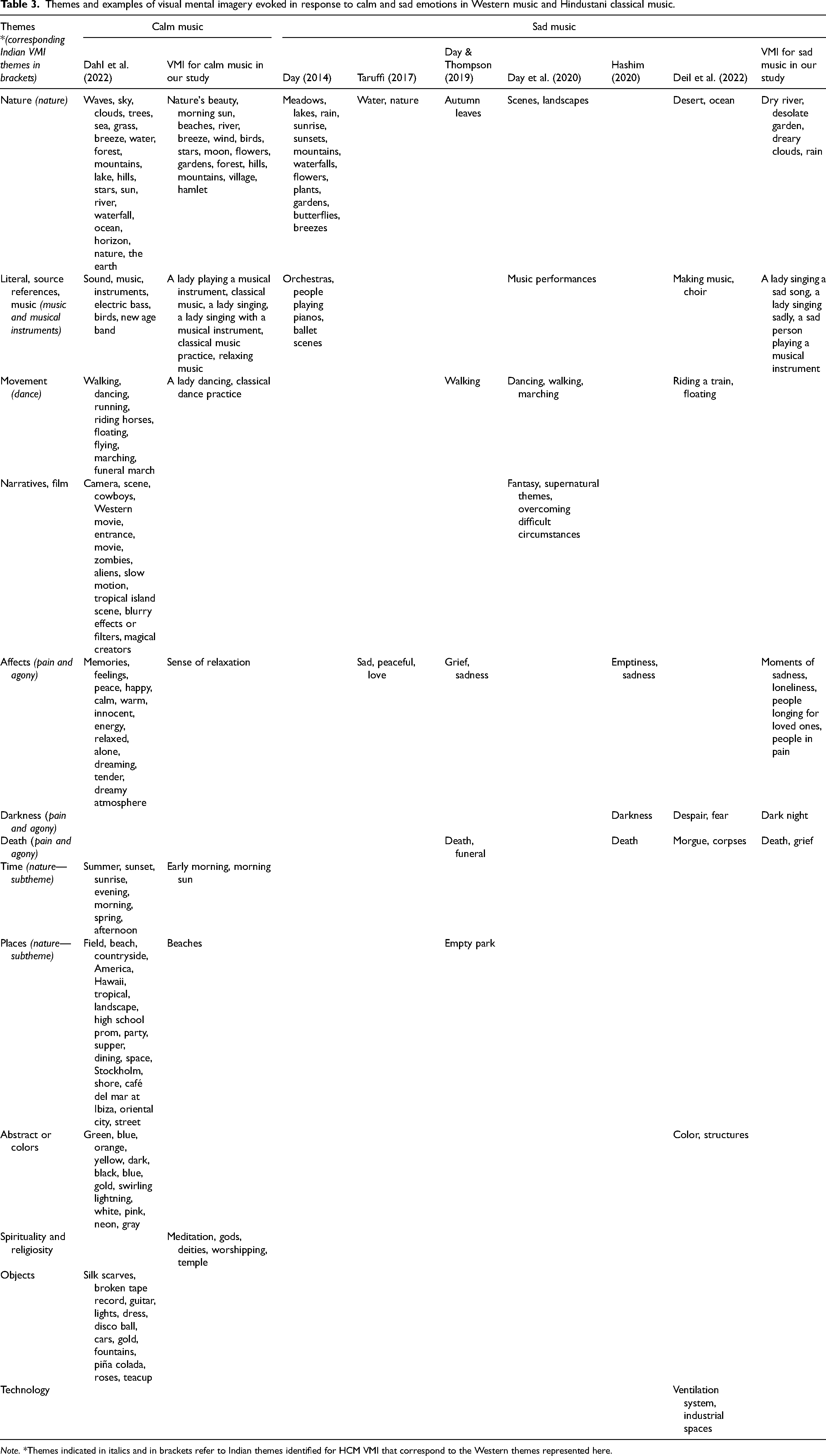
Note. *Themes indicated in italics and in brackets refer to Indian themes identified for HCM VMI that correspond to the Western themes represented here.
At the level of themes, while some themes were common for both HCM and Western music, some were different. Themes in response to calm music for Indian listeners were broadly similar to such themes as “nature,” as well as “references to music and movement (music and musical instruments)” in HCM VMI. Conversely, for Indian calm music, VMI themes that emerged strongly were “spirituality and religiosity,” and “a sense of relaxation,” while for Western calm music, the VMI themes that emerged were “affects,” “places,” “abstract concepts,” and “colors and objects.” Again, many subthemes (indicated in brackets in Table 3) identified for HCM overlapped with others identified in Western music, such as “movement (classical dance),” “time (nature, early morning),” and “places (nature, beaches)”.
The themes for sad music that were common to both traditions, were “nature” and “reference to music.” The themes in sad Western music that overlapped with HCM subthemes were “affects,” “darkness,” and “death.” Such HCM subthemes as “moments of sadness,” “dejected people,” “loneliness,” “people longing for loved ones,” “break-up or separation,” and “people in pain,” were similar to VMI for the theme of “affect.” Such HCM subthemes as “dark night” under the theme of “nature” and “death” under “pain and agony,” were similar to those under the Western themes of “darkness” and “death.”
Themes like “abstract concepts or colors,” “objects,” “places,” and “technology” were not elicited in response to HCM music. Again, while there were thematic similarities, not all VMI showed similarity at the level of subthemes. This applied to both sad and calm music. For example, compared with Deil et al.'s (2022) study, thematic similarities occurred for “nature,” “death,” “darkness,” “music,” and “people.” However, such subthemes as “drought,” “dry river,” and “dreary weather” featured for HCM VMI instead of “forest,” “desert,” and “ocean,” which appeared in the study by Deil et al. (2022). However, similarities were found in such themes as “darkness,” “affects,” and “death,” with similar subthemes in sad music for both traditions.
Similarly, in calm music, subthemes identified in our study, to some extent matched subthemes of Western music, namely “music” and “dance.” However, as expected, HCM referred to Indian contexts, and Western VMI referred to dance and music specific to Western culture. These differences could be due to geographical or situational variables, where people are exposed to different environments.
VI in Dhyanaslokas and VMI Evoked in HCM
For the third objective, VI from the various dhyanaslokas were identified and categorized into themes. The dhyanas were taken from a number of traditional sources (Pandit, 1910; Vijayalakshmi, 2007; Vyāsadeva, 1971) and translated texts, as reported in Table 4.
Themes and subthemes characterizing dhyanasloka verses.

Since the tradition of dhyanas is one of personification, there is always a reference to people, their dress, their attitude, looks, and activities. However, there is also a reference to nature—seasons, sky, clouds, moon, mountains, water, trees, and flowers—musical instruments, smell, and cultural activities, such as worship and dance. Finally, there are references to intimate romantic expressions. The distinctive categories or themes within which the dhyanasloka of a raga traditionally rely on images were identified as (a) personification (gods and goddesses, dancers, singers); (b) gender (masculine, feminine); (c) performing actions (worshipping, singing, dancing, meditating); (d) time of day (morning, afternoon, evening); (e) season (winter); (f) natural objects (flower, trees, birds, mountain, lake, moon); (g) separation from a loved one; and (h) longing for a loved one. These were found to have parity with the themes for HCM we identified earlier and are reported in brackets in Table 4. However, personhood or personification and the embodiment of ragas as human beings is a distinctive category, identified as a theme unique to the medieval tradition.
As mentioned previously, an emotion-based comparison was not possible, owing to various historical inconsistencies in the classification and continuity of the HCM tradition. However, when a comparison between the themes in dhyanaslokas and VMI was conducted for common themes and subthemes, both commonalities and differences emerged. The theme of personification in dhyanaslokas is similar to subthemes of “deities (gods and goddesses),” “a singer,” and “a dancer,” which featured in response to the calm HCM music. Women were visualized as worshipping, singing, dancing, and playing instruments, whereas men were reported as meditating. The time of day was also mentioned in the VMI descriptions. Morning was reflected in descriptions of rehearsing for singing and dancing, going to the temple, sunrise, and calmness prevalent in the early morning. Participants described the subtheme of winter as “a foggy morning,” “dew drops on the grass,” and the calmness experienced during the season. The natural environment and objects, for example, flowers, trees, birds, mountains, lakes, and the moon, featured highly, suggesting that the natural environment contains elements that mimic emotions in music. Themes like “music” and “musical instruments” were also common. The VMI featured musicians, playing and singing with musical instruments. Both men and women were represented in the music extracts, where they performed several actions. Women were observed crying, weeping, playing a musical instrument on the stage in the background, and meditating. Furthermore, since dhyanas are based on rasas, both sadness (karuna) and romantic sadness (or love in separation) figure, even for romantic slokas; this is equivalent to the experience of pain and agony. It is especially observed for romantic dhyanaslokas (and not necessarily for sadness), where the separation of lover and beloved give rise to pain and agony. However, since the very origin of dhyanaslokas and ragamala paintings is based on personhood, this emerged as a separate theme, which was not identified in the contemporary response to HCM.
Discussion
The aim in our study was to explore the nature and content of VMI elicited by sad and calm HCM extracts and compare this with VMI evoked in response to similar Western music and with VMI associated with dhyanaslokas of ragas.
In response to the first objective, the analysis revealed six themes. The results suggest that participants could experience VMI after listening to HCM extracts, consistent with past research on VMI in Western music (Küssner & Eerola, 2019). The VMI were well differentiated for the emotions of sadness and calmness, aligning with past research that the valence of the music influences VMI responses (Martarelli et al., 2016; Taruffi, 2021).
In response to the second objective, a review of the available literature on VMI for sad and calm Western music suggested that a number of themes and subthemes are common to both traditions. However, there were also themes and subthemes that were unique to each tradition.
In response to the final objective, it was found that VI associated with sad and calm emotions could not be identified. However, much of the VI, irrespective of the specific emotion of the dhyanaslokas, fit into the themes and subthemes identified earlier. Findings revealed that VI in medieval traditions had important elements that resemble VMI in response to HCM for contemporary listeners, suggesting continuity in tradition. However, personification emerged as a distinctive theme that is not present anywhere else. Some VI themes were also held in common with Western VMI, suggesting that such affinities also exist.
VMI Evoked by Sad and Calm Clips in HCM
Analysis of VMI in response to sad and calm HCM established that VMI was elicited for most Indian listeners and that there are both thematic and subthematic differences in response to sad and calm music. While some themes are common for sad and calm HCM extracts, the contents and contexts of representations, as suggested by the subthemes, are radically different. For instance, while VMI related to nature is evoked in response to both sad and calm music, the VMI for each differs in valence. While examples of sad VMI are “dreary weather” and “dry nature,” examples of calm VMI are “natural beauty”, “morning sun”, and “river”. Another common theme in response to both sad and calm clips, “music and musical instruments” also shows similar patterns of difference in valence. For example, both types of music have elicited the response of “a lady playing or singing with instruments”. However, for sad music, responses include the additional information “sad song” (the nature of music), “sadly singing” (nature of tone), and “looking sad” (sad face and posture), indicating different ways in which VMI is negative in valence. Our findings agree with the findings of Taruffi (2021) that VMI is different for different emotions, suggesting a difference in valence in some VMI. This is also strongly justified by the fact that, in response to sad music, a whole category of VMI is available for sad music—“pain and agony.” Such a theme in response to calm music is unavailable because calmness is a positive emotion (Labbé et al., 2021).
The descriptions of VMI for both emotions also showed different frequencies for different themes and subthemes. The themes of “nature,” “musical instruments,” and “spirituality” in calm music were elicited most frequently in response to calm emotions. The use of peaceful transcendence, as found in a study by Saarikallio et al. (2021), similar to calmness and devotion, is frequently experienced by Indian listeners; this might be why the frequency of this VMI content might be high. Conversely, the most frequently evoked theme of “pain and agony” was not evoked in response to calm music, indicating distinctive shifts in VMI elicited in calm and sad music. The themes of VMI elicited in response to sad and calm music are discussed in detail next.
Theme 1: Nature.
When one looks at VMI in response to calm music, subthemes, such as “nature’s beauty” under the theme of “nature”, bear descriptions of places (paddy fields, scenery) and greenery (flora, fauna, trees). Other subthemes consist of natural landscapes, such as forests and hills or mountains, locations or human settlements, such as villages or hamlets, natural objects, such as flowers, natural events, or times of day, such as sunrise or early morning. In most of these subthemes, VMI descriptions are self-referential; participants describe relishing freshness and peacefulness by situating themselves in these environments. In such subthemes as “sunrise” and “early morning,” participants refer to these events themselves and attach qualifiers, for example, freshness, clarity, or beauty, in their descriptions. Such subthemes as “forests,” “hills,” “mountains,” and “villages or hamlets” do not involve agencies acting on the object. Therefore, the conjured VMI can be described as an experiential feeling from the fantasy or imagination or from autobiographical memories (Küssner & Eerola, 2019), a tendency similar to both Western and HCM listeners.
While the subtheme of “breeze or wind” is a natural soundscape, it could also depict the movement of the music, as it ebbs and flows with time. Interestingly, the breeze or wind is referred to as gentle, soothing, soft, and cool by the participants. The music might communicate a pleasant feeling that is analogous to a breeze. Such descriptions as “a cold and soothing breeze blowing in the night after a hot day” provide references to this. Bodies of water, such as rivers or lakes, and places attached to them, such as beaches, are also reported. Water in the VMI descriptions can be explained as a metaphor, as the music exhibits both static (e.g., lake) and flowing (river) aspects of water that are generally associated with calmness. In the Western context, water is often used as a metaphor for uncertainty, danger, or calmness (Peltola & Saresma, 2014). However, responses were sparse in the HCM context, suggesting cultural differences.
In contrast to the calm clips, such subthemes as “dry rivers,” “dark night,” “a desolate garden,” and “dreary weather” surface in sad music. Sen (2018) suggests that a river is a rich water source, and that a dry river symbolizes loss of life and drought. This might imply negativity in the music. Other VMI with negative connotations included “a dark night,” “desolate garden,” and “dreary weather,” suggesting that participants might have used these terms to express the depressive or sad mood of the agent. Darkness is also a metaphor to depict sadness (Kövecses, 2005)—it is usually linked with depression (Gonzalez & Aston-Jones, 2008)—and was found to be common VMI in both traditions (Deil et al., 2022; Hashim, 2020).
Theme 2: Music and Musical Instruments.
Kinesthetic imagery of individuals singing and playing musical instruments occurred under the theme of “music and musical instruments.” Indian classical musicians regularly engage in kinesthetic activities, such as playing the tanpura while singing a song with gestures, as well as accompanied by other percussion instruments, such as the tabla, and scaled instruments, for instance, the harmonium. The participants may imagine and see the performers’ bodily movements on stage and use such images to project VMI (Leante, 2009). Most of the VMI is conceived as a woman playing the sitar or a veena, calmly for the calm music and in a sad or depressing manner for the sad music. These descriptions support the view that music often imitates human emotion, where listeners construct an object—for example, a fictional person expressing the emotion perceived in the music (Garrido, 2017). Empathy involves imagining the experience of putting oneself “in the other’s shoes.” It may be that these two processes—imagination and empathy—work closely together in our emotional response to music (Schubert et al., 2018). This also exemplifies events that participants have observed in their daily lives, particularly in social contexts, and the emotional information is reflected in their responses to music (Juslin & Laukka, 2004; Taruffi & Küssner, 2019).
Theme 3: Spirituality ad Religiosity.
Subthemes reflecting spiritual practice, cultural practices, and religious artifacts are “meditation,” “gods and deities,” “worshipping,” and “temples”; these align with one of the mechanisms highlighting cultural understanding and experiences of the listeners (Margulis & McAuley, 2022). Excerpts on VMI under the theme of “meditation,” as described by participants, include “a very melodious snippet trying to get someone into a meditative state of mind.” Another reported “the calmness of a person sitting idle in a meditative posture and getting control over his mind.” Participants imagine that this kind of music can make someone relaxed and focused, and become poised. Cultural objects, such as temples, and rituals, for example, worshipping gods and deities, could be associated with similar music played over loudspeakers in many Indian temple premises in the mornings and evenings. One participant reported the VMI “south-Indian temple” and another reported “visiting a temple in the morning.” Temples, since time immemorial, have practiced early morning music rituals, and musical instruments were played on auspicious occasions to appease gods and deities. Many have reported such images as “worshipping rituals in a south-Indian temple” and “Early morning pooja [worshipping] room with decorations and pooja [the act of worshipping].” Morning prayers, such as bhajan or kirtans, to appease the gods and goddesses are an inevitable part of Indian culture; the VMI possibly reflected these associations, owing to links with autobiographical memories (Jakubowski & Ghosh, 2021).
Theme 4: Relaxing Music.
Calm music often elicits a sense of relaxation and helps the listener calm down and moderate arousal (Pelletier, 2004), describing a relaxed atmosphere, ambience, and postures. One participant indicated, “It was evening and time for relaxing rather than picking up exciting work.” This shows the associative effect of music with contextual images.
Theme 5: Classical Dance.
Participants visualized a classical dancer dancing in morning rehearsals. Notably, in Indian art forms, such as music and dance, Riyaz (practice or training) is also done in the morning. The music, therefore, might have triggered events that the participants had observed in their daily lives.
It is interesting to find only one kind of activity at the center of focus here, compared with Western VMI. True, spiritual practices can also be considered as things that are done, or images associated with sadness and agony might indicate involvement in the act of grieving. But there is a marked absence of VMI of other secular activity in response to HCM clips. This could be due to the specific nature of HCM, which is strongly associated with religion and spirituality (listening to raga music in the early morning or bhajans during worship) or with secular dance performances across India. This view agrees with the observation of Saxena (2009), that a raga generates a spiritual atmosphere.
Theme 6: Pain and Agony.
The subtheme of “grief” is also a subtype of the emotion of sadness, and can be categorized as a type of loss-evoked sadness (Shirai & Suzuki, 2017; Warrenburg, 2020b). It is an emotional response to a distressing experience after the death of a loved one or after a loss of trust, safety, autonomy, or identity (Archer & Freeman, 1999; Epstein, 2019). Grief is accompanied by sadness, negative valence, and a higher intensity or physiological arousal (Huron, 2018; Jefferies et al., 2008; Warrenburg, 2020b). Experiences of grief involve a great deal of personal loss that manifests in crying, weeping, or wailing (Huron, 2015b; Vingerhoets & Cornelius, 2012). “Death,” another subtheme in our study, is a subset of grieving music (Warrenburg, 2020b). Participants reported such VMI as “a lady singing aloud, expressing grief after the death of loved one,” “the depression is over the memory of a funeral ceremony of someone close to me,” and “in a dark room, a woman is crying.” Different terms used to explicate sadness in the clips, like “crying,” “weeping,” “death,” “darkness,” and “depression,” were similar to Warrensburg's (2020b) study on grieving music. Secondly, participants’ descriptions showed that they mostly referred to personal and others’ experiences of grief while listening to sad music (e.g., the death of a close relative or a loved one). This indicates that the music is representative of these emotions and VMI, suggesting that people in different cultures refer to past events or ruminate over them, indicating a strong link with autobiographical memories (Vuoskoski & Eerola, 2012).
For the second recurring subtheme, “moments of sadness,” participants’ descriptions showed that they visualized sad moments experienced by themselves and others. For example, “someone facing hardships in his daily life,” “a very sad moment of my life,” “failure in life, and upsetting consequences,” and “someone is trying hard for something to happen but is failing to achieve it.” There were also references to failure, which is closely connected to perceived sadness; rather, it is a subtype of sadness (Shirai & Suzuki, 2017). Earlier studies suggest that people felt extreme sadness when they perceived that they could not attain a valued goal, making them feel less powerful in such situations (Nezlek et al., 2008; Roseman, 1984). Other VMI, such as “dejected people,” “lonely people,” or “people in pain” points to a sad and depressive atmosphere in which the actors are situated. For example, “a depressed person with a sad state of mind followed by indecisiveness” and “a lonely woman singing with tears in her eyes.” Researchers have advocated that the link between sadness and depression is mediated by rumination (Kirkegaard Thomsen, 2006).
Other subthemes were “people longing for loved ones,” “breaking up with a loved one,” and separation. These themes are similar to the causes of sorrow mentioned in the Natyashastra,3 such as “separation from those who are dear, death, and misfortune.” All these themes are closely connected with interpersonal affiliation, one of the social functions of emotion (Nummenmaa et al., 2021), which is perhaps why they are common to both traditions. Terms associated with sadness also occur in our study, such as “loneliness,” “sorrow,” “gloomy,” “sadness,” “grief,” “depression,” and “unhappiness,” as found in Collier's study (2007). This suggests that music encapsulates these subtle emotion-expressive terms that can be extracted from VMI descriptions.
VMI in Western Music and HCM
Overall, the results show that most Western studies have focused on VMI of sad music, and other music-evoked emotions have received less importance. Some of the themes found from the VMI in response to HCM extracts bear similarities to and differences from those elicited in the context of Western music. Similarities were found in such themes as “nature” and “music and musical instruments”; at a subthematic level, “affects,” “dance,” “darkness,” and “death” were prevalent. Distinct themes, such as “spirituality and religiosity,” indicate a shared culture of the Indian participants that is unavailable in Western music. This might suggest that, although similar mechanisms are in operation for the evocation of VMI, cultural differences might mediate in the formation of distinct VMI.
Findings from a literature review for Western VMI and thematic analysis of HCM VMI suggest that three fundamental operations seem to be at work, explaining both similarities and differences in the evocation of VMI. The first of these, personal associations and autobiographical memories linked to our lives and histories, also reflects extended cultural connotations. Unique personal associations with specific objects might not be generalizable but personal associations, such as, say, feeling calm in a natural green setting or feeling grief at death have both a personal felt aspect (personal experience) and a generalizable aspect (most people feel relaxed in greenery or experience sadness at death). Hence, they can be generalized across individuals and cultures.
The second, cultural associations, leads to categories or subcategories that are unique for both cultures. For instance, the focus on calm music in the Indian context has either nature-based or spiritual connotations. This is distinctive to Indian culture, where HCM and its various variants are most strongly associated with worship, spiritual contexts, or culture (dance and music). In contrast, calmness evokes secular VMI and activities in the Western context.
Thirdly, VMI has symbolic associations, often determined by cultural or personal contexts. Symbolic factors need to be clearly differentiated from cultural factors, in that cultural factors have a direct experiential association—say, the evocation of dance or worship, because that is what one has seen when listening to such music in the past. Dry rivers or dark clouds convey loneliness or sadness in HCM, while imagery of deserts and oceans conveys the same for Western music. Symbolic connotations are sometimes personal, in which case they are not generalizable. But they are often culturally embedded and represent the same evocations differently.
Visual Imagery in Dhyanaslokas and VMI in HCM
Dhyanaslokas and subsequent ragamala paintings, which often inscribe dhyanaslokas above or below the paintings, are clear examples of a unique tradition that greatly emphasizes VI in response to music. Based on our literature review, one can debate whether the images lead to ragas, to represent them or the ragas lead to images, to paint them. But it cannot be questioned that, as the traditions evolved, more of the evocations of the ragas became embedded in the dhyanas and the paintings. While our exploration suggests the use of VI in tradition, it is possible that ancient musicians and listeners actually experienced VMI in response to music that might have resulted in the growth of this tradition. However, the mechanisms of enculturation and embedding to both dhyanas and ragamala seem to be different. Instead of indicating that musicians or listeners of the past experienced VMI in response to such music, we are told that the ragas “embodied” such properties and that they were only “revealed” to the competent musician and connoisseur (Kaufmann, 1965). Dhyanas refer to personhood, thus embodying the music, giving it a human body, creating a unique microcosm within which such music operates. In light of these points, it seems that the mechanisms of evocations of VI based on dhyanaslokas were different from those by which VMI is evoked in contemporary listeners to HCM, and the contexts in which they were conjured were different. However, the representation of human beings in ragas in the dhyanaslokas shows similarities in themes and subthemes reported in VMI in our study in response to two emotions.
The most noticeable difference in terms of VMI evoked in dhyanaslokas and contemporary evocations lies in the ritualistic, formal evocative formula of a dhyan or deep meditative exploration of music as a person (Prajnanananda, 1965). Moreover, the element of self-referentiality is markedly absent in medieval Hindustani tradition. All VMI evocations are, instead, attributed to the personhood of the specific raga and the microcosmic world that she or he inhabits, as stated previously. Within its medieval cultural framework, musicians and listeners are encouraged or expected to respond to the “personality,” “emotional predilection,” and associated and compatible ambience of a raga in predefined ways—VI already embedded within the ragas.
Nonetheless, findings also reveal that, despite these differences, thematic similarities between dhyanas and VMI in HCM are very high, indicating that emotions in music do evoke specific categories of VMI responses (Hashim et al., 2021; Küssner & Eerola, 2019) across time. This suggests that certain common principles operate in eliciting VMI, in spite of the differential frameworks at different points in history. In medieval tradition, the “self” of the raga—raga as a person—is celebrated, and the listener's responses are within the traditional framework. Conversely, in contemporary practice, the listener's self and interpretation are celebrated (Barthes, 2014). Contemporary listeners of both HCM and Western music assert themselves, their interpretations, and evoked images. True, musicians explored VMI by putting themselves in the place of listeners, but similarities abound beyond the conventionalized personification of music in VMI, especially in the associative attributes. What is remarkable here is that though VMI seems to be a spontaneous act and visual representation in dhyanaslokas seems to be a reflective and cognitively driven act, striking similarities seem to be present. This strengthens the supposition that possibly similar processes operate across traditions, as indicated in the discussion of objective one.
Limitations
This study is not without limitations. It has focused only on two emotions, calmness and sadness. This limitation could be overcome in the future using music excerpts representing other emotions evoked by HCM, such as happiness, excitement, or romanticism. Another related limitation is the use of short vocal extracts. Future research can be conducted on music excerpts with the same emotions using instrumental music to understand whether the observations here can be generalized across voice and instruments. While content reflecting grief is found in responses to sad music in this study, stimuli eliciting this granular emotion could not be differentiated. The concept of emotion granularity can be addressed in the future, as used in psychological theories of emotion (Warrenburg, 2020a). This indicates the degree of specificity with which a person expresses emotional states. Pre-rated music extracts of HCM for granular emotions, such as grief, and other emotions, such as melancholy can be examined to understand their VMI contents.
Conclusion
In this study, it is identified that HCM is evocative and representative of VMI in response to two types of emotions: sadness and calmness. This highlights that, in music, these emotions play an important role in influencing the content of evoked VMI. Evoked VMI is influenced by how we feel about a certain kind of music and what contexts (autobiographical memories, semantic knowledge, and cultural associations) modulate our responses. Furthermore, some of the contents of VMI differed from Western music in such themes as “music and musical instruments,” “spirituality and religiosity,” and “classical dance,” suggesting the role of the sociocultural contexts in which this particular type of music is performed. Furthermore, similar mechanisms seem to operate or underlie the evocation of VMI, not only in HCM and Western music but also in medieval Indian traditions. Images sometimes differ based on cultural differences, but the evocation mechanism appears similar. The dhyanasloka tradition also illustrates how response strategies can be determined by complex sociocultural practices, an insight that, in the future could be extended in studying VMI across other cultures, both historically and in contemporary practice.
Footnotes
Action Editor
Solange Glasser, University of Melbourne, Melbourne Conservatorium of Music
Peer Review
One anonymous reviewer
Laura Leante, Durham University, Department of Music
Contributorship
JB conceived the study, reviewed the literature, collected data, analyzed and interpreted the data, interpreted the results, and wrote the first draft of the article; RRB analyzed and interpreted the data, and reviewed the drafts of the article; PP was involved in conceiving the study and checking the manuscript drafts; DS was also involved in conceiving the study and checking the manuscript drafts. All authors reviewed the manuscript.

Declaration of Conflicting Interests
The authors declared no potential conflicts of interest with respect to the research, authorship, and/or publication of this article.
Ethical Approval
The study received ethical approval from the Institute ethics committee of Indian Institute of Technology Kharagpur. Participation in the study was voluntary and participants could withdraw at any point of time. Participants were assured of anonymity of their identity, and use of data for research purpose was guaranteed.
Funding
The authors received no financial support for the research, authorship, and/or publication of this article.
Notes
Appendix A
Themes and subthemes and examples of visual mental imageries evoked by calm and sad music.

| Theme | Subthemes for calm music | Examples | Subthemes for sad music | Examples |
|---|---|---|---|---|
| 1. Nature | Nature’s beauty (30) | I could feel flora and fauna with my eyes closed and just relaxing on the ground with my back laying on the end of a tree trunk. It reminds me of early morning in a calm and greenery place. |
Dry river (6) | The river dried up with dead fishes. A place near the dry banks of a river during hot summers, symbolizing stagnation. |
| Morning sun (17) | Beautiful scenery where the sun has just risen. Sunshine on a chilly morning. |
Dark night (6) |
Dark night. Darkness. Dark forest. A dark street filled with people. |
|
| Beaches, river (16) |
Amid mother nature—sitting beside the shores of a peaceful lake. A scenic early morning against the backdrop of the sound of a gushing river. |
Desolate garden (6) |
A desolated garden without birds. |
|
| Breeze, wind (11) |
A cold and soothing breeze blowing in the night after a hot day. Early morning breeze. |
Dreary clouds, rain (5) |
Dark cloudy morning. Gloomy rainy day. |
|
| Early morning (11) |
There is a tone of freshness early in the morning. Early clean and clear morning in the winter season. |
|||
| Birds (7) |
Calm morning, the birds are flying in the sky. Birds sitting in their nest. |
|||
| Stars, moon (6) |
Watching the night sky filled with stars. Moon and stars. |
|||
| Flowers, gardens (5) |
Watching dew drops on my bloomed roses in the morning. Early morning fresh flowers blooming. |
|||
| Forest (5) |
Staring at a foggy forest from my balcony. |
|||
| Hills, mountains (4) |
Hills. A green and clear hill with trees. |
|||
| Village, hamlets (2) |
A bucolic hamlet. A peaceful village scenery. |
|||
| 2. Music and musical instruments | A lady playing a musical instrument (22) |
A lady with a sitar or any musical instrument. A woman with a musical instrument, like a veena. |
A lady singing a sad song (6) |
Sadness in the tone of the singer. This tone reflects a lady singing a painful and depressing tone. |
| Classical music (20) |
A girl singing Carnatic music on the stage. Traditional setup, a classical singer singing. |
A lady singing sadly (6) |
Lady is singing in a sad and depressing tone of the music. The image or association is of a lady in a sad state singing a low-pitched audio clip. |
|
| A lady singing (16) |
Trees and a flowing river with a lady singing on the shore. The image this clip provokes in my mind is of a lady singing in a soothing tone. |
A sad person playing a musical instrument (2) |
A sad person playing the sitar. Someone is very sad sitting and playing the sitar. |
|
| A lady singing with a musical instrument (13) |
A woman singing among the people playing the table. Lady sitting on the floor—playing and singing—immersed in the emotions. |
|||
| Classical music practice (10) |
All students are practicing classical geet. Lady doing riyaz of her music. |
|||
| 3. Sense of relaxation | Relaxing music (8) |
The music feels calm after a tiring day in the evening and not exciting for new work but signifying that it is time to rest. It was refreshing and relaxing. |
||
| Relaxing activity (6) |
Someone sitting on a chair and relaxing. |
|||
| 4. Spirituality and religiosity | Meditation (23) |
The state of calmness of a person sitting idle in a meditative posture and getting calm and control over his mind. A very melodious snippet trying to get into a meditative state of mind. |
||
| Gods, deity (11) |
Spiritual, godly images. Images of gods and goddesses. |
|||
| Worshipping (11) |
Worshipping rituals are going on in a south-Indian temple. An early morning pooja room with decorations and pooja. |
|||
| Temple (7) |
South-Indian temple. Visiting a temple in the morning. |
|||
| 5. Classical dance | A lady dancing (4) |
Expressions, movement, and fluidity. Classical dance. |
||
| Classical dance practice (2) |
Dancer dancing; a morning routine of classical dance. Classical dance practice in the morning. |
|||
| 6. Pain and agony | Death, grief (35) |
Lady singing aloud expressing grief after the death of a loved one. The depression is over the memory of a funeral ceremony of someone close to me. Someone is crying because someone is not with him, who is very close. |
||
| Moments of sadness (34) |
Someone facing hardships in his daily life. A very sad moment in my life. Failure in life and upsetting consequences. Someone is trying hard for something to happen but is failing to achieve it. |
|||
| Dejected people (21) |
A depressed person with a sad state of mind, followed by indecisiveness. A lady is sitting in distress and thinking about something. |
|||
| Loneliness (15) |
A lonely woman singing with tears in her eyes. Returning home and having dinner alone with parents far away. |
|||
| People longing for loved ones (10) |
A sad woman sitting in front of her door waiting for someone. A person waiting for a loved one. |
|||
| Break-up, separation (9) |
Someone is sad due to love, disappointment, and break-up. A person leaving his wife and kids. |
|||
| People in pain (6) |
A woman who is in pain. This feels to be a depressing tone for me, which reflects a lady in pain. |