



Abstract
Music therapy provides a complex and dynamic environment and as such offers space for the emergence of nonverbal dialogue. We aimed to capture the relational, musical, and physiological aspects of intersubjectivity emerging during dyadic piano improvisations between music therapists and adult participants in a non-clinical feasibility study. Various data from 17 partner improvisations with adult participants and music therapists were collected, including audio, video, and MIDI recordings, physiological (ECG and EDA) measures, questionnaires, and semi-structured debriefing interviews. Parts of these data sets served for a mixed methods analysis to show (1) how instances of intersubjectivity were experienced by therapists and participants (drawing on interview data), (2) how their shared experiences were supported by coordination and contrast at the level of musical features (drawing on musical data), (3) how physiological arousal was compared between an initial resting baseline and the improvisation, and (4) how patterns in the event related electrodermal activity data related to qualities of intersubjectivity and musical interaction in an example of two case studies. In conclusion, intersubjectivity was characterized by overlapping experiences of relational qualities and complex patterns of musical interaction, including contrasting elements of convergence (in pitch contour) and divergence (key velocity and timing). Further, the case studies showed how differently-interpreted experiences can emerge from a homogenous musical structure, and how stronger intersubjectivity may be associated with more active experiential phenomena such as disruption or reciprocity (versus relaxation or security). Additionally, our findings highlight the complexity of musical interaction as an enactive process. Bringing together multi- and interdisciplinary perspectives enhanced a shared understanding of how subjective experiences that arise during dyadic improvisations relate to measures of musical coordination and physiological arousal. The complex mixed methods design proves to be feasible and, as a consequence, can be transferred to clinical settings in the future.
Introduction
Humans are inherently social beings, whose cognitive systems are specialized to enable behaviors that facilitate interaction with others. These behaviors include giving and following social orienting cues (such as gaze) that lead to shared attention (Khoramshahi et al., 2016), synchronizing body motion with others’ motion (Tarr et al., 2014), and engaging in expressive communication (Cross, 2014; Juslin & Laukka, 2003). All these behaviors are important for establishing social bonds and maintaining relationships. The bonds that people form with each other are ultimately fundamental to promoting and sustaining physical and mental well-being.
A broad range of mental health problems can disrupt the basic cognitive abilities that allow people to navigate social interactions and establish social bonds. For the people who are affected by such a difficulty, the consequences of poor social bonding can be substantial, not least because their reduced engagement with others may compound other effects of the disorder. Covering a wide range of practical applications, music therapy (MT) has been explored as a potentially valuable means of treatment and rehabilitation for people living with challenges such as depression, dementia, or autism spectrum disorders (Aalbers et al., 2017; Geretsegger et al., 2022; van der Steen et al., 2018). In MT, music is used as a medium for communication and emotional expression, with the aim of building a dialogue between individuals and improving the client's capacity for social bonding. The current study focused specifically on musical improvisation as a therapeutic method for creating dialogue and developing a relationship between therapist and client. Our broad aim was to show how dialogue emerges between therapist and client during partner-play improvisations.
This paper presents a multi- and interdisciplinary approach, including the perspectives of music therapy, music psychology, and cognitive science as part of a mixed-methods, multi-phase feasibility research study with adult participants in a non-clinical research setting. The first phase of this research involved the development of a qualitative framework for assessing therapists’ and clients’ experiences in terms of meanings and levels of intersubjectivity, named “COME_IN” (standing for content, meanings, and intersubjectivity). The development and presentation of this framework has been published elsewhere (Smetana et al., 2023) but will also be summarized later in this paper.
MT presents an intriguing setting in which to study social and musical interaction. The therapist–client relationship (described by Bruscia, 1998; Jahn-Langenberg, 2002) is distinct from the relationships that occur among trained members of a music ensemble (described by Davidson & Good, 2002; Seddon & Biasutti, 2009) and is likewise distinct from the relationships that occur between music teachers and their students (described by Gaunt, 2010; Schiavio et al., 2020). In a therapeutic context, no special musical knowledge or ability is expected of the client, and artistic goals are not subject to any genre-specific constraints. The therapist has a special responsibility to focus on the client and respond to their playing with techniques that support them, give hold or structure, enhance emotional expression, or challenge and draw them out for a playful, nonverbal acting out of conflicts (Smetana & Storz, 2020). This also includes giving space to the client's creativity, which may trigger non-verbal communication based on a joint and spontaneous interplay of the persons involved (Brown & Pavlicevic, 1996, p. 398).
In the field of music psychology (MP), a prominent focus in recent literature on group music-making has been the nature of the relationships that emerge between group members. These relationships have been studied from a behavioral perspective, through analysis of the musical output and patterns of body motion and gaze (e.g., Bishop et al., 2021; Chang et al., 2019; Walton et al., 2018; Williamon & Davidson, 2002). They have also been studied from a phenomenological perspective, using interviews with group members to determine how they conceptualize their interactions and experiences (Høffding, 2019; Seddon & Biasutti, 2009).
The current study combines central themes of MT and MP in the context of nonverbal, musical interaction and, in addition, integrates physiological data collected during improvising in a dyad. The latter include electrocardiogram (ECG) and electrodermal activity (EDA) data, which are linked to the MT and MP views. Thereby, we make a novel contribution to the literature by combining the results of qualitative analyses of participants’ experiences with quantitative analyses of their musical output and physiological arousal during free dyadic improvisations.
Musical Improvisation as an Active Therapeutic Method
Music therapy encompasses a heterogeneous field of different approaches in which various active and receptive methods of music making and listening to music are applied. The approach that we adopted is based on humanistic and psychodynamic principles with a particular focus on active improvisation. In this understanding, the relational character of musical improvisation facilitates the direct and tangible shape of a client–therapist relationship. Characterized by its spontaneous, unforeseeable nature, improvisation is a creative action that enables a broad variety of human expression and personal and aesthetic experience. In active MT the client(s) play(s) together with or in the presence of a therapist, with or without structuring rules or themes, and without the requirement of special previous knowledge or skills on musical instruments (Smetana, 2018). Regarding the preverbal character of music (i.e., basic experiences of pulse, rhythm, dynamics etc.), the values of MT lie both in uncovering early relational patterns (maladaptive strategies as well as resources) and in the capacity to offer correctional experiences to the client within a therapeutic relationship: Music, as a non-verbal medium that provides an “intermediate space” (Winnicott, 1971) between a therapist and a client, can support these processes (Smetana, 2017). The music therapist gives resonance to the musical expressions of the client. Furthermore, the therapist supports processes of awareness and verbalization, so that important issues can be made accessible for conscious processing and transferred into the client's life context.
Relationship and Dialogue in Music Therapy
The combination of supportive, communicative, but also disclosing and confronting techniques in MT improvisations shifts the therapeutic relationship into the focus of music therapy practice investigated here. According to the therapeutic process, various psychotherapeutic techniques in their non-verbal form, such as holding, supporting, mirroring, grounding, resonating, or containing techniques are applied in MT to address the client's individual needs and stimulate the development of a therapeutic relationship (Bruscia, 1987; Smetana & Storz, 2020; Wigram, 2004). A therapeutic relationship, which is not least a very important parameter for a positive therapy outcome (Wiggins et al., 2012), is not only about a working alliance or an overall “good matching” between therapist and client, but—from a psychotherapeutic view—goes along with the client's intrapsychic development resulting from an encounter between therapist and client, based on intersubjective processes. The intersubjective field, defined as a reciprocal, dynamic system (Atwood & Stolorow, 2014), is rooted in the unconscious of the involved individuals and constitutes the basis for dialogue (Ermann, 2016). Referring to Benjamin's (2004) concept of thirdness, we understand this field to be located in the intersection of the client's and the therapist's subjectivities. From a therapeutic perspective, intersubjectivity provides the underlying structure of relational experience in the here-and-now; as a developmental achievement it involves the capacity to recognize the other as different and separate from oneself and yet connected. In the sense of this profoundly humanistic—and at the same time psychodynamic—idea of therapeutic encounter, we considered the music therapeutic dialogue as a key concept for understanding relational, intersubjective processes in music therapy (Fitzthum et al., 2020), combining psychodynamic and humanistic principles. In our recently published paper (Smetana et al., 2023), we highlighted some important characteristics of dialogue, based on a variety of previous work in MT research and theory building, for example, referring to dialogue as “the logic that lies between, that connects” (Neugebauer & Aldridge, 1998); ontological, ethical, and pragmatic aspects of dialogue as described by Frank and Gilboa (2022); some basic assumptions on the relational music therapist (Trondalen, 2016); or Stensæth's (2017) concept of responsiveness. This was completed by prevailing concepts such as meaningful moments (Amir, 1993), pivotal moments (Gavrielidou & Odell-Miller, 2017), moments of interest (Fachner, 2014; Fachner et al., 2019), or moments of resonance (Coomans, 2018).
On this basis, we define dialogue as follows: Dialogue can be defined as an individual process, based on personal conditions, experienced as meaningful and important, and needing a respectful, unreserved environment, openness, and empathy. Furthermore, dialogue is a highly intersubjective quality of relationship, which shows up in engaging with another person and distinguishing or differentiating between oneself and the other. This is apparent especially in the ability and willingness to engage with a counterpart, with the other, and might go along with a kind of tension, due to the experience of otherness. To be in dialogue, I sometimes must be able to endure the tension between me and not-me—and be able to tolerate difference or even strangeness in contact with the other. Pre-forms of dialogue can manifest themselves in the development of precisely these qualities and abilities. (Smetana et al., 2023)
The core elements of musical communication and non-verbal interaction are at the heart of a growing body of literature on musical dialogue in a therapeutic setting, reaching from Neugebauer and Aldridge's (1998) investigation of the influence of clinically informed improvisation on the patient's and therapist's physiology by measuring heart rate, to a recent study by Hadar and Amir (2021), which focuses on dialogic moments as they were experienced by music therapists and professional musicians in their recorded joint improvisations with a client or another musician. Closely connected to the topic of dialogue is the assessment and investigation of particular moments or processes in the context of MT treatment and therapeutic relationship, which is also attracting interest in research: transitional processes within improvisation in MT with adults (Foubert et al., 2017, 2020); the experience of moments of change in terms of pivotal moments in music therapy from the therapists’ points of views (Gavrielidou & Odell-Miller, 2017); the identification of moments of participant interest during music therapy sessions involving the Bonny Method of Guided Imagery and Music by usage of brain activity measured by electroencephalogram (EEG) (Fachner et al., 2019); or the in-depth analysis of moments of interest (MOI) and moments of no interest (MONI) in music therapy, combined with EEG measurements in patients with neurological challenges (Fachner et al., 2021; Tucek et al., 2022). All these examples share a focus on phenomena of interpersonal meaningfulness to explain how music can bring about beneficial change and development for people living with mental health problems or other conditions. However, apart from a few exceptions, most published research focuses on therapists’ evaluations and external ratings and does not include the clients’ perspectives. What we miss in the literature is the question of how clients subjectively experience such key moments in music therapeutic improvisations, what makes moments meaningful to them, and how they perceive non-verbal processes in terms of relationship and dialogue. Furthermore, there is a gap in connecting the different and interweaving levels of information that can be obtained from a music therapy improvisation and in capturing the relational experience, musical parameters, and physiological processes in a combined research design.
COME_IN: A Qualitative Framework for Content, Meanings and Intersubjectivity in Free Dyadic Improvisations
Motivated by the question of how dialogue as a substantial relational quality emerges and intersubjectively manifests in free, dyadic improvisations, as is typical in humanistic and/or psychodynamic approaches to MT practice, we started our initial research in a non-clinical setting with adult participants (n = 9) and trained music therapists (n = 8). Due to our attempt to cover manifold aspects of subjective experiences in therapeutically informed music improvisation and create as broad a set of categories as possible, and also to gather sufficient experience with the individual study components during the pilot phase before transferring the design into a clinical research setting, only participants without a current mental health diagnosis were included in the feasibility study. A total of 17 free dyadic piano improvisations were recorded and verbally reflected on in semi-structured debriefing interviews. 1 These focused on moments or time periods where one or both improvising people had the feeling that something pivotal happened between them. Even though we are aware that many literature examples are about particular moments in MT, we decided to use the term situations as an umbrella term for shorter or longer events, comprising moments (short, punctual) and/or time periods (longer, processual).
Resulting from a qualitative in-depth analysis of the entire narratives, a complex framework, including the dimensions of contents, meanings, and intersubjectivity (COME_IN) was developed.
This framework consists of two separate sets of qualitative categorizations: (a) 5 categories and 19 sub-categories of meanings, that is, different intra- and interpersonal experiences indicating developments and states of relationship in dyadic improvisations, and (b) 8 categories of intersubjectivity, which is operationalized in temporal and/or content-related overlaps of subjective experiences. Figure 1 illustrates the mutual mobility of the two systems by means of two rotating dials, which can be conceived of as embedded one in the other. Since we have already published an article with a detailed description of the development and the resulting structure and contents of the framework elsewhere (Smetana et al., 2023), we will not go into further details here. However, for the mixed methods analyses that are presented here, it is important to know that the COME_IN framework forms the starting point for our multi- and interdisciplinary analysis steps that we will describe later in this paper.

COME_IN: overview of the framework (Smetana et al., 2023).
Achieving Dialogue Through Musical Interaction
The literature on skilled music ensemble playing describes some of the different modes of interaction that can emerge between partners as they establish a musical dialogue. These include instruction, which constitutes a one-way flow of information from one player to another; cooperation, which occurs when players engage in deliberate communication about their ideas and intentions; and collaboration, which requires a high level of attunement between players and is characterized by creative risk-taking and the emergence of new jointly-constructed outcomes (Seddon & Biasutti, 2009). When playing together, musical partners may move in and out of different modes of interaction depending on the musical demands and their own abilities and attention fluctuations (Bishop & Keller, 2022).
Linson and Clarke (2017) describe ensemble playing as a process of listening-while-performing that happens simultaneously, in parallel, between players. This process does not have to be convergent. Players may interpret the same musical material differently and still manage to coordinate musical output that they jointly judge to be meaningful (Canonne & Aucouturier, 2016; Canonne & Garnier, 2015; Pras et al., 2017). Interpretation, in this context, is partially a process of meaningfully situating a musical utterance within the greater structure of the performance and partially a moment-to-moment process of generating musical responses. The array of possible responses that players perceive depends on their musical knowledge, their technical ability, and the social and artistic goals of the interaction (van der Wel et al., 2015).
Close agreement in players’ interpretations is sometimes needed for their performance to sound coherent, but this is not always the case and depends on the players’ goals and whether the performance is situated within a particular musical style (Schiavio & Høffding, 2015). For styles that have few rules or conventions governing their construction of musical structures (e.g., free improvisation), diversity in interpretations might be welcomed (Canonne & Aucouturier, 2016). In MT improvisations, the therapist and client may differ substantially in their musical knowledge and technical ability. This is especially the case when the client has little or no formal musical training. A given musical phrase may therefore afford a very different range of responses from the therapist than it does from the client, although the therapist's training may allow them some insight into how the client might respond. This difference in approach to the listening-while-performing process raises some questions about how a therapist and a musically untrained client might produce music that is mutually meaningful and allows them to establish a dialogue.
One of the primary ways that people interact with each other musically is through imitation (Leman, 2008, pp. 104–111). Imitation is intrinsically pleasurable and is important for learning and establishing experiences of social connectedness (Schiavio et al., 2020; Trevarthen, 2012). Overt imitation and covert simulation of others’ actions are associated with the so-called mirror neuron system (Hadley et al., 2015) and are posited to be involved in the processes of empathic attunement and emotional contagion (Keller et al., 2014; McGarry & Russo, 2011; Molnar-Szakacs & Overy, 2006).
In music, imitation is important for building musical structure and forms a starting point for call-and-response patterns and musical variations, in which some aspects of a structural fragment are maintained while others are varied. In skilled ensemble playing as well as in therapeutic improvisations, the full breadth of musical relationships that emerge between players extends far beyond what can be characterized as straightforward imitation. Players’ contributions may be divergent but complementary, or even conflicting, and still contribute to a strong shared experience of musical meaning.
Research carried out in a clinical context, using improvisation tasks, has shown that imitative forms of interaction between therapist and client (e.g., musical synchronization) are negatively affected by conditions like borderline personality disorder that are associated with disrupted patterns of interpersonal attachment (Foubert et al., 2017). In a recent study, the strength of imitative interaction between therapist and client, operationalized in terms of similarity in rhythmic complexity and beat clarity during improvisation, was found to improve among people with depression following a music therapy intervention (Hartmann et al., 2023).
In the form of MT that is investigated here, imitation is characterized by echoing and time-delayed repetition of the client's musical motifs (Smetana & Storz, 2020). Yet, dialogue as a relational quality is not primarily defined in completely coordinated and matching experiences of attunement or even synchrony, but rather arises from mutual challenging, interpersonal difference, and otherness; even conflicts, tension, or friction are considered as characteristic for the experience of dialogic encounter.
Our interest focuses on the question of what qualities of togetherness characterize meaningful situations according to their level of intersubjectively shared experiences, and what forms of dialogue can emerge beyond imitation and coordination.
Purpose and Scope of the Current Study
This was a multidisciplinary, mixed methods feasibility research study focused on the interweaving processes between adult participants without a mental health diagnosis (P) and trained music therapists (T), who performed in a free dyadic improvisation as it is applied in music therapy. The aims were the following: (a) to capture the subjective experiences of emotions and relationship and possible intersubjective overlaps between P and T improvising together on the piano; (b) to compare the qualitative results to quantitative analyses of musical parameters before and during meaningful moments or periods that indicate musical togetherness; and (c) to compare the qualitative results to quantitative analyses of psycho-physiologically relevant measurements of arousal, that is, heart rate and electrodermal activity.
Anticipating future application of the study paradigm to clinical MT settings (e.g., people with depression, personality disorders, psychiatric illnesses, adolescents), we intended to find a suitable approach for combining multidisciplinary perspectives into one mixed methods study design with the aim to enhance our knowledge and understanding of therapeutic relationship, dialogue, and intersubjectivity in MT.
As described above, the COME_IN framework served as a basis category set covering individual and shared experiences in improvisations. We intended to connect discussions from MP on imitation and coordination with the framework and to address missing perspectives along theoretical basics on interaction in MT and MP. Furthermore, we describe how this can be connected and/or complemented by the analysis of physiological parameters in the context of cognitive science. The current study included two levels of analysis. The main analysis brought together interview, musical, and physiological data for the full dataset of 17 partner-play improvisations, allowing us to identify commonalities and general patterns across P-T pairs. A secondary analysis focused on two improvisations and followed a case study format, allowing us to examine in more detail the specific circumstances that surrounded particular experiences and musical patterns.
It was important for our approach that the perspectives of our non-clinical study participants (who will be adults with mental health problems in further clinical studies) and music therapists were equally involved in the research process. Our method of data collection and analysis as well as the reflection and discussion of the results are strongly related to underlying considerations regarding the intersubjective field between a client and a therapist. Narratives on subjective experiences of both improvisers form the qualitative data pool on which the mixed methods approach is based. What is also new in our approach is our attempt to investigate the role of difference, or otherness, in the therapeutic dyad, even if we consider simultaneous and synchronous moments or periods as potentially important precursors to the emergence of dialogue.
Research Questions and Hypotheses
Due to the study's partially exploratory character, the following questions are central to our research:
How can the COME_IN framework be used for multi- and interdisciplinary investigations of intersubjective processes between two players in dyadic improvisations? What can we learn about the interplay between the two parts of the framework—meanings and intersubjectivity—that is, the quantity of particular meanings in different levels of intersubjectivity, the proportions of mentioned qualities between P and T, or between longer periods and shorter moments? Which qualities of meaning regarding relational qualities (e.g., autonomy, closeness), self-focused qualities (e.g., awareness, tension), or intra-interpersonal phenomena (e.g., attention, change) arise in dyadic improvisations? When and why do particular forms of musical interaction, such as imitation, synchrony, divergence, or contrast appear, and how is the experience of these patterns related to intersubjective processes of relationship and the emergence of dialogue? What do the physiological data (ECG, EDA) show during the resting state and improvisation phase, and how does skin conductance during the improvisation phase relate to qualities of intersubjectivity and musical interaction?
The central hypotheses of this research address the issue of intersubjectivity in dyadic relational experiences: First, we assume that overlaps or congruence in the subjective experience of the two individuals involved in the improvisation indicate intersubjectivity. The more obvious the matches between the described experiences of significant moments, the stronger we consider the evidence of intersubjectivity to be. From this basis we hypothesize that certain categories of meaningful situations occur more frequently in certain periods of intersubjectivity: Pre-forms of dialogue (relational processes) are assumed to occur more often before relational qualities are established and during periods or moments where there is little evidence of intersubjectivity, while relational qualities are expected to occur in periods or moments where evidence of intersubjectivity is conclusive.
We also hypothesize that alignment in musical features (operationalized as the similarity of the participant's and therapist's playing) occurs most strongly in combination with pre-forms of dialogue. In time periods where the players experience relational qualities, which we expect to see at the most conclusive levels of intersubjectivity, more difference between the participant's and therapist's playing is expected. Physiological measures were included as an index of P’s and T's arousal in response to the task.
Methods
Participants
Overall 17 subjects—9 adult participants (P) (ages 19–44, 8 female) and 8 trained music therapists (T) (ages 28–55, 7 female)—took part in the study, resulting in 17 partner-play improvisations. The study's procedure was approved by the university's ethics committee, and all participants and therapists provided written consent before completing the sessions. Within the 17 improvisations, 8 out of 9 participants performed twice, and most of the music therapists also participated in 2 sessions. T were recruited by the principal researcher through purposeful selection. All professionals were trained in the Viennese tradition of music therapy and had at least five years of clinical experience. P were mostly recruited through university student networks (e.g., music studies, rhythmics, medical studies, philosophy and human sciences, cognitive sciences, health professions). Stemming partly from professional musical training and musical lay contexts, they represented a wide range of musical (improvisation) experience. P and T differed slightly but non-significantly in musical sophistication, measured using the Goldsmiths Musical Sophistication Index (Gold-MSI; Müllensiefen et al., 2014), which captures general musical sophistication through self-reported assessment of active engagement, perceptual activities, musical training, singing ability, and emotions (see Procedure; participants M = 83.3, SD = 27.2, therapists M = 99.4, SD = 9.3; t(10) = 1.65, p = .12).
Equipment and Materials
Improvisations were done on a Yamaha Clavinova, and MIDI data were recorded in Logic Pro X. Heart rate and skin conductance were monitored before and during improvisations using a NeXus-10 MKII, connected to a laptop running BioTrace + software. Three video cameras (two Blackmagic Micro Studio 4K cameras and a Sony HDR-MV1) captured audio and video footage from different viewpoints throughout the sessions. Questionnaires were completed using iPads, and debriefing interviews were recorded using a Zoom H2n. Videos of the improvisations were played back to participants during interviews on a MacBook Pro.
Data Collection
Prior to experiment sessions, all participants and therapists completed questionnaires that assessed musical sophistication (Gold-MSI; Müllensiefen et al., 2014).
Sessions opened with P and T completing the Multidimensional Mood State Questionnaire (MDBF), a 12-item scale for self-assessing current psychological well-being along three dimensions: (a) good––bad mood, (b) wakefulness––fatigue, and (c) calmness––nervousness (Steyer et al., 2004). Following this, both players were fitted with sensors for physiological recordings, which lasted 15 min (cf. Figure 2) and included three phases: (1) resting state; (2) familiarization, where P and T were able to warm up on the piano and talk with each other a little; and (3) improvisation phase. As soon as the improvisation started, T placed a 5-min timer on top of the piano to mark the start. Keeping with the idea of free improvisation, there was no agreement on who would play the first note out of the silence. When the timer ran out and the improvisation was finished, both players completed the MDBF a second time, followed by the Dia-SQN, a written questionnaire that was developed by the principal researcher for the feasibility study, addressing the experience of relationship in terms of meaningful situations, relational needs, self- and other perception, emotions, and the use of therapeutic techniques (Smetana & Stepniczka, 2022).

Research environment, assessment procedure, and data sources.
The session finished with a semi-structured debriefing interview, which P and T completed individually with an experimenter. During the interview, which lasted about half an hour each, the players were able to view an audiovisual recording of their improvisation. The interview focused on players’ experiences of meaningful situations, which they were encouraged to reflect on in terms of their thoughts and feelings, causal conditions, strategies, and consequences.
This paper reports on data from the improvisations, interviews, and physiological arousal measures. Gold-MSI scores have been summarized in the Participants section above.
Analysis
As described above, in an initial step, the 34 debriefing interviews were analyzed using a qualitative content analysis approach, following the step-by-step model of summarizing content analysis (SCA) as described by Mayring (2014, 2019), and the COME_IN framework was developed (Smetana et al., 2023) (see Figure 3, Analysis Step I). Subsequently, we will now provide insights into the multidisciplinary approaches that built on COME_IN, comprising (a) within-framework analyses, (b) musical analyses, and (c) physiological analyses (see Figure 3, Analysis Step II).

Methodological mixed methods framework for the analyses in this paper.
Interview Data
A structured table with time stamps and summarized interview data allowed the organization of reported meaningful situations into the COME_IN two-part categorization system for meaning and intersubjectivity:
Meanings
The summarized statements of the interviews with T and P were coded along the list of definitions as provided in the framework's codebook. 2 This enabled the categorization of every single meaningful moment or time period captured by the interview narratives.
Intersubjectivity
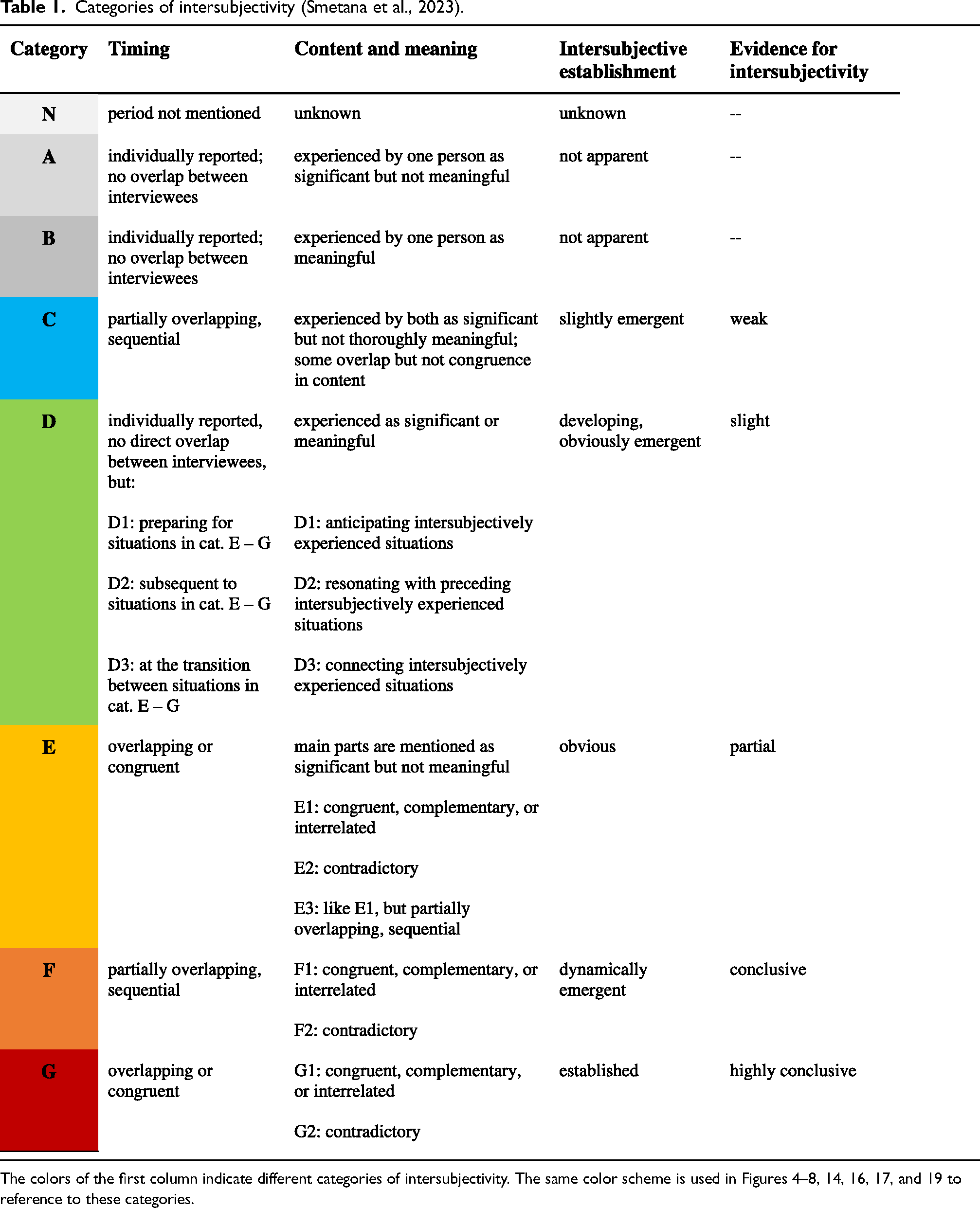
Along the timeline of coded interview statements, the COME_IN categories of intersubjectivity (see Table 1) were deductively applied to all 17 improvisations by assigning them to each single situation or moment within the timeline and quantitatively documented by seconds. Using the software R, the coded time segments of each entire improvisation were brought into a timeline that could be combined with the timelines of the MIDI data as well as the physiological measurement data (see Musical Data and Physiological Data below). Consequently, each moment or time period that was covered by one of the categories A–G could be referred to as an “intersubjectivity window” in subsequent musical and psychophysiological analyses.
Categories of intersubjectivity (Smetana et al., 2023).
Musical Data
MIDI Postprocessing
Since P and T played together at the same Clavinova, their MIDI data were collected in a single recording, and it was necessary to make a manual identification of who played which note. This was done by studying a visual representation of the MIDI data (i.e., a piano roll) and identifying the range of notes that each person played during successive time windows. Where necessary (e.g., when the ranges of played notes overlapped), we referred to the video recordings that captured the players’ hand motion.
Once participants’ and therapists’ notes were separated, their playing was segmented into chords. Although it was impossible for us to know which notes the players intended to play as chords, they did produce clusters of notes that were close enough in time to be perceived as chords. Chord segmentation was done per player. Chords were identified wherever two or more note onsets occurred within a 100 ms window, with no more than 50 ms between successive onsets. Following chord segmentation, we were able to analyze changes in musical features (key velocity, pitch contour, timing) at a chord-level rather than an onset-level timescale. This and all subsequent preprocessing and analysis steps were carried out in R.
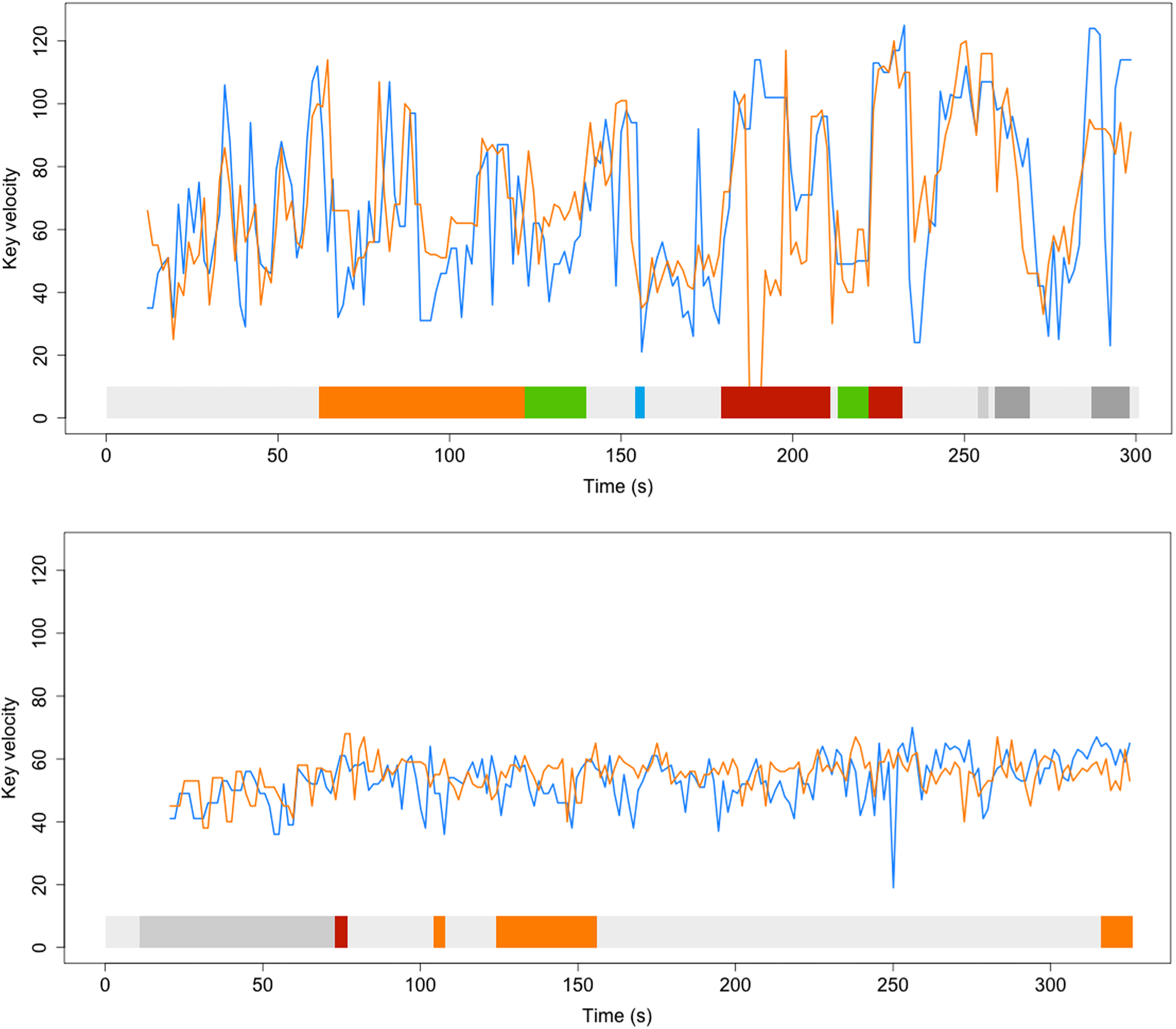
Key velocity curves of two P-T pairs. The upper plot shows an improvisation with many coordinated changes in key velocity, while the lower plot shows an improvisation with relatively constant key velocity. Orange lines indicate P performances, and blue lines indicate T performances. The bars beneath the plots are color-coded to indicate intersubjectivity windows (see Table 1).

Pitch contour curves of two P-T pairs. The upper plot shows an improvisation with a higher density of played notes and a section where P and T played within an overlapping range (around 180–210 s), while the lower plot shows a lower density of played notes. Both plots show some clear coordination in pitch contour. Orange lines indicate P performances, and blue lines indicate T performances. The bars beneath the plots are color-coded to indicate intersubjectivity windows (see Table 1).

Timing curves for two P-T pairs. Both pairs show high variability in the inter-onset intervals (IOIs) of their performed chords and some periods of relative regularity. Note that very small IOIs (i.e., <50 ms) can occur when cascades of notes are played in quick succession (see chord segmentation procedure). Orange lines indicate P performances, and blue lines indicate T performances. The bars beneath the plots are color-coded to indicate intersubjectivity windows (see Table 1).
Key Velocity
Key velocity curves were constructed for each player using the maximum velocity value of each chord (Figure 4). These curves were then resampled at 0.75 Hz using a constant interpolation method. This interpolation gave us common timestamps for the two players. The interpolation also resulted in some smoothing of the key velocity curves, which meant that our analysis focused on mid-level rather than chord-to-chord changes. The resampled curves were normalized to a 0–1 range.
Normalized, resampled key velocity curves were compared within therapist–participant pairs for each intersubjectivity window, so that we could test how similarity in key velocity related to levels of intersubjectivity. In all windows, the mean squared error (MSE) between normalized, resampled key velocity curves was calculated as a measure of (dis)similarity. Cross-correlations between curves were also calculated up to a maximum lag of six chords. The strongest correlation was taken as a measure of (dis)similarity that accounted for potential leading/following relationships between players.
Pitch Contour
Pitch contour curves were constructed for each player by resampling the performed series of pitches at 5 Hz, using a constant interpolation method (Figure 5). Resampled pitch contour curves were then normalized to a 0–1 range. Just as for key velocity, mean squared errors and cross-correlations were calculated as measures of (dis)similarity between players within each intersubjectivity window.
Timing
Timing curves comprising inter-chord intervals (ICIs) were computed for each player, using the mean onset time of each performed chord (Figure 6). ICIs were then normalized to a range of 0–1. Within each intersubjectivity window, a Kullback–Liebler divergence (KLD) was calculated to compare the distributions of normalized ICIs between partners. Cross-correlations were also calculated up to a maximum lag of six ICIs, just as for key velocity and pitch contour.
Generalized Linear Modeling (GLM)
GLM was used, first, to assess the relationship between intersubjectivity and degree of between-player (dis)similarity in musical features. Two models were created. One included for each intersubjectivity window in each improvisation MSEs for key velocity, MSEs for pitch contour, and KLD values for timing (Model 1), and the other included correlation coefficients for key velocity, pitch contour, and timing (Model 2). The predicted variable for both models was intersubjectivity level, which was recoded as a binary variable. Levels D–G (higher evidence of intersubjectivity) received a value of 1, and levels N and A–C (not mentioned in the interviews or little/no evidence of intersubjectivity) received a value of 0. A binomial distribution was specified in the model.
GLM was also used to test how between-player (dis)similarity in musical features related to the categories of meaning that were established based on the interview data (see Table 1). Two models were run for each of categories I–IV. One model included MSEs for key velocity, MSEs for pitch contour, and KLD values for timing, per intersubjectivity window and improvisation. The other model included correlation coefficients for key velocity, pitch contour, and timing, per intersubjectivity window and improvisation. The predicted variable for each model was the presence/absence of meaning codes for the corresponding category, coded as a binary variable.
Principal Component Analysis (PCA)
We ran PCA with the aim of showing how musical features related to meaning codes. PCA can be used to decompose multidimensional data into a few prominent dimensions that capture most of the variance in the data. The analysis was run on a data matrix in which the relevance of each meaning was coded binarily per intersubjectivity window, for each pair of players (i.e., relevance = 1 if the meaning code was assigned to the window, based on the content of the interview; relevance = 0 if the meaning code was not relevant to that segment of the interview). With the data formatted this way, we have an indication of which meaning codes co-occurred in reference to the same intersubjectivity windows, and we can relate the musical features of each window to the occurrence of different codes. Two codes, musical term and music therapy technique were excluded from this analysis, as they related more to technical than experiential phenomena.
From the PCA output, four components were selected that together accounted for just over 50% of the variance in the data. These components represent dimensions that are uncorrelated with each other and affect the co-occurrence of different meaning codes. Linear modeling was then carried out to test the relationships between musical features and each of the selected components. We did not expect to find a perfect relationship between any of the components and a specific musical feature but considered that one or more features might together partially explain some of the components. Two models were run for each component, using the vector of values that comprised the component as the response variable. One model included MSEs for key velocity and pitch contour and KLD values for timing as predictors, and the other model included cross-correlation coefficients for key velocity, pitch contour, and timing as predictors.
Physiological Data
The ECG and EDA were collected (1) to evaluate the resting state phase against the improvisation condition, and (2) to be associated with the qualitative interview data and (3) with the musical analysis as shown in two case studies. This way, we present illustrative insights into how the physiological datasets can be linked to interview and music data in the context of interfaces of dialogue.
Electrocardiogram (ECG)
The ECG allows analyses to be carried out regarding arousal states and how the body is regulating its responses to external changes. The ECG signal was recorded with 256 samples per second, and data pre-processing was carried out with the software “artiifact” (Kaufmann et al., 2011) and the software “kubios” (https://www.kubios.com/; (Tarvainen et al., 2014). It was checked manually for any technical and/or physiological artifacts, and only artifact-free data were included in the analysis. Relevant parameters were calculated, such as heart rate (HR [bpm]), HR variability (HRV), and the square root of the mean squared differences between successive RR 3 intervals (RMSSD [ms]).
Electrodermal Activity (EDA)
EDA captures the variation of the electrical properties of the skin related to sweat secretion. As soon as a low constant voltage is applied, the change in skin conductance (SC) can be captured non-invasively. SC serves as a measure of emotional state or arousal and can be divided into a slowly varying tonic activity, the skin conductance level (SCL), and a rapidly varying phasic activity, the skin conductance response (SCR). The EDA signal was recorded with 32 samples per second, and data pre-processing, also including artifact inspection, was carried out with the software “Ledalab” (http://www.ledalab.de/; Benedek & Kaernbach, 2010a, 2010b). For capturing event related SCRs, the latency window was set from 1−4 s after the start of a defined stimulus (cf. Table 1), and an amplitude minimum of 0.01 µS was considered. The SCR data were then extracted as z-values.
All pre-processed physiological data then were transferred to SPSS v20.0 (Armonk, NY: IBM Corp.) to perform one-way repeated measures ANOVAs.
Results
Results of Interviews
The descriptive analysis of the interview data focused on the interplay of the two parts of the framework. This was captured by (a) calculating the frequencies of coded experiences (N = 780) within different sections of the framework and (b) determining correlations between categories of meaning and intersubjectivity.
Which qualities of meaning were mentioned how often and at which levels of intersubjectivity?
The most frequent mentions regarding the five main categories of meaning (Figure 7) were found to be self-focused qualities (n = 283), followed by relational qualities (n = 150) and intra-interpersonal phenomena (n = 145). Allocations regarding the relational process made up a smaller portion (n = 124), and the fewest experiences referred to music-related and technical terms (n = 78).

Experiences within main- and sub-categories of meaning (N = 780), the latter sorted by levels of intersubjectivity (see Table 1).
Within the 19 sub-categories of meaning, the following experiences were most salient (n > 50): relaxation, tension, awareness, attunement, and closeness (Figure 7).

Experiences within categories of intersubjectivity (N = 780).

Numbers of reported experiences by improvisers. Sum of all experiences over all improvisations by participant (orange) and therapist (blue) in percentage and absolute numbers of reported main categories by participant (orange) and therapist (blue).

Numbers of reported experiences by situations. Sum of all experiences over all improvisations by moments (orange) and time periods (blue) in percentage and absolute numbers of reported main categories by moments (orange) and time periods (blue).
Experiences were unevenly distributed across intersubjectivity categories. Higher frequencies were observed for categories F and G, although variability across meaning codes was also high for these categories (Figure 8).
Which qualities of meaning were mentioned how often by the participants as compared to the therapists?
Among all reported experiences, 52.82% were reported by therapists. In a closer look at the distribution among all 19 sub-categories, therapists showed a mean of m = 21.68 (CI = 18.27–25.10), while participants showed m = 19.37 experiences (CI = 16.86–21.88) (Figure 9).
Which qualities of meaning were mentioned how often in connection with the description of concrete moments, as compared to mentioning them in the context of time periods?
The majority of codings were drawn from reports on periods of time (69.74%). Comparing the distribution of meaningful situations to moments and time periods within all sub-categories, time periods showed a mean of m = 28.63 (CI = 24.08–33.19), in contrast to moments (m = 12.42; CI = 10.32–14.52) (Figure 10).
How do qualities of meaning relate to intersubjectivity?
A chi-squared test was used to assess how frequently the different main categories of meaning appeared in different categories of intersubjectivity. Results show a significant association between meanings and levels of intersubjectivity: χ²(24) = 120.297, p < .001.
Standardized residuals were calculated to determine the significance of deviations or associations between meanings (main categories I–V) and intersubjectivity (categories A–G). A closer look at the details made it possible to identify tendential clusters of individual sub-categories within significant main categories. However, this was of limited statistical validity due to the small amount of data, which led to expected cell frequencies lower than 5.
Results (Table 2) indicate that meanings categorized as relational qualities (in particular, autonomy and conflict) occurred more often in F and G than expected, whereas relational processes were significantly underrepresented in category G. Intra-interpersonal phenomena (in particular, disruption and change) were significantly associated with the establishment of intersubjectivity (category F) rather than in just partially overlapping situations (significantly underrepresented in category E). Self-focused qualities (in particular, relaxation, discomfort, and tension) occurred more often than expected in categories E and G but occurred less often than expected in category F.
Results of chi2 testing the relationship between main meanings (main categories) and intersubjectivity according to standardized residuals.

In contrast, relational qualities were rarely associated with levels with low or no evidence of intersubjectivity (significantly underrepresented in category A), whereas music-related and technical terms were rarely associated with intersubjective situations at a level of high evidence (significantly underrepresented in category G). The latter were instead significantly associated with intersubjectivity according to category C (slightly emergent but weak evidence).
Results of Musical Analysis
How does (dis)similarity in musical features relate to intersubjectivity?
Model 1 indicated a positive effect of key velocity MSEs and a negative effect of pitch contour MSEs. Model 2 indicated a negative effect of timing correlation coefficients (see Table 3). All other effects were non-significant (p > .05). These findings suggest that instances of intersubjectivity were supported by greater dissimilarity between players in key velocity and timing, and greater similarity between players in pitch contour.
Results of GLMs testing the relationship between musical features and intersubjectivity.

How do musical features relate to codes of meaning?
GLM showed a positive relationship between key velocity MSEs and the presence of meaning codes in the relational quality (estimate = 19.05, SE = 5.74, z = 3.32, p < .001), self-focused quality (estimate = 12.79, SE = 5.44, z = 2.35, p = .02), and intra-interpersonal categories (estimate = 12.35, SE = 5.44, z = 2.26, p = .02). No other significant effects were found.
Linear modeling showed a positive relationship between key velocity MSEs and the first PCA component (PC1) (estimate = 6.36, t(153) = 3.05, p = .003). No other significant effects were found for any of the components. These findings suggest that meaning codes with high PC1 values are partially associated with larger between-player key velocity errors (Figure 11).

Plot of PC1 and PC2 values for the different meaning codes. Increasing PC1 values related to increasing between-player key velocity errors.
Results of Physiological Analysis
Is there a difference in physiological data between resting state and improvisation phase?
The results show that there was no significant effect of the experiment phase (resting state vs. improvisation) on HR, F (1, 32) = 3.12, p > .05. This indicates that the improvisation phase was not significantly more stressful than the resting phase. However, there was a trend of significant interaction between the phase of the experiment and being the participant or therapist, F (1, 32) = 4.05, p = .053. Participants were slightly less relaxed than the music therapists during the resting state phase. Concerning the HRV, that is, RMSSD, we observed no significant effect of the experiment phase, F (1, 32) = .083, p > .05, or a significant interaction, F (1, 32) = .137, p > .05. This is an additional indication that the participants and therapists felt similarly relaxed during the resting state and improvisation phase.
However, there was a significant effect of experiment phase on the SCL, F (1, 32) = 59.22, p < .001, ηp2 = .65. This result indicates a form of activation during the improvisation phase.
Interim Discussion
We had hypothesized that certain meaning codes would occur more frequently in periods where intersubjectivity was stronger and more conclusive. In line with this hypothesis, relational qualities occurred more often than expected for intersubjectivity levels F and G. In contrast, relational processes and music-related/MT terminology occurred less often than expected for levels F or G. Self-focused qualities and intra-interpersonal phenomena showed mixed results across more conclusive intersubjectivity levels (E–G), occurring more often than expected for some levels and less often than expected for others. In sum, high levels of intersubjectivity were characterized most consistently by players’ awareness of being in a specific state of interpersonal relation. It is notable that notions about relational qualities rather than relational processes occurred frequently at high intersubjectivity levels. Relational processes may be experienced more as periods of change that players are likely to reflect on differently.
We had also hypothesized that greater between-player similarity in musical features would co-occur with experiences of relational processes, and that greater dissimilarity in musical features would occur at high levels of intersubjectivity. Our hypotheses were only marginally supported. Musical analyses showed that dissimilarity in key velocity related positively to the occurrence of relational qualities, not relational processes. Dissimilarity in key velocity and timing and similarity in pitch contour related positively to intersubjectivity level. These findings support music therapists’ use of techniques that both support and challenge clients during improvisation, suggesting that both forms of interaction are important for intersubjective experiences (cf., Bruscia, 1987; Smetana & Storz, 2020; Wigram, 2004). This resonates also with Stensæth (2017), who stated that responsiveness in MT improvisation comprises not only meaningfulness and harmony but also struggle, dispute, and misunderstandings (p.14). Previous empirical studies have tended to operationalize the strength of interactivity between therapists and clients in terms of similarity in musical features (e.g., rhythmic similarity or synchrony) rather than contrast (e.g., Foubert et al., 2017, Hartmann et al., 2023). Our findings suggest that the highest levels of intersubjectivity are characterized by more complex musical relationships where some features converge and others diverge, as the participant and therapist find ways to complement each other's playing.
ECG and EDA were analyzed as indices of participants’ and therapists’ arousal responses (cf., Berntson et al., 2016; Dawson et al., 2016; Fountoulakis, 2019; Grimnes & Martinsen, 2015) to the improvisation task. Results from the HR/HRV data during the resting state condition and improvisation phase show that both participants and therapists experienced both phases in a similar fashion (cf. Figure 12). From the therapists, such results could be expected because the experimental setting was close to their daily routines of a conventional MT room setting, meeting with new people/clients, being spontaneous actors and improvisers. For the participants, in contrast, the MT study setting was new in terms of environment, encounter, and action. However, there were no indices for stress from the ECG data in the participants. Thus, we assume that in our MT informed improvisation, positive effects of (active) MT, such as, for example, anxiolytic effects (Lu et al., 2021) and stress reduction (De Witte et al., 2022), made an impact. The ECG results taken together with the SCL results additionally suggest a positive emotional and/or cognitive activation in participants and therapists during the improvisation phase (cf. Figures 12 and 13). The type of activation, that is, level and category of intersubjectivity, are described in more detail in the COME_IN framework and are also reflected through the musical data.

HR and HRV during resting vs. improvisation phase. Graphs showing (a) mean HR (bpm) and (b) mean RMSSD (ms) as a measure of HRV from participants (orange) and therapists (blue) during the resting state and improvisation phase.

SCL during resting vs. improvisation phase. Mean SCL in μS during resting state and improvisation phase from participant (orange) and therapist (blue).
Overall, these results suggest that intersubjectivity is characterized by diverse relational qualities, which include aspects of convergence (closeness, reciprocity), aspects of divergence (autonomy, conflict), and a balance of interpersonal roles (autonomy, reciprocity). These diverse qualities are represented both in the nature of the experiences that participants and therapists described and in the way they related to each other musically. Our interdisciplinary approach was critical to achieving these results: The interview analysis provided an intersubjectivity framework that was needed to inform the musical analysis. Still, further steps could be taken to integrate the interview and musical findings. Both interview and musical analyses have been described so far at a summary level involving discussions of patterns and tendencies that occurred across the dataset. At this level, it is difficult to understand how intersubjective experiences arise and unfold. Therefore, in the next section of the paper, we present two Case Studies that explore in detail how the improvisations’ musical content related to participants’ and therapists’ subsequent comments.
Case Studies
In this section, we present two case studies with the aim of exploring how specific instances of intersubjectivity arise and relate to different qualities of meanings, musical features, and textures. For this more detailed and individualized analysis, we selected two improvisations where (i) a range of strong and weak intersubjectivity levels arose, (ii) P and T were thorough in their reflections and commented on many parts of the improvisation, and (iii) P and T varied their use of musical features, including key velocity, pitch contour, and timing, throughout the improvisation. Videos of the improvisations are provided as supplemental material: Case Study 1 and Case Study 2.
Case Study 1
Overview
Plots of key velocities, pitch contour, and timing for Case Study 1 are shown in Figure 14. Average values for key velocity MSEs, pitch contour MSEs, and timing KLD values within intersubjectivity windows are shown alongside the improvisation and experiment averages in Table 4. Figure 15 illustrates the SC responses corresponding to intersubjectivity windows in Case Study 1.

Key velocity, pitch contour, timing curves, and temporal regularity for the therapist (blue) and participant (orange) in Case Study 1.

SC responses corresponding to COME_IN categories in Case Study 1. Sum of event related SCR amplitudes from participant (orange) and therapist (blue) of significant SCRs.
Average values of musical feature measurements within intersubjectivity windows for Case Study 1. For comparison, the average values for the improvisation overall (including sections with low intersubjectivity or not mentioned in the interviews) and the average values across the entire experiment are also listed. periods shorter than 5 s are not included in the table.

Figure 16 shows the codes of meanings allocated to intersubjective periods along the timeline of improvisations, according to the debriefing interviews with the therapist (blue) and participant (orange).

Narrated meanings during intersubjective periods for the therapist (blue) and participant (orange) in Case Study 1.
It is notable that in this case study, there was evidence of developing or established intersubjectivity throughout most of the improvisation. The players seemed to pass through two cycles that each started with a period of developing intersubjectivity (green on the timelines in Figures 14 and 16) and strengthened over the course of a couple of minutes into established intersubjectivity (red on the timelines in Figures 14 and 16). The players were more similar in their key velocities, pitch contours, and timing than most other pairs in the experiment, as we see from the bottom two rows of Table 4. In particular, they tended to coordinate large-scale, slowly-evolving changes in key velocity (see Figure 4, lower curve for a contrasting example of a pair who did not do this). The improvisation was also mostly temporally regular, with the players maintaining a fairly steady beat throughout.
The debriefing interviews indicated that both players experienced a pleasant atmosphere, characterized by mutuality and equality, allowing space to each other, and finding contact. They seemed to have clear boundaries and were able to distinguish between each other while at the same time relating to each other by resonating and responding. Descriptions of relational processes in terms of dialogue went beyond giving answers to the other's statements but also recognizing the lack of distinction as a trigger for change and smooth provocation. Starting from a basically shared mood, self-coherence and differentiation characterized the process.
Developing intersubjectivity, 12–84 s
The participant (P) and therapist (T) entered a period of developing intersubjectivity at the start of the improvisation that lasted for more than a minute (12–84 s). The players started with a few long individual notes, and then at around 56 s, P started playing a repeating, alternating two-note pattern, while T was more variable in pitch and timing. During this period of developing intersubjectivity, both players used similar moderate key velocities. There was some local variability in key velocity but no ascending or descending trends. This kind of similarity also showed up in the SCR data for the participant and therapist, where the curves met in the same direction with a similar value of the sum of SCR amplitudes during that period (cf. Figure 15, D1).
The narratives on this period started from P's experience of closeness (relational quality), while T reported on awareness (self-focused quality) and used musical and technical terms. A shared experienced moment at 56 s led to P's experience of separation but was perceived by T in terms of relational qualities, closeness, and reciprocity, in addition to some intra-interpersonal phenomena, mainly security, attention, and change. This moment of separation also was reflected in the SCR data, where the curves from T and P moved in opposite directions (cf. Figure 15, E1). However, after that, the participant experienced an important moment, as the related SCR curve rose strongly, whereas the therapist's curve did not (cf. Figure 15, D2). And indeed, after an ongoing phase of separation, accompanied by well-being, attention, and change, P described a synchronous transition into a quiet mode.
Obvious intersubjectivity, 106–115 s
The period between 84–106 s was not mentioned in the interviews. Notes were sparser than in the previous section, but the players maintained a regular beat and a similar tempo. Their SCR curves also moved in a similar direction, and it seemed that the participant and therapist were coming together in a more relaxed, habituated cognitive/emotional state again (cf. Figure 15, N2).
Following this section, there was a short period with some evidence of intersubjectivity. During this brief period, only a few notes were played, and these were mostly long, held notes, leading to some large inter-onset intervals (IOIs). Key velocity and pitch contour MSEs and timing KLD values were low compared to the overall averages for the improvisation, but this is partially attributable to the small number of notes that were played, which left less room for variability. This short period of intersubjectivity—determined by a temporally matching experience of both players—might be seen as a preparatory phase to the next stage, which will be described below. P experienced meaning in autonomy (relational) and awareness (self-focused), while T experienced separation (relating), disruption, and attention (intra-interpersonal).
Established intersubjectivity, 115–144 s
The texture of the improvisation changed substantially after 120 s, as the players entered a period of established intersubjectivity. P and T played a rapid series of staccato chords, regularly timed and synchronized. The upper and lower voices of the chords changed in pitch, but the middle voices remained fixed. Key velocities increased suddenly at the start of the period and remained high until the last seconds, when they dropped to a lower level. Of the three musical feature measures, only timing KLD values were below the overall improvisation average during this period, reflecting the mostly isochronous and synchronized rhythm. However, with both P and T playing the same texture of rapid repeating chords, there was more obvious alignment in musical concept between the players during this period than elsewhere in the improvisation. This kind of alignment also could be observed in the SCR data, where both curves started climbing. However, according to the physiological measures this period seemed to be experienced as more relevant by the participant than by the therapist (cf. Figure 15, G1).
The content of the narratives also changed just before the start of the third minute: For the period between 115–144 s, both players reported a meaningful phase of change (intra-interpersonal), described by P as separation in terms of a desire for independence and self-object-differentiation (relating), while T experienced a relational quality of closeness, characterized by simultaneity, finally leading to autonomy and reciprocity.
Developing intersubjectivity, 160–183 s
Following this period of established intersubjectivity was a period that was not mentioned in the interviews. The repeating chords of the previous period were initially carried on, but this changed into an ascending/descending scale by P and then a long held note, during which T played a few short chords. This period was lower in key velocity than the previous period, but key velocity increased again at around 160 s, as the players moved into another period of developing intersubjectivity. P’s and T's playing became more complementary than imitative in this period, with P slowly repeating the same note and T adding a repeating motif with descending pitch. According to the SCR data, both curves were descending, suggesting that both participant and therapist calmed down and relaxed together along with the ongoing improvisation (cf. Figure 15, D3).
In the narratives of the de-briefing interviews, the participants talked about a meaningful sequence, which seemingly served as a preparatory phase for another conclusive period. Both players reported features of separation (relating quality), such as perceiving a need for demarcation and differentiation, which led to experiences of reciprocity (relational) in both, and further autonomy in P, when distinction and differentiation were established. To P, this went along with self-focused qualities of relaxation.
Dynamically emergent intersubjectivity, 185–214 s
After a short gap, the players moved into a period of emergent intersubjectivity. Within this gap both SCR curves rose, but for the therapist especially, something significant must have happened, because their SCR curve reached its peak of the entire measurement. After that, during the period of emergent intersubjectivity, both curves fell again, and the values of the sums of SCR amplitudes from the participant and therapist came close to each other (cf. Figure 15, N4, F1), before they separated again in different directions (cf. Figure 15, N5).
Musically, this period started with a series of ascending and descending scales by P, while T played synchronized chords in the lower register. Timing was regular for both players, with consistently low IOIs, and the pair coordinated some large changes in key velocity. The two players reported similar but different experiences of self-focused qualities: While P's perceived tension went along with awareness toward increased intensity and tended towards a relational quality of conflict, but also reciprocity, T confined herself to describing discomfort due to dissatisfaction.
Established intersubjectivity, 235–247 s
After another 30 s without evidence of intersubjectivity, the final period started with a sudden drop in key velocity for both players. Both simultaneously moved into a higher pitch register and reduced their note density, each playing just a few scattered notes. A coordinated increase in key velocity led into the final period of established intersubjectivity. The players maintained their high pitch register and level of key velocity during this period, while the pattern of their playing became slightly more complex, involving chords and a call-and-response pattern. This level of established intersubjectivity also was represented in the SCR curves of participant and therapist. Both sums of SCR amplitudes reached a similar high value for the first time over the whole improvisation (cf. Figure 15, G2). This period of highly conclusive intersubjectivity was experienced in terms of closeness (relational), characterized by synchronicity with additional perception of well-being (self-focused) and attention (intra-interpersonal) in T.
Summary
In this case study, it is interesting to note that P and T described contrasting experiences of separation and closeness, respectively, during two different periods. The first time that this contrast arose, during a period of developing intersubjectivity (12–84 s), P was playing a simple, regular, and repetitive pattern. T's playing was more variable, though it fit into the temporal framework set down by P. The contrasting experiences reported by P and T suggest that P may have been more focused on the difference between her playing and T's, while T focused on the coherence of the overall structure. The second time that this contrast arose, P and T were playing more similarly, both using regular, repeating, synchronized chords. It seems that players may have very different experiences even while they make near-equivalent contributions to a homogenous musical structure. Physiological measures showed that, during a period of developing intersubjectivity in which P experienced closeness, the SCR curves of P and T tended in the same direction. Moments later, as P experienced separation and T experienced closeness, their SCR curves diverged. During moments or periods that were experienced as strongly positive or negative, there was a stronger rise or even a peak in the SCR data. In contrast, during phases of repetitive musical structure and relaxation, the SCR curves were descending. Both dynamically emergent intersubjectivity and established intersubjectivity were characterized by similarly high values of SCR data of P and T.
Case Study 2
Overview
Plots for key velocity, pitch contour, and timing are shown in Figure 17, and average values for these features are listed in Table 5. Figure 18 illustrates the SC responses corresponding to intersubjectivity windows in Case Study 2. Figure 19 shows the codes of meanings allocated to intersubjective periods along the timeline of improvisations, according to the debriefing interviews with the therapist (blue) and participant (orange).

Key velocity, pitch contour, timing curves, and temporal regularity for the therapist (blue) and participant (orange) in Case Study 2.

SC responses corresponding to COME_IN categories in Case Study 2. Sum of event related SCR amplitudes from participant (orange) and therapist (blue) of significant SCRs.

Narrated meanings during intersubjective periods for the therapist (blue) and participant (orange) in Case Study 2.
Average values of musical feature measurements within intersubjectivity windows for Case Study 2. Average values for the improvisation and the experiment are also listed.

In this case study, there was only one brief instance of highly conclusive, established intersubjectivity but many periods where intersubjectivity was partially evident or developing. This improvisation was notable in that the players used almost the full range of key velocities and coordinated their velocity changes very closely. Indeed, their average key velocity MSE was substantially below the experiment average. The contents of the interviews convey that both players experienced a very lively, intense improvisation, characterized by mutuality, reciprocity, security to initiate changes, expression, and dialogue. There was space to allow dissonance and enough trust to lose control. Moments of synchrony and nearness seemed to enable differentiation and dialogue.
Obvious intersubjectivity, 15–39 s
The players started the improvisation with a call-and-response pattern led by T. Both played with low key velocity and regular timing. This period was described in terms of security (intra-interpersonal), going along with relaxation (self-focused) in P, and growth (relating) in T.
Slightly emergent intersubjectivity, 42–74 s and 89–119 s
As the players moved into the next period, T initiated a change by breaking from her previous pattern and introducing a series of quiet rolled chords. P contributed single tones, repeating the same pitch out of synchrony with T's chords. T seemed to respond to this by adding an irregularly repeating pitch at a lower octave.
The perception of relaxation was continued in this next period (42–74 s) for both players, associated with security (intra-interpersonal) due to the experience of trust in P and closeness (relational) through synchronization in T. These states of relaxation, closeness, and synchronization were also evident in the SCR data, where the curves of the therapist and participant touched each other at almost the same low value of the sum of event-related SCR amplitudes (cf. Figure 18, C1).
During a brief period that was not mentioned in the interviews, the players moved into a new structure, which was initiated when T abandoned her pattern of chords and P introduced a note at a higher register. They then entered a second period (89–119 s) in which intersubjectivity was partially applicable. This period was characterized by coordinated pitch contours, a continued low key velocity, and some near-synchronization that changed into a call-and-response pattern. P described processes of attunement and growth (relating), going along with autonomy (relational), and being embedded in a feeling of well-being (self-focused), while T perceived security (intra-interpersonal) shaped by moments of recurrence, and stayed with the quality of closeness (relational) through synchronization. In addition, some music-related (“rhythmic pulsation”) and technical (“imitation”) terms were used to describe the process.
Slightly emergent intersubjectivity, 166–177 s and 181–183 s
The period between 119–166 s was not mentioned in the interviews. This period started melodically and with a low note density, as each player played one note at a time. Gradually the complexity, note density, and key velocity started increasing. Both P and T played regularly throughout this period and into the period of partially-applicable intersubjectivity that began at 166 s. Here, both P and T played multiple voices, some scaling up and down and some repeating single notes or chords. Key velocity continued to increase slowly. For both the participant and therapist, this was a crucial period according to the SCR curves, which rose to nearly equivalent peaks (cf. Figure 18, C4). Following this, the two curves continued to run parallel in the same direction, almost congruently (cf. Figure 18, N6, C5, N7). At 181 s, P and T were closely aligned in pitch contour, having just completed a descending scale, reached a plateau for a few seconds, then ascended in pitch again. This was followed immediately by a strong accent from P.
The narratives referring to this period showed the full range of relating qualities—mainly growth, but also an ambivalence between separation and attunement in T, who reported on self-focused qualities of (body) awareness. P described self-focused qualities of tension but also well-being and referred to an intra-interpersonal phenomenon of disruption. Regarding the last three seconds of this part, both players reported intra-interpersonal security and also used musical terms. T experienced growth again, while P noticed separation (relating qualities).
Developing intersubjectivity, 207–229 s
In the period between 183–207 s, which was not mentioned in the interviews, P and T continued scaling up and down, producing overlapping melodies with a regular beat. Their key velocities plateaued, then reduced as a period of developing intersubjectivity began at 207 s. The musical structure changed at this point, with P repeating a single note and T repeating a short motif. In the interviews, this period was characterized by relating processes of separation in T and growth in both players, leading to autonomy in both and further reciprocity in T (relational qualities). This went along with self-focused perceptions of awareness (described as “inner dialogue”) and well-being in P, and change in T. Both players noticed repetition in musical terms.
Slightly emergent intersubjectivity, 229–272 s
Following the previous period, P and T started a new pattern characterized by a fast, repeating high note from P and a repeating pitch in the middle register and broken chords in the bass from T. This pattern continued into the start of the next period of partially-applicable intersubjectivity at 229 s, at which point the notes from both players came at a higher rate (though tempo was maintained) and were played staccato. Both P and T increased their key velocity at a similar rate during this period. P experimented with a few patterns, including a series of descending scales followed by a short melody and a series of rapidly repeating notes. Meanwhile, T played an intricate and dissonant pattern of staccato notes and chords. A single moment at 229 s was intersubjectively perceived as meaningful in relational terms of closeness in P, and reciprocity going along with growth (relating) in T. This was followed by a period of lower intersubjectivity from 229–272 s, characterized by growth (in both players), well-being (in T), and release (in P).
Established intersubjectivity, 272–274 s
Leading up to this brief period, the players gradually reduced the variability in their playing until most of the 6–7 voices that were sounding comprised repeating or alternating notes. Key velocity was high and still increasing, and rhythms were mostly isochronous. At 274 s, P began a more variable rhythm, prompting a change in the musical structure. This intense period was experienced by T in relational terms of conflict and reciprocity, going along with dissonance and strangeness perceived as intra-interpersonal phenomena of disruption by both, but at the same time providing security for P. Interestingly, during this short period the SCR curves of P and T coincided at the same value (cf. Figure 18, G1) and moved congruently to the next and final state (cf. Figure 18, F1), which was defined as a period of dynamically emergent intersubjectivity.
Dynamically emergent intersubjectivity, 274–326 s
In the last 52 s of the improvisation, intersubjectivity between P and T was dynamically emergent on a very conclusive level. P's playing became very chordal and dissonant during this period. T initially carried on with (mostly) regular, repeating, staccato chords. Around 295 s, the overall texture changed for both players, with notes coming in bursts and falling into a call-and-response. The sense of temporal regularity that was present at the start of the period disappeared. The final notes were played with a suddenly lower key velocity. The predominantly perceived quality during this period was reciprocity (relational) as an expression of dialogue and togetherness, going along with self-focused qualities of well-being and (cathartic) release in P, and increased awareness in T.
Summary
In this case study, P and T often used a strategy of varying musical parameters individually: For example, the same chords would be repeated, creating an isochronous rhythm, while key velocity increased; or, chords were repeated at a constant key velocity while synchrony between players was varied. Several times, the players created a fixed musical structure that they stayed within for several moments before one player or the other initiated a change. In this way, the players made clear individual contributions to the overall evolving structure of the improvisation. It is also notable that while this pair had many overlapping experiences, the greatest evidence for intersubjectivity came during their final minute of play. Both players described experiences of more active phenomena (e.g., disruption, reciprocity, release) than occurred during the start of the improvisation, when more passive phenomena like relaxation and security arose. Within this case study, the SCR curves of P and T took similar courses alongside experiences such as security and closeness but also during moments or periods of separation and disruption. The same patterns were observed when P and T were playing regularly together and being musically closely aligned. Further, both curves showed lower amplitudes during times of relaxation as well as peaks during crucial moments or periods. During the phase of dynamically emergent intersubjectivity, both SCR curves converged at the same value and congruently moved on.
General Discussion
This study investigated how intersubjectivity emerges during partner-play improvisations, which were carried out at a digital piano by trained music therapists and adult participants in a non-clinical context. Using a mixed methods study design, we aimed to show how instances of intersubjectivity are experienced by therapists and participants (drawing on interview data) and how their shared experiences are supported by coordination and contrast at the level of musical features (drawing on musical data). The study also tested the feasibility of the experimental paradigm for later application with clinical populations, and to this end compared physiological arousal, indexed by heart activity and electrodermal activity, between an initial resting baseline and the improvisation. Furthermore, the patterns in the event related electrodermal activity data were captured and put in relation to the musical features as well as interview data, gaining additional insights concerning intersubjectivity.
Taken together, the results of our musical analyses—based on our dataset of 17 partner-play improvisations—show that intersubjectivity is characterized by overlapping experiences of relational qualities such as closeness, conflict, autonomy, and reciprocity, and complex patterns of musical interaction that include contrasting elements of convergence (in pitch contour) and divergence (key velocity and timing). These findings were explored in greater detail with a pair of case studies. The case studies showed, notably, how differently interpreted experiences can emerge from a homogenous musical structure (e.g., one player describing closeness while the other describes separation) and how, in some cases, stronger intersubjectivity may be associated with more active experiential phenomena such as disruption or reciprocity (versus relaxation or security).
The case studies especially presented an opportunity to compare in detail players’ behavior with their self-reported subjective experiences of improvising together. The technique that we used to access players’ subjective experiences—individual interviews with stimulated recall—is a common means of extracting reflections on experiences and behavior when real-time documentation of reflections is not possible (cf. Elliott, 1986, 2010). These interviews revealed that participants and therapists were able to reflect on diverse aspects of their experiences and give detailed reports of their own internal states as well as relational dynamics. As we said above, partners’ experiences were sometimes in conflict and did not always relate to the music in a way that was obvious to us as experimenters. To some extent, we might attribute some of these seemingly mismatched behaviors and reflections to imprecision in our measures’ abilities to capture the complexity of musical behavior and experience. But this limitation aside, our findings highlight the complexity of musical interaction as an enactive process (Fuchs & De Jaegher, 2009; Schiavio & De Jaegher, 2017; van der Schyff et al., 2018) and indicate that, in the context of free improvisation, it is possible to have a successful interaction with meaningful experiences even if both partners have different interpretations of what is happening. The same argument has been made in reference to skilled free improvisation (Canonne & Aucouturier, 2016).
Imitation and Conflict in Musical Features
We had hypothesized that relational qualities and high levels of intersubjectivity would co-occur with periods of dissimilarity in musical features, while relational processes and lower levels of intersubjectivity would co-occur with periods of similarity. This hypothesis builds on research showing that imitation is important for social bonding (e.g., Meltzoff, 1990; Molnar-Szakacs & Overy, 2006; Trehub et al., 2015) but goes a step further in suggesting that more complex forms of coordination that include contrasting or conflicting responses (e.g., getting louder while one's partner gets softer) may occur more readily once stable relational states have been achieved. Our finding (based on the musical analysis of our full dataset of 17 improvisations) of an association between dissimilarity in certain musical features (key velocity and timing) and high intersubjectivity partially supports this hypothesis, although the opposite was seen for pitch contour—similarity in these features was associated with high intersubjectivity.
These different directions of association may reflect different functions that pitch, timing, and loudness (or physical force) can have in musical interaction. Research has shown that some aspects of temporal coordination, particularly in the presence of a regular beat, are carried out automatically, and breaking from these patterns requires significant effort and control (Keller et al., 2014). Temporal synchronization is also known to affect social bonding (Stupacher et al., 2017; Tarr et al., 2015). Therefore, we could surmise that maintaining close alignment in timing helps to support intersubjective experiences, at least for the participant sample of the current study, which included people without piano-playing and/or improvisation experience. Pianists and, to a lesser extent, people without piano training, have internalized associations between pitch height and horizontal spatial direction (see SMARC/SPARC effects; Lidji et al., 2007; Stewart et al., 2013). Pitch contour, for two people sitting together at a piano, is not only audible but also overtly visible in the direction of their hand/arm motion and may even be felt through touch or posture changes/weight shifts. Given these multimodal cues, alignment between players in the direction of their hand motion might prompt strengthened feelings of “togetherness.” Key velocity is also accompanied by auditory, visual, and motor cues in two players sitting side-by-side, although visual-motor cues can be less overt than for pitch contour. Notable for key velocity—or more specifically, changes in loudness (i.e., musical dynamics)—is its association with expressive intensity (Ilie & Thompson, 2006; Schubert, 2004). This association may provide some clue as to why dissimilarity in key velocity, and not pitch contour, occurred during periods of conclusive intersubjectivity.
Together, these features correspond to three of the most fundamental and easily-manipulated motor parameters available to a person playing the piano—the spatial direction of motion, the timing of motion, and the forcefulness of motion. Other parameters, such as articulation or chord size, may be more difficult for participants who are not experienced pianists to control or even detect and respond to, if manipulated by the therapist. Indeed, we did calculate articulation and note density (number of notes per unit of time) and found that many of the groups did not vary these features at all. These features were, therefore, excluded from our analysis.
Other studies using MIDI analysis of music therapy improvisations (see also Erkkilä, 2007) have included various measures relating to timing (e.g., measures of tempo, deviation from metrical regularity, leading and following between P and T, and rhythmic simplicity; e.g., Foubert et al., 2017). Some of these require that the improvisation is guided by a regular beat and meter, which can be achieved by controlling the structure of the accompaniment that is played by the therapist (Foubert et al., 2017). We did not make any constraints on the therapists’ playing in the current study, and P-T pairs tended to move in and out of periods of temporal regularity (as can be seen in Figures 15 and 17 from the case studies). Various measures relating to pitch have also been used in other studies, including melodic range, pitch entropy, pitch recurrence, and the number of unique notes, among others (Hartmann et al., 2023). Several of these could be integrated into future analyses of partner-play improvisations for a more comprehensive look at how players interact musically.
Several studies have used systematic listening analysis of audio recordings to evaluate the strength and types of interactive musical behavior that arise during MT improvisations. This approach has been especially relevant in clinical contexts where a wide range of interactive behavior (including a total absence of interaction) is possible. Metzner et al. (2018) developed a scale for use in listening analysis that considers if and how musical output is temporally structured and whether the therapist and client play in parallel or interactively. Wigram (2007) described a procedure for event-based analysis of improvisations. In this procedure, the evaluator focuses on musical parameters individually and categorizes musical events, creating a “profile” (based on Bruscia's Improvisational Assessment Profiles; Bruscia, 1987) that describes how autonomous and variable a client is in their use of each parameter. In future studies, listening-based analysis of MT improvisations might be combined with MIDI analysis to obtain a more comprehensive description of how interactions unfold.
Analysis of Mixed Methods Approach
We consider this multi-phase, mixed methods approach to be very promising for further research, especially regarding its implementation in various clinical fields where MT is applied but also to other improvisational contexts, such as between professional musicians. Starting from autonomously conducted analyses by each researchers from three different disciplines (i.e., the framework development, comparisons of physiological data between resting state and improvisation phase and between the improvisers, event related analyses, and the evaluation of musical interaction in terms of key velocity, pitch contour, and timing) led to mutually inspired, multidisciplinary perspectives (i.e., correlations between the COME_IN framework and ECG/EDA data, generalized linear modeling). Not least, an interdisciplinary view on event-related phenomena during single improvisations, as shown in our two case studies, enabled a shared understanding of the interweaving aspects of subjectively experienced relationship, musical interaction, and physiological measures. In our experience, there are manifold reciprocal benefits in combining qualitative and quantitative data, bringing meaning into numbers, and vice versa. The mutual complement of subjective narratives with objective data is core to our research.
One of the most important initial tasks of this study was to condense a very complex therapeutic understanding of relationship, stemming from psychoanalytic and humanistic theories about dialogue and intersubjectivity, to a categoric framework to which quantitative analyses of musical and physiological data could be connected. This is reflected in the assumption that intersubjectivity would be evident in the overlaps of narratives about subjective experiences of two individuals in a dyadic piano improvisation.
Implications and Feasibility of the Procedure for Clinical Populations
In addition to the feedback we received in focus groups with participants (cf. Stepniczka et al., 2020), the data themselves indicate that the non-invasive research design didn’t cause stress to the participants. The almost-even distribution of meaningful experiences between the participants’ and the therapists’ narrations indicates that participants who don’t necessarily have improvisation experience could do the task successfully. The musical data show that participants, even those with little or no improvisation and/or piano experience, made use of a variety of musical parameters.
Looking ahead to further research, our interdisciplinary mixed methods design was developed as a solid base for clinical studies with people, for example, with depressive or anxiety disorders, psychosomatic disorders, (borderline) personality disorders, or in specific fields of MT application (e.g., correctional settings). Although the data derived from the study are quite multi-layered and complex, the setup is quite easy to manage and seems feasible to be transferred to various fields of clinical MT research.
While the results from this initial study show manyfold patterns of how (nonverbal) intersubjectivity arises between people without a mental health diagnosis, clinical studies are needed to find out if and how nonverbal relational quality emerges between a client and a music therapist, when the capacity to express and reflect upon mental states, feelings and emotions, or thoughts, is limited or impaired with mistrust and ambivalence. Possible clinical applications of the current study design and analysis framework could be to identify particularities in relational patterns due to psychic structure (e.g., emotional regulation, attachment, impulse control, self-object differentiation) in people with depressive, anxiety, or personality disorders or in other specific psychiatric and psychosomatic diagnoses.
Furthermore, the framework could also serve to evaluate developments of intra- and interpersonal capacities (e.g., self-awareness, stress regulation) through MT. It would be worthwhile to compare the data in a pre-post design, which could also be suitable for randomized controlled trials. Thus, the assessment design presented here could be applied before and after an MT treatment to evaluate the impact of MT on (a) the capacity for inner and/or relational perception, as expressed in the narratives of de-briefing interviews and subsequently analyzed against the COME_IN framework; (b) the capacity for musical expression and interaction, as shown in musical parameters; and (c) the physiological response to nonverbal emotional exchange and dialogue as it occurs in MT-informed improvisations.
Limitations of the Study
A couple of key limitations should be acknowledged that reduce the reliability and generalizability of our study. First, all of our measures—of experience, musical coordination, and physiological arousal—are unavoidably reductionist and imperfect in their precision, as they only capture a fraction of what actually transpired during the improvisations. When we bring these measures together into an integrated analysis, we can only speculate with a degree of uncertainty how the findings fit together, acknowledging that we do not have the full picture. This limitation could be addressed in the future by employing a machine learning approach to the analysis of musical, physiological, and coded interview data. Given a large enough dataset, such an approach might be successful in identifying patterns that are too complex to be shown through manual analyses.
Second, a larger sample size and more controlled selection of participants based on musical experience might have allowed us to draw conclusions with broader significance. As it was, most of the participants and therapists completed the task twice. Many (though not all) of the participants had experience playing instruments. Given the relatively small sample size, it was not possible to compare the musically-trained participants with the musically-untrained participants. Had we been able to make this comparison, we would have been able to speak more reliably to how readily musically-untrained participants approach the complex task of musical improvisation. Such a finding would have important implications for future applications of the experimental paradigm with clinical populations. While participants in many clinical populations vary in musical experience, it would be useful to have a baseline for how musically-untrained participants without a mental health diagnosis complete the task.
Third, the categories of the COME_IN framework were derived from interview data with participants with relatively good relational conditions and a high willingness to reflect about subjective experiences. As previously discussed, we expect the framework to provide a solid baseline for subsequent clinical studies but are at the same time aware that both category systems—particularly the categories of meanings—will have to be validated by data from narratives with people with mental health problems and with people having less or no musical experience.
Finally, the setting of the feasibility study was not comparable to a real dynamic therapeutic process, where therapeutic alliance and relationship building usually need time, security, and trust to develop, which might be a limitation regarding the role of dialogue in a therapeutic sense. The unfamiliarity between P and T might have had an impact on the fact that some central characteristics of intersubjective experiences, namely a “dyadically expanded state of consciousness” (Tronick et al., 1998)—which builds upon previous experiences between the client and the therapist (Trondalen, 2016)—could not be included in our reflection of emergence of dialogue in the given setting. Further clinical studies should include pre-post investigations in combination with real clinical MT processes.
Final Conclusions
Free dyadic improvisation in a music-therapeutic context provides a highly complex and dynamic environment. Consequently, an appropriate research approach is required that is capable of capturing the various elements within this multifaceted setting. In this paper we presented a mixed methods research approach and interdisciplinary analyses, both of which are promising in their ability to grasp the topic of intersubjectivity in its entirety, including relational, musical, and cognitive-bodily physiological components, which is innovative to MT research. Additionally, the different perspectives and methods within our multi- and interdisciplinary approach enabled both critical reflections and discussions and consequently allowed for a multi-layered validation of our strategies and findings.
Supplemental Material
Supplemental Material
Footnotes
Contributorship
MS and IS conceived the original study and ran the data collection. MS and LB planned the interdisciplinary approach. MS analysed the interviews, LB analysed the musical data, and IS analysed the physiological data. All authors contributed to writing and revising the manuscript: MS and LB in shared first authorship and IS as co-author.
Action Editor
Ian Cross, University of Cambridge, Department of Music.
Peer Review
Two anonymous peer reviewers.
Declaration of Conflicting Interests
The author(s) declared no potential conflicts of interest with respect to the research, authorship, and/or publication of this article.
Ethical Approval
The study procedure was approved by the ethics committee of the University of Music and Performing Arts Vienna (EK Nr: 07/2018) and all participants and therapists provided written consent before completing the sessions.
Funding
The author(s) disclosed receipt of the following financial support for the research, authorship, and/or publication of this article: This work was supported by the University of Oslo and the Research Council of Norway through its Centres of Excellence scheme, project number 262762 and the Austrian Science Fund (P32642). The underlying feasibility study was supported by the Artistic Research – Pilot 2018 (mdw – University of Music and Performing Arts, Vienna). The authors further acknowledge the financial support by the Open Access Fund of the mdw – University of Music and Performing Arts Vienna.

Supplemental Material
Supplemental material for this article is available online.
Notes
References
Supplementary Material
Please find the following supplemental material available below.
For Open Access articles published under a Creative Commons License, all supplemental material carries the same license as the article it is associated with.
For non-Open Access articles published, all supplemental material carries a non-exclusive license, and permission requests for re-use of supplemental material or any part of supplemental material shall be sent directly to the copyright owner as specified in the copyright notice associated with the article.
