



Abstract
Music and dance appear to have a social bonding effect, which some have theorized is part of their ultimate evolutionary function. Prior research has also found a social bonding effect of synchronized movement, and it is possible that interpersonal synchrony could be considered the “active ingredient” in the social bonding consequences of music or dance activity. The present study aimed to separate the effects of synchrony from other factors associated with joint experience of dancing by using a “silent disco” manipulation, in which the timing of a musical stimulus was varied within a dyad in a freestyle dance setting. Three conditions were included: synchrony, tempo-shifted (in which the tempo was stretched by 5% for one participant), and phase-shifted (in which the beat was offset by 90 degrees for one participant). It was found that, when participants were listening to music in time with each other, they gave higher subjective ratings of their experience interacting with their partner. Participants also were observed looking towards each other more in the synchrony condition, compared with the non-synchrony conditions. From this, it appears that sharing time may contribute to the social effects of joint dancing, independent of any other effects associated with sharing space on the dancefloor. Avenues for further research, and possibilities using this “silent disco” paradigm, are discussed.
Introduction
Much speculation exists over the functions of music and dance, being both ubiquitous in human societies, yet not providing obvious fitness benefits. One major theory suggests that they serve to promote social bonding within groups, which then aids the survival of the whole group (Dunbar, 2012). Music and dance may well generate a social bonding effect, but it is only recently that researchers have begun to examine this scientifically. It is now thought that the key factor in social bonding, common to both music and dance as well as a range of other human behaviors, is that they create a space for interpersonal synchronization.
Hove and Risen (2009) were amongst the first to study the importance of synchronous movement in an experimental setting. They found that, in a finger-tapping scenario, a participant would develop a greater sense of affiliation towards the experimenter when both were tapping in synchrony. The social bonding effects of synchronized action may arise early in development. In a study by Cirelli et al. (2014), music was played to infants and an experimenter would move either in or out of synchrony with the infant's spontaneous movement. Infants who experienced the synchronous movement were subsequently more likely to help the experimenter by picking up dropped pens (Cirelli et al., 2014). A similar study found that participating in a shared musical activity increased helping behavior between 4-year-old children, when compared to a control condition (Kirschner & Tomasello, 2010). Not only does this demonstrate a relationship between cooperation and synchronous movement, but it also suggests that this behavioral mechanism exists from a very young age.
Another study by Tarr et al. (2015) measured pain threshold as well as self-reported social bonding in High School aged children after dancing in either moderate or low intensity conditions. This was based on the theory that endorphins (and possibly endocannabinoids) released during vigorous exercise may have a social bonding effect, which may explain the effect of synchronous movement on social bonding (Dunbar, 2010; Tarr et al., 2014); the implication is that simply performing a physical task together may lead to these endorphin-based rewards, independent of – and possibly in addition to – the effects of synchrony. Endorphins also increase pain tolerance, meaning that pain threshold can be used as a proxy measurement (Cohen et al., 2010). The study found that both increased physical exertion (dance intensity) and synchronized movement (compared with non-synchrony) increased the pain thresholds and self-reported bonding measures (Tarr et al., 2015). This suggests that the social bonding effects of group activity cannot be explained solely by physical exertion, but that synchrony also has a role, and may engage the same reward systems.
More recent studies have further supported the synchrony-bonding effect. Listening to a rhythmic stimulus may improve motor coordination between individuals, perhaps through entrainment of movement to that rhythm (Lang et al., 2016). It is likely that improved coordination with a partner may then lead to more positive feelings about that partner. Furthermore, the synchrony-bonding effect is not limited by line of sight, as synchronizing movement with the sounds of another person will increase feelings of affiliation towards them, even if they cannot be seen (Launay et al., 2014). Importantly, the synchrony-bonding effect scales well with increasing group size, making it an efficient way to bond with many people at once (Weinstein et al., 2016). The synchrony-bonding effect is not limited to musical contexts either, as similar results have been demonstrated in rowers when rowing in synchrony (Cohen et al., 2010). Previous studies have also used helping behavior, or cooperation in economic games as indicators of bonding (Cirelli et al., 2014; Rabinowitch & Meltzoff, 2017; Wiltermuth & Heath, 2009), however pro-sociality or cooperation are not necessarily equivalent to bonding; one could choose to help another to garner social favor, rather than through a sense of affiliation. Meta-analyses now suggest a consistent but small effect of synchronized movement on social bonding (Mogan et al., 2017; Rennung & Göritz, 2016; Vicaria & Dickens, 2016).
While many previous studies indicate an effect of interpersonal synchronization on social bonding, it is difficult to adequately control conditions so that the role of synchrony can be appropriately identified within natural behaviors that exhibit synchrony, such as dancing. Stupacher et al. (2017) found independent effects of synchrony and music by using a condition with a metronome. This is a novel design which establishes a role for music in the synchrony-bonding effect. However, non-synchrony was induced by asking participants to take the perspective of a stick figure in motion, so did not require the participant to engage in whole-body movement such as in a naturalistic dance setting. To do so would require a control condition that equates to music/dance but without the synchrony. Instead, many naturalistic studies have compared musical activity with non-musical activity, which does not isolate synchrony (e.g., Pearce et al., 2015). More tightly controlled studies that use simpler synchronized behavior (e.g., finger-tapping) are not always consistent in their construction of non-synchronous conditions, which makes it difficult to draw comparisons between studies, and raises further questions about whether the observed synchrony-bonding effect may in fact be due to the negative effects of non-synchrony, as opposed to the positive effects of synchrony. All of the previous studies build upon the evidence for the synchrony-bonding effect; however, new methods should be explored to fill the gaps in this evidence. One potential method that may address some of these issues is discussed below.
The Silent Disco
Silent discos have become a popular event in which, rather than having a speaker system, only the participants with headphones can hear the music ("Silent Disco", 2015). This creates a distinct in-group and out-group, whereby only those actively participating may hear the music and experience entrainment with other participants (Cummins, 2009). Some silent disco events even have multiple DJs running multiple channels such that not every participant is listening to the same music. 1 The result is that the shared group experience of dancing together is separated from the experience of rhythmic entrainment with other dancers.
The situation created by the silent disco provides an opportunity to study the importance of rhythmic entrainment in the experience of synchronous activity. Reddish et al. (2013) used a four-way wired headphone splitter, delivering metronome beats at either synchronous or non-synchronous tempi, to which participants had been instructed to move in time to, with prescribed movements. In a test of cooperation afterwards, participants were more likely to donate more money to benefit the whole group when they had been moving in synchrony, as compared with the non-synchronous condition. A similar approach was adopted by Cohen et al. (2014) in which four drummers were presented with visual cues to keep a consistent tempo; however, that tempo was not always in synchrony with the other drummers. This created a kind of visual silent disco manipulation to create synchrony or non-synchrony between participants. In this case, prosocial behavior was influenced by a religious prime, but not by the synchrony condition; however, group synchrony did increase feelings of connectedness and trust. Woolhouse et al. (2016) began investigating this by getting two groups of participants to dance in a room together, while each group was listening to different music in a two-channel silent disco scenario. Afterwards, each participant was asked to recall certain features of the other participants, and it was found that memory for those in the same group was better than for those of the other group. The authors suggest this may be a result of attention being directed more towards synchronous than non-synchronous dancers. It is important to note that this study presented the different groups with entirely different music, so it is impossible to determine whether the observed effects resulted from non-synchronous movement or a difference in the affective qualities of the music. Nevertheless, the findings of Woolhouse et al. (2016) are consistent with much of the previous literature, suggesting that synchronous movement may have an important social function; however, the mechanism they suggest of synchrony mediating attention and enhancing memory for others requires further investigation.
There is precedent for the silent disco as a method to examine the role of synchrony in social bonding. Tarr et al. (2016) found an effect of synchrony on both a questionnaire measure of social closeness and on pain threshold. In this experiment, four participants formed a test group, and each group was placed into either a synchronous, partially synchronous, or non-synchronous group, and participants were taught specific dance routines. In the synchronous and partially synchronous conditions, participants heard the same music, but in the partially synchronous condition participants were moving out of phase with each other, while they heard different musical stimuli in the non-synchronous condition. Those in the partially synchronous condition reported experiencing the lowest level of social closeness. A subsequent study by Tarr et al. (2018) similarly used choreographed movements, but with only one participant in Virtual Reality (VR), moving with two avatars who were either synchronized or non-synchronized through inducing a temporal delay. Participants experienced higher self-reported social closeness in the synchrony condition. However, there was no non-synchrony condition in which the avatars moved ahead of the participant, so the avatar was always in a reactive state, and could be seen as following the participant with different degrees of precision. Furthermore, by using pre-choreographed movements, both these studies did not allow for spontaneous movement as one would find on a social dance floor. Nevertheless, these previous studies demonstrate the potential of the silent disco paradigm as a method for testing social synchrony.
The Present Study
The present study aimed to investigate the role of interpersonal synchrony in social bonding through dance. It replicates some of the methodology from Hove and Risen (2009) although in a dance context, rather than with finger-tapping, thus enhancing external validity. The present study also differs from others, such as Hove and Risen (2009), in that there were always two participants in a dyad, without needing an experimenter to play the part of a confederate. This was done using a silent disco paradigm, similar to that used by Woolhouse et al. (2016), although with only two participants listening to stimuli in either synchronous or non-synchronous conditions, and with the nature of the musical stimulus being kept constant between individuals in the dyad, except for a difference in timing. The silent disco, as employed here, provided a method to manipulate whether participants were dancing in time with each other. Assuming that participants would dance with the music they can hear, rather than with the other person they could see, this would induce an incongruency between the auditory (the music) and visual (the movement of the partner) stimuli. Participants were told that they would always be listening to the same music as their partner, and all dyads danced to all conditions in a within-subject design, treating the dyad as the subject.
This study differs from Tarr et al. (2016) in that it involves improvised, rather than choreographed, body movement. Naturalistic dance settings may involve both choreography and improvisation; however, the focus on free movement in the present study allows movement on the dance floor to be used as a dependent measure. The silent disco paradigm, as employed here, provides a method for controlling synchronization, without controlling the freedom for participants to move around and express themselves on the dance floor. While allowing participants to move freely, motion capture was used to record those movements. Motion capture has previously been used to study individuals dancing to music (e.g., Burger et al., 2013; Carlson et al., 2016, 2020), but there are fewer examples of pairs or groups in unrestricted dance scenarios, due to difficulties in analysis (although see Carlson et al., 2018, 2019). More dancers on the floor introduce many more uncontrolled variables and are likely to block the cameras’ line-of-site to the markers. For this reason, we chose to limit our group sizes to dyads, to allow social interaction, but minimize the effect of marker occlusion.
Three different timing conditions were chosen: one synchronous and two different types of non-synchrony. This was motivated by inconsistencies in the definition of synchrony in the literature. The first non-synchronous condition presented each participant with a slightly different tempo of the same track (tempo-shifted), while the second non-synchronous condition had one participant start the track slightly before the other, but at the same tempo (phase-shifted). Tempo-shift is more common in existing literature, but what may emerge from this is a higher-order synchronized structure, where both beats will drift in and out of phase with each other in a consistent pattern. The phase shift ensures that beats never coincide, but there is still a consistent relationship between beats. These conditions represent different types of non-synchrony, and may clarify the effect of non-synchrony, although we had no specific hypotheses.
It was hypothesized that participants would look towards each other more in the synchronous condition, if there is a role of attention in the synchrony-bonding effect as suggested by Woolhouse et al. (2016). Furthermore, interpersonal distance has been observed as an indicator of affiliation and social bonding across cultures (Sorokowska et al., 2017), and so it was expected that dancers may move closer to each other as an expression of bonding through the course of dancing (although see Tarr et al., 2018, who found no effect of synchrony on interpersonal distance in VR). It was further hypothesized that participants would self-report higher levels of social closeness in the synchronous condition than in either of the non-synchronous conditions (tempo-shifted or phase-shifted). Each of these outcome measures should reinforce each other.
Method
Participants
Participants were recruited through online advertisements on Facebook and mailing lists. Most participants were current international students in Finland, between the ages of 19 and 31 (Mean = 25.17), and all had completed at least a High School level of education. There were 24 pairs. Participants self-selected their partner for the silent disco activity, ensuring that all participants were dancing with someone they were comfortable with. This resulted in 20 Female-Female pairs, 3 Male-Female, and 1 Male-Male. 62% of participants had received formal dance training of some kind, and most reported enjoying dancing (Mean = 8.3, on a scale of 10). 85% of participants had received formal musical training and 77% considered themselves to be active musicians at the time of the study. Participants gave written, informed consent to participate in the study and have their anonymous data used for publication. They were hypothesis-blind at the start of the study, but fully debriefed as to the aims of the study after participating.
Apparatus
The study was completed in a motion capture lab, equipped with an 8-camera, Qualisys Oqus 5 + , optical motion capture system, recording at 120 frames per second. Participants all wore a standard arrangement of 28 reflective markers each for a total of 56 markers per pair (see Figure 1). For the purposes of this study, only the head markers were analyzed, as head orientation was of primary interest, and these markers were the least likely to be obscured. An additional “center” marker was also generated computationally at the midpoint between the four physical head markers. Each participant also wore a pair of wireless headphones to isolate the musical stimuli. Statistical analysis was performed in the PAST statistics package (Hammer et al., 2001), and in MATLAB using the MoCap Toolbox (Burger & Toiviainen, 2013).
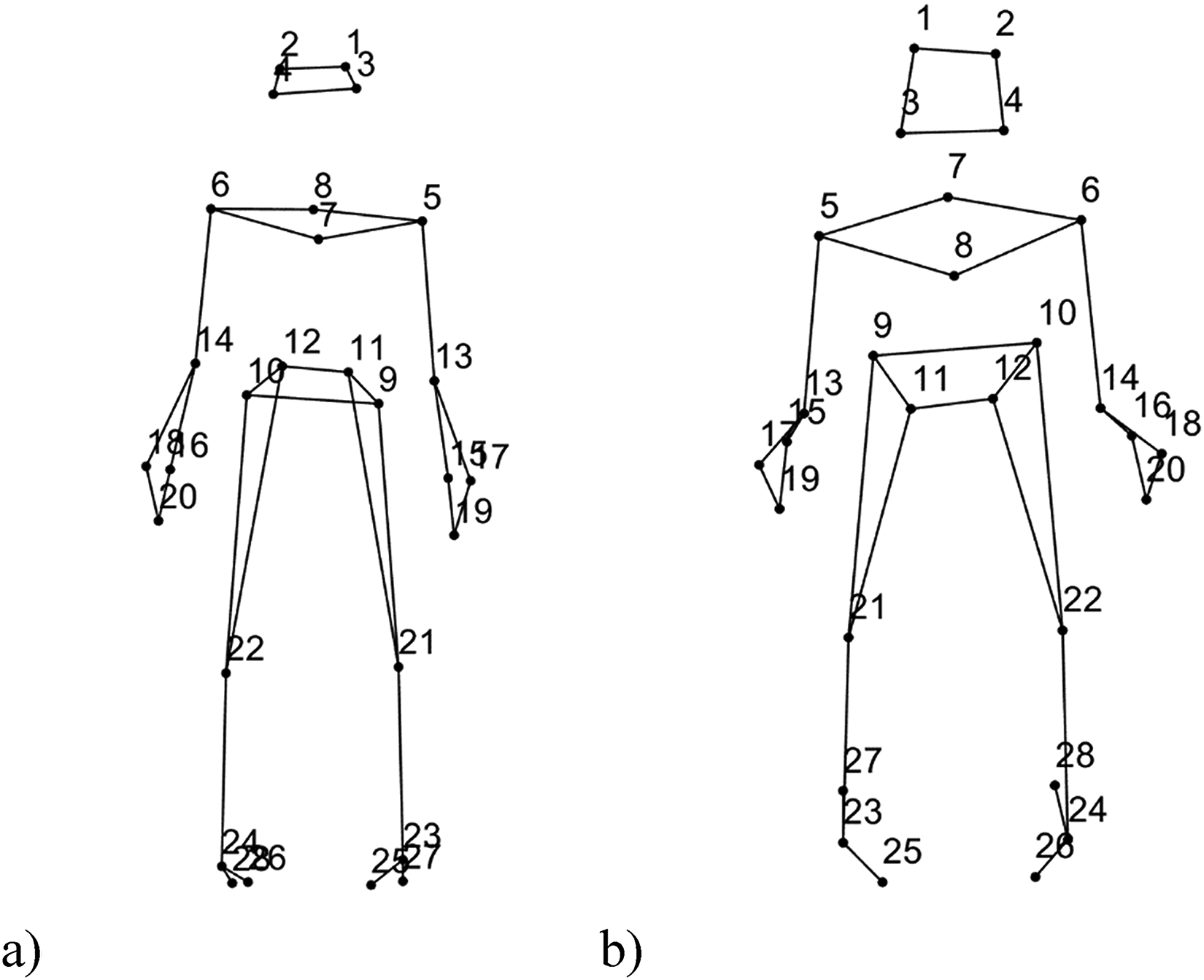
Marker placement from the front (a) and from behind (b). The head markers were of primary interest, consisting of: front-left (1), front-right (2), back-left (3) and back-right (4).
Stimuli
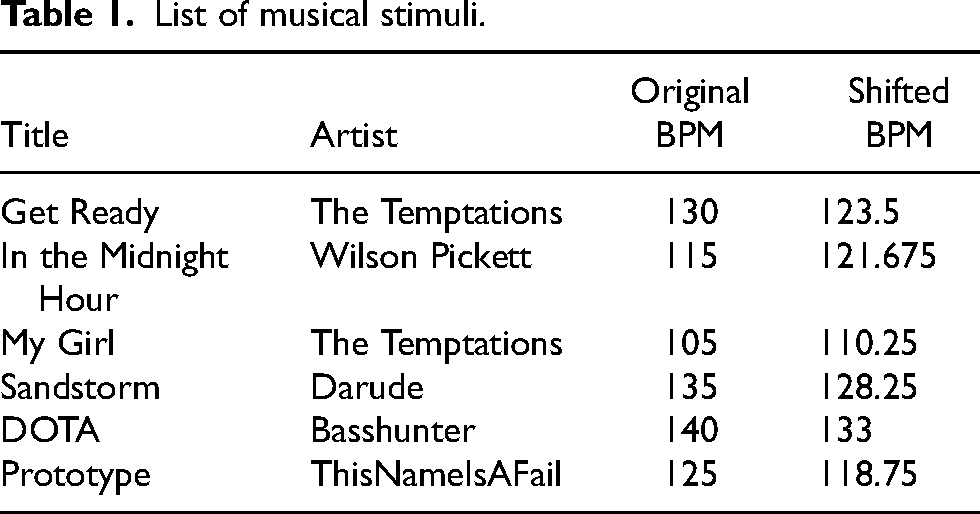
The musical stimuli were created from 30-s excerpts of six songs. Of these, there were three Motown songs and three electronic dance tracks of a range of tempi from 90 to 140bpm. Each piece had high pulse clarity and percussiveness, with a strong bass, as these features produce the most regularity in music-induced movement (Burger et al., 2013). It was important that participants wanted to move to the music, thus providing their partner with a strong visual stimulus of the beat that they hear. Each of the six excerpts was manipulated in two separate ways: the tempo was shifted by 5% towards 120bpm, or a delay of a quarter of a beat was added to the start of the track. Stimuli were manipulated in Audacity, and the manipulation created no audible artefacts. 120 bpm was chosen as an ideal average tempo, as this has been found previously to approximate the average preferred tempo for walking and dance music. (McKinney & Moelants, 2006; Styns et al., 2007). This made for a total of 18 stimuli: the six originals, six tempo-shifted versions, and six phase-shifted versions. Stimuli were played using a Max/MSP patch which randomized their presentation order and controlled timing of playback. The complete list of stimuli can be found in Table 1.
List of musical stimuli.
Procedure
As part of the recruitment process, all participants answered standard demographic questions, in addition to questions about music and dance experience. At the start of the study, both participants were informed that the study was about social interaction on the dance floor and instructed to move freely to the music that they heard. They were told that they would both be hearing the same music, and that the headphones were being used to test whether they worked for stimulus presentation in a motion capture setting, for the sake of future research. Each pair completed all three conditions in a random order. Each of the three conditions consisted of 12 musical stimuli, playing the six 30-s tracks twice. This allowed for counter-balancing the tempo and phase-shifted stimuli so that each participant would experience being both ahead and behind for each track. In the “Synchronized” condition, both participants had the same stimuli, hearing both original or tempo-shifted versions at the same time. The tempo-shifted tracks were included in the “Synchronized” condition to ensure that there was the same number of tracks in each condition, and that any effect of the tempo manipulation was due to non-synchrony between participants, and not the tempo-shift itself. The “Tempo” condition presented the original track to one participant, while the other heard the tempo-shifted version of that same track; the reverse would also occur, so neither was only getting tempo-shifted tracks. Finally, the “Phase” condition only included songs in their original tempo, but for one participant the stimulus would begin quarter of a beat (90o) behind the other; again, this was counter-balanced so that both participants would experience being earlier and later for each stimulus.
At the end of the 12 stimuli of each condition, the participants were asked to step towards a computer one at a time to complete a short questionnaire about their experience during the task. This consisted of five questions about their experience while dancing and was administered at the end of each condition. Their response was recorded on a 10-point scale, where 1 was negative and 10 was positive. The question asking about quality of the interaction was the target for analysis, but other questions were included for exploratory purposes, and to prevent participants from fixating on the social interaction with their partner, given they were answering this questionnaire three times. The questions were as follows:
How would you rate the interaction between yourself and your partner? How much did you enjoy this task? How comfortable did you feel during the task? Did you feel anxious or nervous during the task? How much did you enjoy the music?
Once both participants completed the questionnaire, they would then be asked to step back onto the floor for the next condition. Once the pair completed all three conditions they were debriefed.
Motion Capture Analysis
Motion capture data was exported from Qualisys Track Manager software and imported into MATLAB for analysis with the MoCap Toolbox developed by Burger and Toiviainen (2013). Recordings were trimmed from 10 s after the initial presentation of the stimulus, until the end of the stimulus 20 s later. The first 10 s were removed to give participants time to find the beat after stimulus presentation.
To calculate the interpersonal distance between participants, the midpoint between the four head markers was calculated and used as a central point for each participant. The head markers were used for this purpose, as they were the least likely to have line of sight blocked to the cameras and were thus the most reliable. Interpersonal distance was calculated between the central head points of both participants in the dyad at each frame of the recording. From this, both a mean and variance were calculated for each trial – i.e., the presentation of one stimulus. The average mean distance, and average variance of distance, were then found per condition for each dyad.
Head orientation along the plane parallel to the floor was calculated using the front-left and front-right head markers of each participant in the dyad. This gave a measurement of the degree to which one participant was facing the other, with 0o being facing towards the other, and 180o facing away. Given that dyads were being considered together, each participant's score was then added together into a head divergence score, with a maximum of 360o, as shown in Figure 2. A similar measure of relative orientation in motion capture has been used in Carlson et al. (2019). As with the distance measurement, mean and variance of head divergence was calculated for each trial, and subsequently for each condition.

Measure of head divergence, as looked at from above. Combined head divergence found as the sum of the angles α and β.
Results
Effect of Synchrony Condition on Self-Reported Experience
As the questionnaire yielded ordinal data, non-parametric statistics were used. A repeated-measures Friedman's test found a significant effect of synchrony condition on the response given by participants (n = 48) to the question: “how would you rate your interaction with your partner?”, X2(2) = 10.75, p < 0.01 (see Figure 3). Post-hoc analysis using Bonferroni corrected Wilcoxon signed-rank tests revealed a significant difference between the synchronized and phase-shifted conditions, W = 454.5, z = −3.109, p < 0.01, but no difference between the other conditions. No other significant effects were found on the other questions.

Mean subjective rating of quality of interaction with partner across the three conditions. Error bars show standard deviation. A significant difference found was between the Sync and Phase conditions (* < .05).
Behavioral Measures
Following pre-processing of the motion capture data, as described above, both interpersonal distance and head divergence were analyzed as behavioral measures of social attention. Due to technical problems in some of the recordings, a smaller sample of 19 dyads (n = 19) were used for the motion capture analysis.
Interpersonal Distance
The assumptions of homogeneity and normality were met by the data, and thus parametric statistics were used. Although interpersonal distance appeared to be slightly higher in the phase-shifted condition (see Figure 4), a repeated-measures ANOVA found no significant effect, F(2, 54) = 1.57, p = 0.22, as was the case for variance in interpersonal distance, F(2, 54) = 0.056, p = 0.95.

Mean interpersonal distance of all trials and dyads between synchronous and non-synchronous conditions. Error bars show standard error. The differences here are non-significant.
Head Divergence
The data for mean and variance of head divergence per dyad and condition conformed to the assumptions of normality and homogeneity, and thus parametric statistics were used. A repeated-measures ANOVA revealed a significant effect of condition on the mean head divergence, F(2, 54) = 3.45, p = 0.042. Post-hoc analysis with Tukey's pairwise comparisons revealed the main effect to be between the sync and phase-shifted conditions, t(18) = 3.71, r = 0.23, p = 0.033 (see Figure 5). No significant effects were found in variance of head divergence, F(2, 54) = 2.75, p = 0.078 (see Figure 6).

Mean head divergence of all trials and dyads between synchronous and non-synchronous conditions. Error bars show standard error. A significant difference was found between the Sync and Phase conditions (* < .05).
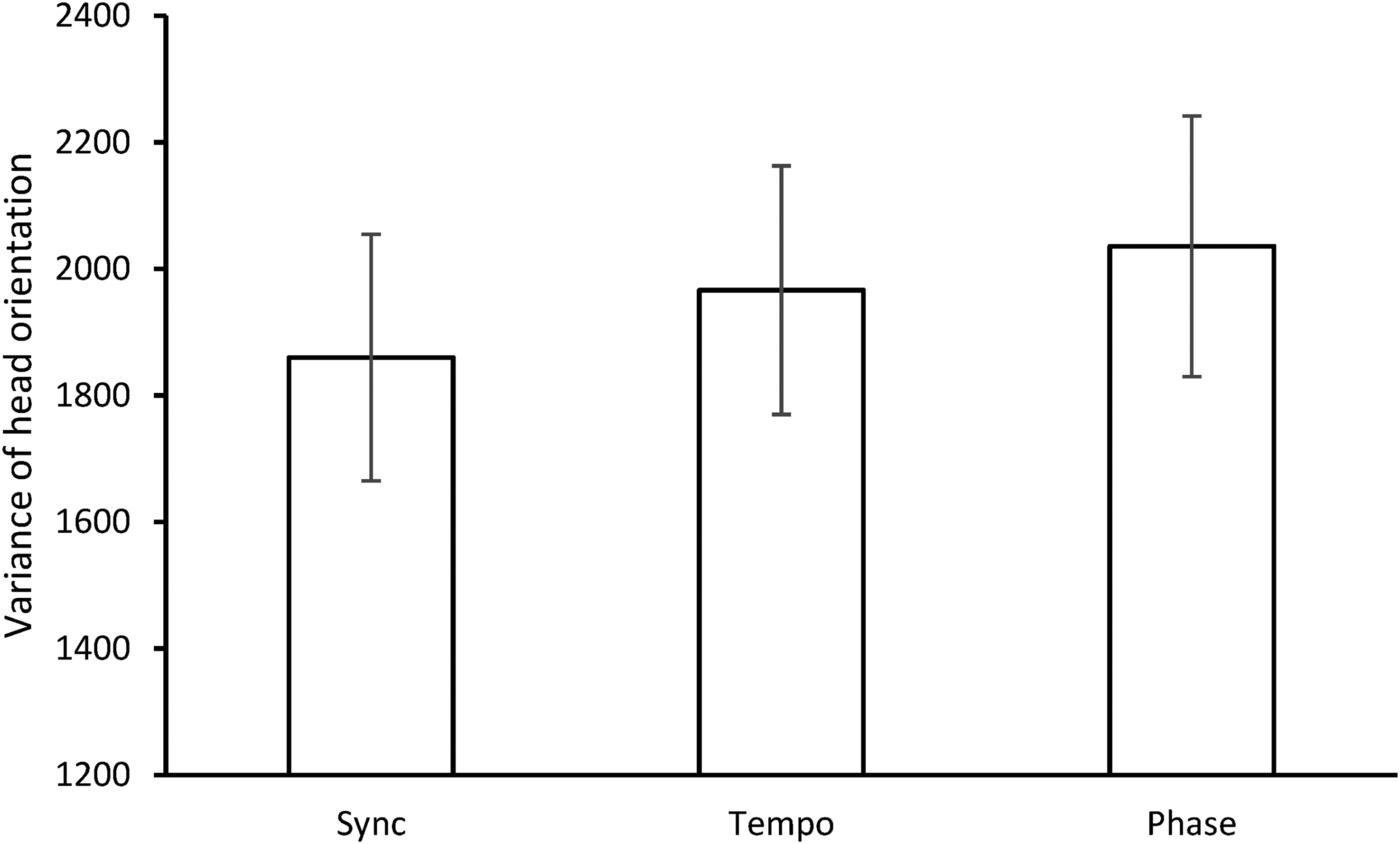
Mean variance of head divergence within each trial, across all dyads, compared between synchronous and non-synchronous conditions. Error bars show standard error. No statistically significant differences were found.
Interpersonal Synchrony
Non-synchrony was induced in this study through varying the timing of musical stimuli. To confirm the effects of the stimuli on interpersonal synchrony, phase-locking indices were calculated using a Hilbert transform (see Burger et al., 2014) for the vertical hip velocities. Due to missing data from misplaced hip-markers, two of the 19 dyads were excluded. These indices were then averaged across stimuli for each dyad and condition (Figure 7). T-tests on mean phase-locking indices found significant effects between all conditions: the synchrony condition showed a stronger phase locking than the tempo-shifted (t(16) = 6.38, p < .0001) and the phase-shifted (t(16) = 3.89, p = .0013) conditions, while the tempo-shifted condition was less phase-locked than the phase-shifted, t(16) = −6.13, p < .0001.

Mean phase-locking index, indicating stability of the phase relationship between participants in a dyad, across the three conditions. Error bars show standard error. All the differences are significant (* < .05).
Discussion
The present study investigated the effect of synchrony on perceived interaction quality and attention in free spontaneous movement to music within dyads. It attempted to maintain maximum ecological validity with the social dance floor, allowing creativity and expression between dancers, while still being able to experimentally manipulate how synchronized the dancers were. Synchrony was manipulated using a silent disco paradigm across three different conditions: synchrony, phase-shifted, and tempo-shifted. We hypothesized that the synchrony condition would produce greater satisfaction with the social interaction, in addition to higher scores on behavioral measures of social affiliation and attention such as interpersonal distance and relative head orientation, than either of the non-synchronous conditions. These hypotheses were partially supported, as synchrony resulted in higher outcomes in a self-report measure of interaction quality, but only compared with the phase-shifted condition. Participants reported a higher quality interaction with their partner when they were both listening to the same music, at the same time. Furthermore, participants looked towards each other more in the synchronous condition than the phase-shifted condition. In both self-reported and behavioral measures, it appears that the phase-shifted condition caused the most disruption to social interaction.
Self-Report Measures
Each dyad was placed in three different conditions in the silent disco paradigm: synchronous, tempo-shifted, and phase-shifted. As was hypothesized, the condition had a significant effect on how they rated the interaction with their partner. This increased satisfaction with the social interaction in synchrony, when compared with the phase-shifted condition, may be interpreted as an indication of social affiliation. However, because of the within-subjects design we avoided asking participants to rate the social bonds with their partner directly, but to report the quality of the interaction they experienced, since participants were dancing in the same dyad across all conditions. Only the effect of being out of phase significantly impacted upon their experience of dancing with their partner. This was a small effect, although meta-analyses have found that, on average, studies of the synchrony-bonding effect usually have small effect sizes, so this is expected (Mogan et al., 2017).
It is worth noting that the tempo-shift was at the level of 5%, so subjects would find themselves coming into synchrony once every 20 beats. This would have occurred three times in every trial in the present study. By contrast, in the phase-shifted condition the beats would never coincide. Therefore, the tempo-shift could be considered a transient phase shift with a regular structure. Having a dance partner always slightly behind or ahead of the beat may be worse than a partner who drifts in and out of phase at regular intervals. It could be that phase differences are harder to ignore than tempo differences because phase locking is more fundamental to sensorimotor synchronization (van der Steen et al., 2015). Previous research has also shown that phase-correction is also largely automatic, while tempo correction is more effortful (Repp & Keller, 2004). The phase-shifted condition may frustrate this automatic phase-correction, leading to lower ratings of a non-synchronous partner. This also implies that the positive experience of synchrony does not hinge upon matching the other person's tempo as such, but rather it is the coincidence of movement that is important. This suggests that for synchrony to be perceived and appreciated, very tight beat matching is required, and certainly a 90-degree phase shift is already beyond an acceptable deviance from the beat.
A more social explanation could suggest that a participant during the non-synchronous conditions may perceive their partner as being either accidentally or deliberately out of time. The manipulation could be perceived as inducing a poor sense of rhythm in one participant, from the perspective of their partner. Thus, it is possible that participants viewed their partner as being uncooperative or incompetent during the non-synchronized conditions. However, given that this was a within-subjects study, there would be no reason for participants to assume that their partner's abilities had changed between conditions, so a between-subjects design may be required to test this explanation further.
There was no effect of synchrony on any of the other self-report measures of the task experience. One may have predicted that enjoyment of the music may be influenced by social interaction while listening to it, but ratings of musical enjoyment remained unaffected by the movements of the partner. This is, however, consistent with the findings of Tarr et al. (2016), who similarly found that synchrony only influenced social bonding, but not personal enjoyment of the music.
Behavioral Measures
Analysis of the behavioral measures (head divergence and interpersonal distance) revealed mixed results. Previous research has suggested that people stand closer to those they feel affiliated to (Snyder & Endelman, 1979; Sorokowska et al., 2017), so the distance between participants during the dance task may indicate feelings of social affiliation which would reinforce the questionnaire results. It was hypothesized that a significant effect would be found of synchrony on interpersonal distance; however, this was not the case. A study of dancers in Virtual Reality also found no effect of synchrony on interpersonal distance, so the present study is consistent with these findings, although the authors note that their participants may have been disinclined to move around the space given the VR equipment they were wearing (Tarr et al., 2018). The present study had fewer constraints on movement, but it is possible that the sample used was too small to find a significant small effect, although there was a trend towards dyads being further from each other when presented with out-of-phase music.
Head divergence did reveal a significant effect. The mean head divergence was lower during the synchrony condition than the phase-shifted condition, implying that participants within the dyad were looking at each other or close to each other for more of the time while in the synchrony condition. No effect of synchrony was found on the variance in head divergence. The effect on mean head divergence suggests that participants may be focusing their attention more closely on their partner when dancing in synchrony. This interpretation would support the suggestion of Woolhouse et al. (2016) that people focus more attention on others who are dancing in time with themselves. Head orientation was used instead of whole-body orientation, to give some indication of visual attention, although eye-tracking would be more precise. Nevertheless, the head divergence measure suggested that, in the case of the synchrony condition, attention of the participants seemed to be directed towards each other for much of the time.
Finally, synchrony between partners in a dyad was measured using a phase-locking index (Burger et al., 2014). This revealed that participants had the most stable phase relationship in the synchrony condition, followed by the phase-shifted condition and then the tempo-shifted condition. The tempo-shifted condition presented stimuli with a variable phase relationship to the two participants in each dyad, so this result is not surprising. The phase-shifted condition, despite presenting a stable phase relationship between stimuli, resulted in a lower phase-locking index score than synchrony, which may indicate that participants were forced to divide their attention between the music they heard and their partner. It is notable that, although the phase-shifted condition did not have the worst synchrony, as measured by the phase-locking index, it did have the lowest subjective ratings of social interaction. One explanation for this could be that having a partner that is consistently slightly off-beat is more disruptive than a partner dancing to an entirely different tempo.
Limitations and Future Directions
From qualitative observations in the motion capture data there appeared to be three different styles of managing non-synchrony with a partner: leading, in which the individual stays with their own beat but tries to dance with their partner; following, in which the individual sacrifices their own beat for the sake of dancing with their partner; and ignoring, in which the individual simply disregards the other person entirely, sometimes turning their back or looking away. Some dyads exhibited a consistent approach within a condition, in this regard. While the present sample was too small to investigate individual differences in this behavior, future research could examine personality traits in relation to dance leadership style. Some may have a tendency to try and lead, where they think their partner is out of time, while others may prefer to follow their partner, even if it contradicts the beat they hear. Indeed, some research has suggested that dancers may adapt to their partner different depending on the Agreeableness trait (Carlson et al., 2018), so it might be expected that Agreeableness could influence one's tendency to follow in the present research. This behavior may also be mediated by ability, as effective following requires adaptive motor skills not required to lead (Konvalinka et al., 2010). These leader-follower decisions may also be influenced by other factors, such as familiarity with, or attractiveness of, the partner.
It is important to note that the present study used participants from a WEIRD – Western, Educated, Industrialized, Rich, and Democratic – background (Henrich et al., 2010), being mostly students at a Finnish university. This cultural background may influence people's dancing abilities, as well as their expectations of coordination with others. Most participants had some music and/or dance experience, and basic partner dances are almost universally taught in Finnish high schools. It is possible that the effects observed here would be different depending upon dance experience, although this was not something that could be tested for in the present study as there was not enough variation in the sample. The present study also asked participants to self-select their partners for the study, bringing in a friend with whom to complete the task. Although an effect was still found on both self-report and behavioral measures of social bonding, there may have been a ceiling to this effect as participants were already friends. Most of the participants here were dancing with friends of the same sex, however effects of sex should be investigated further. Future research would benefit from using participants of more varied cultural backgrounds, but also with different prior knowledge of each other. Other studies have suggested an ice-breaker effect for synchronized movement (Pearce et al., 2015), so the effects observed in the present study may be greater when participants are initially unfamiliar with each other.
In addition to sampling a greater variety of participants, future studies may also investigate the role of imitation and innovation in a dance setting. The present study only manipulated synchrony in dance, however when participants are allowed to freely move, as they were here, they may also generate novel dance moves and subsequently imitate each other. Independent of synchrony, imitation has also been associated with social bonding (Heyes, 2013). Furthermore, dancers and musicians are not always in absolute synchrony, but may perform interlocking, complementary rhythms. Future studies should go beyond synchrony, and examine the shared movement patterns involved in social dance. The silent disco paradigm may have more to contribute here; it allows participants to occupy the same space, but not in time, allowing for an experimental manipulation of synchrony in an ecological dance setting. Timing need not be the only manipulation however, as a similar study to the one presented here could also control for timing, while playing stimuli of different emotional content, for example.
The present study could be interpreted as an experiment in cross-modal interference, in which participants are asked to dance, but given an auditory and visual stimulus in conflict with each other (assuming that their partner is dancing to their own music). Prior studies have demonstrated a superiority of auditory stimuli over visual stimuli for synchronization tasks in terms of accuracy, however both are capable of being effective distractors (Hove et al., 2013). Thus, it may be expected that participants would prefer to dance in time with the beat they hear, rather than with the dancer they see, when in a non-synchrony condition. This tendency may have been overridden by social considerations and a desire to interact with the other but future studies could look at synchronized movement in varied social settings to investigate this further. While the present study observed the synchrony-bonding effect in a naturalistic dance setting, it does little to explain why this effect occurs. Future research may investigate whether the effect arises out of an experience of audio-visual perceptual congruency, from judgements of their partners’ rhythmic abilities, or through some other social process.
Finally, the main effect was found between the synchrony and phase-shifted conditions, on both self-report measures and the behavioral measure of head divergence. The phase shift was set at a quarter of a beat, which corresponds to around 110–135 ms, depending on the tempo. Audio-visual perception has a subjective synchrony threshold around 100 ms, although this is heavily influenced by situational factors (Keetels & Vroomen, 2012). A longer phase shift may be easier to perceive as it could fall on an “off beat”, while the phase shift used in the present study lies just beyond this perceptual threshold, and so may be particularly difficult to integrate. Furthermore, people are often more likely to judge audio and visual events as happening simultaneously when the visual stimulus precedes the audio, than vice-versa. This could arise because auditory stimuli are processed faster than visual stimuli (Jain et al., 2015). There may also be an effect of where attention is directed, depending on how the task is framed (Keetels & Vroomen, 2012). Further research could investigate the thresholds of interpersonal synchrony perception in a range of social conditions, as there are limited conclusions that can be drawn from only the two non-synchrony conditions presented in the present study.
Conclusion
The findings of the present study are broadly consistent with previous research in finding a specific effect of synchronous movement on social bonding (Hove & Risen, 2009; Mogan et al., 2017). Through the use of a silent disco paradigm, this study was able to test the social effects of synchrony within a naturalistic dance setting, suggesting that synchronized movement – as just one of the components of dance behavior – may be integral to the social functions of dance. Subjective ratings of social interaction were reinforced by the behavioral measure of head divergence between partners in the dyad, with participants looking towards each other more when in the synchrony condition.
The present research suggests that interpersonal synchrony, as distinct from any other features of social dance, is important to the experience of a shared dance context. Synchrony, being one of the key components in music and dance behavior, may thus underpin the social functions of music and dance (Savage et al., 2021). This has potential applications in community music making to reduce social isolation in individuals, or promote social cohesion within or between groups. Ultimately, this area of research may explain why humans developed the ability to synchronize movements in our evolutionary history – as a mechanism for bonding – and which is still practiced on dance floors and in concert halls today.
Footnotes
Acknowledgements
The authors wish to thank Mikko Leimu and Markku Pöyhönen for their technical assistance. This study was supported by the Academy of Finland (project number 332331).
Action Editor
Fabia Franco, Middlesex University, Department of Psychology.
Peer Review
Nicolas Farrugia, IMT Atlantique Bretagne-Pays de la Loire, Mathematical and Electrical Engineering.
Jan Stupacher, Aarhus University, Department of Clinical Medicine, Center for Music in the Brain.
Contributorship
All authors contributed to the design and concept of the study. PT secured funding for the study. JB wrote the first draft of the manuscript. All authors reviewed and edited the manuscript and approved the final version.
Ethical Approval
The motion capture study and the perceptual experiments described below took place at the Department of Music, Art, and Culture Studies at the University of Jyväskylä. All experiments were performed in accordance to the guidelines and regulations of the National Advisory Board on Research Ethics in Finland (TENK, see https:// ) relating to research in the humanities and social and behavioral sciences, which the University of Jyväskylä Ethical Committee adheres to. Ethical permission was not needed for this kind of research, according to the aforementioned guidelines and regulations.
Declaration of Conflicting Interests
The authors declared no potential conflicts of interest with respect to the research, authorship, and/or publication of this article.
Funding
The authors disclosed receipt of the following financial support for the research, authorship, and/or publication of this article: This work was supported by the Academy of Finland, (grant number 346210 and 332331).