



Abstract
Previous work suggests that both choir and mindfulness training may improve well-being and auditory skills in older adults. This randomized control trial investigated the effects of a 10-week online choir or mindfulness program on speech-in-noise (SIN) perception. We collected multiple measures of auditory perception and attention, and multiple measures of socioemotional well-being in adults (N = 61) aged 50–65. We observed that both interventions improved SIN perception in high-noise conditions, decreased anxiety, and increased global well-being, mindfulness, and self-transcendence. Choir participants, compared to their own performance, showed improvements in additional noise conditions of the SIN task relative to mindfulness participants. Choir training produced greater advantages than mindfulness training in reducing state anxiety and improving melodic interval discrimination. These findings provide preliminary evidence for improvements in selected well-being and auditory measures as a result of online singing and mindfulness interventions in middle-aged and older adults in the US during the COVID-19 pandemic.
Keywords
As the US population of adults over 50 continues to increase (Jacobsen et al., 2011), more preventative care needs to be invested in developing effective strategies for promotion of healthy aging for individuals in this demographic. Two areas of concern, of many, to this population's healthy aging are hearing (Pichora-Fuller et al., 2015) and socioemotional well-being (Gerino et al., 2017). Hearing difficulties are associated with loneliness (Littlejohn et al., 2022), depression (Li et al., 2014), and impaired social activity (Yoo et al., 2019). One such difficulty is hearing speech in noisy environments, which is particularly important for social functioning. Relatedly, socioemotional well-being is essential for health and cognitive functioning in aging. Loneliness is a strong predictor of dementia (Kuiper et al., 2015; Lara et al., 2019) and related cognitive decline (Gilmour, 2011; Gow et al., 2007). Anxiety (Gulpers et al., 2016) and depression (Köhler et al., 2011) also predict cognitive impairment and dementia.
Many enrichment programs may benefit older adults in terms of auditory skills and socioemotional well-being. Auditory training programs (Ferguson & Henshaw, 2015; Heidari et al., 2020; Humes et al., 2014) have been shown to improve auditory abilities in older adults, which may positively impact social well-being by increasing ease of communication and social activities. Relatedly, interventions aimed at improving well-being and reducing anxiety specifically have been shown to be effective, including those implementing physical activities (Inoue et al., 2020; Pedersen et al., 2017; Stathi et al., 2002) and art classes (Bennington et al., 2016; Johnson et al., 2021).
However, due to the COVID-19 pandemic, there has been an increased need to utilize interventions that are adaptable to a virtual environment, especially given that the COVID-19 pandemic has increased concerns regarding the health and well-being of older adults (De Pue et al., 2021; Krendl & Perry, 2021). Choir training has previously been explored as an intervention for auditory skills and wellness (Hennessy et al., 2022). Yet, to explore the impact of choir training effectively, a comparison intervention that is community-based, socially engaging, and accessible to novices is necessary. Mindfulness training is a compelling candidate for comparison, as it is socially engaging, and has also been studied for its impact on general attentional skills and well-being making it a suitable activity for comparison. Similar to choir training, it can be learned in a relatively short period, practiced in a group, does not require a lot of prompts, and has been shown to benefit both speech-in-noise perception and well-being. Importantly, both choir and mindfulness training programs are adaptable to a virtual format, a necessity during the COVID-19 pandemic.
Speech-in-Noise Perception in Musicians
Musicians demonstrate advantages in perceiving speech-in-noise across various contexts (Hennessy et al., 2022). Cross-sectional research indicates that musicians, as compared to non-musicians, have improved abilities to perceive sentences (Başkent & Gaudrain, 2016; Slater & Kraus, 2016), words (Escobar et al., 2020; Parbery-Clark et al., 2009), and syllables (Du & Zatorre, 2017) in noisy environments. Older adult musicians show less age-related hearing decline and auditory degradation than age-matched non-musician counterparts (Fostick, 2019; Parbery-Clark et al., 2012; Zendel & Alain, 2012), suggesting that music training may play a role in preserving auditory function in later decades of life.
Zendel et al. (2019) showed that older adults placed in six months of piano training outperformed passive controls and a video-game active control group on a speech-in-noise task and showed improved neural auditory encoding as measured by event-related potentials. Specific to choir training, Dubinsky et al. (2019) observed that older adults randomly assigned to group singing for 10 weeks performed better than a passive control group in a sentence-in-noise task. Choir training is hypothesized to improve speech-in-noise perception through improving encoding of low-level auditory features such as frequency or fine temporal structure. For example, Dubinsky et al. (2019) observed that speech-in-noise changes in the choir group were mediated by improvements in pitch discrimination, and this relationship was further predicted by the strength of the auditory brainstem response. Similarly, Hennessy et al. (2021b) found that 12 weeks of choir training as compared to passive music listening resulted in enhanced early auditory encoding in a syllables-in-noise task. These findings together suggest that choir training improves neural encoding of sound both at the brainstem and cortex levels, which consequently can improve speech-in-noise perception. Choir training was additionally chosen for the present investigation as it is a socially engaging activity that is accessible to individuals from a range of musical abilities, making it a reasonable candidate for a community-based implementable music intervention.
Choir Training on Well-Being in Older Adults
Group music-making has been shown to positively impact individuals across the lifespan, including increased well-being and reduced depression and anxiety (for review see Daykin et al., 2018). Regular participation in music-making or listening can improve physical and mental well-being, increase quality of life in adults older than 55 (Chan et al., 2012) and 60 (Coulton et al., 2015), reduce social isolation and poor mental health in adults older than 65 (Cohen et al., 2006), and increase social cohesion, empowerment, and personal well-being adults older than 50 years of age (Creech et al., 2013).
Choir training, specifically, has shown to have socioemotional benefits for adults older than 50 years of age, including the promotion of resilience and social cohesion (Joseph & Southcott, 2018; Pérez-Aldeguer & Leganés, 2014). In a longitudinal study, older adults showed reduced loneliness and increased interest in life after six months of choir participation (Johnson et al., 2020). In addition, the health and well-being benefits have been shown to be effective across different cultures, making their impact especially appealing on a larger scale (Corvo et al., 2020).
Mindfulness Training on Speech-in-Noise Perception and Well-Being
While there is significantly less research investigating the impact of mindfulness training on speech-in-noise perception, Kumar et al. (2013) observed that individuals who had been practicing meditation for at least five years performed better than non-meditators on multiple speech-in-noise tasks in both younger (adults aged 20–30) and older (adults aged 50–65) adults. Differences between groups were hypothesized to be due to changes in attentional processes, where meditation improves attention (Jha et al., 2007; Tang et al., 2007) which then may improve speech-in-noise abilities through top-down processes (Getzmann et al., 2015; Price & Bidelman, 2021).
A wide range of studies has shown the benefits of mindfulness in additionally improving a large range of socioemotional symptoms in younger and older adults (Gu et al., 2015). Mindfulness interventions have shown to decrease stress in adults older than age 45 (Berk et al., 2018) and 65 (Lenze et al., 2014), improve emotional well-being in adults aged 49–79 (Splevins et al., 2009), and reduce loneliness in adults aged 55–85 (Creswell et al., 2012). Studies have also reported that mindfulness interventions reduce depression symptoms in adults older than age 60 (Young & Baime, 2010) and 65 (Gallegos et al., 2013), nursing home residents aged 72–98 (Ernst et al., 2008), and adults aged 65–80 dealing with bereavement (O’Connor et al., 2014). In individuals across the lifespan, participation in as few as three sessions of mindfulness leads to improved life satisfaction and reduced distress (Harnett et al., 2010), and the standard 7- or 8-week long MBSR training can lead to improved emotion regulation (Kral et al., 2018). Improvements in coping and distress may be maintained long-term, as found in a four-year follow-up study (Solhaug et al., 2019).
The COVID-19 Pandemic and Older Adults
The COVID-19 pandemic is a global public health threat, and older adults are especially vulnerable both to the health consequences of the disease (Le Couteur et al., 2020; Verity et al., 2020) and the psychological impacts of social distancing and isolation practices that were implemented to curb viral spread (Krendl & Perry, 2021; Whitehead & Torossian, 2021). Early research on the psychological impact of the COVID-19 pandemic suggests a range of detriments to the well-being of older adults, who experienced increased depression, loneliness (De Pue et al., 2021; Krendl & Perry, 2021), stress (Whitehead & Torossian, 2021), and anxiety (Kobayashi et al., 2021).
Music and Mindfulness During the COVID-19 Pandemic
Both music and mindfulness have been studied for their impact on wellness during the COVID-19 pandemic. Studies with adults of all ages reported individuals increasing their music listening, music-making, and dancing to music (Cabedo-Mas et al., 2021) as well as utilizing music listening to help cope with the stress of the pandemic and increase their well-being (Cabedo-Mas et al., 2021; Hennessy et al., 2021a; Vidas et al., 2021). Notably, the effects of choral singing during the COVID-19 pandemic on well-being are less known, due to the health hazards associated with singing in enclosed group settings (Hamner, 2020). No study to our knowledge has investigated the effects of online choir on auditory skills or well-being during this pandemic. Online mindfulness training during the pandemic has been reported to decrease stress (Lim et al., 2021) as well as decrease anxiety in concert with increased self-compassion (González-García et al., 2021).
Present Study
The present study was conceptualized as a study comparing choir training to mindfulness training. The mindfulness training intervention was selected as an appropriate active control group because such interventions have demonstrated positive impacts on attentional measures and have elicited subjective reports of improvements in well-being and decreases in stress and anxiety. Due to the COVID-19 pandemic, both interventions needed to be delivered via online formats. This was timely and relevant because of the increase in stress, anxiety, depression, as well as loneliness and isolation during the COVID-19 pandemic. Such increases can lead to greater challenges to mental health. Previously, little research has studied the impact of online choir or mindfulness training on the combination of auditory abilities and measures of well-being and mental health of middle-aged and older adults. As the US population ages and in times of increasing reliance on virtual and online networks for communication and healthcare, more research is needed to determine the efficacy of learning these skills in an online environment, something the current study contributes to the field.
In this study, we expand upon previous work (González-García et al., 2021; Hennessy et al., 2021b; Johnson et al., 2020; Lim et al., 2021) to determine the effects of short-term online choir and mindfulness training on speech-in-noise perception and well-being in middle-aged and older adults (aged 50–65) during the COVID-19 pandemic. We aimed to answer whether a short-term active music intervention (i.e., choir training) with older adults results in improved speech-in-noise perception and socioemotional well-being when compared to mindfulness training. We used a randomized control trial design with an active comparison group to determine if potential differences in speech-in-noise abilities and well-being are due to specific qualities of either mindfulness or choir or simply to participating in a known psychologically beneficial communal activity. Choir singing was chosen as the music intervention as an extension of previous work of our lab (Hennessy et al., 2021b): it is practical as a short-term intervention as it is accessible, can be performed in a modified way online, and does not require excessive equipment. Mindfulness training was chosen as a comparison group as it is a group activity with demonstrated benefits to psychological well-being and attention and demonstrates similar accessibility, practicality, and engagement as choir training, making it a reasonable active comparison to assess relative to choral training. We note that we did not include a passive control comparison and acknowledge that both groups could benefit from participating in an activity that is engaging and rewarding. Most significantly, we sought to include mindfulness as a control group for this choir training intervention to put choir training to a more rigorous test than the common use of “no intervention” passive control group. We hypothesized that among older adults, short-term choir versus mindfulness intervention would result in improved auditory skills, while the mindfulness intervention would result in improved mindfulness skills, but both mindfulness and choir training would be effective in improving socioemotional well-being.
Method
Participants
Participants between the ages of 50 to 65 were recruited from across the United States via online platforms, including Research Match, our university's Healthy Minds Research Volunteer Registry, Facebook advertising, Craigslist community postings, and through our lab website. Participants were screened for eligibility based on the following: to be included, participants were required to be a native English speaker who did not meet the following exclusion criteria: 1) use of prescribed hearing aids or a diagnosed auditory processing disorder; 2) current diagnosis of any major neurological or psychiatric disorders (individuals who reported disorders such as anxiety or depression that were well managed and non-debilitating were included); 3) formal music training of five or more years over their lifetime, excluding music instruction as part of typical education curriculum; 4) mindfulness training of two or more years over their lifetime. Exclusion criteria based on length of prior music training was different from length of mindfulness training (5 versus 2 years) because access and engagement with formal music training is a more ubiquitous than mindfulness, particularly for the target age group.
We used a series of studies with short-term music activities and control groups to estimate the magnitude of expected effect sizes in adults older than age 50 (Dubinsky et al., 2019; Hennessy et al., 2021b; Johnson et al., 2020; Zendel et al., 2019). Those studies evaluated adult populations, longitudinal assessment, and the majority included an active yet non-musical comparison group. No comparable virtual studies existed at the time of study conception, so studies used were all conducted in person. Among Dubinsky et al., 2019, Hennessy et al., 2021b, Johnson et al., 2020, and Zendel et al., 2019 the effect sizes were recorded, and the median of these reported effect sizes was calculated for each study. The median of these four medians was then calculated to be d = 0.58 for well-being behavioral outcomes in adults. To determine sample size needed to achieve a power of 0.80, an a priori power analysis using the above median effect size was conducted using G*Power (Faul et al., 2007), with alpha .05 and correlation between repeated measures of 0.5. A total sample size of 60 with two equal-sized groups of n = 30 would be sufficient to achieve 0.80 power.
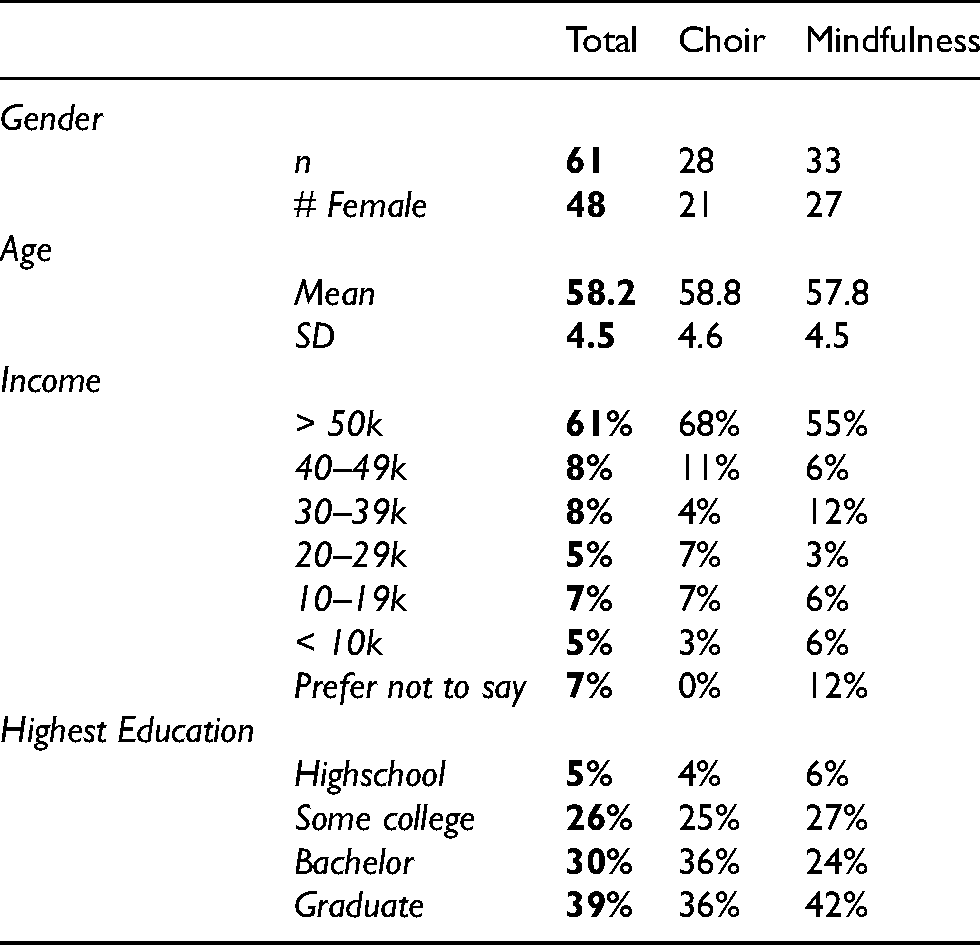
Eighty-one participants (Female = 64) completed the screening assessment, 78 (Female = 61) individuals were enrolled and randomized into one of two groups: Mindfulness (mean age = 57.5, SD = 4.4, Female = 31) and Choir (mean age = 58.23, SD = 4.34, Female = 30). Throughout the study, 11 participants dropped out (8 Choir, 3 Mindfulness) due to personal circumstances, change in schedule, or difficulty with the technology (issues with zoom, internet connectivity), leaving 67 participants who completed their classes as well as pre- and post-tests (n = 31 Choir, and n = 36 Mindfulness). Six individuals were removed for sensitivity analyses due to insufficient completion of the intervention, which was determined as the absence or tardiness that exceeded more than two classes or 2 hrs of instruction, leaving 61 individuals (n = 28 Choir, n = 33 Mindfulness). Demographic characteristics, including socio-economic status and education, of participants included in the final analysis for each group are summarized in Table 1.
Demographic Characteristics of Participants.
Study design was a pre-post, randomized controlled trial. Participants took part in two testing sessions: the pre-test took place up to 3 weeks prior to the intervention, and the post-test took place up to 3 weeks following the completion of the 10-week intervention period. After all participants completed the pre-test, participants were randomized into two groups (Choir and Mindfulness) using an automated Python script stratified by gender and age (mean = 57.5). During pre-test and post-test assessments, participants completed an online version of a suite of behavioral assessments detailed below. All post-intervention assessments were administered and scored using an automated online system. The role of the research staff was to guide the participant through the website and ensure that each participant completed all tasks. Research staff did not directly collect data and they were not masked to the subject's group assignment.
Interventions
The Choir Class
The weekly 1-hr choir class was led by a choral director, four section leaders, and an accompanist from the university's School of Music. The choir director had experience working with novice singers and individuals with minimal or no music training. Additionally, this instructor has led a choir for a separate and similarly designed study (Hennessy et al., 2021b), in which participants were randomly assigned to groups. The choir was structured similarly to an amateur community choir. The weekly rehearsal included vocal and physical warm-ups, short music theory lessons, and singing through a variety of choral repertoire in sectionals and as a complete, four-part chorus. The repertoire included works from different periods, genres, and countries, each providing opportunities for sharing the diverse background of the music and composer. Repertoire list and examples of homework assignments can be found in our Supplementary Materials. Section leaders for each voice part helped support the singers along with part-dominant learning tracks to assist in rehearsing on their own. To aid in their singing and musical development, participants were given homework in the form of pre-recorded videos of vocal exercises three times a week. The videos progressed each week to include additional vocal techniques focusing on building breath support, breath control, tone, and resonance. The introductory music theory lessons during the weekly rehearsal were also reviewed and practiced by participants in their weekly homework designed to take 1 hr per week. Topics included measures, staves, note names, rhythms, rests, intervals, time signatures, key signatures, scales, ear training, and sight-reading. The weekly exercises were formed to provide basic skills to help understand the repertoire they were singing. Homework was not collected or recorded and thus completion of at-home work is unknown, however the choir instructor regularly reviewed the material assigned in the homework during the choir sessions.
Due to the COVID-19 pandemic, all sessions took place on zoom: warm-ups, theory lessons, and singing through repertoire occurred in the main Zoom room with participants singing while their channel was muted. Sectionals occurred via breakout rooms led by the section leaders, allowing participants to ask questions as they were guided in small groups through the repertoire and voice part. Online is not an ideal format for choir training, as there are challenges with singing in sync with others over the zoom platform. This was mitigated by having participants sing along with the director or section leader (who was unmuted) while remaining muted themselves, and the “hand raise” function was utilized to keep participants from talking over one another when they had questions.
The Mindfulness Class
The weekly 1-hr mindfulness class was led by a Mindfulness-Based Stress Reduction (MBSR) certified mindfulness instructor from the USC Center for Mindfulness Science. The mindfulness instructor had over 10 years of experience teaching MBSR to individuals in university, corporate, and community settings. The mindfulness class focused on developing attention and acceptance – specifically, developing deeper focus and concentration, mindful listening, learning to be present, recognizing and letting go of old habit patterns of thinking and reacting, practicing wise responding to stressful life events, and cultivating compassionate self-talk. Mindfulness class curriculum and exercises are available in our Supplemental Materials. Participants were encouraged to pay close attention to their daily life, moment by moment, through a series of meditations to help develop self-awareness and mindful engagement with life experiences. In weekly homework designed to take 1 hr per week, participants were invited to practice formally by meditating and listening to an audio recording specific to the theme being practiced each week. They were also given opportunities to practice informally by being present in their everyday tasks and paying attention to the moment, i.e., directing attention from mind wandering, planning, or worrying to instead pay particular attention in a mindful accepting way to the five senses during meals, washing hands, brushing teeth, etc. Each week's hour-long mindfulness practice sessions took place over Zoom. The instructor started each class with a review of the previous week's home practice before the participants were randomly placed in breakout rooms of roughly 4 participants for a short discussion about the week's prompt. They were brought back to the main room for a full class discussion, during which all participants were muted except those who “raised hands” to contribute or ask questions. At the end of each class, the instructor led the class through a guided meditation.
To compare the interventions, both the mindfulness and choir classes took place on the same day of the week, at the same time, for one hour per week online via Zoom. Both classes were instructed by a professional, certified in their respective field, with experience teaching to individuals from a variety of skill levels. Both classes were taught in a group setting with approximately 30 other individuals, where participants were encouraged to keep their Zoom cameras on. Both classes involved both full-group work and work done in a breakout room. Both classes were accompanied by one hour per week of at-home exercises assigned as homework, but with no systematic follow-up to confirm that the homework was accomplished. Classes differed in content (singing vs. mindfulness), but structural and social aspects of the interventions were designed to remain as similar as possible. Importantly, the choir training specifically engaged sound processing and auditory-motor integration, an element not strongly incorporated in mindfulness training
Assessments
The assessments were broadly designed to assess auditory abilities, musical abilities, socioemotional well-being, and mindfulness.
Measure of Musical Ability
Musical experience was measured at pre-test only utilizing a subset of questions from the self-report Goldsmith's Music Sophistication Index v. 1.0 (Müllensiefen et al., 2014). Specifically, only questions pertaining to the subscales of Music Training and Music Listening Hours were obtained. Questions asked included “I have had ___ or more years of formal training on a musical instrument (including voice) during my lifetime” (answer range 0–10 years) and “I listen attentively to music for ___ or more per day” with (answer range 0 min – 4 hrs).
Auditory Assessments
Loudness levels. As in-person audiometric assessment was not an option, before beginning the hearing tasks each participant was asked to set loudness levels on their device while wearing headphones used for all subsequent tasks. Four loudness levels were required: “soft,” “medium soft,” “medium,” and “medium loud.” Participants were asked to set the loudness levels between 0 and 76 dB using “ + ” and “-“ buttons to adjust the loudness scaling of an 880 Hz pure tone that was 400 ms in duration with 20 ms raised-cosine attack and release ramps until each level reflected what subjectively sounded “soft,” “medium soft,” “medium,” and “medium loud” to their ears. These levels were used as a perceptual calibration for the subsequent tasks with the sound stimuli presented with the same RMS value as the “Medium” level of a pure tone for the loudness scaling. If a participant failed to properly complete and save their personalized loudness levels, the default level was −40 dB relative to the sound card max level.
Pure tone detection thresholds. This task was modeled on a standardized AMCLASS audiogram to collect audiometric thresholds bilaterally at octave steps from 125 Hz to 8 kHz. AMCLASS audiogram classification system is a standardized set of rules that allows for the categorization of the configuration, severity, and interaural asymmetry of an audiogram to best describe and interpret different types of hearing loss (Margolis & Saly, 2007). The task required participants to discern which visual stimulus was paired with a tone, with trials decreasing in volume until a lower threshold of their hearing ability measured for 400 ms sinusoids with 20 ms raised-cosine attack and release ramps at each of 7-octave frequencies from 110–7040 Hz was reached. A three-alternative, three-interval forced-choice method was used. To begin the task, participants clicked the “okay” button. Three buttons labeled “1,” “2,” and “3” appeared on the screen. At the start of each trial, button “1” would flash, followed by button “2” and button “3.” One of the three button flashes was paired with a tone of a starting gain set from the “medium” loudness level, while the other two buttons were paired with silence. The button the tone was matched with varied with each trial. After all three buttons flashed, the participant chose which of the three buttons was paired with the tone. If correct, the gain was reduced by a step, and if incorrect, the gain would be increased by three times the step for the next trial. The first step was 6 dB and was decreased by 2 dB after the first correct answer was given following an error. Participants were allowed three errors in the task. When a third error was made, the run concluded, and the final gain value was taken as the lower threshold of tone detection. This is repeated for each of the seven frequencies until all thresholds have been obtained.
Pitch and rhythm discrimination task. This task was modeled on a previous study design with a goal of detecting deviations in pitch and rhythm (Habibi et al., 2016) and required active assessment of two short musical phrases as being the “same” or “different” from each other by pressing a button. The first five notes of the C major scale (fundamental frequencies 261, 293, 329, 349, and 392 Hz) were used to create 24 pairs of melodies divided equally into four different conditions. In the two tonal (or “pitch”) conditions, the pairs of melodies contained five notes, were set at a steady beat of 120 bpm, and had tonal durations of 500 ms each. The pitches varied to create a melodic phrase lasting 2500 ms with a 2000 ms break between each pair. If the second melody was identical to the first, the condition was “pitch same,” whereas if the second melody had one note different in pitch from the first, the condition was “pitch different.” In the two rhythmic conditions, phrases were confined to a single pitch (varied between the first five notes of C major between trials), with five notes whose durations varied between 125 ms and 1500 ms to create rhythmic patterns. As in the tonal conditions, the second phrase was either identical to the first, giving a “rhythm same” condition, or the second phrase differed rhythmically from the first, giving a “rhythm different” condition. The “rhythm different” condition was obtained by changing the duration values of two adjacent notes, resulting in different rhythmic groupings while keeping the same trial length and total number of notes (5). As an example, two eighth notes (each 500 ms) could be changed to a dotted eighth note (750 ms) and a sixteenth note (250 ms). Three runs of 24 trials were completed. At the start of the task, the participant was informed of the three runs and clicked an “okay” button to start the first run. The two musical phrases were then played, and after the phrases finished, the participant could click either the “same” or “different” button on their screen. As soon as a selection was made, they received feedback if their answer was “correct” or “incorrect,” and then the next phrase would begin. The same 24 pairs of melodies were used in each run, randomly rearranged for each run.
Melodic Contour Identification (MCI). This task was designed to detect participants’ ability to assess the melodic contour of a musical phrase and match it with a visual representation of the phrase's shape. Nine melodic phrases containing five notes each were created based on stepwise movement of pitches up and down the scale to create a melodic contour with a root note of A2 (220 Hz). These contours were comprised of pitches stepping up (“rising”), pitches stepping down (“falling”), pitches remaining the same (“flat”), or a combination of two of the three previous constraints (“rising-flat,” “rising-falling,” “flat-rising,” “flat-falling,” “falling-rising,” and “falling-flat”). Three runs comprising 18 trials each were completed at 220 Hz, with the first run a 1-semitone spacing condition, the second run a two-semitone spacing condition, and the third run with a four-semitone spacing condition. To begin the task, participants were informed of the three runs and clicked a “start” button. A set of 9 buttons appeared on their screen, each labeled with one of the nine phrase shapes and containing a visual representation of the “shape” of the phrase comprised of 5 rectangles (representing the notes) arranged to reflect the changing pitches (i.e., if the phrase is “rising,” the five boxes are arranged on in a diagonal line up and to the left to reflect the increase in pitches with each note; see Figure 1). Participants listened to the musical phrase, and clicked which button matched the shape of the phrase they heard. As soon as a selection was made, they received feedback if their answer was “correct” or “incorrect,” and then the next phrase would begin. This was repeated for a total of three runs, with a different semitone condition at the start of each run.

Melodic contour identification task.
Speech Perception in Noise (SPIN). The SPIN task was modeled on work by Kalikow et al. (1977) and Bilger et al. (1984; 1994). The task was designed as a clinical measure of speech perception, comparing verbal auditory closure (top-down processing that utilizes semantic and syntactic clues) to the utilization of phonetic information (bottom-up processing of acoustic signal; Elliott, 1995; Kalikow et al., 1977). As our goal was to test the processing of acoustic signaling, a subset of 25 “low predictability” sentences consisting of five to eight words (or six to eight syllables) ending in a monosyllabic noun or “key word” (examples: “Tom discussed the hay.” and “We spoke about the knob.”) were chosen from the original SPIN and SPIN-R lists (Bilger, 1994; Kalikow et al., 1977). Low predictability sentences contain no semantic or syntactic clues as to the nature of the final keyword. The task requires active detection of a male voice reading a target sentence and accurately choosing the final “keyword” in the sentence from a setlist of 25 words. The task consists of five rounds with different Signal to Noise Ratio (SNR) parameters in each. The first round consisted solely of a male voice reading each target sentence without background noise (SNR = 100dB). Rounds 2–5 consisted of the male voice reading each target sentence in two-talker background babble as described by Leibold and Buss (2013), read by two female voices at SNRs of 0dB, −5dB, −8dB, −10dB. To begin the task, participants clicked the “start” button, and a list of 25 buttons, each containing a word, appeared on their screen in alphabetical order. Participants listened to a sentence, which was also written at the bottom of the screen with the last word left blank, and then clicked on the button containing the word they thought matched the last word of the sentence they had just heard. Participants received feedback if their answer was “correct” or “incorrect,” then the next sentence was read. This procedure is repeated for a total of 20 sentences (randomly chosen and arranged from the full list of 25) per run for five runs, with the SNR increasing at the start of each run.
Measures of Socioemotional Well-Being
Ryffs Psychological Well-Being Scale (Ryffs PWB). To measure generalized well-being, participants self-reported using Ryff's Psychological Well-Being Scale (PWB; Ryff, 1989) which measures six aspects of socioemotional well-being: autonomy, environmental mastery, personal growth, positive relations with others, purpose in life, and self-acceptance.
State-Trait Anxiety Inventory for Adults (STAI). The measurement of state and trait anxiety was completed with the State-Trait Anxiety Inventory for Adults (STAI; Spielberger et al., 1999) with 20 questions measuring state anxiety (assessing anxiety experienced in the moment of filling out the questionnaire) and 20 questions measuring trait anxiety (a general assessment of anxiety symptoms over the past week) on a 4-point Likert scale.
Resilience scale. To measure resilience, or an individual's capacity for adaptation, balance, competence, determination, optimism, and acceptance in response to their environment, the 25-question Likert-style Resilience Scale was used (Wagnild, 2009).
Five Facet Mindfulness Questionnaire (FFMQ). Assessment of mindfulness was measured using the Five Facet Mindfulness Questionnaire (Baer et al., 2006), a 39-question 5-point Likert-type scale of five facets of mindfulness. In addition to a global mindfulness score, this scale yields scores on each of the following five facets: Acting with Awareness (attending to present moment activities and experiences), Non-judging of inner experience (taking a non-evaluative stance toward thoughts and feelings), Non-reactivity to inner experience (tendency to allow thoughts and feelings to come and go, without getting caught up in or carried away by them), Describing (the capacity to labeling one's internal experiences with words), and Observing (noticing or attending to internal and external experiences including sensations, cognitions, emotions).
Adult Self Transcendence Inventory (ASTI). Self-transcendence, as assessed via the Adult Self Transcendence Inventory (ASTI; Levenson et al., 2005), refers to a decreasing reliance on social definitions of self, increasing interiority, and greater sense of connectedness with past and future generations (Tornstam, 1994). The ASTI is an 18-item Likert scale which measures two factors: self-transcendence and alienation, measuring withdrawal and social isolation.
Three-Dimensional Wisdom Scale (3DWS). Wisdom was assessed utilizing the 39-item Three-Dimensional Wisdom Scale (Ardelt, 2003). This questionnaire measures the wisdom construct using the following three dimensions: cognitive (ability to understand the significance or deeper meaning of life's events), reflective (ability to look at events in life from different perspectives), and affective (having positive emotions and behaviors towards other people and life events and lacking negative behaviors and emotions towards others and life events).
Procedure
Recruitment and enrollment protocols were approved by USC's IRB, approval number UP-19-00350. Due to the COVID-19 pandemic, all assessments and interventions took place remotely. Phone calls and emails were utilized for recruitment and orientation. Two web-based platforms, Qualtrics (Qualtrics, 2020) and TeamHearing.org (Goldsworthy, 2020), were used to remotely conduct psychometric and auditory assessments, respectively. Zoom Video Platform for the implementation of the weekly choir and mindfulness intervention classes. Following a phone or email screening for eligibility, informed consent was obtained utilizing a secure electronic form, and participants could end their participation at any time. Participants received monetary compensation for assessments ($20 per hour) as well as for class attendance ($5 per class). All participants were tested individually online for a duration of approximately one hour each, with assistance provided via phone or Zoom as needed. If participants were unfamiliar with Zoom prior to their participation in our study, they were given a tutorial to familiarize themselves with the platform. Due to the unique nature of the pandemic and the need to conduct research in an online environment, several troubleshooting techniques were utilized to improve the implementation of the research study. Research assistants were available via phone, email, and Zoom to help participants who struggled with internet connectivity, utilizing the Zoom platform during class time or navigating the TeamHearing.org website for assessments.
Statistical Analysis
All statistical analyses were performed using R statistics (R Core Team, 2021). Only participants that included both pre- and post-test data and attended at least 8/10 classes were included in analyses. Outliers were identified as observations 1.58 times the interquartile range beyond the upper and lower quartile (Chambers, 1986; Mcgill et al., 1978) and were removed individually for each task. Separate 2 × 2 ANOVAs were conducted for each outcome variable, with Time as the within-subjects factor (pre-test, post-test) and Group as the between-subjects factor (Choir, Mindfulness). In tasks that included multiple subscales (FFMQ, ASTI, 3DWS, STAI, Ryff's PWB, Pitch and Rhythm), each subscale was assessed using separate ANOVA analyses in addition to the main scale analysis. In tasks that included multiple related conditions (SIN, Melodic Contour Identification), Condition was included as a within-subjects factor in the respective ANOVA analysis.
Results
Means and standard deviations for each task at pre- and post-test in each group are reported in Supplementary Table 1 (Musical Abilities and Auditory Assessments) and Supplementary Table 2 (Measures of Socioemotional Well-being and Mindfulness). No significant differences were observed between groups on age (t (56,85) = 0.80, p = 0.44), gender (χ2 (1, N = 61) = 0.42, p = 0.52), education (χ2 (3, N = 61) = 1.07, p = 0.78), income (χ2 (6, N = 61) = 6.33, p = 0.39), or employment status (χ2 (4, N = 61) = 3.84, p = 0.43) and therefor these factors were not included in further analysis.
Measures of Musical Abilities and Habits
At pre-test, no significant differences were observed between groups on music training scores or daily music listening hours (p's > 0.05).
Auditory Assessments
Pitch and Rhythm Discrimination
Pitch. Performance in the Pitch and Rhythm Discrimination task was assessed with d’, calculated by subtracting the normalized False Alarm rate ([1- accuracy] during Same condition) from the normalized Hit rate (accuracy during the Different condition). Five participants were removed for incompleteness, leaving 56 participants. A main effect of Group was observed in the Pitch condition, where the Choir group had higher overall d’ scores across time points than the Mindfulness group (F(1, 54) = 5.24, p = 0.026, η2 = 0.09). While the main effect of Time was not significant (p = 0.55), a Group by Time interaction effect was observed in the Pitch condition (F(1, 54) = 5.12, p = 0.03, η2 = 0.09). The subsequent post-hoc contrasts indicated that the difference of d’ between the Choir and Mindfulness groups was significant at pre-test (p = 0.02; see Figure 2) but not post-test (p = 0.73).

Pitch and rhythm task performance at pre- and post-test in choir and mindfulness groups.
Rhythm. No effects of Time (p = 0.84), Group (p = 0.10), or Group by Time interaction effects were observed in the Rhythm condition (see Figure 2).
Melodic Contour Identification
For the Melodic Contour Identification task, 5 participants were removed for incompleteness, leaving 56 participants. A significant Time by Interval interaction was observed (F(2, 108) = 5.6, p = 0.005, η2 = 0.09). Post-hoc contrasts between pre- and post-test scores were only significant in the 4-semitone interval condition (p = 0.009; see Figure 3). Explaining the Time × Interval interaction, a significant Group × Time × Interval interaction effect was also observed (F(2, 108) = 3.13, p = 0.048, η2 = 0.05). Post-hoc analysis indicated that this significant interaction was driven by the Choir group performing better at post-test than pre-test in the 4-semitone interval condition (p = 0.0006) with no such improvements seen in the Mindfulness group (p = 0.99).

Melodic contour identification task performance at pre- and post-test in choir and mindfulness groups across interval conditions.
Speech-in-Noise
For the Speech-in-Noise task, 4 participants were removed for incompleteness, and 11 participants were removed for outliers, leaving 46 participants (23 in each group). Outliers were nearly all due to scores between 0% and 15% correct across more than 3 SNR conditions, which may have been due to failure to pay attention, faulty audio equipment, or true inability to discriminate the speech within noise. A main effect of Time was observed, related to improved scores from pre- to post-test (F(1, 44) = 19.01, p = 0.00008, η2 = 0.3). A main effect of SNR was also observed, (F(4, 176) = 190.2, p < 0.00001, η2 = 0.8). where both groups showed stepwise greater accuracy in easier conditions than harder conditions (specifically, 100dB > 0dB, −5dB, −8dB, −10dB; 0dB > −5dB, −8dB, −10dB; −5dB > −8dB, −10dB; −8dB > −10dB). A Time by SNR condition interaction was observed (F(4, 176) = 8.28, p < 0.00001, η2 = 0.16), wherein post-hoc analyses indicated that across groups participants increased their accuracy from pre- to post-test in the two most difficult conditions of the task (SNR = −10, p = 0.00001; SNR = −8, p = 0.00006), but not the other three conditions. No other significant main or interaction effects were observed. Given that the focus of this investigation was centered around speech-in-noise perception changes related to training, we further assessed the effect of Time in each group separately for each SNR condition (see Figure 4). In the Choir group, there was no significant effect of Time in the 100 dB SNR (F(1, 44) = 1.49, p = 0.23, η2 = 0.03), or 0 dB SNR (F (1, 44) = 1.84, p = 0.18, η2 = 0.04) conditions. However, a significant effect of Time was observed in the −5 dB SNR (F(1, 44) = 6.55, p = 0.01, η2 = 0.13), −8 dB SNR (F(1, 44) = 9.39, p = 0.004, η2 = 0.18), and −10 dB SNR (F(1, 44) = 9.09, p = 0.004, η2 = 0.17) conditions, indicating that participants in the Choir group improved their performance from pre- to post-test in these three conditions. In the Mindfulness group, significant improvements over time were observed only for the −10 dB SNR (F(1, 44) = 6.38, p = 0.02, η2 = 0.13) condition. There was no significant effect of Time in the other SIN conditions for the Mindfulness group: 100 dB SNR (F(1, 44) = 1.05, p = 0.31, η2 = 0.02), 0 dB SNR (F(1, 44) = 0.00, p = 1.00, η2 = 0.00), −5 dB SNR (F (1, 44) = 0.24, p = 0.63, η2 = 0.005), −8 dB SNR (F (1, 44) = 1.40, p = 0.24, η2 = 0.03) conditions.
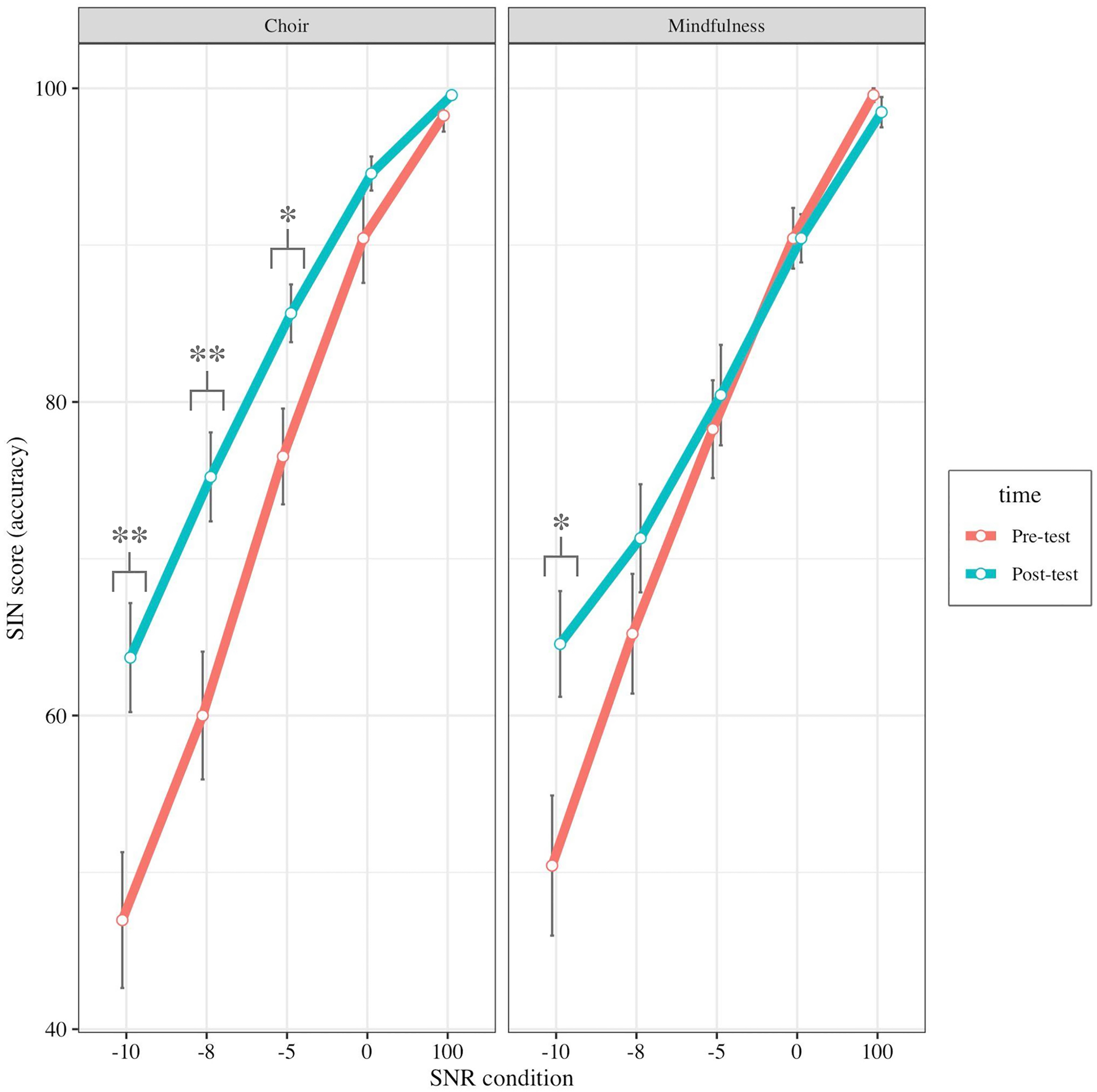
Speech-in-Noise task performance at pre- and post-test in choir and mindfulness groups across SNR conditions.
Measures of Socioemotional Well-Being
Ryff's Scales of Psychological Well-Being
Analysis of the overall Ryff's Scales of Psychological Well-Being scores indicated a main effect of Time (F(1,56) = 5.57, p = 0.02), indicating improvements in general well-being across groups. Analysis of the six subscales Autonomy, Self-Acceptance, Environmental Mastery, Personal Growth, Positive Relations, and Life Purpose was as follows. Six total outliers were removed (1 in Self-Acceptance, 1 in Environmental Mastery, 1 in Positive Relations, 1 in Personal Growth, and 2 in Life Purpose). In the Autonomy subscale, a significant main effect of Group was observed (F(1,59) = 4.52, p = 0.04, η2 = 0.07), in favor of the Mindfulness group compared to the Choir group, however there was no change from pre- to post-test (p = 0.2) or Time × Group interaction (p = 0.6), thus this did not seem related to the intervention. No other significant main or interaction effects were observed for the remaining Ryff's subscales of Environmental Mastery, Self-Acceptance, Personal Growth, Positive Relations, or Life Purpose (p's > 0.10). See Supplementary Figure 1.
State-Trait Anxiety Inventory
For the STAI, one participant was removed as an outlier. On the Trait Anxiety component, a main effect of Time was observed (F(1, 58) = 5.19, p = 0.03, η2 = 0.08), as across groups there was a significant decrease in trait anxiety from pre- to post-test, and there was no main effect of Group or Group × Time interaction. On the State Anxiety component, a main effect of Time was again significant (F(1, 58) = 4.18, p = 0.045, η2 = 0.07), as was a Group × Time interaction F(1, 58) = 4.18, p = 0.045, η2 = 0.07). Post-hoc analysis revealed that the reduction in State Anxiety was primarily driven by the Choir, who were less anxious at post-test than at pre-test (p = 0.04; see Figure 5), with no such changes observed in the Mindfulness group (p = 1.0).

State and trait anxiety scores at pre- and post-test in choir and mindfulness groups.
Resilience
No significant main effects or interaction effects were observed on the Resilience scale (ps > 0.05) (see Supplementary Figure 2). One participant was removed as an outlier.
Mindfulness
Analysis of the overall mindfulness score on the FFMQ revealed a main effect of Time (F(1, 54) = 9.03, p = 0.004, η2 = 0.14) but no main effect of Group or Group × Time interactions. Analysis of the facets of mindfulness revealed specific main effects of Time in three of the five FFMQ mindfulness facets: Acting with awareness (F(1, 59) = 8.21, p = 0.006, η2 = 0.12), Observing (F(1, 59) = 6.14, p = 0.016, η2 = 0.09), and Describing (F(1, 59) = 8.50, p = 0.005, η2 = 0.13). In all three cases, these main effects of Time reflected that scores were higher at post-test compared to pre-test across groups, and no Group or Group × Time interaction effects were identified in any of these facets. The other two FFMQ facet subscales, Non-judging and Non-reacting (5 outliers removed) demonstrated no significant main or interaction effects (p's > 0.10) (see Supplementary Figure 3).
Transcendence
For the ASTI Self Transcendence scale, there was a main effect of Time observed on Self-Transcendence scores (1 outlier removed), (F(1,58) = 9.38, p = 0.003, η2 = 0.14), with higher scores at post-test than at pre-test across groups, with no Group or Group × Time interaction effects. For Alienation, no significant main or interaction effects were observed (see Supplementary Figure 4).
Wisdom
On the 3-Dimensional Wisdom Scale, the overall Wisdom score revealed no main effects of Time or Group and no Group × Time interactions. Two outliers were removed for the Reflective condition and 1 was removed for the Affective condition. No significant main or interaction effects were observed for the Cognitive, Affective, or Reflective subscales (p's > 0.40) (see Supplementary Figure 5).
Discussion
This study investigated the effects of participation in a 10-week online-based choir versus mindfulness program on perceiving speech in noise and socioemotional well-being using a randomized control trial with adults aged 50–65.
We report the following observations: 1) Both interventions were effective in a) improving speech-in-noise perception in the most difficult conditions (−10dB); b) decreasing trait anxiety; and c) increasing feelings of mindfulness, and self-transcendence. 2) Choir training was more advantageous than mindfulness training in reducing state anxiety and in improving performance on the 4-semitone condition of a melodic-contour discrimination task. 3) Participation in choir training significantly improved speech-in-noise perception in two challenging conditions of −8dB and −5dB from pre to post assessment; however, this improvement was limited to when the choir group was compared to themselves, and differences did not reach significance when compared to the mindfulness group. Below, we will discuss each finding in detail and in the context of existing literature.
Speech-in-Noise Perception
In relation to speech-in-noise perception task, we hypothesized that training in the choir would be more effective compared to the training in mindfulness. Our hypothesis was partially supported. Contrary to our prediction, participation in both activities improved speech-in-noise perception, specifically in the most challenging condition of the task (−10 dB SNR) and improvement in this condition was greater than that of the easier conditions of the task (−5 dB, 0dB, 100 dB SNR). However, participants in the Choir group, but not the Mindfulness group, showed additional pre- to post-training improvements in other SNR conditions (−8dB and −5dB), relative to their own performance. Although noteworthy, this improvement did not reach the effect size to signify differences between the two groups. In the following section, we will discuss these results and hypothesized associated mechanisms.
Findings observed in the Choir group are in line with previous work that has demonstrated that both six months of piano training as compared to six months of video games and no training (Zendel et al., 2019) and 10 weeks of choir training as compared to no training (Dubinsky et al., 2019) improves speech-in-noise perception in older adults. In particular, Zendel et al. (2019) observed group differences only in the most difficult SNR condition (0dB) of the speech-in-noise task, highlighting that training effects may be visible only at higher levels of difficulty. Previous work observed neurophysiological, but not behavioral, improvements in speech-in-noise perception in a cohort of older adults with subjective hearing loss after 12-weeks of in-person choir training (Hennessy et al., 2021b), with a lack of behavioral change attributed to limitations of task sensitivity and difficulty. Here, we utilized a speech-in-noise task that, due to the wider range of SNR conditions, was more sensitive and able to detect potential improvements. With increased sensitivity, we observed a pattern of improvement inversely related to the level of difficulty; the most robust improvement in the Choir group was observed in the −10dB SNR condition (16.73% accuracy change), followed by the −8 (15.21% accuracy change) and −5dB (9.13% accuracy change) conditions. The improvements in the Choir group in the most difficult conditions are in line with previous findings demonstrating SIN enhancements after short-term choir training in high-noise contexts, suggesting that improvements may be observed in larger magnitudes with each increased level of difficulty. This pattern may explain why significant improvements are not seen at all SNR levels (0dB or 100dB SNRs). Notably, while this difference may be explained by the observed ceiling effect in the 100dB SNR condition (where accuracy did not reach below 98% in either group or time), the 0dB SNR condition did not show a ceiling effect. This finding illustrates that, even in a virtual setting in which opportunities for listening among a full ensemble of voices were limited, choir training produced some degree of enhancement in SIN abilities.
Training-related improvements may be due to enhancements of bottom-up processes, in which choir training improves participants’ ability to encode auditory features such as frequency and temporal fine structure. In vocal and choir training, participants are constantly engaged in fine frequency adjustments of their own voice in an effort to match to the voice of others or to a piano, which may ultimately lead to better perception and encoding of acoustic features. This is supported by behavioral research showing that pitch discrimination improvements mediate SIN changes over time (Dubinsky et al., 2019), and neurophysiological evidence demonstrating improved early auditory encoding (Hennessy et al., 2021b; Musacchia et al., 2008). Alternatively, or additionally, top-down processes may contribute to training-related improvements specifically in older adults, where choir training has been shown to modulate attentional networks (George & Coch, 2011) and improves participants’ ability to compensate for declining central hearing abilities via higher-level cognitive mechanisms (i.e., “filling”). This mechanism is supported by reports of auditory working memory mediations of SIN perception in musicians (Zhang et al., 2020), and with enhancements in later attention-related auditory evoked potentials such as the P300 (George & Coch, 2011). We hypothesize that bottom-up mechanisms likely contributed more to the observed improvements in SIN perception. Given that participants in this virtual study did not practice attending to or away from other voices in the context of a full ensemble, attentional control mechanisms likely did not play a large role in improved SIN perception. Future work investigating online choir participation with improved technology allowing for multiple voices to be heard at once may provide insight into these underlying mechanisms in this setting and the efficacy of larger-scale remote programs for speech-in-noise perception improvement.
While the Choir group showed significant improvements from pre- to post-test in all three negative SNR conditions (−10 dB, −8 dB, −5 dB), the Mindfulness group also showed significant improvement in only the most difficult condition of the task (−10 dB SNR). In their investigation of meditators’ speech-in-noise perception, Kumar et al. (2013) presented participants with only one SNR condition (−5 dB), and thus comparing the present pattern of results is difficult. Participants in the Mindfulness group showed a pattern of improvement that was observed in the Choir training group, where participants showed the most improvement in the −10dB SNR condition (∼14% accuracy change), followed by the −8 (∼6% accuracy change) and −5 (∼2% accuracy change) dB SNR conditions. While both training programs resulted in similar patterns of improvement, mindfulness training did not have the same magnitude of improvement across all conditions. This may reflect the fact that mindfulness training did not focus solely on activities geared towards improved auditory encoding. Instead, during mindfulness training participants were encouraged to attune themselves to the auditory scene around them at a level that is heightened in comparison to daily life (i.e., mindful listening). Improvements in attentional capacities that have been observed after mindfulness training (Isbel et al., 2019; Klee et al., 2020) may help explain the mindfulness intervention effects on speech-in-noise perception. This may indicate that the interplay of bottom-up and top-down processes, as are involved in choir training, may be more effective or efficient at improving speech-in-noise perception than top-down processes alone, as are involved in mindfulness training. While improvements in attentional processes as gained through mindfulness training may lead to some level of improved SIN perception, they are more robust and observable at lower SNR levels when coupled with training that additionally targets auditory encoding. Given the scarcity of work on mindfulness training's effect on speech-in-noise perception, more research is needed to fully explore this effect. This highlights the importance of using an active control group when assessing the effects of an intervention to accurately determine the effectiveness of the program of study. It is also possible this could simply be a training or participation effect. As we did not have a passive control group, we cannot eliminate this possibility.
Melodic Contour Identification
Across groups, we observed increased accuracy in the least difficult condition (4-semitone) of the melodic contour identification (MCI) task, driven primarily by the Choir group. That is, Choir more than Mindfulness participants increased their ability to identify relationships between musical pitches that were four semitones apart. This finding provided evidence that Choir training was effective in improving auditory related skills including pitch and contour. The 4-semitone condition is the least difficult of the conditions as there is the largest number of semitones between the different pitches presented (i.e., 4 semitones apart, as opposed to 1 or 2 semitones apart). The greater the number of semitones between the different presented notes, the more different in pitch the notes are from one another and therefore the easier it is to tell the difference between the given notes and the overall contour of the melody presented Choir participants regularly practiced identifying contours and vocally producing intervals as a nature of their training. This is in line with previous research indicating that musicians, as compared to non-musicians, show greater contour (Crew et al., 2015) and interval (Banai et al., 2012; Zarate et al., 2012) perception, and increased neural response to deviations in predictable contours and intervals (Fujioka et al., 2004) and that short-term melodic contour and interval training increases contour identification (Davies & Yelland, 1977) and interval identification (Pavlik et al., 2013) respectively. Improvements between or across groups were not observed in the 1- or 2-semitone conditions. These conditions are markedly more difficult and require more fine-tuned discrimination of relationships between pitches. It may be that, with more training or with training that included more personalized feedback (i.e., an in-person program), performance may have improved in the more difficult conditions, as well. Specifically, greater improvements may have been seen if participants were able to sing with others in person or with virtual audio-sets, where they could receive feedback on their heard and vocalized interval estimations from an instructor and other singers.
Pitch and Rhythm Discrimination
Choir participants had overall higher scores in pitch perception across time points. This was driven primarily by the fact that the Choir group, in both pitch and rhythm conditions, had greater discrimination than the Mindfulness group at pre-test and therefore had less room to improve. It may be that participants that had lower overall pitch and rhythm discrimination dropped out of the study once being placed in the Choir group due to their perceived lower inherent musical abilities.
Socioemotional Well-Being
Our hypothesis that both groups would show improvement on measures of socioemotional well-being was partially supported. Participants across groups showed improvements in scores from pre to post-test on a number of psychological measures: the global well-being measure on Ryff Scales of Psychological Well-Being, trait anxiety on the State-Trait Anxiety Inventory, and the global FFMQ mindfulness score as well as the Observe, Describe, and Act with Awareness subscales.
In regard to measures of anxiety on the State-Trait Anxiety Inventory, we found that both groups demonstrated decreases in trait anxiety and the choir group in particular demonstrated decreases in state anxiety. State anxiety as a construct refers to temporary and situational anxiety in-the-moment, whereas Trait anxiety is the way in which an individual responds to stress or worry on a day-to-day basis.
Our finding is in line with previous work demonstrating reduction in overall anxiety (state or trait not specified) for older adults following Mindfulness training (Young & Baime, 2010) and a reduction in state anxiety following a single hour of Choir training in college-aged students (Sanal & Gorsev, 2014). While reductions in trait anxiety were rather equal between groups, reductions in state anxiety observed across groups was largely driven by the Choir group, where post-hoc analysis indicated that the Choir group, but not the Mindfulness group, reported a reduction in state anxiety from pre- to post-test. Our findings suggest that participation in a Choir group may have assisted participants to better manage their anxiety at any given moment.
We asked participants to rate their state anxiety while taking the battery of behavioral assessments at the pre- and post- intervention time points. The fact that state anxiety in the choir group decreased specifically concurrently with an equally decreased trait anxiety across groups may imply something unique about the anxiety response to the testing situation. Specifically, the testing session was accompanied by less anxiety in the post-test in the choir group whereas general anxiety across life circumstances was generally equally improved across groups. This may be related to an effect of choir training on dealing with the psychosocial stressor of “performance” – in this case the performance of the battery of tests. This preferential impact of choir training on performance anxiety is in line with previous findings (Clements-Cortés, 2014; Coulton et al., 2015). This supports the work of two previous studies that showed anxiety reductions in older adults participating in a choral group of 16 (Clements-Cortés, 2014) or 14 weeks (Coulton et al., 2015) though neither utilized an anxiety measure that allowed for the specific measurement of state vs. trait anxiety, respectively.
Music has been demonstrated to induce relaxation and pleasure responses, causing lowered activity in neuroendocrine and sympathetic nervous systems, leading to reduced levels of anxiety, heart rate, and respiration rates (Lai et al., 2008). Additionally, learning a new skill such as singing in public later in life is a vulnerable and anxiety-inducing experience, but overcoming this challenge could lead to an increased sense of one's own abilities and confidence and reduced discomfort (Bugos et al., 2016). Singing in smaller vocal groups such as voice part sectionals also gives agency and builds community. Combining music's ability to induce relaxation and pleasure responses with overcoming the challenges of learning a new performative skill in a socially engaging and participatory activity, may explain the reduced levels of state anxiety specifically seen in the Choir participants.
Participants across groups showed increases in scores from pre to post-test on the global FFMQ mindfulness score as well as the Observe, Describe, and Act with Awareness subscales of the FFMQ. There are mixed findings regarding the effects of mindfulness training on mindfulness-specific measures in older adults, with some studies showing no changes after mindfulness training (Morone et al., 2008; Mularski et al., 2009) and others showing clear improvements (Lenze et al., 2014; Shih et al., 2021) or even mixed results (increases in some skills but decreases in others; Malinowski et al., 2017). Using an online platform for mindfulness training for older adults has not been widely studied. The few studies on online mindfulness training in a general population have shown mixed results, some showing increases in mindfulness (Aikens et al., 2014), while other results are mixed, depending on the type of training used (Mak et al., 2015), or did not measure changes in mindfulness at all (Tkatch et al., 2017). Our results suggest that 10 weeks of training for online mindfulness is long enough to produce effects on self-reported mindfulness for older adults. Additionally, online choir training seems to be an equally effective method for improving mindfulness skills in the older adult population. The fact that choir training seemed to lead to improvements in self-reported mindfulness was not expected, but given the voluminous evidence that self-reported mindfulness is related to improvements in well-being and attentional flexibility in older adults (Kral et al., 2018; Mallya & Fiocco, 2016; Prakash, 2021) we feel it is an understandable novel finding. We hypothesize that the impact of choir training in enhancing attentional engagement with the sensory surround and related affective processing may help explain why people's self-reported observing, describing, and acting with awareness tendencies were increased in the choir training group. Regarding the improvements in the Describe facet specifically, it is possible this could be due to participants having to relate their singing experience verbally to the choir and section leaders to receive feedback, as the participants could not be directly heard singing by the leaders over zoom.
Absence of Additional Changes in Well-Being
Aside from the overall score, no differences between groups or across time were observed for the subscales of the Ryff Scales of Psychological Well-Being. Higher engagement in participatory activities has been shown to have a positive relationship with the well-being of older adults (for review, see Vozikaki et al., 2017), possibly due to social engagement's enhancement of neuroendocrine and immune system functioning (Cohen, 2004), or perhaps the ability for social interaction to increase adaptive coping abilities allowing for the moderation of adversity (Musick & Wilson, 2003). Previous research suggests membership in a group social activity may be more important to improving well-being than the activity itself (Stewart & Lonsdale, 2016). Additionally, the impact of the global COVID-19 pandemic on our well-being indices must be taken into consideration. Early research on the impact of the COVID-19 pandemic shows a negative impact on the well-being of older adults, with increased depression and loneliness (Krendl & Perry, 2021). As the case rates of COVID-19 in the United States were worsening throughout this study, this could have countered any improvements in well-being resulting from choir or mindfulness classes.
Limitations
Limitations of this study design come from the novelty of performing auditory tasks in an at-home environment for the participants, the length of the study intervention, the virtual format, and the online delivery of the intervention. Given that all testing was done in participants’ homes, we were unable to control any background noise in participants' listening environments during the completion of the tasks or during participation in the online classes. While we could control the loudness levels output from the testing website, we were also not able to control the volume level set on the participants' devices to ensure it would be consistent across tasks and at both testing sessions. Additionally, though participants were assigned homework to complete on their own time each week, we had no measure of at-home engagement in those assignments. We also were unable to know if all participants engaged fully in the online classes each week, as we could not directly monitor or observe their participation levels in the ways that can be done in person. We attempted to overcome this potential issue by asking participants to keep their video cameras on during all class sessions. Still, it is possible that participants were not as focused or attentive during classes as they may have been in an in-person setting. This may have been particularly relevant to the Choir group, as participants kept their microphones muted, making it impossible to determine if participants were singing as instructed.
It is possible that the length of our choir and mindfulness interventions in addition to the virtual format may not have been sufficient to improve other well-being measures in either group long-term outside the immediate environment of the class activity at a significant level. In a recent study, participation in 6 months of choir singing led to reduced loneliness and increased interest in life for diverse older adults (Johnson et al., 2020). While previous work indicates that 10 weeks of choir training (Dubinsky et al., 2019) may be enough time to confer advantages to speech-in-noise perception, limited knowledge exists for how long training programs need to be to produce improvements in socioemotional well-being. Similarly, the effects of mindfulness training on wellness in older adults are inconsistent: some studies have shown the standard eight weeks of mindfulness training in older adults is enough to produce a wide range of well-being improvements (Creswell et al., 2012; Young & Baime, 2010), while others suggest it is insufficient (Malinowski et al., 2017; Mallya & Fiocco, 2016).
It is possible that online interactions in the present study were not as meaningful as in-person interactions: unlike during in-person group activities, online platforms make one-on-one personal interactions much more challenging if not impossible, and communication between group members is limited and unnatural, making personal connections less likely to occur. A recent study on social connectedness during the COVID-19 pandemic indicated that forms of low social presence media (email, social media, and games) have a negative relationship with perceived social connectedness while higher social presence media (video and phone calls) have no such relationship.
Finally, as this is one of the first studies exploring the efficacy of mindfulness and choir participation over an online platform with middle-aged and older adults, much is still unknown about the efficacy of learning these skills in an online environment. A qualitative paper based on interviews with choral conductors struggling to teach choirs during the global pandemic underscores how online technology is unable to replace in-person experiences of human connection, interaction, collective breathing, and aesthetic experience, but instead leaves individuals isolated in discrete units learning and singing (Martinec, 2020). Participants taking part in virtual choirs during the pandemic indicate the lack of in-person rehearsals meant the usual boost to their well-being associated with choir was lacking, while some even experienced a negative impact (Daffern et al., 2021). Results from several studies on hour-long interactive online mindfulness training show improvements in well-being after completion of training (Aikens et al., 2014; Mak et al., 2015; Tkatch et al., 2017), yet only one focused on a population of older adults (Tkatch et al., 2017).
Conclusion
During the COVID-19 pandemic, our reliance on virtual platforms for communicating and socializing has grown exponentially. In this randomized control trial, we showed that 10-weeks of an online choir or mindfulness program produces improved speech-in-noise perception in high-noise conditions, decreases in trait anxiety, and improves mindfulness and self-transcendence. We also show that singing in a virtual choir produces additional reductions in state anxiety, improvements in melodic contour identification, and greater improvements in speech-in-noise perception in noisier conditions. Our findings provide evidence for the feasibility of an online choir and mindfulness training program, and preliminary evidence for associated improvements in well-being and auditory measures in adults aged 50–65 across the United States during the COVID-19 pandemic. More research is needed to explore whether these findings can be replicated in a more robust manner in a larger or longer-term trial.
Supplemental Material
sj-docx-1-mns-10.1177_20592043221140524 - Supplemental material for Effects of Online Choir or Mindfulness Interventions on Auditory Perception and Well-Being in Middle- and Older-Aged Adults During the COVID-19 Pandemic: A Randomized Controlled Trial
Supplemental material, sj-docx-1-mns-10.1177_20592043221140524 for Effects of Online Choir or Mindfulness Interventions on Auditory Perception and Well-Being in Middle- and Older-Aged Adults During the COVID-19 Pandemic: A Randomized Controlled Trial by Ellen Herschel, Sarah Hennessy, Baruch R Cahn, Raymond Goldsworthy and Assal Habibi in Music & Science
Supplemental Material
sj-docx-2-mns-10.1177_20592043221140524 - Supplemental material for Effects of Online Choir or Mindfulness Interventions on Auditory Perception and Well-Being in Middle- and Older-Aged Adults During the COVID-19 Pandemic: A Randomized Controlled Trial
Supplemental material, sj-docx-2-mns-10.1177_20592043221140524 for Effects of Online Choir or Mindfulness Interventions on Auditory Perception and Well-Being in Middle- and Older-Aged Adults During the COVID-19 Pandemic: A Randomized Controlled Trial by Ellen Herschel, Sarah Hennessy, Baruch R Cahn, Raymond Goldsworthy and Assal Habibi in Music & Science
Supplemental Material
sj-docx-3-mns-10.1177_20592043221140524 - Supplemental material for Effects of Online Choir or Mindfulness Interventions on Auditory Perception and Well-Being in Middle- and Older-Aged Adults During the COVID-19 Pandemic: A Randomized Controlled Trial
Supplemental material, sj-docx-3-mns-10.1177_20592043221140524 for Effects of Online Choir or Mindfulness Interventions on Auditory Perception and Well-Being in Middle- and Older-Aged Adults During the COVID-19 Pandemic: A Randomized Controlled Trial by Ellen Herschel, Sarah Hennessy, Baruch R Cahn, Raymond Goldsworthy and Assal Habibi in Music & Science
Footnotes
Public Significance Statement:
As our global population ages, and during times of increased reliance on virtual and online technology to provide support, we need to better understand the efficacy of online interventions. This study suggests both online choir and mindfulness programs are feasible interventions that aid in improving well-being and auditory measures of middle-aged and older adults.
Acknowledgments
We would like to thank Andrew Schultz, our choir director, the team of choir group section leaders (Shelby Stroud, Hee Seong Lee, Serge Liberovsky, Yen-Hsiang Nieh), and the accompanist (Barry Tan). We would also like to thank our mindfulness instructor Alex Maizuss. Many thanks to our Brain and Music Lab Research Assistants and the research assistants from Ray Goldsworthy's lab for their help in data collection and class administration.
Author Note

Action Editor
Graham Welch, University College London, Institute of Education.
Peer Review
Gunter Kreutz, Carl von Ossietzky University Oldenburg School of Linguistics and Cultural Studies, Music.
Anne-Marie Czajkowski, University of Leeds, School of Music
Author Contribution(s)
All authors reviewed and edited the manuscript and approved the final version of the manuscript.
Declaration of Conflicting Interests
The author(s) declared no potential conflicts of interest with respect to the research, authorship, and/or publication of this article.
Ethics Approval Statement
This research has been reviewed by the USC Institutional Review Board (IRB). The ethics committee of the University of Southern California approved this study (Approval number: UP-19-00350).
Funding
The author(s) disclosed receipt of the following financial support for the research, authorship, and/or publication of this article: This work was supported by the Southern California Clinical and Translational Science Institute, (grant number UL1TR001855).
Supplemental Material
Supplemental material for this article is available online.
References
Supplementary Material
Please find the following supplemental material available below.
For Open Access articles published under a Creative Commons License, all supplemental material carries the same license as the article it is associated with.
For non-Open Access articles published, all supplemental material carries a non-exclusive license, and permission requests for re-use of supplemental material or any part of supplemental material shall be sent directly to the copyright owner as specified in the copyright notice associated with the article.
