



Abstract
This study, which is based on self-determination theory, compares the motivation and satisfaction of basic psychological needs of music students in instrumental lessons before and after the COVID-19-induced transition to online teaching and learning. We investigated whether, in addition to the satisfaction of students’ basic needs, teachers’ enthusiasm, experience with online teaching, and age can explain motivation in online lessons. Two independent groups of music students were surveyed: one group before (n = 856; Mage = 16.4, SD = 14.1) and the other group after the shift to enforced distance learning (n = 640; Mage = 16.7, SD = 13.8). The main findings are that intrinsic motivation in online learning was significantly lower, and controlled forms of motivation higher than before enforced distance learning. Furthermore, satisfaction of basic needs for autonomy, competence, and relatedness, which are essential for autonomous motivation, were lower in online learning. Regression analyses showed that 39% of the variance of intrinsic motivation for online learning could be explained by social relatedness, perceived teacher’s enthusiasm for teaching, and age.
Keywords
Due to the COVID-19 pandemic (WHO, 2020), school curricula have been changed to distance learning in most countries, and amongst others, attempts have been made to also conduct extracurricular instrumental lessons online. The extent to which distance learning can work in instrumental teaching and the opportunities and difficulties involved are largely unexplored. However, several studies have recently emerged that focus on school-based music instruction in the pandemic (Calderón-Garrido & Gustems-Carnicer, 2021; Daubney & Fautley, 2020; Shaw & Mayo, 2021), instrumental instruction (e.g., Bruin, 2020) or for example on online singing projects (Ho, 2021). Based on research about distance learning before and especially during the pandemic in education (Hartnett, 2015; Müller et al., 2021; Sloan, 2015; Wong, 2020), it can be assumed that particularly learning motivation and its conditions for music lessons are a worthwhile research desideratum.
In the present study, it was possible to compare student data from music schools in Austria on learning motivation and its conditions that were collected before the pandemic with those that were gathered during enforced distance learning. The theoretical basis used is self-determination theory (SDT, Ryan & Deci, 2017), which differentiates forms of motivational regulation according to the degree of self-determination. It has also proven useful in research on motivational processes in instrumental music teaching and learning before (Comeau et al., 2015; Evans, 2015; Evans & Liu, 2019; Schatt, 2018; Wieser, 2018). According to SDT, basic psychological needs satisfaction (BPNS) for autonomy, competence, and social relatedness is essential as a motivational condition, which has also been repeatedly confirmed for music learning and teaching (Evans, 2015; MacIntyre et al., 2018; Miksza et al., 2019).
The extent to which motivational regulation and BPNS differ before the pandemic (face-to-face teaching) and during enforced distance learning and teaching in instrumental instruction is investigated. In addition, the question of whether student motivation can be explained in forced distance learning by relevant conditions is explored.
This study contributes to reducing the research gap and provides more information on whether offering online courses in instrumental instruction (at least as a hybrid supplement to face-to-face instruction) may be an option from a motivational research perspective.
Music schools in Austria: The surveys were conducted in Austrian music schools, which are not an integral part of the formal education system. In Austria, it is common for young people to learn musical instruments at music schools, which are educational institutions offering instrumental and vocal instruction as major subjects and music theory, ensemble playing, and orchestral playing as minor subjects. Instruction at music schools mainly takes the form of weekly one-to-one or (less often) group lessons. Music schools are open to all age groups; they are partly financed by public funds (around 80% on average) and school fees (around 20% on average).
Motivation
Motivation is indispensable for learning and teaching, inside and outside the school context. Numerous studies have shown that intrinsic motivation leads to more accurate and context-related learning, better performance, greater commitment, and persistence (Bailey & Phillips, 2016; Renaud-Dube et al., 2015; Taylor et al., 2014). Looking at the development of learning motivation longitudinally in educational contexts, intrinsic motivation decreases over time, especially when the learning environment changes. For both students and teachers, the learning environment changed significantly, leading to a potential discrepancy between students’ learning environment and basic psychological needs satisfaction. Furthermore, studies designed within the framework of SDT (Gillet et al., 2012; Thomas & Müller, 2014) show that insufficient satisfaction of the basic psychological needs of students leads to a decrease in their intrinsic motivation.
Self-Determination Theory (SDT)
Like other theories of motivation, SDT (Ryan & Deci, 2017) distinguishes between intrinsic and extrinsic motivation. Intrinsically motivated behavior represents the prototype of self-determined behaviors that can be described as “wholly volitional, as representative of and emanating from one's sense of self” (Deci & Ryan, 1994, p. 5). Intrinsically motivated behavior is associated with curiosity, exploration, and interest. By contrast, extrinsically motivated behaviors are undertaken to attain an end state that is separate from the actual behavior. Studies have shown that intrinsic and extrinsic motivation can be related. For example, young people may practice the guitar because their parents pressure them or they want to achieve the self-imposed goal of winning a place at a music conservatory. Both actions are extrinsically motivated, but they are not self-determined to the same degree. For this reason, Ryan and Deci (2002, 2017) developed an approach to motivation that does not conceptualize extrinsic and intrinsic motivation as separate categories, but rather places them on a continuum from controlled to autonomous regulation. Figure 1 illustrates the continuum of self-determination, showing the range of regulatory styles from controlled to self-determined.

Continuum of self-determination (based on Ryan & Deci, 2002, p. 16).
First, external regulation corresponds to the classical definition of extrinsic motivation (see above) and is accompanied by the achievement of rewards or the avoidance of negative consequences. This form of regulation is barely self-determined.
Second, introjected regulation is characterized by a slightly higher degree of self-determination. It is partially internalized into a person's self and occurs when behaviors aim to conform to poorly integrated social norms. It is associated with either approaching “ego enhancement” (Ryan & Deci, 2002, p. 17) or avoiding “ego depletion” (Ryan & Deci, 2008, p. 705) and thus contains both positive (e.g., pride) and negative aspects (e.g., guilty conscience).
Third, the focus of identified regulation is the personal relevance of an action. For example, a young guitar player identifies with the values and aims of a music school and integrates them into his/her self. SDT postulates that the learner in this case regulates his/her behavior according to his/her identification with long-term goals, such as performing with a band.
Fourth, integrated regulation is the motivational style of extrinsic motivation with the highest degree of self-determination. It integrates identified values into a fully coherent sense of self. These values coexist harmoniously along other aspects of the self (Deci & Ryan, 1994, pp. 6–7). Integrated regulation is closely related to intrinsic regulation and it is very difficult to distinguish between these two regulatory styles. We therefore discounted it in the present study, as previously done in other research on self-determined motivation (see Ryan & Connell, 1989).
Basic Psychological Needs Theory
SDT also explains the genesis of motivational regulation by reference to basic psychological needs theory (Evans, 2015), one of the six mini-theories within SDT (Ryan & Deci, 2017). The basic needs for autonomy, competence, and social relatedness are thereby to be understood as a single, holistic, functional system that provides human beings with continuous feedback about the quality and function of person-environment interactions. The satisfaction of these needs is essential for individuals’ adjustment, integrity, and growth, as well as for the development of autonomous forms of motivation (Vansteenkiste et al., 2020).
Autonomy is experienced when people evaluate the goal of an action as subjectively meaningful; they have choices, and they are shown personal respect (e.g., by teachers). Students who perceive their teachers as autonomy-supportive show higher intrinsic motivation, are more goal- and task-oriented, or achieve better results (Gillet et al., 2012; Jang et al., 2016; Katz et al., 2014). Competence is associated with self-efficacy and comes about in the field of education, for example, through structures that promote learning. Experiencing social relatedness means feeling accepted and taken seriously by significant others. The feeling of belonging can refer to aspects of support and helping (care) as well as to emotional relatedness (cf. Ryan & Deci, 2017).
However, the development of self-determined forms of motivation in students is influenced not only by the satisfaction of their basic needs but also their perception of the teacher's enthusiasm when teaching a particular subject (Prenzel et al., 1996). This particularly happens when the student identifies with the teacher. It has been widely empirically confirmed that self-determined forms of motivation as well as basic psychological needs satisfaction (BPNS) are associated with better well-being, life satisfaction, and positive affect, and are associated with persistence in educational settings (e.g., Niemiec & Ryan, 2009, and Ryan & Deci, 2017).
SDT Research and (Instrumental) Music Teaching and Learning
The literature review reports on findings on conditions processes and outcomes of self-determined motivation in education with a focus on music education (Kingsford-Smith & Evans, 2019; MacIntyre et al., 2018; Miksza et al., 2019). However, the SDT framework has rarely been used in investigations of instrumental music teaching and learning (Comeau et al., 2015; Evans, 2015; Evans & Liu, 2019; Schatt, 2018; Wieser, 2018), particularly outside of regular school.
According to Evans (2015), the SDT framework is predominantly suitable for such investigations. Autonomy, competence, and social relatedness, as defined above, are crucial to explanations for motivation. For example, Renwick and McPherson (2002) demonstrated the importance of autonomy for the quality of learning and performance in music education. Belief in one's own competence also plays an essential role in continuing to play a musical instrument, as most people engage in music making as a voluntary activity and often stop playing if they do not feel competent (e.g., O'Neill & Sloboda, 1997). Social relatedness is correlated to the development of self-determined forms of motivation in learning and playing an instrument, as shown by Wieser (2018) and Wieser and Müller (2019). However, it has also been shown that children whose basic psychological needs are not met, or are inadequately met, are more likely to give up playing an instrument altogether (Evans et al., 2012). Evans (2015) additionally observes that social relatedness in particular continues to play a central role in the development of competence in later life.
SDT Research and Online Learning
SDT is used as a framework for explaining motivational behavior in online learning environments (Hartnett, 2015; Sloan, 2015). For example, studies have shown that teacher feedback, relevance of the learning activity (Hartnett et al., 2014), challenge, interest (Shroff et al., 2008), and the experience of competence all influence intrinsic motivation for learning in such environments. Other studies have demonstrated direct (Hsu et al., 2019) and indirect associations (Chen & Jang, 2010) between the satisfaction of basic needs and self-determined forms of motivation in online learning. Few studies, however, have examined the extent to which different media approaches (online or face to face) differ in terms of fostering motivation. Those that have been conducted show that learning in an online environment is not necessarily always conducive to the satisfaction of basic needs (Hartnett, 2015).
Motivation is affected when basic needs are not sufficiently satisfied. This occurs when the students’ workload is too high, opportunities for students to communicate with their peers are scarce, and when teachers’ instructions are unclear or not enough feedback is provided.
Online schooling has thus presented a particular challenge to the support and maintenance of social relatedness (Butz & Stupnisky, 2017). Hence, music teachers preferred face-to-face individual lessons and considered them more effective and efficient for giving feedback and monitoring students’ progress (Hash, 2021). However, Spanish school teachers, for example, also reported that they had even more contact with students in asynchronous music classes through the use of social media than in pre-pandemic classes (Calderón-Garrido & Gustems-Carnicer, 2021).
Another challenge of distance learning includes teachers’ (lack of) technical expertise, students’ access to instruments or technology such as the internet, as well as parental support (e.g., Hash, 2021). A survey of music teachers in an Austrian province found that few teachers had relevant expertise before the beginning of the pandemic and that most teachers had to acquire appropriate digital devices (Music Schools of Carinthia, 2020). It can also be assumed that students’ motivation for learning was influenced by the degree to which they possessed and were comfortable using digital devices at home.
The few studies available on motivation in online instrumental lessons demonstrate that problems with audio quality and latency in particular impair communication and diagnosis, and make collaborative music making almost impossible (Dammers, 2009; Dye, 2016; Hash, 2021; Kenny, 2013; Pike, 2017; Schmidt-Jones, 2020). In addition, distance learning can make learners feel socially isolated (Koutsoupidou, 2014) or unsecure with regard to their learning progress (Bayley & Waldron, 2020). This influences the motivation to learn and play. Schmidt-Jones (2020) reports that frustrations with technology could also lead to student attrition.
Research Gaps
There has been no systematic investigation of the extent to which music students are autonomously or controllably motivated in synchronous online lessons, how their basic psychological needs are satisfied, and how they rate the enthusiasm of the teachers. Furthermore, there are no findings on whether these characteristics differ compared to face-to-face lessons. Additionally, the question of which situational conditions in online instrumental instruction explain students’ motivational regulation remains unanswered. We know a little more about the fact that technical equipment and the ability to handle it influence the experience of students, but the question of how exactly this is related to motivation and BPNS is still open.
Research Questions and Hypotheses
Based on self-determination theory and previous studies, we hypothesize that (1) intrinsic and identified regulation are significantly lower and extrinsic and introjected regulation are significantly higher during online learning than before distance learning, (2) the satisfaction of the basic psychological needs and the perceived teachers’ enthusiasm for delivering music lessons are significantly lower in times of online learning, and (3) the basic psychological need satisfaction and teachers’ perceived enthusiasm, technical expertise of teachers, and students’ access to digital devices predict the types of motivation.
In addition, we will examine whether age explains students’ motivation differently. Empirical studies (e.g., Sheldon et al., 2006; Weman Josefsson et al., 2018) provide evidence to support the proposition that older individuals are less motivated in a controlled manner than younger individuals.
Methods
Participants
In the present study, we were able to compare two independent sample groups. The first group was surveyed before COVID-19 (in conventional classes), and the second group during enforced distance learning (the recommended technical tool for online instrumental music instruction was MS Teams). Both studies were conducted in the same music schools in a state in Austria.
Group 1 (before COVID-19 in 2016; face-to-face learning): This group included 856 music students (67% female, 33% male) aged from 7 to 68 years old (Mage = 16.4, SD = 14.2, Md = 12 years, 4.2% are between 7 and 9 years old and 6% are 40 years or older). The most prominent and represented instrument group was wind instruments (35.2%), followed by string and keyboard instruments. The smallest group was the vocal section (1.6%). The data were collected for a study on motivational quality and BPNS in music lessons at Austrian music schools. The identical scales were used for the survey in enforced distance learning.
Group 2 (during COVID-19 lockdown in April and May 2020; online learning): This group involved 640 music students (72.5% female, 27.5% male) aged from 7 to 77 years old (Mage = 16.7, SD = 13.8, Md = 10 years, 9% are 7 years old and 9% are 40 years or older). With regard to the instrument groups, similar to group 1, the most prominent and represented instrument group was wind instruments (31.7%), followed by string and keyboard instruments. Here, too, the smallest represented group was the vocal section (3.6%).
Although we are dealing with a non-linked sample, the two groups can be compared due to the similarity in important characteristics. The surveys took place at the same music schools with the same teachers, both the survey participants had the same age structure, and both the survey groups comprised a prominent number of female music students and a significant number of students representing the wind instruments. Nevertheless, it was not possible to exactly link the individuals of Group 1 with Group 2. Therefore, the decision was made to use an independent sampling method to calculate the mean differences.
Procedure
In Group 1, the questionnaire was handed out personally to the participants in music schools. Due to severe restrictions, the same procedure could not be applied to Group 2. For this reason, the questionnaire for Group 2 was converted into an online version. The link to this questionnaire was subsequently sent to music teachers four weeks after the first lockdown. They were asked to forward it to their students with the request that the students should complete the questionnaire on their cellphones or personal computers. The participants of both groups were told that the questionnaires were anonymous and were reassured that the individual data would not be available to any teacher and school leader or another third party. Furthermore, the research team informed the school principals, that participants could refuse their participation any time. The mandatory permission for the survey was given by the school principals, who gave the questionnaires or the online links to the respective teachers or directly to the students. Due to the permission of the school principals no separate consent was given to the participants.
Measures
To answer the questions, all the items had a 5-point Likert scale from 1 (do not agree at all) to 5 (agree very strongly). The instruction in the questionnaire was formulated in such a way that it was clear to the students that the relevant items referred only to one-to-one learning situations and not to the group lessons that were attended in some cases in addition.
Exploratory Factor Analysis and Measured Variable Estimates of two Confirmatory Factor Analysis (CFA).

For construct validity, we performed Exploratory Factor Analysis (EFA) using IBM SPSS 26 and Confirmatory Factor Analysis (CFA) using AMOS 26. To check the suitability of the data for EFA, the Kaiser–Mayer–Olkin (KMO) test was used (Bühl, 2012). The KMO measure of sampling adequacy was 0.644, indicating the selection of sampling was adequate for factor analysis. Concerning motivational regulation, standardized coefficients of the EFA and CFA provide an easily interpretable four-factorial solution and demonstrate that the four regulatory styles can be statistically separated (see Table 1). The results also support the simplex structure of motivational regulation, which assumes that constructs that are closer together on the continuum of self-determination are more highly correlated than constructs that are further apart (see also Table 3). In another study, the instrument was shown to be well suited for younger students aged 8 to 12 years (Thomas & Müller, 2016).
Pearson correlations among measured variables before and during COVID-19.
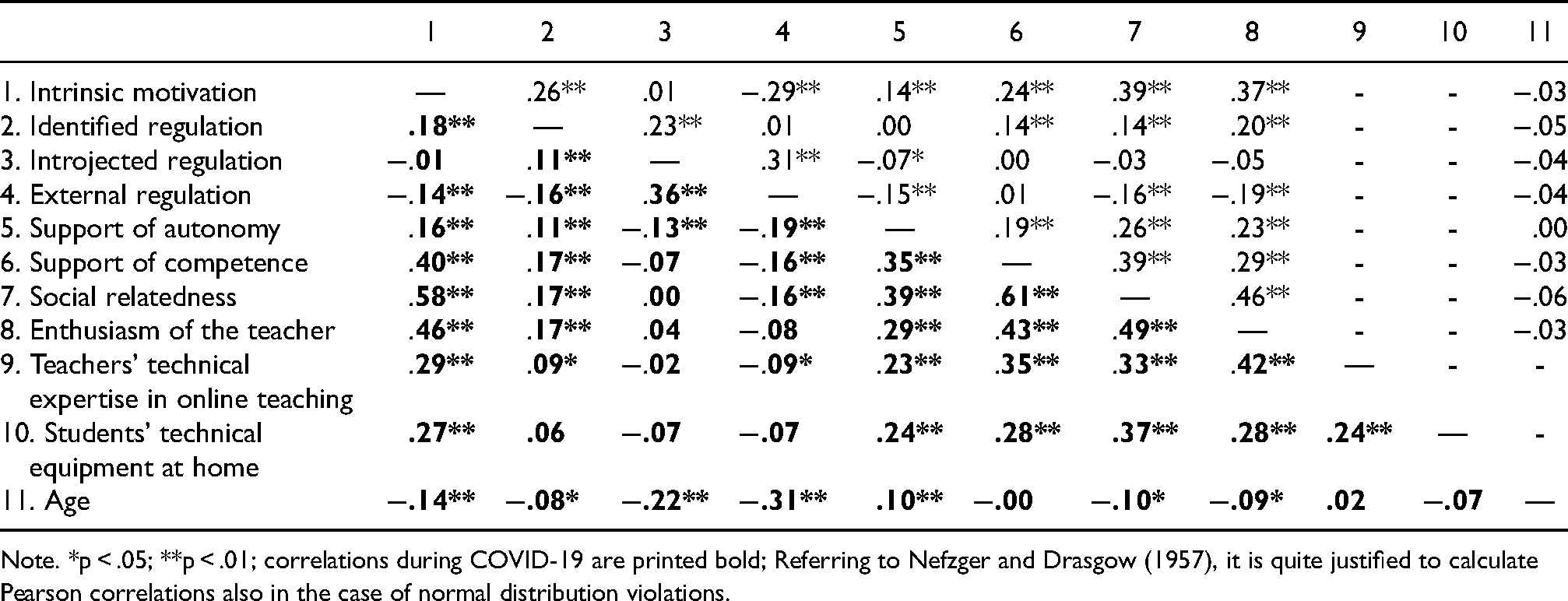
Note. *p < .05; **p < .01; correlations during COVID-19 are printed bold; Referring to Nefzger and Drasgow (1957), it is quite justified to calculate Pearson correlations also in the case of normal distribution violations.
Results
Descriptive Statistics
Table 2 contains the results of the descriptive analyses.
Descriptive statistics and group comparisons.

Scale: 1 (do not agree at all) – 5 (agree very strongly).
Note: Despite the data not being normally distributed, t-tests were used. This is because simulation studies showed that the violation of the normal distribution assumption is not substantial (Wilcox, 2012). According to Cohen (1988), effect sizes < .10 are irrelevant, between .10 and .50 are considered low, and > .80 are considered high.
Finally, music students highly rated the capacity on teaching via online (M = 4.22; SD = .90); they indicated adequate technical equipment for online learning at home (M = 4.27; SD = .97).
Correlations
Table 3 provides an overview of the Pearson correlations of the most important variables for both groups.
Regression Analysis
One of the aims of this study was to explain motivation during learning in an online setting. For this purpose, we used regression analysis (Enter method; Stoetzer, 2020) with the outcome variables intrinsic motivation, identified, introjected and external regulation. In a linear regression analysis, we used the basic needs (first as total scale), enthusiasm of the teacher, teachers’ technical expertise in online teaching, students’ technical equipment at home, and age. Based on SDT and the results of the correlations, we assumed that beside the motivation learning environment (satisfaction of the basic needs), enthusiasm of the teacher, technical aspects and age could be important predictors for motivational regulation in the online mode. No results of the regression analyses for the outcome variables of identified and introjected regulation are reported here, since the explanatory value for introjected regulation is very small, and no difference in identified regulation before and during enforced distance learning is found.
Before regression analyses were used, essential conditions were reviewed. A test for heteroscedasticity, performed with a scatterplot of the regression of the residuals and the regression of the estimated errors, revealed a well randomized distribution (White-Test: p = .001). The calculation of Cook's distance showed no evidence of influential outliers and furthermore, due to the correlations, there is no indication for multicollinearity. However, the measured values of the variables are not normally distributed, which can be seen as a limiting factor for the estimation in the models (see also limitation section).
For the outcome variable intrinsic motivation, 30% (R2 = .30) of the variance can be explained. Best predictors are need satisfaction (β = .295), the perceived enthusiasm of the teacher (β = .266), and age (β = −.112) (see Table 4).
Regression analysis a – intrinsic motivation.

Outcome variable: intrinsic motivation.
Note. CI = confidence interval; LL = lower limit; UL = upper limit.
In the second step, a regression analysis was calculated, in which social relatedness was included as a single need, as this aspect provides a prominent explanation for intrinsic motivation in online learning (e.g., Vayre & Vonthron, 2017). The results show that 39% (R2 = .39) of the variance of intrinsic motivation can be explained. Here, social relatedness (β = .452) and the perceived enthusiasm of the teachers (β = .209) can explain intrinsic motivation best (see Table 5). Thus, the two needs of competence and autonomy cannot explain an additional part of the variance of intrinsic motivation.
Regression analysis b – intrinsic motivation.

Outcome variable: intrinsic motivation.
Note. CI = confidence interval; LL = lower limit; UL = upper limit.
For external regulation, 14% (R2 = .14) of the variance can be explained. Age (β = −.308) and basic need satisfaction (β = −.223) provide the highest significant effect (see Table 6).
Regression analysis external regulation.

Outcome variable: external regulation.
Note. CI = confidence interval; LL = lower limit; UL = upper limit. There is no change in the sign of the confidence interval between LL and UL if the beta coefficients are significant. This speaks for the quality of the beta coefficients (cf. Reinboth, 2006).
The variables “teacher's technical experience of online teaching” and “student's technical equipment at home” cannot contribute to the explanation of intrinsic and external regulation.
Summary and Discussion
The results show that in this cohort of participants intrinsic motivation during the COVID-19-induced transition to online learning was lower than before by more than one standard deviation, and that the two controlled forms of motivation (extrinsic and introjected regulation) were significantly higher (H1). The identified regulation that is directed toward self-determined external goals – such as the goal of playing in an orchestra or ensemble – remained unchanged. This shows that identification with the personally relevant goals associated with music are not affected even by the dramatic change in the learning environment. Since the teachers were largely the same during and before transition to online lessons, it can be assumed that the decrease of intrinsic motivation is due to the enforced shift to online music teaching. This was shown by the significantly lower satisfaction of the basic needs (especially, competence and social relatedness) in remote learning (medium effect size). The same is the case for perceived teachers’ enthusiasm by the students (H2). The lower perceived enthusiasm is attributable not only to the changed communication situation, but also to a decline in teachers’ motivation to teach (Wieser et al., 2022).
The fact that social relatedness, particularly in enforced online teaching and learning, was significantly lower at the onset of COVID-19 pandemic was also demonstrated in a recent study with students (Wong, 2020). In this respect, it is apparently more difficult to ensure social relatedness in enforced distance learning than in face-to-face instruction. However, it should be considered that students in the early phase of enforced online instruction still rate social relatedness relatively high (M = 3.84). After a certain habituation effect, the social relatedness could also be higher again after some time in online classes.
In addition, the data of the present study show that the support for competence was significantly lower in online learning than in face-to-face lessons before the COVID-19 lockdown. The support for competence refers to the quality of instruction, to direct help, explanations, and, especially, to feedback. Hartnett (2015) identifies that, among other things, unclear instructions in online learning can lead to inadequate insufficient need satisfaction and thus a decrease of intrinsic motivation (see also Chen & Jang, 2010). Thielemann (2020) also points out that especially the quality of the learner-focused feedback suffers in online classes. Reasons for this include the difficulty in assessing students’ playing due to poor quality of the sound, unclear tone colors and phrasing, or difficulty in assessing posture (see also Pike, 2017; Schmidt-Jones, 2020). In contrast, the support for autonomy is only slightly worse than in conventional music lessons, due to students still being able to largely contribute by voicing their opinion and making their own choices. This is consistent with the findings of Wong (2020).
The regression analyses demonstrate that the intrinsic motivation in enforced online teaching can be mainly explained by social relatedness and the perceived enthusiasm of the teacher. A model that conceives a single latent variable of “Basic Needs” explains intrinsic motivation less well than a model that includes only social relatedness as a basic need. Thus, social relatedness was found to be the central variable to explain intrinsic motivation compared to the other two needs. Vayre and Vonthron (2017) were also able to show that social support is especially important in online classes. However, it should be noted that social relatedness and support for competence are moderately correlated with each other and thus there is a collinearity effect. This indicates that competence is relevant but does not provide any additional explanatory value. Regarding intrinsic motivation, we also hypothesized that the technical expertise of teachers, as well as students’ access to digital devices, predict the types of motivation. Contrary to what was assumed, the assessment of the technical expertise of the teachers and the technical equipment of the students cannot additionally explain intrinsic motivation (H3).
As evident in other SDT-based studies (Müller et al., 2021; Vandenkerckhove et al., 2019), external regulation is less well explained by perceived satisfaction of the basic needs. However, the explanatory content is higher than in the data collected before the shift to online learning.
Older music students have been shown to be less extrinsically motivated than younger ones. This finding is in line with our expectations and can be justified by the fact that older students have learned to regulate themselves more independently of external influences (Sheldon et al., 2006; Weman Josefsson et al., 2018). Another reason for the negative correlation between age and external regulation could be a selection effect. The reason can then be seen in the fact that extrinsically motivated and amotivated students no longer attend the music schools. However, this positive selection should be rather small, since in conventional music lessons before enforced online learning and teaching the correlation between age and external regulation was near zero. It is more likely that, in a crisis situation, older students can regulate themselves better psychologically and attend lessons with less extrinsic motivation. This can also be demonstrated by the age distribution. After all, 15% of the students surveyed who attend classes online were over 20 years old.
Overall, the findings of this study are consistent with those of many other studies on the importance of satisfying the basic needs in the educational context (e.g., Ryan & Deci, 2017). Moreover, the explanatory values of the three basic needs vary according to setting, cultural context, and population. As one of many possible additional variables involving the teacher, the teacher's enthusiasm for teaching was found to be a strong explanatory factor for intrinsic motivation in online instrumental instruction. As early as 1999, Prenzel and colleagues identified this aspect's importance for autonomous learning motivation.
Limitations and Further Research
The study shows certain limitations. Firstly, the motivational regulation for online instrumental music instruction and the basic needs were measured with an online questionnaire that, due to the prevailing situation through COVID-19, was deliberately not very extensive and time-consuming. For this reason, only two or three items measured the basic needs. As a result, the Cronbach's Alpha values for autonomy and competence were partly low. However, the reliabilities for the two scales social relatedness and the total scale PBNS, which were used as predictors in the regression analyses, are satisfactory. Additionally, the fact that the variables are not normally distributed could also affect the model estimates’ quality in the regression analyses. However, due to clearly significant effects in the models, this limitation should not be very substantial. Secondly, there is a limitation due to sample composition. Despite the good comparability of the two groups (due to the same music schools and teachers, age structure, ratio of female to male students, etc.), it is not possible to estimate whether the same music students actually participated in both groups due to the self-selectivity of the sample. In addition, some students did not participate in online classes because they did not want to. As a result, fewer students participated in study 2. Thirdly, the study didn’t include any descriptive data on how many years of playing experience the music students had. However, this might have an effect on motivation.
Future research efforts should focus on the following main areas:
Further surveys are needed to determine whether the situation has eased again in face-to-face teaching, and whether hybrid solutions are possibly useful. It is an open question whether, over time, experience in online instruction will make BPNS more feasible. This would require longitudinal designs of an experimental nature to be conceived. A worthwhile research desideratum in terms of SDT is also the distinction between online instruction that was voluntarily chosen (e.g., online courses on the Internet) and online instruction that was introduced against the will of the participants (e.g., in the COVID-19 pandemic). It is also an open question how to design online or hybrid learning environments for group instruction. From the point of view of BPNS and for reasons of communication technology, this undertaking seems to be a special challenge. Context-related variables should be included to explain motivation. For example, aspects that lie outside the learning environment of music lessons could play a role in the motivation and the learning behavior of students. This could include home schooling, family issues, and the like. Relatively stable general motivational orientations (autonomous vs. controlled) should be included in study designs and their predictive content for current learning motivation should be investigated (cf. Vansteenkiste et al., 2020).
Practical Implications
Lower intrinsic motivation, higher controlled motivation, and lower need satisfaction initially suggest that synchronous online instruction is suboptimal from a learning motivation perspective. However, it has to be considered that (1) the online instruction was forced and (2) in an early phase of the pandemic, the general crisis situation in life might have directly influenced the motivation and the BPNS of the students. In this respect, it cannot be concluded from the study that online learning in instrumental instruction should be generally rejected. This study points out that BPNS is of high importance for autonomous motivation and should be taken into account when implementing online or hybrid learning environments in instrumental lessons. In particular, social relatedness, which is associated with being a climate conducive to learning, social security, and the feeling of being noticed, is of special importance for high-quality and sustainable motivation in music lessons (see also Bruin, 2020 and Evans, 2015). Support for autonomy in music lessons refers, for example, to participation in the selection of pieces of music, to the consideration of individual interests of the students, for example, in the genre, or to the meaningful justification for certain exercises such as playing scales (giving a rationale). Competence support goes hand in hand with concrete feedback that promotes learning or with enabling experiences of efficacy (the feeling of being able to do something), even if the competencies are still at a low level.
Footnotes
Action editor
Frank Hentschel, Universität zu Köln, Musikwissenschaftliches Institut.
Peer review
Karen Wise, Guildhall School of Music and Drama, Research Department.
Leon de Bruin, University of Melbourne, Conservatorium of Music.
Ross Purves, UCL, Department of Culture, Communication and Media.
Contributorship
MW and FM conceptualized and designed the study. MW performed data collection. MW and FM carried out the statistical calculations. MW and FM wrote the manuscript. MW managed and oversaw the entire project. Both authors listed have made a substantial, direct, and intellectual contribution to the work, and approved it for publication.
Declaration of Conflicting Interests
The author(s) declared no potential conflicts of interest with respect to the research, authorship, and/or publication of this article.
Ethical approval
At the time the study was conducted (2020) and based on the non-sensitive data, there was no need to submit the study to the local Ethics Board. Furthermore, the respective music schools' directors agreed to the study and gave their approval. However, throughout the study and research process the participants' anonymity has been guaranteed.
Funding
The author(s) disclosed receipt of the following financial support for the research, authorship, and/or publication of this article: This work was supported by the Institute of Instruction and School Development; University of Klagenfurt,
