



Abstract
Collaborative playlist-making (CPM), a form of music co-curation where two or more people select and order recorded music together, is a form of group musical engagement that has recently risen to prominence among musicians and nonmusicians in the general population. This paper presents CPM as a form of technologically mediated group musical engagement and informs researchers as to how CPM and its constituent behaviors may be studied in relation to other forms of musical engagement, particularly group music-making. In addition, specific psychological processes expected to be elicited by CPM—self-other merging, cognitive perspective-taking, and shared intentionality—are explicated in an effort to evince how CPM may give rise to socio-cognitive transfer effects in line with Goldman's reconstructive route to empathy. The main purpose of this paper is to promote music psychologists’ study of CPM to probe how musical interaction occurring within everyday contexts can harness music's potential to facilitate communication and bring about social benefits.
Keywords
Introduction
The social essence of music has been emphasized widely in the field of music psychology (Cross, 2005; Huron, 2001; Peretz, 2006). Prominent research foci within this domain include music communication, where musical and affective information is transmitted and received through musical performance (e.g., Bharucha et al., 2012; Chang et al., 2019; Cross, 2014), and social transfer effects, where engagement in group music-making can positively impact social cognition (Cirelli et al., 2014; Kirschner & Tomasello, 2010; Rabinowitch et al., 2013). However, the COVID-19 pandemic has made it difficult to study such foci in the lab, as many of these experimental studies necessitate that a group of individuals are in close face-to-face proximity. Moreover, consideration of the transfer effects that face-to-face group musical engagement has on social capacities begs the question of whether remote group musical engagement may reap similar benefits; if so, this group musical engagement may have the potential to address social needs that are not being fulfilled amidst social isolation during the pandemic.
In this paper, I explicate collaborative playlist-making (CPM) as a digitally mediated form of group musical engagement that does not require face-to-face presence, and that occurs in everyday settings as part of musicians’ and nonmusicians’ daily routines. I situate CPM within the context of other better-known forms of music-making and elucidate the psychological processes that are expected to occur during CPM. Ultimately, I aim to put forward the case for studying group music-making via online studies involving CPM.
CPM is a process in which two or more individuals curate music together using a collaborative playlist (CP), “a list of songs that multiple users have created using a digital platform” (Park et al., 2019). For example, a group of friends planning to go on a bike trip together may engage in CPM, whereby each friend will select some songs that they would like the group to listen to during the bike trip and add them to a list of songs containing the song selections of all group members (see Figure 1 for two additional examples of why and how CPM might occur).
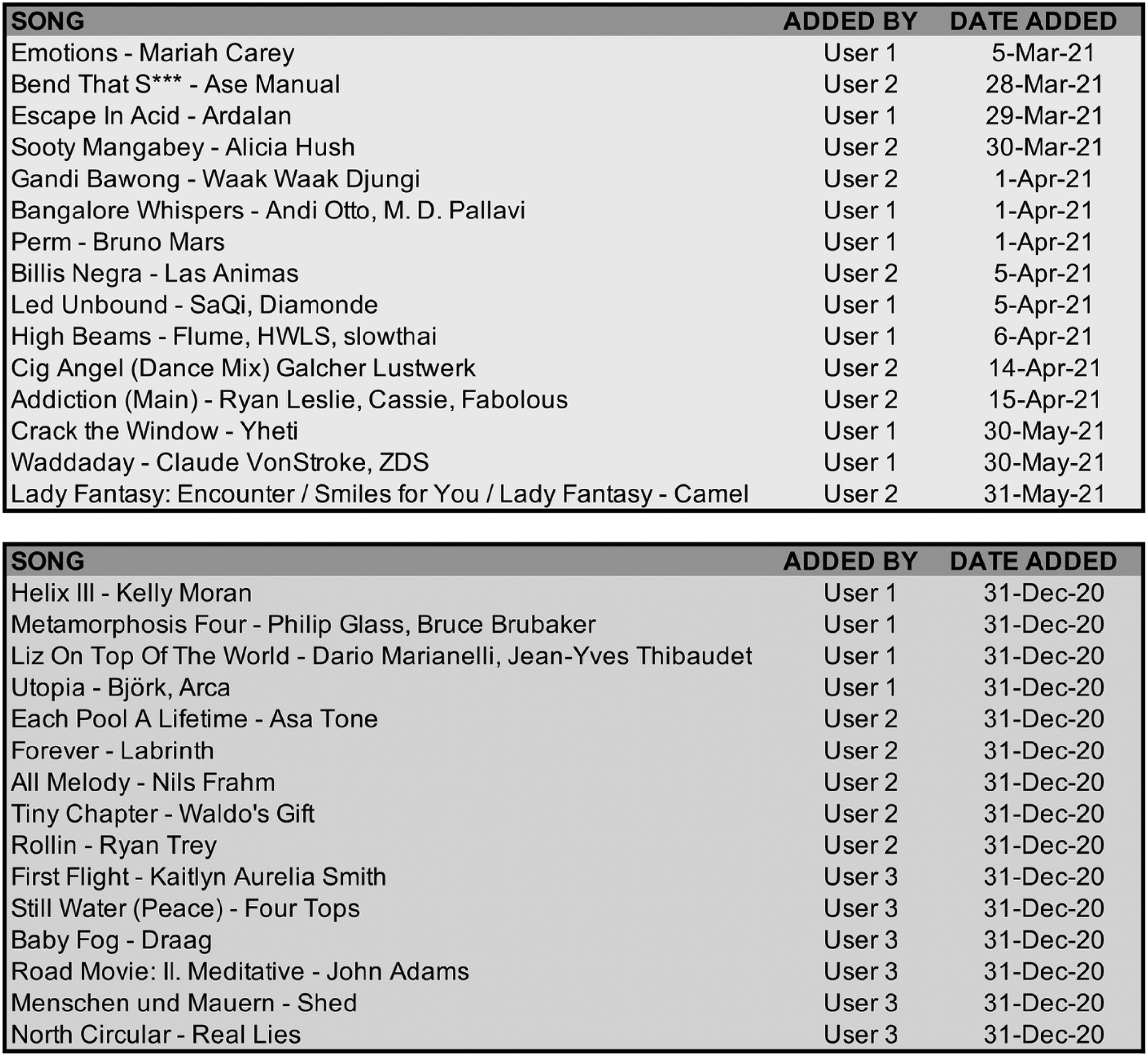
Two examples of collaborative playlists (CPs) (abridged). Top: Two friends who live thousands of miles apart created this CP to stay in touch with one another. They decided (via a phone conversation) to each take turns adding one to two songs to the CP at a time, and that each friend's song selections should be informed by the other friend's most recent song selections so as to create a conversational mood during collaborative playlist-making (CPM) as well as upon playback. The CP was not tied to an external event (as evinced by the temporal irregularity of CPM engagement). Bottom: Three friends who were spending New Year's Eve together decided to make a CP that they could listen to alongside the holiday's festivities. The three friends agreed upon a theme for the CP in advance (“Trippy New Year's Eve”) that would complement the evening's events; this served as a constraint during CPM and directed each friend's song selection. The friends also decided that the CP would be shuffled upon playback, such that song ordering was not part of CPM in this instance.
Key aspects of CPM make it a particularly well-suited choice for those wishing to study remote group musical engagement. First, CPM occurs in a digitally mediated fashion, where the “instrument” being used is a phone, tablet, or computer, and the musical actions that take place occur via these digital instruments; furthermore, interaction occurring among two or more individuals can take place entirely online. Thus, in the global pandemic, CPM is a useful process for online experimental study of musical interaction. Second, CPM is a useful “model organism” for studying psychological mechanisms that underpin group musical engagement. In ecologically valid settings, the interactive behaviors constituting CPM (i.e., selecting and ordering songs from a library within a playlist) are less physically and temporally complex than those behaviors which constitute group music-making. Thus, musical interaction occurring in CPM may be more amenable to being studied in a controlled experimental setting. Third, CPM is a form of everyday musical engagement, or in other words, a form of musical involvement that may form part of one's routine, day-to-day activities (Sloboda & O’Neill, 2001). CPM may be engaged with by anyone with a laptop or smartphone with access to the internet and the ability to play sound regardless of their musical background or physical capacities. Studying CPM, therefore, expands the scope of who is involved in and may benefit from research on musical interaction to a broader population who uses music as part of their everyday routines. Fourth, CPM includes source material and ways of interacting with music that go beyond those rooted in the Western classical tradition. CPM uses recorded music from cloud-based libraries, allowing for a vast array of musical styles that have been published and/or shared online to be represented. Furthermore, CPM allows individuals to flexibly and dynamically interact with music using behaviors that overlap more so with music-sharing traditions (e.g., hip-hop and mixtape creation in urban America) than with Western classical music-making traditions. In this way, CPM may facilitate the psychological investigation of music-making in relation to a broader array of musical traditions than those currently predominating the field.
Background: CPM as Co-Curation
CPM has its roots in music co-curation, “a long-standing social activity” (Park & Kaneshiro, 2022). I consider mixtape DJing, a form of music co-curation that rose to popularity in the 1980s, as the most recent precursor to CPM to probe how music co-curation emphasizes music's communicative potential.
The praxis of mixtape DJing involves “deciding which and in what order to play recorded music” (Greasley & Prior, 2013); a mixtape DJ's materials include recorded music that is most often created by other artists, and the end result of mixtape DJing is either a live musical performance (i.e., a DJ set) or a recording (i.e., a mixtape). Mixtape DJing requires that a DJ selects songs to include in the mixtape and orders them in such a way that the mixtape has a clear form or shape (e.g., an “up, up, and away” shape, where the tempo increases over the course of the playlist; Broughton & Brewster, 2003, p. 133). Similar to how classical performers “realize the conception” of a composer's original creation, so too do mixtape DJs take other artists’ original creations (i.e., recorded music) and transform them into a new performance (i.e., a DJ set or a mixtape; Greasley & Prior, 2013).
In the 1980s and 1990s, mixtape DJing arose as “hip-hop [music's] original mass medium” (Ball, 2011). During this time, mixtape DJs were members of musical communities in urban metropolises, and used recorded music made by community members as the primary material for their mixtapes; often, nonmusical content such as sound bites were included as well. Physical recordings of mixtapes were self-distributed by the DJs who produced them to members of their local community. This allowed direct communication to occur among community members, where mixtapes could convey information using plain language and could “include views not just of particular events but of the underlying realities that cause those events” (Ball, 2011, p. 129). In other words, mixtapes possessed “emancipatory journalistic potential,” where interweaving sound bites from news broadcasts and speeches from local activists with DJ Premier beats facilitated “get[ting] a message out” and “serve[d] developing social movements” (Ball, 2011, p. 127–128). Mixtape DJing thus allowed for multifold communal musical expression where musicians, as well as mixtape DJs, could express themselves musically on a mixtape, social connection where connecting with one's community through making and distributing a mixtape could occur, and direct communication where political information and associated affective sentiment could be relayed to one's community.
Since the dawn of mixtapes, legal constraints and technological advancements have greatly impacted music co-curation. Enforcing bodies such as the Recording Industry Association of America have shut down most channels by which physically recorded mixtapes could be distributed, and most recorded music is stored and distributed digitally (Ball, 2011; Simon, 2019). Today, digital streaming platforms such as SoundCloud, Apple Music, Tidal, and Spotify are the primary vehicle by which music is distributed to listeners, where recorded music is stored in cloud-based libraries, and internet users may engage with, but not own, vast amounts of digital recordings (Richardson, 2014). In the past decade, digital streaming platforms have included CPM, a basic form of music co-creation, as a way for users to engage with digital recordings (Park & Kaneshiro, 2022). Similar to mixtape DJing, the material for CPM includes recorded music made by other artists, and CPM requires that individuals select songs and order them to create a coherent overall form. Notable differences between the two praxes are that the eventual playlist, when compared to a mixtape, has less room to deviate from the recorded material that is used (e.g., songs must be included in their full duration), and that usable material is constrained to that which is hosted on the streaming platform (e.g., externally hosted sound bites cannot be included). Moreover, CPs may only be created by and distributed to users of a certain digital streaming platform. While the digital environment housing CPM does not lend itself to democratizing mass media or nurturing local communities to the same degree that mixtape DJing does, it does allow for interaction through music to take place among individuals that are geographically dispersed, and for individuals to interact with musical traditions and communities to which they would not otherwise be exposed. In these ways, CPM seems to harness the communicative possibilities afforded by mixtape DJing with a new kind of musical community (i.e., a globalized one).
Particularities of CPM: Motives and Constituent Behaviors
Oftentimes, the primary motives for CPM are driven by musical considerations, for instance: amassing music pertaining to a particular genre, artist, or other music classification; or curating the order in which particular songs are played back to achieve a long-range musical narrative (Park & Kaneshiro, 2022). Alternatively, primary motives for CPM may be social, including creating a CP for later use at a specific event (e.g., a birthday party); or creating a CP to bolster an existing relationship (e.g., sharing music with a long-distance friend; Bauer et al., 2018). Lastly, the primary motives for CPM may be personal, including expressing one's knowledge of recorded music within a particular musical genre; and finding new music relating to a particular artist or genre via others’ song additions to a CP (Park & Kaneshiro, 2022). Importantly, in an instance where personal goals are the primary motives for CPM, it is expected that engagement in CPM will be more similar to private music listening or social media engagement than it will be to group music-making.
The main constituent behaviors of CPM involve song selection, song ordering, and discussion. Song selection refers to the process by which a song is retrieved from a cloud-based library and added to a CP. Song ordering refers to the subsequent process in which several songs that have already been added to the playlist are ordinally arranged within the playlist structure; this process linearly dictates when each song will be played back in the eventual listening situation (assuming shuffled playback is not intended). Discussion takes place prior to CPM and intermittently during CPM to align interlocutors’ motives for CPM engagement with one another (Bauer et al., 2018; Park & Lee, 2021); in this way, discussion ensures that group members share common motives for creating their CP.
The shared motives for CPM engagement tend to determine whether and when CPM will stop. For example, CPM that is fueled by a shared social motive will generally have a set “due date” at which it will be terminated (e.g., if a CP is being created for a party, CPM will end when the party occurs), whereas CPM engagement that is fueled by a shared musical motive may go on indefinitely (e.g., a CP of queer punk music may be continually added to as new songs are released).
Though collaborative playlist-listening (CPL) is not the focus of this article, it is important to note that CPs may be used for private or group music listening. CPs driven primarily by social motives will tend to be played in group listening contexts, whereas CPs driven primarily by personal motives will generally be played in private listening contexts. Importantly, the psychological functions of and needs fulfilled by CPM and CP listening are likely to differ, with those related to CPM generally overlapping with those of Musical Group Interaction (MGI; Rabinowitch et al., 2012), and those related to CPL generally overlapping with those of joint music listening and concert attendance.
CPM as Musical Engagement: A Comparative Analysis
How do the constituent behaviors of CPM relate to behaviors occurring in well-studied forms of group musical engagement? In this section, I draw upon existing theoretical models of music-making that have been proposed by ethnomusicological and psychological researchers to evince behavioral similarities between CPM and other forms of musical engagement.
In his essay “Four Fields of Music Making and Sustainable Living,” Turino denotates the “concept of music” as being “four fields of social practice—participatory performance, presentational performance, high-fidelity recording and studio audio art recording” (Turino, 2009). CPM contains elements of participatory performance and high-fidelity recording, as well as new elements resulting from recent technological advancements. First, participatory performance involves a musical performance with “no formal artist-audience distinctions” where “actively contributing to the sound and motion of the musical event” (e.g., through dancing, singing, clapping, playing musical instruments) is considered integral to the performance, and participation does not require musical expertise but rather facilitates interaction among amateur and expert members by allowing for different motives for engagement to co-exist harmoniously (Cross, 2005; Turino, 2009). In CPM, musical contributions occur sequentially and asynchronously: individuals within a CPM group are required to periodically, but not continuously, contribute to the musical event. This distinction sets CPM apart from MGI, where individuals simultaneously contribute to an ongoing musical event (Rabinowitch et al., 2012). The inclusion of individuals with differing skill sets and the necessity that each individual actively contributes to the CP evinces CPM's similarity to participatory performance. Second, high-fidelity recording refers to “the making of recordings that are intended to index or represent live performance” and “involve genre-specific discourses of authenticity” (Turino, 2009). CPM uses high-fidelity recording as the musical material for its interactions; likewise, the quality of a CP hinges on metrics of authenticity that stem from the high-fidelity recordings used to create it. Third, CPM's reliance on digital streaming platforms results in it including constituent behaviors similar to social media engagement; indeed, Turino suggested that new fields of music would need to be created if technological advancement spurred new avenues for music-making (Turino, 2009). Specifically, CPM includes behaviors related to self-presentation on social media (Nadkarni & Hofmann, 2012) and reminders of others via social surrogacy (Gabriel et al., 2016). Moreover, CPM's discursive element suggests that behaviors included in CPM may be similar to those occurring in nonmusical forms of digital collaboration, such as that which would occur when working on an oral presentation together using a cloud-based document. In this case, asynchronous explicit communication allows individuals to more comprehensively interface with each other and the collaborative content than that which would occur synchronously in a digitally mediated context, thereby motivating engagement and facilitating cooperation (Ishtaiwa & Aburezeq, 2015). In sum, by combining components of participatory performance, high-fidelity recording, social media, and digital collaboration, CPM exemplifies a unique avenue by which social behaviors included in face-to-face music-making and online nonmusical interaction can take place via digitally mediated music co-curation.
In determining what musically and socially rooted constraints on behavior are shared among CPM and ensemble-based music-making, it is helpful to consider Keller's account of interpersonal coordination in musical ensemble performance (Keller, 2014). Keller denotes offline preparation (i.e., rehearsal) as serving to coordinate ensemble members’ musical actions in preparation for a future performance via familiarization with idiosyncratic “structural” and “personal” elements related to the music and ensemble members, respectively (2014). CPM may be viewed as a form of musical interpersonal coordination that exclusively contains offline preparation (i.e., an extended rehearsal), where interlocutors familiarize themselves with structural and personal elements over the course of CPM engagement. Structurally speaking, interlocuters must familiarize themselves with the artist or genre-specific constraints of the CP (e.g., individuals making a Russian techno CP should become aware of the beats-per-minute and rhythmic patterns generally used in this genre, and add songs that comply with this genre's constraints); personally speaking, interlocutors must familiarize themselves with each other's “expressive intentions and stylistic tendencies” (e.g., an individual adding to the Russian techno CP may preferentially include songs with female vocals, and other interlocutors will become accustomed to this individual's tendency over the course of CPM; Keller, 2014). Over time, interlocutors’ song selecting and ordering behaviors tend to align with these structural and personal familiarities, ultimately resulting in the creation of a musically coherent CP.
It is worth briefly noting that Keller's model of ensemble performance also incorporates online interpersonal interaction, which refers to those cognitive-motor ensemble skills exhibited during the performance that allow ensemble members to coordinate behavior in real time to clearly “communicate information about musical structure and expressive intentions” (2014); however, owing to its asynchronous and digitally mediated nature, CPM may not be analyzed using the online counterpart of Keller's model.
Interactive Properties and Socio-Cognitive Processes
When people engage in CPM together, several interactive properties and socio-cognitive processes help to bring about and support its constituent interactive behaviors. Specifically, the interactive properties of floating intentionality and disinterested pleasure and the socio-cognitive processes of self-other merging, cognitive perspective-taking, and shared intentionality are implicated in other forms of musical and nonmusical interaction (e.g., completing a puzzle together in Fishburn et al., 2018; MGI in Rabinowitch et al., 2013), and are likely to bring about benefits to social cognition that extend beyond the domain of the interaction, enhancing social cohesion and coordination among CPM interlocutors in nonmusical contexts.
First, floating intentionality refers to music's capacity to permit “specific, but not necessarily uniformly articulated or identical, emotional experiences to coexist” (Cross, 2009; Cross et al., 2012). In other words, music's floating intentionality allows for variation among different individuals’ musical expressions to exist harmoniously within a musical interaction. In the context of CPM, interindividual differences may drive interlocutors to have slightly different internal representations of a shared goal (i.e., shared motives for CPM engagement) and ways by which it may be achieved; this results in each interlocutor's song selection and ordering behaviors ultimately being unique to themselves. Nonetheless, music's floating intentionality allows the perception of another's actions to be somewhat ambiguous, so that one interlocutor can perceive another interlocutor's song selection to be harmonious with their own interpretation of the shared goal, even if the two interlocutors’ interpretations do not exactly overlap. Floating intentionality in CPM may therefore facilitate greater cooperation among different individuals than would be possible during an online interaction taking place via explicit communication (e.g., written text).
Second, disinterested pleasure refers to “the experience of pleasure without presupposing the existence of a pleasurable object” (Kant, 1951). Often, individuals’ motivations to engage in interactive musical behaviors are rooted in their non-teleological experience of pleasure (e.g., deriving pleasure due to the “purely aesthetic” component of music-making; Cross et al., 2012). In CPM, disinterested pleasure motivates interlocutors to engage in song selection and ordering behaviors, whereby interlocutors derive enjoyment from listening to and adding songs to the CP and configuring the CP's order to bring about an overarching shape. In turn, multiple interlocutors’ experience of disinterested pleasure implicitly aligns the bases of their song selecting and ordering behaviors, ultimately resulting in a set of group behaviors that are more coherent with one another. Notably, socially and musically skewed variants of disinterested pleasure may exist in CPM, where CPM driven by shared musical versus social motives prioritizes immersing oneself in music co-curation or immersing oneself in mediated interaction with others, respectively.
Third, self-other merging, the “application of the self to the other and [the] inclusion of the other in the self” (Galinsky et al., 2005), reinforces interlocutors’ understanding of what the shared motives of CPM are, and helps individuals to engage in song selection and ordering behaviors that actively contribute to it. Self-other merging is composed of the inclusion of other in oneself, where mental representations of another are included in one's self-representation, and the inclusion of the self in the other, where mental representations of one's self are included in the representation of another (Batson, 2018). These two processes increase social bonding and social coordination, respectively, and facilitate the covert imitation of interlocutors’ communicative behavior (i.e., predictive emulation; Garrod & Pickering, 2009). In short, self-other merging promotes interlocutors’ song selection and ordering behaviors becoming more coherent with one another's over time (i.e., supports attuning; McCaleb, 2014) and, additionally, facilitates activation of higher-order socio-cognitive processes (Galinsky et al., 2005). Importantly, self-other merging may also be affected by relationship closeness and in-group affiliation (Aron & Fraley, 1999; Branand et al., 2019); studies of CPM should therefore consider whether changes in self-other merging occurring consequent to CPM are modulated by preexisting group affiliation or close relationships.
Fourth, cognitive perspective-taking, the ability to imagine the world from another's vantage point and make inferences about others’ thoughts and beliefs (Healey & Grossman, 2018), allows interlocutors to understand one another's intentions behind their actions during CPM. During CPM, cognitive perspective-taking is facilitated by explicit discussion (e.g., gaining insight into how an interlocutor has interpreted the shared goal for a CP via hearing their reasons for selecting a particular song) as well as by inferring (e.g., attempting to understand an interlocutor's personal preferences within the genre of choice, and taking this into account when considering their reasons for previous song selections). Furthermore, cognitive perspective-taking is thought to encompass self-other merging as a constituent process and to underscore the construction, maintenance, and preservation of social bonds (Davis et al., 1996; Galinsky & Moskowitz, 2000). Thus, it is expected that cognitive perspective-taking will help to bolster social bonds among interlocutors with preexisting close relationships, and to facilitate bond formation among interlocutors with weak preexisting relationships.
Fifth, shared intentionality, or collaborative interactions where participants have a shared commitment and coordinated action roles for pursuing that shared commitment (Tomasello et al., 2005; Tomasello & Carpenter, 2007), is a key component of CPM that supports its being categorized as an interactive process. As previously stated, the shared motives (i.e., shared goals) for CPM are determined conjointly among interlocutors; it is necessary that shared motives are established among all interlocutors at the outset of CPM and adhered to by all interlocutors throughout ongoing CPM. The “joint intentions”—the cognitive representation of the intention which comprises both “self” and “other” intentions—require that interlocutors “choose their own action plan in the activity in light of (and coordinated with) the other's action plan” (Tomasello et al., 2005, p. 681), facilitate cooperation during ongoing CPM and, ultimately, allow the CP to achieve the shared motives. In turn, the “coordinated action roles” of interlocutors pertain to each individual carrying out song selecting and ordering behaviors in alignment with their own cognitive representation of the joint intention. Importantly, shared intentionality has been identified as a key component of MGI that has allowed for it to be studied in comparison to nonmusical forms of collaboration (Cross et al., 2012; Rabinowitch et al., 2012, 2013). By identifying that the requisite components of shared intentionality are also present in CPM, I suggest that some of these psychological processes and resultant benefits attributable to collaboration should also be evident in CPM.
It is worth noting that several socio-affective mechanisms (e.g., affective alignment, emotional contagion) have also been theorized to lie at the mechanistic overlap between face-to-face musical interaction and prosocial behaviors (see Miu & Vuoskoski, 2017; Rabinowitch et al., 2013). However, it is unlikely that processes that rely on socio-affective mechanisms will be elicited during CPM to a high enough degree that it may be comparable to that elicited during face-to-face MGI. This is due to the activation of higher-order socio-affective processes (e.g., intersubjectivity) relying on low-level processes (e.g., entrainment) that necessitate that the interaction should occur face to face, and that interlocutors’ visual, auditory, and perhaps even hormonal cues be transmitted at the time scale of milliseconds (Keller, 2014).
By contrast, the framework that I have presented to describe those socio-cognitive processes likely to be activated during CPM arises from Goldman's denotation of reconstructive empathy, an “effortful” and “constructive process” for empathy generation that contrasts with mirroring routes to empathy that rely on “automatic” socio-affective processes (2011, p. 36). As Goldman discusses, the reconstructive route to empathy requires that interlocutors have “accurate and relevantly complete information about the prior mental states” of other interlocutors for constituent processes such as cognitive perspective-taking to occur (2011, p. 41). Although the reconstructive route to empathy is likely to allow for perspective-taking to occur among interlocutors even outside of familiar contexts, it is unlikely to allow for perspective-taking to occur among novel interlocutors due to the lack of accurate information about these new interlocutors’ mental states (see Goldman's discussion of “enactment imagination” versus “mirroring”). It is therefore expected that cognitive perspective-taking and self-other merging occurring during CPM will result in social transfer effects that are target-specific, where forming and supporting social bonds among interlocutors will be facilitated (Galinsky et al., 2005; Goldman, 2011), but that these transfer effects are unlikely to “activate a general helping mind-set” such as that which is afforded by face-to-face MGI (Cross et al., 2012; Rabinowitch et al., 2013). Looking forward, as technology allowing us to socialize through technologically mediated means develops further, there may be a time where key visual, auditory, and even physiological information may be able to be transmitted among interlocutors who are situated remotely and, thus, that low-level socio-affective mechanisms necessary for activation of empathy via the mirroring route may eventually be able to be elicited during future forms of CPM and promote domain-general empathic behaviors.
Conclusion, Implications, and Further Research
In this paper, I have provided structural, behavioral, and psychological frameworks for considering CPM. This work gives a theoretical basis to future experimental inquiries (such as that done by Harris & Cross, 2021) that empirically investigate whether socio-cognitive components during and group benefits consequent to other forms of interaction may appear in CPM.
When individuals make music together, they each have a stronger tendency to engage in prosocial behaviors—not just among themselves, but generally. This effect has been shown using both self-report and behavioral measures in controlled experimental settings (Beck, 2018; Buren et al., 2019; Kirschner & Tomasello, 2009, 2010; Rabinowitch et al., 2013). Nevertheless, it is unclear how making music together brings about such effects, especially those that transfer to nonmusical settings. Several theoretical models have purported that the prosocial effects of music-making are likely to hinge on key aspects of music as a communicative medium, as well as interactive behaviors that implicate the activation of cognitive processes shared with nonmusical social behaviors (Clark & Giacomantonio, 2013; Cross et al., 2012; Saarikallio, 2019). Insight into the potential roles of each of these aspects in bringing about prosocial tendencies is necessary for the positive social effects of music-making to be meaningfully utilized (e.g., in a clinical setting); experimental research in music cognition can help to clarify the mechanisms by which prosocial tendencies are brought about by music-making.
In this paper, I have argued that CPM is a useful behavior to study in experimental music psychology to elucidate key aspects of music as a medium of collaboration. On one hand, studying CPM allows us to clarify how overarching aspects of music as a medium of communication are related to prosocial tendencies consequent to musical interaction. For instance, is floating intentionality, or the ability of communicated musical content to be ambiguous in its interpretation, sufficient to bring about some of the positive effects on prosocial behaviors? Alternatively, studying CPM allows us to better identify how different interactive behaviors during music-making differentially bring about social transfer effects. For instance, does the cognitive perspective-taking that occurs during musical interactions with others impact the degree to which prosocial behaviors will consequently occur?
Importantly, CPM will not allow us to study how fine-grained properties of music perception (e.g., temporally contingent integration of visual and auditory cues from other performers) may impact consequent prosocial tendencies. Moreover, CPM will not allow us to study how specific actions occurring during group musical performance (e.g., precise fine-tuning of motor programs among ensemble members) may contribute to consequent prosocial tendencies. Instead, lab-based experiments, particularly those allowing for the study of real-time face-to-face group music-making, will be critical for tackling questions relevant to how sensory processing and motor coordination contribute to the social impact of musical interaction.
At the present time, CPM is a useful tool for forming and maintaining social bonds among specific groups of interlocutors who do not have the opportunity to meet face-to-face and may allow for much-needed transfer effects to be imparted on these relationships (e.g., reduction of interpersonal conflict among remotely situated colleagues). Previous experimental research has found that individuals who listened to the music of a specific group had decreased implicit biases toward that specific group following music listening (Vuoskoski et al., 2017). However, this effect was shown to be mediated by individuals’ baseline trait empathy, suggesting that passive music listening may only be an effective means to achieve implicit affiliation for those persons who are already empathically predisposed. Conversely, self-other merging that occurs during cognitive perspective-taking has been found to decrease prejudice and stereotyping of other interlocutors, but also to increase behavioral mimicry and coordinate social behavior among interlocutors (Galinsky et al., 2005). Instrumentalization of cognitive perspective-taking during CPM should effectively facilitate the formation of affiliative bonds among interlocutors that are otherwise thwarted by stereotypes, and the reliance of its interactive behaviors on self-other merging should allow resultant affiliation to occur more independently of individual differences (e.g., in trait empathy) than afforded by engagement in passive music listening. Though this notion is supported by previous experimental research from social psychology (Batson et al., 1997; Galinsky & Moskowitz, 2000; Todd et al., 2011; Vescio et al., 2003), it should be further verified by music psychologists using paradigms that specifically investigate perspective-taking in interactive musical contexts. Experimental study of CPM may shed light on how interactive forms of online musical engagement may have the capacity to target group-specific social benefits, even during times where remote interaction is most prevalent.
Further, engagement with CPs—both CPM and CPL—should be comprehensively investigated in terms of the psychological benefits it may afford. Recent research applying the social surrogacy hypothesis to private music listening on digital streaming platforms has found that it may reap individual benefits including reduced loneliness and improved mood (Schäfer et al., 2020). Investigation of such outcomes consequent to CPM/CPL, and comprehensive application of relevant models from social psychology (e.g., the reminders of others model; Gabriel et al., 2016) should be carried out to determine whether CPM and CPL could fulfill social needs unique to those fulfilled by private music listening in the absence of real-life social interactions.
Of prime importance is that future work addressing such questions emphasizes the following: (a) testable models that draw from and have the capacity to build on mechanistic frameworks for social cognition from the fields of social psychology and social neuroscience; (b) experimental study of populations with varied socioeconomic, demographic, and cultural backgrounds, with particular emphasis on longitudinal studies incorporating interventions; and (c) development and validation of quantitative self-report items and behavioral tasks as well as the inclusion of physiological and neurological assessment of mechanisms underpinning socio-cognitive and socio-affective components of musical interaction. The above are critical for such work to incrementally contribute to the scientific understanding of how musical interaction impacts social cognition, and eventually, how such understanding may result in effective applications.
Footnotes
Action Editor
Emily Payne and Karen Burland, University of Leeds, School of Music.
Peer Review
One anonymous reviewer.
Kevin Ryan, The University of Tennessee Knoxville College of Arts and Sciences, Department of Philosophy.
Declaration of Conflicting Interests
The author(s) declared no potential conflicts of interest with respect to the research, authorship, and/or publication of this article.
Funding
The author disclosed receipt of the following financial support for the research, authorship, and/or publication of this article: This article was supported by the Konrad Adenauer Foundation.
