



Abstract
Objectives:
Mindfulness has been explored in the clinical and educational fields but has rarely been studied in the music domain. This study investigated the effects of teaching eight-week Mindfulness for Singers courses on vocalists’ music education and performance.
Methods:
A mixed methods approach was utilized, which included controlled and randomized controlled trials using standardized and novel mindfulness measures pre- and post-intervention, interviews post-intervention and three months later, concurrent diaries, and a blinded teacher study. Participants included singing students (total n=52) and their teachers (n=11) from a university and a music college over a period of two years.
Results:
Levels of mindfulness increased over the intervention for experimental participants in comparison to controls. Considering their total student cohort, teachers identified 61% of eligible mindfulness singing participants as having completed the mindfulness intervention. Experimental participants reported that learning mindfulness had positive effects in lessons, solo and group instrumental practices, and when performing on stage. They described more focus and attention, positive effects of increased body awareness on singing technique, enhanced socio-collaborative relationships, reductions in performance anxiety, and beneficial effects whilst performing, such as more expressivity and enjoyment.
Conclusions:
Learning mindfulness had positive holistic effects on vocal students and was well received by their mindfulness-naïve singing teachers. Findings suggest that it would be highly beneficial for mindfulness to be made available in music conservatoires and university music departments alongside singing lessons for singers to enhance their present experience as vocal students and their futures as performers and teachers.
Literature
Over the last 40 years there has been a rapidly growing body of evidence studying the effects of learning mindfulness (Black, 2014), predominantly in the scientific and clinical domain (Kabat-Zinn, 2017). Much of it has been positive; for example, there is substantial evidence of benefits for those with psychiatric disorders (for a review, see Goldberg et al., 2018) and, in the UK, mindfulness is now a National Health Service (NHS) recommended treatment for chronic depression (National Institute for Health and Care Excellence (NICE, 2009)).
More recently, mindfulness has been employed in educational contexts to enhance mental and physical health, cognitive functioning, and social and emotional learning (for a review, see Ergas & Hadar, 2019). However, little research has explored mindfulness in the field of music (Lecuona & Rodríguez-Carvajal, 2014), and existing studies tend to be a mixture of theoretical discussions and experimental projects, with varying methods of mindfulness measurement, and different foci, making it difficult to draw firm conclusions about the effects on various aspects of musicians’ practice. This article offers a critical examination of this prior literature and reports the findings of a study investigating the effects of an eight-week mindfulness intervention on vocal students and their teachers in the areas of musical learning, rehearsing, and performing.
Mindfulness and music
The majority of the literature exploring the effects of mindfulness on musical behavior focuses on the effects of mindfulness on music performance anxiety (MPA). Music students may be more anxious and stressed than students in other disciplines (Sternbach, 2008) and, like professional musicians, they often experience MPA (Kenny, 2011). In the DSM-5 (American Psychological Association, 2013), MPA is currently most closely associated with social anxiety disorder, and mindfulness has shown benefits for patients with clinically diagnosed anxiety disorders (Goldin et al., 2017). A randomized and controlled neuroscientific mindfulness study with non-clinical participants (Davidson et al., 2003) demonstrated that learning mindfulness may have the ability to increase positive affect, which led to theorizing as early as 2004 that mindfulness might help musicians with abnormal levels of music performance anxiety (De Felice, 2004).
Studies have explored levels of mindfulness with levels of MPA in samples of musicians (Diaz, 2018; Farnsworth-Grodd & Cameron, 2013). Farnsworth-Grodd and Cameron (2013) measured levels of mindfulness and MPA severity among 159 music students at three time points: at the beginning of term, before examinations, and after examinations. In the performance week, students with greater dispositional mindfulness engaged in more mindful mental approaches, and during performance, those with higher levels of situational mindfulness predicted lower levels of MPA. Intervention studies have measured the effects of learning mindfulness on MPA and psychological wellbeing of music students (Hribar, 2012; Juncos et al., 2017; Steyn et al., 2016). For instance, Hribar (2012) explored the effects of an eight-week MBSR-based mindfulness course on 36 music students using measures of wellbeing, psychological distress, and mindfulness, and post-study interviews with eight participants. Quantitative pre- and post-intervention results based on 25 completed questionnaires demonstrated significant increases in wellbeing and significant decreases in stress and depression, but no changes for anxiety. However, qualitative data suggested benefits of mindfulness for music performance anxiety. Steyn et al. (2016) tested a seven-week mindfulness and psychological skills training course with 21 experimental music student participants and 15 controls who self-reported using pre- and post-questionnaires measuring wellbeing, performance anxiety, and mindfulness levels. Findings suggested improvements for MPA, wellbeing, and mindfulness after training. Despite the positive findings from these studies, it remains unclear whether benefits continued long term or whether being more mindful made any objectively observable improvement in performance quality. Juncos et al. (2017) addressed these issues utilizing the Acceptance Commitment Therapy course (ACT), a mindfulness-based form of psychotherapy, with seven vocalists with MPA, who completed self-report measures, interviews, and video performances at several timescales. Results demonstrated increased acceptance of MPA symptoms and enhanced psychological flexibility, and improved performance quality was noted by two of three performance judges. This pilot study was exploratory with a small sample and no controls; however. when taken in tandem with Hribar (2012) and Steyn et al. (2016), this builds evidence in support of the benefits of using mindfulness for MPA.
The non-MPA mindfulness and musicians literature contains empirical studies which have explored diverse applications using a variety of methodologies and interventions. Studies have investigated the effects of mindful instruction on creativity (Langer et al., 2009; Newton, 2015), music listening (Diaz, 2011), string players’ sound (Dora et al., 2019) and on educational and performance aspects in conservatoire music education (Czajkowski et al., 2020). For example, Newton (2015) ran a twice-weekly mindfulness-based intervention (MBI) over four weeks with three songwriters of whom two were also singers. Participants, interviewed pre- and post-intervention, reported that they had developed enhanced awareness and focus and had cultivated a non-striving attitude which helped them in their creative endeavors. However, with only three participants in this study, any generalization to a broader demographic is difficult. Diaz (2011) employed the Continuous Response Digital Interface (CRDI) method combined with verbal and written responses in a randomized study with groups of music students to investigate the effect of a 15-minute mindfulness meditation guided task on attention and “flow” whilst listening to music. The participants were randomly assigned to different treatment groups and the majority of the mindfulness group participants reported increased attention to the music and decreases in distraction in comparison with controls. Most data gathering was done via self-report methods, but the CRDI provided a unique non-verbal, immediate, and continuous response which strengthens the findings of this study. Czajkowski et al. (2020) employed a mixed methods study to discover the effects of teaching a Mindfulness-Based Stress Reduction (MBSR)-based course for conservatoire music students. Participants reported improvements in levels of mindfulness and beneficial effects on all their music activities including improved focus and enhanced teacher/pupil relations in lessons, more efficient and effective practice, improvements in MPA symptoms, and improved expressivity and enjoyment in performance. However, there were no controls for comparison with treatment or a comparable intervention.
There is a prevalence in mindfulness and musicians literature of theoretical and non-empirical discussion (De Felice, 2004; Elliott, 2010; Patston, 2016; Oyan, 2006; Sandage, 2011; Steinfeld & Brewer, 2015). In his critical examination, for example, of the current state of music education, Patston (2016) outlined a practical suggestion of how instrumental and vocal teachers could motivate students by incorporating mindfulness and positive psychology strategies within the music studio to enhance student engagement and enjoyment. Steinfeld and Brewer (2015) discussed the possible benefits of conceptualizing music-making as mindfulness practice. They suggest that it is the way in which the musician comes back to the object in their practice sessions that is the connecting factor which might, for example, encourage “flow” states, and address practice avoidance. However, there is little empirical evidence to back up these theories.
Elliott (2010) links mindfulness practices directly with possible benefits for singers. For example, mindfulness training starts with learning to be aware of the breath and this is also a key area of importance for singers: being more aware of breathing sensations can bring singers to a more nuanced awareness of breath technique to improve singing. Tan et al. (2020) studied the effect of mindfulness on singers’ use of expression. In a comparative-intervention controlled study, mindfulness participants completed a 20-minute Body Scan and all participants recorded a melody using four different emotions: happy, sad, tender, and angry. Recordings were analyzed for expressive qualities such as tempo, pitch, vibrato, and intensity. The mindfulness group demonstrated higher mindfulness scores and reported feeling more focused and aware; however, the intervention did not seem to affect emotional cue usage in comparison to controls.
Czajkowski & Greasley (2015) utilized an eight-week targeted Mindfulness for Singers course, adapted from the MBSR/MBCT (Mindfulness-Based Cognitive Therapy) courses, with eight university vocal student participants and their four voice teachers. Mindfulness levels were measured using the Five Facet Mindfulness Questionnaire (FFMQ; Baer et al., 2006) and participants took part in post-intervention interviews. Results demonstrated improvements in all mindfulness facets. In post-study interviews, participants described enhanced aural and physical awareness which had a beneficial effect on learning singing technique, helping breathing and sound production, reducing extraneous tension, and improving teacher/pupil relations. In a blinded study, teachers were asked whether they could identify which of their voice students had taken the mindfulness course, based on a description of mindfulness facets, definitions, and expected outcomes (Baer et al., 2006). Teachers were able to identify objectively six of the eight participants as having taken a mindfulness course out of their combined student total of 32. This novel design element highlights that not only were the positive effects felt by the students, but they were also seen by the teachers. However, the study was limited by having a small demographic and no control group for comparison; like other studies in the field, there was no indication as to whether any long-term benefits were experienced.
In summary, there is an increased number of mindfulness for musician studies, but there is potential in many areas for further exploration. Most studies are highly specific in nature, such as concentrating on music listening or MPA, but few are holistic in approach and are often weak in design and scattered in terms of methods and approaches. There is a need for further work which examines the effects of mindfulness intervention on all aspects of a musician’s education and performance. Several studies (Czajkowski & Greasley, 2015; Diaz, 2011; Hribar, 2012) highlight the benefits of using mixed methods approaches to develop robust, multi-faceted findings and the research outlined in this article adopts this approach for this reason. Specifically, this research builds on the previous work by Czajkowski & Greasley (2015) to investigate the effects of mindfulness on singers. Like the previous study, an 8-week mindfulness intervention is implemented, and there is a blind control study with the student participants’ teachers. However, the current study goes beyond this previous small-scale project by utilizing a large demographic across two institutions with students proficient in a range of genres, and with different expectations and performance foci to capture a wider range of perspectives. It employed a controlled and randomized controlled methodology to strengthen quantitative results, with post-study interviews. An anonymous intervention-concurrent diary was included to record immediate effects followed by an interview three months later to investigate longer term effects.
Method
Participants
Participants were singing students and their voice teachers at two institutions. At the University of Leeds (U) student experimental participants (16 females (F), 1 male (M), mean age 21.88, SD=6.85) took the intervention and controls (7F, 4 M, mean age 19.81, SD=1.47) did not.
Due to small numbers of university participants registering for the second year of the study, the study was extended to Leeds College of Music (C). The college agreed that students could be invited to take part but only under the condition that all students who signed up could take the course which is why a different protocol was undertaken. At the college, student participants were randomly divided into experimental (10F, 2M, mean age 20.41, SD =1.50) and wait-list control participants (10F, 2M, mean age 20.16, SD=1.46). Wait-list participants completed research elements at different times to experimental participants and 10 of 12 subsequently became experimental participants and took the intervention (see Procedure). Teacher participants were identified by student participants and those employed at either institution U or C were invited to take part (N=12). Eleven chose to take part (9F, 2M). All participants were anonymized. U experimental student participants were numbered from U1 to U17, C participants numbered C1 to C21 and teachers were given pseudonyms.
Design
This study is a mixed methods experimental design. In a controlled (institution U) and randomized controlled (institution C) design, quantitative data was collected from student participants to measure levels of mindfulness before and after the intervention. Qualitative data was collected during the intervention and afterwards (via diaries and interviews) to explore how learning mindfulness may have manifested itself in participants’ music educational and performing experiences.
Materials
Quantitative data was gathered using two questionnaires: the Five Facet Mindfulness Questionnaire (FFMQ; Baer et al., 2006) and the Mindfulness for Musicians questionnaire (MfM). The FFMQ is a well-used mindfulness questionnaire and assesses levels of mindfulness through the facets of Observe, Describe, Act with Awareness, Non-Judge and Non-React. Observe measures awareness of internal and external stimuli. Describe measures the ability to use words to express experiences. Act with Awareness measures attention to the present moment in comparison to automatic behavior. Non-Judge measures levels of judgment applied to thoughts and emotions. Non-React measures the ability to detach from thoughts and emotions, allowing them to come and go. The questionnaire has previously shown good internal consistency: alpha coefficient values of Non-React = .75, Observe = .83, Act with Awareness = .87, Non-Judge = .87 and Describe = .91 (Baer et al., 2006). To explore construct validity, Baer et al. (2006) ran confirmatory factor analyses on FFMQ item parcels using the comparative fit index (CFI), the non-normed fit index (NNFI), the root mean square error of approximation (RMSEA), and a chi square test to measure any discrepancies between the data and the models. Results showed that the models, particularly the five facet model, fit the data well. For example, in all model tests except for the single factor model, results from the CFI and NNFI were above .90 and the RMSEA returned results of either .06 or .07. Therefore it is advised to not report results as a single factor but to report each of the five facets separately. The FFMQ has 39 positive and negatively worded statements and uses five Likert-style responses for each statement. For example, “I make judgments about whether my thoughts are good or bad,” and “I’m good at finding words to describe my feelings.”
The Mindfulness for Musicians questionnaire (MfM) was developed by the first author and is a new, unvalidated questionnaire. In the original Mindfulness for Singers pilot study (Czajkowski & Greasley, 2015), the FFMQ was used to measure levels of mindfulness. However subtle relationships between the singers’ vocal experience of mindfulness were not reflected in the more general FFMQ responses. The MfM, inspired by the FFMQ, has 15 statements covering the five facets of mindfulness, but in the MfM they are explored through situations pertinent to music student participants: lessons, instrumental practice, and performance. For example, “I suspect that I usually perform on automatic pilot” and “It is difficult to describe clearly in words how I feel before I go on stage.” Each week during the intervention, a pro-forma self-report diary was presented to experimental participants who completed it and returned it anonymously.
Procedure
Ethical approval was granted by the University of Leeds, and Leeds College of Music. All singing students were invited through institution-approved methods and potential participants took part in an initial recruitment information session. Mindfulness is not necessarily helpful for everyone so participants were asked to consult with medical professionals before choosing to take part if they suspected that they may have any mental health issues. Eligible teachers identified in this session were informed of the study and invited to be blinded participants. Pre- and post-intervention questionnaires were completed by all student participants.
Experimental participants took the Mindfulness for Singers (MfS) course as the intervention. This is a singer-targeted eight-week MBI course based on content from the Mindfulness-Based Stress Reduction (MBSR) and Mindfulness-Based Cognitive Therapy (MBCT) courses, the key difference being a mindful performance workshop in week 7. The MBSR course is an evidence-based eight-week course teaching secular mindfulness techniques to assist participants with anxiety, stress, depression, and chronic pain (Kabat-Zinn, 1990). The MBCT is a similar design but with a more cognitive behavioral approach that has been particularly efficacious for those with chronic depression (Segal et al., 2013). As definitions of mindfulness and theoretical understanding of its construct are still under investigation (Hölzel et al., 2011; Lutz et al., 2015), it is important to offer guidance as to the definition and explanation of mindfulness and mindful training used in individual research studies (Davidson & Kaszniak, 2015). The definition of mindfulness used in the current study is the same as that used for the MBSR and MBCT: “paying attention in a particular way: on purpose, in the present moment, and non-judgmentally” (Kabat-Zinn, 1994, p.4). The MfS course taught formal practices such as breath awareness, body scan, mindful movement, mindful yoga, mindful eating, and mindful walking. It taught informal practices such as identifying experiences as pleasant, unpleasant, or neutral and daily habit awareness, and mindful practices in each session concluded with group insight discussions. Each session also included psychoeducation, such as information about anxiety and suffering. Elements were tailored to the singing demographic. The first author designed the course based on 10 years as a mindfulness practitioner, attendance of mindfulness courses and events, and on 20 years’ experience as a professional singer, teacher, and student. Each session took 1 hour per week and participants were required to do at least 10 minutes mindfulness practice a day. Due to students’ timetables, a retreat day was unachievable. Participants were given weekly handouts and MP3 audio recordings of mindfulness exercises to support home practice. All materials were available on a dedicated website and more information about the course contents and procedure can be found at www.mindfulnessforsingers.co.uk.
Qualitative data was collected via anonymous intervention-concurrent diaries, and two individual semi-structured interviews of approximately 20–30 minutes’ duration, one immediately after the intervention and another 3 months later. Student participants’ interview questions asked about the effects of learning mindfulness in daily life, in lessons, practice, and performance. Teacher participants’ blind study consisted of a 15- to 30-minute interview post-intervention. They were asked if they could tell which of their students had taken the mindfulness course and to elaborate on their answers.
Figures 1a and 1b show the pathway for each participant group within the study. For example, at the college (Figure 1a), the wait-list controls (WLC) completed their first questionnaire in November, waited eight weeks, and completed the second questionnaire in January. Then, they did the eight-week intervention alongside experimental participants (EP), thus becoming wait-list experimental participants (WLE), and completed their third questionnaire in March. Like the experimental participants, they had individual one-to-one interviews in March and gave a second interview in June/July. Similarly Figure 1b shows the pathways of the participants at the university. All results were used in the analysis.

Study procedure: Participant pathways at the College.

Study procedure: Participant pathways at the University.
Analysis
Reliability analyses were run on the FFMQ and MfM. Cronbach alpha results for the FFMQ facets for experimental participants were generally good (looking across all facets alpha figures ranged from α=0.673 to 0.926 for experimental participants, controls from α=0.652 to 0.921), and broadly commensurate with other mindfulness studies (c.f. Baer et al., 2006). The MfM, an unvalidated questionnaire, demonstrated lower reliability (looking across all facets, alpha figures for experimental participants ranging from α=0.052 to 0.690, controls ranging from α=0.047 to 0.611). These figures are similar to the previous use of this questionnaire (alpha ranges from α=0.338 to α=0.788) (Czajkowski et al., 2020).
Due to study designs, data calculations investigating possible changes between different time points are presented between each institutions’ groups rather than from pooling all participants’ data. A controlled design was used at U and data was analyzed using t-tests. A randomized control design used at C collected data taken at two and three time points and were analyzed using one-way repeated measures ANOVA. Normality and homogeneity of variance tests were run on data and where data did not meet the assumptions of a parametric test, non-parametric tests were used.
Qualitative data was analyzed using Braun and Clarke’s (2006, 2013) six-step process of thematic analysis. Data was transcribed and read several times and then initially coded in NVivo software. Identified patterns became potential themes, which were then checked against the data set. Themes were revised, defined, and named, and extracts were chosen to represent themes, combined with literature, related to the research question, and written into a report. In order to mitigate against researcher bias, anonymous diaries were also used to collect qualitative data.
Results
The results are presented in three main sections: pre- and post-intervention mindfulness scores, teachers’ blind study results, and insights from the interviews.
Pre- and post-intervention mindfulness scores
There were no significant differences between institutions at baseline except in the FFMQ Describe facet suggesting that participants at institution C started at lower mindfulness levels than those in institution U. At institution U, baseline tests for the FFMQ and MfM showed no significant differences between the experimental (EP) and control (C) groups in any of the mindfulness facets. Taking pre- and post-intervention scores for the FFMQ, there was a statistically significant improvement in scores for the experimental group in the facets of Observe, Describe, and Non-React (see Table 1). For the MfM there were significant results for the experimental participants in the post-intervention facets of Describe, Non-React, and Non-Judge in comparison to their pre-intervention scores (see Table 2). There were no significant differences between the pre- and post-intervention scores for the control participants for either questionnaire.
University FFMQ pre- and post-intervention results for experimental (EP) and control groups (C) using paired t-tests and Wilcoxon test.

* = significant to p<.05
University MfM pre- and post-intervention results for experimental (EP) and control (C) groups utilizing paired t-tests.

* = significant to p<.05
For institution C, baseline tests for the FFMQ and MfM showed no significant differences between groups. One-way parametric ANOVA tests were run on the Observe, Non-Judge, and Non-React facets and non-parametric Kruskal–Wallis tests were run on the Describe and Act with Awareness facets. For the FFMQ, there were significant mean changes in scores for the facets of Observe, Describe, Act with Awareness, and Non-Judge (see Figure 2).

FFMQ post-intervention change score one-way ANOVA and Kruskal–Wallis test results for the College participants. * significant to p<.05. F ANOVA, H Kruskal–Wallis test, WLC Wait-list control group, EP Experimental participants, WLE Wait-list experimental participants (see Figure 1a).
In the MfM, assumption tests were not met for the facet Act with Awareness and so the non-parametric Kruskal–Wallis test was run on this facet. One-way parametric ANOVA tests were run on the other facets. Significant mean changes were found for the facets, Observe and Describe (see Figure 3). Post-hoc analyses were in line with what would be expected from the visualization of the data. For example, for the FFMQ Non-Judge facet, EP had significant improvements in comparison with WLC (p=0.018) and WLE in comparison with WLC (p=0.003). Another example would be the MfM Observe facet: EP had significant improvements in comparison to WLC (p=0.014). In general, the experimental and wait-list experimental groups showed improvements in comparison with the wait-list control group.

MfM post-intervention change score one-way ANOVA and Kruskal–Wallis test results for the College participants. * = significant to p<.05. F ANOVA, H Kruskal–Wallis test, WLC Wait-list control group, EP Experimental participants, WLE. Wait-list experimental participants (see Figure 1a).
Teachers’ blind study
In 2015, Czajkowski interviewed four singing teacher participants, and they identified six of eight eligible MfS students from their combined total student register of 32 (Czajkowski & Greasley, 2015). In the current study, eleven voice teacher participants taught a combined total of 136 students over a period of two years at the two institutions. This included a MfS teacher participant subset of 31 eligible students who took part across five iterations of the MfS course. Of these 31, teachers correctly identified 19 students. The reasons that teachers gave for correctly identifying students covered observed positive changes over a variety of areas such as attitude towards the teacher, to lessons, to learning technique, in their voice, to themselves, and in performance. Some teachers found the task easy and immediately gave names and examples, but some found it harder or were more hesitant. Reasons why students were not identified included voice being second study, gradual improvement over time, and always being excellent students. However, the intervention was well received by the teachers and some who observed changes in their students asked for further information about mindfulness.
Insights from the interviews
Qualitative results highlighted a number of themes. The main themes were effects of mindfulness on participants in singing lessons, practice, and performance. In what follows below we integrate insights from the qualitative diaries and interviews with student and teacher participants drawing reference to the overall scores on the mindfulness facets. Thirty-eight student participants took part in the first interview and 26 in the second interview.
Effects of mindfulness in singing lessons (see Table 3)
Around two-thirds of participants reported doing some mindfulness before most or all singing lessons but other participants did not always find it easy to find time, citing problems such as voice lessons being straight after lectures or being too early in the morning. However, in a similar way to Czajkowski & Greasley (2015), current participants reported improved mindsets in singing lessons and improved physical awareness when learning singing technique.
Thematic overview of the effects of mindfulness in singing lessons.

Twenty-eight participants described having more focus and attention in lessons. For example, C5 commented: “When I did it [mindfulness] beforehand, I was…‘Okay, this is my singing lesson,…this is what I want to work on,’ and I was really focused. It made such a difference.” This compared well with the significant findings from the FFMQ for the Act with Awareness facet for College participants, and higher levels for University experimental participants in comparison with controls. Fifteen participants reported feeling calmer or more relaxed as a result of doing mindfulness before singing lessons, which was emphasized by C11 who said, “I just feel like things come easier. Maybe perhaps because I’m relaxed, more relaxed, or just calmer in a sense and I’m not worrying.” Teachers also noted improvements in identified students describing them as more receptive, responsive, collaborative, open minded, and descriptive. Students were also described as being more hardworking, communicative, positive, reflective, open, polite, and attentive in lessons than before.
Two types of criticism were mentioned by participants: teacher criticism and self-criticism. Singing lessons are collaborations between students and teachers and relations between them are paramount to success (Gaunt, 2008). Current participants found it hard to take criticism from teachers that was abrupt or sarcastic and could be highly self-critical if things went wrong. After doing mindfulness, 15 participants described feeling less offended, less upset, and more accepting of teacher criticism. Teachers noticed changes in identified participants who were seen to take criticism better, be more open to feedback, become less afraid of failure, and demonstrate more positivity. For example, C1’s teacher said:
She’s inclined to be too open and therefore too sensitive to criticism from other people and I found her this term more grounded and happier in what she’s doing. Yes, less worried, less anxious and I’m really pleased about that.
Participants described feeling more relaxed and less anxious with teachers, which improved their relationships. C1 said:
I’ve got quite a good language with [teacher] now…I have to take something she will have said, maybe that I find a bit brash or a bit, “Ooo, okay,” and I take that now with a pinch of salt and I don’t dwell over it. I just think, “She won’t have meant it in a nasty way. She’ll have just been trying to get the best out of me.”
The Non-Judge facet measures responses to self-criticism. The results were mixed and quantitative data suggested that not all students improved in this facet or needed to improve. However, student participants who had been seen as sensitive, anxious, or overly self-critical by teachers, were described as seeming less self-critical, more self-compassionate, more accepting of themselves and their voices, being more rational, more grounded, and happier. C6, for example, was seen by her teacher to accept herself more as a person so that she could accept who she is as a performer. C6 said, “I’m not in my head as much, so it means I’m less self-conscious about making mistakes. I feel more comfortable as well.” Fifteen participants reported that doing mindfulness before lessons helped them engage with themselves kindlier and with less self-criticism if things did not go well.
On average, over 50% of teaching in singing lessons is about technique (Burwell et al., 2003). Thirty-six current participants reported increased physical awareness in lessons, which mirrored the highly significant findings for the Observe facet for experimental groups on the FFMQ. Many participants described this as helping them in learning new singing technique and relocating sensations later. C20 said, “I’ve actually improved more in the last few weeks than I have within the last semester,” which was confirmed by his teacher:
When I first met [C20]…he found the kind of, the experimental side of learning how to sing quite exposing for him…over the last short period he’s got much better dealing with that…and I’ve seen an improvement in his technical approach to the voice but also in his general willingness…I’d say his receptivity has increased…he does seem a bit more present with his body.
Participants’ relationships with their teachers, levels of communication, and learning of technique were described as being affected by improved body awareness; for example, U17 and C11 felt more willing to try out advice and U5 described taking physical technical advice more seriously. Twenty-three mentioned being more aware of specific body parts. Seven found that this helped in improving their singing posture and 14 found it helpful in being aware of abdominal musculature movement which aided learning breath support. Seventeen described having less vocal tension, and being able to be aware of tension and release it. Fourteen found improvements in sound and tone; for example, C12’s teacher described C12 as developing a freer sound over the duration of the intervention and C12 had also noticed that his voice had stopped “cracking” due to improved mindful use of breathing control musculature. In three-month follow-up interviews, participants who had continued doing mindfulness after the course reported many of the same effects: better body awareness, calmer mood, changes in teacher/pupil relationships, and increased productivity in lessons.
Mindfulness effects in vocal practice (see Table 4)
Doing mindfulness before vocal private practice was attributed by participants to have had a positive effect on general practice mindset, focus, practice structure, body awareness and technique, sound production, and creativity. The effect of mindfulness in group practices as reported by participants covered improvements in focus, calmness and present moment awareness, musicianship skills, and personal and interpersonal skills.
Thematic overview of the effects of mindfulness on solo practice.

Current student participants were encouraged to use the 10-minute exercises that they had practiced in each week’s session before singing practices and 34 reported regular compliance. One participant chose to do 30 minutes a day and reported feeling a little depressed occasionally. This effect of undertaking meditation is known in the literature (Cebolla et al., 2017) and is something to be aware of, but was not reported by any other participants in the current study. A large proportion reported feeling more focused, attentive, and aware in practice, 15 described more efficient, effective, and high-quality practice, and 10 noted being better able to deal with problems such as creative block or feeling self-judgmental where they felt it helped them to take a “step back” (U2), have “fresh eyes” (U6), or a clear head (C10). Seventeen participants reported changes in practice structure, as C16 noted:
I’m just doing the bits that I wouldn’t have done before, that before I would have left until the last minute and just done badly. Yes, just giving me more motivation to do that, understanding why I’m doing it, if that makes sense.
Twenty participants also described perceived or actual time changes (see Table 5) which mirrored the previous research of Czajkowski & Greasley (2015). The participants who practiced longer thought that it could be due to increased enjoyment (U4, U6) and better productivity (C15, C16, C19). Every participant who practiced for a shorter length thought that it could be due to improved efficiency; for example, C5 said, “I’m able to do more in a shorter space.”
Instrumental practice time perception changes reported by participants.

Participants noted developing better vocal technique as a result of being more mindful, such as a better ability to transfer learning from lessons to practices (n=7) and being able to deal more effectively with extraneous tension (n=14) specifically in the throat, jaw, neck, shoulders, and arms. C20, for example, found it easier to become aware of his jaw jutting forward, if his breathing was wrong, or if his knees were locking. This supports Elliott’s (2010) suggestion that using mindfulness in singing practice can help retrain bad vocal habits. Being better able to observe physical stimuli, which was reflected in the FFMQ significant findings for Observe for all participants, resulted in many students being able to deal more effectively with extraneous tension. For example, C10 said, “when I tense up, it [the voice] just gets squeaky and bit weird. So, when I relax all the muscles, I can actually do it and it feels easy and I know I don’t strain my voice.” Participants spoke of mindfully increased creativity in practices (n=7) and an improvement in sound (n=10) where increased awareness and application of abdominal support enhanced self-perceived sound output and sounds were described as more confident and less “wobbly” (U13). There was also a general mindset improvement reported, such as less anxiety, more patience, increased confidence and motivation, and being less self-critical.
Some participants who were interviewed three months later did not feel there were any further major changes since those reported at the first interview, but others mentioned that mindfulness had developed the following areas: body awareness and technique, and practice mindset. U3, for example, was happy to have found that mindfulness had helped her develop a less weak and airy voice during the intervention, so she tried an experiment:
So [I] was just thinking that I would try not doing the mindfulness practice and see if there is any difference. I felt there wouldn’t be any difference because I thought since I have been doing the mindfulness practice for so long and I think I get used to the way of producing the voice properly but actually it was different…my voice is very different, weak and very airy. And so it proved that doing the mindfulness practice actually helped to get my voice into shape.
Three participants also reported using mindfulness in order to cope with additional nerves before singing practice as their exams approached.
Some participants, who took part in groups and ensembles, also reported effects of mindfulness training in these areas (see Table 6).
Thematic overview of the effects of mindfulness effects in group rehearsals.
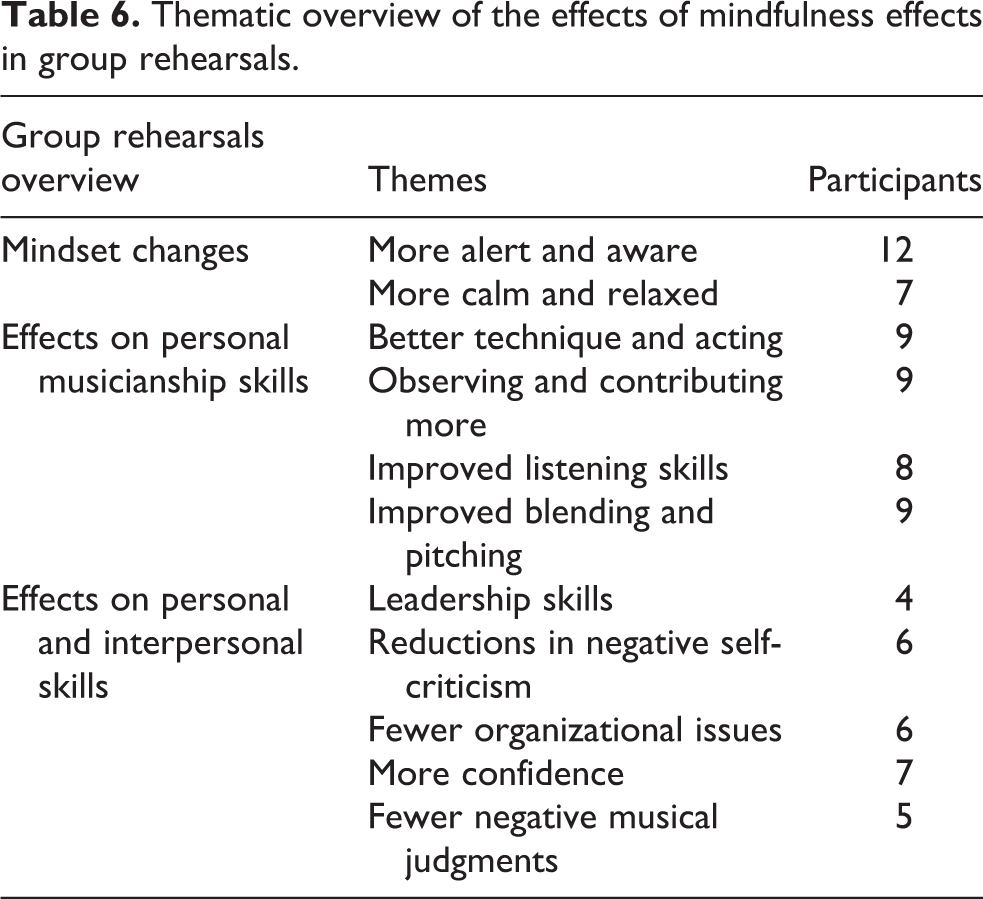
Pulman (2013) found that rehearsals could have a negative effect on attention as they can become fatiguing. A common finding in the current study was that participants found themselves more alert and aware (n=12) and more relaxed and calmer (n=7) in rehearsals after doing mindfulness. Participants reported improved personal musicianship skills such as using better technique and acting skills (n=9), observing more and contributing more (n=9), and improved listening skills (n=8). U13 remarked:
I think it helped a lot with listening skills with being able to home in with different people and to different voices and to intervals in particular and especially in opera where it’s an awful lot of “soloist sings a bit” and “chorus react and adds to it.”
They also reported improved ability to blend and pitch (n=9) and four described developing leadership skills whilst running groups; for example, U5 said:
It’s just being able to give clear instructions for warm-ups. Stretching right up on your tip toes then flopping down, feeling each vertebra, kind of like something that might not have particularly occurred to me before doing this course.
Participants reported improved personal and interpersonal skills such as being less negatively self-critical and having more confidence. Working with other students could be frustrating for participants and they described a better ability to deal with organizational issues and having fewer negative musical judgments. For example, C5 summarized, “Now I’m just like, ‘That’s fine. That happens. We’ll get it next week,’ I’m just more able to deal with it.”
Mindfulness effects in performance
Music performance anxiety (MPA) affects many musicians both physically and mentally (Kenny, 2011). MPA was not formally measured but, from interview analysis, participants in the current study fell into two main groups: those who described higher (n=30) and lower (n=8) levels of MPA. The major difference between the university and college participants was reported in the area of MPA. Fewer than 50% of the university cohort described higher severity of MPA symptoms compared to over 85% of the college contingent. From reports in previous clinical anxiety research (Singh & Gorey, 2018) and mindfulness and MPA research (Hribar, 2012; Steyn et al., 2016), it was expected that mindfulness would have a positive effect on those with high MPA in this study, which was reported to be the case (see Table 7).
Thematic overview of the effects of mindfulness on music performance anxiety and general performance.

Twenty participants reported acceptance or improvement of physical MPA symptoms. Participants reported feeling less tension, and reductions in stomach churning and body shaking. Seven participants reported that they had developed greater acceptance of their experience of MPA symptoms, accepting them in a non-judgmental way. As C12 said, “My legs shake a lot, so what stood out for me from the course was just let it happen. So, I just let it happen and it was gone in 30 seconds, a minute. I kind of enjoyed it!” Participants with higher levels of MPA reported reductions in mental anxiety to a greater or lesser extent at the first interview. Thirteen participants reported feeling more confident and in control, 18 felt more aware and focused, and 15 described feeling calmer and more comfortable on stage. Fourteen also reported changing their audience perception, as C4 said, after mindfulness “even when I’m afraid, it’s still okay.”
Interviewees at three months predominantly spoke about the effects of mindfulness on performance as they had recently completed final exams in this term and had the opportunity to experiment. Most of those with higher MPA said they had continued using mindfulness for performance anxiety with benefits such as reductions or acceptance of physical symptoms and calmer, more focused mindsets. U15, however, said she preferred to pretend the performance was not going to happen, have a glass of wine, and rely on her teacher to support her instead.
Unlike those with higher MPA, none of the participants with lower MPA mentioned any technical problems, negative thoughts, or audience perceptions in performances. However, they did report increased confidence and control, awareness and focus, feeling calmer and more ordered thoughts on stage.
Thirty-seven participants (see Table 7) reported the experience of performing in the present moment on stage after doing mindfulness exercises; as U6 said “it was remarkable, because I am aware, and I’m not usually.” The Act with Awareness facet for the MfM may need adjustment because the low results did not pick up nuances of experience change reported in the interviews. It is also possible that it was taking time for participants to develop awareness on stage. For example, some participants felt their performance went by in less of a blur and they had better memory of the experience, but as U8 said, “It’s all still a bit of a blur but definitely less so than it was before.” This was the case for some participants reporting at the three-month interview. For example, U1 noted that after doing mindfulness before her exam that she felt more prepared and in control in comparison to earlier experiences, and C17, a regular performer, had an interesting insight:
I feel like the more I do it, in a way, the less I need mindfulness with performing and then I need it for other things. For me it’s more of an appreciation, like actually appreciating that you’re doing what you love and you’re having fun and not just doing it and then it’s gone. Have the time to think about it, which is really nice.
One of the main effects noted by participants was a slowing of time perception in mindful performances. For example, C18 said, “It felt like forever, I’m not going to lie to you!” In this extra time, participants described thinking and planning ahead and engaging in more performance elements such as dynamics and characterization. All singers tell stories through song and this often involves portraying characters and emotions. Participants noted an improvement in communication and greater ability to portray their characters. They described being more physically expressive, using the body more in performance and more facial expressions. For example, U9 said, “It’s helped me convey my emotions better and my characterisation, so, so much, because that’s something that I struggled with before.” They also reported playing with musical elements more such as tempo, rubato, rhythm, phrasing, word painting, and most popular was dynamics; for example C12 said, “I was able to swell on longer sustained notes, which was enjoyable.”
Eleven participants reported that the process of training their attention with mindfulness exercises meant that they responded better to adverse unexpected events in performance by being able to refocus on the task at hand quickly, not letting irrational thoughts intrude whilst singing. This corresponded well with high levels for the Non-React facet across the questionnaires for both groups. This also seems to be something that could develop over time. For example, C20 said in his first interview about performing on stage:
I think it’s easier to make negative thoughts become bigger than they are, so when you’re being mindful you notice it and then it’s gone. It’s a lot easier. It is still quite hard to do that and I think you need to practise it for quite a long time to actually get to a stage where it’s going to be something that happens every time.
However, at the 3-month interview, he said:
I messed up one of the ornaments slightly so…it just passed me by and I didn’t really think about it…it’s normally the sort of thing that I cling on to and it would affect the rest of my performance.
This would suggest that learning mindfulness had changed the way he thought about problems on stage and helped him to cope with difficulties more effectively.
Langer et al. (2009) also discovered that the instrumentalists in their study enjoyed performing more when mindful and this was mentioned by 18 participants in the current study. For example, U4 said:
I sang the Mermaid’s Song…I was not thinking about anything about what the audience were thinking and I just really enjoyed singing that and I felt so in the moment. I think the same with my final performance actually.
Learning mindfulness has therefore had far more wide-ranging effects on singers than just the reduction or acceptance of MPA symptoms as suggested in previous literature. It can have a beneficial effect on all aspects of the performing experience.
Discussion
This paper has reported results of a two-year mixed methods project studying the effects of teaching eight-week targeted mindfulness courses to student singers, including findings from a blinded study with participants’ singing teachers. Experimental student participants at two higher education institutions took part in a Mindfulness for Singers course. The majority of these participants completed pre- and post-intervention questionnaires, two interviews (one post-intervention and a second three months later) and an intervention-concurrent anonymous diary. Controls completed intervention-length pre-and post-questionnaires, and teachers taking part in the blinded study were interviewed immediately post-intervention.
Benefits of mindfulness were reported in all main areas of vocal study: lessons, individual and group practices, and performance. In singing lessons, participants reported improvements in mental attitude after doing 10-minutes mindfulness exercises prior to lessons. They noted being more focused and aware, calmer and more relaxed, and less self-critical. Participants noted enhanced body awareness which improved their ability to learn, describe, and consolidate singing technique, which combined with a better ability to deal with teacher criticism, improved teacher/pupil relationships. In the blinded study, 11 teachers were interviewed post-intervention and were able to identify two-thirds of eligible participants from their total student register. These results correspond well with findings from a similar but smaller study by Czajkowski & Greasley (2015). Teacher participants were mostly unaware of mindfulness before taking part but were very positive about it having seen the results for themselves and several asked for more information. Studies in mainstream education have suggested that mindfully-trained teachers integrating mindfulness into their teaching can have a positive effect on students’ wellbeing, socio-emotional learning, and academic performance and that there may be benefits, such as reductions in stress, for teachers themselves (Albrecht, 2018; Flook et al., 2013). Future research therefore could consider teaching mindfulness to singing teachers to explore what effects that might have on their teaching methods and how it might impact their students.
A novel finding from the current study was the positive impact of mindfulness on group practice. Participants reported increased focus and attention, and improved socio-collaborative practices both musically and personally in rehearsals. In individual vocal practice, 10-minutes’ pre-practice mindfulness exercises were reported by participants to improve mindset on entering the practice room. This triggered a cascade of positive effects such as less distraction, changes in practice structure, better ability to deal with problems that occur during practice, enhanced body awareness and improved technique, more expressive and creative exploration, and improvements in sound production. In future, it could be useful to study individual mindfulness exercises to investigate which were most efficacious for different aspects of singing. For example, Dora et al. (2019) discovered that violinists applying specific body part awareness to the pelvis, ribcage, and head region had the most impact in the subjective experience of ease correlated with sound volume and stability.
In performance, expected benefits of learning mindfulness on MPA reported in previous literature (Hribar, 2012; Juncos et al., 2017) were noted by the current participants in the areas of reductions, or greater acceptance, of MPA symptoms for participants who, at interview, reported higher levels of MPA. However, benefits of learning mindfulness were also reported in other aspects of performing rarely noted in previous research. Participants described increased awareness and focus on stage as expected but several also noted a slower perception of time. This had been observed by Jon Kabat-Zinn in meditators (Kabat-Zinn, 2016) but not in musicians. Slower time perception, and more awareness on stage also seemed to have caused other effects such as better memory of the performance, improved ability to deal with unexpected problems, enhanced body awareness, and technical adjustment on stage. Participants also reported increased expressivity, creativity, communication, and characterization, less negative self-criticism, and more enjoyment in performance. It would be interesting to explore these mindful performance effects further by teaching mindfulness to professional singers to see if they had a similar experience.
The qualitative results can be mapped onto the facets of mindfulness (FFMQ) explored by Baer et al. (2006) and theoretical mechanisms of mindfulness framework developed using conceptual, psychological, and neural studies from the mindfulness clinical and theoretical fields by Hölzel et al. (2011). Hölzel et al. (2011) proposed an interactive process between four mechanisms of mindfulness: attention regulation, body awareness, emotion regulation, and self-perception. In the current study, one of the most prevalent responses from participants was that they felt more focused and attentive. Developing better attention regulation was reported by participants as reducing distractions and mind wandering in lessons and solo practice, and resulted in less automatic performing experiences. This is supported by improved results for the FFMQ Act with Awareness facet at the university and significant improvements at the college. Another highly prevalent report was enhanced body awareness with the vocal participants describing becoming aware of specific parts of the body as a result of learning mindful movement and body scanning. This maps well onto the significant results for the Observe facet and, in some cases, was reported as enhancing technical learning and releasing of unnecessary tension. Some participants reported that their enhanced physical awareness, for example, in lessons, led to improved communication with teachers on technical matters. This improved ability to describe how they were feeling matches well with significant improvements measured by the Describe facet. Participants reported enhanced emotion regulation, such as dealing well with unexpected events during performances or developing better responses to organizational and musical issues with peers during group rehearsals. Participants also reported less negative self-judgment in singing-related activities and enhanced abilities to deal with external criticism from teachers suggesting improvements in self-perception, which may be reflected in the results for the facets of Non-Judge and Non-React measured by the mindfulness questionnaires. It was also clear that these mechanisms were integrated but in musician-specific ways. For example, participants who engaged in a few moments of mindfulness before lessons reported feeling more focused and aware mentally which enhanced body awareness, and they also reported feeling calmer and better able to deal with criticism. These changes, in some cases, improved communication with the teacher and such behavior changes often led teachers to identify students as mindfulness participants.
There were limitations to the current study – for example, the sample consisted of mostly female participants; however, this does reflect the normal demographic of male to female singers at this level. Secondly, the MfS course was designed, facilitated and analyzed by the first author, an experienced singer, performer, and mindfulness practitioner. In order to combat possible analytical bias, which can be an issue when the practitioner is also the researcher, independent forms of data collection were carefully chosen. As a result, a strength of this study is its robust methodology: intervention-concurrent anonymous diaries, teachers’ blinded study, and the controlled quantitative designs. An aspect of the research design for improvement in future studies was the MfM questionnaire, which demonstrated lower reliability scores. It would be useful to develop and further evaluate this questionnaire possibly using the MfS or an equivalent intervention, utilizing a larger group of musicians. Another limitation is the inability to ascertain clear causal inferences between the mindfulness course and participants’ reported outcomes due to the possibility of confounding variables such as participants’ continued attendance to singing lessons and performance classes. A further limitation was the inability to run the same quantitative procedure at both institutions. In future studies, it would be ideal to have the same procedure throughout the study. The reliability of the themes was not cross-referenced with any other authors or experts; however, frequent meetings were held with the second author with expertise in qualitative research to discuss transcripts and emerging themes. In order to reduce researcher bias a number of elements were put in place such as a blinded teacher study, the randomized controlled design, and anonymous diaries.
The results of this study strongly suggest that learning mindfulness is highly beneficial to teaching and learning singing for personal, educational, and performance development and was well received by the majority of student and teacher participants. For singers who wish to explore further, it is now relatively easy to find a mindfulness classes in their institution, and also in most major cities where colleges and universities reside. It is also possible to learn mindfulness online and studies have shown small but significant improvements in levels of mindfulness for clinical and non-clinical participants using online methods (Spijkerman et al., 2016). Mindfulness is not for everyone but, based on the results of this study, singers who choose to learn should feel confident that they will find particular benefits for themselves in both their short-term personal, educational, and performance pursuits, and in their everyday lives.
Footnotes
Author contribution
AC researched literature and conceived the subject. AG and AC were involved in study design and gained ethical approval. AC recruited participants, and acquired, analyzed, and interpreted the data. AC wrote the first draft with substantial input from AG and MA. All authors reviewed and edited each manuscript and approved the final version.
Declaration of conflicting interests
The author(s) declared no potential conflicts of interest with respect to the research, authorship, and/or publication of this article.
Ethical approval
All procedures performed in this study involving human participants were in accordance with the ethical standards of Leeds College of Music (now Leeds Conservatoire) Ethics Committee and the University of Leeds Ethics Committee (PVAR 15-008).
Funding
The author(s) received no financial support for the research, authorship, and/or publication of this article.

Informed consent
Informed consent was obtained from all individual participants included in the study.
Action editor
Graham Welch, University College London, Institute of Education.
Peer review
Frank Diaz, Indiana University, Jacobs School of Music.
Ioulia Papageorgi, University of Nicosia, Department of Social Sciences.