




Abstract
Music and empathy are components of social experience. Similar and adjacent functional brain systems are required in the production and understanding of music, the processing of emotion, and engagement in social behavior. Activity in these brain systems is often reflected in autonomic features, including dynamic behavior of the parasympathetic and sympathetic nervous systems. Music may influence prosocial behavior and this effect may be reflected by the behavior of the autonomic nervous system. This experiment was designed to evaluate these relationships. Healthy undergraduate students (N = 60) participated in Cyberball, a task sensitive to differences in prosocial behavior, while listening to or not listening to different types of music. Results indicated that music positively affects prosocial behavior, but autonomic activity does not reflect the degree of music’s effect on prosocial behavior.
Introduction
Empathy
Empathy is a core component of human social experience and may be a critical component of the ability of humans to socially engage with one another (Decety & Ickes, 2011). Empathy may also be a critical component of prosocial behaviors (e.g., cooperative helping) exhibited during musical interactions (Kirschner & Tomasello, 2010, p. 360). From a socio-evolutionary perspective, Kirschner and Tomasello (2010) studied spontaneous cooperative and helpful behaviors in groups of 4-year old children, randomizing participants in pairs between music making and control conditions. For children in the music making condition, the authors found that joint singing and dancing promoted disproportionate levels of collective intention to assist distressed members of the same group, as contrasted with those in the control condition. Another more recent study in line with Kirschner and Tomasello (2010) documents the impacts of long-term musical group interaction on emotional empathy in schoolchildren (Rabinowitch, Cross, & Burnard, 2013). A key finding of Rabinowitch et al. (2013) is the positive effects of a 1-year musical group interaction program on social–emotional capacity development, including joint psychological states, such as shared intentionality and intersubjectivity. These shared states are thought to be part of primary cognitive mechanisms engaged through musical group interaction and part of empathy-promoting musical components, including but not limited to: motor resonance, particularly action understanding (Blakemore & Decety, 2001); imitation (Frith & Frith, 2006); entrainment (Clayton, Sager, & Will, 2005); emotion contagion (Hatfield, Rapson, & Le, 2011); and, perhaps most important to this work, floating intentionality (Cross, 2005).
These studies indicate roles of particularly interactive musical engagement in facilitating prosocial behaviors, perhaps induced by cognitive (Mead, 1934) or affective (Lipps, 1926) empathy. However, they do not address the potential roles of music listening in facilitating prosocial behaviors, nor the potential effects of music listening on empathy. One example of a study addressing this topic was completed by Vuoskoski, Clarke, and DeNora (2017), who studied possible interactions between music listening and implicit cultural affiliation. Vuoskoski, et al. (2017) report a significant interaction effect between listening to music of an unfamiliar culture and implicit affiliation for members of that cultural group in participants with higher trait empathy. Their study builds on prior work elaborating the potential of the combination of music and empathy to evoke emotional responses in listeners, particularly in cross-cultural settings (Clarke et al., 2015). Vuoskoski et al. (2017) also build on work documenting the psychophysiological effects of music listening and empathy in response to opera performances (Miu & Baltes, 2012), wherein manipulation of cognitive empathy during music listening (i.e., participants imagine themselves in the place of a performer; in this case, the performer of the aria Gelido in ogni vena from Antonio Vivaldi’s opera Il Farnace or the performer of the operatic song Rataplan by Maria Malibran) elicited decreased skin conductance level (F [3, 54] = 12.06, p = .006, Cohen’s d = 0.84) and increased respiration rate (F [3, 54] = 10.19, p = 0.000, Cohen’s d = 1.03)) within the high, as contrasted to low, empathy conditions.
Empathy is a complex construct neurophysiologically (Lamm, Batson, & Dacety, 2007; Levenson & Ruef, 1992; Shirtcliff et al., 2009). Levenson and Ruef (1992) used respiratory sinus arrhythmia, a measure derived from heart rate variability, as a predictor for empathy between participants of their study, noting that high parasympathetic tone (respiratory sinus arrhythmia) indicates positive emotion between participant and task settings in heathy adults. As part of the listening project protocol (Porges et al., 2014), an intervention developed using filtered music to facilitate social engagement in children with autism, certain attenuated frequency ranges through computer-generated music positively influenced these children’s ability to socially engage within social activities following music engagement. Miu and Baltes (2012), reported correlates between music listening, empathy, and psychophysiology and summarized their findings as “the first experimental evidence that cognitive empathy influences emotion psychophysiology during music listening.” Prior work leading to the development of this work (Miu & Baltes, 2012) includes that of Krumhansl (1997), who documented significant effects of music listening on emotion induction through psychophysiological measures (including cardiac, vascular, respiratory, and electrodermal); a series of publications by Gomez and Danuser (2004, 2007) documenting both self-report and physiological measures of felt valence and arousal via environmental noise and music (Gomez & Danuser, 2004), and between musical structure and emotion (Gomez & Danuser, 2007); work by Bernardi, Porta, and Sleight (2006), who documented the potential clinical effect of music listening on stress modulation through the measurement of cardiovascular and respiratory systems; and Lundqvist, Carlsson, Hilmersson, and Juslin (2009), who documented significant effects of music listening on the emotivist, in contrast with cognitivist, perspectives of emotional experience with and through music listening.
Empathic Decision Making
This study builds on studies discussed thus far, particularly in consideration of the behavioral components involved with their respective methodologies. To the authors’ knowledge, this study is the first to utilize a behavioral task that quantifies empathic decision making as a form of prosocial behavior while participants listen to music. Two other studies (Crowley, Wu, Molfese, & Mayes, 2010; Riem, Bakermans-Kranenburg, Huffmeijer, & van IJzendoorn, 2013) utilized the same behavioral task to quantify empathic decision making, but participants did not listen to music. Empathic decision making requires social engagement and may be broken down to simply refer to the act of thinking about another’s social experience and perceiving connectedness with another person. Research in game theory (Sanfey, 2007), and the neuroscientific investigation therein (Rilling & Sanfey, 2011), offers insights into empathic decision making through the study of the interaction between the processes of empathy, decision making, and social engagement. Terminology with a similar intent to empathic decision making includes and is not limited to ethical decision making (Bommer, Gratto, Gravander, & Tuttle, 1987; Detert, Treviño, & Sweitzer, 2008; Ferrell & Gresham, 1985; Jones, 1991; O’Fallon & Butterfield, 2013; Treviño, 1986; Wood, 2001); moral decision making (Glenn, Raine, Schug, Young, & Hauser, 2009; Heekeren et al., 2005; Weber, 1996); compassionate decision making (Simpson, Clegg, & Pitsis, 2014); and egalitarian decision making (Deere & Twyman, 2012).
Polyvagal Theory
Building on the background literature of empathy, social engagement, and music listed from a predominantly social science perspective, polyvagal theory presents a psychophysiological approach to understanding human social engagement more generally. Porges (2003) discusses the competitive relationship between the two-medullary source nuclei of the vagus nerve; the nucleus ambiguous and the dorsal motor nucleus, as responsible for parasympathetically mediated heart rate variability, reflecting the behavior of cortical, subcortical, and peripheral nervous system feedback. The theory highlights vagal control of the sino-atrial node of the heart, in which bidirectional communication between it and the brain influences social disposition through shifts in autonomic state: higher parasympathetic nervous system activity (of the nucleus ambiguous and linked to respiratory sinus arrhythmia) is associated with positive social engagement (i.e., reciprocal behavior between two or more individuals), whereas parasympathetic withdrawal and sympathetic dominance are associated with defensive dispositional states (i.e., fight or flight).The human social engagement system is hierarchically organized and reflects dynamic traits of the nervous system, such that emotional and cognitive brain systems are influenced by and influence social disposition, respectively; this disposition is reflected by autonomic state. Empirical support for these claims is documented in studies focused on the function of the hypothalamic-pituitary-adrenal axis, particularly through its release of cortisol and the various functions of it within prosociality. For a thorough review of the relevant literature, see Miller (2018).
The Study
In this investigation, we tested the effects of experimenter-selected instrumental music listening on the human social engagement system in healthy young adults in social settings. The experimenter-selected music included two different ensemble settings: a Brazilian percussion selection and a common piece from the Western European classical music repertoire. To contrast the music selections, no music was also used as a control setting. The principal dependent variable tested was empathic decision making, in the form of Cyberball (Williams & Jarvis, 2006). The following hypotheses were addressed:
We predicted that music would increase parasympathetic activity (as determined by respiratory sinus arrhythmia) and reduce sympathetic activity (as determined by galvanic skin response); music would increase empathic decision making compared with no music; classical music would have a greater effect on both respiratory sinus arrhythmia and empathic decision making than Brazilian music; autonomic response would correlate with degree of empathic decision making.
Methods
Participants and Procedure
Neuropsychiatrically healthy undergraduate students (N = 60; 27 male; mean age = 18.6; see Table 1) at a university in the Southeastern United States completed all the tasks. The experiment included two stages: (1) recruitment and randomization of undergraduate dyad pairs from two separate courses (MUL 2010 & HUM 3025); and (2) assessment in the laboratory.
Demographic characteristics.

After recruitment, the laboratory assessment proceeded as follows: (1) invitation of each participant within the randomized dyad pair to the testing location; (2) orientation to the laboratory test space, which included the participants’ visual overview of the contents of the testing space: table and chairs, MP3 audio player, and laptop computer; (3) request by the examiner for the participants to sign the informed consent documents; (4) administration of deception (i.e., dismissal of participant not doing computer testing from testing space); (5) measurement of baseline autonomic nervous system activity from each participant using an E4 wristband; (6) administration of all baseline psychological assessments (Big Five Inventory 10 (Rammstedt & John, 2007); Short Test of Music Preferences (Rentfrow & Gosling, 2003); Interpersonal Reactivity Index ( Davis,1980); Mini Profile of Music Skill (Zentner & Strauss, 2017); (7) administration of empathic decision making task, accompanied by each of the three music settings (1, non-music setting as control; 2, Brazilian setting; and 3, classical setting); (8) post-experiment survey; and (9) post-experiment debriefing. A period of rest and recovery (1 min) took place between each of the three settings, to allow the participant to prepare for each of the subsequent settings and the examiner to record the recovery period for later analysis.
Four separate groups were randomly created, as determined by date of participation, and exposed to the empathic decision making task within the two music settings and the non-music control setting in the following orders: Group 1, non-music control, Brazilian, and classical; Group 2, non-music control, classical, and Brazilian; Group 3, Brazilian, classical, and non-music control; and Group 4, classical, Brazilian, and non-music control. Based on this ordering, we established the use of the four separate groups to compare or contrast any order effect both within and between groups.
Deception
One member of each dyad pair was randomly chosen to complete the music listening and empathic decision making tasks. The other was dismissed immediately after explanation of the procedure. The dismissed participants were not confederates, as they were not aware of the experimental procedure in advance of convening in the test space. Consent was obtained from participants together. The dismissed participants were each accompanied by the examiner out of the testing space and given verbal confirmation that they were no longer needed for the experiment. The examiner then returned to the testing space. The participant waiting in the testing space was told that the dismissed participant was being taken to another room to complete the experiment. This was done to increase the illusion that the participant in the testing space was playing with real people.
Empathic Decision Making Task
Empathy is a quantifiable indicator of decision making through social inclusion or exclusion activities. Cyberball (Williams & Jarvis, 2006) has been used for such purposes (Masten, Morelli, & Eisenberger, 2011; Meyer et al., 2013, 2015; Nordgren, Banas, & MacDonald, 2011; Riem et al., 2013; Sellaro, Steenbergen, Verkuil, van IJzendoorn, & Colzato, 2015; van der Meulen, van IJzendoorn, & Crone, 2016; Will, Crone, & Güroğlu, 2014; Will, Crone, Van Lier, & Güroğlu, 2016) and was used in this study to measure empathic decision making through a control–treatment design.
Cyberball is a computer-based ball tossing game that defines social engagement as similar to Crowley et al. (2010) and Riem et al. (2013). Cyberball involves three or more participants (one real player and a number of computer-based players) electronically tossing a ball back and forth. The real player decides which computer-based player to toss to at a given moment. Inclusion or exclusion (i.e., ostracism) of an individual is the primary purpose of the game, with several menu options available to alter the decisions of the computer-based players, at the experimenter’s discretion.
For the purposes of this study, the “exclude other” function was used, wherein one computer-based player is preprogrammed (through the available menu options) not to toss to the other computer-based player. According to our hypotheses, the classical music setting was intended to promote the real player (participant wearing the E4 wristband) to toss to the excluded computer-based player more often than the non-excluded computer-based player, indicating the degree of the real player’s empathic decision making. Time interval (approximately 5 min or completion of 60 ball tosses) and number of players (3 players in total, one real and two computer-based players) to which the ball may be tossed were the only customized options used in the experiment (see Figure 1).

Cyberball. The “exclude other” feature of Cyberball is portrayed, wherein one computer player is preprogrammed to ostracize another player (computer or real). In this portrayal, the real player is not included in the visualization of real-game play, which instead takes place between two computer-based players.
Music Settings
The Brazilian music and baroque music differed through the sound of their respective rhythms, tempi, instrumentation, and articulations. In contrast with the polyrhythmic nature of the Brazilian music, the baroque music represented temporally sequenced rhythms exclusive of complex syncopations. Furthermore, the tempi (dominant pulse level; meter) of the two settings differed by ∼50 beats per minute.
The baroque music rhythms involved temporal sequences of interlocking subdivisions of the main pulse at four beats per measure, including whole, half, quarter, eighth, and sixteenth note subdivisions. The phase-locked characteristic of these subdivisions differed from the syncopated nature of the Brazilian music, indicating significant contrast in rhythm between the two selections. The instrumentation of the baroque music comprised bowed stringed instruments: violins, violas, and cellos, primarily articulated in a smooth, connected style without percussive attack, indicating a significant difference in articulations from the Brazilian music.
The Brazilian music was a track from a percussion-based compact disc of Brazilian samba music entitled Batucada: The Sound of the Favelas. The track included polyphonic and polyrhythmic music using a combination of percussive instruments. The instrumentation included: struck metal bells (agogô), hand drums with jingles (pandeiro), struck bass drums (surdo), medium- to high-pitched drums, struck with sticks and hands (repinique and tamborim), and metal shakers (ganzá).
Brazilian carnival samba (the style representative of the Brazilian music selection) is polyrhythmic, combining cultural influences primarily from Africa and Europe, developed over the course of Brazil’s history (Crook, 1993, 2010; Crook & Johnson, 1999). The polyrhythmic nature of samba percussion alone produces a rich musical texture that is often amplified through a combination of string, wind, and vocal timbres. These latter sounds represent the associated or construed melodies and harmonies of the music, which, in conjunction with the percussion, provide a complex and intense amount of energy.
To contrast the Brazilian setting, Johann Pachelbel’s Canon in D major was used as the baroque setting to provide a significant dissimilarity in effect on participants when compared with the Brazilian setting. The baroque setting was a single MP3 track downloaded from the internet. The instrumentation of the recording was bowed-strings in the format of a small chamber ensemble, including violins, violas, cellos, and double-basses. As described previously, the temporal organization of rhythm, slower tempo, instrumentation, and articulation exemplified in this selection differed significantly from the Brazilian setting. Previous research has indicated the variety of effects differing styles of music have on the autonomic nervous systems of individuals, for example, studies on: exercise physiology, the autonomic nervous system, and music (Yamashita, Iwai, Akimoto, Sugawara, & Kono, 2006); autonomic nervous system dysfunction and music (Ellis & Thayer, 2010); music therapy and the autonomic nervous system (Okada et al., 2009); cardiac autonomic regulation (Roque et al., 2013); and skin conductance response, emotion, and music (Khalfa et al., 2002).
Higher empathy is associated with relaxing music, particularly in medical environments involving music therapy (Kemper & Danhauer, 2005; Tansik & Routhieaux, 1999), suggesting a positive correlation between exposure to Pachelbel’s Canon in D major and an increase in empathic decision making in social settings. In contrast, exposure to highly arousing music—as determined by percussive, fast-tempo, highly rhythmic, strongly articulated and loud qualities—is associated with increased heart rate and muscle tension (Bartlett, 1996), indicating the potential for reduced states of empathy, considering the prior statement. The hypothesized shifts in physiological state from exposure to either of the two music settings were predicted to elicit varying empathic decision making. Comparing or contrasting the effects of the Brazilian and baroque settings on the physiological states of the study’s participants was intended to determine the role music plays in facilitating social engagement, as defined by empathic decision making.
Administration of Music Selections
The two music pieces were prerecorded and played back using an Apple iPod and Audio Technica headphones. The recordings were played once the participant was comfortably ready to begin, as approved by their verbal agreement. Each music setting was played for 5 min, or until the Cyberball task ended after the preset number of 60 ball tosses. In the non-music setting, participants played Cyberball for the same amount of total completed time as for each of the music settings to limit cross-condition variability pertaining to time frame. After the 5 min period (or completion of 60 ball tosses in Cyberball), participants completed a short survey of their experience in the experiment.
Autonomic Assessment
For the purposes of this study, three components of the E4 wristband were used, (https://www.empatica.com/en-eu/research/e4/): the photoplethysmograph sensor, the electrodermal activity sensor, and the event-mark button.
The photoplethysmograph sensor measures blood volume—pulse and interbeat intervals were calculated, from which data for each participants’ parasympathetic activity were derived (respiratory sinus arrhythmia). The electrodermal activity sensor measures galvanic skin response, from which data for each participants’ sympathetic activity were derived. The event-marker button allows the user to time-stamp the beginning or end of a component part of the experiment. Validation of the use of the E4 wristband for such purposes is offered through several studies (Kratz et al., 2017; McCarthy, Pradhan, Redpath, & Adler, 2016; Pradhan, Rajan, Adler, & Redpath, 2017).

The three Rs of heart rate variability (resting, reactivity, and recovery), as detailed in Laborde, Mosley, and Thayer (2017). This model visually suggests the significance of ordering the measurement of the relationship between tonic and phasic activity in heart rate variability, to accurately represent changes that occur within the autonomic nervous system throughout stages of executive function. The interaction between the autonomic nervous system and the central nervous system is both constant and fluid, and the use of this model to explain the measurement of tonic and phasic activity shows how the measurement of this interaction is best achieved.
The E4 wristband was placed on each participant before the empathic decision making task. Each of the music and non-music settings accompanied the participant’s playing of three separate empathic decision making tasks. Rest and recovery periods took place between each of the three settings and games of Cyberball (see Figure 2).
Software
The following software programs were used to store and analyze all components to the dataset of this experiment: Limesurvey (https://www.limesurvey.org/), Microsoft Excel (https://products.office.com/en-us/excel), Matlab (https://www.mathworks.com/products/matlab.html), Ledalab (http://www.ledalab.de/), Cardio edit and Cardio batch (https://www.med.unc.edu/psych/research/brainbody/training-workshops), and Statistical Analysis Software (https://www.sas.com/en_us/software/stat.html).
Matlab was used as the base for Ledalab, a tool used for the analysis of skin conductance data. Continuous decomposition analysis of event-specific time frames within each trial of the experiment was used to decompose skin conductance data into continuous phasic and tonic activity. Continuous decomposition analysis outputs represent the average phasic driver within the response window of collected skin conductance data. For our purposes, we focused specifically on the phasic (event-related), rather than the tonic, component.
On completion of continuous decomposition analysis, all outputs were exported to Microsoft Excel and saved. For detailed maintenance, event markers specific to all component parts of the experiment were individually input into the Excel outputs from Ledalab by visually comparing recorded events through the E4 wristband with the Ledalab files. These events were then manually imported into the Excel files for cross-program validity between Empatica connect (https://www.empatica.com/connect/login.php), Ledalab, and Microsoft Excel, specific to the event markers.
Offline software was used to detect the R-wave from heart rate acquisition to generate R–R (or interbeat) intervals. The heart rate data were visually inspected and edited to identify missed and faulty R-wave detections and remove the effect of ventricular arrhythmias. All editing and heart rate variability statistics were performed using CardioEdit and CardioBatch programs. The algorithms included in CardioBatch for calculating high-frequency heart rate variability are based on the methods developed to quantify the amplitude of respiratory sinus arrhythmia—our index of parasympathetic nervous system activity, or vagal tone (Denver, Reed, & Porges, 2007). Note that this metric is significantly more sensitive to vagal blockage than other common metrics (Lewis, Furman, McCool, & Porges, 2012). The procedure was as follows. The R–R intervals (from photoplethysmography) were timed, with millisecond precision, to produce a time series of sequential heart periods. The time series was detrended to remove drift and very-low frequency components. The detrended time series was filtered to extract the heart rate variability pattern associated with spontaneous breathing. Natural logarithm of the variance of the time series was calculated as the measure of high-frequency heart rate variability or respiratory sinus arrhythmia.
Data Analysis
Data were checked for implausible values, missingness, and distributional form. Summary statistics were computed to describe data (means and standard deviations for continuous variables, frequencies, and percentages for categorical variables). Differences between music settings were formed and analyzed using Wilcoxon signed rank tests. Spearman correlational testing was used to test the relationship of empathy and autonomic assessments. The level of significance was set at 0.05. Two-sided testing was used for all tests of hypotheses. Statistical Analysis Software, version 9.4 (Cary, NC) was used for all statistical analysis.
Results
This experiment was designed to predict the effects of two separate music settings on the empathic decision making of healthy young adults. Sixty undergraduate students participated. All participants were neurologically and psychiatrically healthy by self-report. All participants were high school graduates and were undergraduate students at the time of the experiment. Compensation for each participant was extra credit within one of the courses listed in the Participants and Procedure section of the Methods. All participants signed informed consent documents approved by the University of Florida Institutional Review Board. Additional sample information is given in Table 1.
Overall, music had a greater effect on empathic decision making than when no music was playing during Cyberball. However, no statistically significant difference was evident between the two music settings while participants played Cyberball. Parasympathetic response was highest and deviated least from the mean while participants played Cyberball with no music. There was no effect of music on sympathetic nervous system activity during Cyberball when compared with the baseline. The classical music setting had the lowest average sympathetic activity after participants played Cyberball (during the recovery period) (Table 2).
All means and standard deviations of empathic decisions made and autonomic responses to the music and no-music settings. Continuous decomposition analysis was used to determine the skin conductance responses for all participants at baseline, during each music setting, and during the recovery from each music setting.
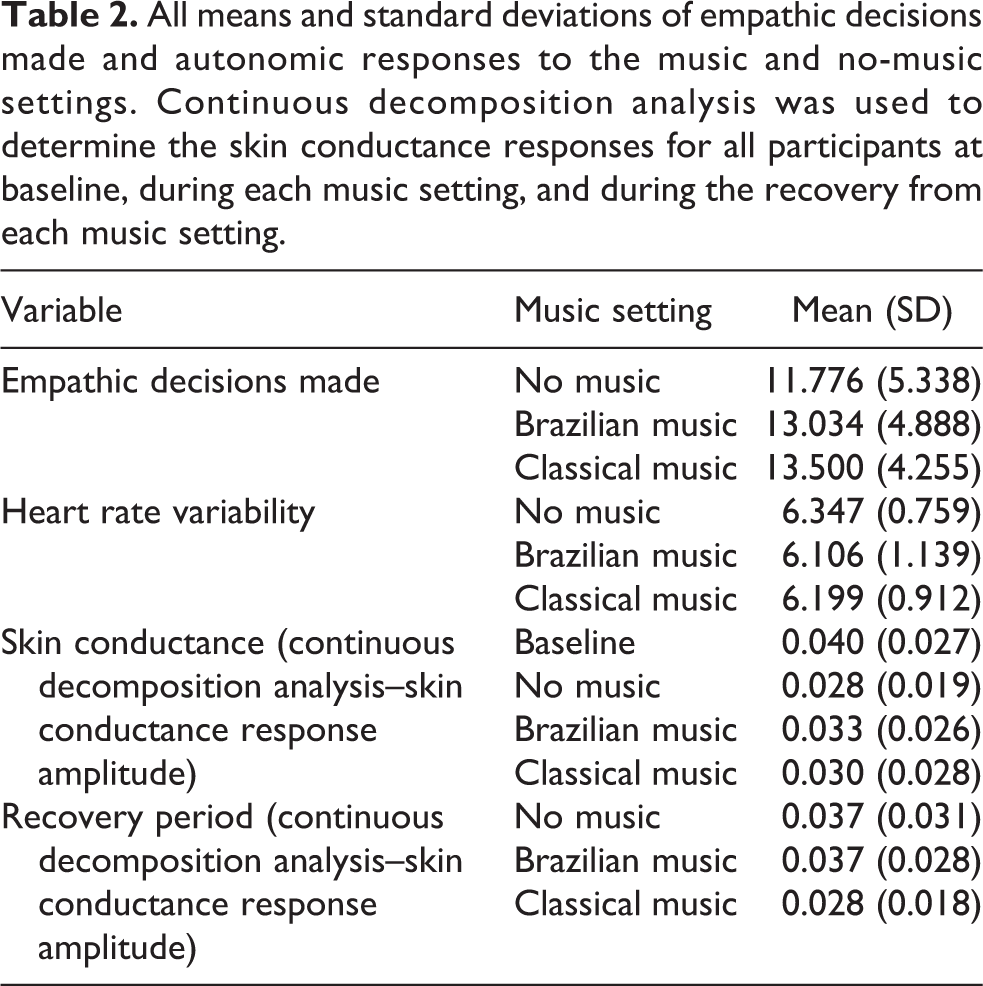
A difference in empathic decision making during Cyberball while baroque music compared to decisions while no music played was observed (Wilcoxon signed rank test, test statistic = 188.5; p = .0258), such that more empathic decisions were made during baroque music than during no music. Lower sympathetic response was evident during recovery (post Cyberball) during the no music condition. (Wilcoxon signed rank test, test statistic = 110.5; p = .0464). Sympathetic activity at baseline was associated with lower sympathetic activity post-cyberball performance while baroque music played. Wilcoxon signed rank test, test statistic = 120; p = .0159.
Empathic decision making was not associated with autonomic behavior. Sympathetic response was lower during cyberball game play compared with baseline (Spearman correlation, r s = .40; p = .0035), but was not associated with performance. No statistically significant results were found when including explanatory variables (i.e., trait personalities, self-report demographic characteristics, trait empathy, music preferences, and music skill) into our data analytic plan.
Discussion
The primary finding of this study is that music affected empathic decision making. Music settings slightly increased empathic decision making compared with the non-music setting. Music setting did not affect autonomic response, and autonomic response largely did not predict the degree of empathic decision making. Finally, there were no significant correlations between self-report variables, autonomic responses, and participants’ performance in Cyberball.
When music was present, as compared with the non-music control, participants’ empathic decisions were higher. This corroborates the results from Kirschner and Tomasello (2010) and Rabinowitch et al. (2013) regarding the overall effects of music on prosocial behavior. Furthermore, this result is consistent with discussions by Small (1998) and Laurence (1999) regarding the physical elements of social engagement through music making correlating or associating with prosocial behavior, as similar to the physical element of empathic decision making defined in this study through Cyberball. Freeman (1998) further corroborates these results, as music and physical activity promote social bonding between nonfamiliar individuals.
Cyberball contains a large number of variable programming options across several domains, perhaps to induce different levels of participation from participants (Hartgerink, Van Beest, Wicherts, & Williams, 2015). Within this experiment, the use of, arguably, the simplest form of the game (i.e., no background image, no background auditory elements, the minimum number of players, no real player faces portrayed on top of original avatar facial features, and no real player names included) may have provided for participants’ habituation to the experimental procedure and limited engagement.
Measuring empathic decision making in laboratory contexts in an ecologically valid manner is a challenge. We chose Cyberball, which is an experimental computer task designed to measure elements of empathy. This task is appealing because it has substantial configurability and has good measurement properties. However, it is not perfect in that there is no personal interaction and the task may be perceived as boring, which could affect engagement in the task and thus diminish the degree that empathy may play in decisions. We introduced a perceived second live player to make it seem that the participant was playing with real human beings to mitigate this effect. This design is repeated in the literature, as Cyberball is structured to facilitate real players’ belief that they are playing with other real players through a number of adaptable functions available in game design (Hühnel, Kuszynski, Asendorpf, & Hess, 2018; Vrijhof et al., 2016). These adaptations to game play may include life-like images of real player faces, background images (e.g., scenes of natural or urban locations), or real-time changes to facial expressions of computer-based players.
Altering the parameters of the game to include greater customization is a potential follow-up aspect that might increase engagement by real players. Furthermore, use of participant-preferred music may also influence engagement. Therefore, further research on the relationships between Cyberball game play (i.e., available outcome measures supplied by the current version of Cyberball) and exposure to music is necessary to explore and provide further conclusions as to what role (or roles) music may play in facilitating empathic decision making, as evidenced by Cyberball game play. This may include greater ecological engagement through participation in empathic decision making involving human–human interaction, rather than human–computer interaction. We did not replicate prior work demonstrating differences in autonomic responses to music. There are several potential possibilities. The use of a different empathic decision making task might have provided for differences in overall effect of the music settings (i.e., classical and Brazilian) on physiological state. The sample sizes in the prior literature have, thus far, been relatively small; leading to a type 1 error. It could also be that other elements of music presentation and context (playing a game) might have mitigated the effect of music on autonomic functions.
Conclusion
The results of this investigation suggest that music may increase empathic decision making. However, the music selections in this study did not associate autonomic response with empathic decision making in the hypothesized directions. This result is not consistent with the prior literature, specific to the effects of music therapy or music-based therapeutic interventions on parasympathetic response (Kemper & Danhauer, 2005; Okada et al., 2009; Roque et al., 2013; Tansik & Routhieaux, 1999). Sample sizes in the prior literature have, thus far, been relatively small. This may lead to type 1 error. Further research is needed with larger samples to flesh out contexts in which varied musical selections may impact relationships between these systems.
Footnotes
Acknowledgement
The authors extend their gratitude to Drs. Larry Crook, Ron Shorr, and Jill Sonke. “The contents of this paper do not represent the views of the Department of Veterans Affairs or the United States Government.”
Contributorship
AC reviewed the literature, conceived of, and executed the project, involving participant recruitment and data collection. DL, WT, and EP were involved in study design. CG and K-BT conducted statistical analyses. JW mentored AC throughout the duration of the project. All authors approved the final manuscript before first submission.
Declaration of conflicting interests
The authors declared no potential conflicts of interest with respect to the research, authorship, and/or publication of this article.
Funding
The authors received no financial support for the research, authorship, and/or publication of this article.

Action Editor
Elaine King, University of Hull, School of Arts.
Peer Review
Anthony Gritten, Royal Academy of Music, Department of Academic Studies.
One anonymous reviewer.