




Abstract
To what extent do classical chamber musicians converge in their characterisations of what just happened in their live duo performance, and to what extent do audience members agree with the performers’ characterisations? In this study a cello-piano duo performed Schumann’s Phantasiestücke, Op. 73, no. 1 as part of their conservatory studio class in which members critique performances in development. Immediately after, the listeners and players individually characterised what had most struck them about the performance, first writing comments from memory and then marking scores while listening to a recording on their personal devices. They all then rated (on a 5-point scale) their agreement with comments by two other class members. Findings demonstrate that classical chamber performers can characterise the performance quite differently than their partner does and that they can disagree with a number of their partner’s characterisations, corroborating previous findings in case studies of jazz performance. Performers’ characterisations can overlap less in which moments strike them as worthy of comment and in their content than their listeners’ characterisations do, and they can agree with a non-partner’s characterisations more than with their partner’s characterisations. At the same time, the data show that listeners who have played the piece before—though not necessarily those who play the same kind of instrument (strings vs. piano)—can be more likely to endorse comments by others who have also played the piece before, even if the comments they make don’t overlap with each other more in timing, content or theme.
Introduction
To what extent do classical chamber performers understand what just happened in their live duo performance in the same way as each other, and to what extent do audience members understand the performance in the same way as the performers? Anecdotally, performers often feel as if they are intersubjectively connected with their performing partners, and they like to assume that their listeners “get” their expressive intentions as performers. Musically experienced audience members like to feel that they have deep understanding of the piece and fair critical perspectives on the performance. The fact that performers follow the same score—and that listeners may have had access to that same score and may have heard previous performances of the same piece—makes it plausible that the experience, reactions and interpretations of co-performers and (at least musically sophisticated) audience members should largely overlap. But how much do they?
Much can and perhaps must be shared among performers for them to be able to play together (Davidson & Good, 2002), from sharing sufficient understanding of the structure of the piece (e.g., Ragert et al., 2013; Williamon & Davidson, 2002), to interpreting each other’s visual and auditory cues (e.g., Bishop & Goebl, 2015; Keller, 2014; Williamon & Davidson, 2002), to predicting and, by some theories, simulating the actions of their performing partner and presenting signals well enough to be able to coordinate (e.g., Keller et al., 2007; Novembre et al., 2019). Of course, how conscious performers are, or even can be, of these processes (Schiavio & Høffding, 2015) and exactly what kinds of representations must be involved is less well understood, but the presumption that much is shared is common.
On the other hand, prior evidence suggests that there can be less overlap between performers’ impressions than one might expect. In one study (Wöllner, 2013), string quartet members did not necessarily agree with each other’s ratings of their own and each other’s expressivity in a joint performance they watched on video. Although it is not in a classical genre, in a previous case study on jazz standard improvisation (Schober & Spiro, 2014) the performers (a saxophonist and pianist) did not fully agree with their partner’s characterisations of what occurred in the improvisations – music-analytically, collaboratively and evaluatively – and they agreed with more of a commenting listener’s characterisations than their partner’s. In a subsequent study of a large set of musically experienced listeners, far fewer listeners agreed with the original performers’ judgements than with the commenting listener’s judgements (Schober & Spiro, 2016). Similarly, in a case study of free jazz improvisers’ shared understanding, the performers did not agree with each other’s characterisations of the improvisation more than they agreed with other experienced free jazz performers’ characterisations (Pras, Schober, et al., 2017).
Our strategy in this case study, as in the previous case studies (Pras, Schober, et al., 2017; Schober & Spiro, 2014, 2016), was to start with what a pair of experienced classical chamber performers and their listeners independently thought worth articulating about their performance immediately afterwards, and then to assess (a) the extent to which they endorsed each other’s comments and (b) the extent to which their patterns of judgment across multiple statements agreed with each other. Unlike in the previous case studies, this time the performance context was a conservatory studio class in which advanced students present works in progress for collective critique. The listeners were 12 musically knowledgeable audience members—members of the class, including two members of another duo who were prepared to play the same piece as a work in progress for critique that day. Rather than using predefined questions or statements about the performance for participants to rate (as in, e.g. Juslin et al., 2011; Platz & Kopiez, 2013; Thompson & Williamon, 2003; Wesolowski, 2016, among many others), we prompted the performers and audience members to individually write down the top three things that had struck them about the performance (like Waterman, 1996). We then asked them to listen to a recording of this performance on their personal devices, and to mark on scores and write about three moments that struck them as worthy of comment. After all had finished, the response sheets were twice redistributed for each participant to rate their agreement (on a 5-point scale) with, and elaborate on if they wished, two other participants’ characterisations.
As we have proposed before (Schober & Spiro, 2016), the range of possible levels of shared understanding we could observe here is actually quite large. At one end of the spectrum we could expect radical idiosyncrasy: that people’s experiences of music may so differ that participants (whether performers or listeners) will never have identical or even strongly overlapping experiences and interpretations. A less extreme possibility—minimal overlap—is that the level of shared understanding depends on the type of information or experience that is focused on: interpretation and experience of some aspects (perhaps mis-tunings, or the music’s temporal structures and surface features) might be more likely to be shared, while broader interpretations of intention and evaluations of success or expression might be very different. On the other end of the spectrum, specific content views suggest that there might be particular aspects of musical performance that participants can identify more or less accurately, for example aspects of players’ communication and alignment (e.g., Keller, 2014; King, 2006), specific expressive, affective or structural characteristics of the music (e.g., Canonne & Garnier, 2015; Hargreaves et al., 2005), judgments of performers’ fidelity to the score (e.g., Waddell et al., 2018) or interpretations of musical meaning (e.g., Clarke, 2005). One might expect classical chamber duos—particularly if they have performed together, rehearsed together or discussed the music before (Ginsborg & King, 2012)—to overlap substantially in understanding of specific content, particularly given shared background knowledge of the piece and musical style (Pitts, 2013).
As for listeners’ and performers’ shared understanding, we propose that the same possibilities are plausible for classical chamber performance as in jazz standard performance (Schober & Spiro, 2016): the greater the experience in the genre, the more likely the overlap in understanding (a more-experienced-listeners-understand-more-like-performers hypothesis) and, at the same time, participants in an interaction may experience and understand what happened differently from outsiders (a listeners-as-outsiders hypothesis).
In looking at performers and audiences together we are interested in gathering characterisations as close to the moment of experience as possible and to study experience of the performance through participants’ (rather than researchers’) perspectives. We are thus attempting to capture a fleeting experience without interfering with the moment of music making or listening too much; so unlike some other studies (e.g., Canonne & Garnier, 2015; Waterman, 1996) we do not ask participants to make judgements or identify moments during the initial experience of the music. Our focus is on a particular occurrence of music making rather than general opinions about collaborative skills (e.g., Cosano Molleja et al., 2017; Dobson & Gaunt, 2015). Our approach is open ended in allowing performers to focus on what they think is worth mentioning rather than asking them to focus on specific predetermined topics (e.g., music-analytic features, performers’ intentions, emotional responses, aesthetic success, or details of their own or other’s playing) or prioritizing particular kinds of characterisations (perceptions, thoughts, feelings, judgments, interpretations, etc.).
Research questions
This case study asks the following research questions about classical chamber duo performers:
Are performers more likely to overlap with each other in their characterisations of a just-completed performance than with non-performing audience members?
Are musicians who have experience playing a piece (have studied, rehearsed or performed it) more likely to overlap with each other in their characterisations of a just-completed performance than with musicians who have no experience with the piece?
Are musicians who play the same kind of instrument (piano vs. strings) more likely to overlap with each other in their characterisations of a just-completed performance than those who play different kinds of instruments?
For each question, we make the comparison by asking whether the musicians being compared
select more of the same moments to comment about
comment more on the same topics
endorse one set of musicians’ comments more than others.
To address these research questions, we asked a cello-piano duo to perform once for the other 12 members of their conservatory studio class a chamber piece they had been working on. The class included another duo who were prepared to play the same piece that day and others with a range of experience with the piece. Immediately afterwards, the listeners and players individually wrote the top three things that had struck them about the performance. Then, listening to a recording of this performance on personal devices, they marked on scores and wrote about three moments that struck them as most worthy of comment. After all the participants had finished, the response sheets were redistributed for each participant to rate their level of endorsement of another participant’s characterisations, and then of one other participant’s characterisations. This allowed us to collect in short order a large number of reactions to a performance and the extent to which those reactions were shared collectively. 1
This method tests the generality of the findings from the jazz case studies in a classical context. It is not a foregone conclusion that what we see in the studies on jazz will extend to a classical context with its score-based performance practice (Seddon & Biasutti, 2009), and in a pair that has rehearsed together extensively.
Method
Participants
The 14 participants were all members of a May 2015 conservatory class called “Duos for Piano & Strings” at Mannes School of Music, College of Performing Arts, The New School. This is a performance-based course in which advanced chamber performers present, workshop, and critique classical chamber duo repertoire, with a focus on “the development of personal musicianship, the discussion of interpretive issues and strategies, and the improvement of technical expertise related to duo repertoire.” All participants had spent notable time with each other over the course of the previous 10 weeks (as well as in other settings) and they therefore had extensive experience discussing and critiquing each other’s chamber performances. The only inclusion criterion was being a member of this class.
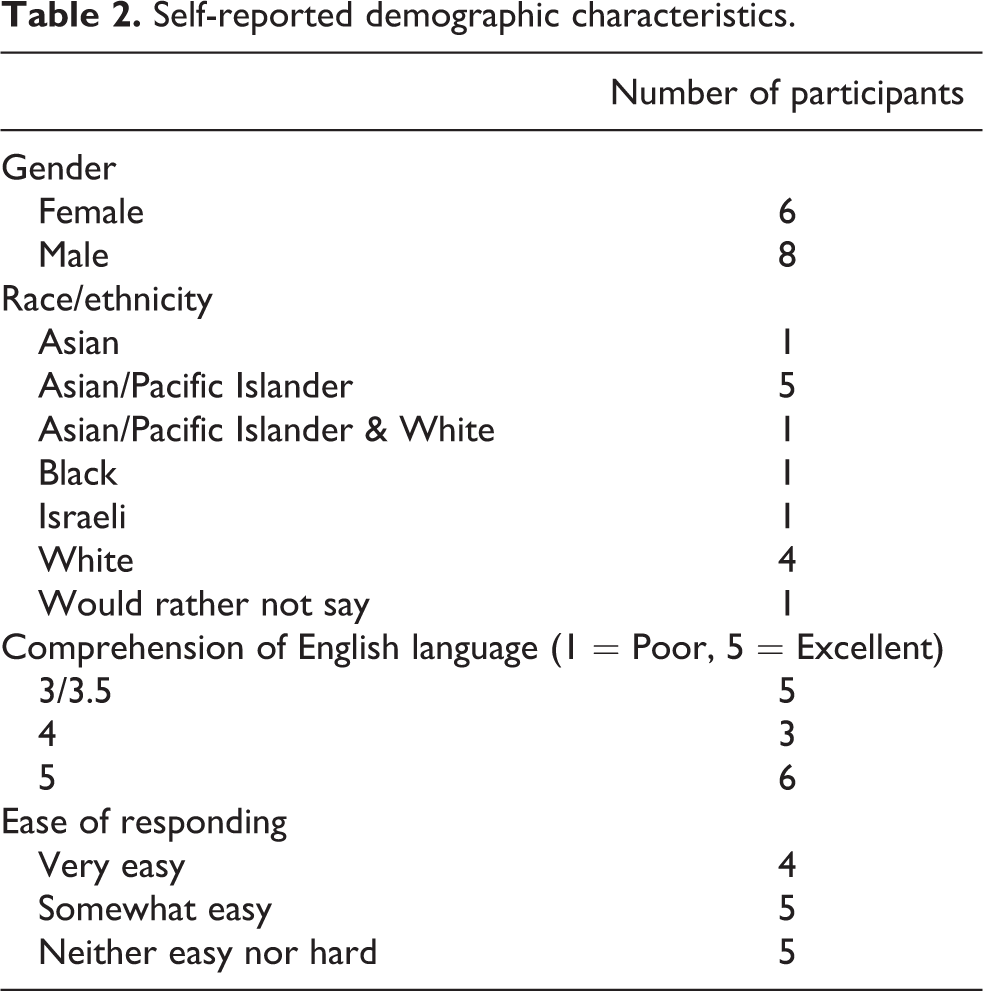
All participants were experienced classical piano and string players (see Table 1 for details). They were all older than 18 years of age, and ranged in age up to their late 20’s (see Table 2 for additional self-reported demographic characteristics). In terms of familiarity with the piece performed in this study, 11 of 14 had heard it, 9 had played it before, and 4 were prepared to play it that day.
Self-reported musical experience.

Self-reported demographic characteristics.
Procedure
The piece
The piece was selected in consultation with the instructor, based on likelihood that existing duos in the class could be willing to rehearse and be relatively quickly prepared to perform in the class. The piece, Schumann’s Phantasiestücke, Op. 73, no. 1 (1849), was originally written for clarinet and piano and subsequently arranged for cello or violin and piano; it has since been arranged for several more instruments (including double bass, horn, bassoon, all with piano accompaniment). As a frequently performed piece that has been called “a veritable chestnut in Schumann’s chamber music repertory” (Reissenberger & Hoeprich, 2014, p. 449), it was likely to be known by many of the participants in our study, whether they played it themselves or had heard it performed. The piece is marked “Zart und mit Ausdruck” (tender and with expression), and it is in a ternary form (A (bars 1-21), B (bars 22- 37), A’ (bars 37 – 59), Coda (bars 59-69)) that includes exact and varied repetition of musical material.
Before the day of performance
The instructor consulted with the class members to gain consent for their participation in the study, with clarity that participation was optional and could be suspended without penalty. Two piano-cello duos were asked to prepare the piece for performance on the day of this study. They were told that only one pair would be asked to perform on the day. These were thus four participants who had a different relationship with the piece (level of most immediately recent familiarity and preparedness to perform with each other) than the rest of the participants.
Participants were instructed to bring their own devices on which they could listen to audio and on which they could receive emails, as well as headphones to allow private listening. The instructor collected email addresses from all participants that they could use on their own devices on the day of performance.
Day of performance
All data collection took place on one day in the room in which students usually had their class. The classroom was set up after a sound check by recording engineer Amandine Pras to determine the best placement for performers and microphones for ensuring acoustic homogeneity between the two instruments, with the goal of achieving “natural” representation of their balance and dynamics. A Royer SF12 stereo ribbon microphone, using the Blumlein stereo system of two coincident bi-directional microphones with an angle of 90 degrees, was used with a portable Tascam dr100 stereo recorder. The instructor introduced the two experimenters, who passed around and collected paper consent forms. A coin was then tossed to decide which of the prepared duos would play.
Performance
The players were instructed to play the piece the whole way through without stopping, and to treat this as a normal performance that they would be doing in this class. The other class members were instructed to listen and pay attention to the performance. The performance then commenced. Immediately after the performance (while participants filled out the first questionnaire), the recording engineer saved the audio recording as an MP3 file in a cloud server, with no postproduction editing, mixing or mastering so as to avoid potentially affecting interpretations of the performance. We then sent an email link to the recorded file to all participants at the email addresses they had provided earlier.
Characterizing general aspects of the performance
Immediately after the performance, the experimenters first handed each participant a pre-assigned private code number (on paper) that would be known only to them and the researchers, for keeping track of responses and being able to assign answer sheets appropriately in the next parts of the study. Researchers then handed out paper copies of the first questionnaire to all participants, including the players, and asked them to write their private code on it. This questionnaire (see Figure 1) instructed participants:
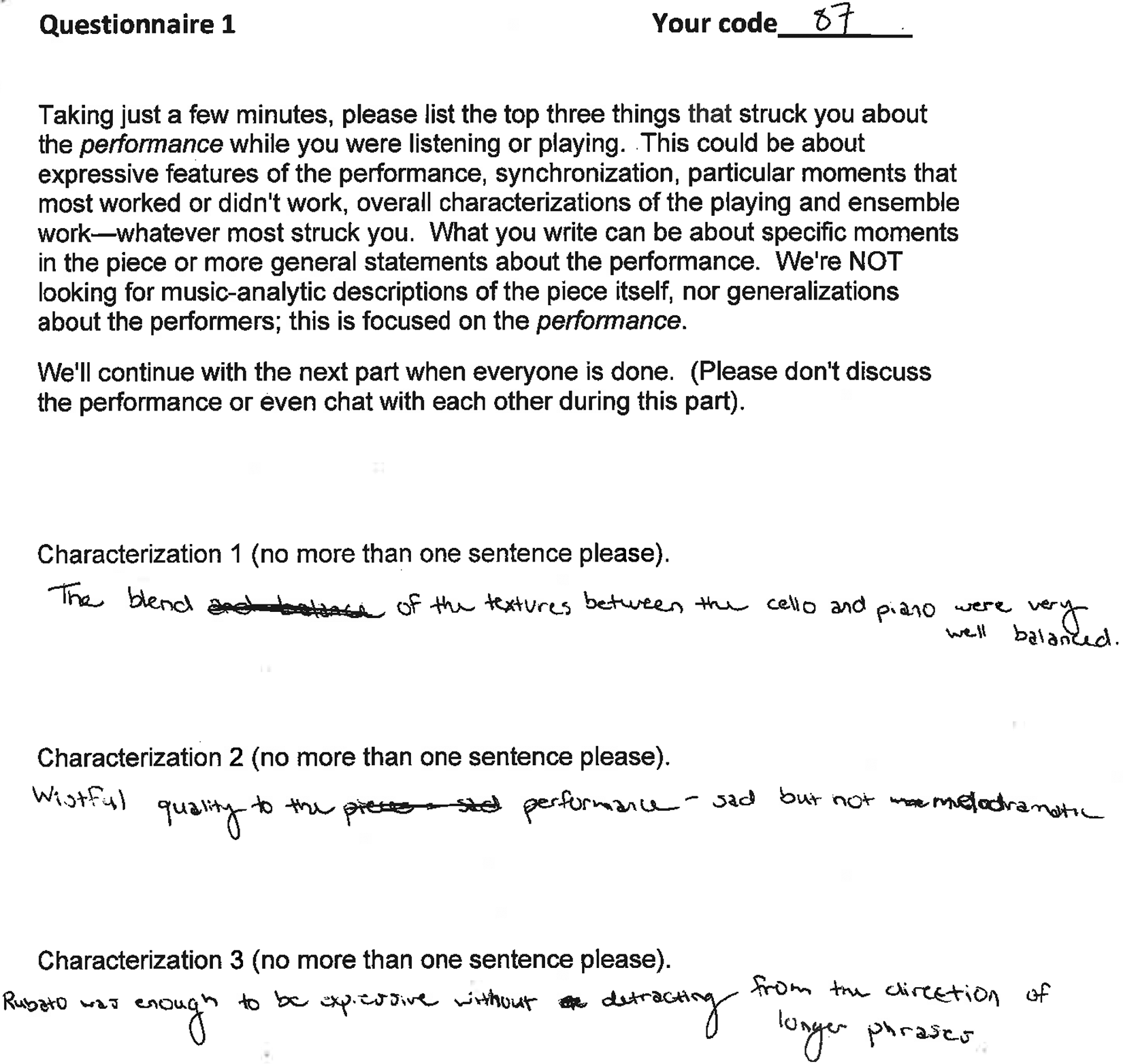
Sample of completed questionnaire 1: General characterisations of the performance.
Taking just a few minutes, please list the top three things that struck you about the performance while you were listening or playing. This could be about expressive features of the performance, synchronization, particular moments that most worked or didn’t work, overall characterizations of the playing and ensemble work—whatever most struck you. What you write can be about specific moments in the piece or more general statements about the performance. We’re NOT looking for music-analytic descriptions of the piece itself, nor generalizations about the performers; this is focused on the performance.
Participants were instructed that the group would continue with the next part when everyone was done, and they were asked not to discuss the performance or even chat with each other during this part.
Characterizing particular moments in the performance
When all participants had finished Questionnaire 1, the experimenters collected it. They then asked all participants to leave the room with their device and go to the hallway where the wireless connection worked. From the email they had just received, participants were to download the audio file to their device, and then return to the classroom.
Each participant was provided with a copy of the musical score for the Phantastiestücke, each copy marked with a letter. Participants were asked to enter their private code on the score. They were then instructed to listen on their own device to the audio recording they had just downloaded. (They were told that they were welcome to follow along in the score while listening or not as they preferred). After listening, they were provided with Questionnaire 2 (see Figure 2 for an example), which instructed them to mark on the score the three moments (which could be individual notes, phrases, or entire sections, as they preferred) that struck them as most worthy of comment—positive or negative—and then to enter their three comments about those moments on Questionnaire 2. These comments could be about the players’ collaboration, the artistic success or non-success of particular moments, or even about technical aspects if those had struck them while listening. They were also told that what they marked here did not have to correspond at all with the general characterisations they had made on Questionnaire 1.

Sample of completed questionnaire 2: Characterisations of particular moments in the performance.
Participants were further instructed that we needed their marking of the score to be very specific about exactly which bars or notes they were commenting on—if possible, even the minutes and seconds in the recording. We also asked them to be as clear as possible about which parts they were referring to: piano, cello, piano left hand, piano right hand, or the ensemble. Participants were told that they were welcome to listen more than once, or to relisten to part of the recording, as needed in order to make their best characterisation. Participants were told that they could take as much time as they needed and that we would move on to the next part once everyone had finished.
While participants filled out Questionnaire 2, the experimenters checked the comments in Questionnaire 1 to determine whether any revealed the identity of the commenter. The comments by one participant (one of the performers) were recopied onto a new sheet anonymizing the text so that the performer’s identity would not be revealed in the next steps. For example, “there were some places the two of us were not together” was rewritten as “there were some places the performers were not together.”
The scores and Questionnaire 2 were collected individually as they were completed, checked in case any needed to be anonymized (none did), and stapled together with the corresponding Questionnaire 1 filled out by the same individual (based on the private code).
Endorsing another participant’s characterisations
The experimenters distributed Questionnaire 3 along with a stapled packet (Questionnaires 1 and 2 and the marked score) following a partially pre-specified scheme based on the private codes; the participants could not tell whose packet they were receiving. The two performers received each other’s packets, and the two participants who had been prepared to play that day but didn’t received each other’s packets. The rest were distributed arbitrarily, making sure that no one would receive their own comments and score.
Participants were instructed to rate on Questionnaire 3 the extent to which they endorsed the characterisations in the packet. For each general statement and for each moment, they were to rate their level of agreement on a 5-point scale, from “strongly disagree” to “strongly agree.” They could also select “don’t understand” if they didn’t understand a comment or marking. They were welcome to elaborate on why they disagreed or had a different interpretation in a “comments” section (see Figure 3 for an example). They were welcome to listen again to the recording in order to make their determination. Participants were told that they could take as much time as they needed, and that we would move on to the next part once everyone had finished.

Sample of completed questionnaire 3: Endorsement another participant’s characterisations.
Endorsing a different participant’s characterisations
After the experimenters had collected the packets that participants had thus far rated in Questionnaire 3, they now distributed the packets to different listeners. The scheme was that the performers now rated characterisations by the prepared-but-not-performing player of their performing partner’s instrument, and that the prepared players now rated characterisations by the performing player of their partner’s instrument. All other participants again rated another arbitrarily assigned participant’s characterisations, making sure that they did not receive the same packet they had rated before or their own.
Reporting previous experience and demographics
Participants then filled out a final questionnaire that asked them about their familiarity with the piece (had they played it before? Heard it before?), their instrumental experience, and their demographic characteristics. Once all questionnaires had been collected, the experimenter spent the remaining class time in a debriefing discussion with the course instructor and class members about the research project, its context, and the next steps in data analysis.
Data coding and analysis strategy
Commenting on the same moments
To examine the extent to which participants commented on the same moments, we plotted the start and end bars and beats of each moment notated on the score by each participant.
Content overlap
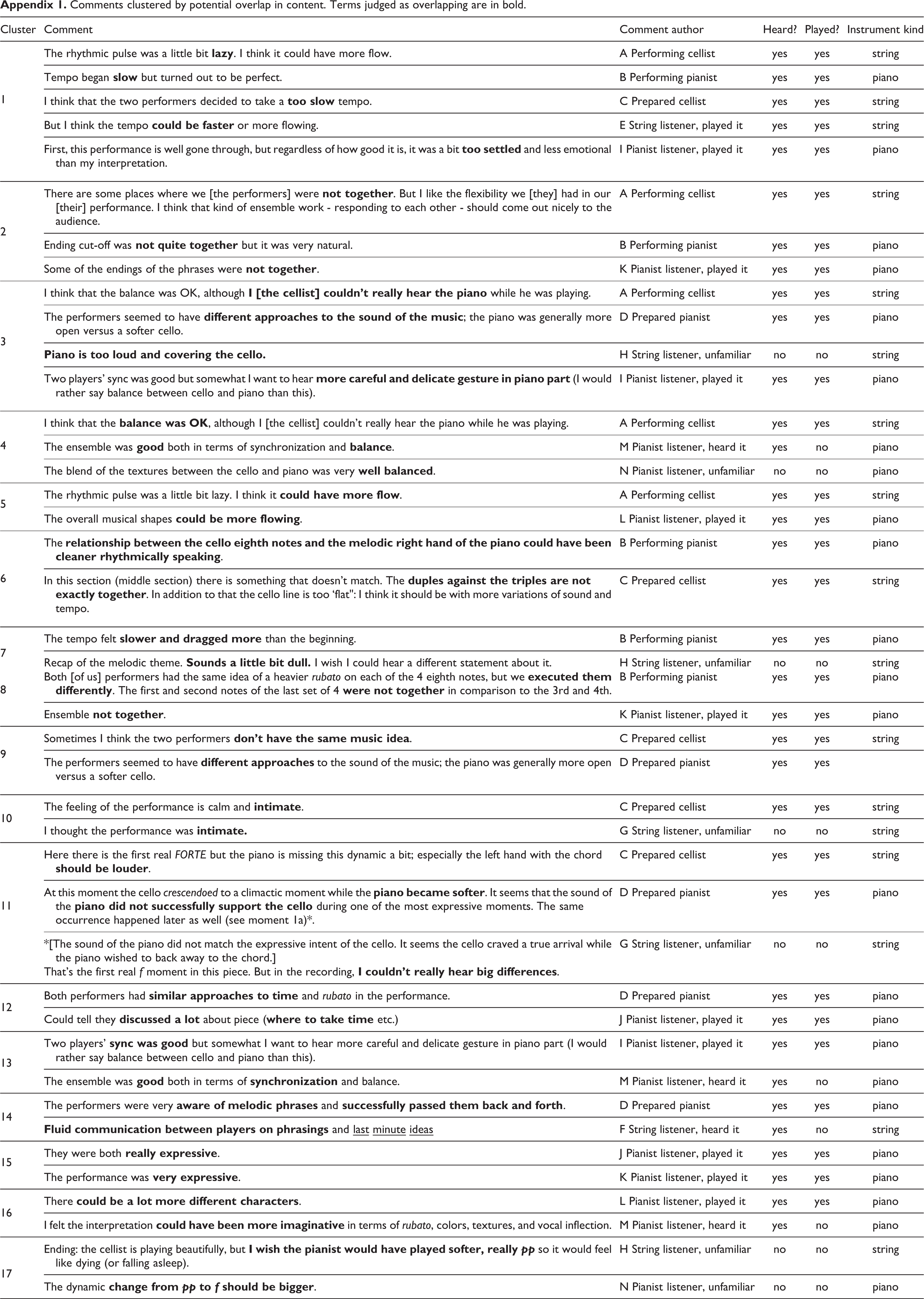
To assess the extent of potential content overlap among different participants’ comments our strategy was to err on the side of finding potential overlap rather than focussing on differences. Both authors together grouped comments that included the same or semantically related words. For example we grouped “lazy,” “slow,” “too slow,” “could be faster,” and “too settled” in one cluster (Cluster 1, Appendix 1). We then further differentiated clusters that broke into clear subgroups based on the fuller context of the comment. For example, we broke a possible cluster about the performers not being together into two, one about the ensemble as a whole (Cluster 8) and the other about being together at particular moments (Cluster 2).
Topic overlap
To examine topic overlap, we first identified a set of broad topics that we saw the full set of comments as encompassing, both evaluatively positive and negative. The first author first identified a set of topics that seemed to represent the range of commentary and then annotated each comment according to the one or more categories from this set that the comment fitted into. Both authors then checked each annotation and for the low-frequency categories merged those that reasonably grouped together. The final set of topics was: dynamics, balance, tempo, timing/rhythmic motion, synchronization, communication, expressivity, tone quality, and other kinds of comments. Table 3 gives examples of comments that we saw as overlapping on the topic of tempo; see Appendix 2 for the full set of comments with all annotations and Supplemental Table 1 for the details of the coding scheme and procedure.
Comments identified as including the topic of tempo. Check marks represent the topics assigned; question marks represent a possible classification. Comments judged as evaluatively positive are represented in green, and as evaluatively negative in red. Each comment can address more than one topic.

Based on the codes assigned to each comment, we counted topic overlap as the number of comments (out of the possible total of 6—three general comments and three comments about particular moments in the performance) that overlapped at all in any topic, for each possible pairing of the 14 participants. To do this, we focused on the content of the three comments about moments independent of which beats the moments were about, taking the generous assumption that two statements about tempo or synchronization in some sense overlap in topic even if they are about different moments. We counted two comments within the same topic as overlapping even if the wording was quite different, but we did not count comments as overlapping if they were coded in the same category but with opposite valence (e.g., one comment praised the balance and the other criticized it), and we only counted “other” comments as overlapping if they did indeed overlap in content. For the few comments that we thought might or might not belong within a particular topic category (those assigned question marks in Appendix 2), we counted them as
belonging to the category for this analysis. For each pairing, we counted the largest number of comments that could be seen as overlapping; so if 4 comments by one party overlapped in content with one comment by the other, that pairing would be assigned a count of 4 overlaps.
Results
Research Question 1: Did the performers overlap with each other in their characterisations of their just-completed performance more than with non-performing audience members?
We address this research question in the following ways.
Commenting on the same moments
Were the performers more similar to each other than listeners in terms of the moments they chose to comment on? Figure 4 plots the time spans for the three moments commented on by each participant. 2 As is visible in Figure 4, the two performers did not overlap at all in the moments they chose to comment on, even under the most generous interpretation of overlapping (any beats of the moments chosen overlap, even if much else doesn’t). Each of the three moments that the performers chose was, however, also chosen by at least one listener, under this generous interpretation. All listeners overlapped with another listener at least once in the moments that they chose, averaging 2.42 (of 3 possible) overlapping moments. Based on moments chosen, the performers were not more similar to each other in their judgments than the listeners.

Locations in piece of moments selected for commentary. Vertical lines represent bars (thicker lines) and beats (thinner lines).
Content overlap
To what extent did performers’ comments overlap in content more than with their audience members’ comments? Appendix 1 groups all the statements of the 84 that we see as potentially (at least partially) overlapping in content. From this clustering, the performers overlapped in content for two statements, one about a (temporarily) too-slow tempo and another about not being together, although in both cases these concerns were raised by at least one other audience member as well. We also see (at least partial) overlap in the content of 2 or 3 other statements by the performers with other audience members. Based on this view of the content, the performers’ comments do not overlap in content more than with other participants’.
Topic overlap
Was there greater overlap in the themes that performers’ comments addressed, even if the precise content of the comments differed? Using the method described earlier, we see that the performers overlapped in topic in some way for 5 of their 6 comments. Both performers overlapped in topic more (all 6 comments) with at least one participant other than their co-performer, and they overlapped in topic with at least two other participants as much (5 comments) as with their co-performer. As Appendix 2 shows, the pattern is the same for the general comments and for the comments about particular moments: the performers’ comments overlap in topic at least as much with more than one other participant’s comments as they do with their performing partner’s comments. Of course, 6 characterisations by each participant surely do not exhaust everything that they thought about the performance, but the comments do give some indication of what they thought was most important to articulate. At least by this coding scheme and counting method, we see no evidence that the performers’ comments overlap in topic more with each other than with their audience members.
Endorsement of the partner’s comments
Did the performing partners endorse their partner’s comments more than they endorsed comments by others? Of course, this data set only includes perfomers’ ratings of two others’ characterisations—their performing partner’s and one prepared non-performer’s—so we see this evidence as suggestive rather than definitive. Nevertheless, both performers endorsed characterisations by the person who was not their partner at least as much as their partner’s charactersisations. As Figure 5 shows, the pianist endorsed the prepared cellist’s comments (giving a rating of “agree” or “strongly agree”) more (5 of 6 comments, 83%) than their partner’s (2 of 6 comments, 33%), and the cellist endorsed no more of their partner’s comments (3 of 6, 50%) than the prepared pianist’s comments (3 of 6, 50%). The pattern is the same if we adjust the ratings based on the raters’ (optional) write-in elaborations about their ratings, which in some cases qualified the rating. For example, the pianist gave an “agree” rating to their cellist partner’s comment “The rhythmic pulse was a little bit lazy. I think it could have more flow,” but the pianist’s comment along with the rating (“I think it was on the slow side, but I wouldn’t use the term ‘lazy.’ I prefer ‘relaxed.’”) suggests less than complete endorsement.

Performers’ endorsement of comments by their partner and prepared non-partner.
In sum, we see no evidence that the performers overlap with each other in their characterisations of their just-completed performance more than with non-performing audience members. They did not select more of the same moments to comment about, address more similar topics, or endorse their partner’s characterisations more.
Research Question 2: Did musicians with experience playing the piece overlap with each other in their characterisations of the performance more than with musicians who did not?
We address this research question by comparing overlap in characterisations between those who had played the piece before (4 who were prepared to play the piece the day of the study and 5 who had played the piece before but had not prepared to play the piece that day) and those who had never played the piece before (5 participants).
Commenting on the same moments
Did those with more experience with the piece choose more of the same moments to comment on? Every one of the 9 participants who had played the piece (the first nine rows of Figure 4) chose at least one of the same moments, using the generous interpretation of overlapping as including any overlapping beats of the moments chosen. Of the three moments chosen, these nine participants averaged 2.1 moments that overlapped with those chosen by another participant who had played the piece. Those who were prepared to play the piece that day chose an average of 2.5 overlapping moments, and those who had played the piece before averaged 1.8 overlapping moments. While this is consistent with the possibility that greater experience with the piece leads to greater overlap in chosen moments, it is not notably different than the 2.0 moments that participants who had not played the piece overlapped in moments chosen with those who had played the piece. It is also not notably different than the 1.9 moments chosen by participants who had played the piece that overlapped with participants who had never played the piece, nor the 2.5 overlapping moments that those prepared to play the piece that day overlapped with participants who had never played the piece. Based on moments chosen, we do not see strong evidence that experience playing the piece led to greater overlap.
Content overlap
To what extent did comments by participants with greater experience with the piece overlap in content any more with each other than with comments by those with less experience? Of the 17 potential content clusters in Appendix 1, only 2 of them include only comments by participants who were prepared to play that day. An additional 6 include only comments by participants who had played the piece before. The remaining 9 clusters also include comments by participants who had never played the piece before. While one might argue that it is striking that 16 of the 17 content clusters include a comment made by someone prepared to play that day (and thus perhaps these participants’ comments reflect particularly notable aspects of the music-making), it is also striking that most of the clusters also include a comment made by someone who was not. So this pattern does not suggest overwhelming evidence supporting the idea that more experienced players will produce more comments in common.
Topic overlap
Did comments by participants who had played the piece before overlap more in the themes they addressed, as coded in Appendix 2? Using the same counting method described earlier, we see that the four participants who were prepared to play that day overlapped in topic for an average of 4.67 (of 6 possible) comments, ranging from 3 to 6. This seems notably higher than the average of 3.0 (of 6 possible) comments (ranging from 1 to 6) that overlapped in topic for participants who had played the piece before but had not prepared to perform the piece that day, but not notably higher than the average of 4.3 comments (ranging from 2 to 6) that overlapped in topic among participants who had never played the piece. The average overlap in topic for comments by participants who had ever played the piece was 3.63 (ranging from 1 to 6). This pattern of findings does not suggest that comments by participants with greater experience with the piece overlap in topic more than comments by participants without experience with the piece.
Endorsing other participants’ comments
Did participants with greater experience with the piece endorse comments by other participants with greater experience any more than they endorsed comments by others? Although our assignment of raters who were not asked to prepare to play that day to rating sheets was arbitrary, fortunately, the five participants who had played the piece before each rated their agreement with one other participant who had played the piece before and one other who had never played the piece. These participants endorsed (giving a 4 or 5 on the 5-point scale) an average of 5.0 of the 6 statements authored by others who had played the piece before (83%), and only 3.2 of the 6 statements authored by others who had never played the piece before (53%). If we augment this subset of participants with ratings by the two non-performing participants (who were prepared to play the piece that day) of comments by their partner (who was also prepared to play that day), the average level of endorsement is still higher, 4.2 of 6 (70%), than endorsement of statements authored by others who had never played the piece before.
As Figure 6 shows, this high endorsement by participants who had played the piece before (but were not prepared to play that day) of comments made by others who had played the piece before is strikingly higher than the endorsement level of the participants who were prepared to play that day, which (averaging from Figure 1) was 3.6 of 6 (60%)—an average of 2.5 of 6 (42%) for players’ endorsement of their performing partner’s comments, and 4 of 6 (67%) for players’ endorsement of comments by another who had been prepared to play that day. The overall pattern of findings is consistent with the proposal that players more experienced with the piece are more likely to endorse comments by others who have also played the piece than comments by those who have never played the piece.
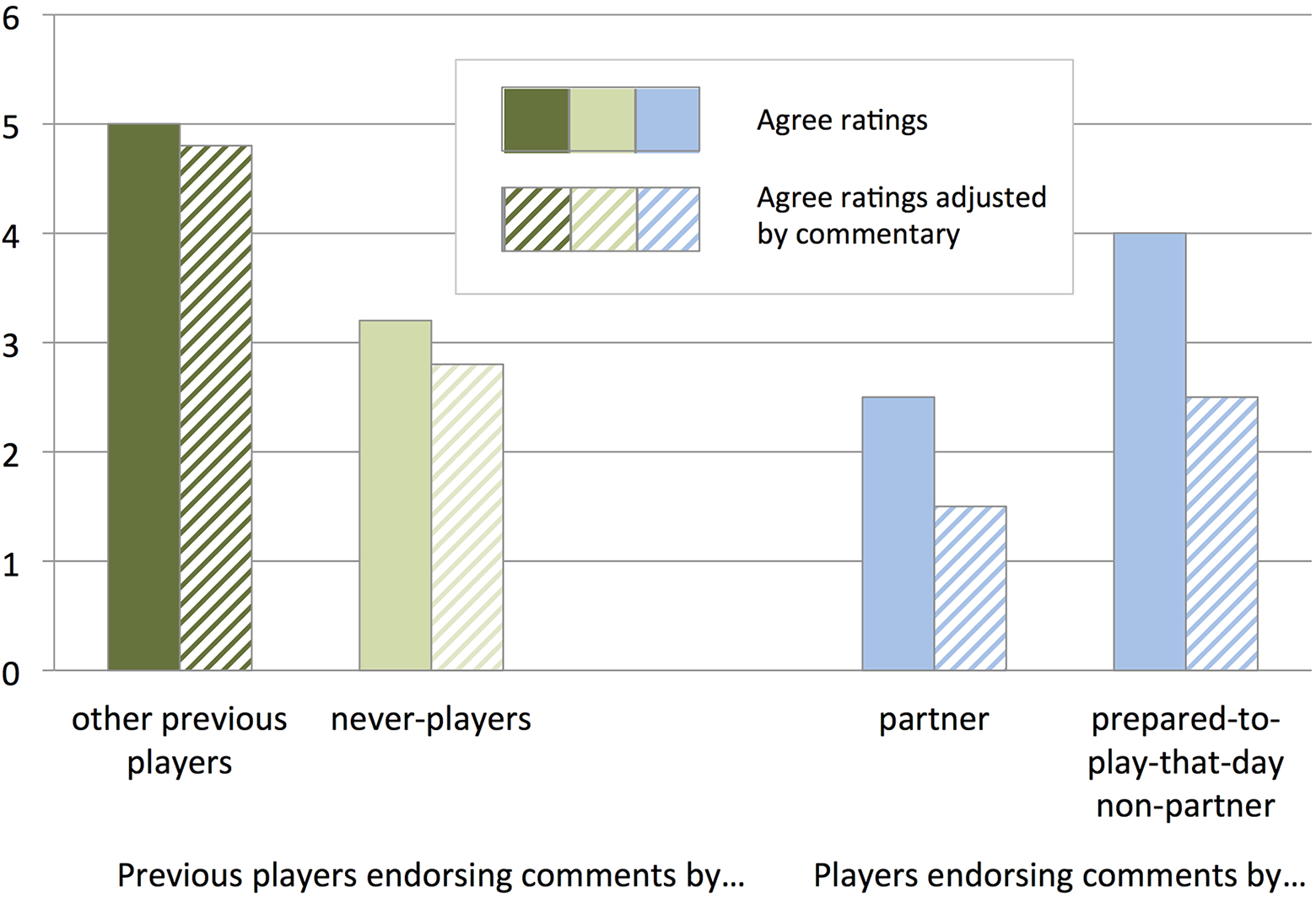
Endorsement of comments by participants who had played the piece before (but were not prepared to play that day) of comments made by others who had played the piece before and comments by participants who had never played the piece. For comparison, the right half of the figure re-plots average endorsement of comments by players from Figure 5.
Research Question 3: Did musicians who play the same kind of instrument (piano vs. strings) overlap in their characterisations of the performance more than those who play different kinds of instruments?
We address this question by comparing overlap in characterisations between the 8 participants whose primary instrument was piano with the 6 participants whose primary instrument was a string instrument.
Commenting on the same moments
Did those who played the same kind of instrument choose more of the same moments to comment on? Counting all participants (including the performers), and using the generous interpretation of overlapping as including any overlapping beats of the moments chosen, pianists averaged 2.0 moments that overlapped with those chosen by another pianist, and string players averaged 1.7 moments that overlapped with those chosen by another string player. In both cases, they did not overlap more with players of the same kind of instrument than with players of the other kind of instrument (string players averaged 2.2 moments that overlapped with pianists’ chosen moments, and pianists averaged 2.0 moments that overlapped with string players’ chosen moments). This pattern of no greater overlap in moments chosen between players of the same kind of instrument than between players of different instruments is the same even if we exclude the performers from the count (in case performers’ unique perspective might skew the results)—same-instrument-kind commenters overlapping on an average of 1.85 moments vs. different-instrument-kind commenters overlapping on 2.0 moments. It is also the same if we also exclude the comments by the two non-performing participants who were prepared to play the piece that day (1.83 vs. 2.0).
This evidence is not consistent with a hypothesis that experience playing the same instrument leads to greater overlap in the moments participants choose to comment on.
Content overlap
Did comments by participants who played the same kind of instrument overlap in content any more with each other than with comments by those who played the other kind? Of the 17 potential content clusters in Appendix 1, 6 of them include only comments by participants who played the same kind of instrument (5 by pianists and 1 by string players). Another 6 include only comments by participants who played different kinds of instruments, and another 5 include comments both by participants who played same and different kinds of instruments. To look at the data a different way, 11 of the 17 clusters included comments by participants who played different instruments, and 11 included comments by participants who played the same instruments. This pattern does not support the hypothesis that players of the same kind of instrument will produce comments that overlap in content more.
Topic overlap
Did comments by participants who played the same kind of instrument overlap more in the themes they addressed, as coded in Appendix 2? Using the same counting method described earlier, we see that the string players overlapped in general topic for an average of 3.7 (of 6 possible) comments, and the pianists overlapped in topic for an average of 4.0 (of 6 possible) comments. This is higher than the average of 3.2 comments that overlapped in topic for pianists with string players, but not higher than the 4.4 comments that overlapped in topic for string players with pianists. At a more general level, participants who played the same kinds of instruments averaged 3.9 comments overlapping in topic, which is not more than the 4.0 comments overlapping in topic among participants who played different kinds of instruments. This pattern of findings is not consistent with a hypothesis that comments by participants who play the same kinds of instruments overlap in topic more than comments by participants who play different kinds of instruments.
Endorsing other participants’ comments
Did participants who played the same kinds of instruments endorse each other’s comments more than they endorsed comments by participants who played different kinds of instruments? Given our arbitrary assignment of raters to rating sheets, there was not an even split of raters in each instrument pairing (6 pianist ratings of pianists’ comments, 10 pianist ratings of string players’ comments, 2 string player ratings of string players’ comments, and 10 string player ratings of pianists’ comments), and so we interpret these results with caution. The evidence is if anything only weakly consistent with the hypothesis: participants endorsed (giving a 4 or 5 on the 5-point scale) an average of 4.0 of the 6 statements authored by others who played the same kind of instrument (67%), and 3.6 of the 6 statements authored by others who played a different kind of instrument (59%); the difference essentially disappears if we look at the qualified ratings, averaging 3.4 (56%) vs. 3.3 (54%). As Figure 7 shows, the pattern looks highly similar for same- vs. different-instrument ratings, even if ratings of comments by pianists seem to be endorsed at a slightly higher rate.

Endorsement of comments by players of same vs. different kinds of instruments as the comment authors (incorporates data from one participant who did not rate the score-based comments for either author by doubling their score to scale it as out of 6 rather than 3).
Exploratory analyses of collective response to performance
Beyond our research questions, the nature of this data set allows a new way of looking at the perspectives of multiple listeners at the same time through different lenses. Supplementary Tables 2–5 list all 84 comments grouped by which were fully endorsed by both raters, less than fully endorsed by both, rejected by both raters and the few that were only rated by one participant. Each comment includes any additional elaboration, which in some cases further explain the rater’s level of endorsement but in other cases qualify their rating.
These tables show the ways in which raters disagreed with each other on virtually every topic covered by the comments. At least anecdotally, some of the perspectives in the comments seem predictable based on the commenters’ and raters’ instruments and prior experience; for example, two pianist listener raters disagreed with the string listener who thought that the pianist’s playing was too loud relative to the cello, in one case thinking the opposite and in the other thinking the balance was just right.
Seen collectively, raters’ elaborations also highlight some divides in the group about general principles of chamber music interpretation, or at least contrasting ideas about how this particular piece should be performed. Clearly some participants believe that recapitulations should be played differently than expositions, in principle, while others believe they should be played identically (see L Pianist Listener’s and K Pianist Listener’s opposite reactions to H String Listener’s comment in Supplemental Table 3: “In my opinion, one should not play the recap the same way, so I agree” vs. “If it’s called ‘recap’ why would you want to hear something different?”). Some participants believed that when two parts repeatedly have different rhythmic notations against each other (in this piece, cello duples against piano triplets), they should be played as matching, at least in Schumann’s chamber works, but others believed that the contrast should be highlighted (for example, F String Listener’s elaboration on disagreeing with I Pianist listener’s comment in Supplemental Table 3). And there were clear differences in judgment of the appropriateness of and success of rubatos and rallentandos.
See https://3milychu.github.io/notesonperspective_journal/ (Chu, 2020) presenting the subset of score-based comments about specific moments in the piece and Supplemental Video 1 for a non-interactive version of the visualization. This kind of visualization, linked to an audiorecording of a performance and a score, can allow a user to select alternate views of a dataset as it unfolds over time—e.g., viewing how comments that were agreed upon vs. disagreed upon cluster, or focusing only on comments by string players or those who had played the piece before or comments about rhythm.
Exploration of this visualization allows simultaneous experience of multiple aspects of the data—the timing of comments, their authorship, their content, and their endorsement by different parties—whose confluence is hard to see at the same time using static representations like Supplemental Tables 2–5 (see Pras, Spiro, et al., 2017, for a different approach to a time-based visualization). Figure 4 already showed which moments in the performance attracted more attention than others. The visualization allows exploration of additional aspects (within the restrictions of the data set, with each participant having marked three spots on the score and provided endorsement ratings of two others’ comments): which kinds of attention by which kinds of authors at which points.
For an example of the kinds of insights that this sort of visualization can afford, consider Supplemental Video 2, which focuses on the moment the transition begins at 1:24. The visualization concretely shows that this moment generated sudden substantial attention with six comments (see Figure 8 for a still image of this moment). The comments highlight the radical difference in interpretation that the same performance can generate among different audience members. Three comments included positive evaluation (coded gold), four included negative evaluation (coded violet), and one was mixed; four were endorsed by both raters and two by only one. While some commentary praises the pianist’s tone quality and expressivity at exactly this moment, other comments critique the pianist’s rhythmic flow and the balance in the pianist’s left and right hand parts; some comments praised the shifting prominence of cello and piano while others wanted more variation in sound and tempo and critiqued the balance between the two instruments. The prepared cellist and pianist visibly disagree in their interpretations here. Supplemental Video 3 shows the same moment, this time focusing only on comments by participants who have played the piece before, which highlight that these participants found more to critique in this moment than participants who hadn’t played the piece before.

Still image of the moment that begins at 1:24 from the interactive time-based visualization Each comment’s author is identified above and to the left. The number of raters (of two) who endorsed each comment is given above and to the right. The topics coded appear below each comment in gold (positive comments) or violet (negative comments).
Viewing the data set through different filters demonstrates further the range of interpretation across the class, with moments of consensus for different kinds of listeners. We don’t want to make too much of the moments of consensus and dissensus that emerge in this relatively small sample of participants, but we believe a visualization tool of this sort could be useful for seeing larger collective patterns in, for example, longitudinal qualitative data sets (Vogl et al., 2018).
Discussion
This case study demonstrates that classical chamber performers can characterise a performance quite differently than their partner does and that they can disagree with most of their partner’s characterisations. They can overlap less in their characterisations of a performance than their listeners do, and they can agree with a non-partner’s characterisations more than with their partner’s characterisations. At the same time, the data show that listeners who have played the piece before—though not necessarily those who play the same kind of instrument as each other (strings vs. piano)—can be more likely to endorse comments by others who have also played the piece before, even if the comments they make don’t overlap more in timing, content or theme.
This pattern of findings in a classroom-based classical chamber duo performance echoes those in our prior case studies in other genres, where we saw no evidence that professional musicians had privileged understanding relative to nonperforming listeners in improvising jazz standards (Schober & Spiro, 2014) or free jazz (Pras, Spiro, et al., 2017)—and if anything, potential evidence for greater shared interpretation by nonperforming listeners. The evidence that prior listeners with greater experience with a piece may have greater overlap in their endorsement of each other’s characterisations also resonates with the results from Schober and Spiro’s (2016) study that included a much larger set of 239 online listeners. In that study, the evidence showed that listeners with genre experience (playing jazz, having experience improvising) were more likely to overlap in patterns of ratings with the performers than those without, which is similar to the current study’s finding about experience with this particular piece. In that study, as in the current study, there was also no evidence that listeners who played specific instruments (saxophone or piano) were more likely to endorse statements by the player of their own instrument than the player of the other instrument. 3
We see this case study of a classical chamber duo’s agreement with each other’s characterisations as showing what can happen rather than what always happens. Patterns of overlapping characterisations among performers relative to listeners might look quite different for performers and listeners with different levels of prior experience with a piece, genre, instrument, or each other. Nonetheless, we find it striking that we observe a similar pattern of performers agreeing with each other’s comments less than with non-performing listeners in another genre, in a performance with quite different constraints. Unlike in the other case studies, the players here knew each other, had played together before and had experience discussing and critiquing each other’s chamber performances; they were performing in a classroom setting at a high-level performance training institution, with an audience of 12 classmates, rather than having been recruited as post-training professional musicians and playing in a concert hall with only the researchers as the audience. Also unlike in the previous case studies, which involved intensive individual post-performance think-aloud interviews and a long delay before participants carried out ratings of a large set of anonymized comments, here the participants provided a smaller set of written comments and marked the score (which was of course not possible in the improvised genres), and ratings of others’ comments were immediate. So even with this more efficient data collection method involving more participants but fewer data points per person, the pattern of evidence is consistent.
The method developed for this study represents a new attempt at tapping into the unfolding collective cognition of musical performers and their audience. While in one sense the data set is far sparser in content than the richer commentary we elicited in our prior studies of this kind (Pras, Schober, et al., 2017; Schober & Spiro, 2014), the method efficiently elicits specific reactions that more general-purpose jury-style ratings would not, and then allows quick assessment of collective agreement. As the time-based visualization and the various lenses through which one can see it demonstrate, even this relatively small data set is rich and complex, and its blend of qualitative and quantitative views is new.
As Radbourne et al. (2013) argue (see also Egermann et al., 2019), new methods for gathering new kinds of data on audience experience are needed given the proliferation of contexts in which listeners experience collaborative musical performance—far beyond standard concert halls or home listening to recordings. With digitally streamed video of ensemble performance—whether the performers are live in the same physical space, in different spaces, or having recorded multiple tracks separately that later are merged—that listeners can experience alone on their mobile device or in a theatre with other audience members whose responses may feed into their own, new questions about how audience members’ thoughts and feelings overlap with performers’ arise. Variants of the method used here—perhaps with all materials online on mobile devices—could allow new time-based accounts of collective experience that are both more fine-grained and larger-scale than have been available before, even with audiences that do not have score-notating experience.
Future studies could test the generality of this case study’s findings across different performance settings, audiences with different degrees and types of musical experience, and performers, and to test variations of the method--for example, asking for more characterisations from each participant or asking participants to rate characterisations by more people. Future studies can also ask new research questions that clearly arise from this set of findings. For example, would the pattern of results be different for performers who have played together for many years, presumably having worked out differences in their aesthetic sensibilities, and having had more chances to discuss their performances and reach a shared vocabulary about their ensemble work? 4 Would long-term fans of a particular ensemble be more likely to overlap in characterisations with the performers and with each other? Do individual differences in performers’ or audience member’s coordination and empathic perspective taking abilities (e.g., Novembre et al., 2019) predict degrees of overlap? Would a larger sample show more nuanced evidence for the more-experienced-listeners-understand-more-like-performers hypothesis, and further evidence on the listeners-as-outsiders hypothesis?
One additional pedagogical note: although the data collection procedure developed for this study was not intended as a classroom intervention, we found it intriguing that it allowed elicitation of thoughtful commentary from all class members simultaneously and privately in a way that isn’t possible in a typical classroom discussion, and it allowed class members to consider and respond to others’ characterisations simultaneously and privately. We speculate that creating the opportunity for this kind of anonymized interchange prior to public discussion may embolden students who don’t always speak up and reveal thinking that might otherwise never be uncovered for all sorts of reasons—from worries about offending or looking foolish, to discomfort with the pressures of public speaking, to needing more time to formulate an opinion, to fitting the social requirement of responding to prior public comments rather than responding directly and individually to the music. We also speculate that immediate close re-listening to what was just heard provides additional opportunities for greater thoughtfulness that may well be useful in the kind of classroom setting studied here.
Despite the many remaining questions about these findings, the data presented here corroborate what we have seen in our case studies of jazz standard and free jazz improvisation: performers’ understanding of what happened is not necessarily privileged relative to outsiders’ understanding. Performer and performer-listener differences in interpretation may not be unique to the jazz world, but may extend across different genres of music making.
Supplemental material
Supplemental Material, sj-zip-1-mns-10.1177_20592043211011091 - Discrepancies and Disagreements in Classical Chamber Musicians’ Characterisations of a Performance
Supplemental Material, sj-zip-1-mns-10.1177_20592043211011091 for Discrepancies and Disagreements in Classical Chamber Musicians’ Characterisations of a Performance by Neta Spiro and Michael F. Schober in Music & Science
Footnotes
Comments clustered by potential overlap in content. Terms judged as overlapping are in bold.
Topics identified as broad content areas across comments. Check marks represent the topics assigned; question marks represent a possible classification. Comments judged as evaluatively positive are represented in green, and as evaluatively negative in red. Each comment can address more than one topic.

Action editor
Isabel Martínez, Universidad Nacional de La Plata, Facultad de Bellas Artes.
Peer review
Elaine King, University of Hull, School of the Arts. Simon Høffding, University of Southern Denmark, Department of Sports Science and Clinical Biomechanics. Mark Reybrouck, KU Leuven - University of Leuven, Musicology Research Group.
Acknowledgements
Many thanks to the players and class members, instructor J.Y. Song, recording engineer Amandine Pras, and to the College of Performing Arts at The New School (Mannes School of Music). Many thanks also to Emily Chu, whose MFA thesis work formed the basis for the time-based visualization presented here, and to Aaron Hill and colleagues in the Data Visualization program at Parsons School of Design for consultation in developing the time-based visualization. Many thanks to Leônidas S. Pereira for assistance with data collection, data entry, and creating  , the last of which also used images by Mourad Mokrane, Luis Prado and Marc Ribera.
Contributorship
Both authors researched literature, conceived and designed the study. MS was involved in participant recruitment and data collection. Both authors jointly carried out data analyses, created figures, and wrote the manuscript.
Declaration of conflicting interests
The author(s) declared no potential conflicts of interest with respect to the research, authorship, and/or publication of this article.
Funding
The author(s) received the following financial support for the research, authorship, and/or publication of this article: This work was supported by the Centre for Performance Science (a partnership of the Royal College of Music and Imperial College London) and by faculty research funds from The New School for Social Research. Publication was supported by Imperial College London.
Notes
Supplemental material
Supplemental material for this article is available online.
References
Supplementary Material
Please find the following supplemental material available below.
For Open Access articles published under a Creative Commons License, all supplemental material carries the same license as the article it is associated with.
For non-Open Access articles published, all supplemental material carries a non-exclusive license, and permission requests for re-use of supplemental material or any part of supplemental material shall be sent directly to the copyright owner as specified in the copyright notice associated with the article.
