




Abstract
Smaller corpora and individual pieces are compared to a large corpus of 2,447 hymns using two measures of melodic angularity: mean interval size and pivot frequency. European art music and West African melodies may exhibit extreme angularity. We argue in the latter that angularity is motivated by linguistic features of tone-level languages. We also found the mean interval sizes of African-American Spirituals and Southern Harmony exceed contemporary hymnody of the 19th century, with levels similar to Nigerian traditional music (Yorùbá oríkì and story songs from eastern Nigeria). This is consistent with the account of W. E. B. Du Bois, who argued that African melody was a primary source for the development of American music. The development of the American spiritual coincides with increasing interval size in 19th-century American hymnody at large, surpassing the same measure applied to earlier European hymns. Based on these findings, we recommend techniques of melodic construction taught by music theorists, especially preference rules for step-wise motion and gap-fill after leaps, be tempered with counterexamples that reflect broader musical aesthetics. This may be achieved by introducing popular music, African and African Diaspora music, and other non-Western music that may or may not be consistent with voice leading principles. There are also many examples from the European canon that are highly angular, like Händel’s “Hallelujah” and Schönberg’s Pierrot Lunaire. Although the tendency of textbooks is to reinforce melodic and part-writing prescriptions with conducive examples from the literature, new perspectives will better equip performers and educators for current music practice.
Introduction
What do Händel’s “Hallelujah” chorus (Figure 1), Èkwúèmé’s “Óbi Dím̀kpá” (Figure 2), and the African-American spiritual “Swing Low, Sweet Chariot” (Figure 3) have in common? They are all great music. Yet, their melodies 1 defy concepts of “good” composition taught in music theory classrooms.

“Messiah” (Chorus) by G. F. Händel, mm 38–41.
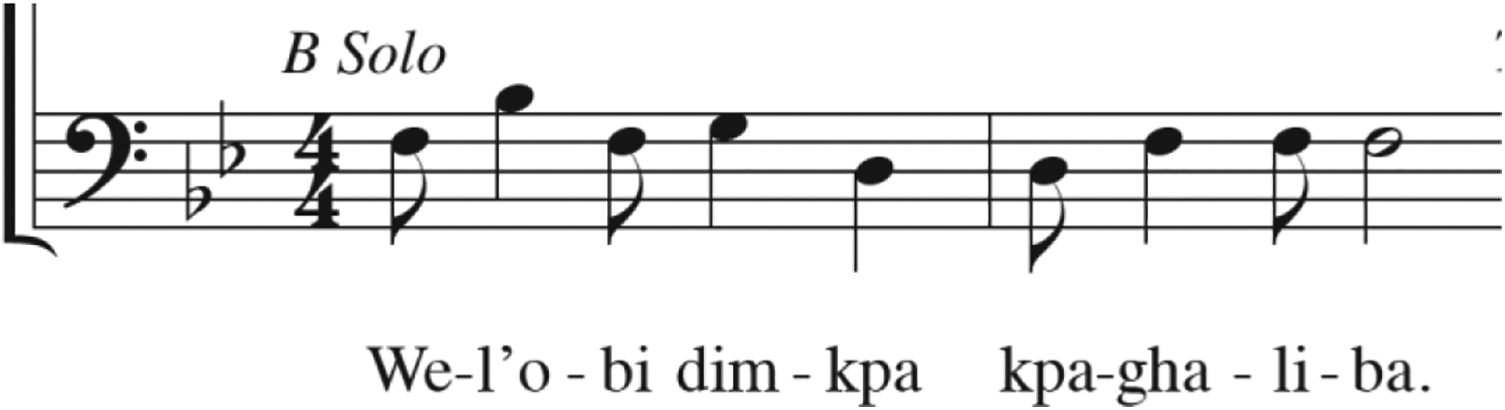
“Obi Dimkpa” (1980) by Laz Ekwueme, opening baritone solo, mm. 1–2.

“Swing Low, Sweet Chariot” mm. 5–6 (harmonization provided by hymnary.org).
Fux’s Gradus ad Parnassum (Steps to Parnassus) (1725) set the precedent of teaching species counterpoint as a core component of education for professional musicians (Fux & Edmunds, 1965). The treatise largely informs the practice of teaching voice-leading and part-writing to this day. In the section “The Melodic Line” of Kostka, Payne, and Almén’s Tonal Harmony (Seventh Edition), the authors provide examples of “good” and “not as good” melodies. After a few pages, the reader is prepared to “criticize each melody” based on a set of “procedures.” Regarding “contour”, melodies should primarily be “conjunct (stepwise)” and have a “single focal point.” Leaps must be handled carefully; they are “usually best approached and left in the direction opposite to the leap” (2014, pp. 66–69). Aesthetic preferences such as conjunct motion and “gap-fill” (a step in the opposite direction after a leap) are standard across current textbooks. Yet, the examples above, all from celebrated pieces of music, 2 do not quite fit. All three pieces have equal or greater parts disjunct motion throughout, and “Swing Low” does not follow the gap-fill principle. According to Kostka, Payne, and Almén’s rubric, these melodies would be “not as good” as examples that do follow these principles.
The title of Steven Laitz’s textbook, The Complete Musician (2012, Third Edition), suggests a more audacious claim than Tonal Harmony, but is largely consistent in the approach to teaching the writing of melodies and developing skills of “melodic criticism” to identify “weaknesses or problems” (2012, p. 45). In Laitz’s 11 examples of “Melody Over One Thousand Years”, he includes Bach and Beethoven (as to be expected); and also “Over the Rainbow” and Billy Joel’s “Piano Man” (2012, pp. 41-42), but not one melody by an African American or from any non-Western culture. An oversight perhaps. Laitz prompts students in the Exercise Interlude for “Melody: Characteristics and Writing” thus: “Play the following two melodies…Which one do you like more? Try to sing each one. Which is more singable and memorable? Why?” (2012, p. 45).
Primarily in the 1990s, David Huron conducted behavioral science studies to derive the familiar voice-leading paradigm from perceptual principles, including preferences for conjunct motion and gap-fill (2001). However, in his more recent book Voice Leading: The Science Behind an Art (2016), Huron points out (citing Carter-Ényì et al. 2013) that living in non-Western cultures (such as tone language cultures) may lead to different perceptual processes (2016, p. 203). Indeed, Huron’s findings from the 1990s were based on data collected from American college students. Other such findings based on “WEIRD” 3 populations have been hard to replicate cross-culturally (Henrich et al., 2010).
It is now almost 300 years since Fux published the Gradus ad Parnassum. Both European and European diasporic music have changed a lot. Westerners are now much more aware of music from non-Western cultures, and Western music has incorporated elements from non-Western cultures for more than a century. So why do Fuxian principles still compel us as educators? Salzer and Schachter wrestled with this question in the preface to their Counterpoint in Composition: The Study of Voice Leading (1969), at a time that could be considered more experimental musically than today: Why should it be necessary to devote time and effort to learning the principles of a musical language no longer employed by most composers?…the tonal language of the past might be termed dead in somewhat the sense that the Latin language is dead…however, the music of the past is far from dead. It lives, first of all, in the interplay between the performer and the sensitive listener. There still exists a considerable number of young performing musicians who are anxious to deepen their understanding of the music that, after all, constitutes the bulk of their repertory. (1969, p. vii)
“Bold and Ragged”: A Characterization of African Melody
Mieczyslaw Kolinski was the founding president of the Society for Ethnomusicology. Kolinski studied at a very traditional German conservatory, Hochschule für Musik in Berlin—but he also studied with Erich von Hornbostel at the University of Berlin. In 1965, Kolinski
4
applied contour analysis to melodies from Africa, Asia, Europe, and North America. He compares a “Dahomey Negro” melody (West African) to a “Kwakiutl Indian” melody (North American): …the melodic line of the Dahomean song is bold and ragged, contrary to the smoothness of the Kwakiutl song…the [Dahomean] melody descends from the highest tone a minor tenth down to the lowest one and then rises again an octave to the second highest tone (Kolinski, 1965) The melody smoothly swings up and down throughout the wide range of an eleventh. The remarkable balance in the structure of the melodic movement apparently results from the strong prevalence and variety of recurrent movements…(1965, p. 116)
Qualitatively, Kolinski’s descriptions for the three non-African melodies—“smoothly swings up and down”, “flows without interruption” and “remarkable balance”—are more positive than his adjectives for the Dahomey melody: “bold and ragged.” However, if “bold” refers to frequent leaps and “ragged” to frequent changes of direction, he is quite correct, which may observed in Figure 4.

“Dahomean Negro” melody (transcription by Kolinski, 1965).
A possible explanation for these observations of a song melody is the nature of Niger-Congo tone-level languages. Perceptual evidence (summarized in the next section) suggests the features of the Dahomey melody may have linguistic motivations.
Tone-Level Languages
It has now been nearly a century since J. J. Ransome-Kuti (Fela Kuti’s grandfather) wrote in a preface to a Yorùbá hymnal that “No [hymn] tune…can possibly express the meaning of words in a ‘tonic’ language such as Yorùbá, so well as one written specially for the words” (Ransome-Kuti, 1923), suggesting that the nature of African melody is linked to linguistic features. Readers from music theory and music cognition may be more familiar with work in the early 2000s investigating nPVI as a metric for rhythm in both language and music (e.g. Patel & Daniele, 2003), but more recently nPVI has been debunked as a metric (first for linguistics by Arvaniti, 2012, and for music by Condit-Schultz, 2019). 5 While musico-linguistic in nature, the tone-tune literature predates the stress-timing queries of the 2000s by nearly a century, and research remains very active to this day, particularly among linguists such as D. Robert Ladd and Murray Schellenberg.
Yorùbá belongs to the West-Benue Congo Branch of the Niger-Congo Language Family, which is concentrated in the densely populated coastal region of southern Benin and Nigeria, identified with a red box in Figure 5.

Public Domain (Wikicommons; Author: Ulamm 2007) 6 .
This region was known as the “Slave Coast” (Cust, 1883) and has hundreds of tone-level languages, including widely-spoken Ìgbò and Yorùbá (identified with red boxes in Figure 5). These cultures have had an immense global influence on music through the African Diaspora.
Tone-level languages like Yorùbá must be contrasted with tone-contour languages like Mandarin, in which pitch contrast may be articulated within a single syllable (see Table 1).
Mandarin /ma/ homograph 7 .

In Yorùbá (and other tone-level languages), pitch contrast is between syllables. 8
To describe tone-levels, linguists have drawn on Western music theory since the first grammar of Yorùbá (see Crowther, 1852). Welmers proposed a major triad to articulate three tone levels (1973). Today, “do-re-mi” is commonly used to teach Nigerian students the Yorùbá tone system (Akinlabi, 2004). Distinction between low-high, mid-high, and mid-low in otherwise identical words (as in Table 2) suggests tone is articulated through both direction and magnitude of pitch change. Phonetic analyses have revealed that tone levels do not behave like the fixed pitches of a piano (e.g. Connell & Ladd, 1990), but there was little perceptual evidence on interval direction and magnitude of tone-level change. 9
Yorùbá /igba/ homograph based on Abraham 1962.

In 2014, we conducted a study (n=1,409) 10 consisting of 5 primer stimuli (natural speech) and 20 experimental stimuli (pitch-modulated speech). For each stimulus, participants selected one of two images that corresponded to words of a minimal pair. The experimental stimuli were modulated between two words at semitone increments. 11 The study included minimal pairs differentiated by interval size alone (e.g. high-mid vs. high-low) and interval direction alone (e.g. high-mid vs. mid-mid).
Results indicate that tone-level contrast (for isolated disyllables) requires a greater and more varied range of pitch intervals than suggested by do-re-mi or a major triad. Approximately 48% of disyllables in Yorùbá and 60% of disyllables in Ìgbò form minimal pairs differentiated by tone alone (Carter-Ényì, 2016), so clear perceptual contrasts are often necessary. The language of the Dahomean song (from Kolinski, 1965) is most likely Fọn, a two-level language overlapping geographically with Yorùbá. There is less documentation of Fọn than Yorùbá, but it is known to be a tone-language relying on similar pitch contrasts. Based on the similarity of results for Yorùbá in Figure 6 and Ìgbò in Figure 7, a similar tone contrast profile is likely for Fọn. Fọn, Ìgbò, and Yorùbá all belong to the Volta-Niger (West Benue-Congo) family. The Dahomey kingdom, located in present-day Benin, was a part of the Yorùbá-speaking Ọyọ Empire in the 18th and 19th centuries up until becoming part of a French colony. Sourced second-hand, from Herskovits field recordings, the recording may or may not be correctly attributed to Dahomey or Fọn speakers, however the melody is most certainly sung in a tone-level language if it comes from the “Slave Coast” region.
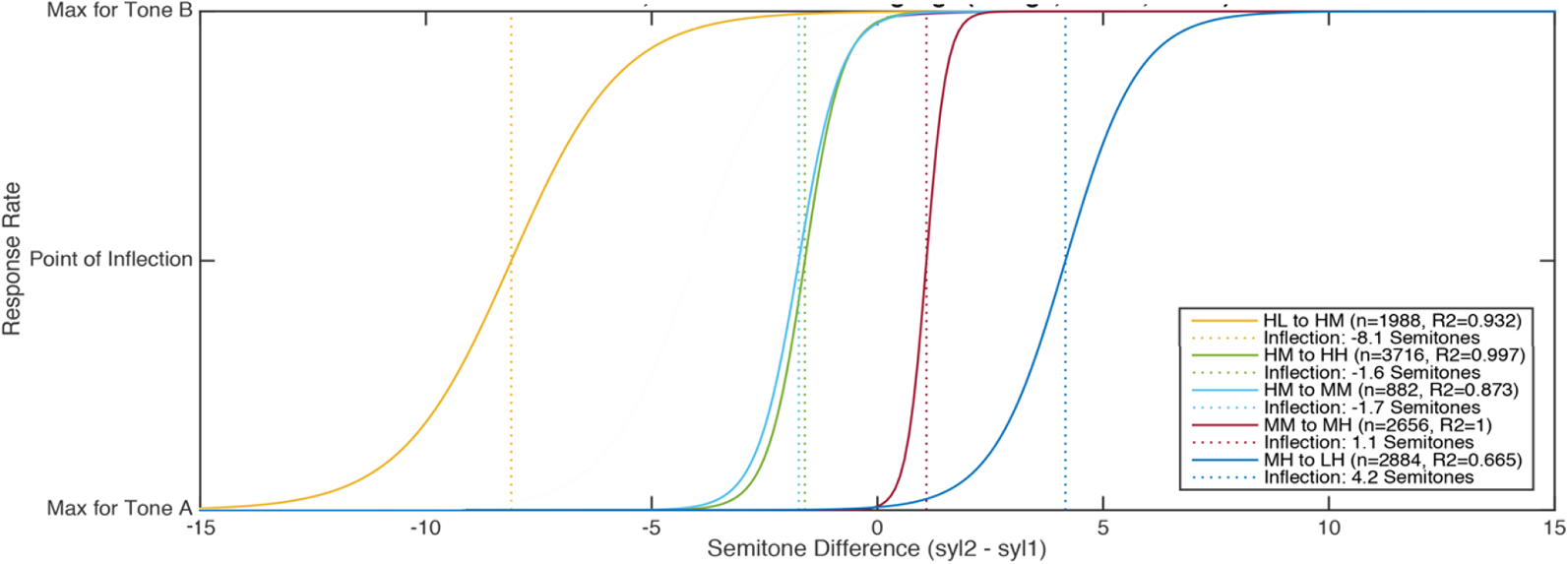
Semitone difference thresholds between adjacent disyllable tonemes (e.g. high-high and high-mid) for Yorùbá, a three-level tone language (H=high; M=mid; L=low) (Carter-Ényì & Carter-Ényì 2016).

Semitone difference thresholds between adjacent disyllable tonemes (e.g. high-high and high-step) for Ìgbò, a two-level tone language with downstep (represented by S) (Carter-Ényì & Carter-Ényì 2016).
Hypotheses, Materials and Methods
A plausible explanation for Kolinski’s assessment of the Dahomey melody as “bold and ragged” is that the melodic features of the song are motivated by linguistic features. It is clear from the full text of Kolinski’s analysis of the Dahomey melody (1965, pp. 116–117) that he finds the piece unusual for the largeness of the intervals and the frequent changes of direction (what Kolinski calls “flexures”, 1965, p. 98). 12 We have interpreted these two notable features as (a) mean interval size and (b) pivot frequency.
The first metric is a simple mean of the melodic interval size in semitones. Melodic intervals are the trajectory (direction and magnitude) between adjacent notes of a melody. For mean interval size, we first removed repeated pitches (a melodic interval of 0 semitones), then took the mean of all interval sizes (a major third up or down = 4 semitones). All intervals were included within individual pieces, including what may be phrase boundaries. Median interval size would avoid the effect outliers have on the mean. However, while mean may be influenced by outliers, we are interested in those outliers (i.e. large intervals). 13 Including a large interval in a piece is quite salient within a melody and so we do not want to mitigate this effect. Another important thing to remember is that even in relatively angular pieces the most common interval is steps.
Consider a piece that has the following collection of interval sizes in semitones (ordered from low to high, not in chronological order within the piece): 1,1,1,1,2,2,2,2,3,3,3,3
Versus this: 1,1,1,1,2,2,2,2,3,3,10,10
In both cases, the median would be 2 but we argue that the perceptual effect of have two large intervals (2 out of 12 melodic intervals) is salient perceptually, important from a traditional music theory analysis perspective, and therefor important statistically. So, in fact, a median could mask important aspects of angularity, as opposed to the mean. Furthermore, the median would be restricted to any discrete value because the intervals are discretized as semitones in integers (ordinal not continuous). On the other hand, with the mean, a data entry error could lead to a large interval and subsequently a distorted mean. Two extreme outliers in interval size were found within the large hymn corpus, in one, four measures had been transposed down an octave in error and this was corrected, the other was found to be a piano piece that we could not imagine being sung as a hymn.
The second metric is the pivot frequency. A “pivot” is operationalized as a note either higher or lower than both notes around it (local maxima/minima) and the pivot frequency is a simple proportion of notes that are pivots out of the total number of notes. There is the danger with this operationalization that ornaments such as trills could greatly inflate this metric. To this end, symbolic data in which ornaments were not encoded was used, i.e. it is the compositional not the performance surface texture of the melody.
The Dahomey melody yields the highest values for the two metrics of melodic angularity out of Kolinski’s four transcriptions, see Table 3. These two measures (mean interval size and pivot frequency) are consistent with the implications of Kolinski’s analysis. The Japanese and Kwakiutl melodies are particularly conjunct with few changes of directions (e.g. “smoothly swings up and down”), while the Dahomey melody is disjunct and frequently changes direction (e.g. “bold and ragged”. The French melody (1965 p. 114) is not extreme in either value, relatively close to the mean in both cases.
Calculations of mean interval size and pivot frequency for Kolinski’s transcriptions.

To study the extent to which angularity in West African melody distinguishes it from other musics, as Kolinski’s small sample of one song from each of four cultures suggests (1965), we gathered a larger selection of data to apply computational metrics. Our null hypothesis (H0) is that examples of West African melody as well as examples of African-American melody (which we consider culturally related to West African melody) will exhibit conjunct motion (small mean interval size) and linear continuity (low pivot frequency), consistent with the descriptions of “good” melody offered by theory textbooks in the introduction. We base our prediction that the null hypothesis is likely to be false on the linguistic motivations addressed in the previous section. 14 Though we predict that, by and large, African and African Diasporic sung melodies will have greater values for mean interval size and pivot frequency than common practice, comparative studies of tone language singing by Schellenberg (2012) and Carter-Ényì and Carter-Ényì (2016) both suggest that not all genres have the same fidelity within a culture. Thus, we have kept data divided by genre, even within the context of the West African data. While this reduces the number of items for each set of observational data, it provides more specificity in the results.
Admittedly, the West African (specifically Nigerian) data is relatively small. All of it was gathered by the authors in Nigeria from these sources: computer-assisted transcription of field recordings (oríkì by Adéyẹmọ and Ògúndepo, Nigerian Church Choruses); transcriptions of studio recordings by music students and faculty at the University of Nigeria Nsukka (Nigerian Story Songs); and electronic engraving files or scores directly from Nigerian composers. In all, there are 20 story songs selected from across the southeastern Nigeria by Danlami Baba (lecturer, University of Nigeria Nsukka) and recorded at the Sam Chukwu Memorial Recording Studio in 2019 and transcribed by Omodoro Ebruphiyor in 2020; 15 9 choruses transcribed from a 2014 recording at a church in Lagos, Nigeria; 4 choral compositions by well-known living Nigerian composers; and 2 transcriptions of Yorùbá oríkì (praise-singing). All of these are diatonic or modal music with the exception of the Yorùbá oríkì, which is chanted independent of a scale. 16
Because we are using new metrics for angularity, operationalized for this study, the first step in this process is to establish a baseline for metrics for the population that most corresponds directly (even on the surface texture) to voice-leading rules: chorales and hymns. As vocal music intended for community singing, hymnody’s “smooth” melodies correspond to music theory “rules” favoring step-wise motion and gap-fill. Fortunately, hymnody is widely available as data. We downloaded a publicly available corpus of hymnody from the Cyber Hymnal (hymntime.com). As of February 2020, the site “has over 14,100 Christian hymns & Gospel songs from many denominations & languages: Lyrics, sheet music, audio, pictures, biographies, history & more” (HymnTime.com2020). At the time of our download, we obtained a batch of over 7,000 files. Of these, 2,447 were usable with the “midi2nmat” function included in the MIDI Toolbox for MATLAB (Eerola & Toiviainen, 2004). For 1,289 files, we were able to link metadata including the nationality of the composer and year of composition. Ornaments such as trills could greatly inflate pivot frequency (and lower mean interval size). To this end, symbolic data in which ornaments were not encoded was used, i.e. it is the compositional not the performance surface texture of the melody. However, to distinguish between pivots beyond that would require going into theories of reduction (e.g. Schenker, Gjerdingen) that would create other confounds.
The year of composition metadata is particularly valuable because music scholars often think of how art music has changed (e.g. Wagner and Schönberg are far more angular than Palestrina and Bach), however, we believe that popular aesthetics have also changed as a result of globalization (since the colonial era). Taking hymns as a form of popular music, at least more populist than concert music, we also perform tests to reject this null hypothesis. While we had fewer predictions about subcorpora of the hymn corpus grouped by national origin, we also present measurements of the hymn corpus by country. Finally, out of curiosity we included other common practice music, particularly the music of Bach and Händel, who were contemporaries of Fux, and presumably closer to what Kostka and Laitz would compliment in their accounts of melodic writing, as well as Schönberg, who is known to be angular in his music. This was obtained from ELVIS and kunstderfuge.com.
Only the primary melody (not harmony) was analyzed, which was assumed to be the soprano unless otherwise indicated. Once the metrics for individual pieces were calculated, if they were grouped into corpora or subcorpora, the median for the grouping was calculated. In this case, the median was preferable because the yielded value is no longer restricted to integers. To check whether small corpora were likely to belong to the same population as the large corpus of hymnody, we used a “bootstrapping” method, detailed further in the results. 17
The experimental data were prepared by the authors and checked repeatedly. Because of the availability of scripts to process MIDI data into matrices, the MIDI toolbox was used in MATLAB was used to convert MIDI into note matrices and original scripts were written to calculate mean interval size and pivot frequency (MIDI toolbox). MATLAB scripts were written to implement the “Bootstrapping” statistical method used to compare the small corpora (observations) to random samples of the large hymn corpus. Links to publicly available data and all MATLAB scripts will be available in the supplemental materials.
Results and Discussion
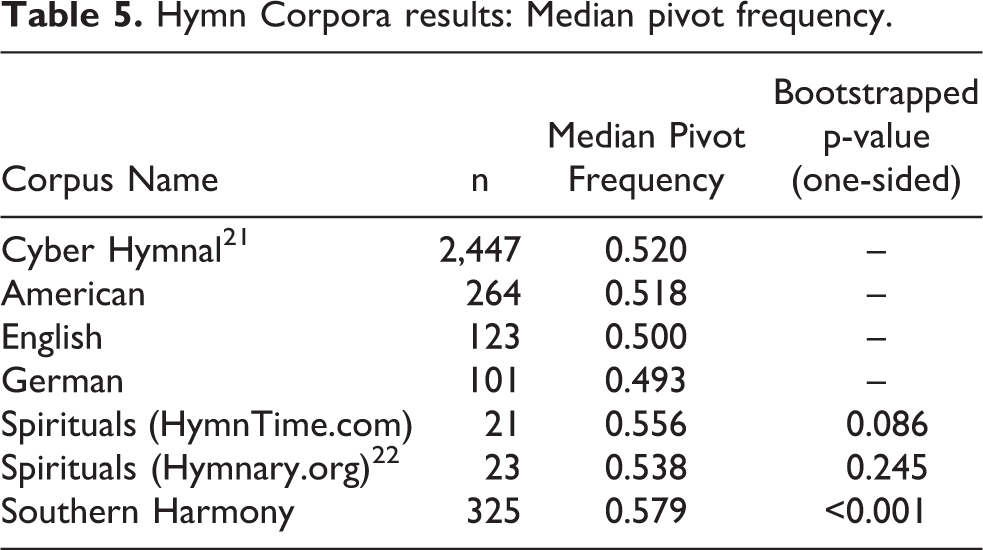
The hymn corpus itself has a median of the mean interval size of 2.839 semitones and is a moderately normal distribution with kurtosis of 1.438 and skewness of 0.662 (see Figure 8). 18 The distribution of the pivot frequency for all hymns is more normal (kurtosis=0.278; skewness: 0.212, see Figure 9). The p-values provided in Tables 4–9 represent the probability of getting values as or more extreme than the observed values based on the distribution of the population (in this case the 2,447 hymns from the Cyber Hymnal are used as the model distribution). With the exception of Tables 8 and 9, the p-values are provided as information and not intended to be viewed as hypothesis related. Based on many mean interval size values for the Cyber Hymnal (n=2,447) bootstrapping was used to estimate the probabilities for getting median values of the samples that are as extreme or more extreme than the observed median values in the drawn sample. As the sample size grows, from n=4 (as with the Nigerian art music) or n=9 (for the Nigerian church choruses), to Bach chorales (n=189), there is more certainty about the median of the mean interval size (according to the Central Limit Theorem). Bootstrapped P-values are included for subcorpora and corpora which are related to the alternate hypothesis that African, African Diaspora and music heavily-influenced by the African Diaspora (in this case, Southern Harmony) have greater angularity (as measured by interval size and pivot frequency) than more conventionally European music at large.

Distribution of the mean interval size for the HymnTime.com corpus.

Distribution of pivot frequency for the HymnTime.com corpus.
Hymn Corpora results: Median of the mean interval size.
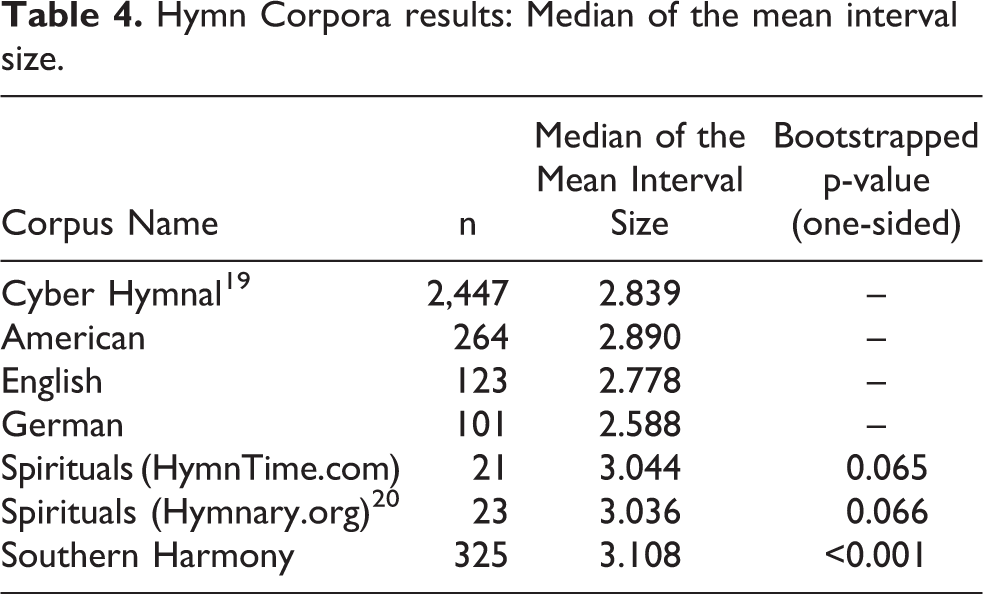
Hymn Corpora results: Median pivot frequency.
European Composer Corpora Results: Median of the Mean Interval Size.

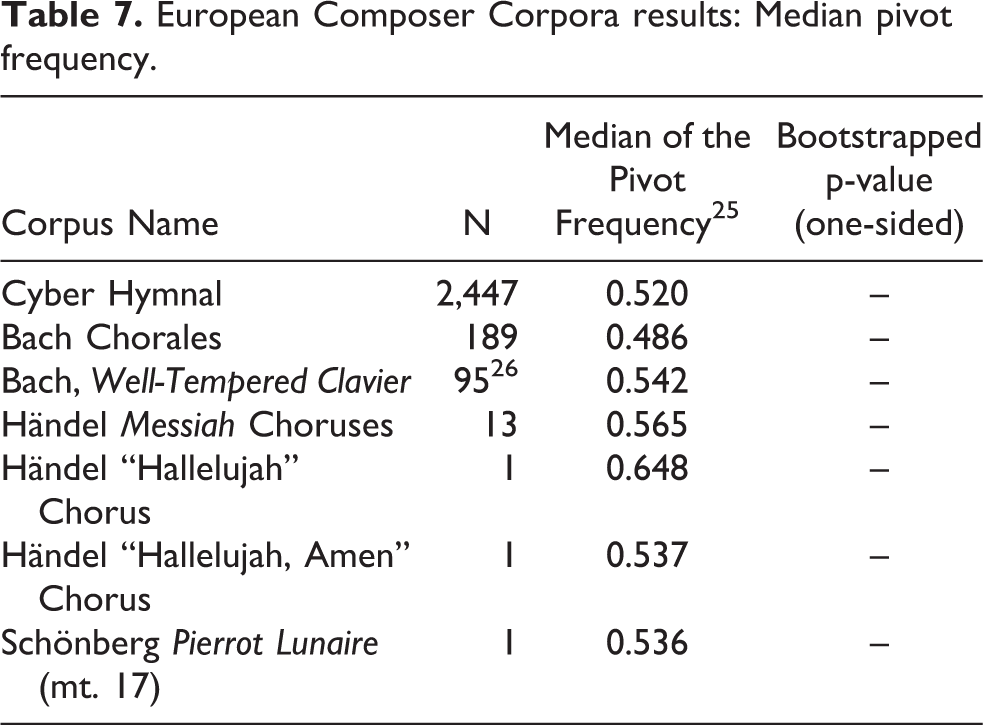
European Composer Corpora results: Median pivot frequency.
Nigeria Corpora Results: Median of the Mean Interval Size.

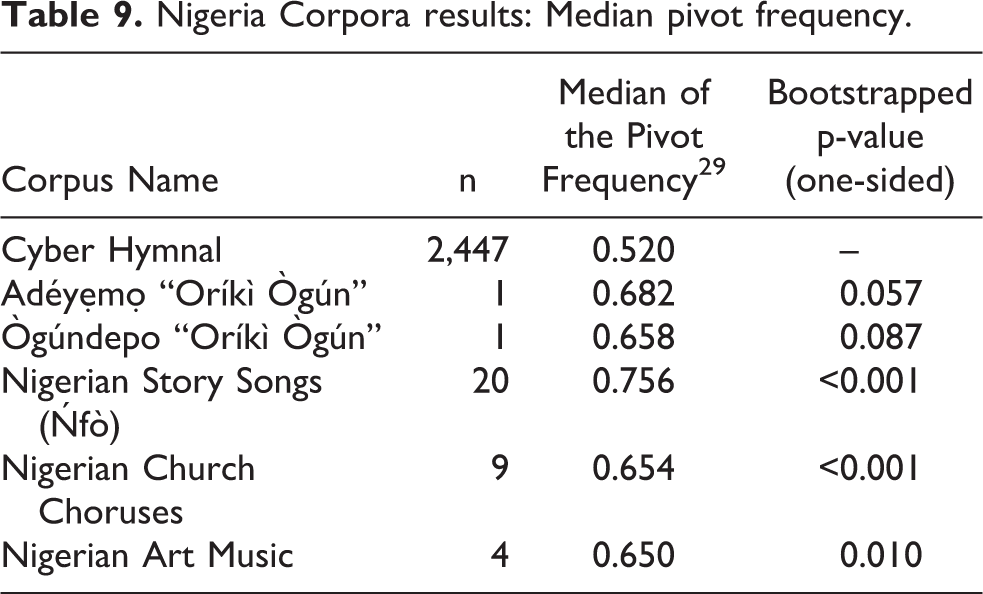
Nigeria Corpora results: Median pivot frequency.
In Table 4 and Table 5, there are subcorpora of the Cyber Hymnal classified by American, English, German, Spirituals (source: HymnTime.com), and two corpora from Hymnary.org: Spirituals and the Southern Harmony collection.
It is notable that American hymns, which are relatively newer, have higher values than English and German hymns. This is further explained through a sorting of hymns into periods based on metadata for the year of composition, displayed with a regression in Figure 10.

Hymns (with metadata) sorted into periods (slope = 0.115 semitones per century; r2=0.8395, degrees of freedom = 4, degrees of freedom adjusted r2=0.7994, sum of squares due to error (SSE) = 0.0283, root mean squared error (RMSE) = 0.0840.
American music (including hymnody) is influenced by greater ethnic diversity than European music. Values for specific hymn corpora, two for African-American Spirituals and the complete Southern Harmony collection (“white Spirituals”) are greater than results for the hymn corpus and national subcorpora. This indicates that the portion of the null hypothesis that refers to African Diaspora music and music influenced by it is likely false.
Table 6 and Table 7 present metrics and results for European art music, including Bach Chorales, Bach’s Well-Tempered Clavier, Händel Messiah Choruses, Händel “Hallelujah” (Chorus) from Messiah, Händel “Hallelujah, Amen” from Judas Maccabeus, and a movement (17) from Schönberg’s Pierrot Lunaire. Perhaps the most predictable result among European composer data was that Schönberg’s interval size is the largest of all the individual pieces considered. This is consistent with Anta’s claim that pitch dispersal is a “secondary determiner” of atonality (2017). However, tonal music may also be dispersed.
One of the most widely-recognized melodies (including in Africa), Händel’s “Hallelujah” chorus scores high in terms of interval size and pivot frequency (nearly 65%!). This is exceptional even within Händel’s oeuvre. The other choruses of Messiah and a similarly rousing chorus, “Hallelujah, Amen” from Judas Maccabeus, are more conjunct than hymns. The values are more consistent with Bach’s Chorales, at the extreme low end of both measurements. When we consider Chorales are the basis of much music theory pedagogy, it is no wonder African melody seems “bold and ragged” from a Western perspective. 27 Bach’s Well-Tempered Clavier is far more adventurous melodically, with values slightly exceeding the hymn corpus. Händel may have intentionally composed the vocal parts of the “Hallelujah” chorus more like instrumental parts. Melodic angularity and punctuated rhythmic motives set the piece apart and may make it memorable.
European classical music and hymns provide a reference point for angularity in West African melodies. The first two examples in Table 8 and Table 9 are field recordings of Yorùbá oríkì transcribed with Melodyne and exported to MATLAB for analysis. Oríkì is a form of praise-singing traditionally used for devotion to indigenous gods like Ògún (god of iron). These field recordings were made in 2013 and 2014. Mayowa Adéyẹmọ is a younger female poet, practicing in a traditionally male genre. Àlàbí Ògúndepo is an elder celebrated poet. They each rendered a version of “Oríkì Ògún” (praise of Ògún), two and six minutes respectively. The Nigerian Art Music small corpus includes two secular works, Èkwúèmé’s “Obi Dimkpa” (1980) in Ìgbò and Nwánkwọ̄’s “Ìyá Mi” in Yorùbá, as well as two sacred works, Olúrántí’s “Polongo Jésù” (1991, 1998) in Yorùbá and Nnam’s “Òtìtó Dìrí Chínēkè” (c. 2010) in Ìgbò. The Nigerian Choruses are transcriptions of popular Christian melodies transcribed from a recording of a Catholic church in Lagos, Nigeria. Finally, the Nigerian story songs (ńfò in Ìgbò) originate from ethnic groups throughout southeastern Nigeria and were recorded by students of the University of Nigeria, Nsukka in August of 2019.
Nigerian works yielded higher pivot frequencies than any European or American data (with the exception of the “Hallelujah” chorus), consistent with the theory that pivots are motivated by lexical tone contours of tone language speech. 30 Nigerian Traditional Music (Oríkì and story songs) and Nigerian Art Music is also attentive to interval size, but Adéyẹmọ’s “Oríkì Ògún” and the Western-influenced church choruses have narrower interval size.
It is understandable that Adéyẹmọ’s “Oríkì Ògún” and the Choruses did not have larger mean interval sizes. Adéyẹmọ has a high voice in comparison with Ògúndepo. Closer analysis reveals Adéyẹmọ carefully distinguishes between tone levels but does so within a narrower semitone range. 31 In Figure 11, we observe that there is a downward leap of roughly five semitones, but also many “steps” of around two semitones. Oríkì is performed in a chant vocal mode, not conformed to a musical scale, and may easily adapt to larger and smaller vocal ranges. The Christian praise choruses are simple melodies for community singing and much less faithful to tone. A change of two tone-levels might be set as a perfect fourth and a step within the same phrase. But these melodies still change direction a lot, suggesting that high pivot frequency (of the order of 2/3 of events) may be the most distinctive feature of West African melody (and Händel’s “Hallelujah” chorus). This is consistent with perceptual findings that suggest changes of direction may be the most essential part of the tone contrast (carry the greatest functional load, Carter-Ényì & Carter-Ényì, 2016).
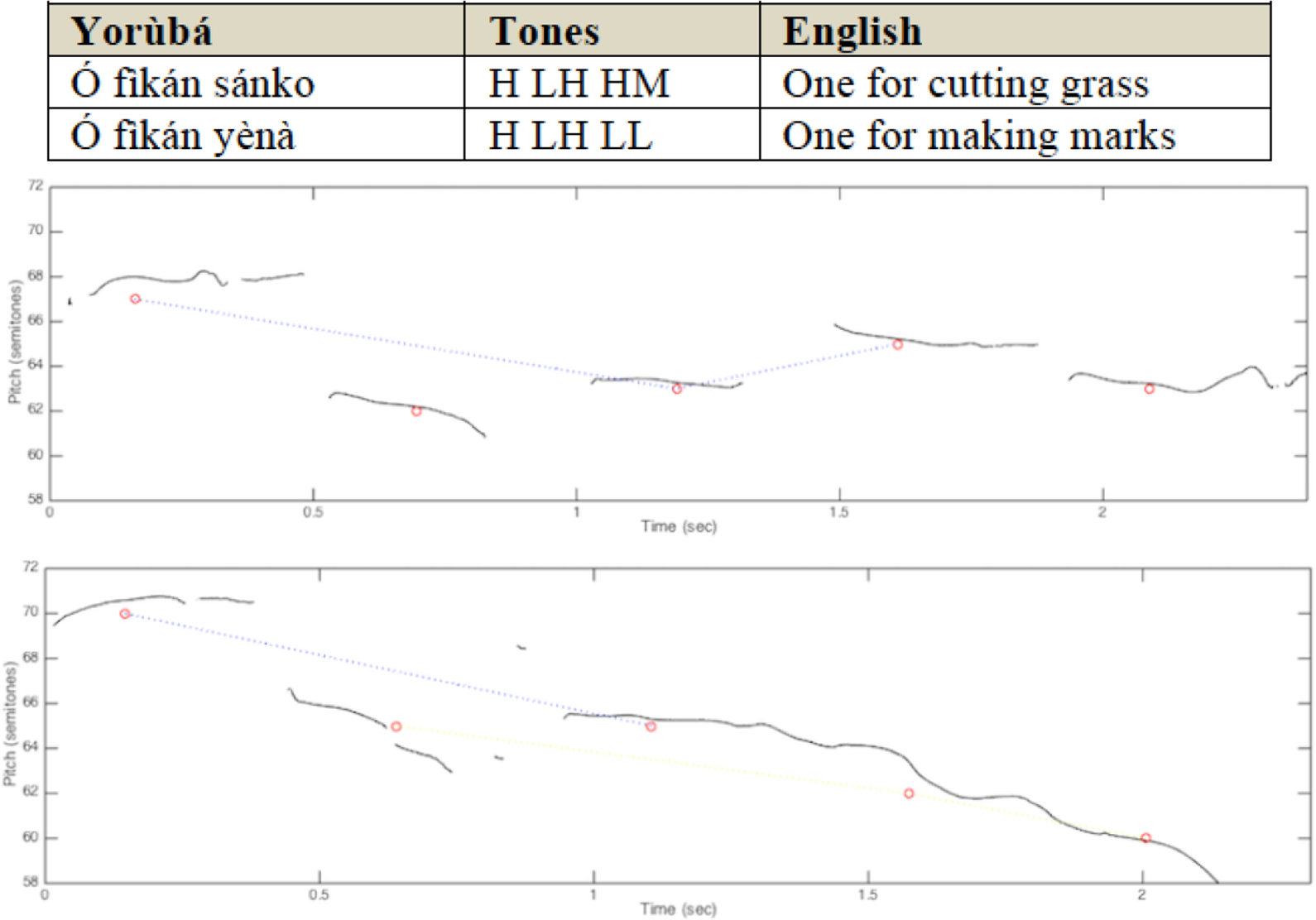
Excerpt from Adéyẹmọ’s “Oríkì Ogun”.
Conclusion
Many observations might be made about this comparison of individual pieces and small corpora to a large corpus of 2,447 hymns. Only the corpora of Nigerian story songs (ńfò, n=20) consistently set themselves apart from the hymns in both mean interval size and pivot frequency (with p-values of <0.001 across the board, see an excerpt in Figure 12). For the latter metric, pivot frequency, all Nigerian pieces stood out. Melodically, the Nigerian pieces form a stark contrast to Bach’s Chorales, which are perhaps the most Fuxian of the music examined. The hymns from the Cyber Hymnal are more of a middle ground between these two extremes. The Cyber Hymnal data includes items that are to some extent influenced by African music, particularly 19th century examples, such as Baptist and missionary hymns, and “black” and “white” spirituals (see below).

First eight measures of lead vocalist melody from “Shere” (Nigerian story song data).
Based on the linguistic background presented, we suggest that the results for the Nigerian music data reflect the influence of tone language culture. Author 1’s field research over the past decade and Author 2’s experience as a professional musician born and raised in Nigeria inform our observation that angularity is common in West African vocal melody, consistent with Kolinski’s comparison of four melodies from four cultures. When Author 1 first analyzed his 2011 field recordings from Nigeria, Author 1 experienced cognitive dissonance between a sincere appreciation of the music and finding that it exhibited many features he had been taught were “not as good” when writing melodies. 32 Given Kolinski’s dichotomous training, at Hochschule für Musik in a traditional conservatory environment and at the University of Berlin as an ethnomusicologist studying with Erich von Hornbostel, the Dahomey melody may have also challenged Kolinski’s notions of melodic construction. Kolinski’s comparative musicology mentor, Hornbostel, proposed that Africans were on average more musically talented than Europeans and he was aware of the linguistic motivations for melodic construction (1928, p. 60). One could imagine that Hornbostel’s words about the very same pieces might have a very different ring, perhaps not seeing the Dahomean melody as a marginal outlier, but as a refreshing and ingenious approach to melody.
Ethnomusicology has celebrated African rhythm, while largely ignoring African melody (see Agawu, 1995; Carter-Ényì, 2016). A few of the most influential writings to push forward African music as African Rhythm include Jones (1949), Chernoff (1979) and Keil (1987). A. M. Jones, a long-time missionary to Zambia (née Northern Rhodesia), coined the term “cross-rhythm” (1949). Participant-observer John Chernoff made cross-rhythms and multiple meters metaphors for Ghanaian society in African Rhythm and African Sensibility (1979). Based on fieldwork in Nigeria, Charles Keil introduced the still sexy concept of “participatory discrepancies” (1987). In theory, Keil’s “participatory discrepancies” do not apply to rhythm alone, but in practice, it has largely become a socio-theoretical stand-in for the less-delicious “polyrhythm”. For further critiques on the essentialist reduction of African music to African rhythm (and a continent to a single amalgamated culture) please see Kofi Agawu’s “The Invention of African Rhythm” (1995).
Two other observations stand out and deserve further investigation: (a) both African and European diatonic melodies may exhibit extreme angularity; and (b) mean interval size of African-American Spirituals and Southern Harmony exceed contemporary hymnody of the 19th century. These lead to critiques of music research and education.
George Pullen Jackson (1874–1953) argued that “black spirituals” were derivative of “white spirituals” and conducted an early corpus study for proof. 33 W.E.B. Du Bois’s account differs. He considered “sorrow songs” “the most beautiful expression of human experience born this side the seas” (1903). He identified four steps of development: (a) African melody; (b) “Afro-American”; (c) blending of “Negro and Caucasian” (a creolization); and (d) songs of white America influenced by “sorrow songs” (1903). Individual spirituals likely have individual stories, but generally, we trust Du Bois’s account. As African-American Spirituals and Southern Harmony exhibit greater interval sizes than hymnody at large, this is partially an argument over credit for angularity, as opposed to guilt over angularity (e.g. Kolinski, 1965), which we embrace. These corpora share the feature of large intervals with West African music, but not frequent pivots. Frequent changes in direction are highly motivated by tone language, so without the language, pivots may have faded as a melodic feature in diaspora. This is consistent with Du Bois’s theories on cultural retentions: “The songs are indeed the siftings of centuries; the music is far more ancient than the words” (1903). Although enslaved Africans in the United States were “seasoned” to rid them of their language and culture, the preliminary findings in this area (that were separate from the main hypothesis testing) are more consistent with Du Bois’s account than Pullen Jackson’s.
In contrast to Jackson’s life-long quest to claim spirituals as white culture, Kolinski’s description of the Dahomey melody as “bold and ragged” is not purely racial bias alone. An unfortunate dichotomy exists between music history and music theory education which likely influenced Kolinski’s ethnomusicological pursuits: music history teaches about the “great” composers and music theory teaches about conformed practice—which the “greats” often defy. This is a toxic combination. And while Kerman in “How we got into analysis…” (1980), perhaps justly, criticized music theory research for failing to synthesize analysis into aesthetic judgments, music theory teaching most certainly does operationalize aesthetics with every note we mark as wrong on compositional exercises. Most theory textbooks focus on cherry-picked examples that reinforce the “rules” and avoid examples by the same composers that do not. Even when non-classical and/or non-Western examples are integrated, they are often examples sought out to once again reinforce Western aesthetic preferences. Undergraduate music theory teaching does highlight Schönberg’s music as angular, but this does not necessarily help the case for accepting angularity as a desirable melodic practice, because his music is widely understood to be brilliant, but also challenging to the listener. The finding that helps to redefine angularity, not as “bold and ragged”, but as distinctive and appealing, is that Händel’s “Hallelujah” chorus is the most similar to West African melodies in terms of both interval size and pivot frequency. Justifying African music with European music is a bit distressing, so it might help to also note that Nigerians love Händel—out of all the composers introduced during colonialism. It is not based on any intimation by Ekwueme, but there is apparent similarity between the opening soprano of the “Hallelujah” chorus (Figure 13) and the opening call of Obi Dimkpa (Figure 14): both have a prominent and long high “do” followed by a leap down to “so” and quick step up to “la” on beat 3 (see Figure 13 and Figure 14). Though angular (and unusual to leap down at the beginning of a melody), they do both follow the “gap-fill” principle—Ekwueme received his PhD in Music Theory from Yale in 1972.
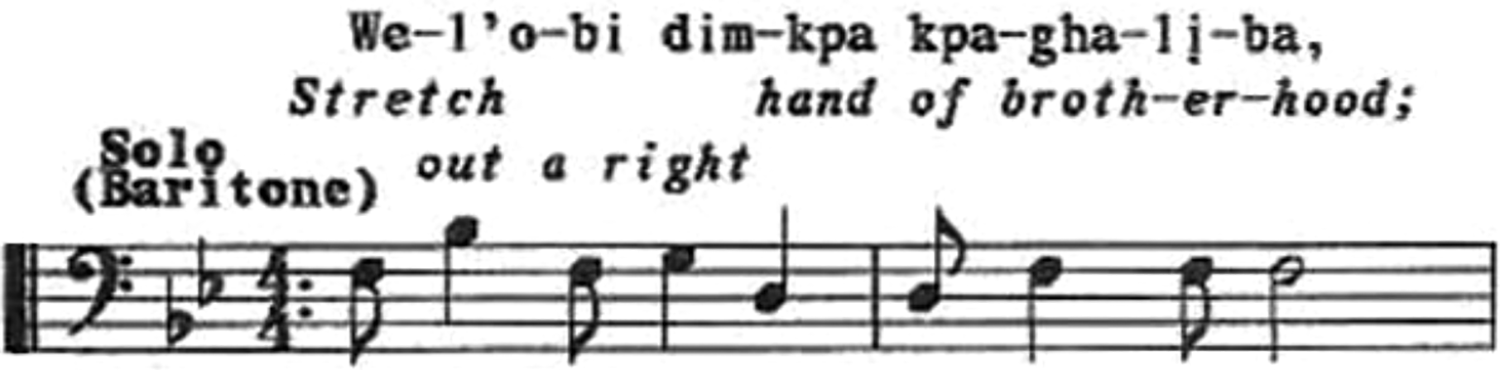
Opening call (solo voice) of “Óbi Dím̀kpá”(1980).

Opening soprano of Händel’s “Hallelujah” chorus.
In Nigeria, these two pieces are both standard repertory for choirs. As we begin to recognize that “the bulk of the repertory” 34 is changing for students around the world. We recommend techniques of melodic construction taught by music theorists, especially preference rules for step-wise motion and gap-fill after leaps, be consistently tempered with counterexamples to better reflect broader musical aesthetics (beyond chorales and hymnody). One avenue is to introduce popular music, African and African Diaspora music, and other non-Western music. However, there are also many examples from the European canon that are highly angular (like Händel’s “Hallelujah”). This will better equip performers and educators for current music practice. 35
Footnotes
Contributorship
Omodoro Ebruphiyor (University of Nigeria Department of Music) transcribed the twenty recordings included on the album Nfo: Stories and Choruses by Lions of Nsukka (2019, University of Nigeria Department of Music/Africana Digital Ethnography Project). The album is available through streaming services and the score transcriptions are available through the Africana Digital Ethnography Project ( ).
).
Declaration of conflicting interests
The author(s) declared no potential conflicts of interest with respect to the research, authorship, and/or publication of this article.
Funding
The author(s) disclosed receipt of the following financial support for the research, authorship, and/or publication of this article: Field recordings and transcriptions used in this study were funded by grants from the American Council for Learned Societies (ACLS) and the National Endowment for the Humanities (NEH) for the Africana Digital Ethnography Project (ADEPt) of Morehouse College.
Action Editor
Andrew Goldman, Western University, Faculty of Music.
Peer Review
Lindsay Warrenburg, Ohio State University, School of Music. One anonymous reviewer.
