




Abstract
Mehrabian and Russell’s Pleasure-Arousal-Dominance model states that people’s interactions and interpretation of their surroundings result from variations in three factors – pleasure, arousal, and dominance. Applied to music, pleasure has been operationalized as how much a person likes the music heard, arousal as how arousing the person considers the music to be, and dominance as the person’s control over the music heard. However, conceptualizing dominance broadly as control means that the construct is not well defined. This research aimed to define the elements related to a listener’s desire for control over music encountered in everyday life. Participants residing in Australia and USA (N = 590) completed an online questionnaire. An exploratory factor analysis of the quantitative items identified five components defining control over music listening: “being personally in charge”, “selection by other people”, “contextual control”, “playback variety”, and “no need for control”. A thematic analysis of open-ended responses indicated additional facets of control including mood regulation, emotional investment, and identity. While the quantitative findings reaffirm previous research, the qualitative findings indicate previous conceptualizations of the control dimension have been limited. These results contribute to our understanding of the model’s dominance component with regard to explaining everyday music listening.
Introduction
Music is increasingly widespread and available in everyday life (Heye & Lamont, 2010; Juslin et al., 2008; Skånland, 2013) – in part due to the increased use of mobile (and internet-based) music listening technologies (Juslin et al., 2008; Krause et al., 2015; Liljeström et al., 2013; Skånland, 2013). Mobile listening devices, such as smartphones, MP3 players, and tablets, not only allow for music to simply be experienced in a large variety of settings (Heye & Lamont, 2010; Juslin et al., 2008; Krause et al., 2016). They also arguably allow for music listeners to have greater control over what they listen to and when (Greasley et al., 2013; Krause et al., 2014). Research has shown that the concept of control is related to everyday music listening (e.g., Greasley & Lamont, 2011; Juslin et al., 2008; Krause & North, 2016a, 2017a). Therefore, there is the need for a theoretical understanding of control pertaining to everyday music listening, to which researchers have suggested applying Mehrabian and Russell’s (1974) Pleasure-Arousal-Dominance model (e.g., Krause & North, 2017a, 2017b).
Literature review
Mehrabian and Russell’s (1974) Pleasure-Arousal-Dominance model
The Pleasure-Arousal-Dominance model theorizes that human emotional and behavioral responses in different environments result from changes in three dimensions: pleasure, arousal and dominance (Mehrabian & Russell, 1974). Each dimension can be considered as a bipolar continuum with individual responses placed somewhere along each continuum; and it is the combination of their locations on each continuum which defines an individual’s response to the environment (Mehrabian & Russell, 1974). Pleasure-displeasure refers to the individual’s feeling state, arousal refers to the degree to which the individual feels stimulated, active, or alert in the environment (from sleep to frantic excitement), and dominance-submissiveness refers to the degree of control the individual feels they have over the environment (Andersson et al., 2012; Hines & Mehrabian, 1979; Mehrabian & Russell, 1974). In the case of everyday music listening, researchers have translated pleasure to refer to how much the individual likes the music, arousal to refer to the individual’s perception of how arousing the music is, and dominance as reflecting the idea of control over what is heard (Krause & North, 2017a).
There exists a wealth of evidence concerning pleasure and arousal in everyday music listening (Greasley & Lamont, 2011; Heye & Lamont, 2010; Juslin et al., 2008; Liljeström et al., 2013; North et al., 2004). Until recently, dominance in everyday music listening had been largely unexplored; and, indeed, research has historically debated the relevance of the third, dominance dimension in part because of research that has focused only on the arousal and pleasure dimensions (e.g. Desmet, 2010; Donovan et al., 1994; Mattila & Wirtz, 2001). However, recent work has highlighted the importance of dominance in explaining people’s behaviors (Yani-de-Soriano & Foxall, 2006). Research findings (e.g., Mehrabian et al., 1997; Yani-de-Soriano & Foxall, 2006) illustrate that people prefer being in situations that support feelings of pleasure and dominance. Indeed, this is also true with regard to people’s responses to music specifically: for example, dominance, operationalized as degree of control over the music influences a people’s responses to both the music and the overall situation they are in (Krause & North, 2017a, see also Krause & North, 2017b).
Given that the three dimensions map onto much of the previous work on musical likes and dislikes with regard to environmental responses to music and because the dominance dimension, in particular, allows for the explicit consideration of control, the Pleasure-Arousal-Dominanc model offers a theoretical framework for examining and explaining everyday music listening. What is necessary, however, is additional consideration of how to define dominance. Its conceptualization as control has arisen from previous research which has expanded on the role of selection and choice in efforts to consider control – for instance, Krause et al. (2014) advocated for a continuum rather than a dichotomy (e.g., distinguishing between having a choice and not having a choice as in North et al., 2004). As researchers have previously remarked, further research is needed to fully conceptualize dominance with regard to everyday music listening (see, e.g. Krause & North, 2017b).
Possible components of control
Control in everyday music listening has been associated with some aspects of the listening context. This has included the location (as well as the associated social norms and activities of varying locations), time of day, presence of other people, and how the music is accessed (Greasley & Lamont, 2011; Juslin et al., 2008; North et al., 2004).
Music is heard in a large variety of locations, at different times of the day, and during different activities (Greasley & Lamont, 2011; Juslin et al., 2008; North et al., 2004; Nowak, 2016). Importantly, the context plays a role in how listeners experience and exert different levels of control over the music heard (Greasley & Lamont, 2011; Greb et al., 2018, 2019; North et al., 2004). Greater control is often associated with private locations, such as in the listener’s home (Greasley & Lamont, 2011; North et al., 2004), with less control associated with public locations, such as in a pub or in a shopping center. However, Krause et al. (2016) found that people reported having a lot of choice in their listening and paying greater attention to music heard in public places when using mobile devices.
The presence of other people can influence the amount of (perceived) control someone has over music heard in everyday life (Greasley & Lamont, 2011; Liljeström et al., 2013; North et al., 2004). While listeners can have more intense emotions when listening with close friends as compared to when listening alone (Liljeström et al., 2013), listening in the presence of others can involve some sacrifice of control, as participants often have to negotiate music choices when others are present (Greasley & Lamont, 2011).
Control over everyday music listening has also been associated with how the music is accessed (Krause et al., 2014, 2015). Personal devices, such as MP3 players, are associated with a larger amount of control as they allow the user to create their own listening space and dictate what music constitutes this; whilst devices such as loudspeakers broadcasting music in public have been associated with a lower amount of control, as they present music selected by others, un-influenced by the listener (Krause et al., 2015; Skånland, 2013). Moreover, the selection method, or how the listener selects the music they listen to, influences control: a higher degree of control is associated with selection methods such as specific album, specific artist, and one’s own playlist as compared to another person selecting the music (Krause et al., 2014).
Having control over music listened to is associated with a range of positive outcomes and emotions. For example, individuals use MP3 players to help create private spaces, within which they could more easily focus on their state of mind and regulate their mood (Skånland, 2013). Additionally, higher amounts of control over everyday music engagement is associated with valued outcomes including relaxation and concentration (Greasley & Lamont, 2011), as well as feeling content and motivated (Krause et al., 2015), and higher levels of liking the music heard (Krause et al., 2014; Liljeström et al., 2013).
Other conceptualizations of control in psychology
In addition, people’s overall desire to have control over the music heard may differ. Thus, in order to better understand control in terms of everyday music listening examining psychological constructs, such as locus of control and time perspective, is also required. Previous research illustrates that individuals who possess an internal locus of control exhibit more information seeking and planning behavior, than those possessing an external locus of control (Das et al., 1995; Davis & Phares, 1967; Prociuk & Breen, 1977). It is possible that self-chosen music might represent an expression of internal control, as the individual is choosing the music; while music chosen by others might then pertain to external control, as the choice is the result of someone other than the individual. Additionally, in terms of everyday music listening, some listeners might desire to control their music, not only to suit their needs, but to also optimize everyday experiences (Heye & Lamont, 2010; North et al., 2004; Skånland, 2013) which could be considered an expression of possessing a stronger internal locus of control.
Time perspective, or the awareness that thoughts and behaviors in the present can have implications for the future (Keough et al., 1999; Zimbardo & Boyd, 1999), can be biased to a future or present orientation (Keough et al., 1999). Present-orientated individuals portray high impulsivity, little concern for actions, and live in the present moment; future-orientated time individuals are conscientious, goal setters, and ambitious (Keough et al., 1999). As time perspective influences decision making and control (Keough et al., 1999), an individual’s time perspective may explain the motivation behind musical control and listening choices. Time perspective could be interpreted as the anticipation of future listening needs; an area of research that has previously been neglected (Krause & North, 2016b).
The digitization of music and increased accessibility provides an opportunity for individuals to plan their music in advance. For example, playlists and mobile devices allow individuals to prepare their music for certain contexts. Playlists require an aspect of planning and organization (DeNora, 2000). It is this preparation and planning associated with playlist listening that could be related to an individual’s expression of control. Specifically, future biased time perspective individuals engage in future planning needs, which could be associated with future listening needs. Yet, on the other hand, playlists can be used to enhance an activity, or to reach a certain goal. Krause and North (2016b) examined playlist listening and time perspective, finding an association between the use of playlists with present time perspective. Therefore, research into conceptualizing control and its various dimensions can look into this relationship with time perspective.
The present research examines the potential relationships between these psychological constructs and control in everyday music listening alongside the consideration of individual differences often considered in music research, including age, gender, and music engagement (e.g., one’s degree of interest in and style of engagement with music). Music listening is technologically dependent (Avdeeff, 2012). Besides the fact that research indicates that younger people are more likely to favor digital technologies (Avdeeff, 2014) and be frequent early-adopters of newer technologies (Tepper & Hargittai, 2009) as compared to older people, one’s age is also related to experiencing the predominant music listening technologies available at any certain time. Today, digital media pervades the listening landscape, with the adoption, and use, of streaming services growing (International Federation of the Phonographic Industry, 2017). Streaming allows for access without ownership, and digital downloads make it possible to purchase single songs as opposed to albums: the vast options that these technologies afford allow for greater user input and control. It is possible, then, that younger individuals may desire more control over their listening due to the current technological landscape.
Previous research has identified that listening motivations can vary by gender: research has shown that females tend to be more skilled than males at selecting music to manage mood (North et al., 2000; Sloboda, 1999). Additionally, listening motivations may be related to listening styles. Greenberg and Rentfrow (2015) defined five different listening engagement styles, distinguishing between physical, cognitive, narrative, affective, and social styles. They highlight how some people focus on the lyrics and musical narrative, while others cognitively process the music or respond physically to music. Recent research indicates that the usage of different formats (i.e., streaming services versus physical formats) was associated with different engagement styles (Krause & Brown, 2019). If different formats afford users different levels of control and the use of different formats is associated with certain engagement styles, then it is possible that there may also be associations between engagement style and the desire for control over one’s listening. Similarly, the level of importance one gives to music in everyday life has been associated with the amount of music heard (Krause & North, 2017b; Krause et al., 2015) as well as ratings concerning being engaged in the music heard (Krause & North, 2017b). Consequently, it is reasonable to consider whether those who place higher importance on music in their lives also desire more control over their listening.
Research questions and hypotheses
The present research was driven by asking: How is control defined in terms of everyday music listening? This research question was addressed in two ways. First, the research examined the dimensional nature to defining this construct using a tailored set of quantitative items. It was hypothesized that the items would group together into factors that would meaningfully define components of the broader concept of control (H1). While exploratory in nature, based on the previous work reviewed earlier, it was predicted that possible factors could relate to the presence of others, listening context, and how music is accessed. To overcome the limitation introduced by relying on researcher definitions and consider the concept broadly, a qualitative component of the research solicited individual listeners’ definitions of control with regard to their own listening. Again, it was hypothesized that participants’ responses would result in a small number of thematic components of control (H2).
A subsidiary question explored the desire for control over music listening with regard to time perspective and locus of control, when controlling for individual differences. In particular, it was hypothesized that (H3a) a stronger internal locus of control would be positively associated with higher overall (‘composite’) scores on a measure of desire for control. A non-directional hypothesis was also made that (H3b) time perspective would be associated with higher overall scores. Based on the connection between planning ahead and future time perspective, future time perspective could be positively associated with a greater desire for control. Based on Krause and North’s (2016b) findings, however, present time perspective could be positively associated with a greater desire for control, reflecting the desire to enhance one’s current activity with music.
Method
Participants
A sample of 590 people aged 17–74 (M = 24.28, Mdn = 21, SD = 9.65) completed the online questionnaire. The majority of the sample was female (70.60%), while 28.90% were male and 0.50% trans male. Of the 590 individuals, 296 (50.20%) resided in Australia and 294 (49.80%) resided in the United States of America. Less than a quarter of the sample (22.90%) considered themselves to be an “active musician”.
Snowball sampling was used. This involved word of mouth, printed flyers around a University campus, social media posts (e.g., Facebook and Twitter), advertising on the lead investigator’s website and online research participation websites, and a University undergraduate student research participation scheme. Students who participated via the University’s research participation program received course credit as compensation. Members of the community had the opportunity to win one of two gift vouchers, as a participation incentive.
Measures
Participants reported their age, gender, and country of residence through simple, single-answer questions.
A 31-item Desire for Control Over Listening Scale (see Table 1) was specifically created for this study. Participants indicated the degree to which each item (e.g., “I prefer my own playlists more than those made by others”) was characteristic of them on a 7-point scale (1= not at all characteristic to 7= extremely characteristic). Items were generated based on the findings of previous literature concerning the presence of other people, context, device used and selection method (e.g., Greasley & Lamont, 2011; Juslin et al., 2008; Krause & North, 2016a; Krause et al., 2014; Liljeström et al., 2013; North et al., 2004). An initial pool of 75 items was refined to 31 items by (1) removing unclear or repetitive items, and (2) a review by an independent music psychology expert. A factor analysis performed on the responses to these 31 items, further described in the Results section, permitted consideration of factors that meaningfully define components of the broader concept of control (Hypothesis 1). Additionally, computing composite scores for participants permitted testing Hypothesis 3.
Factor loadings for the principal components analysis with promax rotation of the “desire for control over listening” items.
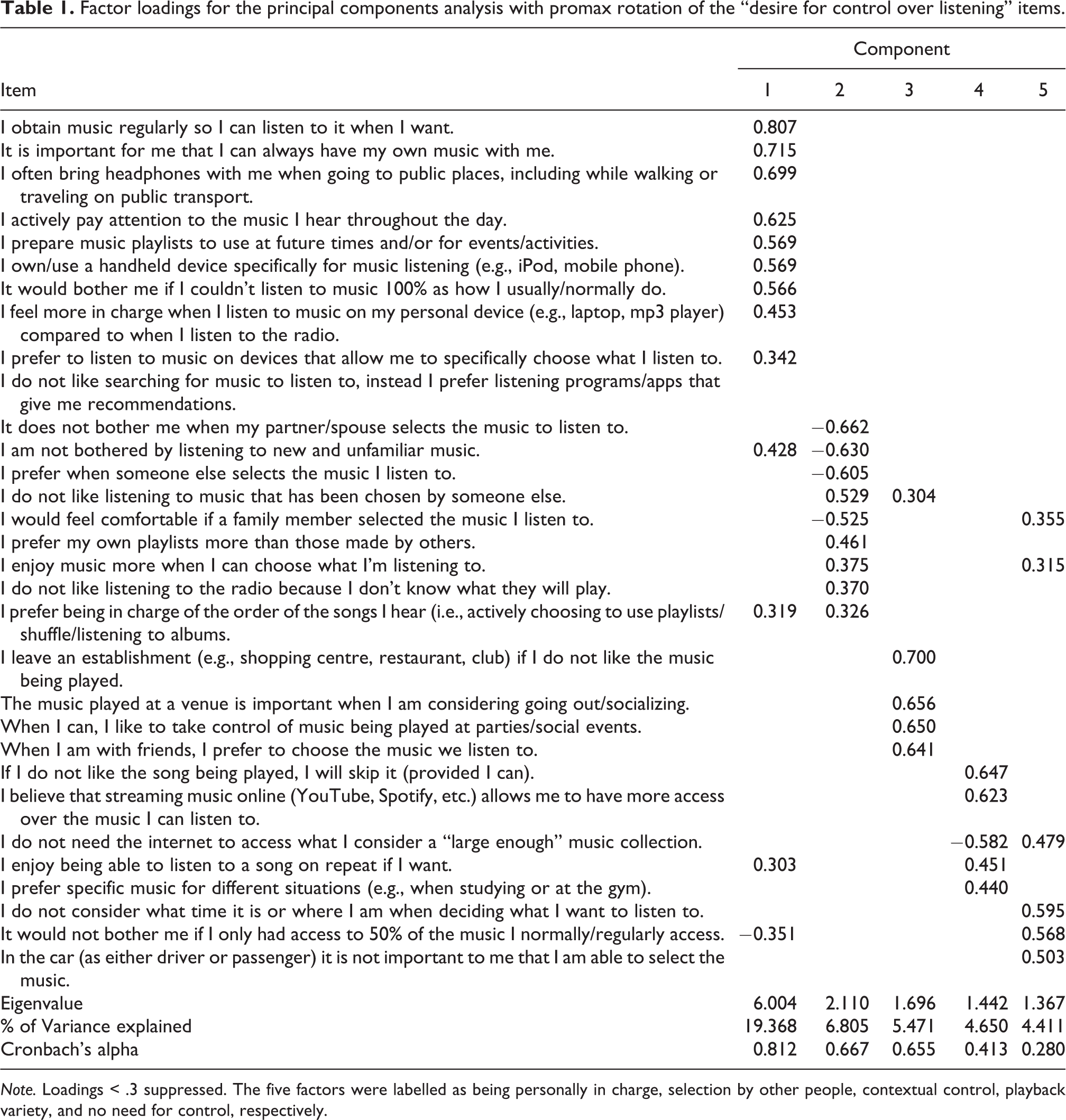
Note. Loadings < .3 suppressed. The five factors were labelled as being personally in charge, selection by other people, contextual control, playback variety, and no need for control, respectively.
Two open-ended questions asked the participants to describe what having, and not having, control over the music they hear in everyday life means to them. These questions were worded as, “Please tell us in the space below what ‘having control over the music you hear in everyday life’ would mean to you” and “To you, what would it mean to NOT have control over the music hear in everyday life?”
Rotter’s (1966) Internal-External (I-E) Scale was used to assess the degree to which participants’ possessed an internal or external locus of control. This 29-item forced-choice measure asks participants to select one of two statements as the one they most agree with (e.g., “What happens to me is my own doing” or “Sometimes I feel that I don’t have enough control over the direction my life is taking”). Scores range from 0 to 23; higher scores are representative of a more internal locus of control. This measure demonstrates reasonably high internal consistency (Rotter, 1966), and adequate test-retest reliability (Layton, 1985; Rotter, 1966). Cronbach’s alpha for the I-E Scale score in the present study was .689.
To measure time perspective, participants completed the Zimbardo Time Perspective Inventory (ZTPI short form; Zimbardo et al., 1997). This measure consists of two subscales; 13 items address “future time perspective” (e.g., “Thinking about the future is pleasant to me”) and nine items address “present time perspective” (e.g., “If I don’t get it done on time, I don’t worry about it”). Participants indicate how characteristic each statement is using a five-point Likert scale (1 = not characteristic to 5 = extremely characteristic). Present and future time perspective mean scores were computed for each participant. Used in prior music-related studies (e.g., Krause & North, 2016b), the ZTPI has demonstrated practical internal reliability and test-retest reliability (Keough et al., 1999; Zimbardo et al., 1997). The Cronbach’s alphas in the present study (future time perspective = .767 and present time perspective = .669) reflect previously reported values (Keough et al., 1999; Krause & North, 2016b; Zimbardo et al., 1997).
Individuals responded to a series of questions concerning their level of music engagement. Participants indicated whether they considered themselves to be an “active musician” (a yes/no response), rated the importance of music in their life (on a seven-point scale, where 1 = not at all and 7 = extremely), and estimated the average number of hours they listened to music daily. Individuals also completed the Musical Engagement Test (MET; Greenberg & Rentfrow, 2015). The MET asks people to rate their agreement with 23 items using a seven-point scale (1 = not at all characteristic, 7 = very characteristic) in order to define people’s style of musical engagement on five dimensions. Dimensions include: physical (e.g. item: “Music makes me want to dance”), cognitive (e.g., “When listening to music, I try to deconstruct the different elements of the song or composition”), narrative (e.g., “When listening to music, I try to understand the underlying meaning of the lyrics or sounds”), affective (e.g., “I can overcome painful emotions when I listen to music”), and social (e.g., “I identify with the musicians that I listen to”). A mean score for each dimension was computed; higher scores denote that the participant tends to engage with music in that particular way. For the present study, Cronbach’s alpha values were .874, .868, .855, .899, and .848 for the cognitive, affective, physical, narrative, and social dimensions respectively.
Procedure
The Curtin University ethics committee approved this study (Approval number RDHS-72-16). Participants accessed the study online using a weblink to the Participant Information Sheet. Participants indicated their consent prior to viewing and completing the questionnaire as a series of webpages. Following completion of the questionnaire, participants were debriefed and then had the opportunity to enter their details for the prize draw or to receive course credit through the research participation program.
Results
Facets of control/dominance
Quantitative measure
To investigate the underlying structure of the 31 items, the responses were subjected to principal components analysis with promax rotation (selected because the factors could be correlated – Allen et al., 2019). Parallel analysis indicated that five factors could be expected; therefore, the principal components analysis was run forcing a five-factor solution. The Kaiser-Meyer-Olkin measure of sampling adequacy was .862 and Bartlett’s test of sphericity was significant (p < .001). In combination, the five factors accounted for 40.383% of the total variance (Table 1). Bivariate correlations amongst the five factors are presented in Table 2.
Correlations amongst the factors resulting from the components analysis (N = 590).

*** p < .001
Items pertaining to the importance of personally controlling music access and selection loaded onto the first factor, labelled “being personally in charge”. Items pertaining to being comfortable with other people (such as friends and partners) selecting music to be heard loaded onto the second factor, labelled “selection by other people”. Items regarding music in specific social settings and events loaded onto the third factor, labelled “contextual control”. The fourth factor, “playback variety”, concerned the use of functions such as skip, repeat, and shuffle. In contrast to these four factors, the fifth factor, labelled as “no need for control”, reflected a lack of concern for controlling what music is heard.
Qualitative thematic analysis
Thematic analysis was performed on the responses to the two qualitative questions which explored how the individual participants defined what having control and not having control over music listening mean to them (H2). Two separate thematic analyses identified patterns within the data responses. In particular, Braun and Clarke’s (2006) six phase process was used, such that first the researchers familiarized themselves with the data and generated initial codes. Then these codes guided the search for themes, looking across all of the responses. Finally, the researchers reviewed and defined the themes.
Concerning the first question, about what having control over music heard in everyday life meant, eight main themes were identified (Table 3). As illustrated in Table 3, responses were largely related choice (n = 142; with 11 sub-themes) and mood (n = 127; with 11 sub-themes). As hypothesized, responses pertaining to the choice theme highlighted the value of having choice as well as access-related issues such as picking songs, influencing what was heard in different places and at different times, acting independently from others, and playlists. Issues around device access and use, and streaming in particular, were also noted. Additional themes that were not hypothesized included identity and the large number of responses pertaining to mood. The mood sub-themes indicate that listening is both mood-dependent but also mood-shifting. People mentioned having control over music would assist in matching a mood but also creating certain moods – referencing both arousal and relaxation, as well as feeling happy, enjoyment, and motivation – as well as for expressing emotions. Overall, the majority of the responses depicted possessing control in a positive manner (e.g., “empowering to have the ability to choose what music you listen to”, “being able to choose the music you and others listen to – you can life the whole mood and create memories, fun, and happiness”). This also includes the generic responses (N = 9) that simply stated that having control would mean “feeling in control” or that it would “mean a lot”. However, a few responses (n = 10) depicted having control negatively (e.g., “I think it would mean you weren’t exposed to new types of music”, “it would become boring as my tastes would not be forced to explore”) or that having control did not matter to the individual (n = 10; e.g. “having control over the music I hear in everyday life is not that important to me”).
Themes identified from the responses to qualitative question one, what having control means (N = 326).

Analysis of the responses to the second question, asking participants what not having control over music heard in everyday life would mean to them, resulted in eight main themes (Table 4). Again, the majority of responses clustered within two main themes, concerning choice (n = 85; with eight sub-themes) and mood (n = 97; with eight sub-themes). The choice and mood sub-themes complement those pertaining to the first question. For example, with no control, people referenced the lack of choice with respect to listening to music one did not pick or does not enjoy; and rather than promoting happiness and joy or calm and relaxation, people referenced negative moods, including feeling anxious, frustrated, and sad in particular. Again, for some people, control seems to be tied to particular devices or methods of selecting and accessing music (e.g., “no access to my music server or library”, “not having access to streaming sites and sites like YouTube”, “if I could not skip music or change channels it would irritate me greatly”) . As was anticipated, the majority of responses were negative (e.g., “lack of freedom”, “to not have access to my choice of music and format or to be actively prevented from making that choice”, “I would feel disconnected and upset”); some responses (N = 19) illustrated quite extreme reactions to the idea of not having control over music in everyday life (e.g., “hell”, “I would be tortured”, “I wouldn’t be able to do it, I have to listen to music, I would go crazy”). However, a small number of responses indicated that not everyone would be bothered by a lack of control (n = 12), or that it would be okay (n = 22). Indeed, some responses suggested that not having control could have positive consequences such as being exposed to new, or more, music (n = 14).
Themes identified from the responses to qualitative question two, what not having control means (N= 319).
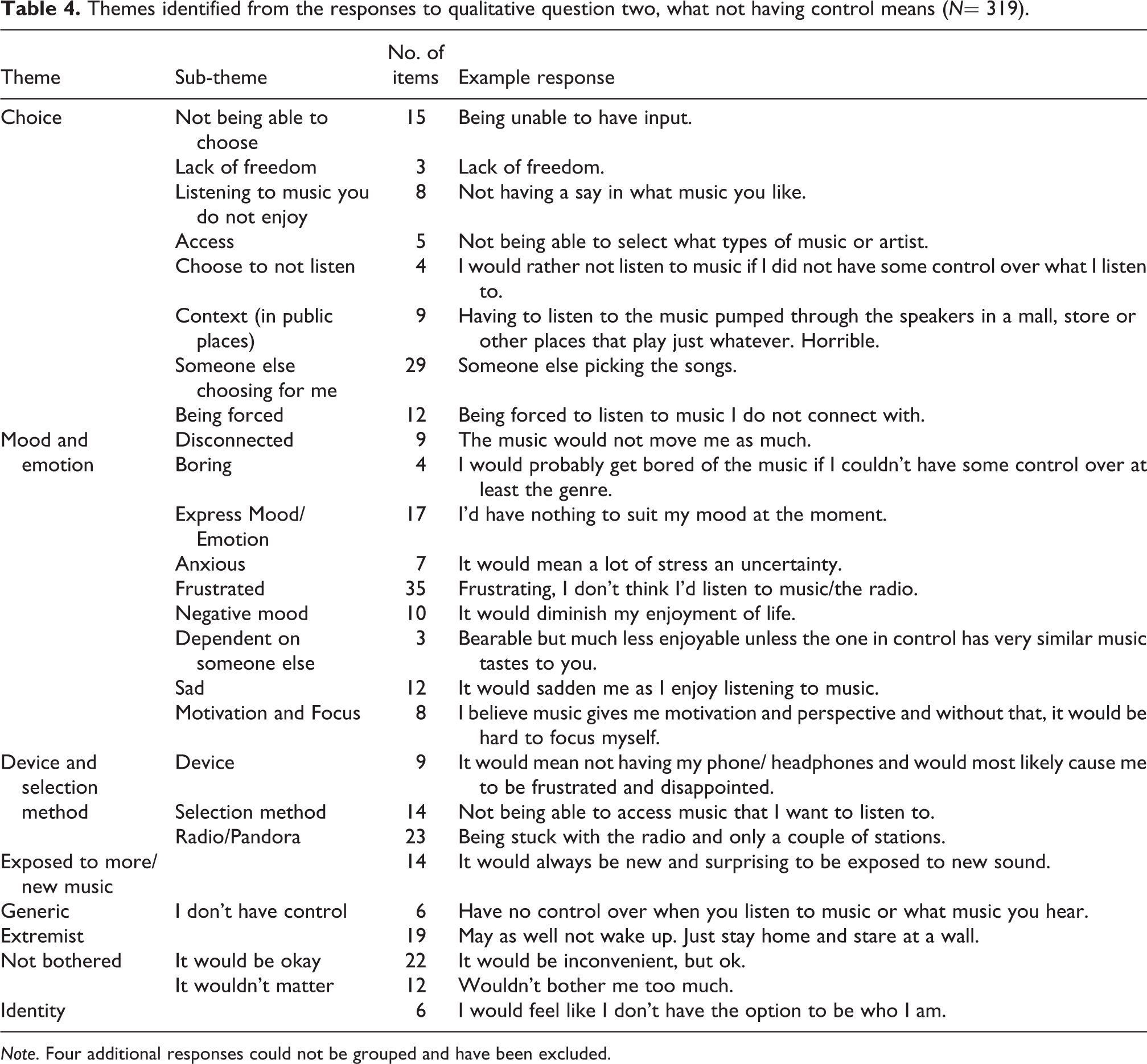
Note. Four additional responses could not be grouped and have been excluded.
Hypothesis 3
To address the subsidiary question concerning the overall desire to have control over one’s listening (H3), a General Linear Mixed Methods (GLMM) analysis was performed. To address an overall desire, a composite “desire for control” score was computed for participants by calculating a sum score of their responses to the 30 “desire for control over listening” items (i.e., the items pertaining to the five factors). Note that seven of these items were reverse coded so that all items were phrased such that desiring more control was indicated by a higher scale response (Cronbach’s alpha = .822). In the GLMM analysis, the composite score served as the criterion variable. The predictor variables entered in this model included gender, country of residence, age, musician status, music importance rating, average daily listening amount, the five MET scores, the locus of control score, and the two time perspective scores.
The overall model was statistically significant, F (14, 407) = 17.140, p < .001, ηp 2 = .371 (see Table 5). Age was negatively associated with the composite control score, indicating younger respondents desired more control over their listening. Males (M = 143.224, SE = 1.583) were more likely to indicate a greater desire for control over their listening than females (M = 138.865, SE = 1.173). The music importance rating was positively associated, indicating that those who rate music as more important in their lives have a stronger desire to control what they hear. Both the MET cognitive and affective engagement styles were positively associated with the composite score. Additionally, the locus of control score was negatively associated with the composite score. Given the coding of the locus of control score means that higher scores are representative of a more internal locus of control, this finding does not support Hypothesis 3a. Rather, surprisingly, it indicates an association between a more external locus of control and a desire to control what music is heard. Neither present nor future time perspective demonstrated a significant association with the composite score in the full model (H3b).
GLMM analysis concerning the composite desire for control score (N = 422).

Note. Overall model: F(14, 407) = 17.140, p < .001, np 2 = .371; DF = 1, 407 for each predictor variable; CI = Confidence interval; MET = Musical Engagement Test; ZTPI = Zimbardo Time Perspective Inventory.
Discussion
While previous research has demonstrated the importance of considering control in everyday listening, and previous researchers have applied Mehrabian and Russell’s (1974) Pleasure-Arousal-Dominance model, this past research has not provided a full understanding of dominance as control. Addressing this research gap, the present study’s results from both the factor analysis and the thematic analysis indicate that dominance concerning everyday music listening is complex and nuanced.
The exploratory factor analysis of the quantitative item responses revealed five dimensions to the construct of control (labeled as being personally in charge, selection by other people, contextual control, playback variety, and no need for control). Elements of these five dimensions support previous research, in that items loading onto them pertain to the ideas of presence of others, context, device, and selection method (Greasley & Lamont, 2011; Juslin et al., 2008; Krause & North, 2016a, 2017a, 2017b; Krause et al., 2014, 2015, 2016). However, the individual dimensions do not reflect these ideas as distinct constructs. Rather, the conceptualization of control is more nuanced. For example, items loading onto “being personally in charge” not only refer to the ownership and use of devices that allow for more control, such as mobile devices and headphones, but also to listener actions that express control (such as regularly obtaining music and controlling the order of song presentation). However, user actions with regard to playback features (i.e., skip, shuffle, etc.) appear in the “playback variety” dimension. Similarly, the use of differing technologies is also woven into the items pertaining to the “selection by other people” factor, suggesting the simple dichotomy between choice/no choice is not sufficient. As anticipated, “contextual control” dimension covers to the desire for control over listening in social contexts, though this factor concerns taking control of the music played at social events and preferring to choose the music heard when with friends.
Further, the results of the thematic analyses revealed conceptualizations of having control in additional ways not addressed by the quantitative items. Participants conceptualized control as not only affecting one’s mood, but also as something that enhances, alters and allows for expression of mood. The participants’ consideration of mood is not surprising, as mood regulation is one of the most commonly cited reasons for listening to music (Lonsdale & North, 2011; Schäfer et al., 2013) and previous research provides evidence linking everyday music listening and mood (e.g., Juslin et al., 2008; Skånland, 2013). Participants in the present study also made reference to their identity when asked about controlling their music listening, which is another common function of music listening (Hargreaves et al., 2002; Schäfer et al., 2013).
The conceptualizations arising from the open-text responses supplement previous conceptualizations of, and aspects of, control. In putting forward the question broadly to the participants, the resulting data offers additional facets to consider in future work. In particular, it is worth noting that people considered control in ways beyond thinking of it as control – it is evident that there is consideration around the evaluation and purpose of control in listening experiences. These themes provide areas worthy of future exploration with regard to defining (and refining) the control construct (and integration into a refined quantitative measure).
It was clear that most participants valued having control over the music they listen to in daily life – evidenced both by generic statements about how having control “means a lot” and “is always valued” and by much more extreme replies (when responding about not having control: e.g. “deprivation of free will”; “worse than having nails being dragged down a chalkboard”). However, it is interesting to consider whether these extreme replies may also indicate the expectation of the ability to control one’s own listening. Such responses may reflect the current digital listening landscape which affords individuals a lot of control, as evidenced by the rise in using streaming services and playlists (International Federation of the Phonographic Industry, 2017; Savage, 2016). Potentially related, the present findings illustrated that younger individuals were more likely to desire control over their listening in general – and this might be a reflection of the current technologies that they are used to employing. Given streaming services are increasingly using artificial intelligence to push individualized, curated recommendations (e.g., Bourreau & Gaudin, 2018), it would be interesting for future work to consider listening control preferences and the acceptance of/reactivity toward such platform-generated recommendations within the evolving streaming landscape.
Of course, not all participants conceptualized having control as something positive: some people mentioned negative consequences of having control, such as the potential for limited exposure to new music. This might be explained by peoples’ differing levels of engagement with music. The results of the GLMM analysis support the idea that people who place more importance on the role of music in their life (as a measure of musical engagement) have a higher desire for controlling their everyday listening. Additionally, the cognitive and affective MET subscales demonstrated significant positive relationships with desiring control, suggesting that a desire for controlling what is heard is associated with listening engagement styles. In particular, the present finding concerning the affective listening style aligns with the large number of responses concerning mood as well as previous research that indicates that mood regulation is one of the most common reasons for listening to music (Lonsdale & North, 2011; Schäfer et al., 2013). If listening for mood regulation, it makes sense that the listener may desire to control that music in order to ensure it matches with one’s desired goal for the music.
Hypothesis 3a predicted that an internal locus of control would be associated with desiring control over the music heard; yet the results indicate that an external locus of control was related, in opposition of the hypothesis. There are two possible interpretations for this result. First, perhaps control over listening is not equated with planning. Secondly, the locus of control measure is concerned with directing one’s life course: perhaps this is a higher, broader level of concern than everyday listening, which could be considered at a more trivial, mundane level. Additionally, present time perspective did not demonstrate a significant association with the composite desire score (H3b). Again, perhaps exerting control, as well as the desire to exert control, over one’s everyday listening is more situational as opposed to being aligned with a longer-standing psychological trait, such as that denoted by time perspective.
While this research focused specifically on examining Mehrabian and Russell’s dimension of dominance as control in particular, the open-ended responses link the construct of control to the arousal and pleasure dimensions. A number of the responses illustrated how having control is associated with pleasure (i.e., the happy and enjoyment sub-themes), supporting previous research findings (e.g., Krause & North, 2017a). Arousal polarization strategies (that is those in which one seeks to maintain or enhance one’s level of arousal rather than to moderate it) are also evinced through a number of the mood sub-themes (namely, arousal and calm/relaxation), in line with previous research (e.g., North & Hargreaves, 2000). It will also be important in future work to consider the influence of people’s perceptions of their experiences relative to all three domains in concert.
Limitations and future research recommendations
The present research was restricted to responses from participants residing in Australia and the USA. Future research will benefit from including participants residing in other (non-western) countries to provide greater generalizability. Secondly, some items included on the measure relate to certain devices and selection methods (e.g., Spotify, YouTube); however, the use of any particular listening technologies should not be assumed. Thus, future research might benefit from including a “Not Applicable” option on measures of desire for control over listening. Moreover, the five factors only explained 40% of the variance and demonstrated lower reliability values, suggesting that further work is needed to improve the measure. Such further revision merits the inclusion of the additional facets as indicated by the results of the thematic analysis (e.g., items relating to mood and identity) as well as probing the value and perceived necessity of having control. Indeed, while it is clear that control is not simply a matter of choice, the questions used in the present study were worded broadly. Thus, finally, future work may also wish to examine contextual responses and/or make use of different measurement tools.
While the present research considered the desire for control relative to the psychological constructs of time perspective and locus of control, other variables could be considered. For instance, the present study’s analysis did not consider the devices employed or preferred by the participants. As the results of the thematic analysis showed very clearly, for some people, certain devices (and selection methods) are inherent to the idea of control. Future research is also needed to consider whether there might be a relationship between these constructs and personality traits. Moreover, the use of a single, composite desire score may not afford detailed consideration of the facets or the influence of the broader everyday context.
Investigations focused on considering the contextual features around the desire for control over music listening would also advance our understanding of everyday listening. Diary and Experience Sampling studies would be well suited to tracking the ability to control and the level of desire for control over time and in relation to contextual variables, which will assist in the refinement of this construct. This work may also consider how one’s desire for control relates to one’s listening goals (e.g., the music’s functions – Groarke & Hogan, 2018). Future findings such as these will inform not only the construction and revision of future measures but also the application of theories, including the Pleasure-Arousal-Dominance model, to explaining everyday interactions with music.
Moreover, while this study responded to remarks concerning the conceptualization of the dominance dimension, operationalizing Mehrabian and Russell’s dominance dimension as control is not the only theoretical possibility. There are other psychological constructs (in addition to locus of control and time perspective) to consider in future work. Applying and differentiating the utility related constructs, such self-control, agency, and empowerment, may advance theoretical frameworks concerning everyday listening. For instance, when considering how music impacts sense of agency, Saarikallio et al. (2020) found that music listening can support agency but that such influences are related to situational factors. It will be important for such work to simultaneously consider work concerning the functions of music listening (e.g., Groarke & Hogan, 2018) as well as work demonstrating the role of situational factors (e.g., Greb et al., 2018).
Conclusion
The present research aimed to better define control in terms of everyday music listening by (1) examining the underlying factors of the construct via both a quantitative measure and eliciting individual responses; and (2) exploring the relationship between the desire for control and individual differences with regard to locus of control, time perspective, and music engagement. The findings indicate that control is more complex and nuanced than originally proposed. The quantitative measure’s factors, being personally in charge, selection by other people, contextual control, playback variety, and no need for control, relate to the findings of previous research, but, in conjunction with the results of the thematic analysis, it is apparent that the measure’s items do not fully define dominance in terms of everyday music listening. Indeed, based on the participants’ open responses, there are additional aspects of the construct in need of further consideration (i.e., those related to mood regulation, identity, and context). In conclusion, the present research has advanced our understanding of what control means in everyday listening to include a wider range of aspects than previously put forward. Additional research attention will continue to refine the application of the Pleasure-Arousal-Dominance model to explaining everyday listening.
Footnotes
Acknowledgement
The authors express sincere gratitude to all of the participants who have participated in this research.
Authorship note
All authors share “first-author” status.
Contributorship
AK, SM, AM, TM, NO, and VT collaborated to conceive and develop this research. SM, AM, TM, NO, and VT gained ethical approval, and conducted participant recruitment. AK, SM, AM, TM, NO, and VT conducted the data analysis. SM, AM, TM, NO, and VT drafted initial versions of the manuscript, with AK offering additional revision. All authors collaborated to approve the final version of the manuscript.
Declaration of Conflicting Interests
The author(s) declared no potential conflicts of interest with respect to the research, authorship, and/or publication of this article.
Ethics approval
The ethics approval for this project stated that the data would be destroyed after 7 years. Further, it did not permit the sharing or re-use of the collected data.
Funding
The author(s) received no financial support for the research, authorship, and/or publication of this article.

Action editor
Alexandra Lamont, Department of Psychology, Keele University.
Peer review
Laszlo Harmat, Linnaeus University, Department of Psychology.