




Abstract
Most notated forms of music require interpretation of loosely-defined score instructions. For music ensembles, coordinating a shared interpretation in which each performer plays a complementary role can be challenging, especially if performers have already established their own individual interpretations. This study aimed to identify the patterns of behavior that distinguish performance in collaborative and solo conditions. We tested the hypothesis that highly skilled pianists would be motivated to create more expressively variable and divergent interpretations in the collaborative duet setting than when performing solo. Pianists recorded solo and duet performances of a new piece following individual rehearsal. MIDI and head motion data were assessed. Contrary to expectations, duet performances were less expressively variable than solo performances and no more or less prototypical; indeed, prototypicality increased with years of training. Leader–follower relationships in note timing emerged, with primos tending to take the lead. Pianists moved less during duet performances, and more smoothly. Coordination in head acceleration patterns also emerged during duet performances. Our findings show how performers’ intent to collaborate encourages more communicative styles of head movement and a conservative or protective style of playing that prioritizes coordination over creativity.
In non-improvised forms of music, performers draw on repertoire comprising prescribed structural elements. Typically, these structural elements are arranged in a template (often notated as a score) that forms a loose assembly of instructions for how and what to play. In the Western classical tradition, the term interpretation describes the process by which performers implement an individualized construction of that template, informed by their own perceptions and preferences as well as their understanding of genre conventions (Juslin & Timmers, 2010; Palmer, 1997).
The interpretability of such repertoire presents a challenge for music ensembles, who have to coordinate a cohesive joint performance even though individual ensemble members might interpret the music differently. This challenge is exacerbated by the fact that musicians often learn a piece individually before attempting it as a group and, furthermore, because they may have few opportunities for group rehearsal before performing the piece for an audience. For a successful ensemble performance, ensemble members do not have to share an identical interpretation of the music, but their interpretations do have to overlap in such a way that their contributions are complementary (Canonne & Aucouturier, 2015; Schiavio & Høffding, 2015). Our study aimed to show how individual performers’ interpretations and communicative behavior inform the joint interpretation that emerges during duet performance of early 20th-century Western classical piano music.
How Coordination Emerges During Ensemble Performance
How do ensembles with different ideas for how a piece should sound manage to coordinate a performance? The joint action literature distinguishes between planned and emergent forms of coordination (Knoblich, Butterfill, & Sebanz, 2011). Duet performance of Western classical music involves both. Planned, or scripted, aspects of coordination are typically established during rehearsal, through a combination of verbal discussion and demonstration/imitation. Planned aspects may relate to performer roles (e.g., who will give the starting cue), or the location of certain expressive landmarks (e.g., where to get louder or softer), among others.
Emergent coordination, which occurs spontaneously and does not require an intention to coordinate, arises in between these scripted landmarks or when performers deviate from the script. Emergent coordination may occur as a result of performers entraining to one another, a process attributable to the coupling of internal oscillators (Large, 2000; Repp, 2005; Schmidt & O’Brien, 1997). It may also (or instead) occur as a result of shared affordances—that is, a given musical stimulus (e.g., a score or sounded line) may encourage convergent responses from different ensemble members (Richardson, Marsch, & Baron, 2007; van der Wel, Sebanz, & Knoblich, 2016).
Though Western classical duet music is generally regarded as more scripted than many other musical forms (especially those involving improvisation), emergent processes are still critical for maintaining temporal synchrony and negotiating new expressive ideas. Indeed, emergent processes likely underlie the cognitive flexibility that is characteristic of skilled performance, which enables seemingly effortless recovery from disruptions and an ability to incorporate spontaneous changes to planned sequences (Glowinski, Bracco, Chiorri, & Grandjean, 2016). Researchers have attempted to describe how emergent coordination manifests in ensemble performances by analyzing different features of performers’ behavior, including between-performer interactions in sound and body movement.
Mechanisms for Negotiating a Shared Interpretation
In some cases, emergent coordination can manifest as a recalibration of individual expectations for piece timing. When playing as an ensemble, musicians adapt their individual timing to accommodate others’ variability. This adaptation can occur online in the form of error-correction, enabling performers to maintain approximate synchrony despite potential differences in how they expect piece timing to unfold (van der Steen, Jacoby, Fairhurst, & Keller, 2015; van der Steen & Keller, 2013).
Over multiple exposures to other performers’ playing styles, musicians may also learn to predict each other’s timing variations. This is particularly relevant in cases where ensemble members may be individually familiar with a piece before attempting to perform it together. Keller, Knoblich, and Repp (2007) found that pianists synchronized better with recordings of their own playing than recordings of others’, suggesting that between-performer differences in playing style affect the quality of coordination. Ragert, Schroeder, and Keller (2013) likewise found worse synchronization among pianists who had previously practiced both parts of a piano duet than among those who had only practiced one part—but this familiarity-caused impairment disappeared rapidly across the pianists’ first few performances together, suggesting that they learned to predict each other’s interpretations. Similarly, Wolf, Sebanz, and Knoblich (2018) found that synchronization between expert and novice pianists improved when experts were familiar with novices’ idiosyncratic timing.
MacRitchie, Herff, Procopio, and Keller (2018) examined how ensemble members cope with salient differences in interpretation, which the authors prompted by adding incongruent instructions to different performers’ scores. Performers prioritized their own performance when differences related to dynamics, but they prioritized the joint performance when differences related to timing, perhaps because alignment of timing is more integral to a coherent ensemble performance than matching dynamics. This finding also reminds us that coordination is not simply a matter of producing the same actions at the same time but, rather, of producing complementary actions that are aligned according to a shared timing framework. It is also important to note that these complementary actions may be staggered in time rather than simultaneous (Walton et al., 2017).
Some research has examined how visual interaction between performers contributes to ensemble coordination. This line of study is motivated by the well-documented finding that, in non-musical contexts, observation of others’ actions can trigger perceptual coupling between individuals and the spontaneous synchronization of rhythmic movements (Demos, Chaffin, Begosh, Daniels, & Marsh, 2012; Richardson, Marsh, Isenhower, Goodman, & Schmidt, 2007). A number of studies have shown that between-performer coordination in movement patterns can arise during ensemble performances (Bishop, Cancino-Chacón, & Goebl, 2019b; Eerola, Jakubowski, Moran, Keller, & Clayton, 2018; Glowinski, Dardard, Gnecco, Piana, & Camurri, 2014; Goebl & Palmer, 2009; Hilt et al., 2019; Keller & Appel, 2010).
There is some evidence that movement and other visual cues (e.g., eye gaze direction) may facilitate some aspects of ensemble performance. Bishop, Cancino-Chacón, and Goebl (2019a) found that duo pianists watched each other more when playing temporally irregular parts of a piece than when playing temporally regular parts; they also watched each other more after rehearsing than before. Body movements were also found to become more “communicative” (e.g., greater in quantity, smoother) during temporally irregular passages and following rehearsal (Bishop et al., 2019b). A possible explanation is that visual interaction is socially motivating and used by performers to confirm each other’s attention and engagement in the performance task—particularly at moments that require careful attention (e.g., due to irregular timing) or present an opportunity for higher-level collaboration (e.g., due to high familiarity). In the study by Bishop, Cancino-Chacón, and Goebl (2019b), musicians were seated facing each other at separate pianos. The current study aimed to add to these findings by testing whether pianists’ body movements are more communicative during duet performance (when performers are seated side-by-side) than during solo performance.
Ensemble performers sometimes fall into patterns of leading and following, which can be observed in their body movements as well as in their sound output (Chang, Livingstone, Bosnyak, & Trainor, 2017; D’Amario, Daffern, & Bailes, 2018; D’Ausilio et al., 2012; Keller & Appel, 2010; Timmers, Endo, Bradbury, & Wing, 2014). Large ensembles, by convention, tend to be led by a conductor, but in small ensembles, performers often exchange leadership roles throughout a performance (while remaining mutually influential). Leader–follower relationships may emerge partially as a mechanism to facilitate negotiation of different expressive ideas.
Not surprisingly, leader–follower relationships tend to be strongest when they arise as a result of experimental manipulation and roles are explicitly assigned prior to the performance. Under more naturalistic conditions, a multitude of social and musical factors may contribute to who takes the lead at any given moment in a performance. As a result, documenting leader–follower relationships as they occur naturally can be complicated (see Bishop, Cancino-Chacón, & Goebl, 2019a). The current study tested the hypothesis that leader–follower relationships facilitate the negotiation of potentially different interpretive choices when performers start practicing a duet together. Thus, we expected to see evidence of performers assuming leadership roles. Specifically, we expected the role of leader to default to the primo, who in the Western classical tradition often plays the melody.
Leader–follower relationships should have the effect of making the performance more predictable for the performers, by reducing the degrees of freedom that underlie potential variability in interpretation (though this may not be the case if the leader chooses a particularly idiosyncratic interpretation or gives unreliable signals). Another way of increasing predictability, and thereby facilitating the task of coordination, would be for each ensemble member to reduce their own variability. Performers might therefore choose a more prototypical (or “average”) style of playing in which patterns of expressive variability follow a standard curve and/or variability is widely reduced (leading to an expressively “flat” performance).
On the other hand, highly skilled ensemble musicians who can learn new music quickly and are used to performing without much time for rehearsal may demonstrate greater flexibility. Compared with less skilled musicians, they may be better able to adapt to each other’s variability and negotiate new expressive nuances on the spot. During skilled ensemble performance, “emergence” may occur, defined in the creativity literature as periods of coordination during which the ensemble converges on a shared pattern that cannot be attributed to the ideas of any one individual (Sawyer, 2006; Sawyer & DeZutter, 2009). Hart, Noy, Feniger-Schaal, Mayo, and Alon (2014) observed periods of emergence in duo performances on a non-musical movement improvisation task, among expert improvisers. Performers abandoned their individual motion signatures during these periods and converged onto a shared motion signature that was more prototypical and predictable. They could then combine these predictable motion segments into new patterns.
During music ensemble performance, we might expect that highly skilled performers who quickly establish low-level coordination (i.e., rapidly entrain to one another) will be able to construct new expressive nuances collaboratively, leading to a greater diversity of interpretations between duet performances than between solo performances (Bishop, 2018).
The current study compared the prototypicality and expressive variability of solo and duet performances in order to test whether a sample of highly skilled pianists would adopt a cautious approach to ensemble coordination or whether they would opt instead for a more flexible, creative approach.
Performers’ capacities for empathy may contribute to how successfully they coordinate a joint interpretation. Empathy can be broken down into two primary subconstructs. “Cognitive empathy” describes a person’s capacity for perspective-taking, while “emotional empathy” describes the ability to share emotional states with others (Shamay-Tsoory, Aharon-Peretz, & Perry, 2009; Smith, 2006). These are reflected in the structure of standard empathy scales, such as the Interpersonal Reactivity Index (which also includes fantasy and personal distress scales; Davis, 1983).
In the literature, both subconstructs are posited to influence music performance and perception. Self-reported perspective-taking ability has been shown to correlate with synchronization success (Pecenka & Keller, 2011) and musical aptitude (Kawase, 2015), while emotional empathy has been shown to relate to the perception of emotional expression in performed music (Wöllner, 2012) and the ability to generate an emotional response (Miu & Balteş, 2012). It also seems to modulate the relationship between perceived and felt emotional experiences during music perception (Egermann & McAdams, 2012). The current study considered whether empathy also relates to how successfully ensemble members converge to a joint interpretation.
Current Study
Current perspectives on ensemble performance suggest that coordination is maintained primarily through low-level entrainment and error-correction mechanisms. Performers make small-scale adjustments to accommodate variability in each other’s output, and in doing so they jointly construct new expressive nuances and/or re-construct nuances that they previously rehearsed. This study attempted to identify the behavioral patterns that distinguish performance in a collaborative setting from solo performance and allow ensemble performers to negotiate a joint interpretation. We used an ecologically valid paradigm in which pianists attempted to coordinate a joint interpretation following individual practice of a new piece. Audio/MIDI and head motion were recorded during solo and duet performances. We then analyzed keystroke timing and velocity and patterns of head motion.
We hypothesized that our sample of highly skilled (ensemble-experienced) pianists would produce more divergent, less prototypical, performances, with greater temporal and dynamic variability, when collaborating with a partner (i.e., in duet conditions) than when performing solo. This was tested against the alternative, more conservative hypothesis that pianists retreat to more predictable patterns of expression when having to coordinate with another person. Which approach to ensemble coordination our pianists would take was partly a question of ability, but was also partly one of motivation: even musicians who are capable of negotiating a new and creative interpretation on the spot might not be motivated to do so outside a real performance situation, in which stakes and possible payoff are higher than in the lab. (Although, for some musicians, the intrinsic reward of collaborating creatively with a co-performer might be sufficient motivation.)
Coordination in head gestures was expected to emerge during duet performances, in line with previous findings (e.g., Bishop et al., 2019b). Pianists were also expected to produce more communicative body movements during duet performance than during solo performance. We hypothesized that leader–follower relationships would arise in both sound and movement as performers attempted to converge their differing expectations towards a single joint interpretation, with the primo more often taking the lead than the secondo.
Finally, empathic concern and perspective taking ability, as well as some factors relating to pianists’ musical experience (e.g., years of study; prior performance experience with their partner), were expected to relate to expressivity and coordination in duet performances.
Method
Participants
Twelve piano duos (24 individual pianists) completed the experiment. The pianists (age in years, M = 25.7, SD = 4.5; 17 female) reported an average of 17.2 years of training (SD = 4.1) and had performed an average of 11.8 concerts (SD = 11.5) in the last year. All but one reported performing professionally. Eight pianists had completed a master’s level degree in music, four had a master’s degree in progress, three had completed an undergraduate degree, and nine had an undergraduate degree in progress. Five of the piano duos had performed together previously, four duos knew each other but had never performed together, and three duos did not previously know each other.
Ethics approval was obtained from the University of Music and Performing Arts Vienna Ethics Committee. All participants provided informed consent and received a small travel reimbursement. One participant did not consent to motion tracking, so that person’s body movements were not recorded. Empathy scores were also omitted for one participant who lacked sufficient fluency in either German or English to complete the empathy questionnaire. (Participants who were not native German speakers could choose to complete the English version of the questionnaire, but in the end all participants used the German version.)
Materials and Equipment
Pianists performed Minuet in C-sharp minor (for solo piano) by Maurice Ravel. A digital score for the piece was obtained from IMSLP (Ravel, 1904/2011). We selected this piece because (1) it is short (23 bars (measures)) and can be read quickly by skilled pianists, (2) it is unlikely to be familiar to participants, and (3) it is engaging and lends itself to a variety of expressive interpretations. The experimenters prepared an arrangement for four hands, based on the original score. Solo and duet scores are included in the Appendix. Beat numbers and section labels (see Analysis) have been added to the scores; these were not included in the versions read by participants.
Pianists played the original solo version of the piece during their solo performances. For the duet performances, they were randomly assigned to play either the primo or secondo part of the arrangement for four hands (see Appendix for the scores used in this study).
Pianists performed on Yamaha Clavinovas and used AKG K271 MKII headphones during the rehearsal period. Audio/MIDI data were collected using a Focusrite Scarlett 18i8 sound card and recorded in Ableton Live. A 12-camera (Prime 13) OptiTrack motion capture system tracked pianists’ head movements and upper body sway, recording at 240 frames per second. Pianists were fitted with 7 reflective markers each: 4 on the head and 3 on the upper back.
To enable synchronization of audio/MIDI and OptiTrack recordings, a film clapboard was marked with reflective markers and placed in view of the cameras, near to a microphone that collected audio from the room. The clapboard was struck once at the start of each recording, and timelines were adjusted retrospectively to begin at this point.
Design
Pianists performed the piece under solo and duet conditions. Their performances were assessed for expressivity (expressive variation, prototypicality, and smoothness in tempo and dynamic curves), tempo and dynamic alignment, gesture quality (quantity of motion and smoothness), gestural coordination, and leader–follower relationships (in sound and gesture). Within-subject comparisons were made to test how expressivity and gesture quality changed between solo and duet performances and investigate the emergence of coordination during duet performances. Between-subject comparisons were made to test for leader–follower relationships. We also investigated the effects of musical structure on performers’ expressive and collaborative behavior by testing for different patterns of behavior across different sections of the piece. The potential relationships of duet expressivity and coordination to empathy scores, years of study, partners’ familiarity with each other, consistency across solo performances, and primo–secondo differences in solo interpretation were assessed as well.
Procedure
Pianists were allowed up to 40 min to practice the solo and four-hands versions of the piece. They practiced individually, each on separate Clavinovas, using sealed headphones (AKG K271). For the practice session they faced in opposite directions and were separated by a movable wall. Once they felt confident with the music, one pianist was sent to another room to complete some questionnaires, including the German version of the Interpersonal Reactivity Index (IRI; Davis, 1983; Paulus, 2009), while the other stayed behind and recorded three solo performances. The two pianists then switched places, so that the pianist who had just recorded their solo performances left to complete the questionnaires, and the pianist who had completed the questionnaires stayed to record their solo performances. Finally, primo and secondo together recorded three performances of the four-hands version of the piece. Pianists were asked to indicate their (subjectively) best solo and duet performances.
Analysis
Preparation of MIDI and Body Motion Data
MIDI data were aligned with the score using the score–performance matcher developed by Flossmann, Goebl, Grachten, Niedermayer, and Widmer (2010), which pairs performed note onsets with notes in the score, filtering out erroneous insertions or substitutions. Tempo and dynamic curves were then obtained for each solo performance and (separately) for the primo and secondo parts of each duet performance. For tempo curves, we took the median note onset time per beat and calculated the corresponding series of interbeat intervals. For dynamic curves, we took the median key velocity per beat. Linear interpolation was used to estimate an onset time and key velocity for any missing beats to obtain full series of values for the piece.
For most analyses relating to MIDI data, separate composite tempo and dynamic curves were constructed for solo and duet conditions, using median values from the three trials that pianists completed under each condition. These “composite performances” were meant to lessen the effect of any unintended (erroneous) deviations in timing or key velocity. In the analysis descriptions below, we specify whether each analysis was run using these composite performances, performers’ self-selected best performances, or data from all trials.
We identified four sections within the piece, corresponding to the “Theme” (bars 1–8), which presents the main theme of the piece; the “Extension” (bars 9–12), which draws out the theme; the “Rise” (bars 13–16), which comprises a climb towards the climax of the piece; and the “Resolution” (bars 17–23), which brings the piece to a close (see Appendix for scores). Most of our analyses were run per section instead of globally, to account for the fact that pianists might behave differently under different music structural constraints.
Our analysis of body motion focused on performers’ head movements, as head markers were recorded more reliably than upper back markers by the motion capture system. Position data were smoothed using functional data analysis (Goebl & Palmer, 2008; Ramsay & Silverman, 2005). Order-6 b-splines were fit to marker trajectories with knots every 50 ms and a roughness penalty applied to the fourth derivative, which smoothed the second derivative (i.e., acceleration). Functional data were then converted back to position, velocity, and acceleration series, with samples every 5 ms.
Expressive Variability in Solo and Duet Performances
As a measure of expressive variability, we assessed the smoothness of tempo and dynamic curves, testing the hypothesis that curves achieved under duet conditions are smoother than those achieved under solo conditions. Smoothness was quantified in terms of curvature (i.e., the inverse of the radius of the circle that would be tangent to the curve at each point (see do Carmo, 2016). Curvature (κ) was computed at each beat position as

Where y(b) is interbeat interval (IBI) or key velocity, which is a function of b, the score time in beats 1 , and y′ and y′′ are the first and second numerical derivatives of y, with respect to b. Larger curvature corresponds to smaller circle radii and lower smoothness.
Prototypicality in Solo and Duet Performances
Prototypical solo and duet tempo and dynamics curves were calculated by averaging standardized IBI or key velocity values at each beat, across all pianists’ performances. These four prototypical curves are shown in Figure 1 along with individual curves for primos in solo and duet conditions. Each composite solo and duo performance was then compared with these prototypical performances, with mean squared errors (MSEs) calculated as a measure of similarity.

Prototypical tempo and dynamics curves for solo and duet performances (in black). Tempo curves for primos in solo and duet conditions are shown in colors. Vertical lines indicate section boundaries.
Primo and Secondo Contributions to Duet Performance
Primo and secondo contributions to duet performances were assessed in two ways. First, we assessed how consistently each pianist performed across solo and duet conditions. MSEs were calculated separately for tempo and dynamics curves, for primos and secondos.
Our second analysis used Granger causality to estimate the influence that each performer had on their partner during duet performances. Granger causality (“G-causality”) estimates the likelihood that a data series y influences another data series x by comparing (1) a restricted model that includes only lags of x with (2) an unrestricted model that also includes lags of y. The predictive success of the two models is assessed (in our case, using a Wald test), and a significant result indicates better performance by the unrestricted model. Granger causalities were computed using the “grangertest” function (“lmtest” package in R; R Core Team, 2013) with an order of 2.
We computed local G-causalities for each section of the piece, using primo and secondo tempo and dynamic curves from each duo’s preferred trial (i.e., the trial that they reported as their best). For this analysis, we used data from a single trial rather than composite curves to avoid “flattening out” any subtle leader–follower activity that might occur. Data were differenced once and then standardized prior to the analysis. G-causalities were computed in both directions, so that we evaluated the potential influence of the primo on the secondo and the potential influence of the secondo on the primo. Occasionally, a significant result was achieved in both directions for the same passage of music; since this usually means that both curves are subject to influence from a tertiary variable (e.g., the musical structure) and do not indicate unidirectional influence between performers, these significant results were treated as non-significant for our analyses.
Precision of Temporal and Dynamic Alignment
The precision of temporal alignment between duet partners was measured by calculating the absolute asynchrony between median primo and secondo note onsets per beat, per performance. The precision of dynamic alignment between duet partners was calculated as the absolute difference between median primo and secondo key velocity values per beat, per performance.
Communicative Gesturing in Solo and Duet Performances
Our analysis of the “communicative” quality of performers’ head motion focused on two measures: quantity of movement and smoothness. These were calculated for participants’ preferred trials rather than for averaged performances. Quantity of movement (QoM) was calculated as the mean absolute distance that the head travelled per observation. Smoothness was operationalized in terms of jerk: we took the first derivative of the acceleration curve for each performance to obtain a series of jerk values, then averaged the jerk values to obtain our measure of smoothness. High jerk (i.e., high jitter) corresponds to low smoothness.
Gesture Coordination During Duet Performance
Two measures assessed gesture coordination during duet performances. Both measures focused on head acceleration, which we have previously found to reflect the performed beat structure of music (Bishop & Goebl, 2017).
The first measure constituted a comparison of primo and secondo head acceleration curves during pianists’ preferred solo and duet performances. Dynamic time warping (“dtw” package in R) was used to align primo and secondo head acceleration curves, and the normalized distance between aligned curves was calculated. (Normalized distances represent distances per step, and are therefore comparable across pairs of curves that differ in length.) Alignments were made for both solo and duet performances, with the expectation that primo-secondo similarity would be greater during the duet performances because performers were interacting. For more detail on the method we used for dynamic time warping, readers can refer to the Appendix of Bishop et al. (2019b).
As a secondary measure of gesture coordination, Granger causalities were computed within each section of the piece, using resampled head acceleration data (8 samples/beat) for pianists’ preferred performances. G-causalities were computed bidirectionally (as described above) using an order of 8 to estimate the potential influence of primos on secondos and vice versa.
Linear Mixed Effects Modeling (LME)
LME was used to test for the effect of selected predictors on each of the measures described above. We used the ‘nlme” package in R to construct models, which were then subjected to an ANOVA to achieve type I F-tests.
Harrison et al. (2018) recommend a ratio of observations to estimated coefficients of at least 3–10 for LME. Therefore, to ensure a ratio within this range, we included in each model only the effects that were most central to our hypotheses. Particularly in analyses with a smaller number of observations, this meant excluding some potentially relevant variables. In most cases we also excluded interactions from the models, as we did not have specific hypotheses about how the effects would interact—with the exception of condition × piece section and role × piece section, which were included in some models. A single model was tested for each of the measures described above; the fixed effects that were included in each model are listed in Tables 1 to 4 (for timing, dynamics, and motion, respectively).
Performance timing results. F-values are listed for significant effects (p = .05, *p < .05, **p < .01, ***p < .001); n.s. indicates a nonsignificant effect and cells with a dash indicate effects that were not tested. Measures are listed in the order that they are described in the text. Abbreviated Fixed Effects include: the condition × piece section interaction (“C × PS”); the role × piece section interaction (“R × PS”); partners’ familiarity with each other (“Familiarity”); empathic concern (“EC”); perspective taking (“PT”); primo–secondo differences in interpretation (“PS diff”); and solo variability (“Solo var”).

Performance dynamics results. Please refer to the caption of Table 1 for an explanation.

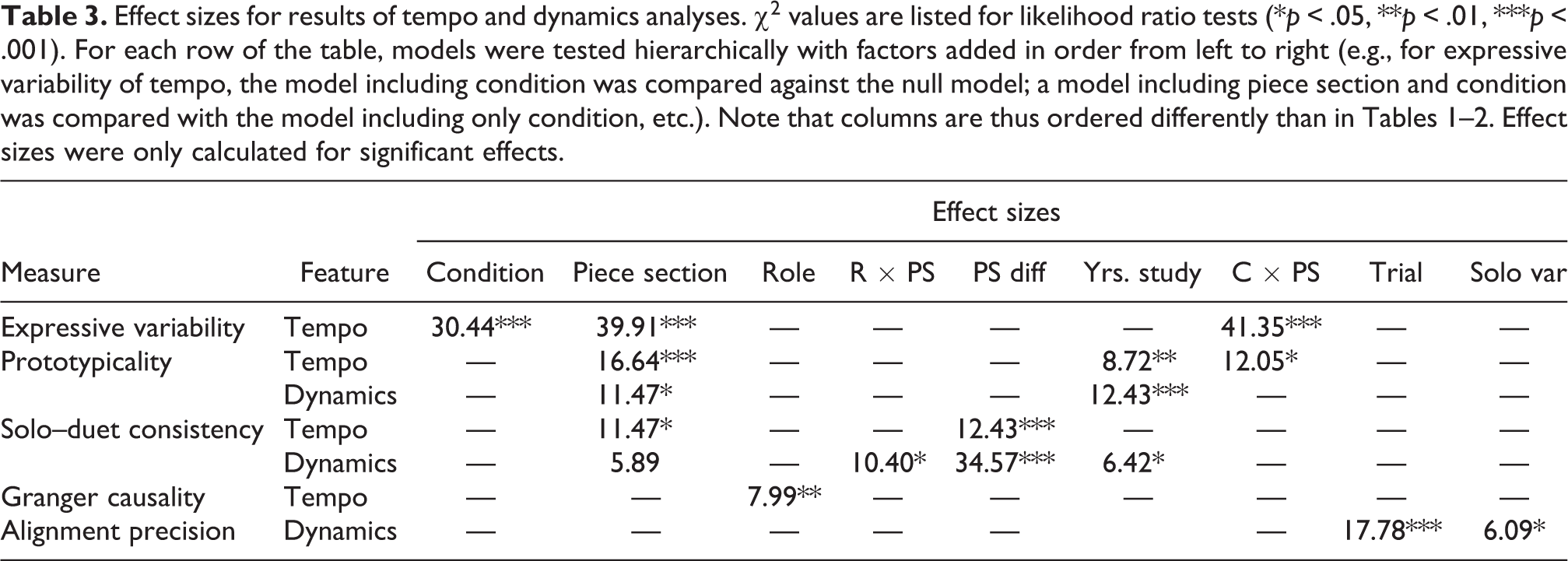
Effect sizes for results of tempo and dynamics analyses. χ2 values are listed for likelihood ratio tests (*p < .05, **p < .01, ***p < .001). For each row of the table, models were tested hierarchically with factors added in order from left to right (e.g., for expressive variability of tempo, the model including condition was compared against the null model; a model including piece section and condition was compared with the model including only condition, etc.). Note that columns are thus ordered differently than in Tables 1–2. Effect sizes were only calculated for significant effects.
Body motion results. Please refer to the caption of Table 1 for an explanation.

Of central interest were the potential effects of condition (solo, duet), piece section (Theme, Extension, Rise, Resolution), and/or role (primo, secondo), and in some cases the interactions between condition and piece section or role and piece section. Most models also included as fixed effects pianists’ scores on the empathic concern (EC) and perspective taking (PT) subscales of the IRI, pianists’ familiarity with each other (performed together previously; never performed together), and pianists’ self-reported years of piano study. Our alignment precision analysis also considered trial number.
In some models, we also included as a fixed effect the magnitude of difference between primo and secondo interpretations (calculated as MSEs between the averaged tempo or dynamic curves of each partner), with the expectation that pianist pairs whose solo interpretations differed more might struggle more to coordinate. Finally, in some models, we included as a fixed effect a measure of the temporal or dynamic variability that pianists achieved across solo performances, with the expectation that pianists who were more variable across solo performances would be more variable between solo and duet performances. For this measure, we computed the sum of between-trial squared errors per beat as

where
Where appropriate, a random effect was included to account for repeated measures. Depending on the predictors included in the model, the random effect generally took the form of subject nested within piece section nested within condition.
Effect sizes for significant fixed effects were estimated by calculating the likelihood ratio for a model that included the factor compared with a null model in which the dependent measure was predicted by its own mean. Where multiple significant fixed effects arose, we compare models hierarchically. Effect sizes for LME results are presented in Tables 3 and 5. Effect sizes for significant post-tests were estimated with Cohen’s d.
Effect sizes for results of body motion analyses. Please refer to the caption of Table 3 for an explanation.

Results
Expressivity in Solo and Duet Performances
Duet performances were hypothesized to contain more expressive variability than solo performances, in line with research theorizing that new interpretations can emerge during collaborative performance if the musicians are sufficiently skilled and motivated.
LME assessing the smoothness of tempo curves yielded significant effects of condition, F(1,84) = 54.18, p < .001, piece section, F(3,63) = 17.06, p < .001, and an interaction, F(3,84) = 16.36, p < .001 (Figure 2). The effect of empathic concern approached significance, F(1,17) = 4.33, p = .05, but none of the other effects was significant (all p > .05).

Curvature of averaged tempo and dynamic curves across piece sections, for solo and duet performances. High curvature corresponds to low smoothness of the prototypical curves shown in Figure 1. Error bars indicate standard error.
The effect of condition indicated smaller curvature, and therefore greater smoothness during duet performances than during solo performances. The correlation between smoothness and empathic concern scores was positive but slight, r = .13, p = .08.
Post-hoc tests showed that smoothness was greater during the Theme, t(63) = 5.35, p < .001, d = 0.78, Extension, t(63) = 5.32, p < .001, d = 0.80, and Rise, t(63) = 6.53, p < .001, d = 0.90, than during the Resolution (tested at a Bonferroni-adjusted (α = .008). Post-hoc tests were also run to investigate the interaction, and showed that differences in smoothness were greatest between solo and duet conditions during the Resolution, t(84) = 9.68, p < .001, d = 1.41; all other between-condition/within-section comparisons were nonsignificant (α = .01).
For dynamics, LME yielded no significant results.
Prototypicality of Solo and Duet Performances
Duet performances were hypothesized to be less prototypical than solo performances, again, in line with research theorizing that new interpretations can emerge during collaborative performance.
LME yielded significant effects of piece section, F(3,63) = 6.13, p < .001, and years of study, F(1,17) = 5.73, p < .03, on MSEs estimating the prototypicality of tempo (Figure 3). The interaction between piece section and condition was also significant, F(3,84) = 3.88, p < .01. All other effects were non-significant.

Prototypicality: Similarity of solo and duet tempo and dynamic curves to prototypical performances. The legend applies to both plots. Error bars indicate standard error.
Years of study correlated negatively with MSEs (r = −.21, p = .005), indicating that more experienced pianists played more prototypically. Post-hoc tests showed that performances were more prototypical during the Theme, t(63) = 3.36, p < .001, d = 0.72, and Extension, t(63) = 3.84, p < .001, d = 0.84, than during the Resolution (α = .008). Post-hoc tests comparing MSEs for solo and duet conditions within piece sections gave no significant results (α = .01).
For dynamics, LME yielded significant effects of piece section, F(3,63) = 3.83, p < .01, and years of study, F(1,17) = 10.97, p < .004. All other effects were non-significant.
Years of study correlated negatively with MSEs (r = −.36, p = .001), indicating that more experienced pianists played more prototypically. Post-hoc tests investigating differences between piece sections were non-significant (α = .008).
Figure 4 shows solo–duet differences in MSEs for tempo and dynamics individually for each pianist according to their years of study. The plots are color-coded by piece section. Most of the difference values cluster around 0, suggesting that pianists played with a similar degree of prototypicality in solo and duet conditions. However, a few points are biased towards larger positive or negative values, indicating a greater degree of divergence from prototypical curves in one condition or the other.

Solo–duet differences in prototypicality for tempo and dynamics. Solo–duet differences are shown for each pianist participant according to their years of study. There are 4 pianists with 15 years of study, 3 pianists with 17 and 20 years, 2 pianists with 14, 16, and 22 years; all other years represent data for 1 pianist.
Primo and Secondo Contributions to Duet Performance
The overall contribution of the primo to duet performances was hypothesized to outweigh the contribution of the secondo, since the leadership role in Western classical piano duets typically defaults to the primo. Similarly, it was hypothesized that primos would tend to lead and secondos would tend to follow during performances.
Our first analysis measured within-subject consistency across solo and duet conditions for primos versus secondos. For tempo, LME produced significant effects of piece section, F(3,59) = 3.27, p = .03, and primo-secondo solo tempo differences, F(1,59) = 4.09, p = .048 (Figure 5). All other effects were non-significant.
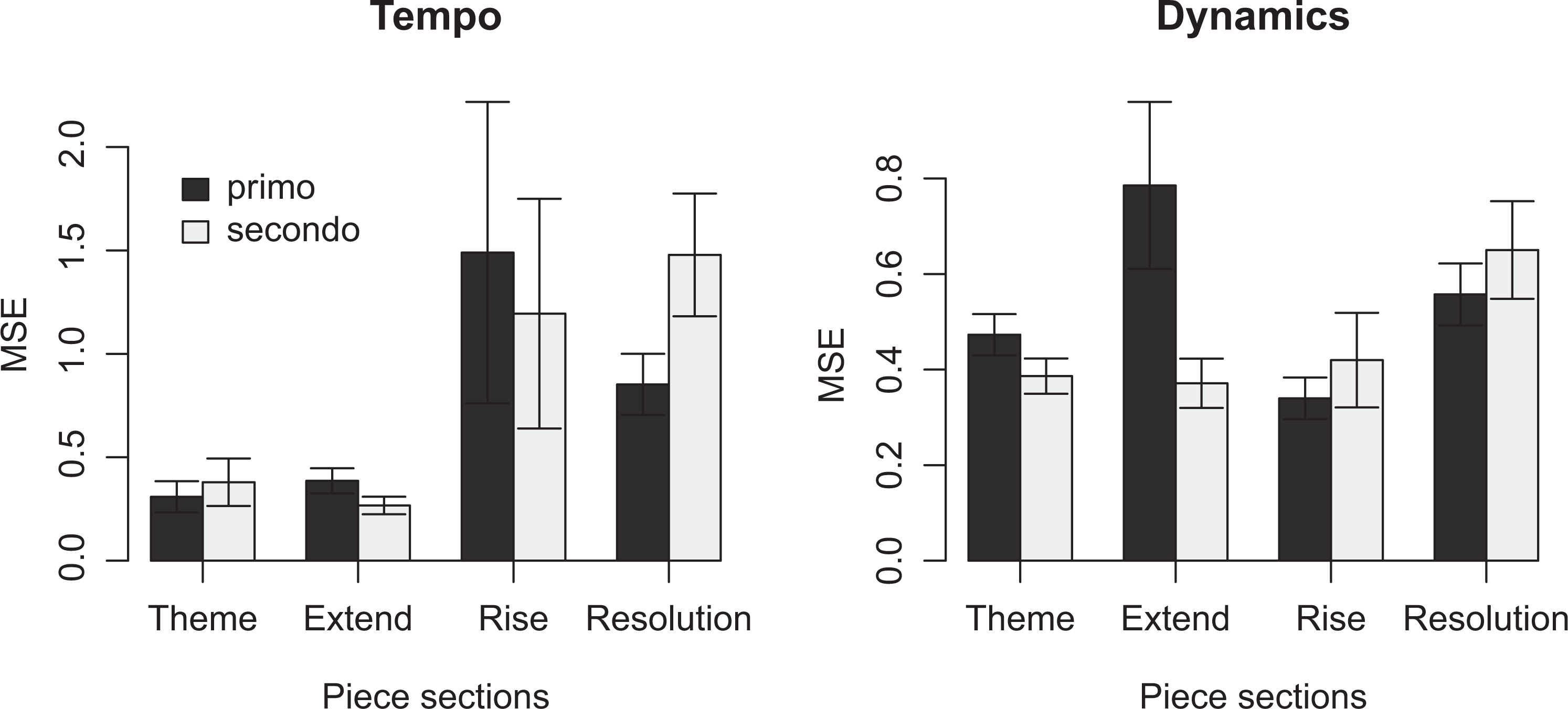
Consistency of tempo and dynamic curves across solo and duet conditions for primos and secondos. The legend applies to both plots. Error bars indicate standard error.
Correlations between MSEs indicating within-pianist consistency across conditions and MSEs indicating primo-secondo differences in solo tempo were positive for secondos (r = .35, p = .01) and nonsignificant for primos. Thus, at least for secondos, increased similarity between primo and secondo solo interpretations related to increased consistency across solo and duet conditions. Post-hoc tests showed greater consistency during the Theme, t(59) = 2.81, p = .007, d = 0.54, and Extension, t(59) = 2.84, p = .006, d = 0.56, than during the Rise; all other effects were nonsignificant (α = .008).
For dynamics, LME showed significant effects of piece section, F(3,59) = 2.77, p = .049, primo-secondo solo dynamics differences, F(1,59) = 33.00, p < .001, and years of study, F(1,15) = 18.42, p, < .001. There was also a significant piece section x role interaction, F(3,59) = 3.50, p = .02.
Moderate correlations occurred between MSEs indicating consistency across conditions and MSEs indicating primo-secondo differences in solo dynamics for primos (r = .56, p < .001) and secondos (F = .54, p < .001). The correlation between MSEs and years of study was negative (r = −.36, p < .001). Post-hoc tests investigating the interaction showed that primos were less consistent that secondos during the Extension, t(16) = 3.21, p = .006; all other between-partner/within-condition contrasts were nonsignificant (α = .01). Post-hoc tests did not indicate significant differences between piece sections (α = .008).
Figure 6 shows between-performer differences in MSEs for each duo individually, ordered by years of study. As can be seen from the graphs, relatively large between-performer differences arose for some duos, in some sections of the piece, suggesting that one performer played much more consistently across solo and duet conditions than the other.

Primo–secondo differences in solo-duet consistency for tempo and dynamics. Primo–secondo differences in MSEs are shown for each duo, ordered by cumulative years of study. There are 2 duos with each of a cumulative 24 and 35 years of lessons; all other years represent 1 duo. Points are color-coded to represent piece sections.
Our second analysis measured the percentage of significant G-causalities occurring per section that indicated primo influence over secondo versus secondo influence over primo. For tempo, LME indicated a significant effect of role on the percentage of significant tests, F(1,40) = 8.02, p = .007, with primos influencing secondos more often than secondos influenced primos (Figure 7). All other effects were non-significant.
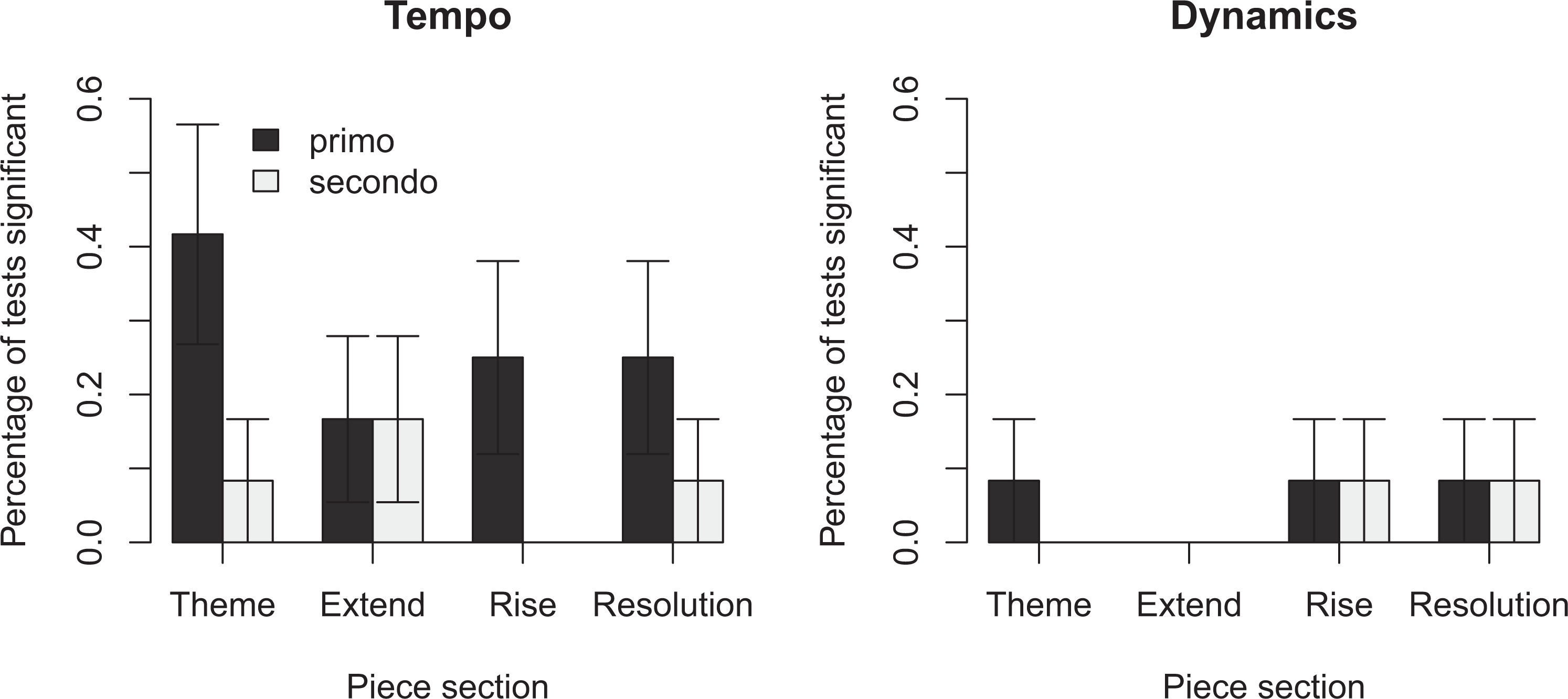
Percentage of Granger causality tests indicating primo or secondo lead for tempo and dynamics. The legend applies to both graphs. Error bars indicate standard error.
Precision of Temporal and Dynamic Alignment
We hypothesized that pianists who showed high between-performance variability in solo conditions would be less precise in aligning their timing and dynamics with their partner during duet performances. LME yielded no significant effects for tempo. For dynamics, the effects of trial, F(2,42) = 9.46, p < .001, and solo variability, F(1,15) = 8.17, p < .01, were significant.
The correlation between primo-secondo differences in key velocity and solo variability was positive (r = .34, p = .003), suggesting that pianists who were more variable across solo performances were also less precise in aligning their dynamics with their partner. Post-hoc tests showed that alignment precision was better (i.e., with smaller error) during the second, t(42) = 3.89, p < .001, d = .72, and third performances, t(42) = 3.62, p < .001, d = 0.62, than during the first (α = .02).
Communicative Gesturing in Solo and Duet Performances
Gesturing was hypothesized to be more “communicative” during duet performances than during solo performances – that is, quantity of motion (QoM) and smoothness were expected to be higher. QoM and smoothness were expected to increase across duet performances as well.
For QoM, LME yielded a significant effect of condition, F(3,63) = 19.22, p < .001, corresponding to greater QoM during solo performances than during duet performances. The effect of piece section was also significant, F(3,378) = 3.16, p < .02 (Figure 8). All other effects were non-significant (p > .05). Post-hoc tests were run to investigate the effect of piece section, but yielded no significant results (α = .008).

Quantity (left) and smoothness (right) of motion across piece sections, for solo and duet performances. The legend on the right applies to both graphs. Error bars indicate standard error.
For smoothness, LME showed a significant effect of condition, F(1,59) = 9.56, p = .003, corresponding to greater smoothness during duet performances than during solo performances. The effect of piece section was also significant, F(3,363) = 45.06, p < .001 (Figure 8). All other effects and interactions were non-significant.
Post-hoc tests were run to investigate the effect of piece section, and showed greater smoothness during the Theme than during the Rise, t(357) = 7.26, p < .001, d = 0.65, and Resolution, t(357) = 9.58, p < .001, d = 0.90, and likewise greater smoothness during the Extension than during the Rise, t(357) = 6.37, p < .001, d = 0.52, and Resolution, t(357) = 8.70, p < .001, d = 0.75.
Gesture Coordination During Duet Performance
We hypothesized that performers’ gestures would become more similar during duet performances, and that evidence of leading/following would manifest in their head acceleration patterns. LME showed significant effects of playing condition, F(1,103) = 8.29, p = .005, and piece section, F(3, 24) = 4.25, p = .02 (Figure 9), corroborating our hypothesis that performers’ gestures are more similar in duet performances. All other effects were non-significant.
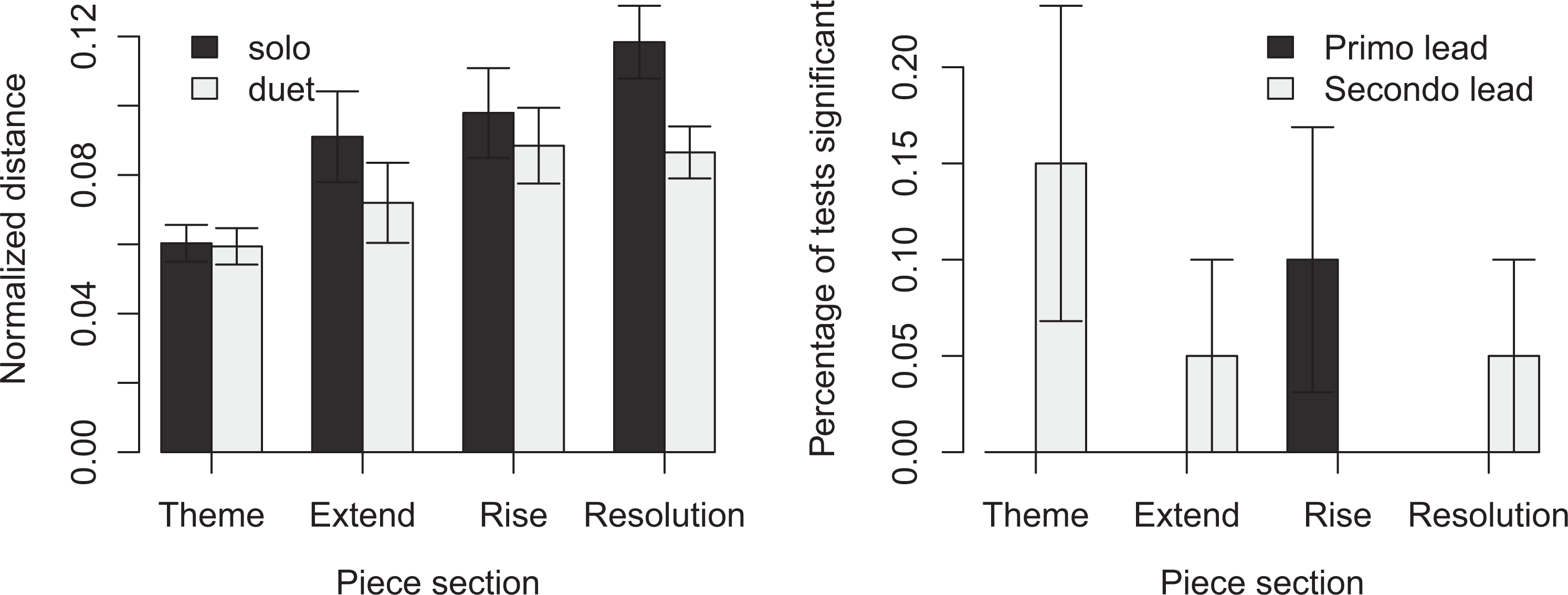
Left: Similarity between primo and secondo head acceleration curves (operationalized as normalized distances) in solo and duet conditions. Smaller distances correspond to greater similarity. Right: Percentage of significant Granger causalities indicating primo or secondo lead during duet performances, across piece sections. Error bars indicate standard error.
The effect of condition corresponded to smaller normalized distances (i.e., greater similarity) between primo and secondo acceleration curves during the duet condition than during the solo condition. Post-hoc tests showed higher coordination in the Theme than in the Resolution, t(24) = 3.55, p = .002, d = 0.95 (α = .008).
No significant effects arose in the analysis of Granger causalities (p > .05; Figure 9). Thus, there was no evidence that either primo or secondo performers led gesturally.
Discussion
This study investigated the patterns of communicative and musically expressive behavior that emerge when two pianists attempt to coordinate duet performances following individual practice. We tested the hypothesis that collaboration between pianists would encourage greater expressive variability, more divergent interpretations, and an increase in the communicative qualities of pianists’ gestures. This hypothesis was motivated by the literature on joint action and creativity, which suggests that, among highly skilled performers, new creative ideas may emerge as a result of performers’ interactions (e.g., Sawyer, 2006; Schiavio & Høffding, 2015). The alternative hypothesis was that performers would retreat to less variable, more prototypical interpretations when playing together, in order to ensure successful coordination.
We found lower temporal variability in duet performances than in solo performances, contrary to our hypothesis. Our prediction that duet performances would be more divergent (less prototypical) than solo performances was also unsupported. Primos led secondos in note timing, as we predicted. Our analyses of body gestures showed that pianists moved more during solo performances than during duet performances, but their movements were smoother during duet performances. Finally, we observed evidence of gestural coordination during duet performances, though no leader–follower patterns emerged. These findings are discussed in greater detail below.
Reduced Temporal Variability and Lack of Divergence During Duet Performances
We observed greater temporal variability during solo performances than during duet performances, in the form of higher curvature (lower smoothness) of tempo curves. We did not observe any effects of playing condition on the smoothness of dynamic curves, suggesting that a similar range of dynamics was maintained across conditions. Temporal variability in solo performances correlated negatively with years of study, suggesting that more experienced pianists played less variably.
The lower smoothness of tempo curves observed during solo performances may have resulted from an increased use of local timing deviations during solo performances. It is possible that some of the heightened temporal variability in solo performances related to insecurity with the music, as solo performances were always given prior to duet performances and had a higher note density. However, since this analysis used composite rather than raw performances (see Analysis), substantial erroneous deviations in timing would have been disregarded.
Prototypicality was similar across solo and duet performances. A slight negative correlation between MSEs and years of study suggested that more experienced pianists played more prototypically than less experienced pianists. Thus, in this study, we found no evidence that collaboration encouraged divergence among duos’ interpretations. Rather, pianists seemed to converge in both conditions to a relatively homogenous range of timing and dynamic profiles. Research by Repp (1997b) showed that early-career musicians tend to play more prototypically than do established musicians. Some categories of listeners, furthermore, tend to prefer more prototypical performances (Repp, 1997a; A. Wolf, Kopiez, Platz, Lin, & Mütze, 2018). Thus, our pianists may not have been driven to create particularly idiosyncratic interpretations. It should also be noted that the limitations of the experimental paradigm (especially the short rehearsal time, and some features of the piece) may not have been optimally conducive to the emergence of divergent interpretations.
Primo/Secondo Contributions to Duet Performances
We assessed the relative magnitude of primo and secondo contributions to duet performances, first, by comparing how consistently primos and secondos played across solo and duet conditions. We found no difference in consistency between primos and secondos, though a correlation with years of study suggested that more experienced pianists played dynamics more consistently across conditions. Positive correlations between solo-duet consistency and primo-secondo differences in solo interpretation emerged for both tempo and (more strongly) dynamics, suggesting that pianists who played more similarly to their partner in solo conditions ended up playing more consistently across conditions. This is a result that we would expect to see if duos preferred to maintain their own solo interpretation during the early stages of collaboration, or tried to find a “middle ground” between their individual interpretation and that of their partner.
We therefore found no evidence that performers’ roles in the collaboration (i.e., primo or secondo) prompted them to either retain or abandon their practiced individual interpretations. On the other hand, looking at the differences in primo and secondo consistency across duos (see Figure 6), we see that for some duos, in some sections of the piece, one performer maintained their individual interpretation more consistently than the other. Individual differences (e.g., relating to personality or skill) may have contributed to one performer taking a more dominant role than the other.
Leader–follower tendencies emerged at the level of sound output during duet performances. Calculation of Granger causalities for performed tempo indicated a significant tendency of primos to lead secondos. The tendency of primos to lead is not surprising, as the primo carried the melody through most of the piece (though the secondo had the melody during the Extension). It is more generally common for the primo to take a leadership role during duet performances, at least in the Western classical tradition, though this convention is easily dismissed if the piece structure suggests otherwise, or if social factors such as performer personality or experience render the secondo the more dominant contributor.
Interview studies have shown that musicians want to feel as though they have a specific role in the collaboration, and a unique contribution to make; some musicians contrast this sense of ownership with being “told what to play” (Hart & Di Blasi, 2015). Identification with a unique role is thought to be important for the emergence of group flow states. Compatibility between performers in terms of aims, skill level, and personality is likewise understood to support group flow. The leader–follower relationships that emerged in the current study could be seen through this lens: primo and secondo pianists had different roles to play, given the structural differences in their parts. The leading/following roles that they assumed were not about one performer dominating the interaction, but rather about performers identifying their unique contributions.
Gestural Coordination During Duet Performances
We did not observe significant leader–follower tendencies at the level of pianists’ body gestures. This is somewhat at odds with prior research (e.g., Keller & Appel, 2010). On the other hand, we did observe some effects of the collaborative setting on other aspects of gesture patterns. Quantity of motion was greater during solo performances than during duet performances, but smoothness was higher during duet performances. The reduction in quantify of motion was unexpected (and in contrast to previous observations; see Bishop et al., 2019b), but could be explained by the fact that pianists had to sit quite close together during the duet performances to play their respective parts, and were more constrained in their range of movement as a result. In fact, relatively little movement might be needed for pianists who are sharing a piano bench (as ours were) to interact with each other at a kinaesthetic-motor level, as they can to some degree feel each other’s changes in posture, position, and weight distribution.
The increased smoothness observed during duet performances echos previous findings of people employing smoother movements during joint action tasks (Vesper, van der Wel, Knoblich, & Sebanz, 2011). Increased smoothness has been shown to improve gesture predictability (Bishop & Goebl, 2017; Wöllner, Parkinson, Deconinck, Hove, & Keller, 2012). Smoothness was also highest during the first half of the piece. During the latter sections, performers used an expanded dynamic range, particularly during the Rise (see Figure 1). Playing at a higher sound level may have necessitated less smooth movement patterns. More generally, the expanded dynamic range likely corresponded to a sense of increased emotional arousal, which may have prompted a more emphasized style of expressive movement as well.
Gestural coordination emerged between co-performers during duet performances. Similarity between primo and secondo head acceleration curves was greater during duet performances than during solo performances. This difference was important to show, as it confirms that the coordination observed during duet performances was not accidental; it did not arise simply because performers happened to respond similarly to the music. Previous research showed that the gestural coordination emerges when performers can see each other, but that the quality of duo synchronization does not depend on their ability to make visual contact (Bishop et al., 2019a, 2019b). Thus, it remains unclear whether performers benefit from coordinating their gestures. It may facilitate high-level coordination of sound output (e.g., of interpretive elements), encourage heightened feelings of collaboration, and/or make performers seem more aligned and interactive from an audience’s perspective.
The Questionable Role of Empathy in Duet Performance
Empathy was hypothesized to relate to expressivity and coordination. However, we did not observe reliable relationships between either empathic concern or perspective taking scores and any of our dependent measures. Stronger relationships might have been found with a more diverse group of participants, as ours were all highly skilled musicians who may represent a biased distribution of empathy scores (if indeed empathy is an important capacity for musical accomplishment; see Kawase, 2015).
Conclusions
Ensemble coordination tends to manifest as a group-level emergent phenomenon, which cannot be reduced to the sum of individual behaviors. Yet sometimes it fails as a result of discrepancies in the expectations of individual performers. This might manifest as period of asynchrony, or a mismatch in dynamic levels, or a passage of flat articulation or unclear phrasing. This study addressed the question of how performers’ expressive and communicative behavior change between solo and collaborative playing conditions. What behaviors enable successful real-time negotiation of a joint interpretation?
Our findings show that expressive behavior changes from solo to duet conditions. The four most notable changes that we observed were (1) a reduction in expressive variability, (2) the emergence of leader–follower relationships, (3) increased smoothness of head movements, and (4) between-performer coordination of head movements.These changes speak to the strategies that musicians use when coordinating with a duet partner for the first time. By reducing expressive variability and assuming leader–follower roles, musicians become more predictable to each other. Coordination becomes a simpler task when there is less uncertainty.
The benefits of using smoother and more coordinated gestures remain unclear – given that previous research suggests no relationship between gesture quality and synchronization success (Bishop et al., 2019b). Rather than improving the predictability of visual signals, changes to gesture quality may serve primarily to support musicians’ own engagement with the music and each other, and/or signal the strength of the performers’ interaction to the audience.
This study aimed to examine performers’ collaborative behavior in a naturalistic setting. More specifically, we focused on the performance of early 20th-century Western classical piano duet music, which participants practiced briefly and individually before attempting to coordinate. Our focus on the initial stages of duet preparation was motivated by the fact that uncertainty at this stage is high—performers are unsure of how their partner will play, and uncertain of whether coordination will succeed. Sometimes, they lack a clear image of how primo and secondo parts will sound when combined. It is important to note that our findings might not generalize to other musical contexts, including forms of ensemble performance in which performers have little means of visual interaction, and forms in which interpretation involves less manipulation of tempo, and more manipulation of other acoustic features (e.g., pitch, timbre, etc.).
Future research should consider how supportive aspects of collaborative behavior—such as characteristics of body movement and gestural coordination—affect performers’ and audience members’ perceptions of performance quality and coordination success. The current study shows that these patterns of behavior emerge during ensemble performance; however, their effects on performance quality and performer experience remain unclear. Further study is also required to explore the complementary roles that performers assume during ensemble performance, particularly with respect to how performers conceptualize and experience them, and how they change over time.
Supplemental Material
Supplemental Material, Duet_score_1 - Negotiating a Shared Interpretation During Piano Duo Performance
Supplemental Material, Duet_score_1 for Negotiating a Shared Interpretation During Piano Duo Performance by Laura Bishop and Werner Goebl in Music & Science
Supplemental Material
Supplemental Material, Solo_score - Negotiating a Shared Interpretation During Piano Duo Performance
Supplemental Material, Solo_score for Negotiating a Shared Interpretation During Piano Duo Performance by Laura Bishop and Werner Goebl in Music & Science
Footnotes
Authors’ Note
Laura Bishop is also affiliated with RITMO Centre for Interdisciplinary Studies in Rhythm, Time and Motion, University of Oslo, Norway.
Acknowledgments
We wish to thank the pianists who participated in the study for their time and effort. We are also grateful to Dr. Carlos E Cancino-Chacón for advice regarding data analysis.
Contributorship
LB was responsible for conceiving the study, researching the literature, collecting and analyzing data, and writing the paper. WG was involved in study design, data analysis, and editing the manuscript.
Declaration of conflicting interests
The authors declared no potential conflicts of interest with respect to the research, authorship, and/or publication of this article.
Funding
The authors disclosed receipt of the following financial support for the research, authorship, and/or publication of this article: This research was supported by Austrian Science Fund (FWF) grant P29427, awarded to LB.

Action Editor
Elaine King, University of Hull, School of the Arts.
Peer review
Clemens Wöllner, Universität Hamburg, Institut für Systematische Musikwissenschaft.
One anonymous reviewer.
Supplemental material for this article is available online.
Note
References
Supplementary Material
Please find the following supplemental material available below.
For Open Access articles published under a Creative Commons License, all supplemental material carries the same license as the article it is associated with.
For non-Open Access articles published, all supplemental material carries a non-exclusive license, and permission requests for re-use of supplemental material or any part of supplemental material shall be sent directly to the copyright owner as specified in the copyright notice associated with the article.
