



Abstract
Inclusion has been a contested concept affecting policy and practice in education for many decades, particularly for individuals on the autism spectrum. Due to the challenges that autistic pupils may face in forming social relationships, they are at a greater risk of isolation and exclusion. This study explored whether music and dance can promote the inclusion of autistic children aged 5–8 years, attending mainstream schools, through participation in a novel music and dance program. A total of 42 pupils (seven autistic), in seven groups, took part in the 6-week program. Engagement on task and physical proximity were used as proxy measures of inclusion. Video observation was used for the collection and analysis of the data. The findings suggest that music is a strong motivational factor for autistic participants and promotes engagement on task. Music and dance have been found to enhance physical contact and cooperation in the group, thus promoting acceptance and inclusion. Implications for practice and directions for further research are discussed.
Introduction
Inclusive Education for Pupils on the Autism Spectrum
Autism affects the ways an individual perceives the world and connects with other people. Autism is currently assessed and diagnosed in childhood by several criteria, including behaviorally presenting difficulties in social interaction and communication as well as restricted repetitive patterns of behaviors, interests or activities (American Psychological Association [APA], 2013).
A growing number of pupils are diagnosed on the autism spectrum, with the majority attending mainstream educational settings in England (Bond & Hebron, 2016; Department for Education [DfE], 2014) as well as in Canada (Lindsay, Proulx, Scott, & Thomson, 2014) and Australia (Garrad, Rayner, & Pedersen, 2018). The inclusion of pupils with special needs and disabilities, including those on the autism spectrum, in education has been an issue that has elicited debate for many years. There seems to be no agreement on what constitutes the most appropriate setting for autistic children and young people, but, for some children, at least, it is believed that attending a mainstream school can be beneficial in terms of social inclusion (Bond & Hebron, 2016). On the other hand, including pupils on the autism spectrum can be challenging for teachers and the autistic pupils in terms of accessing the curriculum and developing positive relationships with peers (Campbell & Barger, 2014), which are fundamental aspects of inclusive education.
There is currently extensive and varied research relating to autistic children and young people (Charman & Howlin, 2003; Guldberg, 2010). There also seems to be a wide range of interventions available, varying from medical ones such as medication and psychotherapy to more behavioral, educational and alternative treatment programs which can often be competing, and although extensively used for a period of time, have been based on no or very little empirical evidence (Humphrey & Parkinson, 2006; Preis, 2007). Since communication and socialization are at the core of the diagnosis of autism, extensive research has been done on specific interventions in these areas (Goldstein, 2002; Krasny, Williams, Provencal, & Ozonoff, 2003; McConnell, 2002).
Given the rising number of young pupils diagnosed in the autism spectrum and attending mainstream schools, there is a need to identify effective strategies for the inclusion of autistic pupils. We suggest that music and dance could enhance the inclusion of autistic pupils in mainstream education. Autistic individuals respond to music as it is highly repetitive, has well-defined patterns with clear start and finish and predictable features. Ockelford (2013) suggests that “it is as though music, with its reliance on repetition, could have been especially devised for those on the autistic spectrum” (p. 99). Movement and dance create an inclusive experience through nonverbal means of expression and communication (Boris, 2001; Koff, 2000).
In the present study, inclusion is defined as peer acceptance, sense of belonging and contribution to the group through engagement in group activities and cooperation between peers (Rose & Shevlin, 2017). Working together with peers on tasks and participating actively in a group activity as well as level of interactions, contact and acceptance are important aspects within the social dimension of inclusion (Koster, Nakken, Pijl, & Van Houten, 2009). Figure 1 presents the novel conceptual framework for inclusion, operationalized for the purpose of the current study. As illustrated in Figure 1, engagement on task and physical proximity were used as a proxy measure for inclusion.
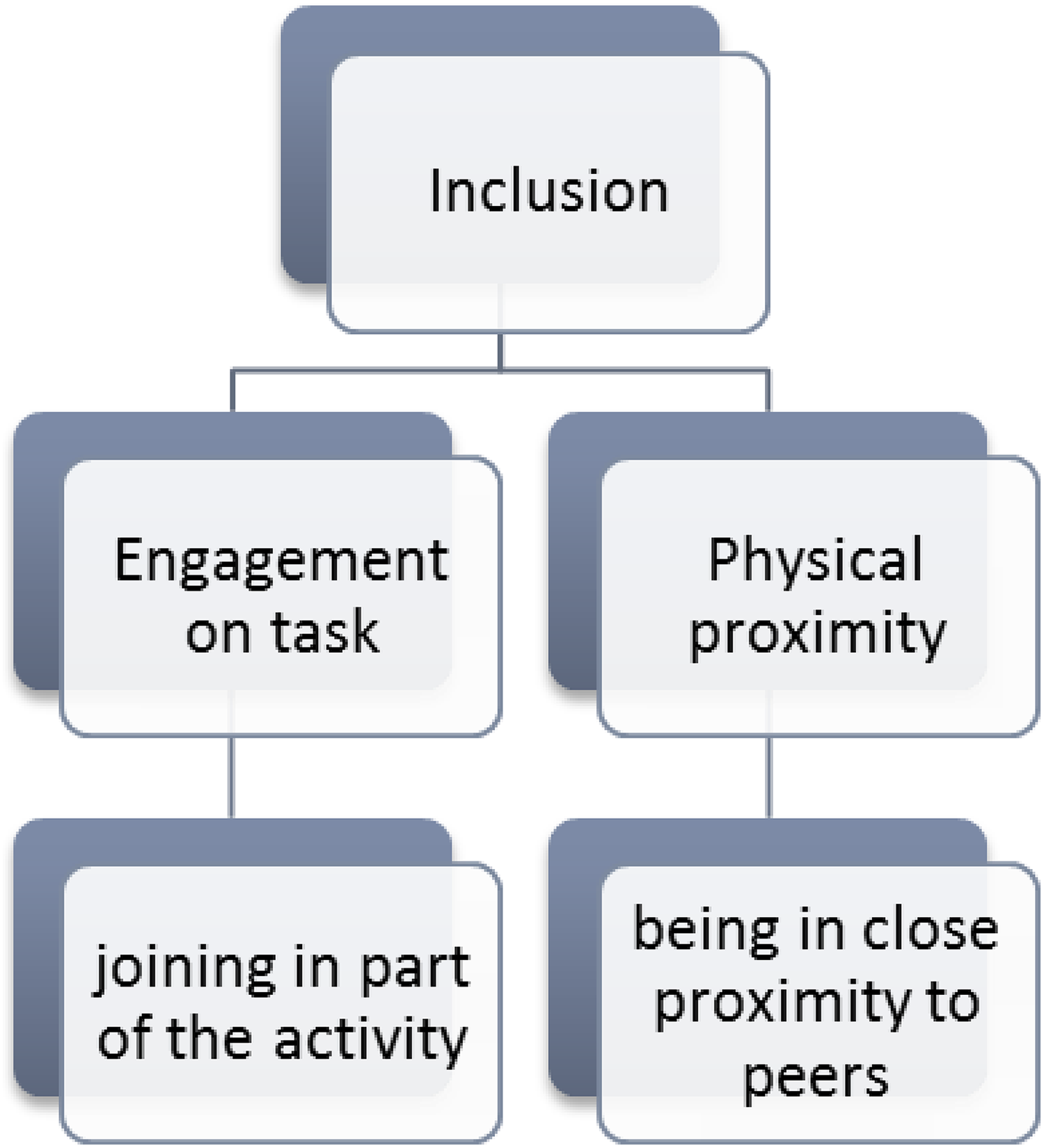
Conceptual framework of inclusion.
Music Used as an Intervention in Therapy and Education for Autistic Pupils
Music is widely used by practitioners in music therapy and music education in programs for autistic individuals, and although this work has been documented in the literature, there is an apparent dearth in experimental studies (Simpson & Keen, 2011) and a continued need for further research (LaGasse, 2017). Most existing research on music has also been based on relatively small samples, with a large number being single case studies (Accordino, Comer, & Heller, 2007; LaGasse, 2017). These studies were in the majority undertaken within music therapy sessions implemented in specialized settings in the form of one-to-one or small group therapy sessions. The majority of these studies are also using solely music without incorporating movement or in comparison with dance or other therapies/disciples (Accordino et al., 2007; Simpson & Keen, 2011).
Music Activities Incorporated in Play and Literacy Sessions
There is a range of approaches and interventions used in music therapy research evaluating the impact on social communication skills in autistic individuals. Among these, some embed music within play or literacy sessions in schools, linked to the design of the present study. Kern and Aldridge (2006) explored the effects of non-directed music therapy activities and teacher and peer music intervention during outdoor play session. The study involved case studies of four autistic boys, aged between 3 and 5 years, attending a community-based childcare program. The aim of the intervention was to encourage the autistic children to take part in outdoor play activities and interact with their peers, thus enhancing their social skills. They found that although the music hut in itself did not enhance social communication, this combined with teacher and peer-mediated interventions improved positive peer interactions and play.
Similarly, Kim, Wigram, and Gold (2008) conducted a research program in which they compared music therapy to play sessions in relation to joint attention and emotional communication; it resulted that the music condition was significantly more effective in initiating joint attention and turn-taking than the play sessions.
In their study, Carnahan, Basham, and Musti-Rao (2009) examined the effect of music within a group setting on levels of active engagement during an interactive book session, during which a variety of interactive materials, such as pictures and/or three-dimensional objects, associated with the storyline were used in an interactive way. They measured attending behavior during three conditions: read only; interactive story using two and three-dimensional materials; and music added with text sung. The results from the children’s observations showed that engagement was improved when interactive books were used in conjunction with music.
Dance Used as an Intervention in Therapy and Education for Autistic Pupils
Dance has been used both in therapy and education as a method to enhance personal development, to facilitate nonverbal interactions and to promote inclusion (Scharoun, Reinders, Bryden, & Fletcher, 2014). Most of the research and practice projects derive from dance movement therapy (Nelson, Paul, Johnston, & Kidder, 2017). It has been used in the school environment with children with special needs, including those on the autism spectrum, mainly in a therapeutic context, as a tool to support body awareness, communication and self-esteem and promote socialization (Tortora, 2010). There is little evidenced-based research on the effectiveness of using dance movement therapy as an intervention for individuals on the autism spectrum (Martin, 2014).
Music is often incorporated in dance/movement interventions and programs. Mateos-Moreno and Atencia-Dona (2013) studied the positive effects of music therapy combined with dance movement therapy for autistic adults. Hartshorn et al. (2001) examined the benefits of dance movement therapy for young autistic children. They implemented 30-minute movement sessions twice per week, for 2 months, for 38 autistic children (mean age = 5 years). Sessions consisted of different activities using music as well as props such as movements with hoops, an obstacle course and moving to the beat of a tambourine. The authors focused on stereotypical behaviors such as wandering and resisting the teacher in the first and last session, by recording the percentage of time each behavior occurred within six randomly distributed 1-minute periods. Results showed a significant increase in attentive behaviors and decrease in anxiety behaviors over the course of the study. Hartshorn et al. (2001) stated that at the end of the program, participants were still lacking full engagement on task; they nevertheless reported a significant improvement in the levels of engagement, considering children had been previously observed wandering and/or resisting the instructor. Lakes et al. (2019) examined the effects of Creatively Able, a music and movement intervention program for 7–12-year-old autistic pupils, with regard to their self-regulation and behavior. Self-report pupil ratings showed that the participants enjoyed and engaged positively in the program. The research results showed some improvement in autism spectrum disorder (ASD) symptoms such as a reduction in stereotyped and compulsive behaviors, related to self-regulation. However, since Creative Able consisted of a range of qualitative features, it was not possible to discriminate which element was most effective for the participants. Nelson, Paul, Johnston, and Kidder (2017) explored the effectiveness of combined play and dance tasks on the play behaviors and skills of autistic young children in inclusive preschool environment. They found that the intervention effectively enhanced social play in young autistic children. In relation to dance, all children, including the ones on the autism spectrum, engaged with joy and enthusiasm in creative dance tasks. Although, at first, the three autistic children stood back and observed what others were doing, as the dance activities went along, they moved closer to their peers and joined in.
The above studies examined either the use of dance or music to support autistic pupils mainly in relation to joint attention, self-regulation and engagement. Although the studies presented positive findings, they were in whole undertaken in specialist settings and within either music or dance therapy sessions/interventions. The present study is the first to examine and compare the benefits of music, dance and music and dance activities combined for young autistic pupils in mainstream school settings. It is designed within an educational framework and delivered by an autism specialist teacher.
The primary aim of the research is to evaluate the effectiveness of a music and dance intervention program in relation to the inclusion of 5–8-year-old autistic pupils attending mainstream schools. The research questions are: To what extent are engagement on task and physical proximity among children (5–8 years old) on the autism spectrum educated in mainstream schools enhanced by music, dance or a combination of both? How did the level of engagement and physical proximity differ in their typically developing peers based on the different tasks? Were there any changes according to the sessions of the intervention program? Relatedly: Have engagement on task and physical proximity increased and improved over time?
The research used an intervention research design over 6 weeks. The analytic strategy aimed to highlight the general levels of inclusion in the autistic and typically developing groups, the differences between those two groups, and the longitudinal effects of the intervention program on inclusion over 6 weeks.
Methods
Participants
Forty-two pupils in total, aged 5–8 years old, participated in the study, which was carried out in five mainstream schools in London. Seven groups of students were included in the study: six pupils in each of the seven groups. Each group contained equal numbers of boys and girls and one autistic child. There were 21 girls and 21 boys in total, among which two girls and five boys on the autism spectrum. Table 1 provides some general information on the pupils of each group with some additional details for the participants who were present per session.
Participants in the study.

Notes. N = 7 number of groups. The columns provide details of the participants per group and numbers represent how many pupils attended per session (S1–S6). (TD) and (A) indicate whether the absent pupil was “typically developing” or autistic.
Procedure
The study was approved by the University Research Ethics Committee and was carried out in accordance with the University’s Ethics Guidelines. Prior to the start of the intervention program parents were asked to give full consent for the participation of their children in the research. They were provided with written information regarding the aims of the study and the data collection process. Parents were also informed of their right to withdraw the child at any time. All pupils took part in the same intervention program and all variables were designed to be fun and educational for all pupils. Simplified clear language and visual supports were used to explain to the children that they could leave the session or group at any stage of the process. Professionals who worked with the children were asked to note and inform the researcher if the children appeared to show a negative reaction to engagement in the activities and would withdraw the participants if needed.
An original intervention program was designed and delivered by the first author, who was unknown to the pupils prior to the start of the study. The program consisted of six sessions lasting approximately 30 minutes each. This time frame was appropriate taking into consideration the content of the intervention and the age of the children. During the 6-week intervention program, four different variables were incorporated, namely a) music, b) dance, c) music and dance, and d) other, neither music nor dance (story by itself). This allowed comparison of music/dance and language-based tasks and activities.
The Intervention Program
The intervention program consisted of an original story enhanced by dance and music activities that related to its content and were designed specifically for this study. The first author is a qualified special needs and dance teacher and has an advanced degree in music education. The sessions followed lesson plan proformas often used in early years education incorporating music and dance elements. Story and storytelling have been used in the form of drama and play in education (Karkou, 2010) and are often the core of dance therapy sessions for children and adults (Tortora, 2006). Listening to stories is part of the National Curriculum statutory English program of study for 5–8-year-olds.
The plot narrates the story of Leo, the lion, who embarks with his animal friends on a treasure hunt. The story was divided into six episodes as were the sessions of the intervention program. Each session included a few props (map, masks, stuffed toys, musical instruments, play tunnel) to increase the level of enjoyment and identification with the story. Although the main episodes of the story were kept the same, a few phrases as well as the pace of story were not identical in all groups. “Other” refers to all tasks relating to the main story, transitions between activities, and any other items that do not involve music or dance. The program, delivered to seven groups of six children, took part in a separate area of the school at the same time and day each week. When there was a key member of staff already supporting the autistic child during the school day, they were present in the session.
Music and Dance Activities
During the sessions, music, dance, or a combination of music and dance activities were designed to complement the story (see Table 2). Every episode contained an “adventure task” that the group had to achieve in order to proceed to the next one. Those tasks involved the participation of all students and required to cooperate in partners or groups. The language story-based activities were equally designed to also enhance cooperation and inclusion of all participants. Sitting on the floor in a group, listening to a story, is part of day lesson routine in early years/key stage 1 as part of circle/carpet time. Dance and/or music activities were at times also performed at the beginning or end of the sessions as introduction or ending. The dance tasks were either predetermined sequences taught to the participants, games with movement, or exercises that provided the opportunities for free expression. These ranged from solo activities to those requiring a partner or a group. When creating the tasks, basic principles of movement (light, strong, fast, slow) were taken into consideration, to allow a variety and combination of time and force elements. Music was used either to complement the movement activity or introduced by itself. The music tasks involved listening to music, playing musical instrument (rainmaker) and a little singing. The songs that accompanied the sessions were selected to match the theme of the different adventures and in the other cases were taken from movies familiar to the children. The program was designed with the idea that it can be replicated by any teacher, support staff or arts specialist without specific knowledge in all areas.
Outline of music and dance intervention program.

Data Collection and Analysis
Video Recording
The 42 30-minute sessions were video recorded, and this material provided the main body of comparison and analysis, mainly focusing on the degree of participation on task and that of physical proximity. In order to record whether students were on task or off task, each session was divided in 10-second periods and the main behavior was coded for each child. The same procedure was followed for the second variable, spatial proximity. For engagement on task, the coding was either “on task” or “off task.” Engagement/participation on task was operationalized as follows. The participant is on task when his or her attention is directed towards a person, action or object used in the session and is either looking, listening or responding to an adult or peer (gestures, signs, words) appropriately or is involved purposefully with the lesson props. The percentage of time during which the pupil was on task was calculated according to the particular task with which the pupils were involved (music, dance, music and dance, other). The second variable—spatial proximity/inclusion in relation to the group—was calculated by using the mean of scores of how much a pupil was included in the group during the four different tasks (music, dance, music and dance, other) in each session. Physical proximity refers to whether the child is away, in the periphery or in physical contact with a peer or the group. In order to calculate the mean, a score was recorded every 10-second period of time: 1 = excluded, 2 = included, 3 = in physical contact, with 3 being the highest, optimal score. The scores for engagement of task and inclusion per task and session for all pupils were then inserted into a statistical software package (SPSS).
Inter-Rater Reliability
At the end of the intervention program and analysis, a second rater with similar qualifications as the first rater, after having a discussion on the operationalized definitions of “engagement” and “physical proximity,” watched a randomly selected videoed session and pupil. The session lasted 27 minutes and 30 seconds and was divided in 10-second periods. Therefore, the rater gave in total 330 ratings in both engagement (165) and inclusion (165) variables using the same rating grid. These were then compared to the first rater’s scores for the same session and pupil. Inter-rater reliability (IRR) was assessed using a two-way mixed, consistency, average-measures intraclass correlation coefficient (ICC) (McGraw & Wong, 1996) to assess the degree that coders provided consistency in their ratings of engagement on task (165) and physical proximity (165) across subjects. The resulting ICC was in the excellent range for both conditions (Cicchetti, 1994). The results for engagement on task ICC = .95 and for physical proximity ICC = .91 indicate that coders had a high degree of agreement and suggest that engagement and physical proximity were rated similarly across the two coders. The high ICC suggests that a minimal amount of measurement error was introduced by the independent coders. Engagement and physical proximity ratings were therefore deemed to be suitable for use in the hypothesis tests of the present study.
Results
Engagement on Task
Due to the small number of participants and the data being non-normally distributed, non-parametric tests were run in SPPS to evaluate the level of engagement of autistic pupils and their peers and compare their scores according to the task they were involved in and the session they attended. These analyses were performed with the aggregated results of the six sessions to evaluate the general levels of engagement (see Table 3). The significance value was set at a threshold of p < .05. Friedman’s ANOVA were run separately for the autistic pupils and their typically developing peers to see whether there was a change between the levels of engagement and the task involved and whether they differed between the participants. Effect sizes were calculated to estimate the effect of the variables in the population and the strength of the intervention. According to Cohen (1992), the following apply with regard to effect sizes: r = .10 (small effect), r = .30 (medium effect), r = .50 (large effect).
Engagement on task and physical proximity per task for all participants (median scores/mean rank scores).

Notes. N = 7 autistic pupils and 35 typically developing pupils. Median scores and mean rank scores for engagement and physical proximity per task for the whole program.
Engagement for Autistic Children
For autistic children, the level of engagement changed according to the task they were taking part in (music, dance, music and dance, other), χ2 (3) = 12.65, p = .005. Pairwise comparisons revealed one statistically significant result (p < .05); the difference of engagement levels between other and music. This indicates that autistic participants were significantly more engaged during music in relation to other language-based tasks. A first post hoc Wilcoxon signed rank test confirmed that autistic participants were significantly more engaged during music activities (Mdn = .95) as compared to other language-based tasks (Mdn = .61) (see Table 4 for results).
Engagement on task—Friedman’s ANOVA pairwise comparisons—Wilcoxon signed rank test results.
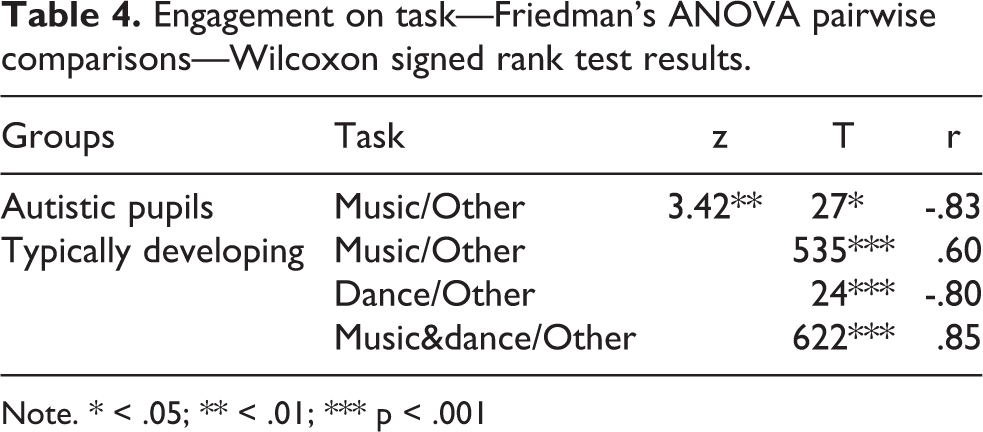
Note. * < .05; ** < .01; *** p < .001
Engagement for the Typically Developing Children
For the typically developing peers, the level of engagement also changed according to the task they were undertaking, χ2 (3) = 54.74, p < .001. The comparison revealed three statistically significant results. More specifically, post hoc Wilcoxon signed rank test showed that the children participated more during music tasks (Mdn = 1) compared to any other activities (Mdn = .92). Similarly, they were significantly more engaged during dance (Mdn = .98) compared to other as well as during music and dance combined in relation to other language-based tasks (Mdn = .99).
Differences in Engagement between Autistic and Typically Developing Children
Mann-Whitney tests were used to evaluate these differences in engagement between the autistic pupils and the typically developing participants according to the task involved. The level of engagement according to whether the children were autistic or non-autistic was significant for three of the four tasks. As shown in Figure 2, for dance, the level of engagement was different between the autistic children (Mdn = .81) and their typically developing peers (Mdn = .98), Similarly, for music and dance, the level of participation on task was different between the children with autism (Mdn = .95) and their non-autistic peers (Mdn = .99) Finally, during other activities, there were significant differences in the level of engagement between autistic (Mdn = .61) and non-autistic participants (Mdn = .93). The level of engagement between children with autism (Mdn = .95) and their non-autistic peers (Mdn = 1.00) was similar for music (see Table 5 for results).

Mann-Whitney test of engagement on tasks for autistic pupils and their typically developing peers. Notes. N = 7 autistic pupils, N = 35 typically developing pupils. Median scores from level of engagement for pupils with autism and their typically developing peers during music, dance, music and dance and other throughout the sessions of the intervention program.
Engagement on task—Mann-Whitney test results between two groups per task.

Note. * < .05; ** < .01; *** p < .001
Task and Session Analysis of Engagement
Mann-Whitney tests were run to compare the level of engagement according to the specific task involved and the number of sessions between pupils with autism and their peers. Although the analysis produced some significant results across tasks and sessions, there was not a linear, progressive increase in the levels of engagement on task from session 1 to session 6. The results confirmed the previous finding that during other activities, the degree of participation on task between autistic children and their typically developing peers was significantly different for all the sessions of the intervention program (see Table 6).
Engagement on task per session and task for all participants.

Notes. N = 7 autistic pupils, 35 typically developing pupils. Median scores of engagement on task per task involved (music, dance, music and dance, other) and sessions 1–6 of the program.
* < .05; ** < .01; *** p < .001.
During the music tasks the Mann-Whitney test revealed no significant results, therefore the level of engagement between autistic children and their typically developing peers was similar for all the sessions. Music was not performed as a task on its own during the second session, as it was either accompanied by dance or movement tasks were performed without music. Throughout the intervention program when children listened to music they would start to dance; therefore, the music task was classified as music and dance.
In sum, results showed that autistic pupils were more engaged during music in relation to “other.” Their typically developing peers were also more engaged in all three tasks—music, dance, and music and dance—as opposed to other tasks, with slightly higher scores during music and dance combined. Interestingly, all participants—autistic pupils and their typically developing peers—were equally engaged only during music throughout the intervention program. In all other tasks, the level of engagement was different across typically developing and autistic participants and sessions. During other, autistic pupils were less engaged than their peers in all six sessions of the program.
Physical Proximity
In order to see whether there was a change between the levels of physical proximity and the task involved, Friedman’s ANOVA was run separately for the autistic pupils and their typically developing peers (see Table 3).
Proximity for Autistic Pupils
For autistic children, the level of physical proximity changed according to the task they were taking part in (music, dance, music and dance, other), χ2 (3) = 19.97, p < .001. Pairwise comparisons revealed three statistically significant results: the level of physical proximity was significantly different between other and dance; other, music and dance; and music, music and dance. Post hoc Wilcoxon signed rank test results (see Table 7) showed that autistic pupils were closer to the group during dance (Mdn = 2.15) as compared to other, as well as during music and dance (Mdn = 2.30) in comparison to other (Mdn = 1.86). Finally, autistic participants were more in physical proximity/contact with their peers during music and dance (Mdn = 2.30) as opposed to music (Mdn = 2.00).
Physical proximity, Friedman’s ANOVA pairwise comparisons—Wilcoxon signed rank test results.

Note. * < .05; ** < .01; *** p < .001
Physical Proximity for Typically Developing Children
Results show that the level of physical proximity changed according to the task typically developing children were undertaking, χ2 (3) = 91.34, p < .001. Pairwise comparisons showed five significant results. Post hoc Wilcoxon tests were run and showed that non-autistic participants were in closer proximity to the group during music and dance (Mdn = 2.31) as opposed to all three tasks: other: Mdn = 2.01; dance: Mdn = 2.18; music: Mdn = 2.00. Typically developing pupils were also in greater physical proximity during dance as compared to other, and as compared to music. Their scores of physical proximity during music and other were similar (see Table 7).
Differences in Physical Proximity between Autistic and Typically Developing Children
In order to see whether there was any difference in the levels of physical proximity between autistic children and their peers according to the four tasks and to compare these differences, further tests were needed. The Mann-Whitney test was used to evaluate these differences in physical proximity between the autistic pupils and their typically developing participants according to the task involved. The level of physical proximity/contact according to whether the children were autistic or non-autistic was significant for one of the four tasks (p < .05). As shown in Figure 3, only during other activities was the level of physical proximity different between the children with autism (Mdn =1.85) and their non-autistic peers (Mdn =2.00), U = 229.00, z = 3.6, p < .001, medium effect size, r = .55. The level of physical proximity between autistic children (Mdn = 2.00) and their peers (Mdn =2.00) was similar for music, music and dance (Mdn = 2.30/2.30) and dance (Mdn = 2.14/2.18).

Mann-Whitney test of physical proximity for autistic pupils and their typically developing peers. Notes. N = 7 autistic pupils, N = 35 typically developing pupils. Median scores from physical proximity for pupils with autism and their typically developing peers during music, dance, music and dance and other throughout the sessions of the intervention program.
Task and Session Analysis of Physical Proximity
Further analyses involved evaluating whether there were any differences in the levels of physical proximity according to the task the children were taking part in, the session of the program and whether they were autistic or not. Mann-Whitney tests were run and produced the following results.
For other, the level of physical proximity was significantly different for five out of the six sessions (p <. 05). Autistic participants were significantly less included or in physical contact compared to their typically developing peers (see results in Table 8).
Physical proximity per session and task for all participants.

Notes. N = 7 autistic pupils, 35 typically developing pupils, Median scores of physical proximity per task involved (music, dance, music and dance, other) and sessions 1–6 go the program.
Note. * < .05; ** < .01; *** p < .001
For music and dance, the level of physical contact/inclusion between children with autism and their peers was significantly different only during session 1. In all other sessions, all participants were in similar proximity to the group and in close proximity/contact with their peers.
For dance, the Mann-Whitney test revealed no significant results; therefore, children with autism were similarly in close proximity/contact as their peers in all of the sessions. Similarly, for music, throughout all the sessions, all pupils had similar scores.
Results showed that autistic pupils were closer to the group during music and dance, especially in relation to other activities. Their peers were also more engaged during dance and music and dance in relation to music or other. In sum, when the task involves dance, physical proximity/inclusion in the group is enhanced. Interestingly, autistic children were equally included during music and dance, dance, and music, but there was a difference in the physical proximity scores during other activities. When looking at the comparisons between each task and session, all participants were similarly included during all music and dance tasks throughout the program as well as during all music or dance tasks, apart from the first session. On the other hand, during other activities, autistic pupils were less included in the group as opposed to their peers.
Discussion
In this study, we explored the impact of music and dance on the social inclusion of primary-age children on the autism spectrum attending mainstream schools. In particular, we sought to discover how pupils across the spectrum can benefit from music and dance/movement sessions in terms of their physical proximity with their peers and their engagement on task, thus enhancing their effective inclusion.
The findings of the quantitative analysis confirm the hypotheses of the study showing that music can enhance engagement for autistic pupils and when combined with dance, promotes physical proximity among participants, thus enhancing inclusion. Other tasks, which involve the story, language tasks and all other transitions, were found to be those during which autistic pupils were least engaged and included in their group of peers.
The main finding was that autistic pupils were more engaged when the task involved music and more included in the group when taking part in music and dance activities. They participated the most during music and were less engaged during other language-based tasks. Overall, non-autistic participants were focused on task and included in the group for the longest periods of time throughout the intervention program during music, dance and combined tasks and less during other language-based tasks. This suggests that music is effective in both physical proximity and engagement and that autistic children are more engaged and included in the group when involved in a task that also includes dance. Dance, together with music, seems to promote physical proximity and contact for pupils with autism and their peers, who seem to benefit from music and dance combined in both conditions, engagement on task and inclusion in the group.
During music only, autistic pupils were equally engaged as their non-autistic peers. This finding is compatible with the results of the study by Kim et al. (2008). The study compared the effectiveness of improvisational music therapy and play sessions with regard to the facilitation of joint attention and nonverbal social communication skills for 10 boys aged 3–5 years. Results showed that improvement in joint attention behaviors was greater in music therapy than in toy play condition. Eye contact duration was significantly longer in music therapy than in play and the same applied for turn-taking duration, which was longer in music therapy sessions.
It was also found that dance, when executed as a task on its own, was not different in relation to other tasks. Therefore, only when dance is accompanied by music do we see an increase in engagement. Typically developing peers were mostly engaged during music and dance combined. This finding is compatible with the results by Hartshorn et al. (2001), who reported an increase in engagement on task for the children with autism who participated in the dance therapy sessions. The authors reported that although there was an increase in engagement, participants were not fully engaged at the end of the intervention. Also, although music was used in the intervention, it was mainly a dance therapy program. Lakes et al. (2019) suggested that taking part in a music and movement program enhanced the engagement of 7–12-year-old autistic pupils.
The analysis with regard to the variable of physical proximity showed that pupils with autism were in closer physical proximity with their peers during music and dance in relation to other tasks. Therefore, dance combined with music seems to be the key for increase in spatial proximity, physical contact, and inclusion. Deveraux (2012) similarly reported that through her personal experiences of using dance movement therapy with individuals with autism, she noticed an increase in the tolerance of physical touch. Nelson et al. (2017) also found that autistic pupils anticipated the dance activities and approached their peers to join in.
Music has been found to be the most motivating and engaging task for autistic pupils throughout the intervention in the present study. On the contrary, language-based tasks were a barrier to participation and a source of confusion and anxiety, leading pupils to become absorbed in self-chosen activities and disengage from the main task. The difficulty of processing and using language is extensively presented in literature and is a core feature of autism, whereas music is an area in which a large number of individuals with autism may even excel. Ockelford (2013) argues that both language and music can be seen as “human forms of communication that occur through streams of sound (heard or imagined) ‘chunked’ in cognition” (Ockelford, 2013, p. 62). The difference, though, as Ockelford explains, is that language is very complex and in order for messages to convey meaning, different elements are incorporated such as: syntax, social context, metaphor, semantic.
The current study offers suggestive evidence for the use of music and dance in schools to support the inclusion of autistic children. Music and dance can be used to complement storytelling and literacy to promote understanding of verbal language and to enhance engagement and motivation of pupils for activities linked to books and stories.
The study has some limitations that need to be addressed. One limitation is the small sample of participants. Due to time constraints, seven pupils on the autism spectrum participated in the study of seven groups of six children in total. Although sample effect sizes were large, in order to generalize the findings for a larger population, a larger number of participants should have been involved. The replication of the study with different groups of participants would enable better generalizability of the findings of the study. The fact that only one practitioner delivered the intervention might have influenced the effectiveness of the program. Having more than one adult leading the program and preferably of a different professional background could provide firm results of the effectiveness of music and movement for pupils with autism.
Future research into the effectiveness of music and dance for autistic children might usefully focus in particular on implementing a program in different settings and with different age groups. This could involve several professionals both in mainstream and specialized settings to measure the effectiveness within different groups of participants. Linking the fields of music and dance therapy and education in research could also be further explored by delivering the interventions in a range of settings. Large randomized controlled trials could provide more definitive evidence.
In sum, the present study confirms previous findings and contributes additional evidence that suggests that music and dance can enhance the inclusion of pupils on the autism spectrum in relation to their engagement on task. Further research should be carried out to explore why and how in particular music and dance can impact on the engagement of pupils with autism and their willingness to participate and be included in a group.
Footnotes
Author contribution
Athina Stamou researched the literature and conceived the study supported by Adam Ockelford. Athina Stamou, Arielle Bonneville Roussy, and Adam Ockelford were involved in the study design and data analysis. Arielle Bonneville Roussy led the quantitative analysis. Lorella Terzi supported with participant recruitment and philosophical underpinning of the study. Athina Stamou wrote the first draft of the manuscript. All authors reviewed and edited the manuscript and approved the final version of the manuscript.
Declaration of conflicting interests
The author(s) declared no potential conflicts of interest with respect to the research, authorship, and/or publication of this article.
Funding
The author(s) received no financial support for the research, authorship, and/or publication of this article.

Peer review
Elizabeth Dowson, University of Nottingham, Institute of Mental Health.
One anonymous reviewer.