




Abstract
Alan Lomax’s Cantometrics Project was arguably both the most ambitious and the most controversial undertaking in music and science that the world has known. Its flagship component, Lomax’s “cantometric” analysis of approximately 1,800 songs from 148 worldwide populations using 36 classificatory features, sparked extensive debate. While Lomax responded to some criticisms, neither his final conclusions nor the evidence on which they were based were ever fully made clear. For decades, neither cantometrics nor Lomax’s related projects involving dance, speech, popular music, digital humanities, pedagogy, and activism were widely adopted by other researchers, but there has been a resurgence of interest since Lomax’s death in 2002. Here, I provide a comprehensive critical review of the Cantometrics Project, focusing on issues regarding the song sample, classification scheme, statistical analyses, interpretation, and ethnocentrism/reductionism. I identify misunderstandings, improvements that were made, and criticisms that remain to be addressed, and distil Lomax’s sometimes-conflicting claims into diagrams summarizing his three primary results: (1) ten regional song-style types, (2) nine musical factors representing intra-musical correlations, and (3) correlations between these musical factors and five factors of social structure. Although Lomax’s interpretations regarding correlations between song style and social structure appear weakly supported, his historical interpretations regarding connections ranging from colonial diaspora to ancient migrations provide a more promising starting point for both research and teaching about the global arts. While Lomax’s attempts to correlate features of social structure such as gender, religion, politics, and economics with stylistic features of musical performance largely failed to gain acceptance, the Cantometrics Project can still provide both inspiration and cautionary lessons for future exploration of relationships between music and culture.
Ethnomusicologists will ignore this book [Folk song style and culture] at their own peril. (Merriam, 1969, p. 386) I have always found cantometrics attractive…So I was surprised that the body of literature which followed, tested, and debated developed only to a narrow trickle. (Nettl, 2006, p. 60)
When Alan Lomax (1915–2002) died, his obituary appeared on the front page of the New York Times (Pareles, 2002). It spoke glowingly of Lomax’s work with famous musicians such as Leadbelly, Pete Seeger, and Bob Dylan, his contribution to the US and European folk revivals, and his passion for “cultural equity: the right of every culture to have equal time on the air and equal time in the classroom”. Yet the 1200-word article barely even mentioned Lomax’s Cantometrics Project, which occupied much of his career and for which he is alternately famous and infamous among academics today.
Beginning in the 1950s, Lomax began constructing the Cantometrics Project (later renamed the “Columbia University Cross-Cultural Study of Expressive Style”), an ambitious, multi-decade, multi-disciplinary, multi-million-dollar project to explore the relationship between music and culture on a global scale. Initially focused on the relationship between traditional folk song style and social structure, it gradually grew to encompass dance, human history, speech, popular music, pedagogy and activism (Averill, 2003; Wood, 2018, Forthcoming). Based primarily on data from his Cantometric song-style classification scheme (co-invented with Victor Grauer), Lomax argued that music both reinforced aspects of social structure and could be used to reconstruct histories of human migration and cultural evolution.
The Cantometrics Project initially met with cautious praise from many of the founding figures of the newly emerged field of ethnomusicology (e.g., McAllester, 1981; Merriam, 1969; Nettl, 1970; Titon, 1982). Even the most critical reviewers expressed their hope that Lomax’s study would lead to further research: After all my quarrel with the method, the selection and application of ethnographic fact, the interpretation, which casually picks the beautiful points and lets the problems rest, after all this I find myself convinced that Lomax has spotted a mechanism by which deep significance is translated systematically into surface significance. One day someone, hopefully Lomax himself (a bit more disciplined and restrained Lomax, less a prophet, more a scholar) will find the rules of this translation and map them so that they will elucidate our understanding of human cultural products…(Maranda, 1970, p. 184)
While ethnomusicologists have not generally attempted to replicate or extend Lomax’s work, several groups from the new generation of cultural evolutionary science have become interested in Lomax’s ideas and data. Luca Cavalli-Sforza, a pioneer in both human genetic anthropology (Cavalli-Sforza, Menozzi, & Piazza, 1994) and cultural evolution (Cavalli-Sforza & Feldman, 1981), was fascinated by the potential congruence of Lomax’s musical maps with his own genetic maps and the linguistic maps produced by Joseph Greenberg (Cavalli-Sforza & Feldman, 2003), and wanted to collaborate with Lomax on a multi-disciplinary exploration of human genetic and musical diversity (Wood, Forthcoming). Unfortunately, Lomax’s ailing health prevented this goal from being fulfilled. Since Lomax’s death in 2002, however, his daughter Anna Lomax Wood (who took over administration of Lomax’s Association for Cultural Equity [ACE]) and Victor Grauer (co-inventor of cantometrics) have worked toward this goal. This has taken place both independently (Grauer, 2005, 2006, 2007, 2009, 2011; Wood, 2018, Forthcoming) and in tandem or in parallel with a wide variety of scientists, including Sarah Tishkoff’s human genetics lab (Callaway, 2007), Armand Leroi’s evolutionary biology lab (Busby, 2006; Leroi et al., 2015; Leroi & Swire, 2006), Simon Dixon’s music information retrieval lab (Panteli, Benetos, & Dixon, 2016, 2017, 2018; Panteli, Bittner, Bello, & Dixon, 2017), Quentin Atkinson’s Cultural Evolution Lab (Du Toit, 2011; Savage & Atkinson, 2015), Steven Brown’s NeuroArts Lab (Brown et al., 2014; Ellis et al., 2018; Rzeszutek, Savage, & Brown, 2012; Savage, Merritt, Rzeszutek, & Brown, 2012), and my own CompMusic Lab (Savage & Brown, 2013, 2014; Savage, Brown, Sakai, & Currie, 2015; Savage, Matsumae, et al., 2015). At the same time, others have investigated similar relationships with minimal reference to Lomax’s ideas or methods (Le Bomin, Lecointre, & Heyer, 2016; Mehr, Singh, York, Glowacki, & Krasnow, 2018; Pamjav, Juhász, Zalán, Németh, & Damdin, 2012). Several of these studies have resulted in media coverage in high-profile news outlets such as the New York Times, Nature News, NBC News, and NPR (Callaway, 2007; Doucleff, 2015; Ghose, 2013; Marshall, 2018). However, this recent explosion of cantometric research has dealt with only certain aspects of the overall Cantometric Project and has yet to produce a comprehensive overview or address many of the important critiques of Lomax’s work.
My goal in this article is to produce such an overview by summarizing Lomax’s own work and its criticisms in light of these recent studies and related developments that have occurred during the half century since Lomax began his work. Because Lomax’s forays into dance (choreometrics) and other domains were less comprehensive and more heavily criticized than his flagship cantometric analysis of traditional folk songs (e.g., Kaeppler, 1978; Kealiinohomoku, 1974; Williams, 1974; Youngerman, 1974), I will focus the bulk of the article primarily on cantometrics, but I will also suggest possibilities for re-extending the analysis into other domains of art and culture. By understanding why Lomax’s vision of an interdisciplinary, global synthesis of science and art failed to take off half a century ago, we may find ourselves better able to try a new approach in today’s new intellectual climate of revived interest in the digital humanities and cultural evolution.
Cantometrics Project overview
Anthony Seeger argues that Lomax deserves to be better recognized as one of the key figures in the history of ethnomusicology, particularly as “a model – however imperfect – of a combination of applied and theoretical ethnomusicology” (2006, p. 218). Since Lomax’s death, several new publications have shed light on the historical development of cantometrics theory and methodology and their potential for enriching our understanding of expressive culture (Averill, 2003; Gold, Revill, & Grimley, 2017; Szwed, 2010; Wood, 2018, Forthcoming). I will briefly summarize the major trends before moving to a critical evaluation of the project itself that is only partially explored by these authors.
John Szwed’s biography gives a broad overview of Lomax’s career and lifetime commitment to recording, disseminating, and raising awareness of underappreciated musics of the common people as part of his “drive to celebrate life in all its diversity” (Szwed, 2010, p. 2). Lomax is best known for his fieldwork recording folk songs, which began with trips in his native American South with his father, John Lomax, to record the music of cowboys and prison inmates, and continued through his work in the Library of Congress and in folk revivals in the US and UK. However, he was always interested in broader theoretical issues, where his ideas were shaped by his studies with renowned musicologists and anthropologists such as Curt Sachs, Charles Seeger, George Herzog and Melville Herskovits. After his socialist tendencies in the cold-war McCarthyist climate led to his investigation by the FBI, Lomax relocated to Europe from 1950–1958 to work on a project he conceived to use the newly invented LP format to publish an anthology of the world’s music, eventually published by Columbia Records as an 18-LP series entitled the World Library of Folk and Primitive Music. Lomax was initially based at the Musée de l’Homme in Paris, where Gilbert Rouget (to whom Claude Lévi-Strauss had recommended Lomax as a “genius” [Szwed, 2010, p. 253]) introduced him to much African and Asian music, particularly the intriguing parallels between the Pygmies of central Africa and the Bushmen of southern Africa.
1
During this period, one of the two major themes of the Cantometrics Project was beginning to crystallize: the idea of music as a marker of human history: Music for most people, not professional musicians, is more than melody, rhythm, and words – it’s what kind of voice the singer uses, the way he holds his body, and it’s when and how and where the song is sung. All this is learned and transmitted from generation to generation. The primary function of music is to remind the listener that he belongs to one certain part of the human race, comes from a certain region, belongs to a certain generation…So far as I can tell there are between [eight] and a dozen main musical families in the world…Each is very, very old. In fact, it seems that musical style changes less than any other aspect of human culture – such as religion, language, etc.…This means that all this gathering of folksongs, besides putting a lot of good tunes back into circulation, will serve in increasing man’s knowledge of himself…in reconstructing the past…in other words, folk music can become a historical touchstone like the radioactive substances studied by geologists. (unpublished letter from Lomax to his family in 1954, quoted in Szwed, 2010, pp. 285–287)
Lomax first published these ideas in the mid-1950s (Lomax, 1955 –1956, 1956), and would spend most of the rest of his life refining and defending them. Upon his return to the US in 1958, he began presenting and publishing these ideas in a variety of academic conferences and journals while searching for collaborators and funding to support his vision of an interdisciplinary science of art (Lomax, 1959, 1962). While some were put off by his style (Wood, Forthcoming), he was able to attract the interest and support of many prominent scholars, including Margaret Mead, Ray Birdwhistell, Edith and George Trager, and Conrad Arensberg. With their support, Lomax was able to secure ultimately over $1 million in grant money from a number of organizations, including the National Institute of Mental Health and the Rockefeller Foundation. Arensberg, a Columbia University anthropologist who first suggested that Lomax explore correlations between his musical data and data on social structure from George Murdock’s (1967) Ethnographic atlas, served as co-director of the Cantometrics Project. Anthropologist Edwin Erickson and programmer Norman Berkowitz were in charge of the statistical analyses. The rest of the interdisciplinary team comprised specialists on various elements of art and culture, all of which were intended to be unified through a series of scientific, behaviour-oriented “-metrics”.
Cantometrics (canto = song, metrics = measure) – the centrepiece and namesake of the Cantometrics Project – was developed in collaboration by Lomax and musicologist Victor Grauer, who along with Roswell Rudd applied it to code several thousand songs from around the world (further details below). Choreologists Irmgard Bartenieff and Forrestine Paulay helped develop a similar model for dance (choreometrics). Similar approaches were explored for speech (parlametrics), vowel use (phonotactics), breathing (minutage), song texts, and instrumentation (reviewed in detail by Wood, 2018). Lomax’s goal was to synthesize these various datasets into a digital interactive “Global Jukebox” that would unify his academic, pedagogical, and activist goals. Despite interest and financial support from Apple and other institutions, Lomax was unable to realize this goal before his death. However, in 2017 a preliminary version of the Global Jukebox (http://theglobaljukebox.org) was finally launched by ACE (Russonello, 2017).
The Cantometrics Project staff presented their initial findings during a day-long presentation at the 1966 annual meeting of the American Association for the Advancement of Science, and these were published as the edited volume Folk song style and culture (hereafter FSSC; Lomax, 1968), with the various sub-projects still at different stages of completion. The chapters devoted to cantometrics were based on a sample of 2,527 songs (Lomax, 1968, pp. 329–337), with corresponding samples of 43 choreometric profiles (based on “over 200 films”; Lomax, 1968, p. 225), and 17 folk song texts (Lomax, 1968, p. 276). The cantometric and choreometric samples were later expanded to over 5,000 songs and over 2,000 dances, respectively, including popular music from Lomax’s Urban Strain project, but these analyses were never published, nor were full details for the other “-metrics” (see Table 1). However, Lomax did publish full training tapes for cantometrics (1976) and partial ones for choreometrics (Bishop & Association for Cultural Equity, 2008). While FSSC was Lomax’s most-cited publication, he also published a number of increasingly sophisticated revisions to his cantometric analyses (Lomax, 1976, 1980, 1982, 1989; Lomax & Arensberg, 1977; Lomax & Berkowitz, 1972) that appear largely unnoticed. In particular, Lomax’s (1980) publication “Factors of musical style” – on which Lomax’s (1989) final published summary is primarily based – presents a number of important methodological advances that address many of cantometrics’ criticisms.
Names and sample sizes of the different components of Alan Lomax’s Cantometrics Project (adapted from Lomax, 1968, 1980, 1989; and Wood, 2018, Forthcoming).

In 2005, ACE began archiving and digitizing Lomax’s data and collaborating on scientific research with Grauer, Tishkoff, and Leroi. This resulted in the deposition of Lomax’s archives in the American Folklife Center (AFC) at the Library of Congress and several intriguing preliminary reports (Busby, 2006; Callaway, 2007; Grauer, 2007; Leroi & Swire, 2006). The newly released online Global Jukebox includes cantometric codings, audio recordings (excluding some pending copyright/cultural permission), and detailed metadata for almost 6,000 songs as well as choreometric codings for several hundred dances.
Cantometrics: Methods and results
Before addressing criticisms of cantometrics, it is important to understand what Lomax actually did. Many things changed between Lomax’s first publication of his ideas (Lomax, 1955 –1956, 1956), FSSC (Lomax, 1968), and his final summary (Lomax, 1989), and these changes are important for interpreting criticisms of cantometrics.
Song sample
Lomax often stated that his cantometric analyses were based on “over four thousand songs from more than four hundred cultures” (Lomax, 1989, p. 230) from “a minimum of ten songs per society” (Lomax, 1968, p. 214). Most have accepted this claim at face value, as in Steven Feld’s influential critique in which he describes Lomax’s sample as “ten songs from four hundred cultures” (Feld, 1984, p. 384). However, Lomax often did not make clear the difference between the data he had available and the data actually used in his analyses, and it appears that even careful curation by ACE was not able to determine exactly which songs were used in which analyses (Wood, Forthcoming). Nevertheless, examination of the appendix data averaged by region (Lomax, 1968, pp. 329–337) 2 gives a sample of only 2,527 songs, with only 19 songs from the “Tribal India” region consisting of two populations (i.e., Lomax’s stated use of “a minimum of ten songs per society” cannot be technically correct). It appears that rather than adding songs, subsequent analyses (including the final world song-style map presented in Lomax, 1989, p. 233) were actually based on a sub-sample of his 1968 data consisting of 148 of the original 233 populations (Lomax, 1976, 1980; Lomax & Berkowitz, 1972). Analysis of ACE’s digitized song counts per population provided by Victor Grauer (personal communication, 2009) suggests that these 148 populations were represented by ∼1,800 songs. Thus, these numbers (1,800 songs from 148 populations) seem like the best available estimate of the actual sample underlying Lomax’s final published findings.
Lomax was much clearer about the populations included in his study. Initially, he a priori grouped 233 populations into 56 culture areas based mostly on Murdock’s Atlas and used these 56 culture areas as the basic units of his analysis. In later studies, he restricted his analyses to 148 populations (see Figure 1) with matching data in Murdock’s Atlas and used these 148 populations as his basic units without constraining them to be grouped in any culture area.

Lomax’s cantometric map of world song style (adapted from Lomax, 1980, pp. 34–36 – refer here for specific names of each sampled population). The 148 populations are classified as part of 10 “song-style regions” or four isolates based on factor analysis of modal profiles constructed from cantometric codings of 1,800 traditional folk songs. (See Table 2 for musical characteristics of the 10 song-styles and example recordings). This map was created using the “maps” package in R V3.4.2 (R Core Team, 2017; source code and data to recreate this map are available at https://github.com/pesavage/cantometrics).
The cantometric sample consisted of audio recordings of traditional folk songs, which Lomax deemed most amenable to cross-cultural comparison. Lomax never provided full details regarding which songs were included in his analysis, but did provide many of the recording sources (Lomax, 1976, pp. 237–256). Most of these recordings are also now accessible at the Global Jukebox. The largest suppliers of recordings were Moses Asch at Folkway Records and Hugh Tracey at the International Library of African Music. Lomax relied for these sources on the recommendations of leading scholars around the world, such as Alan Merriam, David McAllester, Jose Maceda, and many others (acknowledged individually in Lomax, 1968, pp. xv–xvii, and in the “Credits” section of the Global Jukebox website).
Classification scheme
Lomax wanted to replace the traditional musicological emphasis on specialized terminology and Western staff notation with a performance-oriented system that could be used by anyone. After exploring technologies such as sonograms for automated analysis of singing and finding them inferior to the human ear, Lomax recruited musicologist Victor Grauer to help create a universally-applicable song classification scheme in a similar style to Murdock’s Atlas. Lomax dubbed this system “cantometrics”, which he somewhat confusingly defined as “the measure of song, or song as a measure of culture” (Lomax, 1989, p. 230). This scheme was designed to allow any rater who had gone through a relatively brief training procedure 3 to classify a given song by ear on many different features in approximately 15 minutes. In FSSC, this scheme consisted of 37 features (or “characters” in taxonomic terminology) each containing between 3 and 13 different states to choose from (“character-states”). Lomax (1976, 1980, 1989) revised this several times, ultimately arriving at 36 characters each containing between three and six character-states (see Figure 2). 4 One character-state was generally coded per character, but multi-coding of several states was allowed when necessary to capture variability within songs. These characters can be broadly grouped into the domains of vocal performance (ornamentation, blend, tension, dynamics), structure (pitch, rhythm, text, texture, form), and instrumentation (Savage et al., 2012). In general, these characters were structured in a Likert-scale ordinal format and arranged to reflect correlations along an individual–group continuum. For example, interval size could be coded from 1 (small) to 3 (large), while rhythmic blend could be coded from 1 (individualized) to 5 (unified). However, in some cases the format is strictly not ordinal (ordered) but rather nominal (unordered; Stevens, 1946). For example, melodic shape can be classified as (a) arched, (b) terraced, (c) undulating, or (d) descending, and although Lomax arranged them in this order, there is no obvious reason to do so. I have used numbers vs. letters in Figure 2 to distinguish between ordinal vs. nominal features, respectively.

Summary of features of song style and social structure classified by Lomax.
Inter-rater reliability of the scheme was tested preliminarily on 13 characters by Markel on his students at the University of Florida with varying levels of musical training, resulting in a fairly high Ebel’s inter-rater reliability coefficient of .847 (Lomax, Halifax, & Markel, 1968, p. 112). Later this testing was expanded to encompass 34 features rated on “20 to 50 examples similar to [consensus] tape VIIA” by Markel’s group and those at three other US universities by Roswell Rudd, Bess Lomax Hawes, and Jeff Titon, with group sizes “averaging 6–11 students” (Lomax, 1976, p. 270). These gave an average value of .864. Lomax later cited average reliability as 82% without specifying further details (Lomax, 1980, p. 32).
Statistical analyses
Statistical analyses of the cantometric data produced three major results: a regional clustering of the populations, internal correlations among the musical characters, and correlations between musical and cultural characters. The statistical analyses were highly complex, changed often, and rarely fully explained. In FSSC, they were carried out by Berkowitz and Erickson using data from all 2,527 songs, condensed into percentage values for each of the 56 culture areas. Lomax, however, preferred to present the results in the form of “modal profiles” (on Margaret Mead’s recommendation) that reduced internal variability within a population by combining the most common coding(s) for each feature into a single, idealized “favored song style” (Lomax, 1968, p. 133). In later analyses, he used only these modal profiles when performing a “Berkowitz–Lomax form of adaptation of factor analysis” (Lomax, 1980, p. 34), the details of which were never fully explained.
Regional clustering of 10 song types
One of Lomax’s major goals was to group the musics of the world into larger historical/geographic groupings, as linguists have done with language families. In FSSC, the 56 culture areas were grouped into six regions – South America, North America, Insular Pacific, Africa, Europe, and Old High Culture (a pan-Eurasian group roughly corresponding to empires connected by the Silk Road[s]) – and three “troublesome but interesting isolates” (Lomax, 1968, p. 80): Australia, Arctic Asia, and Tribal India. Later reanalysis grouped the 148 populations into one of 10 “song-style regions” and four unique isolates (Lomax, 1980; see Figure 1 above). Each song-style region was characterized as possessing a different primary stylistic song type. Cantometric profiles for each type are given in Lomax (1976, pp. 232–236), while verbal descriptions interspersed with various historical and functional interpretations are given in Lomax (1976, pp. 37–47). The key descriptions for each type are quoted in Table 2, accompanied by archetypal examples selected from Lomax’s training tapes.
Descriptions and example songs from each of Lomax’s 10 regional song styles shown in Figure 1.

Examples were chosen from Lomax’s (1976) training tapes. Full audio recordings, Cantometric codings, and metadata can be found at http://theglobaljukebox.org.
Internal musical correlations
In FSSC, each cantometric character was treated independently, but this caused problems because many were correlated with or dependent on others. For example, a number of characters involving vocal blend or texture dealt with the relationships between multiple voices and thus must all necessarily be coded as “solo” for solo songs. Initially these problems were addressed by excluding 10 problematic characters (Lomax, 1968, p. 78). Later, Lomax used factor analysis to group the 36 characters into nine factors – representing correlations between multiple features – and four uncorrelated isolates (see Figure 2).
Music-culture correlations
Another major goal of cantometrics was to explore relationships between music and culture. This was carried out by examining correlations between the cantometric data and data on social structure. Most of the social structure data were derived from Murdock’s (1967) Ethnographic atlas, but in many cases they were reordered, combined, or otherwise modified, and in some cases new variables were added based on Udy’s (1959) analyses of work teams and Ayres’ (1968) analyses of child-rearing. It is not clear exactly how many features were explored in FSSC, but there appear to have been at least 20 features (including 3-point, 5-point, 7-point, and 18-point versions of the primary scale of economic subsistence type). “Every conceivable match of song style and culture feature” was evaluated through “several thousand correlation tests” (Lomax, 1968, p. 120). Erickson designed several sub-samples to reduce the effect of Galton’s problem (i.e., historical relationships between populations creating spurious correlations). Thirty-eight correlations remained significant (chi-squared P < .05, uncorrected) in these sub-samples (Lomax, 1968, p. 326, 1976, pp. 260–269) although statistical significance was never corrected to control for the multiple comparisons (Dowling & Harwood, 1986).
Later, Lomax applied the same factor analysis techniques he used to account for correlations among musical variables to account for correlations among cultural ones (Lomax & Berkowitz, 1972). He then explored correlations between these aggregated musical factors and cultural factors (Lomax, 1980, p. 45, 1989, pp. 231–233; see Figure 2). In two earlier publications focused less on music and more on a general “evolutionary taxonomy of culture”, the musical and cultural factor analyses were not treated separately but analysed together as a single factor analysis (Lomax & Arensberg, 1977; Lomax & Berkowitz, 1972).
Interpretation
Since his first letters in the 1950s, Lomax had two primary hypotheses to explain the world’s musical diversity: historical and functional. These interpretations were stated clearly at the opening of FSSC: The main findings of this study are two. First, the geography of song styles traces the main paths of human migration and maps the known historical distributions of culture. Second, some traits of song performance show a powerful relationship to features of social structure that regulate interaction in all cultures. (Lomax, 1968, p. 3)
Historical (cultural evolutionist/diffusionist)
Lomax’s historical interpretation followed an interpretive framework assuming progressive evolution from simple to complex societies, using “living cultures as illustrative of stages in human productive development”
5
(Lomax & Arensberg, 1977, p. 660). He believed that two contrasting contemporary song styles – “African Gatherer” and “Siberian” – represented the ancestral styles at the roots of the cultural evolutionary tree of human music, with the other styles evolving progressively from these over time (see Figure 3a). This tree of performance style appears to have two roots: (1) in Siberia and (2) among African Gatherers. The Siberian root has two branches: one into the Circum-Pacific and Nuclear America, thence into Oceania through Melanesia and into East Africa, the second branch to Central Asia and thence into Europe and Asian High Culture…The African Gatherer continuum into Early Agriculture is, by contrast, and on the whole, feminized, polyvoiced, regular in rhythm, repetitious, melodically brief, cohesive, well-integrated, with rhythmically oriented orchestras…West Europe and Oceania, flowering late on the borders of these two ancient specializations, show kinship to both. (Lomax, 1980, pp. 39–40)
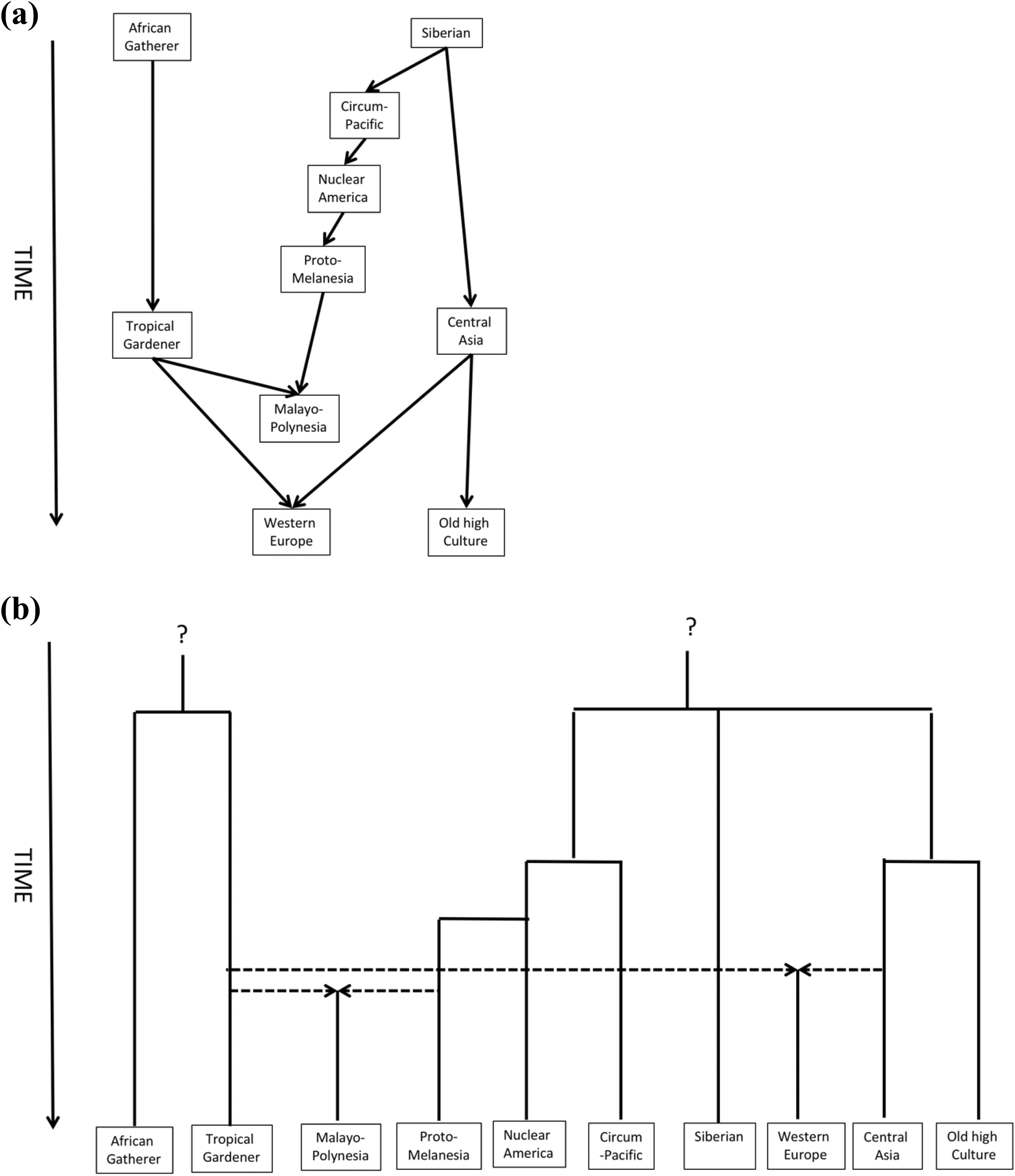
(a) Lomax’s evolutionary interpretation of the relationships between his 10 “song-style regions”. “African Gatherer” and “Siberian” song styles are interpreted as representing the two earliest roots of human song style, evolving over time with some admixture to eventually reach the most evolutionarily recent styles “Old High Culture” and “Western Europe” (adapted from Lomax, 1980). (b) My proposed revision of Lomax’s model, replacing his assumption of evolutionary stasis with the modern cultural evolutionary concept of branching “descent with modification”, using dashed arrows to incorporate the idea of horizontal transmission (e.g., cross-cultural borrowing). See Savage (Forthcoming) for further explanation and theoretical background.
In his later publications, Lomax de-emphasized the evolutionary angle and emphasized the diffusionist one in which music traced the historical migrations of various peoples and their cultures: The resulting regional style map [see Figure 1] presents a layered historical geography of song style and culture. Regional styles 1 and 2 link the multipart singing of the
Functional (structuralist-functionalist)
Lomax also suggested that the correlations between music and culture (see Figure 2) represented not only historical connections but also functional ones in which certain types of singing acted as functional reinforcers of social structure: A framework of explanatory hypotheses for these and other song-style variations has emerged from the study of the powerful correlations among cantometric scales and standard measures for social structure, derived from ethnographic compendiums. The many relationships can only be summarized here.
Constructive criticism
Dozens of critics have weighed in on cantometrics, but much of this criticism points out problems without offering constructive solutions. Although rarely stated, the implication with such criticism is that better methods exist to achieve the same goals.
I will provide a meta-criticism in which I evaluate the primary criticisms of the Cantometrics Project and suggest constructive alternatives to overcome them, drawing largely on my own experiences over the past decade actively trying to build on Lomax’s work. I will focus primarily on in-depth criticisms, ignoring the many largely appreciative summaries that did not offer in-depth critical evaluation (e.g., Herndon, 1978; McAllester, 1981; Merriam, 1969; Naroll, 1969; P. Seeger, 1979; Titon, 1982). In particular, I will focus on the in-depth reviews by Dubinskas (1983), 6 Downey (1970), Driver (1970), Krader (1970), Maranda (1970), Nettl (1970), Pantaleoni (1970, 1972), McLean (1973), Wild (1974), Henry (1976), Erickson (1976), Feld (1984), Dowling and Harwood (1986), and Leroi and Swire (2006).
Victor Grauer (2005) and Anna Lomax Wood (2018, Forthcoming) have also provided their own responses to a number of these criticisms. Their responses provide a valuable contrasting perspective and additional historical context, since they were both deeply involved in the Cantometrics Project. In particular, Grauer, the co-inventor and primary coder of cantometrics, disagrees with Lomax’s functionalist interpretation and progressive evolutionary model, proposing an alternative historical model based more closely on contemporary genetic anthropology (Grauer, 2011).
Song sample
Many reviewers expressed some degree of concern with the size and representativeness of the sample. At a basic level, these included the small sample size (∼10 songs) per culture and the uneven geographic representation whereby some areas that Lomax was more familiar with were over-represented (e.g., Southern USA, Caribbean, Spain, Italy) and others under-represented (e.g., China, Eastern Europe; Dubinskas, 1983; Krader, 1970; Nettl, 1970; Pantaleoni, 1972). Some also noted that it is impossible to evaluate Lomax’s sample because he never published his data on which songs were included (Grauer, 2002, cited in Averill, 2003; Krader, 1970). At a deeper level, these included the criteria by which popular, classical, contemporary or hybrid genres were excluded, and by which the final sample of ∼10 songs was selected from the remaining pool of traditional folk songs (Driver, 1970; Dubinskas, 1983; Maranda, 1970; McLean, 1973), as well as the reliance on field recordings that are inevitably incomplete and biased by logistic and cultural factors involved in the recording process (Dubinskas, 1983; Pantaleoni, 1972). As Dubinskas puts it: sheer numbers and breadth of sampled cultures do not tell us about the cultural contexts of musics. To have a sense of representativeness, the authors really need at least a sketchy ethnography of all the varieties of musical performance of a culture, across class, hierarchy, and gender distinctions as well as in secular and religious, public and domestic, organized and informal arenas of performance. (Dubinskas, 1983, p. 32)
Previously, Steven Brown and I (Savage & Brown, 2013) have suggested a modified version of Lomax’s methodology, aiming to use 30 traditional songs per culture, selected strictly randomly from the pool of available songs to avoid confirmation bias in the selection. In our studies of musical/genetic diversity among indigenous Taiwanese (Brown et al., 2014; Rzeszutek et al., 2012; Savage & Brown, 2014) and Northeast Asian/circumpolar populations (Savage, Matsumae, et al., 2015), we attempted to apply these methods to densely sampled sets of populations within geographically restricted regions in collaboration as much as possible with regional experts (including both ethnomusicologists and genetic anthropologists). In practice, this has proved extremely time-consuming (spending hundreds of hours coding songs by ear) and has not substantially reduced the sampling problems. It has also not yet resulted in much interest in collaboration from ethnomusicologists, although it has been relatively successful in interesting geneticists. So far, the broad patterns of our results seem to be relatively robust to sampling problems (Savage & Brown, 2014). However, replication studies and/or simulation studies along the lines of those used by genetic anthropologists (cf. Evanno, Regnaut, & Goudet, 2005) may be needed to formally evaluate the degree to which the results of Lomax or others are influenced by sampling and methodological issues, and what types of samples might be needed to reduce this influence to an acceptable level.
Classification scheme
Another major locus of criticism has been the reliability and validity of the cantometric classification scheme itself. While some (e.g., Nettl, 1970) have praised cantometrics’ emphasis on performance features over the traditional musicological emphasis on structure and notation, others have criticized the subjective nature of coding such features (Downey, 1970; Maranda, 1970; McLean, 1973). Likewise, some have criticized cantometrics for being too coarse-grained (Dowling & Harwood, 1986), while others have criticized it for being too fine-grained, such that different raters cannot agree on which point on the scale to code a given feature (Nettl, 1970). Even if the classifications can be agreed on reliably, they may still not be correct if the coders do not understand the language or the broader musical system of a given recording (Maranda, 1970; McLean, 1973). Furthermore, the classifications may be influenced by effects of the order in which songs were coded, or by confirmation biases (whether conscious or unconscious) that result in codings that confirm Lomax’s initial hypotheses (Downey, 1970; Maranda, 1970; McLean, 1973).
How could we improve on this system? My colleagues and I (Savage et al., 2012) offered a modified version of cantometrics dubbed “CantoCore” that emphasized “core” structural features over performance ones, based on the assumption that structural features would prove more reliable and less affected by social structure. We tested CantoCore directly against cantometrics using Lomax’s (1976) Consensus Tape containing 30 diverse songs from around the world. While CantoCore was indeed found to be somewhat more reliable than cantometrics (by ∼80% 7 ), much of this difference could be attributed to the poor reliability of cantometrics’ instrumental features, while its performance and structural features were both found to be moderately reliable on average. As a result, we proposed a hybrid system combining CantoCore with vocal performance features from cantometrics and instrumental features from Hornbostel and Sachs’ (1961 [1914]) system (Savage & Brown, 2013; Savage, Brown, et al., 2015).
It has proven hard to evaluate the degree of confirmation bias in Lomax’s dataset, although this may be possible now that the Global Jukebox data have been published. My colleagues and I have striven to reduce the chance of confirmation bias by performing coding blind to extra-acoustic information as much as is practically possible, 8 having randomly selected quality-control sub-samples coded by raters who are both blind to extra-acoustic information and unaware of the research hypotheses, and by publishing full data spreadsheets as online supplemental material to allow others to scrutinize our sample and codings (e.g., Brown et al., 2014; Savage, Brown, et al., 2015; Savage, Matsumae, et al., 2015). For maximum objectivity, all analyses would be performed by raters blind to the research hypotheses, as is sometimes done in biological or medical studies, but the level of time commitment involved has so far made this logistically impossible.
Statistical analysis
Numerous concerns have been raised with the statistical analyses of cantometric data. Many of these are relatively minor technical issues regarding the appropriate methods of converting raw cantometric codings into quantitative data, such as measures of average musical similarity or the frequency of different musical features (Busby, 2006; Driver, 1970; Leroi & Swire, 2006; Rzeszutek et al., 2012). More substantively, many criticized Lomax’s reduction of substantial intra-cultural diversity into a single modal profile (Feld, 1984; Henry, 1976; Nettl, 2006; Rzeszutek et al., 2012; Savage & Brown, 2014). Most crucially, Lomax’s failure to appropriately correct his correlational analyses to account for multiple comparisons (Dowling & Harwood, 1986) or historical relationships among cultures (“Galton’s problem”; Erickson, 1976) was argued to have invalidated most (but not all) of Lomax’s claims of functional music–culture correlations. 9 Erickson’s criticism is especially devastating, coming as it does from one of the Cantometrics Project’s two primary statisticians and being based not on theoretical speculation but an actual quantitative reanalysis of Lomax’s data.
Recently, fields such as linguistics and anthropology have addressed similar criticisms by adapting quantitative methods from evolutionary biology to understand cultural evolution (Cavalli-Sforza & Feldman, 1981; Levinson & Gray, 2012; Mace & Holden, 2005; Mesoudi, 2011; Richerson & Boyd, 2005; Whiten, Hinde, Stringer, & Laland, 2012). Although the degree to which such methods may be appropriately applied to music remains debated (see Savage, Forthcoming, for extensive review and discussion), several studies have attempted to use such methods to improve on cantometrics. My colleagues and I showed that it was possible to adapt the Analysis of Molecular Variance (AMOVA) – which quantifies genetic variation within and between populations – to quantify musical variation within and between populations (Rzeszutek et al., 2012). This analysis of traditional group songs from Taiwan and the Philippines found that 98% of variation was due to within-population variability, while only 2% of variation could be attributed to systematic between-population differences – a breakdown that paralleled the distribution of genetic diversity within and between cultures. This contradicted Lomax’s claim that “the variation of musical style between cultures and culture areas is clearly greater than between the styles of the individuals or groups that compose cultures” (Lomax, 1980, p. 29). At the same time, between-population differences were found to be highly statistically significant (P < .001), and the between-population component of diversity was found to be significantly correlated with patterns of linguistic and genetic diversity (Brown et al., 2014). Furthermore, comparison between patterns produced by the AMOVA analysis and those produced by Lomax’s modal profile method of analysis showed that, while the modal profile loses substantial information, the overall patterns remain highly correlated with those produced by the AMOVA analysis (r s = 0.73). Thus, while reanalysis of the cantometric data should improve the details of Lomax’s regional analyses, it is unlikely to invalidate his major regional groupings.
As for Lomax’s music–culture correlations, Erickson’s (1976) reanalysis is more convincing than Lomax’s original analyses, but it is still relatively crude in that it uses only geographical information as a proxy for historical relationships. Some recent studies of cultural evolution continue to use updated versions of Murdock’s Atlas, but they tend to use phylogenetic methods based on linguistic and/or genetic information instead of or in addition to geographic information in order to control for Galton’s problem (e.g., Currie, Greenhill, Gray, Hasegawa, & Mace, 2010; Mace & Holden, 2005; Mace & Pagel, 1994). Adapting these techniques to music has revealed support for some of Lomax’s intra-musical correlations (e.g., high register correlated with loud dynamics; Savage, Brown, et al., 2015). The same techniques could be applied to re-examining Lomax’s proposed music–culture correlations (taking care to appropriately correct for multiple comparisons, cf. Dowling & Harwood, 1986).
Interpretation
Both Lomax’s historical and functional interpretations have been strongly contested. Criticisms of the functional interpretations have primarily focused on the methodological limitations described above (Erickson, 1976; Naroll, 1969) and on the vague Freudian mechanisms proposed to explain functional relationships between features, such as that between vocal tension and sexual tension (Zemlianova, 1974). Some have criticized the diffusionist angle of Lomax’s historical interpretation, such as ignoring the possibility of independent invention (i.e., polygenesis) and making dubious historical claims, such as ancient connections between Australia and the Americas or between Africa and Oceania (Dubinskas, 1983; McLean, 1973). The cultural evolutionist angle has been particularly criticized as offensive, unsupported by the data, and perpetuating the errors of Lomax’s teacher Curt Sachs and other early comparative musicologists 10 (Dubinskas, 1983; McLean, 1973; McLeod, 1974; Youngerman, 1974; see also the commentaries accompanying Lomax & Arensberg, 1977). More generally, many have criticized Lomax’s unscholarly tone and tendencies to selectively interpret patterns post hoc to match one or the other of his hypotheses, ignoring deviant cases (Dubinskas, 1983; Maranda, 1970; McLean, 1973).
If we accept that Lomax’s approach has value, how might we improve it? Erickson’s (1976) reanalysis has already pointed out how Lomax’s interpretations could be improved by emphasizing the role of history and identity and de-emphasizing direct functionality. Interestingly, one critic of Lomax’s historical interpretation later presented a conceptually similar approach based on classification, clustering, and mapping to support a historical interpretation of song style and instrument distributions in Oceania (McLean, 1979). Grauer (2006, 2011), Leroi and Swire (2006), Brown et al. (2014) and Savage, Matsumae, et al. (2015) have recently proposed refined versions of Lomax’s historical interpretations. Grauer’s modification maintains Lomax’s assumption of stasis that was inherent in most early Spencerian theories of cultural evolution (i.e., both view contemporary Pygmy and Bushman music as representing the nearly unchanged sounds of early humans tens or hundreds of thousands of years ago). In contrast, I propose a modification grounded in modern cultural evolutionary theory that explicitly recognizes the likelihood that all contemporary styles have changed (albeit possibly to varying degrees) through branching processes of “descent with modification” (Savage, Forthcoming; see Figure 3).
While Lomax may have been overly dogmatic in implying that most stylistic similarities were the result of historical diffusion, in general his results suggest a promising degree of correspondence with known historical developments. In particular, six out of his 10 regional styles seem likely to match known patterns of human migration and cultural contact. In order of increasing time-depth, these are:
“Western Europe”: Ballads from Western Europe were brought to the Americas with European colonization (Sharp, 1932) beginning ∼500 years ago (ya).
“Old High Culture”: Musical instruments with origins in the Middle East had travelled via the Silk Road as far as Japan by well over 1,000 ya (Tokita & Hughes, 2008). Around the same time, the Arab conquest of the southern Mediterranean brought people and their songs to southern Mediterranean areas such as Sicily.
“Tropical Gardeners”: Bantu-speaking agriculturalists began expanding eastward from West Africa around 3,000 ya to eventually occupy much of sub-Saharan Africa (Currie, Meade, Guillon, & Mace, 2013; Phillipson, 2005). Later (beginning around 500 ya), Africans were forcibly transported through the Atlantic slave trade westward throughout the Americas.
“Malayo-Polynesia”: Austronesian-speaking agriculturalists began expanding from Taiwan approximately 4,000 ya, reaching Micronesia by ∼3,000 ya and spreading to New Zealand by ∼1,000 ya (Bellwood, 2011; Gray, Drummond, & Greenhill, 2009; Lipson et al., 2014).
“Siberia”: The First Americans crossed from northeastern Siberia to the Bering Strait sometime before the end of LGM (Last Glacial Maximum) ∼15,000 years ago (O’Rourke & Raff, 2010). If the musical style of the Ona (Selk’nam) of South America truly reflected Siberian roots as Lomax claims, this may be the most extreme example of deep musical stylistic roots being preserved across vast expanses of time and space. Later (∼1,500 ya), the expansion of the Okhotsk fishing culture from southeastern Siberia resulted in Siberian influences (although not complete replacement) on both the music and the gene pool of the indigenous Ainu of north Japan (Savage, Matsumae, et al., 2015).
“African Gatherer”: Lomax initially believed that the musical similarities between Pygmies and Bushmen reflected the influence of social structure because these groups were not thought to be historically related. Grauer (2011) later interpreted these similarities as a relic of an ancient style preserved from the time of the first anatomically modern humans (∼200,000 ya). However, recent genetic evidence suggests that these two groups do share common “Proto-Khoesan-Pygmy” roots, although these roots go back to ∼35,000 ya or beyond (Tishkoff et al., 2009). If the musical similarities between the two groups truly reflect similarities preserved from 35,000+ ya, this would suggest that music may potentially have a greater time-depth than language, which is often considered to be limited to ∼10,000 ya (Hammarström, 2016).
There are of course many patterns in Lomax’s map that do not have clear historical explanations, and the examples listed above represent possibilities for future testing, not rigorously confirmed findings. Furthermore, it remains unclear whether Lomax’s musical codings were affected by confirmation bias that may have led them to be influenced by prior knowledge about historical relationships. Nevertheless, Lomax’s map provides a useful starting point from which to attempt to replicate the findings and understand how to explain exceptional cases.
Ethnocentrism/reductionism
Many critics are less concerned about Lomax’s specific claims than with the broader sociopolitical implications of his comparative, scientific approach. Some have pointed out that Lomax’s analyses and interpretations have ignored the semiotic domain of musical meaning that many find to be more important than acoustic style (Blacking, 1977; Dubinskas, 1983; Feld, 1984). As Dubinskas (1983, p. 34) puts it, “For all its statistical elegance, cantometrics cannot tell us what music means to performers”. Some object even more generally to the reductionism and ethnocentrism they see as inherent in scientific approaches to cross-cultural musical comparison (Feld, 1984; Pantaleoni, 1972). Again, if we accept that comparative research is worthwhile, what alternatives might be better?
Feld (1984) is one of Lomax’s few critics to have proposed a constructive alternative. After attempting unsuccessfully to use cantometrics to gain insight into the music of the Kaluli, Feld notes: I still feel that Lomax is asking many of the right questions about music and social institutions, but the mechanics of cantometrics crunches them in ways that cannot satisfy the researcher accustomed to intensive field work, in-depth analysis, and grounded ethnographic theory…My suggestion is true heresy to many committed comparativists, but I think we need to pioneer a qualitative and intensive comparative sociomusicology. (Feld, 1984, p. 385)
While many applauded the attempt to improve on cantometrics, several noted that Feld’s proposal simply replaced a quantitative, ethnocentric method of comparison with a qualitative, ethnocentric one. As Judith and A. L. Becker note: In order to facilitate comparison, a unified frame has been followed by both [Feld and Roseman] which includes a set of categories which have strong historical associations with western scholarship, that is, competence, form, performance, environment, theory and value and equality. The categories belong to our world, not to theirs. (Keil et al., 1984, p. 455)
Conclusion
The Cantometrics Project was an important and controversial landmark in the history of the science of music whose details remain poorly understood more than half a century after its first publication. Although I have offered a few suggestions I feel have the potential to overcome some criticisms, the primary goal of this article was not to defend the claims of Lomax, his supporters, or his critics, but simply to clarify and synthesize the claims and the debates that the Cantometrics Project has produced. I do not intend to imply that any of these debates have been permanently resolved. In particular, debates regarding the nature of musical evolution, correspondence between musical and genetic histories, and the relationship between music and culture remain contested areas ripe for future testing. A nuanced understanding of the Cantometrics Project provides an important starting point for any future attempts to do so.
It is important to remember that Lomax’s Cantometrics Project was fundamentally integrated with his ideological vision unifying research, education, and activism, summarized in his “Appeal for cultural equity” (Lomax, 1977; see also Baron, 2012). Here, Lomax decried the cultural “grey-out” (Lomax, 1977, p. 125) through which globalization of Euro-American styles threatened all other stylistic regions identified by cantometrics. To correct this imbalance, Lomax advocated for equal “money, time on the air, and time in the classroom” (Lomax, 1977, p. 131) across all musical regions identified by the Cantometrics Project. Toward this end, he published training tapes for cantometrics and choreometrics, aiming to introduce students to the world’s musical diversity, established the Association for Cultural Equity, and continued to pursue projects such as the Global Jukebox until his death. Today, these are precisely the kinds of areas that organizations such as schools and UNESCO are targeting to safeguard as the “Intangible Cultural Heritage of Humanity” and teach about cultural diversity through global arts curricula (Grant, 2014; UNESCO, 2003).
Recent renewed interest by scientists and some ethnomusicologists in Lomax’s work has so far been limited primarily to the comparative, historical aspects of cantometrics, with little extension yet into areas such as social structure, non-musical arts, pedagogy, or activism. This may be for the best for now, as Lomax’s over-eagerness to accomplish all of his goals at once may have contributed to some of the methodological shortcomings and cool reception of his work (Wood, Forthcoming). However, it will be important to keep in mind Lomax’s vision of a unified humanistic science of the arts if we are to do justice to the legacy of his Cantometric Project (Clarke, 2014).
Footnotes
Acknowledgments
I thank Steven Brown and Victor Grauer for introducing me to cantometrics; Brown, Grauer, and Anna Lomax Wood for comments on earlier versions of this manuscript; and Kathleen Riviera for providing details of the number of cantometric and choreometric codings available at the Global Jukebox. I am also grateful to my classmates Emi Sakai, Kumi Shimozaki, and Masami Yamashita at the Tokyo University of the Arts for extensive help through training, testing and discussion of cantometrics. Of course, most of all, I am grateful to Alan Lomax for his vision.
Declaration of conflicting interests
The author declared no potential conflicts of interest with respect to the research, authorship, and/or publication of this article.
Funding
The author disclosed receipt of the following financial support for the research, authorship, and/or publication of this article: This research was supported by a Japanese Ministry of Education, Culture, Sports, Science and Technology (MEXT) scholarship, a Startup Grant from the Keio Research Institute at SFC, and an Individual Grant from the Keio Gijuku Academic Development Fund.
Peer review
Elizabeth Tolbert, Peabody Conservatory of the Johns Hopkins University, Department of Musicology.
Robert Attenborough, University of Cambridge, Department of Archaeology and Anthropology.