



Abstract
Conventional wisdom maintains that a robust educated middle class is an important factor for a healthy democracy. Recent empirical evidence, however, has shown that there is a significant variation in middle class support for democracy. How do educated elites respond to declines in democracy? To date, we know relatively little about how the educated elites view, talk, and respond as democracy erodes in their country. We address this gap by conducting a discourse analysis of government and educated elites texts in Indonesia from 2010 through 2020. We find that government and educated elites’ discourses on democracy as democracy backslides tend to diverge significantly: While official texts boast of the Indonesia's identity as a Muslim-majority democracy, materials produced by the country's educated middle class express increasing disenchantment with weak political parties, restrictions on freedom of speech, repressive measures toward government critics, and limited checks on executive overreach. Our results suggest that as democracy erodes, government officials’ narratives continue to present the country as a robust democracy, and as such, official narratives alone would not reveal the cracks in democracy in the early stages of decline. Instead, traces of decline are more visible in everyday discourses, where informed citizens express their concerns and criticisms with less fear of reprisals. Rather than standing with the ruling elites, the educated elite authors and producers in our data respond to democratic erosion by resisting and criticizing illiberal measures and demanding greater protection of rights. Our work highlights the importance of an engaged educated middle class who can perceive the subtle erosion in democratic practices and challenge it, both in Indonesia and beyond.
Introduction
Modernization theory maintains that a strong and educated middle class is a necessary component of democracy (Acemoglu and Robinson, 2006; Almond and Verba, 1989; Boix 2003; Lipset, 1959; Moore, 1966). More recent evidence, however, suggests that middle class support for democracy is context dependent. These studies highlight that middle class views on democracy depend on how their material interests may be affected by democracy. State-employed middle class citizens in autocratic communist and post-communist countries, for example, are less supportive of democracy than their counterparts because their livelihood depends on the state (Chen, 2013; Rosenfeld, 2021). Along a similar vein, others find that middle class entrepreneurs in countries in the Middle East where democratization involved greater political instability tend to be less supportive of democracy than those who live in countries where democratization was more peaceful, since they are wary of how democracy may affect their business (Mazaheri and Monroe, 2018). Similar patterns have been reported in countries in Southeast Asia as well, where middle class citizens are supportive of autocrats to protect their economic interests (Bertrand, 1998). When middle class citizens are beneficiaries of an illiberal state and when democracy appears to threaten their interests, they are much more likely to hold authoritarian views and support the state's illiberal measures.
Despite this growing evidence, we know relatively little about how educated citizens respond and engage with each other during democratic erosion in new democracies. Available evidence has mostly been based on studies of voters in autocracies, where the government officials and institutional practices lean authoritarian. Furthermore, the category of “middle class” itself is arbitrarily determined and often with little agreement between different sources, sometimes lumping together people with very different levels of income, education, and consumption patterns. Furthermore, while available evidence highlights broad patterns in self-reported attitudes and preferences in surveys, they do not capture how different people actually respond and engage each other and the government in real time, i.e. how they talk about the decline of democratic practices with each other and whether, if at all, they oppose the ruling government and resist democratic erosion. How do the educated middle class in new democracies respond to democratic erosion? Do they, as modernization theory would predict, resist increasing illiberalism and demand greater protection of rights, or do they instead support the ruling government and the status quo in the hopes of protecting their interests? To date, we have relatively little evidence on whether educated middle class citizens in eroding democracies stand with the increasingly illiberal regime or oppose the new trends. To answer these questions, we need a different type of data from what is currently available, so that we can observe how educated citizens engage behaviorally and respond to democratic declines in their country.
In this article, we address this gap by using a body of data and a methodological approach that, to the best of our knowledge, have not been applied to the study of democratic erosion in Southeast Asia. Relying on Hopf and Allan’s (2016) discourse analysis protocol, we investigate a sample of official texts produced by the government (i.e. televised presidential speeches, required history textbooks, and ministers’ speeches) and everyday, popular materials produced by some educated elites (i.e. op-eds published in national newspapers, novels, films and letters to the editor) published in Indonesia in Bahasa Indonesia, the national language, in 2010, 2015 and 2020. These texts, authored by different individuals, for different mediums, across multiple years, allow us to “listen in” on how both educated citizens and the country's ruling elites talk about a range of topics they consider salient at the time, including democracy, democratic values and democratic decline. By observing ongoing discourses that occur in these platforms, we can capture how a select group of middle class citizens views and behaviorally responds to the salient issues of the day.
We should note that our primary goal in this paper is to offer an alternative approach and body of evidence to reassess what we already know about democratic erosion. We hope that these initial insights will pave way for a more rigorous theory building and hypothesis testing in the future and will complement available survey-based evidence on middle class views and preferences more broadly.
We find that although both official and educated citizens discourses in 2010 are hopeful and proud of Indonesia's democratic progress, the pattern shifts in 2015 when concerns about Indonesia being “undemocratic” appears more frequently in everyday texts. Complaints about political elites’ self interests and political parties’ failures in advocating for voters emerge in opinion pieces in 2015, alongside broader concerns about the country's corruption and dysfunctional government. By 2020, narratives about Indonesia's “undemocratic” measures in opinion pieces surpass references to Indonesia as a democratic country. In particular, authors criticize the government's increasingly repressive measures against its dissenters, the spread of disinformation in mass media, and growing restrictions on freedom of speech.
These results highlight the divergence between government and educated citizens’ narratives about democracy, and what the latter find alarming about political governance in their country. While the authors of our educated citizens materials articulate concerns about growing undemocratic practices, government sources continue to characterize Indonesia as a robust democracy. This widening gap between official and educated elite narratives about democracy suggests that the latter group perceives the erosion of democratic principles in its country, even when the infrastructure of democratic institutions does not change as drastically and government discourses continue to extol democracy, and they voice their concerns readily. Our results also indicate that as democratic backsliding progresses, educated elite citizens’ concerns expressed in everyday discourses also evolve, from initially focusing on institutions such as elections and the military's role in politics to the protection of freedoms and the government's repressive measures and use of disinformation. In sum, the discourses in the texts we examined suggest that the educated middle class authors of our texts are much more critical of illiberal practices in their country than the ruling elites, and that they express these views in various platforms. Rather than siding with the ruling government and supporting illiberal measures during democratic erosion, the authors of our everyday texts in our data respond to democratic erosion by resisting, criticizing, and highlighting the practices they find to be problematic and inconsistent with democratic principles.
Relevant literature
Modernization theory considers the middle class, broadly defined based on their income and education, as an important component for democracy.
Moore's (1966) famous quote, “No bourgeoisie, no democracy,” succinctly captures how a strong and independent middle class will push for greater rights and protections, that will facilitate the creation of democratic institutions in the long run. 1 Since then, other scholars have also argued that educated citizens are important ingredients for democracy because they are more likely to engage in politics and demand protection for their rights and properties (Almond and Verba, 1989), have more liberal attitudes (Lipset, 1959), be better equipped for political engagement (Glaeser et al., 2007), and challenge autocratic governments (Bueno de Mesquita and Downs, 2005). Inasmuch as universities are perceived as liberal institutions (Dewey, 1916; Lipset, 1959), those who acquire advanced education are expected to hold liberal values (Rhoads, 1998). Plenty of cross-national evidence support this idea as well: countries with more highly educated citizens tend to be more democratic than their counterparts (Barro, 1999), and at the individual level, more highly educated individuals tend to express greater support for democracy (Glaeser et al., 2007). Beyond that, students and educated elites have played a pivotal role in social movements, revolutions, and democratic transitions around the world (Glaeser et al., 2007).
Recent empirical evidence, however, is more ambiguous. While some scholars argue that the positive effects of education on democratic values cut across regime types (Chong and Gradstein, 2015), others suggest that education's influence on democratic attitudes is much stronger in democracies than in autocracies (Diwan and Vartanova, 2020). Österman and Robinson's (2022) analysis of citizens in western and east central European countries shows that citizens who were educated during authoritarian rule tend to be more dissatisfied with democracy than those who were educated in democratic regimes. While some demonstrate that educated citizens in Russia (Gibson et al., 1992) and Vietnam (Dang, 2019) are more supportive of democracy, others suggest that autocrats invest in higher education to cultivate “acquiescent intellectuals” to support their rule (Perry, 2020). In fact, middle class citizens employed by the state in postcommunist autocracies may be much less supportive of democracy (Chen, 2013; Rosenfeld, 2021). Survey evidence from China suggests that middle class dependence on the state and their perceived social and economic well-being are inversely correlated with support for democracy (Chen and Lu, 2011). Still others, based on research done in Kenya, find no link at all between citizens’ education and democratic attitudes (Friedman et al., 2016).
Evidence from Southeast Asia is also similarly mixed. Historically, educated youths in Southeast Asia have spearheaded pro-democracy movements and protests (Aspinall, 2005; Sinpeng, 2017; Weiss, 2011). At the same time, Bertrand (1998) highlights that middle class citizens in countries in Southeast Asia have sometimes pressed for more democracy, whereas at other times, they have also supported autocrats. Several scholars also have shown an increasing illiberal turn among the middle class in some countries in this region (Lertchoosakul, 2021; Mietzner and Muhtadi, 2018; Warburton and Aspinall, 2019).
These studies stress that middle class citizens’ support for democracy is driven by their evaluation of how democracy would impact their social and economic well-being (Chen and Lu, 2011). Writing about public-sector employed middle class citizens in autocratic states, Rosenfeld (2021) argues that reforms and greater attention to broader participation, transparency and rule of law that democratization typically entails may adversely affect the economic prospects of middle class citizens with jobs in state-dependent sectors. Consequently, public-sector employed citizens may be much less supportive of democracy than citizens whose livelihood does not depend on the state. A similar materialist logic is also articulated in a study on middle class support for autocracy in some countries in the Middle East. Mazaheri and Monroe (2018) demonstrate that middle class support for democracy depends on their experience with upheaval and political instability during democratization in their countries. Entrepreneurs who witness instability following pro-democracy movements are less supportive of democracy because of the crisis’ negative impact on small enterprises. Similarly, recent evidence from the Philippines shows that the notion that democracy is equivalent to disorder is linked to lower middle class support for democracy (Garrido, 2021; Hutchcroft and Rocamora, 2003).
Despite these advances, most recent evidence is based on analyses of middle class citizens in authoritarian settings. We know less about how the educated middle class responds to erosion in new democracies. This dearth of evidence is partially driven by the fact that democratic erosion is difficult to identify. When democracies undergo erosion, 2 they experience a gradual movement away from democracy over time (Cianetti and Hanley, 2021). According to Levitsky and Ziblatt (2018: 6), democracies die slowly and incrementally, and that there is usually “no single moment … in which the regime obviously ‘crosses the line’ into dictatorship,” and as such this change can be “almost imperceptible.” Instead of tanks on the streets and military coups, threats in democratic erosion come from democratically elected leaders who use legal procedures at their disposal to weaken existing democratic institutions and expand their powers (Levitsky and Ziblatt, 2018). 3 They may pass laws that expand their powers, pack courts with regime supporters, restrict press freedom, and weaken civil society and opposition parties (Bermeo, 2016; Bernhard et al., 2020). They may use disinformation to rally supporters, polarize the electorate, and undermine the legitimacy of the electoral process (Bennett and Livingston, 2017; Bunte, 2020). While the institutions of democracy may exist and appear to function well, voters in countries where democracy is slowly eroding may report increasingly lukewarm enthusiasm and support for democracy (Muhtadi, 2020), and a greater acceptance of illiberal values and measures (Aspinall et al., 2020). Others have highlighted voters’ increasing detachment from political parties, which can make them vulnerable to populist appeals (Hicken, 2020) and identity-based mobilization (Fossati et al., 2021; Schäfer, 2019). Civil society in a declining democracy is often divided and distracted by misinformation (Mietzner, 2021b).
Beyond the difficulties of precisely identifying when and where erosion is happening, there is also less clarity on who exactly “counts” as middle class. While classical theorists have defined the middle class as educated professionals (Lipset, 1959) and capital owners (Moore, 1966), the contemporary definitions of middle class usually rely on income and consumption thresholds, some of which are arbitrarily determined. In the economics literature, for example, Banerjee and Duflo (2008) have found that a middle class category defined as those who earn between PPP US$2 and US$4 per day would include between 23 and 40% of the population, whereas a US$6–10 income per day threshold for middle class would include people who are usually in the top 20% income earners in the countries they studied. Some others have used a relative definition, defining the middle class as those who fall between the 20th and 80th percentiles of the country's income or consumption distribution (Easterly, 2001). Still others define middle class in terms of economic security, setting a lower and upper-bound per capita household income between PPP US$10 and PPP US$50 per day (World Bank, 2013). Measured in this way, a family of four in Latin America would be counted as middle class if “its annual household income ranged between US$14,600 and US$73,000” (World Bank, 2013: 2). These few examples highlight the vast differences between how recent studies have defined and measured who counts as “middle class.” A family living off of PPP US$2–4 per day would have very different experiences, consumption patterns, and access from one with an income of US$14,600 or US$73,000 per year.
Given the multiple approaches to defining middle class citizens, as well as the heterogeneity of experiences and concerns across the various people who fall in this broader group, and the subtle and often difficult to perceive changes during democratic erosion, we need a better understanding of how educated citizens respond to democratic erosion in their country. Based on earlier research, educated citizens in countries with democratic erosion may react in a couple of ways. First, they may recognize the growing illiberal practices in their country, and respond in a manner consistent with the predictions of classical modernization theory: with demands for a greater protection of rights and resistance against the ruling elites who impose illiberal measures. On the other hand, to the extent that their economic interests are intertwined with the status quo and are potentially threatened by democracy, they may favor the ruling elites’ expansion of powers. This means that a second possible way that educated elites may respond to democratic erosion is to continue to support the ruling elites and their policies, and to express less support and enthusiasm toward democracy.
To date, we have little information on how educated citizens behaviorally engage with each other and respond to democratic downturns in their countries, and how they differ from government officials. 4 We believe that we can complement earlier studies with a different type of data that can show a snapshot of educated citizens’ responses and behavioral engagement to democratic decline, and whether they diverge from the ruling elites.
In this article, we present evidence from the responses and engagement of citizens and government officials during democratic erosion in Indonesia. We analyze a body of government- and citizen-produced texts and conduct a discourse analysis to unearth official and educated elites’ narratives about democracy and their perceptions of the quality of democracy in the country. We believe that these texts—political leaders’ speeches, history textbooks, opinion pieces and letters to the editor published in newspapers, films, and novels—show us ongoing conversations between different individuals and groups in Indonesia, and provide a glimpse into how some citizens engage and behaviorally respond to events and issues they consider salient. Furthermore, given our rich and nuanced texts, we can discern which dimensions of democracy appear more frequently in our texts, and whether and how the authors articulate resistance and criticisms against the government and declines in democratic practices. This discursive approach allows us to examine whether middle class citizens in Indonesia side with the ruling government during democratic erosion, and if their behavior confirms the predictions of modernization theory.
Democracy in Indonesia
Indonesia offers a perfect setting to examine how educated elites respond to democratic erosion. With about 52 million of its population in the World Bank's “middle class” category, and 115 million in the “aspiring middle class” category (Swasono and Suhanda, 2023), Indonesia has a robust and growing middle class. The World Bank defines the “middle class” as those who “enjoy economic security,” whose “income level is sufficient to allow them to enjoy economic security and who are safe from falling back into poverty or vulnerability,” which in practice includes people with a daily expenditure between US$7.75 and 38 (World Bank, 2020: 5, 7). It further subdivides the middle class category into MC1 and MC2, where MC1 includes those who consume US$7.75–20 per person per day, and MC2 includes those who consume between US$20 and 38 per person per day. 5 This class has been growing rapidly, at an average of 10% increase every year between 2002 and 2016. In 2020, one of every five Indonesians was middle class (World Bank, 2020). Some 90% of Indonesia's middle class consume between US$7.75 and US$20 daily. About 80% of the middle class have graduated high school, and 60–67% of people in the middle class category have some form of tertiary education, a significantly higher educational attainment relative to those in the aspiring middle class category, where only half of the group completes high school (World Bank, 2020). Middle class citizens in Indonesia are also significantly better educated than the poor (World Bank, 2020). Most middle class citizens in Indonesia are formal employees and salaried workers.
On the surface, Indonesia checks off many of the requirements of a consolidated democracy: national elections occur regularly, are usually competitive, and are relatively free of violence (Toha and Harish, 2020). Voter turnout at elections is consistently high, hovering at around 70%. Turnovers also occur regularly. The military, which used to have an outsized role in politics under Soeharto, now no longer has protected military seats in parliament and active military personnel are barred from joining political parties and serving in civilian posts. Multiple political parties and political candidates regularly contest elections, at both the national and local levels.
In recent years, however, illiberal practices have become more common. Political candidates often hand out bribes and handouts to buy voters’ support (Muhtadi, 2019). Outside of electoral cycles, the fight against corruption faces an uphill battle. Indonesia's Corruption Eradication Commission (Komisi Pemberantasan Korupsi, or KPK hereafter), once lauded as an effective anti-corruption agency (Bolongaita, 2010), is considerably weaker and less independent now (Hamid, 2021). The police appoints an active member of its force to lead the agency, while the rest of the agency's staff are required to become members of the civil service and pass a “civics” exam, which many claim has little to do with civics and anti-corruption (Hamid, 2021). These steps have significantly reduced the agency's independence and ability to investigate (Antara, 2020).
Beyond the fight against corruption, civil society is also weaker in recent years in Indonesia (Hicken, 2020). Since the introduction of the decree on Social Organizations (Perppu Ormas) regulation in 2017, the government holds the power to abolish any organization deemed to be “anti-Pancasila,” an ambiguously defined term that dates back to Soeharto's justification for repressing his opponents (Aspinall, 2005; Warburton, 2020). In recent years, many of Joko Widodo's critics have been arrested and removed from their positions. In July 2021, a man was arrested for recording and circulating an offensive video against the president on social media (Fajri, 2021). In September 2021, a small group of college students were picked up by security personnel within minutes after displaying a critical poster as Joko Widodo passed by during his visit to Solo (CNN Indonesia, 2021). While each is not drastic enough to destroy Indonesia's democratic progress, these developments undermine Indonesians’ freedom of expression and freedom of association, as citizens can no longer freely express their political preferences and opinions without fear of repercussions.
Available indices and survey data record some of these downturns in democracy in recent years as well. Although the Polity V gives a confident picture of Indonesia's democracy from 2004 to 2018, 6 other indices are not as positive. Freedom House's Freedom in the World annual reports categorized Indonesia as “free” from 2006 through 2013 and “partly free” from 2014 onward, indicating a decline in the quality of democracy. 7 The Varieties of Democracy (V-Dem) LDI index for Indonesia offers a similar picture to Freedom House. Between 2000 and 2020, the LDI index shows a decrease from 2015 to 2020 (see Figure 1). Indonesia's democracy score gained strength between 2000 and 2005, remained stable from 2005 through 2008, before declining slightly between 2010 and 2020.
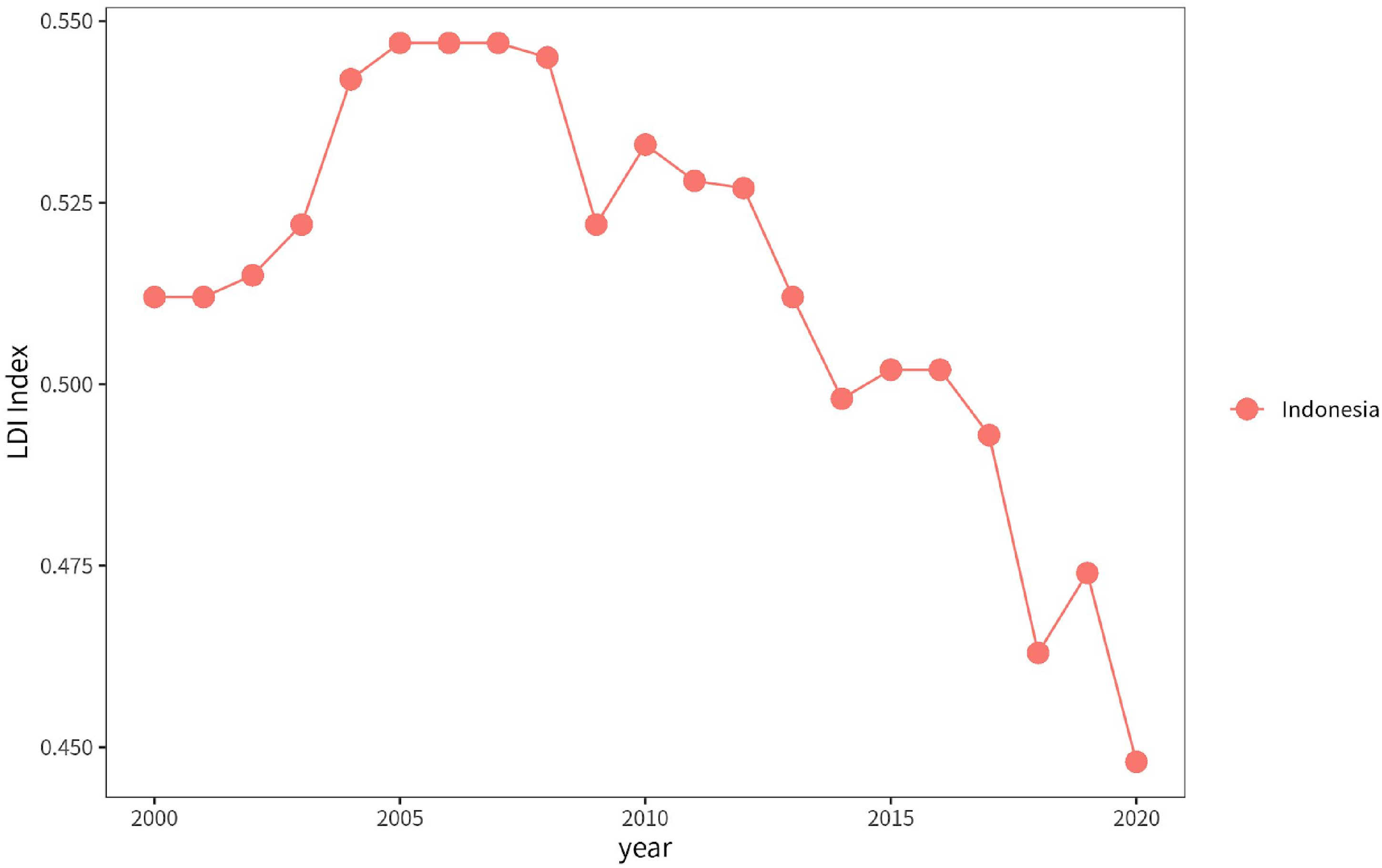
Varieties of democracies LDI index for Indonesia, 2000–2020.
Specific components of the LDI index—freedom of expression, freedom of association, and legislative of checks on power—have declined steadily in recent years (see Figure 2). Notably, these components recorded a drop of around 0.1 on the index score; these downward shifts are still comparatively small.
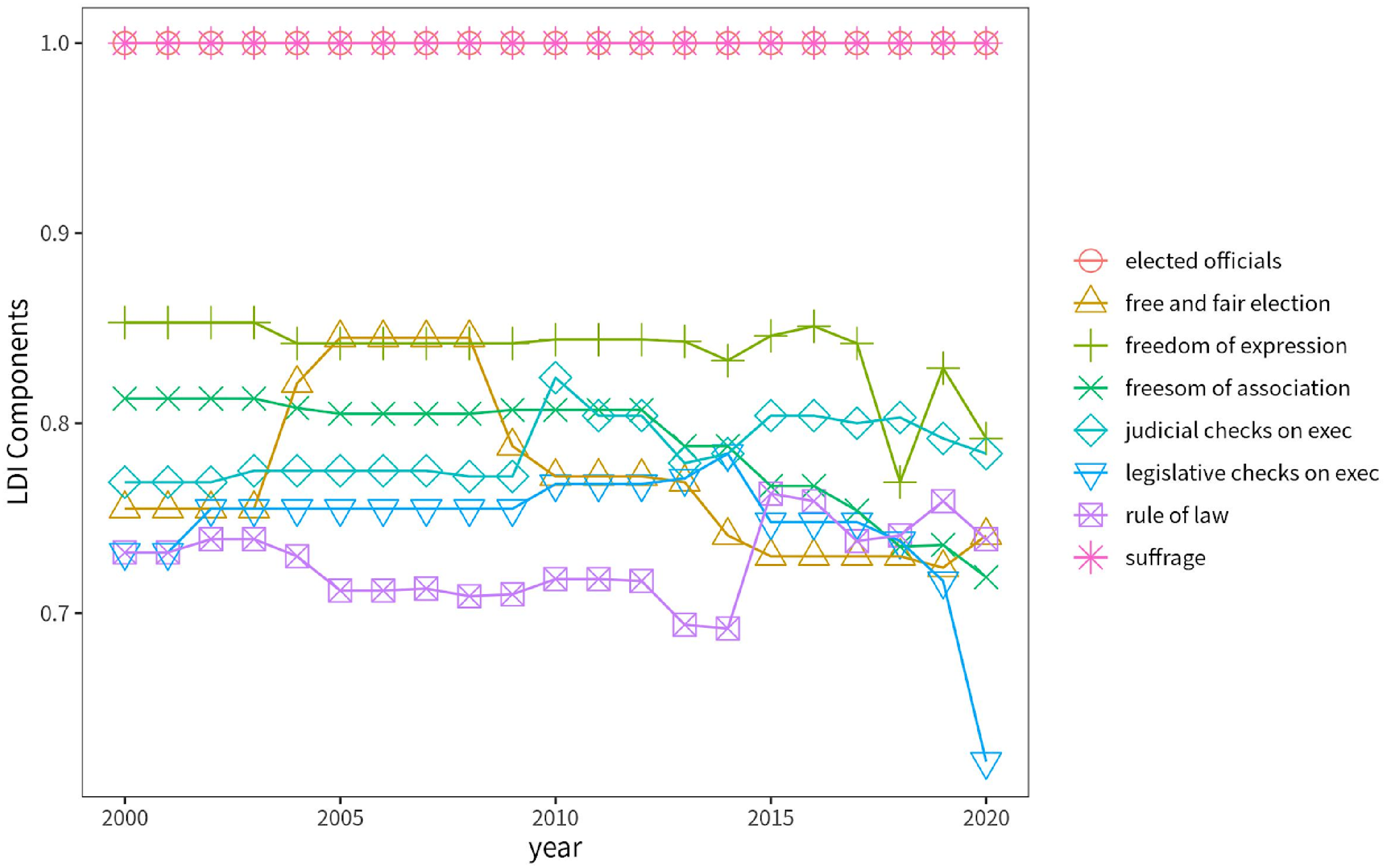
Varieties of democracies LDI components for Indonesia, 2000–2020.
Survey data offer a mixed picture of Indonesians’ views and attitudes about democracy over time: despite consistent support for democracy among the majority of respondents, the proportion of respondents who do not care about living in a democracy is also growing over time. The World Values Survey (WVS, hereafter) asks respondents in Indonesia how important it is for them to live in a democracy. 8 In 2006, 39 of 1887 (1.8%) respondents opted for the lowest three categories (“1–3”), while 1432 (71.1%) respondents selected the top three categories (“8–10”) on the scale. By 2018, 74.3% of 3155 participants in the 2018 survey chose the top three categories, indicating that it is important for them to live in a democratically governed country, while 7.2% of respondents opted for the bottom three categories. This means that although the majority of respondents want to live in a democratically governed country, a growing number of people surveyed want the exact opposite.
The Asian Barometer Surveys (ABS, hereafter) suggest some decline in support for democracy. In May 2011 (Wave 3), when asked where they would want their country to be in the future (question 93), 60.19% of ABS respondents chose the top three categories (i.e. 8, 9 or 10), indicating that they would like Indonesia to be more democratic in the future, while 1.72% of respondents said they would want to see Indonesia be completely autocratic in the future. In January 2016 (Wave 4), when asked where they would expect Indonesia to be 10 years from now (question 96), 41.93% of ABS respondents in Indonesia said that they would expect Indonesia to be democratic (i.e. they selected 8, 9, or 10 on a scale of 1–10). 9 By July 2019 (Wave 5), a total of 48.44% respondents indicated that they would expect Indonesia to be democratic 10 years from now. This Wave 5 number presents a slightly more optimistic view on the prospects of democracy in Indonesia relative to Wave 4, but it is still a decline from Wave 3. 10
While all respondents in Waves 3 to Wave 5 surveys generally continue to report that they expect/want Indonesia to be democratic, their optimism seems to vary based along the lines of socioeconomic status: respondents in the top 20% of income are generally less optimistic about the prospects of democracy in Indonesia than respondents in other quintiles. 11 In Figure 3, we show that respondents in the first quintile of income in Wave 3 report more optimistic predictions of the future of democracy in Indonesia than respondents in other income groups that year. Yet Wave 5 ABS respondents in the top 20% of income report the least optimistic predictions of where they expect Indonesia's democracy will be 10 years from now relative to respondents in other income groups.
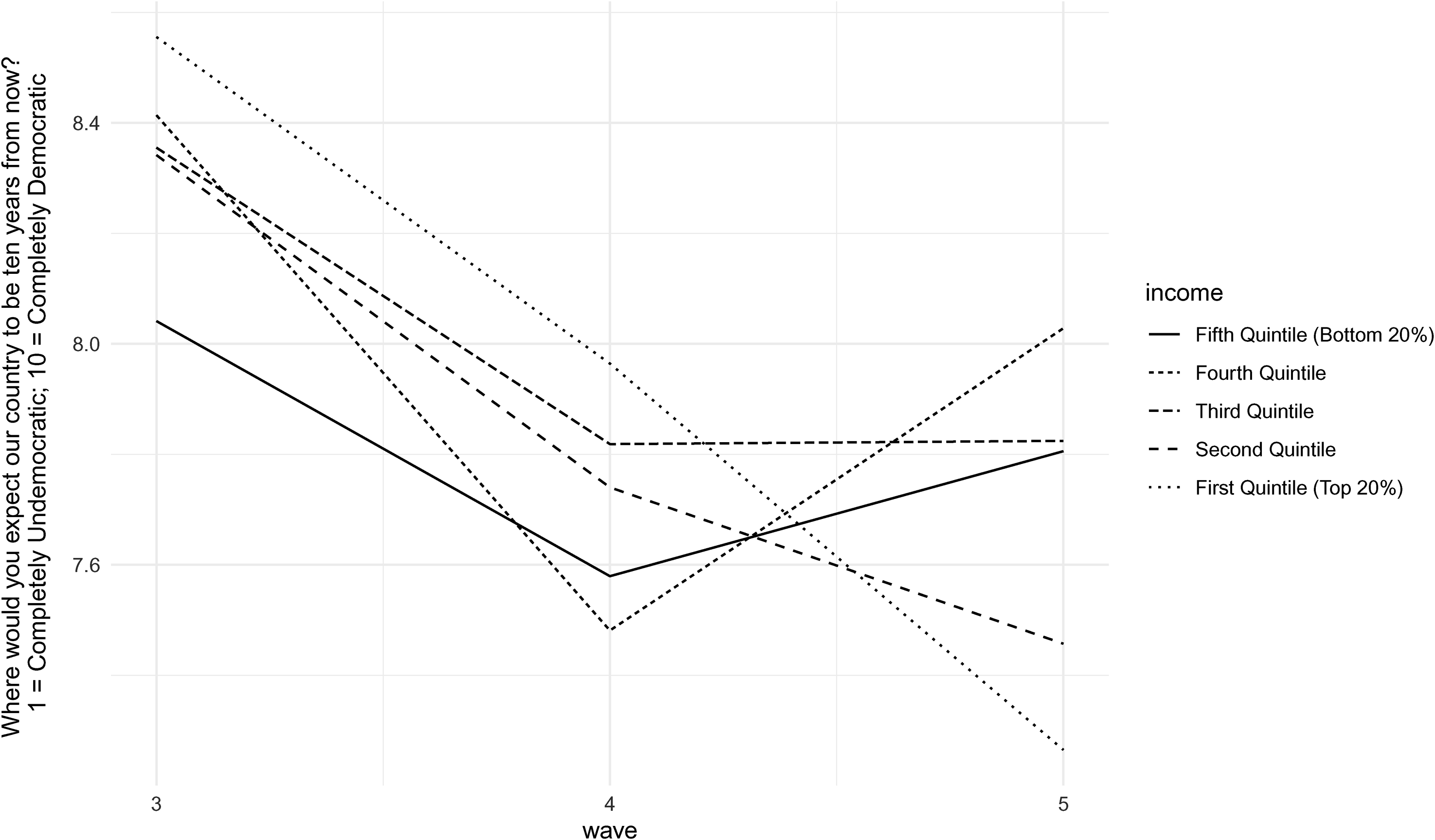
ABS wave 3–5 respondents’ evaluation of future of democracy in Indonesia in 10 years, by income.
There is also a slight difference in optimism about the future of democracy in Indonesia when we consider respondents with a college degree or higher, and those without. We find that respondents with college degrees and above are slightly less optimistic about the prospects of democracy in Indonesia (see Figure A2 in Section D in the Online Appendix).
In Figure 4, we show that overall, Wave 5 ABS respondents view Indonesia's democracy today somewhere between 2.2 and 2.6, which is a democracy but not a full democracy. Respondents in the first quintile of income reported that Indonesia's democracy is somewhere around 2.7 in Wave 2, and around 2.6 in Wave 5. Respondents in the bottom quintile of income also started at around 2.7 in Wave 2, and shifted to 2.2 in Wave 5. While the differences are relatively small, higher income earners in Wave 5 seem to have a less favorable view of Indonesia's democracy than those who make less money in the same survey. 12
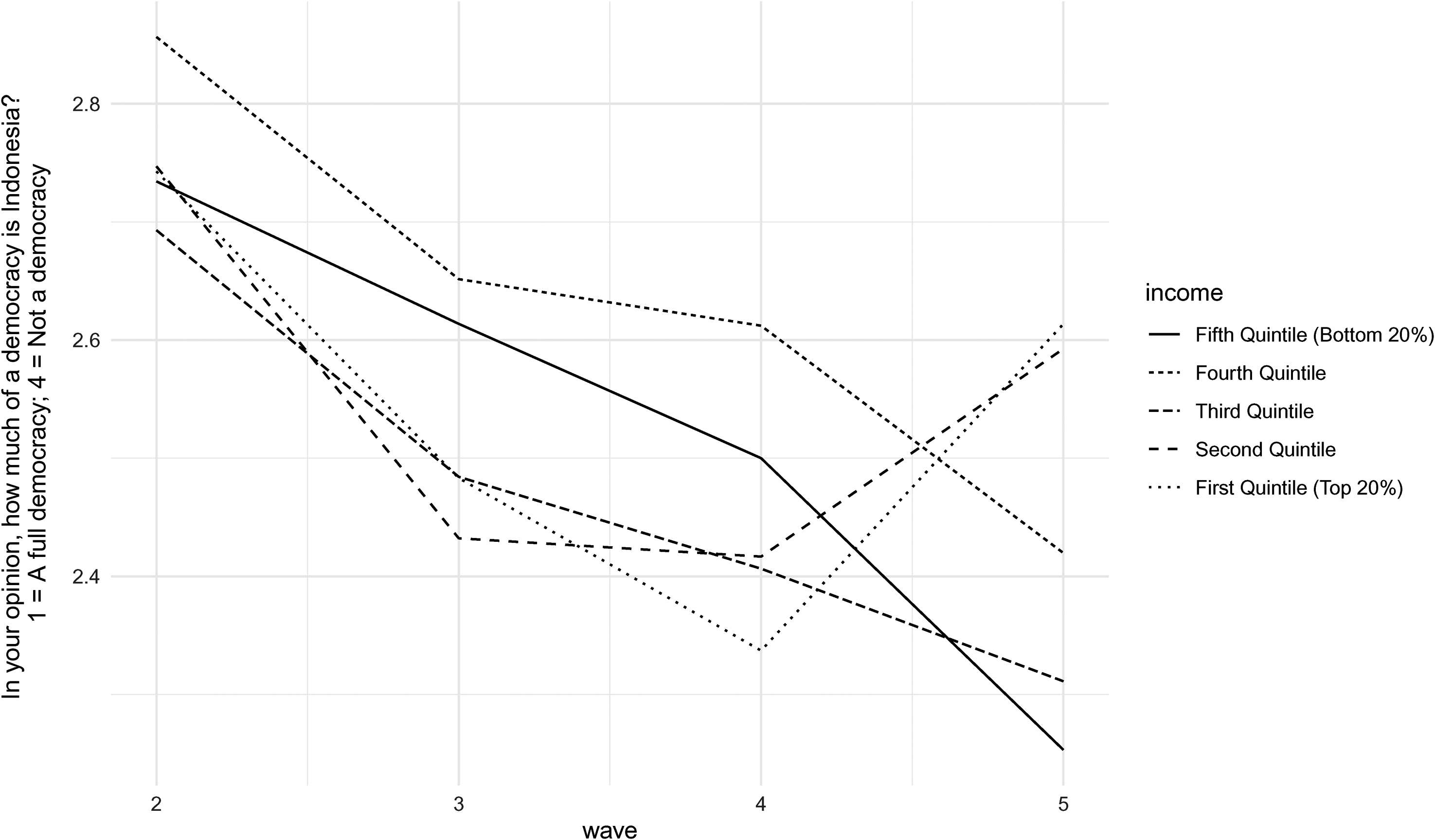
ABS wave 2–5 respondents’ view of whether Indonesia is a democracy, by income.
In terms of satisfaction with democracy, ABS respondents in Indonesia have overall moved towards reporting slightly more satisfaction with democracy over the years. In Figure 5, we show that respondents reported levels of satisfaction with the way democracy works in Indonesia at around 2.6 and 2.7 in Wave 2, and at around 2.2 and 2.3 (i.e. more satisfied) in Wave 5. There is not much of a difference between respondents in the first and fifth quintiles of income, in either Wave 2 or Wave 5 of the surveys. 13
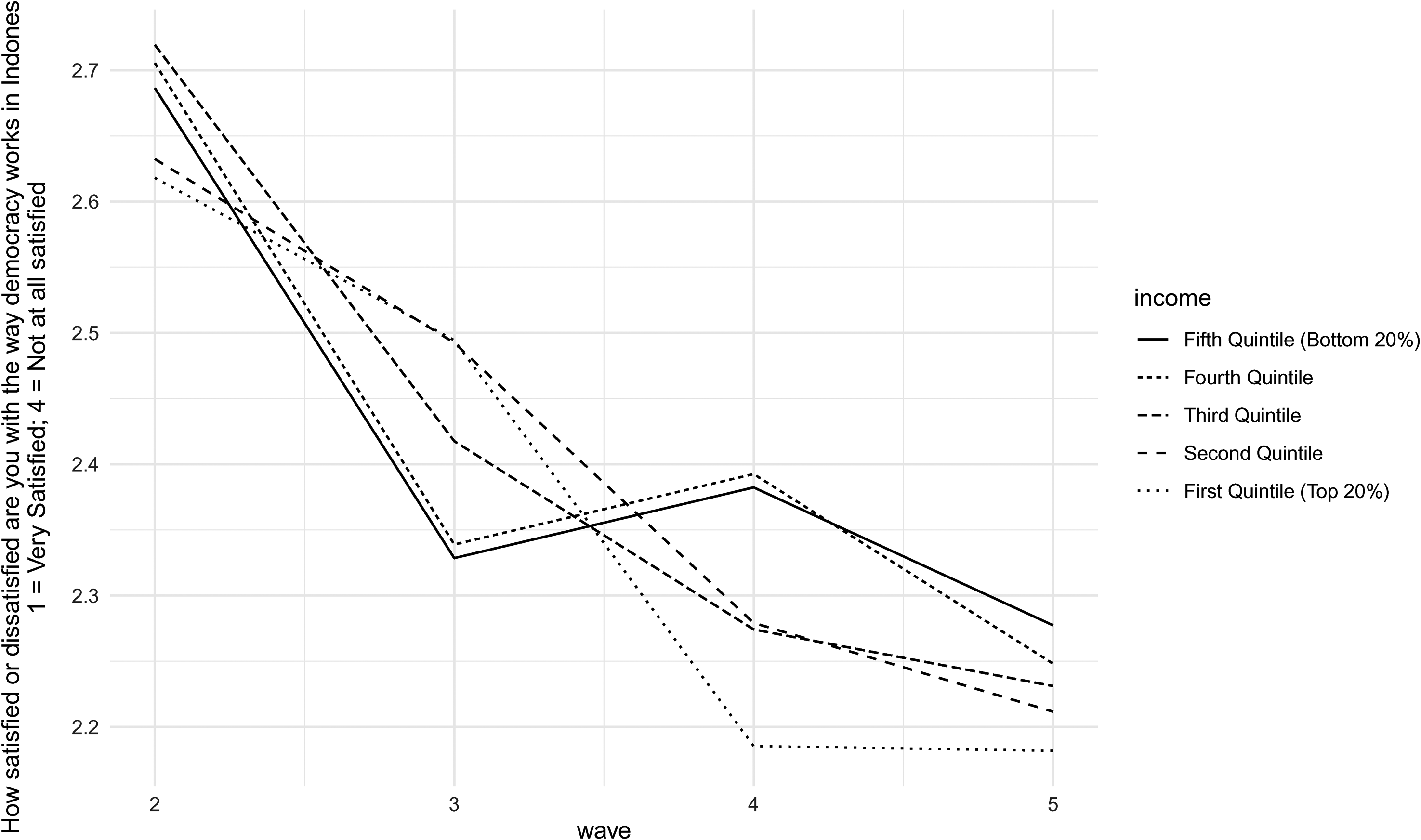
ABS wave 2–5 respondents’ satisfaction with democracy in Indonesia.
In sum, available ABS and WVS survey data offer an ambiguous picture of Indonesian respondents’ view and support for democracy over time. While on the whole survey respondents continue to report that they expect their country to be democratic in the future, that they still consider Indonesia to be a democracy, and generally more people seem to be more satisfied with how democracy works in Indonesia in recent years, there has been a slight drop in the reported perceived levels of quality of democracy by people in the higher echelons of income compared with those in the lower income levels. While the differences in reported levels of support for democracy between different income groups are generally small, they are not absent. These results imply that even if the “average” middle class citizens may be more supportive of increasingly undemocratic measures, as some available works reviewed earlier has suggested, a more educated and wealthier subsection of the middle class may continue to advocate for democracy and criticize measures that weaken democracy. To get a fuller picture, we need to turn to alternative data that can capture how educated citizens engage and respond to these perceived declines, and how they differ from the authorities.
A discourse analysis of democratic backsliding in Indonesia
We turn to a discursive analysis of materials produced by the ruling government and educated citizens. Our goal is to capture how educated citizens respond to democratic downturns and how their discourses may differ, agree with, or even contest those of the government. If they resist increasing illiberal practices by the government, we expect their discourses to be critical of the government's measures that restrict democracy. The government texts, on the other hand, should present a positive picture of Indonesia's democracy and its policies. If, on the other hand, educated elites are less enthusiastic about democracy, we will find less criticism against illiberal practices and the authorities in the materials. We collect a sample of government texts (i.e. texts produced by government officials such as presidential speeches, high school history textbooks, and ministers’ speeches) and texts typically consumed by the educated middle class from Indonesia (i.e. texts produced by citizens, such as novels, letters to the editor in newspaper, and movies) in 2010, 2015, and 2020. All materials are produced by Indonesians, published in the national language, Bahasa Indonesia, and are selected owing to their popularity and wide circulation in Indonesia. We explain our methodological approach and the selection of materials in greater detail below.
Why discourse analysis
In our analysis, we apply a procedure of discourse analysis developed in Hopf and Allan’s (2016) Making Identity Count (MIC, hereafter) study of national identity in great power countries. 14 Unlike other approaches in the literature that have used predetermined categories or relied on survey respondents’ self-reported attitudes, discourse analysis allows us to inductively examine and interpret themes as they appear in everyday conversations. That is, rather than approaching the texts with a list of words, themes, topics, and categories that we believe should be relevant for our research focus, we let the themes “emerge directly” from the texts, before we count the frequency of the themes’ appearance, and note their valence (i.e. whether this is something that the writers consider worth aspiring to or if they are aversive and want to avoid it) (Vucetic and Hopf, 2020). Compared with other approaches, Hopf and Allan (2016) suggest that discourse analysis “best approximates the ethnographic ideal of recovering data from ‘overheard conversations’ that have not been corrupted by pre-theorization or interaction with the analysts” (Hopf and Allan, 2016: 30).
In practice, this protocol entails that we read the text and identify the themes that were both explicitly mentioned as well as the broader themes that are related to them, taking into consideration the local contexts and contingent meanings and references that are implied in the text. Take, for example, this quote from Andrea Hirata's (2020) best-selling novel, Guru Aini: “For him, the world is unfair, law enforcement is untrustworthy, politicians forget their promises, and political leaders protect the thieves” (p. 55). 15 We observe that this quote mentions several identity categories (i.e. the world, law enforcement, politicians, and political leaders) which fall under the broader category of “Government,” and we note that the quote describes several characteristics associated with these identity categories: corrupt, unjust, and unreliable. We interpret this to mean that the text presents a description of rulers as corrupt, unjust, and reliable, with a negative (–) and aversive valence. Hence, in our list of coded themes from the novels we read in 2020, we add the following entries from this quote: “Government: unjust (–),” “Government: unreliable (–),” and “Government: corrupt (–)." 16
This exercise is subjective and interpretive, since what analysts consider as important and how they identify themes from the texts will be conditioned by their biases, personal histories, particular understanding of the issues, and analytical frameworks. There is also a temporal dimension to this exercise, since the same analysts may approach the same texts at different points in time and come away with different sets of interpretations, based on the specific analytical frameworks that were salient to them at those points in time. However, this approach allows us to capture implicit references and meanings, based on our understanding of the local contexts, nuance and events, as well as our grasp on the relationship between the themes mentioned in a particular quote and those described in rest of the text more broadly.
To achieve greater reliability and transparency, once themes/categories have been identified, we count the frequency of these themes’ appearances across the materials sampled, note the valence with which they are mentioned, and discern how the themes are connected within a category of texts and across different materials. That is, generally, higher frequency themes are considered more salient than lower frequency ones. As for valence, we distinguish between themes/categories that are mentioned with positive, negative, neutral, or ambiguous undertones. 17
We also note how Indonesians view others—other countries, groups, organizations, historical events—in relation to themselves, the valence with which they are expressed in the texts, and what they reveal about how Indonesians view themselves. A theme/category mentioned in the text is described in relation to Indonesia in terms of its temporal proximity (i.e. historical vs. contemporary) and location with regards to Indonesia (i.e. internal within Indonesia or external). For example, mentions of the Netherlands as a former colonial power would be coded as an external, historical other, while mentions of Indonesia's now banned communist party, Partai Komunis Indonesia (PKI), would be coded as an internal, historical other. The Ahmadiyah, a religious minority group often persecuted by those who claimed to defend the orthodoxy of Islam, would be coded as an internal, contemporary other.
Once the initial coder has finished coding all the materials, we had another coder read and code the same materials, and the coders discuss discrepancies in their readings thereafter. In the MIC project, inter-coder reliability was scored at 80% across all coders for all countries in the project. 18
Types of materials
To capture a snapshot of how Indonesia's government officials and educated middle class view the state of their democracy and respond and engage with each other, we examine both popular and government-produced texts. In particular, we examine discourses in novels and movies, letters to the editor published in highly circulated newspapers, and government-produced texts such as presidential speeches, education ministers’ speeches, and high school history textbooks.
Building on Gramsci’s (1992) notion that intellectuals and elites shape consensus among the masses through discourses in the media, arts, and education, we join a large body of scholarship that has examined political speeches and history textbooks as sources of official discourses on how political elites have constructed a narrative and a perception of reality for their citizens (Albertson, 2011; De Castella et al., 2009; Haus, 2009). At the same time, popular culture materials produced by artists, writers, directors, editors, and intellectuals both shape public attitudes and reflect existing views among the population. In the context of Indonesia specifically, these materials are also more likely to be produced and consumed by highly engaged and informed citizens, so their messaging and narratives may influence the opinions of many influential people (both inside the government and outside) and could indirectly change the discourses around particular issues and influence policy decisions.
Depictions of groups of people, events, and organizations in popular works such as movies and novels have been shown to reflect popular perceptions, anxieties, and values of the time (Fiorelli, 2016; May, 2000). To draw viewers and readers’ engagement, films and novels typically strive to depict characters, events, and behaviors that are recognizable and relatable to the viewers and readers. Consequently, these depictions can be seen as a lens into popular views, traits, and attitudes of the time. For example, in his analysis of American movies produced between the Great Depression through the Cold War years, May (2000) finds that films in different periods valorize different traits.
By framing an issue and providing a platform for particular voices and messages to be heard, films, media, and novels help define a public issue and influence public opinions (Chong and Druckman, 2007; Gerth and Siegert, 2010). Because they are usually packaged in an entertaining, aesthetically pleasing, and apolitical manner, and because they usually present narratives that viewers/readers can engage with emotionally and identify with, everyday popular materials such as films, shows, and novels have been shown to effectively shift popular opinions (Adkins and Castle, 2014; Ayoub and Garretson, 2017; Castle and Stepp, 2018; Davis and Davenport, 1997).
For our analysis, we use materials that we had collected for the Indonesia component of the MIC in Asia project, which includes texts from 2010 and 2015. We expanded this period by adding additional materials from 2020, which we collected and analyzed using the same set of procedures we used for the 2010 and 2015 materials. 19 The full list of texts we analyzed in this article is included in Section A in the Online Appendix.
We detail them below.
Presidents’ speeches: Two important speeches per year, usually the ones delivered on Independence Day or the parliamentary hearing on budget on 17 August, which are typically televised and broadcast on multiple TV stations. Ministers’ speeches: One speech every year, delivered by the Minister of Education on the National Education Day. The National Education Day is celebrated every year on 2 May, and the current Minister of Education typically delivers a televised speech to celebrate the day.
20
Newspapers: The two highest-circulating newspapers, from which we read all editorials and letters to the editor printed on the fifteenth day of each month.
21
We read letters to the editor and op-eds printed in the Jawa Pos and Kompas newspapers. Kompas, the country's newspaper of record, prints about 500,000 papers every day and is the largest circulating newspaper in Southeast Asia.
22
Jawa Pos has the second highest circulation in the country, issuing around 400,000 papers every day.
23
History textbooks: Two high school history textbooks on Indonesia's national history published in a given year. Ideally these would be history textbooks endorsed by the country's department of education and used widely in public schools. Novels: The top two best-selling novels in Indonesia in a given year, written by Indonesian authors.
24
Movies: The top two box-office movies in the country released in a given year, produced and directed by Indonesian artists and performed in Bahasa Indonesia.
25
We recognize that other materials, such as TV shows, social media, radio talk shows, podcasts, and news coverage, can also reflect government and educated elites’ sentiments, and may be good sources to mine for their engagement and responses to democratic decline. After all, social media penetration in Indonesia is very high, with more than 191 million users, or about 70% of the population (Statista, 2023). Similarly, TV shows such as sinetron 26 have consistently enjoyed broad and loyal viewership in Indonesia since its heyday in the 1990s and 2000s (Rakhmani, 2014). However, given the abundance of texts that the inclusion of social media data and TV shows would bring to the analysis, a discursive method would not be the best approach to use to examine these materials. A natural language processing approach would work much better instead. Given the constraints of our time and resources, we limit our selection to the texts we can best examine using the discursive protocol we use for other materials in the paper.
One may worry about whether our sampled materials accurately reflect the views and responses of educated citizens in Indonesia, the group we are interested in studying. To address this, we report our materials’ authors’ sex, occupation, and institutional affiliation, to the extent that the authors’ names and institutions are provided in the materials. Table A1 in the Online Appendix shows that our materials’ producers are overwhelmingly male and highly educated (i.e. 42.75% are academics, 10% are in the civil service, 15% are business people). While this may still only capture a narrow section of the middle class population, we believe that the popularity of these materials (i.e. best-selling novels, box office movies, and top circulating newspapers) would imply that they are more widely consumed by educated elites in Indonesia. The national newspapers we selected in particular, given their gross circulation numbers, are more widely consumed across Indonesia than tabloids and local newspapers, which have smaller circulation numbers and narrower geographical reach. We believe that newspapers remain a source of information for issues related to politics and governance, and are more likely to be read by highly engaged and informed citizens. The 2016 ABS survey on Indonesia reports that 57.81% of respondents said that they place “quite a lot of trust” in newspapers, while 65.48% of respondents said that they “practically never” turned to their social media networks for information on politics and governance. 27 Wary of the increase of hoaxes and fake news on social media in recent years, many Indonesians have also increasingly relied on broadcast TV as a trusted source of information (Lukman, 2020). For this reason, we can be reasonably confident that Indonesians seeking information about politics and governance are likely to turn to newspapers and broadcast TV, where they will read op-eds and letters to the editors, and watch televised speeches by presidents and ministers.
That said, we note here that because of the discursive approach and the sampling strategy of our materials and texts, we cannot assume that the results we unearth from this exercise is representative of the broader middle class and the country's population more generally. Surveys would still be a better tool for capturing a nationally representative sample. What our method and materials can provide is a glimpse into ongoing exchanges and conversations between highly engaged educated elites and government officials about various topics at different points in time.
Beyond issues related to consumption, some may worry that the specific texts we sample (e.g. novels and films) are products of fiction, and may thus not be the most appropriate media to unearth discourses on democracy and governance. Afterall, many films and novels are popular in part because focus on everyday themes and issues with which most people can resonate (e.g. love, friendship, loss). This may mean that they say little about democracy and democratic backsliding. Moreover, novels and films are often designed to be works of art that are not always intended to reflect popular opinion about political issues, even when politics is mentioned. In the same way, some of our official texts, such as history textbooks, may not update their language and discussion on democracy or democracy-related topics as frequently and as fluidly as presidential speeches would.
We recognize that the dominant themes that may emerge in popular novels and films may have little to do with democracy and backsliding, since they may not be the most salient concerns for the writers and producers, who may have many other goals and messages they want to communicate in through their craft. Similarly, we also recognize that history textbooks are written to teach students about their country's history overall, and democracy may appear in only a small portion of the curriculum. For these reasons, we expect to find fewer mentions and discussions of themes related to democracy in these materials, relative to public officials’ speeches, op-eds and letters to the editors, and we focus our analysis on themes and discourses that emerge in op-eds, letters to the editors and government officials’ speeches, although we present results mined from novels and films as well.
Results
Our materials from 2010 through 2020 suggest that many educated Indonesians do view their country as a democracy, though the sentiments related to this identity as a democratic country and the specific components of democracy that are salient in the texts have changed over time. Overall, we find that the texts produced by educated elites in later years are more critical of government practices and democracy in Indonesia, whereas the official texts continue to extol Indonesia's democracy.
We identified 19 broader categories (i.e. five in 2010 materials, seven in 2015 materials and seven in 2020 materials), and 119 smaller categories in total (i.e. 30 in 2010, 35 in 2015, and 54 in 2020). Across the three years in our data, the materials consistently discussed concerns related to governance, the economy, religion and religious identity, external and internal groups, and Indonesia's past and aspirations for the future. Within these broader categories, themes related to Islam and Muslims, the emerging economy, corruption, government capacity, and Indonesia's standing in the world were frequently mentioned.
Figure 6 provides a snapshot of how the dominant discourses change over time, between 2010, 2015, and 2020. Pooling across all materials we read, we show in Figure 6 the count of each year's top four discursive categories and discursive categories related to democracy (e.g. “democracy,” “democratic,” “democratic transition”). Figure 3(a) shows that from 2010 through 2020, conversations related to being “Muslim” were one of the most discussed in our materials. While some themes were highly discussed in one year and were not in the top-four categories in other years (e.g. “Country in crisis,” “the Netherlands,”), others such as “corrupt” and “the New Order” appeared multiple times as most discussed themes in the materials we read. Figure 3(b) highlights the shift in the frequency of conversations around Indonesia's identity as a “democratic,” “undemocratic,” and “democratizing countries.” In 2010, conversations around democracy were more prevalent than discussions of Indonesia being undemocratic. By 2020, however, mentions of “undemocratic” practices in the country surpass discussions of Indonesia's identity as a democratic country. 28
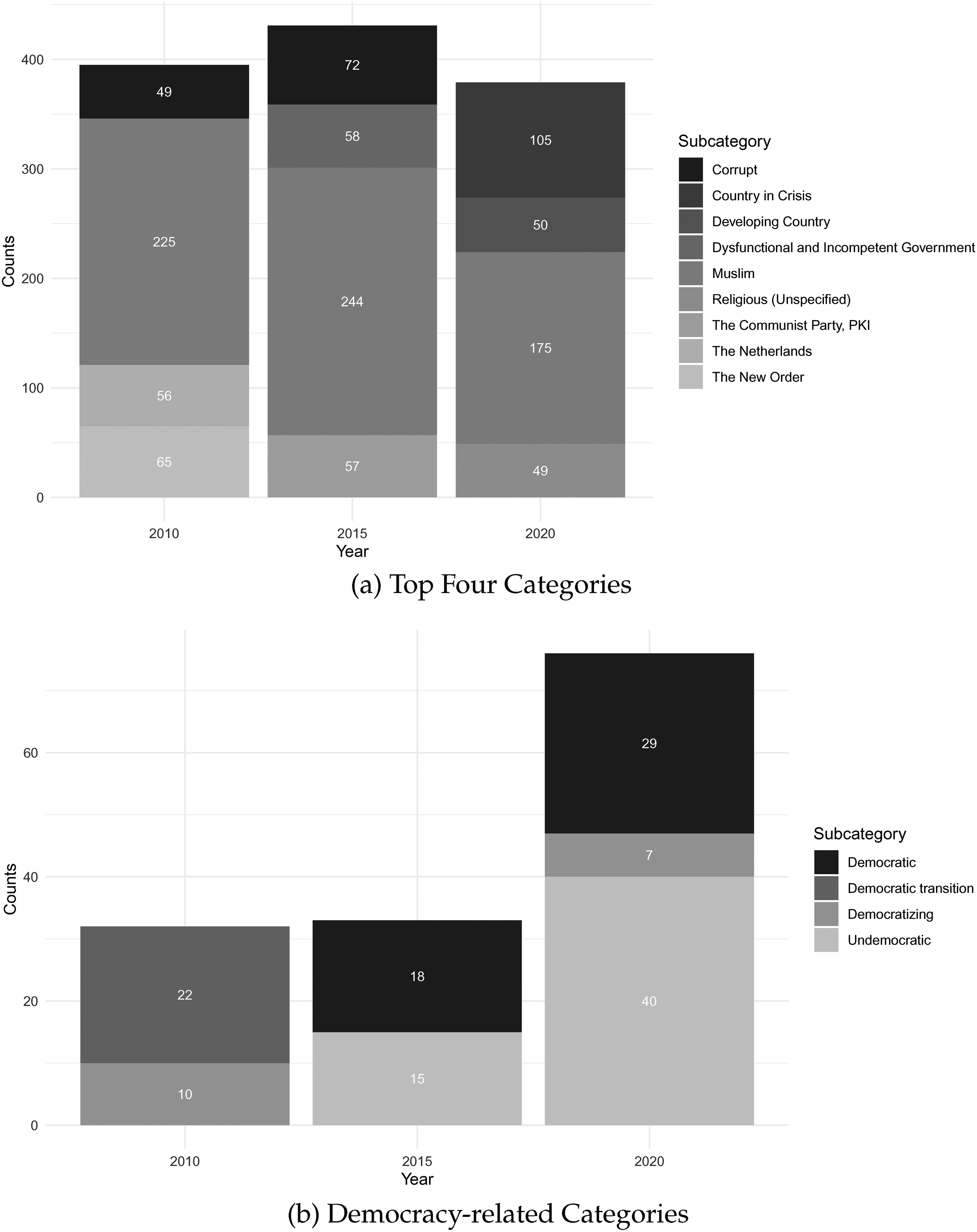
Top categories in our data over time, 2010–2020.
We interpret this shift to mean that the writers and producers of our materials recognize the change in Indonesia's democratic practices over time. In the 2010 texts, we find multiple mentions of celebration and pride of Indonesia's achievements as a Muslim-majority country that has made much progress in democratic consolidation. The texts express strong support for free and fair elections, freedom of association, and checks on government, even as they express concerns over Indonesia's continued failure to protect minorities’ rights to worship. Discourses in the later two years, however, reveal a shift in recognition of the country's less democratic practices.
In 2015, we find increasing concerns about the weakness and failures of political parties to convey the aspirations of the people. In 2020, mentions of Indonesia being “undemocratic” surpassed the count of mentions of Indonesia's democratic identity. Furthermore, in 2020 our popular texts paint a drastically different picture from the official narratives. Whereas government sources in 2020 continue to speak of democracy in a positive valence, the popular materials criticize the government's expansion of executive powers, repression of critics and opponents, and increasing restrictions on freedom of speech, as well as the failure of other branches of government to keep a check on the executive. Our analysis shows that there are important differences in narratives in government and educated elites’ texts. While our government texts continue to affirm Indonesia's commitment to democracy and paint a positive outlook on Indonesia's democratic prospects, the citizens’ texts we read show an increasingly more concerned picture, with increasingly broader and more nuanced themes associated with (un)democracy. Whereas in 2010 our texts primarily associate democracy with free and fair elections, in 2020 we find conversations on the spread of disinformation, the suppression of government critics, and the militarization of university campuses in Indonesia's democracy.
Discourses on democracy in 2010
In the following paragraphs, we discuss the salient themes and discursive categories that emerge in our texts from 2010, the divergence between official and educated elite texts, and what our texts say about how educated middle class citizens in Indonesia react to democratic decline. In Figure 7, we plot the frequency of themes related to democracy appearing in the 2010 texts, broken down based on types of materials. 29
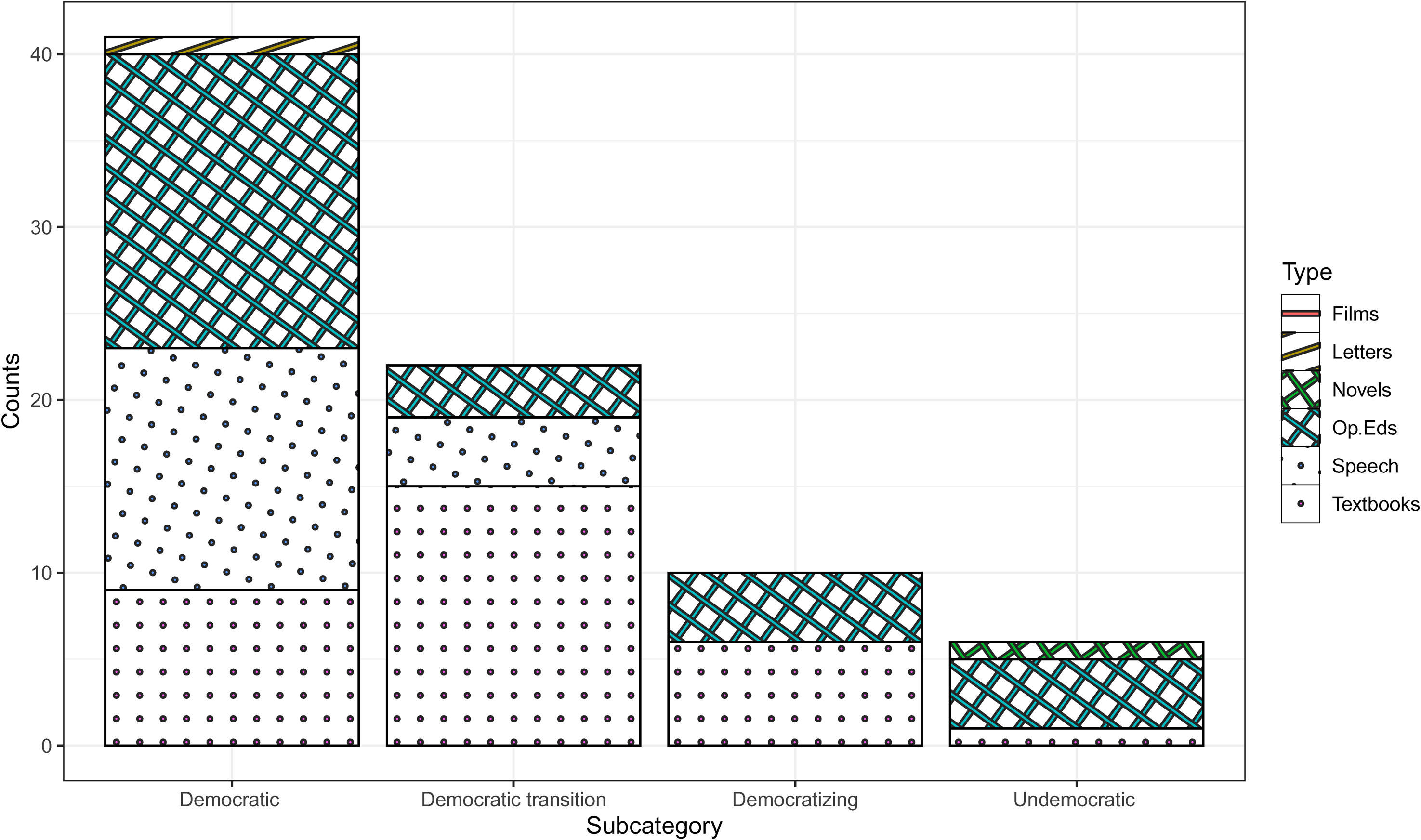
Count of categories related to democracy across different materials, 2010.
The top five discursive categories that emerge in the 2010 texts materials are: (1) “Muslim,” which comprises 25% of all discursive categories in 2010; (2) “the New Order” (7.45%); (3) “the Netherlands” (6.41%); (4) “corrupt” (5.61%) and (5) “democratic” (4.7%). The theme of Indonesia as a “Muslim” country is the most salient theme, and it appears predominantly in everyday texts such as novels and films. The second most commonly mentioned category, “the New Order,” emerges mostly in textbooks. The theme “the Netherlands,” on the other hand, is discussed roughly equally in both official and everyday texts produced and consumed by educated elites. Discourses around Indonesia as a “corrupt” country are common in op-eds, while conversations about Indonesia as a “democratic country” appear frequently in official sources such as speeches and textbooks. 30
The distribution of topics across our 2010 materials suggests that official and educated elite texts focus on different aspects and issues: the citizen-produced materials we read are replete with conversations about Indonesia's religious identity and the failures of Indonesia's government (i.e. corruption, anti-poor and exploitative political elites, vulnerability to violence). The official discourses, on the other hand, focus on Soeharto's New Order regime, the Netherlands, the threat of communism, Indonesia's strong and growing economy and its relationships with other states. 31
Indonesia's identity as a democratic country is one of the five most frequently discussed themes in our 2010 materials. Conversations around democracy and democratic practices consistently lean toward a positive, aspirational valence, rather than a negative one. 32 That is, educated elite writers of our 2010 texts clearly think of their country as a democracy, and they see this as a good thing. A related category, “democratic transition,” is mentioned much less frequently, and only in official materials, with a more cautionary, aversive valence. There are a few articulations of concern about the quality of democracy, which we label as “undemocratic,” but these make up a small proportion of the themes in 2010. 33 Relative to other categories, the theme “undemocratic” is overshadowed by aspirations in both the government and educated elite texts’ expressions of pride of the country's continued maturation of democracy.
In the following paragraphs, we discuss the aspects of democracy that emerge in the materials to highlight what our texts’ authors/producers seem to value and view as necessary requirements for democracy. First, one of the most notable components of democracy that appear in the discourses this year are elections. Indonesia prides itself for its successes in conducting multiple free and fair elections in successions. Having just been re-elected for a second term in the previous year, President Susilo Bambang Yudhoyono, in his independence day speech in 2010, said that Indonesia has conducted “three fair and just elections” and that “every governor, regent, and mayor in Indonesia is directly elected by the people” (Yudhoyono, 2010). In his view, Indonesia deserves its reputation as “the largest democracy after India and the United States of America” (Yudhoyono, 2010). Other official materials convey a similar emphasis on elections. One textbook lauds Megawati Soekarnoputri, the country's first female president whose party won the majority vote in 1999, for her role in advancing democracy in Indonesia because “her government held the 2004 election peacefully and successfully” (Bumi Aksara, 2010b: 33). The official sources clearly recognize the importance of free and fair elections as a requirement for a healthy democracy, and they take pride in Indonesia's accomplishment in this regard.
A second aspect of democracy that is important in the 2010 discourses is the withdrawal of the military from politics. Sulistyowati’s (2010) letter to the editor published in Kompas notes the significant difference between the military's role in the New Order era (1967–1998) and after 2004—the year Indonesia implemented its first direct presidential election: “The military's place in 2004 has significantly changed compared with the New Order period. The year 2004 was a historical moment for the military, as it ended its involvement in politics.”
This writer highlights the significance of the withdrawal of the military from politics as a mark of a successful democracy. Beyond that, his mention of the year 2004 as a point of reference suggests that, in his view, the country's first direct presidential election was another signal of a healthy democracy.
A third component that is important in the 2010 texts is the citizens’ political engagement and ability to keep the government accountable. The president's speech, for example, stresses the need “to safeguard and develop our democracy and decentralization processes so we can have a clean and capable government.” In a Kompas op-ed, Pribadi (2010) calls for active citizen participation and greater accountability: “If we wish to prevent political demoralization, governance and politics cannot be wholly reserved for politicians and political elites, with us being passive as the mere audience.”
A fourth component that the texts view as an important manifestation of democracy is the protection of rights. Both our official and educated elite materials recognize that democracy entails a number of freedoms. The textbooks we read for 2010 also celebrated that Indonesians can now “communicate their aspirations” and that there was “openness” in the country (Bumi Aksara, 2010b: 137). Conversely, the bestselling Negeri 5 Menara novel paints a warning in its main character Alif's complaint that the “local media is heavily censored” (Fuadi, 2009: 172–173).
The writers of our everyday materials stress the need to protect minorities’ rights. In light of President Yudhoyono's decree “freezing” the activities of the marginalized Ahmadiyah sect in June 2008, Pribadi’s (2010) opinion piece in Kompas criticizes the government's continued failure to protect some minorities’ rights to worship: We have all witnessed our fellow citizens who could not exercise their right to practice their faith (a right which is a manifestation of their constitutional right as citizens), when houses of worships were burned to the ground and destroyed without a stern reaction from the government.
Another op-ed piece criticizes the government for allowing some “groups motivated by their communal, religious, and regional interests to have much maneuver over the political arena” (Hidayat, 2010).
These four areas—elections, the military's withdrawal from politics, citizens’ political engagement and ability to keep the government accountable, as well as the protection of rights—are the main aspects that Indonesians seem to associate with democracy in 2010. Rather than a democracy in retreat, Indonesia is perceived as a democracy by our texts’ writers/producers. Beyond that, our materials also reveal that Indonesians are proud of the progress their country has made in democratic consolidation, and they want their democracy to continue to mature. More importantly, our materials show that different aspects of democracy are important to different groups in Indonesia. While government officials focus almost entirely on Indonesia's multiple peaceful elections, the writers of our middle class texts pay significantly more attention to government accountability and the protection of rights and freedoms. Previously invisible in publicly available data, this differing priorities and attention on democracy is much clearer across the different materials in our data.
Discourses on democracy in 2015
The trends shift in 2015. “Democracy” or “democratic” is no longer one of the top five discursive categories in the materials we examine. More importantly, we observe a rise in conversations around the theme of Indonesia's “undemocratic” identity, and a divide between official and educated elite texts in their discourses about democracy: Conversations around “democracy” or “democratic” are more prevalent in official materials such as speeches and history textbooks, while discourses about Indonesia's “undemocratic” identity appear exclusively in opinion pieces. While government officials continue to portray Indonesia as a democracy, educated elite discourses are dominated by criticisms of corruption and government's dysfunction more broadly, as well as elite interests and internal party politics that they perceive to weaken democracy.
The top five most frequently mentioned discursive categories for this year are: (1) “Muslim,” which covers about 25% of the discursive categories this year; (2) “Corrupt” (7%); (3) “Dysfunctional and incompetent government” (5.8%); (4) “The communist party/PKI” (5.7%); and (5) “The middle class” (4.9%). 34 Although the theme “Muslim” and Indonesia's identity as a Muslim country remains as the most dominant theme in 2015, criticisms of corrupt practices and the government's weakness are more prominent this year, and the “democracy” category is not one of the 10 most prevalent categories. Concerns about corruption and the government's dysfunction are more common in op-eds and letters to the editors (see under “Government and Politics” in Figure A11), whereas conversations about Indonesia's identity as a Muslim country are much more typical in novels and films (see in “Religious” in Figure A11). 35 While the 2015 textbooks continue to speak of Indonesia's communist party, there are fewer mentions of Indonesia's past specters (e.g. the New Order and the Netherlands) in this year's texts compared with the 2010 materials (see under “The Others” in Figures A8 and A9.
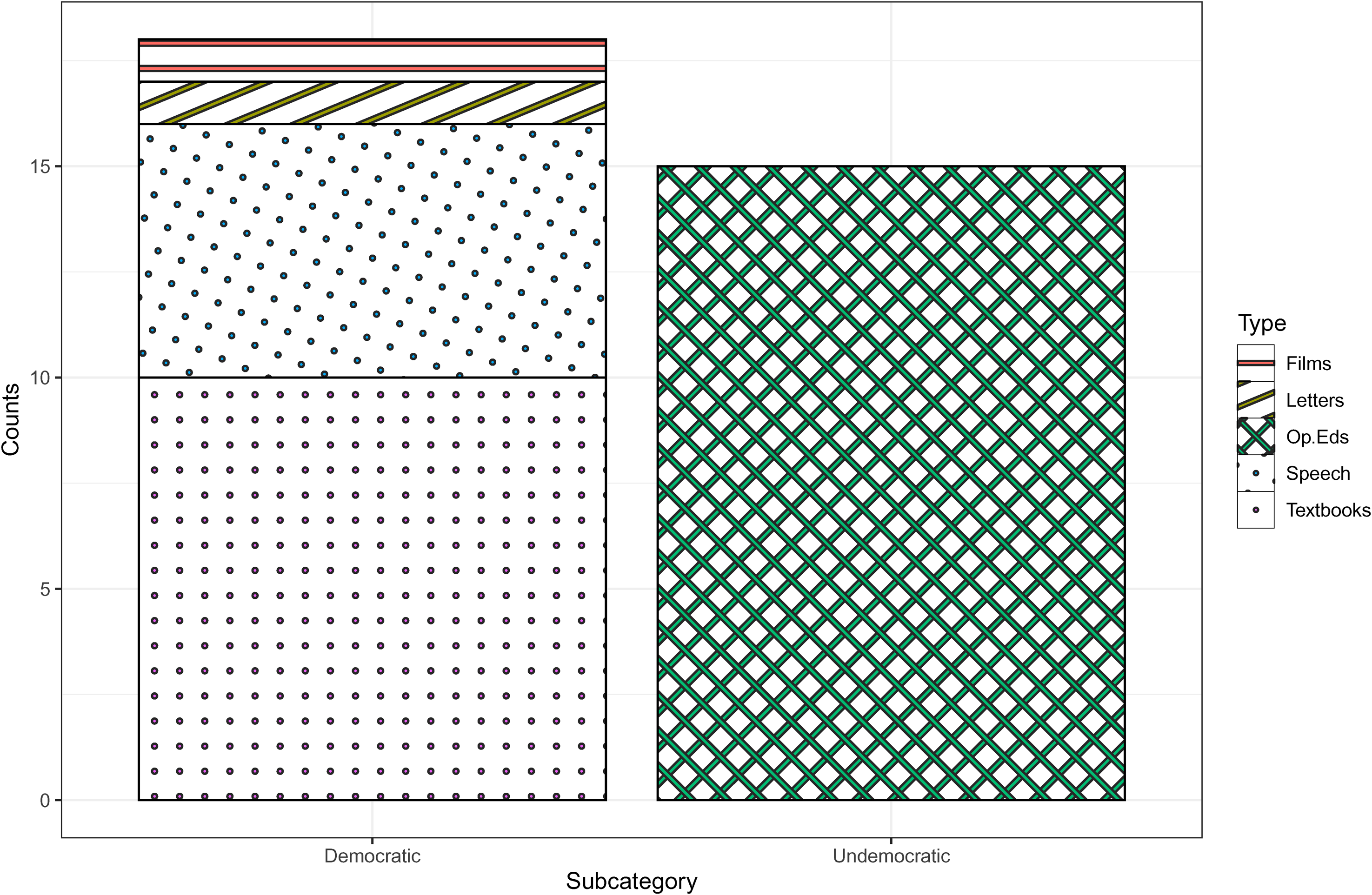
Count of categories related to democracy across different materials, 2015.
When mentioned in the 2015 texts (Figure 8), democracy is usually described as a positive ideal. For example, then President Joko Widodo describes Indonesia as “the third largest democracy in the world” and adds that “on matters concerning democracy, we [Indonesians] have become an excellent example for the world to see” (Widodo, 2015a). In a speech before the People's Consultative Assembly, Widodo (2015b) articulates his hope for democracy in this country: Fellow countrymen, the efforts of state institutions that I mentioned are part of our noble aim to improve the capacity and accountability of our country's development so we can be more democratic, respected, and dignified.
Similarly, a history textbook characterizes Indonesia as “one of the most democratic countries with a conducive investment climate” (Abdurakhman et al., 2018, 202).
Yet there is a sharp contrast between government and educated elite narratives about Indonesia's democracy. Glowing descriptions of democracy are almost entirely contained in official discourses. Everyday educated elite texts, on the other hand, articulate concerns about Indonesia's “undemocratic” practices. In fact, conversations of Indonesia's “undemocratic” features appear only in everyday materials. 36 Contrary to the government officials’ rosy narratives about democracy, many op-ed writers characterize Indonesia as a democratizing country with many shortcomings and superficial democratic features.
One writer believes internal party politics and oligarchs “have destroyed the democratic system we [Indonesians] are building” (Maksum, 2015). Latif (2015)'s op-ed piece in Kompas portrays the failures of Indonesia's democracy at the time: The [country's] hardware—the democratic procedures—relatively seem to be more democratic; however the software—the democratic culture—is still nepotistic–feudalistic; the democratic government is not supported by meritocracy (a government by competent people), on the contrary is maintained by mediocrity (a government by mediocre people); the expansion of political participation runs hand-in-hand with the expansion of participation in corruption; a democracy intended to strengthen the people's sovereignty in fact has only strengthened a select few; a democracy aimed for strengthening civic nationalism in fact nourishes tribalism and provincialism.
Another opinion piece in Jawa Pos observes that the internal conflicts in political parties reflect “no independence yet in carrying out the democratic process” (Aminuddin, 2015). Another writer for Kompas echoes this sentiment, lamenting that “political parties are no longer a pillar of democracy to represent the voice of the people” (Junaidi, 2015).
While most op-eds blame the government and the elite for side-lining “the people,” some trace the country's undemocratic character partly to “the citizens’ apathy and reluctance to participate in the democratic process” (Aminuddin, 2015). The same author laments that Indonesia's big democratic hope, which it has cultivated thus far, is now gone (Aminuddin, 2015).
Concerns about “undemocratic” practices are not the only ones that appear exclusively in citizen-produced texts. The discourses “exploited by corporations” and the country's “Muslim” identity, “weak economy,” “corrupt” practices, “dysfunctional and incompetent government,” “elite rule,” “socieconomicaly unequal,” emerge almost entirely in texts written by educated citizens. 37 These concerns are hardly ever mentioned in official discourses. Instead, leaders’ speeches and history textbooks highlight Indonesia's historical figures (e.g. the communist party, the Netherlands, the Old Order, the New Order, the 1998 crisis) and its standing in the international arena (e.g. Non-aligned, international communities, ASEAN and Southeast Asia). The concerns that official discourses recognize tend to be those that justify and advance the government's stance and policies, such as “prone to social conflict,” “independent and sovereign,” “pro-poor,” among others. Taken together, the split between official and educated elites discourses in 2015 paint a picture of a religious Muslim-majority country with a growing discontentment over economic and political policies, and a government that seems to ignore these concerns.
Based on our 2015 materials, we submit that the writers who produced our citizen texts openly engage and express their criticisms against the failures of democracy in their country that year. Relative to 2010, the discourses in citizen-produced materials in 2015 show that writers of our materials want more than regular and fair elections for their democracy. Rather than simply supporting the status quo and the ruling government, they explicitly attribute the country's ongoing problems to internal party politics and political elite interests. Instead of a docile, autocratic-leaning middle class, these discourses suggest that the authors of the educated elite everyday materials we study want a deeper manifestation of democracy in their country that goes beyond regular elections, and they express these aspirations openly.
Discourses on democracy in 2020
Compared with 2010 and 2015, 2020 in our texts is characterized as a year of further challenges for democracy in Indonesia. Although more heavily dominated by discussions of the COVID-19 pandemic and the government's (mis)management of the crisis, our texts suggest growing discontent with the state of Indonesia's democracy and point to the Widodo administration's undemocratic measures as symptoms of democratic decline. 38 Concerns about the country being “undemocratic” are more prevalent this year than positive mentions about the country's identity and practice as a “democratic” state (see under “Government and Politics” Figure A13). In this way, our texts confirm observers’ characterizations that, in 2020, Indonesia was at its lowest point in its democratic journey since 1998 (Power and Warburton, 2020).
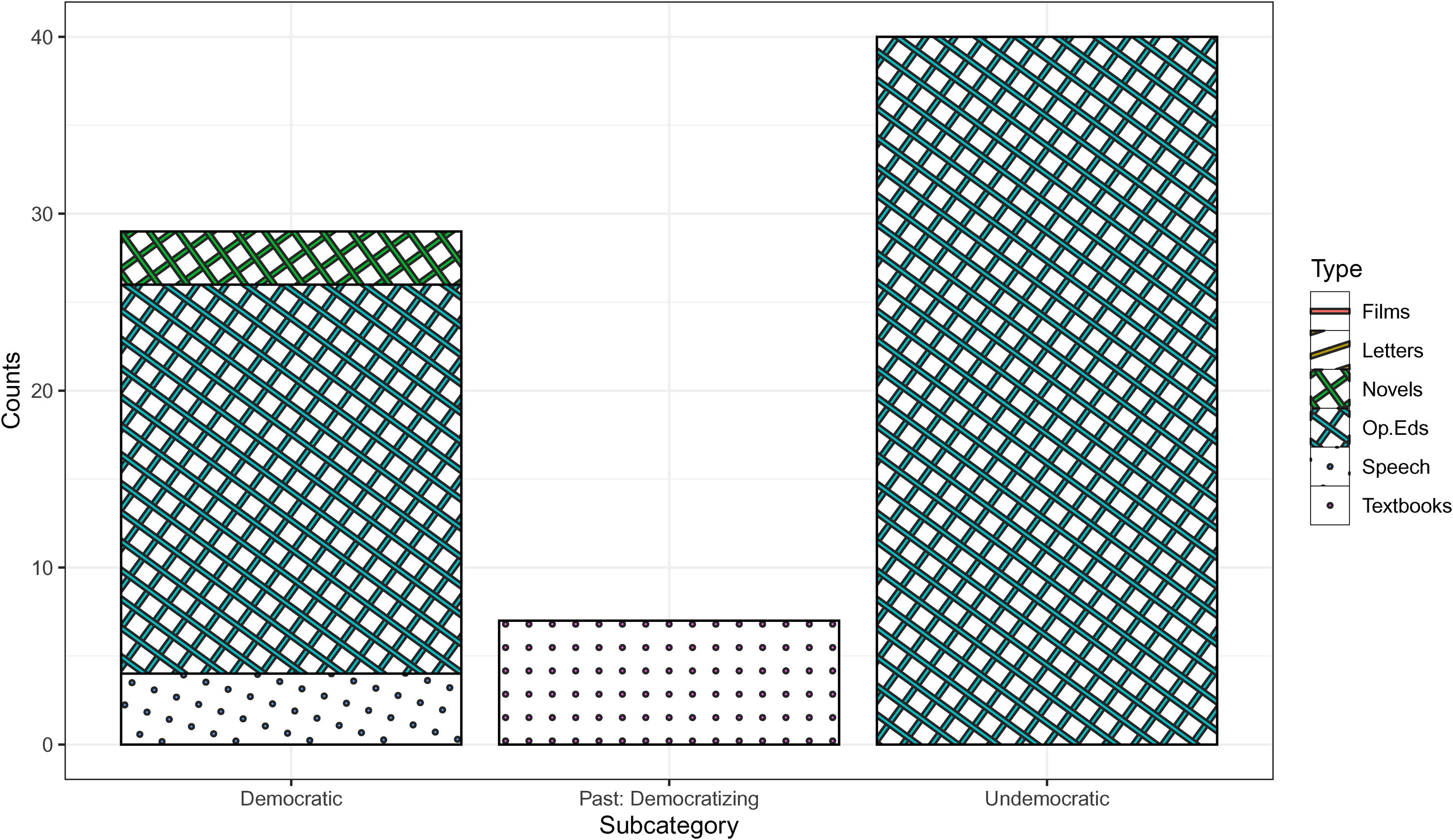
Count of categories related to democracy across different materials, 2020.
Compared with the 2010 and 2015 texts, the 2020 texts articulate more nuanced terms and categories related with democracy. Rather than focusing primarily on elections (as in the 2010 texts) or on political parties (as in the 2015 texts), the 2020 texts speak of the importance of a free press and the dangers of disinformation, and they warn of the dangers of executive overreach and restrictions on freedom of speech as a threat to democracy. For example, in his Kompas op-ed, (Cahyadi, 2020) criticizes the spread of disinformation in Indonesia and calls on the press as a pillar of democracy. The author beseeches the press to disseminate only factually correct information and to be selective in granting those in power a platform: A critical lens towards power is a requirement for mass media as the fourth pillar of democracy. However, this must be conducted based on facts on the ground, instead of simply quoting public officials or politicians whose interests are not always in line with public aspirations.
The official discourses this year express fewer mentions of democracy as compared with previous years, and instead focus more on the COVID-19 pandemic. When they do mention democracy, the sentiments are positive and aspirational, but with a nod towards the importance of order and stability. In his Independence Day speech, for example, President Joko Widodo says that strict implementation of democratic tenets cannot be negotiated and that democracy must persevere without “disrupting rule of law and work efficiency, as well as Indonesian culture” (Widodo, 2020). History textbooks make few explicit mentions of democracy, but some stress that prior administrations’ economic policies offer insights into Indonesia's ongoing journey towards a stronger democracy.
The educated elites texts this year, on the other hand, are critical of elections and of various government measures they perceive as increasingly undemocratic. Awey’s (2020) opinion piece laments that local executive elections are not about aggregating the democratic aspirations of the people. Instead, it argues that these elections are politicians’ self-serving platforms, where social assistance funds are co-opted for campaign purposes and politicians performatively distribute donations during election campaign periods to woo voters.
Beyond elections, our educated elite texts criticize the increasing power of the executive and the government's illiberal approach to dissidents. One key example of expanding executive powers is some political parties’ proposal to scrap local executive elections and to extend the President's term limit to three terms, the latter of which would require amending the 1945 Constitution. While the President himself has publicly rejected this proposal (Gorbiano, 2019), this discussion continues to resurface in the media. Winangun’s (2020) opinion piece in Jawa Pos criticizes this proposal and implores people in power not to chase fleeting power at the expense of the noble constitution, and “forego a democratic and open life for all.” He writes: The duration of power will cause subsequent problems. The government will be authoritarian, undemocratic, and participate in corruption, collusion, nepotism, and monopoly. Power becomes limited. Only a select few can become ministers, governors, regents, mayors, and other strategic positions. The economy, too, will restrict access to a select group of people.
This proposal and the public attention it commanded stir anxieties about democratic regressions in some corners (Nugroho, 2021).
The government's suppression of protesters and critics, and its disregard to their grievances and aspirations, has also worsened these anxieties. In late 2020, the government passed into law the controversial Omnibus bill on Job Creation despite months of mass protests and advocacy efforts to cancel the bill by activists, labor groups, and civil society members. The bill was criticized for its potential adverse impacts on the environment, disregard for workers’ rights, and capitalistic preference for business. One anonymous opinion piece in Jawa Pos (2020b) writes: With all “investment”, questions arise, when investment increases but the fruits are not enjoyed by the Indonesian people, then what? Government data shows that investment increase (as of 2019 was at IDR 700 trillion) in fact absorbed less employment. That means that the investment into Indonesia has not been maximized for public welfare.
There are also reported arrests of protesters. Opinion pieces refer to harsh penalties for government dissenters (Yosarie, 2020). University students who participated in demonstrations have been penalized with expulsions and imprisonment. Some opinion writers caution against increasing military presence (i.e. “militarization”) in higher education institutions and call for the Ministry of Education to protect freedoms on campus and encourage independence in thought and expressing opinion (Yosarie, 2020). The language of militarization is reminiscent of the power of the military during the undemocratic New Order period.
Relatedly, another anonymous Jawa Pos (2020a) opinion piece demonstrates how the government leverages COVID-19 to restrict free expression and public participation such as demonstrations and public assemblies: It is peculiar that state apparatus are not as punishing when it comes to mass organizations (who break COVID-19 protocols through gatherings). The tolerance, facilitation, and appeals provided for these organizations stand in direct contrast with law enforcement on demonstrators against the Omnibus Law. We still remember how the police was very tough on the demonstrators, whose liberty is guaranteed by law, under the guise of health protocols.
In a Kompas op-ed, Araf (2020) observes a lack of “check and balance” between the parliament and the President. Referring to a draft bill on terrorism law involving the military, he worries that this bill would be used to legitimize further curbs on civil liberty and freedom of expression.
Overall, while our texts still characterize Indonesia in 2020 as a democratic country, educated citizen discourses highlight how executive power expansion, silencing of protesters and government critics, and limited checks and balances on the executives are posing a danger to Indonesia's democracy. Our 2020 materials portray a sharp difference between official and educated elite narratives about Indonesia's democracy. Our 2020 government materials are replete with mentions of Indonesia's role and standing in the international community, but they are silent on economic and political concerns that occupy our educated elite everyday texts. While educated elites texts contain discourses about Indonesia's “religious” identity, “country in crisis,” “poor, lack of social mobility,” and “corrupt” government, among others, discourses in government texts highlight Indonesia's “non-aligned” stance, “the Netherlands,” “the communist party,” and the dangers of “separatist” threats. While present in earlier years, the gap between the discourses in everyday materials and those in the government texts is much wider in 2020. 39
Conclusion
The educated middle class are typically considered as advocates of democracy. Evidence from recent years, however, casts doubt on this conventional wisdom as more studies show that the middle class may in fact also harbor illiberal views and are less supportive of democracy. We know even less about how they respond to weakened democratic institutions and practices as democracy is eroding, since democratic erosion by definition happens incrementally over a long period of time, so that the subtle changes may not even be recognizable.
In this article, we contribute to the literature by examining new materials over a 10 year period, with a discursive analysis protocol that allows us to discern educated citizens’ and government officials’ discourses on democracy in their country. Building on Hopf and Allan's (2016) protocols of discourse analysis developed to study national identity, we code presidential speeches, ministers’ speeches, history textbooks, letters to the editor and opinion pieces in national newspapers, and bestselling novels and films produced in Bahasa Indonesia from 2010 to 2020, to identify themes that reflect how educated citizens of Indonesia view their identity as a democratic country. The data and methodological approach allows us to “listen in” to ongoing conversations between many Indonesians, to get a sense of their attitudes about democracy, without the imposition of experts’ pre-theorization. More importantly, because these materials provide insights into ongoing conversations between Indonesians, we can observe how educated elites engage and respond to the changes happening in their country.
We find that in 2010, both official and educated citizen discourses are largely hopeful and celebratory about the advancement of democracy in their country. This confidence in Indonesia's democracy stands on the country's ability to conduct free and fair elections, implement political reforms that have enabled greater competition and restricted military role in politics, and create an open space for political expression. The educated elite authors who produce our everyday texts, while similarly proud of their country's democratic progress as official texts in that year, also stress the importance of citizens’ political engagement, government accountability, and protection of rights. By 2015, there is a greater disconnect between official and educated elite everyday discourses on democracy. While official discourses continue to celebrate Indonesia's status as one of the world's largest democracies, the educated elite materials in 2015 are critical of undemocratic practices in the country and political elites’ corrupt practices, political infighting, and failures in representing the interests of the people. In fact, conversations about “undemocratic” practices occur mostly in educated elite everyday texts, and they almost equal the number of conversations about Indonesia's “democratic” practices, which appear mostly in official materials (i.e. history textbooks and leaders’ speeches). By 2020, conversations of Indonesia being “undemocratic” outnumber conversations of its democratic identity. While government texts continue to reaffirm the country's commitment to democracy, the educated elite everyday texts we read in 2020 condemn the limitation of checks on executive powers as well as the government's increasing restrictions on freedom of speech and implementation of illiberal measures towards critics and oppositions, among others.
Our analysis demonstrates a shift in discourses as democracy declines. In 2010, both official and educated citizens’ discourses are consistent in their praise of Indonesia's advances of democracy, with some caution expressed about the importance of safeguarding democratic practices. Over time, the gap between official and educated citizens’ discourses on democracy widens, as op-eds and letters to the editors are increasingly critical and nuanced in their observations of undemocratic practices in the country, while official discourses maintain a rosy view of Indonesia's democracy. Furthermore, our texts also reveal an evolution in the themes related to democracy that emerged in the discourses over time. Whereas in 2010 the focus is primarily on the infrastructures of democracy (e.g. Indonesia's implementation of elections, institutional reforms), over time the texts focus more on substantive dimensions of democracy, such as a free press that does not spread disinformation, a robust civil society that can articulate its grievances to the government without fear of punishment, and a healthy legislative body that keeps executive power in check.
Our article contributes to the literature in a few ways. First, this article uses a new type of data and methodological approach to analyze democratic backsliding, to answer an understudied question in the democratic erosion literature. Our analysis unearths valuable insights about how educated elites in Indonesia engage and respond as democracy declines. Second, we find that instead of accepting the deterioration of democracy, the authors of our everyday texts vocally criticize the ruling elites’ measures that they perceive as contributing to the problem. Rather than supporting the status quo, they demand greater protection of democracy. In this way, we find that the educated elite writers of our texts respond publicly to democratic erosion in ways that are more consistent with the predictions of classical modernization theory, and less so with the more recent analyses showing the authoritarian leanings of the middle class. Third, our data also suggest that the growing disconnect between the narratives of political elites and the middle class may be an early symptom of democratic decline, and that for observant citizens in new democracies like Indonesia, conversations about democracy also involve more nuance and fine grained details as their expectations of democracy are unmet.
Some limitations remain. In this article, we implement a discourse analysis protocol, originally designed to study national identity in elite and everyday texts among major powers (Hopf and Allan, 2016). As a result, some of the materials (i.e. history textbooks, novels, films) we examine may be better suited to mine discourses related to national identity specifically. The contents of history textbooks are less likely to change drastically from one year to the next, and consequently, may not reflect shifting popular and government discourses on politics and governance. Similarly, novels and films are products of fiction, which may highlight issues that most readers and consumers can readily resonate with, which may not include democracy.
Furthermore, considering the educated elite orientation of the audiences of national newspapers, box-office movies, and best-selling novels in Indonesia, it bears repeating that the texts in our data cannot capture the discourses of other citizen groups in this country and should not be treated as nationally representative. As such, the worries regarding democratic decline in our texts may reflect the particular concerns of a more urban, educated middle-class, and politically engaged section of the Indonesian population. Despite the narrower scope of our analysis, the results we find are generally consistent with the opinions articulated in ABS and WVS surveys: that is, over time, Indonesians seem to become increasingly less optimistic about the future of democracy in Indonesia, even though they continue to report overall satisfaction with the way democracy works in this country and they still consider Indonesia as more of democracy. Future studies on democratic backsliding would do well to broaden the selection of materials to ensure a more representative picture of existing discourses among the broader population.
Footnotes
Acknowledgements
We gratefully acknowledge the support of the Singapore SSRC grant for the Making Identity Count in Asia project. We also would like to thank Joel Selway, Edward Aspinall, Aries Arugay, Yuko Kasuya, Netina Tan, Clio Calimbahin, Meredith Weiss, and other participants of the Democratic Backsliding workshops at Keio University in November 2021, January, and March 2022, for their generous comments and thoughtful engagement. We also thank participants of the Yale–NUS Global Affairs Working Papers series in April 2022, as well as Eve Warburton, Ian Chong, Ted Hopf, and other participants of the Making Identity Count conference in January 2019 at the Asia Research Institute, Singapore, for their feedback and comments that have strengthened our paper. Jia Liang Koh has provided excellent research assistance. All errors are ours.
Declaration of conflicting interests
The authors declared no potential conflicts of interest with respect to the research, authorship, and/or publication of this article.
Funding
The authors disclosed receipt of the following financial support for the research, authorship, and/or publication of this article: This work was supported by the Singapore Social Science Research Council,
