



Abstract
Indonesian democracy is characterised by large governing coalitions and a dominant presidency, coupled with weak parties with few programmatic differences. These features of coalitional presidentialism are the product of a presidential form of government and proportional representation with high district magnitudes and have implications for electoral politics in a diverse socioeconomic context. This manuscript shows that the core features of Indonesian party politics and electoral competition in the 2024 elections can be explained by applying the comparative literature on electoral institutions to Indonesia's social structure and political cleavages. Analysing the interaction of electoral rules, social structure, and politicians’ incentives provides insights into the roots of Indonesia's democratic decline and the pathways towards reform.
Introduction
Indonesian democracy balances presidentialism with multipartyism in one of the world's most diverse sociopolitical landscapes. Since the onset of direct presidential elections in 2004, Indonesian presidents have presided over very large governing coalitions in the legislature and the cabinet that usually encompass nearly every legislative party. Joko Widodo, Indonesia's democratically elected president from 2014–2024, embraced illiberal tactics to achieve his political objectives, and ideological differences have been suppressed in favour of power-sharing across parties since the Reformasi era. These features of Indonesian democracy have been documented extensively (Aspinall and Mietzner, 2019; Mietzner, 2020; Mujani and Liddle, 2021; Power, 2018; Power and Warburton, 2020), as have the implications for legislative opposition, oligarchic power, civil society power, and the constitution order (Crouch, 2023; Diprose et al., 2019; Mudhoffir, 2023; Slater, 2004, 2018). The results have been stabilising for Indonesian democracy in formal terms, but at the expense of representation, competition, and executive restraint (see e.g., Mietzner, 2024).
In this essay, I use comparative insights from the literature on comparative political institutions and consensus democracies (Lijphart, 1999) to examine how electoral rules, presidential politics, and social cleavages shaped the conduct and outcome of the 2024 Indonesian elections. Indonesia's electoral system and form of government produce an extreme version of centripetalism (Horowitz, 2014; Reilly, 2007, 2022). Indonesia's electoral rules combine with presidentialism to produce “supermajority power-sharing” (McGann and Latner, 2013), with proportional representation producing partisan fragmentation alongside two separately elected branches of government. In practice, this form of democracy is best understood as a subtype of coalitional presidentialism characterised by consensus-based norms of decision-making and oversized coalitions. Given these rules, Indonesia's electoral system structures the expression of social and political cleavages in electoral politics. Presidential races have increasingly aligned around an Islamist-pluralist cleavage, with ethnicity playing a subtle residual role.
This manuscript elaborates this argument by placing the results of the 2024 elections in the context of some of the main predictors of voting behaviour – religion, ethnicity, and geography – and the electoral institutions that structure Indonesian politics. The findings have implications for approaches to Indonesian democracy that centre oligarchy, power-sharing, accountability, and culture. Analysing the interaction of electoral rules, social structure, and politicians’ incentives clarifies why Indonesian democracy operates the way that it does without invoking factors such as political culture, the structural power of capital, or informal practices of elite politicking. Such an approach also points towards the root causes of Indonesia's democratic decline, as well as the difficult challenges of reform.
Presidentialism, Multipartyism, and Democracy?
In the 1990s, the consensus among institutionalists was that presidentialism, multipartyism, and democracy were, in the words of Mainwaring (1993), a “difficult combination.” Central to this argument was the observation that legislative coalition-building was more difficult in a system where the president was elected separately from the legislature and the latter contained multiple political parties. Two-party presidential systems can lead to divided government, but because the president's party is expected to be one of the two legislative parties, the stakes are clear and legislative coalition-building is unnecessary: either the president has a legislative majority, or not. In multiparty presidential systems, the president's party is much less likely to command a legislative majority, heightening the threat of divided government and highlighting the competing popular legitimacy of the executive and legislative branches of government.
But like the influential work of Linz (1990) that inspired Mainwaring's analysis, his argument rested primarily on Latin American case materials. These arguments have proven less compelling in a global context. Cheibub (2007) finds that the global correlation between presidentialism and democratic breakdown is a consequence of selection effects, as presidential regimes emerge under conditions under which democracy is unlikely to survive. He also finds that, perhaps surprisingly, presidential regimes are most durable when they have a large number of legislative parties, measured as having an effective number of parties that is greater than 5 (Cheibub, 2007: 96). Pereira and Melo (2012) show, using Latin American examples, that multiparty presidentialism can be an enduring form of democracy. Looking at the Southeast Asian experience, Bünte and Thompson and coauthors have shown that presidentialism and multipartyism have coexisted in Southeast Asia, concluding that institutional variables like electoral systems and forms of government are not related to democratic instability (Bünte and Thompson, 2018, 2023). Table 1 presents data from Bormann and Golder (2022) on regime type, district magnitude, and the effective number of parties for Asian democracies between 2014 and 2020.
Comparative Data on Asian Democracies, 2014–2020.
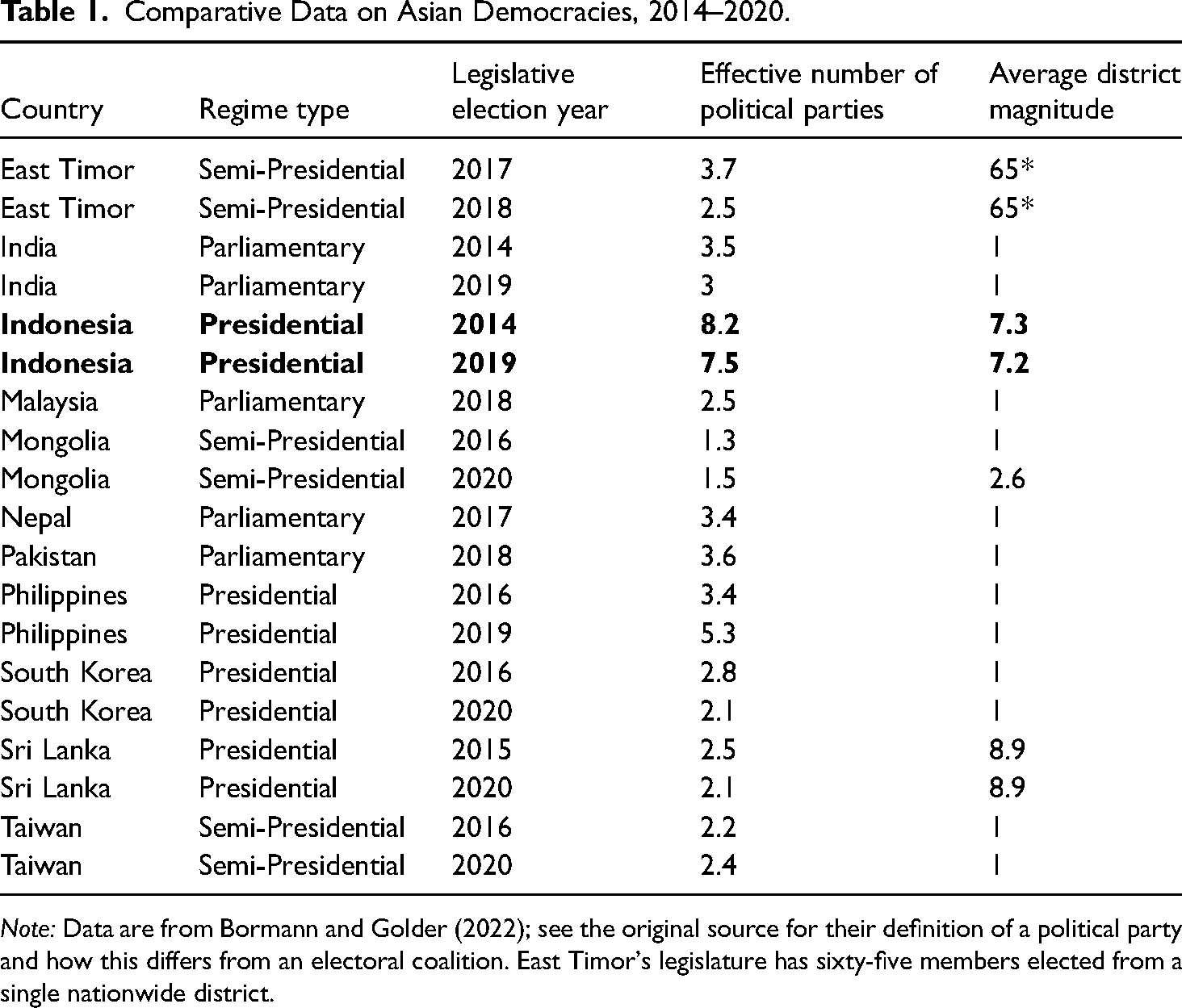
Note: Data are from Bormann and Golder (2022); see the original source for their definition of a political party and how this differs from an electoral coalition. East Timor's legislature has sixty-five members elected from a single nationwide district.
Indonesia has more electorally relevant political parties than any other contemporary Asian democracy, a consequence of its relatively high district magnitude. 1 This is particularly noteworthy when compared to other presidential systems: the Philippines, South Korea, and Taiwan each feature plurality elections and therefore far fewer parties, whereas Sri Lanka has an unusually low number of parties given its high district magnitude.
The Indonesian political literature has grappled with the relationship between presidentialism, multipartyism, and democracy since the reformasi era. To explain why Indonesian democracy has not collapsed, Hanan (2014) responds to Mainwaring (1993) by analysing the informal practices of coalition management among legislative parties and the president. He finds that norms of compromise and consensus-based policymaking, which have a long history in Indonesian politics, explain the stability of multiparty presidentialism. His analysis is also a partial response to Slater (2004), who highlights how Indonesia's power-sharing arrangements reduce executive accountability and dilute the effectiveness of legislative parties in representing distinct platforms and ideologies. Most recently, Mietzner (2023) has unified and extended these arguments by evaluating presidential coalition-management strategies in Indonesia's democratic era, describing a decline of the quality of democracy even as Indonesian democracy – in a minimalist or proceduralist sense – remains durable. Drawing on comparative research on multiparty presidential systems around the world (Chaisty et al., 2014), he characterises Indonesian democracy as an example of coalitional presidentialism. Indonesia's governing coalitions are distinctive among coalitional presidential systems in their tendency towards universal membership, which incentivises consensus-based decision-making within the coalition. Widodo's cabinets achieved near-universal membership through a mix of standard coalition-building coercive practices, but as the authors cited above note, the tendency towards oversized coalitions dates to the early days of reformasi democracy.
Although the scholars cited above differ in their interpretations of the quality of Indonesian democracy, they all agree on the basic facts about contemporary Indonesian democracy. Indonesia's democratic regime is stable, but its quality is declining. Indonesia's party system is complex, with no party commanding anything close to a majority of the seats in the legislature. Indonesia's governing coalitions are oversized, not minimum-winning, and this dilutes the ability of the legislature to constrain the president. And yet, at the same time, the sheer complexity of building and maintaining a governing coalition produces its own constraints on the president, resulting in supermajoritarianism rather than simple majoritarian presidentialism.
These facets of Indonesian democracy are precisely what would be expected from the comparative study of political regimes and electoral systems around the world. The fractionalisation of Indonesia's House of Representatives (Dewan Perwakilan Rakyat, DPR) follows from the use of proportional representation with multimember districts (Cox and Shugart, 1996; Taagepera and Shugart, 1989). 2 Around the world, cabinet coalitions are almost never minimum winning coalitions in countries with more than four electoral parties (Lijphart, 1999: 109–112), and oversized legislative coalitions predominate in party systems with a large number of legislative parties (Taagepera, 2002). As noted above, presidential regimes with more than five electoral parties are comparatively quite durable. Whatever the weaknesses of Indonesia's democracy in practice, its structure is about what we would expect if all we knew about Indonesia was that it is a presidential democracy whose legislature is elected under proportional representation with an average district magnitude of about 7: it is a durable multiparty democracy where presidents rule with oversized governing coalitions.
Social Cleavages and Electoral Politics
None of the spare, mechanical analysis of electoral rules and multiparty presidentialism can explain Indonesian politics in a satisfactory way. This is not just true of the practices of Indonesian presidential politics, as authors like Mietzner (2023) have documented. It is also true of the broader electoral environment. Political competition in democratic systems may be structured by electoral rules and regime institutions, but the content of politics in any country depends on the specific issues that animate voters, movement actors, elites, and political actors and social forces.
To illustrate how coalitional presidentialism structures democratic politics in Indonesia, I examine the relationship between electoral institutions and the social cleavages that animate Indonesian political and social life. Lipset and Rokkan (1967) pioneered the systematic comparative analysis of cleavage structures, explaining why patterns of democratic party competition remained relatively stable over time in advanced democracies with reference to a relatively limited set of core social divisions that found expression in the party system at the moment of franchise expansion. In the Indonesian context, a wide range of social divisions have been identified: aliran (abangan versus santri), religious identity (Islamist versus pluralist/nationalist), ethnicity (Javanese versus non-Javanese, pribumi versus non-pribumi), geography (urban versus rural, Java versus Outer Island), political (communist versus non-communist), and others. Although some of these have analogues in other democratic systems, others are particular to the Indonesian case, and it is their interaction that makes Indonesia unique. It makes little sense to try to relate these categorical distinctions to Lipset and Rokkan's typology of social cleavages, although the parallels are sometimes interesting: centre versus region, “dominant” versus “subject” culture, secular state versus religious establishment, capital versus workers. Although Lipset and Rokkan were interested in how political parties and mass organisational structures developed around these core social distinctions, in the Indonesian case it is more fruitful to see cleavages as long-standing axes of social difference that structure and animate political participation at the elite and mass levels.
Indonesia's parties do not map cleanly onto social cleavages, with the exception of the pluralist-Islamism cleavage (Fossati, 2022). One explanation for the gap between party organisations and social cleavages is the requirement that parties must register and compete across the archipelago, which eliminates the possibility of explicitly ethnic parties and compels Islam-based parties to seek common ground despite regional variations in religious practice. 3 Authors such as Ufen (2008, 2013) have studied how social cleavages have persisted across the decades, and have argued that the presidentialisation of politics helps to explain the relative decline of distinct programmatic politics among many of Indonesia's political parties in the post-Soeharto era. As Samuels and Shugart (2010) observe, presidentialised party systems tend to undermine partisanship even as parties remain the essential vehicles for office-seeking national politicians. And within those weaker parties, there are fewer constraints on party leaders. Parties must focus on presidential elections at the expense of legislative elections. After a president has been elected, the separation of presidential survival from parliamentary politics means that parties have few tools with which to restrain the executive.
The next section explores coalitional presidentialism through the case of Indonesia's 2024 elections. I first detail how presidentialism interacted with Indonesia's cleavage structure to produce a victory for Prabowo, who had twice previously run a campaign that appealed to Islamists but was able to win a commanding victory as a centrist, pluralist candidate. From there, I show how presidentialism structures party competition Indonesia's legislative elections, interacting with district magnitude and local social structure to produce partisan fragmentation.
Cleavages and the 2024 Elections
The 2024 presidential election was a three-cornered race pitting two-time losing presidential candidate and incumbent Minister of Defense Prabowo Subianto against former Jakarta Governor Anies Baswedan and former Central Java Governor Ganjar Pranowo. The details of the nomination and campaign process (Kimura and Anugrah, 2024) are of independent interest, for three reasons. First, Prabowo's campaign received a massive boost from the endorsement of outgoing president Joko Widodo, whose endorsement catapulted him to the position of front-runner. Second, Prabowo chose Widodo's son Gibran Rakabuming Raka as his running mate, leading to a constitutional crisis that culminated in the censure of Chief Justice Anwar Usman, also Widodo's brother-in-law, for having issued a controversial ruling that allowed Gibran to run even though he had not reached the minimum age stipulated under Indonesia's constitution. Third, these developments played out against the background of the breakdown of relations between Widodo and Megawati Sukarnoputri, leader of the People's Democratic Party of Struggle (PDI-P). Widodo was elected president twice while running on the PDI-P ticket, and PDI-P has been the largest party in the DPR since 2014.
Legislative elections took place at the same as the presidential election, with eighteen national parties competing for seats in the DPR. As is customary, parties threw their support behind one of the three presidential tickets. Most notably among the larger parties, PDI-P supported Ganjar, whereas Golkar joined Gerindra in supporting Prabowo (Gerindra's founder and patron) together with the Democrat Party and PAN, a smaller Islamic party. NasDem and two Islamic parties, PKB and PKS, supported Anies. Aside from PDI-P, all other non-Islamic parties espouse a vague nationalist and developmentalist platform. Comparing the three presidential tickets, the most notable difference in endorsements lies in the role of Islamic parties: absent among Ganjar supporters, relatively minor among Prabowo supporters, and more notable among Anies supporters.
Cleavage Politics in the Presidential Election
Because Prabowo ran twice previously, it is instructive to compare his performance across multiple elections. Figure 1 compares the district-level vote share for Prabowo and Gibran in 2024 with support for Prabowo and running mate Sandiaga Uno in 2019.
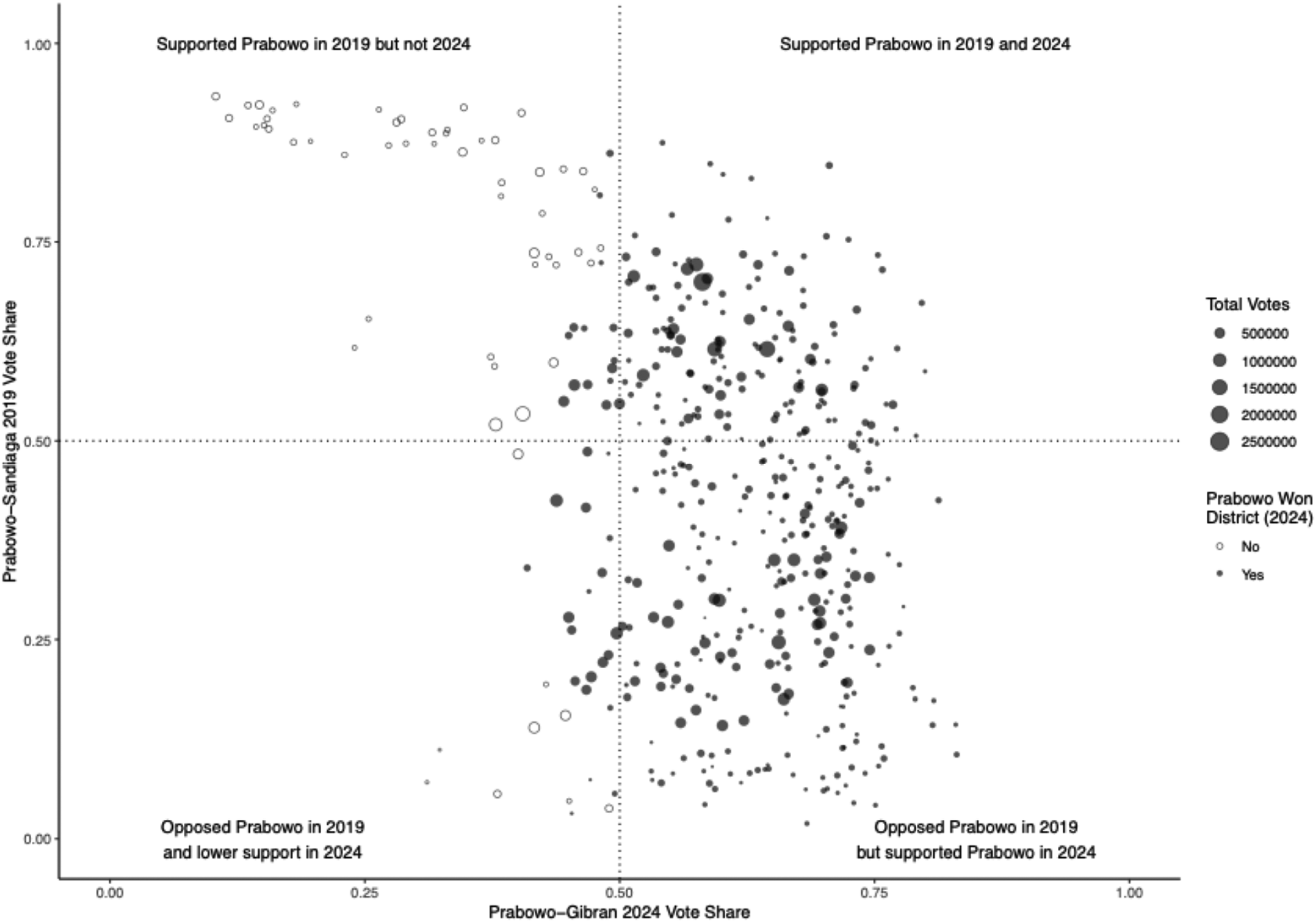
Comparing support for Prabowo, 2019 and 2024.
Two observations immediately stand out. First, the general shift to the right reflects the growth in support for Prabowo between 2019 and 2024. Second, there is a negative correlation between support for Prabowo in 2019 and Prabowo in 2024, meaning that districts in which Prabowo performed well in 2019 tend to be those in which he performed poorly in 2024. Of course, this is only a general statistical association, as Prabowo did win a significant number of districts in both elections. Those are the filled circles in the upper right-hand quadrant. But more points lie on the diagonal: these are districts that supported Prabowo in 2019 but not in 2024 (upper left) and districts that opposed Prabowo in 2019 but supported him in 2024 (lower right). How to make sense of these patterns?
Supplemental appendix Table A1 shows that the vote swing towards Prabowo was largest in rural, ethnically heterogeneous, and Muslim-majority districts (although this last finding masks important variation, as described below). These results are the product of the interaction of Indonesia's cleavage structure and its presidential system of government. Presidentialism encourages ideological and/or partisan sorting along a single dimension that most efficiently channels the electorate's preferences into votes. In Indonesia, at both the elite and mass levels, this dimension corresponds to the Islam versus nationalist/pluralist cleavage. In 2014 and especially in 2019, Prabowo ran against Widodo, whose governance style as Solo mayor and Jakarta governor – and endorsement by PDI-P – aligned him with a pluralist constituency. As a result, Prabowo's campaign sought support among the most efficient opposition: Islamists and Muslim identitarians. In 2024, not only did Widodo's endorsement of Prabowo confer pluralist legitimacy on a politician who had previously been identified with an Islamist constituency, it opened space for an Islamist challenge, filled by Anies. At the same time, Widodo's break with PDI-P meant that the country's largest legislative party nominated its own candidate, Ganjar, in an effort to gain the pluralist and nationalist votes upon which Widodo had previously been elected. Widodo's endorsement of Prabowo thus split the pluralist-nationalist coalition that had supported Widodo in the previous two elections.
Of course, other cleavages have long been relevant for Indonesian politics too. To make sense of these, we can look towards Indonesia's ethnic and religious geography. Figure 2 places the 2024 presidential election results on a map which portrays the three-way distribution of election results. Blue represents districts that voted strongly for Prabowo, green for Anies, and red for Ganjar, with intermediate colours representing results that were more mixed. The ternary plot to the right shows the distribution of votes among the three candidates.
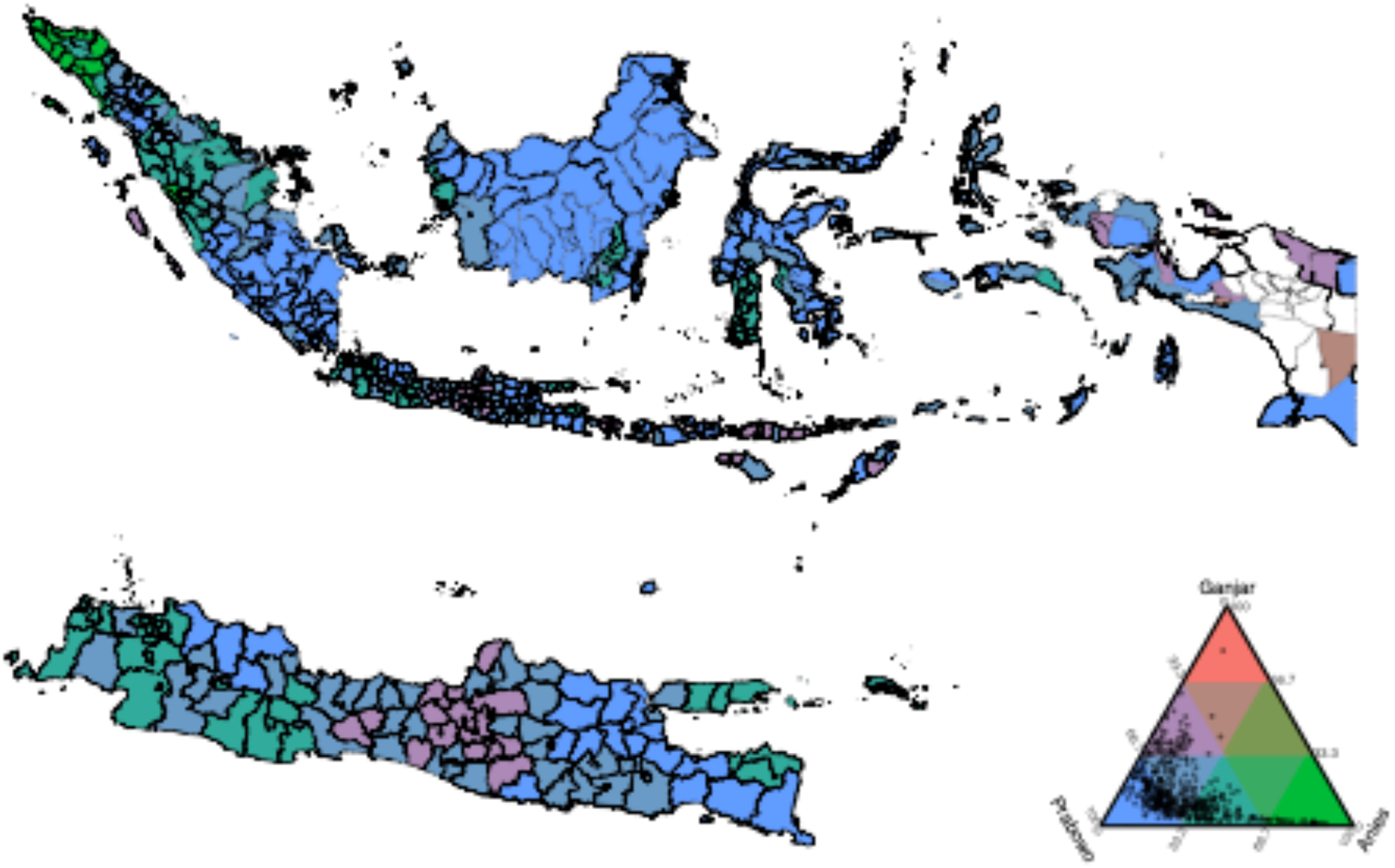
Visualising the 2024 election results.
These results reveal, first, that Anies was the stronger challenger, consistent with the hypothesis that the primary electoral cleavage in presidential elections is between Islam and pluralism (Fossati, 2022; Fossati et al., 2020). Ganjar was a less effective challenger because he ran a pluralist challenge to Prabowo, who was already running on a pluralist platform. Secondly, there are no districts in which the two leading candidates were Ganjar and Anies, suggesting that pluralist voters coordinated on Prabowo in cases where the main cleavage within a district is between Islamists and pluralists. Looking at the map itself, green colours are most common in Aceh and West Sumatra, West Java and Banten, and certain districts in Kalimantan and Sulawesi that are known as strongholds of political Islam, dating at least to the period of the Darul Islam rebellion (Formichi, 2012; van Dijk, 1981). Purple colours correspond to districts where Ganjar and Prabowo were the main two candidates, and tend to appear in Central Java, East Nusa Tenggara, and Papua.
To shed further light on the importance of the Islam versus pluralism cleavage, Figure 3 plots the data in Figure 1, this time breaking out the results by province (arranged from east to west) and by the district's Muslim population share in the 2010 census (Minnesota Population Center, 2020).
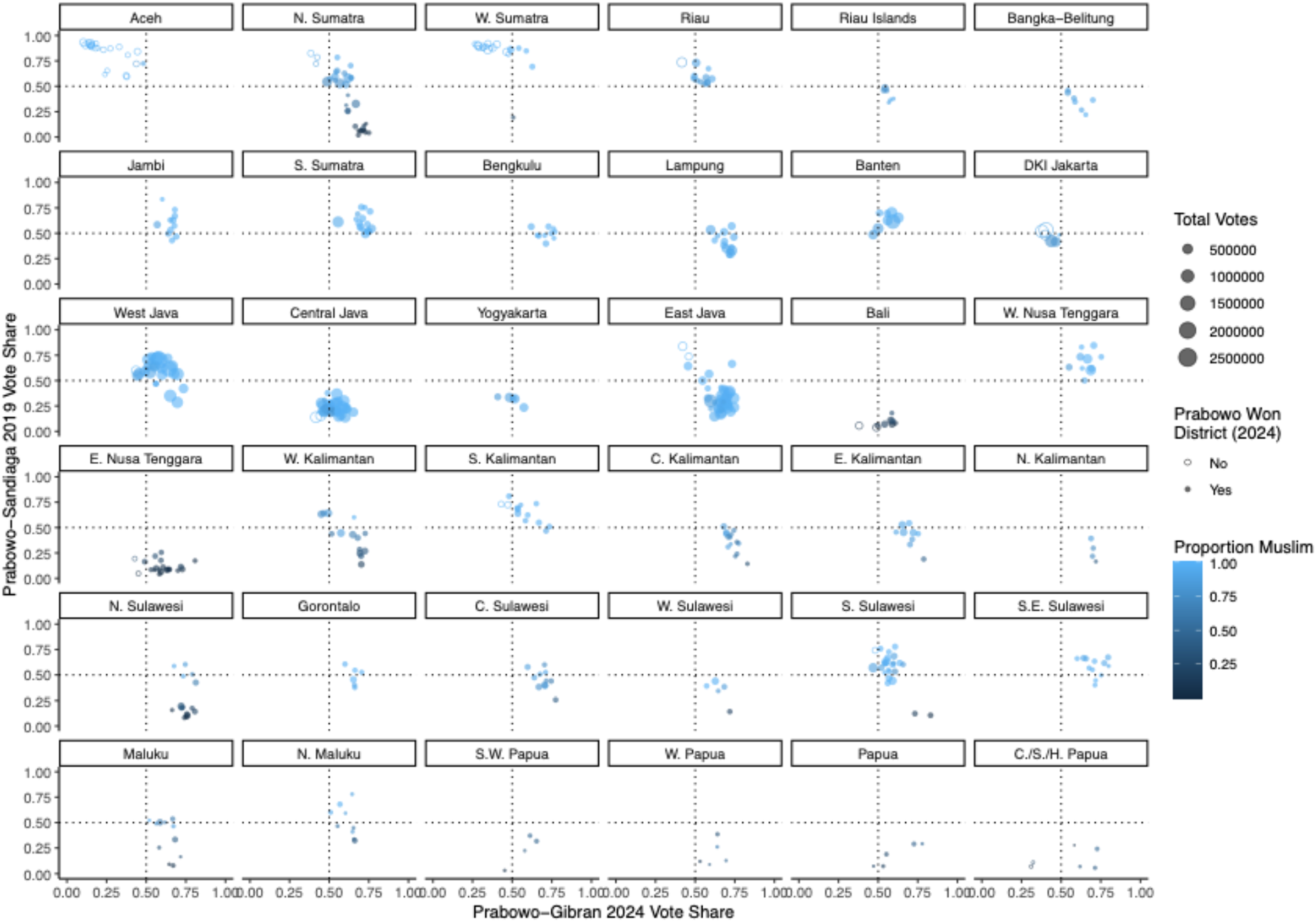
Comparing 2019 and 2024, by province and muslim population share.
We learn that the districts that swung away from Prabowo between 2019 and 2024 tend to be those with large Muslim population shares in Aceh, North Sumatra, West Sumatra, and a few remaining districts in other provinces. These are regions that are known for their history of Islamic conservatism. Prabowo fared well in these regions in 2014 and 2019 when he ran on a more Islamist platform, but he lost support to Anies in 2024.
Large swings towards Prabowo come from two district sources. First, they appear in the majority of non-Muslim districts in North Sumatra, Bali, East Nusa Tenggara, North Sulawesi, Maluku, and Papua. Second, they come from majority Muslim districts in Java. This explains the overall positive relationship between the Prabowo 2024 vote swing and Muslim population share in Table A1. Supplemental Appendix Table A2 and Figure A1 allow the relationship between Muslim population share and Prabowo 2024 vote swing to vary by province using a multilevel model with random slopes and intercepts (Arel-Bundock et al., 2024). Consistent with Figures 2 and 3, the swing towards Prabowo in 2024 is driven by Muslims in Java, Bali, the Moluccas, and Papua. Muslim-majority districts in Aceh and North Sumatra swung away from Prabowo in 2024.
Taken together, and noting that non-Muslims as religious minorities tend to be pluralist nationalists, these findings suggest that Indonesia's Islam versus pluralism cleavage explains the shift in votes for a president whose social basis changed between 2019 and 2024. But why did Muslim-majority districts in Central and East Java swing towards Prabowo, and why did districts in Banten, West Java, and South Sulawesi that had previously supported Prabowo remain loyal to him in 2024? The answer lies in the residual role of ethnicity, specifically a secondary Javanese/non-Javanese cleavage. Figure 4 selects all provinces whose population is at least 90 per cent Muslim, with colours now capturing the Javanese population share (Minnesota Population Center, 2020) and the x-axis now representing Ganjar's 2024 vote share rather than Prabowo's.
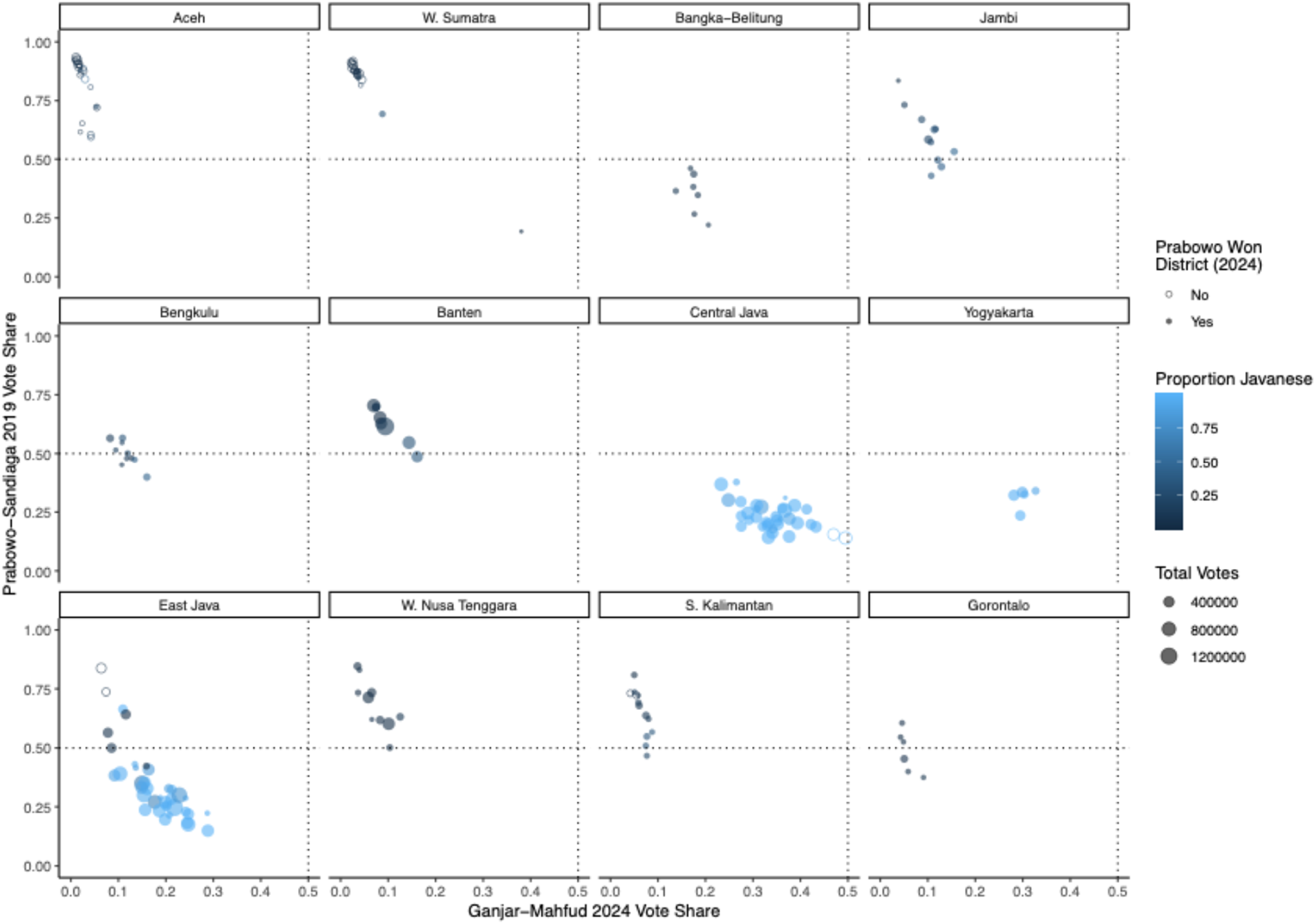
Swings towards Ganjar, by province and javanese population share.
Points further to the right are where Ganjar performed best in 2024. The vote swings here reveal that Ganjar was most successful in districts with large Javanese majorities and that these tend to be places where Prabowo had been unsuccessful in 2019 (this explains the overall negative correlation between Javanese population share and Prabowo's vote swing in 2024 in Table A1). Ganjar was least successful in the majority of non-Javanese districts where Prabowo had always been successful.
A final piece of evidence in favour of the structuring role of presidential elections is the results for Ganjar. If religion is the dominant cleavage and Ganjar and Prabowo's campaigns both appealed to pluralist and nationalist votes, then it should follow that Ganjar voters should be more likely to strategically vote for Prabowo when they do not believe that Ganjar is competitive, even if they prefer Ganjar to Prabowo, as such voters prefer both to Anies. This would be visible in the district-level vote returns: we should see pooling away from Ganjar in those districts where he is the least popular candidate. Duverger's Law applies properly to parliamentary elections at the level of the constituency, not to presidential elections at the level of the district, but as districts are themselves meaningful political units in Indonesia it may follow that Ganjar's local support level is a useful indicator of the local political environment. Cox (1997: 86–88) proposes that comparing the vote totals for the first versus second runner-up – in this case, the second and third place finishers – will reveal evidence of strategic voting. Figure 5 plots the ratio of second-place to third-place votes for all districts in which either Ganjar or Anies came in third place.
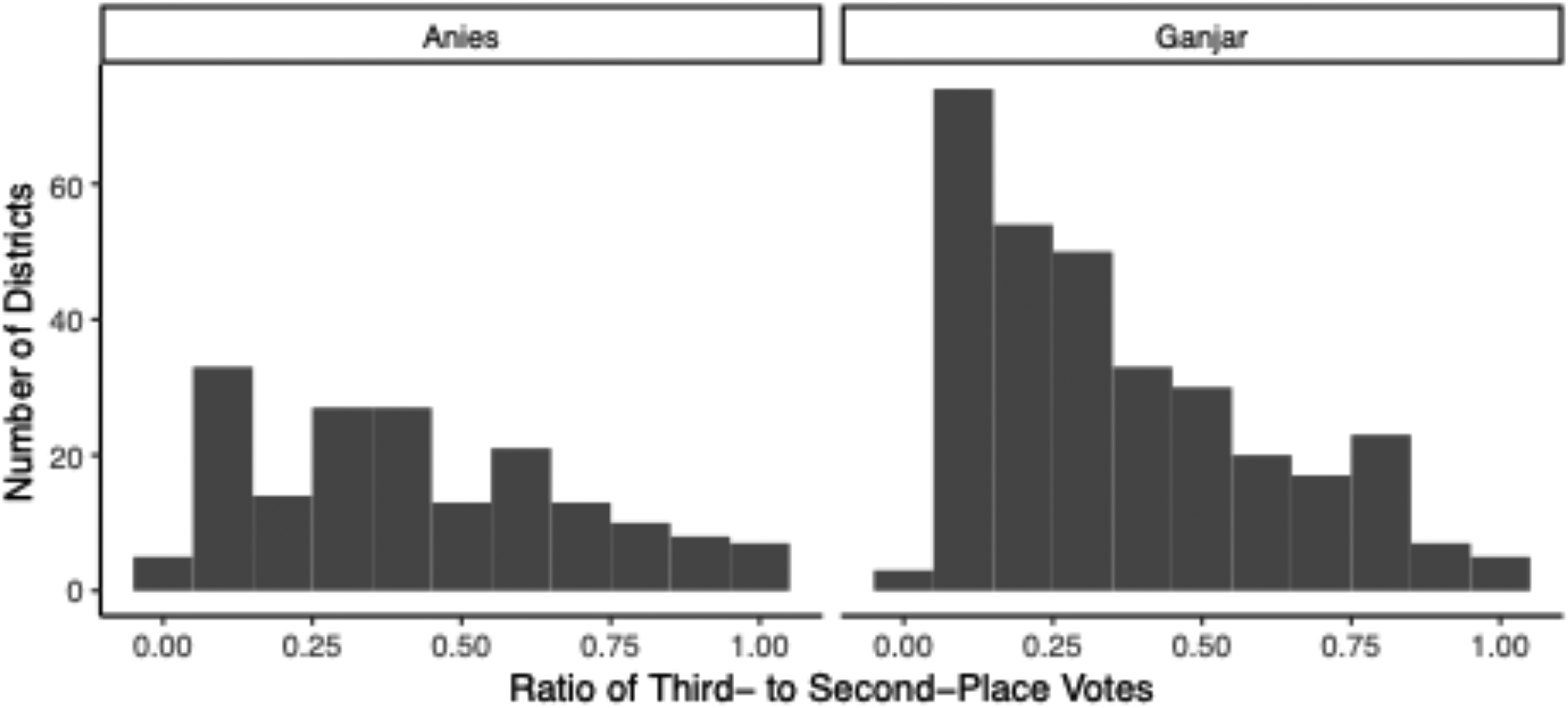
Coordination away from third-place finishers.
These results are consistent with expectations, with most districts that Ganjar lost featuring a significant gap between the second-place and third-place results (so ratios are close to zero). The spread in last-two vote shares is more equal for Anies because his voters were less likely to shift votes to one of the other two candidates than were Ganjar's supporters.
Taken together, these results reveal a dominant Islam-pluralism cleavage within Indonesian presidential elections. They are consistent with existing perspectives on the role of Islam in Indonesian political life. Because this cleavage is dominant, in a winner-take-all presidential election a politician like Prabowo who runs from the centre faces a stronger challenge from campaigns appealing to Islamist constituencies than from campaigns appealing to ethnic or other nationalist constituencies. From the perspective of the Indonesian electorate, Ganjar's campaign was limited by the simple fact that Widodo's endorsement of Prabowo bestowed upon the latter an electoral advantage among pluralist constituencies. Ganjar could only be competitive among voters who rejected Islamism entirely, and because the religious cleavage dominates Indonesian electoral politics, it consigned him to a minority position among pluralists, with most of his electoral success found in majority Javanese districts.
Cleavage Politics in Legislative Elections
Indonesian presidential elections, like all presidential elections, have an effective district magnitude of 1. As discussed previously, DPR elections have an average district magnitude of over 7. This means that many more parties should be competitive. Cox (1997) argues that strategic voting at the constituency level disappears above a district magnitude of 5, a consequence of the sheer complexity of voter and candidate coordination at that scale. But we may still find evidence of both the presidentialisation of party competition and of the independent role of electoral rules in Indonesia's diverse local electoral landscape.
Table 2 lists the party of the top vote recipient – defined as votes for the party or for the candidate – in each electoral district (daerah pilihan, or dapil) for the national-level DPR elections, broken down by the top presidential vote recipient in that electoral district. Cleavage politics appears in these results. In electoral districts in which Anies performed best, the top party tended to be a Muslim party (in particular PKS). PDI-P and other non-Muslim parties were relatively more likely to prevail in districts where Prabowo performed best. Ganjar was not the top presidential candidate in any dapil.
Largest DPR Share by Top Presidential Candidate.
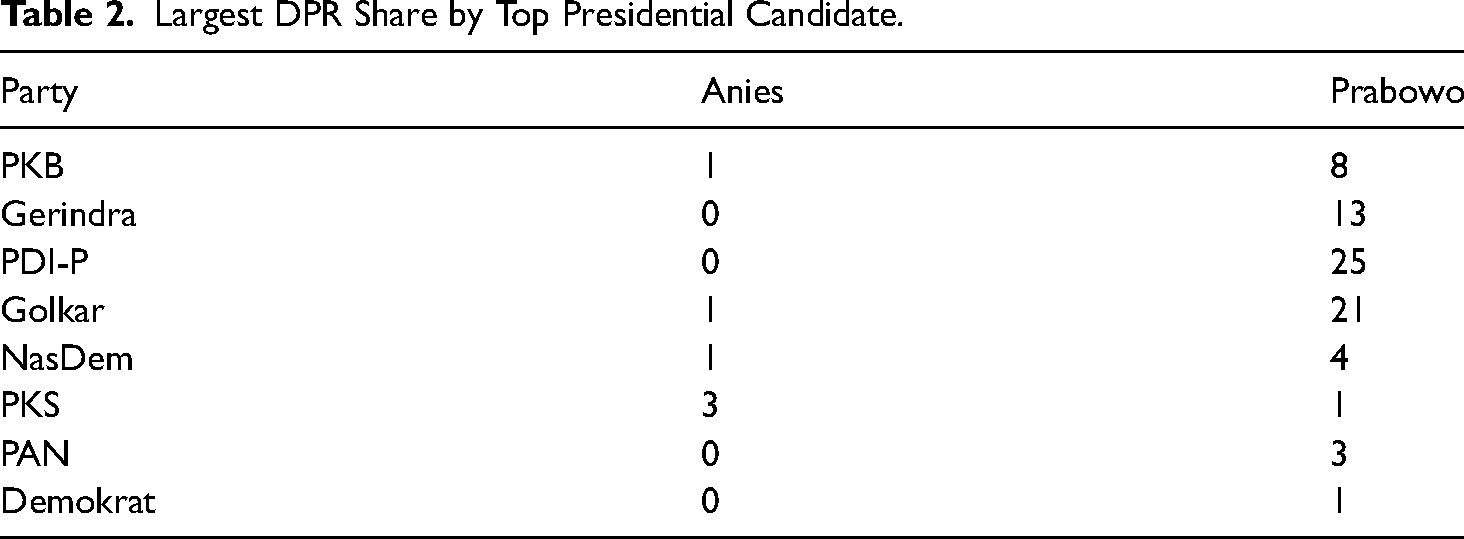
Even though Prabowo was the top presidential candidate in the overwhelming majority of electoral districts, he was relatively more likely to be the top performer in those districts in which non-Muslim parties were the top vote performers (e.g., PDI-P, Gerindra, and Golkar).
For evidence of how presidentialism structures party competition in DPR elections, we can look at district-level variation in how many parties were electorally competitive. To do so, I calculate the effective number of parties (ENP) in DPR elections by district, measured by each party's share of the total number of votes cast in a district (Laakso and Taagepera, 1979). 4 To see how a generalised Duverger's law fares in these elections, Figure 6 compares district-level ENP and the electoral district magnitude for each province (recall that each electoral district [daerah pilihan] comprises several districts [kabupaten and kota]). To represent the influence of social cleavages, it also compares ENP with a measure of ethnic fractionalisation within each district (Alesina et al., 2003). 5
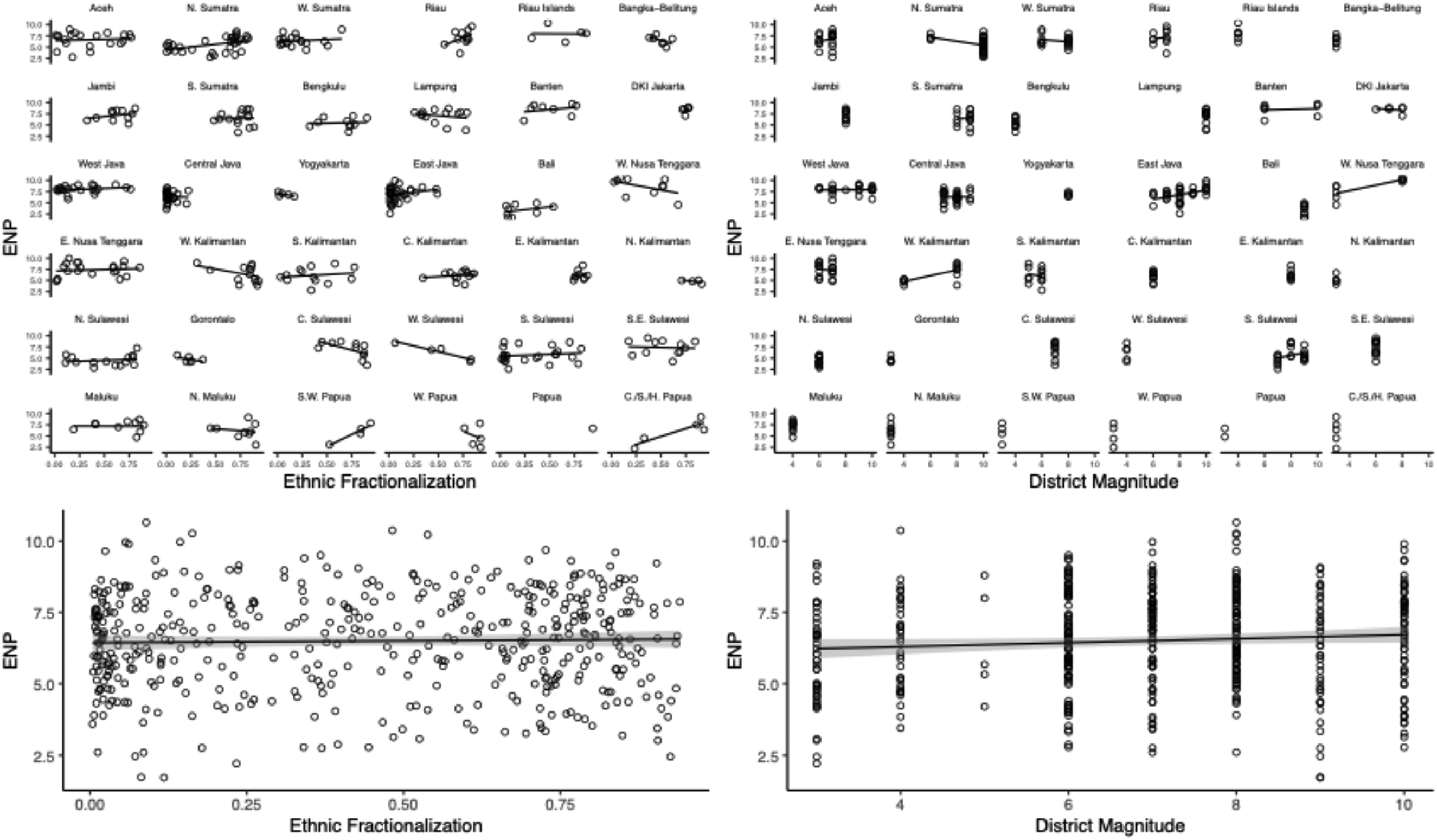
Ethnic fractionalisation, district magnitude, and the number of parties.
There is, overall, no relationship between ethnic fractionalisation and the number of parties, and only a weak relationship between district magnitude and the number of parties. But those results mask substantial differences across provinces, which suggests that once we account for provincial differences in the sociopolitical environment, social structure may matter once again.
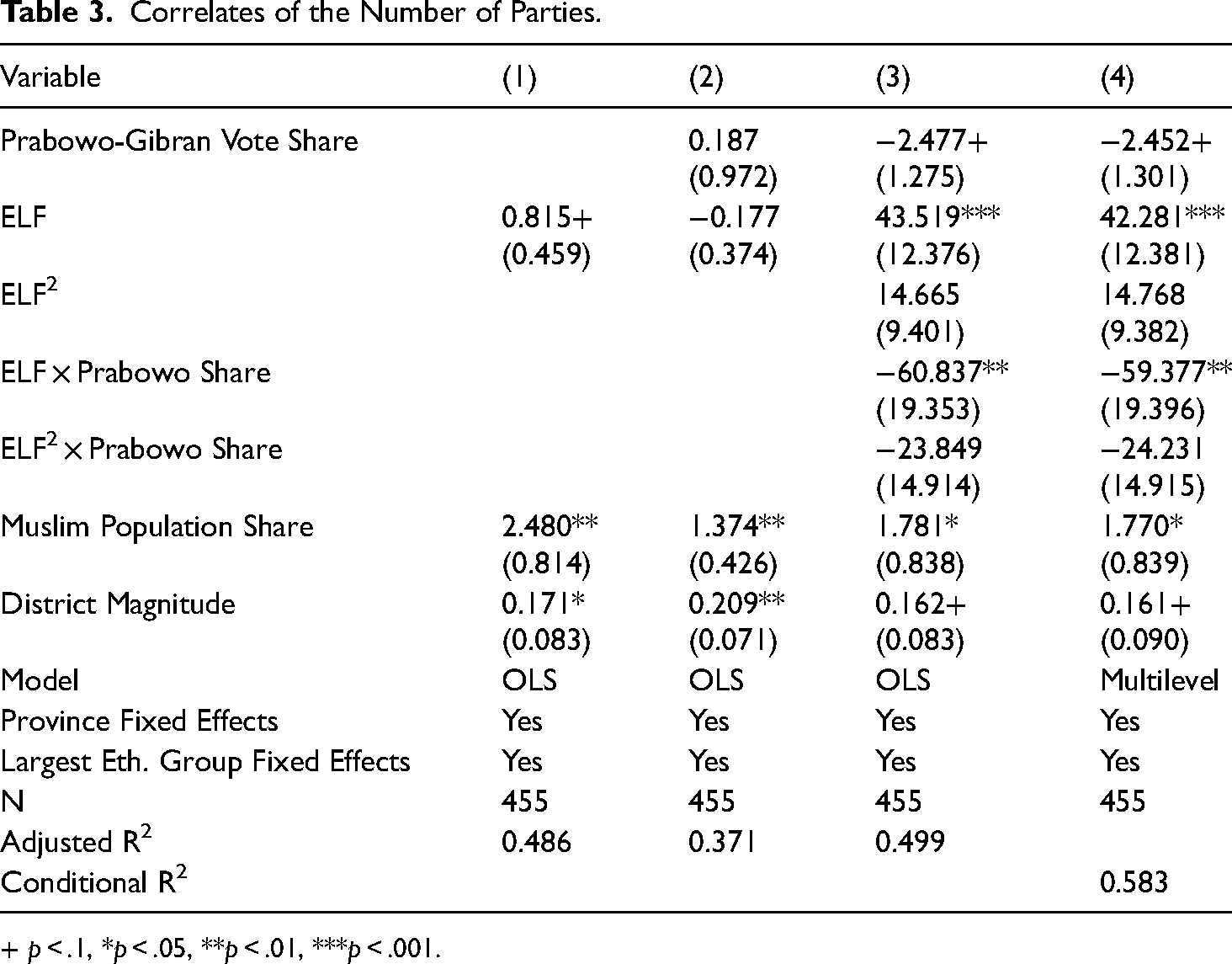
To examine these factors more systematically, Table 3 contains the results of several statistical models that examine the correlates of ENP in the DPR election, across districts. To adjust for confounding factors, all models include fixed effects for the province and the largest ethnic group in a district (Acehnese, Balinese, Javanese, etc.). Model (4) adds random effects at the level of the electoral district.
Correlates of the Number of Parties.
+ p < .1, *p < .05, **p < .01, ***p < .001.
As expected, district magnitude is positively correlated with the number of parties. The same is true of Muslim population share, which might be a consequence of multiple parties competing for Muslim votes in heavily Muslim districts.
Of particular interest are results for ethnic fractionalisation, whose correlation with the number of parties becomes more notable when interacting with Prabowo's vote share in the district. To illustrate these results better, Figure 7 plots the predicted number of parties across levels of ethnic fractionalisation and Prabowo vote share, using the values from Model (3) in Table 3.
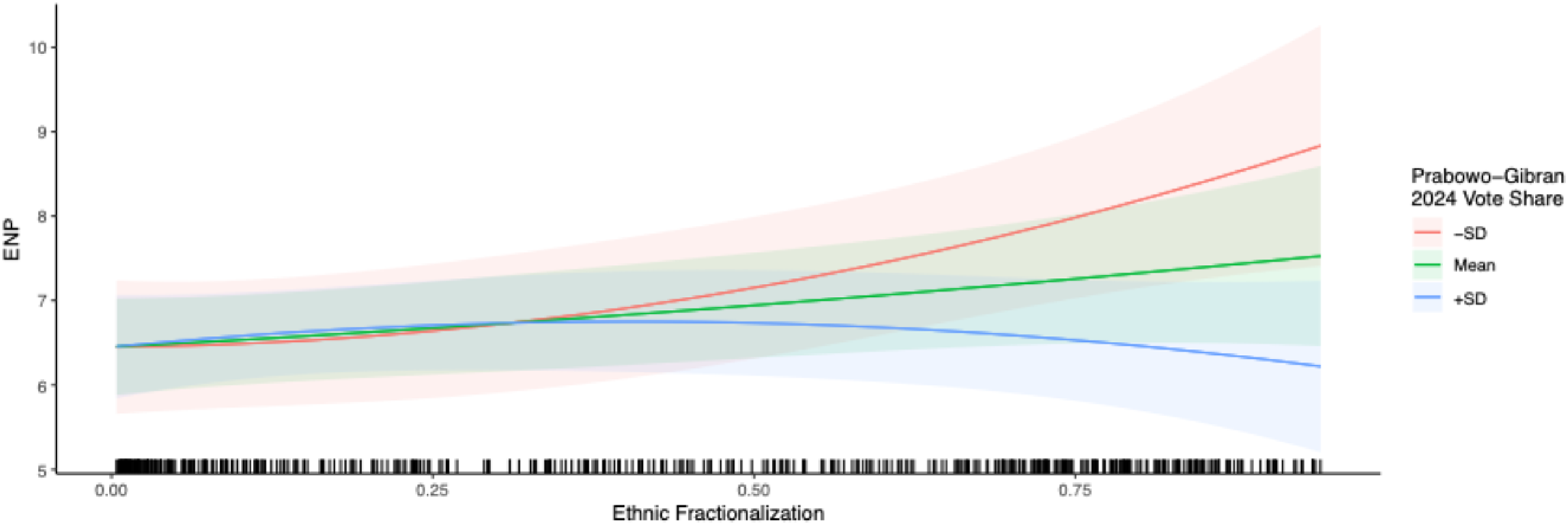
Fractionalisation, presidential vote share, and the number of parties.
Where Prabowo's support is highest (blue line and shaded area) there is no relationship between fractionalisation and the number of parties. Where it is the lowest (red line and shaded area), higher levels of ethnic fractionalisation correspond to a larger number of parties.
This is further evidence of how coalitional presidentialism shapes Indonesian democracy. Across the archipelago, higher district magnitudes correspond to higher numbers of parties, consistent with expectations from the literature on comparative political institutions. Ethnic diversity also corresponds to more parties – but presidentialism mutes this effect in those districts where the winning presidential candidate is most popular.
Indonesia's Coalitional Presidentialism in Comparative Perspective
This essay has used the comparative literature on political institutions to understand the results of Indonesia's 2024 elections. Indonesian democracy has evolved towards a model of democracy whose specific manifestation reflects Indonesia's socioeconomic profile but whose general contours can be predicted from the literature on comparative electoral systems. The hallmark of Indonesian democracy is a consensual form of coalitional presidentialism, which is the consequence of Indonesia's combination of presidentialism and high-magnitude proportional representation. Indonesian electoral politics functions as expected given those rules. Ethnic and religious diversity with high-magnitude proportional representation produces a diverse array of legislative parties, none of which dominate. Presidentialism makes the legislature relatively weak, but to be elected president, candidates must assemble broad electoral coalitions, and to govern, they must assemble grand legislative and cabinet coalitions.
The main empirical contribution of this manuscript is to show how electoral rules and social structure interacted to shape the results of the 2024 election. But perspective taken in this manuscript has broader implications for understanding politics beyond elections. A focus on electoral rules and presidential politics treats large governing coalitions not as pathological manifestations of party cartels – the favoured interpretation of Slater (2004, 2018) – but rather as oversized coalitions similar to those found in other democracies with a large number of small legislative parties. This approach also contrasts with explanations of consensual politics that draw on Indonesia's political culture, either in its manifestation as Javanese norms of reciprocity and mutuality such as gotong royong (Bowen, 1986; Suwignyo, 2019) or in a more generic model of Pancasila which stipulates the essential role of consensus and deliberation (permusyawaratan) in governance and decision-making (Iskandar, 2016; Weatherbee, 1985). Finally, coalitional presidentialism foregrounds electoral institutions instead of material wealth or capital structure, as captured by various approaches to oligarchy, whether elaborated in response to Indonesian democratisation (Robison and Hadiz, 2004) or theorised in more general terms (see also Ford and Pepinsky, 2014; Winters, 2011). There is no reason to argue that culture is irrelevant to Indonesian politics, and Indonesia's political elites obviously exploit electoral incentives and massive material resource advantages to direct policy in their favour. But focusing on the interaction of electoral rules and social structure alone illustrates why Indonesia's coalitions are so large and the dominance of the president over the legislature.
Although a comprehensive analysis of legislative and cabinet coalitions is beyond the scope of this manuscript, focusing on the institutional features of Indonesia's political system suggests that important features of Indonesian politics under democracy – such as the collaborative relationships among the country's oligarchs, the weakness of programmatic politics, and cultural practices of deference to authority and appeals to consensus – can be understood as consequences of Indonesia's political structure. A useful question is whether the architects of Indonesian democracy, from the Indonesian Revolution of 1945 through reformasi, constructed these rules with a full understanding of the implications. One might hypothesise that high-magnitude proportional representation and a presidential form of government were chosen in order to comport with the need for stability of a diverse society or to suit the need for wealth defence in a highly unequal new democracy. Such debates about the endogeneity of democratic institutions to social and economic structures are prominent in comparative European politics (see e.g., Ahmed, 2010; Cusack et al., 2007), and might be extended to the Indonesian case as well. Perhaps coalitional presidentialism is the only stable model of democracy that can be implemented in Indonesia given its sociopolitical conditions. Or, perhaps coalitional presidentialism is the arrangement desired by a powerful economic elite seeking to free itself from the constraints of majoritarian institutions. Work by Horowitz (2012) holds that reformasi involved a deliberate process of constitutional engineering, and Reilly (2007) describes centripetalism as the product of incentives to create stable systems in democratising Asia. These arguments may be extended with new data and a more historical perspective on the revolutionary constitution of 1945.
None of these conclusions should ignore that the quality of Indonesian democracy is declining. Coalitional presidentialism in Indonesia may be predictable, but it is not benign. Much like the critique of the concept of consociationalism as an alternative to winner-take-all presidentialism, which noted the risks of authoritarian centralisation of power-sharing institutions and the role of informal norms in safeguarding the democratic quality of such systems (Lustick, 1979), coalitional presidentialism is obviously vulnerable to authoritarian control. Pereira and Melo (2012: 159) have identified “institutionalised and effective checks on presidential actions” as a central prerequisite for democratic stability under coalitional presidentialism. A dictator ruling Indonesia would use the language of consensus to explain why liberal or winner-take-all democracy is inappropriate for Indonesian society, much as Sukarno and Soeharto once did. Mietzner (2023) has argued persuasively that the practices of coalitional presidentialism have directly undermined the quality of Indonesian democracy, cataloguing the mechanism through which Widodo undermined institutional checks on his authority. Indonesia's version of multiparty coalitional presidentialism exhibits some of the pathologies found in another prominent case of coalitional presidentialism – contemporary Brazil – where pork-barrel politics and official corruption have been necessary to hold together oversized coalitions under presidentialism (see Mello and Spektor, 2018).
Outgoing president Widodo leveraged his massive popularity to bend legal institutions to his will, defending pluralism and developmentalism at the expense of liberalism and competition. And now, Indonesia's president is Prabowo Subianto. The risks are serious. Defending Indonesia's version of coalitional presidentialism as a model for democratic politics requires upholding norms of deference and forbearance (Levitsky and Ziblatt, 2018; Riedl et al., 2025), the rule of law, and judicial autonomy. These cannot be engineered through institutions, they can only be achieved through politics.
Supplemental Material
sj-docx-1-saa-10.1177_18681034251349467 - Supplemental material for Cleavages, Institutions, and Democracy in Indonesia: The 2024 Elections in Comparative Perspective
Supplemental material, sj-docx-1-saa-10.1177_18681034251349467 for Cleavages, Institutions, and Democracy in Indonesia: The 2024 Elections in Comparative Perspective by Thomas B. Pepinsky in Journal of Current Southeast Asian Affairs
Footnotes
Acknowledgement
The author thanks participants at the workshop on The State of Indonesian Democracy and two anonymous referees for helpful comments and feedback. He is responsible for all errors.
Data availability
All replication data are available at https://doi.org/10.7910/DVN/BJTLGP.
Declaration of Conflicting Interests
The author declared no potential conflicts of interest with respect to the research, authorship, and/or publication of this article.
Funding
The author received no financial support for the research, authorship, and/or publication of this article.

Supplemental Material
Supplemental material for this article is available online.
Notes
Author Biography
References
Supplementary Material
Please find the following supplemental material available below.
For Open Access articles published under a Creative Commons License, all supplemental material carries the same license as the article it is associated with.
For non-Open Access articles published, all supplemental material carries a non-exclusive license, and permission requests for re-use of supplemental material or any part of supplemental material shall be sent directly to the copyright owner as specified in the copyright notice associated with the article.
