




Abstract
Observers proclaimed Malaysia's first-ever transfer of federal power through elections in 2018 as marking a democratic transition, only to see in the reversal of that change two years later evidence of backsliding. I argue instead that these concepts lack nuance: we should not read too much into a change of leadership. At best, the electoral-authoritarian regime wobbled; it neither transitioned convincingly in 2018 nor qualified as backsliding per se in 2020. That said, the regime has been edging toward liberalization, but less in the electoral sphere than in civil society and prevailing norms.
Keywords
In the pantheon of would-be democratizers, Malaysia presents a tantalizing case. Over the course of elections since 2008, opposition parties made steady headway toward upsetting the coalition in power since before independence, the Barisan Nasional (BN, National Front). A new coalition, Pakatan Harapan (Alliance of Hope), finally wrested control of the federal government and the majority of state governments in May 2018. Pakatan promised a host of reforms; it had made headway on some of them before a surge of defections and an apparent palace coup returned the BN, with new partners, to power less than two years later. For observers who touted Malaysia's liberalizing moment or “transition” in 2018 1 —the counterpoint to a regional panorama of eroding democracies—this turn was surely evidence of backsliding.
Here, I propose an alternative view, from two directions. First, I suggest that the crux of Malaysia's competitive electoral authoritarian regime had not changed enough to mark a transition as of 2018. The 2020 change in leadership was thus certainly a reversal of fortunes, but less backsliding than standing pat in an illiberal niche. Second, I will suggest that inasmuch as Malaysia's regime has changed, it continues to edge, on balance, in the direction of political liberalism. The place to look for those shifts is less parliament and executive leadership than in civil society and political norms—a political-cultural or cognitive dimension outside the electoral politics commonly taken as the bedrock of “democracy.” Taking these two claims together, the persistently hybrid Malaysian case demonstrates well the gap between democratic transition and liberalization, highlighting the variation in pace and even direction of change possible across political dimensions, as well as the limitations of our common language for these fraught and often unstable processes.
Democratization and its reversal
Before we turn to Malaysia and the political ambiguity it illustrates, it will help to explore how political scientists typically understand and assess democratization and its reversal. Much of the literature on backsliding in particular—a term increasingly in vogue since the 1990s, referring broadly to “state-led debilitation or elimination of any of the political institutions that sustain an existing democracy” (Bermeo, 2016: 5)—remains fairly “inchoate” and inconsistent (Waldner and Lust, 2018: 94–95). Part of the challenge in evaluating Malaysia, I argue, reflects this broader conceptual muddiness.
At least since Huntington (1991) identified his triptych of waves, scholars have been preoccupied with democratization. Of greatest relevance here is the third wave, spanning roughly 30 years from the mid-1970s through the mid-2000s, and following upon a “reverse wave” that started around 1960, as postcolonial states retreated from democratic institutions. Democracy itself is a slippery target. Concedes Diamond (2015: 142), “It is one of the great and probably inescapable ironies of scholarly research that the boom in comparative democratic studies has been accompanied by significant disagreement over how to define and measure democracy.” Unsurprisingly, measures, indicators, and cut-off points for democratization vary, too, not least given the known gap between transition and consolidation. Levitsky and Way (2015: 48–49), for instance, critique “excessively optimistic” early post-cold-war interpretations of authoritarian-regime hiccups as democratization.
In “substantive” terms, consolidation refers to how closely the regime approaches “robust political competition, vibrant civil society, and widespread acceptance of key democratic tenets among the public and the elites”; in “prospective” terms, how durable a democracy is likely to be, assessed by persistence over time and turnovers of power (Svolik, 2015: 715–716). Svolik (2015: 717) identifies “a large, durable, and statistically significant decline in the risk of authoritarian reversals”—consolidation—at the 17–20-year mark. However tautological, then, democracies that endure are enduring. Unsurprisingly tangled, too, is democratic resilience, or “the ability to prevent substantial regression in the quality of democratic institutions and practices,” either in staving off autocratization or regrouping to resist once it has begun (Boese et al., 2021: 886).
Some regimes now classified as regressing may never have really qualified as democracies in the first place. Diamond (2015: 141–142) bemoans the shrinking tally of democracies, compared with swelling ranks from 1975–2007, even while acknowledging that some of that number “were quite illiberal.” It is beyond the scope of this article even to attempt to clear up this definitional muddle, but it usefully prefaces both the ambiguity in conceptualizing backsliding that Malaysia's experience illustrates, and the utility of intensive small-N qualitative approaches for probing nuances that large-N quantitative work may miss.
Measuring backsliding
The literature converges on defining democratic regression or (used synonymously 2 ) democratic backsliding or autocratization as, essentially: “substantial decline in the democratic quality of political institutions [and] processes in a given democracy” (Croissant and Haynes, 2021: 2). Recent scholarship identifies a prolonged, if staggered, global wave of autocratization since around the mid-1990s. As Mori and Kasuya note (2020: 3), that category subsumes three phenomena: backsliding in already-democracies toward autocracy, without crossing a tipping point (see Waldner and Lust, 2018); change of status from democracy to autocracy (see Svolik, 2015); and reconsolidation or deepening of authoritarianism (see Diamond, 2015, Levitsky and Way, 2015). Accounts diverge on the severity of an apparent trend toward fewer democracies, liberal or otherwise (for a summation, see Levitsky and Way, 2015: 45–46), nor is there consensus that what shifts have occurred have been somehow connected (though on Asia as a region, see Croissant and Haynes, 2021). 3 That we should generally not read too much into the coincidence of shifts is all the more apparent with disaggregation: Mori and Kasuya (2020) find starkly divergent component autocratization processes across states, suggesting both vacillation rather than an all-out plunge across indicators, and likely distinct causal paths toward equifinality in outcomes. We return below to this experience of (il)liberalization on different tracks, at different paces, in considering what has changed in Malaysia.
The backsliding/autocratization literature addresses two separate, albeit related, processes: the erosion of democratic institutions and governance where these exist, and the intensification of autocracy, or decline of democratic attributes in democracy's absence—Waldner and Lust (2018: 95) stipulate “degradation in at least two of … competition, participation, and accountability.” Lührmann (2021), in a concept-specifying effort, sketches three phases to autocratization: mounting popular discontent with democracy and political parties, anti-pluralists’ (especially populists’) advance through elections, and those anti-pluralists’ erosion of democracy once in office. By that rubric, a polity must have established democracy before it can come under attack. Her approach mimics Haggard and Kauffman's (2021: 2), which likewise moves from polarization, to election of autocrats, to executive-strengthening and activist-disorienting effects. However, in earlier work, Lührmann and colleagues consider autocratization to occur across the regime spectrum, not only in democracies (Laebens and Lührmann, 2021: 910–911; Lührmann et al., 2019). Elsewhere, she and Stefan Lindberg propose that democratic recession (erosion of democratic qualities) and democratic breakdown (collapse into autocracy) apply to democracies, whereas autocratic consolidation applies to deteriorating democratic attributes in authoritarian regimes (Lührmann and Lindberg, 2019: 1099–1100). Maerz et al. (2021), for their part, label moves in the direction from electoral to closed autocracy as autocratic regression.
A key difficulty in evaluating electoral-authoritarian regimes like Malaysia's—an exemplar of the category for its longevity (Diamond, 2002: 23)—is how unclear it is into which category their decline falls: is their failure-to-thrive more appropriately deemed democratic recession/backsliding or autocratic consolidation? 4 To an extent, the distinction is moot. Much as a hybrid regime might be labeled as either democratic or authoritarian “with adjectives” (Collier and Levitsky, 1997), with the choice between diminished-subtype labels more normative than substantive, so might movement between democracy and authoritarianism, from a point in the middle, be labeled with reference to the pole at either end. These semantics could more usefully reflect where observers understand the regime to have been previously: rather than just noting the direction of movement, the label can tell us whether the process at work marks a change or an intensification of regime type.
It is in conceptual testing and tuning that the Malaysian case is especially helpful. How one conceptualizes the illiberal twists since 2020 depends heavily on how one labels Malaysia's regime type as of (and prior to) 2018, beyond what transpired subsequently. And all these categorizations are fairly normative and subjective. Such fungibility of classification indicates both that regime change in Malaysia has been indeterminate at best, and that our conceptual lexicon might encourage overstatement.
2018: Malaysia's (brief) democratic moment?
Over the course of a decade leading up to Malaysia's 2018 elections, a cluster of increasingly coordinated opposition parties—largely programmatic and politically liberal in orientation—edged incrementally toward victory. Clawing their way into office at the federal level as Pakatan Harapan, helmed by ex-Prime Minister Mahathir Mohamad, the parties presented an ambitious agenda for reform. Once Pakatan assumed power, however, they found legislating and enacting these reforms decidedly challenging, particularly given a less-than-vociferous or expansive popular mandate (more on that below), but also internal disagreement: Mahathir's Malay-communal Parti Pribumi Bersatu Malaysia (Bersatu) sat awkwardly with its noncommunal, secular and Islamist, partners. Less than two years later, in February 2020, the reorganized ancien régime ousted Pakatan, installing Bersatu defector Muhyiddin Yassin as prime minister—though the again-reconfigured government that succeeded that one, emplaced by royal fiat in August 2021 and now with the BN's United Malays National Organisation (UMNO) back on top, promised to fulfil at least a handful of Pakatan's promises.
Neither substantively nor prospectively could Malaysia be deemed a consolidated democracy as of when Pakatan collapsed. Malaysian experience models a process “in which democratically elected leaders weaken[ed] democratic institutions” (Haggard and Kaufman, 2021: 2), but the fact of those leaders’ election did not a democratic transition make. Rather, I propose that we should understand the subsequent change of government as more of a wobble than a leap or even a less decisive “careen” (Slater, 2013: 730), 5 along the regime-type continuum.
What Malaysia experienced in 2020 was decline in the quality of democratic governance, on certain dimensions—or, at least, in reasonable expectations for imminent improvement—from a hybrid-regime starting point. That reality flips the question of whether Malaysia had transitioned to democracy, to what extent, and when (clearly, democracy had not consolidated, by any measure), from an institutional to a cognitive measure: did Malaysia seem to be on track to democratize, and was it still? How much that setback “counts” as backsliding depends on the definition chosen. Such ambiguous cases suggest illiberalization as a more apt term than the alternatives, or simply understanding “democratic decline,” unlike democratic reversal, as not requiring a full transition first.
That said, we can see where Malaysia fits among backsliders—or which part of its framework that might undergird democracy faltered. The closest categories of among the six “varieties of backsliding” Bermeo (2016: 6) identifies are “executive aggrandizement” (since new prime minister Muhyiddin Yassin did prorogue parliament in 2020, blaming the pandemic) or “strategic harassment and manipulation.” 6 Yet Malaysia's failed transition falls squarely into neither of these camps. The shakiness of its foundations for democracy at the outset, and the relative resilience of those factors that might nudge the polity back to the status quo pre-2018 (an issue to which we return below), make this case hard to place. But even if we determine that it has remained hybrid all along (Case, 2019), we can still ponder where we might see glimmerings of change.
If Malaysia has experienced more of a repitching than a reconfiguration, there seems all the more reason to take Mori and Kasuya's (2020) approach of disaggregation: in what sequence have components democratized or declined, which of those carried real systemic punch, and how should we then see the path ahead? Particularly useful, too, is Waldner and Lust's (2018: 108) presentation of backsliding in balance-of-power terms: that incumbents (or in this case, a mix of incumbents and less-than-loyal opposition) “seek partisan advantage by shredding some aspects of competitiveness, participation, and accountability,” such that, “without a large prodemocratic coalition, efficaciously organized and with access to political institutions, democracy remains imperiled—with backsliding as one possible and even likely outcome.”
Nevertheless, we can still identify the direction and nature of Malaysia's illiberal wobble, arresting what had seemed a more energetic bob in the other direction. Aspects of exogenous erosion amplified endogenously sparked decay, in Johannes Gerschewski's (2021) terms. Pakatan failed to consolidate a cross-cutting base of support for new political priorities or ideas, both because of and alongside failure to articulate and communicate clear messages and policy rationales. Among the key causal mechanisms involved were civil societal (that is, substantially exogenous) mobilization around alternatives and endogenous intraparty factionalism, as well as framing contests that stymied the coalition's intended reforms. Pakatan thus lost from within the legitimacy and heft it needed to constrain challengers via institutional (horizontal) mechanisms, as both political parties and civil society organizations polarized (for a useful overview, see Chin, 2020). Moreover, the fact of a coalition-led, parliamentary, federal system multiplies potential fault-lines beyond those a presidential, unitary, and/or dominant-party regime experiences: ousted incumbents could seek state-level allies, for instance, and the prime minister's authority rested on an opportunistic rather than programmatic or ideological coalition agreement. UMNO, and largely ex-UMNO defectors in Bersatu, ultimately benefitted by default.
This complexity limits the conclusions one might extrapolate to hybrid regimes broadly, but they encourage closer scrutiny of transition processes and their conceptual disarticulation from post-transition developments. To set the stage: a brief look at what elevated Pakatan in 2018. Much of the vote that propelled BN out of office that year was more against extraordinarily corrupt Prime Minister Najib Razak than pro-reform—but the latter sentiment still mattered. That Mahathir—standard-bearer of 1980s-style developmentalism and pro-Malay affirmative action as then-BN leader—would be prime minister also reassured some Malay voters of Pakatan's credibility, as well as coaxing further defections from his former party (Abdullah, 2019).
Economic growth prior to the elections was decent, though (experience or perceptions of) inequality, rising costs of living (partly from a still-new goods-and-services tax, GST), and limited opportunities generated aggravation with the incumbent regime. Magnifying these grievances were revelations of the scope and scale of corruption and abuse of public resources (viz., the sordid, massive 1MDB debacle)—economic concerns and corruption topped voters’ lists of priority issues nationally (Weiss, 2019b). That so many Malay voters chose Parti Islam Se-Malaysia (PAS) likewise signaled support for a more Islamist polity and/or preference for a party not wracked by corruption scandals. None of those key concerns necessarily entailed support for significant liberalizing institutional or policy changes, beyond improved governance. Nonetheless, proactive Pakatan voters (as opposed to reactive anti-BN voters), predominantly non-Malay, did also support the coalition's progressive platform of reforms to enhance parliamentary performance, accountability, electoral procedures, civil liberties, and more.
It did not take long after the 2018 election for Malaysia to begin to regress to the mean. At that September's UMNO general assembly (see Saat, 2018), leaders touting a more pluralist, “progressive” politics lost out to avatars of a more Malay-centered, old-style politics. Najib's erstwhile deputy and home minister, Ahmad Zahid Hamid, secured election as party president, besting Khairy Jamaluddin, who advocated re-angling UMNO toward liberalism, including parliamentary reform to enhance horizontal accountability, as well as anti-corruption party elder Tengku Razaleigh Hamzah. Within about a year, UMNO and the Islamist PAS were moving toward cementing formal collaboration; that alliance, Muafakat Nasional, plus Bersatu, formed the crux of the Malay-unity-oriented Perikatan Nasional that came to power the following March (Wan Saiful, 2020a). (The new prime minister, Bersatu's Muhyiddin, had preceded Ahmad Zahid as deputy prime minister in Najib's administration before leaving UMNO.)
The disunity clearly apparent at the UMNO party assembly illuminated still-persistent divisions—but also the extent of support within the party for business as usual, notwithstanding sentiment for change in the latter days of Najib's scandal-wracked premiership and a spate of subsequent defections. Najib himself set to work, with remarkable success, on renovating his image, despite ongoing court cases, then conviction. UMNO vice-president Ismail Sabri Yaakob, a committed ethnonationalist, became the come-from-behind consensus prime minister in August 2021. Yet leadership struggles—from Najib's obdurate refusal to yield, to the rivals who vied bitterly to replace him, to the quests for supremacy that each new alliance raises (with PAS, with Bersatu, perhaps even with Pakatan)—continue to complicate UMNO's reconfirming dominance. But we cannot read too much into UMNO's (and, hence, the BN's) shakiness: it is merely the fact that this party was firmly in control for so long that gives its teetering the mien of regime change. The political system UMNO cultivated, both formal institutions and informal norms, remains largely intact.
To be fair, Pakatan did make some progress toward its envisioned “New Malaysia” during its unexpectedly brief stint in office. One could make the case that a transition toward democratization had begun, before being capsized (then partly resuscitated in reforms to which the newer-still government acceded in August 2021). Varieties of Democracy (V-Dem) expert-survey data (Figure 1) suggest as much, even allowing for a measure of over-exuberance in early post-election assessments. The new government appointed, to great fanfare, an advisory Council of Eminent Persons (CEP) for its first hundred days on reforms; the CEP then appointed a similarly illustrious Institutional Reform Committee (IRC) to solicit input and formulate concrete suggestions. A set of overlapping, longer-lasting consultative bodies tackled electoral, parliamentary, and other reforms (see Weiss, 2019a: 54–57).
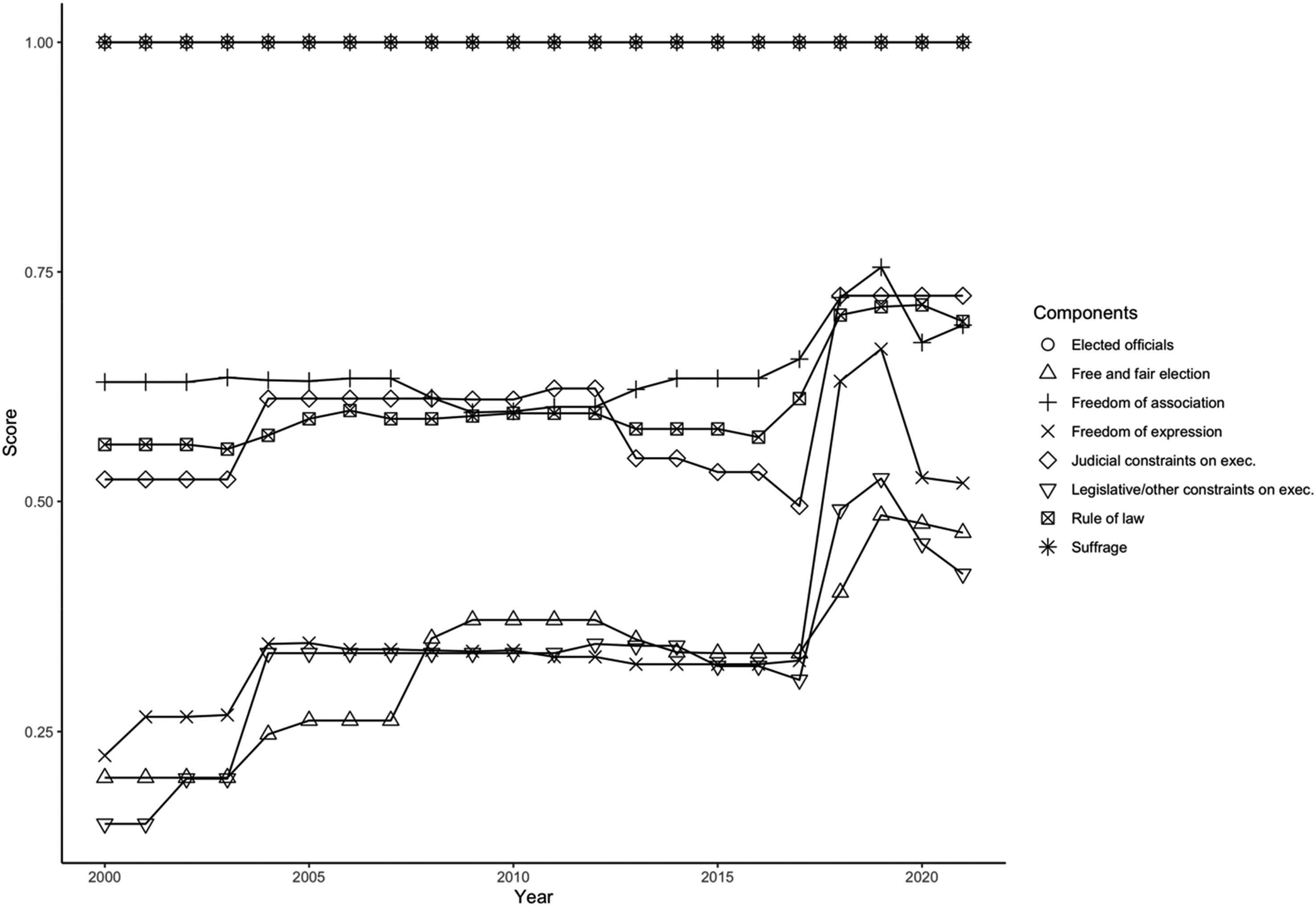
V-Dem Liberal Democracy Index (LDI), Malaysia. Source: V-Dem dataset, https://www.v-dem.net/vdemds.html.
Governance, particularly anticorruption, topped Mahathir's agenda: his administration restructured the relevant institutional apparatus and processes, and worked together with domestic experts and international advisors to identify problems and remedies. A political financing law, its passage expected to be imminent, remained in the works as Pakatan fell. Consultations on possible sweeping electoral reform were likewise then still underway, though the Election Commission had implemented technical improvements (e.g. to nomination processes), exercised more proactive oversight in by-elections, and, for instance, engaged in consultations with election-reform coalition Bersih. Pakatan—and specifically, new Dewan Rakyat (lower house) speaker Mohamad Ariff Md. Yusuf—had established a set of all-party parliamentary select committees, with plans for additional ones. Parliament had passed its first-ever unanimously approved constitutional amendment in July 2019, to lower the voting age from 21 to 18 and implement automatic voter registration, dramatically expanding the franchise. A reformist chief justice, Richard Malanjum, prioritized improving access to justice, judicial appointments, public-interest legislation, institutional autonomy, and consultative decision-making, though again, changes took time. 7 Civil liberties expanded somewhat: controls on media relaxed, for instance.
However, continuing politicization of, and ethnoreligious polarization around, issues impeded progress toward reforms such as signing on to the International Convention on the Elimination of All Forms of Racial Discrimination or recognizing (or at least, not actively attacking) sexuality or gender-identity rights (e.g. Tan, 2019). Other potential reforms floundered as Mahathir balked. Reviving an outmoded chestnut of ethnic-Chinese dominance, for instance, he eschewed reintroduction of local-government elections after over five decades’ hiatus.
All told, the reforms achieved or realistically likely constituted more pro-democratic nudges than the makings of regime change. The lurch at the top was momentous (but reversible); the scoot at the stickier institutional base was far more modest. Reworking the electoral system to render less likely entrenchment of a new dominant party, for instance, would certainly have punted Malaysia much farther toward the liberal pole, but the seeming impossibility of even quite minor institutional reforms demonstrates the implausibility of Pakatan's mustering such political will. Nor did Pakatan seriously revise many of the procedural and distributive aspects of the regime that had so advantaged BN previously. Pakatan continued to engage in its own “elite-level patronage,” for instance, to the extent that Mahathir took the helm of sovereign-wealth fund Khazanah Nasional, with Minister of Economic Affairs Azmin Ali also on the board (Case, 2019: 21–23). Opposition legislators, too, still received a mere token allotment of constituency-development funds, as only a small improvement over BN's complete denial of those resources, curbing their capacity for crowd-pleasing service provision—and voters did still demand the same sorts of grassroots-level interventions as ever. (Progress toward equalization resumed under Ismail Sabri's subsequent UMNO-led administration, per a confidence-and-supply agreement with Pakatan.) For that matter, while Pakatan implemented mechanisms for consultations with civil society, experts, and the general public, policy-making remained substantially a top-down, closed process. All told, then, change of leadership through elections “neither necessarily revamps nor reflects transformation of deep-set norms and practices across parties and voters” (Weiss, 2020: 148).
Indeed, voters themselves are key. In Malaysia we have, arguably, a case of “an initial victory by prodemocratic cultural groups followed by their defeat at the hands of antidemocratic cultural groups” (Waldner and Lust, 2018: 98). Pakatan started to hemorrhage popular support almost immediately after the May 2018 election, worsening near-consistently until Pakatan's collapse in early 2020 (Figure 2), especially among the Malay majority (Figure 3). The coalition had captured only a minority of the Malay vote (see Suffian and Lee, 2020): roughly one-third voted for Pakatan (especially on the urbanized west coast), one-third for PAS (especially on the more rural east coast), and one-third for UMNO.
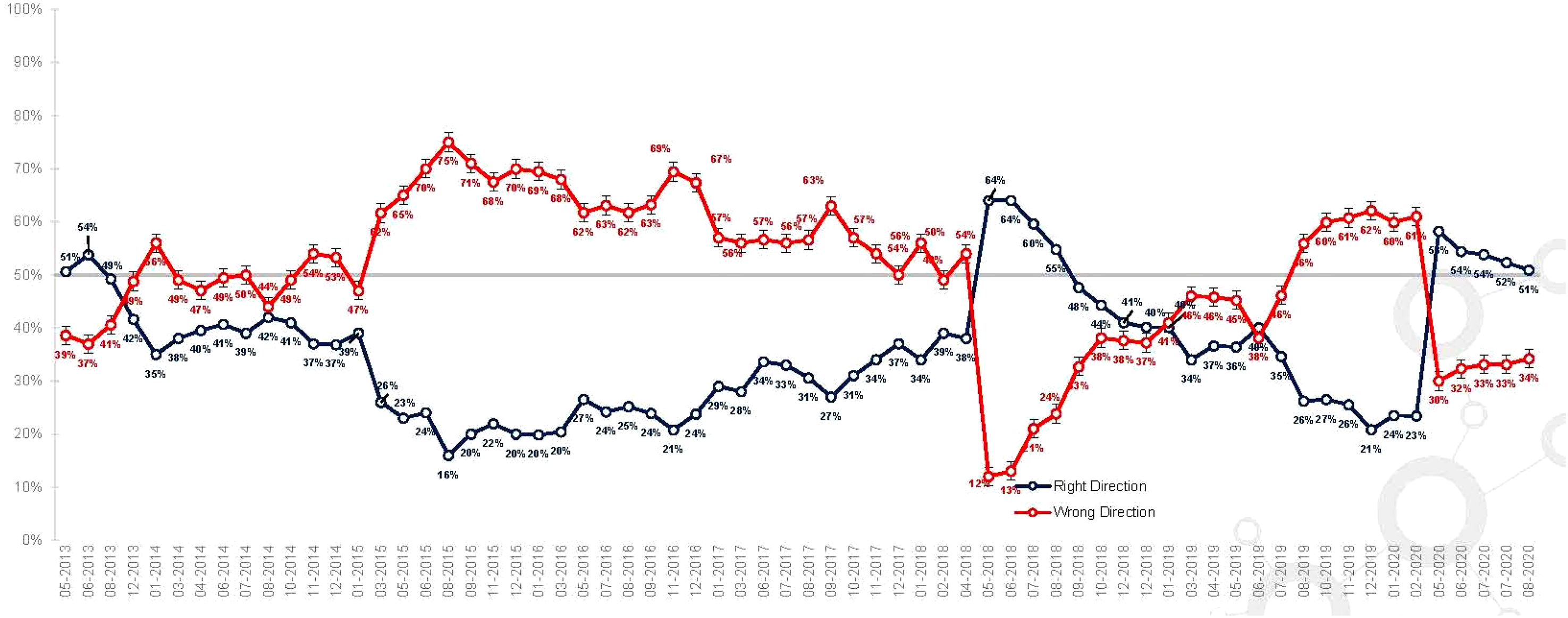
Right vs. wrong direction. Q: In general, would you say that things in Malaysia are heading in the right direction or are they heading in the wrong direction? Source: Merdeka Center, Survey report – April 2021 final, https://merdeka.org/v2/download/survey-report-april-2021-final/, slide 5.
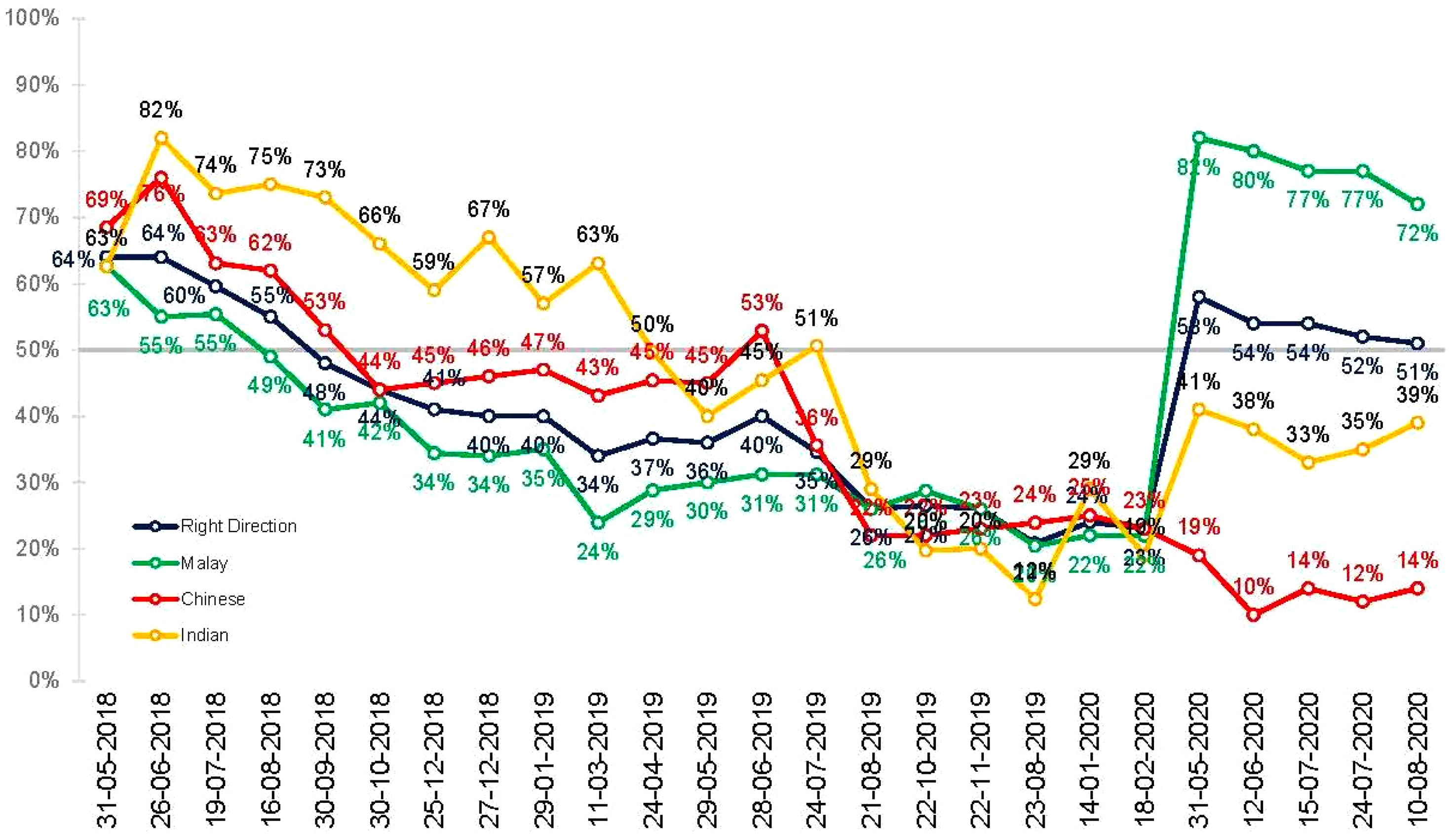
Right direction, by ethnicity. Q: In general, would you say that things in Malaysia are heading in the right direction or are they heading in the wrong direction? Source: Merdeka Center, Survey report – April 2021 final, https://merdeka.org/v2/download/survey-report-april-2021-final/, slide 6.
Most analysts at the time concurred in attributing UMNO's diminished support to Najib—outpolling his party in 2013, but decidedly not in 2018 (though he retained his seat). Not all anti-Najib protest voters expected those votes to tally to a BN loss. Certainly many lacked any clear yen for change beyond Najib's ouster (and perhaps repeal of the GST and lower costs of living); among those who did seek reform, many preferred a more Islamist alternative—which Pakatan was not, notwithstanding Islamist-credentialed flagbearer (and Mahathir's long-ago deputy) Anwar Ibrahim—amid strong and rising, but heterogeneously oriented, political Islamism (Ahmad Fauzi and Che Hamdan, 2020). Others trusted that Mahathir would at least keep the Democratic Action Party (DAP), UMNO's and PAS's eternal “Chinese” bogey, from wreaking havoc (e.g. Rahman, 2018: 674–675). Regardless, zest for change (via whichever opposition alternative), especially among younger cohorts, encouraged genuine, cross-racial enthusiasm when Pakatan first came to power.
The honeymoon was fleeting. As popular enthusiasm waned, so did elite unity. The addition of Bersatu, a communal party primarily of UMNO exiles, to Pakatan, and Anwar's being obliged to yield to Mahathir once again, set the stage for continuing fractiousness, especially within Anwar's Parti Keadilan Rakyat (PKR, People's Justice Party); those issues could be swept under the rug only until the coalition was obliged to govern. Mahathir's continued recruitment of UMNO party-hoppers, to augment Bersatu's heft within the coalition, did not help (Case, 2019: 13–15). Moreover, while some ministries and agencies functioned reasonably well, at least some amount of “institutional resistance” from a bureaucracy not fully on-board with a new administration bent on reorganization, cleaning-up, and downsizing made matters worse. Pushback ranged from “sullen resistance” to more active undermining and sabotage (Case, 2019: 15–17).
Months of behind-the-scenes machinations, substantially centered on who would succeed Mahathir and when, compounded by policy disagreements, culminated in heated negotiations in a Sheraton Hotel in suburban Kuala Lumpur, Mahathir's resignation as prime minister, the flight of factions from both Mahathir's Bersatu and Anwar's PKR, the king's intervention … and a new government. The how and why of those developments are gnarly. Suffice it to say that the proximate cause of the government's collapse was elite defections, galvanized by personality clashes and communal fear-mongering—specifically, concerns, which Malay-Muslim civil society amplified, that the Chinese-led DAP was too dominant within Pakatan and that Pakatan's proposed reforms endangered Malay-Muslim preeminence and privileges (for an insider perspective, see Wan Saiful, 2020b).
The Perikatan government that succeeded Pakatan's proved no more stable. Amid continuing, ricocheting elite defections, as well as the public-health and economic catastrophe of COVID-19—ramping up just as Pakatan collapsed—Muhyiddin governed largely without parliamentary oversight, suspending the legislature for months, precluding a vote of confidence he might lose. Billions of ringgit in relief funds flowed via stimulus packages absent parliamentary oversight or transparency. Explain Azmil Tayeb and Por Heong Hong (2020: 328), Muhyiddin's administration: appear[ed] to have taken the crisis as an opportunity to build its legitimacy and portray itself as a benevolent authoritarian government by releasing a series of cash payment packages; it also used the outbreak as an unspoken excuse to avoid parliamentary checks and balances.
Sustained emergency rule clearly represented a sharp swing toward authoritarianism, but not an institutionalized one. We have (so far!) yet to see the sorts of signs in Malaysia that we may have elsewhere of enduring backsliding (however characterized), in the name of pandemic management. Other aspects of Perikatan's administration offer more grist for assessment: crackdowns on media and activists ticked upwards near-immediately, hosts of Perikatan legislators and allies secured appointments to government-linked-corporation boards, new state governments appointed local councilors from their own elites’ camps (not that such praxis had radically changed under Pakatan), etc. And both sides—since Pakatan still controlled several state governments—politicized COVID-19 assistance, though heavy centralization of resources largely restricts credit-claiming gestures to especially wealthy and/or central-government-aligned states (Yeoh, 2020: 4–6).
In other words, in terms of formal politics and institutions (if not leadership and party coalitions), Malaysia has shifted only slightly from where it was on the eve of the last election. It would be a stretch to say that Malaysia experienced a regime transition in 2018—but nor could one characterize its teetering back in 2020 in overly momentous terms, apart from its having foreclosed even the possibility of Pakatan's making good on its promises. That said, Malaysia's oscillation over the past several years suggests the polity might be revving up for more substantial movement. We turn next to where that momentum seems strongest: outside the institutions central to concepts of democratic transition and decline.
Sussing out Malaysia's democratic corners
It is easy—especially in retrospect—to read Pakatan's ephemeral success as a lucky fluke. Yet something still led to that result: clearly, Malaysia's institutional framework and political culture are not entirely static. Najib's excessive rent-seeking delivered a kick, but at least a solid share of the population was already pondering a move; reformist sentiment, both secular-progressive and Islamist, had been gaining steam since at least the Reformasi movement of the late 1990s, fueling Pakatan's progress (Saravanamuttu, 2020). That something gets at a larger problem in the literature: in focusing on what is visible and measurable, especially leadership and votes, scholars give short shrift to critically important underlying shifts, including cognitive, political-cultural dimensions of democratization. This literature's heavy reliance on data from such troves as the Varieties of Democracy (V-Dem) initiative—a uniquely rich and cross-checked source (Coppedge et al., 2019)—may in fact misrepresent qualities or obscure patterns that such data capture poorly. 8 In particular, civil society, and civic culture and participation broadly, tend to fall from the democracy-assessing frame, however well-established their centrality (e.g. Alagappa, 2004; Almond and Verba, 1963; Bernhard, 2020).
One way we might examine what ground Malaysia has lost and where its regime now stands is by examining pushback: both where it comes from and when it works. Comparing democratic reversals in the Philippines and Thailand, Mark Thompson (2021: 125) explains, “whether backsliding generates substantial or limited opposition is crucial in grasping how successful regimes have been in legitimizing their eroding of liberal democratic norms and institutions.” Thompson builds on Laebens and Lührmann's (2021: 909, 912–13) conceptualization of accountability, or what “constrains the use of political power,” to trace opposition to autocratization. They offer a three-fold typology of accountability as vertical (electoral competition among and within parties, which can remove power-abusing incumbents); horizontal (parliamentary, judicial, and other institutional oversight, including to coordinate against or sanction an overreaching executive); and diagonal (mobilization among, information-sharing by, or pressure from civil society and media). 9 Giving due analytical weight to all three of these forms captures more of how democracy might make inroads (or be thwarted) than does privileging institutional channels.
This framework proves especially helpful for understanding Malaysia's situation, inasmuch as institutional and extra-institutional dimensions may well be out of sync in timing or objectives, and it takes seriously the normative backdrop that represents and encourages public preference for democracy. In Malaysia, the process by which Perikatan Nasional rose (if less clearly that by which Pakatan Harapan fell) was clearly illiberal; widely rebuked as a “backdoor government,” Muhyiddin's administration readily took advantage of opportunities to evade parliamentary checks (that is, horizontal accountability). Yet, by then, Pakatan had suffered plunging popular support and by-election losses. And among the Malay majority (decidedly not the Chinese minority), new Perikatan enjoyed dramatically higher popular trust and support than Pakatan (Figure 3). Such data suggest that Perikatan would have enjoyed greater vertical accountability, if put to the test through an early election, and would also enjoy strong backing in at least Malay-Muslim civil society (diagonal accountability). One could argue that the extent of disfavor for Pakatan and disappointment in its performance signaled that the coalition had lost legitimacy; were mechanisms for horizontal accountability stronger, they could have allowed a check without entailing so antidemocratic a process. Indeed, that vertical and diagonal accountability—elections, and especially civic activism—offer more promising (if still imperfect) checks, is in line with wider Asia-Pacific patterns (Croissant and Haynes, 2021: 14).
The electoral/vertical mechanism is fairly straightforward—and its violation in early 2020, then again in mid-2021, plainly angles Malaysia more toward autocracy than democracy, however well-received the outcome. But civil society, including (potentially multivalent) diagonal accountability, is similarly salient to consider, even if less prominent in discussions of and metrics for democratic transition and consolidation. It is here, in patterns of political engagement and evolving political norms, that we might get a better sense of Malaysia's orientation and drift. On balance, we could characterize Malaysian civil society as supporting voices that champion democratic norms, praxis, and inclusivity, albeit also voices more accepting or even supportive of exclusive, antidemocratic modes; both camps seek to hold politicians to account.
However useful for accountability, especially where institutional and electoral mechanisms remain underdeveloped, civil society is not inherently a champion of democracy. Civil society organizations (CSOs) may be subject to elite capture, and thus unable or unwilling to push back against democratic backsliding (Lorch, 2021). Or CSOs may be polarized in much the same ways as political parties, weakening their capacity or concern for resistance and undermining possibilities for diagonal accountability (Mietzner, 2021). 10 But Malaysian civil society specifically does include a quotient of energetic, pro-democratic “accountability actors,” or individuals and groups who “pressure and contain the incumbent” (Laebens and Lührmann, 2021: 913), some long-standing, and others launched or empowered amid more recent turmoil. Those CSOs cannot simply make democratization happen, not least given resistance from among CSO peers, nor do they all share the same instrumental or expressive goals, but they do still present a reservoir of norm-shifting, accountability-pressing agency. Such civic engagement represents a key, though never exclusive, avenue for liberalization. More broadly, over two decades’ stepped-up pro-democratic activism, however beleaguered, has arguably weakened the “fear factor” restraining engagement and encouraged more Malaysians to feel entitled to engage.
Lack of autonomy—partisan capture, driven by and reflecting both ideological differentiation and personalistic considerations and interests—did and does mark Malaysian civil society. Diagonal accountability may be no more assured, in strength or direction, than horizontal or vertical; which vector matters most, when, varies. As Lorch (2021) finds for Bangladesh, Thailand, and the Philippines, polarization reverberates through Malaysian civil society. What she writes of these previously “weak democracies” fits Malaysia to some extent: captured by “the same political elites that had also captured key democratic state institutions,” CSOs lacked sufficient autonomy to act “as an effective accountability mechanism against the power abuses committed by political elites” (Lorch, 2021: 92). Entrenchment of party-linked camps not only ensured support in Malaysian civil society for both liberalizing reforms and their eschewal or undoing, but also made it harder for CSOs to hold their favored parties’ feet to the fire. Exacerbating the latter effect all the more was the long-term hemorrhage of “progressive” activists inclined toward Pakatan into the latter's machinery and, eventually, administration, depleting civil society of capacity with which to hold that administration accountable (see Dryzek, 1996: 485).
And yet Malaysian civil society still can and does push back; its polarized camps shift gears as their elite allies and patrons move in and out of office, following or leading popular groundswells. To some extent, the COVID-19 pandemic may have accentuated this role: CSOs stepped in to support struggling communities as Muhyiddin's new government struggled to keep crisis in check, testing faith in those elites’ capacity and will (e.g. Rahman, 2020; Tayeb and Por, 2021). Diminished elite capture could well prove an enduring effect. Yet civil society has laid claim to voice on matters of governance long predating the pandemic. Starting prior to the 2008 elections, in which a precursor coalition to Pakatan Harapan made significant headway, the Movement for Clean and Fair Elections (aka Bersih, “Clean”) started to rouse increasing interest in and concern for reforms to the electoral process, then to the political system overall. Drawing in or allying with activists from a host of “progressive” movements, Bersih—and Pakatan directly—benefited from the resources and sensibility civil society could offer; civic engagement, especially via Bersih, was critical to 2018's “breakthrough” (Chan, 2018). Meanwhile, Malay-rights CSOs, aligned similarly with UMNO, PAS, and/or Bersatu, also ramped up their efforts as the political context shifted. Ultimately, civil society helped in “both enabling electoral turnover and bolstering illiberal incumbents” (Weiss, 2021: 120): diagonal accountability may pull toward different poles.
To understand shifts in popular attitudes and political preferences—pro- or anti-democratic—and to grasp the scale and quality of diagonal accountability mechanisms, then, requires that we look beyond political parties and their representatives, to CSOs and their supporters. Among the most notable such initiatives: with the 2018 election, a well-organized CSO Platform for Reform formed among over 50 organizations, to take advantage of emerging space for institutional input and feedback (Weiss, 2021: 128). Albeit problematically divorced from an Islamist segment within civil society, the CSO Platform warrants mention as a pro-democratic niche. In the context of a still persistently hybrid regime, this initiative and its members have offered capacity for ready participation in consultative processes, to counter exclusivist or counter-democratic framings of issues (e.g. the racial polarization that Pakatan's less-than-stellar attention to message control and framing allowed), and to develop and present ideas for reforms that might render formal-political institutions and actors better able to advocate for democratization.
However much Malaysia's institutional leadership now vacillates—among parties, coalitions, programs—civil society offers distinct potential to pull the regime toward or from a more democratic equilibrium. Those efforts may well sidestep or outright reject formal politics, though: informal politics may pursue its own track. A palpable liberalizing impulse in Malaysian civil society since at least the late 1990s, though, continuing today, suggests democratizing potential percolates still within the polity. Malaysia thus offers a compelling test case of how diagonal accountability, reflecting shifts in popular attitudes and mobilization, may serve to effect—or impede or redirect—incremental change in a hybrid regime, even when horizontal and vertical accountability remain constant. And that trait, in turn, suggests just how partial assessments of democratic status centering institutions and elections may be.
Conclusion
Where does Malaysia now fit, among the ranks of regime transitioners, stand-patters, and backsliders? Essentially, back where it started, albeit with less-stable leadership—entailing an electoral field even more ripe for polarizing rhetoric and policies, and for good or bad actors to make their mark. Malaysia remains firmly hybrid. It teetered toward its democratic side in 2018, before tottering back toward its authoritarian prospect in 2020.
William Case sums up his take on why Pakatan Harapan never successfully propelled Malaysia out of the hybrid camp in the first place. Even before the coalition collapsed, he suggested that Pakatan had “slowed its reformist agenda” in an effort “to mitigate elite-level fractiousness and popular resentments.” In consequence, “in pale form, then, it now resembles the UMNO-led Barisan that it succeeded, leaving many authoritarian controls in place, while resorting to old-time political strategies and policy preferences”—Malaysia's hybrid regime managed “to survive electoral turnover” (Case, 2019: 3). The changes since then seem more of the same: reshuffling among elites rather than institutional shifts, notwithstanding marginal reforms (Case, 2019: 7–8). The Pakatan administration surely did prefer further reforms, but the regime, plus the multivalent popular will behind it, had not sufficiently changed for the coalition to be able to pursue those reforms and remain legitimate—or, as it happened, in office.
In sum, then, Malaysia has neither convincingly transitioned to nor receded from democracy; it remains a wobbly hybrid, even as we might see in its oscillations, and particularly within civil society, real potential for a democratic turn. Extant concepts of and indicators for democratic transition and regression suggest a more institutional and legible path; Malaysian experience suggests instead how hard-to-capture these processes may be.
Footnotes
Acknowledgements
My thanks to Yuko Kasuya and Netina Tan for organizing the initiative of which this article is a part (and to Yuko also for her assistance with V-Dem data). Thanks also to the participants in both workshops, and especially discussants Walid Jumblatt Abdullah and Ian Chong, as well as the journal's anonymous reviewers, for their helpful suggestions and critiques.
Declaration of conflicting interests
The author declared no potential conflicts of interest with respect to the research, authorship, and/or publication of this article.
Funding
The author received no financial support for the research, authorship, and/or publication of this article
