




Abstract
This article provides a new conceptualization of regime transformation that allows scholars to address democratization and autocratization as related but obverse processes. We introduce a dataset that captures 680 episodes of regime transformation (ERT) from 1900 to 2019 and offers novel insights into regime change over the past 120 years. The ERT has three main advantages over other approaches. First, it avoids problematic assumptions of unit homogeneity and constant as well as symmetric effects. Second, it integrates key insights from qualitative studies by treating regime change as a gradual and uncertain process. Third, the ERT is based on a unified framework for studying regime transformation in either direction. The dataset differentiates between four broad types of regime transformation: liberalization in autocracies, democratic deepening in democracies, and autocratization in both democracies and autocracies (democratic and autocratic regression). It further distinguishes ten patterns with distinct outcomes, including standard depictions of regime change (i.e. democratic transition or breakdown). A minority (32%) of ERTs produce a regime transition, with the majority of episodes either ending before a transition takes place or not having the potential for such a transition (i.e. further democratization in democratic regimes or further autocratization in autocratic regimes). We also provide comparisons to other datasets, illustrative case studies to demonstrate face validity, and a discussion about how the ERT framework can be applied in peace research.
Introduction
Two dominant approaches to the study of regime change
This article introduces the Episodes of Regime Transformation (ERT) dataset. Using an innovative conceptual framework to overcome limitations in the literature, the ERT dataset captures processes of regime transformation in either direction along the democratic–autocratic continuum. It allows for research on four broad types of regime transformation, including liberalization in autocracies, democratic deepening in democracies and autocratization in both democracies and autocracies. The ERT dataset distinguishes ten patterns with distinct outcomes, including standard depictions of regime change (i.e. democratic transition or breakdown). The dataset (V2.2) includes start and end dates, as well as the type and outcome, of 680 episodes observed in the Varieties of Democracy (V-Dem) dataset from 1900 to 2019 (Coppedge et al., 2020). It is updated every year with a new release of the V-Dem dataset. 1
The ERT dataset has three main advantages over other approaches. First, it avoids problematic assumptions of unit homogeneity and constant and symmetric effects. Second, it integrates key insights from qualitative studies by treating regime change as a gradual and uncertain process. Finally, the ERT dataset allows scholars to study democratization and autocratization within the same systematic framework. For quantitative researchers, the ERT dataset provides opportunities to model the causes and consequences of democratization and autocratization simultaneously while taking heterogeneity in the sample into account. For qualitative researchers, it provides key insights for single and comparative case selection. In short, the ERT dataset enables scholars to analyze processes, mechanisms and outcomes within and between defined ERTs.
The questions raised here are also highly relevant to the policy-practitioner community. Democracy is associated with international and domestic peace (Altman, Rojas-de Galarreta & Urdinez, 2021; Fjelde, Knutsen & Nygård, 2021), economic development (Acemoglu et al., 2019) and environmental protections (Farzin & Bond, 2006). Democratic institutions promote investments in human development (Gerring, Thacker & Alfaro, 2012) that benefit ordinary citizens through improved education (Ansell & Lindvall, 2013), health (Bollyky et al., 2019) and gender equality (Sundström et al., 2017). Therefore, knowledge about how democracy emerges, declines, and dies is not merely an academic exercise.
A divided literature on regime change
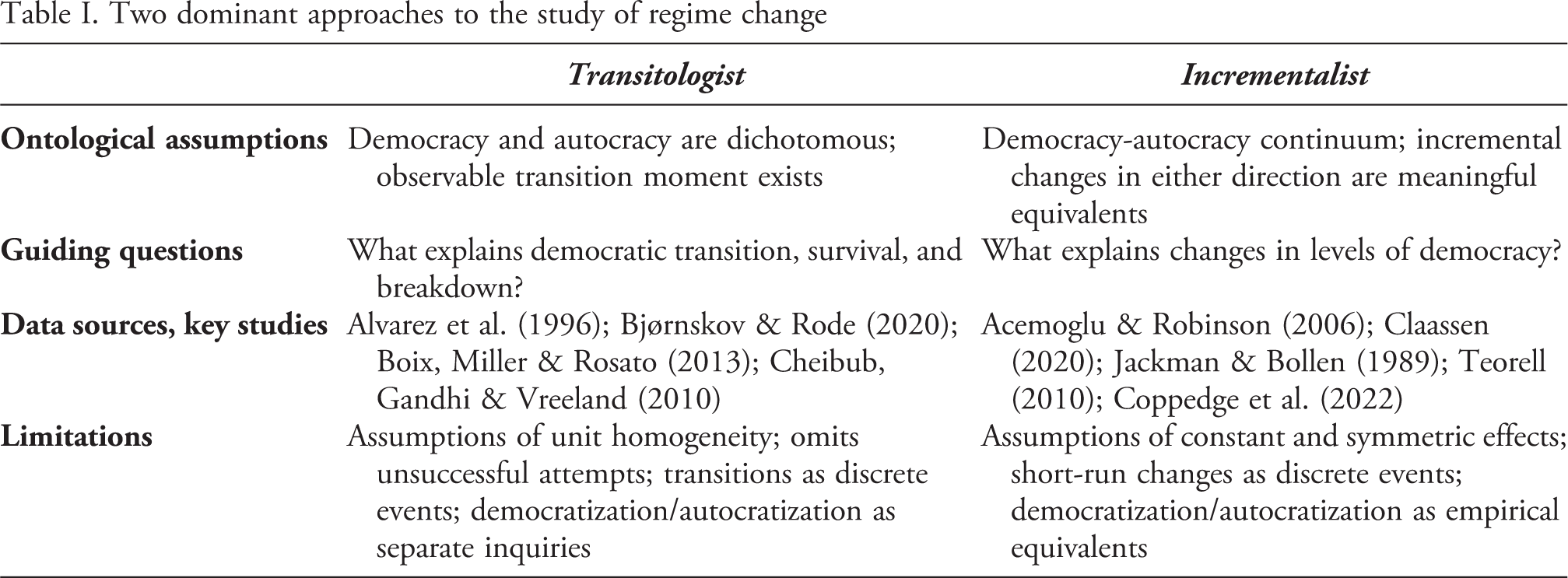
Research on regime change usually takes either a transitologist or incrementalist perspective (Table I). The transitologist approach focuses on democratic transitions and breakdowns as discrete events. 2 For example, classic case-based works on democratic transitions focus on founding elections as moments of discrete regime change (O’Donnell & Schmitter, 1986; Diamond et al., 1989). While this literature acknowledges complex processes and multiple pathways to uncertain outcomes, the goal is to explain the transition moment. Meanwhile, quantitative works in this genre use a dichotomous measure of democracy, regressing discrete changes in regime classification on explanatory factors of interest (e.g. Bjørnskov & Rode, 2020; Boix & Stokes, 2003; Brownlee, 2009; Epstein et al., 2006; Haggard & Kaufman, 2012; Miller, 2015; Przeworski et al., 2000). As a result, the transition moment becomes isolated from the complex processes discussed in case studies, even if recent work on the ‘stickiness’ of authoritarian institutions highlights political legacies (Albertus & Menaldo, 2018). Regardless of methodology, the transitologist approach makes two core ontological assumptions: (1) regimes can be dichotomized into the conceptual categories of democracies and autocracies; and (2) there is a distinct, observable moment of transition between democracy and autocracy.
By contrast, the incrementalist approach explores gradual changes in levels of democracy, usually with quantitative methods, although they might be paired with case studies (e.g. Acemoglu & Robinson, 2006; Claassen, 2020; Coppedge & Reinicke, 1990; Jackman & Bollen, 1989; Levitz & Pop-Eleches, 2010; Teorell, 2010; Coppedge et al., 2022). 3 For example, Teorell (2010) and Coppedge et al. (2022) provide an empirical overview of the determinants of democratization based on annual changes, as well as annual upturns and downturns. These studies avoid ontological assumptions about the dichotomous nature of regimes or transitions as events (Jackman & Bollen, 1989). Instead, they rely on two different ontological assumptions: (1) democracy and autocracy lie at opposite ends of a continuum; and (2) equidistant changes in one direction or another, and at any place along the scale, are meaningful equivalents.
Three core limitations
The divided literature on regime change impedes efforts at knowledge accumulation. Each approach involves a ‘bundle’ of assumptions and choices with certain trade-offs. While a few recent works attempt to combine incrementalism with transitology (e.g. Mainwaring & Bizzarro, 2019; Haggard & Kaufman, 2021), such integrated approaches to studying regime change are infrequent and overshadowed in the literature dominated by the transitologist-incrementalist divide. As a result, three fundamental limitations in the literature undermine efforts at knowledge accumulation and practical relevance, which we aim to overcome with a unified framework for studying regime transformation.
First, the transitologist approach assumes unit homogeneity by treating all observations within the same regime class as equivalent, even though the cases and underlying processes often differ. Operationalizing democratization as a discrete transition from non-democracy to democracy based on a nominal-level measure such as that of Boix, Miller & Rosato (2013) or some threshold on a continuous indicator assumes that all autocracies have an equal likelihood of transitioning to democracy, ceteris paribus. This ignores heterogeneity among autocracies that would be difficult to fully control for, and treats fully closed countries as equally likely to transition to democracy as more liberal cases. More critically, it fails to account for those cases where democratization (or autocratization) started but a transition never occurred. This means that the probability of democratization is based on comparing those that successfully democratized with a sample that includes both those that never liberalized and those that did. Ignoring heterogeneity among the null units in the sample means overlooking ‘potentially relevant and theoretically revealing cases’ (Ziblatt, 2006: 24). 4
The incrementalist approach overcomes the assumption of unit homogeneity by operationalizing democratization as changes in levels of democracy using a continuous measure. Yet, this introduces an equally vexing assumption of constant and symmetric effects, which treats the same amount of change as equivalent, and the effects of causes as the same, across the full range of values. It seems unrealistic, for example, to assume that an annual change of 0.05 on a scale of 0–1 means the same thing for Saudi Arabia, which scored 0.02 in 2019, as it does for Denmark, which scored 0.90. Averages based on a sample that includes both countries that increased in the democracy score and those that decreased also treats them as having the same underlying causes. Yet, research suggests that the factors causing annual increases (democratization) and annual decreases (autocratization) in democracy scores are often different (Teorell, 2010; Coppedge et al., 2022).
Second, both approaches amplify short-term changes when using quantitative methods. Whether measured as a dichotomy or interval, regime change is typically treated as an annual event. Regressing the probability of regime change (dichotomous or incremental) on antecedent factors without considering the preceding gradual changes risks misattributing causes by interpreting the Conceptualizing ERTs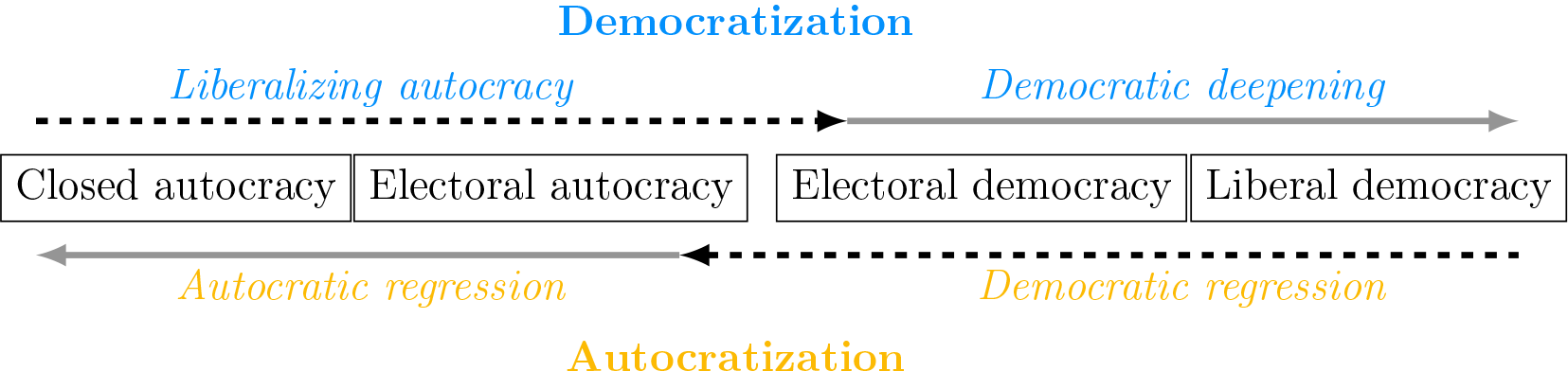
Third, the two approaches either treat democratization and autocratization as separate fields of inquiry or as meaningful equivalents. For example, whereas Linz (1978) discusses the breakdown of democratic regimes, Linz & Stepan (1996) focus exclusively on democratic transitions (and consolidation), with little bridging between the theories. This trend carries over into quantitative research that typically theorizes and models democratic transition and democratic breakdown in separate publications. Even recent work combining elements from both approaches only considers backsliding or erosion in democracies (e.g. Mainwaring & Bizzarro, 2019; Haggard & Kaufman, 2021). One exception is Gates et al. (2006), later corroborated by Knutsen & Nygård (2015), showing that hybrid regimes are more likely to experience regime transitions in either direction. By contrast, the incrementalist approach usually makes no distinction between democratization and autocratization. Equidistant annual changes on democracy scores are treated as empirical equivalents, regardless of whether those changes are positive or negative. Two exceptions are Teorell (2010) and Coppedge et al. (2022), who show that factors associated with annual increases and decreases are often distinct, calling into question the common approach to treating the determinants of democratization and autocratization as purely symmetrical.
In short, the literature presents parallel sets of explanations for related processes, with a proliferation of jargon (e.g. ‘democratic backsliding’ versus ‘autocratization’) and incomplete theory building. The transitologist approach treats regimes taxonomically by dichotomizing them and the incrementalist approach views regimes as a single class of phenomenon whose attributes can be quantified along a unidimensional continuum. 5 As a result, we know very little about whether and how transitions in either direction are similar (or complements) over time, both in process and their determinants.
Episodes of regime transformation
We aim to overcome some key challenges in the literature by developing a unifying framework that leverages the strengths of both the transitologist and incrementalist perspectives. We bridge these two approaches by conceptualizing regime transformation as an incremental process that may or may not yield a discrete regime transition. More specifically, we conceptualize ERTs as periods when a country undergoes sustained and substantial changes along a democracy–autocracy continuum. These episodes substantively transform the regime (fitting with the incrementalist approach) but may not necessarily yield a regime transition (from the transitologist approach). 6 Thus, we apply a ‘directional’ definition to regime transformation whereby democratization and autocratization occur even if the case does not cross some qualitative threshold between democracy and autocracy (Treisman, 2020: 6).
As illustrated in Figure 1, we distinguish episodes based on their direction of movement along a continuum from liberal democracy to closed autocracy (Schedler, 2001). We treat regimes as the same class of phenomena that can exhibit varying degrees of conformity to liberal democracy as an ideal type (similar to the incrementalist approach), while also acknowledging the important dividing line between regimes that fulfill the minimal criteria for democracy and those that do not (similar to the transitologist approach). We base these minimal criteria on the six institutional guarantees for Representation of outcomes of democratization (a, left) and autocratization (b, right) episodes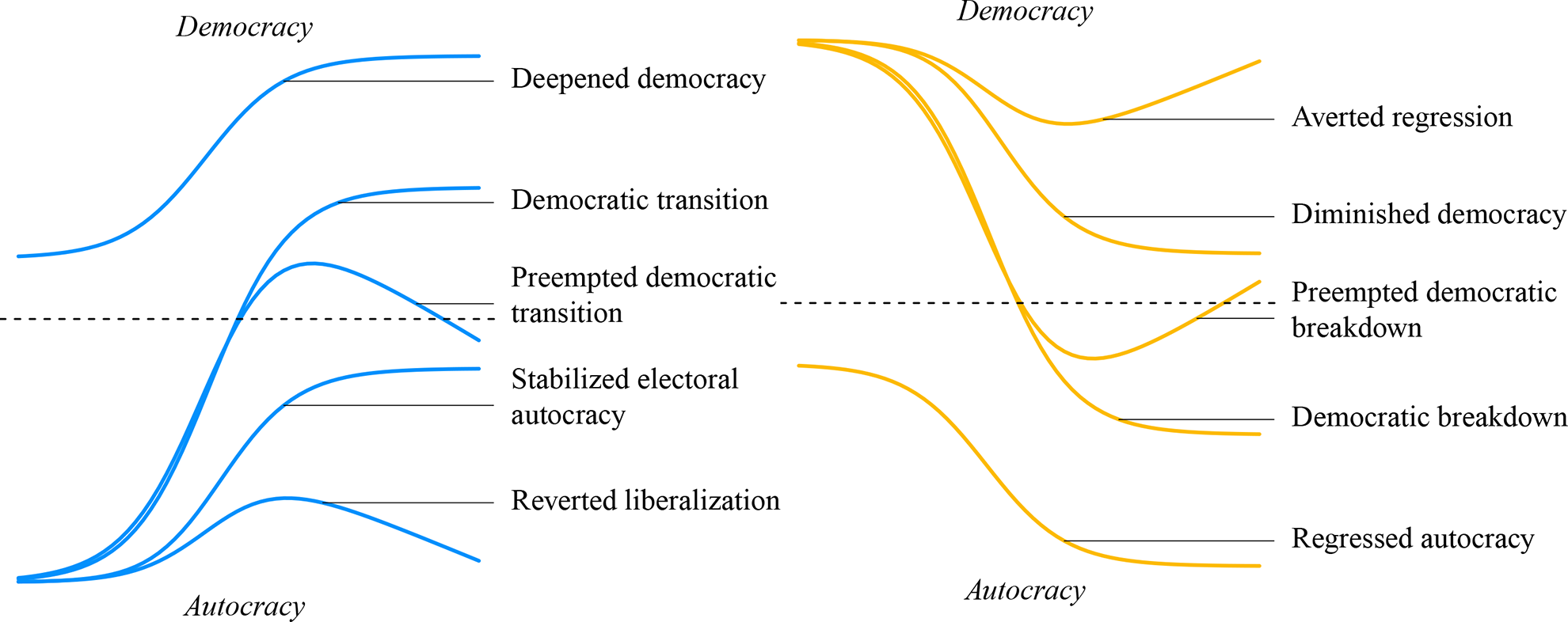
We further distinguish episodes that have the potential to produce a regime transition from those that enrich qualities congruent with the current regime type. 7 The former, represented by the dashed lines in Figure 1, include episodes of democratization in autocracies (liberalizing autocracy) and episodes of autocratization in democracies (democratic regression). The latter, represented by the solid lines in Figure 1, include episodes of democratization in democracies (democratic deepening) and episodes of autocratization in autocracies (autocratic regression).
Regime transformation processes are highly uncertain and a transition is neither inevitable nor the only possible outcome (Schedler, 2001, 2013; Treisman, 2020). Figure 2 depicts ten possible patterns and outcomes of ERTs, all based on an intuition about a non-linear relationship between regime transformation and measures of democracy. The dotted line illustrates the boundary between democracy (above) and autocracy (below). Figure 2(a) provides an overview of outcomes for democratization episodes. A democratic transition occurs when an autocratic regime sees sufficient reforms to cross a minimal threshold of democracy and then holds a founding democratic election. We define a founding democratic election as the first free and fair election held under minimally democratic conditions after which the elected officials assumed or continued office in either the national legislature, executive, or constituent assembly. Liberalizing autocracies can fail to produce a democratic transition in three ways. First, the regime could encounter a preempted democratic transition by achieving minimally democratic conditions but failing to hold a founding election before reverting back to autocracy. Second, autocratic regimes may undergo substantial liberalization before becoming a stabilized electoral autocracy. Third, after experiencing substantial liberalization, the regime could revert back to lower levels of democracy (i.e. reverted liberalization, Wilson et al., forthcoming). Finally, for episodes of democratic deepening, we consider the outcome a foregone conclusion – referring to this as deepened democracy.
Operationalization of episodes
Operationalizing ERTs
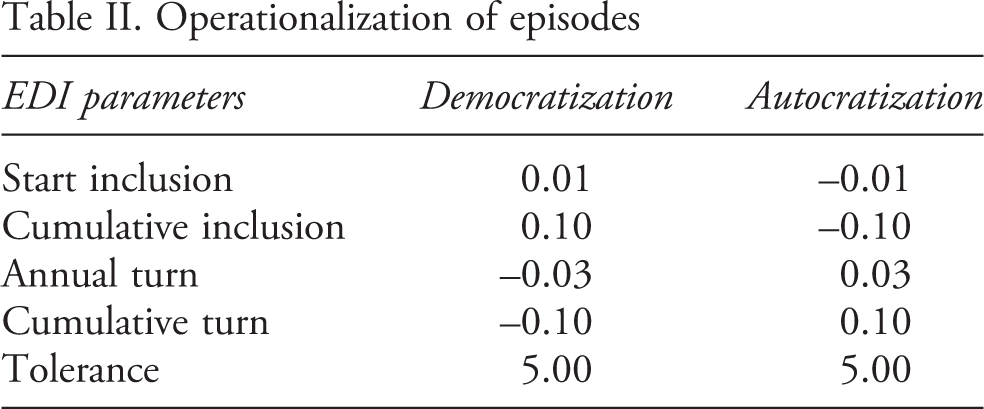
Table II summarizes the default parameters for identifying episodes in the ERT dataset, which we derived from a three-step validation process outlined below. We use V-Dem’s Electoral Democracy Index (EDI) to represent the continuum from autocracy to democracy on a range of 0–1 (Coppedge et al., 2020). We code ERTs based on an initial annual change of at least ±0.01 (start inclusion), followed by an overall change of at least ±0.10 over the duration of the episode (cumulative inclusion). ERTs are considered ongoing as long as the EDI score (i) changes at least once every five consecutive years (tolerance), (ii) does not have a reverse annual change of 0.03 or greater (annual turn), and (iii) does not experience a cumulative reverse change of 0.10 over a five-year period (cumulative turn). The final year of all episodes is coded as the year the case experienced a change of at least ±0.01 after episode onset and immediately prior to experiencing one of these three conditions for termination. The episode is censored if the end date corresponds with the final year or the year before a gap starts in the V-Dem coding for the country unit.
We coded the outcome for each episode based on our stylized representation in Figure 2. We use the Regimes of the World (RoW) (Lührmann, Tannenberg & Lindberg, 2018) to estimate a potential democratic transition or democratic breakdown within the episode. Rather than using a single arbitrary cutoff on an interval scale, RoW identifies democracies as regimes with sufficiently free and fair multiparty elections and where other institutions and practices identified by Dahl (1971) are sufficiently developed. RoW distinguishes between closed autocracies with no multiparty elections and electoral autocracies that hold flawed multiparty elections. And it differentiates electoral democracies – or those regimes with free and fair multiparty elections – from liberal democracies that also have sufficient minority protections and rule of law.
When a case crosses the threshold from the democratic end of the spectrum (i.e. liberal/electoral democracy) to closed autocracy on the RoW measure, we automatically code this as a democratic breakdown because multiparty elections no longer exist. When a case goes from being democratic to electoral autocracy, we first check to see that it either (a) held elections that were not free and fair or (b) remained classified as an electoral autocracy for the tolerance period (five years). For democratic transitions, similarly, we look for a change in classification from autocracy (either closed or electoral) to democracy (either electoral or liberal). We also check to see whether free and fair elections occurred and whether the winners were allowed to take office. 8 Finally, we code the other (non-transition) outcomes for both democratization and autocratization based on the criteria for determining episode termination following the conceptualizations outlined above and illustrated in Figure 2. The outcome is censored for episodes that have the potential for a regime transition but are ongoing in the final observation year of the dataset or before a gap in coding.
Classifying observations as we have done with the ERT dataset faces several common challenges, including the question of whether conceptual categories are mutually exclusive and what appropriate thresholds should be used for classification. We arrived at our default parameters through an extensive validation process, which we detail in our ‘static’ Online appendix. In short, we aimed to ensure the greatest face-validity based on case evidence, while also capturing meaningful changes from the earliest moment and minimizing overlap between episodes. For additional transparency, we provide a ‘dynamic’ Shiny app(endix) and an R package, both of which allow users to flexibly adjust the parameters and to test how changes to the default thresholds Description of our sample of ERTs (1900–2019)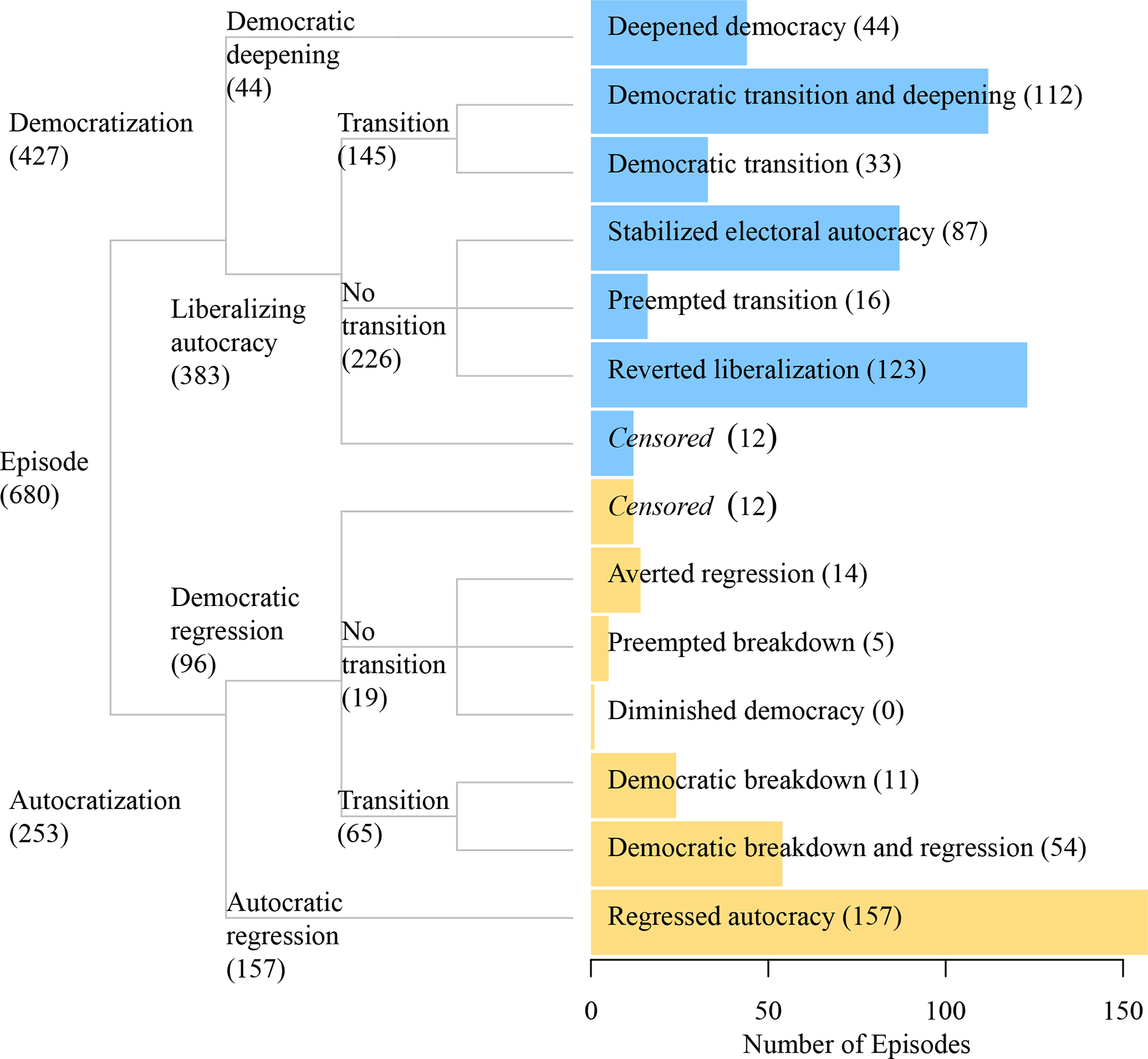
Based on our coding rules, the ERT dataset (V2.2) provides information on the start and end year, type, and outcome of 680 ERTs from 1900 to 2019. Figure 3 provides a summary of these episodes and their outcomes. Democratization accounts for 63% of ERTs (n=427), with liberalization in autocracies being far more common (n=383) than deepening in democracies (n=44). Nevertheless, democratic transitions appear to be the exception rather than the rule. Over 60% of the time (n=226 out of 371 uncensored episodes) liberalization does not yield a democracy. While democratic transition occurs in only 39% of the episodes where the outcome is known (n=145 out of 371 uncensored episodes), a sizeable majority (77%, n=112) go on to experience further democratic deepening.
In cases where liberalization did not produce a democratic transition, we find a higher frequency of reverted liberalization (33%, n=123), in which reforms – whether strategic or genuine – abruptly reverse course over a one to five year period. Meanwhile, 87 episodes stall under autocracy and 16 other episodes come close to a democratic transition, only to be preempted. These cases demonstrate the high level of uncertainty for liberalization in autocracies, constituting ‘near misses’ that dominant approaches have overlooked. The outcome remains censored for 11 episodes as of 2019, and the German Democratic Republic is censored by German reunification in 1990.
The lower half of Figure 3 describes episodes of autocratization, representing 37% of the ERTs (n=253). A clear majority of these (62%, n=157) involve further regression in already autocratic regimes. By contrast, only 96 (38%) affect democracies. Among the 84 uncensored episodes of democratic regression, 65 (77%) lead to a democratic breakdown, followed by further autocratization about 79% of the time (n=51 out of 65 breakdowns). Notably, only 19 democracies survived autocratization. Averted regression is the most common way (74%, n=14). Cases of preempted democratic breakdown appear just five times in the ERT dataset – Mali (1997–1998), India (1971–1976), Georgia (2006–2010), Finland (1937–1940) and North Macedonia (2000) – and we observe no cases of diminished democracy. For 11 democracies – including the United States (since 2015) and India (since 2002) – the outcome remains undetermined as of 2019. Austria from 1931–1938 is also censored by German occupation, which results in a gap in the V-Dem data.
Overcoming three core limitations
The ERT dataset addresses three limitations of dominant transitologist and incrementalist approaches to studying regime change. First, the ERT dataset avoids assumptions of unit homogeneity and constant and symmetric effects. It supports studying gradual processes of regime transformation by drawing on continuous data while also enabling differentiation of processes and outcomes in a categorical way, allowing for heterogeneity. The delineation of episodes based on their trajectories encourages scholars to evaluate the differences in development patterns exhibited by the shapes in Figure 2. In particular, our approach provides information about ‘near misses’ where, despite considerable potential, a regime transition did not occur, allowing us to compare ‘successful’ and various types of ‘unsuccessful’ cases.
Second, the ERT dataset allows us to study regime change as an inherently uncertain process that is sometimes dramatic and other times incremental. It recognizes both the transformation process and transition event as key elements of regime change. While we are not the first to conceptualize regime changes within ‘episodes’ (see, for example, Cassani & Tomini, 2020; Dresden & Howard, 2016; Gurses, 2011; Lührmann & Lindberg, 2019; Papaioannou & Siourounis, 2008; Tilly, 2001), past treatments use the term in the context of creating regime typologies or discrete observations of regime change.
Finally, our approach captures ERTs in either direction (both democratization and autocratization) within one framework. This unifies the literature, while avoiding assumptions about the empirical equivalence of unit changes in opposite directions on the democracy–autocracy continuum. We see opportunities for theory building about whether democratization and autocratization have similar causes (and effects) and new research questions, such as whether sequentially obverse episodes are legacies of one another. In sum, establishing replicable rules for identifying democratization and autocratization episodes and summarizing the ways that they begin and end takes seriously calls for improving research on regime change, both unifying and expanding on the literature.
Comparisons with other datasets
Number of episodes that include transitions coded by other datasets
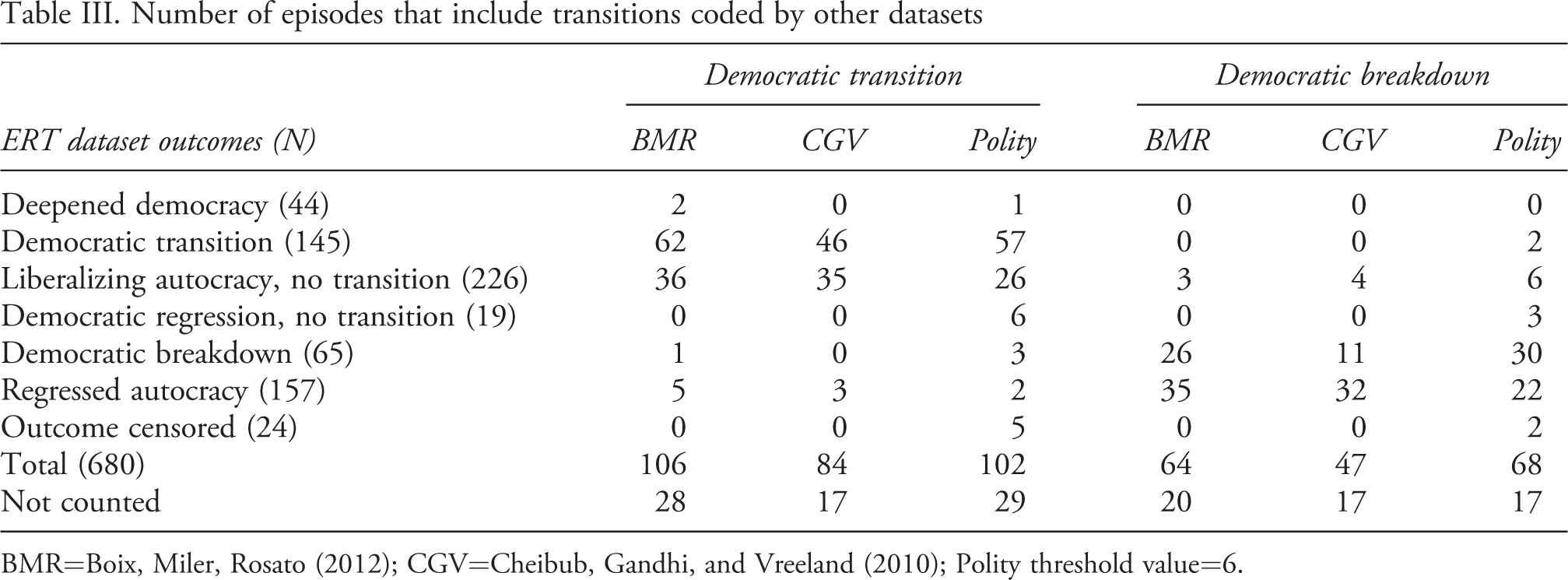
BMR=Boix, Miler, Rosato (2012); CGV=Cheibub, Gandhi, and Vreeland (2010); Polity threshold value=6.
The comparison between dichotomous democracy measures and the ERT dataset supports four major takeaways. First, the extent to which alternative ways of representing regime transition do not overlap underscores our contribution of a larger sample that covers a longer period of time and counts a larger number of potential and actual transitions. Second, some of the overlap shows questionable cases that are misrepresented by binary measures. For example, BMR include five democratic transitions that occurred during episodes of autocratic regression, meaning the autocracy was getting less democratic at the time. Third, it underscores the potential for measurement error, particularly where there is large disagreement between binary measures in quantitative analyses. Fourth, the exercise highlights the importance of measuring regime transformation as a more complex process with several potential outcomes that cannot be gleaned from discrete measures of regime change.
What do these differences mean for real world cases? The aggregate figures above tell us how often our sample and transitions overlap with others. Yet, face validity is also important for determining the value of our framework. Below, we demonstrate that the ERT dataset more accurately characterizes the dynamics associated with regime transformation in Turkey and Argentina than the BMR and CGV. The cases also underscore the close relationship between conflict and regime change.
Turkey
Figure 4 plots the ERT data for Turkey alongside Polity scores (dotted line) and regime change events as measured by BMR and CGV. The figure suggests that Polity frequently overstates the level of democracy in this case. While BMR and CGV often capture transitions and breakdowns, only the ERT dataset describes Turkey’s long-term development.
In 1908, a coalition of reformists called the Young Turks revolted against Sultan Abdülhamid II and re-established constitutional rule. However, factionalization led to the centralization of authority under a triumvirate. The Polity score increased substantially but remained low, consistent with the observed episode in the ERT dataset that produced reverted liberalization. Following the death of Mustafa Kemal Atatürk in 1938 and the Second World War, notable reforms including new political parties and trade unions, universal suffrage, direct elections and improvements in press freedoms occurred. Polity scores above 6 suggest a democratic transition. However, the Democrat Party became increasingly repressive after it secured a majority of legislative seats in 1950. As a result, the ERT dataset codes this as reverted liberalization followed by an episode of autocratic regression. Meanwhile, the dichotomous BMR and CGV measures suggest that nothing happened during this period.
Military officers led a bloodless coup against the party in 1960 and a referendum in 1961 approved a new constitution. The ERT dataset and the three alternative measures agree that a democratic transition occurred.
11
Likewise, all measures code the military coup in 1980 and the imposition of martial law as a democratic breakdown. A referendum in 1982 approved another new Illustrating the ERT dataset’s face validity for Turkey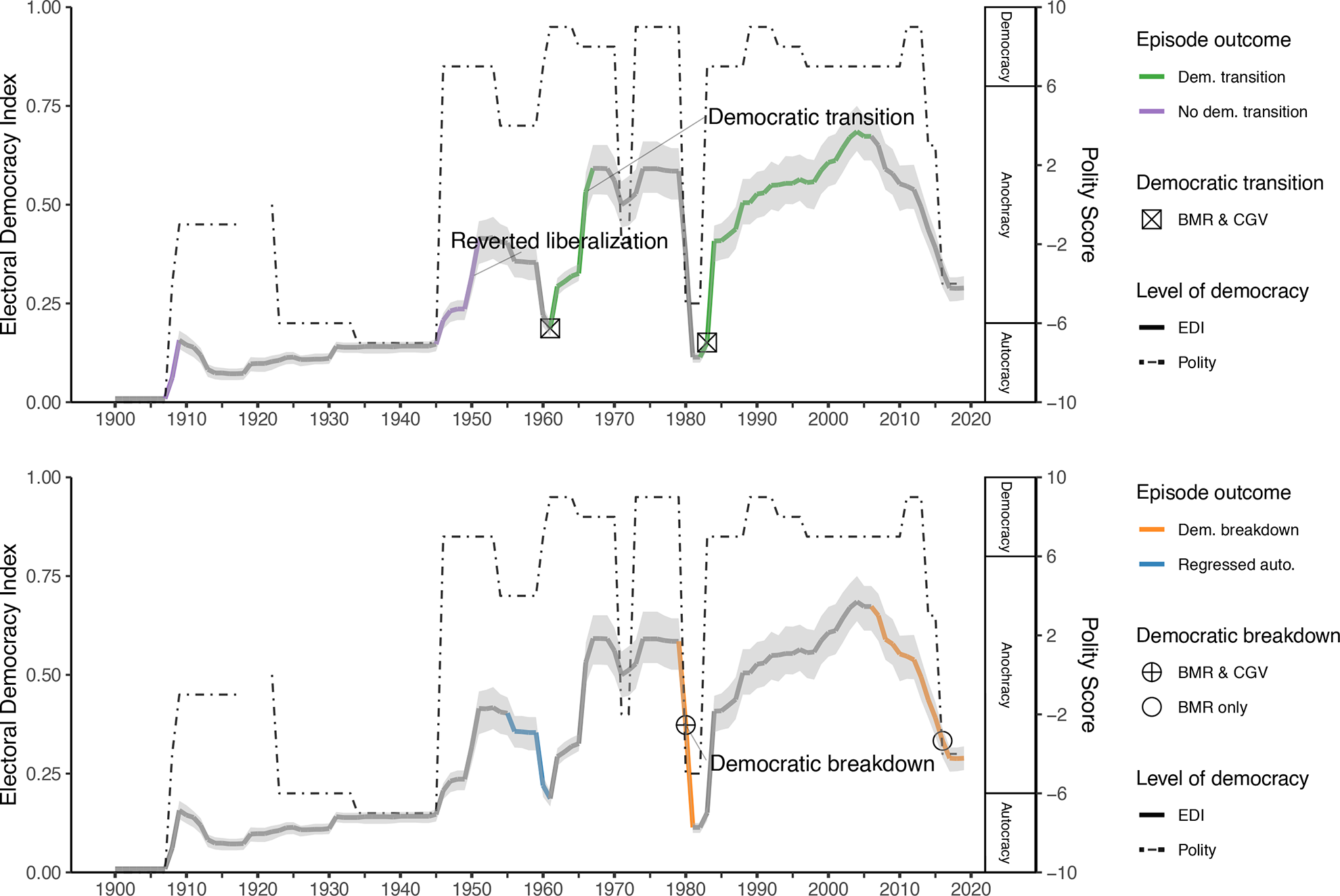
Democracy in Turkey took a decisive turn after the Justice and Development Party (Adalet ve Kalknma Partisi; AKP) won a legislative majority in 2002. While initially the AKP government promised to pursue a democratic reform agenda between 2002 and 2005, human rights violations intensified when the EU moved away from verbal commitments to condition membership on the implementation of political reforms (Kubicek, 2011). The crackdown against civil society groups, the media and peaceful protesters during the 2013 Gezi Park protests provide a clear indication that Turkey was autocratizing (Esen & Gumuscu, 2016; Bashirov & Lancaster, 2018). Evidence that the AKP began intimidating journalists immediately after its ascent to power in 2002 suggests an earlier authoritarian turn (Esen & Gumuscu, 2016: 1590). The episodes depicted in Figure 4 show that autocratization began in 2007. Instead of emphasizing democratic breakdown in 2014, our approach treats the events surrounding the start of the democratic regression episode in the mid-2000s as a critical part of a longer trend.
Turkey underscores an important difference between an episodic versus a dichotomous approach to depicting regime change. The ERT data indicate that Turkey transitioned to democracy in 1982, although the process would seem more protracted than is conveyed by alternative measures. The combination of the episodic approach and V-Dem’s more fine-grained data used to create the ERT dataset portrays it as more gradual, conflictual and iterative. The precariousness of democratic development in Turkey after 1982 helps to explain its regression in the late 2000s (Somer, 2017).
Argentina
Figure 5 illustrates the political development of Argentina, which, like Turkey, also saw fluctuations in democratization and autocratization. In 1912, the introduction of universal, secret and mandatory male suffrage through the creation of an electoral list enabled the opposition candidate Hipólito Yrigoyen to win Illustrating the ERT dataset’s face validity for Argentina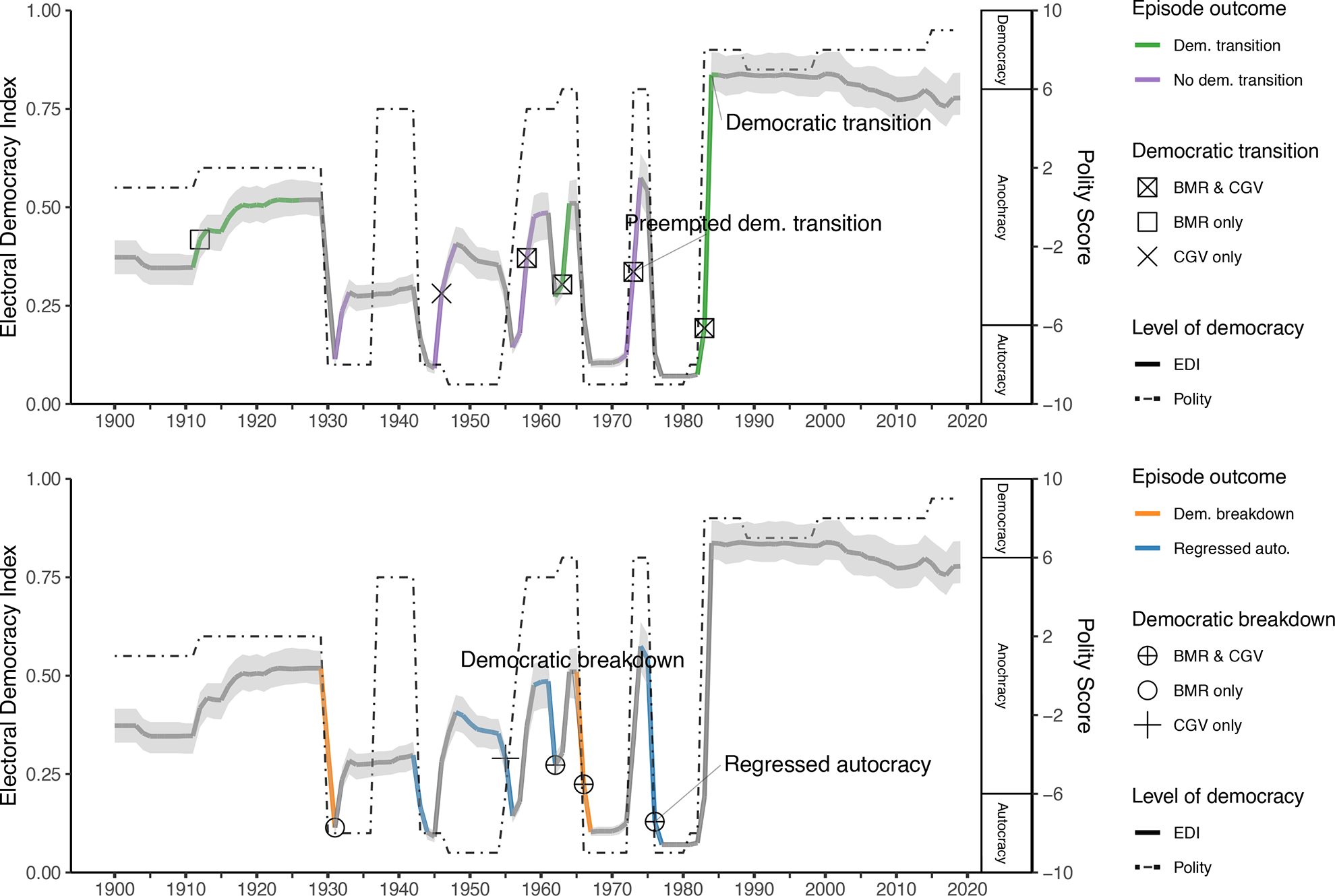
Nevertheless, the Great Depression prompted a coup d’état in 1930 by Lieutenant General José Félix Uriburu, which both Polity and Boix, Miller & Rosato (2013) register as democratic breakdown (Chen, 2007; Wynia, 1990). This initiated a decade of rule by conservative groups who maintained power through fraudulent indirect elections (Alston & Gallo, 2010; Chen, 2007; Wynia, 1990). During this period, the Polity data suggest that the restoration of civilian rule was more democratic than before the coup, while BMR do not register any regime change.
In 1943, amid concerns that continued electoral fraud would radicalize Argentine politics, Arturo Rawson replaced President Ramón Castillo in a coup. This invited several subsequent coups. In the 1946 presidential election, Colonel Juan Perón won as the candidate of the newly formed Labor Party. Perón was a consummate populist who maintained support through paternalistic policies and the manipulation of elections. He was eventually sent into exile by a military coup in 1956. The datasets disagree on the Peronist period – only CGV codes Perón's ascension as a democratic transition. The measures also disagree on successor governments. CGV and BMR code the restoration of civilian government as a democratic transition, while Polity and the ERT dataset do not code Argentina as democratizing until after another military intervention in 1962.
Although Perón returned to office in 1973, his death in 1974 and a series of political and economic crises prompted another coup – this time against his wife and Vice President Isabel Martínez de Perón – in 1976 (Chen, 2007; Wynia, 1990). The fact that all three alternative measures portray Perón's brief return as a democratic transition demonstrates a limitation of using Coups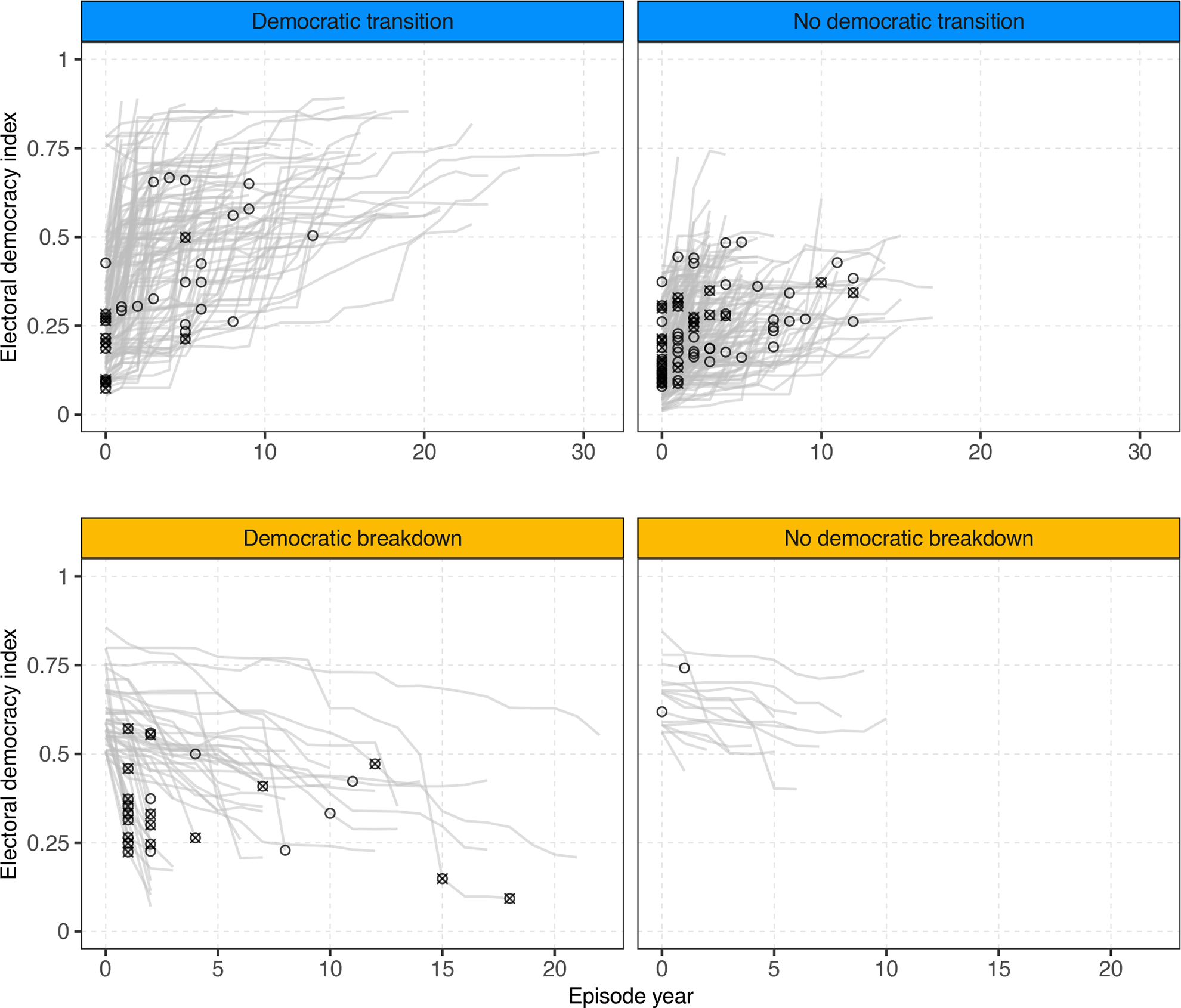
The case of Argentina illustrates several instances where the ERT dataset and alternative measures disagree. For example, BMR code a democratic transition in Argentina in 1912 that would be ignored using conventional thresholds for Polity. There are also several instances of liberalization without a democratic transition in the ERT dataset where alternative measures suggest a transition took place. Notably, alternative datasets disagree on whether Perón’s first presidency was a democracy. The episodes shown in Figure 5 differed in important ways. One involved a democratic transition that did not deepen and another a preempted democratic transition. Moreover, two were characterized by stabilized electoral autocracy and one by liberalization under autocracy that reverted. These patterns of regime transformation – offset by periods of democratic breakdown and autocratic regression – exemplify the importance of the ERT dataset joining together information on democratization and autocratization to explain democratic development over time.
Conflict and regime transformation
The ERT dataset and peace research
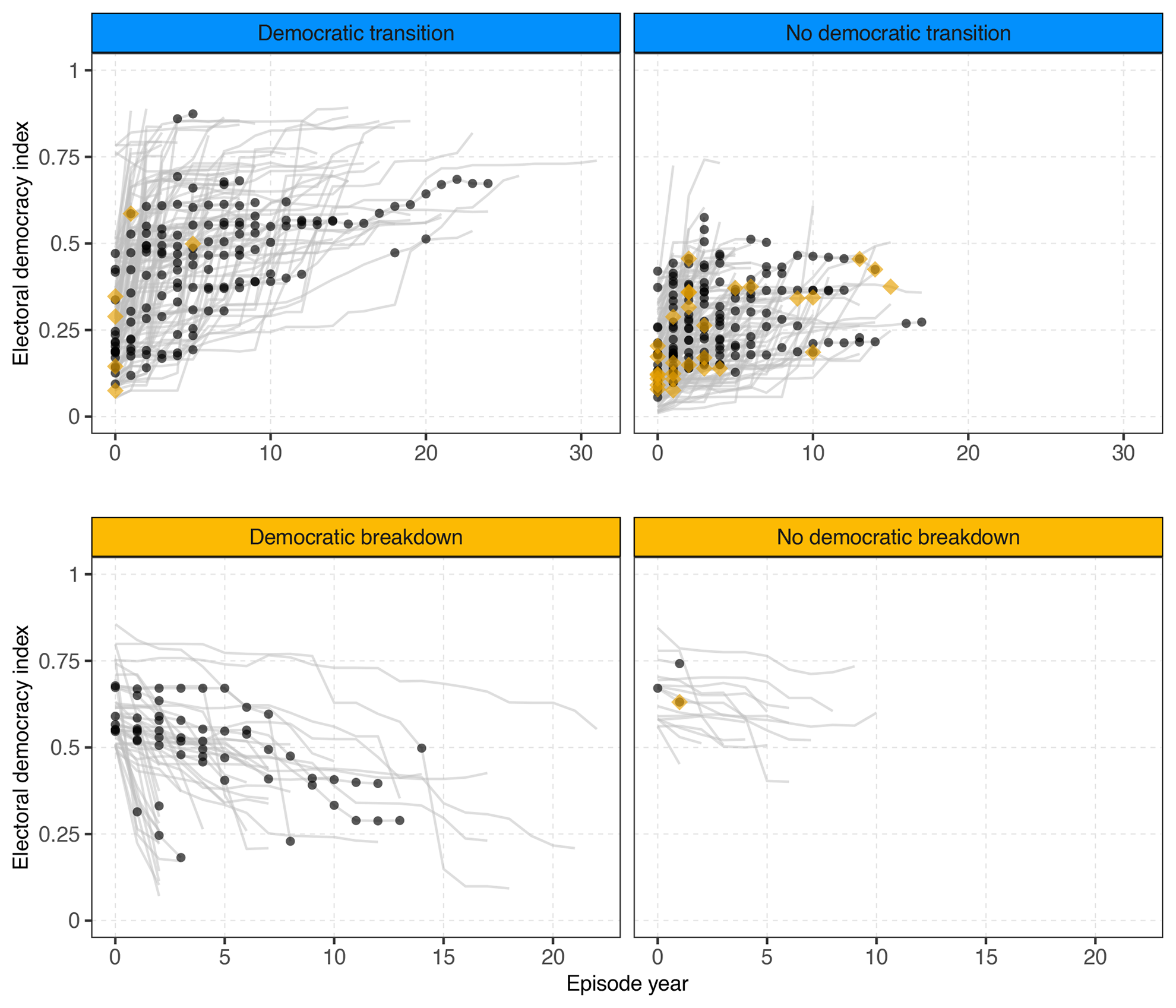
The ERT dataset will find broad applications in conflict research. For example, it can inform ongoing debates about whether autocratizing countries are more belligerent (e.g. Ward & Gleditsch, 1998) or whether democratization in ethnically heterogeneous societies leads to a higher risk of civil conflict (Mousseau, 2001). To demonstrate potential applications, Figures 6 and 7 plot coup d’états (Powell & Thyne, 2011; Przeworski et al., 2013) and interstate and intrastate conflicts from the PRIO/UCDP armed conflict dataset (Sundberg & Melander, 2013, V20.1) during episodes of liberalizing autocracy (top panel) and democratic regression (bottom panel) since 1946. 12
Figure 6 illustrates the value of using the ERT dataset to investigate military intervention and democracy. In particular, we find that coups are associated with failed liberalization and democratic breakdowns. While the onset of many liberalization episodes coincides with a (successful) coup, failed liberalization episodes tend to experience additional coups later in the process. Attempted and successful coups occur in only 9% and 10% (respectively) of the episodes that produced a democratic transition. By contrast, attempted (14%) or successful coups (13%) are more likely when liberalization fails to produce a democratic transition. Over half (51%) and three-quarters (78%), respectively, of these attempted and successful coups occur in episodes resulting in reverted liberalization, and no successful coups occur in episodes where stabilized electoral autocracy is the outcome. This suggests that military interventions pose a threat to liberalization, but are less likely when elites manage the process as a survival tactic. Furthermore, we find that the onset of democratic regression is not associated with coups; rather, military interventions typically occur toward the end of such episodes. More than one-third of episodes that produced a democratic breakdown experienced at least one coup, while not a single successful coup is observed during episodes that avoided democratic breakdown. This suggests that military interventions to aid a failing democracy (almost) never help and may actually contribute to democratic breakdown.
Figure 7 illustrates how the ERT dataset can help expand existing work on the relationship between conflict and political regimes (see Hegre et al., 2001). We find evidence that interstate conflict is associated with failed liberalization. Almost 9% of episodes of liberalizing autocracy that did not produce a democratic transition had one or more interstate conflicts versus only 4% of episodes with a democratic transition. For civil conflict, the differences are less pronounced. Liberalizing autocracies experience similar rates of intrastate conflict regardless of whether a transition to democracy occurs (26% for transitions and 27% for non-transition outcomes). Meanwhile, the rarity of international conflict during democratic regression suggests that domestic factors may be more salient for the erosion and breakdown of democracy. We find only one case where international conflict occurred during an episode of democratic regression – the Indo-Pakistani War of 1971, coinciding with India’s episode from 1971 to 1976, which managed to avoid breakdown. By contrast, we find that intrastate conflict occurs in about 30% of episodes resulting in a democratic breakdown, while only two episodes where democracy survived (Venezuela in 1992 and India 1971–1976) experienced intrastate conflict. These insights also speak to questions about regime type and conflict. The ERT dataset contributes to peace research by allowing for a more fine-grained empirical analysis of the propensity of conflict in countries experiencing regime transformation and the effect of conflict on transition outcomes.
Conclusion
The ERT dataset unifies the bifurcated literature on regime change while also addressing its precarious limitations. We develop a framework that eschews assumptions of unit homogeneity and constant and symmetric effects, and allows analysis of gradual regime transformation, while simultaneously categorizing outcomes and identifying equifinality. The ERT dataset facilitates analyses of regime change as an inherently uncertain process – sometimes dramatic, other times incremental. It captures movements in either direction (democratization and autocratization), while avoiding assumptions about the empirical equivalence of unit changes.
This article draws several initial conclusions from the ERT dataset (V2.2). First, only some ERTs have the potential for a regime transition, and there is no guarantee that such a transition will occur. We find that only about 40% of autocracies that liberalize actually transition into democracy. By contrast, 77% of democracies experiencing autocratization break down by the end of the episode. The ERT dataset not only identifies episodes with a potential for transition, it also includes episodes of ‘democratic deepening’ and ‘autocratic regression’, which are often treated as a separate domain (see, for example, the literature on democratic consolidation). Integrating them alongside episodes with (potential) regime transitions is a valuable point of comparison. Second, when a democratic transition or breakdown occurs, in most cases the country continues to experience further democratization or autocratization, respectively. The transition event is one step in a longer process rather than its culmination. Third, democratic regimes are less prone to experiencing regime transformation, in either direction, when compared with autocracies. Roughly 80% of the observed ERTs since 1900 have occurred in autocracies. Thus, authoritarian regimes are generally less stable than democracies. Fourth, democratization is much more common than autocratization. This finding fits with the modern expansion of democracy through several global waves of democratization (Huntington, 1993). Yet, our findings also support the argument that the world is currently in a wave of autocratization – nearly two-thirds of countries undergoing regime transformation at the end of 2019 were autocratizing.
The fact that we observe many different outcomes – not just democratic transition or breakdown – shows room for growth in studying regime transformation. This is exemplified by the step-wise deterioration of democracies like present-day Turkey and the bumpy road to democracy punctuated by failed liberalization and regression in Argentina. By embracing an episodes approach, we support a research agenda that encourages bounded generalizations about a complex and indeterminate phenomenon. Such conclusions may be present in the literature, but the conditions under which certain theories hold are unclear and the explanations for related processes remain disparate. A process-oriented approach to identifying and explaining regime transformation may therefore help knit together existing conclusions and expand scholarly understanding of an important set of outcomes.
Several areas of research await exploration. For peace studies, scholars can use the ERT dataset to conduct fine-grained empirical analysis of how conflict affects regime transformation and vice versa. As illustrated here, coups, interstate and intrastate conflict may explain both the onset and outcome of episodes. Regime transformation may also act as the independent variable, explaining why some countries are more belligerent than others. Qualitative researchers may benefit from using the dataset to select appropriate cases. For example, the ERT dataset allows researchers to isolate cases that have similar starting values for paired comparisons, with conflict as a possible explanation for divergent outcomes of regime transformation. In short, by identifying states that are in the process of regime transformation, we can better understand the emergence and decline of democracy, as well as where states are more likely to see coups and conflict, all of which have important academic and policy implications.
Footnotes
Replication data
Replication files for the figures in this article can be found at http://www.prio.no/jpr/datasets. The ERT dataset, R package, and codebook are available here: https://github.com/vdeminstitute/ERT. The Shiny app(endix) is available here: 
Acknowledgments
The ERT framework and dataset is the outcome of several years of collaborative work. The original conceptual foundation was created by Lindberg in the ERC grant application funding the project. We recognize (in alphabetical order) Vanessa Boese-Schlosser, Patrik Lindenfors, Jean Lachapelle, Anna Lührmann, Joshua Krusell, Laura Maxwell, Juraj Medzihorsky, and Richard Morgan, all of whom have actively contributed to years of trial and error that put us in a place to author this piece and to launch the ERT dataset. We also thank Emilie Segura for skillful research assistance.
Funding
The author(s) received financial support for the research, authorship, and/or publication of this article: This research project was principally supported by European Research Council, Consolidator Grant 724191, PI: Staffan I Lindberg; but also by Knut and Alice Wallenberg Foundation to Wallenberg Academy Fellow Staffan I Lindberg, Grant 2018.0144; as well as by co-funding from the Vice-Chancellor’s office, the Dean of the College of Social Sciences, and the Department of Political Science at University of Gothenburg. Seraphine F Maerz received funding by the German Research Foundation, project no. 421517935.