



Abstract
The present study aimed to explore and describe how pedagogical methods are communicated within formal documents pertaining to clinical placement studies in the first year of nursing education. Developing professional competence among nursing students during clinical placements is essential to the provision of high-quality patient care. The nursing bachelor programme in Norway has undergone a transition process involving the development of new study plans with corresponding subject plans in all higher educational institutions. A qualitative descriptive research design was applied. Formal documents (study plans and subject plans) from all the 13 Norwegian Nursing programs were included. Thematic document analysis was used. The results show there exist huge differences in presenting the nursing study programme in study plans and subject plans. Nursing programs should consider developing uniform documentation processes to ensure that they meet the standards, as well as to enhance students’ possibilities to transfer between higher educational institutions in nursing nationally and internationally.
Keywords
Introduction
A keystone of nursing education programmes is that nursing students should develop professional competence to be sufficiently knowledgeable to meet patients’ needs and provide care with high quality at all ages.1,2 Despite the growing demand for knowledgeable nursing professionals globally, newly qualified nurses lack sufficient professional competence to provide nursing care that meets nursing professional standards.3–5
The nursing bachelor programme in Norway has from 2017 to 2019 undergone a transition process involving the development of new study plans with corresponding subject plans in all Higher Educational Institutions (HEIs) so that they align with learning outcome descriptions outlined in new national guidelines. 6 A study plan includes a programme and descriptions regarding what and how students are expected to learn. Study plans should specify the pedagogical methods employed because it is important to have appropriate teaching and learning activities, enabling as many students as possible to achieve the required learning outcomes regardless of their theoretical background or motivation. 7 Nursing students are expected to use the study plan in preparing how they can acquire necessary knowledge and skills.
Students need to apply their knowledge and skills in real-world situations and gain hands-on experience under the supervision of registered nurse mentors and nurse teachers.8,9 Supportive clinical placement studies are important for students to achieve optimal learning experiences.8,10,11 Commonly, nursing students have their first clinical placement study during the first year of education, preferably in a nursing home setting.11,12 Nursing home settings typically involve frailty older adults with multiple chronic conditions and healthcare needs. 13 Clinical placement learning environments involving older patients offer rich learning opportunities with unique challenges and objectives.8,14 However, many nursing students experience insufficient learning situations during their first clinical placement study for various reasons,15,16 such as minimal structured support from clinical registered nurse mentors.11,17 Moreover, many nursing students drop out of their education because they find it challenging to organise their studies and master the required learning outcomes. 18
In Norway, nursing education comprises a three-year bachelor programme covering 180 European credit points. The Nurse Educator Core Competencies report 19 highlights the responsibility of university colleges and universities to educate registered nurses with the necessary professional competence for appropriate healthcare services in clinical placement. To learn and develop sufficient professional competence, nursing students spend half their education time in clinical placement studies.20,21 Effective collaboration between HEIs and placement settings is therefore important to ensure optimal student learning during clinical placement studies. 22
The European Union (EU) directive on recognition of professional qualifications (EU 2005/2013) 21 specifies how clinical placements should be conducted. In addition, Norwegian clinical placement studies are regulated through two recently developed national guidelines, the Regulations concerning Supervising Quality of Higher Education 23 and the Regulations on National Guidelines for Nursing Education. 12 The purpose of the national guidelines is to ensure a nationally equitable academic standard so that graduated nurses have a common final competence, regardless of the educational institution. 12 The guidelines describe learning outcomes for the nursing competency areas such as health, illness and nursing, as well as categoriisng them into knowledge, skills and general competence. Learning outcomes are defined as statements of what a student is expected to know, understand and/or be able to demonstrate at the end of a programme. 24 Newly educated nurses need defined core competencies to meet the challenges expected as a registered nurse. 25 The Nurse Educator Core Competencies report 19 indicates that expected pedagogical methods for clinical placement studies in the Bachelor of Nursing programme should be specified, including formal documents describing learning activities promoting appropriate learning situations and learning processes to achieve the specified learning outcomes.7,19 Nurse education programmes need to consider that the information in their formal documents must reach out to the greater proportion of today's students with little background of relevant knowledge. 26
Specifying expected pedagogical methods for clinical placement studies in the Bachelor of Nursing program is of global interest, especially given the increasing practice exchange between different countries and healthcare systems. 27 The understanding and expertise gained through nursing education is of paramount importance globally, given the educational disparities that exist across different countries. 28 Therefore, the recognition and appreciation of an internationally relevant knowledge acquired through nursing education is crucial.
Most students need learning and teaching methods that motivate them to reach acceptable levels of knowledge, skills and general competence.7,29 Teaching methods or pedagogical learning methods refer to a systematic approach based on various pedagogical learning and teaching principles and strategies. 30 This method includes didactic lectures, memorisation and deliberate practice. 31 According to Shin et al., 29 traditional teacher-centred methods in nursing education have been unsuccessful in developing students’ competency. The method often results in passive learning and risking poor cognitive development. A passive nursing student approach may not encourage problem-solving and metacognitive skills, but may degrade the students learning.31,32 However, in the last decade, there has been a shift towards the learner-centred method. 33 By contrast, the learner-centred method involves strategies that improve students’ learning processes, with students at the centre of their own learning process. In this approach, the teacher serves as a guide and supports students, helping students take ownership of their learning. 31 By actively engaging in their own learning, students can better apply new information to previously learned concepts. 25 Implementing a learner-centred method not only increases satisfaction for both students and teachers, but also motivates students to develop excellent problem-solving and critical-thinking abilities.25,31,32 These skills are essential for fulfilling the responsibilities of professional registered nurses. In the present study, learning activities are conceptualised as methods employed to facilitate the acquisition of knowledge, skills and competencies among students during clinical placements.
The present study is part of a Norwegian nationwide study under the auspices of Norwegian Network for Educational Research in Nursing (NorNERN) in which all the 13 Norwegian educational institutions have a formal representative. The overall study aim of the nationwide study is to explore and analyse the content of formal curriculum documents addressing the pedagogical and nursing scope in the placement studies. To our knowledge, descriptions of pedagogical methods that foster the achievement of learning outcomes for nursing students during their clinical placements in Norway have not been explored. Considering the newly developed study plans and the requirements from the Nurse Educator Core Competencies report, the present study aimed to explore and describe how pedagogical methods are communicated within the formal documents pertaining to clinical placement studies. Students in the initial clinical placement were chosen because they often lack experience and need to understand the learning process and expectations. The research question guiding this study was: how are pedagogical methods described in study plans and subject plans for the first clinical practice in nursing homes?
Methods
A qualitative descriptive research design was selected for the study because it is suitable for exploring and describing unexplored subject and ‘data-near’ findings. 34 Document analysis was chosen as our methodology because of its systematic approach, which deals with identifying and selecting applicable documents, thereby generating relevant data.35,36 Document analysis includes a process that extracts and analyses data in line with the aim of the study and research questions to expand understanding of a given topic.36,37
Data collection
The empirical material used in this study was formal documents from all nursing education programmes in Norway in 2022–2023 (N = 13), including formal documents that are available to students, and all interested parties. The inclusion criteria were study plans for whole Bachelor of Nursing programmes and subject plans related to the first year of clinical placement education in nursing homes. Assessment forms or documents detailing specific learning activities were excluded from the study because these documents are only available to students after the program start. We chose the initial clinical placement period because first-year students typically lack experience and it is important for them to understand both the learning process and the associated expectations. 38 Collectively, the selected documents are interrelated and can be understood as a document chain in which each build on the other. 35
Data analysis
This study employed document analysis as a methodological approach. In line with Bowen, 36 the analysis was performed in four phases consisting of (1) skimming documents, (2) reading and interpretating documents, (3) identifying meaningful and relevant texts and (4) organising information into categories related to research questions. In phases 1 and 2, four of the researchers (MTS, MKRS, BMS and MR) individually skimmed, read and interpreted in an iterative process that combined elements of both content analysis and thematic analysis (Bowen, 2009). In phase 3, the same four researchers first individually and then in pairs (MTS and BMS, MKRS and MR) identified meaningful and relevant texts from the documents that described the pedagogical methods. In phase 4, we organised the information in the data material into categories. Initially, as a collaborative effort, we systematically organised through an iterative process the data into subcategories and categories relevant to the research question. In this analysis process, we developed a structured categorisation matrix, which all the researchers (MTS, BMS, MR, MKRS, HMSB, BC and IRS) agreed upon. To ensure the accuracy of the final empirical material, the process involved a thorough and focused rereading and review of the data to reassess the performed data selection that was coded. In addition, to maintain consistency and dependability of the findings, all researchers collaborated to reconcile any differences in opinion on which data to include in the analysis. All the researchers finally assessed and agreed upon the results. The variation of pages in the study and subject plans was calculated using Excel (Microsoft Corp.). The researchers ensured reflexivity and consensus by engaging in numerous virtual meetings on Zoom (https://www.zoom.com) throughout the analysis.
Ethical considerations
Before the collection of documents to be analysed in the project, general information about the study was sent to all universities and colleges in Norway that offered a bachelor's degree programme in nursing. All the formal leaders of the educational institutions were informed and consented to providing access to the relevant documents, and the representatives collected the relevant institutional documents that eventually formed a digital database where all the project groups could retrieve data relevant for their scope. All documents were approached in an unbiased and respectful manner, ensuring neutrality in the analysis process. Each HEIs was given a number (from 1 to 13) to ensure anonymity. All the researchers were cognisant that the objective was not to assess the quality of the educational documents but rather to scrutinise how the descriptions of clinical placement education were articulated in alignment with the study's aim and research question. We demonstrated objectivity regarding the documents by ensuring that the data material was fairly represented. 36 Hence, we refrained from connecting the various clinical placement education documents to variations in the number of pages within study plans and subject plans.
Results
The empirical material consisted of formal documents incorporating study plans and subject plans from all HEIs including the 13 bachelor of nursing programmes in Norway. Subject plans were related to the first year of education. To provide an overall picture of the data being reviewed in the formal documents, the results first present variations in the number of pages (Table 1), second the characteristics of the formal documents (Table 2) and third an overview of the categories and subcategories reflecting pedagogical methods in the subject plans (Table 3).
Variations in the number of pages in study plans and subject plans.

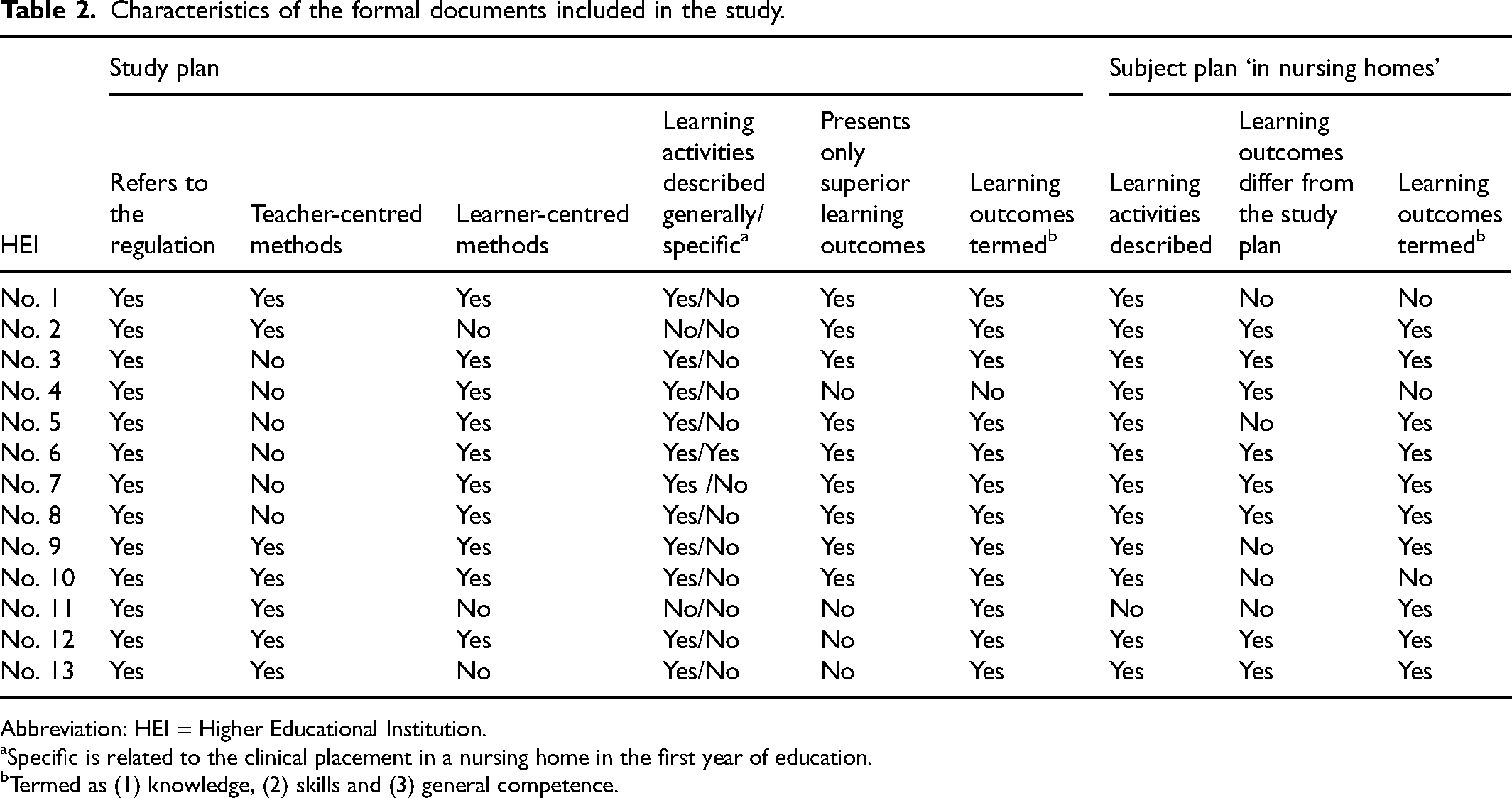
Characteristics of the formal documents included in the study.
Abbreviation: HEI = Higher Educational Institution.
Specific is related to the clinical placement in a nursing home in the first year of education.
Termed as (1) knowledge, (2) skills and (3) general competence.
Categories and subcategories reflecting pedagogical methods in subject plans in the first year of clinical placement education.

The data reveal substantial variations in the number of pages within the study plans, spanning from six to 88 pages. Similarly, the subject plans range from two to 14 pages. Notably, six out of 13 study plans included all subject plans, resulting in a total of 44–88 pages. A study plan with fewer pages did not always correspond to a subject plan with more pages.
Regarding the characteristics of the formal documents presented in Table 2, this study found that all the study plans refer to the Regulations on National Guidelines for Nursing Education. In our data material, only two study plans do not describe learning activities in general or specifically in the study plan (HEI numbers 2 and 11), and one of these (HEI number 11) does not describe them in the subject plan either. Only one HEI includes specific learning activities in both the study and subject plans (HEI number 6). Learning outcomes are termed as knowledge, skills and general competence in 12 of the 13 HEIs’ study plans and in 10 of the subject plans. Moreover, in eight of the HEIs, the description of the learning outcomes in the subject plans differs from the study plan, which means that the texts in these two documents are not aligned. In the study plans, six HEIs have not described teacher-centred methods, and three HEIs have not described learner-centred methods.
The data regarding the learning methods presented in the subject plans in the first year of education in clinical placement in nursing homes yielded two categories: (1) teacher-centred learning methods and (2) learner-centred methods (Table 3).
Overall, Table 3 shows that HEIs have fewer learning activities that are categorised in teacher-centred methods than in learner-centred methods. In the category Teacher-centred methods, most of the HEIs highlight the subcategory Guidance in practice; however, verbal feedback from the teacher was only described in one subject plan. Furthermore, the subcategories Preparation for practice and Assessment as a basis for learning are less described in the subject plans.
The data reveal that, in the learner-centred methods, the activities are mostly related to the subcategory In-depth learning in practice, with approaches to engage the students in reflective processes such as reflection groups. Within the subcategory Framework for learning, most of the HEIs have written employment requirements. Furthermore, within the subcategory Take personal responsibility for learning, the data reveal learning activities that facilitate students to be engaged in self-assessment and self-study.
Discussion
The present study aimed to explore and describe how pedagogical methods are communicated in the formal documents related to clinical placement studies for the first clinical practice in nursing homes. The document data show that there exist huge differences in presenting the nursing study programme in study plans and subject plans from the 13 bachelor of nursing programmes in Norway. First, the document data reveal substantial variations in the number of pages within the study plans but less variation in the subject plans. However, a study plan with fewer pages does not always correspond to a subject plan with more pages. In addition, the data reveal a great deal of variation regarding the characteristics of the formal documents. How the curriculum is being constructed in higher education is not broadly discussed in the literature. 39 The large variation in the number of pages and characteristics of study plans and subject plans can create confusion among students and potential teachers who seek to understand the educational programmes. When students try to decide to which HEIs to apply, they struggle to compare the different programmes because of the absence of common key competencies and levels of learning objectives at the same programme levels. 40 To ensure a more holistic and comprehensible educational experience nationally, there is a need to develop uniform and clear standards for the design of study and subject plans with nursing competencies the different HEIs and their teachers agree upon. 40 In line with the Horizon Report: Higher Education Edition (2017), an HEI should intend to educate nursing students in a manner that meets the needs of professional nurses to fill evolving job market needs. 2 Consequently, an educational professional collaboration is preferred when designing study plans and subject plans, ensuring several perspectives and approaches.
The document data reveal that 10 out of 13 HEIs have integrated learner-centred methods into their study plans, and the pedagogical methods in the subject plans are mainly both teacher-centred and learner-centred methods. The learner-centred method uses learning outcomes focused on what the students are expected to be able to do at the end of the clinical placement. 41 These findings indicate that in most of the documents from the Norwegians HEIs recognise the importance of promoting a learner-centred method in education, in which students are actively engaged in their learning process. The focus on learner-centred methods is essential to ensuring that nursing students develop the necessary competencies and skills to become professional registered nurses. As emphasised by Kennedy 24 and Logeswaran et al., 31 the learner-centred method promotes learning outcomes that enhance higher cognitive skills, critical thinking and self-directed learning, all of which are essential in nursing practice and patient safety.
The data reveal that, in the learner-centred methods, the activities are mostly related to the subcategory In-depth learning in practice to engage the students in reflective processes. As Adams Becker et al., 2 point out, the traditional role of teachers as providers of knowledge is being rethought. Instead of being passive consumers, students are now more active participants in their learning processes. To support this trend, teachers have shifted their roles from being instructors who teach from the ‘stage’ to mentors, coaches and guides who support students as they work on complex problems and develop concrete skills. In learner-centred methods, such as student-led group discussions, students are encouraged to think deeply and reflect on a given topic. However, this requires effective facilitation by the teacher and clear structures and routines to ensure effective learning outcomes. 2 Therefore, integrating learner-centred methods into study plans and subject plans can provide a structured and focused education programme that supports the development of learners’ competencies and skills effectively during clinical placements. Similarly, Logeswaranet al. 31 and Kompa 32 recommend the use of the learner-centred approach as an essential element in developing a student-centred learning environment that engages learners actively and supports their learning processes.
The document data of the subject plans reveal that, in the category Teacher-centred methods, most of the HEIs highlight the subcategory Guidance in practice, whereas the subcategories Preparation for practice and Assessment as a basis for learning are less described.
Educational institutions should be more conscientious when describing teaching methods in study plans and subject plans. In the case of teacher-centred methods and learner-centred methods, these methods should be clearly described so that students can know what to expect from the educational programme. 42
All the substantial variations this document analysis uncovered in the study plans and subject plans can represent a potential challenge faced by students who transfer to another HEI as a result of moving. Such transitions can be difficult for students because they might compare the study plans and subject plans, and it may be challenging to know how to continue their studies. Students may find it challenging to understand the expectations, learning outcomes and course content between different HEIs, 43 which may affect their performance and academic progress. Establishing clear articulation agreements between educational institutions can facilitate seamless transitions for nursing students. These agreements outline the transferability of credits earned at one institution to another, ensuring that students do not face unnecessary setbacks in their educational progression, which is of great importance because of the nursing shortage in the nursing profession in Norway. 44 Based on the data from this document analysis, we suggest that study plans and subject plans should be documented and verifiable to ensure that they meet the necessary standards according to the new regulations. 12
Strengths, limitations and trustworthiness
The selected documents included in the present study are all government documents related to the relevant colleges and universities. There is a limitation using document analysis because it may not capture the nuanced, institution-specific pedagogical methods that are not explicitly documented in the government documents. Furthermore, a document analysis may not capture the full scope of students’ experiences or pedagogical methods applied in clinical placement.
In the process of selecting documents, we focused on the documents’ credibility, authenticity, representativeness and meaning. 36 The researchers broad expertise as educators in nursing and extensive research experience deepened the trustworthiness of the interpretation because all them participated in the analysis and agreed on the findings.
Conclusions
Overall, integrating learner-centred methods into study plans and subject plans should be a priority for nursing educators because this can help to promote deeper learning and better learning outcomes for nursing students, supporting them to achieve needed professional competence as registered nurses. Nurse educators at HEIs should consider developing a uniform documentation process for all study plans and subject plans to ensure that they meet the standards and to document any future improvement processes. Further research should aim to uncover the complete range of student experiences, as well as the pedagogical methodologies employed in clinical placement.
Footnotes
Author contributions
Marianne Trygg Solberg was responsible for study conceptualisation, methodology, investigation, data extraction and control of data extraction, formal analysis, writing the original draft, visualisation, and project administration. MTS is the corresponding author. Berit Harriet Mosseng Sjølie contributed to conceptualisation, methodology, data extraction and control of data extraction, formal analysis, investigation, reviewing and editing. Mette Kristin Ragnhildstveit Sætra contributed to conceptualisation, data extraction and control of data extraction, formal analysis, reviewing and editing. Hanne Maria Sørensen Bingen contributed to conceptualisation and analysis, reviewing and editing. Bjørg Christiansen contributed to conceptualisation and analysis, reviewing and editing. Ingrid Rachel Strand contributed to conceptualisation and the analysis, reviewing and editing. Monika Ravik contributed to conceptualisation, methodology, data extraction and control of data extraction, formal analysis, investigation, reviewing and editing.
Data availability statement
The data that support the findings of this study are available from the corresponding author upon reasonable request.
Declaration of conflicting interests
The authors declared no potential conflicts of interest with respect to the research, authorship and/or publication of this article.
Funding
The authors received no financial support for the research, authorship and/or publication of this article.
