




Abstract
In this article we share our experience of successfully changing our teaching and assignment methods by combining scientific research and student learning, with both students and faculty benefitting. Students applied their course material in a practical assignment collecting nursing faculty study data. In a survey following the course completion, students expressed their satisfaction and described how their knowledge base from the course material came to life when carrying out the course assignment. The core lesson we learned and share here with readers is that there are, without a doubt, underutilized opportunities for combining student course assignments with scientific research of faculty.
Introduction
The COVID-19 pandemic which struck the world at the beginning of the year 2020 shook up our lives and changed a lot of things, including some of our methods of teaching and learning. Universities that adhered to the traditional face-to-face model were forced to move to online teaching, with new challenges, but also opportunities.1–3 At many universities, including the University of Iceland, there were times that students were barely or not at all allowed in the school buildings for months, with strict rules about gatherings, distances and travelling. In late 2020, with the COVID-19 pandemic still on the rise, uncertainty about the upcoming year was extreme. All this led to a major revision of a graduate course on management in healthcare at the University of Iceland Faculty of Nursing; a challenging, cumbersome, yet educationally rich experience. Besides teaching everything online, the faculty in charge of this course had to come up with an innovative solution to substitute for a face-to-face international week, the crown of jewel in our course. 4 Keeping students excited about the subject as well as the assignment, truly widening their horizons and leaving them eager to grow as global nurse leaders, was the mission in this changed world of COVID. We had to think quickly and wisely to preserve the value of the course and come up with something equally exciting and valuable that we could do without ever meeting face to face.
Considering the importance of student exposure to research practices, the University of Iceland has encouraged its faculty to increase student involvement in research. In addition, the University has emphasized faculty–student collaboration. In this article we share our experience of successfully changing our teaching and assignment methods by combining scientific research and student learning, with both students and faculty benefitting. We present data from the students involved, expressing their experience of collaborating in research with their instructor. We also highlight the benefits and the challenges that we encountered, encouraging other faculty to follow in our footsteps.
The management in healthcare course
The course Management in healthcare has been running for years as a required course in the graduate nursing management programme at the University of Iceland. The course is taught in collaboration with the University of Minnesota School of Nursing in the US. For the past five years an increased global perspective has been added to the course, with collaborative online international learning (COIL) 5 throughout the semester, and with an international week at the end of the course, 4 emphasizing global thinking and cultural sensitivity besides core managerial and leadership content. The aim of the course is for students to gain theoretical and practical knowledge on administrative matters and prepare them for administrative roles in healthcare. Student assignments have a global reference, 6 requiring students to work on assignments locally and then share their findings and discuss them with their US colleagues with a global perspective.
Combining student learning and scientific research
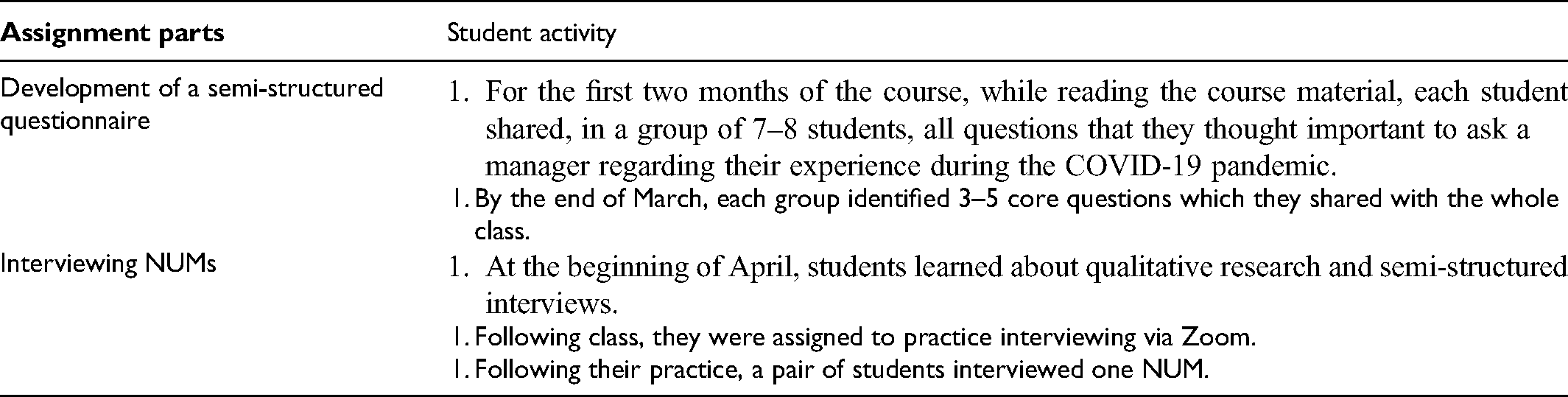
Instead of having an international week with faculty and students from the US, the Icelandic students were assigned to participate in a scientific study with faculty. With the goal of using this unique opportunity of experiencing and partaking in a major pandemic requiring global thinking and ensuring students’ knowledge and understanding of the management content of the course, it seemed ideal to use a prospective study on the work of nurse unit managers (NUMs) during the pandemic. The first author of this article had laid the foundations for the study with a team of experts in nursing administration. The assignment had two main parts as outlined in Table 1. Part one included students’ participation in developing the study questionnaire, requiring them to get acquainted with and reflect on the course content as well as to collaborate with other students in group discussions. Part two included learning, practicing, and carrying out qualitative data collection in an empirical study on nursing management during a pandemic. Due to COVID, all this had to take place online.
The assignment on the work of nurse unit managers (NUM) during a pandemic.
The benefits for students and faculty: A purposeful assignment with a lot of learning
Following finals, when all grading was done and students were out of school, a short survey was conducted among students to gather their thoughts and perspectives on participating in scientific research as a course assignment. Participation in the survey was 46% (11 out of 24). Prior to a research assistant interviewing students by telephone, information on the survey was sent to each student via email informing them about the survey and that participation was voluntary, anonymous, and equalled a signed informed consent.
The survey included four multiple-choice questions and two open-ended questions. Students were asked to what extent they agreed or disagreed with the statements seen in Table 2. All participants agreed or agreed to some extent that the assignment had served the purpose of the course, that they had learned a lot from the assignment, that they recommended using scientific studies as assignments in this course, and that they recommended using scientific research as assignments in courses on nursing and healthcare administration.
Students’ evaluation of their participation in scientific research as a course assignment (N = 11a).
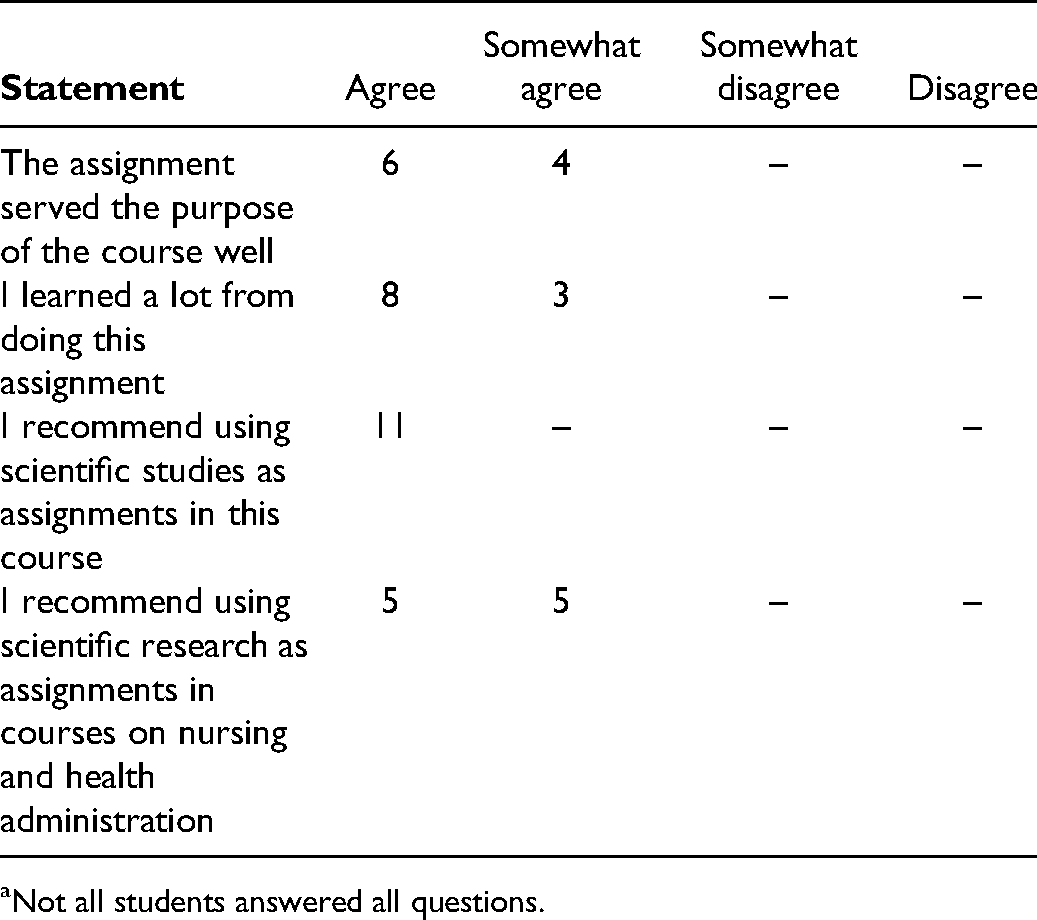
Not all students answered all questions.
The open-ended questions asked about what had been most valuable in this assignment and whether students recommended changes to the assignment. Students’ answers indicated that both the preparation for the data collection as well as the interview itself, had been of great value to them. Participating in the development of the questionnaire, learning about qualitative research and data collection, practicing their interview skills, and preparing for the actual interview were all valuable lessons. In their interview with the NUMs about their work and lessons learned during the COVID-19 pandemic, the course material was realized. Students used the word ‘practical’ about the assignment, referring to how their knowledge base from the course material came to life in their interview with a healthcare professional in an administrative role. The only thing some students recommended changing was to have the interviews with administrators face to face, although they also praised the advantages of online interviewing, such as being able to interview NUMs in different parts of the country. To sum up, this experience was positive and valuable for the students.
For the faculty, the experience of developing a research proposal, carrying out the research, and including students’ assignments within that work, was exciting and scary at the same time. The most challenging parts were that, to match the parallel processes of the course and student learning with the timeline of the study, logistics and learning needed to be in sync. To be of value and challenging enough, the assignment had to require students to apply the reading material, lectures, and class discussion, to the development of the questionnaire. The logistics of matching the timing of recruiting study participants with the time schedule of the course, planning the interviews, and assigning one NUM to each pair of students, all required structure, discipline, and a lot of communication. Through the collaboration of teacher and students, with the help of academic and clinical colleagues, and the willingness of the participating NUMs, rich data were collected from 13 NUMs. The benefits for the faculty were the good experience of integrating this scientific research into student learning and assignments, being able to carry out an important study at this crucial time, and to get rich valuable data in short time.
Conclusions
Combining student learning and scientific research in collaboration with faculty had multiple benefits for everyone involved. Not only did students gain knowledge about the work experience of NUMs during the COVID-19 pandemic, but they also practiced collaborating on an important project that required rigid scientific methods. Due to the emphasis on clinical services, nursing students may lack research literacy and understanding of the research process, which in turn may limit their understanding of the relevance of evidence-based nursing to clinical practice. This presents the challenge to educators to implement strategies in courses that prepare students to assume these roles. Even though the main goal of this research assignment was for students to gain understanding of how administrators dealt with their role and responsibilities during a pandemic, they also learned how to gain evidence in a scientific manner and understood more fully how scientific research relates to practice. Undergraduate research courses and internships, commonly use faculty–student collaboration,7,8 but as far as we know, there has not been much field-connected research collaboration in administrative graduate courses. This is to everyone’s benefit, faculty and students alike, as it builds a research community in the field as well as consideration for a career in academia. Combining research-based assignments of students with scientific research of faculty, adds value to the study for students, encourages their critical reflection and deepens their learning in the area of study. 9 Our data support this.
As identified by Flugelman et al., 1 the COVID-19 pandemic forced faculty to think out of the box and truly come up with innovative teaching methods that could work online. As far as the transition to online teaching is concerned, our experience and findings indicated good logistics and full use of the opportunities of online teaching, which is in concordance with findings of former studies on the essentials for successful online teaching at the graduate level. 10
A fruitful combination of student learning and scientific research in an administrative course in nursing is certainly possible during challenging times, such as in the midst of a pandemic. Both our own experiences and students’ perceptions of their experiences of participating support this. We encourage other nursing faculty to follow in our footsteps, by rethinking their courses and modifying them accordingly.
Footnotes
Acknowledgements
The authors acknowledge the students who participated in the course Management in healthcare in spring 2021.
Conflict of interest
The authors declare that there is no conflict of interest.
Funding
The authors disclosed receipt of the following financial support for the research, authorship, and/or publication of this article: This project was funded by a research grant from The Association of Registered Nurses in Iceland (grant number na).
