




Abstract
The aim of this study was to gain increased understanding about lived experiences of teenagers participating in PIS-divorce groups (programme for implementation of divorce groups in school). From the perspective of caring science and based on an ontological assumption of human interdependence, as well as earlier research that showed lack of consensus on the effect of divorce on children, the question that we felt needed to be asked was how teenagers experienced PIS-divorce groups, and the meaning of this experience in the time after. The methodological approach was phenomenological-hermeneutical. The sample is based on interviews with five teenagers. The analysis uncovered two themes: To be in between and To be there for each other. Teenagers viewed the offer of support as important. PIS-divorce groups enabled them to increase their understanding of their life situation. The caring science concepts of suffering, love, and interdependence have contributed to give new and deeper understanding to teenagers’ lived experience.
Introduction
Each year more than 30,000 children in Norway experience divorce. A Norwegian television programme entitled Divorced, broadcast in March 2015, discussed the issue of helping children cope with their parents’ divorce. 1 As divorce has become so common, one question that needs to be asked is whether teenagers have developed skills to cope with their new situation. 2 In a survey on dropping out of high school, 50 out of 100 youngsters cited their parents’ divorce, or the acquisition by their parents of new partners, as a reason for dropping out. 3 Divorce is one of the two most common reasons why children contact the Ombudsman for children in Norway. 4
It has been asked what family and society can do to help children cope with their new life in divorced families. 5 Based on caring science and the ontological assumption about human interdependence we live in a world depending on each other, and caring is in focus.6–10 Health is the aim of caring and can be understood as experiencing feeling good. 11
PIS-groups (programme for implementation of divorce groups in school), which are on offer in some schools will give children an opportunity to express and discuss their experiences regarding their parents’ divorce. Over a period of six weeks 4–6 pupils meet in the group for an hour, together with a special educator and the school nurse. After half a year there is a follow-up meeting. 12
Earlier research
Størkesen found that divorce groups for children were beneficial. 5 Egge further demonstrated that divorce groups were important for health promotion. 13 The experience of being together with other children who had experienced divorce had a positive health impact. The children found someone to identify with, experienced openness, and were supported by each other. Divorce support groups resulted in increased safety and confidence and enhanced understanding of divorce and of parents/step parents. Some children also managed to see a positive outcome from divorce. 13
Thuen observed that there was no consensus in the earlier research on the effect of divorce on children, a shortcoming which has resulted in ongoing heated debate about the extent to which divorce actually hurts children. 14 Researchers have agreed that the children of divorced parents reported significantly more psychological hurt; however, where parents cooperated with each other, children were then better able to find coherence and meaning in life. 14 Teenagers who experienced divorce after the age of 15 years did not suffer more than other children. 15 However, Ahrons found that 20 years after the experience of divorce, the quality of children’s family systems was affected. New relationships had challenged many. Therefore, she insists that children’s voices must be heard because they are different from adults. 16
Teenagers of divorced parents reported more symptoms of anxiety and depression, lower subjective experience of wellness and more school-related problems. 5 According to Amato et al., 17 earlier research18–20 has validated the hypothesis of ‘the good divorce’. Amato et al., however, refute the notion of ‘the good divorce’ as a panacea for ensuring that children thrive in divorced families. 17 Butler et al. found that children experienced divorce as an ongoing crisis and that they reported problems sourcing information about divorce, which could have helped them better understand their own situation. 21 According to Emery, the pain related to divorce never disappears, even for the most resilient children, and it hurts children if the parents do not allow them to have their own painful feelings. 22 Marschall found that children who moved between their parents weekly tried their best to adjust to their new situations and to develop strategies to cope with the loss and grief they suffered from the absence of the parent they were apart from. 23
Aim
The aim was to gain increased understanding about lived experiences of teenagers who participated in PIS-divorce groups.
Design and methods
A phenomenological-hermeneutical research method was adopted for the purpose of the study. This method gives the opportunity to increase understanding of a phenomenon, in this case the experiences of teenagers participating in PIS-divorce groups. The method was designed to afford increased insight into the meaning that emerges from the interviewees’ lived experiences.
Design
This is a qualitative study, based on semi-structured interviews. An interview guide containing two main questions and follow-up questions was used. The participants were asked about their experience participating in the PIS-divorce group in school and what the PIS-divorce group meant for them in the time after. Focus during follow-up questions was on what the teenagers found important to talk about.
Selection
To make the participants’ experience being interviewed as safe as possible, the selection was limited to pupils the interviewer as school nurse had met in earlier PIS-groups. The interviewer had not been in contact with the teenagers in the period between participating in the PIS-group and being interviewed. The pool from which the selection was made comprised 36 teenagers. Two boys and three girls, aged 13 to 15 years, who had participated in different divorce groups in the 4th to 7th grades in primary school, were interviewed. The interviews were conducted in 2014. Each interview lasted between 25 and 55 minutes, was tape-recorded and subsequently transcribed. All interviews, the transcription of which totalled 109 pages of text, were included in the analysis.
Ethics
The study was approved by the Norwegian Data Protection Agency (reg.38911/3/JSL). Written consent was obtained both from teenagers and the parent with parental responsibility. All parties were provided with verbal and written information about the study, which included a statement of the right of the children to withdraw from participation at any time. To ensure confidentiality, personal information, the tape-recorder, and transcriptions of the interviews were stored separately and kept under lock. The participants were given fictive names, regardless of gender. Quotes were not attributed to their authors. This was a follow-up study of an existing programme and, by virtue of the Regional Committee for Medical Research Ethics in Western Norway (12.03.2014 reg.2014/507) further approval was not required.
Data analyses
The phenomenological-hermeneutical method developed by Lindseth and Norberg was adopted for the study. 24 From a phenomenological perspective, the focus was on understanding the meaning of the lived experiences of the informants communicating with the interviewer. Narrative interviews were transcribed and hermeneutically interpreted. Initially, a naive understanding was formulated. Then the text was divided into meaning units that were condensed and divided into themes and sub-themes and compared with the naive understanding. Then the text was read again and a comprehensive understanding was formulated.
Findings
Naive understanding
Teenagers considered the offer to participate in a PIS-divorce group as important. They remembered a surprisingly great deal from their time in the group, even five years on. They spoke openly, and communicated with empathy on how the PIS-divorce group had influenced their own lives, and what it meant to be a child in divorced families. Everyone remarked that his or her daily life was affected by having divorced parents, even those who were unable to remember how their lives were before divorce. The teenagers related the different themes of the PIS-divorce group to their own real-life experiences. Even though the research questions were about the PIS-divorce groups all the teenagers in the interviews talked also about their own life experiences being a child in a divorce family. Pivotal issues were tough choices in relation to visitation arrangements, Christmas and vacations, new family members, loss, and thoughts of guilt. The teenagers needed to know that there was someone there for them, someone to talk to, and someone to listen to and to understand them. The teenagers stated that the PIS-divorce group offer was as important to middle school as to primary school pupils. They mentioned that they would recommend it to others and suggested that we extend the group offer.
Structural analysis
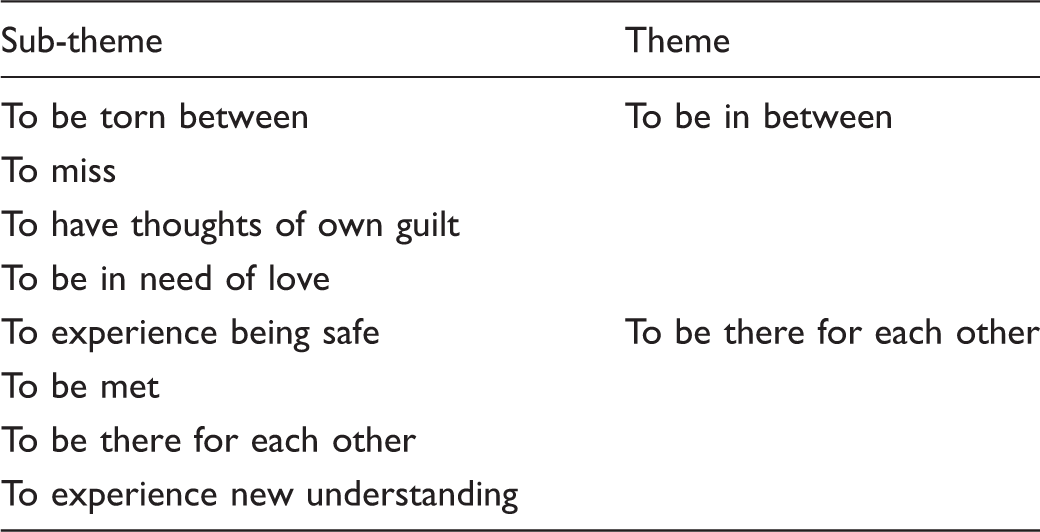
Results of thematic analysis, identification of sub-themes and themes for to be in between and to be there for each other.
Example of condensation-abstraction process for the theme To be in between.
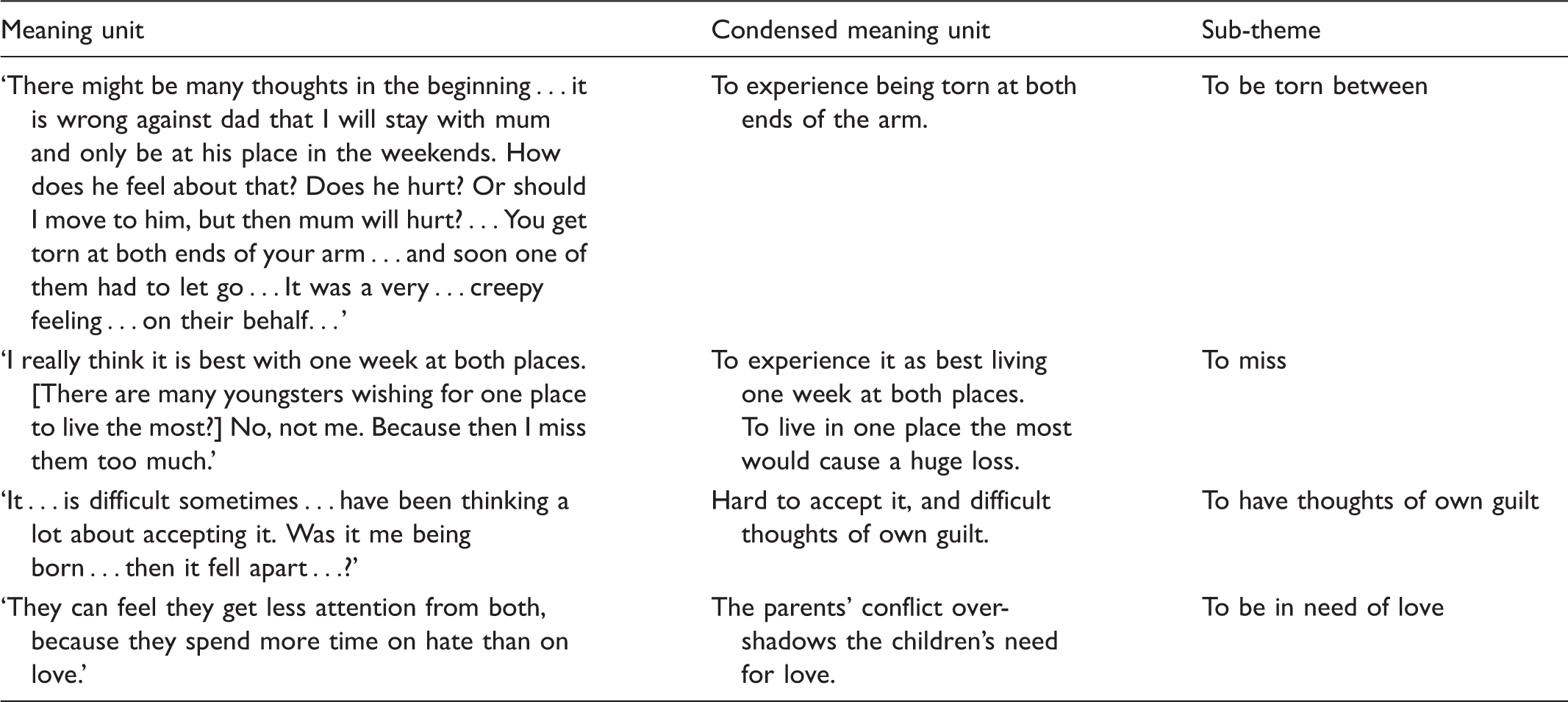
To be in between was about the teenagers’ thoughts on being torn between, to miss, to have thoughts of own guilt, and to be in need of love. Sub-theme one was To be torn between. One teenager said: ‘You become like a separated soul. One part belonged to the one [parent], the second part belonged to the other [parent]’.
The teenagers relayed their experiences on tough choices in relation to everyday life, holidays and vacations. Issues arising in this context related to the choice of home and contact arrangements, weekly packing, and coordination of holidays and vacations. Everyday life was affected for many years following the parents’ divorce but the consequences were experienced differently. One teenager said: ‘It affects everything in my life. I am back and forth. I almost live in a suitcase’. Another teenager remarked that everyday life had changed dramatically after experiencing a second divorce. Another described everyday life as quite normal but experienced the weekly packing of luggage a challenge. Choice of home and contact arrangements were tough. The task of choosing between parents, based on their own needs, was hard. One commented: ‘You are torn at both ends of your arm … and soon one had to let go … it was a very … like … creepy feeling … on behalf of them … in a way’.
One teenager found the experience of autonomy as both positive and problematic, venturing that dividing time between parents on a 50-50 basis was an optimal solution. Another interviewee had looked for a 50-50 arrangement for a long time and had finally experienced being listened to. A third teenager experienced relief in not having to choose between parents, as one parent had been given parental responsibility by the court. Another observed: ‘Hardest … that has been … trial … THAT time was very hard … it was creepy everything … I did not like it, I did not like that they were arguing’.
One teenager remembered very well that holidays were a contentious issue, and commented that they were still posing a challenge. In a similar vein, another teenager stated that he had never experienced a holiday together with one of his parents.
Sub-theme two was To miss. To choose one means to miss the other. To choose a 50-50 arrangement was a way of reducing deprivation. One of the teenagers remarked: ‘One misses life as it was, in spite of understanding that one’s earlier life is not possible’, and one said: ‘I do not know if I would have my parents together … but at the same time I would have them together. I would have a unity’.
Sub-theme three, To have thoughts of own guilt, was often mentioned in the narratives. One reported that she experienced it as tough thoughts: ‘Was it my fault?? THAT is what I often was thinking’, ‘I was very like … why … it goes intense … you go around and think … why? Was it me? Didn’t they want me? … Was that the reason why there was quarrelling?’. She remarked that participation in group conversation made it possible for her to quash these types of thoughts.
Sub-theme four was To be in need of love. On the topic of what children of divorced parents needed, one declaimed spontaneously: ‘LOVE!’ children need love from everyone, she emphasised. She added that children can feel that they are given less attention by both parents, as parents are paying more attention to hating each other. One teenager commented that it was difficult to understand what love was, in the way adults talked about it. Teenagers did not understand how parents could say they still loved each other, when they were with new partners.
The teenagers discussed why their parents divorced. Two reported that their parents did not fit together. Another said that his/her parents did not like each other anymore, and two cited multiple conflicts as the reason.
Also, the experience of their stepparents cooperating with their ex-partners gave rise to new questions. One commented: ‘Then I started wondering why my mother and father did not manage to cooperate … My mother did not manage to put words on it, neither did my dad’.
Another ventured that what was good also hurt: ‘It is really hard thinking of your parents not being … together. At the same time, I do not want to think about it either … then I would not have got new siblings and stuff’. Love is also about responsibility for parents and one’s new family. One of the teenagers said that you do your best to make it work. Another confided: ‘I do not want to leave my mother, even if she is … may be … not quite able to stand on her own feet’.
The second theme To be there for each other was about the group offer, how the teenagers experienced it, and what it meant to them. To be there for each other meant to feel safe, to be met, to be there for each other, and to experience new understanding. Sub-theme five, To experience being safe, was about feeling safe in the group, about safety in common experiences, and about the perception that feeling safe was the foundation for opening up to one another. To experience, rather than being alone in the world with one’s experiences, a sense of community with others in the same situation, was important for the teenagers. One expressed it as follows: ‘It is very okay going in such group, because … when you hear that others’ stories as are much the same as your own, then you get like … I am not alone … I have people who have experienced getting through the same’. The teenagers experienced a feeling of safety in the group and one commented: ‘I felt a little free when I got the opportunity to talk about it. There are really not many I can talk about it to’.
Some teenagers welcomed the fact that there were not more than six children in each group. They would have had more difficulty talking openly in larger groups. Also, some found participation difficult due to the presence of peers from their own school class, whereas one teenager felt safe knowing most of the other children in the group. Being there for each other was also about the possibility of speaking when feeling ready to speak, of not being pushed to speak, and of having the right to decide when and what to talk about. One teenager remembered first being worried about speaking in the group, but felt confident about speaking when she recognised her own experiences in the group themes. One said: ‘I remember that confidentiality was important, because then I could say everything, without anything muting me’.
Sub-theme six, To be met, was about having someone who sees you, talks to you, listens to you, takes you seriously, understands you, and communicates trustworthiness when you need it. It may be a friend, a parent, a teacher or a neighbour. What is important is, not the person’s profession, but that that person understands you and takes you seriously. Many people can see, if they only open their eyes: ‘What I think is important is that people should bother to care’ one commented.
One of the teenagers said: ‘parents think a little more of themselves … I understand it in a way, because it is them who get most affected’. Another participant had the experience where one parent understood that it was hard to be a child of divorce, whereas the other parent saw only possibilities and solutions in the situation.
One teenager ventured that when parents do not take their children’s needs seriously, it is important that other adults help the children to be understood. Another view expressed was that a school nurse should be more visible in schools, consulting the pupils regularly and enquiring about their welfare. One participant observed that when someone is suffering it is important that another cares. She reported an experience of feeling cared: ‘I see you are suffering. Do you feel like talking about it? … if not, you should know that I am here … Those are very nice words to hear’.
Sub-theme three is to be there for each other. One said: ‘The fact that you know you have someone, that you are not alone in the world’. The teenagers had thoughts about being there for each other, about talking and listening to each other, and about doing things together. All of them found it important having a good friend. The PIS-divorce group was emphasised as being important in primary school and as an option that should be on offer in middle school. The consensus was that individual conversations with a school nurse could not replace the PIS-divorce group, which gave them the experience of a sense of community with others in the same situation. The PIS-divorce group gave them meaning in their life for a time afterwards. One of them said it was difficult to encapsulate in words, but recalled that the group offer was comforting. The teenagers suggested more meetings over a longer time-period and more time to talk about themselves. A follow-up group half a year later was, according to the teenagers, also important. Everyone wanted to recommend the group offer to others in the same situation. One said: ‘I think it can help a lot of people coming out of the little shell they are hiding inside’.
Sub-theme eight was To experience new understanding. The teenagers spoke about questioning their past and about how participating in the group had resulted in increased understanding. One said: ‘It was much that dawned for me. I felt it became easier for me’. According to another, involvement in the group made it possible for the teenagers to move on with their lives, knowing that it was not their fault that their parents had divorced. Involvement in the PIS-divorce group also deepened the participants’ understanding, giving them both a feeling of relief and a meaning which was conducive to their health and enjoyment of life.
Comprehensive understanding and discussion
The themes To be in between and To be there for each other summarise the essence of the structural analysis and will be discussed applying a caring science perspective.6–10 Being a child from a divorced family may be understood as to be in between and is about experiencing being torn between parents, missing one, having thoughts of guilt, and being in need of love. Divorce is a common phenomenon in our society and narratives from both this study and earlier research14,16 show that divorce affects teenagers’ health. Both our professional understanding as school nurses, and the understanding of other professionals, affect how the needs of children of divorce will be met. We need to listen to children’s voices as their experiences differ from adults’ experiences. 16 Both this study and earlier research 21 show that teenage children of divorced couples suffer in their daily lives for many years following the divorce. Egge takes the view that the group offer can make it easier for teenagers to see the positive effects of divorce; 13 however, such beneficial effects were not evident in the teenagers’ stories. Only one of the teenagers referred to the positive experience of gaining new siblings, conceding, at the same time, however, that it was difficult thinking about parents not being together. There was also a thread of ambivalence and double thinking running through the teenagers’ stories which may be understood as being in between. To choose one means to relegate the other. Experiencing happiness by being with one parent means missing the other. Also, even where the parents do their best to cooperate, teenagers may still experience being in between. According to Amato et al. this may be interpreted as meaning that ‘good’ divorce does not necessarily mean that children are necessarily happy in divorced families. 17
In this study, choosing contact arrangements was, for the teenagers, to choose between their parents. To opt for a 50-50 arrangement was about reducing deprivation. Marschall described such measures as adaptation strategies children deploy to deal with the deprivation and grief caused by the absence of the parent from whom they are separated. 23
The single word ‘Love!’ used by one of the teenagers, represented the teenagers’ need for love. Tolerance, interest and caring are everyday expressions of love. 9 Also, assuming responsibility for one’s parents and new families may be interpreted as expressions of love. According to Arman and Rehnsfeldt, 9 love as a concept is not used in everyday language, but, in this study, the teenagers were concerned about love and expressed it in words. The youngsters commented, reflecting the view of Ahrons, 16 that parents were challenged by the acquisition of a new partner. As one noted, the children were liable to experience a diminution in attention from their parents when one parent acquired a new partner and conflicts between the parents increased: ‘they use more time on hate than on love’. One way to understand this experience is as being in between, not experiencing the love one is looking for.
The second theme was about the meaning of the group offer. The group offer increased the teenagers’ experience of meaning and coherence which, according to Dahlberg and Segersten, is important for children’s health. 11 As one interviewee said: ‘It was then much that it came clear for me. I felt it became easier for me afterwards’. Egge reported similar findings. 13
The teenagers’ stories also shed light on another way of understanding the value of the group offer. To be there for each other is the essence of the PIS-divorce group offer. It is about being met when you are suffering, having someone open their eyes and be willing to see you, and being taken seriously. It is, therefore, about the existential conditions of life and the revelation that we are all dependent on each other – it is about imparting an interdependence perspective. 6 Suffering is a natural part of human life, and in line with Rehnsfeldt and Arman, 10 suffering is compatible with health. What is important is that the suffering experiences are being met. As the teenagers say, being met makes you feel better, and this is important to health. 11
The teenagers emphasised that there are times when the children of divorced parents needed someone to talk to and someone to understand them. This need for a sense of community with others was understandable and in line with the views of Løgstrup 6 and Martinsen 7 that, as humans, we live in a common world, are dependent on each other, and play a part in each other’s lives. Egge noted that, for children who experienced divorce, community with other children produced the same result as a health promotion effect. 13
The teenagers also emphasised the need to feel safe in the group and to be able to share their thoughts and feelings with each other: ‘I felt a little free when I could talk about it. There are not that many I can talk to about it’. The group was, therefore, about trust. Løgstrup ventured that human life is about meeting each other in natural trust. 6
The teenagers described themselves as wondering about the past and about why life was the way it was. This concerned existential questions, which, some said, they were not accustomed to talking about with friends and parents. Martinsen commented that, in our busy society, there is no room for these types of reflections. 7 The group offer can be a forum for such conversation and reflection.
Another way of understanding the meaning of the group offer is in light of the ethics of life. According to Løgstrup, if your understanding of life is that other humans are important in your life, this understanding will translate into your taking care of the others in your life. 6 With regard to the teenagers’ understanding of their lives, their views were framed with reference to their family lives and the experiences of being in between. The teenagers emphasised the importance of being in communion with each other. They also understood that their parents had different levels of ability to understand and to take their challenges seriously, which they attributed to their parents’ experiences in life. These thoughts showed the youngsters’ depth and maturity, but also their need for understanding in their lives. The group offer was capable of providing a sense of community and experience of common meaning and understanding of life. 9
The teenagers’ experience of the group offer was about the meaning of being met. One way of understanding this is to reflect on the thoughts they shared about the loss of love and not being seen. May be talking about ‘being there for each other’ was the reason why the teenagers opened up to discuss their thoughts of what is missing in the experience of being in between, which came up as the first theme. The group gave them something they missed: love and being seen. This can be understood in line with what has been described earlier: that children of divorced parents reported significantly more psychological hurt. 14 Suffering has a health impact, 10 and the teenagers put words on the meaning of experiencing love and being seen when suffering.
Caregivers should be aware that, according to Løgstrup, 6 in every meeting between humans there is an ethical demand. When a person in trust puts more or less of his life in the hands of other people, then there is a demand for others to take care of the suffering human being. One could ask why caregivers do not see the one suffering. The teenagers point out their need of being met and experiencing dignity through their experiences being taken seriously: ‘There are many who can see, if they only open their eyes’. Maybe this is about taking their responsibility as a human in communion with another human.
Critical considerations
The purpose of using a phenomenological-hermeneutical method is to uncover essential meaning in the world. What we found in the interpretation of the text was not just one, and only one, meaning. 24 The questions about validity and reliability are different in qualitative than in quantitative research. In qualitative research the question focuses on the extent to which the researcher is consistent and aware throughout the research process. The fact that the interviewer had met the informants as a school nurse in PIS-divorce groups could have affected both the conduct of the interview and the interpretation of the results. To what extent it is possible to put one’s own pre-understanding aside could be discussed, but both when doing the interviews and in the process of analysis one was aware of these challenges. In the interviews the focus was on the teenagers’ experiences, and the interpretation of the text was from the perspective of caring science.
Conclusions
The study showed that PIS-divorce groups were viewed by the teenagers as an important offer. The study also brought to light new understandings of teenagers’ experiences of life. To be children from divorced families may be understood as to be in between, which means having ambivalent thoughts and contradictory feelings, to be torn between parents and to be in need of love. To be there for each other was the essence in the teenagers’ stories about the meaning of the group offer, which meant being safe, being met and experiencing new understanding. The caring science concepts of suffering, love and interdependence have contributed to new and deeper understanding of the teenagers’ lived experiences.
Footnotes
Funding
This research received no specific grant from any funding agency in the public, commercial, or not-for-profit sectors.
Conflict of interest
The authors declare that there is no conflict of interest.