



Abstract
Despite the prevalence of global migration flows from more developed to less developed areas, few studies have been conducted on this phenomenon. This research utilizes data recently collected in 2020 regarding migration intentions among residents of Hong Kong considering moving from Hong Kong to the Chinese mainland. Our study aims to understand the role of social networks and perceptions of destinations in migration intentions. The results suggest that social networks, perceptions of governance quality, and perceived knowledge of the overall development plan for destinations are significantly related to the intention to migrate from more developed to less developed areas. The analysis further indicates an indirect relationship where strong social networks enhance the perception of governance quality and the understanding of development plans to reinforce migration intentions. These findings underscore the complexity of migration dynamics and highlight the need for a nuanced understanding of migration drivers beyond economic factors.
Keywords
Introduction
We have seen an emerging migration pattern in recent decades, with people moving from more developed areas to less developed areas. According to a report from the United Nations Department of Economic and Social Affairs (UNDESA, 2020), about 92 million people moved from developed areas to developing areas in 2021, a figure that nearly doubles the 56 million recorded in 2000. In comparison, the migration flow from less developed areas to more developed areas, traditionally the focus of international migration studies, totaled only 11 million in the same year, which is roughly one-ninth of the volume of the flow from more developed to less developed areas (UNDESA, 2020).
Despite the large volume of migration from more developed to less developed areas around the globe, few studies have been devoted to this migration flow. Most of the research that has been conducted, largely based on qualitative case studies, focuses on lifestyle migration, whereby people move in hopes of improving their quality of life or to experience a different lifestyle (Cohen et al., 2015; Torkington, 2012). The emphasis of these studies is on consumption patterns, leisure activities, and tourism lifestyles (Åkerlund and Sandberg, 2015; Jaisuekun and Sunanta, 2021; Stone and Stubbs, 2007). Some even suggest that the migration flow reflects the intention of individuals to achieve self-realization (Benson and Osbaldiston, 2016; Oliver and O’Reilly, 2010).
There has been less discussion about the intention to migrate for employment from more developed to less developed areas. An exception is the work by Lai et al. (2022), focusing on economic-driven migration, which compared the significance of economic and non-economic factors related to personal characteristics. However, given the proliferation of social media and the less expensive and broad use of telecommunications, the intention to migrate from a more developed area to a less developed area can be shaped by individual social networks within the destination and perceptions of the less developed area, such as perceptions of governance quality and knowledge of development prospects. While the importance of these factors has been well documented in the literature on migration (e.g. De Haas and Fokkema, 2011), the application of this understanding is contested, as less developed areas are usually characterized by rapidly changing institutional arrangements and constant changes in the direction and flow of resources (Schaub, 2012). In such a dynamic environment, social networks in or information about the destination may become more important (Ferwerda and Gest, 2021).
In this study, we explore the ways that social networks at the destination, the perception of its governance, and the perceived knowledge of its overall development plan for the less developed area are related to the intention to migrate from more developed areas to less developed areas. The latter two factors address two important perceptions of the migration destinations: the perception of local governance and the perceived knowledge of the region's overall development plan. Our study goes one step further and suggests that these two factors are shaped by a third factor: the social networks of potential migrants in their intended destination. In other words, we argue that social networks in the destination have direct and indirect relationships with migration intention through the potential migrant's perceptions of the destination. Migration intention is widely considered as a reliable predictor of actual emigration within a two-year timeframe (McHugh, 1984; Tezcan, 2019; Van Dalen and Henkens, 2008). Our study is drawn from a survey conducted in Hong Kong to understand the intention of individuals to move to cities in the Chinese mainland within the Greater Bay Area (GBA). The GBA covers Hong Kong, Macau, and nine mainland cities near to Hong Kong and Macau in Guangdong province.
There are four advantages to studying this specific migration pattern: First, Hong Kong has a larger GDP per capita than any of the cities in the Chinese mainland within the GBA. In 2020, the GDP per capita in Hong Kong was US$46,323, while in Shenzhen and Guangzhou the figures were US$19,240 and US$10,690, respectively. As such, migration from Hong Kong to the GBA epitomizes the type of migration pattern of interest to our study. Second, despite being part of China, Hong Kong maintains an administrative border with the Chinese mainland under the “One Country, Two Systems” framework of governance. Hong Kong residents require documentation and approval to travel to, work, or live in the Chinese mainland. The same requirements apply to people traveling from the Chinese mainland to Hong Kong. Third, Hong Kong and the cities within the GBA are in close proximity. The farthest city in the region is about 193 km from Hong Kong, while the closest is only 28 km away. Therefore, our analysis will not be affected by variation in geographic proximity. Finally, migration from Hong Kong to mainland cities in the GBA does not involve factors of race or ethnicity, as the majority (92%) of residents in Hong Kong are ethnically Chinese (Census and Statistics Department of Hong Kong, 2022). Therefore, the analysis will not be tainted by racial/ethnic effects.
Drawing on data collected in Hong Kong in 2020 about intention to migrate to the GBA, our study shows that social networks, governance quality perceptions, and perceived knowledge of the overall development plan at the destination are significantly related to the intention to migrate from more developed to less developed areas. The findings further suggest that when taking into consideration the indirect relationship between migration intentions and perceived quality of governance and perceived knowledge of the overall development plan as mediated through social networks in the destination, all three factors remain significant. Overall, the findings on the direct and indirect relationships of social networks and migration intention suggest a strong relationship between social networks at the destination and the intention to migrate from more developed to less developed areas.
Literature review
Migration from more developed areas to less developed areas
To understand how social networks and personal experience in the destination and the perception of the destination are related to the intention to migrate from a more developed area to a less developed area, two unique features of less developed areas should be considered. First, as noted earlier, less developed areas are usually associated with constantly changing institutional arrangements that lead to changes in the flow of resources, rules, and regulations (Ogus, 2005; Stark, 1984). Second, in less developed areas, both formal channels and informal social networks are equally important for obtaining information and resources; sometimes informal social networks are even more important. It has been documented that in less developed societies, social networks can be critical to job search (Wahba and Zenou, 2005), income attainment (Bian, 2018), and mobilization of resources (Stuart and Sorenson, 2005). Such patterns, including the effect of guanxi (personal connections) on various aspects of social and economic outcomes, have been especially well researched in the context of China (Chen et al., 2013).
When confronted with these conditions, migrants from more developed areas, accustomed to stable institutional arrangements and clear sets of rules and regulations, feel more comfortable and safer if they have a larger social network, or even personal experience, in the less developed area to which they intend to move. Given the potential for rapid change, they are more likely to feel confident in their intention to migrate if they hold a more positive view of the local governance in the destination and aware of its development plans. In the following section, we discuss how this understanding of the less developed area helps to disentangle the relationships between migration intention and social networks, perception of governance, and knowledge of the development plan at the destination.
Social networks
It has been well documented that social networks help migrants reduce the social and psychological costs of adjustment (Massey et al., 1993). While weak ties can provide access to diverse information and opportunities (Granovetter, 1973), we propose that strong social ties are particularly crucial in the context of migration to less developed areas. We define strong social ties as social networks with friends, relatives, and family members. As Wellman and Wortley (1990) noted, social networks with friends, relatives, and family members provide emotional, financial, and social support. Migrants can obtain much needed information from network members who understand their unique needs. Migrants trust those with whom they have strong ties to provide guidance in navigating unfamiliar social norms and constant institutional changes (Amit and Riss, 2007). Bian's classic study about job search and guanxi in developing societies highlights the critical role of strong ties in the labor market fraught with institutional uncertainty (Bian, 2018).
Networks of strong ties based on friends, relatives, and family members are not the only social networks accessible to migrants. Beyond familial and friendship ties, migrants also gain from social networks developed during previous work experience in the destination (Beaverstock, 2005). With colleagues of similar occupational background, networks developed at previous workplaces in the destination can facilitate job searches upon return. This connection is important in a less developed area where employment information may not be obtained easily through regular channels. Furthermore, previous workplace experience in the destination suggests that individuals are likely to be familiar with the operations and institutional arrangements of specific occupations and even the general job market in the destination (Hu et al., 2022). Such information helps new migrants adapt, especially to the new work environment.
Finally, migrants’ social networks can benefit if they have studied in the destination. As alumni of the same academic institutions work in a variety of industries after graduation, alumni networks provide diverse job information from a range of industrial sectors (Poros, 2001). More than employment information, the cultural and historical knowledge gained during their studies arms migrants with the context needed to navigate the social landscape of the destination. Migrants may feel more confident in adapting to their new environment, despite frequent changes, when they already have some understanding of the symbolic structure of the society, which helps them be aware of the significance of various events and activities.
Having social networks in the destination (including strong-ties networks developed during previous work experience or previous studying experience in the destination) is positively related to the intention to migrate.
Perception of the quality of governance in the destination
The flow of migrants is affected by their perception of the quality of governance in the destination (Ariu et al., 2016; Giang et al., 2020). This is a crucial determinant of migration from more developed to less developed areas. Given that a less developed area may constitute an unfamiliar social and economic environment, and possibly a rapidly changing political system, the intention to migrate can be enhanced by a positive view of the local governance (Zhu et al., 2021). When they have a more favorable view of the governance in the destination, potential migrants expect that the area's economic, social, and political policies will improve, and that the issues they are concerned about will be resolved. For instance, studies have shown that the migration intentions of foreign Muslim students are shaped by their views of the governance of religious practices in destinations where they study (Sia et al., 2017). Such reasoning echoes the findings of Amuedo-Dorantes et al. (2015) that migrants’ perceptions of policies on parent–child separation by law enforcement in the United States affects unauthorized crossings by Central American deportees.
A more positive view of the quality of the governance of a less developed destination is positively related to the intention to migrate to that area.
Perceived knowledge of the overall development plan of the destination
Related to the perceived quality of governance, the intention to migrate can be influenced by the potential migrant's sense of familiarity with the overall development plan for the less developed area. Individuals evaluate whether they fit into the perceived overall development plan. They feel more confident in preparing for possible changes if they know the direction of those changes. Information about the overall development plan of the destination helps to reduce uncertainty about their adaptation. It provides a mental map for making sense of the future of the less developed area and, at the same time, making sense of their individual role within the larger development picture (Jaffe and Nebenzahl, 2006). However, it is important to point out that information obtained by potential migrants may not be accurate. Their information may be exaggerated or even fictitious. Yet, regardless of whether the information received is accurate, their evaluation based on the information received shapes their view of the future development of the destination.
Having more perceived knowledge of the overall development plan for the destination is positively related to the intention to migrate to a less developed area.
The indirect relationship of social networks in the destination and migration intention
Social networks in the destination can have an indirect relationship with migration intention by mediating the perception of the quality of governance and perceived knowledge of the development plan of the destination. Though such an indirect relationship is self-evident, we do not know of any study that has explored it.
Social networks at the destination can shape potential migrants’ perception of the quality of governance in the destination and their perceived knowledge of the overall development of the destination. A potential migrant's social network mediates between the two factors and migration intention in three possible ways: First, individuals who have social networks in the destination, whether through relatives and friends or through their own former experience, have more information about the destination. More information helps them form their views about the society, including the quality of its governance. Second, individuals’ social networks in the destination shape their views of the society in the destination by inevitably expressing opinions about the government during discussions. Members of social networks have ample opportunity to elaborate their views, and individuals considering migration have opportunity to ask for clarification. Such discussions shape the potential migrants’ views of the destination society. Sometimes information and discussion with network members may play a more important role than reading comments online or obtaining information from government materials. Third, with more information available, and through receiving opinions about the destination, individuals may be confident that they have a lot of knowledge about developments at the destination.
Based on these factors, we develop the following two hypotheses:
The relationship between a potential migrant's perception of the quality of governance in a less developed area and their intention to migrate there is positively related to the social network in the destination.
The relationship between a potential migrant's perceived knowledge of the overall development plan of a less developed area and their intention to migrate there is positively related to social networks in the destination.
Data and methods
Data
The data used in this article are drawn from a survey conducted in 2020 in Hong Kong. The survey interviewed 3500 ethnically Chinese Hong Kong residents aged 18 to 50 years old. Most workplaces enforce the mandatory retirement age of 60 in Hong Kong. The cutoff age of 50 in the survey was to prevent the inclusion of any Hong Kong residents considering migrating to mainland cities in the GBA for retirement. Respondents were limited to individuals who were ethnically Chinese and who were born in Hong Kong or migrated to Hong Kong before the age of 12.
Respondent-driven sampling was employed to overcome three challenges. First, most people in Hong Kong live in gated communities where public access is not allowed. Second, workers in Hong Kong usually work very long hours and are not always available to be contacted. Third, most people in Hong Kong use cellular phones and do not have land lines. It is common local practice not to respond to calls from unknown callers.
Data collection started with 56 seed interviewees. Each respondent was encouraged to recommend two further potential respondents. Each potential respondent was contacted; those who agreed were interviewed and were asked to recommend two more potential respondents. After seven such waves, about 3500 individuals had been interviewed. Calculations suggested that all major demographic variables had reached saturation. We calculated a weight (RDS-II) to ensure the inferred representation of the sample at the population level. RDS-II takes sampling probabilities and network size into consideration.
Variables
The intention to migrate is captured by the following question in the survey: “How likely is your intention to work and develop your career in mainland cities in the Greater Bay Area in the next five years?” Potential responses are: “very likely”, “likely”, “average”, “unlikely”, and “very unlikely”.
Our analysis focuses on three sets of factors: social networks in the migration destination, perceptions of the governance in the destination, and perceived knowledge of the overall development at the destination. To capture the social networks of respondents, we included variables to indicate whether respondents had immediate family members, relatives, and/or friends working in the Chinese mainland. We also included variables to indicate whether respondents had any work experience in the Chinese mainland, and whether they had received or were receiving any education in the Chinese mainland (0 = no, 1 = yes).
We included five questions to explore whether respondents had favorable views of the quality of governance in the GBA across five areas: social order, legal system, freedom of access to information, food safety, and housing affordability. These aspects were chosen because they are the key concerns that most Hong Kong residents have about living in mainland cities. According to a poll conducted by the Hong Kong Institute of Asia-Pacific Studies of the Chinese University of Hong Kong in 2018 (Hong Kong Institute of Asia-Pacific Studies, 2018), the top four concerns of Hong Kong residents about working in the GBA were access to information, food safety, social order, and transportation between mainland cities in the GBA and Hong Kong. Transportation between mainland cities in the GBA and Hong Kong is no longer a major concern, because there have been many developments in that area since the survey was conducted in 2018. A number of ports were opened, and hours of service were extended at the border between Hong Kong and the mainland. A high-speed train line from China was extended to a stop in Hong Kong. A major bridge was built to connect Hong Kong, Zhuhai, and Macau. As a result, travel between mainland cites in the GBA and Hong Kong has been enhanced substantially since 2018, and concerns about transportation have become less significant. Therefore, we did not include it in our list of questions about governance, but instead included housing affordability, a social issue that has received tremendous attention in recent years among people from all walks of life in Hong Kong. Possible responses to the questions were on a 5-point Likert scale, from 5 (“strongly agree”) to 1 (“strongly disagree”).
In addition, we included a variable to indicate respondents’ perceived knowledge of the overall development plan of the GBA. As many policies have been implemented to support development and to encourage Hong Kong residents to work in the GBA, knowledge about these and other proposed policies is important when deciding whether or not to move there. Respondents were asked about the extent of their knowledge of the overall development plan for the GBA. Their options were “very high”, “high”, “average”, “low”, and “very low”.
In our analysis, we controlled for a set of demographic characteristics: age, gender (0 = male, 1 = female), marital status (0 = other, 1 = cohabitation or married), whether they have children (0 = no, 1 = yes), and father's and mother's birthplaces (0 = neither parent born in mainland, 1 = one parent born in mainland, 2 = both parents born in mainland). We expected that the following characteristics would correspond to a higher intention to migrate to the GBA: being young single and male; being born in the Chinese mainland; having a low level of education; not having children; having parents that were born in the mainland.
We also controlled for the socioeconomic background of respondents, including university completion, self-perceived health condition (on a scale from 1 to 5, where 1 is “poor” and 5 is “very good”), occupation (0 = service-sector or low-skilled occupations, 1 = professional occupation), industrial sector of employment (0 = primary or secondary, 1 = tertiary or quaternary), monthly income level (0 = less than 20,000 HKD, 1 = more than 20,000 HKD 1 ), speaking Putonghua (Mandarin Chinese, the official language of the Chinese mainland 2 ), owning a home (0 = no, 1 = yes), and perceived social status (on a scale from 1 to 10, where 1 is the lowest and 10 is the highest). We expected that the following characteristics would correspond to a higher intention to migrate to the GBA: having better health, receiving lower income, working in a service-sector or low-skilled job, speaking Putonghua, having lower perceived social status.
Results
Table 1 presents the descriptive statistics of the variables included in the analysis. The results indicate a low intention to migrate to the GBA, with an average of 1.88 out of 5. This is somewhat surprising given the cultural similarity, proximity, and historical ties between Hong Kong and Chinese mainland cities in the GBA. Within the sample selection (N = 2934) of individuals of working age between 18 and 50, most respondents were born in Hong Kong with an average age of 37.2. As most respondents grew up in Hong Kong (79.22%), a substantial portion of them indicated that they did not have personal connections in Chinese mainland (87.03%), and the vast majority did not have any work or study experience in the Chinese mainland (98.45% and 99.25% respectively). A notable 87.2% of respondents reported never having traveled to Chinese mainland. The latter findings are surprising, as Hong Kong is located next to the mainland, many families have historical roots that can be traced back to the mainland, and there has been rapid development of economic activities with the mainland.
Summary statistics of weighted sample.
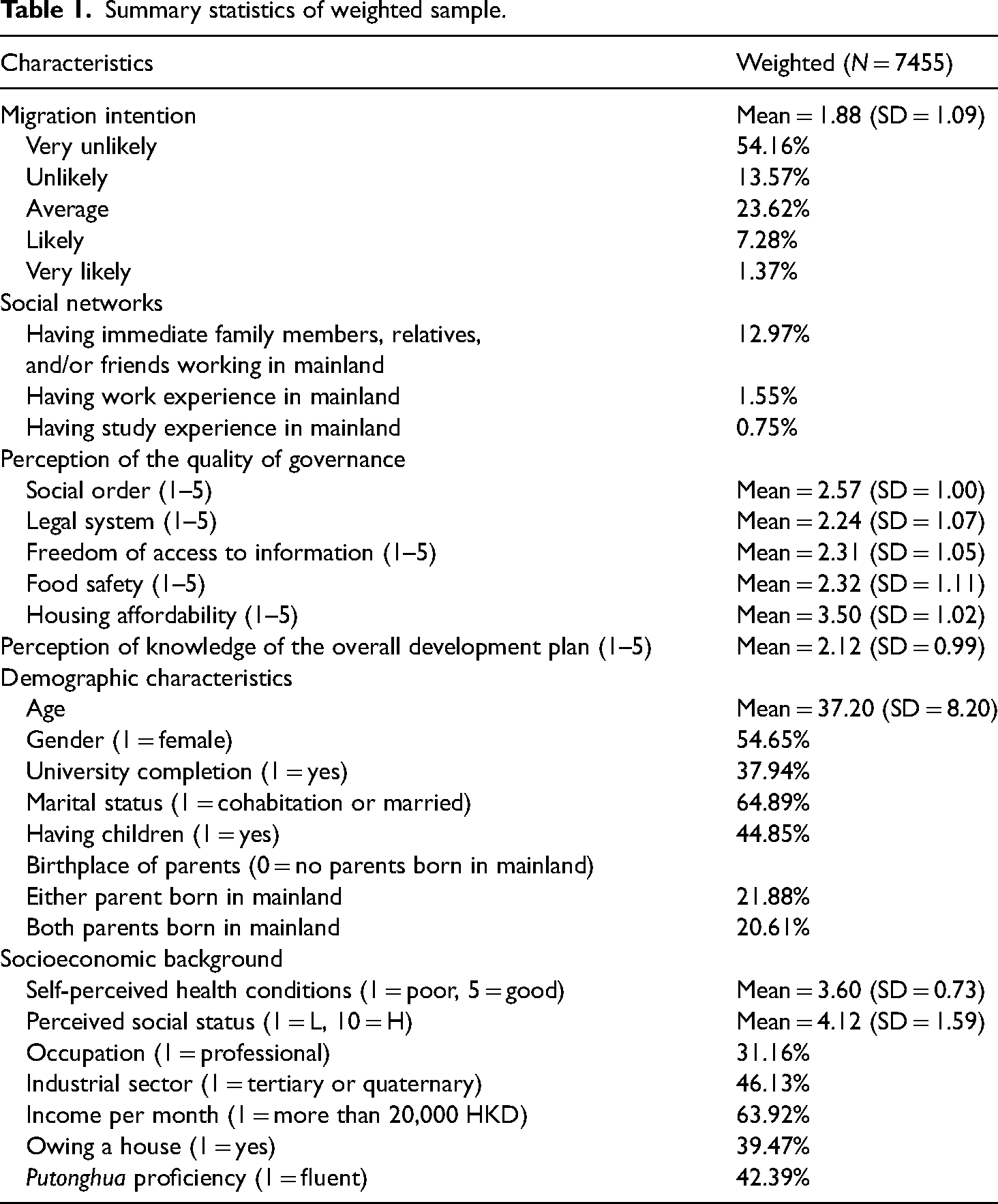
Respondents rated the quality of governance to be relatively low across four domains: social order (2.57), legal system (2.24), freedom of access to information (2.31), and food safety (2.32). The exception is housing affordability (3.5). In other words, most respondents do not have a favorable view of the governance of mainland cities in the GBA.
The incomes of the respondents were generally higher (63.92% had monthly incomes of more than 20,000 HKD) than the Hong Kong average (18,400 HKD per month in 2020). The reasons are that the group selected was individuals of working age, and no recent migrants were included in the sample. Older individuals and recent migrants often have lower incomes. While the majority of respondents were fluent in the local dialect, Cantonese (94.57%), approximately 42% were also fluent in Putonghua. Half of the respondents were married and reported having children.
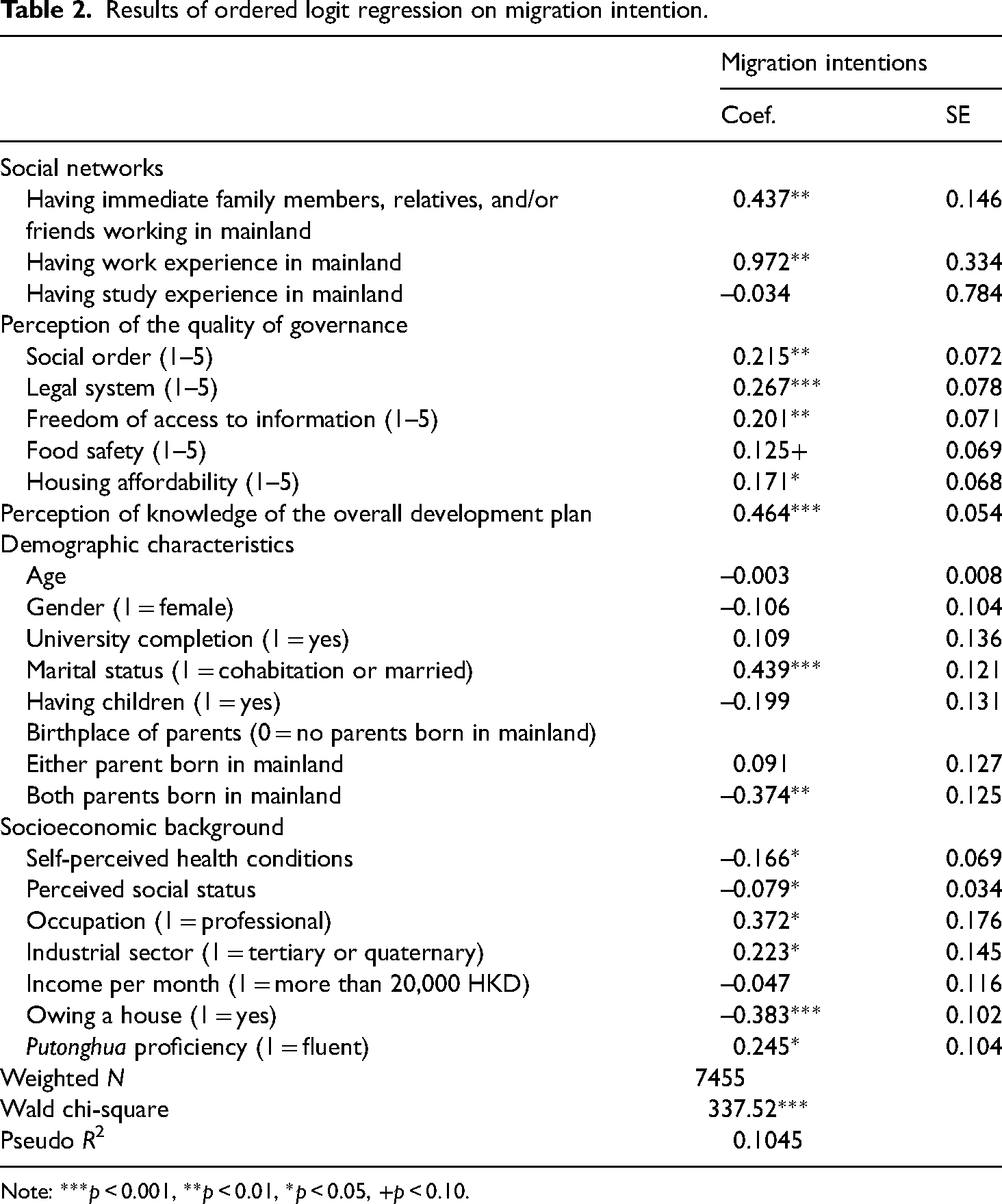
To provide an assessment of the relationships between migration intention and social networks in the GBA, perceptions of the governance in the GBA, and perceived knowledge of the overall development of the GBA, we conducted ordered logistic regression. Brant's test was performed and showed that the model meets the assumption of proportional odds. The model controls for the socioeconomic and demographic backgrounds of the respondents. 3
The results are reported in Table 2. All social networks, except study experience in Chinese mainland, were significantly related to the intention to migrate. The relationship of migration intention with work experience was much stronger than the relationship with having relatives and friends in the mainland. Findings also suggest that among all aspects of perceived quality of governance, only perceptions of food safety were not related. Finally, perceived knowledge of the overall development plan of the GBA region was positively related to the intention to migrate.
Results of ordered logit regression on migration intention.
Note: ***p < 0.001, **p < 0.01, *p < 0.05, +p < 0.10.
As for the control variables, respondents whose parents were both born in the mainland, who were single, had better perceived health, higher perceived social status, were not in a managerial position, and did not own a home had a higher intention to migrate.
Indirect relationship of social networks and intention to migrate
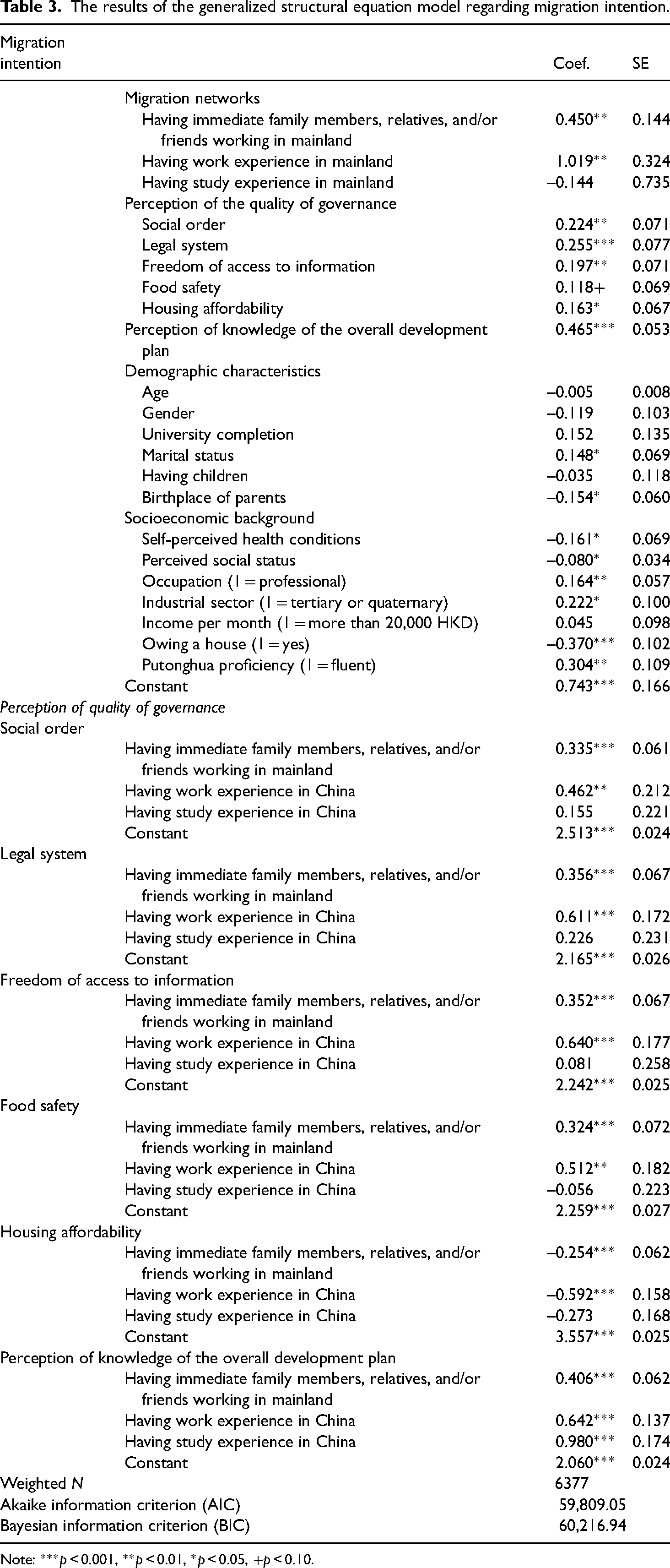
To better understand the complexity of the ways that social networks are related to the intention to migrate, we also explored the indirect relationship of social networks and migration intention through the perception of the quality of governance and the perceived knowledge of the overall development plan for the GBA. Table 3 reports the results of the generalized structural equation model (GSEM) that captures this indirect relationship.
The results of the generalized structural equation model regarding migration intention.
Note: ***p < 0.001, **p < 0.01, *p < 0.05, +p < 0.10.
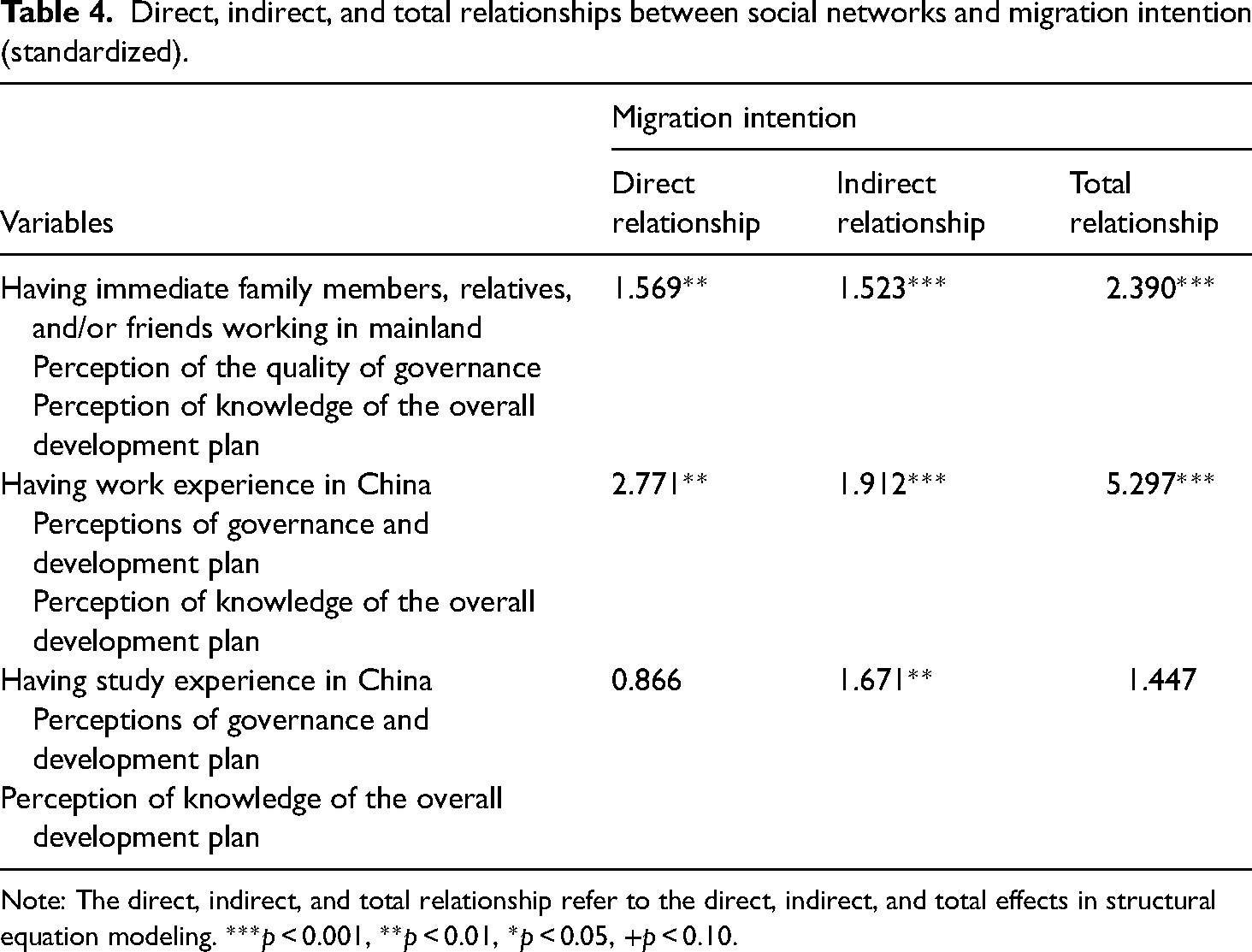
The findings show patterns similar to those reported in Table 2. They clearly suggest that though access to social networks in the destination was positively related to perceptions of the quality of governance and the perceived knowledge of overall development plan of the mainland cities in the GBA, all three sets of factors still maintained independent and significant relationships to the intention to migrate. The findings in Table 4 are based on the GSEM reported in Table 3. Taking both direct and indirect relationships together, social networks have a strong and significant positive relationship with the intention to migrate. 4 The indirect effects of having immediate family members, relatives, and/or friends working in the Chinese mainland and having study experience in the mainland are stronger than the respective direct effects.
Direct, indirect, and total relationships between social networks and migration intention (standardized).
Note: The direct, indirect, and total relationship refer to the direct, indirect, and total effects in structural equation modeling. ***p < 0.001, **p < 0.01, *p < 0.05, +p < 0.10.
Conclusion
With this study, we fill a research gap in understanding migration from more developed areas to less developed areas. We have explored how social networks in the destination and perceptions of the quality of governance and perceived knowledge of the overall development of the destination are related to the intention to migrate. As we hypothesized, all have significant and positive relationships with migration intentions.
We also employed GSEM to determine the extent to which these relationships hold when controlling for the indirect relationship of social networks and migration intention through the perception of the quality of governance and perceived knowledge of the development plan at the destination. Nevertheless, the findings suggest that the direct relationships between social networks and the perception of the quality of governance and the perceived knowledge of the overall development plan for the destination remain strong.
In addition to these initial findings, some others are worth further discussion because they have significant implications for understanding migration from more developed to less developed areas. First, among various social network variables, the relationship between migration intention and work experience in the destination is much stronger than the relationship between migration intention and strong ties from knowing relatives and friends in the mainland. These findings suggest that networks developed at previous workplaces at the destination are crucial for economic migration, not only for the intention to migrate from a less developed area to a more developed area, but also in the reverse direction. The reason is that workplace experience develops networks that are specific to a particular occupation or industry, and so can be very helpful in job search when individuals arrive at a new place. In a less developed area, both formal and informal channels are important for job search. In addition, past workplace experience at the destination implies that individuals are more familiar with the operations and institutional arrangements of a specific occupation or industry. As such, they may feel more confident in their ability to adapt successfully to the new place.
Second, although various social network variables are related to the intention to migrate, study experience is not. The insignificance of this relationship may suggest that respondents cannot retain relationships with friends they met at school. It also is possible that they realize that the culture they learn during their time of study may not help them adapt to the larger society after graduation. After all, having a job and surviving in the job market may be direct and important considerations.
Third, the perception of the quality of governance and the perceived knowledge of the general development plan for the destination are positively related to the intention to migrate. The findings suggest that the subjective dimensions of perceived good governance and perceived knowledge of the overall development plan provide a positive and confident evaluation of how the current society will improve and how well individuals might fit into the less developed society. Thus, the intention to migrate to a less developed area is not based only on current views of the destination, but also on confidence in its future development.
Finally, our findings highlight the direct and indirect influence of social networks on migration intentions. Social networks not only impact an individual's intention to migrate, but also play a significant role in shaping subjective perceptions that inform migration decisions. Social networks provide individuals with a vast amount of information about the quality of governance and overall development of potential destinations. As these factors are subjective, their interpretation can significantly sway decisions to migrate.
In short, we have provided a preliminary analysis of the intention to migrate to a less developed area from a more developed area. However, our study is about one specific migration flow, from Hong Kong to mainland cities in the GBA. Future research should explore other migration flows on other continents. Moreover, our study relates only to the general population. Future research should focus on the highly educated population, as they are the group that many countries want to recruit. Finally, we were limited by our data to exploring only associations; we were not able to delineate possible confounding effects. Future research should utilize panel data to overcome these limitations. As migration from more developed to less developed areas represents a substantial percentage of the overall global migration flow, more research to understand the flow is needed.
Footnotes
Contributorship
Cheng Chow conducted the research and data analysis with input and suggestions from Eric Fong. Both Cheng Chow and Eric Fong collaborated on writing the manuscript. Both authors have reviewed and approved the final version of the manuscript.
Declaration of conflicting interests
The authors declared no potential conflicts of interest with respect to the research, authorship, and/or publication of this article.
Funding
The research was supported by Strategic Public Policy Research Funding Scheme, Hong Kong Special Administrative Region of China (grant no.: S2018.A4.009.185).
