




Abstract
Programmer interns are a distinctive group of precarious laborers. They undertake the same jobs as junior programmers with formal employment, while suffering from high pressure and earning low pay. Still, they are convinced that only a long-term internship can keep them on the right track of professional career development. We explore their consent-making through six months of fieldwork in an internet company, and propose the “enterprising-self” game to explain their subjective orientations. In the enterprising-self game, programmer interns become accustomed to identifying themselves with a particular type of quantifiable labor product, for instance, the positioning of “their” sticky notes on company whiteboards and the expected “T-levels” that represent their employability in the industry, by which their enterprising self is a by-product. Programmer interns seems to believe that, rather than higher education, state-owned enterprises, or multinational enterprises, only domestic internet companies can help them attain their enterprising selves. Even though the supervisor–intern relationship and the “gender game” of masculinity performance constitute part of the programmer interns’ enterprising-self game, the essence of the game has never been challenged and in some ways is only being reinforced. Though only a few lucky employees can win the game by attaining promotion to the senior engineer or management level, most of them still get lost in the “periodic” and “imperceptible” time of life as a programmer, which is characterized by full devotion to the company, until the “35-year-old crisis”.
As revealed by Elster (1988), work provides many nonpecuniary benefits beyond a guaranteed income. These benefits include the opportunity for self-realization and thus both others’ respect and self-esteem, a social environment where one can escape isolation, structure for everyday life, as well as an escape from unabated and alienating freedom. However, precarious jobs challenge these benefits.
The term “precarity” harks back to Bourdieu’s description of the colonial working class in the 1960s (Cangià, 2018). Precarious jobs are the increasingly large percentage of jobs that are “insecure, low paid, and vulnerable to many forms of abuse” (Rodgers and Rodgers, 1989: 1). Jobs have become more precarious since the 1970s due to globalization, deregulation, and especially the rise of “post-Fordism” (Kalleberg, 2011: 1–3). We now hear about precarity in the news every day; it has become the condition of our time (Tsing, 2015: 20). Precariousness has even been presented as “a general principle of the human (and who counts as such)” (Neilson and Rossiter, 2005). In such precariousness, one’s economic productivity is prioritized, often at the sacrifice of one’s anticipated future (Anderson, 2010). As a result, nothing is guaranteed to those in precarious jobs. The more one works, the easier it is for one to become lost.
The internship is one of these precarious jobs (Allison, 2012; Standing, 2014). As Perlin (2012: 17–18, 23) pointed out in her book Intern Nation, interns are often asked to do “grunt work” such as cleaning toilets or serving hamburgers, not to mention the “long hours, low pay, and tight living conditions”. The very significance of the word intern, she continues, lies in its ambiguity. In contrast to this neoliberal approach, studies on interns in China tend to emphasize coercion over consent. Chan et al. (2015) and Chan (2017) dissected the student labor phenomenon under Chinese state capitalism. They found that companies, vocational schools, and local governments conduct joint “internship programs” to recruit large numbers of lower-cost and flexible teenage students as factory workers, as a means to increase profits. However, according to our observations, student laborers are ubiquitous across socioeconomic regimes in China. Many of them are even consenting white-collar workers in office buildings, not manual workers in factories. Programmer interns are typical of these “self-programming” laborers (Castells, 1996; Qiu, 2009). Like other student laborers, they are expected to work overtime, with minimum statutory wages or benefits, and worker grievances and anxiety are rampant. However, unlike their factory peers, they nonetheless anticipate promising futures in the internet industry, in which they have attained high income and social status. Programmer interns do the same work as formal employees, but their daily salary (usually 100–200 yuan, about 15–30 US dollar) is only one-fourth that of these formal employees. “Voluntary” overtime work is common. Getting off work at 2 a.m., cycling back to one’s dormitory alone, and sleeping five hours a night is the most common schedule for programmer interns when production schedules are tight. Interns nonetheless seemed to relish these challenges, stating that internships are a “serious business”. Otherwise, they would have “no options” in the annual post-graduation job hunt. Skilled workers like programmers have been called the “aristocracy of the working class” (Wang, 2011). Why then do they consent to long periods of work, for a fraction of the standard pay, as the prerequisite to their careers? This question will be answered in the following sections.
Theories of consent-making
The “making-out” game
The most influential theory for explaining worker consent has been the “making-out” game, a term coined by Burawoy (1979). This is an institution created to sustain subjective orientations, such as willingness to work, whereby the meaningless, boring, and coercive nature of work is transformed into a game. As a result, productivity is maximized, while minimizing the potential for labor–management conflict.
The making-out game is ideologically neutral, though it was initially created in capitalism. This gamification mechanism also applies to socialist regimes. According to Zhou’s (2013) observation, the “spontaneous” labor competition in the name of “Do It Yourself, Eat Well” (ziji dongshou, fengyi zushi), was a consequence of political mobilization in the mass production movement of the 1930s and 1940s in China. Through competition, the early cadres of the Chinese Communist Party (CCP) were encouraged to be competitive and enthusiastic in their farming work. Under these gamification circumstances, those who were left behind would try their best to catch up. As a result, workers would find pleasure in competition, which spread across the society of the CCP’s “revolutionary base areas”. The contradictions arising from the “compulsory ration payments” (an agricultural tax) were even temporarily resolved: The soldiers usually played with birch-bark cards during the break, shouting, “You took my ‘red pig’”, and “I got your ‘black sheep’”. It turned out that the soldiers were translating the symbols on the cards into the raw products in the competition. Within these leisure games, the interests of production through reclaiming wasteland were imprinted deep in their minds. (Zhou, 2013: 92)
Unfortunately, neither of these conditions explain programmer interns’ worker consent. Programmer interns receive “package” payments that differ only according to the enterprises they serve. In other words, their salary is not directly linked to their technical competence. The number of lines of code, or bugs in their code, also do not serve the purpose of determining remuneration. In practice, no enterprises attempt to quantify these as reliable and enforceable criteria for quantifying piecework. Furthermore, even if programmer interns can “get a new degree” or “develop a personal brand” by building their resume, increased employability is ultimately an intangible goal (Chertkovskaya et al., 2013; Leonard et al., 2016; Vallas and Christin, 2017; Vallas and Hill, 2018). Moreover, a more impressive internship resume never guarantees a better, formal job. In short, the making-out game and the gamification approach in general cannot explain all of the programmer interns’ consent.
The gender and boss games
The incentives behind the making-out game may transcend money and fame. Based on Burawoy (1979), Game and Pringle (1983), Gottfried and Graham (1993), and Pringle (1989) reject the assumption of a homogenous work culture along gender lines. According to Gottfried and Graham’s (1993) observations of a Japanese automobile assembly plant, men derive job satisfaction by handling “big parts”, while women work primarily with “many small parts”. In a daily ritual of hegemonic masculinity, workers adopt a “manly” posture, challenge each other to races, then joke by boasting about their respective performances. Therefore, capitalist production is maintained as a well-oiled machine. This was later called the “gender game”.
As workplace culture for programmers is dominated by masculinity, gender is a powerful perspective. Programmers are typically a male-dominated occupational group. 1 As Wright (1996: 86) puts it, programmers display aggressive technical self-confidence and the hands-on capacity for success. They also define professional competence in hegemonically masculine terms, and devalue women’s gender characteristics. In typical “male breadwinner gender contract” countries, such as Germany and Japan (and also China), females are most likely to do part-time and temporary work, especially during their marriage and childbearing years (Gottfried and Hayashi-Kato, 1998; Gottfried, 2003). Though this is not necessarily the case in other cultures, the male-dominated programmer interns themselves may have inherently conflictual senses of the gender game. Furthermore, as Connell (1995: 76) points out, hegemonic masculinity “is not a fixed character type, always and everywhere the same. It is, rather, the masculinity that occupies the hegemonic position in a given pattern of gender relations, a position always contestable”. It has been found that some programmers in Silicon Valley who are married with children opt to separate themselves from “frat boys” and “locker room guys” who are hostile towards women. Still, they need to be technically capable and devoted to their work, as well as maintaining relationships and fulfilling family needs, in other words, to be the “go-to guys” (Cooper, 2000). In any case, the gender game approach is limited.
Another related concept is the “boss game”. The boss game implies that one’s “making out” in the immediate present is undertaken for future career development (Shieh, 1990; Yang, 2010; Zheng et al., 2015). Mears (2011: 49, 116, 163) found that most London Fashion Week designers were unlikely to pay first-time models. Rather, they would merely “trade” them leftover samples from past seasons. Meanwhile, models would even be willing to lose money to work for magazines, because they would bet that the symbolic capital derived from these working opportunities would boost their profiles over the long-run. Working “for free” here is interpreted as working “for myself”—that is, as vital to securing future work. This happens in the digital economy as well. In early 1999, 15,000 “volunteers” worked for free for America Online (AOL), helping it to generate at least 7 million USD in monthly profits (Terranova, 2000). At present, several industries in the digital economy require multiple unpaid internships as a de facto requirement for a paid position. Sadly, interns consider these to be “training opportunities” (Neff, 2012: 158). This all echoes the conclusions of Perlin (2012), discussed above. Nevertheless, few programmers have succeeded in starting up their own businesses and becoming real bosses. There is also a saying in the industry that, “not a single internet company boss has ever written code for a living” (Yan, 2005, 2006). Therefore, while business skills are an inevitable component of masculinity for Chinese men (Louie, 2002), the unattainable nature of the entrepreneurial aspect of the boss game precludes it from explaining programmers’ consent, especially in their “introductory” intern stage.
However, it should be noted that though the extent to which games motivate programmer interns to consent is unknown, there should be terms that are sensible enough for them to accept high-pressure, low-paying jobs.
Relational work and free labor
An extensive literature explores forms of consent from the perspective of boundaries between intimacy and economic exchange; the most influential is “relational work theory”. Zelizer (2005, 2012) reminds us that we cannot view economic activity and intimate relations as two separate spheres hostile to each other. In relational work, she continues, “for each distinct category of social relations, people build a boundary” and “designate certain sorts of economic transactions as appropriate for the relation, bar other transactions as inappropriate, and adopt certain media for reckoning and facilitating economic transactions within the relation” (Zelizer, 2012: 146). Thus, developing relational work requires effort in “establishing, maintaining, negotiating, transforming, and terminating interpersonal relations” (Zelizer, 2012: 149). Therefore, consent is embedded in relational infrastructures, such as gifts, favors, perks, and “simple” romantic relationships that generate the idiosyncratic incentives that prompt people to work for free; this is exemplified by the female nightclub workers in Mears’s (2015: 1107) study. In return, this “relational infrastructure” is redefined by their labor as “leisure and friendship”. The presence of money even threatens to cross a symbolic boundary into the disreputable terrain of sexual exchange (Mears, 2015). As Zelizer (1994) puts it, cash is not the most important signifier of worth in this case.
In China as well, relational infrastructures are employed to produce intern laborers’ consent in cultural industries, through the so-called “tutor system”. As a tutor, a formal employee acts like a “close friend” and “life coach”, caring about whether interns have argued with their boyfriend or girlfriend, driving them to buy groceries, and providing them with free passes to events (Jia and Zhong, 2018). The traditional Chinese mentoring system in the handicraft industry is another example of relational work. Not only does this relationship require intermediary acquaintances for guarantees and introductions, but in addition to formal labor relations (including free labor for a period stipulated by contract), there are also life-dependence relationships, such as the mentee’s love life—these matters would fall under the purview of the mentor’s “family obligation” to their mentee. This tradition is reminiscent of the danwei (work unit) mentoring system in the socialist era (Fu and Qu, 2015; Peng, 2003).
“Mentees led by a skilled mentor” (shifu dai tudi) has been an integral means of training programmers ever since the beginning of the internship age in China. Theoretically, the possibility that their working consent derives primarily from this relational work cannot be ruled out.
The three theories discussed above each provide insight into the issue of programmer intern consent in China. We will depart from them here, and delve into the field where programmer interns work, witnessing their words and deeds. Then, we will bridge the theoretical and empirical resources to understand their subjectivities in this consent-making.
Our fieldwork site
China’s 800 million internet users and 788 million mobile phone users are the bedrock of its internet economy. Programmer interns are found in all kinds of internet companies. Although the structure may change over time, our programmer informants tell us that Chinese internet companies are a typical “jungle society” (see Figure 1). At the top are the “BAT” companies (tech giants Baidu, Alibaba, and Tencent), which are “every programmer’s dream”. These are followed by the highly competitive “second-tiers”, which generally include research-oriented companies with strong technical capabilities, such as Face++; the emerging unicorn “TMD” companies (Toutiao (ByteDance), Meda (Meituan-Dianping), and Didi Chuxing); established portals, such as Sina and Sohu; and the tail end of the BAT companies, which includes Baidu Maps and Netease Games. The “second-tiers” cannot compete with the BATs in terms of capitalization, yet they are still attractive to programmers, since these companies have the potential to become top-tier companies (ByteDance is an example of this; it is generally understood that it has now replaced Baidu and become the new “B” in “BATs”). At the bottom are small and medium-sized internet companies like Dragonfly FM and 4399. There are also state-owned enterprises (SOEs), such as Neusoft and Kingdee, which are too complex to be discussed here. Regardless, they would not be the first choice for most internship-seekers.
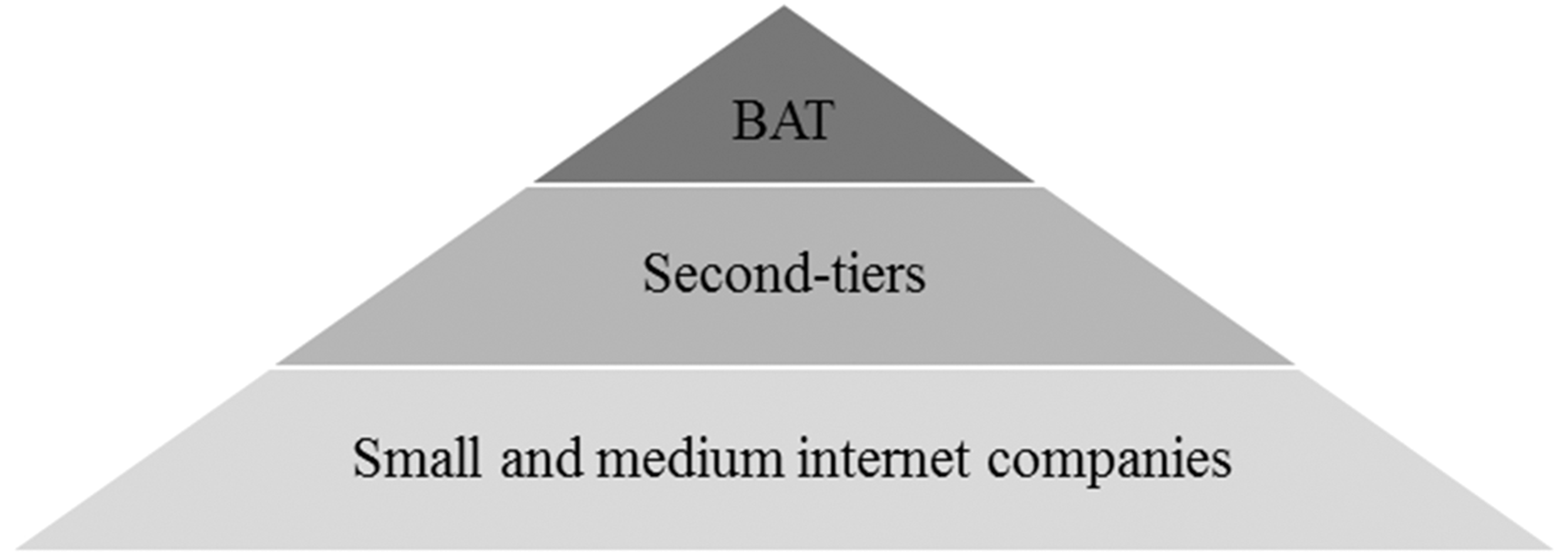
The “jungle society” of the Chinese internet industry.
We chose to conduct fieldwork in the “second-tier” of the Chinese internet industry to maximize the diversity of the causes of consent. Our fieldwork site is a food delivery company that we refer to as “Weixun” (a pseudonym), located in “B city”. Food delivery is the most important component of the “lonely economy”, which targets single men and women in big cities as potential customers. At the same time, it has been the fastest-growing sector of China’s internet economy in recent years (She, 2018). According to the “2018 Lifestyle Consumption Trends Report” by CBNData and Koubei, food delivery orders grew 141% in 2017 over the previous year, with a 98% increase in registered users (CBNData and Koubei, 2018). All of this business maintenance and expansion requires the hard work of a workforce of programmers, including front-end (FE), research and development (RD), quality assurance (QA), operations (OP), database administration (DBA), and infrastructure (INF).
Weixun has about 3000 formal employees, in various divisions such as R&D, product development, marketing, human resources (HR), and finance. As a typical IT company, the programmers are the company’s highest-paid and most essential employees, numbering 500 to 600, and occupying two massive, but still overcrowded, offices. There are two restrooms, both for men, near the programmers’ offices, which is indicative of the office’s sex ratio. The company’s working hours begin at 10 a.m., but employees are still showing up at 11 a.m.; close of business is at 7 p.m., but the lights are still on as late as 2 a.m. For years there have been 20 to 30 R&D interns at Weixun; the internship is about three to six months in length, but after joining the company, they still have to participate in a “180-day training program” 2 before being offered a job. The interns receive 150–200 yuan (about 20–30 US dollar) per day, far less than the remuneration for formal employees. Still, both groups shoulder the same work.
The second author (Yang) entered the field as an HR intern at Weixun, with the aim of gaining better access to the interns, and an insight into the company’s management system. With the informed consent of the department head, Yang started her six months of fieldwork. Beyond participant observation, Yang conducted in-depth interviews with 20 programmer interns (see Table 1). During the fieldwork, Yang and the first author Wang regularly communicated with each other through fieldnotes. Wang provided the theoretical framework and wrote this manuscript.
Key informants.

Notes: 1. Chinese universities also have a pyramid structure. The most selective are the “985” universities, followed by the “211” universities. Below these are the “ordinary” universities, there are also second- and third-tier universities. 2. DBA: database administration; FE: front-end; INF: infrastructure; OP: operations; QA: quality assurance; RD: research and development.
3. * = participant is female.
The “enterprising-self” game
Unlike the making-out game, the gender game, or the boss game, we call the rationalization of the high-pressure, low-paying professional lives of programmer interns the “enterprising-self” game. As Rose (1992: 146) denoted in his essay “Governing the Enterprising Self”, the enterprising-self is “a calculating self, a self that calculates about itself and that works upon itself” to “better itself”. Mears (2011: 116) employed the same term to describe how models attribute their success and failure in the market to personal responsibility. This responsibility-taking phenomenon applies to China too. Especially since the mid-1990s, the image of the enterprising self has been shared by many Chinese youths. They accept personal responsibility for their career-building failures, and practice self-control (Yan, 2010). However, we call it a game because while the programmer interns mock the perceived uselessness and ruthlessness of meritocracy in universities they apply the same identity politics and skill-enhancement logic to rationalize the “jungle society” of the internet companies with which they are affiliated. In short, they are calculating on the companies to improve their positions in the pyramid. Their own competence is irrelevant.
Conscience and the making of “serious business”
Regarding the motivation for the internship, a frequent response we heard was “how can I get a job without an internship?” Some even said that the internship was their “occasional burst of conscience” and that they were not “that deprived”. The truth, however, might be similar to what W05 told us: “Most university students go to internships, except for those who are not able to”. For them, the internship is a necessary step from the “ivory tower” of higher education to the real world, and it is “serious business”. This begs the question: what is “serious business”?
First of all, though all programmer interns retain their student status, most expressed dissatisfaction with their university education: The knowledge you learn in university is quite old, and I wonder if you have the same feeling … that no matter the textbooks or technical instructions … the material has not changed for many, many years. (W12) What I have learned in class, won’t be used … over the next 30 years. That it is outdated is not a big problem for me, the simplicity is. Every time I program, I feel like I am playing with toys. They are too far from the real practices; they can never be applied. Thus, I convinced myself, I have to see the real thing myself before beginning [formal] work. (W15) Taobao … can withstand millions of clicks on “Singles’ Day” [an annual “Black Friday”-style shopping event]. In universities, by contrast, their registration systems are so easily crashed during course-grabbing. Even if [Taobao and the universities] apply the same technology, no one [at the universities] can tell you how it works. (W08) There was one guy who interned in a network security company. After graduation, this guy had two choices: one was a small and unknown startup, the other was a famous SOE. Ultimately, he chose the SOE. The wages and benefits were indeed good, and the career trajectory was even promising. After several years, however, the guy finally couldn’t stand it any longer … So that guy wrote a small program for logging data that was typically logged manually. The program surely saved hours of stupid work. As a result, the guy would kill the time it had saved by writing novels. His boss eventually found out his secret. The automatic input program was unacceptable to the boss, and that poor guy was scolded. That guy has now learned his lesson: in an SOE, no suggestions should be proposed in the first place. In those years, there was a small, unknown startup that grew rapidly. It offered that guy a network security position. That poor guy was still hesitant. Then, the startup was acquired by Alibaba Group which is now famous for its product Alipay. At the age of 40, that poor guy finally quit the SOE, unmarried. The only job left to him was software testing in Hangzhou, with a monthly salary of 8000 yuan [about 1200 US dollar].
Another clue is that we did not hear these stories from those who had actually interned at SOEs. One of which was W06, who complained that there was indeed a culture of delays in SOEs, but who did not repeat these tales: “I spent a whole week (in the SOE) on just a couple of webpages. It was always unhurried”. W11 corroborated this with his experience: “The reason I left [the SOE] was I had no work to do”. In contrast, they all believed that the companies at which they were working were good: “[I must] constantly communicate with other colleagues about requirements, bugs, and interfaces. Requirements may change at any time, and I have to stay competitive. If they have any new requirements, they may need me to add them immediately, or remove the inappropriate ones”(W11). Indeed, in this sense, the culture of delays in SOEs is once again seen as akin to “playing house,” in contrast to the culture of efficiency in internet companies. As W20 confessed, “I would feel sorry for myself if I had chosen to work for a SOE”.
Multinational enterprises (MNEs) are also labeled as inefficient: MNEs are “hoggeries” [yangzhu, lit. “pig-rearing facilities”]. All that matters is … the statistics. Even in the IT division, the majority of the job is preparing the presentation … every day. The working conditions are good. Business trips and hotels, taxi commutes, are all covered by the company. The problem is there is no competitive pressure, it’s just like a hoggery. (W06)
Sometimes, subjective orientations are explained in line with the so-called “socially adaptable competence” (shiying yu shehui de nengli): The graduate internship is more valuable for our major … At the undergraduate level, we were not very familiar with real society yet. Thus now we have to go out [for an internship] to “see the world” [jianshi yixia shimian], and develop our socially adaptable competence.
“My project”
After they get an internship in an internet company, the motive of improving their technical competence and “socially adaptable competence” is put aside. Instead, they enjoy themselves in their project. Or, in their words, “my project”.
In “their project”, their own code will always be used. “That’s the best part for a programmer” (W01, W07, W10). Otherwise, it would be “another’s project”, which is the typical arrangement in university education: In university labs, we would write locally, on “local host” for convenience when starting out … Because the supervisor would coach us during the coding process, we rarely do the kind of work that takes alert thinking … and there will still be parts of the code that you have never used before. (W02) I should have done my research plan last December. I have absolutely no idea, and I’m worried about it. My supervisor told me, “Just write anything, because you will have to revise it anyway” … This year, before I started looking for a job, I thought I needed to finalize my thesis with my supervisor. Surprisingly, my supervisor asked me to finish his project first. Everyone in my lab was busy completing the supervisor’s projects and everyone ended up with no time to write their theses … The good thing is that this is okay for getting a degree. Finish the project, put it into a template, and write it up. That’s it! Of course, there needs to be some contribution to the field, the workload also has to be recognized … But this year we have a new bullshit rule: everyone has to earn at least 100,000 yuan [about 15,000 US dollar] for the lab before graduation. The supervisor assigned us to make a “home button” for a program. He said it was okay one moment, but then asked us to change it the next … I tried to persuade him that it would be stupid to change it, from both the user’s and the developer’s perspective. Guess what he said? He was so impatient, and threatened me, “Are you going to quit?”
Once contracted, the interns are assigned to one or several mentors (shifu) at Weixun who will stay with them throughout their internship. Most mentors are young formal employees or team leaders. They are responsible for assigning work to the interns and checking their code. Of course, the reciprocal exchange is that they can assign any work they don’t want to do to the interns. This mentor–mentee relationship is primarily so that the company can minimize bugs in the interns’ code. However, many interns are naive and treat this relationship as intimacy. As W08 said, mentors are like family members: Mentors will always be with you, reading your code, over and over again, constantly telling you what the errors are, which ways of writing code are childish, and what the code is supposed to look like … [The mentor] will coach you as if you were his or her own younger brother, and tell you everything he or she knows, as well as information about the company’s technology. And you will become familiar with all the protocols of the company little by little, too. This is what you can never learn on your own! And mentors were once coached by other mentors. Generally, if he told me how to improve one time … he can leave it to me and never get bothered. [It’s also] my attitude as a good student. It would be too much to ask mentors to help you again and again on “your project”.
As the name implies, a “stand-up meeting” is a group of seven or eight programmers who hold a simple meeting with just a whiteboard and several sticky notes. The essence of the “stand-up meeting” is the quick assignment of working tasks, as well as communication about any problems they have faced. The “stand-up meeting” usually takes less than fifteen minutes. It has been interpreted as a part of the efficiency culture in internet companies. These meetings typically require attendees to provide a brief of their progress, their schedule for the day, and what obstacles have been encountered. Even the language in the briefing must be “normalized” (i.e. shortened). All of this is in sharp contrast to the lengthy meetings in SOEs and universities.
In a “stand-up meeting”, participants’ sense of self is minimized, at least verbally. Still, their existence can be restored, materially, on the whiteboard. The secret lies in the sticky notes. During the briefing in the “stand-up meeting”, presenters move the notes to the next column to visualize their progress. The whiteboard can stand in for the sub-system on which the team is working, while the sticky notes represent the programmers themselves, including the interns. In Figure 2, the header of the whiteboard labels tasks with statuses such as “Pending”, “In Development”, “Online Commissioning”, “Testing”, and “Problems”. Each sticky note is marked with task details, the programmer in charge, and which department is responsible for the task. This is how they cooperate. In their words, it is a “team fight”. 4 Thus, it is explicit who is doing a good job and who is slowing the whole team down as a “piggy teammate” (zhu duiyou). 5
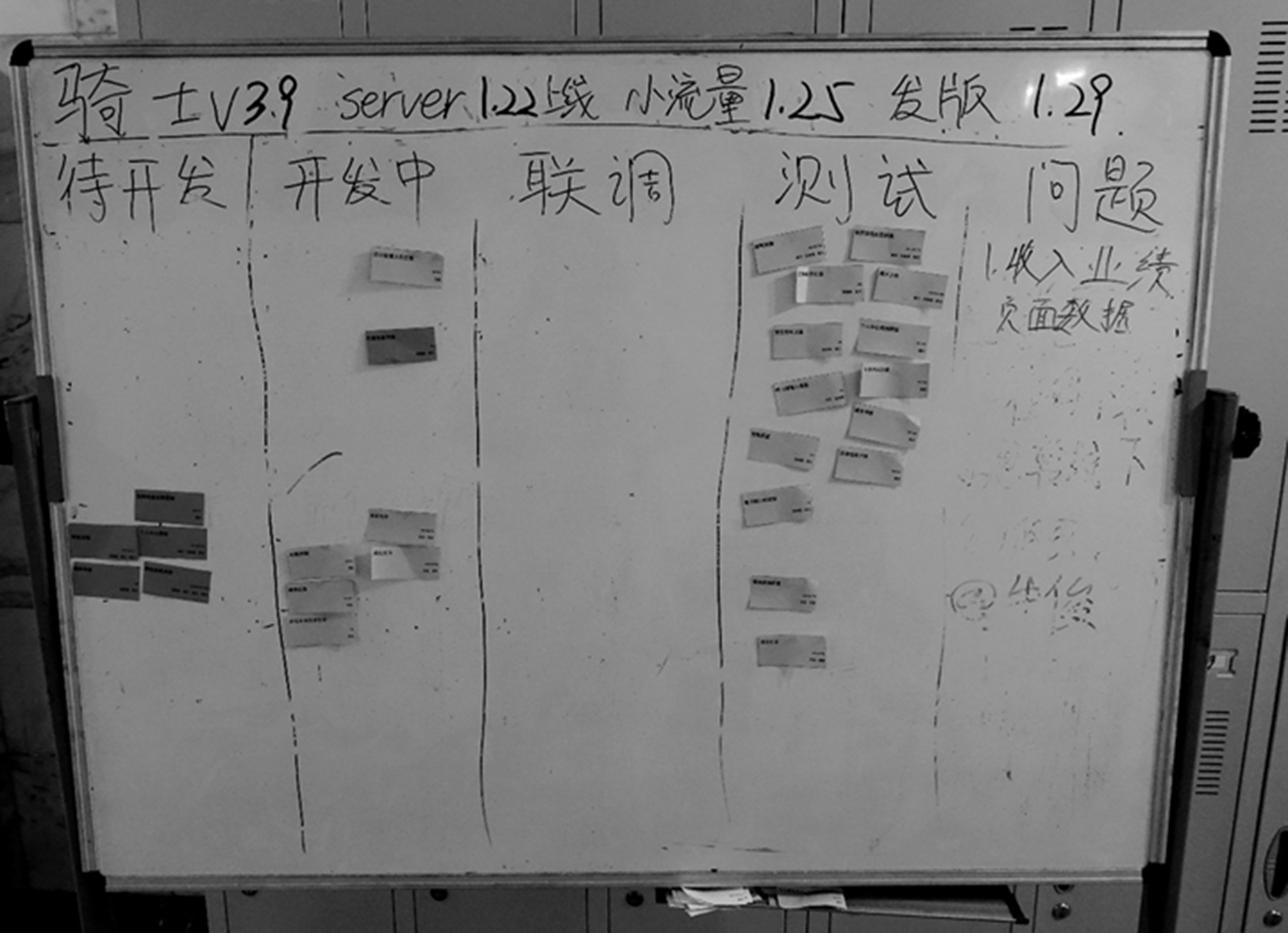
Whiteboard and sticky notes for a “stand-up meeting”.
The whiteboard and sticky notes will be left in the corridor for the remainder of the day until the next “stand-up meeting”. The whiteboard is the progress bar for the “team fight”, which is not only a matter of saving face, but also evidence that they have learned something at the company. Usually, the last part of a “stand-up meeting” consists of verbal praise for anyone who has achieved rapid technical progress, as indicated by the speed of the movement of their sticky notes. As they work alongside formal employees in the same team, interns are unlikely to be the fastest learners. As a result, everyone competes to not be left behind. “Don’t make trouble for others” is the “socially adaptable competence” that they absorb. As W03 said: I used to code all by myself [on campus]. It was my business and I could code, operate, and change whatever I wanted. But now … I have to be concerned about others on the same project. A project is usually done by dozens of programmers. If I change something, others have to revise because of me. W18: My project went online two days ago. This is my second project. Still, there was a bug … I was so worried, looking for all the solutions, and finally solved it … I felt so guilty, so guilty, so guilty … I’ve learned my lesson. It’s such a serious mistake, although that bug affected less than five users. W17: The user base of your project is huge! That’s the point. I once revised the database but crashed the whole system. I changed everything back before anyone else knew … You should know that any changes on the user end are important. They have to download and reinstall the app. It was almost an accident. Less than five users? Luckily you fixed it right away.
In conclusion, while in university your supervisors squeeze and threaten you, in the internet company your mentors help you, and the team and the users need you. “It’s clear what choice to make”, we were told.
Chivalry
When asked why the informants wanted to intern at Weixun, the answer was invariably “money!” However, as we got to know the interns better, we found that they had some complaints in hindsight. Even in addition to improving their technological competence, and their the so-called “socially adaptable competence”, they still needed more to justify their high-pressure, low-paying job. Weixun knows this too. The slogan they use for encouragement is “dreams and responsibility”. As written in an email from the CEO to all employees and interns: I still remember the lights on the second floor at 3 a.m., the figures of our “riders” [qishi, “delivery men”, which has the same pronunciation as “knights” in Chinese] in the smoggy, rainy, and snowy days, the high-fives celebrating every solved technical problem … These scenes have long been deep in my mind, recalled vividly. I know that “chivalry”, in the sense of courage and wisdom, has long been inscribed into our blood, and that “chivalry” is the dream and responsibility for everyone in the internet industry. The girl was not able to answer two questions in the second-round interview … Generally speaking, one would fail if he or she failed to answer even one of the questions. But you know, the girl passed! Probably just because she was girl … HR prefers girls because they are so rare.
The gender stereotype of the programmer is manifested in many ways. For example, the authors learned that the “wrong career choice” man mentioned before was actually a woman, as if only in this way could the story’s misery be elucidated. Another way is that men who have girlfriends tend to despise those who don’t. However, the most common way is to gossip about female programmers who get the job only for their “body capital”.
What’s worse, female programmers are starting to see themselves through gendered glasses, though most will never agree that their job offer is partially due to their “good looks”. As W12 confessed: A girl from my university was so lucky to get all kinds of offers … She was an “offer killer” [laughs] … Boys may be more technically competent, but their communication skills are not so good, or they might just be nervous … Girls are more delicate and attentive.
The road to the “bigwigs”
Programmer interns know that both relationship work and the gender game are just a “blind carbon copy”
6
of the enterprising-self game. They have to return to the game itself eventually. After the “180-day training program”, there would be no mentors anymore. In the case of technical problems, they would have to fix their own. Another option would be to ask “bigwigs” (da lao) for help. W03 shared one of his help-seeking experiences: I went directly to the bigwig’s desk, “bent the knee” [internet slang for showing humility], and begged, “Bro, how can I solve this problem?” The bigwig “rubbed my head” [internet slang for comforting someone], and said, “This is something I’ve encountered before, I’ll send you two articles”. As soon as I finished the reading, I knew what to do! I bookmarked the two articles in case anyone asked me for help.
As mentioned, the sense of improving technical competence is the essence of the enterprising-self game. Like Shieh’s (1990) “from workers to bosses”, “intern–180-day trainee–formal employee–mentor–bigwig” is the ideal pathway and an indicator of rising technical competence. Moreover, in Weixun, technical competence is quantified in terms of “T-levels”—used to distinguish junior, intermediate, and senior engineers, as well as upper-level employees such as technology officers and senior technology officers. “The best part is that these T-levels will be recognized by other internet companies, though they might be named differently. T5 in Baidu equals a P6 in Alibaba Group” (W11). Programmers believe these T-levels to be fair: “If I can’t solve the problems that a T4 engineer can solve, then I don’t deserve to be a T4” (W15). Interns won’t get any “T-level” unless they are formally employed. Yet most believe they are about to achieve this.
What is most important is that internships provide a chance to start over, in case they lose their opportunity to ascend the university pyramid, such as by attending “985” and “211” universities. Additionally, if they are unable to choose majors such as computer science or software engineering, an internship will get them the ticket too. W16 missed the opportunity to study computer science in university because he had “hated biology” in high school. Still, he stuck with independent learning and doing internships in startup companies, and finally got an internship offer from Weixun. Therefore, non-“985”, non-“211”, and non-related-major students treasure internships. It is the only window of opportunity left for them to compete with the elite universities such as Tsinghua and Peking University.
Theoretically, technical competence is only one measure in pursuing the enterprising self. Unfortunately, measuring it is complicated. Therefore, the interns would conceptualize their competence in terms of the position of their sticky notes on the whiteboard in the stand-up meetings. They would also conceptualize it in terms of the “intern–180-day trainee–formal employee–mentor–bigwig” pathway. Still, this is not entirely convincing. To achieve employability, all that matters is T-levels, which they can only earn after being formally employed. However, the interns are complacent about substituting the company ranking in place of their personal T-levels. This is the typical identity politics with which they are familiar: in the university system, there is a similar pyramid consisting of “985”, “211”, and “ordinary” universities. They report that they hate the outdated and unrealistic university education, and that they are even more disgusted with the supervisor–student relationships in university settings. Still, they rely on similar mentor–mentee relationships to incorporate up-to-date and practical knowledge into “their projects”. Here the making-out game, relational work, and the gender game coincide in the enterprising-self game; of which the individual’s contributions to the company are merely a by-product. Yet, still they persuade others to join these games. As W12 said: The internship is 10,000 times more awesome than the university. You will learn a lot, and get paid. I want to intern every day. Otherwise, the 150 yuan [about 22 US dollar] would be my loss.
What is lost in games?
Like all games, the enterprising-self game has an ambiguous relationship with reality. The universities are too “basic”, SOEs “procrastinate”, and MNEs are too “sheltered”. Each of these is defined in opposition to the practical, efficient, and enterprising internet companies. In this enterprising-self game, the interns hope one day to become “bigwigs” who can wander freely at the top of the pyramid. Like all games, only a few lucky players can be the winners. Interns know this. Still, they believe nothing bad will happen to them as long as they make enough effort.
The three types of time
In a virtual game, one is able to reset; one has infinite time and lives. However, reality is different.
In Baidu’s case, new employees can usually become T3s or T4s (junior or intermediate engineers), with an annual salary of about 220,000 yuan (about 33,000 US dollar). One may expect to rise to T5 and T6 (senior engineers), with an annual salary of 500,000 to 600,000 yuan (about 75,000 to 90,000 US dollar) over the next few years. However, T6 will be the “watershed”. According to company by-laws, one can shift to the management track after T6, and there will be extra benefits such as stock options, which are unavailable to lower-level employees. Thus, there will be only limited seats for T6s. And they must hurry. Weixun and any other internet companies only hire programmers that are younger than 35 (and ideally single), to maintain their efficiency. Still, the programmers are expected to pass T6 before age 35. Accordingly, there is a so-called “35-year-old crisis” in the industry: employees 35 and older are generally perceived as not suitable for excessive overtime, having limited enthusiasm to learn, and being trapped in family obligations. Huawei laid off a large number of 35 and older employees in 2017. A programmer who got fired from ZTE after working for them for years jumped off the company's building to commit suicide. Like a career in modeling, most programmers have low expectations for longevity; each year at a certain age “new faces [are] added and old ones dropped … like a revolving door” (Mears, 2011: 37). Time is limited.
However, the anxiety of “finite” time is soon surpassed by that of “periodic” time—the time which corresponds to the T-level exam every six months. Following a pattern established at Baidu, Weixun has T-level exams twice a year. Anyone can participate as long as they get approval from their superior. Unlike written examinations (e.g. the college entrance exam or Gaokao) with which they are familiar, in the T-level exam, programmers only need to orally present their work performance and future work plan. The process and criteria are both black-boxed. They can only wait for the results: “yes” means a rise in T-level, and “no” means “try again”. One can continue trying, like a game, until they approach the “35-year-old line”. When opportunities are few, switching to other companies is the smart choice. As W05 confessed, in that case, one would contact head-hunting agencies, to “check for opportunities in another company”. However, getting a raise elsewhere is usually as difficult as getting a raise from one’s current employer, if not more so. W03 explains, “There is a shortage of senior engineers everywhere … [but] there are always too many junior and intermediate engineers.” Still, lots of people choose to leave Weixun after the T-level exams. And new faces will soon be added.
Anxiety can be also attenuated by the “imperceptible” time of office work for programmers. This refers to the fact that in “flexible working” internet companies like Weixun, interns and employees do not need to punch in. Time off is determined by the projects. There are dinner coupons at 7 p.m., extra shuttle buses at 8 p.m., taxi bonuses at 9 p.m., and late-night snacks after 10 p.m.. Weixun has devised many ways to keep interns and employees in the office, pushing them to work more. Sometimes, people may worry that “this tough work must be harder as you get old”. Most of the time, they do it anyway. As W15 said, “You call this work overtime? I didn’t feel anything. I don’t have this word in my dictionary”. Under this working pace, employees often confuse day from night, workdays from weekends.
Therefore, as the three types of time interact, the anxiety of finite time is blunted by the “periodic” time, recurring every six months, and the “imperceptible” time inherent to every day. As in a game of infinite time, programmers are rewarded with infinite lives, and those lives are destined for pursuing the enterprising self. Then, one day they will be 35.
Complete devotion
Xiang (2006) has previously asked why Indian programmers don’t unite and fight back. We asked the same question. The most common answer was, “It’s completely your choice”.
Later, we found that the working environment physically prevents them from uniting. Programmers remain at the office most of the time. Still, they have few chances to communicate beyond “stand-up meetings” and other work meetings. Thus, they are technically coding alone. The first step in their “coding” is to put on their headphones: I wear my headphones when I’m working. That’s how I tell others, “Now I’m working, please do not disturb”. In urgent cases, they can find me on IM [instant messengers, e.g. WeChat]. I hate people wandering around disturbing me … Only with headphones can I be focused.
Several small non-work-related gatherings happen at lunchtime. As mentioned, programmers usually arrive to work late in the morning. After arriving, they do some “fast charging”—browsing tech forums for information. Soon, it’s lunchtime. Somebody may propose “Eat?” in one of their IM groups. Others may second, “Go, go”. When one person stands up and takes off their headphones, it is the cue for the others to go. The group lunch is usually at a nearby small restaurant. Alternatively, they may order delivery, through the Weixun app or those of their competitors. It is still awkward to meet a competitor’s “riders” in their office building, for example, when “ordering wrong”.
For W08, B city was an unfamiliar place. So, when he got an internship offer from his schoolmate, he had to ask to share an apartment. Still, his schoolmate covered the bigger part: the monthly rent was 5500 yuan (about 825 US dollar), and he only needed to pay 2000 yuan (about 300 US dollar). They would commute back and forth and work in the same department. He still remembers the kind favor he received, which made the strange city feel like home. As soon as he was formally employed, he offered to pay a bigger share of the living expenditures. Additionally, he decided to help the interns in his group in a similar way: If we ordered something expensive, we wouldn’t let the interns pay. Only formal employees would split the bill. It is only a few bucks more for us. It could have been too much if we counted on them to pay. (W08)
Like all human beings, programmers need communication. However, in an efficient working culture, “gossip” is discouraged. In fact, from the beginning of their internships, interns are trained on how to speak. Even their lives are disciplined as such. Programmer interns begin using their apps from time to time, to enjoy the fruits of their labor during time off. They may remain on stand-by via IM, just in case they are still needed (W10), or they may take the time to learn to improve their technical competence (W15, W16), just like they do in the office.
As a result, programmers’ private lives are compressed. The desiring-self can only be expressed at the lunch table, or during the long commute hours and in shared living arrangements, if they live with colleagues like W08. The rest of the enterprising-self component evolves, devoting them to the company where they will make their home. One evening, Weixun’s warehouse caught fire, with smoke sweeping throughout the offices. Five fire engines came, yet the employees and interns were waiting outside the cordons, yelling “Luckily I saved my code!”, “Luckily I grabbed my laptop!” Many replied, “the work is waiting for me” when asked why they hadn’t gone home.
Conclusion
We propose the term enterprising-self game to explain the subjective orientations of programmer interns, because the essence of the game is the equivalent of what Burawoy (1979) called the making-out game. Unlike the making-out game, however, the enterprising-self game lacks tangible, quantifiable products of labor. The enterprising self could be considered a by-product. The only visible recognition of one’s progress in this game are the sticky notes on the whiteboard. There are also the expected T-levels that represent employability in the industry. The mentor–mentee relationship is a form of relational work (Zelizer, 2005, 2012). However, it is not an integral component since it is unrelated to an enterprising mind or a deft hand. For the same reason, gender games (Gottfried and Graham, 1993) are not applicable, even though female programmers are stereotyped.
The most ingenious aspect of the enterprising-self game is that it differentiates itself from other “bad” institutions. In the logic of internet companies, university education is too basic to be practical. University supervisors even force their supervisees to work on their own projects, from which they learn nothing. Ironically, if one wishes to play the enterprising-self game and get an internship, the university experience—exams and homework—recurs. However, an internship in a particular internet company is viewed as a remedy to the status politics of the university system. Although technical and other competences are difficult to measure, universities are not as bad as programmer interns make them out to be, though they are not the “ivory tower” anymore either. We learned that W11’s idle roommate finally got a job, thanks to his supervisor. Weixun propagandizes that MNEs are “hoggeries”. Still, it copies most of their methods to build “a harmonious working environment”. These methods include free food, sports facilities, restaurants, cafés, events, tech sharing talks, and other perks that encourage employees to work longer hours (Fuchs, 2013: 223). However, these internet companies can only achieve their self-affirmation by flaunting practical, efficient, and enterprising characteristics. Otherwise, they will become like Foxconn, which allegedly abuses “student laborers”. As Beck and Beck-Gernsheim (2011) said, the enterprising self should be subject to the natural rights of individuals. We agree. However, in the enterprising-self game of programmer interns, their rights are deprived. A three-to-six-month internship is brief. For a favorable resume, one usually needs to intern several times. Beginning in the second year of college, or the first year of graduate school, and they are on the internship track. Some of the informants which me met in the field had interned for as long as 2.5 years. One could also argue that this is brief as well. Yet they are less than 10 years away from the “35-year-old line” after getting a master’s degree. In these 10 years, they have to first survive the “180-day training program”, then pass the T-levels one-by-one, until getting a T6 or above. The game ends with only a few winners. However, the anxiety is diluted by the “periodic” and “imperceptible” time of the programmer’s life. In the culture of efficiency, programmers soon learn to be isolated, squeezing their desiring-self, and sticking to their choice.
Finally, the question arises: is the internship a necessary institution for programmers, especially with the significant overlap between the internship and the “180-day training program”? Of course, for internet companies, they can cut costs by just hiring interns. But as Butler (1990: 143) reminds us, any social category “ought not to be conceived as a noun or a substantial thing or a static cultural marker but rather an incessant and repeated action of some sort”. The distinction between interns and “180-day trainees” is also performatively constituted, through the roles played in sharing talks and other work rituals. Furthermore, both interns and “180-day trainees” can increase the value of their labor by learning practical coding skills, if they are lucky enough to be formally employed. Still, the limited opportunities for promotion close this avenue to career advancement (Yanagisako, 2018). Not everyone can be a “bigwig”. As Khan (2010: 136) reveals, the “bigwigs” are also “an embodied performative act enabled by both possessions and the inscriptions that accompany experiences within … institutions”. Speaking of institutions, the supply of young, cheap, atomized, and harvestable interns is crucial to the internet industry. Only with institutions like the internship 7 can internet companies maintain only core business personnel, to increase efficiency as well as reduce costs (Liang, 2013). As a result, for those who fail to develop sufficient technical skills, their jobs prospects are like those of the delivery riders of the Weixun app: they will be forced into the margins of society. In short, the programmer interns who frantically code the new versions, pages, and functions of their apps marginalize their incomplete selves through the enterprising-self game.
Footnotes
Acknowledgments
First and foremost, we would like to express our deepest gratitude to our informants in Weixun for their unconditional trust, patience, and assistance. We also thank Benjamin Ross, a PhD candidate in sociology at the University of Chicago, for his assistance with English-language editing. Last but not least, we thank the anonymous reviewers and the editor Professor Jun Zhang for their insightful and helpful suggestions.
Declaration of conflicting interests
The author(s) declared no potential conflicts of interest with respect to the research, authorship, and/or publication of this article.
Funding
The author(s) received no financial support for the research, authorship, and/or publication of this article.