




Abstract
Bargaining is a significant form of interaction between different levels of the Chinese government. Therefore, the mechanism of bargaining is suggested as a representative operational model for understanding the behaviors of local governments in the hierarchical system of government. This paper describes in detail several rounds of bargaining between superior and subordinate government officials in the process of implementing a policy prohibiting grazing in Sidong County. The policy was made at the county level. Township-level governments chose to bargain with their superior due to the difficulty of implementation in the early stages but failed. Strict implementation then led to frequent conflicts between local government and farmers. The township level of government instantly turned to bargaining with the county level and used a confrontational strategy to successfully obtain more freedom for implementation. This paper uses the theoretical framework of implementation costs analysis to illustrate the functioning mechanism of bargaining behavior. The different combinations of implementation costs cause township-level governments to choose or adjust to different methods. The high cost of implementation processes allows the township-level government to use bargaining as the only reasonable method of implementation. The process of bargaining indicates that township-level governments improve bargaining ability relative to strict requirements for implementation of policy and intensifying social conflicts. The essential features of bargaining in policy implementation among different levels of the Chinese governmental hierarchy are: no deadlock implementation; agreement point swings from side to side; and alternating occurrences between short-run equilibrium and bargaining.
Introduction
The following consensus has been formed among studies of policy implementation: the relationship between policy implementation and policy formulation is not linear, and there is no ‘perfect’ implementation that is fully consistent with policy settings. In the multi-hierarchical government system with distinctive power centralization, as the policy-making rights are concentrated among higher authorities, the policy process between policy makers and policy implementers is extended, and execution deviations exist universally among local governments. Such behaviors can be summarized as ‘flexibility,’ ‘selective implementation,’ ‘strategicism,’ etc., and have received a great deal of attention (O’Brien and Li, 1999; Ouyang, 2011; Tao et al., 2016; Wang et al., 1997; Ye, 2015). Among different levels of the government hierarchical system, flexible execution can be regarded as a kind of response of the subordinate government to ‘inappropriate’ policies of the superior government; such a response is neither loyalty nor obedience, but rather a change or even a breach of the policy’s original intention so as to make the policy more executable. In such a response mechanism, policy-making and policy implementation are isolated, the superior government is responsible for policy-making, and the subordinate government is responsible for implementation (Zhou, 2014; Zhou and Lian, 2012). Grassroots governments often expresses doubts about or dissatisfaction with ‘inappropriate’ policies through ‘bargaining’ (negotiation game), thus sending feedback to the superior government in policy execution, and modifying or even altering the policies in the process of implementation. Compared with one-sided implementing actions such as obedience and flexibility, the pattern of bargaining can only be formed through ‘price offering’ and ‘beating a bargain’ between the superior and the subordinate governments; thus, policy-making and implementation are intertwined rather than isolated. On the surface, the subordinate government tries to express its benefit publicly through bargaining, with some tinge of public offence to the superior government. This may bring about unfavorable results to the subordinate government, and for this reason, it will try to avoid bargaining as a response (Ni and Xie, 2016; Wang et al., 1997). However, in the process of policy implementation, there is a universal phenomenon in that the superior and subordinate government share common interests and strive for cooperation, while disagreeing about how it should be carried out. This is precisely the condition that gives rise to bargaining. Therefore, from the typological point of view, the bargaining mechanism can be used as a representative operational mechanism for understanding local government behavior in hierarchical government systems.
The research question and related studies
Macroscopic cognition on bargaining: government structure and the institutional environment
Bargaining is a very important form of interaction between subordinate and superior governments in China. The central and local governments apply various means to tackle conflicts in negotiations. The relationship between the central government and local governments is, in essence, a multi-stage bargaining process (Lampton, 1992; Shirk, 1993; Zheng, 2013). In the financial field, which is the most typical field for government games, the central and local governments are always bargaining over the division of fiscal revenues in fiscal contracting or tax sharing. The tax-sharing system shifts fiscal decentralization to fiscal centralization, and local governments’ confrontational behaviors gradually increase (Qu et al., 2009; Zhang, 2006). Among studies on the interaction between the central and local governments before and after the reform of rural taxes and fees, some researchers (Li and Wu, 2005) found that the central government tried to force reforms at the grassroots level through a series of measures, but the grassroots governments adopted strategies such as flexible implementation, complaints, and passive implementation to rebel against the central government by claiming that the reforms created new burdens for rural areas, and thus the grassroots governments forced the central government to revise its original policies. In the national governance system, with the project system as its core, the project contracting departments set up competitive targets, and the local governments add their own intentions and interests based on local governance experiences; in this way, there have been new forms of bargaining within the hierarchical governance system, such as ‘project packaging,’ ‘project support,’ and ‘project counter-control’ (Chen et al., 2015; Di, 2015; Feng, 2009; Zhe and Chen, 2011).
A review of the aforementioned research studies leads to the following conclusions. First, the bargaining strategy is diverse. Different government departments may adopt different bargaining strategies under a unified policy. At different stages of policy implementation, the bargaining strategies may also vary. Second, environmental differences or changes in policy implementation may lead to changes in bargaining strategies. Government departments will consider their own interests and the interests of the other party in choosing a bargaining strategy. Third, bargaining usually occurs in the process of policy implementation. Bargaining can change the original setting of the policy. With other conditions unchanged, the choice of bargaining strategy will affect the extent to which the policy can be adjusted. Most of the studies described above explain bargaining through institutional factors such as centralization and decentralization; however, there is little discussion about the internal operating mechanisms of bargaining. Limited by research methods, there is a lack of close observation of the bargaining process. This paper attempts to conduct a micro-analysis of bargaining in the implementation of a specific policy by adopting a case after field observation, and to describe the bargaining between the township and county governments in implementing a policy prohibiting grazing in a farming and pastoral county in northeast China, and tries to describe the occurrence of bargaining in detail, the grassroots government’s bargaining strategy, and its effects.
Microscopic study of bargaining: occurrence, strategy and validity
There have been several representative empirical studies in recent years on the micro-mechanism of bargaining as a theoretical growth point. Li (2010) conducted an ethnographic study of local government behaviors in the ‘city-village transformation incident’ and found that, in the face of in-system mobilization by the superior government, the street government tends to exaggerate the difficulties and help the superior government to fully understand the difficulty of the transformation so that the superior government will not easily make a decision of ‘reconstruction.’ Zhou and Lian (2011) took the policy implementation negotiation among the provincial and municipal environmental protection departments as an example and established a sequential game model between the superior government (such as the provincial Department of Environmental Protection) and the subordinate government (such as the municipal Environmental Protection Bureau) from the perspective of game theory. The superior government has two strategies of ‘regular mode’ and ‘mobilization mode’ in policy implementation, while the subordinate government tends to choose the response methods of ‘formal negotiation,’ ‘informal negotiation,’ or ‘quasi-exit’ in the implementation process. If the superior government adopts the mobilization model, quasi-exit would be the best response strategy for the subordinate government. He and Wang (2012) took taxi industry regulation as an example in further discussing the complex relationship between formal and informal negotiations among different levels in a hierarchical government system. The study found that in a government system with stability as the common goal, the lower and upper levels of government are more inclined to resolve problems by adopting formal negotiations or multiple rounds of negotiations. The subordinate government cannot refuse top-down orders, nor can they choose to drop out of the game. Zhang et al. (2016) chose the case of interaction between subordinate and superior governments in the administrative division adjustment of a town and constructed a bargaining model with the characteristics of a consultation game. In this model, the superior government fully understands its limitations in information and cognitive ability, and therefore allows its subordinates to propose alternative consultation plans after putting forward the plan containing its net income, on the condition that the consultation plan should not reduce the net income of the superior government in the original plan. In the studies summarized above, we have seen the operation process of bargaining in policy implementation and different operational mechanisms. Local governments cannot completely withdraw from the policy implementation process, but they have conflicts with the superior government over some specific rules of implementation. Defined from the perspective of game theory, bargaining between a county and township government is a game for their common and conflicting interests.
Research question: bargaining in policy implementation
Concerning the methods, strategies, and processes of bargaining between the lower and upper levels of government, the existing literature provides specific and detailed studies (Liu, 2016; Zhou and Lian, 2011). This material will not be discussed in this paper, but some doubts about the operation mechanism of bargaining which are not fully answered and even some basic questions will be further addressed.
The first question is: At a high cost, why does the grassroots government initiate bargaining? Factors such as the policy implementation preferences of the superior government, the degree of consistency of the tasks between the subordinate and superior governments, and the power balance and negotiation statuses of the parties all affect the occurrence of bargaining between local governments, but there are no mechanism analyses with strict logic. This paper, uses the analytical framework of implementation costs and attempts to discuss government behavior orientations caused by the different combinations and changes of implementation process costs, including the exertion costs for the superior government and the exertion costs for the public, and then analyzes the occurring mechanism of bargaining.
Another question that needs to be explained is: What factors lead to changes and equilibrium of the agreement point between the subordinate and superior governments? Existing studies have discussed the government bargaining strategies, such as formal negotiations, informal negotiations, quasi-exit, multiple rounds of negotiations, balance and win–win. These strategies are related to the bargaining costs of both parties and affect the game structure. This paper will start from the constraint changes in the policy implementation process, observe the relative changes of the bargaining power of the two parties under the government hierarchical system, and show that no deadlock in implementation, alternation of short-term equilibrium and bargaining, and swing of agreement point are the typical characteristics of bargaining between the subordinate and superior governments in policy implementation.
Case overview: 1 the grazing prohibition policy in Sidong County
Located in the southwest of Heilongjiang province, Sidong is a large county with animal husbandry as the pillar industry and agriculture as its supplement. The county has 11 townships, 12 agriculture, forestry, animal husbandry and fishery farms, and 79 administrative villages, taking up an area of 6176 square kilometers. I went for investigation to Sidong County in 2006, when the total population of the county was 250,000, including a 171,800 rural population. There are 4.69 million mu (1 mu ≈ 666.67 m2) of grassland in the area, accounting for 50.7% of the total area. There are 121,000 cows in stock, 262,000 mutton sheep, four towns with over 10 thousand cows, 34 villages with over one thousand cows, 27 high-standard professional cow-breeding villages, and 985 households with over 10 cows. In 2006, I took a temporary post in Telahe town of Sidong County and carried out social investigations. In 2007, I returned to Sidong County and conducted research at the county level and a wider township level. In 2009, I returned to Sidong County to update investigation information.
Working process of the grazing prohibition work during 2001 through 2010 in Sidong County. 25
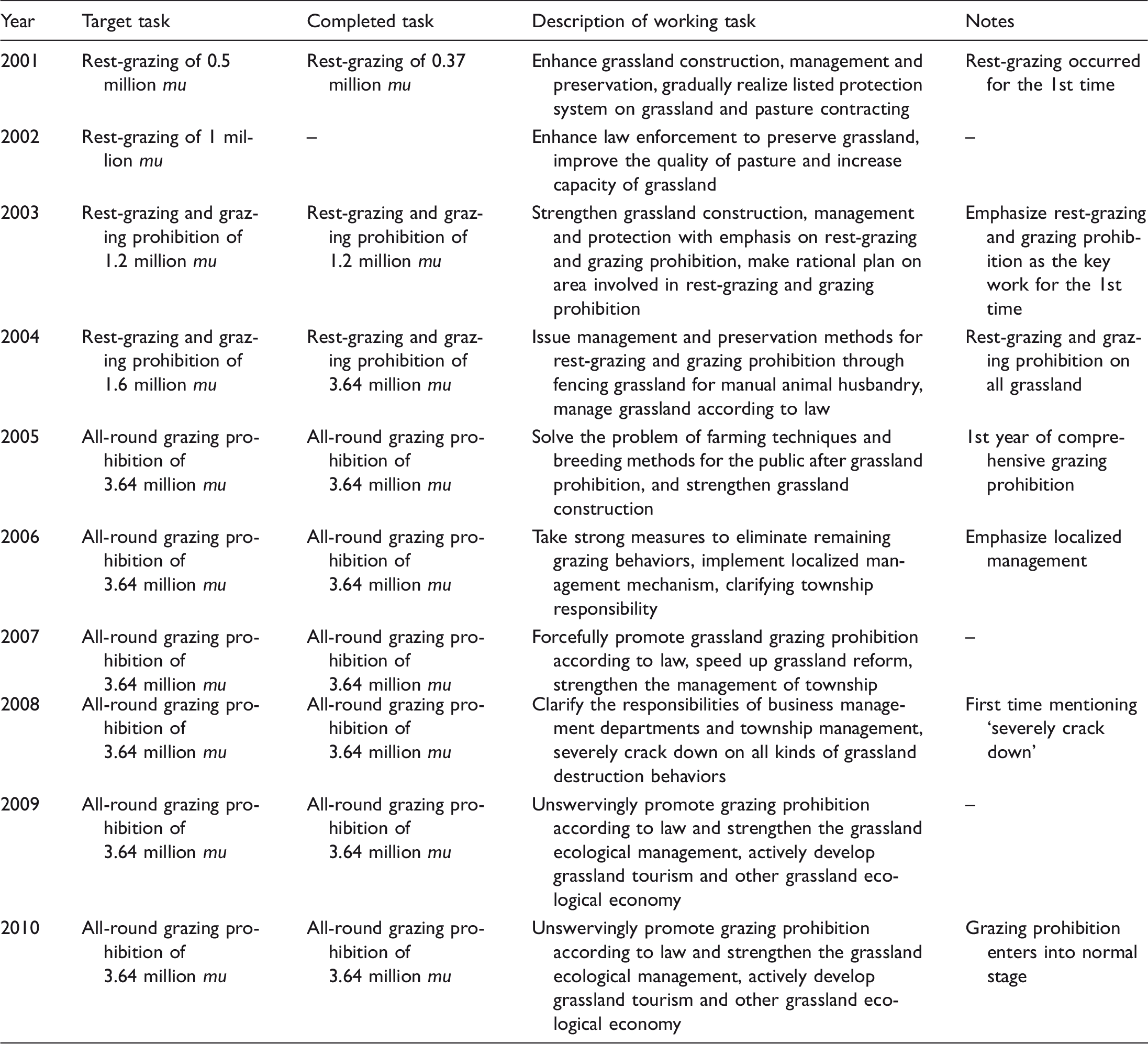
Starting in 2001, the whole county put great emphasis on the work of prohibition of grazing, which was mentioned in each of the government work reports over the years. In the first years of implementing prohibition of grazing, the target tasks and completed tasks were increased year by year. In 2004, the site-meeting on municipal grazing prohibition work was held in Sidong County—‘in order to show our support for grazing prohibition of the whole city, the county government set a great target to realize grazing prohibition throughout the whole county’3—and the target area for prohibition of grazing was set at 1.6 million mu. By the end of that year, prohibition of grazing on all grasslands in the county was finally achieved. In 2005, comprehensive grazing prohibition was accomplished in the whole county: ‘no single cow, sheep or a big head of domestic animal are allowed to be seen on the grassland.’ Since localized management was implemented on grazing prohibition and township government is the direct department in charge, there was less and less room for ‘cheating’ on the part of grassroots departments, and the grazing prohibition work suddenly became difficult. For farmer households, the work of grazing prohibition involved top-to-bottom implementation, and what the farmers got was just a notice of prohibition. Other than accepting publicity and education, there was no room for negotiation, not to mention detailed policy explanation. This situation led to the conflicts between the government and farmer households.
Multiple rounds of bargaining among township governments
Bargaining among governments: concept and implications
‘Bargaining’ refers to the following situation: two participants (organizations) with common interests are in need of cooperation, but while cooperating, they may also experience conflicts of interest. Thus, before they begin cooperating (and achieve results), the participants need to agree on their method of cooperation. On the one hand, each participant wishes to reach an agreement, but on the other hand, each wants that agreement to be favorable to them. Therefore, the participants can only reach an agreement after paying an expensive delay cost (Muthoo, 2005; Rubinstein, 1982). In the case of rest-grazing and grazing prohibition, the county government and township government share common interests, namely, the execution of the rest-grazing and grazing prohibition policy; however, regarding the manner of implementation, loose or strict, they conflict. In order to achieve an agreement that is favorable for each of them, they offer prices, bargain, and try to beat a bargain, which are typical bargaining behaviors. Compared with the typical bargaining model, bargaining between subordinate and superior governments has multiple implications.
The two bargaining parties are township government and county government
According to the control rights theory put forward by Zhou and Lian (2012), a provincial government, county government, and township government can be regarded as a ‘principal-manager-agent.’ The rest-grazing and grazing prohibition policy in the case discussed in this paper was a unified regulation issued by the provincial government. On this basis, the county government ‘added weight,’ and issued the grazing prohibition policy within the county; therefore, the county government could be regarded as the policy maker. In cases of rest-grazing and grazing prohibition, the two parties involved in bargaining are the county and township governments. Taking the perspective of principal-agent, this paper adopts a simplified ‘client-agent’ model: the county government holds some target setting rights, adequate incentive distribution rights, and inspection and acceptance rights, so it is the policy principal; township governments are responsible for specific implementation, so they are the policy agents.
Common and differing interests between the county and township governments
The county and township governments share the common target of implementing the rest-grazing and grazing prohibition policy. In the process of implementation, successive and concomitant targets emerge, particularly the goal of reducing conflicts between the government and people and sustaining social stability. The divergence between the two governments concerns to what extent the policy shall be executed. If we put the execution of grazing prohibition policy on a spectrum from full execution to non-execution, their divergence might be an agreement point on the spectrum between full and non-execution. The action closer to the full execution end can be regarded as strict execution, while that closer to non-execution can be considered loose execution. Since the common interests of the county and township governments shift from a single target to multiple targets, the two parties may have differences over the degree of strictness of the policy execution, and the pattern of bargaining may also change.
‘Price offering’ and ‘price beating’ in policy execution
The classical Rubinstein bargaining model (Rubinstein, 1991) assumes that the bargaining process is not friction-free, that the participants have to spend time, which is valuable to them. When time is valuable to at least one party, the participants tend to reach an agreement. In reality, the more complicated cost of bargaining includes other scaling factors. In cases of rest-grazing and grazing prohibition implementation, because it is a mandatory policy from top to bottom, the township government has no room for bargaining before the policy issuing; after the implementation of the policy, the county and township governments will bargain over the manner of implementation, and in this way, bargaining progresses from the stage of policy making to that of policy implementation. In the process of bargaining, the forms of both sides’ price offerings are mainly embodied in specific and visible actions. In particular, the township government as the executor will ‘bid a price’ on whether or not to implement grazing prohibition or on the strictness of the policy, while the county government bargains on whether or not to carry out rewards and punishments or on specific kinds of rewards and punishments to be used. In addition, official documents and meetings as well as informal consultations are also bargaining venues between both parties.
Multiple rounds of bargaining
The bargaining between the county and township governments in policy implementation is not a process of one-off completion. It is necessary to go through multiple rounds of negotiations. In particular, the implementation pattern formed after each bargaining period will lead to changes in the power structure of bargaining and elicit a new round of bargaining. In the cases of rest-grazing and grazing prohibition, the conflicts triggered by strict implementation of the policy changed the bargaining power of the county and township governments, which became the endogenous variable for a new round of bargaining. Therefore, each period of bargaining between the county and township governments becomes a new starting point. The process generates results, while the results also generate process. Therefore, the agreement point between the two parties is constantly changing.
Irrevocable policy implementation
Compared with the classical bargaining model, since there is an organizational system of county and township governments, the bargaining between them is irrevocable. Moreover, given the conflicts in the process of implementation, the two extreme cases of full execution and non-execution would not occur in policy implementation (which are the deadlock points in bargaining). Once the policy is issued and implemented, it cannot be suspended during implementation. It should be noted that the county and township governments may bargain on the implementation of some policies, and rest-grazing and grazing prohibition is only one of them. Since the bargaining is embedded in the regular game structure, the loss in rest-grazing and grazing prohibition of one party may be compensated in other rounds of bargaining. In order to simplify the discussion, the bargaining in the implementation of grazing prohibition was selected as the case for this study, and the impact of the policy game which is closely related to it will also be discussed, for example, the livestock development strategy in the county.
Price offering-price bidding: price bidding by the county and township governments in the period of grazing prohibition
As stated above, bargaining between subordinate and superior governments is a continuous process, with multiple rounds of price offering and price beating. Based on the case of rest-grazing and grazing prohibition in this paper, and according to the development trend of bargaining between the county and township governments in policy execution, the stages of bargaining between both parties are divided by taking typical events in the case as the key points, and the policy execution in these stages is discussed.
The first stage of bargaining occurred mainly during the rest-grazing period. The year 2001, when rest-grazing was first proposed in Sidong County, is taken as the starting point, and June of 2004, when the Municipal Grazing Prohibition and Shed-feeding of Cattle and Sheep Meeting was held in Sidong County, is taken as the end of this stage. The main task of this stage was for the whole county to clarify the requirements of rest-grazing and grazing prohibition and try to adapt to the change from grazing to shed-feeding. The county and township governments ‘offered a price’ in response to the rest-grazing requirements. However, in this stage, no essential bargaining was formed, that is, the two parties just offered prices without negotiation or bargaining on the agreement point. In the early stages of rest-grazing, the county government offered the price of rest-grazing in the whole county, that is, no grazing in specific periods or specific places. Since grazing was allowed in periods and places not prohibited from grazing, the rest-grazing policy did not arouse tension in the whole county. During the late period of rest-grazing, with the expanding rest-grazing area and the coming of comprehensive implementation of grazing prohibition, the county government required the whole county to solve the technological problems in livestock breeding and husbandry methods for farmers and make full preparations for comprehensive grazing prohibition.
In order to achieve rest-grazing and change the mode of production, the county government carried out extensive mobilization. The county Party Secretary stated on many important occasions, The ecological disasters caused by water and grass shortages are not only the case in Sidong County, but also a big problem that directly threatens the surrounding area and even the whole province. Each year the municipal government pools a great deal of funds to support ecological construction in our county. If we don’t treasure such support, we will be restricted in all aspects, like tourism and animal husbandry.
4
Prohibition of grazing is not just prohibition. If the livestock are not allowed on the grassland, what food can they eat? So, we should solve the problem of feedstuff and the problem of breeding places. In this way we can understand the significance of prohibition of grazing. We should regard it as a breakthrough to promote the standardization and scientific transformation of animal husbandry in the county.
5
The towns in Sidong County, especially those that implemented rest-grazing, responded to the price offering by the county government and took corresponding measures, including establishing a Grazing Prohibition Work Leading Group with the Secretary of the Party Committee and Township leaders as the group leaders, mobilizing among towns, sending leaflets to farmer households, implementing grassland reform and pasture contracting, listing and protecting rest-grazing areas, fencing grassland for manual animal husbandry, and ‘instructing the animal husbandry and ecological centers to organize joint inspection teams for inspection and law enforcement over grazing resting and prohibition areas in all villages.’
6
In June 2004, the Municipal Grazing Rest and Grazing Prohibition Working Meeting was held in Sidong County. Wolin, a large township of animal husbandry, became a visiting site and introduced the work experience of rest-grazing and grazing prohibition to attendees. The meeting also became the highest extent of response by the township governments to the price offering by the county government during the rest-grazing period. The activities above showed that the township governments were indeed giving a positive response to the price offering by the county government. However, in terms of the other aspect of rest-grazing policy, that is, punishing illegal grazing, the township did not fulfill the county government’s ‘price bidding’ requirement, since farmers’ grazing behaviors still existed in the rest-grazing and grazing prohibition areas. As one farmer recalled, At the beginning of the grazing prohibition period, I received a notice and also attended meetings, but I still grazed my cows in those areas. The government did not check it frequently, and even if they noticed, they only criticized me, after which I drove the cows away, that’s all. Some people ignored them and there was nothing [i.e. punishment].
7
Strictly speaking, the ‘price bidding’ by the county and township governments during the rest-grazing period was not a bargaining behavior, because only one party offered a price, while the other party failed to beat the price. The county government put forward the decision regarding rest-grazing and the corresponding requirements. The township governments did not publicly oppose rest-grazing by the county government; rather, they implemented the policy only partially. The easier tasks they would implement by following the instructions of the superior government, while with the more difficult requirements that might easily trigger contradictions between the government and farmers, such as ‘grazing checking and punishment,’ they tended to avoid execution or took alternative actions. Rather than this being considered price beating by the township governments, it might be taken as ‘price bidding’ by means of specific actions, such as the partial execution of the requirements by the county government, which was actually a price offering, and later, the county government tacitly approving the attitude and execution force of township governments.
Price offering-price beating-price making: the agreement point goes to the strict-execution end
Bargaining at this stage mainly occurred during the mobilization period after the comprehensive execution of grazing prohibition. Comprehensive grazing prohibition was taken as the starting point, and the office meeting at the grazing prohibition site of Telahe town in September of 2005 as the end. The county government required comprehensive grazing prohibition in all towns, together with strict supervision, checking, and acceptance. After comprehensive grazing prohibition, it was easy to spot grazing behaviors on grasslands; therefore, the county-level inspections could be executed more easily: ‘In case of any illegal acts on grasslands, we shall announce the criminals publicly and punish them severely.’ When initiating comprehensive grazing prohibition, what the township governments were facing was not the fundamental problem of the transformation of production mode, but rather, how to go about realizing the direct target set by the county government, comprehensive grazing prohibition in ‘making the grassland free from a single head of livestock.’ An excellent means of achieving this goal was to urge towns to ‘strictly check and manage the grasslands.’ Strict implementation was the usual method applied by the government during the mobilization period. Although township governments failed to adapt to the rapid transition from rest-grazing to comprehensive grazing prohibition, they were very clear about the requirements of the county government. Therefore, they strictly implemented the grazing prohibition ordered by the county government and responded to the ‘price offering’ by their superior. In 2005, a Grassland Grazing Prohibition and Management Team was set up in Wolin township. The team was equipped with two vehicles for patrol inspections on all grasslands in all towns and clearing and punishing illegal grazing. In five months, the team handled more than 60 cases of illegal grazing.
Despite the strict regulations for grassland inspection and the town-to-village system of inspectors, grassland supervision was still difficult: The farmers always played hide-and-seek with us. After we went away, they would come out and graze their livestock on grasslands, or they would graze cattle in the daytime and rest in the evening.
8
The grassland is very large; we can only spot cases near roads when driving motors. There might be someone grazing cattle somewhere out of sight. Sometimes, people reported a case, but when we got there, we could not find a single person or cow.
9
Against this background, the township governments began to intensively ‘beat the price’ of the county government. Although the township governments did not explicitly ask for a loose policy of grazing prohibition, they hoped that the county government could consider the practical difficulties of implementation. As a matter of fact, in the early period of rest-grazing and grazing prohibition, the township governments realized the difficulty in work and expressed their views to the county government in due time. However, since the county government did not impose substantial punishments for illegal actions, the bargaining did not have substantive meaning. After entering the stage of comprehensive grazing prohibition, the county government began to play hardball, and the township governments became active in ‘price beating.’ In the work reports submitted by the township governments to the county government in the middle of the year, the following sentences were repeated many times: The people didn’t have an accurate understanding of grazing prohibition, and there are great difficulties in implementation. We hope the county government can take this into comprehensive consideration.
10
You should not ask me about the matter of grazing prohibition. Please ask Z, the county head. He is superior to me. I told him all that I want to say.
11
At the beginning of the meeting, all the township secretaries and town heads expressed concern about the difficulties of carrying out grazing prohibition, but the secretary of County Committee X was resolute, and stated explicitly that comprehensive grazing prohibition was a political task, and there was no room for negotiation. Meanwhile, he put forward three points, which were to punish the illegal grazing behaviors according to regulations and the law, to find out the reasons for the behaviors, and to propose solutions for problems and implement them immediately.
12
First, we should severely punish managers in the region, dismiss the inspector team and never hire them; second, we should work with greater effort and check the grazing prohibition work in the town. Once we find private or secret grazing we should handle the cases strictly; third, the responsibility mechanism should be clearly defined, for grassland management of the villages, we should confer the one-vote veto system on village cadres.
13
Price offering-price beating-bargaining again: the agreement point goes to the end of relaxed execution
The bargaining between the county and township governments did not end with the high-profile ‘pricing’ by the county government. With the extending impacts of grazing prohibition among the farmers, the bargaining ability of the two sides was changing, and the new bargaining pattern was gradually taking shape. This round of bargaining began with the county government’s preparation and introduction of the ‘Regulations on the Management of Grasslands in Sidong County’ as its starting point and ended with the Emergency Meeting of Grazing Prohibition in the county in 2013. This period took a long time, with alternating occurrences of price bidding, price beating, and bargaining, which pushed grazing prohibition into a regular implementation stage. In May 2006, the ‘Regulations on the Management of Grasslands in Sidong County’ (hereinafter referred to as Regulations) were issued and implemented. These were considered ‘legal regulations for the unified planning, protection, construction, and management of grassland resources with high pertinence and operability. The Regulations reinforced the penalties on illegal acts, and provided a more favorable legal guarantee for strengthening the administrative supervision and management of grassland resources.’ 14 After four years of rest-grazing as a transition period and one year of grazing prohibition mobilization, the comprehensive grazing prohibition in Sidong County was about to enter a regular working period at the government level. The introduction of the Regulations and strict penalties on illegal grazing could be regarded as the ‘official bidding’ by the county government, which highlighted the legitimacy of the requirements of the county government.
In response, in order to ensure the legitimacy of the law enforcement process, all towns issued various documents to reinforce the strict enforcement by township governments. In the ‘2005 Grassland Grazing Prohibition and Fence Management and Contracting Management Measures in Wolin Township,’ it is stipulated that ‘during the working period of the grazing prohibition inspectors, in case of discovering any behaviors of grazing and livestock entering the grassland, all fines obtained shall be in possession of the inspectors.’
In the Grazing Prohibition Management Measures in Telahe town in 2006, it was stipulated, For the violations of private grazing, the grazing prohibition inspectors have the right to impose penalties. In the premise of not exceeding regulations, the amount of fines shall be decided after discussions based on village regulations by the villager representatives. Those who violate the regulations and graze privately and those who refuse to correct errors after repeated education and refuse to cooperate shall be transferred to judicial organs for handling. The regulations above were intended to provide legitimacy support for the work of grazing prohibition of the whole town. Even the village rules and regulations have ‘Carry out comprehensive grazing prohibition and protection of grasslands’ as the first article, stipulating that ‘livestock and poultry must be in shed-feeding and should not be released out of each courtyard. The grazing of cows, horses, donkeys and sheep in grasslands must be strictly punished; there is no room for contesting if any livestock are beaten to death for illegal grazing.’
15
All villagers have the right and obligation to protect the grasslands of their own village and other villages. They have the right to prohibit grazing and preserve the grasslands of their own village and other villages. Any villagers can organize themselves spontaneously into a grassland inspection team with one member or several members and impose penalties for illegal grazing.
16
However, the behavior of the township governments toward the end of strict execution directly resulted in frequent conflicts between grassroots governments and farmers. Among the 12 cases of illegal grazing announced in March 2006 in Wolin township, each case was accompanied with conflicts. According to the grassland inspectors, any grazing behaviors that were spotted by the county and township governments must be punished. Otherwise, ‘the town could not afford the fines if it imposes the penalty on itself.’ Concerning the cases found by the township government and not discovered by the higher authorities, the township government would educate the farmers for a first offence but would not tolerate a repeated offence and would impose a fine. The fine was the corresponding amount strictly based on the regulations of higher authorities. ‘The process should be videotaped as evidence, for fear that the grazing (farmer households) would deny it.’ 17 In the whole process of law enforcement, the farmers generally refused to pay fines or even refused to drive their cattle away from the grassland. The conflict was about to break out. Since the on-the-spot evidence of illegal grazing was very important, the law enforcement cadres usually issued a fine in the case of ‘catching violators and livestock at the same time.’ However, because farmers believed that there were many ‘unreasonable articles’ in the grazing prohibition policy, and the face-to-face ‘benefit battles’ immediately happened at the scene of inspection, the conflicts were inevitable. There were frequent cases of minor complaints, angry scolding, tense confrontations, and even fights. As a result, the township governments became more ‘radical’ in the process of handling grazing behaviors, and the conflicts between government cadres and farmers escalated.
On the one hand, higher authorities were required to achieve the target of comprehensive grazing prohibition; on the other hand, there was social tension from local farmers and ‘conflicts were about to break out at any moment,’ which troubled the governance in the area and created awkwardness for township governments in implementing grazing prohibition. Moreover, with the passage of time, they felt even more awkward. How could they manage the work well by satisfying the requirements of both sides? The township cadres racked their brains. 18 The township governments began to initiate a new round of bargaining by taking advantage of the conflicts between the government and the farmers. Conflict means social instability. Maintaining social stability under governance is an important duty of the local government and even bears the meaning of a one-vote veto. On the condition that the implementation of the grazing prohibition policy would not cause social instability, the superior government would ask the grassroots government to strictly execute grazing prohibition; however, when the policy of grazing prohibition caused social instability which exceeded the tolerable bounds of the superior government, the superior government’s requirements for grassroots governments might be mitigated to a bearable level for the sake of social stability. After the township government recognized this, the conflicts between grassroots cadres and farmers could become an effective instrument for bargaining between the township governments and the county government.
The channels of bargaining were both formal and informal. In public or private places where government cadres of different levels met, the township government cadres frequently reported the implementation progress of the grazing prohibition policy to the superior government and especially emphasized the cases of punishment and conflicts arising therefrom. During investigations in 2006 and 2007, on occasions on which government leaders were present, as was I, the leaders of township governments frequently mentioned the violation cases during the grazing prohibition investigations of their own town; sometimes, several leaders from different towns reached a consensus and jointly expressed concerns about the difficulties of implementation and the serious condition to the county leaders. The strict implementation of the policy generated forceful impacts on the social governance of township governments. The township governments also expressed the same opinions to the superior government through other channels. For example, cadres dispatched by the county government to towns described their problems to the superior government. In 2006, an investigator was dispatched to Wolin township. He expressed the following opinions on the work of grazing prohibition in the town: ‘We should not avoid legal means of influencing the violating behaviors of individual farmers, but the forceful execution of the policy has already given great shocks to the grassroots society.’ Interestingly, the reporting materials of township governments to the county government included detailed descriptions on the conflicts between the government and farmers.
19
In addition to stating the facts, these seemingly hyperbolic materials implied that ‘if we do not take any effective means or make policy adjustments, we may cause greater or uncontrollable social conflicts.’
20
In the grazing investigation, they normally found individual farmers who grazed sheep or cows, and there were seldom any fierce conflicts. However, there were serious results once in a while. When the head of the Office of Justice in Ketai township leading members of the grazing prohibition team tried to stop individual villagers from grazing, his right eye was wounded by a blow of the villagers during pushing, and his eye eventually became blind.
21
If we say in that in the mobilization stage of grazing prohibition, the township governments’ bargaining with the county government giving their reason as difficulties in work failed to change the price set by the county government, and at this time, the price beating by township governments to the county government with the reason of social conflicts inevitably aroused the concern of the county government, then, in the words of the county leader, We can say that any policy issued by the county government needs the township and grassroots society’s cooperation, so we should consider their difficulties in policy implementation. As for the rest-grazing and grazing prohibition policy, there were difficulties in the early stages of policy implementation. On the one hand, we were supposed to develop animal husbandry in a time of grazing prohibition, and the township governments felt puzzled. On the other hand, the farmers also felt puzzled, because they had been engaged in grazing since their old ancestors’ time. Now they feel uncomfortable after grazing prohibition, so illegal grazing has existed for a long time… the county government should realize the difficulties of the grassroots society, especially the conflicts between the law enforcement officers and the farmers. The county government should stick to the general orientation as well as adjusting methods of working.
22
there will be more approvals if there are more applications. There is indeed difficulty in grazing prohibition, and the authority will understand the situation. Hence, the possibility of approval will increase.
23
Implementation compliance, flexibility and bargaining
The formulation and issuing of the rest-grazing and grazing prohibition policy is a mandatory systematic transition. The county government seizes the power of goal setting, stipulating the task of comprehensive grazing prohibition. The goal is very clear, namely, prohibiting grazing on grasslands at any time. Rightly after the implementation of the grazing prohibition policy, localized management was practiced, requiring all towns to establish grazing prohibiting working groups led by the ‘top leaders.’ Each working group was to manage the work of grazing prohibition in its own administrative region and implement the accountability system to responsible leaders; in this way, the grassroots governments undertook the task of implementing grazing prohibition in grassroots society. The whole implementation process of the grazing prohibition policy in Sidong County shows that in the gaming with the county government, the township governments took three different approaches to implementation: compliance, being flexible, and bargaining. In the stage of rest-grazing, despite the demands by the county government, township governments conducted the policy partially based on their own conditions. Both sides offered prices but neither responded directly to the price offering. There was no obvious progress in grassland protection compared with that before rest-grazing. In the grazing prohibition mobilization stage, the county government required comprehensive execution of grazing prohibition. The township governments bargained with the county government using the reason of great difficulties in working and inadaptability. However, the county government demanded that township governments continue strict execution and set the price of a political task. In this way, the whole county entered a highly strict grazing prohibiting period. As the grazing prohibition work entered the regular stage, the county government continued to require strict implementation by township governments, but the township governments took the resistance of farmers and conflicts between the government and the public as the basis for counter-offering. After the county government weighed its options, it again offered a price and silently consented to looser enforcement by the township governments. The enforcement of grazing prohibition became looser, and the subordinate and superior governments reached a ‘tacit agreement’ on policy implementation for both sides.
The occurring mechanism of bargaining behavior
Bargaining behavior in policy implementation is actually the subordinate government’s open expression of its own interests to the superior government, with the subordinate government demanding that the superior government amend its policy or accepting the policy initiative with a suspicious or even resistant attitude. Compared with strict implementation of policy, bargaining may bring about more unfavorable results to a township government and require it to assume more action costs. The county government, as the client and manager of township governments, has the assessment power over the performance of township governments. Even if township governments win in bargaining, this action may still affect their position in implementing orders set by the county government. Within an administrative system of step-down decomposition and implementation of tasks, the superior government expects the subordinate government to execute orders and reduce behaviors of flexible execution, therefore avoiding bargaining by the subordinate government (Ai, 2011).
In the implementation process of the grazing prohibition policy in Sidong County, the township governments repeatedly bargained over the price offered by the county government. In this paper, I try to provide an explanation for the bargaining behaviors by the grassroots government from the perspective of implementation costs and treat the characteristics and results of policy implementation as all kinds of implementation costs and the results of participants’ coping strategies to such costs, and in this way, relate all kinds of structural elements to behavior results (Dixit, 1996).
Analysis framework: the combination of policy implementation costs and their changes
Suppose a township government is a rational actor who has multiple choices for implementation, while among different implementation methods, it may choose the one with lower costs, and when an implementation method has high costs, it may turn to other methods or try to reduce the implementation costs of this method. In implementing the policy from higher authorities, a township government may consume some resources, which can be called the ‘execution process cost.’ Meanwhile, since policy execution may generate externality, influences from the actors affected by the township government’s policy execution can be called the ‘external cost.’ There are two objects involved in the policy implementation of the township government (Ouyang, 2009)— the first is the superior government and the second is the social public. Therefore, the external costs include the exertion cost imposed by higher authorities and the exertion cost imposed by the public. The former cost refers to punishments for failure to meet the superior government’s requirements in policy implementation; the latter refers to resistance from the public when the policy implementation does not meet people’s expectations. In the process of policy implementation, there are implementation process costs, the exertion cost of higher authorities, and the exertion cost of the people. However, due to different situations in implementation, the quantity and combined weights of the three factors are also different. The township government will also choose different methods of implementation according to the costs and combined weights.
Model of implementation cost and government’s choice of implementation.
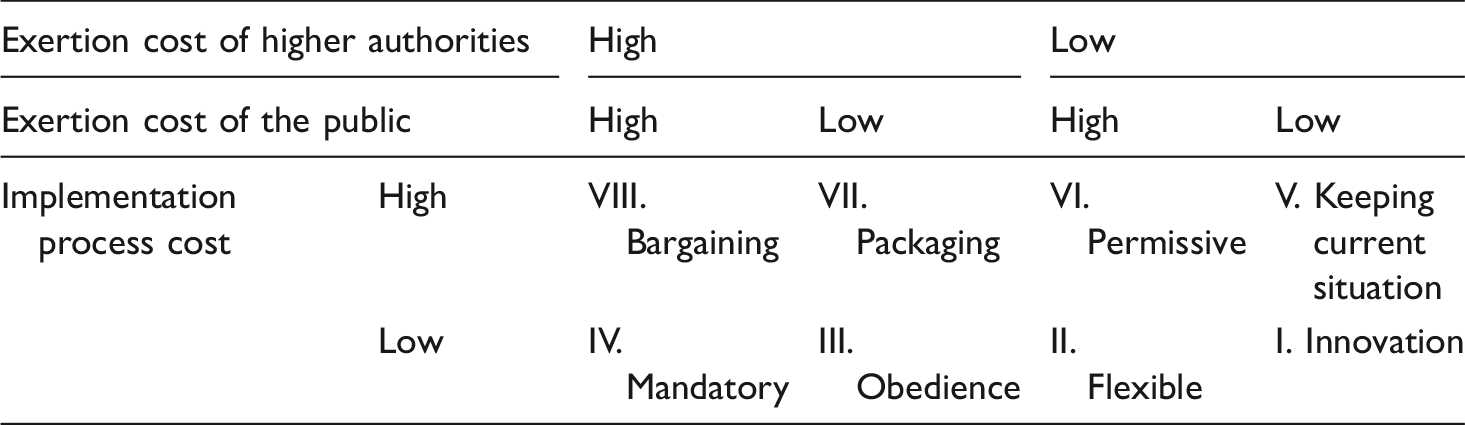
Type I: When the exertion cost from higher authorities is low, and the exertion cost from the public is also low, the grassroots government has greater freedom of choice and more space in implementation and tends to choose innovative methods of implementation (Liu and Tian, 2009).
Type II: When the exertion cost from higher authorities is low while the exertion cost from the public is high, the grassroots government tends to take flexible measures to adapt to the real environment for implementation and to avoid arguments and conflicts with the public, since there is a low possibility of punishment by the superior government, and the major pressure comes from the public.
Type III: The exertion cost from higher authorities is high while the exertion cost from the public is low. The grassroots government tends to obey the commands from the higher authorities so as to avoid punishment, and it may not encounter much resistance from the public.
Type IV: Both the exertion cost from higher authorities and the exertion cost from the public are high. If the grassroots government chooses to implement the policy, it may encounter punishment from higher authorities and resistance from the public; therefore, it must continue exploring resources for implementation and enforce the policy.
In the case of high implementation costs, the grassroots government tends to avoid or even refuse implementation. Differences in external costs involve the following types of implementation.
Type V: The exertion cost from higher authorities is low and the exertion cost from the public is also low. Even if the grassroots government does not implement the policy, it will not be negatively evaluated by the higher-level government and the public, so it will choose to maintain the status quo.
Type VI: The exertion cost from higher authorities is low while the exertion cost from the public is high. In this case, the grassroots government can concern itself less with the approval by the superior government than with the attitude of the public. In order to avoid conflicts with the public, the grassroots government chooses to let members of the public judge and decide on their own.
Type VII: The exertion cost from higher authorities is high, while the exertion cost from the public is low. The grassroots government concerns itself more with the evaluation of the superior government; however, due to the high cost of implementation, it tends to engage in ‘packaging’ in implementation (Feng, 2009) and make false declarations about its effects.
Type VIII: The exertion cost from higher authorities is high and the exertion cost from the public is also high. The grassroots government is in a dilemma: especially when the implementation costs and the exertion cost from the public become constant or continuously increase, the grassroots government will turn to the ‘original imposer’ of the high cost, the superior government, to acquire space for implementation.
The structural elements that affect implementation costs include power distribution between the subordinate and superior government, complexity of social environment, degree of policy clarity, and flexibility in the implementation process (Cai, 2008; He and Kong, 2011; Matland, 1995; Zhou, 2008). Implementation costs can be regarded as the intermediate mechanism between structural elements and implementation behaviors. The functioning of structural elements should be achieved after cost-based weighing by the grassroots government. Meanwhile, the costs of implementation and the different proportions of costs in combination can be perceived by the township government, which will take actions based on its weighing and judgment of implementation costs. This view can explain the differences in investment by different township governments in bargaining with the superior government. Those large towns of animal husbandry that are greatly affected by the policy of grazing prohibition are always active, because they are affected most by the implementation costs. Moreover, implementation process costs, the amount of exertion cost from higher authorities, and exertion cost from the public are relative to each other and constantly change with the execution process. By observing the actions of grassroots governments during the long implementation process, we can see that their implementation methods are dynamic. When a government finds an implementation method with lower costs and higher value, it may make change methods in time. From the perspective of utility maximization, if the grassroots government can find an implementation scheme that can integrate the interests of the superior government, the grassroots government, and the local public, the grassroots government may choose this scheme; when its costs remains high, the grassroots government tends to break through into an easier approach (Shleifer and Vishny, 1998; Yang and Su, 2002). This is the presupposition of the bargaining behavior initiated by the grassroots government.
Explanation for the bargaining behavior in the implementation of grazing prohibition
In the stage of rest-grazing, the county government put forward the requirement of rest-grazing, but failed to follow up with intensive supervision and checking. During this stage, if the township government strictly implements the stipulations of the higher authorities and strictly prohibits grazing in grasslands, it should invest a great deal of manpower and material resources on the one hand, and on the other hand, it may encounter resistance from the grazing households. However, the strict implementation may not receive acknowledgment and approval by the superior government. In addition, the township government faces high exertion costs from the public; therefore, the grassroots government can take advantage of the policy gap and turn a blind eye to illegal grazing, and may not be severely punished by the superior government. The township government tends to be flexible at this stage, that is, to implement rest-grazing policy according to the actual situation and its own preferences, rather than strictly following the policy set by the superior government.
In the stage of comprehensive grazing prohibition, the county government not only put forward more severe stipulations on grazing prohibition, but also dissected the measures of grazing prohibition in detail and required township governments to strictly implement the policy throughout the region for the entire year, following up with intensive inspection and checking. The county government would punish the township government once it discovered any illegal grazing. It reduced the cost for the township government for obeying the policy from higher authorities, and the cost for violating or refusing to implement the policy increased sharply. Meanwhile, in checking for illegal grazing, the township governments encountered resistance from farmer households; especially after large-scale measures of punishment and confiscation were used to implement the policy instead of persuasion, education, and driving away, the conflicts between farmer households and township governments began to accumulate. The comprehensive grazing prohibition stipulated by policy and farmer households’ appeals over grazing could not be satisfied at the same time. The two items of external cost to the township government—exertion cost from higher authorities and exertion cost from the public—were increasing, and implementation was restricted. At the early stage of implementing comprehensive grazing prohibition, the township government tried to bargain with the county government; however, the endeavor was turned off by the county government for the reason of political task. Compared with the external cost, the township government could invest more implementation resources, since its implementation cost was relatively low. Therefore, the township government chose to enforce the policy; however, in the meantime, almost all towns implemented the policy of grazing prohibition with reluctance.
As the grazing prohibition policy progressed, the county government failed to alleviate the inspection and punishment of the township governments, while the resistance of farmer households failed to abate; on the contrary, the scale and intensity were increasing. At this stage, if a township government continued to implement the strict policy of grazing prohibition, social conflicts would intensify. If the township government refused to implement the policy of grazing prohibition or became flexible in its implementation, its behavior would not be approved by the higher authorities, and all kinds of punishments would challenge the township government. The township government realized that it could not resolve the conflicts between implementation and coordination within the range of its own power and resource ability, and it could hardly bear the dual pressures from the superior government and the public. Since it could not resolve the difficulties on its own, it had to shift the difficulties to external factors and try to find solutions from the policy origin through extension methods, and thus the bargaining behaviors of the township government were triggered. In terms of the changes in the choice of the township government, bargaining was a compelling and ‘remaining choice,’ but in terms of its effects, by introducing the county government into the process of policy execution, the township government urged the county government to adjust its policy for local conflicts, and relieved itself from the dilemma temporarily.
Structurally, systematic reform and policy implementation patterns may affect implementation cost. Systematic reform involves interest adjustment, so it carries the potential threat of triggering social conflicts, while interest adjustment brings about social fragmentation, and the greater the fragmentation is, the more difficult the process of systematic reform will be, and the greater the possibility of inducing conflicts (Knight, 1922; Yang, 2005). Before the issuing and implementation of rest-grazing and grazing prohibition policy, the grazing farmer households, as stakeholders, did not participate in policy formulation, and the negotiation process in the policy formulation stage was shifted to the implementation stage. This undoubtedly increased the exertion cost from the public in the policy execution process of the grassroots government.
Due to heavy workloads and limited time, after a short period of rest-grazing as a transition, Sidong County entered the stage of comprehensive grazing prohibition. The superior government and governments of different levels as followers took implementing this policy as a key task, to which great weight or concern was attached, and policy implementation was pushed forward through mobilization (Xun and Bao, 2007). Under the mobilization mode, governments at all levels focused their attention on the implementation of the new policy. The county-level government not only stipulated strictly but also performed a detailed task dissection, together with intensive inspection, imposing high pressure on grassroots government. However, the effects of policy implementation were not determined only by grassroots government: the implementation required the cooperation of farmer households, and the latter failed to cooperate within the scope of the policy. When choosing to strictly implement punitive measures in accordance with the regulations by the superior government, the township government was subjected to large-scale and intensive resistance, social conflicts were on the verge of breaking out, and implementation costs quickly exceeded what township governments could afford. The compulsory systematic changes, the mobilization-oriented implementation mode, and the unacceptable consequences of policy implementation increased the process and external costs of policy execution by the grassroots government, and thus only bargaining could be applied to find alternative or corrective solutions.
The changes and equilibrium of agreement points in bargaining
The elements of bargaining include a set of possible agreements, no-agreement results, and the utility function of the participants. In terms of bargaining in policy implementation, full execution and no execution at all are no-agreement results. The area between the two statuses is the possible set of agreements and the obtained utility. In the ‘client-agent’ relationship in which the superior government formulates policies and the subordinate government implements policies, if the county government has strong game power, the agreement point goes to the end of full execution; if the township government has strong game power, it goes toward the loose end of execution. Generally in the policy mobilization stage, the county government requires (nearly) full implementation and imposes high penalty costs and, thus, the agreement point goes toward the end of full implementation; however, with changes in the implementation environment and bargaining between both sides, the game power of township government rises, it possess greater advantages in terms of information, commitment, and social risk tolerance, and the agreement point of the two parties moves to the loose end of execution.
Bargaining requires costs, and the tolerance for costs determines the bargaining ability of both sides. The bargaining ability of participants weakens with the rise of bargaining costs to themselves and strengthens with the rise of bargaining costs to their rivals; the changes in costs or in bargaining ability result in the bargaining pattern. Since the bargaining pattern is jointly molded by both parties, therefore, the equilibrium of agreement point in bargaining is determined more by the relative bargaining abilities of the participants, which are expressed by the relative bargaining costs of participants, rather than the absolute bargaining costs (Muthoo, 1993, 2005). Relative bargaining ability is an important concept.
In the gaming between the county and township governments, the absolute bargaining ability of the county government is much higher than that of the township government; in terms of absolute value, township government has no bargaining ability at all (Liu, 2016), but the reason for the township government to pay the price offering of the county government is that the relative values of bargaining of the two parties have changed.
At first, the bargaining ability of the township government is weak, because it basically has no means to bind the county government. Even if it initiates bargaining, the bargaining cost is quite high, but as the risk of social conflict increases, the bargaining cost of county government-resistance by the public resulting from urging the township government to strictly implement grazing the prohibition task may increase, the township government’s bargaining ability increases instead. The township government also faces the social risks that may arise from an increase in social conflicts. Therefore, it will also try to minimize the occurrence of social conflicts. However, from the point of view of bargaining, since the township government bears the implementation costs, the exertion cost from higher authorities, and the exertion cost from the public, while the county government did not previously have to bear such costs, and the pressure brought about by an increase of exertion cost from the public to the township government is significantly less than that brought about by an increased public cost to the county government, in this way, changes in relative values can result in the adjustment in a bargaining pattern.
In bargaining, weak points can usually serve as the source of strong points (Schelling, 1980). Before initiating bargaining, the participants express their stances through incomplete commitment, while they must pay costs if they want to cancel such incomplete commitment. For example, in the case under discussion, the county government pointed out that ‘if the policy of grazing prohibition is not strictly implemented, it will be regarded as incompletion of a political task.’ This is the incomplete commitment of the county government to the township government; the township government stated that ‘if the grazing prohibition policy is not properly adjusted, the resulting social conflict may become out of control.’ This is the incomplete commitment of the township government to the county government. As the marginal cost caused by canceling the incomplete commitment increases, the participant’s bargaining ability also increases. In the implementation of grazing prohibition policy, the county government had commitment, and the township government also had commitment, but the marginal cost of cancelling commitment for the township government was higher than that for the county government. When implementation cost was high, the township government had no other choice, although the cost of canceling commitment for the county government was also high, but it was still relatively low compared to the cost for the township government, which was why the county government was willing to make concessions. The bargaining between county and township governments occurred in the process of policy implementation, so their bargaining ability changed with the changes of constraint elements, especially when, after encountering the refusal by the superior government, the enforcement of grazing prohibition by township governments led to more conflicts between grassroots government cadres and farmers. This action of ‘waste of money’ imposed huge cost pressures on the county government, and thus it improved the bargaining ability of the township government.
The county and township governments were faced with multiple rounds of bargaining. The irrevocability of the system determined that they would reach an agreement in every round of bargaining, and the agreement point each time was not fixed at one position, nor would it move to one end, but at a boundary point where it would turn around toward the other end. This is the pendulum equilibrium of the long-term game relationship (Li, 2005). There was no deadlock in the policy execution of the county and township governments, the agreement point moved constantly, and short-term equilibrium and bargaining occurred alternately.
Conclusions and discussion
Bargaining is a common phenomenon in policy implementations of the Chinese government. This paper proposes a question from the perspectives of experience and theory: Why do grassroots governments bargain with superior governments? What are the factors that lead to changes and equilibriums of the agreement points between the subordinate and superior governments? The grassroots government has to bear the implementation process costs, the exertion cost from higher authorities, and the exertion cost from the public. When the three kinds of costs stay high, the grassroots government tends to choose bargaining with the superior government as a way of seeking more space for implementation from the superior government. When both sides bargain in the process of policy implementation, the cost for them is not invariant. When the relative value of bargaining cost for the grassroots government is less than that for the superior government, the bargaining ability of the township government is relatively increased, pushing the agreement point from the strict end to the loose end of implementation. Deadlock in implementation, alternation of short-term equilibrium and bargaining, and pendulum of agreement point are the typical characteristics in policy execution between the subordinate and superior government in policy implementation. In the analysis framework in this paper, the policy implementation cost can explain the occurrence of bargaining, but not its direction, that is, why the bargaining happens between the subordinate and superior government and not between grassroots government and the public. The introduction of a typical case can explain the direction of bargaining, but increasing restrictive conditions may weaken the simplicity of the model. In experience analysis, the township government is conceptualized as a unified body involved in bargaining, but actually, there are differences among township governments, which compete with each other. This factor inevitably affects the generation mechanism of bargaining. For simplicity of discussion, this point is not fully analyzed in this paper.
The discussion of the generation mechanism of bargaining cannot avoid the systematic space set by the superior government. If the superior government does not leave any space at all, it is impossible for the subordinate government to initiate bargaining, and thus it has to choose to strictly implement the policy. It can be inferred that with the concentration of power, the pressure from the government on the people will intensify. On the contrary, if the superior government leaves enough space, the subordinate government can implement policy with other substitute measures, rather than using bargaining, which requires a high cost, namely, that under the condition of separation of powers, the subordinate government tends to be flexible in implementation. It should be observed that, in the process of policy execution, the subordinate government is not totally powerless, that the superior government has reverse dependence on the subordinate government for administrative cooperation and local resources, and such dependence becomes the capital of the subordinate government in offering a price to the superior government (Zhang, 2014). The occurrence of bargaining requires systematic space, and the implementation of a new policy creates the opportunity for such space. On the one hand, the superior government wants to preserve its top-down authority and assign working tasks to the subordinate government; on the other hand, the superior government is not totally clear about the new policy and the degree of adaptation to the implementation environment; therefore, it may leave flexible space for the implementation of the subordinate government. When the subordinate government encounters dual pressures by the superior government and the implementation environment and cannot achieve the mission through deep implementation, re-bargaining is a reasonable choice. In the early stage of implementing a new policy, bargaining occurs frequently, and this point is consistent with empirical facts.
When we look at policy implementation between the subordinate and superior governments in China from a macroscopic perspective, jointly influenced by the factors of the policy pushing model, the awakening of public rights awareness, and the tension between technology governance and local coordination, the importance of bargaining becomes even more prominent. Objectively speaking, the bargaining between the subordinate and superior governments can form a buffer between system formulator and the public and reduce the external cost of policy implementation; however, frequent bargaining may easily result in the abuse of administrative resources, reduce implementation efficiency, and meanwhile harm the authority and seriousness of a policy issued by the government. The essence of bargaining logic is still to find an equilibrium between policy formulation and policy implementation. This is not merely a problem in the process of policy implementation, moreover, it requires a responding administrative system.
Footnotes
Acknowledgment
I would like to express my gratitude for the help in this paper from Shiding Liu, Xueguang Zhou, Yuzhao Liu, Xiaochun Huang, Shenyong Hao, Min Ye, Baoqing Pang, Jianning Yu, and Shanqing He, as well as mentors and friends in the ‘grassroots government in the urbanization process’ discussion group. I also want to thank the peer reviewers of this paper for their valuable comments and suggestions. The author takes sole responsibility for his views.
Declaration of Conflicting Interests
The author(s) declared no potential conflicts of interest with respect to the research, authorship, and/or publication of this article.
Funding
The author(s) disclosed receipt of the following financial support for the research, authorship, and/or publication of this article: This research was supported by the Shanghai Philosophy and Social Science Planning Program (2015ESH001).