



Abstract
In this article we build on the concept of incompleteness, as recently developed in both organisational and urban studies, to improve our understanding of the collective actions of grassroots organisations in creating and governing critical infrastructures in the changing and resource-scarce contexts of urban informal settlements. Empirically, the article is informed by the case of resident associations providing critical services and infrastructure in informal settlements in Kisumu, Kenya. Findings suggest three organisational processes that grassroots organisations develop for the production and governance of incomplete grassroots infrastructures: shaping a partial organisation but creating the illusion of a formal and complete organisation; crafting critical (and often hidden) material and organisational infrastructures for the subsistence of dormant (but still visible) structures; and moulding nested infrastructure that shelters layers of floating and autonomous groups embedded in communities. In a resource-poor environment, the strategy is to create incompleteness, less organisation and to keep it partial and limited to a minimum of elements. The article also explores the political implications of organisational and infrastructural incompleteness by examining how it leads to efforts to craft loose and ambiguous governmental arrangements, connecting them materially and politically to formal infrastructure systems. These governmental arrangements are shifting and in the making, and therefore also incomplete. The article reveals how grassroots organisations mobilise a wide range of (in)visibility approaches. It concludes by exposing the hidden power of ‘incompleteness’ and the potential in hiding certain elements of incompleteness from outsiders, while rendering other elements visible when perceived as useful.
Introduction
In informal settlements disconnected from networked infrastructure systems (Lawhon et al., 2018; O’Brien et al., 2019), urban dwellers engage in everyday practices to secure water, sanitation, energy, transportation and waste management services. These practices of ‘entrepreneurial urbanism’ (Chien, 2018; McFarlane, 2012) take many different forms, ranging from individual silent encroachment (Bayat, 2000) on electricity grids or water pipes, to unregistered social networks and collectively organised responses (Myers, 2011). Examples of the latter include the introduction of prepaid water meters in Johannesburg (Von Schnitzler, 2016), social mobilisation concerning sanitation in Kampala (McFarlane and Silver, 2017) and negotiations by slum dweller associations in Mumbai to improve sanitation infrastructures (Appadurai, 2001).
Nevertheless, the very heterogeneous (Lawhon et al., 2018) and incremental (Silver, 2014; Simone, 2008) infrastructures that the grassroots construct are usually disregarded by public officials. These bottom-up practices can be invisible to the eyes of city planners or seem dysfunctional or incomplete and, therefore, be perceived as ineffective from the perspective of the northern ‘modern infrastructure ideal’ (Graham and Marvin, 2001).
Previous research argues, however, that incompleteness in both organisational design (Ahrne and Brunsson, 2011; Garud et al., 2008) and urban infrastructures (Guma, 2020; Simone, 2015) is not necessarily a negative feature or a threat, but can instead be beneficial. Incompleteness is better understood as a quality that describes infrastructures as emergent, shifting, open and in the making. It is a virtue that disadvantaged urban communities nurture, to protect their informal practices from the scrutiny of authorities by ‘keeping things incomplete’ (Simone, 2014: 330). But while incompleteness is emerging as a key dimension of both organisational and urban infrastructural processes, the two strands of scholarship have yet to speak to each other.
This article attempts to bring together the organisation and urban studies literatures regarding this less-discussed feature of incompleteness as a purposeful characteristic, to examine the collective actions of grassroots organisations that create and govern critical infrastructures in the changing and resource-scarce contexts of informal settlements. Specifically, we bring organisation theory (e.g. Ahrne and Brunsson, 2011) to bear on our understanding of the social organisation of infrastructures in urban studies. Empirically, the article is informed by the case of grassroots organisations supporting the production and maintenance of critical infrastructures and services in informal settlements of Kisumu, Kenya. In the first part of the article, we examine the role that grassroots organisations play in the production and governance of such infrastructures. Findings suggest three organisational processes that grassroots organisations engage in to produce and govern incomplete grassroots infrastructures: (1) creating representations of formal and complete organisations behind which organisational incompleteness can be instrumentally managed; (2) crafting critical (and often hidden) material and organisational infrastructures for the subsistence of dormant (but still visible) structures; and (3) moulding nested structures that shelter layers of floating and autonomous groups embedded in the communities. In the second part of the article, we explore the political implications of organisational and infrastructural incompleteness by examining the ambiguous and loose grassroots governmental arrangements they construct. These governmental arrangements are shifting and in the making, and therefore also incomplete. The article concludes by revealing the hidden power of ‘incompleteness’ and its potential in hiding certain elements of incompleteness from outsiders, while rendering other elements visible when perceived as useful. By so doing, the article contributes to ongoing southern theory-making developments in urban and organisation studies.
Organisational and urban incompleteness
Organisational incompleteness
In the context of Global South cities’ informal settlements, grassroots social movements (Castells, 1983) have evolved into various forms of associational life and organisation, such as neighbourhood associations, created to address the basic infrastructural needs of residents (Mitlin and Patel, 2014). Grassroots organisations usually combine service provision with strategies of political advocacy, negotiation and confrontation (Mitlin, 2018). While some scholars point to the risk of the co-optation of grassroots organisations through their collaboration with governmental and non-governmental actors (Zapata Campos et al., 2021), other commentators argue that the networks they form are turning, deliberately or not, into new urban social movements at the fringes of the formal city (Appadurai, 2001; Holston, 2009).
The organisational form into which they crystallise varies depending on the context. In Kenya, most grassroots organisations in informal settlements take the form of community-based organisations and self-help groups, increasingly organised under the umbrella of resident associations (RAs). Since colonial times, RAs have been the associative form representing residents’ views in middle-class neighbourhoods, responding to government ineptitude in meeting the infrastructural needs of residents (Rubin, 2021). More recently, RAs have increasingly extended to both high- and low-income settlements in Kenya (Echessa, 2010) and other African cities.
Grassroots organisations, such as RAs, are usually characterised by a strong sense of locality and territoriality, authenticity, resource scarcity and moderate organisational formality (Chowdhury et al., 2021). Rather than relying on formal bureaucratic organisations, the grassroots develop adhocracy, informality and ‘flexibly configured organisational landscapes’ (Simone, 2004: 407) in order to adapt to the changing environments and unpredictable conditions in which people live.
In organisation studies, some of these practices have been described as ‘partial organisation’, which relies on ‘less than all organisational elements’ (Ahrne and Brunsson, 2011: 84). In contrast, standard organisation theory is often limited to the definition of complete formal organisation, which draws on the full array of organisational elements, such as membership, hierarchy, rules, rewards, sanctions and monitoring. While the design of these elements varies, ‘the management of a formal organization cannot decide to abstain from an element altogether: if we are to make people believe that something is an organization or a “true” organization (Brunsson, 2006), then we have to show them that it has access to all these elements’ (Ahrne and Brunsson, 2011: 86). By contrast, Ahrne and Brunsson have argued that partial organisations are those that access one or a combination of these elements separately, such as loose public–private partnerships relying on hierarchy and membership, but without rules or sanctions.
Lacking some of these organisational elements, partial or incomplete organisations can nevertheless experience difficulties arising from insufficient hierarchy, rules or membership. On that note, in her studies of grassroots/community organisations for the governance of common resources, Ostrom (1990) concluded that these organisations can better succeed when they have access to a broad repertoire of organisational elements. In other words, she claimed that when the grassroots can create complete organisations, they have a better chance of maintaining their activities. It is important to clarify that, while Ostrom and other political scientists prefer the concept of an ‘institution’, organisation theorists and we in this article use the notions of ‘formal organisation’ and parts of a formal organisation to refer to similar phenomena.
Ahrne and Brunsson (2011) expected lack of resources to result in an incapacity to access one or several organisational elements, and hence in partial organisation. Other organisations, however, actively desist from incorporating all organisational elements because a lower level of organising is beneficial for them; for example, in resource-poor and turbulent environments, such as informal urban settlements.
Urban incompleteness
Simone (2015: 154) has argued for the craft of incompleteness in African cities, where everything is ‘incomplete, shocked open, ready to be refigured to pass on’. A logic of incompleteness provides residents with a broad repertoire of strategies to adapt and sustain social, entrepreneurial and infrastructural life in informal settlements.
In this line of argument, Guma (2020: 733) has claimed that incompleteness does not denote a missing element, ‘but a never-ending state of becoming; it does not imply a condition that arises because of absences, but because of possibilities’. That is, incompleteness is not necessarily something detrimental, but can imply a ‘source of potency’ (Guma, 2020: 733), creativity and openness. Guma identified three core features of incompleteness in the financial infrastructures of Nairobi’s informal settlements: transiency (the inherent nature of infrastructure as transitory); continuity (continuous tinkering for infrastructural maintenance); and contingency (as users’ inclinations and practices are not fixed but rather, continuously negotiated and situated, opening new possibilities in the course of uncertainty).
Beyond the ability of incompleteness to facilitate adaptation to changing urban settings, Simone (2014: 330) contended that deliberate incompleteness or ‘the preference for keeping things incomplete’, can protect the social and material infrastructures developed by communities. Deliberate incompleteness can help prevent slum dwellers’ exclusion from their own innovations by keeping them less legible, and thus less visible to the gaze of, for example, public officers. This sort of invisibility (or incompleteness) by design (Garud et al., 2008; Scott, 1990; Star, 1999) hides these less orthodox and often illegal developments at the fringes of the formal economy, the formal city and the formal infrastructural systems.
Incompleteness can therefore be an infrastructural feature and a deliberate organisational strategy, but also a perception, an inability ‘to see’. Perceptions of incompleteness can result from predominant ideals of rationality and modernity (Graham and Marvin, 2001) pervasive among both public officers and researchers. Simone (2004) highlighted the difficulty the untrained eye has in seeing the complexity of African cities and their organisational life, mistakenly seeing neighbourhoods or whole cities as ‘incomplete’. This is because of their illegibility to those who apply a conventional imaginary of modern western cities and their high-tech infrastructures (Coutard and Rutherford, 2015). As we will show later, in these situations, representations of seemingly complete or formal organisations directed towards these actors can be created to ‘hide’ the logic of incompleteness.
Perceptions of incompleteness can also result from the positionality of the observer, since certain organisational elements, or parts of the infrastructure, cannot be discerned by outsiders (Star, 1999). For example, certain forms of social organisation, such as economies of affection, describe social relations of extended families that offer protection in times of need (Hyden, 1983). These ‘invisible organisations’ are difficult for outsiders to perceive because they are ‘ad hoc and informal rather than regular and formalized’ (Bratton, 1989: 9). While the organisational façade of such initiatives might resemble the ceremonial rituals or myths (Meyer and Rowan, 1977) of formal and complete organisations, created to gain necessary external legitimacy, other less visible internal organisational infrastructures, such as face-to-face meetings, help coalesce loose constellations of actors (Haug, 2013) to stabilise and reproduce organisations. Following Haug (2013), research into grassroots organisations calls for exposing, mapping and understanding the collective (and externally invisible) actions sustaining organisational infrastructures.
Building on this emergent literature, this article is informed by a definition of incompleteness: (1) as an infrastructural feature allowing adaptation to changing urban environments; (2) as a deliberate organisational strategy to keep communities illegible and invisible; and (3) as a representation, a perceptual lack contingent on imaginaries of values, beliefs and positionality. This redefinition of incompleteness rooted in and relevant to southern cities is intended to contribute to wider ongoing debates within southern theorising in urban (e.g. Ernstson et al., 2014; Lawhon, 2020; Robinson, 2013; Roy, 2009; Watson, 2009) and organisation studies (e.g. Alcadipani et al., 2012; Bobby Banerjee and Prasad, 2008; Ibarra-Colado, 2006; Prasad, 2003) by developing constructs about how the city, together with its infrastructure and organisation, is and ought to be.
We are aware of the challenges of adopting a vocabulary of incompleteness, as it may fall into assumptions in which southern cities and their organising are explained as ‘not northern’ rather than approached on their own terms. Instead, we advocate the redefinition of incompleteness inspired by the creativity of the everyday practices of African cities (Guma, 2020; Simone, 2008), far from perceptions of the inadequacy and dysfunctionality of southern settings in comparison with northern cities. As we argue throughout this article, the grassroots organisations studied here challenge how collective action is theorised in terms of, for example, a southern logic of incompleteness, rather than in terms of urban social movement theories as developed from northern accounts. By rethinking and redefining ‘incompleteness’ in cities and organisations, we hope to contribute to the unlearning of northern and modern notions of completeness versus incompleteness so as to enable scholars from the North to ‘learn anew’ about still unfamiliar places (Lawhon, 2020) in urban and organisation theory, such as the Global South’s informal settlements, together with their governance and organising.
Methodology
Empirically, the article is informed by the study of three resident associations in as many informal settlements in Kisumu, Kenya: Manyatta, Nyalenda B and Obunga. The study uses a combination of methods, including document studies, meeting observations, visual ethnography, interviews, focus groups and stakeholder workshops. We conducted fieldwork during five periods: November/December 2017, April 2018, November/December 2018, September 2019 and November 2019. Complementary interviews were conducted in 2020.
We conducted over 50 in-depth interviews with representatives of grassroots initiatives at the informal settlements (i.e. youth groups, women’s groups, community-based organisations and resident associations), members of other grassroots networks providing critical infrastructures and services in the informal settlements (i.e. the Kisumu Waste Actors Network, women’s fishmonger groups and the Kisumu Street Vendors Association) and officers and politicians from Kisumu County and the City of Kisumu. Many interviews started as group interviews with members of the grassroots organisations, which were followed up by individual interviews. The interviews covered themes such as the description of the infrastructures and services provided by the grassroots organisations, these organisations’ histories, the actors involved, the addressed challenges, how resources were mobilised and what impacts and changes were experienced in the communities due to their work. We also explored knowledge development processes as well as issues of internal management, external relations and governance. Most interviews were recorded and transcribed for analysis. During the observations, we took notes, which were later coded as data.
Our research strategy has been pragmatic in that it began with collecting data and later involved abductive iterative moves (Charmaz, 2016) between collecting, sorting, coding and probing the data, and then collecting new data (in successive fieldwork trips) until we could reconstruct the story of the studied grassroots organisations. We started by interviewing and observing; as we got to know the case better, the coding showed that the collective actions mobilised by the grassroots organisations in the production and governance of infrastructure in their communities were characterised by being partial and complete, critical and dormant, and floating and nested. Further coding of the political implications of these grassroots infrastructures showed how the loose and ‘incomplete’ governance arrangements were developed by the community to engage with local authorities.
Kisumu and informal settlements’ resident associations
The case: Kisumu
With a population of 471,542 inhabitants in 2019 and a rapid urbanisation rate of 4.3% yearly (Kenya National Bureau of Statistics, 2019; Republic of Kenya, 2016), Kisumu, on the shores of Lake Victoria, is the third largest city in Kenya. Kisumu has a planned city centre and large unplanned urban and peri-urban areas. Over 60% of Kisumu’s population live in the unplanned informal settlements, with deprived housing conditions, scarce toilets and showers, few household waste collection services, generally fragile services and unclear legality (Kain et al., 2016). The city has a very fragile public sector functioning parallel to a growing informal sector in direct need of infrastructure for basic service delivery. Non-governmental organisations (NGOs), community-based organisations (CBOs) and the community at large usually provide most critical services, ranging from waste collection to water supply, sanitation and even access to capital and savings. The city is therefore a good learning case for bottom-up resilience induced and nurtured to meet dynamic societal needs.
Resident associations: Building critical infrastructures from below
RAs are a relatively new organisational form articulating residents’ interests in Kenya. The oldest RAs date to the 1990s in Nairobi’s middle-class neighbourhoods (Echessa, 2010). By 2004, the umbrella organisation Kenya Alliance of Resident Associations (KARA) had 236 affiliated unit associations (Chitere and Ombati, 2004). As of 2021, it is estimated that there are over 3000 RAs, although half are apparently inactive (KARA interview). RAs generally promote residents’ participation in the design and delivery of shared services and infrastructure. While issues of security and environmental degradation predominate in the formation of high-income RAs, RAs in middle–low-income settlements focus more on lobbying for better services from city planners and on raising funds to address social welfare and economic challenges. In low-income settings, RAs are created both to improve shared infrastructures and to support community businesses and complementary income (Echessa, 2010).
External drivers have prompted the formation of many RAs through, for example, church organisations’ coordination efforts, advice from chiefs or local government officers and, in high-income neighbourhoods, the influence of foreign residents. In the last decade, NGOs have instrumentally supported the diffusion of RAs in informal urban settlements to strengthen the social capital and organisational capacity of these communities.
The City of Kisumu has been no exception to establishing the RA as the typical organisational form representing residents’ interests and improving service delivery in informal settlements. In 2003, grassroots organisations in Manyatta started with the initiation of water and sanitation projects funded by the NGO Sana International. As part of these activities, the NGO supported the creation of the Manyatta RA, providing templates for its constitution and facilitating its registration. Other RAs have been founded in most informal settlements in Kisumu (e.g. in Obunga in 2005 and Nyalenda B in 2008, also supported by Sana International). Today there are 15 RAs in the city (comprising Manyatta A and B, Nyalenda A and B, Obunga, Kibos in Nubian, Kaloleni, Migosi, Ondiek, Makasembo, Bandani, Kibuye, Lumumba, Manyatta Arab/Mosque and Pembe Tatu in Sauri Yako), 10 of which are active and fairly visible.
In two of the three cases studied here (Manyatta and Obunga), the RA started with water provision in partnership with the municipality. Other taskforces were then developed, as external funders provided resources, and became inactive when resources dried up. The most common taskforces address solid waste management, sanitation, water supply, urban agriculture, economic empowerment, children’s rights, human rights, health, women’s empowerment, housing and renewable energy. More recently, new groups and activities have been added, such as boda-boda or ‘table bank’ groups.
RAs adopt formal, very hierarchical organisational forms, with a chair, executive committee, ad hoc taskforces and elected representation from the different territorial units in the settlement. Members of executive committees are elected every three years, while the unit leaders and taskforce heads are elected every two years. Elections start with zonal leaders and then the executive committee at the RA level is elected by all members. Any resident in the informal settlement qualifies to become a member, as long as an annual fee is paid (US$1 in Nyalenda, US$2.50 in Obunga and US$5 in Manyatta). Members of the executive usually meet weekly to receive reports from taskforces and decide on activities to undertake. Taskforces are formed based on the needs of the RA, and members are assigned to them through nomination.
Grassroots organisations and critical infrastructure
In this section, we analyse the social and organisational work that grassroots organisations mobilise in producing and governing critical grassroots infrastructure based on the study of RAs in Kisumu’s informal settlements.
Hiding incompleteness: Partial organisations creating the illusion of complete organisations
RA establishment was encouraged and assisted by several NGOs through providing training activities and draft constitutions, which explains why RAs in different informal settlements in Kisumu developed similar organisational forms – a process termed ‘organisational isomorphism’ (Meyer and Rowan, 1977). In addition, successful RAs (e.g. in Manyatta) were used as a template for RAs in other informal neighbourhoods (e.g. in Obunga). As RAs were formed, they developed a façade of formal and hierarchical organisation, with an executive committee, a chair, territorial representation of sub-units and taskforce coordinators.
Differently expressed, RAs create an illusion of being complete and ‘true organisations’ (Brunsson, 2006) containing all the assumed features of formal organisations. In so doing, they maintain the ceremonial rituals (Meyer and Rowan, 1977) necessary to gain legitimacy and attract potential resources. Often criticised for ‘not being reliable, never [holding] elections … [and being] amorphous’ (Interview with municipal officer) in their quest for visibility and legitimacy in the eyes of local authorities and development agencies, RAs strive to resemble complete organisations. For example, by adopting the label ‘resident association’, even though some are not legally constituted as such, RAs give the impression of covering large territories and therefore of having broad representativeness.
Yet, RAs are more accurately characterised by organisational incompleteness, their partial organising relying on ‘less than all organisational elements’ (Ahrne and Brunsson, 2011: 84), including aspects of the organisational environment. These grassroots initiatives therefore build their RAs with the ‘minimum’ (Simone, 2004), ‘partial’ and ‘adjusted’ (Amin and Thrift, 2017) set of elements at hand. They adopt several organisational elements, mostly membership and hierarchy, a combination that mirrors the constitution of the RAs as umbrella organisations encompassing smaller groups (Ahrne and Brunsson, 2011). Other elements are not included in practice either because of a lack of resources typical of informal settlements, because they obstruct the use of other elements (i.e. the bureaucracy generated by control and sanction systems), because there is resistance or simply because certain formal elements (e.g. monitoring) are not needed in an umbrella organisation like an RA.
Even the organisational elements fundamental to RAs, such as membership, remain loose. To illustrate, despite membership fees being compulsory, in the territories of some RAs very few members pay them as sanctions are not applied. On one hand, this loose membership reduces the economic resources of the RA; on the other hand, it allows open and fluid membership and broader representation in these low-income neighbourhoods. For example, in Manyatta, paying a fee for meeting attendance has recently become compulsory as part of a collective saving scheme, as described below. Still, the application of the rules and the sanction system is flexible, in order not to exclude participants: Now it is compulsory for all the members of the organizing committee to participate in the table bank … But the amount to pay [every week when they attend the meetings] is minimal, and we don’t put pressure so as not to push members away … [this is why sanctions] are flexible. (Manyatta RA)
This fluid membership also depends on the intermittency of ongoing projects that might attract members as possible recipients. One example was cited by the Obunga RA, which, when calling a meeting at which an external organisation asked to meet all taskforces, also included the water taskforce, even though it had separated from the RA and become independent a while earlier.
While purposefully being part of the craft of organising grassroots infrastructures in the context of informal settlements, features of incompleteness often must be hidden, to gain legitimacy in the eyes of actors who can potentially provide critical resources. Grassroots organisations ambiguously draw both on incompleteness to adapt to the context and challenges of informal urban settlements (Guma, 2020; Simone, 2015) and, as seen in our studies, on representations of completeness by hiding selected features of incompleteness. This ambiguous work of managing organisational incompleteness and its representations is conducted iteratively, as developed below.
Critical and dormant infrastructures
While some ceremonial organisational elements are missing, many organisational activities of the RAs are run on an ad hoc basis; for example, through intermittent taskforces that are activated when external funders provide resources and put on standby when resources dry up. Some taskforces were described as part of the formal RA organisation, but in practice many remained inoperative for long periods, as explained by one member of Nyalenda RA: ‘Some taskforces are dormant; it depends on the unit. We started with waste management, but sanitation and water are the more active now’ (Nyalenda A RA).
Similarly, waste management was one of the first taskforces created by Obunga RA. Unable to achieve financial sustainability for their activities, the taskforce became inactive after a few years, only to be revived for particular community clean-ups when the county convened them.
Informants referred to these inactive yet quickly reactivated organisational infrastructures as ‘dormant’. They are characterised by their ability to remain in reserve, with minimum or no resources and yet alert, swiftly reviving when resources are mobilised from government or donors. While dormant, members of these taskforces shift to other active taskforces, preventing loss of knowledge and capacities: RA member: ‘Drainage, sanitation, and housing are dormant taskforces.’ Another RA member: ‘No! but even I am member of the Manyatta Housing taskforce … Some members shift focus from housing to water because that is where the money is. People move from one taskforce to another one.’ (Conversation with Manyatta RA members)
However, the dormant organisational infrastructures can continue to be made visible to outsiders (see Figure 1) in formal accounts of their RA’s structures. Dormant infrastructures are another expression of the ambiguous work of incompleteness, a transitory organisational form (Guma, 2020) that facilitates adaptation in resource-scarce environments while helping to build legitimacy through visibility. By making the dormant infrastructure visible, partial incompleteness is obscured and potential resources can be accessed whenever opportunities emerge in the institutional environment.
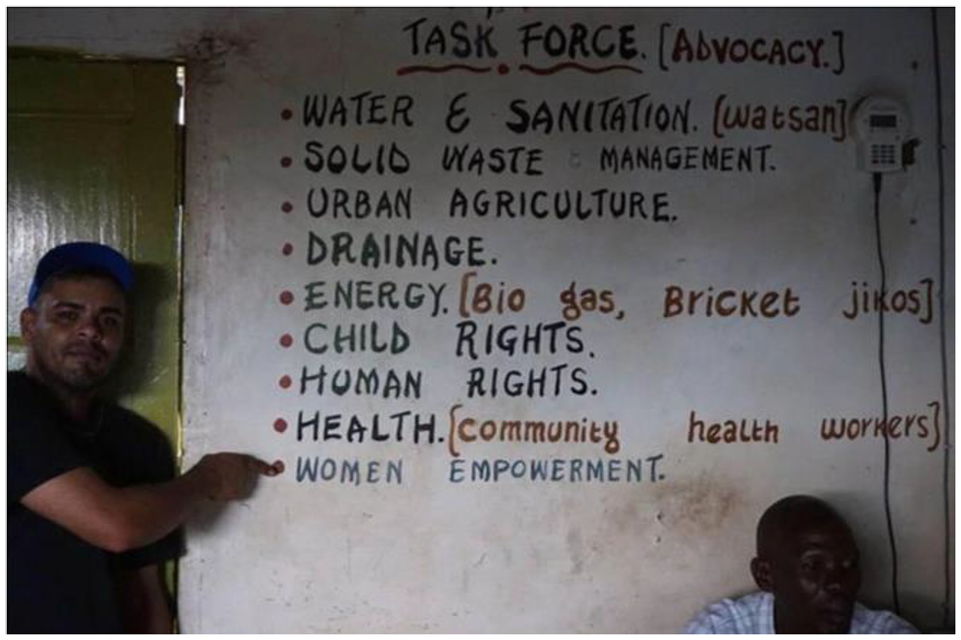
Obunga RA taskforces noted by a visitor.
In such a loose and transient organisational context, the uninterrupted presence of certain critical infrastructures generates the minimal material and organisational resources for the continuity of the RA. As critical material infrastructures, they sustain life in the informal settlement through, for example, providing water or saving infrastructures, as RA members admitted: ‘Water is the mother of others’ (Interview, Obunga RA); ‘Water is life – with waste you can throw it away’ (Interview, Manyatta RA); ‘Money matters’ (Interview, Obunga RA). These infrastructures are materially critical, compared with other infrastructures and services provided by the RA which could be intermittent or dormant (e.g. energy and women’s empowerment groups). Besides the fact that people need water to survive, water provision (in a co-production system with the municipal water company Kiwasco) is a service that generates regular revenue for the organisation. Similarly, in each of the three RAs, hundreds of residents are involved in tens of ‘table bank’ groups, providing their members with financial infrastructure. Table banking refers to a collective funding strategy in which small community groups meet weekly to pool savings and lend to participants at interest. Participation is based on acquaintance and trust. Vulnerable communities across Kenya use table banking to give themselves access to crucial financial infrastructure for saving and investing for businesses and household needs. More recently, table banking has been introduced to collect the funds necessary to expand the services provided by some RA taskforces, such as the water taskforce in Manyatta RA. In this way, community savings infrastructure makes the RAs more independent from external actors: ‘This [i.e. the new table bank connected to the water taskforce in Manyatta] makes a big difference. We used to have partners but now we can sustain ourselves’ (Interview, Manyatta RA).
These infrastructures are critical not only in material terms. Their organisational infrastructure also makes a fundamental contribution to the stability and continuity (Guma, 2020) of the organisations in which they are embedded. Requiring regular face-to-face meetings, table banks also engender the cohesion and sense of belonging necessary to keep RAs alive (Haug, 2013). Linking existing taskforces to new table banks (e.g. a table bank group created among the members of the waste management taskforce in Obunga, and another in the water group in Manyatta) has been a deliberate RA strategy, not only to pool the funds necessary for providing these services but also to ensure meeting participation among members: Where you keep your money is where your mind is, and you make sure that at the end of the year you get interest on top of your savings [so you attend meetings every week] … Attendance has improved, people are eager to come; now people ask when the meetings are scheduled instead of us chasing them. (Interview, Manyatta RA)
Even during an extreme crisis such as the COVID-19 pandemic, when public gatherings of more than six people have been temporarily banned, table banks continue working by bringing people together in smaller groups to pay their weekly contributions.
Critical infrastructure thus not only materially sustains life in informal settlements; it also provides the social (McFarlane and Silver, 2017) and organisational infrastructures, through ‘technologies of social organisation and experience’ (Dierwechter, 2004), that fuel and support the continuity of grassroots organisations and the services they create. While critical infrastructure enables continuity, dormant organisational infrastructures facilitate transiency. Continuity and transiency are both core features of incompleteness (Guma, 2020).
Yet, despite the critical material and organisational contributions of some taskforces to the continuity and endurance of the grassroots infrastructures, their work may pass unnoticed by or even remain invisible to outsiders. On that note, Hyden (1983) has remarked how associational life in African communities can remain invisible to the untrained eye of the newcomer, though it is visible to the participant communities. Cultural institutions in which these organisations are embedded, such as collective saving through table banking, penetrate the grassroots organisations, concealed in the soil under the grassroots (Star, 1999). For example, it took several rounds of fieldwork for researchers, including the local team, to notice the existence of table banks in connection with RAs. Yet these critical infrastructures remain visible to the members of the community who participate daily in their maintenance (Star, 1999). Community finances, as critical and providing continuity, are here understood as an ‘infrastructure of infrastructure’ (Peck and Whiteside, 2016) or a ‘pervasive infrastructure’ (Amin and Thrift, 2017: 55) that enables other infrastructures to continue doing their work.
For the grassroots who can ‘see’ these activities, their value is clear: ‘We are discussing how to include more self-help groups … some of them are part of the RA as individuals, so we now want to bring them together as groups … so we have a bigger resource’ (Interview, Nyalenda B). Although these groups are invisible to those who are not residents of the informal settlement, grassroots organisations have the faculty to ‘see’ them. They develop a ‘grassroots gaze’, to ‘see like a state’ (Scott, 1990) or ‘like a city’ (Amin and Thrift, 2017; Magnusson, 2013; McFarlane and Silver, 2017), that enables the grassroots themselves to make their communities and practices legible for their own benefit (Appadurai, 2001; McFarlane and Silver, 2017; Zapata Campos et al., 2021). That is, they make parts of their organisational and infrastructural incompleteness purposefully visible when they perceive it as beneficial. Grassroots organisations also strive to incorporate these elements into their governance infrastructures and render them visible, for example to governmental actors, since ‘you need to be “seen by the state” before benefiting from it’ (Parnell and Pieterse, 2010: 153), as discussed below. Again, they ambiguously draw on both hidden and visible incompleteness.
Nested and floating structures
A closer look at these grassroots organisations shows how their organisational structures and units are embedded in other structures (i.e. taskforces, CBOs and territorial units embedded within RAs), nested in layers (Ostrom, 1990), with autonomous groups such as table banks floating in the organisational flux of the RA, yet without formal links to the RA’s hierarchical structures.
Regarding the first ‘nested’ feature, RAs are umbrella organisations that serve as an entry point to the local communities in the informal settlements, linking smaller community groups and taskforces to broader local, national and international institutional actors and their associated resources: After post-election violence, there was no group supporting the community, no group that could take the lead, everything coming to Nyalenda B – if we could not unify ourselves in small units in Nyalenda B, we would not benefit from resources. (Interview, Nyalenda B RA)
‘Nestedness’ acts as an organisational device to help the grassroots gain visibility, legitimacy and access to resources: ‘Through Bamato CBO and the Nyalenda RA [in which this group is embedded], we [i.e. the Tema-Tema women’s group] made linkages to other organizations through which we have managed to gain further recognition, visibility, and support’ (Interview, Tema-Tema women’s group, Nyalenda RA). Being an umbrella organisation also demands the constant search for, and recruitment of, new community groups to be integrated into the nested structure to improve their economic sustainability as well as external legitimacy: ‘We see new groups, like the boda-boda group, and see how to bring them together, how to recruit new groups’ (Interview, Nyalenda B RA). This is organised through autonomous sub-units embedded in a nested structure, in which the different groups are attached to the RA while they continue operating individually, with their own routines, rules and practices (Interview, Manyatta RA). By associating themselves with the RA, these smaller groups increase their chances of ‘being seen’ by non-community actors and gaining access to potential future resources.
Table banks were usually freely created under the organisational umbrella of the RAs; some of them initially simply used RA space for meetings, while in other cases, some RA members were table bank members. Table banks remained ‘floating’ in the RA structure. RAs, attentive to this development, crafted strategies to incorporate table bank groups into their formal configuration, to intensify participation in internal meetings (e.g. as table banking requires attending regular meetings to pool savings) and to financially support some of the critical infrastructures and services provided by other taskforces, as discussed above: ‘Some table banks are inside, some are outside [the organisational boundaries of the RA] … we are planning to support the inclusion of table banking this year; it attracts more members’ (Interview, Obunga RA). Similarly, emergent self-help groups are gradually and informally being co-opted and incorporated under the organisational umbrella of the RA: We have also women’s, youth, and self-help groups [e.g. boda-boda] that are not connected as groups but as individuals, and might participate in the activities … not officially integrated but somehow connected through the members … [We bring these groups in as] we are an entry point in Nyalenda B, we identify who, what groups are successful. (Interview, Nyalenda B)
Organising incompleteness requires continuous recruitment, both because incompleteness is malleable and because the recruited groups are themselves transitory, always in the making and with a limited lifespan: ‘We are trying to bring about partnership, but the lifespan of self-help groups … will not be more than five years, unless we can help them become more durable’ (Interview, Nyalenda B). Grassroots infrastructures constantly work to incorporate floating and fluid infrastructures (features of incompleteness) into their nested and fixed structures (their formal and ‘complete’ organisation), such as table banks and self-help groups. This constant work of balancing completeness and incompleteness is conducted through ongoing tinkering (Barinaga, 2017; Knorr-Cetina, 1983), patching-up and organisational reconfiguration (Guma, 2020).
Political implications of the incompleteness of grassroots infrastructure
RAs seem to have developed organisational infrastructures that draw on both the crafting of incompleteness and the representation of completeness. What are the political implications of organising grassroots infrastructure based on a logic of incompleteness? Who is included in and excluded from such ‘incomplete’ grassroots infrastructures?
Building (in)complete governmental arrangements from the grassroots
At times they do not move down to us, we don’t move up to them – then there is a gap. (Interview, Nyalenda B)
RAs tried to bridge the political gap between the grassroots infrastructure and local government by building new governmental arrangements from below. For example, Kisumu RAs, and the CBOs nested within them, negotiated the conditions for accessing the formal networked infrastructure, such as by applying for municipal licences for community groups to collect and dispose of waste at the municipal dumpsite. Another example comes from Obunga RA. Through its involvement in the ‘participatory budgeting’ process, Obunga RA successfully advocated for road construction in the informal settlement, bridging a prevalent political gap from Obunga all the way up to the county level. Such initiatives demonstrate the ability and legitimacy of RAs to provide grassroots infrastructural services and to represent a large number of residents.
Despite progress, governance arrangements that connect community groups to local government have been criticised by grassroots organisations for being mere tokenism. Grassroots organisations have nevertheless articulated strategies to claim the ‘completion’ of these unfinished governmental arrangements. An example, again, is the aforementioned participatory budgeting, in which groups make demands to the county government to provide documents and budgets well in advance and to hold meetings in the informal settlements at times of the day when residents can attend: Things are done ‘under the water’ [in secret] … with the Kisumu Finance Bill, the county advertises that participation has occurred when in practice it has not. Usually, they give out their pamphlets and reports with little time to spare, so we don’t have time to read in advance, to prepare or to share with our members. (Interview, Tema-Tema women’s group) We want them to change their [i.e. the county officers’] attitude. We are not only implementing the county’s ideas, but also our own ideas! If they don’t listen, we will stop the meeting! There was lots planned, nothing implemented … Bottom-up and top-down do not meet, they collide. (CBO interview)
In this case, grassroots governmental arrangements mediate public interventions, resulting in ‘discrete modes of community organisation’ (Skuse and Cousins, 2007: 979). In other words, the grassroots engage in partial, unfinished and, in that sense, incomplete governmental arrangements.
On other occasions, governmental arrangements were breached by the local government. This was the case regarding the transport of waste collected in the informal settlements, which was to be disposed of in skip containers at transfer points, an arrangement that was interrupted years ago because of insufficient municipal trucks (Kain et al., 2016). These political agreements between grassroots organisations and local government are loose and ambiguous (Turok and Borel-Saladin, 2018) and can easily be destabilised by quick evictions, unannounced relocations and breaches of contract. They are accordingly better defined as shifting and incomplete – that is, these governmental arrangements from below, as a continuation of the grassroots organisation and its infrastructures, are characterised by their contingency, with their uses being not fixed but in the making (Guma, 2020).
The limits of grassroots incompleteness
When they work, these unstable governmental arrangements can ‘switch on’ (Zapata Campos and Zapata, 2013) those parts of the city that have been abandoned by government. Still, they can exclude other grassroots initiatives and residents, and even hinder or lock in the development of grassroots infrastructure within the community. For example, the existence of a dormant waste management taskforce in the Obunga RA hindered the creation of new youth groups to provide waste collection services to the community, showing that even dormant infrastructures can exert power.
RAs have also been criticised by non-governmental actors, who have the ‘impression that the community does not trust them [i.e. the RAs]’ (NGO interview). For example, NGO officers tried to develop some projects through the RA but were unable to reach participants through RA meetings: ‘When we entered Obunga, we went to the Obunga RA first, but nobody was coming to their meetings. These people were interested in their own concerns’ (NGO interview). While the connections these grassroots organisations make can shift power dynamics towards a more inclusive city, their incompleteness can also perpetuate local power dynamics shaping a ‘tyranny from below’ (Zapata and Zapata Campos, 2015) in which the ‘grasstops’ (De Souza Briggs, 2008) and other gatekeepers, such as landlords (Lawhon et al., 2018), gangs, leaders, civic associations and NGOs, block progress and control or capture benefits intended for the poor by misusing them for private interests (Björkman, 2015; de Wit and Berner, 2009; McFarlane, 2012). Still, RAs are striving to improve – and make more complete – their accountability, record-keeping and transparency. From this perspective, issues of representativeness, citizenship and deep democracy are extremely relevant to building a genuine and deep grassroots infrastructure from below (Appadurai, 2001) and not only from the grasstops.
This suggests that the boundaries of the grassroots organisations and their infrastructures are malleable, transitory and incomplete. They can develop towards clientelism favouring the grasstops and/or towards the development of collective and equitable strategies vis-á-vis government. The latter can be exemplified by Manyatta RA, where a group of residents, through their collective savings, formed a new water taskforce in collaboration with the municipal water agency, and by so doing succeeded in doubling the water supply coverage in the neighbourhood. While residents participate in creating critical infrastructure for material purposes, their practices are also political in that they engage with the political bodies of the city and county to provide critical services and improve residents’ living conditions. Such collective strategies, described in the literature as ‘platforms of engagement’ (Ernstson et al., 2014) or ‘incremental infrastructures’ (Silver, 2014), can transform citizens from individualised consumers into active subjects. This emergent ‘grassroots infrastructure’ citizenship resonates with new forms of ‘infrapolitics’ (Scott, 1990), deep democracy (Appadurai, 2001), insurgent citizenship (Holston, 2009) and grassroots governmentality (Roy, 2009; Zapata Campos et al., 2021), whereby citizens develop knowledge and capacities as builders of their own material, organisational and political infrastructure. Incompleteness of citizenship, according to Sassen (2009), is particularly evident in the episodes of unsettlement quite common in constantly changing environments such as informal settlements. Still, our findings show that such incomplete citizenship makes it possible for marginalised citizens to claim inclusion and to expand their influence.
Conclusions
This article has examined the collective actions of grassroots organisations in creating and governing critical grassroots infrastructure in the context of scarcity and uncertainty characteristic of informal settlements. It shows how grassroots organisations actively maintain a logic of incompleteness, developing flexibly configured organisational landscapes (Simone, 2004) in combination with formal hierarchical façades that create representations of complete organisation. They craft material/organisational infrastructures – often hidden from the eye of the outsider – that are critical both for sustaining human life and for the subsistence of dormant structures. Paradoxically, the latter can be visible to external actors and can therefore be reactivated to exploit sudden opportunities. Grassroots organisations also mould nested infrastructures that shelter layers of autonomous groups deeply embedded in the communities. These nested infrastructures are porous, that is, open and incomplete, enabling the infiltration of new activities and members that remain floating in the organisational flux, while producing images of completeness.
By uncovering the hidden power of incompleteness, this article makes a twofold contribution to the literature on incompleteness and cities (Guma, 2020; Simone, 2015). Grassroots organisations ambiguously draw first on organisational incompleteness and, second, on the management of its representations and (in)visibility.
First, the article shows how grassroots organisations providing critical infrastructures build on incompleteness to facilitate the inflow of elements from their environment and adapt to resource-scarce settings. Incompleteness makes it possible to take full advantage of informal networks among RA members or embedded in the cultural setting. The physical and organisational infrastructures, and the ambiguous and loose governmental arrangements (Turok and Borel-Saladin, 2018) they build up, are also better defined as shifting, in the making, contingent and therefore incomplete. Ostrom (1990) has previously shown how the successful governance of common resources is more likely to happen when organisations have access to broader organisational elements in their repertoires. Our article also elicits the possibility of governing collective services and infrastructure through incompleteness. In a resource-poor environment, the strategy is to create organisational incompleteness (Simone, 2015), to keep organisation ‘partial’ (Ahrne and Brunsson, 2011) and ‘adjusted’ (Amin and Thrift, 2017) to the ‘minimum set of elements’ (Simone, 2004) necessary for its performance. Incompleteness thus becomes a powerful strategy for adapting to resource-poor and changing environments.
Second, organisational incompleteness has also been developed as a deliberate organisational strategy to manage representations of communities and to keep communities and some of their organisational accounts (in)visible when perceived as beneficial. Grassroots organisations therefore mobilise a wide register of (in)visibility (Larkin, 2013). This is possible since visibility is relative and situated (Carse, 2012; Star, 1999) and contingent on systems of values and positionality. On one hand, the invisibility by design of some organisational elements serves ‘to avoid the need to generate statements about eligibility, status and propriety that might precipitate the exclusion of specific kinds of residents’ (Simone, 2015: 160). It responds to ‘a preference for keeping things incomplete’ (Simone, 2014: 330) in order to protect the actions and the infrastructure built up by urban dwellers, often outside the boundaries of legal, networked infrastructures. On the other hand, while representations of complete organisations are being developed, certain features of incompleteness can be kept hidden, at the same time as other loose organisational accounts and groups can be purposefully rendered visible to external actors, when necessary. For most external governmental and non-governmental actors, incompleteness denotes ‘partial completion’ of the project of modernity (Graham and Marvin, 2001: 82). Thus, creating a façade of completeness responds to the modern rational myth usually embraced by NGOs, governments and donors regarding what a true organisation is, and what a modern networked city and infrastructure should look like. This is done by keeping dormant structures visible, by locating non-legal practices out of the gaze of authorities and by embedding hidden local structures within visible nested infrastructures (see Figure 2). We conclude that it is these continuous and ambiguous efforts to balance (in)completeness and its representations that make it possible to adapt organisations to the changing and resource-scarce environments of informal settlements.

Register of visibility approaches.
This (in)visible work of (in)completeness has clear implications for urban planning and policy-making in the context of cities such as Kisumu. There is hidden strength in the incompleteness of grassroots infrastructures, not only because they provide critical material services to sustain life, but also because they craft the multifunctionality, diversity and emergence of highly adaptable (Ahern, 2011) social and organisational infrastructures needed to fuel, support and unify cities in times of crisis and uncertainty. But creating conditions that might allow a governance of incompleteness requires a normative change in how we perceive both community inclusion and development. The constant work of developing grassroots infrastructures through a logic of incompleteness challenges the normative expectations of what grassroots organisations and infrastructures are, or are supposed to be. City planners and officers should not disregard grassroots organisations and their infrastructural work because they are, or seem to be, incomplete. Instead, in the ‘post-networked city’ (Coutard and Rutherford, 2015) of the informal settlements, we argue for ‘a politics of the possible’ (Simone, 2008) informed by city planners and officers learning to ‘see’ the grassroots’ practices and organisations ‘that are already in place’ (Amin and Cirolia, 2018: 277).
Strengthening grassroots infrastructure, far from justifying the retreat of the state in providing services, strengthens city planning and governance from below where incompleteness, completeness and their representations live side by side.
Footnotes
Declaration of conflicting interests
The author(s) declared no potential conflicts of interest with respect to the research, authorship, and/or publication of this article.
Funding
The author(s) disclosed receipt of the following financial support for the research, authorship, and/or publication of this article: This paper is based on field work conducted as part of the research projects “Community currencies for inclusive economies” funded by DANIDA and "Grassroots initiatives, institutional entrepreneurship and inclusive urban governance: constructing and transforming the city from below" funded by the Swedish Research Institute for Local Democracy.
