




Abstract
Prior research has shown that time availability, relative resources, and gender perspective have great effects on couples’ division of housework, yet less attention has been paid to how the magnitude of these influences varies by cohort. By embedding the three dominant micro-level perspectives on housework in a macro-level context (i.e. cohort-level), this study examines each of the three perspectives’ explanatory powers for explaining the housework behaviors of two post-1976 cohorts: the early- and late-reform marriage cohorts. Regression results and Relative Importance analyses examining the three perspectives on housework show dissimilar effects for the two cohorts: the relative resources and gender perspectives better predict the housework gender gap in early-reform couples, while the time availability perspective better predicts the housework gender gap in late-reform couples. Specifically, the three most important predictors of the housework gender gap for the early-reform cohort are wife’s weekly paid work hours, wife’s proportion of couple’s income, and wife or her parents owning the house, while for the younger, late-reform cohort, the three most important predictors are wife’s employment, wife’s weekly paid work hours, and number of co-living children, suggesting that the relative resources perspective is weakened for the late-reform cohort. In addition, both the Relative Importance analyses and the Seemingly Unrelated Regression estimations reveal that although early-reform couples are likely to ‘do gender’ as a performance, this diminishes for late-reform Chinese couples. These changes indicate an uneven process regarding gender equality and the need to take cohort into account when testing the micro-level theoretical perspectives on the housework gap.
Introduction
Women still bear a disproportionate share of domestic responsibilities, despite the general trend of gender convergence in housework, with women doing less and men doing more (Altintas and Sullivan, 2016; Bianchi and Milkie, 2010; Goldin, 2014; Shelton and John, 1996). According to current estimates, women are responsible for two-thirds of routine housework in North America (Lachance-Grzela and Bouchard, 2010) and 70% of total household tasks in China on a usual workday (National Bureau of Statistics, 2012). What keeps men’s and women’s allocation of time to unpaid work dissimilar?
A body of literature, consisting mainly of a great many quantitative studies, on the division of domestic labor has grown extensively since the 1970s and has provided several explanations for household labor division, which are commonly dominated by three perspectives: the time availability perspective, the relative resources perspective, and the gender perspective (Bianchi and Milkie, 2010; Bianchi et al., 2000; Fahlén, 2016; Lachance-Grzela and Bouchard, 2010; Shelton and John, 1996).
However, although most researchers on housework division have used the abovementioned perspectives to formulate their research hypotheses, the above three theoretical perspectives are all micro-level perspectives, which risk assuming that these resources are static in nature and thus insufficient for reaching a more complete understanding of domestic labor divisions (Fuwa and Cohen, 2007). Consequently, in the first decade of the 21st century, a number of studies have employed a macro-level approach that places individual behaviors into the broader social context (Aboim, 2010; Altintas and Sullivan, 2016; Cooke and Baxter, 2010; Craig and Mullan, 2010; Davis and Greenstein, 2004; Fahlén, 2016; Fuwa and Cohen, 2007; Geist and Cohen, 2011; Hook, 2010; Ruppanner, 2010; Treas and Lui, 2013).
Since then, it has been well documented that cross-national comparative studies are a useful way to apply the macro-level perspective and to give due consideration to the broad social context, yet little research has explored the extent to which cohort variations shape household labor divisions. This is perhaps because few researchers hold an optimistic vision about a dramatic cohort change in regard to domestic labor divisions (see Lachance-Grzela and Bouchard, 2010). We instead believe that even when few cohort differences exist in regard to household labor divisions, there are still huge differences in factors that affect household labor divisions, and these differences affect cohort groups in different ways. In other words, we believe that the magnitudes of the three micro-level models’ explanatory powers vary by cohort.
By integrating micro-level and macro-level perspectives on housework, we examine the three classical perspectives on housework in explaining the gender gap among contemporary Chinese adults. Deviating from prior studies, we also explore the various effects of the three perspectives by comparing two post-1976 birth cohorts: the early-reform cohort and the late-reform cohort. In addition to comparing the variations of the three perspectives in the two marriage cohorts, we also consider the relative importance of each perspective in explaining the housework gender gap.
This research goes beyond common studies of household divisions by integrating the micro-level and macro-level perspectives on household divisions. Our study contributes to current research in three respects. First, it enriches the theoretical debate about housework by taking cohort into account, which reveals the importance of each of the three perspectives in explaining the housework behaviors of different cohorts. We find that, as prior research showed (Bianchi et al., 2000; Chesley and Flood, 2017; Fahlén, 2016; Lachance-Grzela and Bouchard, 2010), the three perspectives are all important factors in predicting the time women spend on housework and the gender gap in regard to housework, but not in predicting these same factors for men. Second, when research is specific to China, Ordinary Linear Square (OLS) Regression and Relative Importance (RI) analyses suggest a relatively larger explanatory power of the gender perspective and the relative resources perspective for the early-reform gender gap in housework and a relatively larger explanatory power of the time availability perspective for the late-reform gender gap. Third, related to the second point, both the RI analysis and the Seemingly Unrelated Regression (SUR) estimations reveal that, although early-reform married couples are likely to ‘do gender’ as a performance of roles, this behavior does not exist for late-reform Chinese couples.
Background
In this section, we first review the three most commonly used micro-level theoretical perspectives in household labor division research. We then introduce the recent recommendation of both employing a macro-level perspective in studying housework behaviors and integrating the micro- and macro-level perspectives. We conclude the section by describing how we are going to integrate these two perspective levels using Chinese married couples as a case study.
Micro-level research on housework
Only a few qualitative studies in the early 21st century have attempted to explain the asymmetry in the division of domestic labor, as is indicated by a systematic review of housework studies (Lachance-Grzela and Bouchard, 2010). Among the vast number of quantitative studies on the division of household labor, which has grown extensively since the 1970s, three perspectives dominate: the time availability perspective, the relative resources perspective, and the gender perspective (Bianchi and Milkie, 2010; Bianchi et al., 2000; Fahlén, 2016; Lachance-Grzela and Bouchard, 2010; Sayer, 2005; Shelton and John, 1996).
Drawing on rational choice theory and Becker’s New Home Economics, the time availability perspective characterizes the division of household labor as the result of women’s and men’s other time commitments (Hook, 2010, 2017; Shelton and John, 1996). It assumes that couples divide household tasks according to the time they each have available (Davis et al., 2007; Lachance-Grzela and Bouchard, 2010) and posits that women devoting more time than men to household tasks is due to their devoting less time than men to market work. The relative resources account (also referred to as economic dependence, economic exchange, or the bargaining explanation), drawing on game theory and social exchange theory (Hook, 2010, 2017), assumes that the person who is to carry out household tasks is chosen through a process of bargaining, with those who have more resources (e.g. earnings and educational attainment) doing less housework as an exchange. Empirical studies have found that when couples have more equitable resources, husbands and wives are more likely to share housework (Pinto and Coltrane, 2009).
The above two perspectives share the assumption that housework is less pleasing work, which both spouses are motivated to avoid or decrease. These two perspectives fall short of explaining why women who have paid labor time and resources comparable to those of their husbands still do most of the domestic work.
The gender role perspective was raised due to the weakness of the above two perspectives and has some variants. The first gender role perspective is related to the gender display hypothesis, which assumes that men doing less housework is interpreted as ‘doing gender’. Using large-scale data, Brines found that if a husband earned much less than his wife, he would probably do considerably less housework, so that he could at least maintain his masculinity in the domestic sphere (Brines, 1994). This perspective discloses the importance of ‘doing gender’ for economically disadvantaged men as a way of maintaining their masculine identities. Under this assumption, housework is a performance. Another variant of the gender perspective is the gender neutralization hypothesis, which, unlike the gender display hypothesis, which mainly focuses on men’s performance, suggests that both husbands and wives are acting to neutralize a non-normative provider role when they do housework (Greenstein, 2000). That is to say, both economically dependent men and breadwinner women are likely to neutralize the gender deviance in market work by devoting less and more time to domestic work, respectively. These two gender hypotheses are cited as evidence that the effect of gender overrides the power of money (Sullivan, 2011).
The time availability and relative resources perspectives were popular before the 1990s, until the gender perspective was raised by Brines in 1994. Recently, however, several studies have begun to favor the other two perspectives over the gender perspective, in that existing research finds that the gender display perspective is a ‘statistical fact’ and is thus questionable; as to the women’s ‘doing gender’ hypothesis, former studies fail to take women’s absolute income into account; as to the men’s ‘doing gender’ hypothesis, recent studies have shown that it only applies to a small, limited group (Sullivan, 2011). For instance, a more recent study found that women and men in gender-atypical occupations perform a more gender-atypical combination of chores, which led the author to conclude that the influence of gender deviance neutralization in the housework literature may overshadow alternative explanations and model specifications (McClintock, 2017).
In all, the three perspectives are best taken as being complementary and integrative, as consistently suggested by prior research, in that each of the three perspectives describes an important impact on the division of housework (Chesley and Flood, 2017; Fahlén 2016; Lachance-Grzela and Bouchard, 2010). The time availability and relative resources perspectives do help to explain why women do more housework and men do less, but the gender perspective invokes more insight into the household division of labor for couples in unusual forms, such as for a dependent husband and a breadwinner wife, whose household divisions more often than not run counter to the former two perspectives. Our study will consider all three perspectives. The first research question examines how each of these perspectives affects the housework gender gap.
Macro-level research on housework
All three of the aforementioned theoretical perspectives on household labor allocation are micro-level perspectives. They remain of modest significance in regard to arriving at a more complete understanding of the human capital world because they risk assuming that these resources are static in nature (Fuwa and Cohen, 2007) and thus fail to give due consideration to the broader social context in which individual behaviors take place. Thus, since the beginning of the 21st century, family scholars have called for a macro-level perspective that places individuals in context to understand the household labor allocation (Cooke and Baxter, 2010; Craig and Mullan, 2010; Davis and Greenstein, 2004; Fahlén, 2016; Fuwa and Cohen, 2007; Geist and Cohen, 2011; Hook, 2010). A macro-level perspective is grounded in the idea that ‘structural and cultural forces shape the way individuals behave in their own home and, particularly, how they organize and share housework’ (Lachance-Grzela and Bouchard, 2010). As such, cross-national research that examines how existing (and/or modified) national contexts shape housework and the gendered division of housework thrives (Aboim, 2010; Altintas and Sullivan, 2016; Cooke and Baxter, 2010; Craig and Mullan 2010; Davis and Greenstein, 2004; Fahlén, 2016; Fuwa and Cohen, 2007; Geist and Cohen, 2011; Hook, 2010; Ruppanner, 2010; Treas and Lui, 2013).
In addition to making cross-national comparisons, another approach to comparative studies is to take cohort influences into account. Cohort analysis, narrowly speaking, refers to examining individuals who share a common experience during a specified period of time (Glenn, 2005), and is beneficial for understanding the sources and nature of social change. Compared to the former approach, the latter approach has drawn scant attention from researchers, perhaps because few researchers hold an optimistic vision about a dramatic cohort change in the gendered division of household tasks (i.e. women still do the lion’s share of domestic work and some even express reservations about the convergence of men’s and women’s time spent on household tasks; see Lachance-Grzela and Bouchard, 2010). Nonetheless, this approach is valuable in that it assumes that the effect of early life exposure to a series of different and sometimes counteracting social policies on housework behavior becomes salient via a mechanism of ‘lagged adaptation’; once becoming salient, such an effect tends to persist over the life course (Zhang, 2017). The lagged adaptation mechanism in part explains the mixed or inconsistent results obtained from cross-national studies. Previous housework studies from the cohort perspective find that early life experiences have enduring effects throughout the adult life course and later adulthood (Artis and Pavalko, 2003). As such, comparing the variations in the sources of changes that affect the amount and share of housework facilitates a holistic understanding of an individual’s housework behavior. We discuss cohort differences in the next section.
Taken together, we intend to embed the micro-level perspectives in a macro-level (i.e. cohort-level) context and compare the relative importance of micro-level perspectives’ explanatory power in explaining the housework behaviors of different cohorts.
Integrating the micro- and macro-level perspectives
China provides a useful case study for cohort comparisons, since the pace of change in China has been rapid and is still accelerating significantly. Chinese women’s roles have experienced a transformative shift since the beginning of the reform era (1978–present). In 1949–1976, the socialist state assumed that the key approach to women’s liberation was women’s equal participation in production outside the household, a basis upon which women could control their lives without subjecting themselves to the traditional patrilineal and patriarchal family systems. Along with the intensified socialization of household tasks, strong socialist gender propaganda led to the near-total female labor participation rate in that era. This from-top-to-bottom socialist gender agenda has had little permanent effect on the amount of women’s domestic tasks (Zuo and Bian, 2001), despite the agenda’s strong influence in pushing women to participate in the paid work outside the household and its great effort to alleviate female burdens by providing public services.
In 1978, China entered the reform era. The new leadership repudiated the overriding rule of class struggle and replaced it with discourses on ‘economic priority’. Consequently, much of the previous socialist gender discourse was undone. The original belief that women’s emancipation should result from women’s participation in non-domestic labor was rejected (Jacka, 1990). The effects of the changing gender discourse varied. On the one hand, the economic reforms yielded significant positive changes for women. The leading changes occurred in the fields of education and paid work (Wu and Zhang, 2010). On the other hand, the marked withdrawal of the post-1976 state from efforts to directly promote gender equality contributed to the marginalized status of women (Jacka, 2013).
As such, the distinct gender discourses in the aforementioned two eras clearly have different implications for couples’ housework practices. Recent research comparing cohort differences in housework found great cohort variations in the divisions of household labor (Luo and Chui, 2018; Zhang, 2017). Zhang (2017) analyzed data from the 2006 China Health and Nutrition Survey and distinguished married, urban respondents into three cohorts: the pre-reform cohort, the early-reform cohort, and the late-reform cohort. The three cohorts experienced their twenties in the periods 1966 to 1979 (pre-reform), 1980 to 1994 (early-reform), and 1995 to 2006 (late-reform), respectively. With regard to housework activities, Zhang found that, adjusting for confounding factors such as paid working hours, educational background, and family structures, although there were no cohort differences among wives, husbands of the two recent-reform cohorts spent considerably less time doing housework than husbands of the pre-reform cohort, leaving a larger gender gap in recent cohorts than in the prior cohort. Zhang attributed the evident differences between husbands in different cohorts to the distinct early life exposures that husbands had experienced, such that pre-reform husbands who grew up under the political emphasis on gender equity did more housework than the reform husbands who grew up in an era that has far different political and economic agendas (Zhang, 2017).
Additionally, Luo and Chui (2018) categorized individuals into five cohorts and used hierarchical age–period–cohort growth curve models to explore gender disparities in housework time across Chinese adults’ life courses and across different birth cohorts. Consistent with the results of Zhang’s study (Zhang, 2017), they also found great inter-cohort variations in the overall housework trajectories. They found that recent cohorts showed a larger gender gap in housework than prior cohorts, which was largely due to the fact that husbands from recent cohorts did far less housework than husbands from earlier cohorts, suggesting a re-embracement of the separate-sphere model.
Prior research studying the housework behavior in China informed us significantly by either examining the cohort differences in housework behavior or examining the micro-level perspectives in explaining the housework gender gap (He et al., 2018; Liu et al., 2015; Yang, 2014). Nonetheless, we know relatively little about to what extent the micro-level perspectives contribute to cohort variations. As such, the current study employs a similar cohort perspective and uniquely focuses on the relative importance of each perspective in explaining housework divisions of each cohort. Specifically, we distinguish two reform marriage cohorts, the early- and late-reform cohorts. The early-reform marriage cohort is composed of husbands and wives who experienced the early-reform period in their twenties and are possibly still affected by pre-reform socialist discourse. We expect that the division of domestic labor of the early-reform cohort was similar to that for cohorts who grew up in 1949–1976. That is, although women were encouraged to seek paid employment outside the household, their traditional, homemaking roles in the household do not change remarkably. The late-reform marriage cohort is composed of couples who grew up in the late-reform period, most of whom are assumed to have been affected very little by pre-reform gender discourse, and most of whom have been affected by the rapid economic development and the stringent one-child policy. As such, we expect that meanings brought by the market job and child rearing are different for couples growing up in the late-reform era and couples growing up in the early-reform era.
The current study is organized around two basic questions. First, how can the three micro-level perspectives explain the housework gap among Chinese couples? Second, does the magnitude of the three perspectives’ influences differ between the early- and late- reform cohorts or do the three perspectives matter equally for the two cohorts? The first question examines the three micro-level perspectives’ efficacy in predicting Chinese couples’ housework behavior and the second question takes the macro-level perspective into account by measuring the extent to which the three perspectives that explain the gender gap vary by cohort.
Methodology
Data
Data for the analysis come from the 2012 Chinese General Social Survey (CGSS henceforth; see http://cgss.ruc.edu.cn/), one of the earliest ongoing representative survey projects in China. Although the CGSS began in 2003, we specifically select the 2012 CGSS because it joined in with the cross-national and collaborative International Social Survey Programme (ISSP; www.issp.org/menu-top/home/) and incorporated the survey module ‘Family and Changing Gender Roles’, which is related to our research objectives. The 2012 CGSS adopted a multistage, stratified sampling design, with county-level units as the primary sampling units and community-level units (including neighborhood and village committees) as the secondary sampling units. Within each community, 25 households were randomly sampled and, in each household, one adult aged 18 or above was randomly selected to serve as the respondent.
The original sample of the 2012 CGSS included 11,765 respondents, among which 5946 respondents participated in answering the ‘Family and Changing Gender Roles’ module. We excluded 1156 respondents who were single, divorced, widowed, or cohabiting with others at the time of the survey. Another 527 respondents were excluded because of missing housework information regarding either the respondent or his/her spouse. A total of 1626 respondents were excluded from the analysis, as we focus on respondents aged between 18 and 55. Finally, 36 respondents who did not provide information on marriage year were excluded. Because respondents were asked to provide housework and other key information regarding their spouses, we obtained couple-level data regarding housework. The resulting sample consists of 5202 respondents. In total, the sample consists of 2601 couples, including 1132 couples for the early-reform marriage cohort, and 1469 couples for the late-reform marriage cohort.
Measures
Three dependent variables are examined: husband’s weekly housework hours, wife’s weekly housework hours, and the gender gap in housework time. The gender gap variable is the focus of this study. Showing the separate regressions for both husbands and wives in addition to the regressions for the gender gap helps to clarify the source of the changes in the gap. As with most studies in this area (Lachance-Grzela and Bouchard, 2010), housework time is measured as the number of hours each wife and husband spent on housework per week, on average, and did not include time spent on childcare tasks. The gender gap variable is measured as the difference between the spouses; we subtract a husband’s weekly housework hours from his wife’s housework hours.
The two marriage cohorts, the early- and late-reform cohorts, are distinguished by the year 1992, when China launched a large-scale campaign to further reform its economy and social system after its initial reform attempt in 1978. The younger, late-reform marriage cohort is coded as 1 and the older, early-reform cohort as 0. The early-reform marriage cohort consists of husbands and wives who experienced the early-reform period (1978 to 1992) in their twenties (mean age of 47 by 2012, married between 1963 and 1992). The late-reform marriage cohort consists of couples who experienced the late-reform period (1993–2012), with an average age of 34 by 2012 (married between 1993 and 2012).
Following the influential work of Bianchi et al. (2000), there are three sets of variables that are in accordance with the three micro-level perspectives on housework. The time availability perspective is measured by three variables: wife’s weekly work hours, husband’s weekly work hours, and the number of children co-living with their parents. We adjusted for the latter variable as children increase people’s time on housework other than the parental care time.
The relative resources perspective is measured in terms of relative educational status, income level, and house ownership, the latter of which acted only as a control variable in Bianchi et al.’s study; we decided to take it as a main explanatory variable due to the increasingly predominant importance of house ownership for Chinese people since China’s entry into the reform era. Relative education is measured with three dummy variables: (a) husband received more years of schooling than wife (the omitted category); (b) husband and wife had the same number of years of schooling; and (c) wife received more years of schooling than husband. The respondent’s educational level is included as a control, which is coded into a series of four dummy variables: elementary school or less (the omitted category), junior high school, senior high school, and college or above. Relative income is measured by the simple term of the wife’s proportion of the couple’s total yearly income. The spouse’s logged income is included as a control variable. Relative house ownership is measured in terms of a series of three dummy variables: (a) husband or his parents owned the house (the omitted category); (b) both husband and wife owned the house; and (c) wife or her parents owned the house.
‘Doing gender’ perspective is first measured by the quadratic terms of the wife’s proportion of the couple’s total yearly income and employment status. A U-shape arises when the simple term of the wife’s share of the couple’s income is negative and the quadratic term of the wife’s share is positive, which suggests the existence of a gender display (Bittman et al., 2003; Kan and He, 2018; Lachance-Grzela and Bouchard, 2010; Yu, 2014; Yu and Xie, 2011). Employment status is another variable with which to test whether or not unemployed men who are economically disadvantaged do little housework so that they can maintain their masculinity in the domestic sphere, or whether or not breadwinning women do more housework to show their femininity and/or to protect their husbands’ masculinity, an assumption that posits that doing housework is a performance (Brines, 1994; Chesley and Flood, 2017). It is measured in terms of a series of three dummy variables: (a) husband was employed but wife was not employed during the time of the survey (the omitted category); (b) both husband and wife were employed; and (c) husband was not employed, with wife of any work status.
In addition to the above three sets of explanatory variables, several covariates are included as controls in this analysis. Age is measured in years. Because an additional analysis found no quadratic effects of age, we did not include the quadratic term of age in the analysis. House size is measured as the total area of the house in square meters. Hukou, the household registration type, is a dummy variable, with 1 denoting the spouse having an urban hukou. Regional differences in economic development are considered and categorized into five dummy variables: mega city (including autonomous cities), coastal (including the most economically developed provinces), northeast, inland, and the mountainous south (the most economically underdeveloped provinces, the omitted category). Additionally, we controlled for the gender of the respondent, as prior research revealed that men may overestimate the time their wives spent on housework while women may underestimate the time their husbands spent on housework because it is women who usually perform the bulk of housework (Kamo, 2000).
Analysis
Our analysis consists of three steps. We first performed six OLS regressions for both the early- and late-reform cohorts between each spouse’s housework time and the gender gap, and three sets of variables: the time availability variables, the relative resources variables, and the gender perspective variables. The two gap regressions are the focus of the current study. They either widen or narrow when the wife reduces her housework time or when the husband increases his. Showing the separate regressions for both husband and wife, in addition to the regressions for the gender gap, helps to clarify the source of the changes in the gap.
In the second step, we conducted SUR estimations. SUR estimates two parallel regressions simultaneously, assuming that the error terms are correlated across the equations, which facilitates estimations in terms of efficiency (Moon and Perron, 2006). In this study, SUR estimations are used to compare regressions in regard to early- and late-reform cohorts and to test whether or not the three sets of determinants have the same power in estimating the housework gap.
Because our focus is the different effects of the three perspectives in regard to explaining the gender gap in housework, we are concerned with the relative importance of each perspective. Thus, in the third step, we conduct an RI analysis also called Dominance Analysis) to test the importance of each variable in explaining the gender gap in housework. RI analysis partitions the additional contribution of an explanatory variable or set of variables in terms of the change in explained variance or the change in R2 produced in multiple regression models, taking the correlation between variables into account (Krasikova et al., 2011; Tonidandel and LeBreton, 2011).
Nonetheless, one complication inherent in any analysis of cohort variations is the confounding effects of age, period, and cohort. In our analyses, we adjusted for period effects by examining cohorts over the same period of time (i.e. 2012), but the cohort differences that were of interest were likely to be confounded by age. To mitigate the potential confounding effect of age, we used two strategies.
We added age-specific variables such as presence of children and employment information, as suggested by prior research (Artis and Pavalko, 2003; Zhang, 2017). We restricted the research sample to a narrow group who were at their prime working age (18–55).
Results
Gender difference in housework hours, work hours, education, income, and employment.
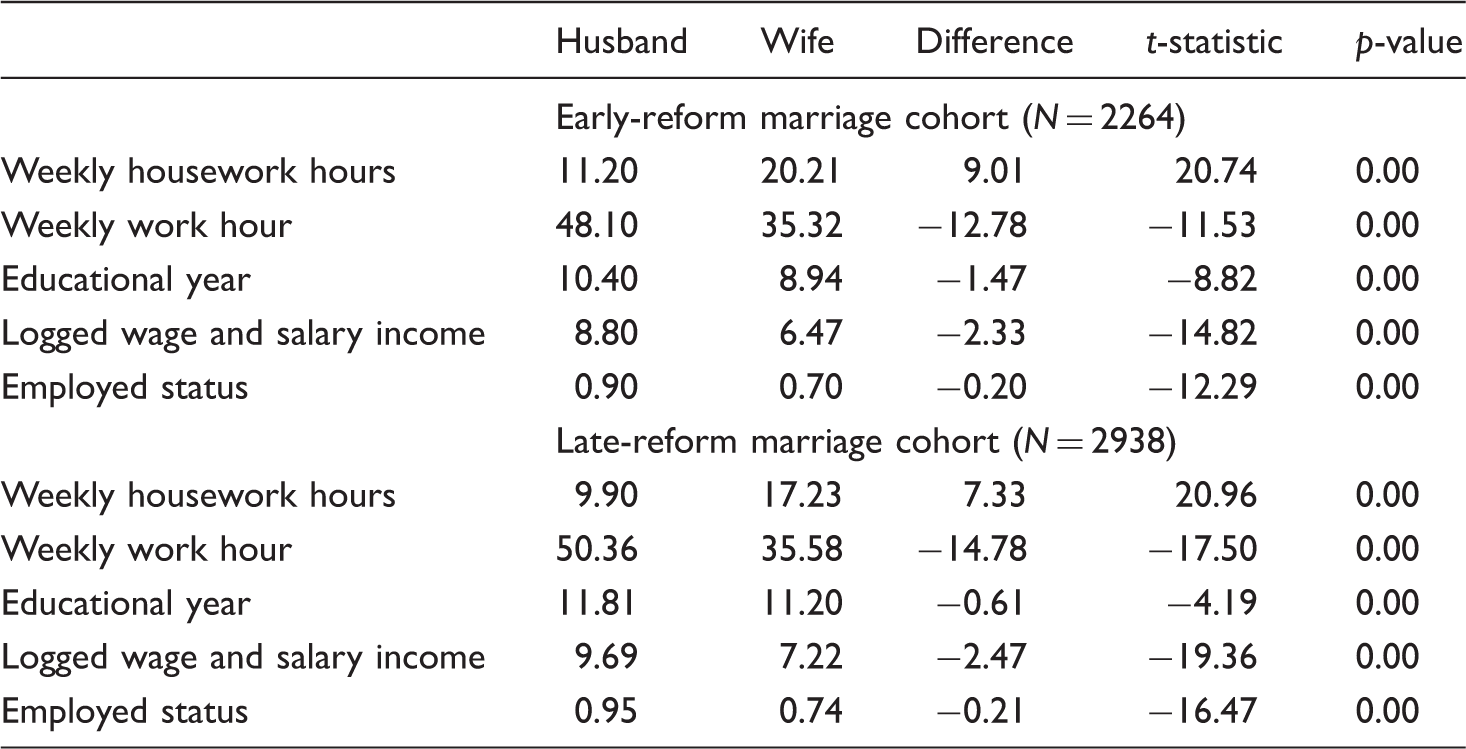
In addition to the apparent gender differences in weekly housework hours, for both cohorts, there exist consistent gender differences in the key explanatory variables as well. Compared to women, husbands devote more time to paid market work, receive more schooling years, earn higher incomes, and have higher labor force participation rates. From the early-reform cohort to the late-reform cohort, some of the above characteristics converge in regard to the gender gap (e.g. housework hours and educational years), some expand (e.g. paid work hours and annual income), and some remain nearly the same (e.g. employment rate).
Descriptive statistics of variables used in the analysis.
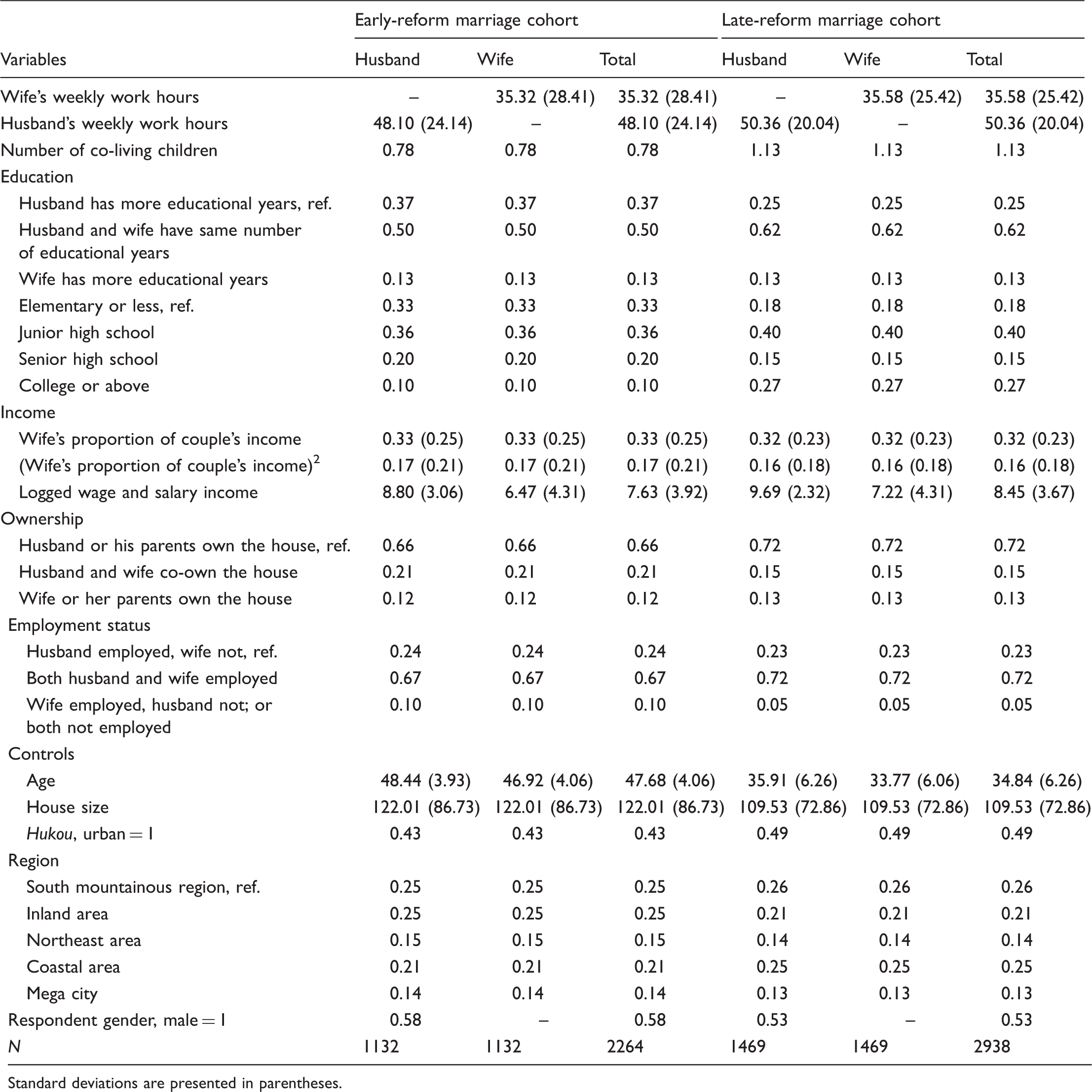
Standard deviations are presented in parentheses.
Regression model results
Direct effect of gender on weekly housework hours.
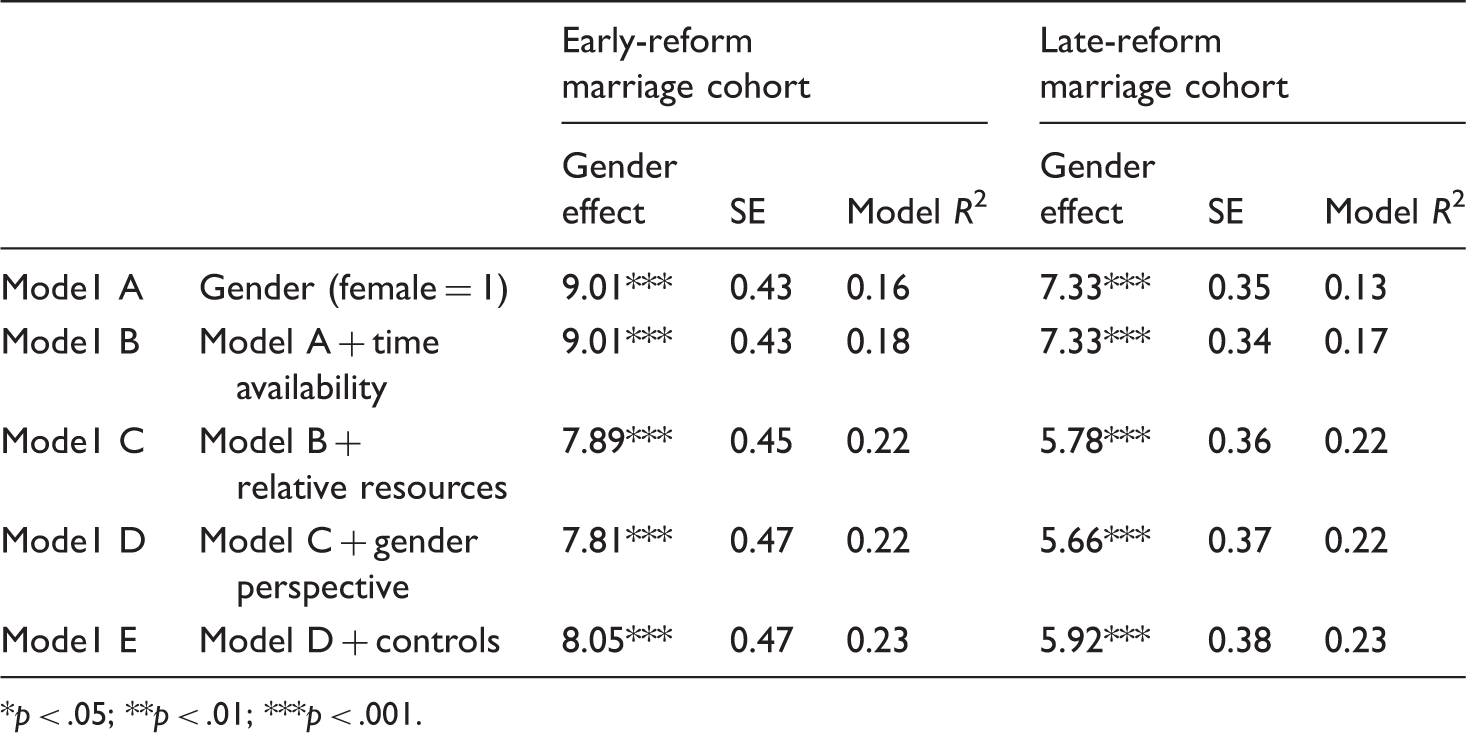
*p < .05; **p < .01; ***p < .001.
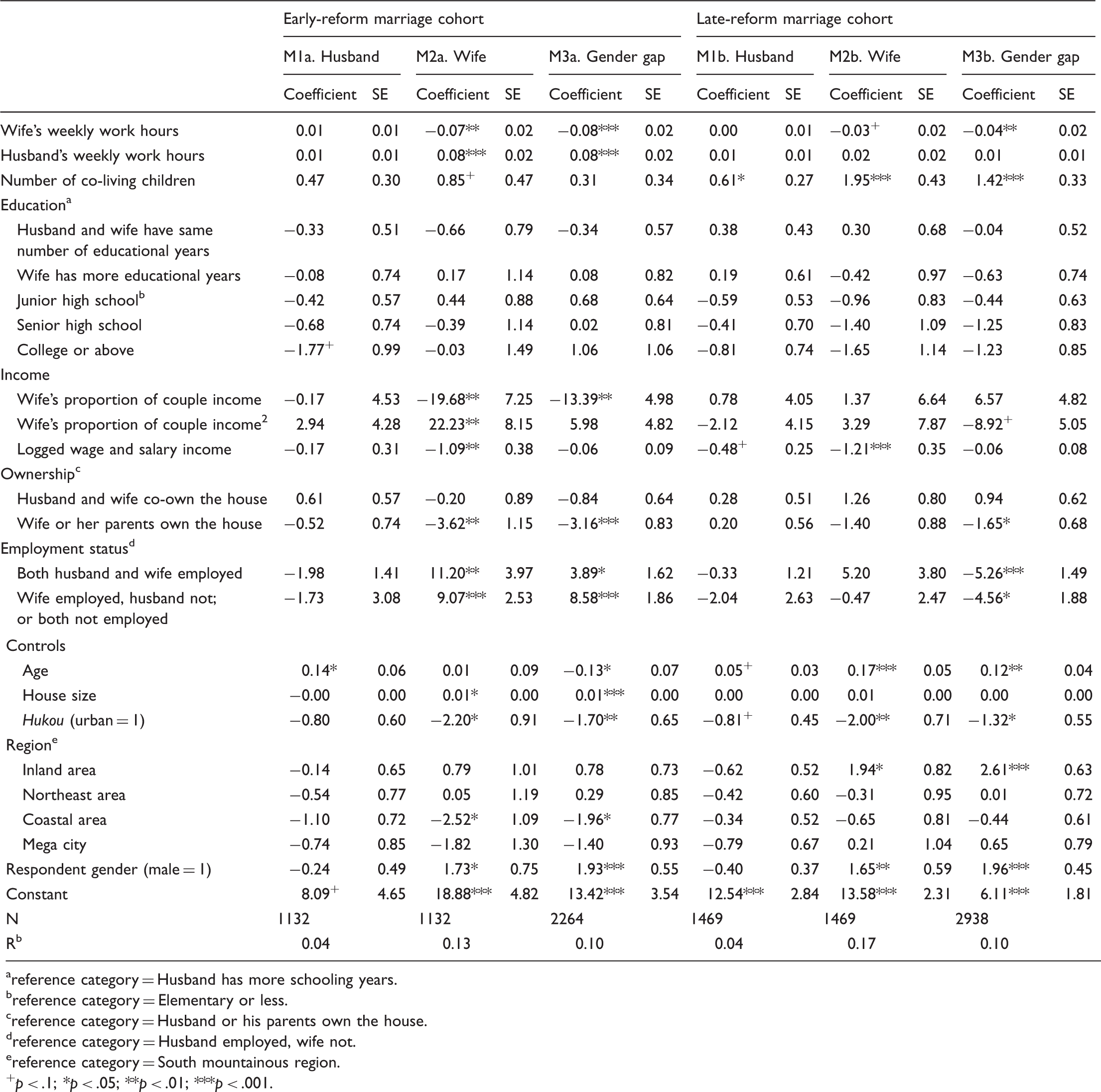
OLS coefficients for determinants of housework hours and gender gap for married couples.
reference category = Husband has more schooling years.
reference category = Elementary or less.
reference category = Husband or his parents own the house.
reference category = Husband employed, wife not.
reference category = South mountainous region.
+p < .1; *p < .05; **p < .01; ***p < .001.
M1a, M2a, and M3a in Table 4 report the regression results of the early-reform husbands’ time spent on housework, the early-reform wives’ time spent on housework, and the within-couple gender gap. In terms of time availability variables, the number of children co-living with the parents does not show an evident effect on the couples’ housework hours or the housework gap. Wives’ and husbands’ weekly work hours are not associated with husbands’ hours spent doing housework, but are clearly associated with wives’ housework hours; wives dedicating more time to paid labor means less housework time and husbands dedicating more time to paid labor means their wives spend more time doing housework. Both spouses’ market work is related to the gender gap as well.
In terms of the effect of education, income, and house ownership, first, compared with couples in which the husband has more educational years than the wife, couples in which the wife and the husband have the same number of schooling years and couples in which the wife has more schooling years than the husband are not evidently different from couples in which husband has more educational years. Second, both the simple and the quadratic terms of the wives’ proportion of the couples’ income are significant. The negative sign of the simple term and the positive sign of the quadratic term reveal a U-shaped effect of women’s relative earnings on women’s housework hours. This suggests that, when the value of wife’s proportion of the couple’s income is lower than 0.44 (19.68/[2*22.23]), her housework hours decrease and the gender gap narrows. After that point, the negative effect of her income on housework hours stops and begins to have a positive effect. Third, home ownership matters in that, compared to couples in which the husband or his parents own the house, couples in which the wife or her parents own the house have a smaller gender gap in regard to housework hours because wives in this type of couple perform significantly less housework.
The couple’s employment status also plays a role. Wives in dual-earning couples and wives in couples in which the husbands are economically dependent evidently devote more time to doing housework than wives in couples in which wives are economically dependent. In addition to this, the gender gap is larger for couples in which husbands are unemployed than for couples in which husbands have paid work, implying the potential existence of ‘doing gender’.
M1b, M2b, and M3b in Table 4 report the regression results of late-reform husbands’ time spent doing housework, wives’ time spent doing housework, and the within-couple housework gender gap. In terms of time availability variables, in contrast with the early-reform cohort, neither late-reform wives’ nor late-reform husbands’ work hours are significantly associated with their housework time, and the number of co-living children is expected to increase the gender gap only for the late-reform cohort. In terms of the effect of education, similar to the early-reform cohort, the effect of relative education plays no significant role in affecting husbands’ and wives’ housework time and the gender gap in housework. In terms of the effect of income, in contrast with their early-reform counterparts, for late-reform couples relative income is no longer significant; only wives’ absolute income is negatively associated with wives’ housework time, but this plays no significant role in narrowing the gender gap. The effect of employment is opposite that for the early-reform couples. Although when compared to couples in which husbands have paid jobs and wives do not, early-reform couples in which wives have paid jobs increase their housework time and this leads to a wide gender gap, late-reform couples in which wives have paid jobs show a significantly smaller gender gap, which may imply the non-existence of ‘doing gender’.
SUR
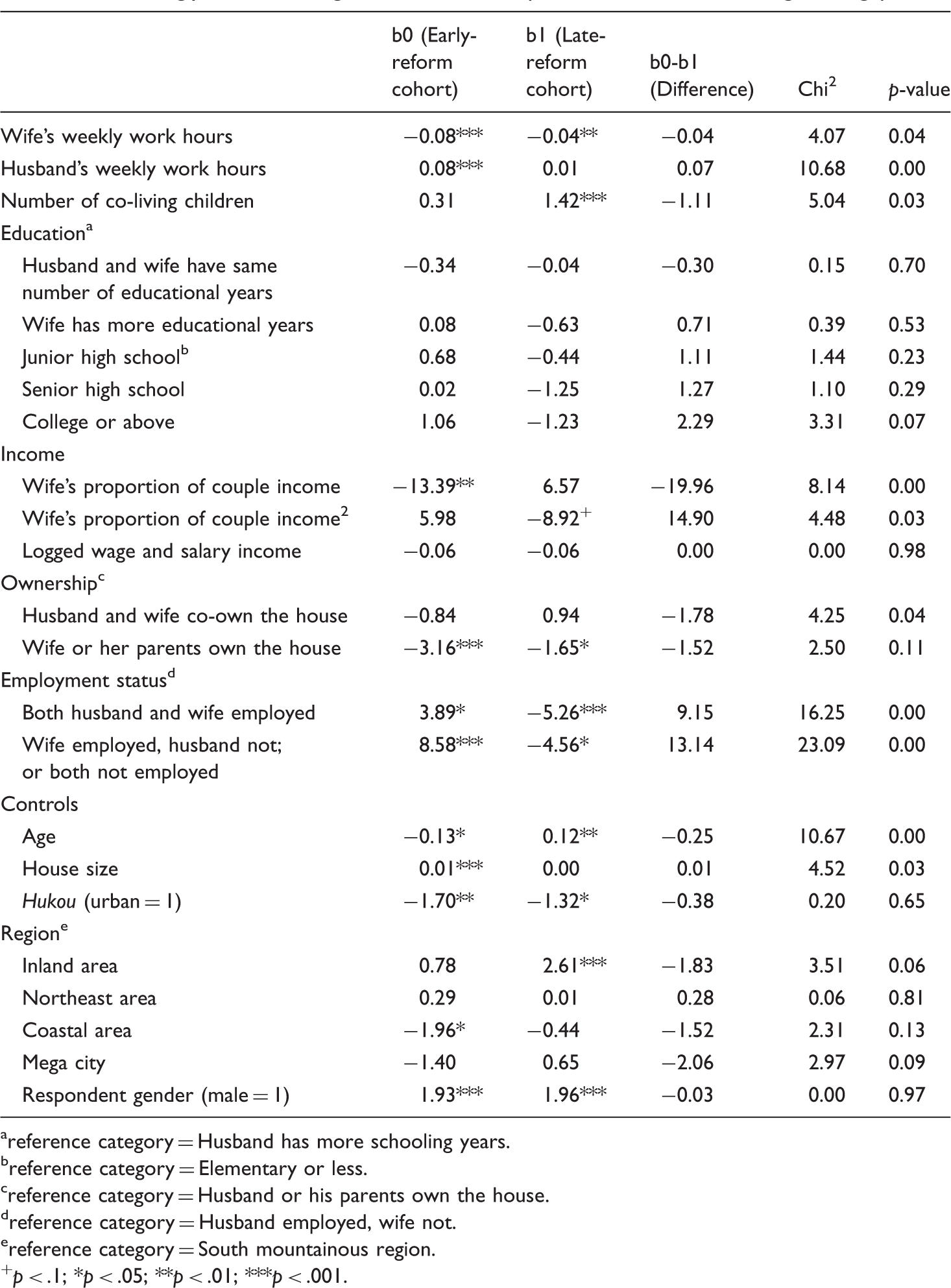
Seemingly unrelated regression model for predictors of housework gender gap.
reference category = Husband has more schooling years.
reference category = Elementary or less.
reference category = Husband or his parents own the house.
reference category = Husband employed, wife not.
reference category = South mountainous region.
+p < .1; *p < .05; **p < .01; ***p < .001.
Table 5 shows that, first of all, in terms of time availability variables, all three variables show different effects for the two marriage cohorts:
The effect of wives’ longer paid hours on reducing the gender gap is smaller for the late-reform couples (as shown in Figure 1). The effect of husbands’ longer paid hours on increasing the gender gap diminishes to the extent that it becomes insignificant for the late-reform cohort. The effect of children’s presence in the home is evidently larger for the late-reform cohort.
Second, as expected, there is no great variation in regard to the effect of education on housework gap, as education’s effects are insignificant for both cohorts. The role of wives’ relative earnings is also smaller for the late-reform cohort, and such reductions are significant. In addition to this, the equalizing effect of late-reform women’s sole home ownership is not as large as that of early-reform women, despite such reductions being insignificant.
Marginal effect of wife’s work hour on housework gap.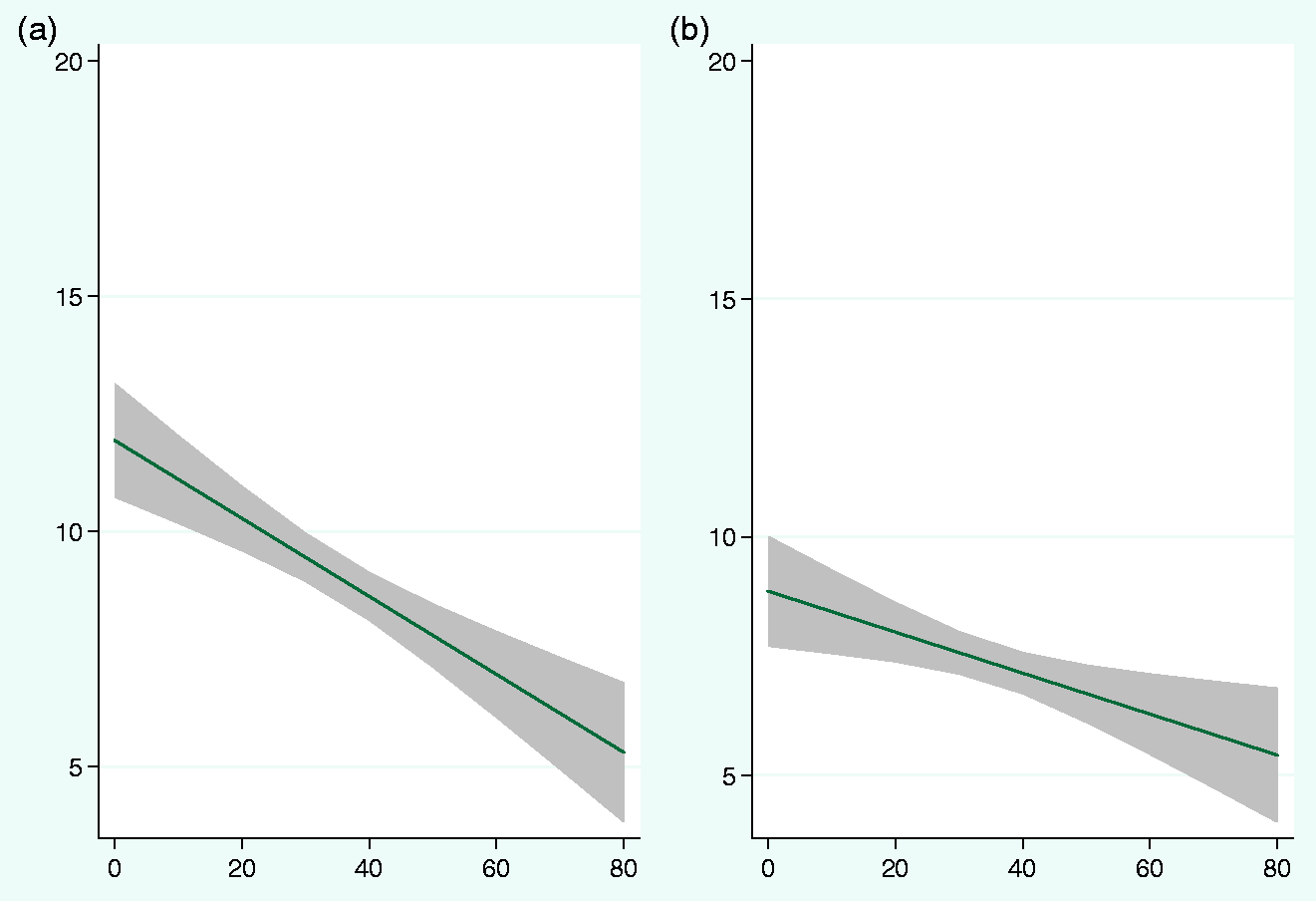
Third, and perhaps more importantly, couples’ employment status apparently has different implications for the early-reform and late-reform cohorts, in that the signs of the b0 and b1 coefficients change to the opposite, the within-gender gap is evidently smaller for dual-earning couples than for single-earning couples in which the husband is employed but the wife is not, indicating that the early-reform couples’ ‘doing gender’ behavior does not apply to the late-reform married couples.
RI analysis
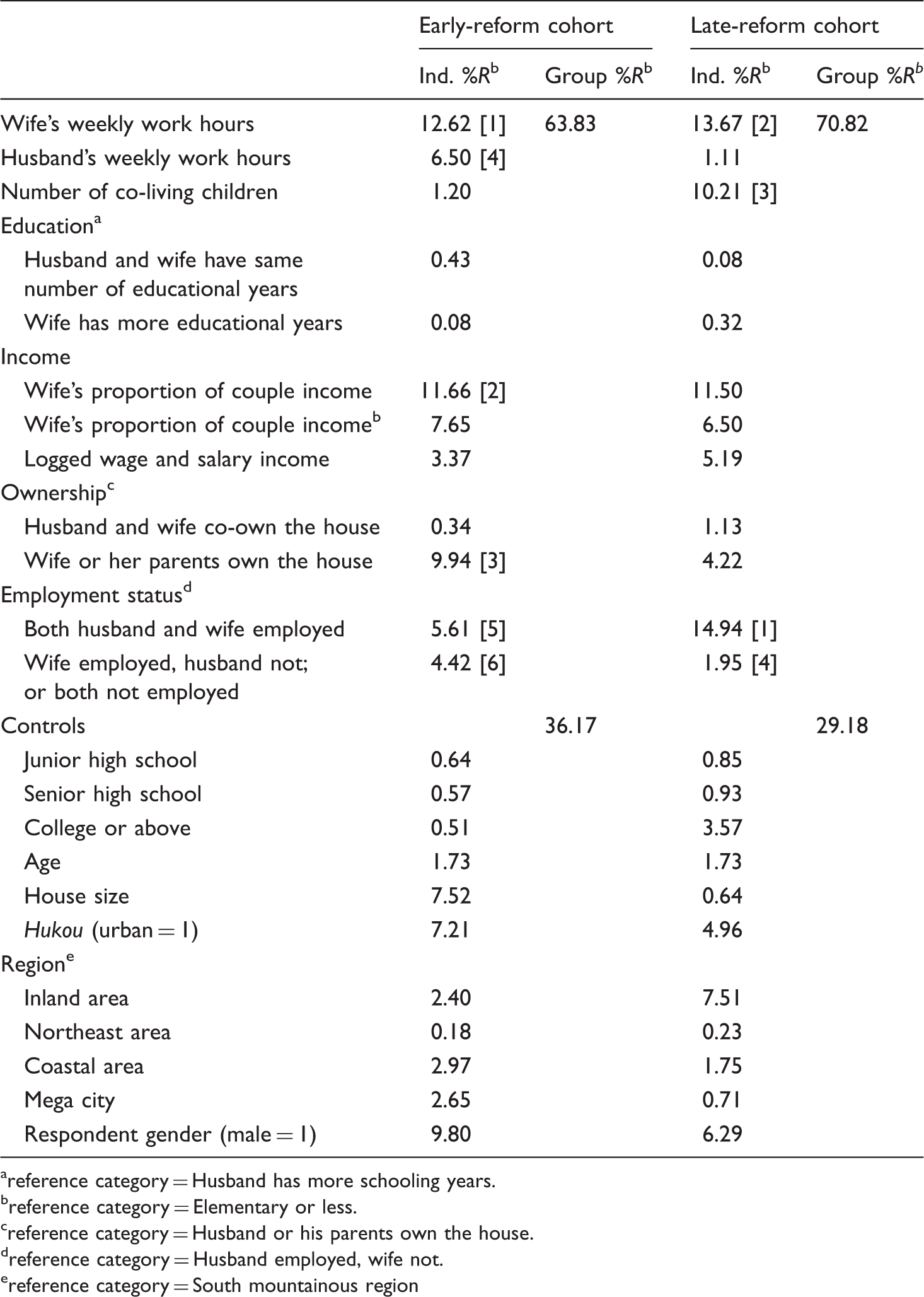
Relative Importance (RI) analysis.
reference category = Husband has more schooling years.
reference category = Elementary or less.
reference category = Husband or his parents own the house.
reference category = Husband employed, wife not.
reference category = South mountainous region
Discussion and conclusion
A vast amount of literature has shown that the time availability perspective, the relative resources perspective, and the doing gender perspective are linked to the allocation of household labor, yet less attention has been paid to how these effects vary by cohort. Drawing from the three micro-level theoretical perspectives and analyzing couple-level data, this study examines each of the three perspectives’ explanatory powers in explaining the housework behaviors among two post-1976 cohorts: the early- and late-reform married cohorts. This study makes conceptual and empirical contributions to the existing literature by taking the role of cohort into consideration. It presents three main findings. First, there are both similarities and differences between the three perspectives in regard to explaining the housework gender gap. Second, the relative importance of the three perspectives varies by cohort. Third, there is a diminished ‘doing gender’ phenomenon in the late-reform couples.
First of all, there are both similarities and differences in the three perspectives in regard to explaining the housework gender gap. On the one hand, for both marriage cohorts, the three perspectives have similar effects: women’s longer paid hours in the job market and women’s home ownership predict a smaller housework gender gap. On the other hand, different effects exist as well. OLS and SUR results reveal that: first, the following factors play a role in either increasing or decreasing the gender gap only for the early-reform marriage cohort – both husbands’ longer paid work hours and their unemployment status are related to a larger gender gap, whereas similar income levels are related to a smaller gender gap; second, the significant effects related to more co-living children indicating a larger gender gap and dual-earning families indicating a smaller gender gap are only present for the late-reform married couples.
Second, the importance of the sources of the gender gap varies by cohort. The RI analysis results show that, in terms of time availability variables, although both wife’s weekly work time and the number of co-living children matter for the late-marriage cohort gender gap, the role of children in affecting the early-couple gender gap is minimal. Income and home ownership only matter for the early-reform housework gap. The couples’ employment status, particularly for couples in which both have a paid job in the market, matters most for the late-reform marriage cohort. An early-reform wife, either employed or unemployed, whose husband does not have a paid job in the survey year, is significantly likely to devote more time to doing housework than an unemployed wife whose husband is employed. In other words, employed women from the early-reform cohort are likely to ‘do gender’. This phenomenon does not apply to the late-reform women; wives’ employed work status is no longer significantly associated with more housework time and is significantly associated with a narrowed gender gap in regard to housework. In short, late-reform women are less likely to ‘do gender’.
Third, following the second point, we find more evidence to support the diminished ‘doing gender’ thesis that occurred in the late-reform cohort. For the early-reform cohort, the negative sign of the simple term and the positive sign of the quadratic term of women’s proportion of couples’ income reveal a U-shaped patterned effect of women’s relative earnings, suggesting that when early-reform wives’ relative earnings increase, their housework hours decrease and the gender gap narrows. However, when wives’ relative earnings reach a certain point (the turning point of this ratio is 0.44), their housework hours and the gender gap no longer decrease, as the wives’ income continually increases. This effect is too large to be ignored as, among all the 1132 early-reform wives, 448 wives (40%) earned an annual income that was greater than the turnabout value of the relative income ratio. As suggested by prior research, a U-shaped patterned effect of wives’ relative income suggests the possible existence of the ‘doing gender’ phenomenon (Bittman et al., 2003; Lachance-Grzela and Bouchard, 2010). That is, high-income wives are likely to intentionally do more housework in the domestic sphere in order to either maintain the masculinity of their husbands, who earn relatively less, or neutralize their less-feminized role caused by their ‘overly-accentuated’ role in paid market work, or both.
Since the small late-reform housework gender gap is not correlated with wife’s proportion of the couple’s income, wife’s absolute income, and husband’s longer work time, but correlated with wife’s longer work time, wife being employed, and having fewer co-living children, we suspect that the symbolic meaning of women having a market job and the ideology of ‘intensive motherhood’ may play a role. For one thing, women having a paid job outside the household, a major strategy popularized in the pre-reform era for women’s liberation, have opposite implications for pre- and early-reform women as opposed to that for late-reform women. Prior research suggests that although such a strategy is useful in terms of encouraging women crossing the traditional, inside-and-outside boundaries and stepping out of the household, it is minimal in changing women’s traditional homemaker role within the household (Zuo and Bian, 2001). For the late-reform couple in which women have experienced a growing advantage in the labor market since the market reform (Kan and He, 2018), a woman having a paid job means a smaller gender gap in housework even if she does not earn a lot of money or contribute a lot to the family. For another, although the stringent one-child policy led to a lower fertility rate and fewer children that each family raised, late-reform women must spend a great deal of time participating in childcare, as the prevalent maternal ideal of ‘intensive motherhood’ requires that women share increasing responsibility within the household to produce more ‘quality children’ (Bianchi, 2000). Additionally, children’s age may also play a role, given that late-reform couples tend to have younger children who create extra needs for housework. We checked another national dataset, the China Health Nutrition Survey (CHNS), and found that respondents who have children at home under age 6 spent increasing time taking care of young children: respondents on average spent 2.03 hours per week in 2006 (SD = 52.84), 11.55 hours in 2009 (SD = 45.64), 14.25 hours in 2011 (SD = 44.77), and 19.80 hours in 2015 (SD = 25.65).
Despite the diminishing role of women ‘doing gender’, the gender gap for housework remains persistent. Although the absolute housework gender gap has decreased, wives still do two-thirds of the total housework, as did their predecessors. The fundamental basis for this persistent gender gap in housework lies in the consistent gender differences in time availability, resources and bargaining power, and gender ideology. Women have fewer paid market work hours, suffer devaluation and underpayment in predominantly female occupations, and face great challenges brought about by the new ideology of intensive mothering. Women still have a lower likelihood of home ownership, which is in part due to the strong influence of the traditional patrilocal residence customs and in part due to the marital norms of expecting men to buy a house to get married.
This study has limitations that point to areas for further research. One limitation is that the current study simply focused on post-1976 married couples and did not investigate the housework behavior of pre-reform married couples. This point merits investigation because, for pre-reform married couples who experienced their childhood and adulthood during 1949–1976, resources or capital such as educational level or income level are not as important as political capital (i.e. being a Chinese Communist Party member), as indicated by the basic principle of market transition theory, which argues optimistically that, with China’s transition into a market economy, marketization would diminish the sources and power of administrative leaders, which are replaced by symbols of human capital and market power, such as education, occupation, and industry replacement (Nee, 1989; Nee and Opper, 2010). In the case of gender equality within the household, this perspective may imply that pre-reform women’s political power may have had more bargaining power than their educational or income level. However, we do not know for certain if this was the case.
A second limitation is that we fail to disentangle the confounding effect of life courses and cohort because of the cross-sectional nature of the data. It is possible that the differences in factors that are associated with housework gender gap in the two post-1976 cohorts are only due to individuals being at different life stages, instead of belonging to different cohorts and experiencing different societal changes. Therefore, the findings should be interpreted with caution.
Third, the lack of data on Chinese couples’ housework behavior across a long period of time means that we cannot assess the housework gender gap from a historical period perspective, which would be interesting in regard to comparing the period effect and the cohort effect on housework behavior and exploring the various effects of the three classical models in different periods and for different cohorts.
Fourth, we acknowledge data limitations that may cause bias in regard to the results of the current study. Prior research finds that, compared to time-diary data, questionnaire-based surveys yield higher estimates of the reported household task hours (Lachance-Grzela and Bouchard, 2010; Shelton and John, 1996). However, as we focus on the gender gap in household tasks, this bias could be minimized to a certain extent.
Footnotes
Declaration of Conflicting Interests
The author(s) declared no potential conflicts of interest with respect to the research, authorship, and/or publication of this article.
Funding
The author(s) received no financial support for the research, authorship and/or publication of this article.