



Abstract
This article is concerned with examining the relation between gender division of unpaid work and class. Drawing on in-depth interviews with middle-class dual earner heterosexual couples conducted in Russia, I show how the gender division of housework and care could be shaped by processes of accountability not only to sex category (“doing gender”) but also to class category (“doing class”). I discuss how my interviewees perceived various gender contracts that have evolved in post-socialist Russia as profoundly classed. I further show how their resulting understandings of middle-class (in)appropriate ways of doing masculinity and femininity influenced the division of work in their families. Men were not only accountable as breadwinners but also as carers; while women, in addition to their caring roles, were accountable for their career and sex appeal. In several couples, this double gender and class accountability underpinned their comparatively more equal—although not necessarily more egalitarian—gender division of housework and care.
Doing Gender with Class: Gender Division of Unpaid Work in Russian Middle-Class Dual Earner Heterosexual Households
International research has demonstrated that the level of gender equality in the division of both housework and childcare is positively related to class. Higher educated men and women share housework more equally (Cooke, 2011; Esping-Andersen, 2009; Evertsson et al., 2009). Women with higher earnings and from higher income households “buy themselves out” of housework (Gupta, Evertsso, Grunow, Nermo, & Sayer, 2010; Heisig, 2011). Both higher educated men and higher educated women spend more time with their children (Esping-Andersen, 2009; Sayer, Gauthier, & Furstenberg, 2004; Sullivan, 2010; Sullivan, Billari, & Altintas, 2014). And although higher educated mothers—similarly to women from other classes—provide significantly more care than equally educated fathers (Esping-Andersen, 2009; Sayer et al., 2004), there is evidence suggesting that the education gap in fathers’ contribution to childcare is growing (Sullivan, 2010) and that the gender gap in routine childcare among higher educated parents is narrowing (Craig & Mullan, 2011).
To date, studies focusing on these observed relations between class and gender division of unpaid work have primarily treated class as a structural position of individual partners that influences their absolute and/or relative shares of housework and care via their time availability, ability to bargain, and/or outsource. At the same time, the role of changing gender ideologies and their relation with class in the domain of unpaid work remains undertheorized and warrants further investigation (Geist & Ruppanner, 2018; Sullivan, 2010).
In this article, I aim to address this theoretical gap by focusing on the related processes of accountability to sex (Hollander, 2013; West & Zimmerman, 1987, 2009) and class (West & Fenstermaker, 1995; Yodanis, 2002) categories as shaping negotiations about and performance of unpaid work among Russian middle-class dual earner heterosexual couples. In the following sections I draw on in-depth interview data to demonstrate how my respondents associated various modes of dividing paid and unpaid work within families with specific class positions in contemporary Russian society. I analyze this relationship by employing the conceptual framework of gender contracts (Goldstein-Gidoni, 2019; Hirdman, 1996; Rantalaiho, 1997; Sa’ar, 2009). I then discuss how their resulting understandings of middle-class (in)appropriate ways of doing femininity and masculinity in paid and unpaid work domains influenced the actual division of work in their families. I argue that, when it came to negotiations about gender division of labor within their own families, they held themselves and each other accountable not only to sex category but also to actual or aspirational class category, that is, middle-class. As I also show, in several couples this double accountability was a factor in their comparatively more equal gender division of unpaid work.
Russia is a noteworthy context for studying the relation between class and gender inequality in the division of unpaid work because, due to the relatively recent transition from socialism to capitalism, the processes of class formation are more evident there than in the Western contexts where this type of study is usually carried out. Over the past 30 years, the country has experienced radical social and economic changes that have affected normative expectations of gender (Tartakovskaya, 2012; Temkina & Rotkirkh, 2002) and resulted in a complete redrawing of class relations (Gapova, 2002; Iarskaia-Smirnova & Romanov, 2012). Gapova has argued that the processes of class formation have redefined the notions of masculine and feminine in post-Soviet Russia (Gapova, 2002). Rotkirch, Tkach, and Zdravomyslova (2012, p. 130) have also pointed out the emergence in Russia of “home as a significant domain of class structuration and distinction.” Recent qualitative evidence has suggested that Russians’ practices in the domain of unpaid work are becoming increasingly class-differentiated (Lipasova, 2016, 2017; Rotkirch et al., 2012; Utrata, 2011; Zdravomyslova & Tkach, 2016). Ukhova (2020) has also quantitatively shown that more educated and more affluent couples in Russia have a more gender-equal division of domestic labor.
Conceptual Framework: Doing Gender, Doing Class, and the Relevance of Gender Contract
In social interactions, people are held accountable to sex category and thereby “do gender” (West & Zimmerman, 1987, 2009). Accountability could be conceptualized as “a three-part interactional system that produces gender,” which involves “orientation of one’s thoughts, perception, and behavior to the societal ideals and local expectations associated with sex category,” assessment of one’s own and other people’s behavior in relation to these expectations, and holding others responsible for accomplishment of gender through enforcement of interactional consequences for (non-)compliance (Hollander, 2013, p. 9–10). Based on this definition, in the text, I use “accountable to” to refer to people’s orientation to sex category and “accountable for” when I refer to processes of (self-)assessment and enforcement.
The household—where men and women negotiate about and perform housework and care work—remains one of the key arenas for the accomplishment of gender (Risman, 2004, 2018; West & Zimmerman, 1987). Women’s increased participation in the labor market has not radically redrawn the distribution of unpaid work in the household precisely because “gender still trumps the structural variables of time and economic dependency when it comes to housework and care work” (Risman, 2018, p. 19).
Similar to and along with gender, class is also “done.” Accountability to class category (West & Fenstermaker, 1995) or so-called social class role (“behaviors, tastes, and values that are socially defined as appropriate and expected of individuals of a particular socioeconomic position”) (Yodanis, 2002, p. 325–326) leads people to produce certain representations of themselves. Class is “done” through presentation of symbols (tastes, values, and activities) of specific social class roles. Closely related to the “doing class” approach is Beverley Skegg’s Bourdieusian analysis of “making class,” in which she conceptualizes class as something that “is not given, but is in continuous production” (Skeggs, 2004, p. 3). Central to accomplishment of class are the processes of establishing boundaries, drawing distinctions, and attributing and claiming respectability (Lamont, 1992; Skeggs, 1997, 2004; Yodanis, 2002).
While processes of “doing gender” have been explored quite extensively as causes of gender inequality in the division of unpaid work (for a recent review, see Geist & Ruppanner, 2018), processes of “doing class” have received much less attention. A number of empirical studies over the last years have been concerned with so-called class gradients in the amount of time women and men from different classes spend on housework and childcare (Gupta, Evertsson, Grunow, Nermo, & Sayer, 2010; Heisig, 2011; Schneider & Hastings, 2017; Sullivan, 2010; Sullivan et al., 2014). As these studies have primarily focused on class as a structural location of individual partners, the role of class accountability has largely been neglected.
Moreover, the literature on “doing class,” while compellingly showing that the domestic sphere represents an important site for production of class, has not explicitly addressed the issue of gender inequalities within the household. Collins (1992) has argued that everything from cleaning and straightening the house to cooking, physical care, education, and the moral upbringing of children could be considered as realms of class production performed by women. For the working-class women with whom Skeggs (Skeggs, 1997) did her research, home was an important site for displaying respectability. These women were particularly concerned about cleanliness and how it reflected on them. Gregson & Lowe (1995) found that, for the middle-class women they studied, outsourcing of certain housework and care tasks was not only a way to enable them to combine motherhood and work but also a way to “perform” middle-classness.
Given the above, my contribution in this article is to show how the processes of doing class could shape gender inequalities in the division of unpaid work. In order to do this, I will employ the conceptual framework of “gender contract” as my analytical tool. Gender contract is a concept that was initially developed by Scandinavian feminist scholars to refer to “unspoken rules, mutual obligations, and rights which define the relations between women and men, between genders and generations, and finally between the areas of production and reproduction” in specific socio-historical contexts (Hirdman, 1996; Rantalaiho, 1997, p. 25). In contrast to Carole Pateman’s (Pateman, 1988) “sexual contract,” which is conceptualized as a contract between maintaining men’s rule over women, gender contract is viewed as capturing a norm about “what a Man and Woman should do in relation to each other” (Hirdman, 1996, p. 23). Gender contracts, then, could be considered as entailing those very “normative conceptions of appropriate attitudes and activities for particular sex categories” (West & Zimmerman, 1987, p. 134–135) that are at the core of the processes of gender accountability. Yet, the notion of gender contract emphasizes the mutuality of accountability between partners, their agency, and the potential for modification of gendered power relations through negotiation (Hirdman, 1996). In contrast to primarily descriptive terms, such as, for example, “work-family arrangements” (Hook, 2015) and the concept of gender contract, emphasizes the cultural normativity of certain breadwinning/caregiving arrangements (Goldstein-Gidoni, 2019; Sa’ar, 2009).
The main reason I employ the conceptual framework of gender contracts is that they are able to serve as terms of both gender and class accountability. As Williams has demonstrated, in the United States, where “the breadwinner-homemaker family has been emblematic of middle-class status since the emergence of the notion of separate spheres,” adherence to traditional gender roles among working-class families is driven by their middle-class aspirations and represents a “class act” (Williams, 2010, p. 157–158). As I will show in the empirical section of this article, adherence to other types of gender contracts, entailing more gender-equal division of both paid and unpaid work, could also be driven by accountability to class category. Finally, it is important to note that the concept of “gender contract” has been widely used by Russian feminist scholars whose work I drew on, and thus it also had a significant heuristic value for this study.
Gender Contracts, Class, and Division of Unpaid Work in Russia
The hegemonic Soviet gender contract of “working mother” implied equal participation of men and women in the labor market combined with women’s overwhelming responsibility for housework and care—which was usually shared between female members of the extended family—and men’s “domestic marginalization” (Ashwin & Lytkina, 2004; Temkina & Rotkirkh, 2002). Temkina & Rotkirkh (2002) have argued that in the post-Soviet period there appeared, alongside the working mother contract, a range of alternative gender contracts entailing different divisions of labor and power in the family. They include the “career-oriented woman” contract (women focus on professional development; organization of housework and childcare is usually negotiated with relatives and hired domestic and care workers, while men’s position in the domestic sphere remains marginal); the “housewife/male breadwinner” contract (man is a dominating agent; he possesses the power and material resources to support motherhood and female sexual attractiveness); the “sponsored woman” contract (man has a similar role as in the housewife/male breadwinner contract, but this relationship could be expected not to include joint residence and shared children).
Despite some diversification of gender contracts, women’s overall employment in contemporary Russia remains high (Atencio & Posadas, 2015) while gender inequality in the division of housework (Ashwin & Isupova, 2018) and childcare (Lipasova, 2016, 2017) persists. International comparative research on factors of gender inequality in the division of unpaid work found that theories of time availability and relative resources have lower explanatory power in Russia (Fuwa, 2004). At the same time, as Ashwin and Isupova (2018) have demonstrated that accountability to persisting “traditional” gender ideology, which in the Russian context “implies support for a ‘transitional’ model in which the man is the breadwinner (highest earner) and the woman is employed and takes primary responsibility for domestic labor” (Ashwin & Isupova, 2018, p. 447) underlies the modes of “doing gender” that perpetuate gender inequality in the domestic sphere. While it is important to note that Ashwin and Isupova (2018) found signs of increasing egalitarianism in Russians’ attitudes towards gender division of unpaid work, their analysis did not explicitly focus on class as a potential explanatory variable.
Research employing a class lens on the gender division of unpaid work in Russia has been quite limited, but it offers important avenues for further exploration. When pointing out the diversification of gender contracts that emerged in the post-Soviet period, Temkina & Rotkirkh (2002) hypothesized that these contracts would become differentiated by class. They predicted that the contract of working mother would prevail among low-income families, while the contract of housewife/male breadwinner would become common among the upper classes. They also expected that some working mothers with prestigious jobs would embrace the contract of career-oriented woman.
Emerging empirical evidence indicates that practices in the domain of unpaid work in Russia are, indeed, becoming more class-differentiated and could also be considered as realms of class production. Lipasova (2016, 2017), who did research both with urban middle-class fathers and with working-class and “potential middle-class” fathers in the Russian provinces, found that paternal aspirations about and actual involvement in childcare varied between these groups, with only urban middle-class fathers embracing new models of involved parenthood (at least at the attitudinal level). Scholars researching the outsourcing of housework and childcare demonstrated how these practices are becoming an important source for the construction of middle-class identities (Rotkirch et al., 2012; Zdravomyslova & Tkach, 2016). In her quantitative study of changes in men’s relative involvement in housework among heterosexual couples in Russia (and other five Central and Eastern European countries) covering 1994–2012, Ukhova (2020) showed that higher education and household affluence in contemporary Russia are associated with a more gender-equal division of domestic labor; and that the positive effect of income has significantly increased over time. In what follows, I provide further empirical evidence of the association between class and gender division of unpaid work in contemporary Russia and discuss how gender and class accountability underpin this association.
Data and Method
This article relies on qualitative interview data from 27 partners of dual earner heterosexual couples with co-resident children, and data from structured questionnaires completed after these interviews collected as part of a larger mixed methods study on changes in gender division of unpaid work in post-socialist Russia. I individually interviewed the members of 13 couples plus one woman (whose husband eventually dropped out of the study). I conducted all the interviews in summer 2017. The decision to focus on interviewing couples was determined by my analytical focus on the interactional level.
All interviews were conducted in Saint Petersburg, the second largest city in Russia. The rationale for focusing on Saint Petersburg was a combination of comparatively high levels of economic inequality in the city (Federal Service of State Statistics (Rosstat) (2017) and its peculiar local gender culture. Similarly to Muscovites, Petersburgians express a stronger preference for an egalitarian division of unpaid work within families and place less emphasis on the importance of men being the main breadwinners than people in the rest of Russia (Skoglund, 2021). Being located rather far from the capital, but in close proximity to Western Europe, and having strong historical and cultural ties with the latter, Saint Petersburg’s middle classes are characterized by high receptivity to European cultural trends (Avdeeva, 2020). At the same time, the city is also home to the most famous champion of “traditional values” legislation, MP Vitaly Milonov. Thus, in comparison with the rest of the country, Saint Petersburg is a place with relatively salient class inequalities, where the population has also had greater exposure to a competing “Western” discourse of gender equality alongside the discourse of traditional (family) values. As the strengthened association between class and the gender division of unpaid work is a relatively recent phenomenon in Russia (Ukhova, 2020), one might expect that this association would be more tangible in Saint Petersburg, potentially making the city a good site for studying the mechanisms underlying this relation. These specifics of the city’s gender culture, however, should be taken into account when interpreting the findings of this study, as the city population’s relatively progressive attitudes about gender-equal sharing of housework and childcare could clearly affect interactional accountability.
I began interviews with a convenience sample recruited through the most widely used social network platform in Russia, vk.com. I posted an announcement about the study and asked my friends and acquaintances to share it with their own networks. Using social networks for recruitment was a way to facilitate trust in a context where personal connections are highly important (Ledeneva, 1998). At the later stage of my fieldwork I also used snowball sampling. I rewarded participation in interviews with a gift card for 1,000 RUB (approximately US$17 USD in 2017) for online purchases. The initial announcement included information about the reward. I took the decision to pay participants primarily on ethical grounds. Asking full-time employed people with children to dedicate 1.5–2 hours of their time to talking about unpaid work, and not reward them for that, seemed ethically dubious to me. While all participants accepted the cards, none appeared to be primarily motivated by financial gain, which was also reflected in the length of our meetings. The interviews lasted, on average, 105 minutes.
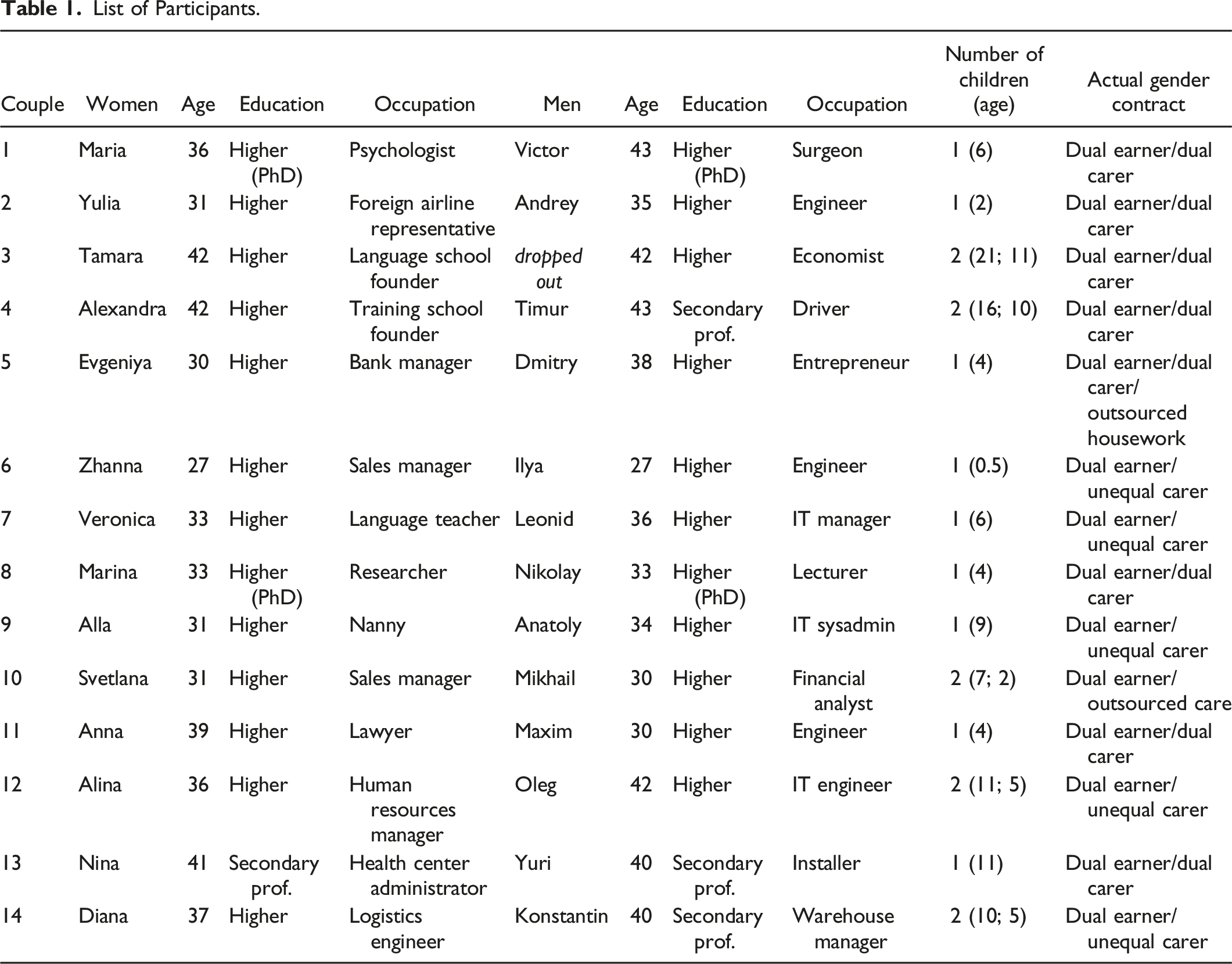
List of Participants.
I conducted interviews myself in Russian and a freelance assistant transcribed them. I met interviewees in places of their choice, including their flats, offices, and cafes. As a married Russian woman who was born and raised in Saint Petersburg, but later moved abroad for educational and professional reasons, I was perceived by my respondents not only as a cultural insider but also as someone with experience of social mobility that many of them were highly curious about, and some even wanted to reproduce. As recent research on class habitus has suggested, a desire for social mobility represents a key element of the habitus of Russian middle-class youth (Vanke et al., 2017). Overall, I found that my positionality facilitated the establishment of rapport.
I used the method of problem-centered interview (PCI) (Witzel & Reiter, 2012). I coded and analyzed interviews using a mix of inductive and deductive approaches in several stages, moving from descriptive and topic codes up to analytical codes and themes (Richards, 2015). I started with a small list of theory-driven topic codes to account for how my interviewees themselves mobilized conventional couple level explanations of the gender division of housework and care (e.g., availability of time, “male,” and “female” tasks). I immediately noticed that they also drew on other sorts of explanations, such as level of education, upbringing, or “culture.” In parallel, as I coded up, the theme of “class aspirations” emerged as one of the most loaded. This theme often co-occurred in the narratives with reflections on actual, imagined, and/or aspired modes of dividing labor in and outside of the home. Analysis of these co-occurrences led me to the idea of a typology of “classed gender contracts” (presented in the first part of the empirical section). Analysis of data on conflicts further revealed related themes of “accountability” and “class (in)appropriateness” of certain gendered practices. In the second part of the empirical section, I discuss how processes of gender and class accountability shaped actual gender division of work in my respondents’ families.
Classed Gender Contracts
In this section, I discuss my interviewees’ representations of “classed gender contracts.” I show how they associated class positions in contemporary Russian society with ways of dividing paid and unpaid work within families.
The first time I was confronted with such representation was early on in my fieldwork during the interview with Andrey. Andrey and his wife Yulia shared the care of their son, housework, and household management nearly equally. Toward the end of the interview I asked Andrey if he thought the division of labor in their family corresponded to normative expectations about women’s and men’s roles currently existing in the Russian society (something he had referred to earlier). His answer was: “I think we fit in. It’s 2017 and… There are rich families, middle, and poor. I do not consider us rich, rather middle. I think we are not very different from the families that live in Saint Petersburg”. What was striking for me in Andrey’s answer was the symbolic connection that he established between gender contracts and families’ class positions. In the course of my fieldwork, I became increasingly aware of the existence of these connotative connections.
Differences between the various gender contracts emphasized by my interviewees were not always articulated in directly class-related terms, such as income or education. Sometimes they mobilized symbolic binaries—such as Russia versus West (see Rivkin-Fish, 2009, p. 80 on the importance of “fantasized Western subject” for construction of middle-class identities in Russia), Soviet versus modern, Petersburg (Piter) and Moscow versus provincial towns and rural areas—to make sense of those differences. The terms that they used, however, clearly implied the existence of some sort of geographical/social/economic boundaries between families adopting different gender contracts. Yet, these boundaries did not simply mark differences. They were profoundly normative and moral; they divided what was considered worthy and respectable from what was not. In what follows, I first discuss the contracts that my interviewees devalued, that is, “working mother,” “housewife/breadwinner,” and “sponsored woman.” I then turn to the contracts they constructed as respectable and moral, that is, “career-oriented woman” and “egalitarian” gender contracts.
Lower Class: The Working Mother Contract
The contract of working mother, the hegemonic gender contract of the Soviet period (Temkina & Rotkirkh, 2002), was a central element in my respondents’ narratives. The descriptions they provided for it were almost unanimous: it included a woman carrying the triple burden of paid work, housework, and childcare (and sometimes also care for other relatives and/or subsistence farming) together with a man completely disengaged from any sort of household activities and frequently not working for pay either. Anna poignantly called this contract “classical matriarchy”—alluding to a marginalized role of men in such households (cf. Ashwin & Lytkina, 2004): Half is with one foot in Europe and with the other one in Asia or somewhere even deeper. Those who are not in the avant-garde, not in Piter and Moscow […] there you have classical matriarchy. The woman is dragging everything, and the man is earning. In the best case scenario, he’s earning. (Anna)
All interviewees placed the origins of this contract in the Soviet period, as evidenced by the quotes of Diana and Victor below. The association with the Soviet period had a profoundly negative meaning for my interviewees. It marked this type of contract as unmodern. It was constructed as unmodern also through the narrative mobilization of the symbolic binaries urban/rural, Piter-Moscow/other towns, Europe/Asia, educated/uneducated. I think that the majority of people live with a sort of Soviet stereotype that the woman is cooking, cleaning, washing and the husband is lying and reading. And if it is so and this is what is being conveyed [to children] in the family, it’s a disaster, because for the woman that’s very difficult. But the people who have gone to the university, etc., they’re thinking… Although you may also have exceptions there, but in general they are more modern, they are ready to take up more duties, to participate more and bear responsibility. That’s in Piter [St.Petersburg – auth.]. But if you go somewhere else – that’s 100% [sure that you’ll encounter] what I described earlier. (Diana) If you go from Saint Petersburg to Pskov, you get into another country. The way of living there will be completely… Soviet Union, with all its expressions, views, views on the family life, etc., on leisure, on the division of roles in the family, on women’s and men’s duties. (Victor)
Devaluation of the working mother gender contract as a middle-class distinction strategy itself has roots in the late Soviet period. As Akhtyrskyi (2017) pointed out, among parts of the highly educated intelligentsia class in the Soviet Union, anti-Soviet sentiments were expressed in the rejection of Soviet gender policies. At the time, this rejection resulted in a greater propensity to endorse the housewife/male breadwinner gender contract. As I show in the next section, however, this no longer seems to be the case for the Russian urban middle class that my interviewees represented.
Upper Class: The Housewife/Breadwinner Contract
The housewife/breadwinner gender contract that appeared in the post-Soviet period (Rotkirch et al., 2007; Temkina & Rotkirkh, 2002) was, indeed, an important point of reference for my respondents. They shared basic assumptions about the distribution of paid and unpaid work among couples observing such a contract. It was clearly identified as the contract of the upper classes and perceived as relatively uncommon: “The women who do not work… I can only remember one former classmate, and [she is not working] only because her husband is very rich” (Oleg).
While a small number of respondents evaluated this contract neutrally (“has a right to exist” (Leonid)), most constructed it as problematic for two main reasons. A first set of arguments included depictions of housewives as “women who do not develop in all the senses” (Victor), “limiting themselves” (Zhanna), and potentially “going crazy within four walls” (Andrey). Second, women embracing or aspiring toward such gender contracts were portrayed as immoral consumers: “If you look around, there are very many girly girls who would go to the beauty salon as if to work and sugar daddies with money” (Alina). There was a strong association between the housewife/breadwinner contract and the supported woman contract (Temkina & Rotkirkh, 2002). In several instances, this contract was also constructed as something outdated and unmodern, as a legacy of the late socialist/early post-socialist period when women were structurally forced to engage in this sort of relationship: “[At] the end of the 1980s […] for many young women the option of getting married and—figuratively speaking—getting a free ride or living ‘behind’ someone was a survival option” (Victor). Only Evgeniya, who was raised in an affluent family with a stay-at-home mother, saw this arrangement as highly desirable—a view that her dissatisfaction with her current job and her husband’s relatively low income also contributed to.
Men’s role within this contract was, on the contrary, notably less problematized. For both male and female interviewees, men’s ability to meet breadwinning expectations justified their assumed disengagement from housework and/or childcare (cf. Ashwin & Isupova, 2018). In fact, the situations when such men still did actively engage in those activities roused respondents’ admiration: “I’m genuinely impressed and I very much admire my friends that are… There’s one family where the father… the wife doesn’t work and he does. But they share the night shifts with the baby equally, despite the fact that he works” (Mikhail).
Middle Class: From the Career-Oriented Woman to the Egalitarian Gender Contract
The career-oriented woman gender contract (Temkina & Rotkirkh, 2002) was also extensively discussed by my respondents. This was not surprising, since many female interviewees identified as career women and all respondents had such women in their social circles. Respondents’ description of this contract in terms of paid and unpaid work division broadly fell into three sub-categories (although they did not use these terms themselves): dual earner/unequal carer; dual earner/outsourced care; dual earner/dual carer.
The key commonality between the three sub-categories was the character of the woman’s paid work. Career women’s engagement in paid work was constructed in almost exclusively positive terms by both male and female interviewees. This also differentiated the career-oriented woman contract from that of the working mother. The images of “independent and well-developed women” (Tamara) that achieve success through paid work they choose to—rather than have to—engage in (“The woman is not a draft horse. She does what she wants.” (Dmitry)) were prominent across women’s and men’s narratives. In many instances, career women were also depicted as morally superior to housewives, precisely because of their paid work.
Career women were, however, described as having different arrangements when it came to housework and childcare. Some of them had dual earner/unequal carer contracts and male partners who did not take any responsibility for things done within the household—although in contrast to lower class men they admittedly earned well—and were dismissively described by my respondents in their narratives as “big boys behind mama’s back” (Anna). Career progression of women under this arrangement was primarily enabled by participation of other—mostly female—members of their extended families in childcare. A modified version of the dual earner/unequal carer contract was the dual earner/outsourced care contract. Outsourcing was viewed by both female and male interviewees as something that has become more available materially and more acceptable symbolically for middle classes. Yet, under this type of contract the outsourcing of domestic work and care remained women’s zone of responsibility. As Tamara described her highly successful entrepreneur friend: “She’s a sort of organizer. So, everything that she’s outsourcing—she has arranged it herself. She has a nanny, tutors for children, a woman who cleans the flat, and a lot of other things.” My interviewees clearly considered the above as middle- and upper-class contracts because of the level of assumed income, types of jobs performed, and consumption patterns (outsourcing, engaging in flat renovations, fitness, etc.) of the people engaged in them.
The emergence of dual earner/unequal carer contract and dual earner/outsourced care contracts as sub-categories of the career-oriented woman gender contract was already predicted in the early 2000s (Temkina & Rotkirkh, 2002). My respondents, however, also talked about another sub-category, which only recently has been identified in sociological literature on Russia (Chernova, 2014). It could be defined as dual earner/dual carer or “egalitarian” (some respondents actually used the latter term). The key features differentiating this sub-type from the aforementioned ones were related to the understanding of men’s roles within it. Men in this contract were described first and foremost as involved fathers fully participating in their child’s life: Evgeniya: Now, of course, the century of cool dads has begun. Previously, they sort of steered clear off [the children], and now they are just right on. […] It’s a full-fledged participation in the child’s life. Not like “I’ll communicate with him, once he starts talking”, but in full, with washing bottoms, etc. In one of the couples that we know it was the dad that woke up at night to [care for] the child, to rock him, to feed, and so on. So, full-fledged participation. Both as a friend, as an authority, and as a parent [who is] always close. Interviewer: Why do you think this has happened in contemporary Russia, that such category of dads has appeared? Evgeniya: This probably has not one single reason. Probably, [because] we have also seen how it’s done not in Russia. European dads are a special story. Maybe, it’s a sort of generational tiredness, because… How much longer could women pull everything themselves?
They were also praised for their ability to recognize women’s equal contribution in the domain of paid work and translate this into both lower demands regarding women’s contribution in the domestic sphere and their own increased participation in routine housework tasks. At the same time, female partners of such men were characterized as having lower male breadwinning expectations. Among younger [people] – older people don’t have this at all – [there are cases] when partners are egalitarian. I see that that is happening, I see it among my acquaintances. Men already see that women have the same rights, that if she earns, then she also gets tired, that she has a right to have time for herself, to go to the gym rather than staying by the cookstove. […] Now you [also] no longer have [a situation] when the woman expects the man to earn millions, she’s ready to help him financially. (Anna)
This egalitarian contract was unequivocally constructed as modern. As the quotes above show, it was attributed to the younger generation and perceived as something “European” (a classic metaphor for modern in Russia (Pilkington, Omel’chenko, Flynn, & Bliudina, 2002)). It also had clear class connotations in the respondents’ narratives as a characteristic of the educated (see the quote by Diana in the following section).
Gender and Class Accountability
The above-discussed shared representations of classed gender contracts can be seen to underpin my respondents’ understandings of middle-class (in)appropriate ways of “doing gender.” As a result, both in paid and in unpaid work domains, my interviewees held themselves, each other, and others directly involved in their families’ reproductive work (primarily grandparents) accountable not only to sex category (West & Zimmerman, 1987) but also to actual or aspired class category (middle-class) (West & Fenstermaker, 1995; Yodanis, 2002). This double accountability was determinative for the eventual division of both types of work. In Table 1, along with the demographic data, I indicate which of the above-described gender contracts my interviewees’ own family arrangements most closely resembled.
Class (aspirations), however, moderated gendered expectations in paid and unpaid work in different ways. In the realm of paid work, class (aspirations) primarily impacted women’s accountability. When it came to unpaid work, class played a larger role in moderating expectations towards men’s roles.
It is beyond the scope of this article to discuss other relatives’ accountability. But, as often is the case in Russia, many of my respondents’ parents were indeed involved in childcare provision. As I found out, however, grandparents’ class position (their work schedules and contents of their work, their consumption patterns, such as traveling, continuous learning, and/or their attempts to meet new partners) significantly moderated my respondents’ expectations and their parents’ accountability when it came to negotiations about childcare sharing (cf. Utrata (2011, 2015) on gender, age, and class accountability among Russian single mothers and their mothers).
Holding (Aspiring) Middle-Class Men Accountable as Carers
Most of my female respondents held their husbands accountable not only as breadwinners but also as carers. Independently of men’s actual earnings, they considered a lack of men’s involvement in housework not just unfair but also inappropriate for their (aspired) class position. A female partner (Diana) from a mixed-class couple who was deeply dissatisfied with the existing gender division of housework and childcare with her husband (Konstantin) answered my question about how she thought they compared in terms of their gender division of labor with people they knew as follows: I can say that we are very different from (my) colleagues, because… again, if we return to education… Mainly, of course, people have office jobs. When I tell [about my situation]… nobody usually understands me. So, I don’t really like telling my story very much – they don’t have such situations where a person does not want to do anything. So, they always sit down and somehow in an educated way, with argumentation [decide] “I can’t manage this timewise, and you can, so you do it”. That’s why it’s easier for them – their dads could cook a soup, could bring a child to a doctor. And I always even envy this a bit, because they don’t have such a problem that they have to force, to make dramas “Let it be you who do it today”, so, it comes naturally to them. Everything is completely different. And actually, if it happens that I have lunch with a male colleague, I could communicate with him absolutely equally – he understands and knows what is happening at his child’s school, knows what’s going on when the child is ill, which medicines he takes, could call a doctor, could wash a child… And I don’t even talk about things like washing the dishes… I communicate with him as if we’re equals, he knows everything. And ours [respondent’s husband – auth.] knows very little. I mean if I tell him “You go to a doctor today”, and he [responds] “What should I say there?” I tell him “The child is ill, he has this diagnosis”. He writes everything down and goes there with a sheet of paper. In principle, he’s not interested to get to know things by himself. My colleagues do not have this. Father and mother – they are equal, they’re interchangeable and equal. There’s no such thing that this should be done by a woman, and this by a man. (Diana)
The above quote illustrates that Diana considers the ability to negotiate about and actual involvement of men in unpaid work as a middle-class marker. Feelings that made her unwilling to share her story with her colleagues could be interpreted as a form of class shame (Skeggs, 1997). Diana sanctioned her husband’s behavior with frequent conflicts. At the end of the interview, she also admitted that she was seriously considering a divorce. A number of other female interviewees felt similarly embarrassed about their husbands’ complete disengagement from housework and, especially, childcare.
Husbands’ ability to meet their wives’ expectations concerning housework and childcare, on the contrary, was a source of pride for the women who were in the relationships characterized by comparatively more equal distribution of unpaid work. Alexandra, a successful entrepreneur who was also in a cross-class marriage and was the main breadwinner in the family, expressed high levels of satisfaction with the current division of unpaid work in their family: He knows better [than I], when the [parents] meeting is, what [girls] should do for school. He is reading a class blog of our youngest [daughter] and reminds me about things. So, I don’t feel like this sort of rabid mama who always knows everything that is happening at her children’s school… (Alexandra)
Comparing her own family with a wealthy housewife/breadwinner family of her close relatives, Alexandra emphasized that while a woman in that family “could have rest, because she has this sort of daddy (…) I could have rest, because I have negotiated with my husband-friend. That’s democratic”. Alexandra considered the gender division of work in their family as something that distinguished them both from the working mother (and marginalized husband) contract of the lower classes and from the housewife/breadwinner contract. It allowed them to claim middle-class status not only materially (through the comparatively high income that Alexandra’s business was bringing them) but also symbolically. It was the latter that Diana and her husband Konstantin have continuously failed to achieve, despite his sufficiently high material contribution to the family budget.
In contrast to Diana’s husband, most male respondents also held themselves accountable as carers. They actively tried to distance themselves from the images of men associated with the working mother contract. Maxim, who grew up in a remote rural area and told me about having many “infantile” men among his relatives, considered his own equal involvement in housework and childcare a sort of class marker that distinguished him from them. For Maxim, an urban aspiring middle-class man like himself “should be earning money for the main part of the family’s budget [through] work, business. But he also should take care of housekeeping. It is his responsibility to make the domestic life of his family comfortable”. Maxim and his wife Anna, indeed, both reported nearly equal sharing of childcare, housework, and domestic management.
For most men, greater involvement in housework and, especially, childcare was also a way to distance themselves from their own parents’ gender contracts (all of which were essentially Soviet working mother contracts): I’m not a supporter of the approach “You need it – you do it” (…) I’ve always been irritated by this. My [parental] family is more traditional in this sense. So, my mom always cooked and, since I spent time with her, I understand [how difficult] this sort of woman’s work [is]. (Victor) My father perceived me – I suppose – as something taken for granted. A typical family should have had a child. They brought the child to a kindergarten. Then he grew up. (…) I completely reject the model that I had [in the relationship] with my father during my childhood, i.e. that I was just a necessary element, as it seemed to me. And all the fantasies that I wanted to realize with my father I now transfer to my son. (Dmitry)
Women’s and men’s expectations of greater men’s involvement in routine housework and care were also related to the outsourcing of “male tasks” (flat renovations, repairs, car maintenance, etc.) that has become a common practice in Russian urban centers. In the Soviet period under a shortage economy, these tasks constituted a significant part of men’s domestic responsibilities, and some of my interviewees saw it as a justification for their fathers’ non-involvement in other types of housework and care. Being ready to outsource (and actually doing it) in the current economic environment was a self-evident choice for most of my interviewees, which itself could be considered a class distinction strategy (Rotkirch et al., 2012). Outsourcing of “male tasks” was perceived as unacceptable only by male interviewees with working-class backgrounds. For them, their ability to perform these tasks constituted an important way of “doing” masculinity. But they were the only ones who still held themselves accountable to sex category in this way.
My respondents’ ability to derive respectability from their relatively equal distribution of unpaid work was enabled by the increasing cultural availability of the dual earner/dual carer gender contract. At the interactional level, this increased cultural availability translated into high levels of acceptability (“I cannot name among my acquaintances a person who shies away from domestic responsibilities, someone who would say ‘That’s not a man’s task’” (Timur)) and sometimes even positive sanctioning (e.g., by kindergarten teachers) of increased men’s involvement in housework and childcare.
There was, however, a crucial difference in how my male and female respondents perceived the dual earner/dual carer arrangements. Most women saw it as their ultimate goal, and those who have achieved it derived respectability from it. On the contrary, most men—except Victor, who was a self-proclaimed egalitarian—did not see this kind of distribution of labor as their final desired goal. While equal division of childcare was as desirable for many of them as for women, equal division of housework was just an intermediate strategy. What most men who, in fact, ‘shared the load’ actually aspired to was a dual earner/dual carer/outsourced housework sort of contract that for them was the marker of the successful upper classes. As Andrey admitted, in an ideal situation he would prefer “to have a private house, to earn a lot of money and let servants deal with the housework.”
Holding (Aspiring) Middle-Class Women Accountable for Their Careers and Sex Appeal
The second key factor that impacted distribution of unpaid work among my interviewees was that female partners were held accountable not only as homemakers and carers but also as workers. Especially in couples with relatively more equal distribution of unpaid work, men placed strong emphasis on their wives’ careers and self-realization while constructing their wives’ incomes as symbolically unimportant to them (cf. Anderson, 2017): When Zhenya [Evgeniya] starts getting pleasure from her work, when she calls me and says “I’m proud of myself because I managed to do this and that” – I feel great. It would be cool, if she’d continue developing in this direction, it would be great. She should become a real professional. But not in order to bring more money to the family, no, but so that she would glow [with enthusiasm] that she is able [to do that], that she’s a professional, that she’s a sort of entity, growing entity. That’s what I would like very much. If she would get two kopecs for that – I don’t give a toss about that. We have never been hungry and we never will, so the financial question doesn’t interest me. (Dmitry)
Both this devaluation of women’s incomes and simultaneous valuation of their careers were part of my male interviewees’ middle-class distinction strategy. They wanted to distance themselves from the images of men who depended on their wives’ incomes, which they associated with the working mother gender contract. At the same time, they also clearly wanted to distinguish their partners from the housewives and “supported women.” Therefore, they held them accountable for professional self-realization that they perceived as a middle-class-appropriate way of doing femininity in the domain of paid work. This finding is corroborated by the results of the 2011 Russian wave of World Values Survey (Inglehart et al., 2014) which showed that the higher the subjective social class of men, the more likely they were to disagree with the statement that “Being a housewife is just as fulfilling as working for pay” (31.9% of upper class men vs. 7.8% of lower class men).
Women in these couples also held themselves accountable as workers, but on slightly different terms. Like their partners, they actively constructed their work as a source of self-realization, but they did not downplay the material importance of their incomes to the same extent that their partners did. They recognized that without their incomes their families would not be able to maintain the same middle-class standard of living. With very few exceptions, however, there was little disagreement between male and female respondents regarding the importance of woman’s paid work.
In addition to professional self-realization, several women in my sample faced their partners’ expectations concerning their ability to maintain physical attractiveness. Men never openly spoke about their expectations regarding their partners’ appearance, but from women’s interviews it became clear that this was a significant factor affecting their relationships. As Anna put it, she was expected “to work, to do housework, to be beautiful and young, to go to fitness, to not get tired, and to look well and young.” In recent years, aesthetic labor has become an important aspect of doing middle-class femininity (Porteous, 2017) and my interviewees clearly had to deal with these expectations in their everyday life.
Heightened expectations of (aspiring) middle-class women’s professional self-realization, together with heightened demands placed on their physical attractiveness and sex appeal, were unsurprisingly difficult to combine with continued expectations regarding their roles as primary homemakers and carers. This had served as a source of conflict among several of the interviewed couples, and as a consequence of this conflict unpaid work was eventually redistributed. The most extreme conflict had emerged between Svetlana and Mikhail. After a prestigious degree and several years of working in the corporate sector, Svetlana had spent the subsequent few years as a housewife taking care of two children, until her highly successful husband requested a divorce having complained that she had become “too homely” (Mikhail). After Svetlana resumed working, they eventually got back together. I have always, certainly, felt comfortable with [the idea of] a woman taking care of home. This is what I probably had expected. But with the passage of time, I have become smarter and understood that if a woman would wash, iron, stay with kids, she would, most likely, look worse, she won’t be so interesting for me as a person, and so on. So, I have come to the point when I am ready to compromise. That’s what it probably is… I have come [the point] that I am ready to have a cleaner, I from time to time say to Svetlana, let’s bring out clothes to dry cleaning, let’s not have dinner – “Don’t cook, please, for three hours, let’s go somewhere and spend time together.” I’ve also come to understand that it is very important that a woman is interesting for me. My initial attitude was erroneous, yes. (Mikhail)
A possibility to outsource routine housework—which the (aspiring) middle classes in Russia now are expected to at least consider (Rotkirch et al., 2012)—was another important moderating factor of women’s accountability in the domestic sphere. As a consequence of their own accountability to the middle-class category, several men did not feel entitled to expect from their partners the performance of potentially outsourceable domestic work.
Discussion and Conclusions
Answering the call to further investigate the role of changing normative expectations of gender and their relation with class in the domain of unpaid work (Geist & Ruppanner, 2018; Sullivan, 2010), I have focused on processes of gender accountability (West & Zimmerman, 1987,2009) and class accountability (West & Fenstermaker, 1995; Yodanis, 2002) as shaping negotiations about and performance of housework and care among Russian (aspiring) middle-class dual earner heterosexual couples. My analysis allowed me to explore a potential explanatory mechanism for the positive association between class and gender equality in the division of unpaid work, observed both in Russia and internationally. In particular, I showed that my respondents viewed the gender contracts that emerged during Soviet and post-Soviet periods in Russia as profoundly classed. They considered specific ways of doing femininity and masculinity and, relatedly, specific modes of dividing paid and unpaid work as signaling specific social class roles (cf. “class acts” in Williams 2010). In contrast to Williams’ (2010) argument that the traditional gender performance and aspiration to achieve housewife/breadwinner family arrangement is related to middle-class status aspirations, my respondents overwhelmingly associated the dual earner/dual carer and dual earner/dual carer/outsourced housework arrangements with the middle-class status. As a result, they held themselves and each other accountable for doing masculinity and femininity both in paid and unpaid work domains in ways that they considered appropriate for their actual or aspired middle-class role. (Aspiring) middle-class men were accountable not only as breadwinners, but also as carers; while (aspiring) middle-class women, in addition to their caring roles, were accountable for their career and sex appeal. In several cases, this double gender and class accountability was an important factor in a comparatively more gender-equal distribution of unpaid work.
The results of this study suggest that, in research on gender inequality in the division of unpaid work, class should be treated as more than just a socio-demographic variable indicating partners’ structural position. Understanding class also as a process and as something that could be signaled and marked through particular gendered practices expands our ability to comprehend the association between class and gender inequality in the domestic domain.
This study also demonstrates why the narrowing of the gender gap in unpaid work among higher classes may not necessarily be a sign of increasing gender egalitarianism. First, as was the case for many of my male interviewees, a more equal gender division of housework could be an intermediate strategy used by those who—due to their class position/aspirations—perceive it as a source of respectability, but are not (yet) able to outsource. In highly unequal and marketized societies like contemporary Russia, where unpaid work is much less valued than paid work (Utrata, 2011, 2015), and the politicization of the private sphere and the rise of the grassroots feminist movement have only recently begun (Couch, 2020), gender equality in the domestic domain is not likely to be perceived by many as an end goal. Second, a narrow conceptualization of unpaid work may prevent us from seeing how gender inequality in this domain could morph depending on a couple’s class (aspirations). Different types of unpaid work have different symbolic value in class production (Collins, 1992). For some of my respondents, as a result of their class accountability, women’s ability to perform aesthetic labor was relatively more important than their ability to perform housework, and time for the former was secured at the expense of the latter. Aesthetic labor, however, is usually not accounted for in surveys on the gender division of unpaid work.
This study is only a first step towards a better understanding of how gender and class are done in dual earner families across different countries and of the role that these processes play in the reproduction of and change in gender inequality in the division of unpaid work. To improve our understanding of this mechanism, future qualitative inquiries should focus on those contexts.
Footnotes
Acknowledgments
I am grateful to Sarah Ashwin, Sonja Drobnic, Eva Fodor, Olaf Groh-Samberg, Ksenia Meshkova, Ania Plomien, and Gabrielle Varro for their feedback on various versions of this article, with special thanks to Herwig Reiter for his advice on the research design.
Declaration of Conflicting Interests
The author(s) declared no potential conflicts of interest with respect to the research, authorship, and/or publication of this article.
Funding
The author(s) disclosed receipt of the following financial support for the research, authorship, and/or publication of this article: This research was carried out as part of an ongoing doctoral project funded by a scholarship granted from the Bremen International Graduate School of Social Sciences (BIGSSS).
