



Abstract
Unpredictable work schedules dictated by employers can be difficult to reconcile with parental obligations. As such, they may motivate different strategies for managing and dividing domestic labor among partnered parents. Drawing on pooled cross-national survey data of dual-earner heterosexual parents of young children in Canada, Germany, Poland, Italy, Sweden, and the United States, we investigate the relationship between the predictability of parental work schedules and divisions of housework and childcare. Analyses reveal stronger adaptations in childcare than housework, with results suggesting that when parental availability is uncertain, families tend to rely more often on the partner with a regular schedule to manage and meet children's needs. When both parents have unpredictable schedules, fathers also take on a greater share of childcare. The implications of fathers’ unpredictable schedules thus differ depending on whether the mother also works an unpredictable schedule, highlighting the importance of analyzing parents’ schedules together. Household economic security and gender egalitarian attitudes around fathers’ caregiving also condition the relationship between unpredictable schedules and divisions of domestic labor. Overall, findings highlight the need to expand understanding of time availability in research on domestic labor beyond total work hours to wider and more relational temporal dimensions.
Keywords
Irregular and unpredictable work schedules are a growing issue across industrialized countries (Kalleberg et al., 2022; Lambert et al., 2019; McCrate, 2018) and have been linked to numerous problems for workers including economic insecurity, increased stress, poor sleep quality, and difficulty making plans for leisure activities (Lozano et al., 2016; Schneider & Harknett, 2019, 2021; Silva et al., 2023). For parents, unpredictable schedules can intensify work-family conflicts (Harknett et al., 2022; Henly & Lambert, 2014; Luhr et al., 2022; McCrate, 2013), proliferating negative outcomes through the family. Studies in the United States and Canada demonstrate that irregular schedules can negatively affect children's behavior and well-being (Hsueh & Yoshikawa, 2007; Schneider & Harknett, 2022; Walther & Pilarz, 2023), and make it more difficult to access childcare services and meet family commitments (Kim & Liu, 2021; Richardson et al., 2021). Although navigating the work-family interface can be challenging for all parents, this is particularly so for those with unpredictable schedules over which they have little control.
While it is clear that unpredictable schedules can be difficult to reconcile with parental obligations, there is little research about how they impact family organization and functioning; in particular, the division of unpaid, socially reproductive labor in families. As Clawson and Gerstel’'s (2014) research on American health care workers demonstrated, schedules are not simply individual; they are part of a collective and relational “web of time” through which changes to one person's schedule reverberate to impact others’ schedules both in the workplace and at home. This interconnection can lead to “co-operation and accommodation, struggle and conflict…” (ibid, p.6) between multiple actors as people work to meet demands across various domains. In this article, we hone in on one dimension of the broader web of time—the work-family interface.
Whereas research on unpredictable work has typically investigated individuals’ schedules in isolation, we consider both partners’ schedules in dual-earner different-sex couples with young children. The focus on dual-earner couples enables us to consider the implications of unpredictable schedules among the population of parents that must balance multiple work schedules. Drawing on 2021 cross-national survey data from six countries that vary in their institutional and normative contexts around work and care (Canada, Germany, Poland, Italy, Sweden, and the United States), we compare the association between different configurations of parental work schedules and gender divisions of childcare and housework to better assess whether and how unpredictability at work relates to how parents divide tasks and responsibilities at home.
Bridging research on irregular schedules and work-family scholarship on domestic labor, we provide the first systematic assessment of the relationship between the [un]predictability of family work schedules and childcare and housework. In so doing, we expand both the scope of research on irregular schedules and scholarship on domestic labor and gender inequality. We show that it is not simply one person’s unpredictable schedule that is relevant for family outcomes; instead, the configuration of mothers’ and fathers’ schedules (mother only, father only, or both unpredictable) matters. Our analyses reveal that one partner's unpredictable schedule tends to shift the work of caring for children (but not housework) towards the partner with a predictable schedule, highlighting the difficulties unpredictability at work poses for meeting children's needs. When both partners have unpredictable schedules, divisions of both housework and childcare tend to become more even, but only when attitudes about gender are egalitarian and households are economically secure. Our findings thus highlight the need to expand theoretical understanding of “time availability” in research on domestic labor beyond a simple quantitative assessment of total work hours to other temporal dimensions salient in contemporary workplaces, and to consider the relationship between work time and divisions of domestic labor alongside gender attitudes and family economic security.
Background
Scholarship investigating gendered divisions of household labor typically focuses on three key mechanisms that tend to increase women's share of routine housework and caring tasks: time availability, relative resources, and gendered cultural schemas and patterns of interaction. Both time availability and gendered cultural schemas are relevant for the relationship between unpredictable schedules and divisions of labor.
Unpredictable Schedules, Domestic Labor, and Time Availability
Scholars emphasizing how time availability shapes domestic labor have typically focused on the amount of time each member of a couple has available to devote to domestic work as indicated by employment status and/or the number of hours spent in paid employment (Blair & Lichter, 1991; Coverman, 1985; Gough & Killewald, 2011; Stafford et al., 1977). As women tend to work fewer hours than men (in part because of household decisions to prioritize men's employment and women's caregiving), this gives women more time for housework and caregiving. However, paid work time has other salient dimensions beyond quantity. Notably, when parents work shapes availability for time-sensitive tasks. A parent working an evening shift away from home may not be able to cook dinner but could be available during the day to care for children while the other parent works, allowing families to avoid childcare expenses or to fill gaps when childcare services are not available. Indeed, research on employment schedules and caregiving has found that when parents work evenings, nights, or weekends, “tag-team” parenting strategies can lead to a more egalitarian split of childcare time or tasks (Barnett & Gareis, 2007; Täht & Mills, 2012).
Although schedules with non-standard hours that are predictable may alleviate work-family conflict (Lozano et al., 2016) and encourage more equal divisions of domestic labor (Hook & Wolfe, 2013), the consequences of unpredictable schedules are uncertain. Past quantitative scholarship has not directly investigated the relationship between schedule predictability and divisions of domestic labor among parents. However, the unpredictability of work schedules over which workers have limited control may require adjustments at home (Clawson & Gerstel, 2014; Qian & Sayer, 2022). In this case, it is not the amount of time parents have free of employment obligations that matters, or when shifts occur, but the uncertainty surrounding whether time will be available at a given moment. For example, if a parent is called into work hours before they are needed, any prior plans to use that time would need to be adjusted. Such uncertainty can operate as ongoing shocks that render the “web of time” more fragile, requiring a constant reweaving as parents collaborate and negotiate to meet both family and employment responsibilities. Indeed, qualitative research has revealed that although an irregular schedule coupled with significant worker control may be a means of reconciling work and family demands, unpredictability without such control creates challenges (Clawson & Gerstel, 2014; Luhr et al., 2022; Shows & Gerstel, 2009). Stanczyk et al. (2017), for example, found that limited advance notice of schedules increased the probability that low-wage women working in a U.S. retail firm wanted more time for housework, suggesting that unpredictable schedules impeded their ability to manage necessary household tasks.
An unpredictable schedule may allow for unanticipated “free” time available for domestic labor. However, it also means that it is difficult to know when such time will be available, reducing one's ability to commit to meeting time-sensitive tasks such as making dinner or transporting children to lessons. Moreover, unpredictable schedules can reduce non-parental options to meet domestic needs. To highlight a key example, unpredictable schedules are difficult to coordinate with the operating hours of childcare centres (Harknett et al., 2022; Kim & Liu, 2021; Richardson et al., 2021). Where childcare access is limited or expensive, this can make it too costly for parents to commit to paying for childcare spaces they may or may not need on a given day. Limited access to regulated childcare in turn can impact access to government subsidies, leaving low-income families with even fewer alternatives to tag-team parenting or relying on a relative (Carrillo et al., 2017). The costs and unavailability of desirable, flexible childcare arrangements may therefore increase the need for parental involvement, while also reducing families’ ability to rely on the parent with an unpredictable schedule.
Thus, when one person's schedule cannot be predicted well in advance, it is more difficult to rely on them to perform time-sensitive domestic tasks such as making meals, putting children to bed, cleaning up daily messes, and taking children to and from appointments and activities. On balance, we expect this will increase the probability that a partner with a predictable schedule will organize such tasks around their own, more dependable, availability. This should also increase the degree of responsibility the person with a predictable schedule takes for organizational and cognitive aspects of meeting domestic needs, such as scheduling children's medical appointments and activities, since this will more likely need to be done around their own availability. We hypothesize that such pressures should tip divisions of labor away from the partner with an unpredictable schedule:
When both partners have unpredictable schedules, the household web of time will be particularly fragile. Meeting household needs around caregiving and housework likely requires an especially fluid and contingent division of labor. We expect this will increase the probability that tasks will be shared equally, as both parents will have to step up and adapt to changing work schedules to meet domestic needs.
Unpredictable Schedules, Domestic Labor, and Gender Norms
Arguments about time availability are gender neutral. Moreover, social norms about the divisions of childcare and domestic labor increasingly reflect gender egalitarian ideals (Gerson & Gerson, 2010; Pedulla & Thébaud, 2015). Nonetheless, despite progress towards greater gender egalitarianism (Carlson et al., 2020; Guppy et al., 2019; Milkie et al., 2024; Scarborough et al., 2019; Shafer et al., 2020), divisions of domestic tasks and responsibility lag ideals (Daminger, 2019, 2020; Offer, 2014).
Further, mothers remain more likely to adapt employment to accommodate caregiving than fathers. For example, when schools and childcare centres shuttered early in the pandemic, mothers were more likely to reduce work hours or leave their job to manage increased domestic responsibilities (Collins et al., 2021; Fuller & Qian, 2021; Qian & Fuller, 2020). Australian research found that when fathers had non-standard schedules (working nights, evenings, or weekends), mothers did more unpaid work, but the reverse was not the case (Craig & Powell, 2011). Mothers with non-standard hours worked to fit their employment and family responsibilities around each other, with negligible impact on fathers’ domestic work as a result (ibid). Gender norms may thus also influence both the experience of unpredictable schedules and household adaptations.
Given women's disproportionate responsibility for housework and childcare and greater probability of adapting employment to domestic needs, we expect that divisions of domestic labor will be more sensitive to men's unpredictable schedules than to women's. When fathers’ schedules conflict with domestic work, they may view it as natural and unproblematic to rely on mothers to handle the home front. When only mothers have unpredictable schedules, on the other hand, fathers may be less inclined to step in. Rather than allocate tasks to fathers, mothers may rely on alternative strategies, such as refusing shifts, changing when they handle household tasks (e.g., preparing meals ahead of time), or working hard to secure non-parental substitutes, like female kin, for domestic labor (Clawson & Gerstel, 2014).
1
Consistent with this expectation, Luhr et al.'s (2022) research on mothers working in the low-wage service sector in the United States found that those with more unstable schedules had a greater likelihood of missing work because they could not find care for their children regardless of whether or not they had a spouse. Qian and Sayer (2022) also found that when American parents worked on different days week by week, mothers spent more time doing routine childcare, but fathers’ childcare time did not significantly change. Mothers’ irregular and unpredictable schedules may also exacerbate tendencies to prioritize men's employment as more important (Cortis et al., 2024). This leads us to expect:
Rather than shift domestic divisions towards equality, as the contingency of time availability perspective (H1b) suggested, a focus on gender norms predicts:
The above arguments reflect prevailing gendered patterns at the intersection of work and family. However, it is important to recognize variability among households. Household arrangements may not perfectly reflect ideals about gender divisions of earning and caring, but that does not mean the latter are irrelevant. Couples who espouse more egalitarian gender beliefs do often divide domestic labor more equally (Carlson et al., 2024; Davis & Greenstein, 2009). We therefore expect that:
Unpredictable Schedules, Domestic Labor, and Economic Security
While unpredictable schedules are disruptive to the establishment and maintenance of household routines, the degree to which this affects divisions of domestic labor may be conditional on access to other resources to meet family needs. Families that are more economically secure should be less impacted as they can more easily afford flexible substitutes for parental labor such as take-out meals, nannies, and babysitters. This leads us to expect:
Cross-National Variations
On balance, we expect that the relationships hypothesized above will be similar across national contexts as none of the countries in our study have implemented broadly applicable regulations around unpredictable work schedules or family policy provisions that would address the specific challenges associated with unpredictable schedules. However, the interplay of broader cultural norms and institutional arrangements could weaken or strengthen the hypothesized relationships across countries. The intersection of dominant cultural ideals about work-family arrangements, state policy approaches, and associated variation in the organization of both employment relations and intra and extra-familial care provision ultimately matters for gender divisions of work and care (e.g., Budig et al., 2016; Fervers & Kurowska, 2022; Pfau-Effinger, 2023; Ruppanner & Huffman, 2014). Two aspects of national context stand out as likely relevant.
First, in countries where social norms and institutional arrangements are more supportive of mothers’ employment and men's involvement in caregiving, there may be greater social pressure both for fathers to respond to family care needs, and for employers to recognize such imperatives as legitimate demands on their time. We expect this to result in time availability rather than gender norms driving couple responses to schedule unpredictability (support for H1a and H1b, rather than H2a and H2b). The reverse should be true in countries where policy frameworks and cultural norms more strongly promote maternal responsibility for caregiving. Second, countries also vary with respect to employers’ ability to easily dismiss workers whose employment is disrupted by care responsibilities (as when a worker is unable to take a shift scheduled at the last minute because they cannot find someone to care for their child). Where protections are stronger, parents should be more able to adapt their employment to care responsibilities. This should strengthen relationships predicted by H2a and H2b where cultural norms more strongly support maternal caregiving (since mothers will be more able to adapt their own employment to domestic demands, reducing the need for fathers to take on this work), but weaken the relationship between schedules and divisions of labor predicted by H1a and H1b where cultural norms around earning and caring are more gender egalitarian (since both partners will be more able to adapt their employment to address domestic needs without fear of job loss).
The countries in our study represent distinct welfare state and care regimes and thus ensure diversity in opportunities for families to reconcile work and family responsibilities (Kurowska et al., 2023). Social-democratic Sweden stands out for its long history of promoting a more gender equal sharing of both paid and unpaid work. It has long had dedicated parenting leaves earmarked for fathers to incentivize father involvement in caregiving (Duvander & Fahlen, 2025), and currently has the longest and most generous periods of such leaves (10.9 full-rate equivalent (FTE) weeks) among the six countries (OECD, 2025b). Among our countries, Sweden had the highest rate of maternal employment in 2021 (82.9%), the most mothers employed full-time (74.4%) (OECD, 2025a), and the most egalitarian gender role attitudes as measured by 2012 data from the International Social Survey Program's Family and Changing Gender Roles module (note: Italy did not participate in the 2012 ISSP) (Lomazzi & Seddig, 2020). Swedish work cultures tend to recognize care demands as necessary and legitimate claims on workers’ time and attention (Collins, 2019) and workers in Sweden also enjoy relatively high power vis-à-vis employers generally. Sweden has by far the highest trade-union density of the countries in our study (65.2%), and the second strongest protections against dismissals for workers on regular contracts (OECD, 2025d, 2025e).
In West Germany, family and labor policy was historically organized around a conservative male-breadwinner model that incentivized women to be the main housekeepers and caregivers of children. During the division of Germany from 1949–1990, female full-time employment was the norm in East Germany (Fauser et al., 2024). Partly as a result of new family policies introduced in the early 2000s aimed at closing the gender gap in employment and care, these differences between East and West Germany are narrowing (Ferragina et al., 2015; Reimer, 2020). Changes in social policy towards a more social-democratic approach in Germany, including parenting leave entitlements earmarked for fathers (5.7 weeks) (OECD, 2025c), have been accompanied with more egalitarian gender norms: in 2012, Germany ranked below only Sweden among our countries (Lomazzi & Seddig, 2020). However, although most German mothers are now employed (74%), only 38% are employed full time, tying with Italy for the lowest rate among the six countries (OECD, 2025a). Trade union density is relatively low (16.7%) (OECD, 2025e), and employment protections are around the OECD average (OECD, 2025d).
A legacy of socialist emphasis on employment for all, mothers in Poland have relatively high rates of employment (71%), with the second highest rate of full-time maternal employment (63%) among the six countries (OECD, 2025a). Despite this, a modified male breadwinner cultural model remains dominant, with women still expected to be the main housekeepers and caregivers (Ciccia & Bleijenbergh, 2014; Kurowska, 2020). Notwithstanding some policy initiatives promoting paternal care (the second most generous parenting leave entitlement earmarked for fathers (8.3 FTE weeks)) (OECD, 2025b), gender attitudes remain the most conservative among our countries (Lomazzi & Seddig, 2020). As in Germany, trade union density is relatively low (13.4%) (OECD, 2025e), and employment protections are around the OECD average (OECD, 2025d).
Italy exemplifies a conservative welfare state which centers family-based care systems. (Collins, 2019; Duvander & Ruspini, 2021). Weak public care supports and workplaces organized with little consideration of the needs of caregivers have reinforced the dominance of gender traditionalism: rates of maternal employment are low (57.2%; 38.1% full-time) (OECD, 2025a) and men are relatively uninvolved in housework and caregiving despite the existence of paid parenting leave reserved for fathers (5.9 FTE weeks) (Ciccia & Bleijenbergh, 2014; Collins, 2019; Ferragina et al., 2015; OECD, 2025b). Italy has the second highest union density rate, and the strongest employment protections against dismissal for workers with regular contracts (OECD, 2025d, 2025e).
The United States has long been characterized as a liberal welfare state (Esping-Andersen, 1990) which means minimal state investment and maximum reliance on private, market-based approaches to employment protections and family policies. An outlier among advanced industrialized countries, there are no national entitlements to paid parenting leave for either mothers or fathers (OECD, 2025b). With a weak public safety net, all adults are expected to rely on the labor market or families for economic support. However, they are provided little government help in navigating conflicts with caregiving, which is largely viewed as a private responsibility. Ideal-worker norms promote worker compliance to employer demands regardless of caregiving responsibilities (Collins, 2019), further reinforced by limited employment protections: the United States has the lowest unionization rate and weakest employment protections of the countries in our sample (OECD, 2025d, 2025e). Although a weak social safety net incentivizes maternal employment, it also can make such employment more difficult for mothers to maintain. The United States has the second lowest rates of maternal employment (67.1%), with only 56% of mothers employed full-time (OECD, 2025a). In 2012, the US registered more conservative family and gender role attitudes than Sweden, Germany, and Canada (Lomazzi & Seddig, 2020).
Canada is often characterized in the same liberal welfare state category as the United States (Esping-Andersen, 1990), but it has a stronger social safety net which has strengthened in the past decade, particularly when it comes to family policy (Beland et al., 2025; Friendly & Prentice, 2024). Notably, the province of Québec resembles a social democratic state with respect to family policy, having made substantial investments to provide low-cost childcare and more generous parental leaves (including dedicated entitlements for fathers) (Mathieu et al., 2020). The rest of Canada has also moved in this direction, implementing leave earmarked for fathers in 2019 (although only 2 FTE weeks) (OECD, 2025b). Employment protections for workers with regular contracts, although weaker than Sweden, Poland, Germany, and Italy, are stronger than in the United States, and unionization levels are considerably higher (OECD, 2025d, 2025e). This more supportive context is reflected in the second highest rate of maternal employment (76.8%; 61.9% full-time) (OECD, 2025a), despite Canadians exhibiting somewhat more conservative gender role attitudes than Germany (and Sweden) (Ferragina et al., 2015).
In light of these differences across countries, predictions predicated on conservative gender norms that promote maternal responsibility for domestic labor (Hypotheses 2a and 2b) should be more strongly supported in Poland and Germany (the latter because high rates of maternal part-time employment prevail notwithstanding relatively gender egalitarian attitudes and policies). This should be even more pronounced for Italy given stronger employment protections (at least for regular workers). In Canada, the combination of weak employment protections coupled with norms and policies relatively supportive of maternal employment should strengthen the role of time availability in shaping family responses to unpredictable schedules (Hypotheses 1a and 1b). Although gender norms are more conservative in the United States than in Canada, we expect particularly limited employment protections and intense ideal-worker norms will lead to similar outcomes there. Finally, strong employment protections and support for caregiving in Sweden should result in the weakest relationship between schedules and divisions of domestic labor. To the extent that there is a relationship, egalitarian norms suggest time availability (Hypotheses 1a and 1b) will shape responses.
Data and Methods
Our analysis uses data from the Familydemic Harmonized Dataset (FHD), a cross-national survey of parents with at least one child under 12 years old fielded between June and September 2021 in Canada, Germany, Poland, Italy, Sweden, and the United States (Kurowska et al., 2023).
The survey was conducted in each country using large quota random samples from certified opt-in panels. Designed to capture the work/care experiences of parents during the pandemic, it includes a rich set of employment, housework, and caregiving variables for both respondents and their partners, allowing us to construct household-level configurations of paid work, household work, and childcare for parents of young children.
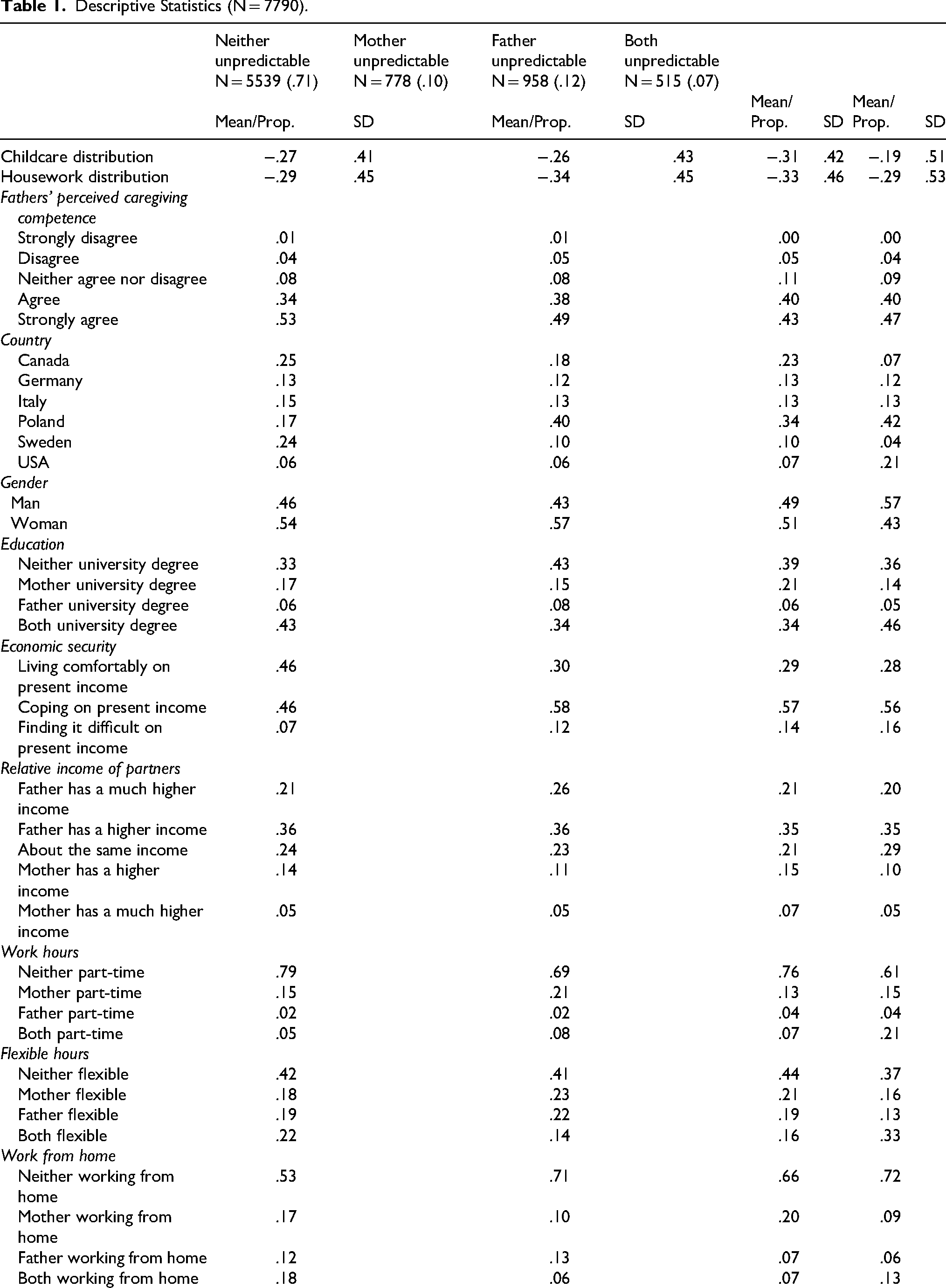
Because we are interested in gendered divisions of housework and childcare, we restrict analyses to co-resident different-sex couples with members who identify as men or women (N = 16516). We further limit the sample to dual-earner employee couples with both partners currently working, as a partner who is out of the labor force, unemployed, or on leave can usually be available to meet childcare and housework needs regardless of the other's schedule, and because those who are self-employed do not have schedules dictated by an employer (N = 8539). Finally, we drop individuals with missing data, for a final sample of 7790 (Canada 1794; Germany 992; Italy 1114; Poland 1790; Sweden 1527; USA 573). Although these restrictions may result in a more socioeconomically advantaged sample (e.g., only 7% of the sample report finding it difficult to manage with current finances, see Table 1), focusing on dual-earner couples enables us to more fully understand the association between unpredictable schedules and domestic labor in families that balance multiple work schedules.
Descriptive Statistics (N = 7790).
Measures
Dependent variables: The FHD includes an array of variables indexing respondents’ perception of the division of childcare and housework tasks and responsibilities.
In each case, respondents were asked who in your household did/was responsible for aspects of housework and childcare. The five possible answer categories were (verbatim in survey): “always or usually me,” “about equal,” “always or usually my partner,” “always or usually someone else,” and “does not apply”. We focus on the first three response categories and combine the response with information about respondent gender to construct a numeric variable with three outcomes: always or usually mother (−1); about equal (0); always or usually father (1). For simplicity, we refer to women partners as “mothers” and men partners as “fathers” throughout regardless of biological or step-parenting status and the marital status of partners. Responses that work was done always or usually by someone else or does not apply are coded as missing. We then create two summary variables. The first captures the individual's mean score for the division of housework. This mean is calculated from scores for five tasks and one measure for overall responsibility (cooking and preparing meals, daily kitchen cleaning, cleaning other parts of the house, laundry, shopping for groceries or household supplies, responsibility for housework). The second captures the individual's mean score for the division of childcare, including five tasks and three responsibilities (physical care, playing with or reading to children, helping with children's schoolwork, transporting and accompanying children to activities, providing general oversight and supervision, responsibility for children's daily life and activities, responsibility for health needs of children, and responsibility for children's schooling. In doing so, we follow the existing literature that constructs similar unweighted childcare and housework division indices (Aassve et al., 2015; Haney & Barber, 2022).
We recognize that there may be important differences between domestic tasks and responsibilities in terms of the nature of their temporal demands. Our questions about responsibilities were designed to capture the mental labor of recognizing needs, devising solutions to meet them, monitoring outcomes, and caring for others’ emotional wellbeing (Daminger, 2019; Dean et al., 2021; Doucet, 2023; McKeown, 2021; Robertson et al., 2019). To capture this, questions about responsibilities were prefaced with an explanation differentiating them from physical domestic tasks that noted: “Now, we want to know about RESPONSIBILITY, which is different from doing tasks. Responsibility means NOTICING NEEDS and MANAGING, ORGANIZING, and PLANNING different spheres of family life. Examples:
For both the housework and childcare index, the mean score excludes measures with missing values. For example, if the respondent does not have a school-aged child, they will not have valid data for the variable asking about helping with schooling. Their mean score will not include this value, whereas it will for a person with a school-aged child. As Italy did not ask questions about responsibilities, scores for Italian respondents did not include these measures. Given this difference, we re-estimated all models without Italy as a robustness check and did not find substantive differences in results.
Independent variable: We combine information on respondent gender and self's and partner's work schedules to create a household level measure of schedule predictability. Questions on respondent and partner schedule predictability asked: “Do/does you/your partner have an irregular schedule that is decided at short notice by your employer?” Our variable has four categories: neither mother nor father has an unpredictable schedule; only mother has an unpredictable schedule; only father has an unpredictable schedule; both mother and father have unpredictable schedules. Note that our measure combines several distinct aspects of scheduling (variability, limited advance notice, lack of worker control) that, brought together, create the potential for substantial work-life conflict and disruption to domestic routines. Employees may not have control over their schedules, but if they are posted with sufficient lead-time, workers can anticipate and plan and thus better manage family responsibilities (Cho et al., 2024; Henly & Lambert, 2014). Likewise, if workers have control over their schedules, variability may reflect helpful flexibility rather than uncertainty (Lambert et al., 2019). When schedules vary alongside little advance notice or employee control, unpredictability is high and meeting family responsibilities becomes much more difficult.
Moderator variables: To assess the sensitivity of results to attitudes about gender norms, we draw on responses to the statement, “In general, fathers are as well suited to look after their children as mothers.” Answers were: strongly disagree (0), disagree (1), neither agree nor disagree (2), agree (3), strongly agree (4). Our indicator of economic security is based on a question asking respondents whether they were currently living comfortably on present income, coping on present income, finding it difficult on present income, or finding it very difficult on present income. We combine the last two categories as relatively few respondents reported they were finding it very difficult. With only six countries in our data, using specific country-level attributes to consider cross-national variation in relationships is problematic. We therefore use country as a moderator variable. Although this does not allow us to ascertain associations with particular institutional features, it captures broad differences across countries that may be related to the interplay between different elements.
Control variables: All models control for a set of covariates that may influence both parents’ risk of employment in jobs with unpredictable hours and reported divisions of domestic labor: respondent gender identity (man or woman), country, respondent and partner's education (neither has university degree, only mother has degree, only father has degree, both have degree), and economic security.
Other employment characteristics typical of jobs with unpredictable schedules may also shape divisions of domestic labor. We control for differences in relative income between partners as unpredictable schedules may depress earnings if workers refuse shifts that conflict with domestic duties. Unpredictable schedules are also disproportionately found in low-paid jobs, although it is possible that in some cases employers may compensate for poor schedules with higher earnings. Relative earnings, may, in turn, impact the balance of power in relationships and the degree to which couples prioritize the employment demands of one partner over the other. Relative income is based on the question, “Considering all sources of income, between you and your partner, who has the higher income currently?”, with answers combined with gender information to create the categories of: father has a much higher income, father has a higher income, partners have about the same income, mother has a higher income, mother has a much higher income.
We also account for job characteristics that may be associated with unpredictable schedules and that impact parents’ availability for childcare and domestic work: household-level measures of part-time status (working less than 30 hours a week), flexible working hours (able to vary start and/or stop times according to one's needs or preference), and working from home. Working from home is particularly important to consider given the timing of our survey a year and a half into the COVID-19 pandemic, when rates remained elevated. Although those working from home are more likely to have predictable schedules (see Table 1), this is not universally true, and unpredictability is less disruptive to domestic obligations when job duties are carried out at home. Measures for part-time and flexible hours are both derived from separate questions about respondent's and partner's working conditions. These are combined with information about respondent gender to create variables with response categories of: neither, only mother, only father, or both. The measure of the couple's work from home situation is derived by combining information about respondent gender and self and partner's main working status from a monthly roster: both mainly working at workplace, only mother mainly working from home, only father mainly working from home, both mainly working from home. Data limitations mean that we must assess this as of June 2021 rather than at the time of survey (late August/early September). In some cases, the respondent or partner (who are both employed at the time of the survey) was on leave or not employed in June and hence is missing data on work location. For respondents who were on leave, we use the status from the last month they were employed. As a sensitivity test, we ran models without these respondents with no discernable impact on results. Because households where either the respondent or partner was not employed in June contribute by far the largest number of missing cases in our data (N = 540), we also ran models that include all respondents but dropped the work from home control—there were no substantive differences in results.
We hypothesized that household economic security might moderate the relationship between schedules and domestic labor as those with more financial resources would be better able to purchase flexible substitutes for domestic labor. To capture such outsourcing more directly, we run models adding two outsourcing measures based on answers to questions about how often families received help with housework and with childcare from other people. Answers were every day, twice a week or more, once a week, once or twice a month, never or less than once a month. Sweden did not include the question asking about help with housework on their survey, and a small number of respondents in other countries were also skipped (Germany: 1; Italy: 14; USA: 6). To avoid dropping Swedish respondents from the model, we code respondents with missing values with a “not asked” category. and caution readers not to interpret this or the Sweden coefficient in models including this covariate given collinearity.
Analytic Strategy
Our main models are estimated with Ordinary Least Squares regression. We estimate separate models for housework and childcare indexes, each with and without controls. To provide additional context for our main results, we also estimate multinomial logistic models predicting the division of individual housework and childcare tasks and responsibilities. To assess variability in the relationship between schedules and domestic labor by gender attitudes (treated as continuous), economic security, and country, we run OLS models including interactions between these terms and schedules.
Results
Table 1 presents descriptive statistics for all analytical and control variables by schedule configuration. Overall, approximately one-third of the sample dealt with schedule unpredictability: both parents had unpredictable schedules in 7% of families, whereas similar proportions of families experienced unpredictable schedules for only mothers (10%) or fathers (12%).
Figure 1 provides an overview of the distribution of housework and childcare by parental schedule using our index variables. As the means of scores for the division of multiple tasks/responsibilities, these can take numerous values between −1 and 1: −1 would indicate that the respondent believes the mother in the couple does all or most of each task and responsibility, 0 that they believe each task and responsibility is divided about equally (or that tasks/responsibilities that one parent does more of are balanced by the other parent assuming a greater role for a different task/responsibility), and 1 that they believe the father does all or most of each task and responsibility.
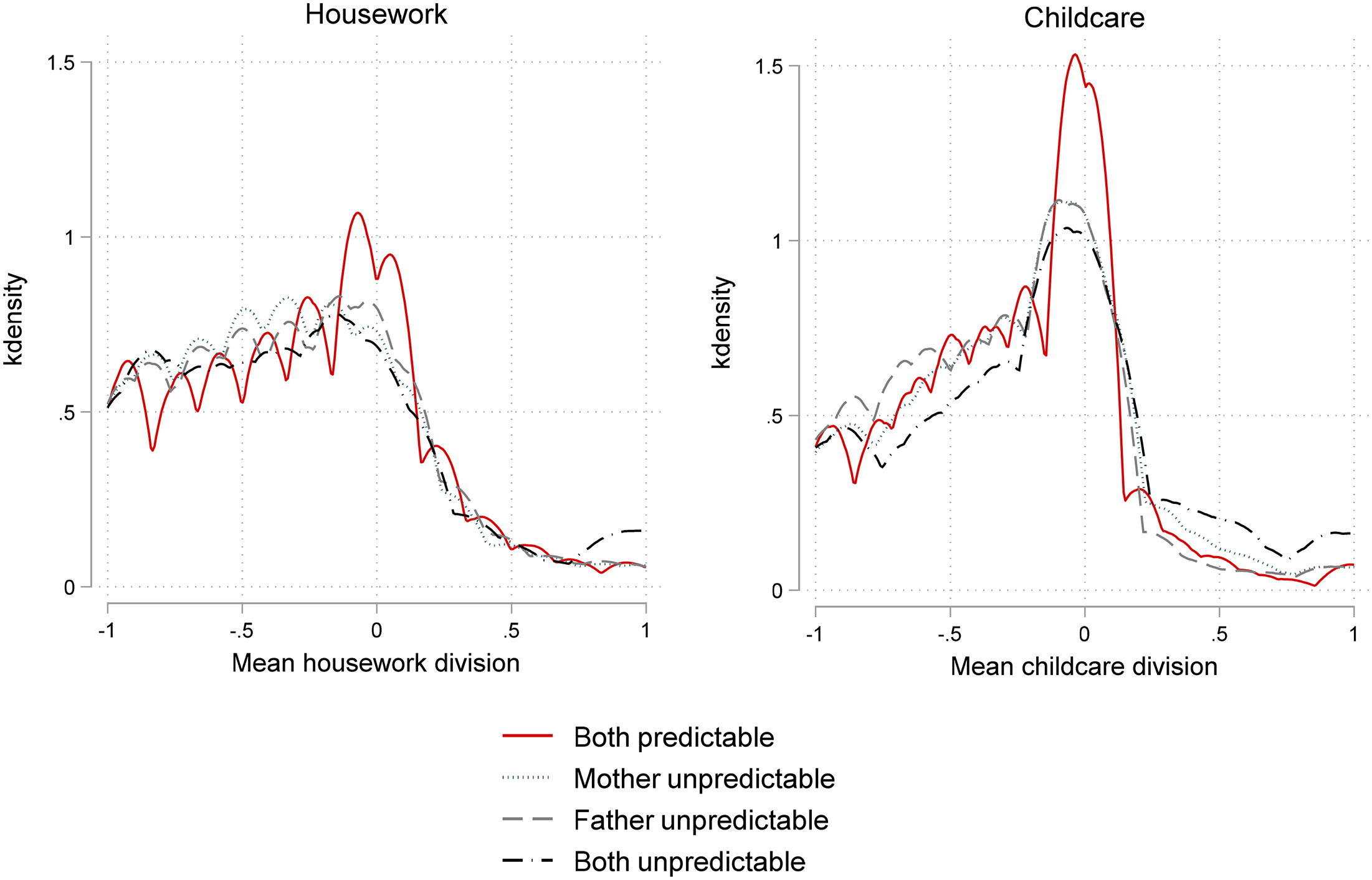
Divisions of Housework and Childcare by Parental Schedules.
Looking at the distributions reveals that regardless of schedule, most households report divisions of labor ranging from mother-dominated to equal, with few skewed towards father doing more. Childcare is more evenly distributed than housework. For both housework and childcare, parents with predictable schedules are more likely to report exactly even distributions of labor than when schedules are unpredictable. For childcare in particular, mothers’ unpredictability shifts the distribution away from reporting equal divisions towards fathers doing a slightly higher share vis-à-vis those with predictable schedules, fathers’ unpredictability moves the distribution in the opposite direction, and when both are unpredictable, there are more families reporting fathers doing a greater share of domestic labor and fewer reporting mothers doing a greater share.
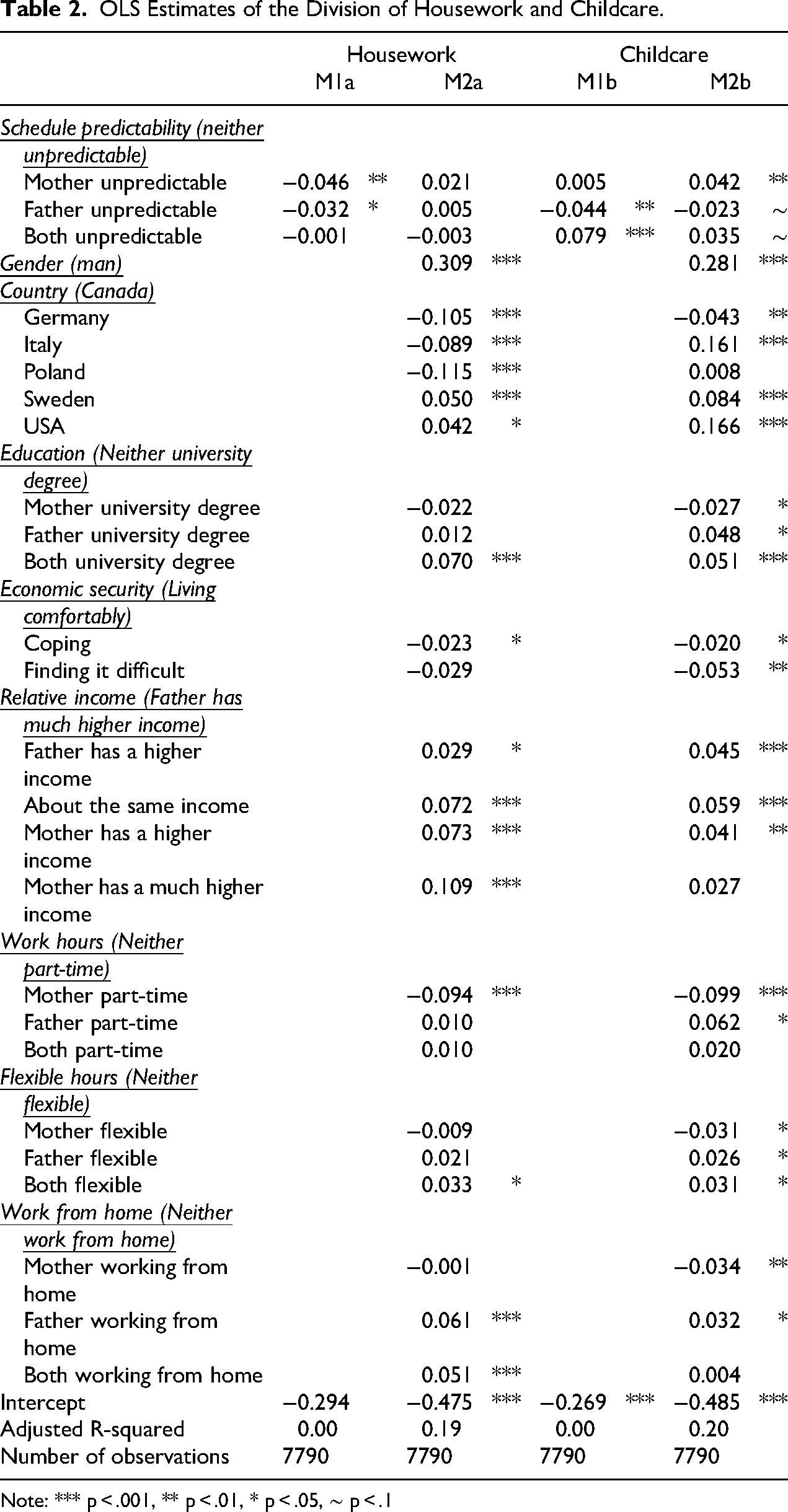
To test the relationship between schedules and divisions of labor more formally, Table 2 presents OLS regression estimates of a baseline model with just the schedule variable as well as a model including all controls for housework and childcare. Negative coefficients indicate reduced paternal shares of domestic labor, and positive coefficients indicate increased paternal shares. The baseline model for housework (M1a) suggests that when either partner alone has an unpredictable schedule, fathers’ overall share of housework declines compared to families with predictable schedules (β = −.046 when mothers alone have unpredictable schedules and β = −.032 when fathers alone do). There is no difference when both partners have unpredictable schedules. However, adding controls (M2a) renders all relationships non-significant.
OLS Estimates of the Division of Housework and Childcare.
Note: *** p < .001, ** p < .01, * p < .05, ∼ p < .1
There are persistent differences for childcare. In the baseline model (M1b), mothers alone having an unpredictable schedule does not significantly impact estimates of the overall division of childcare but when fathers alone have an unpredictable schedule, their share declines (β = −.044), and when both have an unpredictable schedule, fathers’ share increases (β = .079). Adding controls (M2b) reveals a significant increase in fathers’ share of childcare when mothers alone have unpredictable schedules (β = .042). Results for both childcare and housework thus suggest that other characteristics correlated with mothers’ unpredictable schedules tend to suppress fathers’ participation in domestic labor. Once we account for these characteristics, mothers’ unpredictable schedules are associated with an increase in fathers’ involvement in childcare. Note that while this difference is small, the effect size is larger than for most other work characteristics that we would expect to increase fathers’ availability for care, i.e., when fathers alone work from home (c.f. neither parent does: β = .032) or when fathers alone have flexible hours (c.f. neither parent does β = .026), and is comparable to the effect size associated with differences in partners’ relative income (difference between families where mothers have a higher income and those where fathers have a much higher income; β = .041). Only fathers’ singular part-time status matters more (c.f. both parents work full-time: β = −.062).
The model including controls (M2b) continues to show a reduced paternal share of childcare when fathers alone have unpredictable schedules, although the magnitude is smaller (β = −.023) and does not quite reach conventional levels of significance (p = .08). Results are thus broadly consistent with expectations about the contingency of time availability (H1a), as when either mothers or fathers alone have an unpredictable schedule, their partner appears to take on an increased share of childcare. Contrary to our expectation that gender norms would make partners more sensitive to fathers’ schedule instability (H2a), Wald tests reveal that shifts in divisions of childcare are more pronounced when mothers have unpredictable schedules.
Consistent with the baseline model (M1b), when both partners have unpredictable schedules, divisions of labor remain more equal in childcare, although the magnitude of the effect is reduced with the addition of controls (M2b: β = .035, p = .051). The coefficient for both unpredictable does not differ significantly from the coefficient for mothers’ solo unpredictability, suggesting that it is mothers’ schedule instability that chiefly drives changes in divisions of labor. Greater overall schedule uncertainty appears to encourage households to call on both parents to meet childcare needs, moving them away from a default reliance on mothers. This adds further support to the contingency of the time availability perspective generally and H1b specifically.
Multinomial Logistic Results for Each Type of Housework and Childcare Tasks and Responsibilities
To provide insight into the particular tasks/responsibilities that are most sensitive to unpredictable parental schedules, we estimate multinomial logistic models predicting divisions of labor (always or usually the mother, about equal, or always or usually the father) for each task/responsibility by schedule configuration. We focus again on differences in outcomes by schedule type rather than absolute probabilities, with Figures 2 and 3 presenting the average marginal effects relative to both parents having predictable schedules. Zero on the x-axis denotes no difference in the probability of reporting a particular division of labor relative to households with regular schedules, positive values indicate increased probability of reporting an outcome, and negative values indicate decreased probability. The same set of controls are included as in Table 2 M2a and M2b, and full results are available in Supplemental Material Tables A.1–A.4.
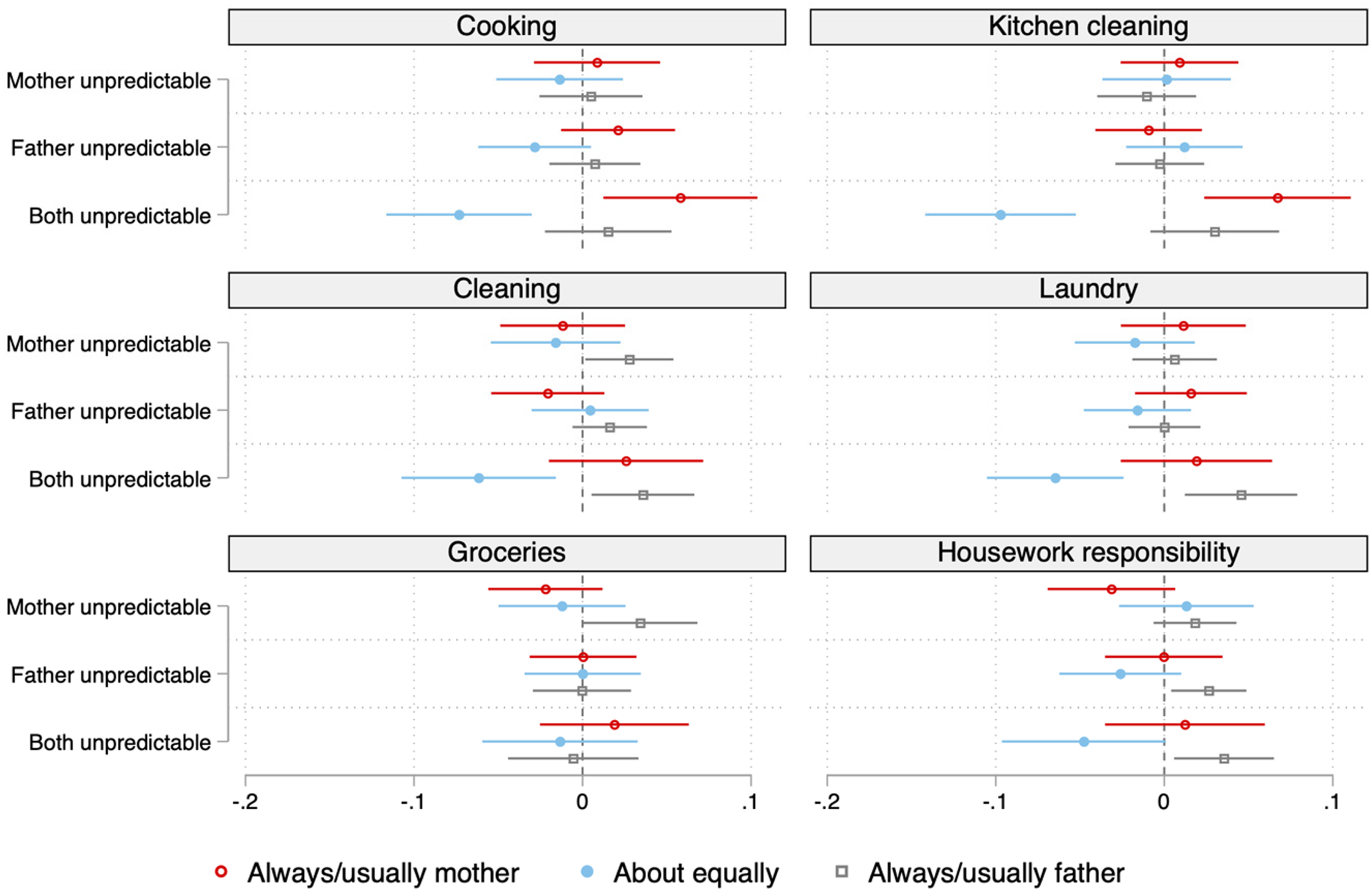
Predicted Difference in Probability of Reporting Housework Divisions Relative to Parents with Regular Schedules.
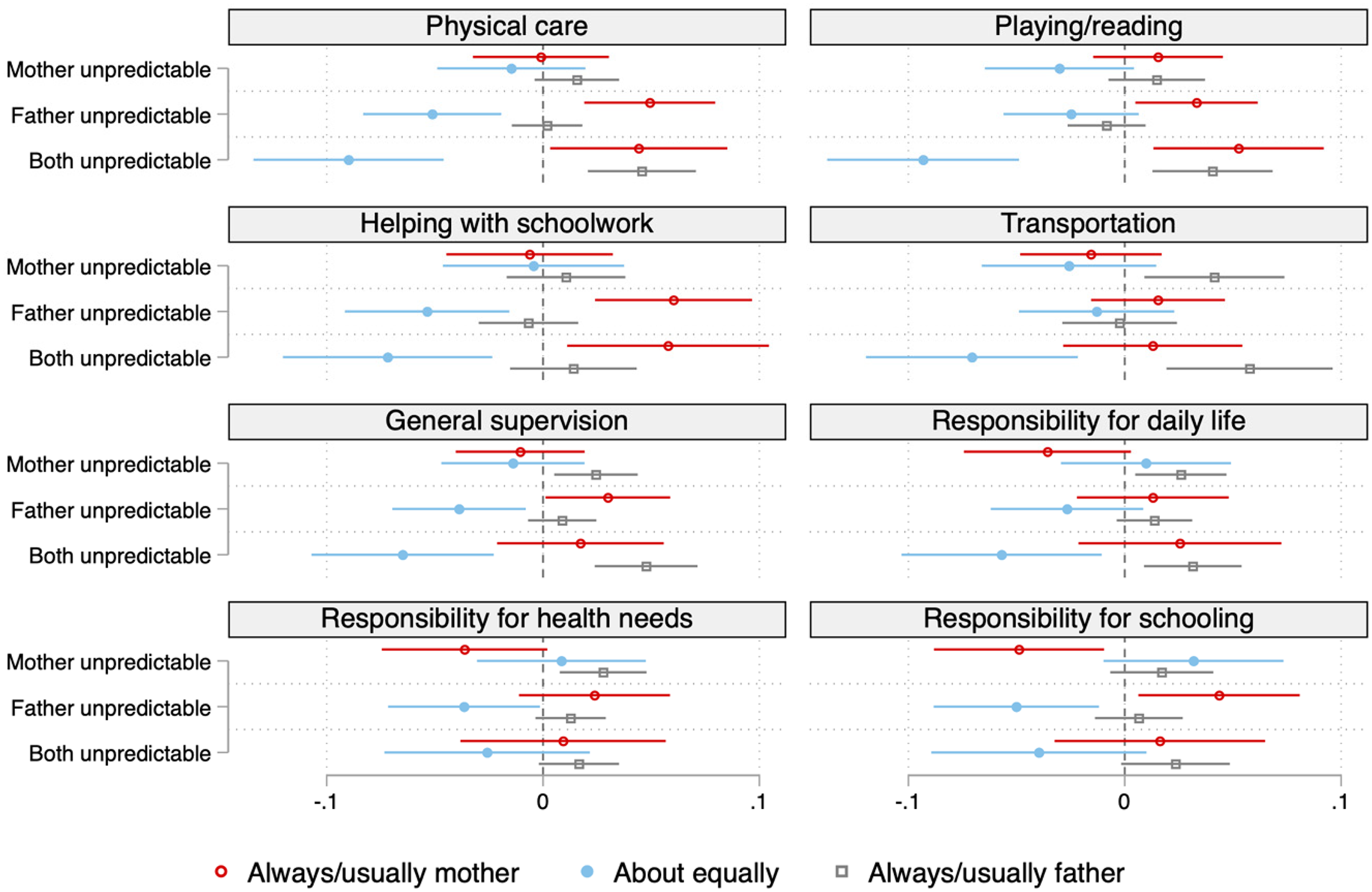
Predicted Difference in Probability of Reporting Childcare Divisions Relative to Parents with Regular Schedules.
Figure 2 illustrates patterns for housework. Recall that we did not find a significant relationship between parental schedules and overall housework division net of controls. Compared to households where both partners have predictable schedules, the divisions of most individual tasks and the overall responsibility for housework also do not typically differ significantly when either partner alone has an unpredictable schedule. However, when only mothers’ schedules are unpredictable, respondents are more likely to report that fathers always or usually take on cleaning (by 2.8 percentage points) and grocery shopping (by 3.4 percentage points). When only fathers have unpredictable schedules, respondents are 2.6 percentage points more likely to report that fathers always or usually shoulder the overall responsibility for housework and 2.8 percentage points less likely (p = .1) to report that cooking is about equally divided.
Notably, when both partners work unpredictable schedules, respondents are less likely to report equal divisions of labor for all types of housework except grocery shopping. Mothers take on more cooking and kitchen cleaning, while fathers do more cleaning and laundry and have an increased likelihood of shouldering responsibility for housework. Taken together, these offsetting differences may explain the nonsignificant results in the composite housework division observed in Table 2 M2a.
Next, Figure 3 presents the division of specific childcare tasks and responsibilities, again using households with both partners on predictable schedules as the reference group. Consistent with the results for our composite measure of childcare divisions, when one partner alone has an unpredictable schedule, the other is more likely to take on all or most aspects of childcare relative to households with predictable schedules, although not all differences are statistically significant. With mothers’ unpredictable schedules, fathers are significantly more likely to assume all or most transportation and supervision tasks, as well as responsibilities for children's daily life and health needs (by 4.1, 2.4, 2.6, and 2.8 percentage points, respectively). When fathers alone have unpredictable schedules, mothers are significantly more likely to always or usually shoulder every childcare task (increases ranging from 3.0 to 6.0 percentage points) except transportation, and to take on more responsibility for schooling (4.4 percentage points).
As with housework, when both partners have unpredictable schedules, the probability of reporting an equal division of labor decreases. Decreases are significant for all tasks and responsibilities save responsibility for children's health needs and schooling. Relative to families with predictable schedules, mothers are 5.8 percentage points more likely to take on helping with schoolwork, whereas fathers have a significantly increased probability of handling most or all transportation and general supervision duties, as well as responsibility for children's daily life and schooling (p = .07) (by 5.8, 4.8, 3.1, and 2 percentage points, respectively). For physical care and playing/reading, the likelihood that both mothers and fathers take on all or most of these tasks increases, with fewer couples sharing these two tasks equally.
Taken together, these task- and responsibility-specific results add nuance to our understanding of how couples adapt to schedule unpredictability. When one partner's schedule is unpredictable, the other steps in, with the difference most pronounced for fathers when mothers’ schedules are unpredictable, and more consistent for childcare versus housework. When both schedules are unpredictable, divisions of particular tasks/responsibilities do not necessarily become more fluid and egalitarian. Instead, parents tend to specialize more. For housework, shifts towards greater paternal and maternal shares for individual domains offset each other, leading to a null overall effect. For childcare, by contrast, more tasks/responsibilities shift towards fathers, resulting in the increase in fathers’ overall share of childcare evident in the models with the composite measure.
Differences by Gender Attitudes and Economic Security
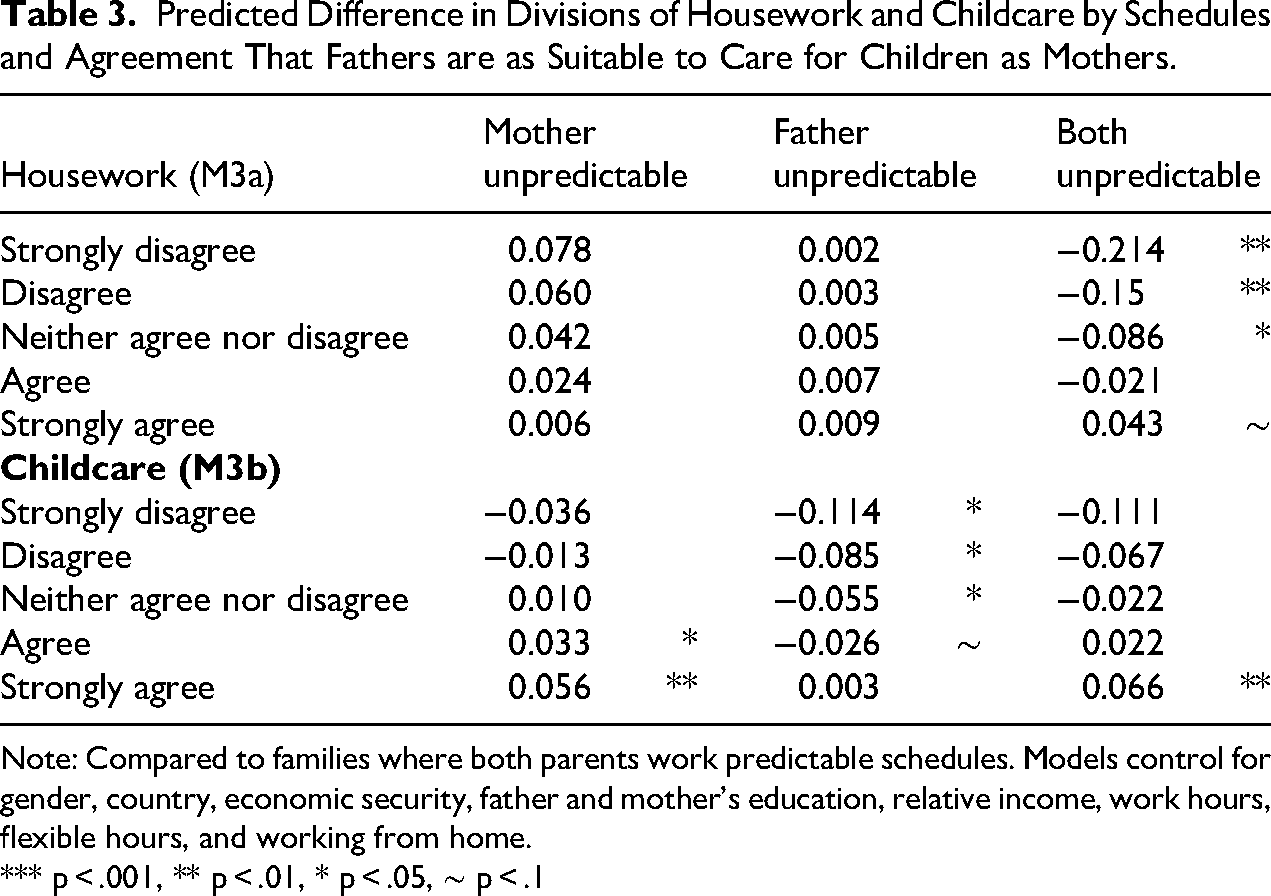
Results so far suggest that household adaptations to irregular schedules are driven by uncertain time availability, with no support for hypotheses derived from expectations about gender norms once control variables are included in models. However, we have not accounted for variability among households in adherence to (in)egalitarian ideals about gender and domestic labor. We do so now by including an interaction between schedules and beliefs about fathers’ suitability in caring for children in M3a (housework) and M3b (childcare). Table 3 presents the predicted difference in divisions of labor by schedule and gender attitudes relative to households where both parents have predictable schedules. Full model results are reported in Appendix Table A.5.
Predicted Difference in Divisions of Housework and Childcare by Schedules and Agreement That Fathers are as Suitable to Care for Children as Mothers.
Note: Compared to families where both parents work predictable schedules. Models control for gender, country, economic security, father and mother's education, relative income, work hours, flexible hours, and working from home.
*** p < .001, ** p < .01, * p < .05, ∼ p < .1
Gender attitudes moderate the relationship between schedules and housework divisions only when both parents have unpredictable schedules. In families with predictable schedules, mothers’ share of housework increases as attitudes become less egalitarian. This dynamic is exacerbated in families where both parents have unpredictable schedules. Where attitudes are least egalitarian (strong disagreement that fathers are as well suited to care for children as mothers), the average score is lower by .21 relative to families with predictable schedules. This difference becomes smaller as couples become more egalitarian. When couples agree that fathers are as suitable to care for children, it is small and not significant, and when respondents have strongly egalitarian views, mothers take on a smaller share of housework in families where both parents have unpredictable schedules than in families with predictable schedules (average score is higher by .04; p = .09). Results therefore provide partial support for Hypothesis 3, as the previously unsupported H2b (that mothers’ share of housework would be higher when both partners have unpredictable schedules) is now supported when attitudes are inegalitarian or neutral.
The relationship between schedules and divisions of childcare is also moderated by gender attitudes. Previously, we found that when one parent had an unpredictable schedule, the other parent's share of childcare increased. Fathers’ share of childcare also increased when both parents had unpredictable schedules. Accounting for the interaction between schedules and gender attitudes reveals that these patterns are strengthened when they align with gender attitudes. It is only when respondents agree that fathers are as suitable to care for children as mothers that fathers’ share of childcare is predicted to increase when mothers alone have unpredictable schedules (score is higher by .03 when respondents agree and by .06 when they strongly agree), and strong agreement is necessary before fathers take on an increased share of childcare when both partners have unpredictable schedules (average score is higher by .07). When fathers alone work unpredictable schedules, the corresponding increase in mothers’ share of childcare is likewise greater as attitudes become less egalitarian (and when attitudes are strongly egalitarian mothers do not assume an increased share of childcare).
Thus, when attitudes are neutral or inegalitarian, Hypothesis 2a is supported—having one partner with an irregular schedule increases one's share of childcare more strongly when the partner with an irregular schedule is a father. This is consistent with Hypothesis 3, which predicted that H2a would have greater support when gender attitudes are less egalitarian.
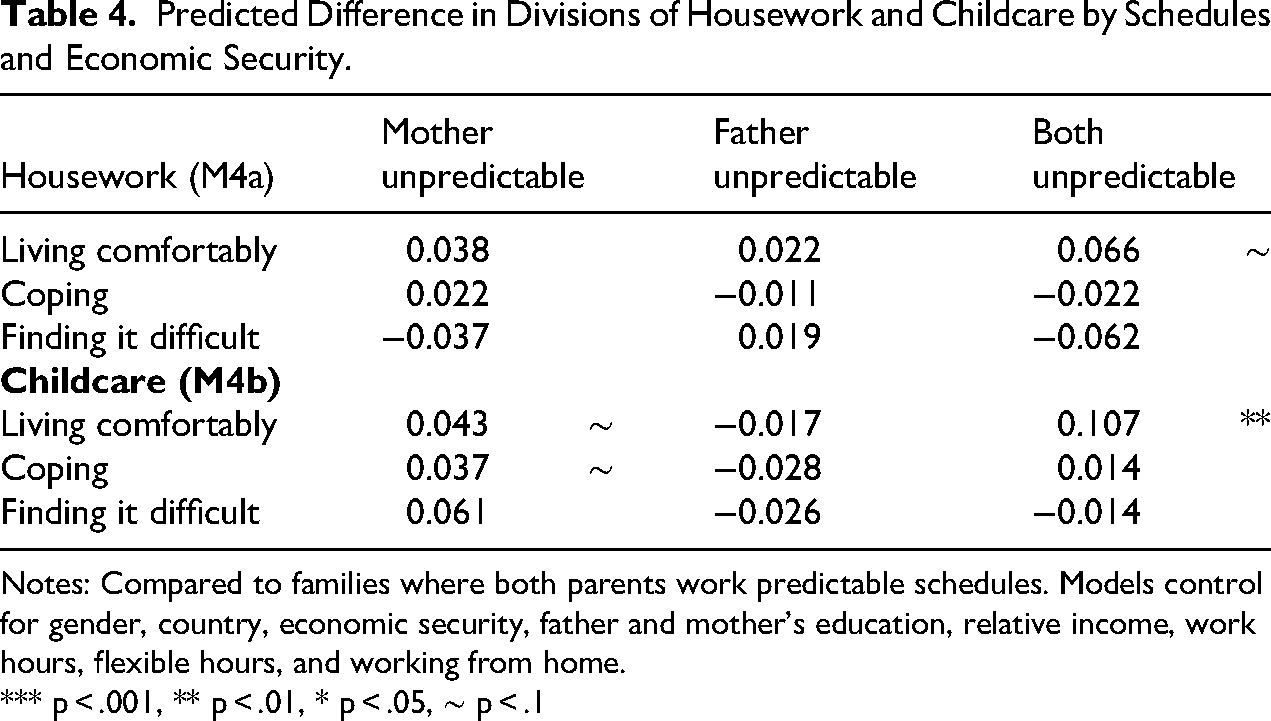
Next, we consider variation by economic security. Table 4 shows the predicted difference in divisions of housework (M4a) and childcare (M4b) by schedule at each level of economic security. Full regression results can be found in Supplemental Material Table A.5. When only one parent has an unpredictable schedule, divisions of housework are indistinguishable from families with predictable schedules regardless of the level of economic security. However, when both parents have unpredictable schedules, families that are “living comfortably” report a larger paternal share of housework than their counterparts with predictable schedules (p = .07). When families are “coping” or “finding it difficult” on present income, by contrast, there is no significant difference in paternal involvement in housework vis-à-vis families with regular schedules.
Predicted Difference in Divisions of Housework and Childcare by Schedules and Economic Security.
Notes: Compared to families where both parents work predictable schedules. Models control for gender, country, economic security, father and mother's education, relative income, work hours, flexible hours, and working from home.
*** p < .001, ** p < .01, * p < .05, ∼ p < .1
For childcare, economic security moderates the relationship between parental work schedules and the division of labor when mothers alone or both parents have unpredictable schedules, but not when only fathers do. Among families who report “living comfortably” or “coping” on their present income, the division of childcare is more egalitarian (average score is higher by .04; p = .1) when mothers alone have unpredictable schedules than when both parents have predictable schedules. It is only households who are “living comfortably” who experience a more egalitarian division of childcare when both parents have unpredictable schedules (average score is higher by .11).
Results for both housework and childcare thus run counter to our expectation that greater economic security would facilitate outsourcing, which would, in turn, reduce the need to shift divisions of labor in households managing unpredictable schedules (H4). To account for the impact of outsourcing more directly, we included controls for receiving additional help with childcare and housework in supplemental models (Supplemental Material mpa#nbsp;Table A.6). Outsourcing is indeed correlated with divisions of labor. Men perform a greater share of housework in families where others help with housework daily, as well as when outside childcare help is received (at all levels). Men also perform a greater share of childcare when families receive daily outside help with housework and with childcare. When fathers are more involved in domestic labor, it appears easier for families to ask for and/or receive help to lighten the load. Including these controls, however, does not substantively impact our focal findings.
Country Differences
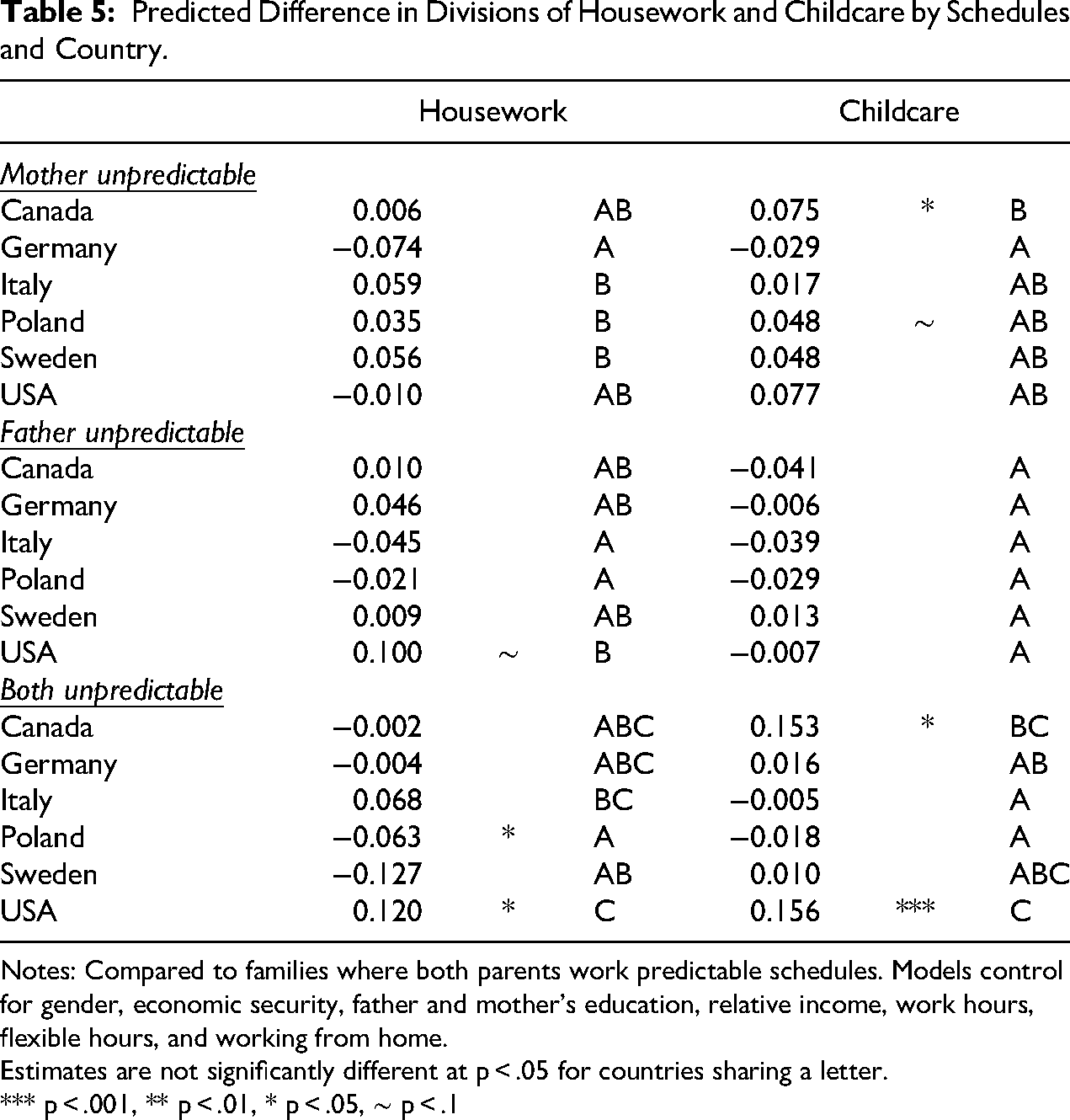
To assess potential cross-national variation in the relationship between unpredictable schedules and divisions of domestic labor, we next run models with an interaction between schedule and country. To facilitate interpretation and illustrate contrasts across countries, Table 5 reports predicted marginal effects for the difference in divisions of labor relative to both parents having predictable schedules by country. Countries sharing a letter in the contrast column are not significantly different at the .05 level. Full OLS model results are in Supplemental Material mpa#nbsp;Table A.7.
Predicted Difference in Divisions of Housework and Childcare by Schedules and Country.
Notes: Compared to families where both parents work predictable schedules. Models control for gender, economic security, father and mother's education, relative income, work hours, flexible hours, and working from home.
Estimates are not significantly different at p < .05 for countries sharing a letter.
*** p < .001, ** p < .01, * p < .05, ∼ p < .1
Results in Table 5 show limited evidence of cross-national variation in the relationship between schedules and divisions of housework. Consistent with the main results reported in Model 2, scheduling configurations are not significantly associated with differences in reported housework divisions of labor in any country when the mother alone has an unpredictable schedule. When the father alone does, results are likewise non-significant for all countries save the United States. Here fathers’ unpredictability is associated with an increase in men's share of domestic labor (0.1 difference in mean score; p = .07), but this does not differ from the (non-significant) estimates for Canada, Germany and Sweden. When both parents have an unpredictable schedule, fathers’ share of housework is higher (by .12) in the United States, but lower in Poland (by −.063). This is consistent with our expectation that time availability would be more salient in the United States and gender norms more salient in Poland. However, Poland does not differ from any country save the United States, and results for the United States are also indistinguishable from not only Canada (as expected), but also Germany and Italy.
Turning to childcare, when mothers alone have an unpredictable schedule, fathers are reported to perform a larger share of childcare in Canada vis-à-vis families with predictable schedules (.075). Coefficients are also positive and not different from Canada (although not reaching independent significance) in all other countries except Germany, where the coefficient is negative but not significant. Re-running the pooled model without Canada (estimates available on request) still results in a slightly smaller but significantly higher positive association between father involvement and having a mother with an unpredictable schedule across the rest of the countries. On balance, results suggest a largely consistent positive association between mothers alone having unpredictable schedules and greater father involvement in childcare.
Disaggregating results across countries reveals no significant effects in any country when fathers alone have unpredictable schedules. Although coefficients are negative across the board, the (marginally) significant tilt towards greater mother involvement is thus only apparent when power is increased by pooling observations across countries. When both partners have unpredictable schedules, fathers’ involvement relative to families with both partners with predictable schedules is only significantly different (higher) in the two liberal countries with the weakest labor protections: Canada (.15), and the United States (.16). When we compare estimates across countries (contrast column) these effects differ from Italy and Poland, but not from Sweden, or, for the United States, from Germany.
Discussion
Families with unpredictable schedules face myriad challenges when juggling the demands of employment, housework, and childcare. Our findings suggest that schedule unpredictability can reshape how families divide domestic labor. Overall, we found the strongest evidence for adaptation in childcare. Supporting our time-availability hypotheses (H1a and H1b), when one partner had an unpredictable schedule, the other performed a greater share of childcare than in families with predictable schedules, and fathers also performed a greater share when both parents had unpredictable schedules. Housework divisions were less sensitive to schedule differences overall. While we did find some significant differences for individual housework tasks and responsibility, shifts towards greater father involvement in some areas tended to be offset by shifts towards greater mother involvement in others, resulting in null overall effects. Only in households where both parents had unpredictable schedules and where attitudes were not egalitarian or economic security was strongest did overall housework divisions differ from those in families with predictable schedules.
The relative insensitivity of overall housework divisions to schedule unpredictability may reflect lower time-sensitivity and greater substitutability of this labor compared to childcare. Cleaning a dirty kitchen or doing the laundry may be deferred until the parent with an unpredictable schedule comes home, and meals may be made ahead of time or ordered in, creating less pressure for the other parent to step in. By contrast, children's childcare, school, and activity schedules are often rigid and their needs for care and attention immediate. Who cares for children also matters, making outsourcing more difficult. A babysitter may be able to take a child to a sports competition, but having a parent watching can be important for family relationships, making it preferable for one parent or the other to attend. The ongoing pandemic context may also have made parents more hesitant to reach beyond their immediate household for care. The most dramatic pandemic restrictions had eased by the time of our data collection following the rollout of vaccinations, but COVID-19 remained ongoing and older adults were still vulnerable. In this context, some parents may have been reluctant to ask grandparents to provide the kind of informal and flexible care that can be especially helpful when schedules are uncertain.
Although the overall results provided little support for our hypotheses related to gender norms (H2a and H2b), models considering variation in families’ gender attitudes revealed their salience (H3). Time availability and gender norms are typically treated as competing explanations for gender divisions of domestic labor, but our results highlight their interconnection: gender attitudes conditioned how households responded to unpredictability.
Contrary to our expectations about outsourcing (H4), we found that economic security was a precondition for the relationship between dual unpredictability and more equal divisions of labor. This suggests that families cannot simply buy their way out of the challenges that unpredictable schedules create by outsourcing care. Why more financially secure families would more often respond to dual unpredictability with a more even division of domestic labor is less clear. One possibility relates to selection effects. Households where men are less able to take on the increased childcare demands associated with mothers’ or dual unpredictable schedules may seek to avoid these schedule configurations. As shown in Table 1, families reporting “living comfortably” are disproportionately represented in the group where neither parent has an unpredictable schedule. Economically secure families with unpredictable schedules may therefore enjoy unmeasured resources, such as supervisory support, that make it easier for men to meet caregiving needs under unpredictable schedules without risking their own employment.
Our analysis drew on data from six countries with distinctive work-care policy regimes and varying rates of both unpredictable schedules and maternal employment. While we expected challenges of unpredictable schedules to be broadly similar across contexts, variation in cultural norms, policy provisions around care, and legal frameworks around employment can shape which work-care strategies are available and desirable to parents. Overall, evidence for cross-national variation was weak. We did not find consistent relationships between country-level gender norms and how families responded to unpredictable schedules. Families’ own gender attitudes thus appear more important than broader national context. It is important to consider, however, that assessing cross-national differences substantially reduces statistical power compared to pooled analyses. For instance, in Sweden, the most gender egalitarian country, only 23 respondents reported both parents with unpredictable schedules. Larger samples are needed before drawing firm conclusions about cross-national differences.
Findings did suggest that worker empowerment and employment norms could matter, although again, these findings should be interpreted with caution. For childcare, the clearest evidence for increased father involvement when mothers had unpredictable schedules was in Canada and, when both parents had unpredictable schedules, the United States. This may reflect the more individualistic approach of liberal welfare states, where parents are expected to solve work-family conflicts on their own, and where employers retain greater more power. In this context, fathers may need to step up to keep mothers from losing their jobs. It is also possible that the need for fathers’ care work is greater if mothers’ unpredictable schedules are more unstable in these countries because of weaker norms, regulations, and union protections. “Short notice” may thus be interpreted differently by respondents in Canada and the United States versus the European countries.
There are three key limitations in our data. First, we measure perceptions of domestic labor. Consistent with past research, the controls for gender in our models reveal that men typically perceive such divisions to be more equal than do women (we do not find differences in the relationship between gender and schedule type—results available on request). Time-use surveys that collect detailed daily diary data would provide more robust estimates of divisions of labor but are currently limited to individual-level data. We encourage survey designers to consider broadening their scope to allow for household-level analyses.
A second limitation concerns the scope of tasks included. As with most quantitative surveys on household work and childcare, we measured a set of routine tasks and regular responsibilities (five housework tasks, five childcare tasks, and four measures of housework and childcare responsibilities). This is not exhaustive. As highlighted in qualitative research studies, diverse households may have more care work tasks and responsibilities (i.e., eldercare, care of children with disabilities); different kinds of unpaid work, as is often the case for rural families, Indigenous families, and multi-generational families; wider spatial dimensions of care work (e.g., volunteer work, community-based childcare work); or work done outside of the parental dyad. Our survey asked whether labor was performed “always or usually someone else” (excluded from analysis), but this misses intermittent but potentially critical help from extended family members or others. We were able to control for such outside help with housework and childcare (Supplemental Material Table A.6) but could not incorporate it directly in our dependent variables.
Finally, our measures for divisions of labor are relatively coarse, distinguishing only between divisions where mothers or fathers did “most or all” and where labor was divided “about equally.” This may under-estimate shifts towards a greater domestic workload for mothers. Because women are already more likely than men to report, or be reported as, doing all or most of each task and responsibility, there is a ceiling effect that dampens our ability to measure increases in women's domestic labor. Because we focus on divisions of domestic labor, not total amounts performed by fathers and mothers, it may also be that divisions of labor are more equal but mothers’ overall domestic load is higher (i.e., if unpredictability makes outsourcing more difficult).
Conclusion
Scholarship on divisions of domestic labor has long highlighted the potential importance of time availability. We extend this scholarship by demonstrating that it is not just the amount of time parents spend on employment, or when shifts are scheduled that matters, but also predictability. Furthermore, prior research typically examines individual schedules in isolation, but our study captures the interdependent nature of family lives by focusing on the combination of both partners’ work schedules. This couple-level perspective reveals how divisions of domestic labor are shaped through the interplay of both partners’ opportunities and constraints. Consider childcare: results for fathers’ unpredictability varied depending on whether their partner also had an unpredictable schedule. When only the fathers’ schedule was unpredictable, mothers’ share of childcare increased, but when his partner also had an unpredictable schedule, his share of childcare increased. These offsetting effects obscure the impacts of fathers’ schedules if they are considered in isolation from partners’ schedules, highlighting the importance of exploring household schedule configurations in future research.
The uneven division of domestic labor is an important aspect of gender inequality. Fathers’ ability and willingness to take on a greater share of childcare when their partners have unpredictable schedules suggests some cause for optimism for progress towards shared care. However, this optimism must be tempered by the possibility that our measures underestimate shifts towards greater workloads for mothers. In addition, our analysis focused only on partnered parents. Whether divorced or separated fathers would respond similarly is an open question. The greater challenges facing single parents (usually mothers) without co-parents when schedules are unpredictable also caution against a rosy conclusion. Greater equality on the home front in some circumstances must be weighed against evidence of a broad array of negative outcomes for individual workers and their families. And, of course, when only fathers had unpredictable schedules, caregiving inequality increased.
Our analysis focused on supply-side factors. Yet employer and supervisor attitudes and organizational policies are also critical to parents’ ability to manage both unpredictable schedules and domestic needs. Employers are unlikely to be sensitive to family demands around housework, but caregiving clashes may be accommodated in some instances, reducing the likelihood that workers would need to rely on partners. Additional research exploring how workplace gender dynamics and power relations shape mothers and fathers’ ability to accommodate caregiving demands would be useful to provide deeper insight into how and when unpredictable schedules alter domestic divisions.
Other intersecting dimensions of workplace inequality regimes that shape relations of power, such as skill divisions and racialization, likely also impact how workers experience irregular schedules. Much research on irregular schedules has focused on low-wage sectors of the labor market where workers have little power. Yet this is not the only context where unpredictable schedules occur. Indeed, slightly more families reported unpredictable schedules for both partners if both had university degrees (7.3%) than if neither did (6.7%). Although our focus on the labor market as a whole provides a more encompassing picture of unpredictable schedules than much past research in this area, more research is needed to understand how workplace contexts shape the experience of unpredictable schedules, and how this, in turn, impacts the work-family interface.
This is a particularly important issue given ongoing shifts in employment and caregiving in the wake of the COVID-19 pandemic. Our data were collected a year and a half into the pandemic when caregiving and schooling disruptions were less acute, but still evident. The initial, dramatic closures and moves online increased parents’ overall workload and resulted in modest shifts towards greater father involvement in housework and caregiving in many countries, as well as a great deal of media attention to the issue of fathers’ involvement at home. This may have inspired employers to be more sympathetic to fathers’ caregiving role, making it easier for them to increase their involvement in caregiving when mothers’ schedules were unpredictable. Whether this heralds a lasting cultural shift is an open question. Likewise, the rise and fall of remote and hybrid work arrangements since the pandemic could make a difference if the ability to work from home mitigates negative effects of schedule unpredictability on time availability by enabling multitasking. Our descriptive results in Table 1 suggest that working from home is less common among workers with unpredictable schedules compared to those with more predictable ones. Future studies should consider whether remote work moderates the effects of schedule unpredictability and consider other parental strategies to accommodate domestic work and unpredictable schedules, such as the withdrawal of the other parent from the labor force.
Although our study focused on household adaptations to unpredictable schedules, regulations targeting scheduling are a growing area of policy intervention and clearly matter for the experience of workers. In Washington state in the United States, for example, Seattle's Secure Scheduling Ordinance, which covers hourly employees of large retail and food service companies, has a number of provisions aiming to reduce unpredictability for workers who are covered, such as the requirement to post schedules 14 days in advance (Seattle Office of Labor Standards 2024). In Canada, provincial employment standards do not require advance notice of schedules, but workers covered by the Canada Labour Code (those employed in industries that cross provincial lines) must receive 96 hour advance notice. The European Union (EU) Directive 2019/1152 on transparent and predictable working conditions in the EU directs member states to guarantee a “reasonable advance notice period” of work assignments and that work takes place within predetermined reference hours and days. As the issue of unpredictable schedules garners more attention from the public and policymakers, understanding how various policy approaches matter for worker and family outcomes is a critical area for future research.
Supplemental Material
sj-docx-1-wox-10.1177_07308884251390866 - Supplemental material for Unpredictable Work Schedules and Gender Divisions of Domestic Labor
Supplemental material, sj-docx-1-wox-10.1177_07308884251390866 for Unpredictable Work Schedules and Gender Divisions of Domestic Labor by Sylvia Fuller, Manlin Cai, Richard Petts, Andrea Doucet, Anna Kurowska, Donna Lero, and Thordis Reimer in Work and Occupations
Footnotes
Author Contributions
Ethical Approval and Informed Consent
The Familydemic Questionnaire and study protocol were approved by the Ethical Committee at the University of Warsaw (Komisja Rektorska ds. Etyki Badań Naukowych z Udziałem Człowieka) as well as Davidson College's Institutional Review Board, the Swedish Ethics Review Authority (Etikprövningsmyndigheten), the Behavioural Review Ethics Board at the University of British Columbia, the Social Science Research Ethics Board at Brock University, the Social Ethics Board at Dalhousie University, the Research Ethics Board at the University of Guelph and the Ethical Committee (Commissione Etica) of the University of Florence.
The collection of the Familydemic survey data complies with all ethical regulations of public opinion survey data. Participants were informed of the purpose of the study and consented to share their data. Individual data has been entirely anonymized. All respondents agreed to the respective privacy policy before they answered the questionnaire.
Funding
The authors disclosed receipt of the following financial support for the research, authorship, and/or publication of this article: This research was supported in part by the National Science Centre in Poland under grant nr 2020/37/B/HS5/02703. The Canadian survey was funded by the Social Sciences and Humanities Research Council of Canada (SSHRC) through the Reimagining Care/Work Policies Partnership project (grant number 895-2020-1011) with Andrea Doucet as Principal Investigator and Sylvia Fuller as Co-Investigator. Fielding of the survey in Sweden was paid for by a grant from the Royal Swedish Academy of Sciences (SO2021-0028) with support also from FORTE: Swedish Research Council for Health, Working Life and Welfare (2019-00337). Funding for the German survey was provided by the COVID-19 Funds, University of Hamburg, the Gender Promotion Funds of the Faculty of Business, Economics and Social Sciences, University of Hamburg, and the Centre for Sustainable Society Research (CSS), University of Hamburg. Funding for the Italian survey was provided by Raffaele Guetto and Daniele Vignoli's personal research funding at the University of Florence. Funding for the US survey was provided by Davidson College and Fordham University. Università degli Studi di Firenze, Royal Swedish Academy of Sciences, University of Hamburg, Fordham University, Forskningsrådet om Hälsa, Arbetsliv och Välfärd, Narodowe Centrum Nauki, Social Sciences and Humanities Research Council of Canada, Davidson College, (grant number SO2021-0028, 2019-00337, nr 2020/37/B/HS5/02703, 895-2020-1011).
Declaration of Conflicting Interests
The authors declared no potential conflicts of interest with respect to the research, authorship, and/or publication of this article.
Supplemental Material
Supplemental material for this article is available online.
Notes
Author Biographies
 ).
).
).
References
Supplementary Material
Please find the following supplemental material available below.
For Open Access articles published under a Creative Commons License, all supplemental material carries the same license as the article it is associated with.
For non-Open Access articles published, all supplemental material carries a non-exclusive license, and permission requests for re-use of supplemental material or any part of supplemental material shall be sent directly to the copyright owner as specified in the copyright notice associated with the article.
