




Abstract
We explore cross-country differences in the transition to adulthood between China, Germany, and the USA. Using large-scale panel studies, we examine the timing of leaving the parental home, first marriage and first parenthood. For those born between 1933 and 1988, we observe a delay in the timing of first marriage in all three societies. But the delay is steeper in the USA than in Germany and China. The age at first childbirth is increasing in all three countries. By age 30, most individuals in China have married their first partner and become parents, whereas in the USA and Germany less than half of the population have experienced one of these events. There are large differences in educational and employment trajectories between the urban and rural populations in China, less so in the USA, whereas almost no differences are observed in Germany. The three countries are alike in the proportion of individuals who have left the parental home by age 30. In all three countries, individuals without tertiary qualifications are more likely to have experienced all three events by age 30. But with regard to first marriage, a larger share of higher-educated individuals get married by the age of 30 in the USA, whereas in China it is the less educated who are more likely to get married.
Introduction
The second demographic transition framework assumes countries follow a linear path of development from high to low fertility, a decline in marriage formation, and an increase in non-marital births, which is related to the rise of non-marital cohabitation (Lesthaeghe, 2010; van de Kaa, 1987). As this framework has thus far only been shown to apply to European and American societies, it is unclear whether it is equally applicable to other societies. Previous research has shown that gender roles within marriage and the centrality of children to marriage are changing in East Asia. Raymo et al. (2014) observed that less-conservative values are spreading in the region. Japan, South Korea, Taiwan (China), and Hong Kong (China) also experienced the same trend of fertility postponement as European countries did several decades ago (Lesthaeghe, 2010). Furthermore, increasing numbers of premarital cohabitations have been observed between 1954 and 1984 in Japan (Lesthaeghe, 2010).
In this paper, we examine differences and similarities in the transition to adulthood in China, the USA and Germany. In contrast with previous research, we use cohort rather than period data. Thus, we are able to provide an overview of how the transition to adulthood has changed across cohorts in all three countries. First, we focus on the ages at which 25%, 50% and 75% of a cohort have left home, married, or become parents. Second, we examine the links between the partnership-parenthood trajectory and the school-work trajectory. Third, we take into account variations within countries in the transition to adulthood by gender, educational background, and rural or urban living.
National contexts in comparison: Welfare state, geographic extent, cultural regime, and kinship system (Nauck et al., 2017).
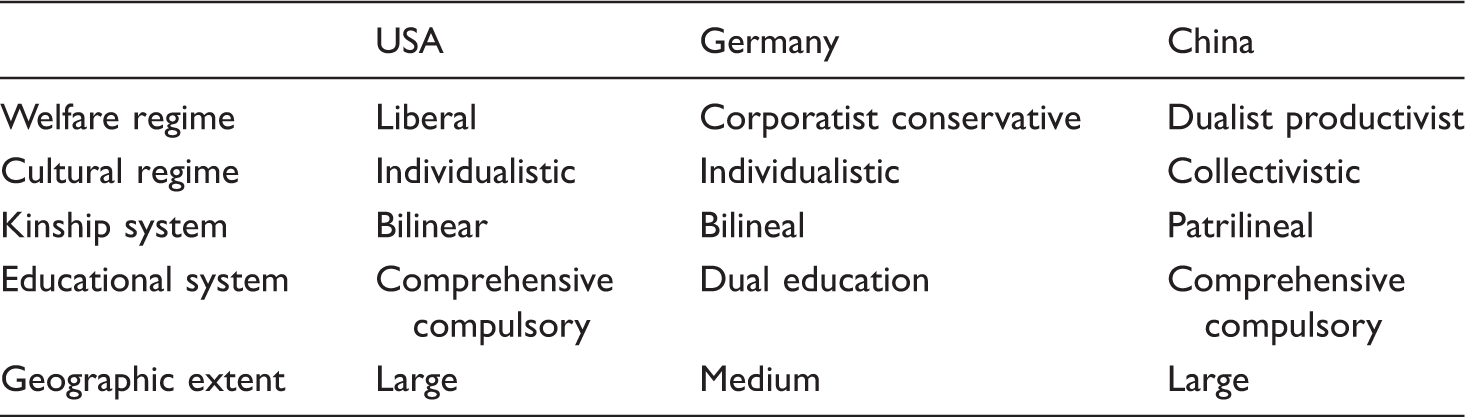
We begin by monitoring the changes in the transition to adulthood across birth cohorts, analyzing individual-level census data from all three countries, and comparing cohorts of individuals born between 1933 and 1988. We then provide evidence on the transition to adulthood and its links with the school-work trajectory by analyzing large-scale panel studies. We also examine differences in the transition to adulthood across social groups as defined by, for example, educational attainment. Finally, we discuss our findings and how differences in the transition to adulthood across countries relate to differences in national contexts.
Changes in the transition to adulthood across birth cohorts 1933–1988 in China, Germany, and the USA
In the USA and Germany, a change from the so-called ‘Golden Age of Marriage’ to increasing individualization of the life course has occurred since the 1960s. During the ‘Golden Age of Marriage’, high marriage rates were observed in Western Europe and the USA. For example, in the late 1980s around 87% of all individuals in Germany had been married at least once (Dorbritz, 2008). The share of married individuals has been declining in younger cohorts in Western Europe (Holland, 2017). For the USA, Goldstein and Kenney (2001) find that marriage rates remained high among the 1950 to 1960 birth cohorts (around 90%), with less-educated groups increasingly foregoing marriage compared to more educated groups. For the Chinese birth cohorts of 1936–46, 1946–55, 1956–65, 1966–75, and 1976, Yeung and Hu (2013) showed that younger birth cohorts married at a higher age than older birth cohorts: In the oldest birth cohort, about one-third were married by age 20, compared to only 17% of the 1956–66 cohort. Although marriage rates in East Asia have been declining, almost everyone in China was married by age 35, regardless of their year of birth. With regard to the timing of first parenthood, we find that across birth cohorts, individuals had their first child at increasing ages. However, most birth cohort members have had a child by age 30. These numbers differ by gender and urban or rural living, with women and individuals with rural hukou experiencing the transition to adulthood earlier than men or individuals with urban hukou (Yeung and Hu, 2013; Yi and Vaupel, 1989).
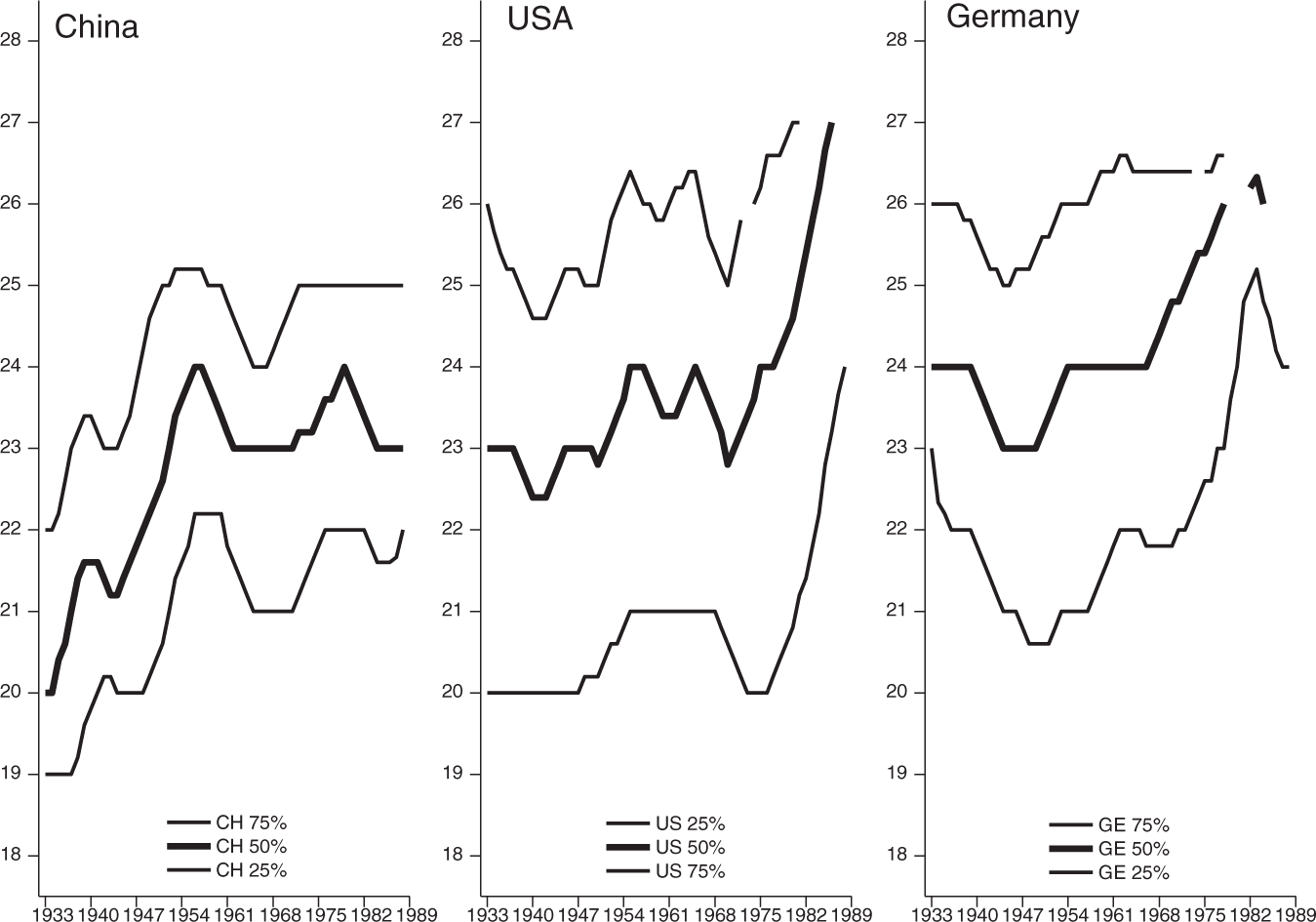
This paper provides comparative survival estimates for birth cohorts 1933 through 1988 in all three countries, which is unprecedented in research. We are able to study differences in the timing of these events across cohorts and can detect processes of de-standardization over time from a comparative perspective. We present differences in the timing of first marriage and first parenthood across the above-named birth cohorts in Figures 1 and 2.
Year-wise survival estimates of age at first marriage across birth cohorts 1933–1988 (USA, Germany, China). Year-wise survival estimates of age at first birth across birth cohorts 1933–1988 (only women).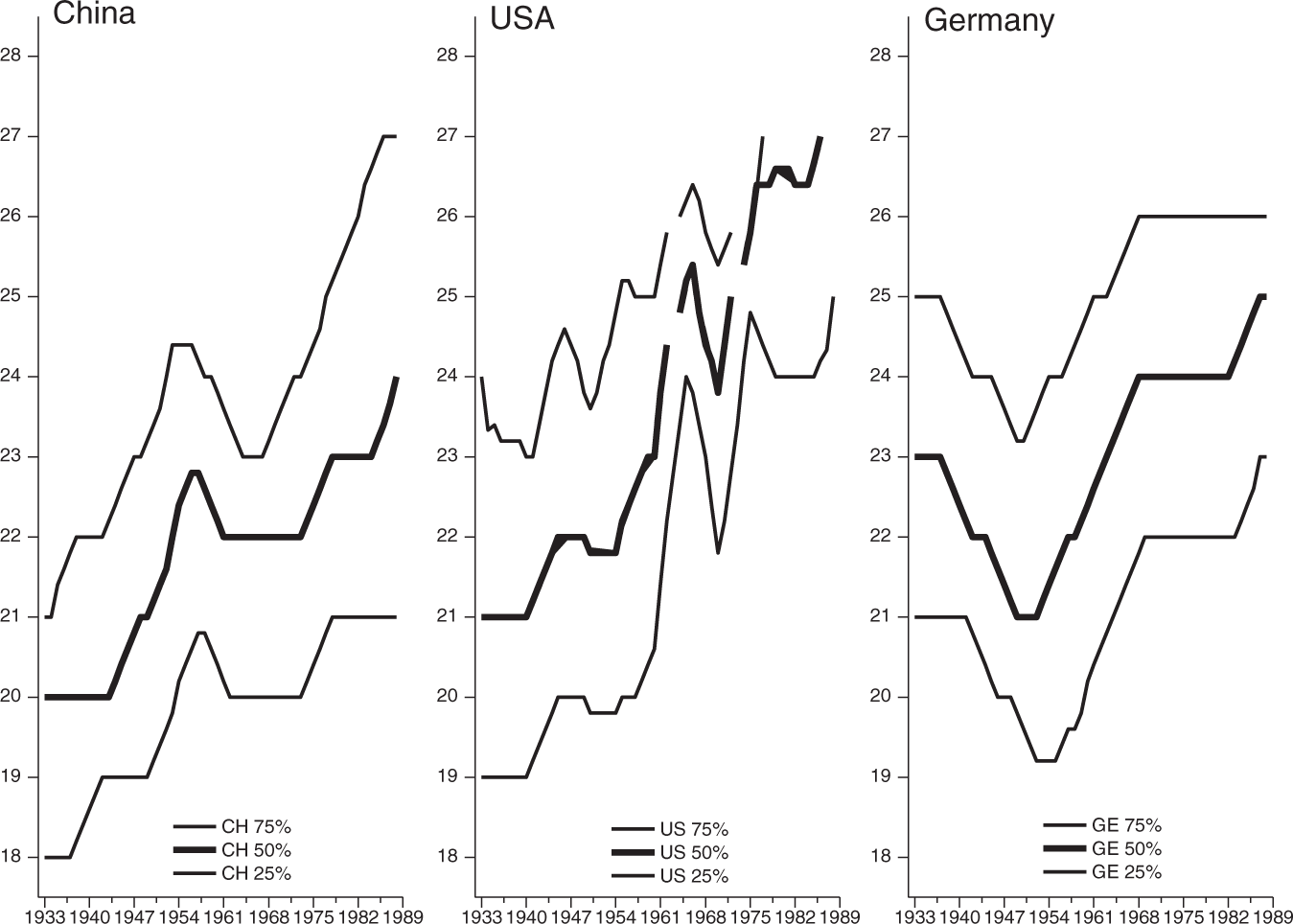
Beginning with inter-cohort differences in the USA, the timing of first marriage has been delayed by about six years since the 1947 birth cohort (see Figure 1). Thereby, we extend Goldstein and Kenney’s (2001) findings for US women: The researchers found that ages at first marriage of birth cohorts 1945–1949, 1950–1954, 1955–1959, and 1960–1964 have been increasing. The gap between the lowest and highest percentiles, however, has decreased since the 1967 birth cohort, indicating higher standardization of age at first marriage across cohorts.
For Germany, we observe decreasing ages at first marriage for birth cohorts 1944 through 1952. Since the 1953 birth cohort, age at first marriage has increased by about four years. By way of comparison, the median age of first marriage has been rising more steeply in the USA than in Germany for the youngest birth cohorts. This might be related to findings in previous research showing that marriage has become more stratified by education in the USA: The share of individuals who marry is higher among those with higher education levels. The gap between the 25th and 75th percentile has remained stable, indicating no processes of de-standardization over time.
For China, increasing ages at first marriage can be observed from the 1935 birth cohort on towards birth cohorts 1960–1963. Marital ages then stabilized for birth cohorts 1964–1970 but rose again for later cohorts. Here, we might observe an effect of the New Marriage Law, which was issued on 10 September 1980 and formally carried out on 1 January 1981, on several birth cohorts after 1960. According to the New Marriage Law, the minimum age for marriage was increased from 20 to 22 for men and from 18 to 20 for women. For China, we observe an increasing spread between the 25th and 75th percentiles in the 1970 and younger birth cohorts.
With regard to age at first childbirth, we observe decreasing ages in the 1945–1954 birth cohorts in Germany. Since the 1955 birth cohort, the age at first childbirth has increased by about four years (see Figure 2). In the USA, we do not observe a similar pattern. Age at first birth increased slightly for birth cohorts 1948–1956, then decreased again slightly for the 1957–1972 birth cohort. Since the 1973 birth cohort, age has been increasing sharply again. The spread between the 25th and 75th percentiles has increased across birth cohorts, indicating de-standardization of these events in the USA. Although age at first childbirth in Germany has increased by about four years in birth cohorts 1933 to 1988, the spread between the 25th and 75th percentiles has decreased in these birth cohorts. For Germany, we therefore find an increasing standardization in the age at first birth. For China, we observe three stages of increase in age at first birth interrupted by a decline in birth cohorts 1942–1945 and cohorts born in the 1960s. Across birth cohorts 1935–1941, 1947–1959, and 1970–1980, age at first birth increased. Although the decline in age at first birth for the 1942–1945 birth cohorts can be explained by the 1959–1961 famine, the new Chinese Marriage Law entailed a decline in age at first birth for individuals born in the 1960s. The 1959–1961 famine seriously influenced Chinese people’s health and socioeconomic outcomes (e.g. Cai and Wang, 2005; Fan and Qian, 2015). The spread between the 25th and 75th percentiles has, however, remained stable.
Prevalence and timing of leaving home, first marriage, and having a first child in comparison
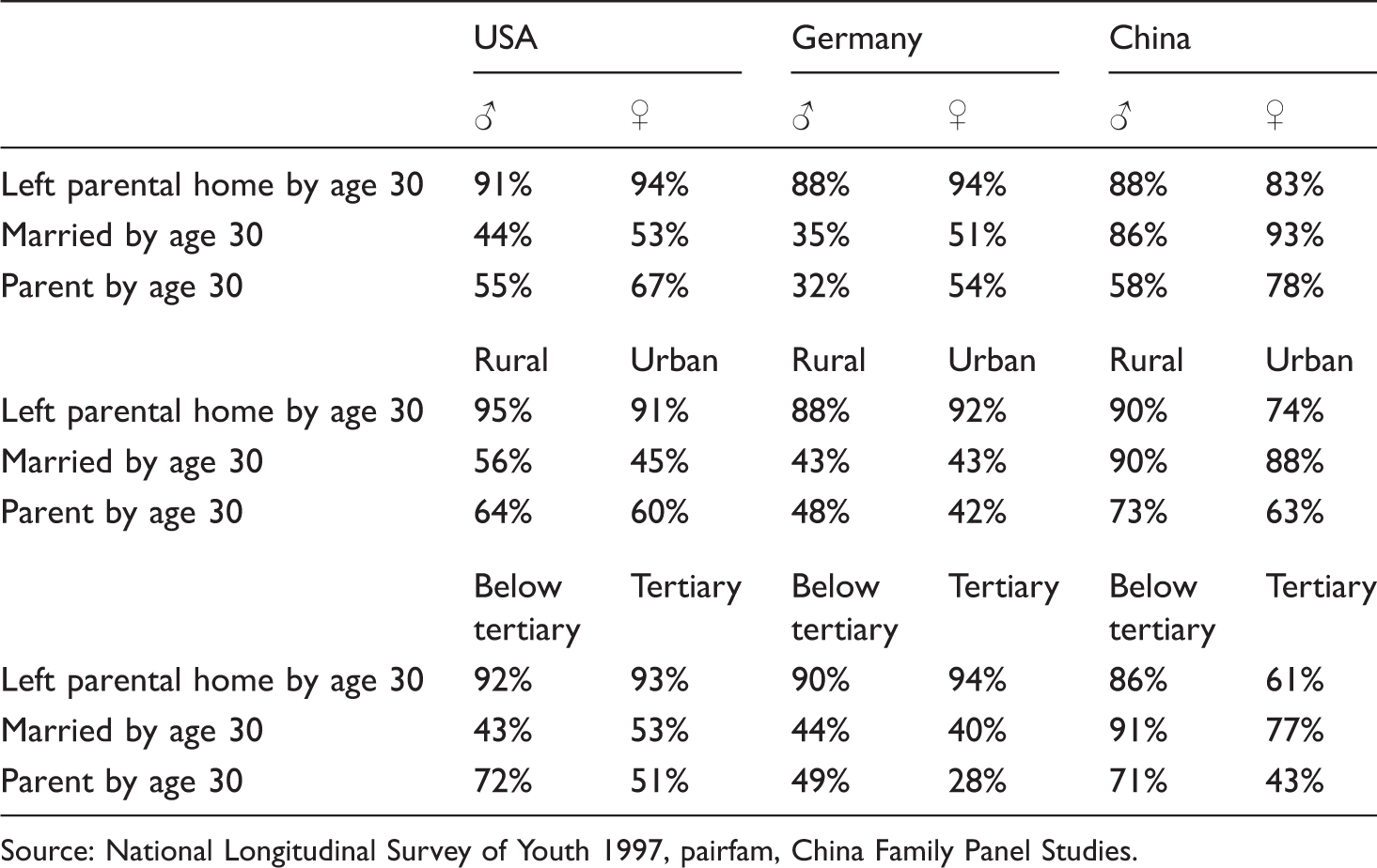
We continue by examining group differences in the prevalence and timing of leaving the parental home, marrying for the first time, and having a first child (see Figure 3). We differentiate by gender, urban or rural residency, and educational background across all three countries in specific birth cohorts: In Germany, individuals born between 1981 and 1983 were analyzed, whereas in China, birth cohorts 1980 to 1984 and in the USA cohorts between 1980 and 1984 were examined.
Prevalence and timing of leaving home, first marriage and having a first child by age 30 in comparison between the USA, Germany, and China.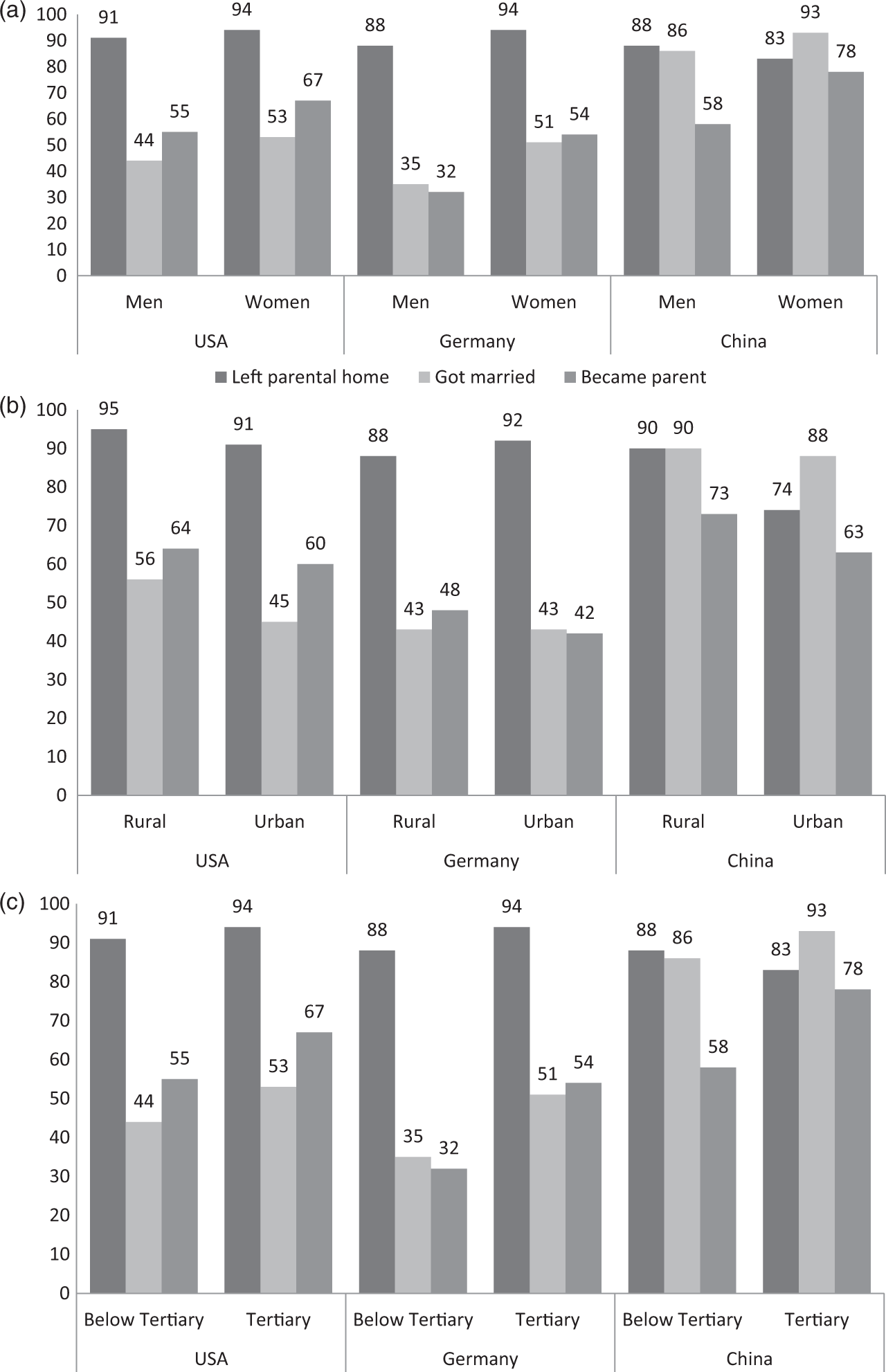
Prevalence and timing of leaving home, first marriage, and having a first child in comparison between the USA, Germany, and China.
Source: National Longitudinal Survey of Youth 1997, pairfam, China Family Panel Studies.
We further observe that a larger number of Chinese respondents married for the first time by age 30 compared to those in the USA and Germany: 40% more women in China (93%) were married by this age than in the USA (53%) and Germany (51%). The higher prevalence of first marriage in China compared to both other countries might be related to the high importance assigned to marriage by most respondents in Asian societies (Yeung and Hu, 2013). Across all countries, we observe lower numbers of men than women marrying for the first time by age 30 (see Table 2), but again, the number of men who were married for the first time by age 30 is about 40% higher in China (86%) compared to the USA (44%) and Germany (35%).
Earlier marriage timing in China might also be related to a higher number of first childbirths by age 30 among women in China (78%) than in the USA (67%) and Germany (54%). A lower number of childbirths than marriages in China might indicate that many Chinese people prefer to marry prior to becoming parents. Although low marriage numbers in Germany coincide with comparatively low numbers of first childbirths regardless of gender, the prevalence of first childbirth by age 30 in the USA is about 10% higher than the prevalence of first marriage for both genders. Marriage might therefore have lost some of its relevance for a successful transition to adulthood in the USA, at least for some groups. Cherlin (2010) provides evidence that African Americans are much less likely to get married than to live in an unmarried cohabitation, although the prevalence of teenage pregnancies among African Americans is higher than in other groups. In Germany, the prevalences of first marriage and first parenthood are similarly high before age 30, indicating these events might not be independent of one another, but both are often postponed to higher ages. Consistent gender differences across all three countries can be observed, with 10–20% less men than women having a child by age 30. The higher ages of first parenthood for men in all three countries might be related to the persistence of educational hypergamy. Finally, in a cross-country comparison, the prevalence of first childbirth is lowest for women living in Germany (Germany: 54%, USA: 67%, China: 78%).
We continue by presenting differences relating to urban-rural residency, measured in the first wave of each panel study. When comparing differences in the transition to adulthood between the urban and rural populations in all three countries, the largest difference can be observed between China’s rural and urban populations: Fewer individuals living in China’s urban regions leave the parental home (74%) than those in rural regions (90%). This finding might be related to sharply increasing real estate prices in urban regions (Ren and Hu, 2016). Yet, the social norm of setting up one’s own home before moving out of the parental home is still prevalent in China. Another probable explanation is that rural individuals have to move out of the parental home to pursue higher education or find work, given the large geographical distances between urban regions in the east of China, where many individuals find work, and rural regions in the west of China. Our findings match Whyte’s (2010) interpretation of China being divided into two societies: Urban and rural. Furthermore, Yu and Xie (2015b) demonstrated urban residents' greater and earlier exposure to Western culture, for example, through the influence of foreign media, and more pluralistic values in urban than in rural regions. As a result, lifestyles differ between urban and rural regions. Yu and Xie’s findings are consistent with our result that fewer individuals in urban areas become parents by age 30 (73% in rural regions; 63% in urban regions). Despite the higher number of rural residents who have left the parental home by age 30 (90% rural; 74% urban) and have had a first child by the same age (rural: 73%; urban: 63%), only small differences can be observed between Chinese rural and urban regions with regard to the number of individuals married by age 30 (urban: 88%; rural: 90%).
In the USA, we observe large urban-rural differences in the prevalence of first marriage, with more individuals in rural (56%) than in urban regions (45%) getting married by age 30. This might indicate that the urban and rural populations in the USA differ in their socioeconomic composition and/or normative ideas of the right timing of first marriage: Snyder et al. (2004) found that more women in urban centers and suburban areas in the USA marry at higher ages than women in rural areas. Despite its large geographical area and the probable necessity to leave the parental home to pursue higher education or find work, only small urban-rural differences in the prevalence of leaving home before the age of 30 can be observed. Furthermore, small urban-rural differences are apparent in the prevalence of first parenthood up to age 30 (64% in rural regions; 60% in urban regions).
The smallest differences in the urban and rural populations’ life courses can be observed in Germany: The populations are alike in the numbers of individuals who have experienced all three events by age 30, that is, leaving the parental home, getting married for the first time and having a first child (Figure 3). This finding might be related to the comparatively small geographical size of Germany.
Finally, we compare the transition to adulthood across different educational groups in all three countries (Figure 3). We differentiate between individuals who did and did not attain tertiary-level education. Considerable differences in the transition to adulthood exist between educational groups in China, whereas they are less apparent in the USA and Germany. In China, fewer individuals in the higher-educated group have experienced all three events by age 30 than individuals in the lower-educated group. Specifically, 61% of individuals with tertiary education have left the parental home by age 30, compared to 86% of individuals who attained less than tertiary education. Similarly, 77% of all individuals with tertiary education were married by age 30 compared to 91% of all individuals who had a lower educational level.
With regard to first parenthood, only 43% of individuals with tertiary education had a first child by age 30, compared to 71% of individuals without tertiary education. These numbers either point towards a lower prevalence of these three events in the tertiary education group or many members of this group postpone these three events until after age 30. As the ideal transition to adulthood is often conceived as an ordered sequence in many societies (Diabaté and Lück, 2014), late childbearing, and late marriage among higher educated individuals might indicate that the ideal transition to adulthood in China is likely conceived as finishing education, getting married, and then having a first child. This resembles the typical sequence of events during the transition to adulthood in Europe: First, achieving economic independence, then leaving the parental home, and finally getting married and becoming a parent (Perelli-Harris et al., 2012). The postponement of first parenthood across birth cohorts, which we previously observed, could thus be related to educational expansion in younger birth cohorts. Prolonged periods of education often entail delays in the transition to adulthood, such as a later exit from the parents’ household and postponed partnering and fertility (e.g. Treiman, 2013; Vogel, 2002; Yeung, 2013) as well as urbanization (e.g. Yi and Vaupel, 1989). Poston et al. (2015) explain that educational expansion entails a delay in age at first marriage, as higher educated women are more economically independent, inducing them to take more time finding a suitable spouse.
In the USA and Germany, we observe similar differences between educational groups in the prevalence of these two events, but on a lower level. In both countries, about 20% fewer individuals with tertiary education become parents by age 30 than individuals who have not attained tertiary education (see Figure 3). However, only small differences between educational groups exist in the prevalence of leaving home in both countries.
We also find that in the USA, unlike in the other two countries, a higher prevalence of first marriage by age 30 can be observed for individuals with higher levels of education than for those with lower levels. This confirms previous findings for the USA, showing that more highly educated individuals in the USA are more likely to get married than less-educated individuals, although fewer individuals in the former group marry before age 25 (Cherlin, 2010; Goldstein and Kenney, 2001). In China, we observe the opposite phenomenon: A higher number of less-educated individuals marry for the first time by age 30: 91% of individuals with less than tertiary education and 77% of individuals with tertiary education married for the first time by age 30.
In conclusion, the number of individuals who marry or become parents by age 30 is lowest in Germany, followed by the USA and China. We find striking similarities and differences in the transition to adulthood across all three countries. We first observe an extended transition to adulthood in the USA and Germany compared to China. Most individuals in our Chinese sample have left home, married, and become parents by age 30, whereas this is not the case in the USA and Germany. This is probably related to comparatively early completion of the educational trajectory in China. In both the USA and Germany, the proportion of individuals who had a first child by age 30 is much lower than in China. Parenthood is thus either foregone or postponed until after age 30 by many individuals in Germany and the USA. From a comparative perspective, the transition to adulthood takes longest in Germany. An exception is leaving the parental home, as fewer individuals, irrespective of their educational background, have left the parental home by age 30 in China compared to those in Germany or the USA.
In all three samples, we observe gender differences, with more women than men getting married and having a first child by age 30 (Figure 3). These gender differences are thus consistent across cultural and welfare regimes. Rural-urban differences in the transition to adulthood are strongest in China. The three countries resemble each other in the small differences between educational groups with regard to the prevalence and timing of having a first child by age 30: A lower number of higher educated individuals experience first childbirth by this age than their counterparts with less education.
Educational and employment trajectories in a comparative perspective
The educational system defines educational trajectories by its age-graded and time-scheduled sequence of classes, which in turn affects the prevalence and timing of life events such as having a first child and marrying for the first time (Mayer, 2004). Regional and subgroup differences in professional lives therefore shape differences in people’s private lives.
Overall, large differences in educational trajectories can be observed between Germany and both China and the USA (see Figure 4), being related to their different educational systems, which we will describe. These differences are the result of the rigid labor market and employment regime in Germany versus unstable employment trajectories and relative income volatility across the life course in the USA (Mayer, 2004) and the shortage of higher education and relative gender equality in the labor market in China, as well as China’s specific labor contract law.
Educational and employment trajectories in comparison between the USA, Germany, and China.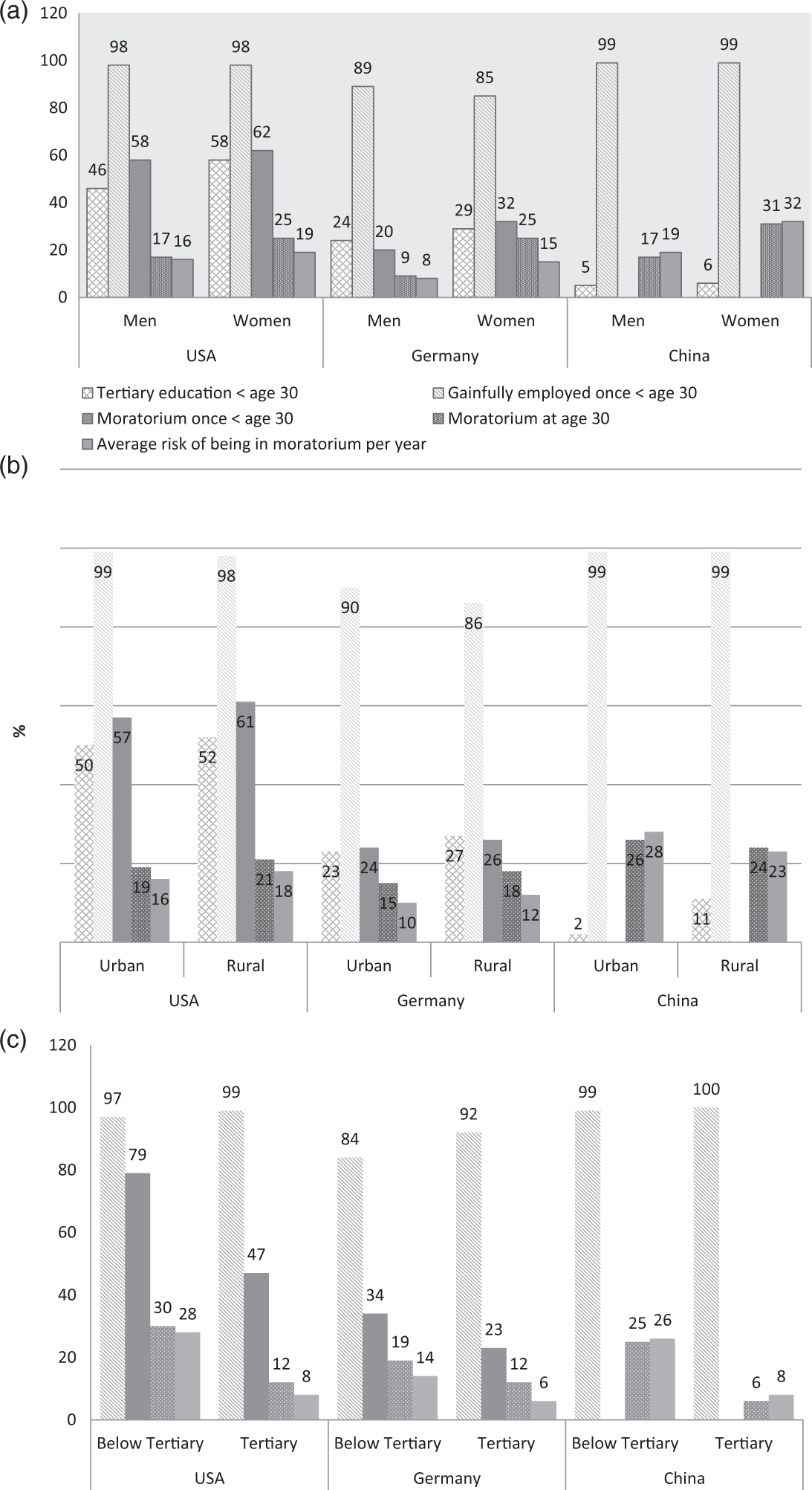
We begin by examining gender differences in educational participation between China, the USA and Germany: The number of men or women who received tertiary degrees by age 30 in China (5% ♂/ 6% ♀) is much lower than in the other two countries. Germany ranks second (24% ♂/ 29% ♀), whereas in the USA about half of all individuals have completed tertiary education before age 30 (46% ♂/ 58% ♀). In China, more women than men obtain tertiary degrees before age 30, whereas in both other countries only small gender differences can be observed. The latter finding exemplifies differences between the educational systems of Germany and the USA, that is, Germany’s dual system versus college education in the USA. Although in the USA, college education is regarded as tertiary, in Germany completing training while studying part time is defined as secondary education.
Despite differences in the timing of educational graduation, the majority of individuals in all three countries have been gainfully employed once by age 30, although we observe slightly lower numbers in Germany, probably due to most individuals’ comparatively late completion of their educational trajectory. At the same time, we observe gender differences in employment histories across all countries. About half as many men as women have experienced a moratorium at age 30 in all three countries, that is, being neither in the educational nor in the occupational system.
Educational and employment paths also differ largely between rural and urban populations in China, whereas Germany’s and the USA's rural and urban populations (Figure 4) resemble one another in their education trajectories. Only 2% of all individuals in the Chinese rural population have completed tertiary education before they turned 30. Among the urban population, about six times as many individuals, 11%, have completed the same educational level. Urban and rural residents in China thus pursue different educational and employment paths and experience different partnership formation processes before age 30. Specifically, due to the higher proportion of individuals with tertiary degrees in urban regions, a larger proportion of urban residents in China marry at higher ages and after achieving their degrees, resulting in higher ages at first birth.
Again, possibly due to the above-mentioned differences in the definition of tertiary education in the USA and Germany, the number of individuals in the rural or urban populations who have completed tertiary education by age 30 is lower in Germany than in the USA. The chances of having finished tertiary education or being in a moratorium are similar for the rural or urban populations in Germany and the USA.
We further observe higher ages at finishing one’s educational trajectory and starting gainful employment in Germany than in China and the USA: most individuals were gainfully employed at least once by age 30 in the USA and China regardless of their educational backgrounds (98% and 99%, respectively). For Germany, we observe slightly lower numbers of individuals without tertiary education who have entered the workforce by age 30 than individuals who achieved tertiary educational levels: 84% of all individuals who attained less than tertiary education were gainfully employed by age 30 compared to 92% of all individuals who achieved tertiary education. Furthermore, the average risk of being in a moratorium per year is about 15% higher in China or the USA than in Germany, at least for individuals who acquired less than tertiary education. In general, less-educated individuals’ risk of experiencing a moratorium is higher in all three countries when compared to individuals who attained tertiary education.
Discussion
Getting married for the first time and having a first child are decisions with long-term consequences, made in a state of uncertainty. These decisions are thus often highly normatively regulated and resistant to change (Nauck, 2007). Cross-national differences in cultural and welfare regimes and differences in housing markets, educational systems, and geographical size contribute to country differences in the transition to adulthood, and thus to life-course patterns.
We first examined inter-birth-cohort differences for birth cohorts 1933–1988 in China, the USA and Germany. Here, we comparatively studied the timing and prevalence of the three events of leaving the parental home, marrying for the first time, and having a first child. In this regard, this paper is the first to present birth cohort instead of period estimates. We observed a delay in first marriage in all three countries across birth cohorts, yet this was more manifest in the USA than in the other two countries. The spread between the 25th and 75th percentiles in the age at first marriage has, however, increased across cohorts in China, pointing towards de-standardization of the timing of this event. With regard to the age at which individuals became parents for the first time, we observed de-standardization in the USA and standardization in Germany across cohorts. In all countries, we observed delays in the age at first marriage and first childbirth. Specifically, for the timing of age at first marriage, we observed a decrease in Germany in birth cohorts from 1939 to 1953, followed by an increase in all birth cohorts after 1954. However, in the USA, we observed an increase between 1939 and 1966, followed by a small decrease in birth cohorts 1966 and 1972, and another increase in all younger birth cohorts. Finally, in China an increase in the age at first marriage in birth cohorts 1933 to 1956 was followed by a small decrease in birth cohorts 1957 to 1960 and an increase in all the following birth cohorts. Here, we might observe an effect of the New Marriage Law, which was issued in 1981, on several birth cohorts after 1960.
The age at first birth decreased in Germany in birth cohorts 1933 to 1951 and increased in younger birth cohorts. In the USA, we observe a volatile development of age at first birth across birth cohorts and a small increase in the youngest birth cohorts. For China, a delay in first childbirth in older cohorts might be connected to strictly enforced family planning policies, whereas age at first childbirth remained stable after a relative relaxation of family planning policies since the middle of the 1980s. A significant difference from the second demographic transition in Europe can be observed in East Asia, as Lesthaeghe (2014) describes. Although the postponement of fertility in East Asia resembles developments during the second demographic transition in Europe, the emergence of new patterns in partnership formation is proceeding more slowly.
Second, we calculated the prevalence and timing of events in private lives and its interdependence with professional careers in all three countries. The following similarities can be observed: More women than men experience first marriage and first parenthood before age 30, independent of the cultural or structural context in which they live. In addition, nearly all individuals in all three countries have left the parental home (at least once) by age 30.
Consistent with differences in national cultural regimes, we observed nearly universal first marriage by age 30 in China, whereas many individuals probably forego marriage completely or postpone first marriage past age 30 in the USA and Germany. The higher prevalence of first marriage in China compared to both other countries might be related to the high importance that most respondents in Asian societies still assign to marriage (Yeung and Hu, 2013). It might, furthermore, be related to the comparatively early completion of the educational trajectory in China.
The prevalence of first marriage and first parenthood by age 30 is comparatively low for men and women in Germany, whereas a de-coupling of marriage and childbearing could be why we see a lower prevalence of first marriage than of first childbirth in the USA by this age. The de-standardization of the life course with regard to the timing and prevalence of first marriage and first parenthood, therefore, is highest in the USA, whereas it is comparatively low in China. In the USA, pronounced differences in partnership behavior across ethnic groups could provide one explanation for this finding. In our German sample, both first marriage and first parenthood do not seem to be part of most individuals’ life courses until age 30. Thus, we cannot draw any conclusion on the degree of life-course standardization in Germany compared to the degrees in the USA and China.
Overall, we do not observe large urban-rural differences in the transition to adulthood among young adults in the USA and Germany, whereas differences in life-course patterns among urban or rural residents are higher in China. Specifically, no differences in the timing and prevalence of leaving the parental home or first parenthood could be observed in the USA or Germany. One exception is first marriage in the USA, with fewer individuals in urban regions marrying for the first time by age 30 than in rural regions. One reason for cross-country differences between the urban and rural populations in China could lie in differences in opportunities and restrictions in urban and rural regions and the Chinese household registration system (hukou), which grants social advantages to urban residents (Yu and Xie, 2015a). In spite of this, urban residents in Germany and the USA have a slightly higher risk of being unemployed once by age 30 than rural residents. We also find differences in life-course patterns across different educational groups in the USA and China, whereas differences across educational groups are slightly lower in Germany.
Different labor market opportunities and restrictions entail differences in the risk of unemployment in all three countries: A lower risk of being in a moratorium by age 30 is observable in Germany than in the USA and China. Furthermore, due to longer formation periods in Germany, fewer individuals have been employed once by age 30 than in both other countries. More individuals in the USA and China appear to pursue paid work parallel to their educational trajectories after they have left compulsory schooling, as nearly the whole sample has been gainfully employed once by age 30. Differences in labor market opportunities and restrictions as well as an extended educational period in Germany contribute to a comparably low unemployment risk by age 30 in Germany and a comparably high unemployment risk in China and the USA through this age.
Coming back to our initial question of the suitability of applying the second demographic transition framework on demographic developments outside of Europe, we come to a mixed conclusion. Although a delay in the timing of fertility can be observed across all three countries, a decline in marriage formation is not observable in China. This observation is in accordance with Lesthaeghe’s (2014) observation that the second demographic transition unfolds differently in East Asia than in Europe. In East Asia, fertility postponement can be observed, similar to the second demographic transition in Europe. This development, however, is only connected to a slow change in partnership formation patterns, that is, marriage being replaced or postponed by increasing rates of unmarried cohabitation, although due to data limitations, we cannot draw any conclusion on the rise in non-marital cohabitation or the increase in non-marital births in a comparative perspective. This would be a fruitful object of study in future research. Although we have shown that the development of partnership-formation patterns occurs differently in China than in the USA and Germany, our inter-cohort comparisons for all three countries indicate a postponement of first marriage and first childbirth as well as growing individualization in the timing of both these events. The universality of these latter-named developments in all three countries might indicate the applicability of the second demographic transition framework to these specific occurrences.
Footnotes
Acknowledgments
Many thanks to Maja Djundeva, postdoctoral researcher, and Jing Zhang, doctoral researcher, at the Department of Sociology, Erasmus Universiteit Rotterdam, for providing constructive feedback on an earlier draft of this paper.
Declaration of Conflicting Interests
The author(s) declared no potential conflicts of interest with respect to the research, authorship, and/or publication of this article.
Funding
The author(s) disclosed receipt of the following financial support for the research, authorship, and/or publication of this article: This paper is a result of the research project ‘Life Course and Family Dynamics in a Comparative Perspective’, funded by the National Science Foundation of China (71461137001) and the German Science Foundation (NA164/19-1).