



Abstract
Past studies examining the transition to adulthood within the Chinese context often implicitly or explicitly assume that the rural population is a homogeneous group and suggest that rural individuals tend to enter the workforce and marry at younger ages than their urban peers. This assumption overlooks the distinct challenges faced by rural youth, who often confront higher poverty risks and greater uncertainties compared to urban counterparts, yet empirical research on these unique challenges is limited. Using both a national survey and a unique longitudinal sample of rural youth in one of the poorest regions of China, this study demonstrates that rural youth experience a greater diversity of pathways from adolescence to early adulthood than do urban youth, which contradicts many earlier studies in Western contexts. In addition, this study identifies a variety of childhood environment factors that structure the transition pathways of rural youth. This study highlights the growing rural–urban disparity in China and has important implications for research on social stratification and rural youth development.
Introduction
Rural areas in China are home to an estimated 600 million youths, accounting for half of the total youth population, and this number is expected to grow over the next 35 years (International Fund for Agricultural Development, 2022). Moreover, globally, extreme poverty overwhelmingly affects rural populations (United Nations Statistics Division, 2023). Despite the demographic significance of rural youth, few empirical studies have focused on the particular challenges of the transition to adulthood among this population. In this study, we investigate links between childhood environments and the transition to adulthood for a sample of youths growing up in rural communities in one of China's poorest provinces. The context of the transition to adulthood in China has transformed dramatically in recent decades, with the shift from a socialist to a market economy, accompanied by a period of dramatic economic growth and sharply rising inequality. Much research has investigated changing dynamics in the transition to adulthood and family formation behaviors in this period, on a national scale and among the urban population (Cai and Feng, 2014; Qian and Qian, 2017; Tian, 2016; Yu and Xie, 2015). A common observation in the literature is that the urban population typically follows a trajectory marked by extended education, stable employment, and delayed marriage and childbearing (Van Winkle and Wen, 2023; Wang and Zhao, 2021; Yeung and Hu, 2013). In contrast, the rural population tends to follow a different trajectory characterized by lower levels of education, earlier entry into the workforce, and earlier marriage. Furthermore, the transition pathways of the rural population often adhere to a traditional sequence of schooling, entering the workforce, and marriage, unlike their urban counterparts, among whom the percentage following nontraditional sequences has been increasing (Tian, 2016).
However, few empirical studies have focused on the particular challenges and heterogeneity of the transition to adulthood among rural youth, who experience elevated risks of poverty and more uncertainties, on average, compared to their urban counterparts. From a cross-cohort comparison perspective, it is possible that the urban population has undergone deeper ideational and institutional transformations as a result of rapid urbanization and industrialization, leading to an increase in nonstandardized transition to adulthood pathways. However, in a within-cohort comparison, more diversified and complex patterns of transition to adulthood might be expected among rural youth, compared to their urban peers, for a number of reasons.
First, many rural children are left behind with one or both absent parents because of the patterns of labor migration to metropolitan regions (Liang, 2016; Xiang, 2007). Children of migratory workers may have the possibility of traveling between their natal communities and their parents’ places of employment (Chiang et al., 2012). However, due to institutional and economic restrictions, such as the household registration (hukou) system, which limits rural children's ability to attend school in urban regions, many of those children must remain in rural regions for education and live with single parent or extended family members. Studies of the impact of parental migration on left behind children compared to other rural children show mixed results, reflecting complicated selection factors, the benefits of remittances, and the harm of lost supervision, guidance, and support (Lu, 2012; Qian and Qian, 2017; Shen et al., 2021; Wen et al., 2015; Xu and Xie, 2015; Zhou et al., 2014) (for a review, see Liang, 2016). Recent studies indicate that the detrimental effects of parental migration on their children's health and education depend on factors such as the emotional well-being and parenting behaviors of the primary caregiver (Lu et al., 2019), the age of the children when the parents migrate (Huang et al., 2018), and the cumulative duration of parental absence (Meng and Yamauchi, 2017).
Second, early exit from education, among other factors, may position the most disadvantaged rural youth for a very tenuous attachment to the labor market (Shi et al., 2015; Yi et al., 2012). Many youths may be involved in nonstandard employment or economic sectors with high turnover rates. A concerning development in a number of countries has been the large number of youths who are excluded from economic opportunities—characterized as not being in education, employment, or training (NEET) (Yeung and Yang, 2020). A significant proportion of young individuals, particularly in Asia, “opt out” of the competitive education system and standard employment with the expectation of having little opportunity to advance in social class. According to a recent study on China, the total NEET rate for people aged 16–35 was 8% in 2012 (Yang, 2020). Individuals with lower educational attainment, migrants, and women are more likely than others to experience NEET during young adulthood.
Third, various factors influence rural adolescent family formation behaviors in opposing directions. Rural youth, on the one hand, are more likely than their urban counterparts to marry and have children at a younger age due to normative expectations or family pressures. On the other hand, the rising trend of hypergamy in marriage predisposes socioeconomically disadvantaged male adolescents toward exclusion from the institution of marriage (Zhou, 2019). Rural marriage markets may be further complicated by sex ratio imbalances, which may provide divergent paths for men and women in their relationship and marriage patterns (Jiang et al., 2014; Trent and South, 2011).
In this study, we investigate the variation in timing and sequence of Chinese rural millennials (born between 1987 and 1991) in reaching a series of life milestones. We also utilize the post-1970s and post-1980s birth cohorts from the China Labor-Force Dynamic Survey 2014 as a supplement, as discussed later in the Data and Methods section. This group, known as the post-1980s and post-1990s generations in China, has been exposed to profound social changes, such as rapid economic development, massive parental migration, and widening rural–urban inequalities in many domains. Following norms in the research on the transition to adulthood, we define the essential milestones for reaching adulthood as graduating from school, starting one's first job, entering into marriage, and becoming a parent (Macmillan and Copher, 2005; Yeung and Hu, 2013). We demonstrate that rural youth in China experience a higher degree of uncertainty and diversity in their transition pathways during early adulthood compared to their urban counterparts. This finding differs from what modernization theory or the second demographic transition theory predicts and contrasts with empirical findings in the West. The de-standardization of transition paths for rural youth, rather than urban youth, may reflect China's growing rural–urban educational and economic opportunity disparities. While urban youth have benefited from educational expansion and economic prosperity in recent decades, many rural youths remain deprived of basic education and enter adulthood at a younger age. Additionally, we found that the transition pathways to adulthood for rural female youth are more responsive to sibship structure and family economic conditions than those of rural male youth. In contrast, rural male youths are more influenced by family disruption and parental expectations regarding children's support for their elderly years.
This article is organized as follows: We begin with a review of the literature on the transition to adulthood, focusing on the differences between rural and urban youth and discussing the limitations of previous studies. We then discuss the cultural and rural contexts of China. Next, we provide an overview of our data and the study site before proceeding with the analyses. In the analytic results section, we first employ the entropy index to study rural–urban differences in life course trajectories from adolescence to early adulthood (ages 16–24). We use both a nationally representative survey and a 15-year longitudinal study of rural children in Gansu, one of the least developed provinces in China. Additionally, we apply latent class analysis to this rural panel data to identify different transition pathways of Chinese rural millennials (born between 1987 and 1991). We then use various childhood environment factors in the rural context to predict the membership of these pathways using multinomial regression analysis. Finally, we conclude with a discussion of the implications and limitations of our findings.
Transition to adulthood: The rural–urban divide
Since the 1990s, research on the transition to adulthood has documented a de-standardization of the family life trajectories of young adults (Billari and Liefbroer, 2010; Elzinga and Liefbroer, 2007; Furstenberg, 2013; Juárez et al., 2013; Rindfuss et al., 1987; Settersten and Ray, 2010; Shanahan, 2000). Geographically, the de-standardization of pathways to adulthood tends to start in developed areas rather than isolated areas. For example, Lesthaeghe and Neidert (2006) found that the components of the second demographic transition, such as premarital cohabitation and postponement of marriage and childbearing, are more pronounced in the metropolitan areas than in the rural areas of the United States. The mechanisms explaining such rural–urban differences are that urban residents are less reliant on family ties, and thus less controlled by traditional norms.
Institutionalization theory, on the other hand, maintains that institutional regulation has the power to standardize the pathways to adulthood (for a review, see Shanahan, 2000). For youth in particular, institutional changes have facilitated compulsory school attendance, extending their time spent at school and thus delaying leaving the parental home and family formation. In countries experiencing rapid educational expansion, the heterogeneity in life course transitions in early adulthood has tended to decline (Fussell and Furstenberg Jr., 2005; Park, 2013). For instance, Park (2013) found that the life courses of Korean urban youth were highly standardized before high school graduation because of the rapid expansion of the education system. Because the institutionalization process in rural areas tends to lag behind that in urban areas, there is reason to expect a more standardized life course transition for urban youth than for rural youth in early adulthood.
Existing research on the transition to adulthood in rural areas mainly focuses on describing the trends over periods or birth cohorts and contrasting the differences with urban areas using multiple waves of cross-sectional surveys or censuses (Fussell and Furstenberg Jr., 2005; Pesando et al., 2021; Tian, 2016; Yeung and Hu, 2013). For instance, Pesando et al. (2021) investigate the transition to first sexual intercourse, first union, and first birth across 69 low- and middle-income countries by birth cohorts. They found little variation between rural and urban areas except for in South America and Southeast and Central Asia, where urban residents had a higher proportion than rural residents in the “delay[ed] rapid transition” and “gradual transition” clusters. Along these lines, research relying on the heterogeneity index has often found that urban youth display a higher level of diversification in the transition to adulthood than do rural youth (Fussell and Furstenberg Jr., 2005; Tian, 2016).
However, one limitation of using cross-sectional data is that they sometimes conflates rural-to-urban migrants with urban residents. While urban residents may follow a standardized path in the school-to-work transition in their young adulthood, the pathways to adulthood of rural-to-urban migrants are expected to vary depending on their reasons for migration. In addition, as Fussell (2005) has pointed out, the definitions of urban and rural regions have also changed with time because of the rapid urbanization and industrialization processes in developing countries. That is, the de-standardization of the transition to adulthood found in urban regions may reflect variation among both rural-to-urban migrants and urban residents.
Even less is known about factors shaping the transition to adulthood among rural youth. In the Chinese context, children from rural areas have limited social and financial resources at both the family and community levels, especially when compared to urban youth (Cherng and Hannum, 2013; Hannum, 2003). Because of scant public support and larger family size, rural youth may have greater responsibilities to take care of their parents and other family members. Perception and anticipation of family economic difficulties among rural youth may alter their decisions in regard to school, employment, and family formation (Crockett and Bingham, 2000). Furthermore, parents in rural areas are more likely to be influenced by traditional gender norms and thus invest more in boys than girls (Li and Lavely, 2003). However, rural young men in China with more education are experiencing the “individualization” predicted by second demographic transition theory: they are more likely to migrate for work, eschew certain traditional gender and family attitudes, and by necessity substitute material support for traditional family co-residence (Zhang et al., 2023).
The impact of childhood environments on transition to adulthood in rural context
Gender equity and parents’ old-age support
Previous studies have found that parental attitudes have independent impacts on children's attitudes and behaviors towards premarital sex, cohabitation, marriage, and childbearing (Barber, 2001; Cunningham, 2001; Jennings et al., 2012). Gender attitudes are important because traditional gender values emphasize the gendered division of labor. Girls from families who are less supportive of gender equality may complete their education and start a family earlier.
In rural settings in many Asian countries, it is also important to consider parents’ attitudes toward old-age support. In a patriarchal society, sons are viewed as permanent members of the family and have the responsibility to continue the family lineage, whereas daughters will eventually marry out and become members of their husband’s family (Cain, 1991; Li and Lavely, 2003; Yu et al., 2012). Thus, parents may invest more in sons in anticipation of better economic returns and greater old-age support. According to research conducted in rural northwest China, the majority of parents maintain egalitarian attitudes about girls and boys having equal opportunities, but half of parents still agree that sons should be the ones to provide old-age support (Hannum et al., 2009; Zhang et al., 2007). We hypothesize that girls who come from families that are less supportive of gender equality and prefer sons for old-age support are more likely to end up on disadvantaged pathways to adulthood.
Sibship structure and pathways to adulthood
The negative effect of sibship size on educational attainment is well documented (Steelman et al., 2002). One common explanation is the resource dilution hypothesis. This hypothesis suggests that the family resources that each child can share are diluted as the number of children increases. Empirical studies in the United States and Western Europe have confirmed that sibship size is inversely associated with children's participation in extracurricular activities, educational performance, and parents’ time and financial investments in each child (Steelman et al., 2002).
Research in East and South Asian contexts extends the resource dilution hypothesis by emphasizing the gender-asymmetrical nature of resource transfer within the family (Chu et al., 2007; Kugler and Kumar, 2017; Liu, 2023; Yu et al., 2012). Specifically, the cultural norm of son preference tends to prioritize boys instead of girls. For girls, the presence of a younger brother in the family may dilute their resources, especially in rural areas where the family resources are tight. Older sisters with younger siblings may do more chores and undertake more caregiving labor (Hu, 2018; Liu, 2023). In addition, older sisters may find themselves under pressure to enter the labor market earlier and remit to their family and younger siblings.
Despite the existence of the One-Child Policy, having siblings is common in rural China. One reason is that rural families are allowed to have a second child (Greenhalgh, 1994). In rural contexts, particularly those characterized by extreme poverty, the existence of siblings creates an environment for sibling competition (Chen, 2020). We hypothesize that girls who have younger brothers are more likely to end up on disadvantaged pathways to adulthood. On the other hand, boys with older sisters are more likely to be on advantageous pathways to adulthood.
Family background and socioeconomic status
Social inequality and poverty experienced in early life can predict future life trajectories. Research on social mobility has recognized the ascriptive features of the family of origin, such as parents’ education and financial resources, can affect offspring's status attainment (Blau and Duncan, 1967; Hout, 2018). Parents from the top socioeconomic strata not only invest more money and time on their children but also adopt a more active parenting style than parents from lower strata (Bianchi et al., 2004; Lareau, 2011; Mclanahan, 2004). As a result, children from affluent families are more likely to pursue higher education, postpone union formation and childbearing, and avoid risky behaviors.
In addition to financial resources, family stability is essential for child development. A large body of research has documented the negative impact of family instability on the transition to adulthood. Children who experienced family instability are more likely to have early union formation, earlier childbearing, and early labor force participation (Amato and Patterson, 2017; Fomby and Cherlin, 2007; Goldberg, 2013; McLanahan et al., 2013). In East Asian societies, the adverse effects of parental divorce on children's education are generally less pronounced compared to Western contexts (Yeung and Park, 2016; Park, 2007). Research indicates that academic disadvantages are more commonly observed in children raised by single fathers, rather than those raised by single mothers (Cheung and Park, 2016; Park, 2008; Zhang, 2020). This difference is partly attributed to the active involvement of mothers and the supportive role of grandparents, who act as buffers to mitigate the negative impacts of divorce on children's educational outcomes (Zhang, 2020). Most studies on family instability in China primarily examine its effects on child well-being and academic performance, with only a few studies exploring its impact on other outcomes during the transition to adulthood. One exception indicates that children from divorced families typically begin sexual intercourse earlier than those from intact families, yet their ages of first marriage remain similar (Zhang, 2022). In the rural China context, we hypothesize that children from the lowest socioeconomic statuses, and those experiencing family instability, are more likely to be on disadvantageous pathways to adulthood.
Data and methods
We use two sets of data, the 2014 wave of the China Labor-force Dynamics Survey (CLDS) and the Gansu Survey of Children and Families (GSCF), for our empirical analysis. The CLDS, conducted by the Centre for Social Science Surveys at Sun Yat-Sen University, is a nationally representative social survey targeted at the labor force in both urban and rural areas. The 2014 wave included 23,594 respondents aged 15 and older from 404 communities across 29 of the 31 mainland provinces in China. We restricted our study population to individuals born between 1970 and 1989, affording us a sample size of 8376. We apply cross-sectional sampling weights throughout our analysis.
The GSCF is a multilevel, longitudinal survey that aims to investigate the education, health, psychosocial development, and adulthood outcomes of rural children. Gansu, located in northwestern China, is mostly an agricultural province with large mountainous and desert areas. Since 1990, Gansu has been one of the least developed provinces in China in terms of GDP per capita. Unsurprisingly, Gansu has one of the highest rates of rural poverty and economic instability in China.
A multistage cluster was employed to target a sample of 2000 rural children in Gansu in the year 2000, and this sample followed up on in 2004, 2007, 2009, and 2015. In addition to the targeted children, detailed information about the children's households, parents, communities, and a supplementary sample of targeted children's siblings was collected. In this analysis, we used the education, employment, migration, and family formation histories from the 2009 and 2015 children surveys. We also used household surveys from 2000 and 2004 to obtain data on family socioeconomic status, childhood adverse experiences, and community context.
In our analysis, we first apply the entropy index to study the rural–urban difference in uncertainty and diversity of life course trajectories from adolescence to early adulthood (ages 16–24) using both CLDS and GSCF. During this period, individuals often experience significant life changes, such as completing education, entering the workforce, and forming long-term relationships. 1 Following norms in the research on the transition to adulthood, we define the essential milestones for reaching adulthood—graduating from school, starting a first job, entering into marriage, and becoming a parent—as dichotomous variables (Macmillan and Copher, 2005; Yeung and Hu, 2013). We use the distribution of different status combinations of these four variables to calculate the age-specific entropy index. At one age, an individual could have 16 different statuses (2 × 2 × 2 × 2) based on their education, employment, marital, and childbearing statuses. Because CLDS only asked women's childbearing history, we cannot calculate the year when a man first became a father. Therefore, we only use the other three statuses to calculate the entropy index for men. We first compare the age-specific entropy index between rural and urban hukou statuses using the 1980–1989 cohort from CLDS and the 1987–1991 cohort from GSCF. 2 Next, we compare the differences between the 1970–1979 cohort and the 1980–1989 cohort using only CLDS data.
Finally, we employ latent class analysis to identify different transition pathways of Chinese rural millennials (born between 1987 and 1991) using the GSCF, a 15-year longitudinal study of rural children in one of the least developed provinces in China. We then use a variety of childhood environment factors in rural contexts to predict the membership in these pathways using multinomial regression analyses. Table 1 provides descriptive statistics by gender for all variables used in the multinomial regression analyses.
Measures
Gender attitudes. In the 2000 survey, mothers were asked whether they agreed, disagreed, or had no opinion on a battery of questions regarding their gender attitudes. Using exploratory factor analysis (EFA), we generated a gender equity index based on responses to the following five statements: (1) If they work hard, girls can do as well as boys in school; (2) Girls should enjoy the same opportunities to be educated as boys; (3) Given equal opportunities, women can reach the same achievements as men; (4) Couples should share the housework if they both work full-time; (5) Parents should encourage girls to think as independently as boys.
We performed EFA based on a matrix of polychoric correlations. Previous research indicates that this approach works better than using classical Pearson's correlations to recover the factor model when the ordinal variables are measured by fewer than five categories and when distributions of the ordinal variables are asymmetrical (Watkins, 2018). In modeling analysis, we standardized the predicted factor scores to ease interpretation (Cronbach's Alpha: 0.613; McDonald's Omega: 0.676).
We included another question to capture gender attitudes regarding intergenerational support. Mothers were asked whether they agreed, disagreed, or had no opinion on the following statement: Parents should rely on sons for caregiving when they get old. We generated a binary variable with 1 for “agree” and 0 for either “disagree” or “have no opinion”. In our final sample, 57.5% of mothers agreed with this statement.
Sibship structure. In the 2000 household survey, household respondents were asked to report demographic characteristics of all the household members, including the siblings of focus children who were not residing in the household during the interview. Although China adopted the One-Child Policy in 1980, rural families were allowed to have one additional child if their first one was a girl. In our sample, only 6.5% of focus children had no siblings, 61.5% had one sibling, and 32% had more than one sibling. We generated four continuous variables measuring the number of older brothers, older sisters, younger brothers, and younger sisters, respectively.
Educational aspirations. In the 2000 survey, children were asked what the highest level of schooling was that they wanted to complete. Likewise, mothers were asked what the highest grade of schooling was that they wished their children to achieve. We translated the grade to the years of schooling necessary for that grade and generated two continuous variables on the educational aspirations of children and mothers.
Family background and socioeconomic status. We included a set of measurements on family socioeconomic status using parents’ educational attainment, household wealth, and mother's reported income insufficiency. Parents’ educational attainment was a three-category (below junior high school, junior high school, high school and above) variable with below junior high school as the reference category. Household wealth is a summation of the total value of the household's housing assets, fixed assets, and durable goods. We created a wealth quintile and contrasted the middle three categories with the poorest and richest quintile. The income insufficiency variable represents whether family income was insufficient in the past year. We coded 1 for this variable if the family had not had sufficient income and 0 if the mother reported having barely sufficient income or some surplus income.
We included two binary variables indicating whether the father was absent (19.42% of the total sample) and whether the original family was disrupted (4.2%). Following the prior literature, we defined absent fathers as those who had lived at home for less than six months in the past year. Family disruption was coded 1 if the parents had divorced or separated, or at least one parent had died, before the year 2000. All family background and socioeconomic variables are based on date reported in 2000 before the respondents began their transitions to adulthood.
Analytic approach
Heterogeneity of the transition to adulthood: The entropy index
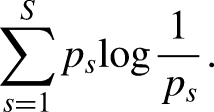
We first compute the age-specific entropy index by hukou status at birth and by gender. The entropy index measures the level of heterogeneity in one's demographic status combination at a specific age. The formula can be expressed as:
Identification of the transition profile
We included four transition markers that are widely used in the literature on transition to adulthood in our latent class analysis: school attendance, first job, first marriage, and first parenthood. Using the retrospective reports on life history in the 2015 survey, we constructed person–year records for men and women from ages 16–24. First job, first marriage, and first parenthood are non-recurring events and were coded as 0 before the event and 1 after the event. School attendance was a recurring event with 1 coded as being in school and 0 coded as out of school. To improve the model fit, we chose transition statuses at ages 16, 20, and 24 to build the latent class models. We began by fitting a single cluster model and gradually increased the number of clusters, up to eight. The selection of the models involved balancing the goodness of fit, parsimony of the model, and interpretability of the resulting classes. The Appendix includes tables of goodness-of-fit statistics that present the relationship between the Bayesian information criterion (BIC) and the number of clusters for both men and women. Based on these results, we adopted a four-class model for both men and women because adding one additional class either increased the BIC or did not improve the BIC considerably.
Class membership prediction
In order to investigate the relationship between latent classes and childhood environment factors, we adopted the bias-adjusted three-step approach for the latent class analysis (Bakk et al., 2013; Bolck et al., 2004; Vermunt, 2010). In our study, the three steps involved: (1) building a latent class model based on variables of transition markers; (2) assigning each individual to latent classes based on their posterior class membership; (3) examining the association between latent classes and external childhood environment predictors. This approach avoids complex model-building processes compared to the one-step approach. It also outperforms traditional approaches in producing unbiased and efficient estimations by properly accounting for classification errors that arise from class membership assignment (Bakk et al., 2013; Bolck et al., 2004; Vermunt, 2010).
Results
Heterogeneity in the transition to adulthood: Rural–urban differences
Figure 1 presents the age-specific entropy index results by hukou origin and by gender. The upper panel shows the 1980–1989 cohort from CLDS and the 1987–1991 cohort from GSCF. Although not directly comparable, the age-specific entropy indexes for male and female youth in the GSCF sample closely align with those of the rural sample from CLDS. Between the ages of 15 and 21, male youth with urban hukou have a more standardized life course trajectory on average than men with rural hukou. After the age of 21, the age-specific entropy indexes overlap, with rural males displaying a slightly larger degree of variability. In contrast, women with urban hukou at birth had lower entropy than those with rural hukou throughout adolescence and early adulthood. The age-specific entropy for the rural Gansu sample is broadly comparable with the rural sample in CLDS, with the exception of males aged 16–19, who had a lower entropy than the CLDS rural sample but a higher entropy than the CLDS urban sample. These findings are consistent with our hypothesis that life course trajectories during adolescence and early adulthood are more structured and organized for urban youth than for rural youth. The lower panel in Figure 1 presents the age-specific entropy for the 1970–1979 birth cohort from the CLDS sample only. For both males and females, rural youths had higher entropy indexes across almost all ages from 16 to 24 than urban youths. Yet the rural–urban gap is not as large as observed in the post-1980 cohort, shown in the upper panel in Figure 1.
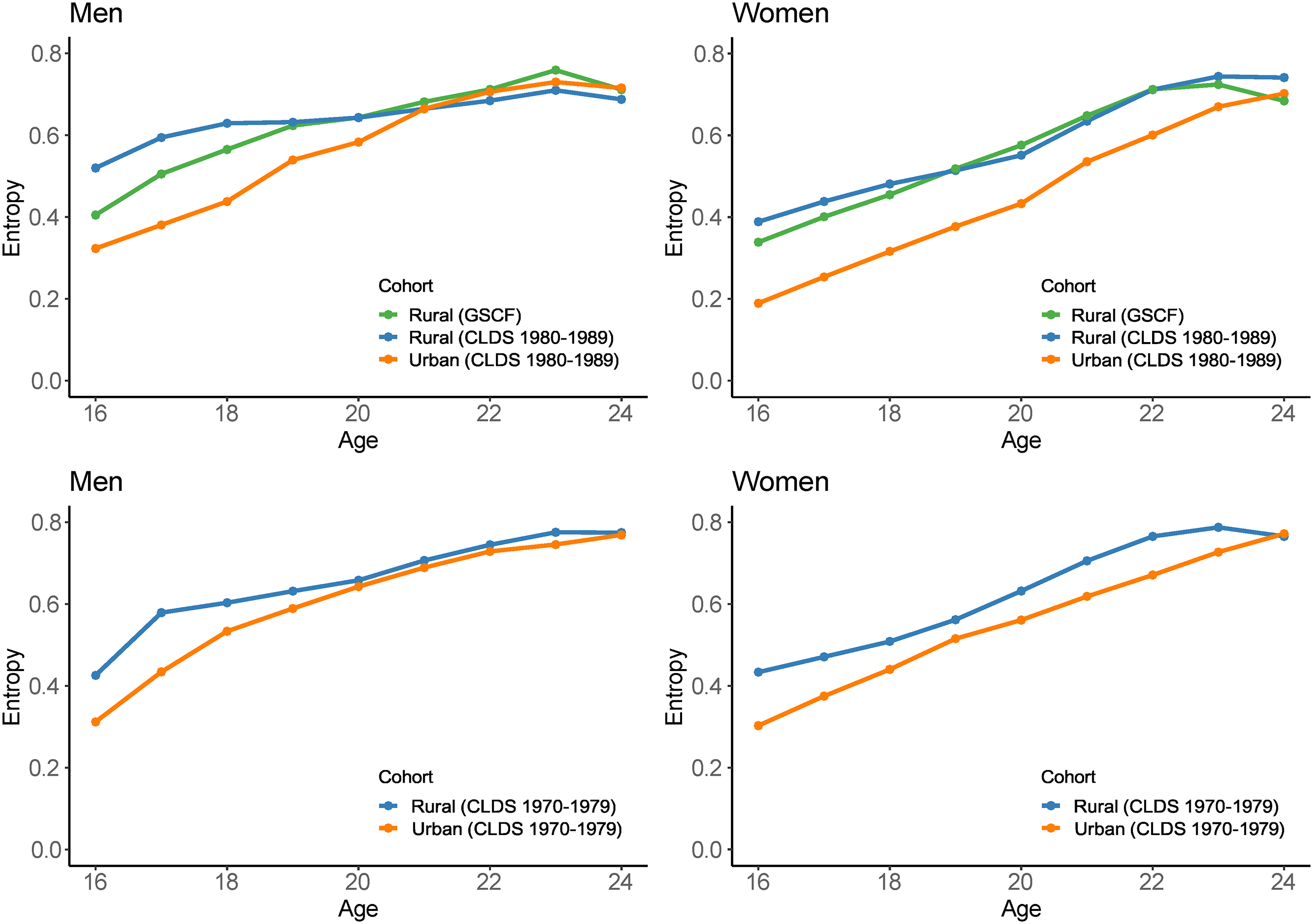
Age-specific entropy indexes by residence and gender, ages 16–24.
Figure 2 visualizes the cohort differences in the age-specific entropy index for the post-1970 and post-1980 cohorts using the CLDS samples. Except for rural men, we found that the post-1980 group showed a lower level of variability than the post-1970 generation in transition to adulthood pathways. Women with urban hukou had the greatest decline of these four categories, likely because of the marriage postponement and increased education opportunities experienced by the most recent cohorts of urban women.
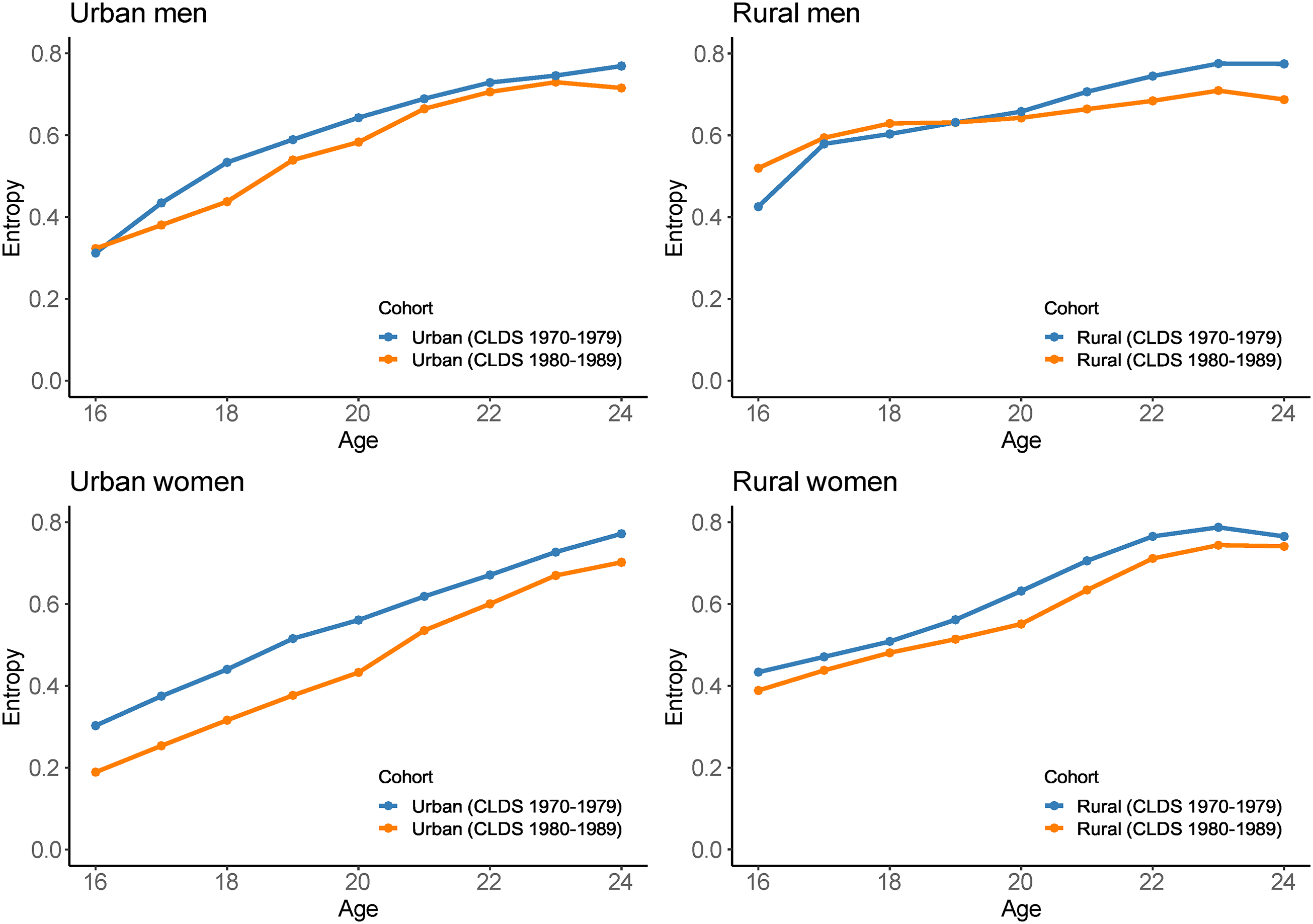
Age-specific entropy indexes by cohort, residence, and gender, ages 16–24.
Identification of the transition profile
Figure 3 depicts the four transition profiles for adolescent males based on the age-specific conditional probabilities from the four-cluster latent class model using the GSCF sample. The “keep in school” cluster represents 47% of the male sample and is composed of individuals who have an extended school enrollment history. The majority of them remained unmarried until the age of 24, consistent with literature suggesting that education has a delaying effect on family formation (Yu and Xie, 2015). The “work first, late marriage” cluster includes 33% of males who had an early employment history and a pattern of late family formation. The “marriage first” cluster, accounting for 8% of the male sample, displays similar transition trajectories in education and family formation compared to the “work first, late marriage” cluster. However, they started their employment late, and by the age of 24, only around 60% had started working. The “early transition” cluster comprises 12% of the male sample. They left school and started work early. By the age of 24, nearly all of them had married and had children.
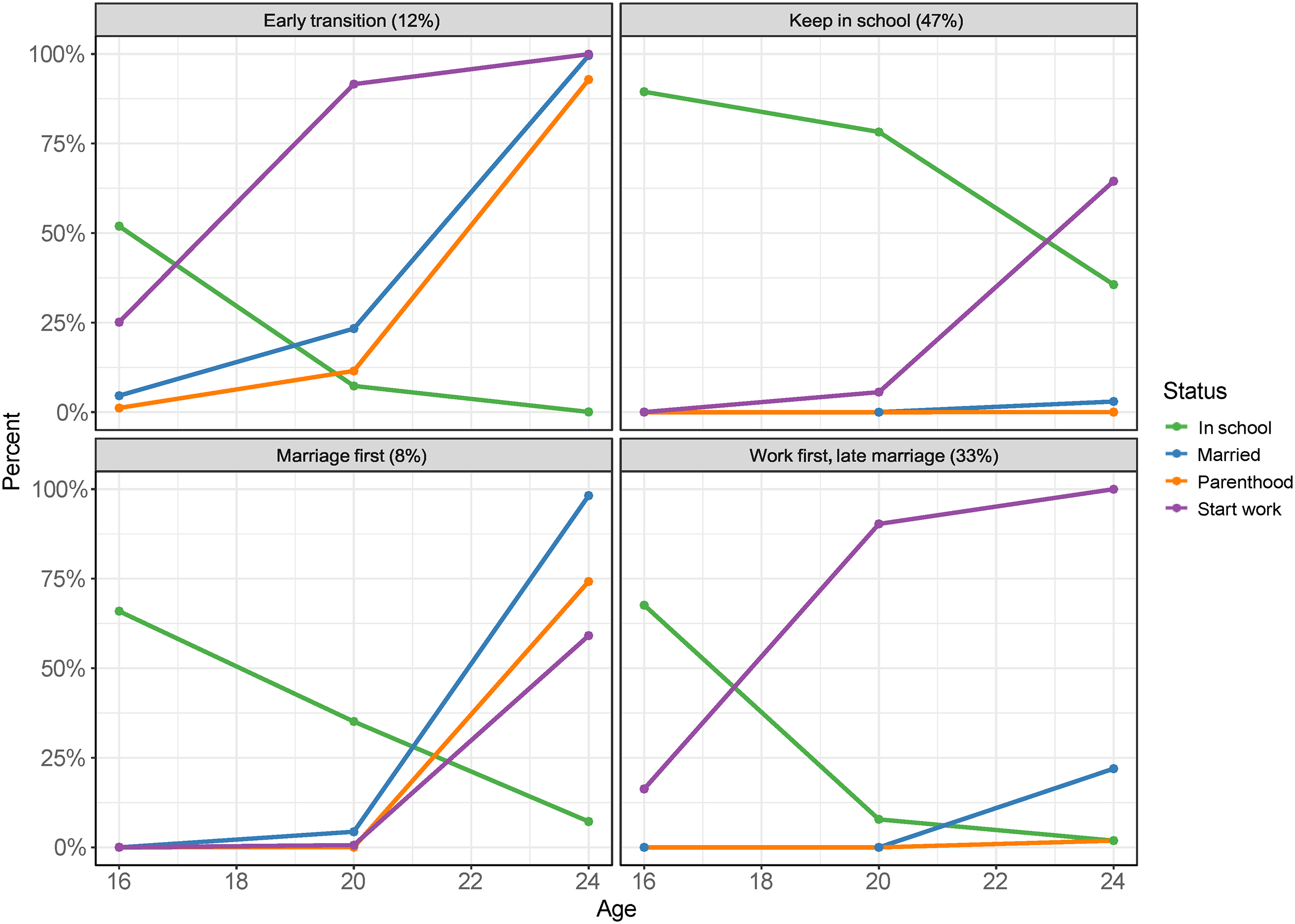
Estimated population prevalence and conditional age-specific probabilities for latent pathways to adulthood among young men.
Figure 4 illustrates the transition profiles for adolescent females, using a four-cluster latent class model similar to that employed for the male sample. The “keep in school” cluster, comprising 41% of the female sample, echoes the male pattern with extended school enrollment and delayed family formation. The “early transition” cluster is the second largest, accounting for 23% of the female sample, a figure that is double that of the male sample, highlighting a significant gender difference in early departure from education and swift progression into family life. The “marriage first” cluster is significantly better represented in the female sample, representing 20% of the sample, which is 12 percentage points higher than that of the male sample, indicating a stronger inclination towards prioritizing family formation over career at an early stage among young women. Finally, the “work first, late marriage” cluster comprises 16% of the female sample, indicating a pattern of establishing a career before family, although this group is notably smaller than the equivalent male cluster. In the next section, we utilize individual, family, and community characteristics to predict the memberships of the transition profile identified here for the GSCF sample.
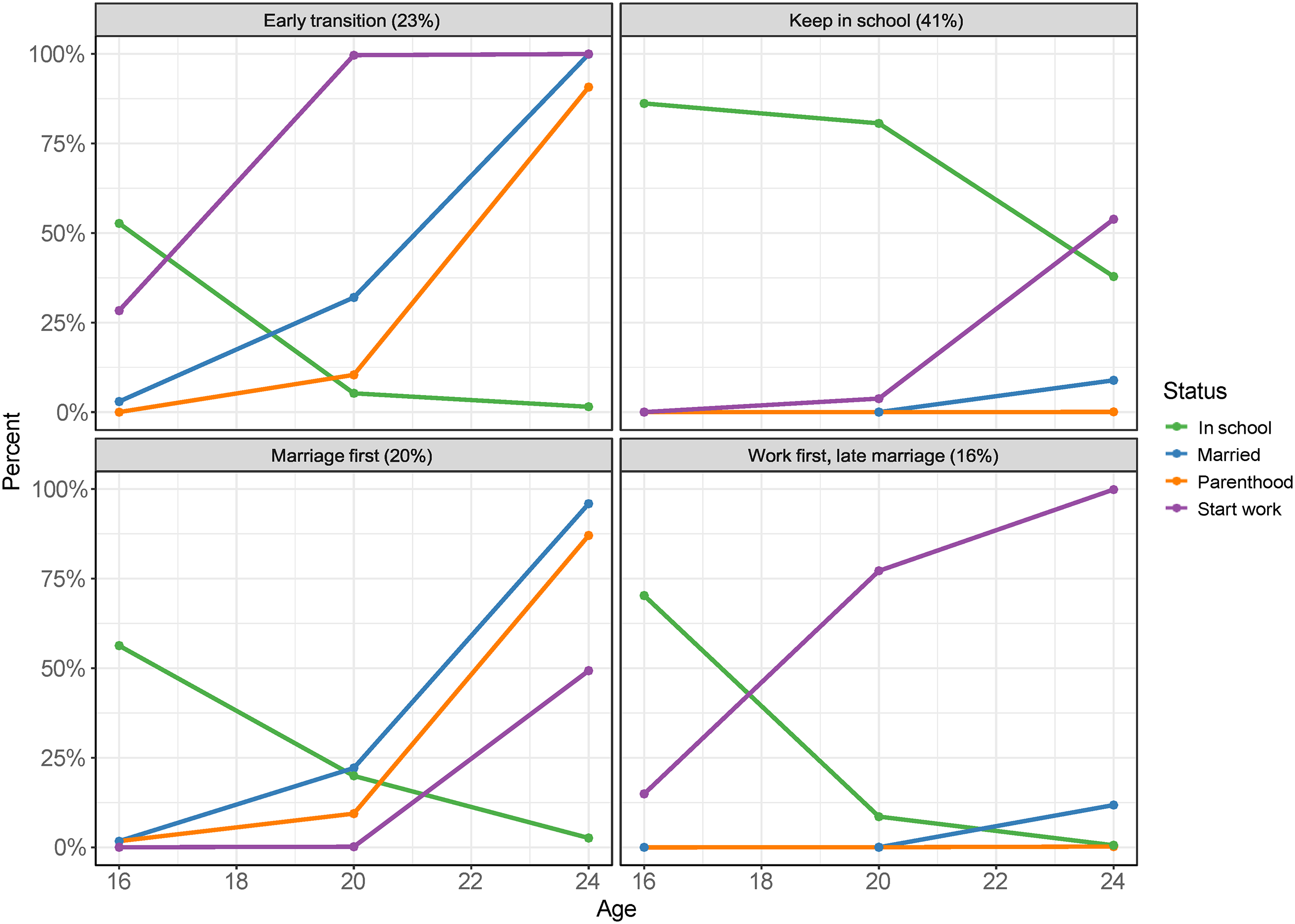
Estimated population prevalence and conditional age-specific probabilities for latent pathways to adulthood among young women.
Class membership prediction
Male youth. Table 2 presents estimates from a three-step, bias-adjusted multinomial logistic model analyzing the impact of family background and demographic characteristics on cluster membership for the male sample. Mothers who strongly believe in relying on sons for support in their old age are more likely to have sons in the “early transition” cluster rather than the “keep in school” cluster. Specifically, the likelihood of entering early employment and marriage is 142% higher than that of remaining in school if the child’s mother holds this belief. This belief is also positively associated with the likelihood of being in the “work first, late marriage” cluster; however, this effect is only marginally significant. Both the child's and the mother's educational aspirations are negatively related to the likelihood of belonging to any cluster other than the “keep in education” class. An increase in educational aspirations notably decreases the probability of being in the “work first, late marriage” cluster. Similarly, a rise in the mother's educational aspirations significantly lowers the probability of being in the “marriage first” cluster. Factors like the gender equity index and family size do not significantly influence cluster membership for the male sample.
Descriptive statistics.
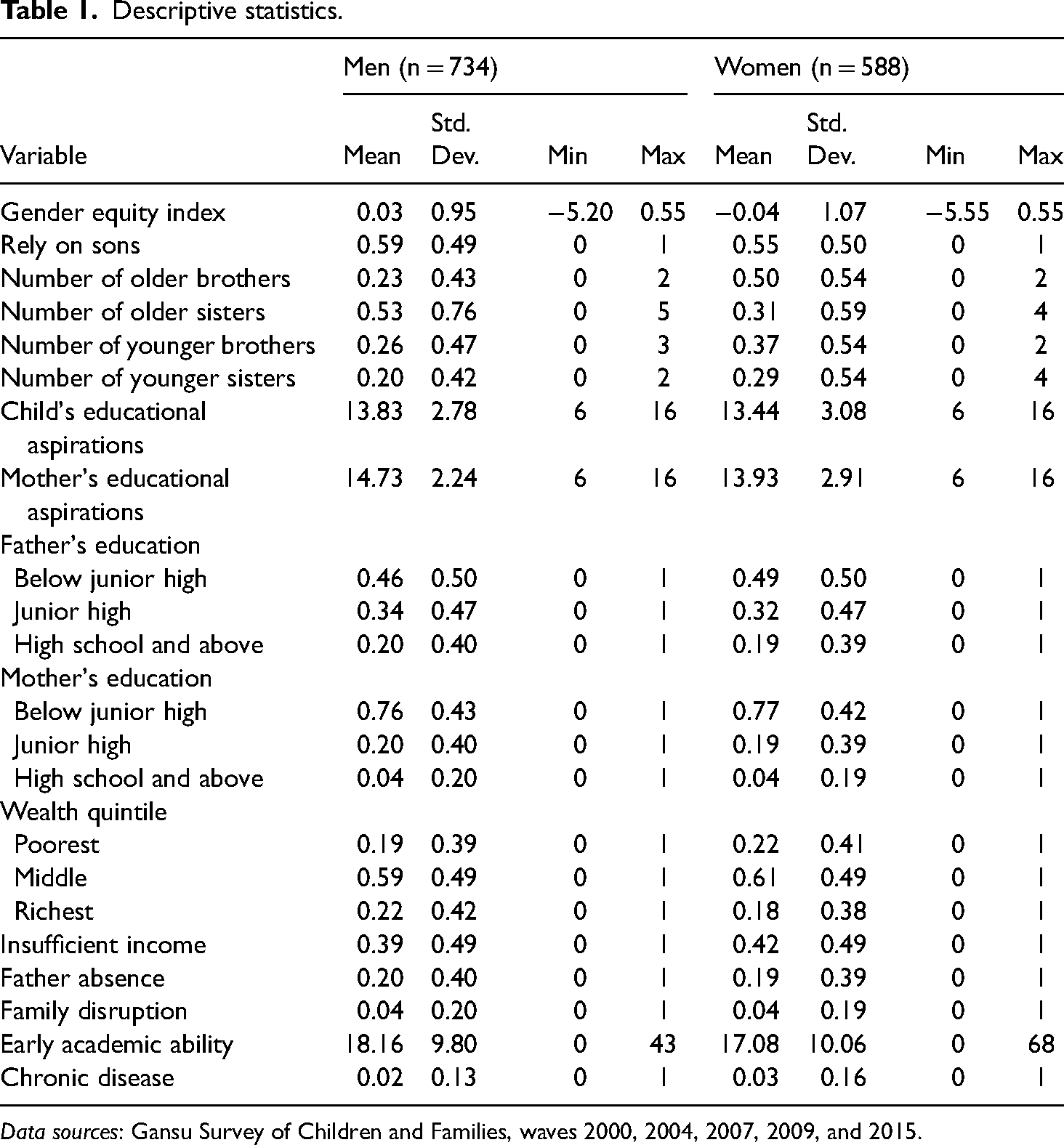
Data sources: Gansu Survey of Children and Families, waves 2000, 2004, 2007, 2009, and 2015.
Multinomial logit results for the pathways to adulthood among young men, ages 16–24 (ref.: “keep in school”).
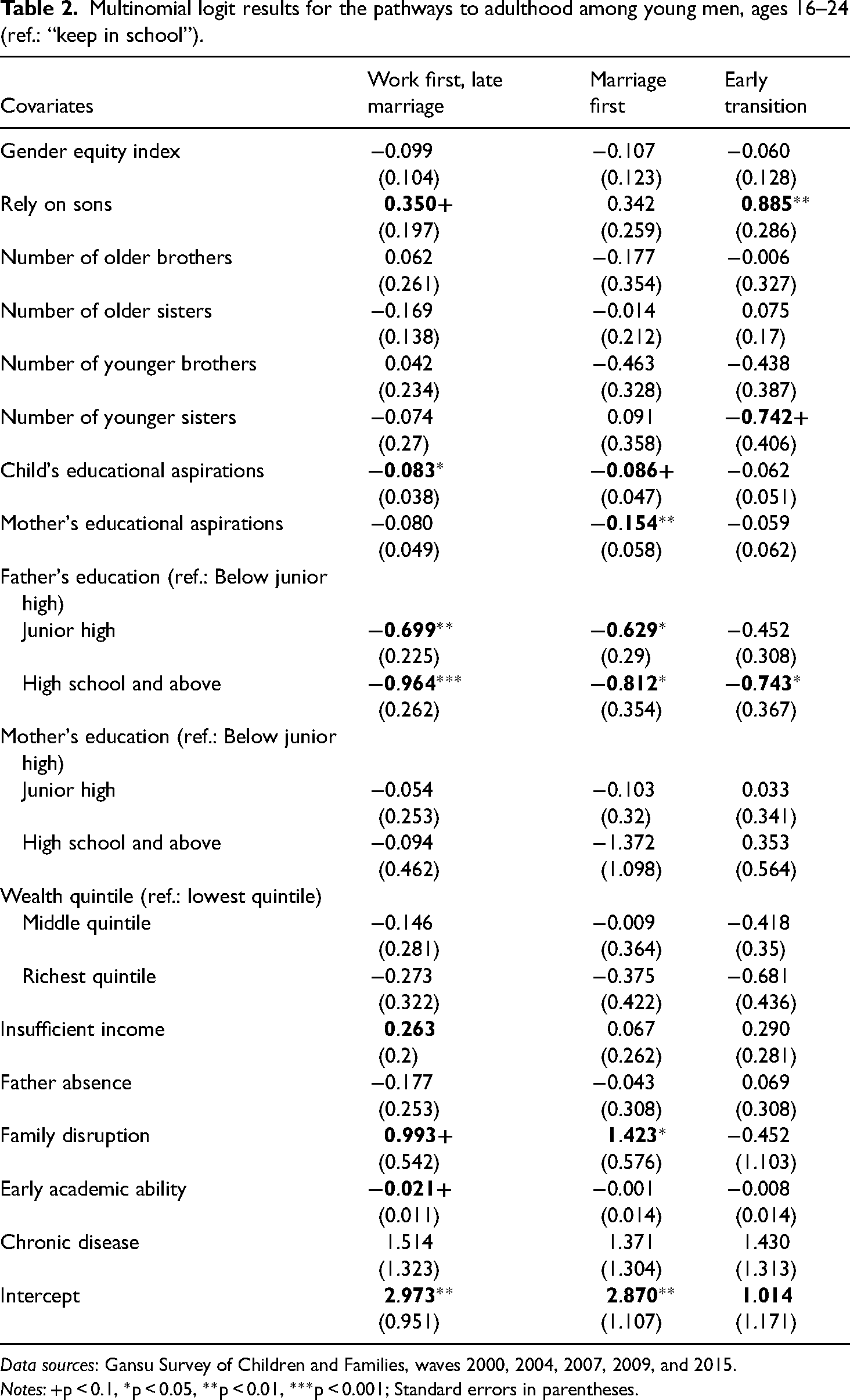
Data sources: Gansu Survey of Children and Families, waves 2000, 2004, 2007, 2009, and 2015.
Notes: +p < 0.1, *p < 0.05, **p < 0.01, ***p < 0.001; Standard errors in parentheses.
Results from Table 2 also indicates that fathers’ education significantly influences male youth to remain in education rather than entering the labor market or marriage at early ages. In addition, experience of family disruption increases the likelihood of being in the “marriage first” and “work first, late marriage” clusters, although the latter association is only marginally significant. Additionally, for male youth, cluster membership appears unaffected by the mother's education, early academic ability, household wealth, and income sufficiency.
Female youth. Table 3 presents a parallel model focusing on predictors of cluster membership for the female sample. The analysis indicates that mothers’ support of gender equity correlates with a reduced likelihood of their daughters being in the “work first, late marriage” and “early transition” clusters. In contrast to male youth, whose memberships are insensitive to sibship structure, sibship structure significantly affects cluster memberships of female youth. The presence of one additional younger brother significantly increases the likelihood of falling into the “work first, late marriage” and “early transition” clusters, that is, by 172% and 109%, respectively.
Multinomial logit results for the pathways to adulthood among young women, ages 16–24 (ref.: “keep in school”).
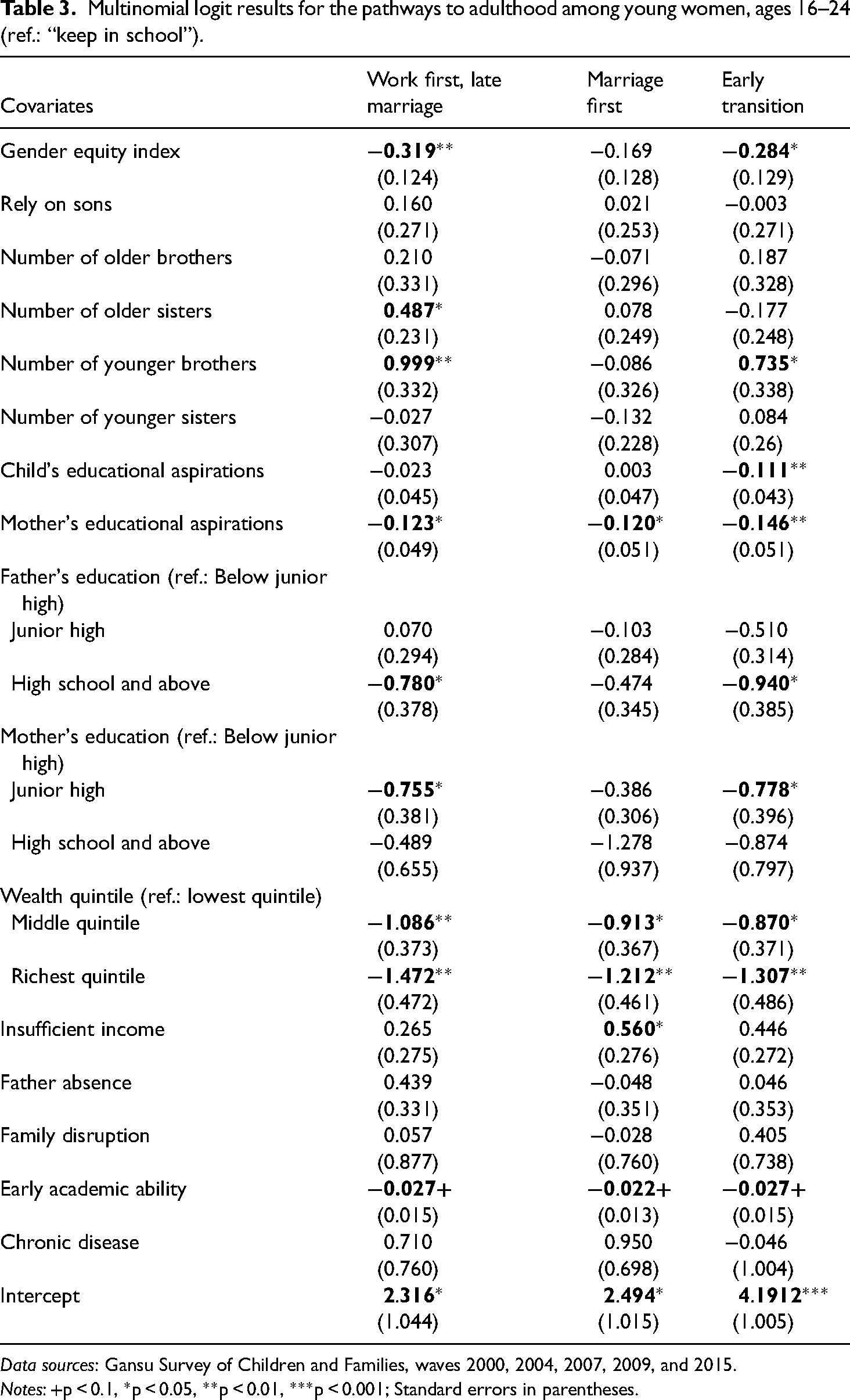
Data sources: Gansu Survey of Children and Families, waves 2000, 2004, 2007, 2009, and 2015.
Notes: +p < 0.1, *p < 0.05, **p < 0.01, ***p < 0.001; Standard errors in parentheses.
Both female youths’ and their mothers’ educational aspirations play a crucial role in keeping women in school. While mothers with higher educational aspirations exert a protective influence against entry into disadvantageous pathways, reducing the likelihood of their daughters being in any cluster other than “keep in school”, women's own educational aspirations significantly reduce their likelihood of being in the “early transition” cluster. Both fathers’ and mothers’ educational attainments exhibit a similar protective effect. Having a father with a high school or higher degree and having a mother with a junior high school degree are negatively associated with their daughters’ likelihood of being in the “early transition” or “work first, late marriage” clusters. The effect of the mother having a high school or higher education is in the same direction, although it is not statistically significant, mainly because only a small number of mothers in our sample had attained this level of education.
Contrary to the results observed in the male sample, female cluster membership is more sensitive to household wealth and income insufficiency. Female youths from wealthier families are less likely to be in clusters other than “keep in school”. Additionally, having insufficient family income in 2000 significantly increased women's probability of being in the “marriage first” cluster.
Discussion and conclusions
The pathways to adulthood in China have become protracted, more diverse, and less predictable. Both the second demographic transition and modernization theories suggest that the more economically developed a region is, the more complex and diverse the transition pathways are. These theories are grounded in a culturalist perspective, contending that evolving norms and beliefs originate in urban areas before disseminating to rural regions. Drawing from the social stratification literature, we argue that structural forces, such as poverty, and gender norms play an equally, if not more, important role in shaping the pathways to adulthood. This is demonstrated through a comparative analysis of urban and rural Chinese youth during the adolescent to early adulthood period. Our findings reveal that throughout this age span, rural youth in China navigate more diverse pathways than their urban counterparts, indicative of a turbulent life course pattern. In contrast, urban youth, benefiting from educational expansion, experience a more stable and institutionalized trajectory from adolescence to early adulthood.
However, we also found substantial heterogeneity within rural youth in their transition to adulthood pathway from adolescence to early adulthood. Nearly 47% of male youths and 41% of female youths in our sample have extended school enrollment, and thus have postponed employment and family formation. The remaining youth left school earlier and followed different pathways in employment, marriage, and parenthood. Furthermore, the association between early childhood environment and latent class outcomes shows that rural youths’ pathways to adulthood are stratified by parents’ education and household economic status, and are influenced by individuals' educational aspirations, sibship structure, and social and gender norms.
This study contributes to existing research in three ways. First, it reveals that China's post-1980s and post-1990s generations of rural youth experience more diverse or de-standardized pathways from adolescence to early adulthood compared to their urban counterparts. This study thus aligns with recent comparative literature to challenge the prevailing assumption that transition to adulthood pathways mimic the Western model: that is, the transition pathway becoming more diversified first in developed regions, a pattern which then spreads to developing regions driven by ideational changes (Van Winkle, 2018; Van Winkle and Wen, 2023). Instead, in the Chinese context, the de-standardization of rural youths’ pathways to adulthood likely stems from a scarcity of resources in their families and communities, coupled with elevated economic uncertainties and institutional setting that divide the rural and urban population, rather than from ideational changes suggested by the second demographic transition theory. A comparable observation was made by Van Winkle and Wen (2023). They identified educational attainment as a significant driver that explains a substantial portion of the differences life course transitions acrss Chinese birth cohorts from 1930 to 1978. Our results complement their findings in showing that dropping out of school in early adulthood contributes to more diverse pathways for disadvantaged rural youth. Although our study cannot address urban and rural differences in life course trajectories after the age of 24, rural and urban differences are evident during this early-age transition period (Figure 1). Furthermore, the gap widens from the post-1970s to the post-1980s cohorts, as shown in Figure 2. Investigating whether youth with rural hukou origin exhibit more diverse pathways to adulthood across a broader age range is promising for future research.
Secondly, using a unique 15-year longitudinal dataset from impoverished rural communities in northwestern China, this study is among the first to empirically distinguish unique pathways to adulthood for both rural boys and girls. A substantial proportion of rural youths remain in education and delay their marriage or childbearing until the age of 24 (above 40% for both the female and male samples). This group, which may later obtain urban hukou through educational migration, can be easily conflated with urban residents in a cross-sectional study design. Previous research often simplifies the transition to adulthood by broadly categorizing populations into rural and urban groups, typically concluding that rural individuals are more inclined to enter the labor market and marriage at an earlier age compared to their urban counterparts. This generalization, however, tends to overlook the heterogeneity within the rural youth population. Our findings imply that rural youth cannot be universally labeled as undergoing a comparatively early transition to adulthood; such an observation may reflect that the “left behind” rural population consists of selected individuals who have faced extreme disadvantages and constrained life opportunities.
Finally, this study explores key childhood environment factors influencing the transition to adulthood and uncovers notable gender differences. Parental education emerged as a protective factor, reducing the likelihood of entering disadvantageous pathways for both young men and women. However, family structure and economic conditions affect the pathways to adulthood distinctly by gender. Young women, especially those with younger brothers and from low-income families, are more likely to leave school early, whereas these factors do not significantly affect the transitions of young men. Conversely, family disruptions like divorce have a negative impact on the transition pathways of young men, but this effect is not observed for young women. This study also underscores the continued influence of cultural norms in rural areas, such as old-age support and son preference. On one hand, rural young women from families that strongly support gender equality are more likely to remain in school. On the other hand, rural young men who face high expectations to care for aging parents—a responsibility that often extends to their wives as well, tend to marry earlier, exemplifies the continuation of these traditional norms.
This study highlights the importance of local context in interpreting and understanding the transition to adulthood research. The de-standardization of transition to adulthood pathways among rural youth may exacerbate rural–urban inequalities in the accumulation of social capital. This issue arises not only from limited educational opportunities, but also from the challenges rural youth face in forming and maintaining stable social networks.
Our study has several limitations. First, although this study utilizes a unique longitudinal dataset focusing on rural youth from one of the poorest provinces in northwestern China, the unique economic, social, and cultural factors of northwestern China's rural areas might not be representative of rural areas in other parts of China or in other countries. Secondly, even though the study identifies substantial heterogeneity within rural communities, there might still be nuances and subgroups that are not fully captured or understood. This can lead to an incomplete understanding of the diverse experiences of rural youth. Furthermore, we can only utilize childhood environment factors dating back to ages 9–12 for children in the GSCF sample. The study might overlook important developmental factors occurring in early childhood, which can significantly influence later life course events. Similarly, by focusing only on youth life trajectories from ages 16–24, it may not capture the full trajectory of adulthood transitions that continue beyond the age of 24. However, in supporting our findings, a recent related study employing a broader age range and including birth cohorts before 1978 found that urban hukou origin was associated with less diverse life courses (Van Winkle and Wen, 2023). Future research could explore whether the rural–urban divide persists for more recent cohorts, like those we have considered in our study.
The pathways followed by rural youth can shape their future life trajectories and subsequently impact broader economic dynamics. Extended education, for example, tends to equip individuals with more specialized skills, enhancing their prospects in the job market. On the hand, early entry into the labor force may provide immediate income but might limit access to higher-paying or more secure jobs in the long run. This dynamic can affect not only individual livelihoods but also the overall economic development of rural areas and the country. Future research could extend this study by investigating the long-term impacts of the diverse adulthood transition pathways identified in our study, particularly focusing on their influence on individuals' livelihoods, career development, the dynamics of social relationship, and overall wellbeing.
Supplemental Material
sj-docx-1-chs-10.1177_2057150X241254905 - Supplemental material for Diverse pathways from adolescence to early adulthood among China's rural youth: A new perspective
Supplemental material, sj-docx-1-chs-10.1177_2057150X241254905 for Diverse pathways from adolescence to early adulthood among China's rural youth: A new perspective by Kai Feng and Emily Hannum in Chinese Journal of Sociology
Footnotes
Acknowledgement
We thank Shichao Du and the Center for Social Science Survey at Sun Yat-sen University for their assistance in accessing the CLDS data. We also thank the journal editors, anonymous reviewers, Etienne Breton, Monica Grant, Keera Allendorf, and participants of the 2022 Annual Meeting for their valuable comments and suggestions. Data used in this paper is from the China Laborforce Dynamics Survey (CLDS) by the Center for Social Science Survey at Sun Yat-sen University in Guangzhou, China. The opinions are the authors' alone. Please refer to http://css.sysu.edu.cn for more information about the CLDS data.
Contributorship
Kai Feng and Emily Hannum designed the study, contributed to the data analysis, and drafted the manuscript. Both authors reviewed and edited the manuscript prior to submission.
Declaration of conflicting interests
The authors declared no potential conflicts of interest with respect to the research, authorship, and/or publication of this article.
Funding
The Gansu Survey of Children and Families was supported by the Hong Kong Research Grants Council (GRF 692713). Earlier waves of data were supported by the United Kingdom Economic and Social Research Council and Department for International Development (ESRC RES-167-25-0250), The Spencer Foundation Small and Major Grants Programs, The World Bank, and National Institutes of Health (1R01TW005930-01 and 5R01TW005930-02).

Supplemental material
Supplemental material for this article is available online.
Notes
References
Supplementary Material
Please find the following supplemental material available below.
For Open Access articles published under a Creative Commons License, all supplemental material carries the same license as the article it is associated with.
For non-Open Access articles published, all supplemental material carries a non-exclusive license, and permission requests for re-use of supplemental material or any part of supplemental material shall be sent directly to the copyright owner as specified in the copyright notice associated with the article.
