



Abstract
By using the Propensity Score Matching model, this study proves the existence of an Internet premium effect. After other factors are controlled, it is found that the average wage income of Internet users is 1.38 times that of non-users. At the same time, there are significant gender differences in the premium effect of the Internet on wages: Women’s Internet wage premium is 90.6% that of men. Furthermore, it is found that the Internet premium effect on wages is highly related to users’ online behaviors. Compared with female users, male users are more inclined to use Internet resources to acquire knowledge and human capital; among female users, those with a greater conception of gender equality are more inclined to use the Internet for learning and accumulation of human capital. Using the framework of previous research on gender inequality in cyberspace, this study focuses on how gender perception influences Internet users’ preferences and ways of using the Internet, which is an important cause and mechanism of reproduction of gender inequality in cyberspace.
Introduction
The 21st century is the age of digital information based on the Internet. With the continuous advancement of information technology, the Internet has changed people’s productivity and lifestyles to a large extent. On the one hand, the Internet makes communication more convenient; on the other hand, the Internet also provides people with more resources and opportunities (Golder and Macy, 2014). Levy and Murnane (1996) point out that there is a strong positive correlation between a worker’s ability level and the complementary effect of technology. The extra income that can be obtained by quickly adapting to new technologies is called the ‘premium effect’ of the Internet on wages (Krueger, 1993).
With the vigorous development of the Internet in China, the digital divide between male and female Internet users is also narrowing year by year. In the 1990s, the ratio of Chinese male Internet users to female users was 5.6:1, and female users only accounted for about 15.1% of the total. By July 2000, the proportion of female Internet users had risen to 25.3%. By June 2015, the ratio was 55.1: 44.9. 1 Seemingly, the sex ratio of Internet users is decreasing, but will the Internet bring the same benefits to both male and female users? How does the use of the Internet affect gender differences in income distribution?
Based on the Chinese Woman’s Status Survey data (the third phase), this study mainly discusses the following issues: first, whether there is a significant gender difference in the wage premium effect of the Internet; and second, if there is, what are the causes of the difference?
Literature review
The premium effect of the Internet on wages
The wage premium effect of using the Internet is reflected both directly and indirectly. Directly, using the Internet reduces the cost of information processing, improves work efficiency, and consequently increases income (Levy and Murnane, 1996; Mossberger et al., 2008). By studying the relationship between supply and demand of workers at different educational levels in 1940–1996, Katz and his colleagues found that the rapid escalation of technology drastically expanded the demand for workers who could use the Internet, and pushed up their wage growth (Autor et al., 1998). Indirectly, Internet technology has made massive resources rapidly available to users and, with the accompanying increase in human capital accumulation, has led to wage growth (DiMaggio et al., 2004). Researchers have found that by learning from the Internet (Spooner and Rainie, 2000), searching for jobs with the help of the Internet (DiMaggio and Hargittai, 2001), and consulting the Internet concerning medical issues (Pandey et al., 2003), people can improve their personal capabilities and therefore stand out in the labor market.
From Australian survey data, it was found that the Internet can generate a wage premium of 12–14% (Miller and Mulvey, 1997). In 2001, the premium rate for American workers who use the Internet was around 10% (Lee and Kim, 2004). A CFPS2010-based study also found an Internet wage premium effect on Chinese workers (Liu and Jin, 2015).
However, does the Internet wage premium have the same effect on different genders? This depends mainly on two factors: first, whether males and females have equal access to the Internet; and second, whether the Internet wage premium has the same effect on male and female Internet users.
The influence of Internet use on gender equality
Although few studies have focused on gender differences in the wage premium effect of the Internet, many in-depth studies have looked at the influence of the Internet on gender equality.
Equal Internet access for males and females
Some researchers have argued that gender inequality in social resources and education leads to easier access to the Internet for males than for females (Warschauer, 2003). Norris’s (2001) study in the United States and European countries found that Internet users are generally from the advantaged groups in a society: whites, highly educated people, and males. A transnational follow-up study by Ono and Zavodny (2004, 2007) found that males use the Internet more frequently than females do, at home, at work, or in public areas such as libraries. Some domestic studies also found the same trend (Liu, 2001; Zhou, 2005).
However, some researchers have taken a more positive attitude. They believed that although at the beginning the Internet was dominated by advantaged classes, with the development of information technology, it would be popularized from the top down. In showing how structural inequality would be resolved over the course of the development of science and technology, Blau stated that although its earliest users might be the uppermost classes of society, such as highly educated white men, as technology became more popular, other segments of the middle and upper classes, such as well-educated black males or white females, would begin to benefit as they started using the new technologies, step by step. The application of science and technology throughout the entire society would ultimately be achieved by this step-by-step progression (Blau, 1977). Leigh and Atkinson (2001) argued that the different uses of the Internet among different groups of people were due to the fact that the popularization of the Internet itself follows an S-type curve: the gaps between groups existed simply because they were located on different sections of the curve; equality would be achieved eventually, including equality between men and women. Leigh and Atkinson seem to be correct: more recent studies in Europe and the United States have found that a balance between female and male Internet users is being reached (Norris, 2001).
The Internet wage premium effects on females and males
Although the Internet provides users with a wealth of information and resources, this does not mean that the wage premium effects of the Internet are the same for female and male users. The following issues must be considered (DiMaggio et al., 2004).
First, gender differences in socioeconomic status affect the relative efficiencies of Internet use for women and men. Social and economic status and the amount of resources affect not only people’s access to the Internet, but also their Internet skills. 2 In a survey of US netizens, in terms of online skills, male users scored significantly higher than female users (Wasserman and Richmond-Abbott, 2005). Male users can get the information they need on the Internet more quickly and efficiently (Hargittai and Hinnant, 2008).
Second, gender differences in Internet use affect relative human capital levels for women and men. Due to gender differences in use habits and preferences, even if females and males have equal access to the Internet, they have different degrees of benefits in human capital improvement from the Internet. The Pew Research Center in the United States of America found that although there was no significant difference in the prevalence of Internet use between men and women in the USA, there were significant differences in the ways the two sexes used the Internet (Bélanger and Carter, 2009); women, more than men, preferred to use the Internet as a social platform, for activities such as chatting with friends. Another study found that female netizens used email more frequently than their male counterparts and were more likely to use the Internet for personal communication, while male netizens were more likely to use email for work (Jackson et al., 2001). In addition, male Internet users were more frequently engaged in various commercial activities via the Internet (Akhter, 2003).
Third, the improvement effect of the Internet on human capital for both genders can be effectively transformed into real benefits, or not. Even if there is no gender difference in the improvement effect of the Internet on human capital, society may still discriminate in evaluating such improvement. In the case of web-based job seeking, for example, the National Academy of Development and Strategy at Renmin University of China undertook a social experiment. It randomly selected 100 students from a university in Beijing as subjects, and each subject was required to prepare two résumés with the same content but with different genders. The report of the experiment showed that the ‘male’ résumés received 42% more interview invitations than the ‘female’ résumés received (Ge et al., 2015).
Research framework
To sum up, the existing research on the relationship between gender and the wage premium effects of the Internet mainly focuses on social and individual aspects.
The social aspect includes structural factors and cultural factors. ‘Structural factors’ refers to the gender-based unequal distribution of social status and resources, and ‘cultural factors’ refers to gender discrimination in the labor market. On the one hand, the unequal distribution of social resources leads to women having fewer opportunities to access the Internet
3
and also leads to men’s inherent higher efficiency of Internet use with the help of their social status and resource advantages, as is shown in Route 1 of Figure 1. On the other hand, gender discrimination means that the labor market favors the dominant gender in the case of the same human capital, causing pricing differences in the Internet premium effect. In other words, even if women and men have the same Internet skills, the benefits they obtain from the Internet are still different, as is shown in Route 2 of Figure 1.
Analysis of the mechanism of wage premium effect of the Internet.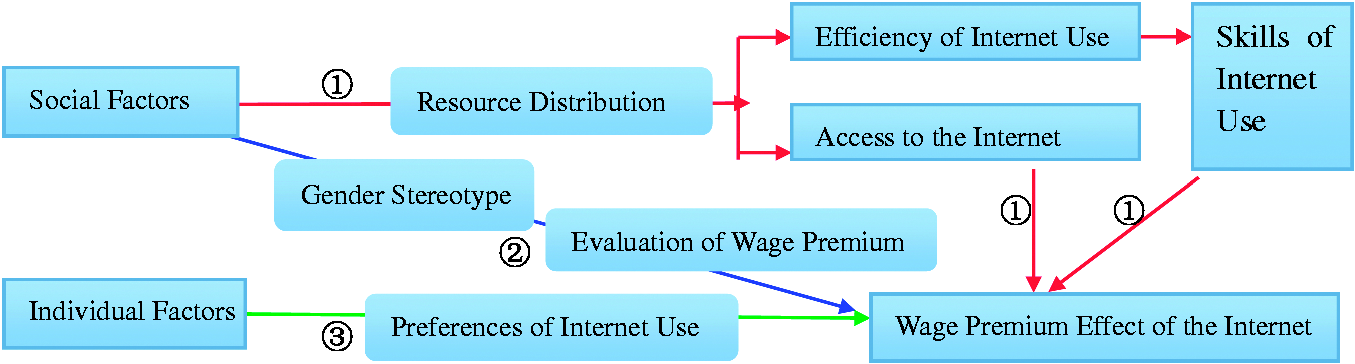
From the individual aspect, gender differences in habits and preferences regarding Internet use leads to a higher Internet wage premium effect for males than females, as is shown in Route 3 of Figure 1.
Recent research, however, suggests that cultural attitudes can also influence people’s preferences through individual cognition, which may ultimately lead to gender differences in the Internet wage premium effect, as is shown by the dashed line in Figure 2. A multinational study found that in most countries there is a gender stereotype that women are inferior to men in mastering Internet skills. A survey in the state of New Jersey found that women subjectively believe they are significantly inferior to men in terms of Internet skills, even if objectively they are the same (Hargittai and Shafer, 2006), and Broos’ (2005) study found that, compared with those of men, women’s attitudes are more negative and more anxious concerning skill learning on the Internet. Under the influence of their parents and friends, this gender stereotype affects women’s attitudes and willingness to acquire Internet skills (Abdelfattah, 2013). Cooper’s study found that among randomly selected female students in a high school, those who were much more influenced by traditional gender perspectives were lower in Internet skills, whereas those who recognized themselves more as students than as females were more capable of using the Internet (Cooper, 2006).
The influence of gender perception on wage premium effect of the Internet.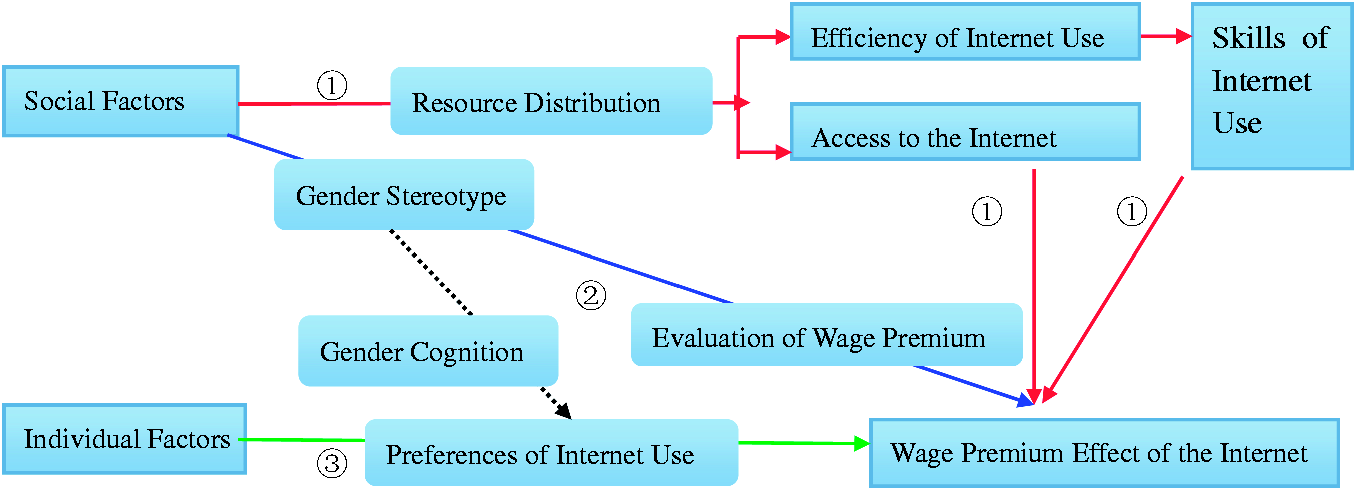
With the development of information technology and the promotion of female status, the sex ratio of Internet users in China tends to balance, which shows that females and males have equal opportunity to access the Internet. However, due to the relative socioeconomic statuses and differing behavior preferences of the sexes, coupled with the impact of gender discrimination, the Internet wage premium effect for men and women is assumed to be different. Therefore, the first hypothesis in this paper is:
Because gender stereotypes affect their subjective willingness and self-awareness in mastering Internet skills, women who tend to have a more egalitarian and modern conception of gender may have a more positive learning attitude and higher self-evaluation when using the Internet, and thus get their human capital promoted more. Therefore, the second hypothesis in this paper is:
Research methodology
Simultaneity bias may exist between Internet users’ employment of the Internet and their wages, resulting in endogenous problems. Therefore, this paper adopts the Propensity Score Matching model to evaluate the wage premium effect of the Internet on different groups of users. First, the model uses logistic regression to compute the propensity score of Internet using (marked as P).
Second, based on the score (Pi) of a case in the control group (Internet users), a case whose score (Pj) is the closest to Pi is selected in the control group (non-users). If the absolute value of the difference between the propensity score of the case in the matched group and that of any case in the control group exceeds 0.25 times the standard deviation of the propensity score, the control group case is deleted and the next round match is performed. The standard deviation of the propensity score of this paper is 2.560, and therefore the absolute value of the difference between the control group and the matched group should be less than 0.640. The formula is as follows (Guo, 2012):


Third, the matched pair of cases are selected from the overall sample (not put back), and repeat in this way. The cases selected form a new sample, which basically solves the endogenous problem.
Fourth, based on the sample selected by Propensity Score Matching, the wage premium effect of the Internet is computed, and whether there is a gender difference in the Internet wage premium effect is further analyzed.
Last, how women’s gender attitudes affect the way the Internet is used is analyzed through the Structural Equation Model, and how the differences in the use of the Internet affect the wage premium of the Internet.
Introduction to the data and variables
This paper uses data from the Chinese Women’s Status Survey (third phase). The China Women’s Status Survey is a national-scale sample survey that has been conducted by the National Women’s Federation and the National Bureau of Statistics since 1990 and is conducted every 10 years. The purpose of the survey is to fully and accurately reflect the current social status and past status changes of Chinese women. Taking 1 December 2010 as the standard time point, the survey data of the third phase cover nine aspects, namely health, education, economy, social security, politics, marriage and family, lifestyle, legal rights, and awareness and gender conception (Project Group of the 3rd Survey on the Status of Chinese Women, 2011). In order to discuss the influence of Internet use on people’s wage incomes, this paper retains cases in which individuals are currently working and are between 18 and 60 years of age. In total, 18,721 samples were retained after invalid samples of all available variables were deleted. 4
The dependent variables are the natural logarithm of the personal total labor income of the previous year.
The independent variables include:
Using the Internet or not. Because the third phase of the Chinese Women’s Status Survey investigates how much time the respondents spend on the Internet,
5
and to adapt to the Propensity Score Matching model, this article will re-encode time the respondents spend on the Internet as a dichotomous dummy variable (never online is re-encoded as 0, any amount of time online as 1). Purpose in using the Internet. Respondents’ purpose in using the Internet will be measured in terms of seven aspects (four options—never, occasionally, sometimes, and often—are assigned from 0 to 3): using the Internet for browsing news; using the Internet for investing in the stock market; using the Internet for learning or working; shopping online; using the Internet for expressing oneself online; using the Internet for instant chatting; using the Internet for entertainment. By principal component analysis, in this study, two factors are extracted and named ‘development factor’ and ‘entertainment factor,’ respectively. After calculating the standard deviation, two 0–100 standardized variables are generated, which represent two kinds of different behavior patterns. The higher the score is, the higher the degree of people using the Internet for learning or entertaining.
6
Gender perception. In the third phase, the Chinese Women’s Status Survey designed a number of questions about gender division of labor, gender temperament and other gender-related questions. The validity analysis shows that gender perception can be divided into three aspects: concept of gender division of labor, expectation of gender role, and aspiration for gender equality. Reliability analysis shows that, among the three, the most effective and credible aspect is the measurement of concept of gender division of labor (Liu and Tong, 2014). In this paper, concept of gender division of labor is mainly used to discuss the impact of gender perception on the use of the Internet. The corresponding survey includes the following statements: ‘men should be socially oriented and women should be family-oriented’; ‘It is the man who should be responsible for making money and supporting the family’; ‘The career of the husband is much more important than that of his wife’; ‘A marriage with a rich man is always better and easier than struggling for well-being by yourself.’ Five options are provided for each of the above statements: totally agree, agree, not sure, disagree and totally disagree. The scores for each of these options are 5, 4, 3, 2, and 1.
Distribution of variables.
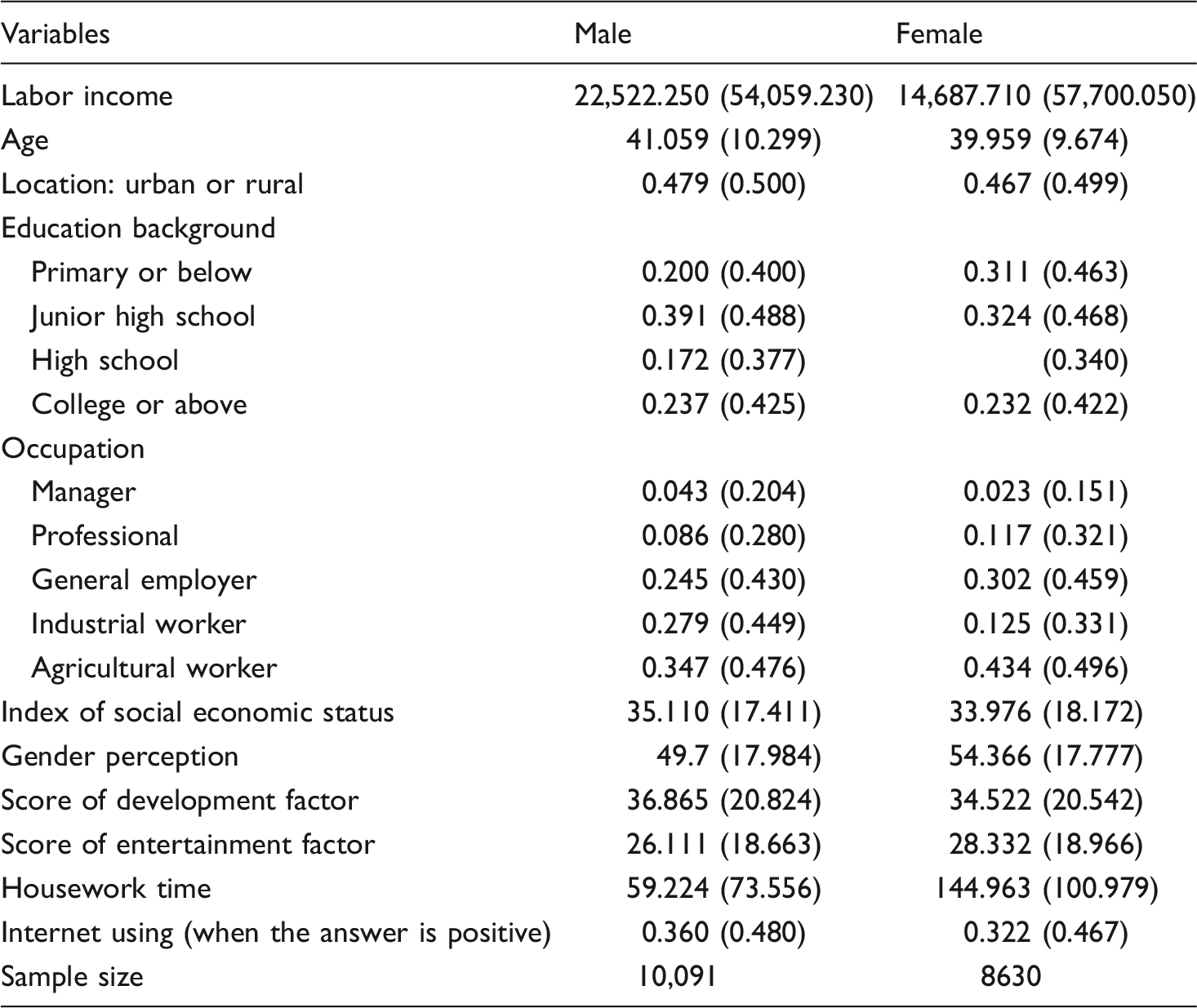
Note: Figures in brackets are standard deviations.
As shown in Table 1, the average wage income of men in 2009 is 22,522.25 yuan, significantly higher than that of women, which is 14,687.71 yuan. In the sample, the average age of men is 41.059 years and that of women is 39.959. The proportions of male and female urban population are 47.9% and 46.7%, respectively. The proportion of men whose education background is primary or below is 20%, and that of women is 31.1%. The proportion of men whose education background is high school is 17.2%, compared with 13.4% of women. The proportion of men who finished college education is 23.7% and women, 23.2%.
In terms of occupational status, men rank higher than women. Among the male respondents, managers account for 4.3%, while the proportion of female managers is only 2.3%. Among the male respondents, the proportion of agricultural workers with lower occupational status is 34.7%, while the proportions of professionals and general employees with higher occupational status are 8.6% and 24.5%, respectively. Among the female respondents, the proportion of agricultural workers accounts for 43.4%, professionals, 11.7%, and general employees, 30.2%. It can be seen that the female respondents are more concentrated in these two types of occupations, which, at the same time, shows serious polarization of the hourglass type.
There are significant gender differences in use of the Internet, with 36% in the male sample using the Internet, 3.8% higher than that of the female sample, which is 32.2%. The difference in the proportion of men and women using the Internet shows the gender inequality in access to it. In use of the Internet, the survey of users found that men are more likely than women to use the Internet for learning and working, while women are more likely to use the Internet for entertainment. Men’s development factor score is 36.865, higher than that of women, 34.522, while women’s entertainment factor score is higher than that of men, 28.332 and 26.111, respectively.
Research findings
The necessity of propensity score matching
Analysis of influencing factors of Internet use.
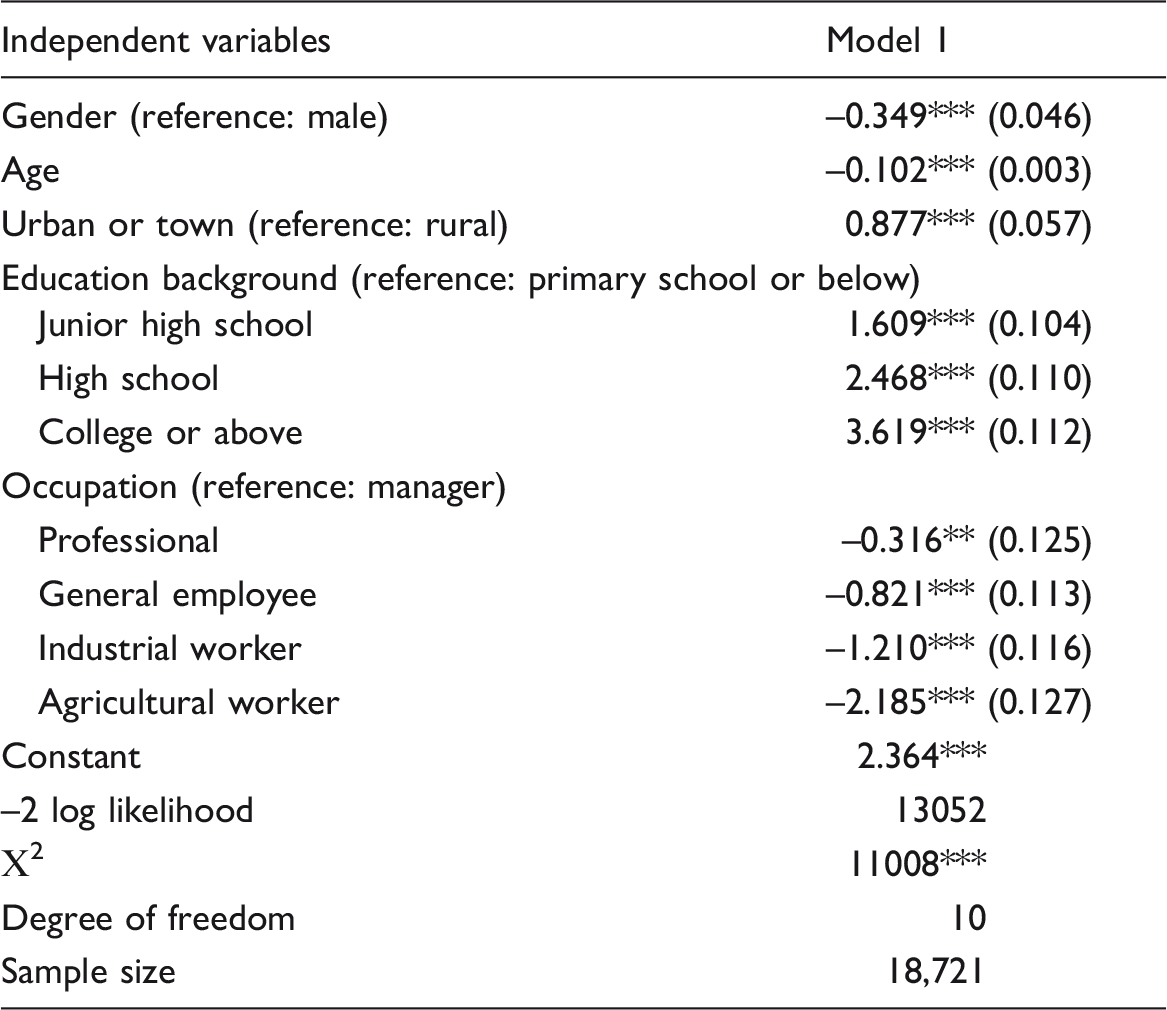
Note: Two-tailed test: ***p < 0.01, **p < 0.05.
Regression model of wage income.
Note: Two-tailed test: ***p < 0.01, **p < 0.05, *p < 0.1
Factors that influence the online behaviors.
Note: Two-tailed test: ***p < 0.01, **p < 0.05, *p < 0.1
Gender differences in the wage premium effects of the Internet
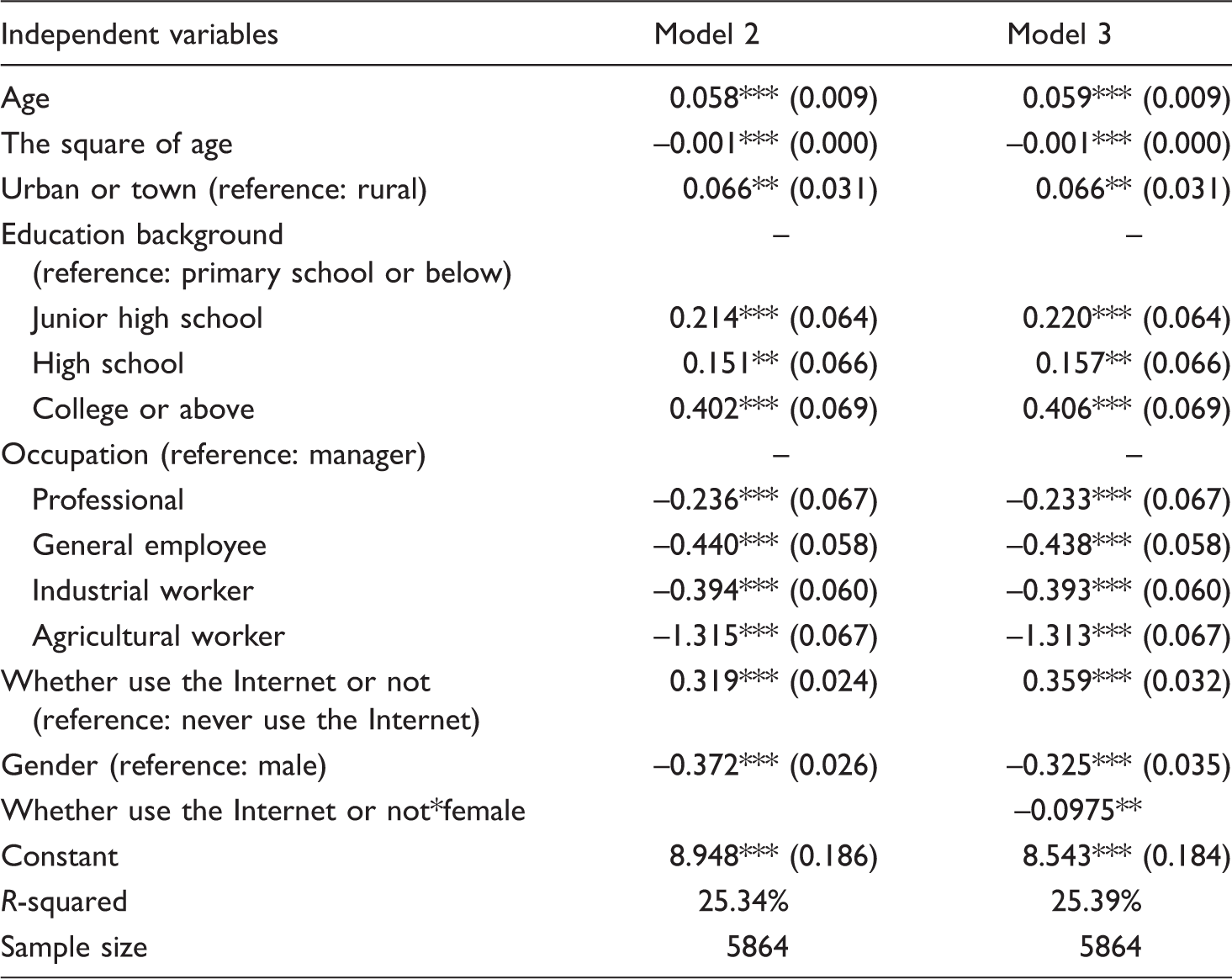
Through Propensity Score Matching, 5864 cases are extracted in this paper, and the sample retention ratio is relatively high. The regression model shows that Internet users have significantly higher wage incomes than non-users. As shown in Model 2 of Table 3, after other factors are controlled, the average wage income of Internet users is 1.38 times (e0.319 = 1.375) that of non-users. Model 3 (Table 3) shows that the Internet wage premium effect is more pronounced for male users, whereas the effect for female users is relatively low. After other factors are controlled, the Internet wage premium for women is 90.6% (e–0.098 = 0.906) that of men. The first hypothesis of the study is confirmed: the wage premium effect of the Internet on male users is significantly higher than that on women after other factors are controlled.
Gender differences in using the Internet
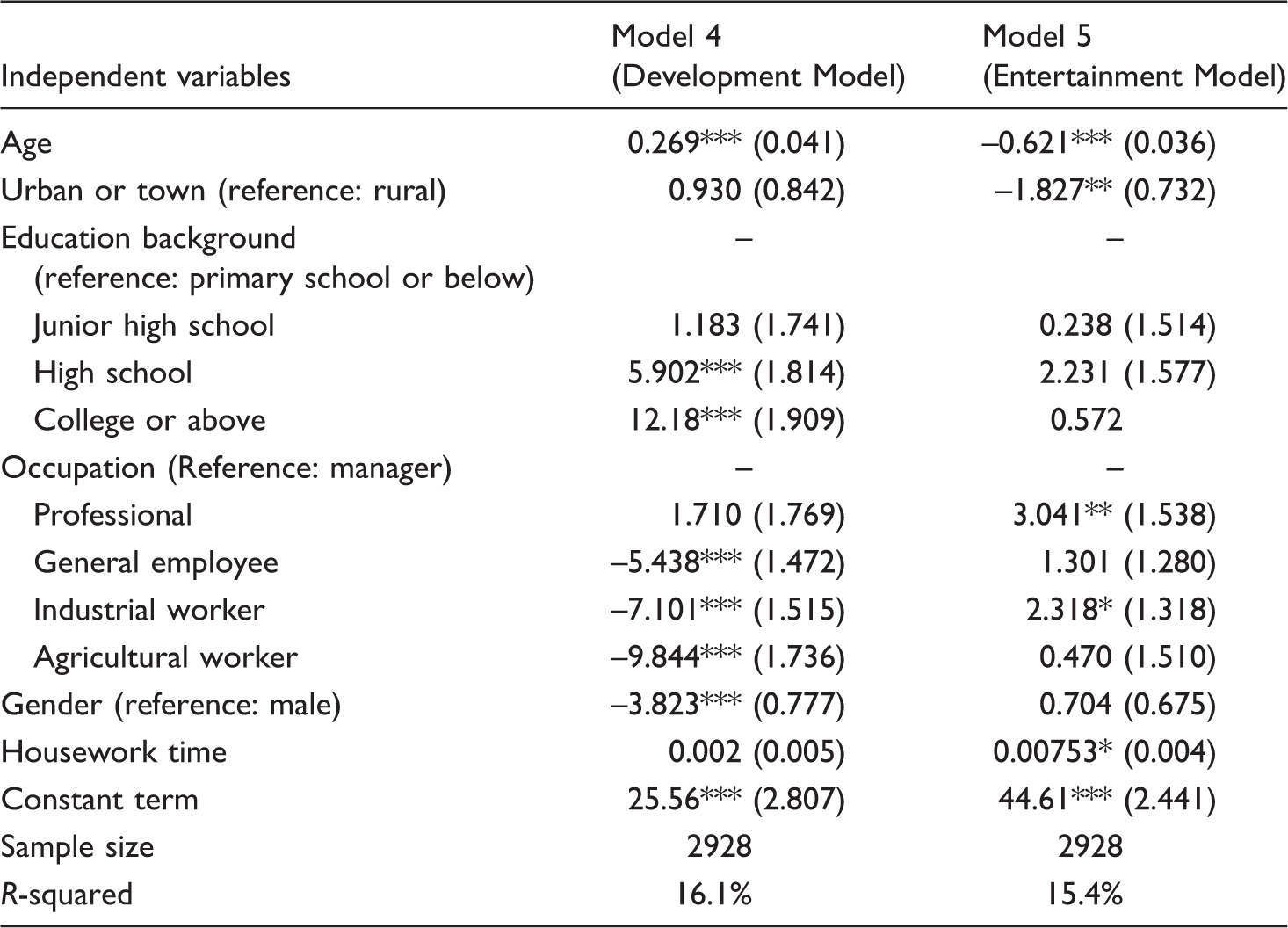
In order to elucidate the causes and mechanisms behind the gender differences in the premium effect of the Internet, this paper further analyzes the online behaviors of respondents on the basis of the samples obtained after Propensity Score Matching. Through factor analysis, this paper classifies Internet users’ online behaviors as the ‘development factor’ and the ‘entertainment factor.’ The ‘development factor’ mainly refers to the preference for using the Internet to acquire knowledge and accumulate human capital. These uses of the Internet enhance people’s competitiveness in the labor market, thereby increasing their income. Our study finds that, compared with female users, male users score higher in terms of the development factor. As is shown in Model 4 of Table 4, after other factors are controlled, male users’ development factor scores are 3.823 points higher than those of female users.
The ‘entertainment factor’ mainly refers to using the Internet as a means of recreation, for activities such as online shopping, chatting online with friends, etc. In terms of human capital accumulation and competitiveness in the labor market, the entertainment factor is minimally helpful to Internet users. In this analysis, there is no significant gender difference in entertainment factor scores. As shown in Model 5, education background has no significant effect on users’ entertainment factor scores, suggesting that people’s use of the Internet is likely to be a cross-class behavior. From the intercept terms of Model 4 and Model 5, we can also see that currently, Chinese users overall use the Internet for entertainment more often than for development.
Gender perception and the wage premium effect of the Internet
Through individual self-cognition, gender perception influences the willingness to use and the way of using the Internet, which leads to the reproduction of gender inequality in cyberspace, and eventually leads to the gender difference in the Internet wage premium effect.
In order to confirm the second hypothesis of this paper, that ‘after controlling other factors, the more equal women believe the two genders to be, the higher the wage premium effect of the Internet is for them,’ this paper retains the samples of female Internet users extracted by means of Propensity Score Matching, and a total of 1046 samples are taken. The wage premium effect on female Internet users is calculated by counter-factual regression prediction (Cattaneo, 2010). The specific calculation method is described as follows: First, the regression equation of the wage income of female non-users is created. Second, this equation is used to predict the income of female Internet users without using the Internet (a counter-factual situation). Finally, the actual income of female Internet users minus their income in the counter-factual situation is their Internet wage premium.
Through Structural Equation Modeling
8
(Figure 3) it is found that women’s gender attitudes are significantly related to their use of the Internet. That is, after other factors are controlled, the more equal females believe the two genders to be, the more likely they are to use the Internet for learning, and the higher their development factor scores are. The standardized correlation coefficient between women’s conception of gender equality and their development factor scores is 0.27, which is statistically significant. This finding, to a large extent, is consistent with many previous findings. Because the traditional gender conception expects women’s gender roles to be more emotional, and men’s gender roles more instrumental, women are inclined to use the Internet for relationship maintenance and social contact, whereas men’s use of the Internet is often tool based and goal oriented (Kennedy, 2000). Therefore, women who believe the two genders to be more equal are less impacted by traditional gender role expectations.
Relation between women’s gender perception and the Internet wage premium.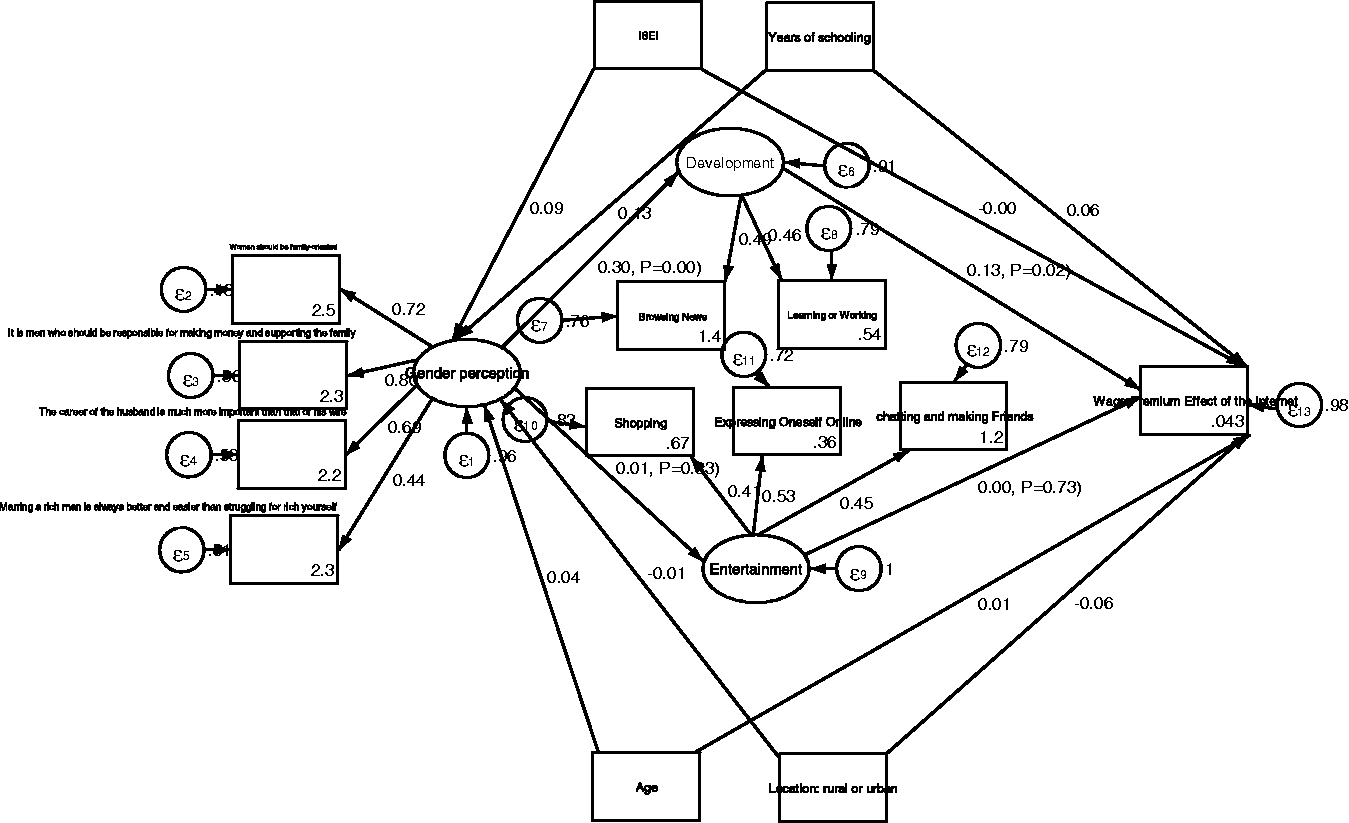
At the same time, female Internet users’ development factor scores are significantly correlated with their Internet wage premiums. The standardized correlation coefficient between female users’ development factor scores and their Internet wage premiums is 0.13, which is statistically significant. The indirect effect of female Internet users’ gender perceptions on their Internet wage premiums is: 0.3 * 0.13 + 0.01 * 0.00 = 0.039. Thus, our second hypothesis is confirmed, that after other factors are controlled, the more equal women believe the two genders to be, the higher the Internet’s wage premium effect is for them. Moreover, women’s gender perceptions first directly influence their development-oriented use of the Internet and then further influence their Internet wage premiums. The correlation coefficient between women’s gender perceptions and their entertainment-oriented use of the Internet is only 0.01, and there is no statistical significance.
Conclusion and discussion
This paper, by means of Propensity Score Matching, reveals a significant gender difference in the wage premium effect of Internet use. This difference is mainly reflected in the fact that the Internet wage premium effect for male users is significantly higher than that for female users. At the same time, according to the Structural Equation Model, this study points out: (a) Female Internet users’ gender perceptions have a significant effect on their ways of using the Internet and their use preferences: the more equal women believe the two genders to be, the more they are inclined to use the Internet for relearning knowledge and re-accumulating human capital; (b) women’s ways of using the Internet and their use preferences have a significant influence on the Internet premium effect on their wages: the higher their development factor scores, the greater the Internet premium effect is; and (c) the gender perceptions of female Internet users, by influencing their ways of using the Internet and their use preferences, indirectly but significantly affect the Internet premium effects on their wages. Thus, our two hypotheses are confirmed.
Specifically, this paper first verifies that the Internet premium effect does exist: after other factors are controlled, the average wage income of Internet users is 1.375 times that of non-users. However, cyberspace is not, as imagined, a ‘no border, transgender’ utopia. On the contrary, in reality, gender inequality is successfully reproduced in cyberspace: there is a significant gender difference in the Internet premium effect. With other factors controlled, the Internet wage premium of female users is 90.6% that of male users.
This paper further finds that the wage premium effect of the Internet is closely related to users’ online behaviors. Compared with female users, male users have a stronger preference for using online resources for relearning and human capital re-accumulation. Among female Internet users, those who have a more egalitarian gender perception are more inclined to use the Internet for relearning and human capital re-accumulation, which changes their use of the Internet, and enhances their wage premium effect from Internet usage.
Compared with previous research, this paper extends the research and discussion on the wage premium effect of the Internet in the following two respects: First, previous research and theoretical frameworks only discussed the mechanism and possibility of gender inequality in cyberspace. Taking wage income as a starting point, this study directly proves that there is a significant gender difference in the wage premium effects of the Internet. Second, previous research and theoretical frameworks explored the reproduction mechanism of gender inequality in cyberspace only from the one-dimensional ‘social and individual levels.’ The reproduction mechanism of ‘social level’ mainly includes (a) the inequality of access and efficiency of Internet using caused by the unequal distribution of social resources; and (b) the pricing difference in wage premium effects of the Internet caused by social gender discrimination. The reproduction mechanism of ‘individual level’ mainly refers to the gender difference in the Internet wage premium effect caused by individuals’ habits and preferences in Internet use. In general, the reproduction mechanism of the social level embodies the structural influence, whereas this mechanism results from the individual actions and choices of Internet users. This paper mainly focuses on how cultural perception influences people’s preferences and ways of using the Internet and thus becomes an important cause and mechanism of reproduction that leads to gender inequality in cyberspace—a process going from the outside to the inside.
In the age of the Internet, connection means value, and having no access to the Internet almost certainly means being left behind (Castells, 2006). In cyberspace, fragmented resources and time are reintegrated to offer people a larger platform and more possibilities. But this study finds that in this virtual space, men precede women once again. The impact of ingrained gender perception on individual preferences and behavioral patterns is likely to lead to the emergence of the ‘second digital divide,’ so that gender differences in cyberspace may not disappear but, in turn, trigger the reproduction of gender inequality, as is shown in Figure 3. Therefore, in the process of popularizing the Internet, the government and society need to make further efforts to promote women’s effective use of online resources in order to avoid the emergence of the second digital divide (Bimber, 2000).
Of course, the reproduction of gender inequality in cyberspace is not only limited to how people use the Internet; it is also influenced by factors such as occupational segregation, unspoken rules of the labor market, and so on (Project Group of the 3rd Survey on the Status of Chinese Women, 2011; Tong and Liu, 2015), and the impact of the Internet on users is not only reflected in wage income. In addition to the impact of cultural perception on people’s ways and preferences of Internet use, other social factors also need further study. Cyberspace has created infinite possibilities, and users’ online behaviors need more detailed and in-depth research.
Footnotes
Funding
This research received no specific grant from any funding agency in the public, commercial or not-for-profit sectors.