



Abstract
The authors examine gender differences in perceptions of the fairness of one’s own pay. This work differs from previous studies, as the authors not only assess whether women are as likely as men to perceive their pay as unfair at the same absolute wage levels. Instead, they use an innovative methodology based on linked employer-employee data. This makes it possible to compare subjective perceptions of (un)fair pay with the predicted pay of comparable others with the same individual-, work-, occupation-, and firm-related characteristics. The authors use the measurement of how closely a person’s pay aligns with the predicted pay of comparable others as a strictly empirical indicator of whether someone’s pay is fair. Overall, women are as likely as men to perceive a fair wage as unfair or an unfair wage as fair. Although the data at hand do not make it possible to explore the causes of this, or to assess whether women and men used to differ more in their perceptions of fairness, the authors speculate that women today may be more aware of the societal debate about gender-based wage discrimination, and their perceptions of appropriate compensation may be less influenced by gendered comparison groups and gender status beliefs than previous research has suggested.
Gender Differences in Perceptions of the Fairness of One’s Own Wages
Wage inequality is a central topic in the extensive literature on distributive justice (Jasso and Rossi 1977). A person’s income has enormous implications for other domains of life, such as health, housing, and political participation (Bor, Cohen, and Galea 2017; Dong 2017; Elsässer and Schäfer 2023; Tammaru et al. 2019; Zheng et al. 2022). As a result, wage inequalities that are systematically related to ascriptive characteristics are under close public and academic scrutiny. In terms of income differences between men and women, the “gender wage gap” is not only one of the most prominent findings in empirical social research, but also at the center of a lively public debate. Numerous studies have shown what factors contribute to this gap, which persists even though women have surpassed men in educational attainment (DiPrete and Buchmann 2013). This research has identified factors related to the supply side, such as women working fewer hours (Schmitt and Auspurg 2022), often for family reasons, their employment in female-dominated occupations (Levanon and Grusky 2016) but also factors related to the demand side, such as gender discrimination by employers (Bertogg et al. 2020). Among other things, the sociological literature has revealed that one potential reason for the persistence of the gender wage gap is that women and men perceive it as legitimate, i.e., they believe that women should earn less: “both men and women consider somewhat lower earnings for female employees than for otherwise similar male employees to be fair” (Auspurg, Hinz, and Sauer 2017:179), although a recent investigation could not find this pattern anymore (Strauß, Brüggemann, and Lang 2025).
Less attention has been paid to the question of what wages men and women perceive as fair or unfair for themselves, yet it is equally important. Just like factual wage inequalities, these perceptions have consequences, for example, for employees’ work performance (Cohen-Charash and Spector 2001), for life satisfaction (Adriaans 2023), and even for people’s physical health (Schunck, Sauer, and Valet 2015). And just like them, they seem to be systematically related to ascriptive traits, as the literature on gender differences in employees’ evaluations of their own pay suggests. An important finding in this line of research is the so-called paradox of the contented female worker (Crosby, 1982). It refers to the more general observation that “despite having poorer objective working conditions than men, women are more satisfied than men with their jobs,” including their own pay (Smyth et al. 2021:573).
Studies that examine this phenomenon typically compare women’s and men’s perceptions of the fairness of their own wages, holding individual characteristics such as education or work experience and absolute wage levels constant. Given the gender wage gap, the latter is important because wage levels and perceived wage fairness are strongly and positively correlated (Mohrenweiser and Pfeifer 2023). On the basis of these studies, however, the empirical evidence on whether women feel they are paid more, less, or equally fairly than men, is mixed (Adriaans and Targa 2023; Brüggemann and Hinz 2023; Pfeifer and Stephan 2019; Valet 2018). This is unfortunate because knowing whether women and men really differ in their perceptions of the fairness of their own pay is important, for example, for understanding the role these differences play in perpetuating gender-based wage inequalities, e.g., by limiting women’s demands for pay raises (Pfeifer and Stephan 2019)
We argue that answering this question requires more than comparing men and women with similar individual characteristics and incomes. Rather, it is necessary to assess whether gender differences in perceptions of fairness persist when comparing men and women who are actually paid equally fairly or unfairly. Only if this were the case could it be assumed that women are more, less, or equally tolerant of unfairly low wages—or more, less, or equally intolerant of fair wages—than men. As it is difficult, if not impossible, to determine when a wage is fair, this is a challenging endeavor.
We therefore ask the more modest but still unanswered question of whether women’s and men’s perceptions of the fairness of their own pay differ when we consider how much they earn relative to comparable others. We define “relative to comparable others” in the sense of earning at least as much or less than other employees with similar individual (e.g., level of education and work experience) and work-related characteristics (e.g., part-time or full-time job) who work in the same occupations in the same firms. We assess what they earn relative to these comparable others by calculating predicted wages as the wage that each employee in our dataset with a given and complex set of characteristics should earn if he or she were to earn as much as comparable others.
Like several previous studies, we first explore gender differences in employees’ perceptions of the fairness of their own wages. We do so using novel data from a survey of 538 firms in Germany (Strauß et al. 2022). We then go beyond previous research by secondly assessing, for each respondent in the survey, whether he or she is paid less, the same or more than comparable others. In this sense, we use an employee’s wage relative to others as an indicator, certainly limited and purely empirical, of “actual” fairness. We are able to do so by linking survey data with administrative data for all 142,000 employees from the same 538 firms. By comparing perceived and “actual” pay fairness, we assess whether women are as likely, more likely, or less likely than men to perceive their own pay as fair or unfair in a more nuanced way than previous studies.
In short, our analyses show that women and men have similar perceptions of the fairness of their wages once we control for both absolute and relative wage levels. In particular, there is no evidence that women are more likely than men to accept wages that are lower than the wages of comparable other employees. Although this confirms previous studies suggesting that men and women do not differ substantively in their fairness perceptions when it comes to their own wages (e.g., Valet 2018), data limitations prevent us from directly examining the reasons why we (and others) find no evidence for the previously described “contented female worker paradox.” We are also unable to examine possible changes in men’s and women’s fairness perceptions over time, but nevertheless confident that a growing awareness of the existence and illegitimacy of gender discrimination in the labor market contributes to this finding.
The Gender Wage Gap and Employees’ Perceived Fairness of Their Own Wages: The Concept of “Comparable Others”
The “gender wage gap” is defined as “the difference between the average gross hourly earnings of men and women expressed as a percentage of the average gross hourly earnings of men [italics added]” (Destatis 2024). Individual-, work-, occupation-, and firm-related characteristics have all been shown to contribute and thus partly explain the gender wage gap, with changing relative importance over time (Blau and Kahn 2017). On this basis, numerous empirical studies calculate an adjusted (or “net”) gender wage gap that considers, among others, gender differences in human capital endowments, part-time work, occupational segregation and employer characteristics. In Germany, this adjusted gender wage gap amounts to 5.9 percent (Mischler 2021). Even though this is much lower than the unadjusted gender wage gap of about 20.1 percent, there is thus a remaining, “unexplained” gender gap in wages, that has even increased at the top of the wage distribution according to a recent study (Bonaccolto-Töpfer, Castagnetti, and Rosti 2023).
This gap does not directly indicate gender-based individual discrimination, in the sense of the “difference between the treatment that a target group actually receives and the treatment they would receive if they were not members of the target group but were otherwise the same” (Quillian 2006:302). This is because it could reflect differences between men and women (e.g., in psychological characteristics or noncognitive skills) that are unobservable in census and most survey data (Blau and Kahn 2017). This gap just indicates the “upper limit” for discriminatory treatment. Another caveat is just as important. Showing, for example, that female nurses earn as much as male nurses with the same human capital characteristics who work similar work hours in a comparable institution does not imply that there is no gender-based discrimination. After all, labor markets are strongly and persistently gender-segregated and male dominated jobs are usually better paid than female dominated jobs (Leuze and Strauß 2016). This possible devaluation of “female-typical” occupations (England 1992) alone can be considered discriminatory.
Less research has been conducted on men’s and women’s own perceptions of fairness of their wages. In addition, we already mentioned that these studies yield mixed results. Some studies suggest that after controlling for individual characteristics and absolute wages, women are more likely than men to perceive their wages as fair (Pfeifer and Stephan 2019). Others show that women are not generally more likely (Valet 2018) or even less likely (Adriaans and Targa 2023; Brüggemann and Hinz 2023) than men to perceive their own wages as fair. Although these studies greatly enhance our understanding of the social dynamics behind the gender wage gap, they say little about whether a female employee who feels treated (un)fairly is “actually” treated as (un)fair as comparable men. Roughly controlling for education, wage level, and occupation-related characteristics (Brüggemann and Hinz 2023 used International Standard Classification of Occupations 2008 codes, e.g., “mechanics”; Valet 2018 used, among others, occupational prestige; Pfeifer and Stephan 2019 used 11 job categories, e.g., “qualified employees”) is not enough to answer this question. As a fictitious example, consider a male and a female mechanic who earn approximately 4,000 euros per month and both feel that they are fairly compensated. However, the woman is an aeromechanic (and earns less than other aeromechanics) and the man is a precision mechanic (and earns more than other precision mechanics). Although the analysis would show that both perceive their wage as fair at a similar wage level, the woman would actually be more accepting of an unfairly low wage than the man. As a consequence, one would underestimate the contented female worker paradox.
A more valid analysis of gender differences in perceived wage fairness therefore requires that women’s and men’s perceptions of being paid fairly are “compared” with a more accurate indicator of the “actual” fairness of their pay. To be sure, finding such an indicator is challenging. In a normative sense, it is essentially impossible to determine whether a given wage is fair, because wages reflect various facets, including the value a worker produces, the effort she puts into the job, her bargaining power, or her needs (Hufe, Kanbur, and Peichl 2022; Reed 1925). For our purposes, and in the context of the debate about perceived wage fairness, a pragmatic and purely empirical approach is to relate these perceptions to what a person earns relative to others.
Conceptually and methodologically, the search for a “fair wage” indicator follows a similar strategy to that used in the literature on “relative earnings.” The latter have been defined as the difference between a person’s “own earnings and the comparison earnings of his or her referential standard” (Schneider and Valet 2017:227; for a helpful overview, see Valet 2018 and Senik 2021). The underlying theoretical framework of this approach is equity theory which posits that social comparison processes are more important for perceptions of “distributive justice” than the unequal distribution of rewards such as income per se (Adams 1965; Homans 1985; Jasso and Rossi 1977).
Methodologically, these studies mostly rely on administrative data to calculate “reference wages” of different other groups of employees (such as similar individuals in the same firm, in the same occupation, or in the same country). On the basis of this information they assess which groups’ wages are most important in shaping employees’ perceptions that they are (un)fairly paid. Godechot and Senik (2015) showed that employees’ subjective satisfaction with their wage depends, among other factors, on the reference wages of comparable workers in the region. Mohrenweiser and Pfeifer (2023) demonstrated that “internal” reference wages within firms and “outside” reference wages shape perceived wage fairness over and above one’s own wage level. Bygren (2004:221) combined interview and register data in Sweden and concludes that “Swedish workers primarily compare their pay with that of similar others (i.e., others with the same education and work experience) in their occupation and in the labor market as a whole,” while comparisons within the workplace are less important. Several studies have shown that other workers in the same occupation as well as colleagues from the same firm seem to be relevant referents for wage comparisons (Brown 2001; Godechot and Senik 2015; Hauret and Williams 2019; Schneider and Schupp 2010, Strauß et al. 2025).
Although this literature does not typically focus on gender differences, Bygren’s (2004) finding points to a gendered pattern in the sense that for women, within-occupation comparisons are most important, while men look at the national labor market (Bygren 2004; see also Valet 2018). In line with this (but using a different methodological approach), Valet (2018) showed that women are more satisfied with their wages only in female-dominated occupations and argues that in these contexts women compare themselves with other women rather than with men. As women earn less than men, it is such gendered reference groups rather than an inherently higher tolerance for lower wages that explain the contented female worker paradox.
Rather than adding another study to this line of research, we use linked employer-employee data to compute predicted wages (see the data section for a detailed description of our approach), which then allow us to “benchmark” or “validate” subjective perceptions of fairness. As these wage predictions are based on large numbers of employees, they permit the simultaneous and fine-grained consideration of various dimensions of similarity between those who assess the fairness of their wages and most similar individuals who share the same productive qualities (e.g., education or work experience) as well as the same demographic (e.g., age), work (e.g., full-time versus part-time), occupation (e.g., exact occupation such as precision mechanic, see example mentioned above), and firm (e.g., firm size) related characteristics. With this approach, we can distinguish between employees who earn the same, less, or more than comparable others and use this as a basis to determine whether a person is paid fairly.
Why Men and Women Might (Not) Differ in Their Perceived Fairness of Own Wages: Theoretical Arguments and Expected Results
We now turn to the question of why women and men might differ in their perceptions of the fairness of their own wages. To keep our theoretical framework relatively simple and to facilitate interpretation, we use a binary indicator in the theory-testing part of our analyses; that is, we study women’s and men’s perceptions under the condition that they are paid either fairly or unfairly low. This allows us to distinguishing between those who earn at least the same (which we define as “fair” in the predicted sense) versus less (which we define as “unfair” in the predicted sense) than comparable others (for details, see the data section).
Taking into account the limitations discussed above, particularly those related to a possible devaluation of female-dominated occupations, it is then possible to distinguish between different combinations of employees who are paid fairly in the predicted sense and who perceive themselves to be paid fairly. In the group of those who earn at least as much as comparable others, employees can “accurately” perceive their wage as fair, but they can also perceive it as unfairly low, which we label “suspicious” for a more intuitive understanding of these categories (for the time being we ignore the very few respondents who believe their wage is unfairly high, but see Figure 1 below for descriptive evidence). Women may be as likely, less likely, or more likely than men to be accurate or suspicious in their perceptions of wage fairness. Likewise, in the group of those who earn less than comparable others, employees can perceive their wage “accurately” as unfair or as fair; we label the latter group as “naive.” Again, women may be just as likely, less likely, or more likely than men to be accurate or naive in their perceptions of wage fairness. In what follows, we present theoretical arguments for each of these outcomes.

Actual and perceived wage fairness, by gender.
As the findings on the net gender wage gap suggest, wage differences between men and women in Germany become much smaller once individuals with very similar individual-, work-, occupation-, and firm-related characteristics are compared. Moreover, recent studies no longer find that women are generally more accepting of lower wages than men. As mentioned above, Valet (2018), for example, found no general gender differences in fairness evaluations of one’s own wages, but only in female-dominated fields. This may reflect the dramatic shift toward greater gender equality in terms of labor market integration in recent decades. Women enter higher education at higher rates than men (Clancy and O’Sullivan 2020) and are overrepresented among university graduates compared with men. Many women have entered professional and managerial occupations that were previously almost exclusively reserved for men (Russell, McGinnity, and O’Connell 2017). The emergence of public childcare support has increased women’s opportunities for continued labor force participation (Gehringer and Klasen 2017; Thévenon 2016). These developments toward greater gender equality may have led to converging aspirations for participation and expectations for equality between men and women. As we are comparing men and women working in the same occupations and even in the same firms, we thus start with the “null hypothesis” that this finding remains stable once relative wage levels are taken into account, that is, that there are no gender differences in the perceived fairness of one’s own pay once absolute and relative wages (i.e., the wages of comparable others) are taken into account. Our “null hypothesis” thus reads as follows:
Hypothesis 0: Women are equally likely as men to perceive their wages accurately, that is, as fair if they receive the same (or higher) wages and as unfair when they receive lower wages than comparable employees.
However, there are also theoretical arguments as to why women may be more accepting of lower wages than men. As outlined above, one important argument that has been put forward in the literature to explain the “contented female worker paradox” is that men and women use different reference groups when they think about which wage would be fair for a woman versus a man (Auspurg et al. 2017; Valet 2018). Because of homophily and strong occupational segregation, women are more likely to think of other women when evaluating what level of pay would be fair, and men are more likely to think of other men. In other words, both groups use “gender-specific referents” (Auspurg et al. 2017:181). For this reason, the wages that women perceive as fair, for both men and women, tend to be lower than the wages that men perceive as fair: “what is” becomes the basis of “what ought to be” (Auspurg et al. 2017:184). An alternative mechanism is based on findings that both men and women have biased “gender status beliefs,” including biased perceptions of female productivity (Auspurg et al. 2017; UNDP 2023:15). Women are thus judged to be less competent and productive in the labor market than men, and both men and women believe that women should earn less.
On the basis of these mechanisms, one would also expect to find systematic differences in how women and men perceive the fairness of their own wages. Note that they do not require women to explicitly compare themselves with men when asked about the fairness of their own wages. Because of the pronounced segregation of the labor market between men and women, most women who simply compare themselves with others in the same occupation automatically compare themselves mostly with other women (for evidence, see Bygren 2004; Valet 2018). Similarly, those who hold gendered status beliefs and perceive women as less productive than men may also underestimate their own productivity. As a consequence, and in line with the “contented female worker paradox,” they should perceive their own wages as more fair than men who compare themselves more often with other men and who perceive men, including themselves, as more productive than women. Indeed, Pfeifer and Stephan (2019) found empirical evidence for this on the basis of panel data from Germany.
In our analyses, we therefore test the following hypotheses:
Hypothesis 1a: Women are more likely than men to perceive their own wages as fair if they receive lower wages than comparable others (i.e., they are more “naive” than men).
Hypothesis 1b: Women are less likely than men to perceive their own wages as unfair if they receive the same wages as comparable others (i.e., they are less “suspicious” than men).
Alternatively, on the basis of a different set of theoretical arguments, it seems also possible that women are less likely to perceive their wages as fair at given absolute and relative wage levels. This mechanism focuses on the role of “social awareness” in in the perception of inequality. There is evidence that in current societal debates, inequalities based on ascriptive characteristics such as gender or ethnicity are often framed as highly unfair and nonmeritocratic (e.g., in the media). This “reinforces the perception that these inequalities are driven more by processes of discrimination” and are thus illegitimate (Jun et al. 2022:7). This argument goes back to the so-called Tocqueville paradox that states that once social injustices are no longer as marked as they used to be, awareness of and sensitivity to remaining inequalities is pronounced. In fact, there is evidence from the literature on perceived unfair treatment of ethnic minority members, that increasing peoples’ awareness of the existence of discrimination increases their reports about experiencing ethnic discrimination in the past (Schaeffer and Kas 2025). High political commitment to equality at the macro level also plays a role in this regard. In particular, “social and equal-treatment policies may increase the salience of remaining inequalities” (Schaeffer, Kas, and Hagedorn 2023:8). Broad antidiscrimination legislations may not only come along with a high awareness that inequalities based on gender or ethnicity violate meritocratic principles, but also the awareness of discrimination itself (Kislev 2018).
As individuals who are personally affected by these inequalities, members of minority groups may be particularly susceptible to perceptions of unfair treatment, regardless of whether it happened or not. This could also affect women’s perceptions of fairness of their wages. After all, except in rare situation of full transparency, individuals do not know whether they are paid fairly as compared with others. The salient societal debate about the persistence and illegitimacy of gender-based discrimination and inequality may thus have flipped the “contented female worker bias” in a direction that women are less likely than men to perceive their own wages as fair and more likely to feel underpaid. And in fact, some of the studies cited above provide empirical evidence for this (Adriaans and Targa 2023) and ponder whether “societal change has fostered the awareness of women for gender inequality” (Brüggemann and Hinz 2023:13), even though they do not directly look into the role of social awareness (see also Strauß et al. 2025). In contrast to the theoretical arguments leading to hypothesis 1, the mechanism outlined here requires that women consciously compare themselves with men when thinking about the fairness of their own pay, at least to some extent.
Empirically, we thus assess the following hypotheses:
Hypothesis 2a: Women are less likely than men to perceive their own wages as fair if they receive lower wages than comparable others (i.e., women are less “naive” than men).
Hypothesis 2b: Women are more likely than men to perceive their own wages as unfair if they receive the same wages as comparable others (i.e., women are more “suspicious” than men).
The theoretical arguments and empirical findings presented so far have allowed us to come up with rather fine-grained expectations about gender differences in perceptions of wages that are equally high or lower than the wages of comparable employees (see Table 1). We now explain in greater detail how we plan to test these hypotheses empirically.
Summary of Theoretical Arguments and Derived Hypotheses about Gender Differences in Biased Perceptions of Fairness of Own Wage.
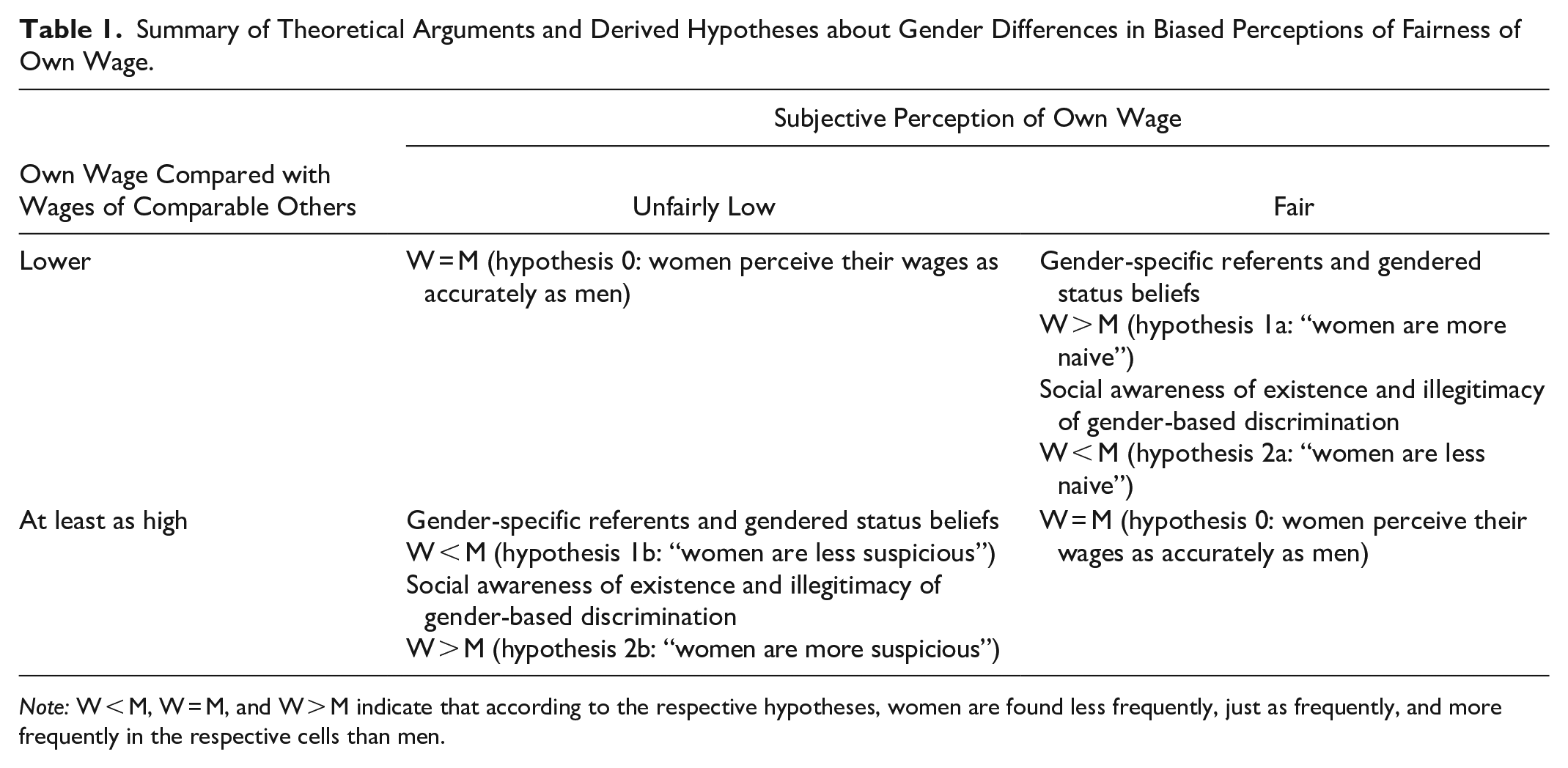
Note: W < M, W = M, and W > M indicate that according to the respective hypotheses, women are found less frequently, just as frequently, and more frequently in the respective cells than men.
Data: Combining Survey and Administrative Data to Calculate Fair Wages in the Predicted and in the Perceived Sense
We obtain the subjective perception of wage fairness from survey data that was conducted online between May and August 2021 (see Strauß et al. 2022 for detailed documentation). German employees were sampled on the basis of two administrative data sources, the Establishment History Panel and the Employee History (Beschäftigtenhistorik) of the Institute for Employment Research. They cover all firms with at least one employee and the complete working population except for self-employed individuals and civil servants in Germany. A stratified sampling approach was applied. In brief, 27 sampling cells were constructed on the basis of terciles of firm Gini coefficients, the share of female managers, and the gender pay gap (Strauß et al., 2025). The final sample of persons invited to participate in the survey consisted of 54,000 employees from 538 firms with at least 100 employees subject to social security contributions. 7,867 employees took part in the survey of which 6,836 gave their consent to link the survey data with administrative data. Among others, respondents were asked the following question: “Would you say your gross pay is unfairly low, fair, or unfairly high?” (9-point Likert-type scale ranging from −4 to 4, distribution in Figure A1 in the Appendix). Note that this question is very general and does not refer to specific comparisons (e.g., with others in the same job or with men). The comparison processes that employers engage in thus remain a black box in our study.
We link data from this survey to administrative data on all workers from the 538 firms from which we drew our sample of invited employees. After excluding individuals with missing information for the wage regression in the administrative data, we are left with 6,661 survey respondents and 142,444 workers from the same firms who did not participate in the survey. 1 We use this extended sample to calculate on the individual level whether respondents’ wages (as reported in the administrative data) are equal, lower, or higher than the wages of comparable employees in the same firm. We do so by estimating wage regressions to predict the wage a particular person should earn if he or she were to earn as much as comparable others with the same observable individual-, work-, occupation-, and firm-related characteristics:

The dependent variable y is the logarithm of gross daily wages at the end of 2019 of individual i working in occupation o at firm f. The independent variables in these wage regressions include the following characteristics
We do not include gender in the regressions to avoid reproducing a gender bias: if we only analyzed whether women earned less than comparable women, women who earned less than men in the same jobs would end up in the fairly paid category. Similarly, if we used comparable men’s wages as a benchmark, the group of objectively underpaid women would be larger. By including firm fixed effects, we assume that earning the same as comparable others refers to others working in the same firm rather than others in the same industry (which may include others with the same individual-, work-, and occupation-related characteristics who work in better-paying firms). As this is debatable, we also calculate models without firm fixed effects (see robustness analyses).
On this basis, we can assess whether respondents who earn less, more or the same as the predicted wage (i.e., the wage of comparable others) perceive their wage as fair or unfair, and describe gender differences in this relationship between “actual” and “perceived” wage fairness. As mentioned above, we use dummy variables for a more direct test of our hypotheses and a more intuitive understanding of our results: One dummy variable for wages being the same or higher than or lower than the predicted wage (“fair: predicted”) and one, based on the survey data, for respondents’ perception that their wage is fair (“fair: perceived” for a score of 0–4 on the 9-point Likert-type scale) or unfairly high (which only about 150 respondents say) versus unfairly low. On the basis of these two wage fairness dummies, we construct two additional dummy variables: one for wages that are fair in the predicted sense but that individuals perceive as unfairly low (as described above, we call this group “suspicious” employees) and one for wages that are unfair in the predicted sense but that individuals perceive as fair (we call this group “naive” employees) (see Table 2). All other respondents belong to the “accurate” group. On this basis, we assess whether women are more likely, less likely, or just as likely as men to be in one of these groups. After final data preparation our analysis sample consists of 3,984 employees. 4
Construction of Dependent Dummy Variables.


In robustness tests, we change the definition of predicted fair wages, exclude employees who reported being overrewarded from the category of “subjectively” fairly paid individuals, limit the sample to full-time employees and to employees who are at least partly aware of what others earn (on the basis of data from the survey), use industry rather than firm fixed effects in the wage prediction (see the section on robustness tests) and restrict the analysis to respondents who perceive their wage as highly unfair.
Analytical Strategy
We proceed in three steps. First, we present descriptive findings on the distribution of wages and on the share of women and men who receive the same, a higher or a lower wage than comparable employees and of the share of women and men who perceive their wage as fair or as unfairly high or low under these conditions (Figure 1).
Second, we use our dummy variables to distinguish between respondents who receive the same or a higher wage than the predicted wage or a lower wage (“fair: predicted”) and who perceive their wage as fair or unfair (“fair: perceived”). On the basis of linear probability models, we assess which characteristics make it more likely to receive at least the predicted wage and to perceive their wage as fair (first two columns of Table 4).
Third, on this basis, we analyze which characteristics make it more likely to belong to the group of “naive” respondents, who receive an unfairly low wage in the predicted sense but perceive their wage as fair. This allows us to test our hypotheses that women are equally likely (hypothesis 0), more likely (hypothesis 1a), or less likely (hypothesis 2a) than men to be “naive.” We also assess which characteristics make it more likely to belong to the group of “suspicious” respondents, who receive a fair wage in the predicted sense but perceive their wage as unfair. This allows us to test our hypotheses that women are equally likely (hypothesis 0), less likely (hypothesis 1b), or more likely (hypothesis 2b) than men to be “suspicious” (last wo columns of Table 4 and Figure 2).

Linear predictions by gender for main result and several robustness checks.
In all multivariate models, we control for absolute wages, age, tenure and nationality (German vs. non-German) of the employees, children, and working in a part-time job and include firm fixed effects and occupation fixed effects. Except for the fixed effects, for which we use information from the administrative data, all other variables in these models come from the survey data.
Descriptive Findings I: The Distribution of Wages
Table 3 shows the mean values of predicted and reported wages by gender (see Table A3 for descriptive statistics of main variables used for estimations).
Mean Values of Wage Variables by Gender.

Source: Beschäftigtenhistorik, Survey “FAIR: Arbeiten in Deutschland” (Strauß et al. 2022).
p = .001.
We see that the gross monthly wage according to administrative data and the gross monthly wage reported in the survey differ only slightly. In both cases, women earn almost €1,000 less than men. Women’s predicted wages (i.e., the wage of a person with the average individual-, work-, and firm-related characteristics of female employees) are also lower, but with about €840 the difference is slightly less pronounced than it is for actual wages. The difference between −994.53 and −840.03 is −154.5; this value indicates the size of the unexplained gender wage gap in our data, that is, the amount that women earn less than men that is not accounted for by individual-, occupation-, work-, or firm-related characteristics observable in our data. The fact that the adjusted gender wage gap in our data (about 3 percent) is smaller than in the general German population (5.9 percent), can probably be attributed to our specific sample that only includes employees from larger firms (with at least 100 employees) that are on average better paid than employees in small and medium-sized firms where women are overrepresented (OECD 2022).
In Figure 1, we graphically display the link between respondents’ actual and perceived wage fairness (see Figure 1). To this end, we estimate a model with the categorical perceived fairness of the wage as the dependent variable and the difference between the actual and predicted wage and its interaction with gender as explanatory variables (as well as further control variables, see Table A4). We then plot the predictions of perceived wage fairness and the difference between actual and predicted wages (from the administrative data) for male and female employees.
The results show, first, that the large majority of employees perceive their wage as unfairly low (i.e., they are located below the horizontal dashed line that indicates the position of those individuals who reported that they earn neither too much nor too little). In the sense of our dummy variables, there are far fewer “naive” than “suspicious” respondents. Actual wages, on the other hand, appear to be fairly evenly distributed to the right and left of the vertical dashed line, which indicates the position of employees who earn exactly the wage that comparable others with the same individual, occupational, work and company characteristics earn and who, in this sense, receive a fair wage. At first glance, there are no gender differences: orange (female) and blue (male) dots appear to be rather evenly distributed across the cloud, an impression confirmed by the predictive margins shown at the bottom of the graph. Whether we look at those earning less or more (displayed in €500 intervals) than the predicted wage: the differences between men and women are small and not statistically significant.
Descriptive Findings II: Who Gets Fair Wages in the Predicted and Perceived Sense?
For the ease of interpretation and to test our hypotheses more directly, we use our dummy variables in the remaining analyses. That means we only differentiate between respondents who are paid fairly versus unfairly low in the predicted and in the perceived sense, that is, those who earn more than the predicted wage are allocated to the group of respondents who are paid fairly and those (few) who perceive their wage as unfairly high are allocated to the group of respondents who perceive their wage as fair.
Columns labeled (a) in Table 4 first show the correlation between gender and wage fairness, without controlling for other characteristics. Although 53.8 percent of male employees receive a fair predicted wage and 43.3 percent consider their wage to be fair, the shares among women are only 48.9 percent and 39.4 percent respectively. In the next step, we estimate the marginal effects of gender and other factors on the determinants of fair wages in the predicted and in the perceived sense simultaneously (see columns 1b and 2b in Table 4). Those with higher wages are also more likely to earn as much or more than comparable employees. In line with previous research, the likelihood that employees perceive their wage to be fair also increases with wage levels. Once we control for wage, women are somewhat more likely to receive the predicted wage than men (see model 1b in Table 4; the effect is significant at the 5 percent level). Figure A2 sheds light on this counterintuitive finding. As the predicted wage calculated for women is lower than for men (see Table 3), they receive the predicted wage “earlier” (i.e., at lower wage levels than men). In other words, a woman who earns €7,000 is more likely to receive the predicted wage than a man who needs to earn about €8,000 to receive the predicted wage with the same likelihood. Results also show that women are just as likely as men to believe that they are rewarded fairly once we control for wage level. Note that these descriptive results do not yet take into account whether someone earns what comparable others earn or less.
Regression Results: Baseline Models.

Source: Beschäftigtenhistorik, Survey “FAIR: Arbeiten in Deutschland” (Strauß et al. 2022).
Note: Regressions (b) include firm fixed effects and occupation fixed effects. Values in parentheses are robust standard errors.
p < .10. *p < .05. **p < .01. ***p < .001.
Hypotheses Test: Are Women More, Less, or Equally “Naive” or “Suspicious” Than Men When Evaluating the Fairness of Their Wages?
On the basis of the predictive margins, we cannot clearly distinguish between “accurate” and “naive” respondents and between “accurate” and “suspicious” respondents. To test our hypotheses on gender differences in belonging to one of these groups more directly, we therefore look separately at the subsample of those employees who earn less than comparable others and assess whether women are more, less or equally likely than men to perceive these unfairly low wages as fair (column 3 in Table 4). We also look separately at the subsample of those employees who earn as much as comparable others and assess whether women are more, less or equally likely than men to perceive these fair wages as unfair (column 4 in Table 4).
In short, once we control for individual, work, occupation, and firm characteristics, we do not see gender differences in either direction (columns 3b and 4b in Table 4). Women are neither more “naive” nor more “suspicious” than men—in line with the null hypotheses that there are no gender differences in (un)fairness perceptions—and refuting hypotheses 1a and 1b as well as hypotheses 2a and 2b. Another important result is that the key determinant of whether someone perceives his or her wage as fair is the wage level. Employees who earn more tend to be more “naive” and they are clearly less “suspicious.” The same is true for those who work part-time and those with longer tenure with the current employer. Employees with foreign citizenship are more likely to be “suspicious” (i.e., to perceive their pay as unfair), even if they belong to the subsample that received fair pay in the predicted sense.
Robustness of the Results
To check the robustness of our main results, we made some modifications to our sample and our binary dependent variables. Along with the main results, the linear predictions by gender for being “naive” or “suspicious” for all robustness checks are presented in Figure 2. First, we change the threshold at which a predicted wage is coded as fair. For our main estimations, the threshold was exactly set at the actual wage. In this robustness test, we set the threshold more generously and define predicted wages as fair as soon as they are at least 95 percent of the actual wage. As a result, 384 more people receive predicted fair wages. The results are very similar to the previous ones (see Table A6). Second, we exclude employees who state that their wages are unfairly too high. This affects only 150 employees and the results hardly change (see Table A7). Third, we do not have information on hours worked in the administrative data. Therefore, we can only use information on whether a person worked full-time or part-time for the wage estimations. Full-time work is relatively unproblematic as there should be little variation in working hours but for part-time work, the number of hours most likely varies more. We therefore exclude part-time employees for a robustness test. The results are shown in Table A8. They are similar to our main results. However, women are not more likely to receive the predicted wage than men. Fourth, we limit our main analyses to the sample of employees who are at least partly aware of what their coworkers earn. 5 This implies that we focus on individuals who can assess their wage in relation to that of their colleagues more accurately. Again, the results remain unchanged (see Table A9)
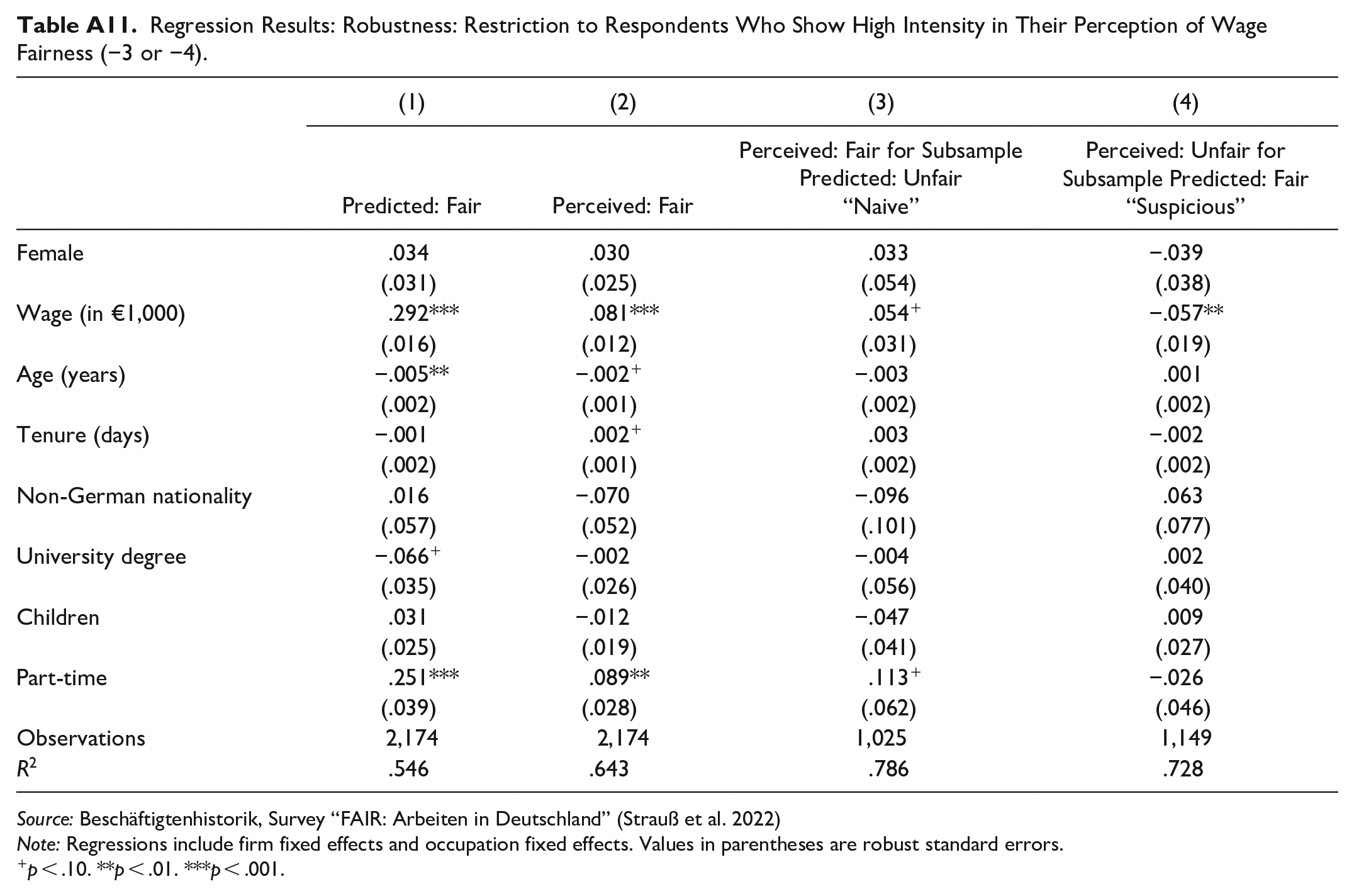
Fifth we estimate our models without firm fixed effects but use industry fixed effects instead. As a consequence, we allocate respondents in low-paying firms who receive at least the same wage as comparable employees working in the same firm but less than comparable employees in other firms in the same industry more often into the category of those who are unfairly paid in the predicted sense rather than to those who are paid fairly (the shares in the fair category thus decrease from 49 percent to 44 percent for women and for men from 54 percent to 47 percent; see Table A10). Sixth and finally, we investigate heterogeneity in the intensity of perceived unfairness of one’s wage by excluding those with moderate perceived unfairness (−1 or −2) from the analysis. In this specification, fewer respondents perceive their wage as unfair (those with −3 or −4 on our scale; see Table 2). The relative size of the group that perceives fairness has thus increased, and there are more respondents in the “naive” group than in the “suspicious” group. Most important, there are still no gender differences (see Table A11).
Conclusion and Discussion
The gender wage gap has received a great deal of public attention. Previous studies have provided empirical evidence and theoretical arguments for its persistence. The latter include the claim that employees accept this inequality because of women’s tendency to compare their wages to those of other women, who on average earn less than men and to gendered status beliefs about women’s lower labor market productivity (Auspurg et al. 2017). These arguments also provide an explanation for women’s tendency to be satisfied with lower own earnings, an aspect of the so-called contented female worker paradox.
However, on the basis of another strand of literature that focuses primarily on ethnic and racial minorities (Schaeffer and Kas 2023), the opposite could be the case. Because of salient public debates about the illegitimacy of unequal treatment based on ascriptive characteristics, women may be quite aware of the existence and the illegitimacy of such inequalities (Jun et al. 2022) which may affect them personally. As a result of these general dynamics, women today may “anxiously expect” and “readily perceive” (Mendoza-Denton et al. 2002) unfair treatment. This, in turn, may affect their perceptions of the fairness of their own wages.
Because few employees know exactly how much comparable coworkers earn, these evaluations typically take place in highly ambiguous situations. They are therefore prone to bias, including a “naive” underestimation and a “suspicious” overestimation of the unfairness of one’s own pay. We tested these hypotheses that women are more naive or more suspicious than men against the null hypothesis that women and men are equally accurate in assessing the fairness of their own pay. Although several recent studies suggest this, they have typically analyzed whether women are as likely as men to perceive their pay as (un-)fair at a given wage level. This strategy, however, cannot rule out that women are paid less (un-)fairly than men.
We have built on this research and gone beyond it by applying a methodology known from the literature on reference wages. On the basis of linked employer-employee data, we calculated the predicted wage for each respondent in our dataset, that is, the wage that a particular person should earn if he or she were to earn as much as comparable others with the same observable individual-, work-, occupation-, and firm-related characteristics. We then assessed whether an employee earns more, less or the same, and compared this empirical indicator of pay fairness with their subjective perception that they are paid fairly and looked at gender differences herein.
In line with other recent studies, our results support the null hypothesis that women are neither more nor less accepting of lower wages than men; in other words, they are neither more nor less “naive” or “suspicious” than men when it comes to judging the fairness of their own pay.
To be sure, our approach has its limitations. Most important, fairness is a big concept, and our approach is as innovative as pragmatic. It completely ignores—and we want to be very clear about this—the fact that wages are lower in many female-dominated occupations or in certain firms into which women self-select (e.g., because of family responsibilities). Our definition of a fair wage is also purely relative (to the wage of comparable others) and does not take into account the many tricky normative issues that surround this concept.
Second, we do not know what reference groups respondents compare themselves with when deciding whether they think that their pay is fair. The survey question we use does not specify specific comparison groups (e.g., male colleagues, coworkers). Accordingly, we define comparable as others who are as similar as possible in terms of the individual, occupational, and work-related characteristics, independent of their gender. By using firm fixed effects in our main analyses, we followed arguments from the previous literature in our main analysis that those doing the same job in the same firm are the most important reference group for employees. Third, only German firms with at least 100 employees are included in our sample. Future studies should assess the generalizability of our findings to smaller firms and beyond the German context. As the gender wage gap tends to be lager in smaller firms, we may underestimate the share of women who are unfairly paid.
Fourth and finally, because the complex data central to this study are not available for earlier periods, we were not able to look at trends over time or to directly assess the role of awareness of unequal treatment, which is at the heart of the idea that women may be more “suspicious” than men. In any case, as acceptance of inequality plays an important role in its persistence, the finding that women are no more likely than men to accept unfairly low wages is ultimately good news.
Footnotes
Appendix
Regression Results: Robustness: Restriction to Respondents Who Show High Intensity in Their Perception of Wage Fairness (−3 or −4).
| (1) | (2) | (3) | (4) | |
|---|---|---|---|---|
| Predicted: Fair | Perceived: Fair | Perceived: Fair for Subsample Predicted: Unfair |
Perceived: Unfair for Subsample Predicted: Fair |
|
| Female | .034 | .030 | .033 | −.039 |
| (.031) | (.025) | (.054) | (.038) | |
| Wage (in €1,000) | .292*** | .081*** | .054 + | −.057** |
| (.016) | (.012) | (.031) | (.019) | |
| Age (years) | −.005** | −.002 + | −.003 | .001 |
| (.002) | (.001) | (.002) | (.002) | |
| Tenure (days) | −.001 | .002 + | .003 | −.002 |
| (.002) | (.001) | (.002) | (.002) | |
| Non-German nationality | .016 | −.070 | −.096 | .063 |
| (.057) | (.052) | (.101) | (.077) | |
| University degree | −.066 + | −.002 | −.004 | .002 |
| (.035) | (.026) | (.056) | (.040) | |
| Children | .031 | −.012 | −.047 | .009 |
| (.025) | (.019) | (.041) | (.027) | |
| Part-time | .251*** | .089** | .113 + | −.026 |
| (.039) | (.028) | (.062) | (.046) | |
| Observations | 2,174 | 2,174 | 1,025 | 1,149 |
| R 2 | .546 | .643 | .786 | .728 |
Source: Beschäftigtenhistorik, Survey “FAIR: Arbeiten in Deutschland” (Strauß et al. 2022)
Note: Regressions include firm fixed effects and occupation fixed effects. Values in parentheses are robust standard errors.
p < .10. **p < .01. ***p < .001.
Funding
The author(s) disclosed receipt of the following financial support for the research, authorship, and/or publication of this article: Deutsche Forschungsgemeinschaft (DFG – German Research Foundation) under Germany‘s Excellence Strategy – EXC-2035/1 – 390681379.

1
2
4
As the latest wage information in the administrative data is from December 2019 and the survey was conducted 1.5 years later, we further restrict our analysis sample to workers who did not change their employer within this period. This reduces our sample for the main analyses to 6,022 observations. We also drop all persons with missing values in our outcomes (16 observations with missing values for subjective and objective assessment of wages) and explanatory variables (152 observations) as well as individuals with implausible differences between actual and predicted wage (more than 100 percent difference based only on administrative data information, 59 observations with missing values). For our analyses, we assume that the worker’s own assessment of fair renumeration in the summer of 2021 and the objective assessment of December 2019 are for “the same wage.” To ensure this, we also exclude individuals for whom the wage from the administrative data measured in December 2019 and the wage given in the survey 1.5 years later differs by more than 15 percent (1,811 observations). Finally, we end up with 3,984 observations for our main estimations.
5
This restriction is based on the survey question “Are you familiar with your colleagues’ salaries?” for which respondents could answer “yes,” “partially,” or “no.” We exclude respondents answering “no” for this robustness check.