




Abstract
This study investigated how the combination of textual and visual frames influences the attribution of responsibility for arrest and deportation of undocumented migrants and empathy. A 3 visual frame: (no photo, stereotypical photo, counter-stereotypical photo) × 2 textual frame: (episodic, thematic) between-subjects online experiment revealed that including a counter-stereotypical photograph in both episodic and thematic news stories had a positive effect on empathy for undocumented migrants but did not affect responsibility for arrest and deportation. Adding a stereotypical photograph to an episodic news story significantly reduced societal responsibility for arrest and deportation and decreased the level of empathy.
Keywords
Experimental studies have confirmed the news media’s important role in influencing people’s attitudes toward immigration and in particular Latino migrants (Figueroa-Caballero & Mastro, 2019; Wei et al., 2019). Research on framing effects has shown that variations of frames in news stories about immigration can significantly affect the viewers’/readers’ emotional response toward immigrants (Lecheler et al., 2015). As the news media landscape has become increasingly multimodal and ubiquitous (Dan, 2018; Powell et al., 2018), online news utilizes a combination of text and visuals to reach the audience (Dan, 2018; Vobič & Tomanić Trivundža, 2015). It is crucial that studies on framing effects and immigration include both stories and visuals to decipher how diverse modes of representations shape public opinion, attitudes, and perceptions.
Analyzing the effects of combined visuals and text in news remains vital because images stimulate viewer’s attention and brains tend to assimilate visuals faster than words (Bucher & Schumacher, 2006; Holsanova et al., 2006). Studies have shown the juxtaposition of visuals and words “can enhance the memory for the comprehension of the verbal information” (Abraham & Appiah, 2006). There is evidence that individuals reading news remember visuals better than words (Blum & Bucher, 1998) and the process of absorbing information is facilitated if the verbal or textual frame is accompanied by visual frames (Gibson & Zillmann, 2000).
Research has found even a one-time exposure to counter-stereotypical images can reduce negative perception of outgroups and improve racial attitudes toward Black Americans (Power et al., 1996; Ramasubramanian, 2011; Ramasubramanian & Oliver, 2007). Concerning the representation of Latino, Mastro and Tukachinsky (2011) confirmed that counter-stereotypical exemplars in media can positively influence the perception of ethnic groups. Parrott and colleagues’ (2019) study indicated a more positive visual depiction of immigrants on social media improves the audiences’ overall attitude toward immigration.
Although several studies have focused on the framing effects of photographs and stories separately, the combined effects of visual and verbal frames on people’s perception remain a relatively unexplored area of study. In addition, until now, little research has examined the effects of counter-stereotypical and stereotypical visual frames and textual thematic/episodic frames that focus on news stories and images about undocumented Latino migrants. Employing a 3 (visual frame: no photo, stereotypical photo, counter-stereotypical photo) × 2 textual frame: (episodic, thematic) online experiment, this study tests how and if the combination of textual and visual frames affects people’s attribution of responsibility for arrests and deportations and the level of empathy for deported undocumented migrants.
The effect of thematic and episodic frames
In the vast scholarship of framing, one line of inquiry focuses on emphasis-framing effects (Chong & Druckman, 2007). Druckman indicates that is rarely possible to manipulate frames without modifying some of the facts presented. He refers to emphasis-framing when certain aspects of a media message are highlighted, influencing the audiences’ perception and point of view about an issue (Druckman, 2001). Emphasis frames give salience to specific angles of an issue while excluding others, “making certain interpretations more relevant and applicable in subsequent judgment making” (Sun et al., 2016, p. 141). Emphasis-framing directs attention to a certain aspect of an issue, activating viewers/readers’ pre-existing mental schemas and potentially influencing people’s perception of attribution of responsibility (Weiner, 1985). Text and visuals can be used to emphasize certain aspects of events, influencing people’s decision to assign responsibility for that event to individual or societal factors (Lewis et al., 2023).
Iyengar operationalized emphasis frames as individual versus societal frames (Sun et al., 2016). An episodic story is a news story that “takes the form of a case study or event-oriented report and depicts public issues in terms of concrete instances” (Iyengar, 1994, p. 14). Episodic articles usually do not provide precise context; they focus on individuals and cases describing “specific people,” (Ben-Porath & Shaker, 2010). Episodic frames put a human face to the story (Zhang et al., 2016). Given the lack of detailed information or any explanation about the societal reasons behind a certain problem, the exposure to episodic frames tends to lead the audience to attribute responsibility for an issue and its solution to the individual depicted in the story (Iyengar, 1994). There is substantial support in the literature indicating that people exposed to news framed episodically tend to attribute responsibility of issues to the individual rather than the society. These results were confirmed in experimental studies testing framing effects on policies about climate change (Hart, 2011), mandatory minimum sentencing for crime (Gross, 2008), and social security (Springer & Harwood, 2015).
Thematic stories offer the audience a background of the issue; they emphasize the general impact of policies, providing overall patterns, data, trends, and in-depth analysis. A thematically framed news story “places public issues in some more general context” (Iyengar, 1994, p. 14), shifting people’s attribution of responsibility for the issue and its solution to society. Thematic stories include information about policies while highlighting the societal conditions linked to the issue, “encouraging collective public action and cultivating a sense of shared responsibility” (Major, 2009, p. 20). Following Iyengar’s study, scholarship has shown a significant relationship between thematic news stories and audiences’ attribution of responsibility to society for poverty and Muslim Americans (Feezell et al., 2019), lung cancer and obesity (Major, 2009), and policy related to climate change (Hart, 2011).
Regarding the topic of immigration, findings on the still limited scholarship on thematic and episodic framing effects and responsibility are discordant. Episodic stories may be used to focus on specific individuals to lead the viewers/readers to blame undocumented migrants (Berg, 2009; Masuoka & Junn, 2013) and to foster a negative depiction of immigration as harmful to the community and as a threat to the society (Chavez, 2020). However, as some episodic stories with a positive tone tend to increase the support for specific categories of immigrants (Merolla et al., 2013), they can also positively affect people’s opinion toward immigration when the audience sympathizes with a particular policy or situation, like in the case of the “Dreamers,” in turn increasing attribution of responsibility for the issue to the society (Haynes et al., 2016). Conversely, news media can rely on thematic stories to present solutions without labeling individual immigrants, potentially helping the audience to better understand the broader dynamics of a complex issue such as immigration (Iyengar, 1994; McLeod et al., 1999). On the contrary, thematic stories with negative language can de-humanize and de-personalize immigrants, providing a stereotypical depiction of immigration that can potentially discourage empathy and shift the blame to migrants (Figenschou & Thorbjørnsrud, 2015; Somaini, 2019).
In addition to the discrepant findings within the literature on immigration, Boukes (2022) noted that the recent mixed results in the scholarship of thematic and episodic framing effects on responsibility may be due to the type of exemplars in the news stories that are being tested. For instance, describing different exemplars in an episodic story can produce contrasting results in how people perceive the responsibility for a social issue. In other words, people’s attribution of responsibility can be affected by how the story is framed and by the individuals portrayed in that frame.
To the knowledge of the authors, this is the first study that tests the effects of thematic and episodic stories of undocumented immigration on attribution of responsibility and empathy. Considering the contradictory results of previous research, the following research questions are posed:
Visual frames and the activation of stereotypes and counter-stereotypes
The point of theoretical connection between framing and visual framing lies in the act of selecting, highlighting, or omitting a certain aspect or angle of an issue. As with framing, the visual frame’s function is to select, emphasize, or highlight a certain aspect of a message (the visual) and present it to the audience (Entman, 1993). How news outlets visually frame a certain issue, thus the decision of what type of images are published alongside the stories, can influence the way the viewers/readers understand or interpret that issue.
Powell and colleagues (2015) found that, when presented together, visual frames drive behavioral choices regardless of the linked text. Sontag (2018) found that in messages about depression, the addition of visuals fostered empathy and identification with patients. Gartner (2011) showed that adding loss-frame images in stories about war decreased support for military intervention. von Sikorski and colleagues (2012) found that, when media visually framed Paralympian athletes cheered by the crowd, people’s empathy for the athletes increased. In sum, there is some evidence that visuals combined with text produce stronger effects than text alone when measuring specific emotions (Powell et al., 2019; Scharrer & Blackburn, 2015), in memory retention (Newhagen & Reeves, 1992) and in activating stereotypical schemas toward crime (Abraham & Appiah, 2006).
Visuals can impact how the audience perceives ethnic groups, potentially contributing to the formation of stereotypes. For example, news articles about issues such as the AIDS epidemic or stories about the reliance on welfare policies have been regularly juxtaposed with images of Black Americans, implying that both issues were inherently connected to being Black and living in predominantly Black communities (Bird, 1996; Entman, 1993; Martindale, 1996). Journalists may write news stories to explicitly make a statement or to explain the details of an issue (e.g. undocumented immigration), while visuals can be published alongside text to express more nuanced, implicit, and subtle meanings, directing the viewer/reader to associate the story with the individual(s) portrayed in the images (Abraham, 2002). Even when pictures do not openly vilify ethnic groups, the overlapping of visuals and text can activate pre-existing schemas toward that specific ethnic group, fostering stereotypes (Grimes & Drechsel, 1996).
The continuous and persistent stereotypical representation of outgroups in the media not only influences public opinion but also encapsulates the way the audience sees certain ethnic groups. In other words, the stereotypes become the schemata audience members activate to judge outgroups (Abraham & Appiah, 2006). Researchers have shown individuals tend to categorize people based on cognitive models that are stored in the brain and that facilitate quick information processing (Mackie et al., 1996). These mental representations can lead to generalizations and drive stereotyping when defining outgroups (Operario & Friske, 2001).
Given the preponderance of negative and positive stereotypes in the media landscape, the role of counter-stereotypes is critical. Counter-stereotypes not only convey a positive representation, but they are “ideas about a group that challenge, or counter widely held cultural beliefs and mental models of a group” (Ramasubramanian et al., 2020, p. 2). Research shows that counter-stereotypical media messages can decrease prejudice and racial stereotypes (Holt, 2013; Ramasubramanian & Oliver, 2007). Counter-stereotypical representations in news media can foster the viewers’/readers’ sympathy for representatives of outgroups (Power et al., 1996). Moreover, audiences who are exposed to counter-stereotypical portrayals are more inclined to blame society for the outgroups’ problems, while audiences who are exposed to stereotypical messages are more inclined to blame the individual members outgroups.
Media effects on empathy toward stigmatized groups
The media coverage of stigmatized groups such as migrants can also have an impact on the level of empathy, and consequently on people’s attitudes toward outgroups and social policies (Hoops & Braitman, 2019; Oliver et al., 2012). Spiro (1992) defined empathy as the people’s capacity to understand other groups or individuals’ perspectives. For Hoffman (2000), empathy is one’s ability to feel other individual emotional needs and reactions. Overall, researchers agree empathy is an “emotional response to the welfare of another” (Johnson et al., 2009, p. 465), and it involves understanding other individuals’ perspectives and situations, showing concern for their well-being (Batson et al., 1996). This study focuses on the affective element of empathy (Tsang, 2018). Affective empathy is described as the emotional reaction to the experience of others, the capacity to understand others’ feelings (Bandura, 2002), and an ‘affective response to another person, which often involves sharing that person’s emotional state (Decety & Jackson, 2004). This study considers empathy as an affective experience linked to the viewers’ ability to share the undocumented migrants’ ordeal of being arrested and deported.
Johnson et al. (2009) found the stereotypical visual portrayals of Black men as looters in the aftermath of Hurricane Katrina significantly decreased empathy and support for public policies such as government assistance. Similar results were obtained when people were exposed to stereotypical images of Black women as sexual and promiscuous in rap videos. In a follow-up experiment, Johnson et al. (2009) found images of sexualized Black women elicited lower levels of empathy for Black women in financial need during pregnancy and stronger individual attribution of promiscuity. Hecht et al. (2022) found videos of people diagnosed with schizophrenia and autism and that focused on the patients’ personal experience were highly effective in stimulating empathy and in reducing stigma.
Other studies showed media messages that are framed episodically and highlight the human-interest side of an issue by including biographical details of the people involved are also effective in eliciting empathy. Gross (2008) found episodic stories with empathetic language about a woman accused of drug-related crimes were more emotionally engaging; it increased empathy and reduced the support for mandatory minimum sentences. Overall, the literature reveals that by modifying the way outgroups are framed using words or visuals, the news media can affect people’s empathy. There is evidence confirming that when media outlets humanize outgroups, the level of empathy increases, and this may lead to a shift in causal attribution, a reduction of stigma, and an increase in support of public policies.
Considering that images enhance memory and are assimilated faster than words, and importantly, that counter-stereotypical messages can reduce pre-existing categorization and stereotypes, this study predicts if news organizations change how they visually frame migrants by selecting and adding counter-stereotypical photographs to either episodic and thematic stories, attribution of responsibility for arrests and deportations will shift from the individual to the societal, and empathy for undocumented migrants will increase. On the contrary, if news organizations add stereotypical visual frames to episodic and thematic stories, the attribution of responsibility will shift to the individual, and the level of empathy will decrease.
Therefore, the following hypotheses are tested:
Method
An online experiment was conducted to test if the combination of different textual frames (episodic and thematic) and visual frames (stereotypical and counter-stereotypical) influences the attribution of responsibility and empathetic response. This experimental study used a 3 (visual frame: no photo, stereotypical photo, counter-stereotypical photo) × 2 (textual frame: episodic/thematic) between-subjects factorial design. Depending on the condition to which they were randomly assigned, participants read one news story framed thematically or one news story that was framed episodically. The stories included either one stereotypical photograph of an undocumented migrant, one counter-stereotypical photograph of an undocumented migrant, or no photograph. The stories were counterbalanced to account for order effects (Table 1 in the Supplemental Materials).
Participants and procedure
Participants (N = 420) were recruited through Amazon’s Mechanical Turk in exchange for $1. Although Turk does not provide a random sample, this method was used because research has shown it provides a more representative sample of the U.S. population compared with college students, thus guaranteeing higher external validity (Berinsky et al., 2012; Minton et al., 2020). MTurk samples were also found to be closely representative of the U.S. political ideological divisions in the mass public (Clifford et al., 2015). The survey experiment was posted on Turk on September 16, 2021, and data were collected through October 7, 2021. The title of the Turk hit read “Take a brief survey about news and opinions in the United States (∼10 min.).” The job description stated, “Read the news article and answer a battery of questions about the issue described in the story.” Eligible MTurk workers had to be U.S. residents, had a task completion rate > 95%, and have completed more than 10,000 tasks. Data were collected using Qualtrics to which the workers were directed from Amazon Mechanical Turk. A bot detection tool with Q RecaptchaScore was activated for each respondent.
Eight participants were dropped because they did not complete over half of the survey for a total N of 412 participants. The mean age of the participants was 43.5 years. The majority of respondents (40.7%) reported a household income between $50,000 and $100,000 a year. As for education, 51% completed a bachelor’s degree, 17.9% had a high school diploma, 16.9% had a master’s degree, 11.6% had an associate degree, and 1.9% had a Ph.D./Doctoral degree.
Participants were randomly assigned to one of the six experimental conditions. The stories were counterbalanced to ensure there were no order effects. Each participant read one news story (one episodic or one thematic). For the participants who received thematic or episodic stories with photographs, one photo was included for each news story (one stereotypical photograph or one counter-stereotypical photograph). The participant read the immigration news story (with or without photographs depending on the condition), filled out a questionnaire, and proceeded with the online submission.
Controls
This study was a randomized experiment, but three control variables that would be of importance for the issue of immigration—gender, party ID, and ethnic background (Guo et al., 2020) were added. Participants were asked to identify their political affiliation (1—Strongly Republican, 7 = Strongly Democrat), and the mean average was 4.42 (SD = 1.88). Overall, the sample of participants was moderately Democrat. Notably, 51.3% of participants identified as male, 48% as female, and 0.7% as non-binary. Regarding ethnic background, 75.7% of participants identified as White—Caucasian, 8.9% as Black—African American, 6.5% as Asian—Eastern, 4.3% as Latino or Hispanic, 1.9% as Mixed race, 1.4% as Asian—Indian, 0.5% as Native American, and 0.5% as Other.
Manipulation and pre-tests
The authors conducted a first pre-test with a sample of 62 undergraduate students enrolled in a media and communication course and who did not take part in the actual survey experiment. After reading the news stories and then viewing the pictures, participants answered the following open-ended questions: “Suppose a friend came to visit you and she or he has not read this story. How would you describe this story to that friend?” and “How would you describe the photo to a friend?” Participants reading the thematic news story answered the question using more thematic statements (N = 54) than episodic statements (N = 8), while participants reading the episodic news story used more episodic statements (N = 57) than thematic statements (N = 5). Participants who looked at the stereotypical photo described the picture, or the migrant represented in stereotypical terms (N = 53), participant who viewed the counter-stereotypical photo described the picture or the migrant represented in counter-stereotypical terms (N = 55).
A manipulation check was also conducted during the survey experiment. After reading the news story and looking at the photo (if the picture was included in the condition to which they were assigned), 420 respondents were asked to describe the article and/or the picture to a friend. A quantitative content analysis of the answers was conducted to verify if participants identified thematic/episodic news stories and stereotypical/counter-stereotypical photographs. For both news articles and photographs, the unit of analysis was the statement and the coding categories were the episodic and thematic statements and the stereotypical and counter-stereotypical statements. One coder was trained and coded 15% of the sample of statements for intercoder reliability. Krippendorff’s alpha was considered acceptable and ranged from .8 to .88. The Chi-square test showed that participants who read the news story framed episodically wrote significantly more episodic statements than thematic χ2 (1, N = 192) = 23.39, p < .001. Individuals who read the thematic news story identified more thematic statements than episodic χ2 (1, N = 188) = 7.322, p = .002. Respondents who looked at the stereotypical photo of the migrants described the image with more stereotypical statements χ2 (1, N = 114) = 9.95, p < .001, while participants who looked at the counter-stereotypical photo described the image significantly with more counter-stereotypical statements χ2 (1, N = 101) = 3.57, p < .001.
Stimulus materials
The stories were based on real news articles found on the search engines of local U.S. news websites. The stories had approximately the same number of words (201–220), quotes, sources, and episodic or thematic statements (see stimuli in Appendix A). The first condition included an episodic story that focuses on one undocumented man originally from Mexico who has been living and working in the United States for almost a decade. The story reports his arrest after a raid of the ICE officers and his deportation.
The second condition included one story framed thematically. The article gave information about the raids organized by ICE and the arrest and deportation of hundreds of immigrants who have been living and working in the United States. The difficulty of obtaining permanent residency and citizenship was also described. The third condition included the episodic story with one stereotypical photograph representing the migrant described in the story. As news organizations have often linked undocumented immigration to stories and images about crime and arrests, the stereotypical photograph showed a mugshot of the individual after the arrest by the ICE officers.
The fourth condition included the thematic story and one stereotypical photograph. The individual portrayed in the photographs is the same in both stories, but a caption describes the migrant as one of the people (thematic) or the person (episodic) arrested during the raid. The fifth condition included the episodic story and one counter-stereotypical photograph representing the unauthorized immigrant described in the story. The sixth condition incorporated the thematic story and one counter-stereotypical photograph. As for the stereotype conditions, the individual portrayed in the photograph was the same in both the stories and the caption described the migrant as one of the people (thematic) or the person (episodic) arrested during the raid. Counter-stereotypical portrayals “challenge or counter widely held cultural beliefs and mental models of a group” (Ramasubramanian et al., 2020). In the fifth and sixth conditions, the counter-stereotypical photo showed the migrant before the arrest, while at work, smartly dressed in his office and looking directly at the camera. No visual portrayal of the search, raid, or arrest was shown.
Dependent variables
Attribution responsibility
Following Iyengar (1994) and Major (2009), five statements measured the societal responsibility for arrests and deportations, and five statements measured the individual responsibility for arrests and deportations. Measures were taken using 7-point Likert-type scales. To find how the 10 statements reflected underlying dimensions, a factor analysis with varimax rotation was conducted. The factor analysis indicated that the dependent variable attribution of responsibility clustered with two dimensions: societal responsibility and individual responsibility. The societal responsibility index included the statements: “Failure of the federal government to consider undocumented migrants as an important resource for the society is partly to blame for their arrests and deportations,” “The federal government’s inaction in providing businesses and industries with adequate number of worker Visas is partly to blame for the arrest and deportation of undocumented migrants,” “The federal government should provide a pathway to permanent residency and citizenship for undocumented migrants,” and “The federal government’s discrimination and prejudice against undocumented migrants is partly to blame for their arrests and deportations” (Cronbach’s alpha .902). The individual responsibility index included the following statements: “Undocumented migrants without proper documentation such as worker Visas are directly responsible for their arrest and deportation,” “Undocumented migrants should blame themselves for their arrest and deportation,” “The arrest and deportation of undocumented migrants is a problem of the individual migrants and not the Federal government.” “If undocumented migrants try, they will obtain permanent residence and citizenship,” and “If undocumented migrants work hard, they will be able to secure permanent residence and citizenship” (Cronbach’s alpha .826).
Empathy
The empathy index was adapted from previous studies (Hoops & Braitman, 2019; Olckers et al., 2010). A 7-point Likert-type type scale, which ranged from strongly disagree to strongly agree, was used for measurements. A higher score indicated greater empathy for undocumented migrants. The statements included were “The suffering of undocumented migrants deeply disturbs me,” “It makes me upset to see how undocumented migrants are treated,” “I feel deeply for undocumented migrants,” “It hurts to see undocumented migrants in pain,” and “I feel sad for the undocumented migrants who are arrested and deported” (Cronbach’s alpha .952).
Results
To answer RQ1 and RQ2 and to test H1–H4, a multivariate analysis of covariance (MANCOVA) was employed with textual frames (thematic, episodic) × visual frames (stereotypical photo, counter-stereotypical photo, no photo) as independent variables, individual responsibility, societal responsibility and empathy as dependent variables and political ID, ethnic background, and gender as covariates (see Tables 3–5 in the Supplemental Materials for full results). MANCOVA revealed a significant difference between the textual/visual frames of immigration in articles on the combined dependent variables after controlling for covariates (F (15, 1107) = 1.836, p = .003, Wilks’ Λ = .91, partial η2 = .028). Univariate tests showed that there was a significant effect on societal responsibility, (F (5, 403) = 2.597, p = .025, partial η2 = .031), without covariates, p = .018, individual responsibility (F (5, 403) = 2.379, p = .038, partial η2 = .029), without covariates, p = .014, and empathy (F (5, 403) = 2.5, p < .030, partial η2 = 0.30), without covariates, p = .007 (see Figures 1–3 for a graphical representation of the findings after controlling for covariates).
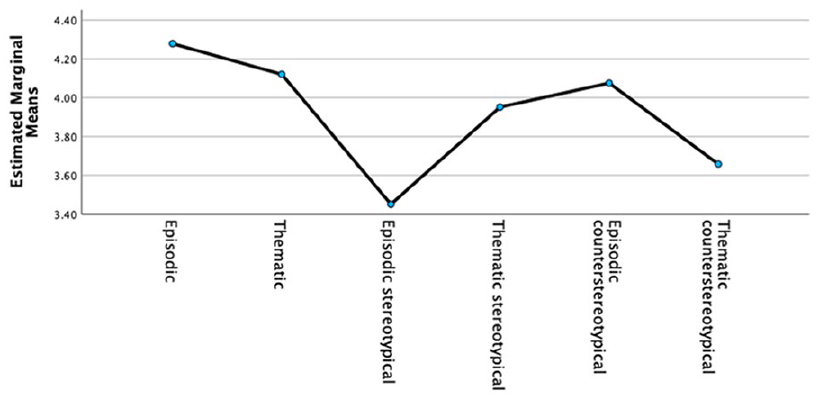
Estimated marginal means of societal responsibility after controlling for ethnic background, religion, and political orientation. p = .025.
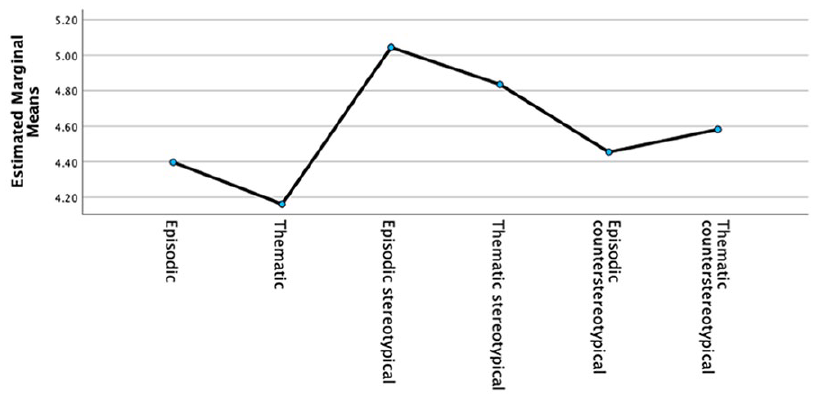
Estimated marginal means of individual responsibility after controlling for ethnic background, religion, and political orientation. p = .038.
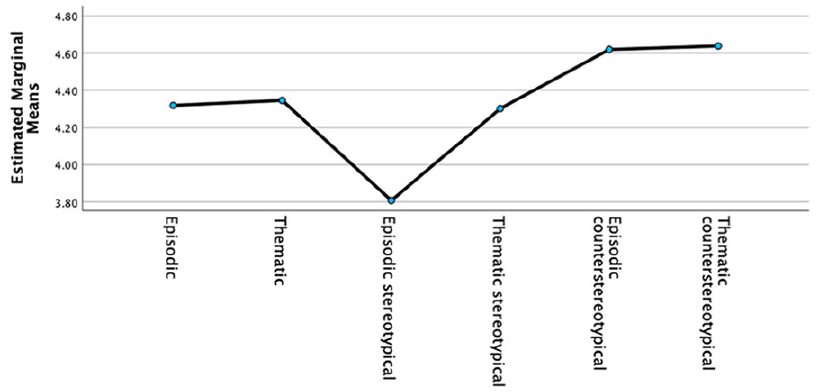
Estimated marginal means of empathy after controlling for ethnic background, religion, and political orientation. p = .030.
To answer RQ1 and RQ2, Bonferroni post hoc comparisons revealed that the mean scores for thematic and episodic frames without photographs did not significantly differ for societal responsibility, individual responsibility, and empathy. In other words, comparing textual frames without photographs did not produce any statistical differences among the participants. Post hoc tests also indicated news stories with the counter-stereotypical photograph (either thematic or episodic) did not significantly increase societal responsibility. H1 was not supported.
Participants who read both the thematic news story with a counter-stereotypical photograph (M = 4.75, SD = 1.52, p = .040, p = .031 without covariates) and the episodic news story with a counter-stereotypical photograph (M = 4.56, SD = 1.6, p = .035, p = .003 without covariates) reported significantly higher levels of empathy for undocumented migrants than participants who read the episodic news story with a stereotypical photograph (M = 3.65, SD = 1.80). Therefore, H2 was partially supported.
H3 was also partially supported. Reading news stories with a stereotypical photograph significantly shifted the blame for arrests and deportations to the individual, but the difference was only found when comparing the episodic news story/stereotypical photograph (M = 5.13, SD = 1.76) with the thematic news story without visuals (M = 4.13, SD = 1.83, p = .38, p = .012 without covariates). Participants blamed the society at a significantly higher rate when reading the episodic story with no photo (M = 4.25, SD = 1.88, p = .037, p = .026 without covariates) than after reading the episodic news story with a stereotypical photograph (M = 3.31, SD = 1.69).
H4 was partially supported. People who read the episodic news story with a stereotypical photograph reported significantly lower levels of empathy for migrants (M = 3.65, SD = 1.80, p = .040, p = .031 without covariates) than participants who read either the episodic with a counter-stereotypical photograph (M = 4.56, SD = 1.61, p = .035, p = .003 without covariates) or the thematic news story with a counter-stereotypical photograph (M = 4.75, SD = 1.52).
Reading either the episodic or the thematic news story both with a counter-stereotypical/stereotypical photograph did not produce a significant effect on the attribution of responsibility or empathy.
Discussion and conclusion
Thematic versus episodic news stories with no photograph
Although experiments have found that reading episodic news stories about social issues leads to attribution of responsibility to individuals and reading thematic news stories increases responsibility to the society (Gross, 2008; Iyengar, 1994; Major, 2009; Springer & Harwood, 2015), regarding immigration, the effects of episodic and thematic stories are mixed and discordant. Importantly, this experiment showed that comparing thematic and episodic news without photograph did not significantly affect societal responsibility, individual responsibility, and empathy.
Several reasons can help explain our results. As episodic news focuses on a particular exemplar and on a specific story about an individual, people sometimes empathize with the person portrayed in the news story, generalizing and interpreting the problem described as a societal issue and not as an individual one. Some research has found that episodic stories where individuals are described as dealing with personal struggles can increase societal responsibility and reduce the blame to the individuals (Shah et al., 2004).
The articles were developed by limiting empathic language, using a neutral tone, and following the operationalization of Iyengar (1994), but it is possible that reading the story of the arrest and deportation of an undocumented migrant living for a decade in the United States and owning a business was not perceived as negative enough to shift the blame from the society to the individual. Perhaps participants partially recognized the issue as a problem that afflicts the society as a whole and that should be solved by a governmental intervention. The lack of difference in level of empathy and attribution of responsibility when comparing the episodic and thematic conditions is an indication that exposing participants to news articles that focus on the arrests and deportations of an individual migrant or of a group of migrants without visuals may not produce tangible effects on empathetic responses.
After the pre-tests were conducted, one statement criticizing the migrants working in the United States without proper working visas was included in both thematic and episodic stories. This study does not aim to understand if and how a specific sentence produced an effect on people’s perception of undocumented migrants. We do not know if this statement affected the participants’ empathy or attribution of responsibility. However, it may have contributed to the lack of significant differences between thematic and episodic frames without photographs.
Effects on responsibility after including photographs
Based on the previous research (Hecht et al., 2022; Ramasubramanian, 2011, 2015), one of the main assumptions of this experiment was that participants reading news stories (either episodic or thematic) with a counter-stereotypical photograph of an undocumented migrant would be more likely to attribute responsibility for arrests and deportations to society than participants who read news stories with stereotypical photographs or with no photo.
Regarding societal responsibility, three key results can be extrapolated from the responses of the participants. The inclusion of a counter-stereotypical photograph did not contribute significantly to shift the blame for arrests and deportations from the individual to the society. Theoretically, this study shows that a single exposure to counter-stereotypical representation may be effective in certain circumstances, but in this specific case, one photograph depicting a well-dressed undocumented migrant in his office before the arrest was not sufficient to shift the blame for his arrest from the individual to the society. On the contrary, reading either the episodic or the thematic news story with no photograph significantly increased the level of responsibility toward the society compared with reading the episodic news story with the stereotypical photo.
Reading the episodic news story with the stereotypical photo led to significantly lower responsibility for the society compared with the episodic news story with no visual. Media often frames undocumented immigration in connection to criminality (Dixon & Williams, 2015; Dragojevic et al., 2016). In this experiment, the stereotypical photograph of the undocumented migrant is a mugshot, which epitomizes the idea of illegality, a portrayal commonly used to represent outgroups, ethnic minorities, and undocumented migrants in the news media. This study offers some evidence that adding a single stereotypical photo can lead to a decrease in the perceived societal responsibility for arrests and deportations.
The experiment revealed that participants who read the episodic news story with the stereotypical photograph were significantly more likely to blame the individual for their arrest and deportation than people who read the thematic news story with no photo. This finding confirms the effectiveness of the exposure to a single stereotypical photo in influencing the audience. Although reading the episodic news story alone was not enough to shift the blame from the society to the individual, adding a photograph that emphasized the idea of undocumented migrants as criminals had a significant impact. On the contrary, reading the thematic news story with no photo was linked to a lower individual responsibility, indicating that participants perceived the thematic news story with no visual as effective to de-emphasize the individual’s responsibility for arrest and deportation.
This study showed that comparing an episodic news story with a thematic news story both including a counter-stereotypical or a stereotypical image did not significantly affect societal and individual responsibility. When we tested the differences between textual frames, the impact on the attribution of responsibility was minimal and non-significant even when a visual component, albeit the same in both conditions, was included. From the theoretical point of view, these non-significant results are relevant because they demonstrate that the mere inclusion of the same still image in two stories framed episodically and thematically may not significantly influence the attribution of responsibility for the arrests of undocumented migrants.
Effects on empathy after including photographs
As expected, participants who read either the episodic or the thematic news story that included a counter-stereotypical photograph reported higher levels of empathy for undocumented migrants. However, the level of empathy increased significantly only when news stories with the counter-stereotypical photograph were compared with the episodic news story with the stereotypical photograph. This experiment presents evidence that photographs that portray undocumented migrants counter-stereotypically can have a positive impact on people’s ability to empathize with the migrants’ negative experience of being arrested and deported. The key finding concerning empathy is that regardless of how the news story was framed, the addition of a counter-stereotypical photo of an undocumented migrant was significantly more effective in increasing empathy than reading an episodic news story with a mugshot.
The lowest emphatic responses were found when participants were exposed to an episodic story with the stereotypical photograph. As it happened with attribution of responsibility, it is possible that the episodic news story gave the participants basic biographical information about an undocumented migrant, and the mugshot complemented the information, adding a (stereotypical) face to the story that caused a decrease in empathy.
As found for the attribution indexes, no differences were found when comparing an episodic news story to a thematic news story that included a counter-stereotypical image or a stereotypical image. This study showed that participants reading either the thematic or the episodic story with the counter-stereotypical image reported very similar levels of empathy. Likewise, differences in empathy among individuals who read the episodic story or the thematic story with the stereotypical image were minimal and non-significant. In sum, the experiment shows that one-time exposure to different textual frames with the same visual frame may not produce effects on empathic responses.
Implications, limitations, and future studies
This experiment showed a stereotypical photo in combination with an episodic story had a negative effect on empathy, and it contributed to shifting the blame for arrest and deportation to the individual. News outlets tend to publish mugshots of migrants arrested. This is probably because they can easily access these photos through local sheriffs or police departments. The choice is questionable but somehow understandable in case of arrests and deportations after a crime, but if the person deported is not involved in a criminal activity, the repetition of visual stereotypes can negatively impact attitude toward migrants. Efforts should be made by newsrooms to diversify and improve the types of photographs used to frame immigration. This is even more important as online news virally circulates on social media platforms.
In this study, the inclusion of a counter-stereotypical photo was effective in increasing empathy for undocumented migrants, but findings were non-significant for attribution of responsibility and no differences were found when two different news stories were compared with the same set of images. In terms of implications for journalists, these results are difficult to interpret. Reporters should be encouraged to use counter-stereotypical portrayals of migrants because they can increase empathetic responses from the audience, but the effects of such a choice on the attribution of responsibility can take longer time than a single exposure. Newsrooms and journalists should think about counter-stereotypical portrayals of migrants as a part of a medium-/long-term plan to provide fairer and ethically responsible journalism.
The non-significant differences when comparing episodic and thematic stories with no photographs are not a rejection of Iyengar’s seminal work and the subsequent research that confirmed his findings, but we believe this study adds a further layer to the debate on the effects of episodic and thematic frames on responsibility and empathy. The lack of explicit valence of the stories probably reduced or minimized framing effects, and developing the stories with openly negative or positive valence may have changed the results.
The experiment has several limitations. Recruiting through Amazon’s Mechanical Turk provided a more representative sample than college students when looking at age, household income, and political affiliation. However, while ethnically diverse, the proportion of White/Caucasian who participated in the experiment was higher than the actual U.S. population, while the percentage of Black Americans and Hispanic was lower.
In this study, the episodic news focuses on one Mexican man. Future studies should test the effects of episodic stories that include women and migrants coming from different nations. Photographs were successfully pretested before the actual experiment, but only a single photo was included in the news stories. Repeated exposure to different visuals may lead the audience to respond differently than after only a quick look at one photograph.
Only photographs were used as visual stimuli. Moving images in news may have different effects on people (Powell et al., 2018). Future experiments should include a combination of videos, pictures, text, and audio and measure potential audience engagement on social media platforms.
Supplemental Material
sj-docx-1-ctp-10.1177_20570473241249769 – Supplemental material for The influence of visual and textual frames on people’s perception of migrants
Supplemental material, sj-docx-1-ctp-10.1177_20570473241249769 for The influence of visual and textual frames on people’s perception of migrants by Umberto Famulari and Lesa Hatley Major in Communication and the Public
Footnotes

Supplemental material
Supplemental material for this article is available online.
Author biographies
References
Supplementary Material
Please find the following supplemental material available below.
For Open Access articles published under a Creative Commons License, all supplemental material carries the same license as the article it is associated with.
For non-Open Access articles published, all supplemental material carries a non-exclusive license, and permission requests for re-use of supplemental material or any part of supplemental material shall be sent directly to the copyright owner as specified in the copyright notice associated with the article.
