




Abstract
The current Russian–Ukrainian War sparked a new wave of misinformation across social media. However, there is a lack of cross-platform research approaches around war events. This article followed the path of comparative media analysis. We used a three-step method from Triangulation theory and gathered 309,260 relevant posts from both the Twitter and Weibo platforms. We found that (1) Weibo posts are synchronized with Chinese mainstream media, and there is an “Amplification” phenomenon; Twitter posts are delicate and provocative from the perspective of individual encounters; (2) the topics of Weibo are “wide and scattered,” together to form a panoramic broadcast of the conflict. While topics of Twitter formed a condemnation around the invasion war; (3) the positive and negative emotion volume has gone through three stages: “Confrontation,” “Polarization,” and “Extension” with the development of the war. Finally, though the two social media fields present different characteristics, the call for humanitarianism and peace constitutes the unity of public opinion.
Introduction
Social media have evolved into widely used and legitimate sources of news and information, particularly for natural disasters, crises, and other extreme events (Pepitone, 2010). In terms of War events, wartime online opinion may have a larger scope with a significant impact on the global political, economic, and cultural structure. The two world wars of the last century still bring irreconcilable confrontations to the international community, and the media use war ideology to distinguish between “self” and “enemy” (Bourdieu & Wacquant, 1992, pp. 28–35). The ongoing military conflict between Russia and Ukraine has become a new battleground of modern information warfare. The role of social media has been well documented during the conflict in Ukraine, in the Crimean crisis, and in the separatist rebellion in Donbas.
The dynamics of public opinion around the war on social media platforms require focused attention. Different from general public opinion events, wartime information is extremely channel-dependent on government and media (Cai, 2017, p. 84). However, the existing studies are primarily macroscopic discussions of public opinion and policies. There is a lack of cross-platform research approaches around war events, which may reflect different social media ecosystems and even media and ideological cultures. Also, these studies neglect to focus on the structure and patterns of specific events from an internal perspective.
Military hard power is no longer the only force that determines the victory of the war. On 24 February 2022, Russian troops crossed Ukraine’s border, which was the most severe international dispute in recent years. The war has stirred up the global social arena discourse and the global discussion provides the basis for global data acquisition, it is essential to reveal how the information is transmitted during the war, and how different social media ecosystems and ideological cultures are embedded in it. Our study took the Russian–Ukrainian War as the object of analysis, and collected commentary data on two different social media platforms.
Literature review
War public opinion heuristics
In the post-truth era, the expansion of communication media and forms has given rise to the wild growth of information. The reality of war has been “relayed” to the world through rich social media posts to a battlefield filled with blood and fire unabashedly and with significant visual impact: the crash of planes, the explosion of tanks, the death of soldiers. Real information is mixed with disinformation, and an almost absurd world is unsparingly revealed to the world.
War public opinion is actually an extension and expression of real war in cyberspace (Yu & Yuan, 2021, p. 28). The “war public opinion” discussed in this study refers to all information about the war, including true and false information, which is openly or semi-openly discussed by Internet users on social media platforms, forming a wave of opinions on specific topics and emotional orientations.
Comparative media analysis as a fundamental approach
The social media analysis of the Russian–Ukrainian War adopts the method of comparative media analysis. The potential differences between the two media ecosystems are revealed by comparing the posts from Weibo and Twitter. The root of media comparative analysis comes from frame theory. In the earliest discussions of framing theory (e.g. Goffman, 1974/1986), the frame has underlying, implicit cultural meanings. It has its own cultural background, and the presence of the fame essentially invites audiences to apply the information and meanings within which the culture has imbued the frame. In other words, multiple ways to decode and comprehend frames in various cultural contexts exist. This background dependency of the frame is also described as “cultural resonance” (Gamson & Modigliani, 1987, p. 140) or “narrative fidelity” (Snow & Benford, 1988, p. 201).
Since Siebert, Peterson, and Schramm published their groundbreaking book in 1956, comparative journalism and media studies have gradually become a required field in cross-cultural communication research. The press always takes on the form and coloration of the social and political structures within which it operates (Siebert et al., 1956, p. 1). One of the most important fields in media studies, as Katz and Lazarsfeld described, is evaluating how the mass media “campaigns” influence audiences’ perceptions, such as “votes, to sell soap, to reduce prejudice” (Katz & Lazarsfeld, 2017, p. 19). The media reporting frame has the color of the national social structure, whether political power control, economic ambitions, or cultural representation. By preempting attention, the media are thought to con strain us to evaluate people. Social psychology’s frame of reference emerges here as agenda setting (Katz, 1987, p. 29). Most of the literature on the media is highly ethnocentric and nation-centered, in the sense that it refers only to the experience of a single country, yet is written in general terms, as though the model that prevailed in that country were universal (Hallin & Mancini, 2004, p. 20).
When reporting controversial incidents in a multicultural environment, journalists are consciously or unconsciously constrained by cognitive patterns formed by their cultural backgrounds, which are difficult or impossible to eliminate in the news production process. For example, the researcher has found that the US newspapers more frequently emphasized the economic consequences, responsibility leadership, and conflict frames than the Chinese newspapers. However, the Chinese news articles presented the financial results, responsibility, and leadership news frames more positively than the US news articles (Luther & Zhou, 2005, p. 857).
In the current Russian–Ukrainian War, there are noticeable differences and even contradictions between Weibo and Twitter platforms in terms of media presentation and the opinions of netizens. Although Twitter is not directly equivalent to the American public opinion field, the analysis of social platforms with different cultural backgrounds can draw some inspiration from a series of transnational studies. Past studies have shown a dualistic relationship of the news framing between Chinese and American mainstream media (Wang, 1992, p. 197; Luther & Zhou, 2005, p. 860; Wu, 2006, p. 251; Guo, 2012, p. 2; Duan & Takahashi, 2017, p. 83). While the Chinese news image of the United States went from “devil” to “friend” and back to “adversary,” the American news image of China went from “automatons” to “virtuous” to “repressive” (Parsons & Xiaoge, 2001, p. 51). With one frame logically arising from its predecessor, two overarching frames emerged: American hegemony and Chinese puppet imagery. To some extent, these are the cases of national centrism presented by the media. For most of its history, the discipline of international communication was dominated by the national outlook (Chalaby, 2007, p. 61). Media workers select news materials and produce news pieces from their own nation’s perspective. Through its vast influence, those developed countries’ mainstream media select and produce global news pieces and tell the rest of the world what they should see and listen to. They are simply holding up a mirror for what the developing world is aspired to become on the road to modernization, setting out the vision of the universal relevance of Western experiences (Lerner, 1958, p. 3).
Previous war and social media research characteristics and limits
There are some contemporary studies on public opinion during the war that use both quantitative and qualitative methods in recent years. Most of the works followed a relatively specific way to evaluate a certain topic and tried to give a comprehensive review of the connections between war and wartime opinion.
Previous research presents the following characteristics: first, this is an interdisciplinary field, with literature from multidisciplinary establishments such as Communication, Politics, Psychology, Sociology, and Computer Science. For example, Politics and Economics scholars found captured as marginal casualty figures are an important additional aspect of human costs and a critical factor in determining wartime opinion (Gartner & Segura, 1998, p. 278). Based on the Iraq War, some Journalism studies found aggregate perceptions of success are more responsive to casualties and key events than are aggregate beliefs about the war’s merits (Voeten & Brewer, 2006, p. 809). Second, the topics are diverse, but some of them lacks theoretical support. One research concluded the United States may combine information warfare, psychological warfare and political warfare to serve its goal of containing China without providing sufficient data (Zhang & Hu, 2022, p. 1). The presentation of opinions is more like subjective judgment. Such as “Information in a war situation is characterized by borderless communication, the same direction of different targets, combined with the magnification of sensational effects and huge ‘lethality’” (Pan & Song, 2012, p. 81). Too much attention has been paid to grand narrative logic, such as the reporting framework of a limited number of official media or institutions, and the public opinion guiding strategy of global propaganda at special times. Third, at the data level, some existing findings are mostly based on small case studies. One article just used four to five samples to determine the turning point of domestic public opinion in the United States during the Vietnam War (Shang, 2019, p. 1). This leads to the conclusion that the study can only be discussed at the media level because of the small sample size.
Hence, regardless of the various analysis around war and public opinion, we found academic achievements of an adjoint analysis about war events and mainstream global social platforms, together by using Social Network Analysis (SNA) and Sentiment to analyze social media data, are not enough. From the actual war to information warfare and also psychological warfare, two mesoscopic levels arose: platform and audience. Emphasizing the “adjoint” means obtaining data and tracking the real situation of social media in time. The years in which a plethora of studies are published tend to have major wars or disputes, such as the bombing of the Confederacy in 1999 (Gries, 2001), the Iraq War in 2003 (Foyle, 2004), and the Diaoyu Islands dispute (Hollihan, 2014), but the studies themselves have a certain lag. At the same time, there are numerous cross platform comparative analysis, one study examined the use of the Chinese Weibo during 2013 smog emergency and compared with North America (Lin et al., 2016, p. 576), but few of them are aiming war events based on different regions and languages. The latest research began to pay attention to the asymmetry of news reports on different platforms, and also the specific characteristics of this asymmetry in the public opinion field. Researchers found that topics extracted through Latent Dirichlet Allocation (LDA) suggest that majority of the Afghanistan people seem satisfied with the Taliban’s takeover (Lee et al., 2022). However, war, as a major and sudden international event, does not simply trigger one regional information wave. How the relevant issues are distributed, how the accompanying emotions are presented, and how the reality and cyberspace are related under the refraction of data, all these issues need to be further explored.
Establish a “Triangulation” method to analyze the big data
Denzin and Flick proposed a research idea called “Triangulation” (Denzin & Norman, 1989, p. 19; Flick, 2008, p. 31) and it has become a staple in social science research (Wilson, 2014, p. 75). The use of multiple methods, or triangulation, reflects an attempt to secure an in-depth understanding of the phenomenon in question (Denzin, 2012, p. 82), and to increase the validity and completeness of the assessment measures. The analysis target is to make reasonable interpretations and certain inferences based on completely actual phenomena. The messages on social media miscellaneous. At present, the war between Russia and Ukraine is still developing, the messages on social media is so miscellaneous and all kinds of complicated and distracting information have put forward more accurate and credible data requirements for war public opinion research. Triangulation is an important concept regarding data analysis for an empirical study (Fusch et al., 2018, p. 21). Especially, when facing a transnational context, the data usually have different characteristics and presentations (Labhardt, 2019, p. 79). The mixed methods are keys to fully get the completeness of objective data and the accuracy of subjective judgments. It is more necessary to do “accompanying” data research following the development of events.
Based on the above discussion, this article takes Weibo and Twitter as the research platform. The specific research questions are as follows: (1) What are the high-frequency semantic keywords of netizen’s comments around the Russian–Ukrainian War? How do different high-frequency keywords relate to each other? What topics do they collectively form? (2) At the structural level, what are the characteristics of the overall semantic network? What are the differences of these two platforms? (3) At the emotional level, what are the characteristics of netizen’s emotional trends? (4) How can these features and differences be explained from the perspective of computational propaganda for information and media ideology?
Methodology
Research methods
Through the idea of the multivariate analysis revealed by triangulation, this article analyzes the characteristics and differences of the Twitter public opinion field from the perspectives of “event enumeration,” “semantic mining,” and “sentiment analysis.” Due to the research subject being non-structural text discourse on social media, the text semantic network analysis is carried out in two steps.
The first step is Co-word analysis. The fundamental theoretical assumption of this method is that the relationship between words determines semantic production (Wettler & Rapp, 1993, p. 1). Co-word analysis counts the words that appear in the same post or news, and calculates the frequency of co-occurrence. The second step is “textual sentiment analysis,” which is the process of extracting information from user opinions, and obtaining people’s basic emotions as positive/negative/neutral (Yadav & Vishwakarma, 2020, p. 4335). In this study, we used the survey from Qingbo bigdata (https://yuqing.gsdata.cn/) to collect sentiment values of words in posts, and then perform weighted calculations to judge the overall sentiment tendency. According to Qingbo document, the survey is based on the Bidirectional Transformer (BERT) pre-training model, with the f1_score 86.18%, precision 86.22%, and recall 86.18%. BERT has demonstrated its effectiveness in a wide range of natural language processing tasks (Devlin et al., 2018, p. 4186). Traditional BERT in Chinese tasks was also examined by scholars and proved good results, its further new model modifies the masked language model task as a language correction manner and mitigates the discrepancy of the pre-training and fine-tuning stage (Cui et al., 2021, p. 3514).
Data collection
To conduct “accompanying” research and cover a sufficiently complete logical chain as much as possible, the study selects a total of 3 weeks of data from 1 week before the outbreak of the war to 2 weeks after that, which is, from 17 February 2022, to 5 March 2022, and carried out the data mining of online comments about the Russian–Ukrainian War on Twitter and Weibo. Twitter is one of the most popular social platforms around the world and has attracted mainstream media from most countries in the world, such as @PDChina in China, @Asahi Shimbun in Japan, and @BBCNews in Britain, which can reflect the discourse characteristics of major global public opinion fields (Zhang & Ye, 2022, p. 162). Weibo is the largest and probably the only online social platform suitable for Chinese citizens to discuss public issues. Before formulating the plan, word cloud calculation was carried out on one million large-scale data to determine the research keyword plan (Figure 1): “Russia/Russian/Putin/Ukraine/Ukrainian/Zelensky/NATO/US/Military/ War/.”
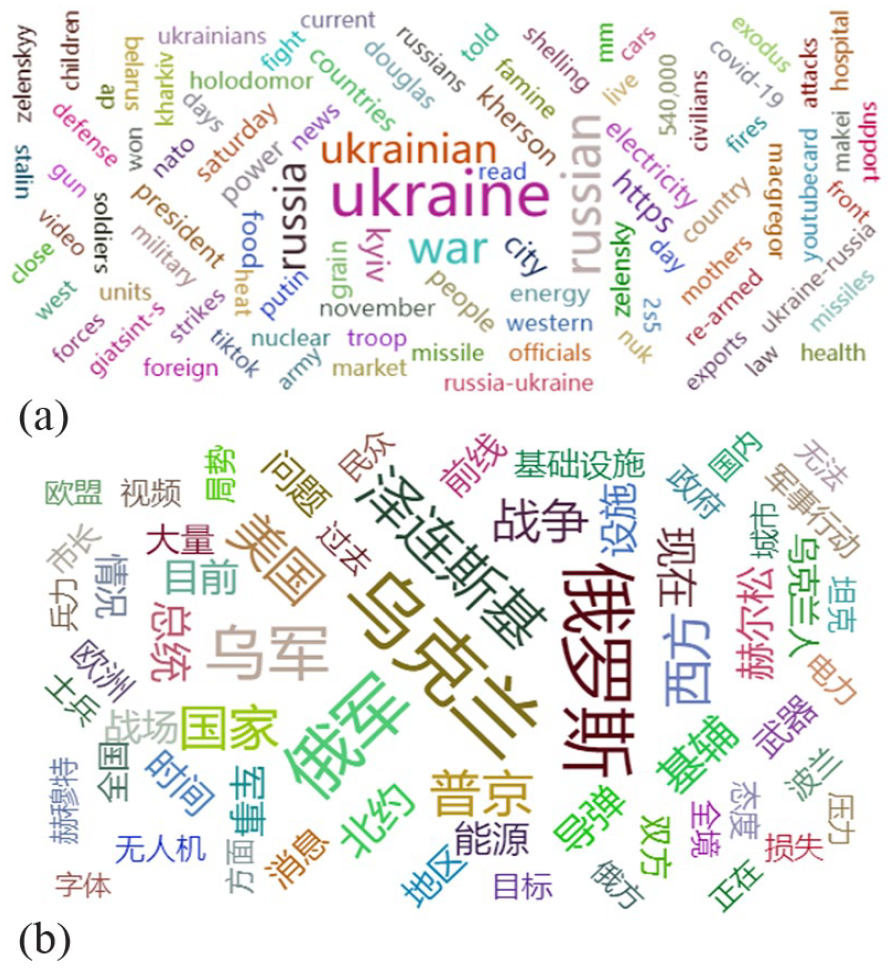
Word cloud of coarse-grained data in the pre-mining stage. (a) Word cloud of Twitter. (b) Word cloud of Weibo.
For Weibo, we also followed the same method by determining the word cloud (see word cloud 1b) and then mining the data from the website. This research uses manual screening after the platform collection to eliminate the postings which are not related to the Russian–Ukrainian War, and finally collected 266,689 tweets, with extracted fields including keywords, media names and accounts, posting times, links, text content, number of retweets and likes, original creators, mentions, and post regions (see the supplemental material). The text contents are selected as the basic corpus for further collation and analysis.
Data processing
In this stage, each independent post is used as a co-word unit to calculate the word frequency, extract the top keywords, construct the co-occurrence word matrix, and import the co-word matrix into Gephi software26 to draw the co-occurrence map of the keywords of the Russian–Ukrainian War. On this basis, UCINET 6 and SPSS26.0 conduct agglomerative subgroup clustering and multidimensional scaling analysis for high-frequency keywords. Then the sentiment judgment model based on deep learning is used to determine the sentiment attribute of Weibo and Twitter comment data, which is used to analyze the emotion changes on time series and to summarize the features of two different platform users’ comments on the Russian–Ukrainian War.
Results
Semantic network analysis: macro narrative versus micro focus
To clarify a few points about the data that we got from Weibo and Twitter: the gap between the data and the conclusions is always the focus of the researchers. As shown in the data form, this research depends on the basic semantic content, so we can only do extended exploration from the basic materials. A large amount of data points to certain keywords, some of which are very significant in number, so the events formed by these keywords were the main focus of netizens at that time, this is also the basis for our thematic and subgroup analysis.
The text of more than 300,000 posts on the Russian–Ukrainian War was divided into words, removing garbled codes and dummy words, and combining words with the same meaning (e.g. “Russian president” and “Putin” were both replaced by “Putin”). The study first counted the top 20 keywords of public opinion on the Russian–Ukrainian War (Table 1), and the most frequent words on Weibo were “Putin / Russian Army / Russia / Ukraine / Weibo / President / military action,” and so on. The above words were commonly used in the headlines of various news media reports, which showed the typical Laswell’s “5 W” pattern (Gao, 2008, p. 37). Regarding the top high-frequency words, the terms used on Weibo are similar to those used in official media briefings. On Twitter, the overall word frequency of Twitter is higher than that of Weibo, with the highest words being “Ukraine / Russia / Putin / War / Facebook / Tik Tok,” and so on. Twitter and Weibo have similar characteristics, with the most common words related to the war such as “Russia,” “Ukraine,” and “Putin.” Still, Facebook and TikTok also have a higher share of words on Twitter because of the international sanctions against Russia after the war and the ban on Facebook access, as well as the widespread uploading of videos taken by many Ukrainian people to TikTok.
Top 20 keywords of Weibo and Twitter public opinion around war.
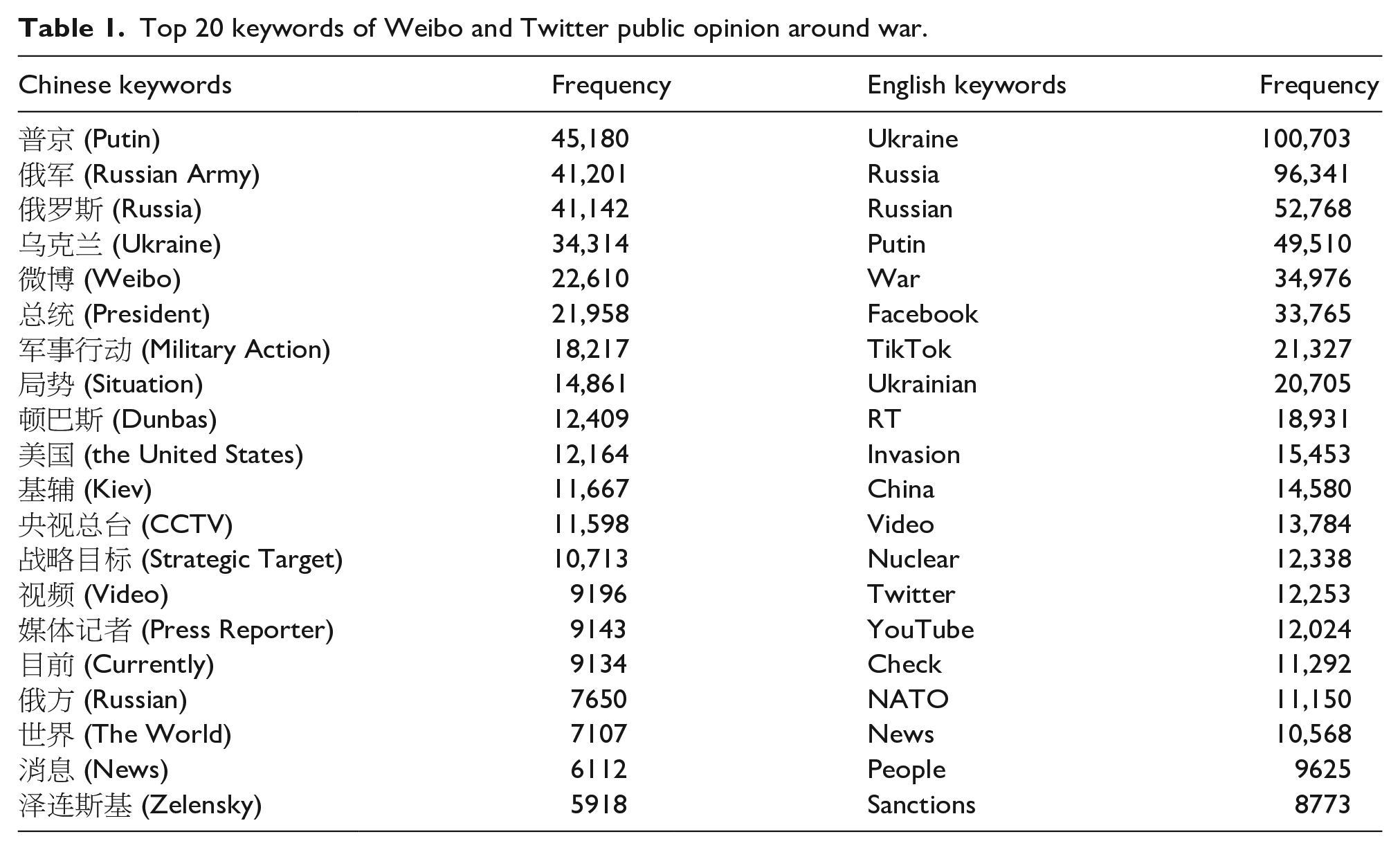
To construct a semantic network graph, the analysis of Weibo selected those appearing more than 100 times as high-frequency keywords (Dong & Qian, 2017, p. 422), which in total yielded 789 high-frequency keywords, of which the TOP 10% were selected for analysis (Yan & Wang, 2018, p. 97), that is, 79 high-frequency keywords to establish a co-occurrence matrix. The analysis of Twitter kept the same number of high-frequency keywords as Weibo, so the study selected those appearing more than 380 times as high-frequency keywords after retracing the word frequency, which resulted in a total of 781 high-frequency keywords, and also selected the TOP 10% of them as the object of analysis, that is, 78 high-frequency keywords to establish the matrix.
The co-occurrence matrix of keywords of Weibo and Twitter was input into Gephi to plot a Russian–Ukrainian War co-occurrence map (Figures 2 and 3).
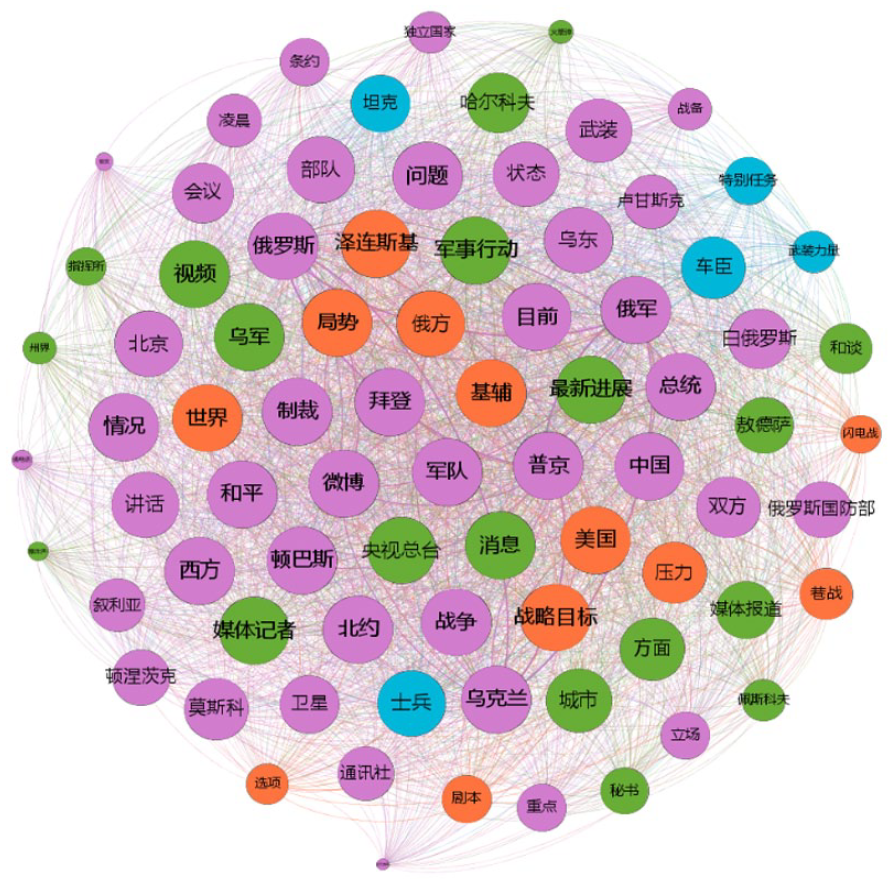
Semantic network diagram of high-frequency keywords of war on Weibo.
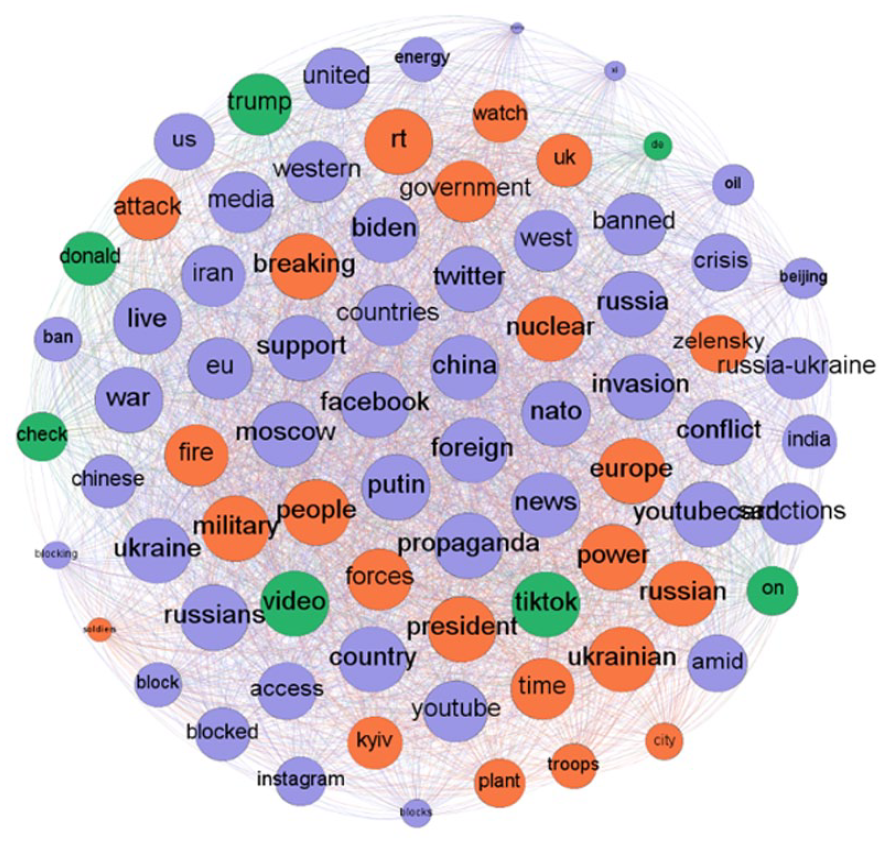
Semantic network diagram of high-frequency keywords of war on Twitter.
We ran the analysis in Gephi with a centrality measure for node sizing and colored the nodes by the modularity analysis result. The semantic network relationship graph of high-frequency keywords about the Russian–Ukrainian War on Weibo consists of 79 nodes and 2878 edges, the modularity is 0.130 with four communities. Each node represents a keyword, and the connecting lines between nodes represent the co-occurrence relationship between keywords, that is, appearing in a Russian–Ukrainian War tweet at the same time. The size and color of the nodes represent word frequency, with larger nodes and darker colors indicating higher word frequency, and the thickness of the links represents the number of co-occurrences, with more co-occurrences the thicker the links (B. Li, 2019). High-frequency words in the core areas of the chart include “Putin, Zelensky, Russia, Russian army, Ukraine, military operations, strategic objectives, Biden, the United States, the west, NATO, Donbas, Kiev, the latest progress,” and so on.
The orange cluster represents the report on the relationship between Russia, Ukraine, and the United States. The purple cluster shows the latest progress of the Russian army in Ukraine. The green cluster indicates the movement of the Ukrainian army in Kharkov. The blue cluster reveals the participation of the Chechnya armed forces. The results indicate that Weibo users are more concerned about the latest developments in the Russian offensive, such as “On the outskirts of Donetsk, we have witnessed a large number of military vehicles . . . Russian troops have almost taken control of the area” and “I thought the fight would be over in 48 hours, but now it seems I was too naïve.” The Russian military is also motivated by political motives, such as “Ukraine will never join NATO; NATO is committed not to continue its eastward expansion. Russia is trying to promote talks by fighting.” Attention is also paid to the reaction of NATO, especially the US government. Attention to the latest developments on the Russian–Ukrainian battlefield, analysis of Russia’s combat motives, and comments on the West’s reaction are the three main aspects of Weibo.
Similarly, the semantic network graph of Twitter high-frequency keywords is analyzed, which consists of 78 nodes and 2921 edges, the modularity is 0.126 with three communities. The high-frequency words in the core area of it include Russia (Russian), Ukraine (Ukrainian), Putin, War, RT, Invasion, China, Nuclear, NATO, Support, People, Military, Europe, and Propaganda. The orange node cluster represents the threat of Putin’s words about nuclear war, the blue node represents cluster shows the public attention to the specific details of the war, and the green node represents cluster is a combination of Trump’s view on the issue. These results showed Twitter users have different perspectives from Weibo. Twitter users are also interested in the following five areas: first, the possibility of nuclear weapons use mentioned by Putin; second, the real-life situation of the Ukrainian people; third, the attitude of China; fourth, the assistance of Western countries, including Europe, to Ukraine; and fifth, the “blocking” of Russia media. Compared with Weibo, Twitter is significantly richer in topics. Russia’s so-called “special military operation” is widely referred to by the term “invasion,” which implies aggression against the sovereignty of another country (Oxford dictionaries, 2022). The highly negative term in the English context is a side note to the “anti-Russian and pro-Ukrainian” stance of Twitter users.
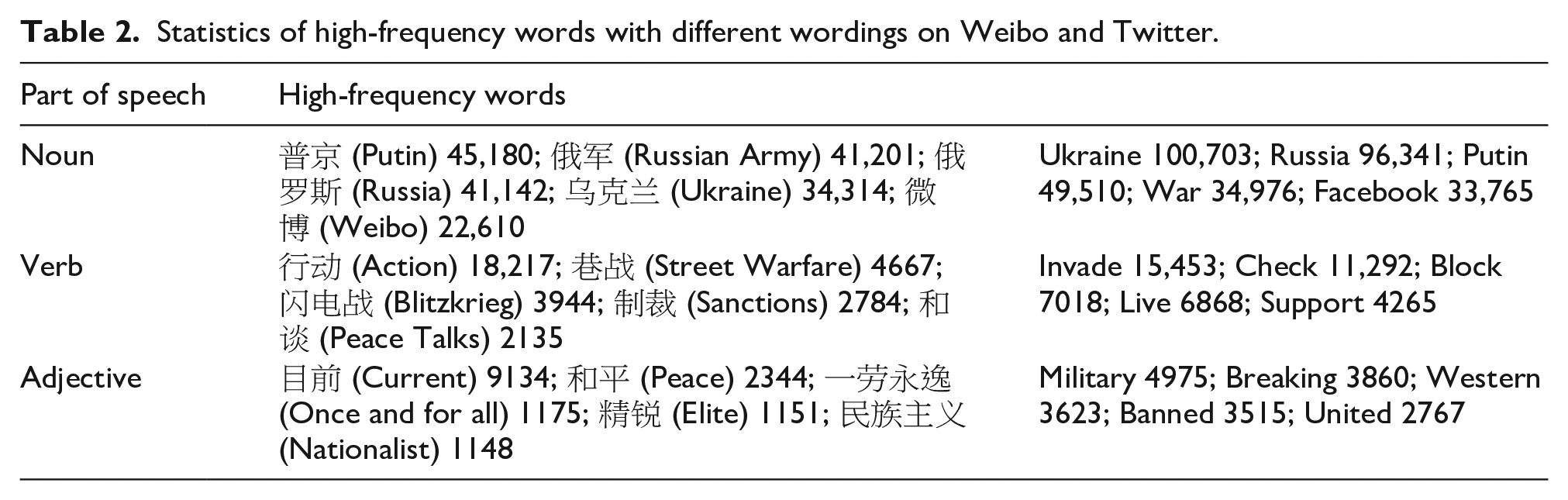
The top five of each word frequency were categorized and selected according to their lexical nature (Table 2). Regarding nouns, both sides focus on the core subjects, but many Weibo users talk about Putin (personal image, past background), rather than the war itself. Twitter users are more concerned with the reality of the war between Ukraine and Russia. Regarding verbs, Weibo focuses more on the dynamics of the battle. Twitter, however, is more to discuss the armed invasion of Ukraine by Russia and the assistance of Western countries, and to criticize Russia’s barbaric acts. In terms of adjectives, Weibo users are judgmental and subjective. The internet is full of “emotional” retellings of the Russian narrative of the war’s motives, such as eliminating neo-Nazis and achieving regional peace. Twitter, however, is full of calls and proposals, such as sanctions against Russia, calls for Ukraine and the world to unite against Russia.
Statistics of high-frequency words with different wordings on Weibo and Twitter.
Cohesive subgroup cluster analysis: one event with multiple frames
Based on the above analysis of keywords, which reflects the rhetorical characteristics of specific statements made by netizens about the Russian–Ukrainian War, high keywords can be classified by cluster analysis, in which highly related words together form a word cluster.
The high-frequency keywords of Weibo and Twitter were constructed into a cohesive matrix, with the size of “79 × 79” for Weibo and “78 × 78” for Twitter. Then imported into UCINET 6 to analyze the cohesive subgroups and measure the density of each subgroup. First, the analysis results of the subgroup model of Weibo are shown in Figure 7, which is divided into eight groups, and the modularity goodness-of-fit (R2) is 0.251, which is greater than the statistically significant better value of 0.25 (Jiang & Tang, 2015, p. 57), indicating that the model fits fine.
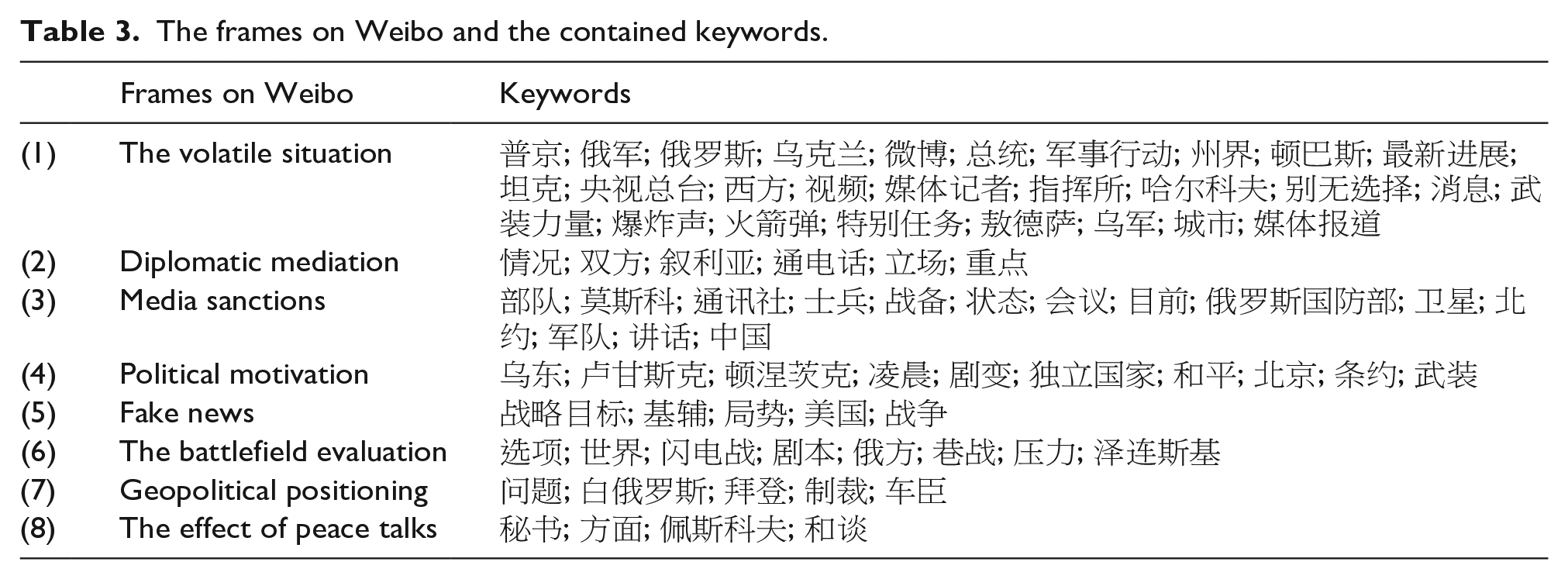
The more relevant high-frequency keywords will coalesce into a subgroup in the tree diagram. The primary subgroups will also hook up to become higher-level subgroups. As can be seen from Figure 4 and Table 3, the eight subgroups represent the main frames of current Weibo users’ comments: (1) The volatile situation: the sharply worsened situation between Russia and Ukraine and the latest developments in Russian military operations are highlighted, with 27 high-frequency words such as “tanks,” “explosions,” and “command posts.” (2) Diplomatic mediation: the discussion focuses on multilateral diplomatic events since the outbreak of the war and analyzes the political significance behind the leaders’ calls, with six high-frequency words include “Syria,” “phone call,” and “position.” (3) Media sanctions: in particular, many media outlets, including RT, were sanctioned by main Western countries. The netizens further discussed the possible impact of sanctions on Russia’s economy and society. There were 14 high-frequency words such as “satellite news agency,” “Moscow,” and “speech.” (4) Political motivation: the main discussion was about Putin’s motivation to support the independence of Donetsk and Luhansk region. There are 10 high-frequency words such as “Donetsk” and “Luhansk.” (5) Fake news: Russian claimed that Ukrainian President Zelensky posted “fake” videos on social media several times, Russian media was proved to be spreading fake news. There was a clear shift in the debate, from initial ridicule to analysis of the global solidarity that his social actions brought to Ukraine. There were eight high-frequency words such as “Zelensky,” “world,” and “script.”. (6) The battlefield evaluation: after a considerable stage of development of the war, netizens evaluate the loss of Russian military objectives such as the possible number of Russian casualties. There are five high-frequency words such as “Kiev,” “strategic objectives,” and “situation”. (7) Geopolitical positioning: some netizens discussed the situation during Prague Spring and also the past wars in Chechnya. There are five high-frequency words, including “Belarus,” “Chechnya,” and “problems.” (8) The effect of peace talks. This framework more focused on the details of the Russia–Ukraine negotiations, netizens were trying to predict the possibility of successful peace talks. High-frequency words such as “Peskov,” “peace talks,” and “secretary” are commonly used. The density calculations for the eight subgroups are shown in Table 4.
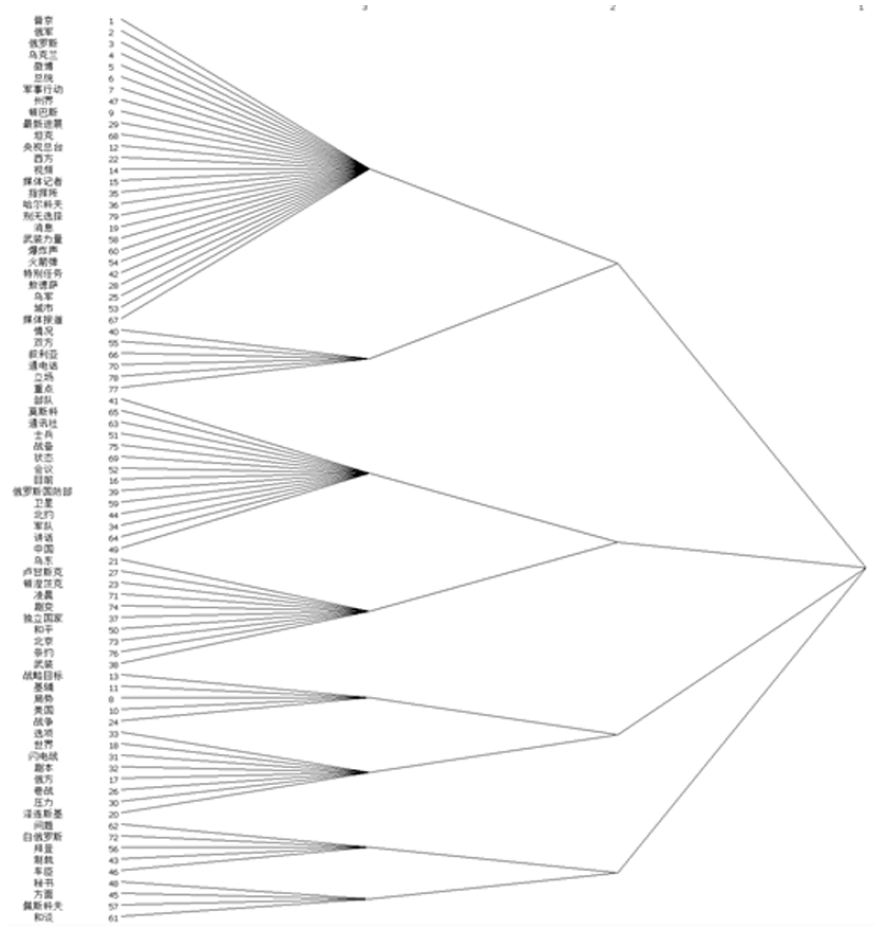
Tree diagram of the subgroups of Weibo high-frequency keywords.
The frames on Weibo and the contained keywords.
The density matrix of eight subgroups of the Weibo high-frequency keyword network.
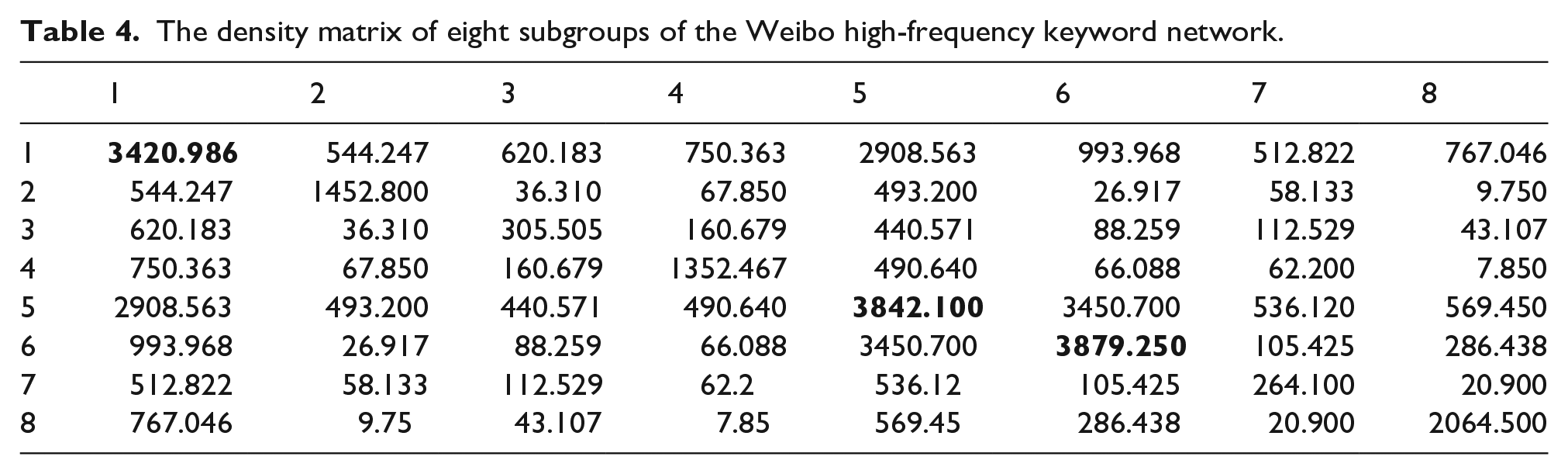
The average density of Subgroup 6 is the highest, at 3879.250, indicating that the high-frequency keywords in Subgroup 6 have the highest relevance to each other. The “battlefield review framework” is a typical discourse structure of Weibo users. The discourse structure of “soldiers fighting in the alley—encircling Kiev—strategic goal achieved” is highly correlated with real military operations and has a strong dependency. This part of the discourse features also coincides with the Chinese online media reports, indicating that the primary source of information for Weibo netizens remains all kinds of Chinese media (including official media, and self-media). In addition, the average density of Subgroups 1 and 5 are also higher, indicating that “volatile frames” and “fake news frames” are also more common.
The subgroup results of Twitter are shown in Figure 5 and Table 5. There are also eight subgroups. The modularity goodness-of-fit (R2) is 0.204.
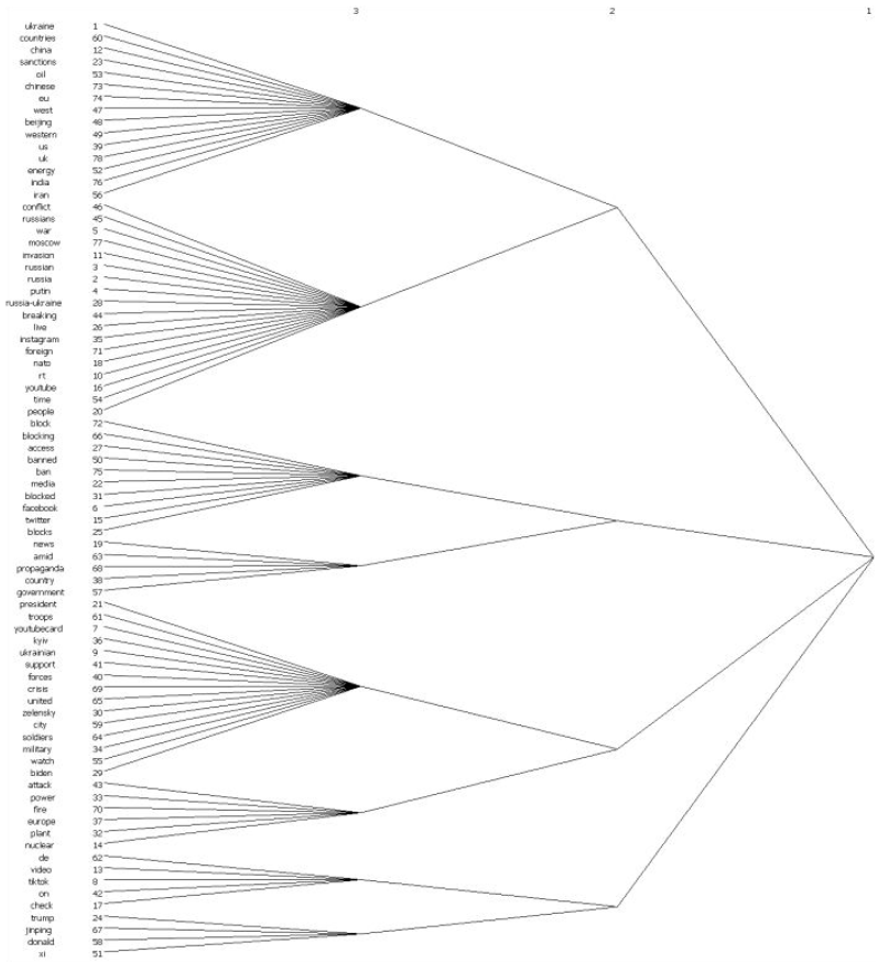
Tree diagram of the subgroups of Twitter high-frequency keywords.
The frames on Twitter and the contained keywords.
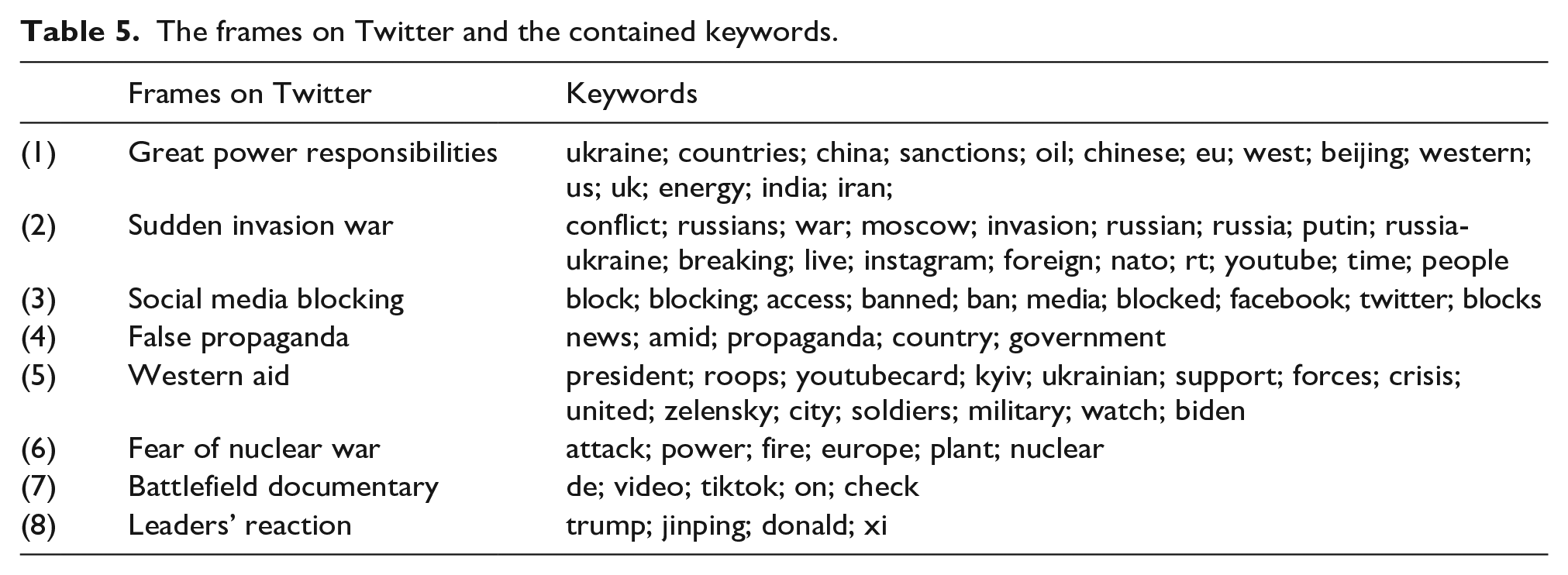
For Twitter, the eight subgroups are: (1) Great power responsibilities: Twitter users considered the political positions of China and India on the Russian–Ukrainian War, and criticized China and India for being “too close” to Russia. There are 15 high-frequency words, such as “US,” “China,” and “India.” (2) Sudden invasion war: Twitter users criticized Russia’s barbaric armed invasion of Ukraine. There were 18 high-frequency words such as “Invasion,” “Putin,” and “Breaking.” (3) Social media blocking: netizens expressed support for the blocking policies of Russian mainstream media accounts worldwide. High-frequency terms include “YouTube,” “Ban,” and “Block.” (4) False propaganda: similar to false news, netizens discussed Russian false propaganda in the war, and were particularly suspicious of the casualties mentioned in the Russian news. Five high-frequency words include “Propaganda,” “Country,” and “Government.” (5) Western aid: mainly discusses news about various types of retired American and British soldiers going to the battlefield in Ukraine. There are 15 high-frequency words such as “Support,” “Crisis,” and “Soldiers.” (6) Fear of nuclear war: after Russian President Putin announced that he would not rule out the use of nuclear weapons, Twitter users concentrated on expressing condemnation and concern, with six high-frequency words such as “Nuclear,” “Fire,” and “Plant.” (7) Battlefield documentary: it mainly involves various video clips uploaded by Ukrainian people to social media, showing the real life of Ukraine under the war. There are five high-frequency words such as “TikTok,” “Check,” and “Video.” (8) Leaders’ reaction: Twitter users focused on former or current national leaders and discussed their social media statements (e.g. Trump’s attacks on the Biden administration). Four high-frequency words were used, including “Trump.” The density calculations for the eight subgroups are shown in Table 6.
The density matrix of eight subgroups of Twitter’s high-frequency keyword network.
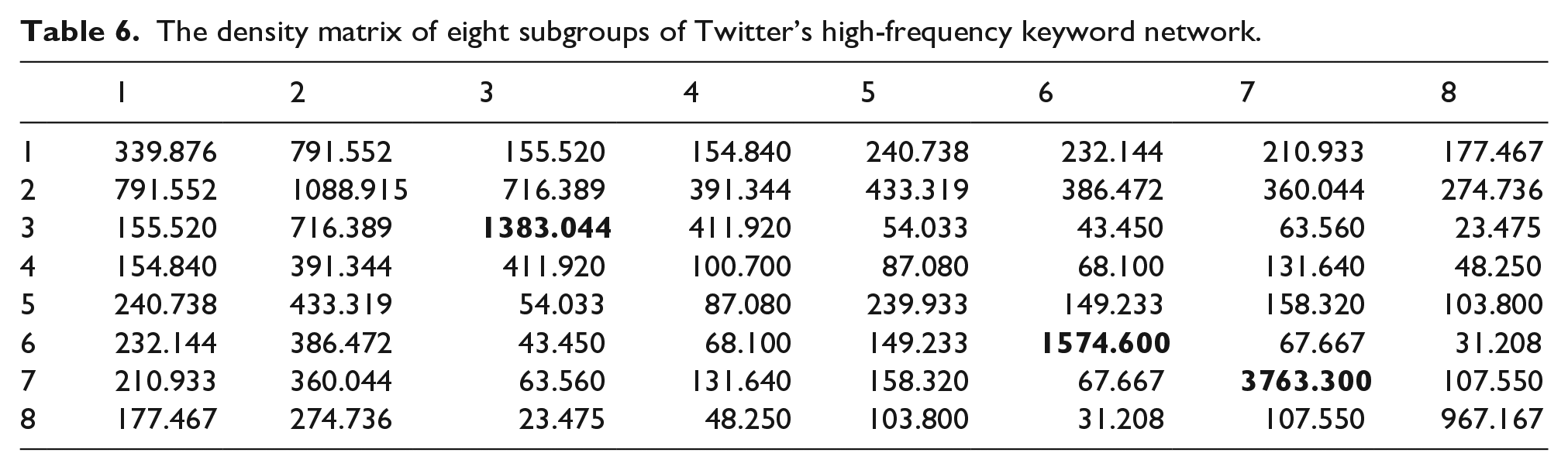
The average density of Subgroup 7 is the highest, at 3763.300, indicating the highest correlation between high-frequency keywords in Subgroup 7. The “battlefield documentary” is a typical discourse structure of Twitter users. On one hand, the Ukrainian people tweeted a lot about the real battlefield. On the other hand, netizens are also most concerned about civilian corpus rather than the official narrative from the media, which is different from Weibo, probably due to different content distribution mechanisms and platform logic. In addition, the average density of Subgroups 6 and 3 is also higher, indicating that the “fear of nuclear war” and “social media blocking” are also common. The above three types of subgroups fully demonstrate the “pro-Ukrainian and anti-Russian” position of Twitter users, while from the perspective of the general public, they hope the war will end as soon as possible.
Multidimensional scale analysis: broad and scattered versus single point
In this section, the study measures the distance between keywords through multidimensional scale analysis to show the structure of the data. This method uses the specific location of objects in two or three dimensions, and by looking at the planar distance between objects, the similarity between them can be understood (Liu & Ye, 2012, pp. 50–58). First, the co-occurrence matrix of high-frequency keywords “79 × 79” on Weibo was generated. Next, we converted it into a correlation matrix by “classification-systematic clustering-interval-cosine” in SPSS 26, and then analyzed it with multidimensional scaling (Alscal). The European distance measurement model (Euclidean) was used to conduct a multidimensional scale analysis on the high-frequency keywords of the Russian–Ukrainian War review. The stress and RSQ test statistics proposed by Kruskal were used to calculate the reliability and validity (Kruskal, 1967). The results showed that stress = 0.120 and RSQ = 0.868 (the reference value was 0.6), and the model fit was good.
The intersection of Dimensions 1 and 2 in Figure 6 is the centrality point, parameterized by centrality and density in two-dimensional coordinates. The horizontal axis is centrality, representing the strength of inter-domain influence; the vertical axis is density, which represents “the strength of connections within a domain” (Law et al., 1988, pp. 251–264). Each small circle is a keyword, and the closer the keyword is to the center of the coordinate intersection, the more influential it is. As can be seen from Figure 7, there are more high-frequency words near the center point of the whole figure, “Russia,” “Putin,” “Ukraine,” “tank,” “soldier,” and other words describing basic facts are closest to the center, indicating that the discourse pattern of Weibo users is dominated by relaying and sharing media news reports, there comments are mostly copying and reposting news headlines, lacking their own diversity of views. The discourse structure around the Russian–Ukrainian War is relatively homogeneous. Further analysis shows that the keywords distributed in the upper part of Dimension 1 (vertical axis) are mostly related to military and political actions (“speech” and “armed” enter). The bottom part gradually transitions to those related to military results (“explosion” and “command post” destroyed), so Dimension 1 is interpreted as an “action-result” dimension. The keywords on the left side of Dimension 2 (horizontal axis) are mostly related to the names of countries, locations, and institutions, and refer to macro battlefield dynamics, while the further to the right, the more they are related to leaders (micro individuals) such as Biden and Zelenski. Therefore, Dimension 2 is interpreted as the “macro battlefield—micro individual” dimension.
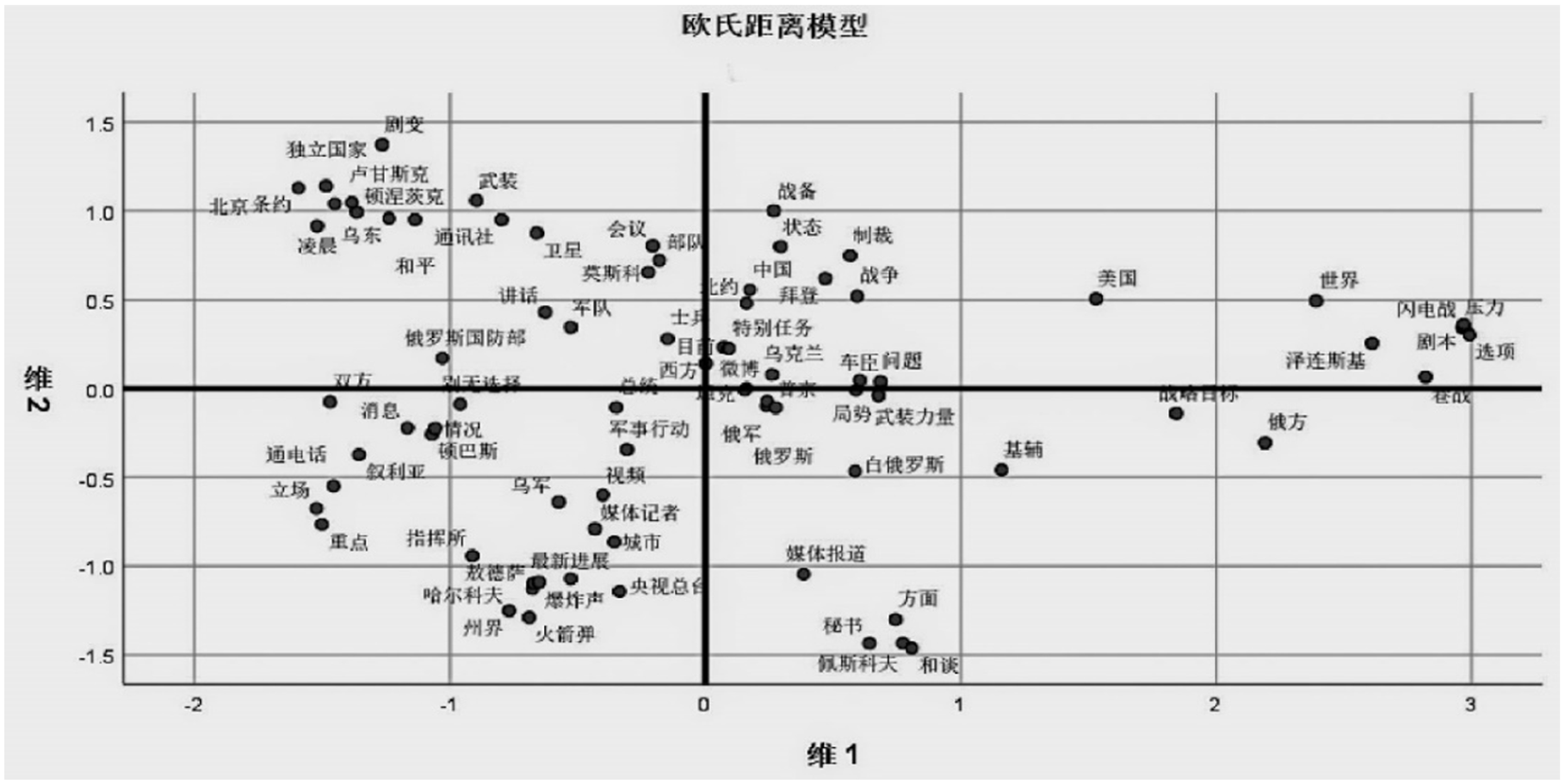
Multidimensional scale analysis of high-frequency keywords on Weibo.
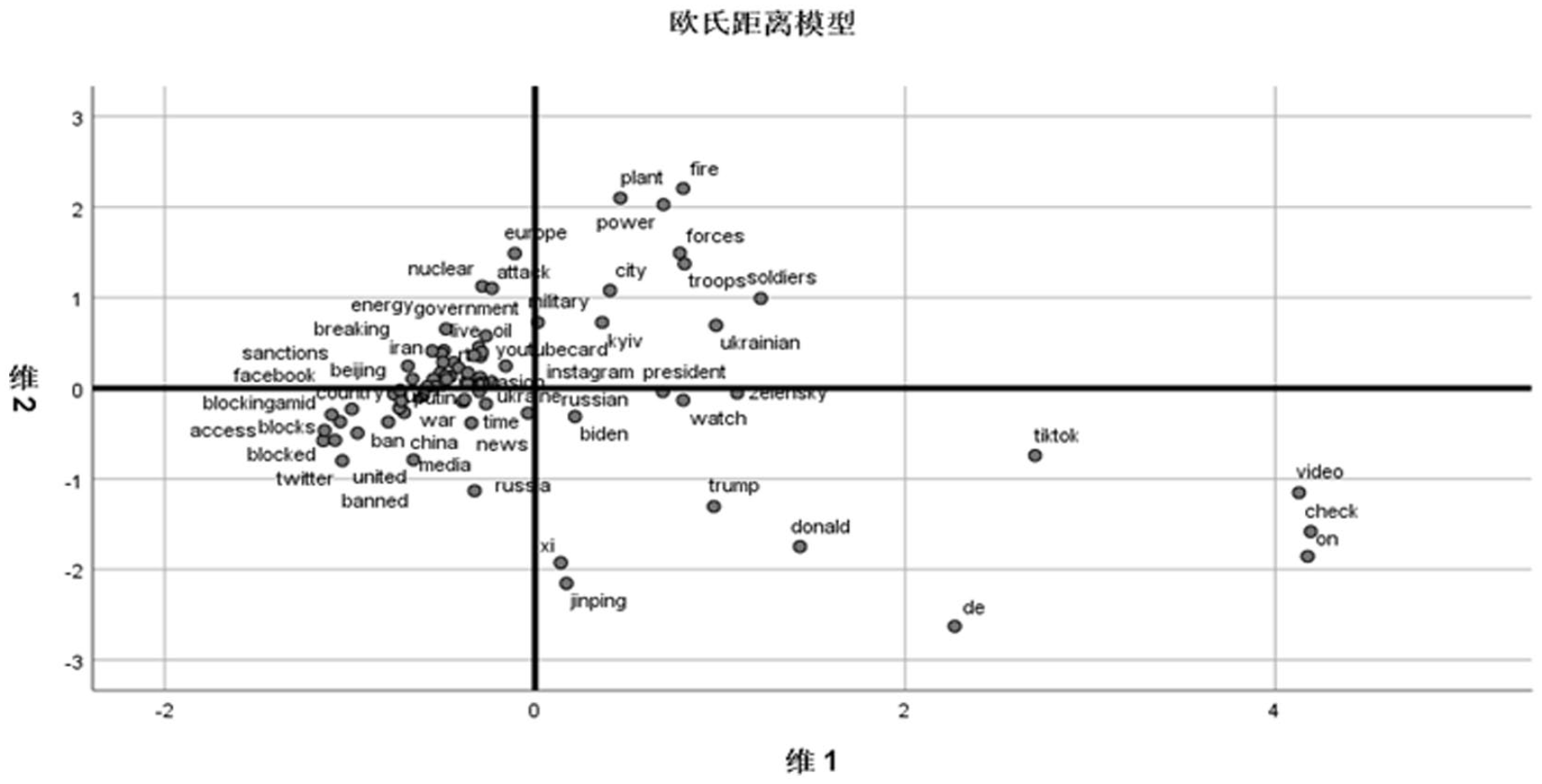
Multidimensional scale analysis of high-frequency keywords on Twitter.
As a result, the figure can be divided into four major parts. The upper left quadrant is the densest and centripetal domain, the semantic type of “macro-military action.” As the initiator of the war and because of the particular diplomatic relationship between China and Russia, the media coverage of Russia on Weibo is much more than that of Ukraine, which leads to a grand and restrained war narrative logic overriding the delicate, emotional, and descriptive portrayal of people. Among the 19 high-frequency keywords, except for a few adjectives such as “dramatic change.” All of them are nouns with high subjective convergence and refer to the actions of the Russian military without exception. The upper right quadrant has fewer keywords, mainly the type of “micro-individual actions,” indicating that a small number of Weibo users emphasize the appeals or aid actions of the Western camp, such as Zelensky and Biden, to condemn Russia’s special military actions. The bottom left quadrant is mainly the type of “macro military effect,” which echoes the top left quadrant and results from military actions. Still, some military fans analyze the combat effect of Russian, Ukrainian, and Western-aided military equipment on Weibo. The keywords in the bottom right quadrant are the least frequent, mainly of the “micro-individual effects” type, referring to the effects of military operations on the battlefield, which are highlighted at the individual level. For example, Russian Presidential Press Secretary Peskov has been the window for Putin’s dialogue with the outside world and the process of peace talks with relevant officials. The large horizontal and vertical span between the four major structures indicates that the focus of attention and commentary on Weibo public opinion is broad, dispersed, and scattered.
The same procedure was performed for the Twitter data, and the results showed that the model fit was good for stress = 0.172 and RSQ = 0.932. As can be seen from Figure 8, the high-frequency keywords of the whole graph are clustered around the central point, with “Ukraine,” “Russia,” “Russian,” “Putin,” “War,” “Facebook,” and “Invasion” as the words closest to the center, indicating that the comments and concerns of Twitter are more focused.
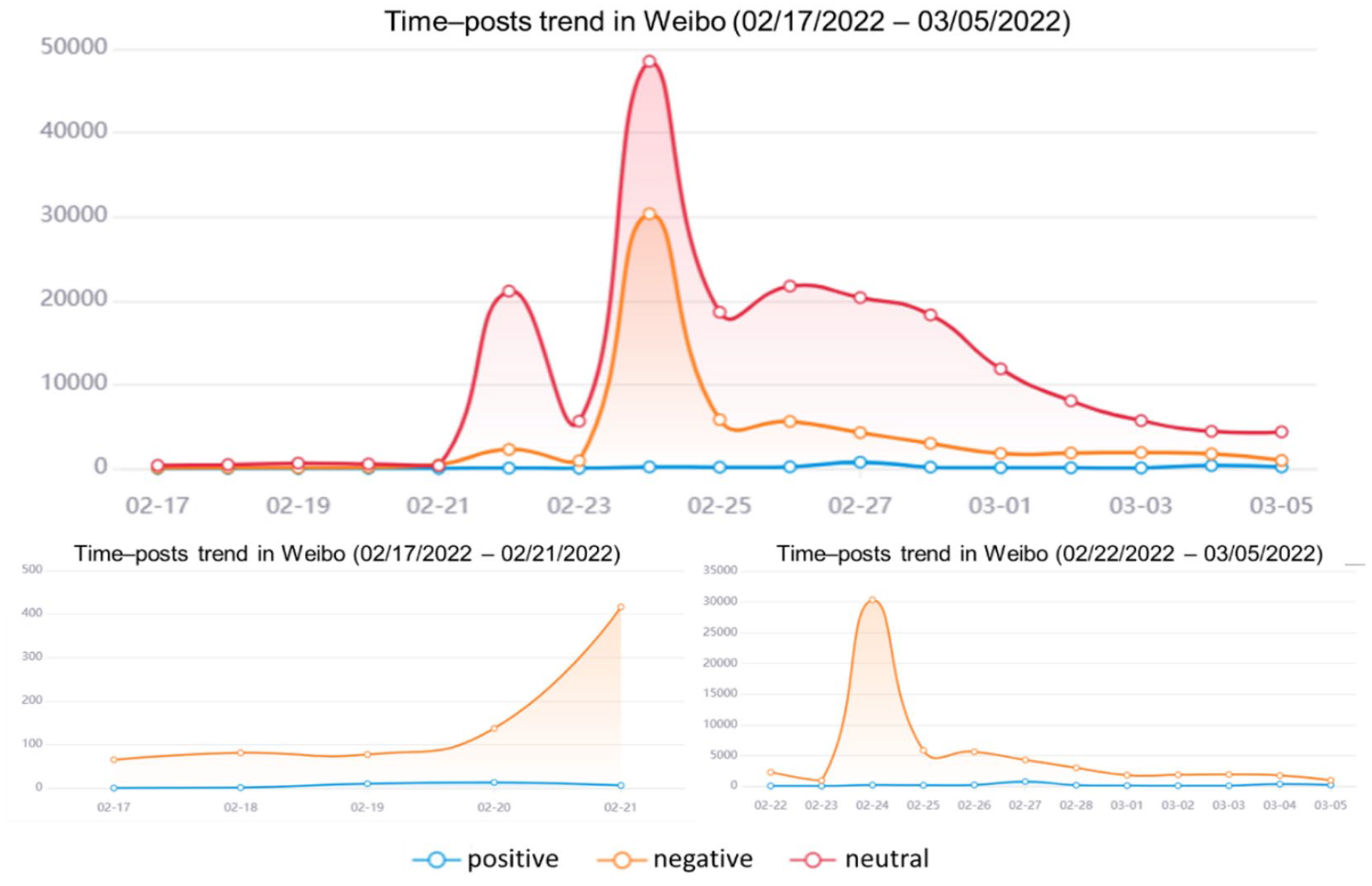
The trend of Weibo sentiment on the Russian–Ukrainian War.
Twitter comments on Russia tend to tie Putin, Russia, and the Russian people together to form regional public opinion suppression. Further analysis shows that the keywords in Dimension 2 (horizontal axis) are all distributed on the left side, so there is no keyword expression specificity in Dimension 2. The keywords distributed in the upper part of Dimension 1 (vertical axis) are mostly related to the military, political and economic actions of Russian and Ukrainian forces (“Military,” “Oil,” “Nuclear,” etc.), while the bottom part gradually transitions to the involvement and handling of the war situation by countries other than Russia and Ukraine (“China,” “Ban,” “Access,” etc.), so Dimension 1 is only interpreted as the dimension of “Russia–Ukraine confrontation—multinational multilateral response.”
As a result, the whole figure can be divided into two major parts, with no clear boundary between them, which can even be seen as a main structure biased to the left of the central point, indicating that the focus of attention and comments in the Twitter opinion field is more concentrated. The left side of the center point level is the area with the highest keyword density and concentricity. This part refers to comments about Putin and Russian dynamics, which are the source of all conflicts. In the upper half, Twitter netizens made highly unanimous comments around the “Russia–Ukraine confrontation,” and the attitude of the netizens was lopsided, with the majority of them clarifying “resist Russia and support Ukraine.” In the bottom half, from the “multinational multilateral response” model, netizens generally believe that Ukraine should be supported militarily and economically as soon as possible, while sanctions should be imposed on Russia in multiple dimensions.
Sentiment analysis on time series: positive and negative game
Based on the content of a single tweet, the sentiment attributes of the tweets are classified as “positive,” “negative,” and “neutral.” The degree of negativity and positivity is compared with determine whether the posters’ subjective expressions are positive or negative.
Since the determination of sentiment attributes of text content is highly subjective, a cross-validation method is used in the annotation process: three researchers in the field of news communication, based on the above rules, manually annotated 1000 corpus each, using at least two people annotating the same sentiment attributes as the annotation results. Based on the manually annotated corpus, the deep learning model is trained and the machine automatically determines the sentiment attributes. The sentiment analysis model is used to determine the sentiment attributes of Weibo and Twitter comments (/tweets) data for time series sentiment trend analysis.
To include the overall situation of emotion trends in the longest possible period, the data of this part are from 17 February 2022 to 5 March 2022. An example of automatic sentiment attribute determination based on deep learning is shown Table 7. Positive comments contain words with positive meanings such as encouragement, praise, and cheer; negative comments contain words with negative meanings, such as bashing, insulting and sad; and neutral are objective statements without obvious tendencies.
Examples of comment sentiment attributes on Weibo.
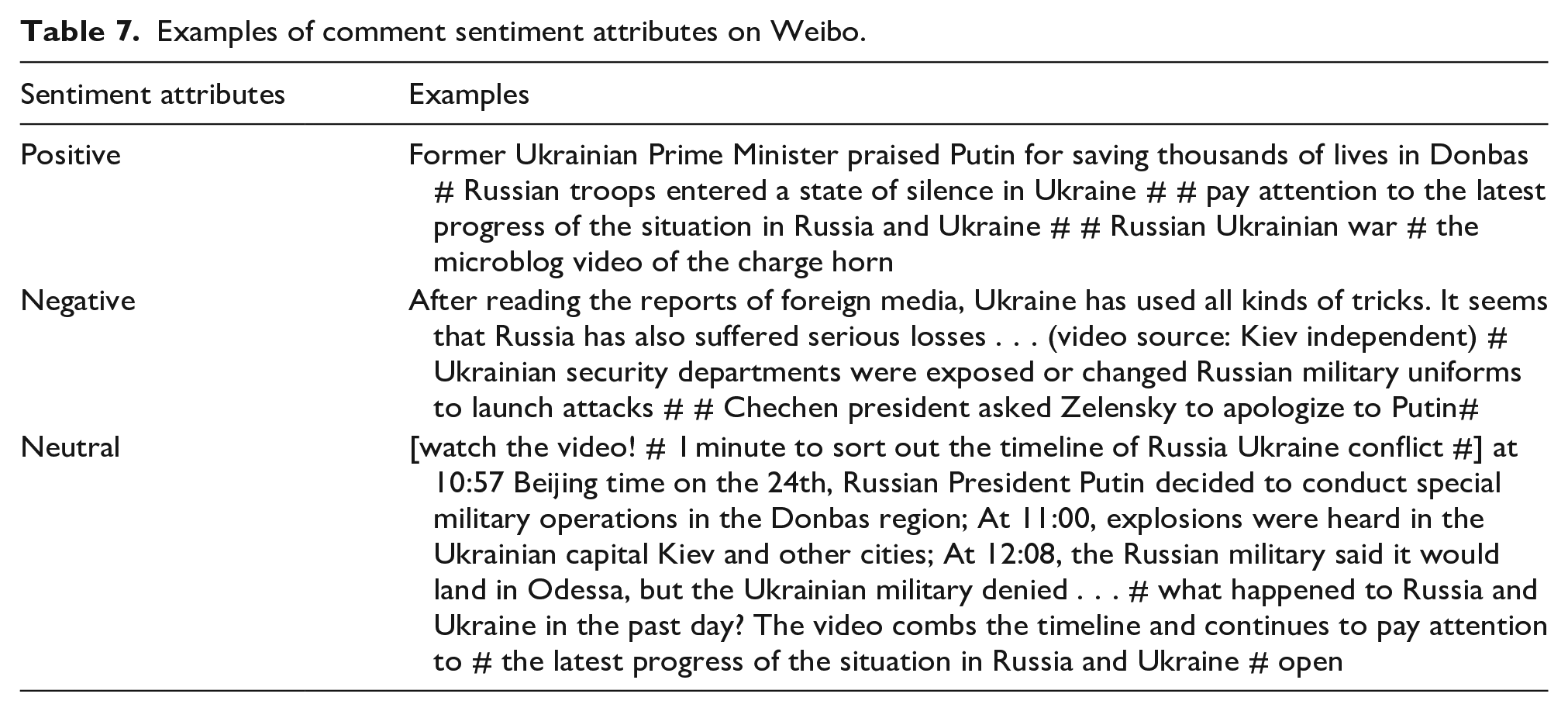
On Weibo, negative topics included accusations against the United States, as well as accusations against Russia and dissatisfaction with the war. There were a few positive topics reflecting “pro-Russia” sentiment. The trend of “positive, negative, and neutral” posts from 17 February 2022 to 5 March 2022 is shown in Figure 8.
Before February 21, the volume of negative topics overwhelmed that of positive topics; the total volume of topics was lower than 400 per day. Since February 22, following the signing of Putin’s order to recognize the “Donetsk People’s Republic” and “Luhansk People’s Republic” in eastern Ukraine, the volume of topics related to the Russia–Ukraine conflict rose sharply, with the volume of negative topics continuously overwhelming that of positive topics. During this whole period, both positive and negative posts were dominated by the neutral ones.
Twitter showed different pattern. Taking the same operation path for Twitter, an example of automatic sentiment attribute determination is shown in Table 8.
Example of tweets sentiment attributes on Twitter.
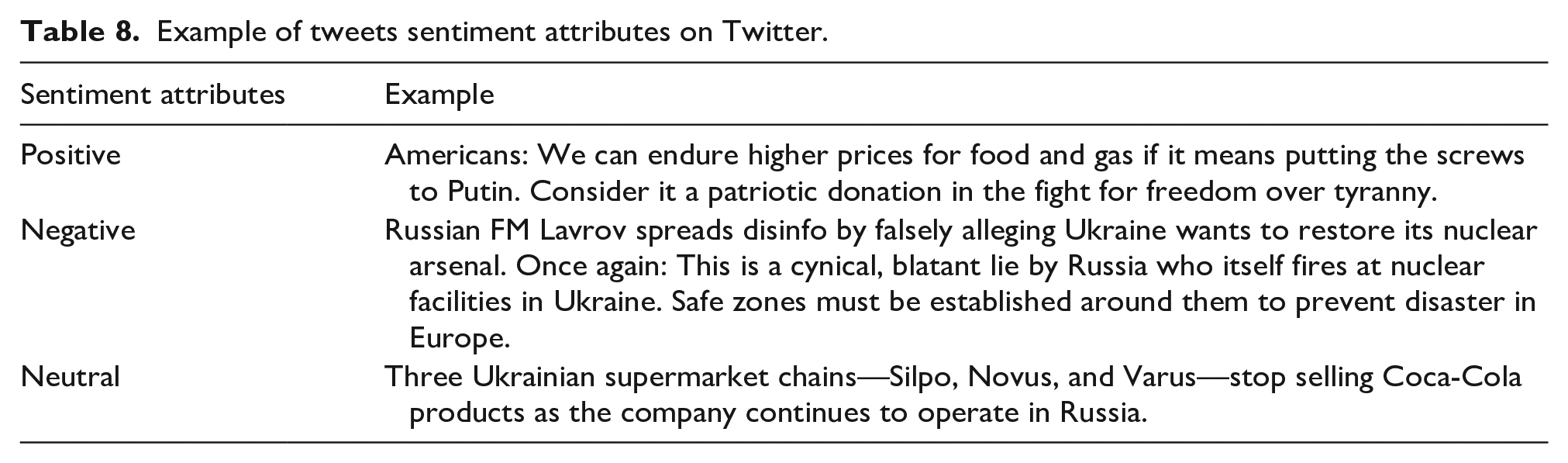
On Twitter, discussions raised after 23 February. It maintained a high level and did not calm down even 1 week after the war had broken out. Positive topics are mainly “pro-Ukraine and anti-Russia,” while negative topics are similar to Chinese ones, mainly blaming Russia and discontent with the war. The trend of positive, negative, and neutral posts from 17 February 2022 to 5 March 2022 is shown in Figure 9.
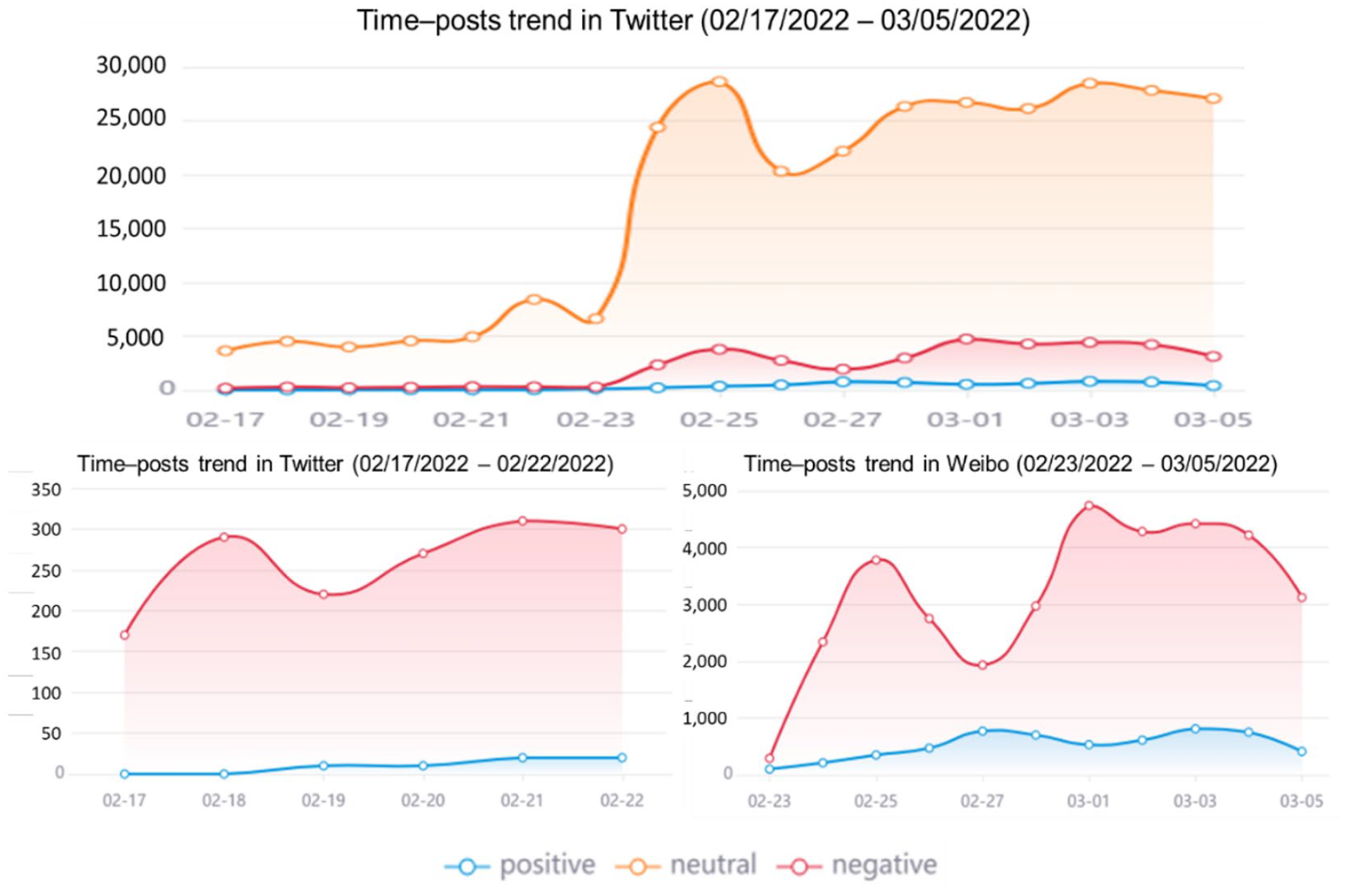
The trend of Twitter sentiment on the Russian–Ukrainian War.
Differences in the number of users on the two platforms themselves have led to inconsistencies in the volume of Russian–Ukrainian War sound bites. In terms of specific sentiment trends, Twitter and Weibo show roughly the same trends. Between 17 and 22 February 2022 (inclusive; Beijing time, the same below), the US–Russian presidential dialogue led to a slight increase in the overall volume of topics, with negative topics overwhelming positive ones; in addition to blaming Russia (Putin), negative topics also began to include “China’s inaction” or the perception that China supports Russia. By 23 February, the volume of topics related to the Russia–Ukraine conflict rose sharply, with neutral topics dominating. Unlike Weibo, the volume of positive topics was always higher than negative topics during the hot war between 26 February and 3 March (Figure 10) on Twitter. The negative topic volume gradually exceeded the positive volume until the week after the war (4 March) and was suppressed, while the negative topic volume consistently overwhelmed the positive during the corresponding period on Weibo.
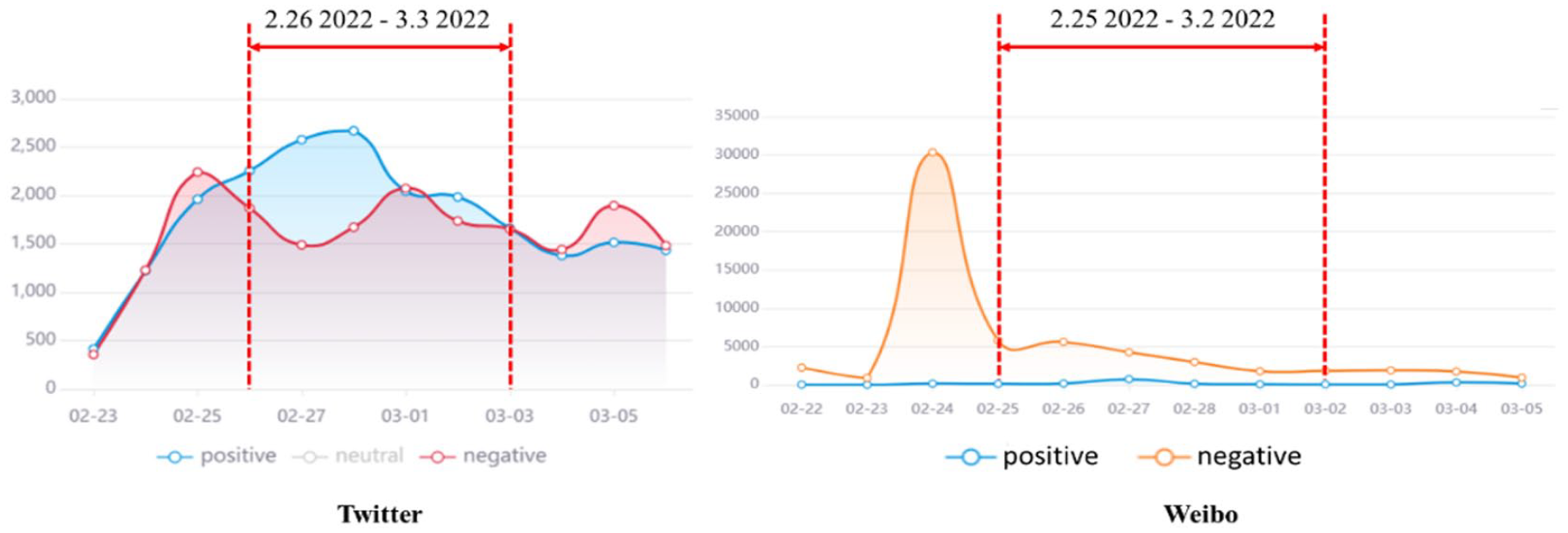
Comparison of the emotion trend of both platforms.
The difference in sentiment in international and Chinese social media opinion (Figure 10) is due to the difference in the content of “positive” topics. Both international and Chinese negative topics are allegations of war; nonetheless, Chinese positive topics are dominated by expressions of support or admiration for Russia (Putin), while international positive topics are dominated by praise and support for Ukraine. This situation is related to the difference in the ecology of public opinion. The Twitter public opinion field focuses on the tragedy of the ordinary Ukrainian people in a state of war from the perspective of civilians. The Western public looks to NATO and other Western political and military organizations to “save” Ukraine.
In spite of the difference of /negative sentiments between Weibo and Twitter, as the war progresses, especially with the disclosure of more and more information on global social media such as “destruction of towns,” “casualties,” and “displacement of refugees,” the volume of negative sentiment in the public opinion field has formed a scale effect. When the hot war was officially fought, the polarization intensified. The positive and negative voices were always in the state of “one side suppressing the other,” during which the dominant rhetoric of the international platform gradually developed from strong support for Ukraine to accusations of war.
Discussion and conclusion
As social media gradually becoming a conveyor belt for “post-truth” (Hannan, 2018, p. 214), in the Russian–Ukrainian War, the posts on Weibo and Twitter have conveyed the information for “post-war.” This study conducts a comparison sentiment analysis based on two major social media platforms and collects commentary data through data mining. The following characteristics are found. At the semantic level, Weibo posts are synchronized with Chinese mainstream media with broad instead of deep narration, while Twitter posts focus more on individual encounters. On Weibo, the large opinion environment keeps synchronization with official media announcements, which is related to the content production and review mechanism of media platforms. Unlike Weibo, users on Twitter pay more attention to the civilian corpus, cutting from individual encounters, with delicate and inflammatory expressions. Some scholars have found that international social media platforms such as Twitter have gradually become a political tool for political leaders (Buccoliero et al., 2020, p. 88) and is affected by the culture of “political correctness” (Wikström, 2016, p. 159). From our analysis about the fames, posts on Twitter are somehow also showing a certain degree of “political intentions.” At the structural level, the topics on Weibo were “wide and scattered,” with discussions around the Russian–Ukrainian War involving bilateral political, military, diplomatic, and economic aspects; while the topics on Twitter formed a condemnation around the invasion war, which especially focused on “Putin’s armed invasion war” and “support for the Ukrainian resistance.” Weibo users tended to repost and comment on the news, while Twitter users preferred to tell stories and trigger empathy. The storytelling strategy improved immersion and engagement (Domínguez, 2017, p. 10), which, on one hand, may arouse the care about the victims, but, on the other hand, may abet irrational quarrels and misleading.
At the emotional level, the positive and negative comments follow the development of war and go through three stages: “confrontation,” “polarization,” and “extension.” Individual emotions interacted and dynamically generated the “collective emotion” (Goldenberg et al., 2020, p. 155). At a collective level, emotions accelerated to contaminate and polarize. Twitter triggered condemnation during the war, and encouraged users to be enrolled in this collective condemnation. This negative type of emotion mutually influenced and kept the whole discussion to last for a long period of time. This phenomenon could be explained by the emotion cascades theory that the constant emotion from new people entering the group helps maintain the emotion intensity (Hasking et al., 2018, p. 941). Discussion in Weibo gradually calmed down because the wide and macrolevel narration could not continuously trigger active and longlasting emotions. Although negative/positive emotions polarized when the hot war began, after 1 week, the temporary collective went back to the individual level, which generated a lower emotion intensity.
Longer lasting truth is found in negative sentiment from both two major platforms. Although those two public domains show different divisive features and differences, negative posts aggregated to highlight the call for humanitarianism and peace constitutes the homogeneity of public opinion, this is a common demand that transcends ideology. Public attention is focused on the Ukrainian–Polish border, Ukrainian women, children, captured Russian fighters, and expatriates from various countries. The long-lasting call for peace should be noted no matter what politicians in hostile countries or swayed news media say.
There are some shortness existing in our study. It is sad that the war is not over yet, and new phenomena, questions, and social concerns that need to be answered may surface. Therefore, this “concomitant” study is only the beginning and needs to be further improved. Besides, the research only focused on the panoramic portrayal of the Russian–Ukrainian War on typical social media, which may leave out many fragmented but important contents. More specific events in the war could be used in future researches as entry points to dig deeper for clues.
Supplemental Material
sj-7z-1-ctp-10.1177_20570473231165563 – Supplemental material for Differentiation and unity: A Cross-platform Comparison Analysis of Online Posts’ Semantics of the Russian–Ukrainian War Based on Weibo and Twitter
Supplemental material, sj-7z-1-ctp-10.1177_20570473231165563 for Differentiation and unity: A Cross-platform Comparison Analysis of Online Posts’ Semantics of the Russian–Ukrainian War Based on Weibo and Twitter by Wei Tao and Yingtong Peng in Communication and the Public
Footnotes

Supplemental material
Supplemental material for this article is available online.
Author biographies
References
Supplementary Material
Please find the following supplemental material available below.
For Open Access articles published under a Creative Commons License, all supplemental material carries the same license as the article it is associated with.
For non-Open Access articles published, all supplemental material carries a non-exclusive license, and permission requests for re-use of supplemental material or any part of supplemental material shall be sent directly to the copyright owner as specified in the copyright notice associated with the article.
