




Abstract
Populism has become a widely used concept in both academia and the media. The term’s popularity has encouraged scholars to question how it is applied and to theorize on the consequences of its use. However, there is little empirical research on the temporal and cross-country changes in the use of the term in the public sphere. This article analyses the significations given to the terms ‘populism’ and ‘populist’ in six countries’ daily newspapers over a period of nearly two decades. It presents the results of a quantitative content analysis of texts (N = 3252) published in legacy daily papers in Finland, Sweden, the United States, the United Kingdom, the Netherlands and Turkey in the years 2000–2018. The article shows how the salience, meanings and perceived repercussions of ‘populism’ change over time and vary between the countries. The study reveals how, towards the end of the 2010s, the term is increasingly used in the context of right-wing populism and as a reference to political ideas that are detrimental to democracy. The results are examined in the context of developing academic discussions regarding the effects of ‘populism’ becoming a ubiquitous signifier in the media.
Introduction
Research has suggested that the term ‘populism’ has no fixed meaning (Dean and Maiguashca, 2020; De Cleen et al., 2018), and that in the vernacular language, it is more likely to be used pejoratively than analytically (Bale et al., 2011; Brookes, 2018). A recent study demonstrated that use of the term more than quadrupled in academic journal articles during the 2010s (Brown and Mondon, 2021: 3). As populism has become a mainstream concept both in academia and in the media, the terms’ varied uses have raised concerns over its analytical value in describing ‘real-life’ phenomena (e.g. Dean and Maiguashca, 2020; Goyvaerts and De Cleen, 2020). De Cleen et al. (2018) urge populism scholars to ask whether their selected definition of populism can, for example, feed into anti-populist rhetoric or provide momentum for ‘populist hype’. Dean and Maiguashca (2020: 19) warn that ‘we are witnessing a degree of conceptual overreach that threatens to swamp all our analyses of and discourses about contemporary politics’ and that both scholars and journalists should be aware of the potentially harmful and muddling consequences of the term’s (mis)use (see also Goyvaerts and De Cleen, 2020). Still, there have been no systematic comparative studies analysing the meanings of ‘populism’ over a longer time in different national contexts.
This paper presents a quantitative content analysis of the significations given to the terms ‘populism’ and ‘populist’ in daily newspapers of six countries during the first two decades of the 21st century. The countries included in the study are the United States, the United Kingdom, the Netherlands, Finland, Sweden and Turkey. The research focuses on observing temporal and cross-country changes, similarities and differences in (1) the term’s salience, (2) the tone of the coverage, (3) what phenomena newspapers are referring to when invoking the term ‘populism’ and (4) what kinds of effects ‘populism’ is framed to have on democracy. The study goes on to show that the term has been used to describe different phenomena at different times and in different countries, but over time, hegemonic understandings of the term suggest that populism is a (radical) right-wing ideology increasingly viewed as detrimental to democracy. The study provides new empirical evidence to engage in the ongoing discussion regarding the consequences of ‘populism’ becoming a prevalent political signifier in the public sphere.
‘Populism’ as a political signifier
As populist political actors and their agendas have become more mainstream in politics, the use of the term ‘populism’ has peaked in both academia and public discussions (see Brown and Mondon, 2021). However, the term’s ambiguity, as highlighted by several scholars, has led to its being used in various and incongruous ways or often left completely undefined, especially in the media (e.g. Canovan, 1999; Laclau, 2005; Taggart, 2000). Therefore, based on Laclau’s (2005) approach to populism, a new line of research has emerged to demonstrate that the term ‘populism’ can be viewed as a ‘floating signifier’, a word whose meanings have not crystallized but are subject to a constant process of discursive struggle (Dean and Maiguashca, 2020; De Cleen et al., 2018). The innovation of this emerging field of study is that it proposes analysing populism not as a political ontology (be it stylistic, ideological or discursive) but as a political signifier whose hegemonic uses have real-life consequences that ‘are distinct from the impact of particular populist policies’ (De Cleen et al., 2020). According to Eklundh (2020), since the word ‘populism’ is used with the purpose (or at least with the result) of establishing discursive divides between in- and out-groups, we must critically assess the consequences of its uses.
Scholars have suggested that the public use of the term has led to the construction and sustaining of ‘populist hype’ that gives the rise of right-wing populism disproportionate attention (Glynos and Mondon, 2016: 2). This may serve to skew the public’s understanding of populism and also to mainstream, euphemize and trivialize the far right (Brown and Mondon, 2021). Thus, a consequence of the term’s alleged synonymization with emotionally driven and negatively perceived political phenomena that actively challenge liberal democracy is to allow ‘populism’ to be used to enforce political discourses that aim to oppose all who are assigned the role of ‘populist’ (Brown and Mondon, 2021; Eklundh, 2020). Maiguashca (2019: 769) argues that as populism has become a trope du jour, it is likely to ‘encourage brash judgements and indignant outrage at any and all challenges to the centre ground of politics’. Therefore, one of the main consequences of the term’s public (mis)use is the conflation of the various ideological manifestations of populism, leading to the boosting of particularly populist radical-right demands while delegitimizing the demands of other movements and actors similarly described as ‘populist’ (De Cleen et al., 2020: 169; Brown and Mondon, 2021; Goyvaerts and De Cleen, 2020). But to what extent have these theorizations pertaining to the increased and negative salience of ‘populism’, to the exaggerated focus on the radical right, and to the hegemonic portrayals of populism as a threat to (liberal) democracy been analysed in longitudinal and cross-country settings?
While an increasing number of studies have investigated the mainstreaming and prevalence of populist rhetoric, populist discourses or populist messages in the media over time (e.g. Aalberg et al., 2017; Hameleers and Vliegenthart, 2020; Manucci and Weber, 2017; Reinemann et al., 2019), populism has been systematically analysed as a signifier in the media in few pieces of research. A decade ago, Bale et al. (2011) investigated the use of the term in British ‘highbrow’ dailies, while Herkman (2016, 2017) studied the framing of populism in Nordic dailies and tabloids at the beginning of the early 2010s. Goyvaerts and De Cleen (2020) analysed seven Flemish newspapers’ use of the term by adopting a discourse-analysis-based approach during a single election in 2014, and Brookes (2018) employed discourse analysis to study the journalistic use of the term during the US presidential elections and the Australian federal elections in 2016. Brown and Mondon (2021) combined discourse theory, critical discourse studies and computational linguistics to analyse the use of the term in the UK’s Guardian newspaper during 2019.
Therefore, the works by Bale et al. (2011) and Herkman (2016, 2017) remain the only quantitative content analyses of the significations of populism in the media, and only Herkman’s studies have incorporated comparisons between countries. Bale et al. (2011) analysed how the terms ‘populism’ and ‘populist’ were used in four UK broadsheet newspapers during two 3-month periods in 2007 and 2008. They found that populism was used in the media to refer to a wide range of unrelated issues and actors, that no particular policies were viewed as populist as such and that populism was predominantly used to label political opponents. Herkman (2016) study indicated that populism was typically framed negatively in the Nordic press but that its use was more systematic than in the UK: most often populism was connected to domestic or European right-wing populist actors and their nationalist or nativist ideologies. Using a different approach, Brown and Mondon (2021) demonstrated that populism is often used as a euphemism for racism, nativism and anti-immigration sentiment. However, we know little about the temporal and cross-country generalizability of the emergence of the so-called ‘populist hype’ and how the mainstream meanings and suggested consequences of ‘populism’ have changed.
In contrast to several studies that have researched ‘populist political communication’, our study is not primarily interested in analysing the media as platforms for the dissemination of populist communication or the media as actors that utilize populism’s stylistic and ideological elements (Aalberg et al., 2017; Reinemann et al., 2019). Instead, we are interested in what the term has been suggested to mean over time in different countries. Following a similar heuristic approach to that chosen by Bale et al. (2011), we use newspaper articles as data as they allow the monitoring of the usage of the term not only by journalists but also by politicians and the public via a single source. By incorporating comparative and temporal analysis into the research design, we are able to contribute to three theoretical discussions regarding the scale and consequences of the politics of the term ‘populism’. First, we demonstrate to what extent, where and when ‘populism’ has been a so-called floating signifier: What kinds of understandings of ‘populism’ have mainstreamed in the first two decades of the 21st century in the daily press? Second, we empirically explore the existence of media-induced ‘populist hype’ and describe its characteristics and prevalence: Is there such a thing as populist hype, and who is being hyped? Third, we contribute to the ongoing discussion regarding the consequences of the term’s public use by highlighting core changes in the hegemonic meanings of the term.
Data and method
To explore developments in the public use of ‘populism’ longitudinally, we collected a large sample of newspaper articles from the years 2000 to 2018. The chosen period extends from the end of the pre-9/11 era to the end of the pre-Covid era, covering the increasing success of European populist movements in the 2000s as well as the Brexit vote and Donald Trump’s victory in the US presidential election of 2016 and their aftermaths.
The data were collected from daily newspapers for two reasons. First, despite the increasing importance of digital and social media in contemporary politics, daily newspapers still symbolize the backbone of the public sphere in many countries. Their well-maintained archives combined with their relatively unchanged format and societal mission, if you will, are well suited to the collection of a longitudinal comparative sample of topical issues in countries with different political cultures and media systems (see, e.g. Picard, 2015: 1–2; Schmidt et al., 2013: 1233–1234). Newspapers also persist as key players in the online news market. Second, even though we do not suggest that newspapers are the perfect mirror of the increasingly fragmented and hybrid publics of the 21st century, they do provide a heuristic keyhole through which we can explore the salience of and significations given to ‘populism’ by various actors in several countries during the first two decades of the new millennium.
The selected papers are legacy dailies from six countries: Finland, Sweden, the Netherlands, the US, the UK and Turkey. The countries were selected to represent a variety of national contexts with different histories of populism. In Hallin and Mancini’s (2004) seminal classification, Finland, Sweden and the Netherlands represent democratic corporatist models, while the US and the UK exemplify liberal ones. The southern European ‘polarized pluralist’ countries are not included in this study for practical reasons. Instead, Turkey represents here a different context in comparison to northern European and US liberal democracies. The newspapers included in the study are Helsingin Sanomat (HS) from Finland, Dagens Nyheter (DN) from Sweden, De Volkskrant from the Netherlands, The New York Times (NYT) from the US, The Times from the UK and Hürriyet from Turkey.
Since the media and political systems differ among the countries, the papers were selected based on their journalistic and historical status. The papers are among the most traditional and popular dailies in their countries and have long histories ranging between 100 and 230 years, except for Hürriyet, which was founded in 1948. The papers are declared to be politically independent, although historically they have exhibited mostly liberal centre-left political orientations, except for The Times, which has a more conservative orientation, and Hürriyet, with clear links to the ruling power in Turkey. Most importantly, they all represent mainstream journalistic media that often remain in confrontation especially with the illiberal elements of populism (see Krämer, 2018). The papers in the sample also have well-maintained digital archives.
The articles discussing populism between 2000 and 2018 were collected from the online archives of the aforementioned papers using the search word ‘populis*’, covering all variants of the term (noun, adjective, actor) as applied naturally in the native languages. Using a systematic random sampling, we selected for analysis every 10th article that discussed populism in the context of politics. Articles referring to populism in the contexts of culture, economics and sports, for example, and with no clear connection to politics (around 10%), were excluded from the sample along with a modest number of duplicates. The total sample contains 3252 (=N) various types of newspaper articles, from which 434 were published in Helsingin Sanomat, 549 in Dagens Nyheter, 522 in De Volkskrant, 475 in The Times, 832 in The New York Times and 437 in Hürriyet. The sample represents a 10th of all the articles that explicitly mentioned political populism during the years 2000–2018. Therefore, the newspapers published approximately 32,500 articles mentioning populism in total, the numbers varying from approximately 4000 to 8000 articles per paper.
The full selected sample of 3252 articles was coded and analysed using quantitative content analysis. The codebook contained descriptive variables on story size, journalistic genre, tone, grammatical use of the terms, primary actors, and quoted sources, but the variables most relevant for this study pertained to the primary meanings and normative evaluations made about populism in each article. We discuss the classification criteria of different variables in more detail when necessary.
The coding was done by native research assistants, who were master’s degree students or doctoral candidates in political science or in media and communication studies. After having tested and modified the codebook in the Finnish context, the research assistants were trained in how to guarantee the uniformity and reliability of the coding.
The reliability of the full coding was tested with 10% of the Finnish sample. The inter-coder reliability between two coders was generally very good in descriptive variables (mostly well over 90), good in our key variables of measuring the importance (88.6), actors (77.3) and use (72.7) of populism, but not that good in some of the more interpretive variables of meanings and tones of populism (generally between 60 and 70, the highest being 74.1) using the Holsti formula. Thus, those parts of the results are more approximate than fully statistically reliable. Nevertheless, we believe that our research design reveals the most general trends and emphases in mainstream populism discussions rather reliably.
To guarantee coding reliability between the countries, the coding was carried out with constant collaboration and feedback between the coders and the research lead. The coding was mostly carried out in 2019, and it was completed just before the Covid-19 pandemic in February 2020. The presentation of the results follows the logic of the set research question: we present the temporal changes and pertinent cross-country findings in order of salience, tone of coverage, the meanings of the term, and the suggested effects of ‘populism’ for democracy.
Salience of populism
There has been a global rise in the salience of populism terminology (see Figure 1). After remaining relatively steady for 15 years, the number of articles discussing populism increased drastically after 2015 in all the analysed papers. The longitudinal development of the overall salience of ‘populism’ was statistically significant in all countries (Pearson χ2 = 210.802; df = 108; p < 0.001). The salience of the term peaked in all of the countries in 2017, following the Brexit referendum, the election of Donald Trump and Cambridge Dictionary selecting populism as ‘the word of the year’. It must be noted that Donald Trump was a primary or secondary character in 22.6% of all populism stories published in 2016–2018, and thus his candidacy and presidency had a global impact on the salience of populism.
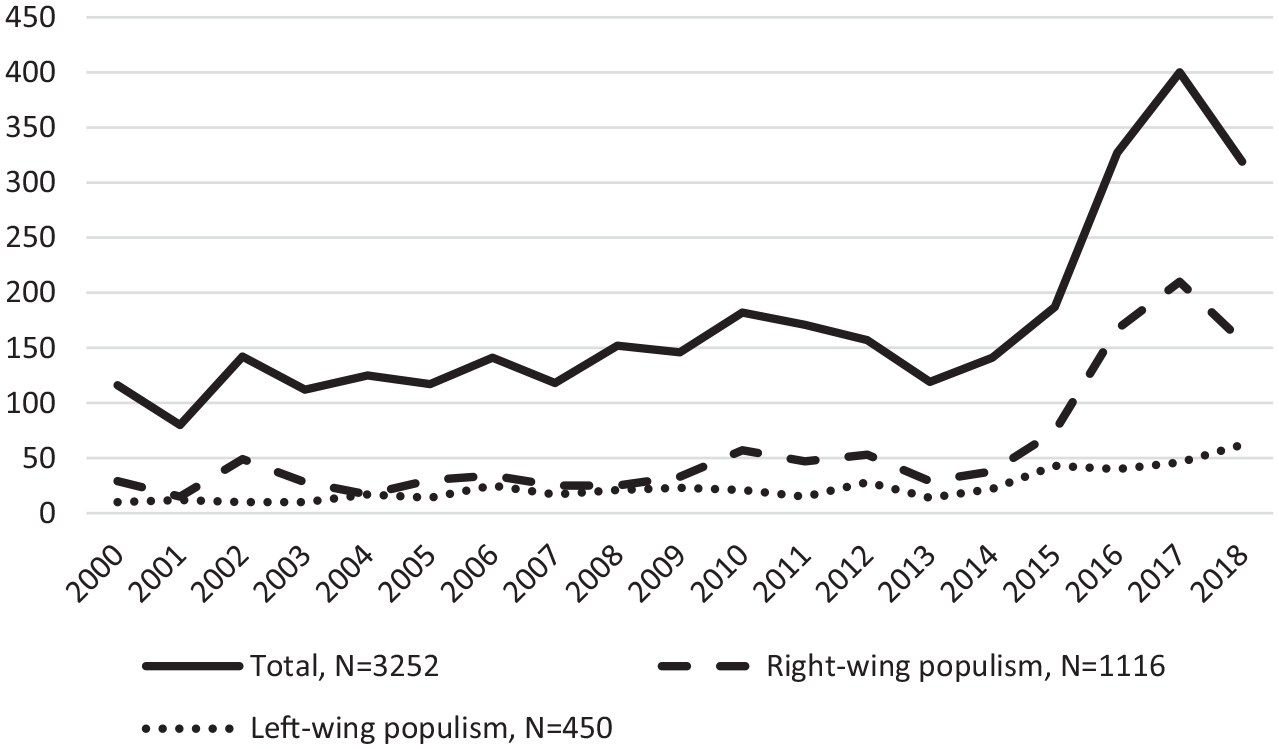
Articles discussing populism, right-wing populism and left-wing populism by year (N = 3252).
In 2017, the analysed newspapers published three and a half times as many articles on populism as they did at the beginning of the millennium. It is also noteworthy that there was a slightly larger increase in the salience of ‘populism’ in the daily papers compared to the increase in (all types of) populist party support during the two first decades of the 21st century. The tripling of the term’s use in newspapers exceeds the growth of populist party support as, for comparison, populist party support in Europe increased only 2.3-fold (from 11.8% in 2000 to 27.5% in 2018) (PopuList, 2020). The slight incongruence between the growth in populist party support and the mediated salience of populism supports the idea of media-induced ‘populist hype’, in which the media’s use of the term ‘populism’ exceeds populist actors’ real-life support and political weight (Brown and Mondon, 2021; De Cleen et al., 2020). However, when analysing what ideological contents populism is most often associated with in the latter half of the 2010s, it becomes clear that the ‘hype’ pertained to only one kind of populism.
About half (n = 1566) of the full sample’s articles explicitly discussed populism as either ‘right-wing’ or ‘left-wing’ populism. In our codebook, right-wing populism referred to anti-immigration-sentiment, nationalism, nativism and/or support for ethnic exclusion, and left-wing populism to anti-capitalism and/or opposition to economic globalization. However, in rarer cases where a right-wing political actor’s populism was described as, for example, ‘protectionist’, the article was coded under ‘right-wing populism’. The variables pertaining to right- and left-wing populism were among the most reliable in terms of their coding. According to the data, references to right-wing populism have increased 7.2-fold (Figure 1), and thus most of the increase in populism’s overall salience between 2016 and 2018 occurred as a result of the increased salience of its right-wing variant. For the sake of comparison, European right-wing populist parties’ support did not even triple during the same time period (from around 5.6% in 2000 to 14.5% in 2018) (PopuList, 2020). Thus, a notable ‘populist hype’ can be observed for right-wing populism, as the increase in references to nationalist or nativist populism vastly exceeded the growth of right wing populism’s political support at the level of parties.
The share of articles discussing specifically the right-wing variant of populism increased in all of the analysed papers. A notable difference is that in the Netherlands populism was already viewed more coherently as ‘right-wing’ populism in the early 2000s due to, for example, the rise and murder of Pim Fortyun. Despite the fact that the number of articles using ‘populism’ in the context of left-wing populism also increased during the years 2000–2018, the increase is both absolutely and relatively much more modest. During populism’s peak year in terms of newspaper coverage, 2017, more than four and a half times more articles were published on right-wing populism than on its left-wing variant, whereas before 2015, right-wing populism was discussed only slightly more often. Also, the growth of left-wing populist party support in Europe (5.5-fold increase) (PopuList, 2020) almost precisely matches the increase in the salience of left-wing populism in the media (5.6-fold increase). Therefore, we can conclude that ‘populist hype’ exists for right-wing populism but not for left-wing populism. However, it must be noted that no countries with successful left-wing populist parties (e.g. Greece or Spain) were included in the study, and thus the sampling may emphasize stories on the radical right.
When comparing the annual change in the genres or types of articles, our analysis shows that the coverage of populism in the overall sample increased similarly in both editorial content (editorials, columns, feature stories, interviews and letters to editors) and news content (news articles, newsflashes, news headlines and quotations from other papers). Despite the fact that the share of editorial content increased slightly after 2015, a clear editorial investment in manufacturing ‘populist hype’ is not indicated by the analysis. However, in countries where a cordon sanitaire has been established around populist radical right-wing actors, the role of editorial content in discussing populism is relatively more prominent. Whereas in Sweden and the Netherlands more than 70% of all ‘populism’ pieces were editorial in content, the same holds true for only around half of the stories published in Finland, the UK and Turkey and for only one out of four stories published in The New York Times.
Tone of discussing populism
In terms of tone, a slight difference was detected in the coverage of the two most-often recognized types of populism: whereas 60% of all stories covering right-wing populism view the phenomenon of populism negatively, the same holds true for only 49% of stories on left-wing populism (see Figure 2). Overall, stories mentioning the term have a predominantly negative tone (55.8%), and contrastingly, the tone is almost never positive (3.8%). This is not surprising since the mainstream news media in many countries are known to be sceptical of populist actors (see Herkman, 2016; Krämer, 2018; Wettstein et al., 2018), but our analysis also shows that the overall tone towards populism in the media has become increasingly negative and less neutral over time. However, it is noteworthy that the share of articles that portray populism ambivalently, as having both negative and positive aspects, has also slightly increased. Considering the remarkable increase in ‘populist hype’ since 2015, it is worth noting that even though a more negative tone was detected, the change towards negativity is not overly drastic relatively: daily papers have always been quite critical of populism as a phenomenon, and not just since 2015.
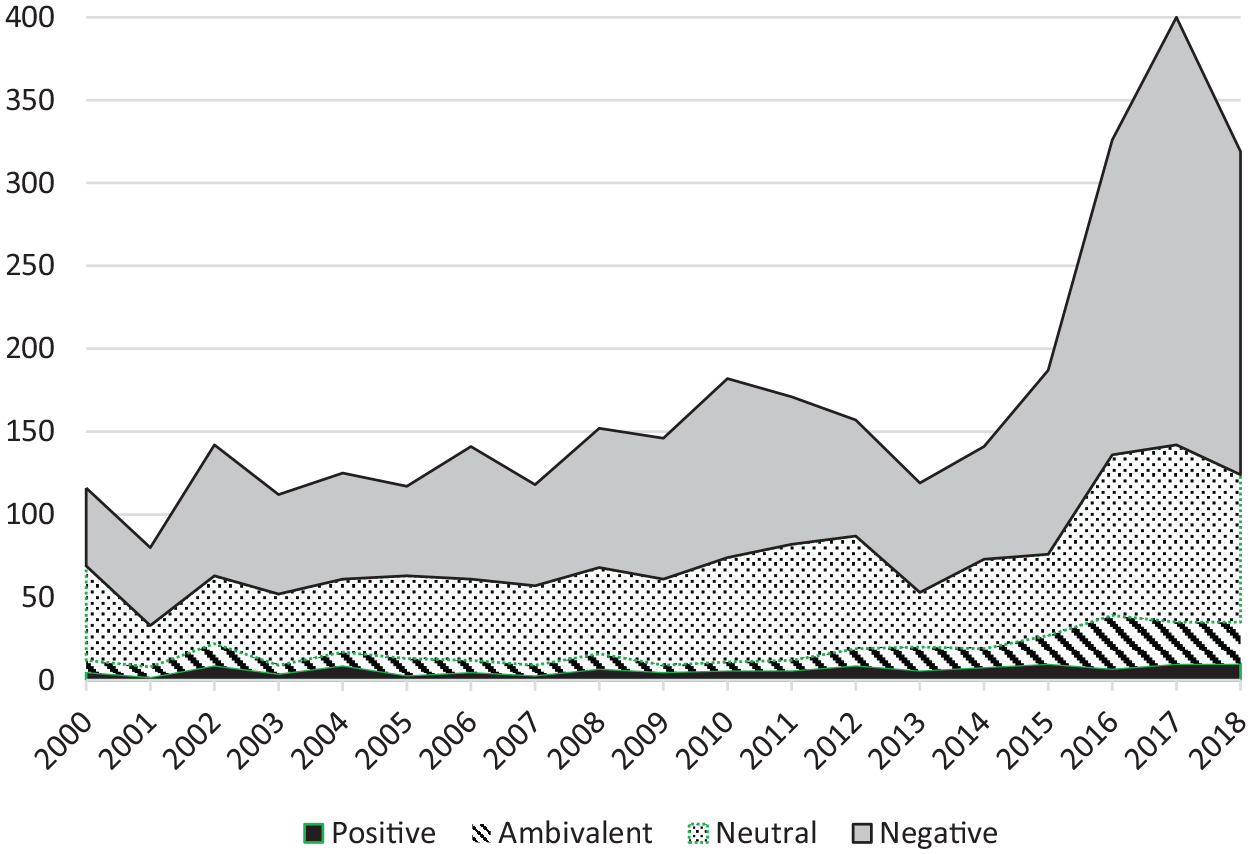
Article tone over time (N = 3252).
Bale et al. (2011: 124) found in their study that editorial or op-ed content tended to be more negative in the use of ‘populism’ as a term compared to news articles. Our data confirms that opinion pieces, such as columns (69.9% negative), editorials (60.6%) and especially letters to the editor (79.3%), are more often negative towards populism when compared to news articles (44.1%). The result may echo news criteria and journalistic routines emphasizing negativity as a criterion on the one hand and ‘neutrality or objectivity’ as a routine on the other. It also reproduces the common divide between editorial story types with a more negative or critical tone and news articles with a more neutral tone. Tone was found to vary also depending on who it was that was discussing populism in the media. For example, whereas populist politicians often view populism positively (44.7%), non-populist politicians (1.8%) and journalists (3.5%) almost never adopt a positive tone. However, significant differences between the newspapers show that contextual differences affect public discourses on populism.
There were notable differences in the general tone of the articles between the newspapers in the different countries (see Table 1). In general, a negative tone predominated, but Dagens Nyheter and De Volkskrant framed populism more negatively than did the other papers, while The New York Times and The Times instead adopted more of a neutral or even positive tone relatively more often than the other newspapers. Helsingin Sanomat, in turn, was the most even in its tone, emphasizing an ambivalent approach to populism in which both negative and positive evaluations go hand in hand. The almost solely negative tone in the Turkish paper Hürriyet is striking and can be explained by a rather unanimous understanding of populism as the irresponsible spending of public funds, as in the Turkish context the term ‘halkcilik’ is used to refer to more egalitarian and positive aspects of populist ideas. Only recently has Hürriyet begun to use ‘populism’ to refer to the Western radical right, but the tone has been negative in that context as well, due to the radical right’s Islamophobia, for example. The other newspapers tended to view populism more as a domestic phenomenon and assessed it in the local context.
Types of tones (%) in the different newspapers (N = 3252) (Pearson χ2 = 725.009; df = 18; p < 0.001).
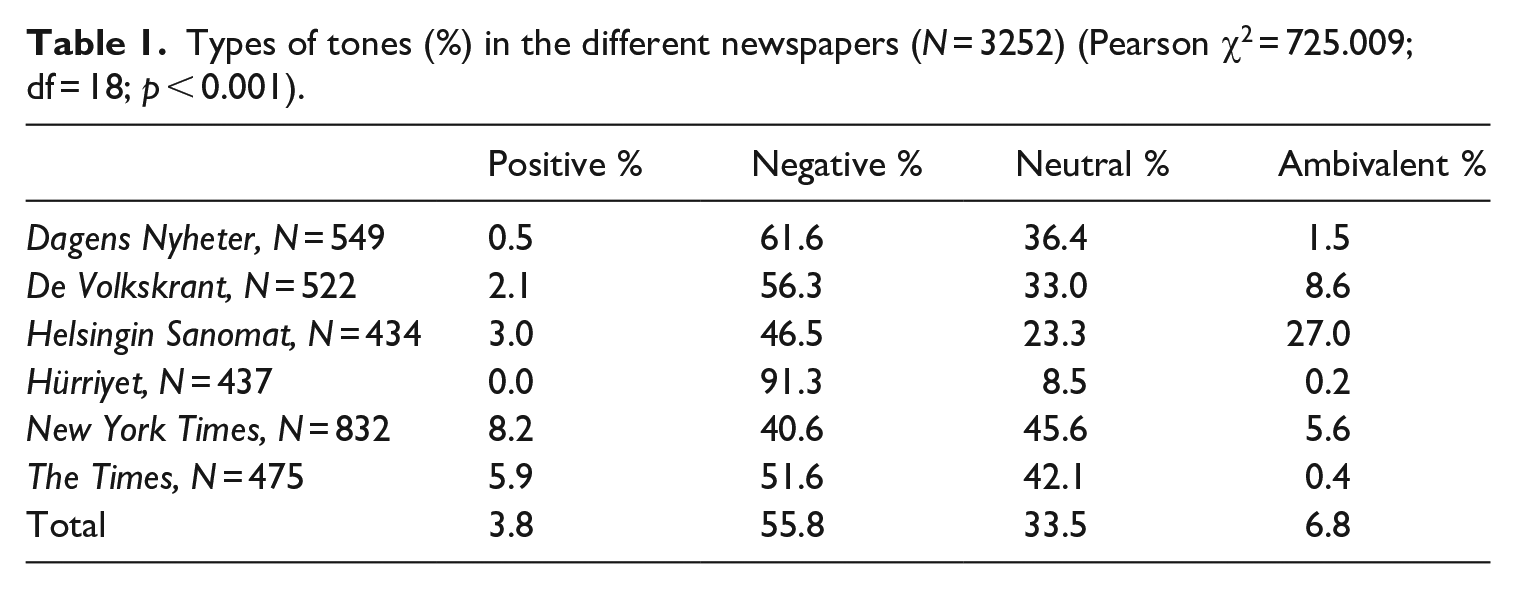
The predominantly negative tone and critical evaluation of populism in Dagens Nyheter and De Volkskrant can be explained by how the Swedish and Dutch media are highly critical of the respective countries’ domestic populist radical right (see Herkman, 2016; Wettstein et al., 2018). Contrastingly, in the Anglo-American context, populism has traditionally referred to political style or rhetoric and also to ‘popularity among the people’ in the English language rather than to ideology per se (see Williams, 1988: 236–238), which partially explains the higher share of articles with a positive tone in The New York Times and The Times than in the other papers. There was also a remarkably consistent framing of populism as ‘the voice of the people’ in articles published by The Times, indicating that the conservative background of the paper and prolific discussion regarding the Brexit referendum in the UK during 2014–2016 increased positive evaluations of the term. However, negative evaluations of populism that were anchored to the radical right also increased in the US and the UK towards the end of the sample period. The relatively high share of articles with an ambivalent tone in Helsingin Sanomat is linked to the country’s long tradition of agrarian populism and to the highly institutionalized position of the Finns Party in the Finnish party system, making populism a divaricate phenomenon, with radical-right connotations only recently emerging, differentiating Finland from other Nordic countries (see Herkman and Jungar, 2021).
Meanings of populism
Next, we look at what ‘populism’ as a term has been used to refer to. When analysing the absolute number of articles with different understandings of populism, it would appear that ‘populism’ is most often used as a negative label assigned to political enemies or as a way of criticizing someone for ‘pandering to public opinion’ (Bale et al., 2011: 127; Brookes, 2018). However, our data shows that over time, the significations given to ‘populism’ have gained a more concrete form, referring less to the ‘political game’ or to how politicians do politics or accommodate themselves to what is popular at the time. Instead, our analysis portrays a shift towards populism becoming increasingly viewed as ideological content.
To illustrate the temporal changes in the frequency of different significations given to populism, two analytical categories were formed. The first one included articles that understood populism as a political style. This category contains all articles that defined populism, according to our coding scheme, as rhetoric, a style of discourse or political performance, political game, or an intent to mislead. The second category contains all articles that used the term ‘populism’ to refer to ideological content. This category contains articles in which populism referred explicitly to nationalism, nativism, support for ethnic exclusion, opposition to immigration, anti-capitalism, opposition to economic globalization, or Euroscepticism. Additionally, articles that referred to populism generally as ‘an ideology’ were also included in the second category.
The timeline (see Figure 3) reveals a major post-2014 shift from a mainstream understanding of populism as a way of doing politics towards an understanding of populism as political ideas. However, this change does not mean that there has been a public breakthrough of the so-called ideational approach to populism, which views populism as a particular set of political ideas (Hawkins et al., 2019; Mudde, 2018), as the newspaper articles rarely make a clear distinction between the thin-ideological core of populism and the harder ideologies that populist actors represent and utilize. For example, whereas ‘anti-elitism’ and ‘acting as a voice of the people’ have remained steady meanings for populism in the press, there has been a statistically significant increase over time in the share of articles that use populism to refer especially to nativism, racism, Euroscepticism (Pearson χ2 = 170,151; df = 18; p < 0.001) and opposition to economic globalization and neo-liberal capitalism (Pearson χ2 = 40,548; df = 18; p = 0.002).
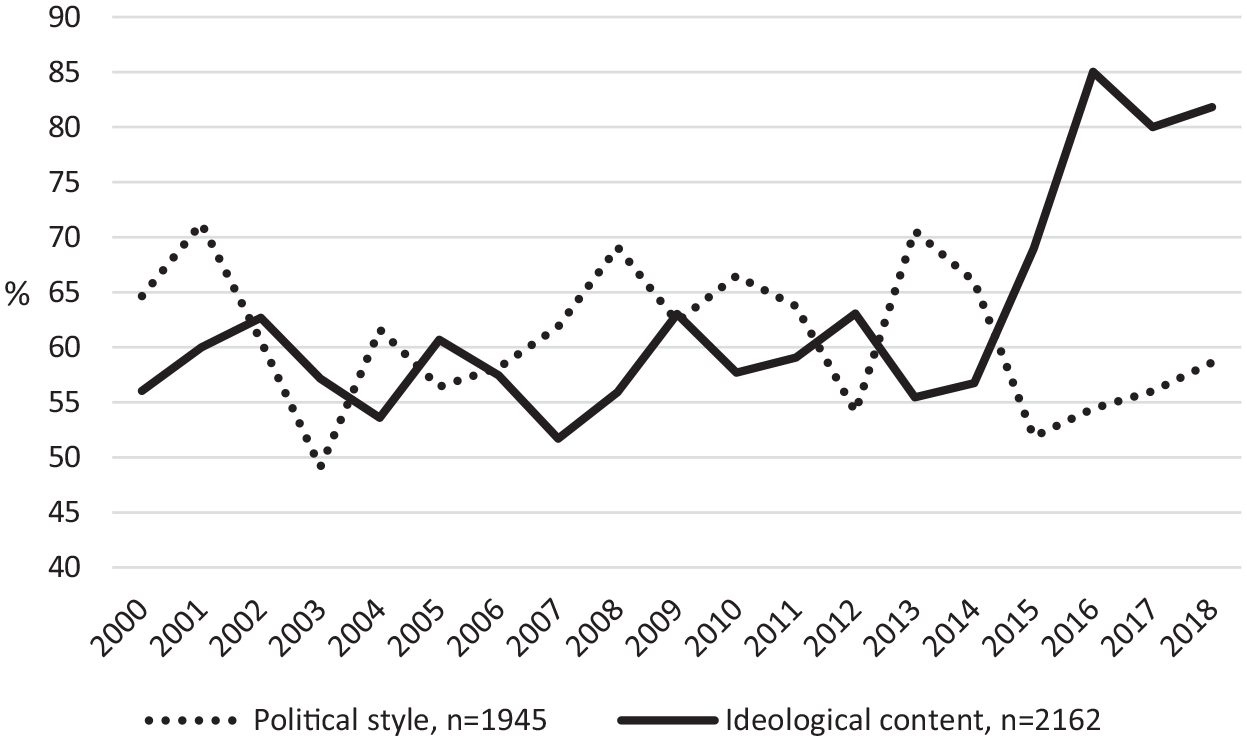
Percentage of articles referring to populism as a political style or ideological content (n = 3252) (Since articles may contain references to populism both as a political style and ideological content, the combined percentages of the two categories may exceed 100).
It is noteworthy that whereas in the early 2000s it was more common to use ‘populism’ without defining it, this has become, according to our sample, increasingly rare in the late 2010s. In the year 2000, almost 9% of the articles mentioned populism without giving any hint of what the author meant by the term, whereas in 2018 the same holds true for less than 2% of articles. In addition to the various sub-categories of political styles and ideas, 173 articles (5.3% of the full sample) used the term ‘populism’ to refer to a completely different phenomenon. This share has similarly decreased especially after 2015, and thus, it is increasingly less common for populism to be used to refer to something other than political style or political ideas. Additionally, the use of ‘populist’ as an adjective, which was common in the beginning of the sample period, has also decreased, and by the end of the 2010s newspapers are using the word more as a noun together with ‘populism’. Considering the decreasing share of articles using ‘populism’ in undefined or anomalous ways, one can assume that the mainstream meanings of populism are stabilizing. However, there are – once again – differences between the papers.
When comparing whether the newspapers use the term ‘populism’ to refer to a political style or ideological content or as an adjective or noun, the results inter-crossed between papers. Hürriyet, Helsingin Sanomat and The Times referred to populism more often as political style, whereas De Volkskrant, The New York Times and Dagens Nyheter referred to it more as ideology, but The Times, Helsingin Sanomat and Dagens Nyheter favoured using the term as a noun, whereas the three other papers used the term more often as an adjective. Thus, no clear logic in the use of the term can be found in this sense, as differences in the languages and political cultures influence how the papers verbalize the term ‘populism’. However, there is a general trend from style to ideology and from adjective to noun towards the end of the sample period for all the analysed papers. To sum up, it can be argued that populism was linked more often to various individual political actors and their political styles and tactics at the beginning of the 21st century, but that, especially after 2015, populism has been increasingly used to refer to right-wing ideas hosted especially by radical-right political movements and parties.
Perceived consequences of populism
Last, we present the results concerning populism’s alleged consequences for democracy. To analyse whether the newspaper articles described populism as having either negative or positive consequences for democracy, again two categories were formed by combining multiple sub-categories of our coding scheme. The ‘positive effects on democracy’ category included articles that claimed that populism promotes an understandable political language, mobilizes ordinary people and criticizes and challenges unhealthy or stagnant features of political systems. The ‘negative effects on democracy’ category included any articles blaming populism for inciting people to use insulting language, inciting violence, misinforming or fooling the people, or supporting the mobilization of extreme or anti-democratic movements. Additionally, we included in the second category any articles that framed populism as a type of political demagogy detrimental to the legitimacy of democratic political institutions and decision-making processes or as a phenomenon that potentially discourages participation in representative democracies.
According to our analysis, the extent to which newspapers assess populism as harmful for democracy has increased throughout the sample period, especially after the year 2014, whereas articles framing populism’s effects on democracy as positive have been remarkably fewer in number both in absolute terms and in terms of their relative share (see Figure 4). When looking at the annual relative shares of individual analytical sub-categories, towards the end of the sample period, the articles slightly more often viewed populism as contributing to hate speech and violence and notably more often as supporting the mobilization of democratically unhealthy forces – even before the storming of the Capitol by Trump supporters in January of 2021.
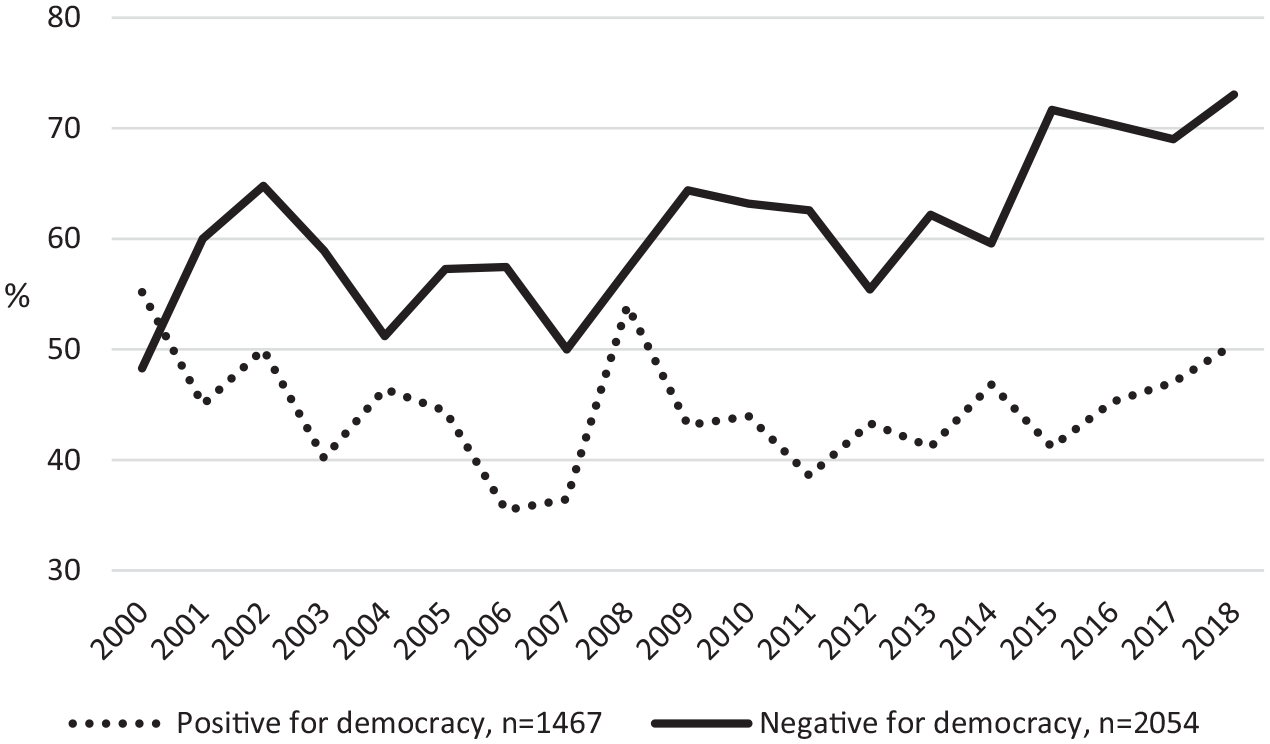
Percentage of articles describing positive and negative effects of populism for democracy (n = 3252) (Since articles may contain references to both negative and positive effects of populism, the combined percentages of the two categories may exceed 100).
Interestingly, despite a number of recent studies exploring the connection between populism and ‘fake news’ or the ‘post-truth era’ (e.g. Tumber and Waisbord, 2021), the relative share of articles discussing populism as a way of dis-informing or fooling the public has not increased over time in the full sample. Even though it has become slightly more common to view the rise of populism as the result of inherent problems in liberal democracy towards the end of the sample period, newspaper articles that frame the rise of populism as a healthy response to political systems’ failings are rather rare compared to those that frame it as a threat. Thus, the change in the alleged effects of populism on democracy mirrors the shift in the term’s mainstream meaning: the understanding of populism has shifted from being understood as a harmlessly inane political style towards being viewed as illiberal and potentially dangerous ideas.
In the overall sample, the newspapers more often portray populism as having negative rather than positive consequences for democracy, but there are notable differences between the papers (see Figure 5). In The Times, which often suggested that populism has the ability to address the people in their own language, the positive effects of populism even dominated. In comparison, about an equal share of articles in The New York Times mentioned both the positive and negative effects of populism. In the other four papers, the negative effects were clearly dominant. Hürriyet, Dagens Nyheter and De Volkskrant especially portrayed populism as harmful to democracy, but in Helsingin Sanomat positive effects were also prominent, despite the paper framing populism generally in a negative manner. These results correspond somewhat with the overall tones and meanings given to populism in the newspapers (see Table 1). However, our longitudinal analysis demonstrates that even in countries where populism has previously had more positive connotations, framing populism’s effects on democracy as harmful increased after 2015.
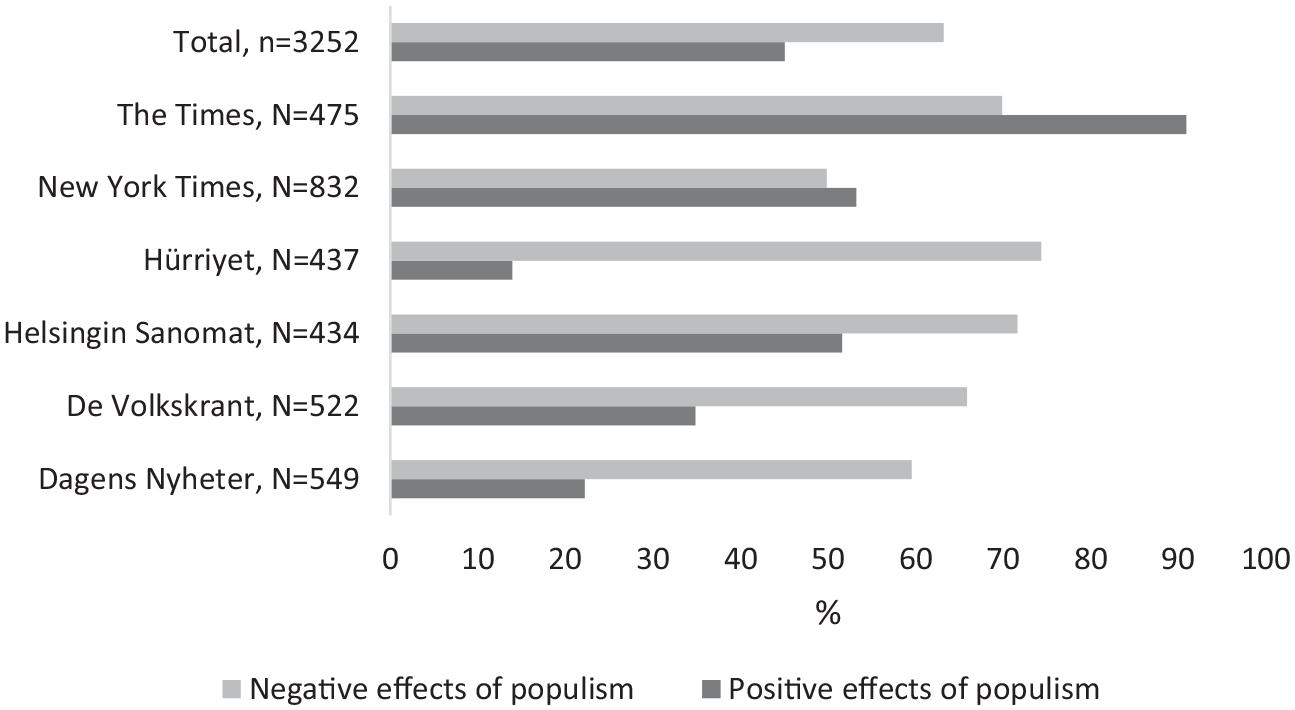
Share of articles describing positive and negative effects of populism for democracy by paper (Since articles may contain references to both negative and positive effects of populism, the combined percentages of the two categories may exceed 100).
Discussion
According to Skinner (1999), our social and moral world is held together by our use of words, and this bond can be reappraised by ‘changing the ways in which these inherited normative vocabularies are applied’ (p. 64). In this article, we presented the first longitudinal comparative analysis of how terminology pertaining to ‘populism’ has been applied in different countries. Specific national contexts affect the salience, meaning and perceived consequences of populism, but certain trends hold true for all the analysed countries. It has now been a decade since Bale et al. (2011: 125) found that ‘populism’ is often used as a pejorative term to refer to the policies and actions of political opponents in the British press. According to our analysis, since the early years of the 2000s the term ‘populism’ has been applied less and less ambiguously. Despite the fact that populism is still often viewed as a questionable trait of the ‘political game’ or ‘political style’ and that the term is still used as a pejorative, this meaning has become drastically less mainstream. Populism is increasingly viewed in the mainstream media as political ideas.
However, the types of populist ideas framed to manifest in ‘populism’ are not the same ideas that ideational scholars of populism regard as ‘populist ideas’ (e.g. Mudde, 2018). Instead of using populism to refer to the thin-ideological mix of anti-elitism, people-centrism and demands for popular sovereignty, the newspapers use populism to refer to the thicker ideological contents promoted and hosted by ‘populist’ political actors. Whereas in the early 2000s the newspapers used the term more often to characterize individual politicians and tactics, now they use it mainly to describe (or to euphemize) political parties or movements and their ideas. After 2015, these ‘populist’ actors and ideas have prominently been from the radical or extreme right.
Regarding our first task of investigating to what extent, where and when the term ‘populism’ has been a so-called floating signifier, and what kinds of understandings of ‘populism’ have become mainstream in the two first decades of the 21st century, our study shows that the meanings of ‘populism’ are less varied and increasingly unequivocal at the end of the 2010s than they were in the 2000s. The public understanding of populism has changed from viewing populism (banally) as a matter of how politics is done towards perceiving it as an ideologically coherent phenomenon and as an ideational entity – be it one that is mostly viewed as far-right. The salience and meanings of populism today are thus increasingly stable and anchored to right-wing populism.
Our second research task was to explore whether there is such a thing as ‘populist hype’ and who are the ones being hyped (see Glynos and Mondon, 2016). Our analysis demonstrates that, indeed, one can speak especially of a (right-wing) populist hype, particularly after the year 2015, because of the disproportionally high peak in the salience of right-wing populism observed in all of the studied countries. However, this hype exists only for right-wing populism, and our longitudinal analysis dates the beginning of the hype to the year 2015, with it peaking in 2017. Therefore, our findings support recent (post-2015) studies that have suggested that populism is being used as a euphemism for the radical right and its thicker ideological contents (Brown and Mondon, 2021; Goyvaerts and De Cleen, 2020). But our analysis also reveals that such has not always been the case, and that the mainstream meanings of populism drastically changed towards a situation that supports this type of theorization only during the latter half of the 2010s.
Since the overall tone with which newspapers discus populism is becoming increasingly negative, and since they simultaneously suggest that populism poses a threat for democracy, the right-wing populist hype in the legacy press can be regarded as having promoted anti-populism by enabling the conflation of vastly different political ideologies and projects (Brown and Mondon, 2021; Eklundh, 2020; Wettstein et al., 2018). However, the overall bad press that populism has received has not obviously diminished the success of the radical right. Quite the contrary: radical right actors are famous for claiming that the mainstream media are part of the elite that allegedly oppresses them, thereby bolstering their identity and strengthening their support through this underdog process (Hellström, 2016; Mazzoleni, 2008).
Thus, rather contrary to Laclau’s (2005: 94) view in which populist group identification of ‘us’ is constructed through the empty signifier of ‘the people’ as an ideal totality, the legacy press has begun to fill in the meanings of ‘populism’ as a floating signifier with particular ideological content linked specifically to the far right. This change in the mainstream meaning of ‘populism’, rendering it a euphemism, maintains the discursive political constellation of two societal blocs, legitimizing the radical right’s claims of an unresolvable antagonism between them and the liberal elites and facilitating the dismissal and denouncing of other claims made in the name of the people (see De Cleen et al., 2020: 169). Therefore, the mainstream meanings of populism are hegemonic in two senses. First, they are hegemonic in the sense that they dominate the public understanding of populism: a set of bad ideas that are bad for democracy. Second, the current mainstreamed meanings of the term are hegemonic also in the Gramscian sense, as they protect the status quo from being legitimately contested within the liberal democratic system.
Our analysis has concentrated on dailies to make reliable longitudinal and contextual comparisons possible. Though daily newspapers can serve as analytical keyholes through which to assess mainstream understandings of words, the media environment has changed radically during the two first decades of the 21st century, and this is likely also to have affected how populism is discussed in the public sphere. For example, there is evidence that the hybridizing media environment facilitates the attribution of particularly anti-hegemonic and controversial communications as the ‘vox populi’, affecting how populist movements are appraised in society (see Hatakka, 2019). Also, different types of media with different ideological leanings are likely to evaluate populism differently: we would have obtained different results for the US if, for example, FOX television had been analysed instead of The New York Times, as the conservative orientation of The Times seemingly influenced our results in comparison to the other papers. Therefore, future studies analysing populism as a signifier should expand from focussing on the legacy press to investigating the dynamics between different types of interlinked media in negotiating the meanings of populism.
Furthermore, since quantitative analyses of populism as a signifier reveal little about the context-specific discursive nuances pertaining to different populist movements, further qualitative analyses regarding how the meanings of populism have developed in specific contexts and languages are encouraged. Given the limited sample of countries examined here, countries with prominent left-wing populist actors or post-communist countries would be especially interesting cases for future research. Finally, since the defeat of Donald Trump and the rise of citizen movements pertaining to the Covid-19 pandemic have already influenced public discussions on populism, research on the meanings of populism should be continued into the 2020s.
