




Abstract
On November 1, 2015, comedian Margaret Cho announced a two-part campaign inspired by her history as a sexual-abuse survivor, to promote her new music video ‘I Wanna Kill My Rapist’. This included the creation of the hashtag #12DaysofRage. In this article, I explore how Cho used her status as a celebrity to circulate #12DaysofRage which acted as a discursive intervention in rape culture. I used content analysis and thematic analysis to identify themes in the archive of 2401 tweets I collected. I also performed a feminist discourse analysis on both the tweets and news coverage of the campaign to situate the hashtag within its historical, social, and political context. I argue that Cho performed what I call ‘promotional activism’, a subsection of celebrity activism where a celebrity promotes a cause as part of the promotion of a particular project or product. Cho’s choice to centre herself in the campaign made it impossible to separate Cho from the hashtag, preventing #12DaysofRage from greater viral potential, but still acting as a resonant, but ephemeral, gathering point for survivor-focused advocacy.
Introduction
The comedy industry, like many other entertainment industries, has recently been forced to reckon with its culture of misogyny. In part because of the Me Too movement, some of comedy’s biggest names have been outed and/or charged as abusers. In 2017, Louis C.K., was accused of masturbating in front of multiple women colleagues, an accusation he later confirmed (Ryzik et al., 2017). In 2018, Bill Cosby was sentenced to 3-to-10 years for sexual assault after drugging and sexual abusing dozens of women over decades (Bowley & Jacobs, 2021). 1 Pre-dating Me Too, comedian Margaret Cho launched a 12-day campaign entitled ‘12 Days of Rage’ as an intervention into the conversation surrounding misogyny in comedy, and rape culture generally. On November 1, 2015, Cho announced that she was releasing a new song and accompanying music video entitled ‘I Wanna Kill My Rapist’. The music video showed a group of women, of different sizes, age and ability, being trained to murder a rapist. Leading up to the release of the music video, Cho shared 12 videos, one per day, telling the story of incidents of sexual abuse she had survived and encouraged others share their story using the hashtag #12DaysofRage (Figure 1). In the following days, people tweeted out their stories, some with accompanying videos, replied with statements of love, encouragement and support, and interacted with Cho directly using the hashtag.
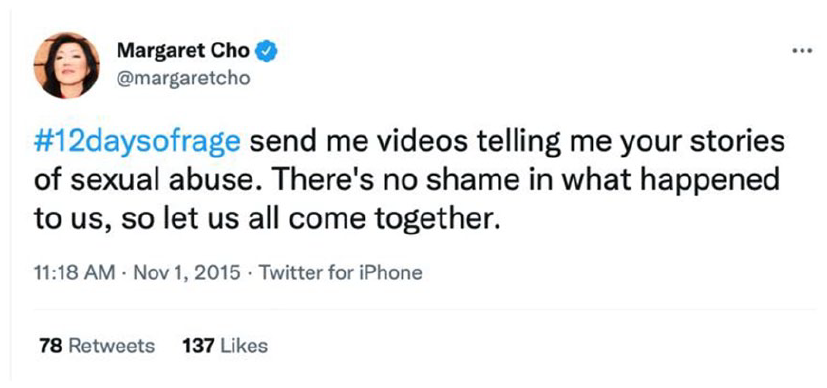
Tweet by Margaret Cho (@margaretcho) from November 1, 2015: ‘#12daysofrage send me videos telling me your stories of sexual abuse. There’s no shame in what happened to us, so let us all come together.’
This article primarily focuses on the use of the #12DaysofRage hashtag, thereby contributing to the literature on digital and hashtag feminism. I position #12DaysofRage as a discursive online intervention in rape culture, defined as ‘ideologies or behaviours that condone or normalize sexual violence’ (Stubbs-Richardson et al., 2018, p. 91). More specifically, I argue that #12DaysofRage is emblematic of what I call ‘promotional activism’. Unlike other forms of celebrity activism, promotional activism integrates advocacy around a particular issue into the promotional strategy of a product. In this case, Cho used the hashtag campaign to advocate for survivor-oriented justice as a part of the promotion for her music video, which acted as the culmination of the campaign. I thematically analyse 2401 tweets containing the hashtag #12DaysofRage as well as news articles, blogs and interviews with Cho about the campaign and music video. I further contextualize the campaign within Cho’s own career as a politically charged comedian. I argue that #12DaysofRage is an exemplary case study, pre-dating #MeToo, of feminist hashtag activism that centres the needs, feelings, and narratives of survivors. I situate this within scholarship that considers social media-based celebrity activism, but I contend that this is a unique case in that it expands on the traditionally more philanthropic and/or electoral activism. Unlike brand activism, where corporations align their products and public face with social change initiatives, promotional activism is when a celebrity or public figure uses a cause to promote a specific project. This provides a unique insight into the possibilities of hashtag activism to enhance the visibility of celebrity’s artistic endeavours while also bringing to the forefront an important discussion of rape and rape culture.
Literature review
In the following literature review, I first outline digital feminist activism more generally. I then outline two subsections of digital feminist activism that make up the Cho campaign: hashtag feminism and celebrity activism.
Digital feminist activism
Digital feminist activism is the act of producing, circulating and discussing feminist content online. It can take different forms, from memes (Brantner et al., 2020; Rentschler & Thrift, 2015), to blogs (Baer, 2016; Kuo, 2016), to hashtags (Cole & Atuk, 2019; Lopez et al., 2019), span a range of platforms and be used in a ‘multitude of ways, by different groups for a variety of purposes’ (Keller et al., 2018, p. 5). Digital media is one of the cornerstones of ‘fourth wave’ feminism (Retallack et al., 2016), because it opened the door to more accessible forms of feminist movement organizing (Zheng, 2015) and wider distribution of feminist knowledge (Keller et al., 2018). Demographic groups typically dissuaded, if not at times outright barred, from more formal spaces of political participation, including young women (Flores et al., 2018; Harris, 2008; Sills et al., 2016), transgender people (Jackson, 2018), and Black, Indigenous, people of colour (BIPOC) (Jackson, 2016; Williams, 2015, 2016, 2021) are able to connect with other feminists forming communities of care and support (Click et al., 2015; Powell, 2015).
Despite its documented impact on the personal, national and international level, digital feminist activism is still often negated as being a form of slacktivism (Myles, 2019) – meaning that it has an insubstantial impact and ‘slacks’ in its activist aspirations (Guillard, 2016, p. 610). Importantly, Jackson (2018) argues that the privileging of ‘offline’ activism reflects ‘the stubborn persistence of masculinist, traditional construction of politics that equates activism with on-the-ground agitation and protest’ (p. 43). Furthermore, this critique takes an overwhelmingly white and Western-centric perspective on digital activism. Digital feminism has had a particular impact in countries where mainstream media is more vehemently censored (Brimacombe et al., 2018; Han, 2021; Tan, 2017; Wiedlack, 2018; Yin & Sun, 2021). For example, in 2015, five women, nicknamed the Feminist Five, were detained in China for planning an event addressing sexual harassment on public transportation (Zheng, 2015). What followed was an example of ‘a successful feminist response to authoritarianism’ (p. 476). Petitions calling for the release of the Feminist Five circulated globally and garnered over 2 million signatures and feminist organizations outside of China organized demonstrations protesting the detention resulted in all five women being released on bail on April 13, 2015 (Zheng, 2015). This case makes evident not only the complementary use between online and offline digital activism (Clark, 2016; Fischer, 2016; Mendes et al., 2018), but counters the idea that digital feminist activism is inherently ‘low risk’ (Fischer, 2016, p. 757; Berridge & Portwood-Stacer, 2015).
In Brimacombe et al’.s (2018) study of digital feminist activists in Fiji, their participants alleged being put under both online and offline surveillance by the government. This included receiving phone calls from police intelligence about their posts and being put under ‘digital surveillance by national security forces’ (p. 518). In China, feminist digital activists work to find creative solutions to circumvent censorship like posting pictures or screenshots instead of text (Tan, 2017).
In addition to facing risks of government or police intervention, feminists all over the world face intense harassment and abuse from the general public (Keller et al., 2018; Tan, 2017). Jane (2014) uses the term e-bile to describe the ‘extravagant invective, the sexualised threats of violence, and the recreational nastiness that have come to constitute a dominant tenor of internet discourse’ (p. 532). In Keller et al.’s (2018) study of feminists’ use of digital tools, they found that 72% of their survey respondents had experienced ‘negativity, hostility or trolling’ (p. 242). Online harassment and abuse can range from undermining and insulting comments (i.e., calling someone ugly) to ‘vitriolic and graphic rape and death threats’ (p. 242) to doxxing, where personal information, like a person’s home address or workplace, is circulated online without permission. This can have long-term effects on individuals, such as defensiveness and hyper-vigilance, and on society more generally by reinforcing harmful stereotypes (Oksanen et al., 2014).
The circulation of e-bile also complicates the idea of the internet as an implicitly open and equal democratic space for all. This idea is further complicated when considering the uneven power relations embedded in digital platforms (Flores et al., 2018). Social media platforms are owned and operated by corporations with their own values and interests that are often diametrically opposed to digital activism (Srnicek, 2016). As well, while online activism is often seen as accessible, many people find themselves with limited access to digital tools (Clark, 2016; Turley & Fisher, 2018); or leisure time to spend online (Lopez et al., 2019). These are certainly important critiques that consider the socio-economic barriers to digital feminism without undermining its potential to form meaningful spaces for connective action.
Hashtag feminism and celebrity digital activism
#12DaysofRage fits into a subsection of digital feminist action termed hashtag feminism. Hashtags are the ‘# symbol followed by a thematic word or phrase’ (Mendes et al., 2018, p. 237) used to attract people to a certain topic or event allowing for conversations among users. Hashtag feminism is the process of using a hashtag to ‘produce communities of conversation among disparate Twitter users’ (Keller et al., 2019, p. 16) with the aim of subverting commonly held patriarchal ideas and dialogue (Dixon, 2014; Yin & Sun, 2021). The feminist use of hashtags is a form of what Shaw (2016) calls discursive activism which is ‘speech or texts that seek to challenge opposing discourses by exposing power relations within these discourses, denaturalizing what appears normal and demonstrating the flawed assumptions of mainstream social discourse’ (p. 42).
Built into the hashtag is the function of connectivity that has the potential to open new ‘discursive spaces’ allowing feminists to ‘invent and circulate counter discourses, which in turn permit them to formulate oppositional interpretations of their identities, interests, and needs’ (Sills et al., 2016, p. 937). Hashtag feminism has been shown to assist in creating meaningful connections between individuals (Bowles Eagle, 2015; Cole & Atuk, 2019; Lopez et al., 2019; Mendes et al., 2018), attracting attention from mainstream media on diverse topics (Brimacombe et al., 2018; Horeck, 2014; Yin & Sun, 2021), and shifting conversations, online and off, to individuals or movements that are often ignored or derided (Akinbobola, 2019; Higgs, 2015; Jackson et al., 2018; Williams, 2015, 2016). Hashtags can also act as an accessible educational tool, even when people choose not to actively participate in the creation of content (Peters & Besley, 2019).
But even social media campaigns intended to amplify marginalized voices can still reproduce ‘positions of privilege’ (Holm & Castro, 2018, p. 331). For example, in their study of the hashtag #solidarityisforwhitewomen, Holm and Castro found that white women who tweeted out their support of the hashtag took attention away from the voices of Black women. Although hashtag feminism is justifiably critiqued for centering the voices of white women, this can risk overlooking the immense contributions of BIPOC women to the construction and maintenance of activist-oriented hashtags (Nakamura, 2015). Williams (2015) argues that Black feminists use social media to fill the ‘gap in national media coverage of black women’s issues’ (p. 343). For instance, the hashtag #SayHerName, developed by legal scholar Kimberle Crenshaw in 2014, brought much needed attention to ‘police violence against Black women’ (Williams, 2021, p. 2), when media was overwhelmingly concentrated on violence against Black men. Similarly, the hashtag #NotYourAsianSidekick, started by Suey Park, an online social justice advocate shined a spotlight on the exclusion of Asian American Pacific Islanders from mainstream feminism (Kuo, 2016). These hashtags acted as gathering points for voices that are traditionally marginalized and demonstrated the ‘relationships between feminist and racialized online publics’ (p. 496).
Hashtags have also actively been taken up by celebrities to promote activist causes. Hashtags have the potential to connect not only celebrities with their fans, but fans with one another. Perhaps most famously, Alyssa Milano used the hashtag #MeToo in 2017 to call out of sexual predators and abusers in Hollywood – the actual creator of the phrase/movement was Tarana Burke, a Black activist who worked with survivors of abuse (Trott, 2020). Celebrity activism is not a new phenomenon, but social media allows for celebrities to perform what Ellcessor (2018) calls connected celebrity activism, which is ‘ongoing, seemingly authentic, technology-facilitated performances that forge connections between a celebrity persona, projects, interactions, causes and activist organizations’ (p. 256). At the forefront of connected celebrity activism is building relationships with fans, adding a veneer of authenticity to their public persona (Williams, 2021).
Celebrity activism is part of what Banet-Weiser (2018) has termed popular feminism. Popular feminism is innately rooted in a neoliberal discourse of empowerment and confidence and circulates through highly visible, accessible and often online channels (Banet-Weiser, 2018; Banet-Weiser & Wiltner, 2016). Celebrities’ involvement in activism can certainly be surface-level or attention-grabbing (Wiedlack, 2018), but it can also reach beyond the promotional machinations of the industry and open ‘spaces for, and connections to, mobilizing feminist practices’ (Banet-Weiser, 2018, p. xi). For instance, in their study of Lady Gaga fans online, Click et al. (2015) found that Lady Gaga’s outspoken support of LGBTQ+ communities helped create a ‘like-minded sympathetic online community’ (p. 611).
Many of the causes celebrities attach themselves to are, as Duvall & Heckemeyer, (2018) argue, associated with ‘humanitarian or philanthropic causes that pose little risk to their star status, do not alienate their fans, and promote their celebrity brand’ (p. 256). But Black celebrities during the first wave of Black Lives Matter protests in 2015, faced a more complicated terrain when considering whether or not to share the hashtag #BLM. Black celebrities still ‘struggle to perform celebrity and attain star status in cultural industries that systematically marginalise politically engaged people of colour’ (Duvall & Heckemeyer, 2018, p. 396). Celebrity activism is thus not without risk, but generally is more akin to connective, rather than collective action where the celebrity acts as the ‘node’ around which ‘individuals who may not have previously had connections to one another’ (Ellcessor, 2018, p. 263) come together around a particular issue to organize and act. Celebrity does not always bring expertise, but it does bring attention to movements that could influence national or international agendas (Olson, 2016).
This was evident in Cho’s #12DaysofRage campaign, which helped foster a ‘virtual space where victims of inequality can coexist together in a space that acknowledges their pain, narrative, and isolation’ (Dixon, 2014, p. 34). Cho’s campaign combined both feminist hashtags and celebrity digital activism into promotional activism. Unlike most celebrity digital activism where celebrities use social media to promote their political affiliations or philanthropic causes (Park et al., 2015), Cho used #12DaysofRage as a promotional campaign, although a very personal one, for her song and music video ‘I Wanna Kill My Rapist’. The song and music video also acted as commentary on how survivors of sexual abuse are meant to look and react. Here, we can see the intermingling of activism and capital, where Cho both created a supportive environment for people to come forward while also using that as a method of advertising for her music video. It is not uncommon for celebrities to use digital activism to bolster their own projects, like actor Jesse Williams promoting his documentary Stay Woke: The Black Lives Matter Movement using the #BlackLivesMatter hashtag (Duvall & Heckemeyer, 2018); or actor Marlee Matlin using the hashtag of the popular television show she acted on, #switchedatbirth, to promote her sign language app (Ellcessor, 2018). Cho’s activism was unique in that she created the hashtag specifically for the purpose of promoting her music video and connecting with fans thus creating a community where she was not only a node connecting individuals, but a member of a connective action against rape culture.
Methodology
For this article, I used a two-step coding and analysis process. First, I performed a content analysis on the tweets I collected from Twitter archives that contained the hashtag #12DaysofRage. I got assistance in exporting the tweets into an Excel spreadsheet using Python software. I set the dates for the search from the first day Cho introduced the hashtag, November 1, 2015, to the day the search was performed in September 2020. In total, 2569 tweets were collected, although not all were relevant. Tweets were omitted from the data if they retweeted a tweet with no additional text, or if the meaning was difficult to discern (e.g., tweets exclusively comprised of symbols). In total, I performed a content analysis on 2401 tweets.
Content analysis is the ‘systematic study of texts and other cultural products or nonliving data forms. The data used in this kind of research thus exists independently of the research process’ (Leavy, 2007, p. 227). Content analysis stems out of the belief that ‘we can learn about our society by interrogating the material items produce within the culture’ (p. 229). In this case, the material items were tweets. The initial purpose of the content analysis was to find out what topics appear and how often. This gave me a better idea of the general content of the campaign. I read through all 2401 tweets in an excel spreadsheet. I performed an inductive rather than a deductive analysis meaning that I was not going in with a preconceived idea of what I would find. After my initial reading of the tweets, I found patterns of responses that formed my initial seven coding categories. I then went back and colour-coded each of the tweets in the initial excel spreadsheet according to their categories. My content analysis identified seven major codes: (1) personal stories of experiences with sexual abuse and harassment; (2) solidarity and support for either the campaign, Cho or other users of the hashtag; (3) other people’s stories shared by users; (4) links and news related to the campaign or sexual abuse; (5) Cho’s tweets; (6) anti-campaign (often trolling) tweets; and (7) reactions to trolls.
After completing the initial content analysis, I then performed a thematic analysis. A thematic analysis is a ‘method for identifying, analysing and reporting patterns (themes) within data’ (Braun and Clarke, 2008, p. 79). Performing the thematic analysis allowed me to drill down into themes within my initial categories that reflected how ‘realities, meanings, experiences and so on are the effects of a range of discourses’ (p. 81). I sorted my initial codes into different themes using a separate excel spreadsheet for each theme. Four overarching themes emerged which I explore in-depth in the tweet analysis section of this paper: (1) personal testimony, support and feminist-responsibility; (2) challenges to rape myths; (3) knowledge sharing, resources and awareness; and (4) popular misogyny: anti-campaigners and reaction to trolls. Taken together, these themes allowed me to make sense of how people took part in the campaign and how it acted most effectively as a, short-term, form of awareness, support and truth-telling.
To reflect on what the tweets said about not only the #12DaysofRage campaign, but also the historical, social and political contexts in which the tweets were circulating, I performed a feminist critical discourse analysis (CDA). CDA considers how language constructs our understandings of the world through text (Gill, 2007). Feminist CDA specifically allowed me to understand the ‘complex, subtle, and sometimes not so subtle, ways in which frequently taken-for-granted gendered assumptions and hegemonic power relations are discursively produced, sustained, negotiated and challenged in different contexts and communities’ (Lazar, 2007, p. 142). To understand the discursive context of the campaign and the ‘state of public discourse’ (Clark, 2016, p. 793) surrounding it, I gathered, news articles, blogs and interviews about the campaign. Despite this article primarily focusing on the work of the hashtag, it cannot be separated from both Cho’s career and the broader campaign. Because of this I watched all 12 of Cho’s videos documenting her experiences of sexual abuse in addition to her music video for her song ‘I Wanna Kill My Rapist’.
One difficulty I encountered was deciding how to ethically present the tweets, when I felt that they added necessary examples and/or context to the research (Akinbobola, 2019; Mann, 2014). This was a particularly important decision as many of the tweets I gathered, while publicly available, shared intimate details of individual’s personal experiences with sexual assault. While the collection of tweets is technically ‘unobtrusive’, meaning that I did not ‘intrude into social life by observing, survey or interviewing’ (Leavy, 2007, p. 229), I still questioned the ethics of including Twitter handles. In Kim and Kim’s (2014) #Twitter Ethics Manifesto, they remind us that ‘public’ means ‘white property laws; public means not safe for women of color; public means not safe for marginalized voices’. Mann (2014) argues for a collaborative approach that seeks consent from tweet authors to prevent the use of online platforms as merely resources disconnected from the material realities of the users. I followed Akinbobola (2019), who, while acknowledging the importance of seeking user-consent, also understands its limiting potential, particularly when following the threads of the hashtag and therefore anonymized the tweets that they used. I chose not to anonymize Margaret Cho’s tweets as she is a public figure, the creator of the hashtag and actively promoted the use and circulation of the hashtag on Twitter, in mainstream media outlets, and on her personal blog.
‘I wanna kill my rapist’: Cho’s role as silence-breaker
San Francisco born Margaret Cho, is a self-proclaimed ‘Korean American, fag hag, shit starter, girl comic, trash talker’ (Lee, 2013, p. 423). She began performing at comedy clubs as a teenager with her high school improv group and never stopped (Cho, 2001). Cho is unabashedly political in her career tackling topics from sexism to homophobia, fat-shaming to Asian stereotypes and even sexual abuse. Notably, it was not until 2015 that she began to delve into the explicit details of her experience as a survivor of numerous incidents of sexual violence. In Billboard Magazine’s exclusive interview with Cho about her music video, Cho intimated that she was molested by a family friend from the ages of 5 to 12. At 14, Cho was raped by an acquaintance who continued to rape her throughout her teenage years (Bacher, 2015). In an article for Nylon Magazine, Cho (2015) wrote that although her family believed her ‘it was more important to them to keep the peace’. This led Cho to stay quiet, internalizing ‘shame, sadness, and utter loneliness’ manifesting in years of eating disorders, drug addiction, depression and attempted suicide. Rather than killing herself though, Cho vowed to kill the rapist in her mind.
Reflecting on why she started #12DaysofRage, Cho spoke of two main catalysts. The first was a 2012 incident where an audience member at a Daniel Tosh comedy show expressed disgust over a rape joke he told. In response, Tosh said ‘Wouldn’t it be funny if that girl got raped by like, 5 guys right now? Like right now?’ (Proulx, 2018, p. 188). This sparked a debate over rape jokes with some arguing that that any critique of comedy was tantamount to censure, where others argued that rape jokes were never funny. Cho, known for her dark and political humour, believed that rape jokes could be feminist if they critiqued patriarchal power structures. Cho felt a responsibility to contribute to the debate because there were ‘comedians like (Daniel) Tosh talking about raping women’, when, she believed, what was needed was comedy from the ‘perspective of the survivor’ (Cho quoted in Thapliyal, 2018).
The second catalyst was when her family invited one of her abusers to a special event in her honour. When he went to hug her, she whispered in his ear ‘You know what you did, and I am going to fucking kill you’ (Cho, 2015). Cho expressed that it ‘felt good to threaten his life’ and began to write what would become ‘I Wanna Kill My Rapist’. Cho follows hooks (1995), who believes that rage has the potential to be a healing response to ‘oppression and exploitation’ (p. 18). She rejected the language of survival that stresses acceptance and forgiveness, instead finding that rage was keeping her alive: ‘We’re told by therapists and clergy and mentors that you need to forgive and heal, and I’m not there, and I don’t plan on going there’ (Cho quoted in Gibson, 2015). Along with her music video, Cho released 12 videos, one a day for 12 days, each one a personal testimonial of abuse she survived accompanied by the hashtag #12DaysofRage.
Many feminist hashtags have been tied to specific campaigns or incidents but were discursively framed in ways that made them broadly appealing (Clark, 2016; Jackson et al., 2018; Storer & Rodriguez, 2020). For example, #BeenRapedNeverReported was started by journalists Antonia Zerbiasias and Sue Montgomery in response to the backlash directed towards people who came forward with allegations of sexual abuse lodged against Canadian media personality Jian Ghomeshi in 2014 (Keller et al., 2019). Using the hashtag, Twitter users shared why they did not report their experiences of abuse and rape to the police. Because #12DaysofRage was specifically part of Cho’s promotional campaign, it arguably did not have the same discursive appeal of other hashtags. On the other hand, the discursive framing of the hashtag made it inseparable from Cho, allowing her to be credited for her work, even if she did not explicitly receive monetary compensation for it. This is significant in that the erasure of BIPOC women’s work in digital feminism is all-too common (Holm & Castro, 2018; Nakamura, 2015). BIPOC women who create viral hashtags, are often displaced from the movement, thereby undermining the labour and work that went into its original inception, for instance, Alyssa Milano overshadowing Tarana Burke’s creation of #MeToo as discussed previously. In the case of #12DaysofRage, Cho emphatically centred herself and her identity as a Korean, bisexual woman and former sex worker. Nonetheless, the inseparability of the hashtag from Cho potentially contributed to its limited circulation. Considering how few tweets took place after the release of the music video from Cho herself, there is an implication that she never intended for the campaign to go beyond its release. This speaks to the limitations of promotional activism that, while having the ability to create intense moments of connection, are ultimately fleeting once the product being promoted is released.
The circulation of Cho’s campaign was aided by her status as a celebrity. Not only did she have a built-in fan base, but she also had access to major media outlets such as The Washington Post and Billboard Magazine and premiered her video on the popular celebrity gossip blog Perez Hilton. Perez Hilton, aka Mario Armando Lavandeire Jr., is a controversial figure in part because of his history of outing several gay celebrities (McIntosh, 2020). This begs the question as to why Cho, who led a campaign centred around self-disclosure, decided to premier her music video on the site of someone who robbed celebrities of that very thing. While the fact that #12DaysofRage was a publicity campaign does not necessarily take away its power, it does bring up questions of the integrity and altruism of celebrity interventions in digital feminism. Furthermore, it demonstrates that while Cho signified resistance in her campaign, she nonetheless maintained neoliberal traits by working within ‘capitalist star industries through self-branding’ (Duvall & Heckemeyer, 2018, p. 394).
Despite the hashtag’s contribution to Cho’s publicity and its limited circulation, it still shows the importance of feminist hashtags as ‘artefacts and cultural infrastructures generated by feminist-identified movements and practitioners’ that have ‘political significance and potentially transformative power’ (Rentschler & Thrift, 2015, p. 240). In the next section, I look at how the campaign circulated and reverberated throughout Twitter and survivor-centred communities. This demonstrates how Cho’s celebrity combined with the promotional nature of the campaign opened a, however brief, digital space of support and connection.
Tweet analysis
In the following section, I unpack the four categories that emerged out of my thematic analysis. Each theme contributes to an analysis of the effectiveness of the campaign in creating a space for discursive activism against rape culture. I contextualize the tweets within previous literature on digital feminism, hashtag feminism and Cho’s own writing and interviews about the campaign.
Personal testimony, support and feminist-responsibility
#12DaysofRage acted as what Rentschler (2014) terms ‘feminist response-ability’ combining ‘testimonial, advice giving, and cultures of support’ (p. 68). Through the hashtag, users cultivated the ‘capacity for collective response to individual experiences of sexual violence’ (Clark-Parsons, 2018, p. 2129). My findings are in line with Clark’s (2016) analysis of the #WhyIStayed hashtag, in that many of the tweets were either personal stories of abuse and/or harassment (701 tweets). A small number of people tweeted other people’s stories (19 tweets), but the majority tweeted ‘expressions of support’ (p. 796) (751 tweets). Cho, herself, actively interacted with the campaign tweeting in response to, and retweeting, users’ stories of abuse and survival (472 tweets).
Twitter is limiting in its format for storytelling (at the time tweets had to be 140 characters or less) meaning some people shared their stories through linked videos or poetry or simply acknowledged that they were survivors of abuse. Other users told their stories in great detail over several tweets. #12DaysofRage gave survivors an ‘extra-juridical approach’ (Cole & Atuk, 2019, p. 29) to speaking and being heard. The legal system is notorious for being inaccessible and potentially re-traumatizing to survivors of sexual violence (Boux & Daum, 2015; Kim, 2018). Users of the hashtag expressed their own experiences with the criminal justice system detailing incompetence and further abuse, such as telling the survivor that their parents should have them committed.
Users could not only share their own stories of sexual violence, but also bear witness to the stories of others. In an interview with Ms. Magazine, Cho positioned witnessing as central to her campaign, believing that to bear ‘perpetual witness to the constant struggle of equality is a beautiful thing’ (Cho quoted in Kim, 2017). Cho demonstrated this by retweeting and responding to many of the stories encouraging digital community building. Many of Cho’s tweets expressed familial love, especially in response to survivors who, like her, had their experiences silenced by their family. Digital exchanges of testimonial support can act as what Powell (2015) calls ‘technosocial practices of informal justice’ (p. 73), especially for those who do not have access to, or feel safe engaging with, the criminal justice system. Powell argues that these online exchanges can bring about opportunities for justice that centre the needs of survivors that are not currently being met by the formal justice system including a supportive audience.
Similarly, to participants of the #BeenRapedNeverReported hashtag users spoke of how much the ‘solidarity and support’ (Mendes et al., 2018, p. 238) from people online meant to them (Figure 2). Even if people were not ready to share their story, they expressed their appreciation for #12DaysofRage and encouraged others to follow. Whether they were survivors or supporters, the campaign opened space for people to seek their own form of justice by telling their stories, seeking validation, and supporting one another.
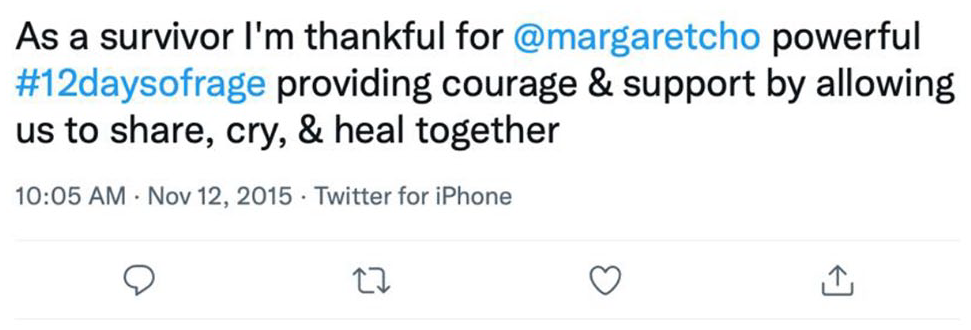
Anomyized tweet from November 12, 2015: ‘As a survivor I’m thankful for @margaretcho powerful #12daysofrage providing courage & support by allowing us to share, cry, & heal together.’
Challenges to rape myths
The campaign acted as a form of ‘accessible education about social justice issues’ (Sills et al., 2016, p. 943) including actively challenging pre-conceived notions of rape and abuse, also known as ‘rape myths’. Rape myths can take many forms, but some of the most popular variations are as follows: ‘disbelief of women’s rape claims (e.g., “she is lying”), victim blaming and slut shaming (e.g., “she was asking for it”), the myth of masculine aggressive sexuality (e.g., “boys will be boys”), and “real” rape is a violent act perpetrated by a stranger’ (Boux & Daum, 2015, p. 155). Many users of the hashtag explicitly countered the idea that acquaintance rape – rape committed by someone you know – was merely women regretting consensual encounters (Schwartz & Legget, 1999). Users wrote about their close relationships with their abusers, some being intimate partners or close personal friends.
Users not only called out these rape myths but noted how they permeated the formal legal and justice system (Figure 3). This emphasizes the added victim-blaming that occurs when survivors do not fit into the image of the ideal victim – often represented as ‘innocent and white’ (Bumiller, 2008, p. 9) – for instance, sex workers. Cho, herself a former sex worker, took opportunities both on Twitter and in the media to centre discussions of sex work. Sex workers are often, wrongfully, believed to be ‘responsible for their assault’, or ‘impossible to rape’ (Sprankle et al., 2018, p. 243) because of the nature of their work. In an interview with the online magazine ravishly, Cho expressed frustration with this idea, arguing for the decriminalization of all sex work (Burns, 2015). Several of the #12DaysofRage users spoke of their experiences of abuse while working as sex workers where others challenged the idea that rape was somehow a consequence of their profession.
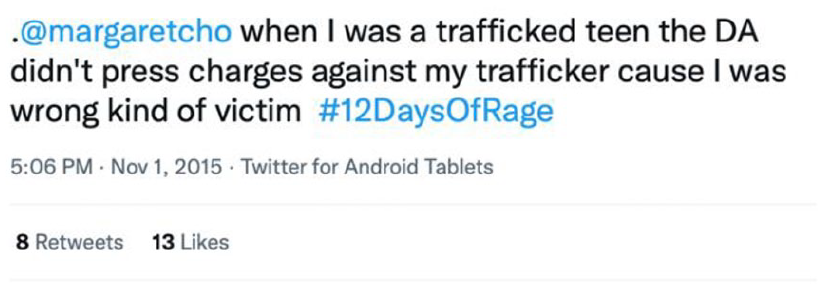
Anonymized tweet from November 1, 2015: ‘.@margaretcho when I was a trafficked teen the DA didn’t press charges against my trafficker cuase I was wrong kind of victim #12DaysOfRage.’
Another common rape myth challenged was the idea that only women are victims of rape. Boux and Daum (2015) argue that men who are survivors of rape face a different kind of victim-blaming that is nonetheless also entrenched in misogyny. For example, men often face an internal struggle with their masculinity which is then perpetuated externally in the legal system. Several users pointed to the regularity of rape against men and how men lack proper support and services. Men also shared their own stories of abuse and Cho actively responded to these tweets acknowledging that the campaign was for all survivors, not only women (Figure 4). By challenging a myriad of rape myths, #12DaysofRage acted as a form of accessible pedagogy, where Cho and the users of the hashtag, worked to shift the discourse away from the normalization and rationalization of sexual violence.
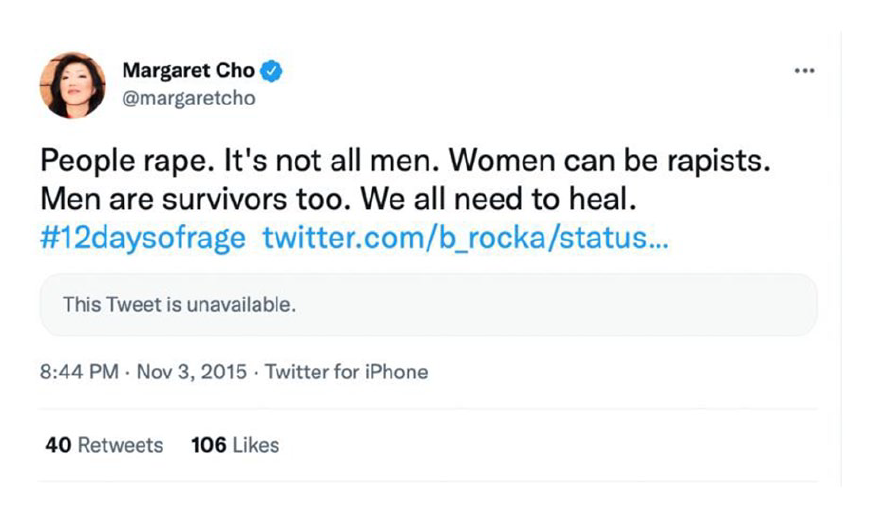
Tweet by Margaret Cho (@margaretcho) from November 3, 2015 ‘People rape. It’s not all men. Women can be rapists. Men are survivors too. We all need to heal. #12daysofrage.’
Knowledge sharing, resources and awareness
Users of the #12DaysofRage hashtag actively used tweets as an ‘educational tool’ (Keller et al., 2019, p. 139) to spread awareness and engage with others (Salter, 2013). Many linked to resources outside of Twitter using hyperlinks. Sharing hyperlinks is a common practice on Twitter that allows people to connect to more information. These included links to news articles relating to sexual violence, anti-violence organizations like Rape, Abuse & Incest National Network (RAINN), and additional information about the campaign (334 tweets).
There were also several tweets that incorporated other prominent cases of rape and sexual assault or issues of oppression, using multiple hashtags. The act of combining hashtags ‘discursively connect[s] the conversation about rape culture with other forms of oppression’ (Keller et al., 2019, p. 130). Among the other hashtags, there were sparse mentions to #BlackLivesMatter (6 tweets) and #RepealThe8th (3 tweets), a hashtag addressing the right to abortion in Ireland. But the most popular hashtag/topic referenced was #FreeKesha (6 tweets featured the hashtag #FreeKesha, but 16 tweets total referenced Kesha) – Kesha being a popular singer songwriter. At the time of #12DaysofRage, Kesha was filing an injunction request against Sony to release her from her recording contract with producer Dr. Luke, who, allegedly, raped her in 2005 (Lockett et al., 2021). Cho herself became vocal on the topic and regularly tweeted about it throughout the campaign arguing that Kesha was being held prisoner (Figure 5).
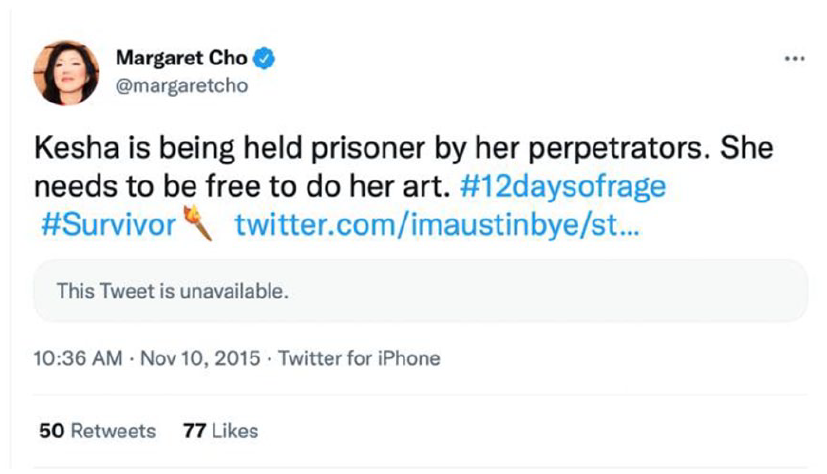
Tweet by Margaret Cho (@margaretcho) from November 10, 2015: ‘Kesha is being held prisoner by her perpetrators. She needs to be free to do her art. #12daysofrage #Survivor (torch emoji).’
While not a hashtag, another popular target of the users’ of #12DaysofRage was Bloomingdale’s 2015 Christmas ad campaign (16 tweets). The Bloomingdale ad featured a man looking at a woman who is not paying attention to him, with the caption ‘SPIKE YOUR BEST FRIEND’S EGGNOG WHEN THEY’RE NOT LOOKING’ (Paquette, 2015). The advertisement appeared to condone, if not encourage, date rape. Users of the #12DaysofRage hashtag took to Twitter to condemn the advertisement and because of the backlash, Bloomingdale’s eventually took down the advertisement and issued an apology. The use of #12DaysofRage in conjunction with users’ protest of Bloomingdale’s, demonstrated how the advertisement had symbolic and real-world implications for gender-based violence. By publicly blasting Bloomingdale’s and Kesha’s abuser, and the companies and formal criminal justice system that were failing her, users used Twitter and #12DaysofRage to ‘respond to rape culture, and hold those responsible for its practices’ (Rentschler, 2014, p. 67).
Popular misogyny: anti-campaigners and reaction to trolls
I gathered a small number of tweets (16) that were vocally against #12DaysofRage. I acknowledge that this is not a representative sample as those who ‘trolled’ the campaign did not necessarily use the hashtag. This was evident by several users who addressed trolling tweets that did not appear in my data collection. While some of the tweets trivialized or made light of the campaign, the more insidious ones targeted the credibility of survivors and Cho herself (Figure 6). Most common among these tweets were those that linked to an article from the infamous Men’s Rights site Return of Kings (ROK). 2 The article argues that while ‘rape is a serious crime [. . .] years of feminist indoctrination have taught us that rape can be virtually anything’ (Sebastian, 2015). Using terms like ‘rape hysteria’ perpetuates ideas of women as ‘vengeful’ or ‘lying and vindictive shrew(s)’ (Gruber, 2009, p. 590), which permeate popular and legal discourse. Users responded to trolls emphatically defending the hashtag, generally and Cho, specifically. One user quoted a common complaint from detractors and corrected it emphasizing the needs of survivors (Figure 7).
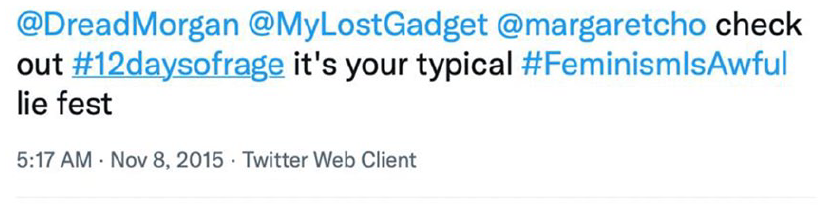
Anonymized tweet from November 8, 2015: ‘@DreadMorgan @MyLostGadget @margaretcho check out #12daysofrage it’s your typical #FeminismIsAwful lie fest.’
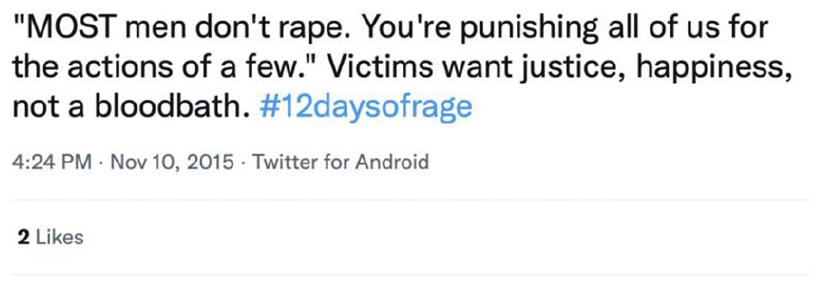
Anonymized tweet from November 10, 2015: ‘“MOST men don’t rape. You’re punishing all of us for the action of a few.” Victims want justice, happiness, not a bloodbath. #12daysofrage.’
The trolling of the campaign, points to the resurgence of anti-feminism or as Banet-Weiser and Wiltner (2016) call it, popular misogyny; a ‘basic anti-female violent expression that circulates to wide audiences on popular media platforms’ (p. 72). Popular misogyny is, in part, a response to popular feminism where men see their ‘rightful place in the social hierarchy’ (p. 72) being undermined. This is made evident in the ‘About’ (n.d) section of ROK which, among other things, touts a belief that masculinity is being ‘punished and shamed’ thereby allowing ‘women to assert superiority and control over men’. The negative and misogynist reactions to Cho’s campaign are a reminder that although hashtag feminism has the potential to connect and educate, it is not a risk-free pursuit.
Conclusion
This article has contributed to scholarship on feminist digital activism using #12DaysofRage. The #12DaysofRage campaign acts as an important case study to consider both the limitations and power of promotional/celebrity digital activism. Unlike other forms of celebrity activism that are tied to larger campaigns and organizations (Ellcessor, 2018), Cho’s was implemented as a promotional strategy. Arguably the most innovative element of the campaign, its inseparability from Cho, was also one of its biggest drawbacks. Because the hashtag was explicitly tied to her, it lacked the discursive appeal of, for example, #MeToo. Nonetheless, I found that although Cho’s campaign was swift, it was also deeply felt. The evidence I gathered points towards Cho’s ability to create, but not sustain, her advocacy campaign – although because of its promotional status, it can be argued she never meant to sustain it.
From the tweets I gathered, the limited run of the campaign did not seem take away from the impact and value of the stories that were told and shared. This presents the double-edged sword of celebrity activism. Although important causes and discussions may reach mainstream attention because of the attachment of a celebrity figure, they are also still tied to the production of the celebrity themselves, or the celebrity-commodity. The celebrity-commodity is ‘simultaneously, an individual with a degree of agency, a cultural worker who is paid for their labour, and the entity upon which that labour is exerted’ (Farrell, 2019, p. 5). As Farrell writes, in the ‘attention-competitive environment’ (p. 5) a celebrity associating themselves with a good cause can be a ‘key asset’ (p. 5). The promotion of her music video demonstrated how celebrity activism can be used to create a sense of community among survivors while, at the same time, generating economic capital.
Due to the scope of my study, I was unable to gauge the ripple effects of the campaign, but I do feel it is valid to categorize it, along with hashtags like #BeenRapedNeverReported, #WhyIStayed and #YesAllWomen, as a proto-#MeToo movement, that challenged cultures of rape and misogyny and encouraged survivors of abuse to tell their stories. Although #12DaysofRage was a part of a publicity campaign leading up to the release of Cho’s video, it also acted as a, albeit much smaller than some, form of cathartic digital storytelling support and education. Without discounting Cho’s own dedication to the cause of survivor-centred justice, her campaign was nonetheless oriented around the promotion of her own music video. But, the music video’s revenge fantasy premise interspersed with moments of tenderness between survivors made the music video’s release a cathartic end to the campaign, and a celebration of, connectivity and support (Figure 8).
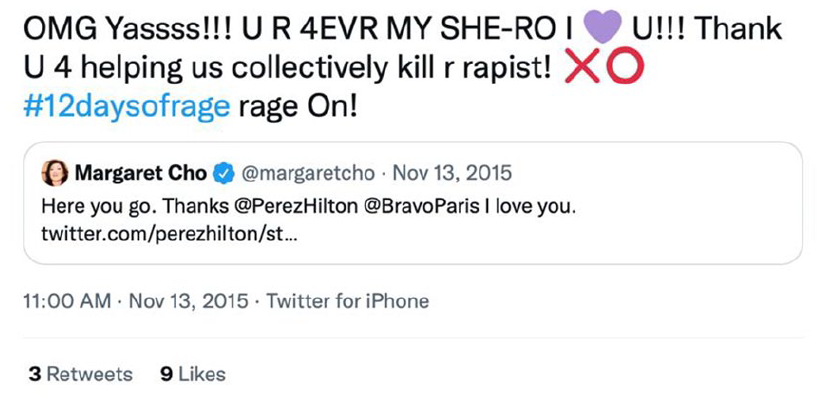
Quote tweet by anonymized user from November 13, 2015: ‘OMG Yassss! U R 4ER MY SHE-RO I (purple heart emoji) U!!! Thank U 4 helping us collectively kill r rapist! XO #12daysofrage rage On! Original tweet from.’ Original tweet from @margaretcho on November 13, 2015: ‘Here you go. Thanks @PerezHilton @BravoParis I love you.’
Footnotes
Acknowledgements
Thank-you to Dr. Nicole Cohen, Dr. Mark Campbell, Dr. Dan Guadagnolo and the attendees and organizers of the 2018 Mixed Bill conference at Sheffield Hallam University for their feedback on previous iterations of this paper. Thank-you to Zac Ryan for his technical assistance and Dr. Sarah Lubelski and Dr. L. Dugan Nichols for editing. Finally, I would like to thank the anonymous reviewers who provided thoughtful and constructive feedback.
Funding
The author(s) disclosed receipt of the following financial support for the research, authorship, and/or publication of this article: Social Sciences and Humanities Research Council of Canada.
