



Abstract
This article traces the development of popular forms of anti-trafficking activism in the United States through a social network and discourse analysis that focuses on NGO websites, celebrity advocacy, merchandising, social media campaigns, and policy interventions. This “branded activism,” as we describe it, plays an important role in legitimizing an emerging anti-trafficking consensus that increasingly shapes both US foreign policy and domestic policing, and is frequently driven by an anti-sex work politics. Popular anti-trafficking discourses, we find, build on melodramatic narratives of victims and (white) saviors, depoliticize the complex labor and migration issues at stake, reinforce capitalist logics, and enable policy interventions that produce harm for migrants, sex workers, and others ostensibly being “rescued.” Celebrity and marketing-driven branded activism relies especially strongly on parallels drawn between histories of chattel slavery and what anti-trafficking campaigns call “modern-day slavery.” We challenge these parallels, particularly as they encourage participants to see themselves as abolitionist saviors in ways that reinforce neo-liberal notions of empowerment rooted in communicative capitalist networks.
Keywords
In the online store for the END IT Movement, a prominent anti-trafficking awareness-raising initiative supported by celebrities like Kristen Bell, Ashton Kutcher, and Carrie Underwood, visitors can choose between a range of t-shirts and other paraphernalia (including a onesie for babies) that show their commitment to the cause. Among the slogans is one that brands us a “Freedom Fighter,” which, by conceptualizing contemporary forms of trafficking and exploitation as modern-day slavery, allows us to participate virtually in a long line of emancipationist movements. As an END IT news release marking the eighth annual “Shine a Light on Slavery” Day in 2020 emphasized, this new activism is firmly rooted in the contemporary media landscape: “‘Shine a Light on Slavery’ Day continuously generates a groundswell of buzz and attention in the media landscape—reaching millions of people via varying social media platforms. . .becom[ing] a top-trending topic across social media channels” (END IT Movement, 2020). This social media, branding, and celebrity awareness-raising is fundamental to END IT (“Awareness is doing the work,” their home page proclaims), but is also increasingly at the heart of much contemporary anti-trafficking mobilization (Figure 1).
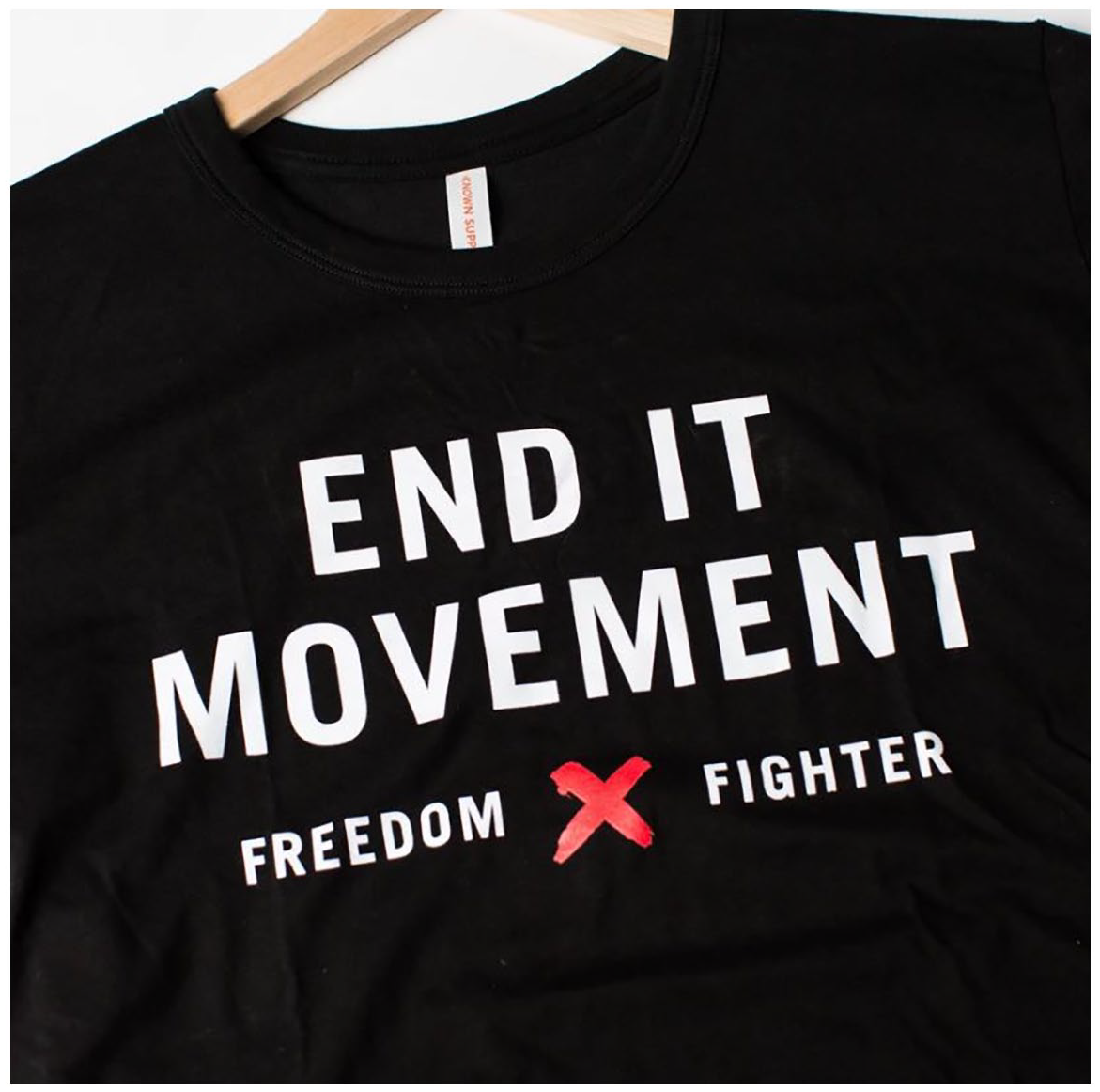
END IT movement t-shirt for sale in online store (retrieved June 29, 2020).
END IT and “Shine a Light on Slavery” Day, to which we return later, are emblematic of a significant shift in 21st century anti-trafficking campaigns, a turn to what we call branded activism: social media savvy, celebrity-driven, and deeply embedded in a consumerist and capitalist logic. These contemporary branded activist movements have their roots in early 1990s anti-trafficking activism that arose largely in response the wave of women migrating out of the Soviet Union after its collapse (Durisin and Heynen, 2015; Lobasz, 2019) and, particularly in the United States, was driven by an unlikely coalition of evangelical Christians and certain segments of the women’s movement that advance anti-sex work politics. Those anti-trafficking campaigns were highly successful in establishing an anti-trafficking common sense that drove significant legislative changes. Most notable, and both signed into law in 2000, were the United Nations Protocol to Prevent, Suppress and Punish Trafficking in Persons, Especially Women and Children and the American Victims of Trafficking and Violence Protection Act (TVPA), with the latter including provisions that imposed American anti-trafficking legislation abroad. Present day anti-trafficking efforts build on these successes, but the evangelical and select women’s movement perspectives have been dramatically amplified and transformed by awareness-raising organizations and campaigns built around more entrepreneurial and neo-liberal media strategies. Two prominent themes promoted by anti-trafficking activists in the 1990s remain central, however. First, much anti-trafficking activism continues to be driven by an anti-sex work framework that focuses on sex trafficking rather than other forms of labor exploitation, and that in turn conflates sex work in general with trafficking. Second, current campaigns are overwhelmingly built on the claim that trafficking (and often by extension sex work) is a form of modern-day slavery. These themes, as our research shows, link the new branded activism to earlier anti-trafficking politics, and are at the rhetorical and affective heart of the elaboration of a broad-based anti-trafficking common sense.
Various groups have offered vigorous challenges to dominant anti-trafficking approaches, drawing on human rights, harm reduction, and labor-based perspectives to demonstrate that the concern with sex trafficking legitimizes police- and security-based responses that produce myriad harms, often precisely for the marginalized sex working and migrant communities they claim to be saving (Amnesty International, 2016; Durisin and van der Meulen, 2020; Empower Foundation, 2012; GAATW, 2007; Lam, 2018; NSWP, 2019). It is these critical sex worker rights perspectives that inform our own work here. Yet notably, current sex workers and sex work advocates have been routinely excluded from participation in the development of most laws and policies, including the TVPA, and under President George W. Bush a gag rule was instituted that required foreign and domestic NGOs to sign an anti-prostitution pledge to gain access to government funding.
The recoding of the complex transnational dynamics of labor and migration through the lens of trafficking has legitimized the dramatic expansion of policing and security-based interventions. The United States is instrumental in this respect because of the prominence and power of US-based anti-trafficking organizations, but also because anti-trafficking is now a major influencer of US foreign policy interventions in areas ranging from foreign aid distribution to the justification of wall-building along the US-Mexico border. Our contention in focusing on US-based branded activism, then, is that its impacts are not simply domestic, but global in their implications. That said, while US legislation extends its reach outward, the domestic definition of trafficking has also expanded. A range of domestic labor practices are included in anti-trafficking initiatives, but sex work as a whole is increasingly identified with trafficking (Bernstein, 2010; Lobasz, 2019).
The branded activist approaches that we examine here are just one part of a larger anti-trafficking assemblage, but we argue that they play an increasingly important role in legitimizing troubling legislative, policing, and security interventions, and generating an anti-trafficking common sense that is increasingly difficult to challenge. Our research aims to understand how this common sense has spread well beyond the initial core of evangelical and anti-prostitution women’s movement activists to become a key arena of networked activism rooted in social media and consumerist awareness-raising. This research is driven by our observation in recent years of a dramatic surge in the number of groups dedicated to the cause, in particular those whose organizational presence, as in the case of the END IT Movement, is primarily or wholly located online and on social media, and often encompasses celebrity engagement and branding strategies. We thus sought to develop a systematic overview of this new media landscape, the shifts and continuities it represents for the larger anti-trafficking movement, and the potential implications of this branded activism.
We begin our discussion with an outline of our methodological and conceptual approaches in mapping the landscape of anti-trafficking branded activism in the US. We then turn to the role of what has been dubbed celebrity humanitarianism (Kapoor, 2013; Kempadoo, 2015) or celanthropy (Rojek, 2014). Myriad celebrities have come to occupy the role of abolitionist savior and expert, often after purportedly witnessing the horrors of trafficking, and they play a key role in mediating popular anti-trafficking narratives. Slavery and abolition is the language through which this savior trope is predominantly constructed; accordingly the third section of the article examines how the rhetoric of slavery produces affective responses that obscures the politics of capitalist labor and exploitation. In the fourth and final section we look more concretely at how anti-trafficking online awareness campaigns have used the affordances of social media platforms and other digital technologies to develop a participatory consumerist politics that, we argue, is rooted in the logic of what Jodi Dean (2014) terms communicative capitalism. In this new branded activism, consumerist action stands in for more substantive forms of politics in ways that, both in the US and abroad, facilitate criminalizing, policing, and securitizing responses that have hugely damaging impacts, particularly on already marginalized communities.
Anti-trafficking branded activism: Approaches and methods
Our research combines social network and discourse analysis to map the terrain of anti-trafficking activism, particularly online, and explore the key tropes driving mobilization. Social network analysis focuses on the determination of key nodes, actors, and levels or layers in particular organizational or online networks (Scott and Carrington, 2011), with our project focusing primarily on the latter while remaining attentive to the ways that online networks connect with state, NGO, police, and other organizations. Snowball sampling, where access to subjects is gained through initial informants, is often used in this context, with social position, reputation, or participation in specific events determining inclusion in the study (Yang et al., 2017). Given our focus on online activism, our sampling primarily involved mapping online connections in the form of links, shared participation in campaigns, celebrity participation and collaboration across organizations, engagement with political or state actors, and partnership connections. This mapping project enabled key nodes and actors, as well as their movement reputation, to emerge. For example, the central nodes found in our social network analysis included organizations like the Polaris Project and the International Justice Mission (IJM), which are often cited as the most influential to US-based anti-trafficking. As of December 2020, Polaris listed twenty-five corporate partners, three celebrity “ambassadors” (Terry Crews, Ashley Judd, Steve McQueen), and two coalition partners (Alliance to End Slavery and Trafficking [ATEST], Migration that Works). Both coalition partners are themselves coalitions, with ATEST linking to fifteen more partners and Migration that Works to another twenty-five. More common, however, were inbound links, with far more organizations and campaigns citing Polaris or IJM as a way of legitimizing their work, and thus demonstrating the movement reputation of these NGOs. Celebrity involvement marked an additional source for identifying organizations. The website www.looktothestars.org, which documents celebrity philanthropic and political engagements, was a major source in that respect, and campaigns like “Shine a Light on Slavery” Day linked key anti-trafficking celebrities whose involvement could then be tracked to other organizations. In some instances, celebrities themselves have created organizations and websites that we incorporated in our dataset (e.g., Ashton Kutcher, Jada Pinkett Smith, Julia Ormond).
From a social network perspective, we can conceptualize the anti-trafficking field as operating on two levels, with service-provision organizations at one level and awareness-raising ones at another, although this distinction is blurry; major service-provision organizations like Polaris and IJM engage deeply in awareness-raising as well. To put it a different way, larger dual- or multi-role organizations are what Hall et al. (1978) calls primary definers, with branded activist campaigns developing secondary or supportive media strategies that provide crucial ideological work in cementing the anti-trafficking common sense on which the legitimacy of anti-trafficking activities rests. It is the ideological work of these organizations that is the focus of our research and analysis. In determining which organizations to include in our social network mapping we concentrated primarily on those with anti-trafficking as their main focus, leaving out the many organizations that, like the Salvation Army, engage in anti-trafficking programing and activities as only part of their larger mandate. With the exception of Polaris and IJM, which we include in order to trace the ways in which anti-trafficking mobilization is channeled into policy and other interventions, we also focused our analysis on organizations and campaigns primarily engaging in branded activist practices rather than service provision. Finally, we excluded the many city- or state-level organizations that we found in favor of those with a broader national or international reach. We were thus left with a database of 58 organizations and campaigns on which to draw.
Social media mapping is a powerful tool, but it provides only limited insight into the substance of anti-trafficking campaigns. Our study thus also deployed thematic content and critical discourse analysis, largely following van Dijk (1993, 2001), to break down the complex ways in which these organizations and movements both produce meaning and replicate systems of power, with the focus on the communicative strategies used. Our findings identified two central discourses around which much anti-trafficking branded activism is built: rescue narratives replicating broader white savior perspectives, and a reliance on the language of slavery and abolition. Additionally, as the designation of branded activism suggests, this advocacy work is rooted in market-based approaches especially common in cause-related marketing campaigns like Pink Ribbon breast cancer awareness (King, 2006) or Bono’s Project Red (Bell, 2011), and also in much celebrity activism. A number of discursive strategies were identified, including: heavy reliance on the genre conventions of melodrama; the constitution of both celebrities and ordinary people as rescuers; and a contradictory conception of labor that enables the promotion of criminalizing, policing, and securitizing approaches. An attention to the logic of communicative capitalism in our discourse analysis enabled us to see beyond content as well, and to the ways in which, as Dean (2014: n.p.) argues, “capitalism has subsumed communication such that communication does not provide a critical outside.” Reclassifying criminalized sex workers as trafficking victims by many of the organizations we reviewed represents what Hoang (2016) refers to as “perverse humanitarianism,” a consumer-friendly simplification that makes the new anti-trafficking so widely palatable while at the same time expanding rather than limiting the role of police and security agencies, along with their civil society partners, in anti-trafficking work.
Celebrity anti-trafficking: From witness to savior
In 2012 the horrors of trafficking were brought to the attention of Jada Pinkett Smith by her daughter Willow, who had watched a documentary on the topic. This revelatory and transformative moment of witnessing is one that that Pinkett Smith has spoken about frequently since, and which led her only 8 months later to address the US Senate Foreign Relations Committee as an expert on the subject. Pinkett Smith’s trajectory is a familiar one in the world of anti-trafficking celebrity advocacy, with most celebrity stories beginning with a moment of witnessing that spurs them into action as rescuer, and often then legitimizes their role as purported expert. Celebrities frequently link with anti-trafficking organizations or, as in Pinkett Smith’s case, found their own. Hers is called Don’t Sell Bodies (n.d.), although its website is no longer fully functional, with some links broken, and the online store, a staple of anti-trafficking awareness NGOs, closed. The organization did leave some controversy in its wake, having launched a video, directed by Salma Hayek, in which Pinkett Smith sang naked about the evils of trafficking. Still present on the store’s webpage, however, is a logo of a child holding a balloon on which is written “I Free Slaves.” The site and the organization are typical of many branded activist NGOs in paralleling slavery and trafficking and in focusing on building awareness rather than providing services. It situates itself in a network that includes the Polaris-run National Human Trafficking Hotline, the Coalition to Abolish Slavery and Trafficking (CAST), Not For Sale, and Department of Justice anti-trafficking initiatives. Mirroring the larger neo-liberal logic of branded activism, Don’t Sell Bodies (n.d.) stresses “empowerment,” and offers capitalism as a solution: we need to use “the power of business and social enterprise to create viable alternatives to slavery”.
Don’t Sell Bodies is a small but typical node in larger online anti-trafficking networks, and it is also typical in its mobilization of celebrity activism. As Haynes (2014: 29) contends, “Celebrities take up issues that are enticing, simple, and fundable and that feed into ‘the rescue myth.’” Rojek (2014: 127) describes celebrity advocates as “Big Citizens,” their celanthropy (celebrity philanthropy) “reinforc[ing] the media presentation of the world as a collection of disjoined episodes, incidents and emergencies. . .[that] leaves the primary cultural, social and economic structures of invisible government intact.” Celebrity humanitarianism is burnished and used not only by NGOs, but by government agencies and institutions. The United Nations Goodwill Ambassadors, which have seen their numbers and roles expand dramatically since the 1990s, are perhaps the most notable example of the institutionalization of celebrities as experts, with the UN “creat[ing] pseudo political positions for entertainment celebrities like female actors, pop stars and supermodels” (Hopkins, 2018: 275). Many engage with trafficking, including perhaps the most famous, Angelina Jolie in her role as Special Envoy for the UN High Commissioner for Refugees. Goodwill Ambassadors who focus at least in part on trafficking include Julia Ormond and Mira Sorvino for the UNODC, and David Beckham, Jackie Chan, Ricky Martin, and Lucy Liu for UNICEF (Haynes, 2014; United Nations, n.d.). Such appointments feed celebrities’ own brands and give them license to travel the globe as witnesses and alleged experts—a mobility that those who are ostensibly being saved by anti-trafficking organizations are largely denied, in part through anti-trafficking legislation.
Celebrity activism serves to reinforce gendered white savior narratives. As scholars have argued of the UN Ambassadors more generally, men are more often represented as lone action figures saving feminized victims, while women, who are the most prominent and numerous of the Ambassadors, act more as “emotional diplomats” (Wilkins, 2015: 180), and often take on a maternal role (Bell, 2013). As the examples we look at below suggest, these dynamics are present in the anti-trafficking realm as well, with women tending to deploy rhetorics of care and supportive roles encouraging the empowerment of female victims, while male celebrities more often promote their own active interventions. These gendered logics are cemented through the melodramatic structures of anti-trafficking discourses. Melodrama has long been critiqued for reading social conflicts and anxieties through the lens of middle-class familial morality (Elsaesser, 1987), and for reinforcing ideals of domestic order wherein women’s autonomy, agency, and desire were suppressed (Doane, 1984), perspectives that underlie anti-trafficking narratives. Anti-trafficking “melomentaries,” as Vance (2012: 210) calls documentaries on the subject, are powerful examples of this reactionary genre that simultaneously reinforce racist global logics: The spectatorship of suffering that these accounts offer exempt the Western viewer, as well as her government and her investments, while providing the pleasure of condemning evil in the form of individual traffickers and sex-seeking men. Further evidence of the displacement of real issues of globalization lies in the rescue fantasy, which pursued to the logical endpoint, returns women either to the poverty of the rural village and the strictures of segregated women’s work or retrains them for ‘modern’ work in multinational sweatshops.
The racializing dynamics of these rescue projects are built on colonial logics that, as Kempadoo (2015) puts it, produce a new “white (wo)man’s burden” in which an idealized passive racialized victim is saved by white rescuers. Celebrity witnessing enables the unfolding of the melodramatic trafficking narrative and its figuration of the (white) savior. Today anyone with money can bear witness thanks to the development of tours organized by secular, evangelical, and/or commercial anti-trafficking organizations like Global Justice Projects and Abolish the Trade that bring North American and European tourists to Thailand and other purported sex trafficking hotbeds (Bernstein and Shih, 2014), but for the most part it is celebrities who act as surrogates for ordinary anti-trafficking subjects. Celebrities generate an “authenticity effect,” as Chouliaraki (2012: 12) describes it in her critique of broader practices of celebrity advocacy, which is enabled and legitimized by their roles as United Nations or NGO spokespeople. “Indeed,” Chouliaraki argues, “the personification of humanitarian discourse takes place through firsthand accounts of human misfortune that the celebrity formulates as her personal testimony from the zones of suffering, balancing accurate description with the evocation of genuine emotion” (6). As our research demonstrates, and as we will discuss in later sections, in the realm of anti-trafficking this celebrity action is enabled primarily through myriad branding and communicative capitalist practices, from selling t-shirts to generating social media impressions, and is grounded in the reproduction of narratives of slavery and abolition.
Our research found many instances of celebrity witnessing and activism noted across websites, news stories, documentaries, and other interventions, with Jada Pickett Smith, Mira Sorvino, Ashton Kutcher, and Ricky Martin offering four typical examples. Sorvino is one of the most prominent celebrity anti-trafficking activists, with her turn to advocacy stemming not from direct witnessing, as is the case with many celebrities, but from playing a witness: she starred as an undercover agent from the Department of Homeland Security’s Immigration and Customs Enforcement (ICE) combatting sex trafficking in the 2005 TV miniseries Human Trafficking. The series is interesting in that Sorvino was playing a part typically reserved for a male actor, but its greater significance lies in its foregrounding of the extent to which anti-trafficking narratives so easily blur the distinction between fiction and reality, her subsequent career a testament to that tendency. As her real-life anti-trafficking activism ramped up, other similar acting roles followed, most notably in the 2012 thriller Trade of Innocents, and, alongside Jim Caviezel, another Christian anti-trafficking advocate, in the upcoming slavery-themed film Sound of Freedom telling the story of Tim Ballard and Operation Underground Railroad, an organization that deploys former US military and security operatives in collaboration with local police and security agencies to stage paramilitary anti-trafficking “rescue” operations abroad.
As De Villiers (2016) suggests, the language and melodramatic tropes deployed in Sorvino’s fictional roles are replicated in her documentaries and activism. This blended fictional-factual persona grounds her growing stature as a purported anti-trafficking expert promoting an explicitly anti-sex work politic. She has served as advisor to a wide range of anti-trafficking organizations, spoken on a Vatican-sponsored panel on “Ending Human Trafficking by 2030” at the United Nations, advised the airline industry on identifying traffickers and victims, given a keynote speech at a prominent symposium on applying data analytics to solving human trafficking (another keynote speaker was the head of ICE, her fictional former employer), and lobbied countless legislators to bring about policy changes.
For Ashton Kutcher, it was the experience of seeing the Dateline documentary Children for Sale with his then wife Demi Moore that launched his anti-trafficking work: “I was watching six and seven-year-old girls being raped for profit. . . I said to myself: I don’t want to live in a world where these things are happening and I’m not doing anything about them” (quoted in Kavner, 2011). The narrative structure of celebrity witnessing is captured clearly in this quote (Kutcher’s desire to “do something” is typical of male celebrities), as is its profoundly voyeuristic and colonial dimensions; this is the vantage point of the global elite, a white, wealthy, and male gaze that can survey “the world” and intervene at will. Of course, as Majic (2018) points out, no actual rape of children was depicted in the documentary, and it is absurd to think that such a moment could in any event provide meaningful insight into the exceptionally complex issues and dynamics the term “trafficking” tries to encompass, but the redemptive savior narrative functions best with an instance of absolute horror. Kutcher has repeatedly invoked similar stories, particularly in legitimizing his role as expert in founding THORN, an NGO that developed the web-based tool Spotlight designed to identify traffickers and their victims. Giving expert testimony at a 2017 US Senate hearing, Kutcher describes his inspiration as coming from a Department of Homeland Security request to help find a perpetrator who had been abusing a 7-year-old girl. When. . .
. . .asked if we had a tool, I had to say no. . .It devastated me. It haunted me because for the next three months I had to go to sleep every night and think about that little girl that was still being abused. And, the fact that if I built the right thing, we could save her. . .So, that’s what we did, and now if I get that phone call, the answer would be yes. (quoted in Reyner, 2017)
There is little reflection here on what it means to conflate trafficking with child sexual abuse. The focus instead, as is so often the case, is on the witnessing and subsequent heroism of the (male) rescuer. It is Kutcher who personally saves future girls. The now-defunct Demi & Ashton Foundation (n.d.) website made this self-aggrandizing dimension evident in a most bizarre way. Rather than victims (who are depicted through a photo of passive chained feet, shown in Figure 2), the “about us” description proclaims that the foundation “is dedicated to the people who sacrificed their lives for this idea of creating an organization and foundation for the victims of sex slavery and human trafficking”; it is thus Demi and Ashton who are to be celebrated.

Image from the Demi & Ashton Foundation’s now-defunct website (retrieved June 29, 2020).
Ricky Martin is another who followed the witness-rescuer-expert trajectory. The website of the Ricky Martin Foundation tells the story of the inspiration behind its founding. In 2002 Martin “witnessed the second most lucrative crime in the world, when he rescued three girls that were about to be sold into prostitution in India. These minors were going to become victims of human trafficking, also known as modern slavery” (Ricky Martin Foundation, 2016). Martin added even more pathos to this account in his expert testimony to hearings of the Committee of International Relations on “Enhancing the Global Fight to End Human Trafficking,” saying: “I met three little girls that were living on the streets, maybe days away from being sold into prostitution, trembling beneath plastic bags. I knew then I had to do something” (United States House of Representatives, 2006). Like Kutcher, Martin stresses this need to “do something,” but where Kutcher tied child sexual abuse to trafficking, Martin here appears to conflate it with child poverty. Note the “maybe” in the second account, which suggests that any future trafficking was imagined by Martin himself. The effect is that poverty and its systemic roots are erased from consideration, replaced by the spectacular horror of trafficking. Poverty, in other words, is remade in a way that frames police and security agencies as the primary responders.
Martin’s intervention is especially ironic given that India is home to a number of sex worker rights groups, including the Durbar Mahila Samanwaya Committee, the largest sex worker-led organization in the world, whose extensive activities include supporting children and youth living in poverty while challenging the criminalization of sex work. The Durbar Committee rejects the politics of rescue espoused by many anti-trafficking activists from the Global North, and specifically challenges the conflation of sex work and trafficking. The constant evocation in anti-trafficking discourses of passive, impoverished, and mutely suffering victims abroad cements a familiar colonial narrative with exceptionally dangerous implications especially when translated into policy and practice (Andrijasevic, 2007). Bell’s (2013: 22) work on the white savior suggests that “[i]n some ways celebrity advocacy has become the window on Africa for many Euro-North Americans,” an argument that, in the case of trafficking, could apply to the Global South as a whole (see also Cole, 2012). As Bernstein (2010: 50) notes, the conflation of sex work with trafficking in popular anti-trafficking narratives has “effectively neutralized domains of political struggle around questions of labor, migration, and sexual freedom via the tropes of prostitution as gender violence and sexual slavery.”
Colonial tropes run through the work of evangelical and anti-sex work women’s movements that have driven change in the US over the past 30 years, but celebrity activism generally reframes these religious and political interventions in the language of consumer culture. That said, witnessing dovetails well with evangelical demands to bear witness to the Word of God by living a Christian life. Evangelically oriented organizations like International Justice Mission (n.d.), which boasts of having “rescued more than 49,000 people from slavery and other forms of violence,” and which was the model for Sorvino’s 2012 film Trade of Innocents, continue to play an outsized role. Sorvino is a relatively rare celebrity who invokes the role of faith in her own anti-trafficking work: Whatever strength God is according you is the way that you should serve. Anytime someone treats a human being as less than themselves, that just burns me up and makes me kind of crazy and human slavery is one of the strongest expressions of that ill, that social ill that we have in the world today. I pray before I give my speeches, and I hope I’m doing God’s will with what I’m doing. (quoted in Risen Magazine, n.d.)
Whether in evangelical or secular guises, in cementing a colonial politics of rescue the “celebritization of human trafficking” (Haynes, 2014) produces a discursive frame that directs attention away from social dimensions of poverty, violence, criminalization, or migration, substituting instead a frame of slavery and abolition that fits seamlessly with the logic of branding that celebrities themselves do so much to promote.
Everyday abolitionists: Slavery, labor, and the politics of branding
Polaris (n.d.), which runs the National Human Trafficking Hotline and works closely with police and various government agencies, including ICE, is arguably the most significant anti-trafficking NGO in the United States. Their 2019 financial report showed revenues of over $13 million. In describing the origin of their name, their homepage states: Founded in 2002, Polaris is named for the North Star, which people held in slavery in the United States used as a guide to navigate their way to freedom. Today we are filling in the roadmap for that journey and lighting the path ahead.
This rhetorical connection between slavery and trafficking is not unique. Indeed, our research demonstrates that the language of chattel slavery is ubiquitous in anti-trafficking activism. Of the 58 organizations we examined, only four did not include slavery as a prominent framing for their work. Love146 (n.d.), which promotes itself as a “big tent” organization, is one of these, although they retain a focus on abolition that they tie to trafficking and exploitation rather than slavery. Half the Sky Movement (n.d.) likewise eschews the language of slavery, but again invokes it indirectly in arguing that “just as slavery was the defining struggle of the 19th century and totalitarianism of the 20th, the fight to end the oppression of women and girls worldwide defines our current century.” These are exceptions, however, in a field where slavery and abolition are frequently part of the very names of various groups: Slavery Footprint; Don’t Sell Bodies; Operation Underground Railroad; End Slavery Now; Free the Slaves; The Exodus Road. Slavery and abolition are particularly central as well to the branding, merchandising, and cause-related marketing dimensions of anti-trafficking groups. T-shirts and other apparel allow us to brand ourselves, as with the freedom fighter shirts sold by the END IT Movement noted earlier, or the “abolitionist” t-shirts formerly available through the Christian anti-trafficking organization Rescue:Freedom. Commodity activism of this kind is ubiquitous today but, as Banet-Weiser and Mukherjee (2012: 2) argue, echoing Jodi Dean’s conceptualization of communicative capitalism, it also “serves as a trenchant reminder that there is no ‘outside’ to the logics of contemporary capitalism.”
The central contradiction that emerges here is that the invocation of slavery is designed to suggest that the suppression of trafficking is necessary precisely because it lies “outside” the legitimate bounds of capitalist labor. Sex work is the key site for anti-trafficking in that sense, with the slavery frame buttressing the claims of anti-sex work activists who have long argued that sex work is exploitative and violent, not a form of labor. This perspective suggests that trafficking can only be addressed via criminalization and policing. It also serves to rehabilitate by contrast other forms of labor which are then deemed not only legitimate, but empowering. The redemptive power of labor is captured in the fair trade designation of the branded apparel sold by NGOs like Rescue:Freedom, but the use of labor as part of the rescue project makes the perverse dynamics at play here most visible. Hoang (2016) details how in one instance women declared rescued by an anti-trafficking NGO in Vietnam were paid $10 for each piece of clothing sewn, which were then sold abroad as fair trade for $100. Worse, the workers themselves did not receive the pay directly, but had it routed instead to their hometowns. An NGO staff member detailed the logic: Here, we teach women discipline. We call them artisans because we want them to see value in the work that they produce, but we have to manage their money for them to teach them the value of saving. Otherwise, after they leave here, they will go right back into sex work. (quoted in Hoang, 2016: 29)
Labor itself appears here as therapeutic, as one example of the entrepreneurial “empowerment” promoted by celebrities like Jada Pinkett Smith. What is denied, however, is any agency for women themselves to define what counts as legitimate work, their own seeming desire to return to sex work suggesting that they do not share the understandings of their rescuers.
The denial that sex work is itself a form of labor also highlights the irony of a rescue industry that promotes training in what can only be described as sweatshop-ready skills, most notably in the garment industry. As Hua (2018: 252) argues, “The focus on commodity chains and “slave free” products makes clear the privileging of “restoring human dignity” over any kind of material redistribution that would call into question the terms of capital accumulation.” Again, the most trenchant critiques of these perspectives come from the Global South and from those most likely to be deemed trafficked by potential rescuers. The conception of labor as redemption has been lampooned by one of the Asia Pacific Network of Sex Work Projects’ campaign slogans: “Don’t talk to us about sewing machines: Talk to us about worker’s rights.” If we are to conceive of labor as empowerment, we would do far better to take our cue from Thai sex worker rights organization Empower Foundation (2012), which re-centers the agency and perspectives of workers themselves against the politics of rescue and the damage wrought by the savior complex.
The multifaceted relationship between labor and criminalization in anti-trafficking branded activism comes into sharp relief in the movement’s appropriation of the language and imagery of slavery and abolition. Browne’s (2015) Dark Matters provides a powerful starting point for thinking through the complex interconnections between branding and American chattel slavery. Using Stuart Hall’s theorization of “epidermalization” and Anne McClintock’s notion of “commodity racism,” Browne foregrounds the historical use of branding as a way of marking slave bodies as commodities, visible to the surveillant gaze. The echoes of this history shape contemporary consumer cultures, she contends, with branding “not only about the violence inflicted on black skin, but also about how blackness brands certain consumable goods” (p. 124). Branding in this broader sense is “a racializing act” (p. 92) that knits together longer histories of white supremacy, commodification, and capitalism. While Browne does not discuss contemporary anti-trafficking, we would argue that her account contains an implicit warning against the movement’s easy appropriations of histories of slavery, as well as appropriations of Blackness and other markers of racialized otherness in anti-trafficking branded activism.
The appropriation of slavery as parallel to trafficking obscures the specific histories of American chattel slavery; while some of the anti-trafficking organizations we examined offer more nuanced accounts (see also Kempadoo, 2015), most draw on the emotive power of slavery without any engagement with these histories. Instead, marketing and branding strategies, exemplified by apparel sales and online participatory activism, prompt us to claim an abolitionist subjectivity. Anti-trafficking campaign materials are littered with images of chains and other signifiers of bondage (De Shalit, Heynen, and van der Meulen, 2014). The Demi & Ashton Foundation (n.d.) website we encountered earlier provides one example; another is the logo of Free the Slaves (n.d.), a fist in the shape of an opened lock that matches their slogans for action which implore us to “Open the lock. Help set someone free” and to “Unlock slavery.” In these ways, narratives of slavery enable the reframing of reactionary political projects as emancipatory. As Lobasz (2019: 185) notes, conservative evangelical activists like Gary Haugen, the head of the International Justice Mission who regularly gestures to Abraham Lincoln as his inspiration, use slavery to sustain a restrictive conception of women’s sexuality: “In representing trafficked persons—especially women and girls trafficked for sex—as survivors of slavery, religious abolitionists are able to evoke compassion for those who have engaged in what otherwise might be considered sexual sin” (emphasis in original). Here we see clearly the role of anti-trafficking in cementing misogynist gendered norms, promoted in this case by an NGO with over $80 million in revenues in 2019, close ties to political leaders, and field offices around the world that collaborate with local police to stage so-called rescue missions.
Discourses of slavery and abolition thus serve to reinforce reactionary gendered dynamics, but they also work to displace or efface meaningful engagements with racism. Indeed, anti-trafficking branded activism rarely foregrounds racism as a dimension of “modern day slavery,” and when it does, the result is often to displace racism elsewhere. Thus, for example, Free the Slaves (n.d.) is unusual in mounting a campaign to “Stop Racism & Slavery,” which is based on the premise that “racial injustice is a legacy of slavery.” However, their campaign call notes that “the Emancipation Proclamation and the 13th Amendment outlawed slavery in the U.S.,” thus implying that racism is no longer an issue in the US. Instead, they suggest that contemporary racism is now elsewhere: in Mauritania, where lighter-skinned people enslave darker-skinned; in the Dominican Republic where Haitians are forced to work on sugar cane plantations; and in India where the caste system enables bondage.
This displacement can also be domestic. An article entitled “How Porn Fuels Trafficking” by the anti-porn and anti-trafficking organization Fight the New Drug (2017), an ostensibly secular and science-oriented NGO founded in 2009 by a group of Mormon activists, exemplifies this trend. The article develops a rather convoluted reading of a 2008 New York Times blog story titled “What a Pimp Reads” (Cowan, 2008). In detailing the conviction on trafficking charges of Corey Davis, a Black man, the NYT blog post includes a brief description of the reading materials found in his car, which included a reprint of The Willie Lynch Letter, a likely fake letter supposedly recording a 1712 speech by a slave owner to Virginia colonists on how to control their slaves. Seizing on this discovery, the Fight the New Drug (2017) article asks: “Why would a modern New York pimp be reading a 300-year-old set of instructions for how to break a slave? . . . Considering the degree of intimidation, coercion, brainwashing, and violence that that accompanies sex trafficking today, it makes a lot of sense.” The article is typical of much anti-trafficking writing in creating a potent brew in which pornography, sex work, violent assault, and slavery are conflated, with the result an account of trafficking in which a Black man is the new enslaver literally working from the playbook of 18th century white slave owners. Such reactionary appropriations of slavery represent especially egregious instances of what Maynard (2018: 282) has described as “the (ab)use of the term ‘abolition’ by anti-prostitution crusaders appropriating Black suffering, exacerbating the harms toward Black women in general and toward those with perceived or real involvement in the sex industry in particular.” Especially in a context where calls to defund police are growing, the deployment of images of slavery in anti-trafficking mobilizing works to do the opposite in calling for increased criminalization and police intervention.
The Slavery Footprint (n.d.) project is anomalous in the context of our discussion here in that, unlike most of the anti-trafficking organizations examined, it is not primarily focused on sex trafficking. It is also distinctive in encouraging us to question our assumptions around slavery. Most people, their website suggests, see slavery as lying in the past, subscribing to the following reductive narrative: As far back as humanity goes, people have bought, sold, and enslaved other people. But one of the great triumphs of our world has been our ability to end such evil practices. People rose up against slavery and didn’t mince words. ‘Abolition’ leaves no room for compromise. Emancipation set the slaves free. (Slavery Footprint, n.d.)
Despite asking us to rethink this history, however, the organization ultimately reinforces rather than questions the analogy with slavery. It replaces one complacent view (that slavery was ubiquitous until it was heroically abolished) with another (that while we may employ slaves whenever we participate in market-based production and consumption, we can “solve” this problem via the market). We need to ask where our brands source their products, Slavery Footprint says, claiming that “a free market should come from free people.” Slavery in this case is contrasted with a free market in which exploitation does not (cannot) exist. Distinguishing in this way between slavery and free labor produces myriad problems: it is frequently tied to an anti-sex work position that disproportionately harms marginalized sex workers; it undercuts anti-racist politics and critical understandings of trafficking; it blocks any analysis of capitalism as itself the source of labor exploitation; and it legitimizes criminalizing and policing interventions. More than anything, this reductive understanding of slavery enables an abolitionist subject-position that can be easily occupied with little sustained, difficult, or nuanced understanding of its implications. In displacing and effacing considerations of racism, it is especially hospitable to white subjects, and it meshes well with the neo-liberal practices of branding and celebrity activism, as well as the logics of communicative capitalism.
Communicative capitalism and criminalization: Online campaigns
The turn to slavery and abolition as a way of distinguishing “legitimate” from “illegitimate” labor is a hallmark of the anti-trafficking movement, and perhaps the most important way in which, as a movement, it sustains rather than challenges the logic of capital. If slavery is the problem, then labor laws, health and safety regulations, unions, or any other labor-based response to exploitation can safely be set aside. Social media and other online campaigns have cemented the anti-trafficking agenda as a new common sense while, we argue, mirroring in their digital logics the capitalist dynamics at play here. The Slavery Footprint project illustrates these implications, while also pointing to the ways in which much anti-trafficking organizing sustains the work of state agencies. Slavery Footprint (n.d.) is an interactive website produced through a partnership between the anti-trafficking activist and filmmaker Justin Dillon and the US State Department that, by asking us to input our demographic information (age, gender, where we live) and then correlating it with our place in global supply chains (what food, medicine, electronics, and other products we consume), tells us how many slaves we ostensibly have working for us. But before the final tally is shown, we are coyly asked one final question: “How many times have you paid for sex?” We are invited to pull down the zipper on a pair of virtual pants, but it reveals only text: “OK, We’re not going to make you answer this one but here are some facts you should know,” including that participating in the sex industry “mak[es] your slavery footprint inestimably bigger” (Figure 3).
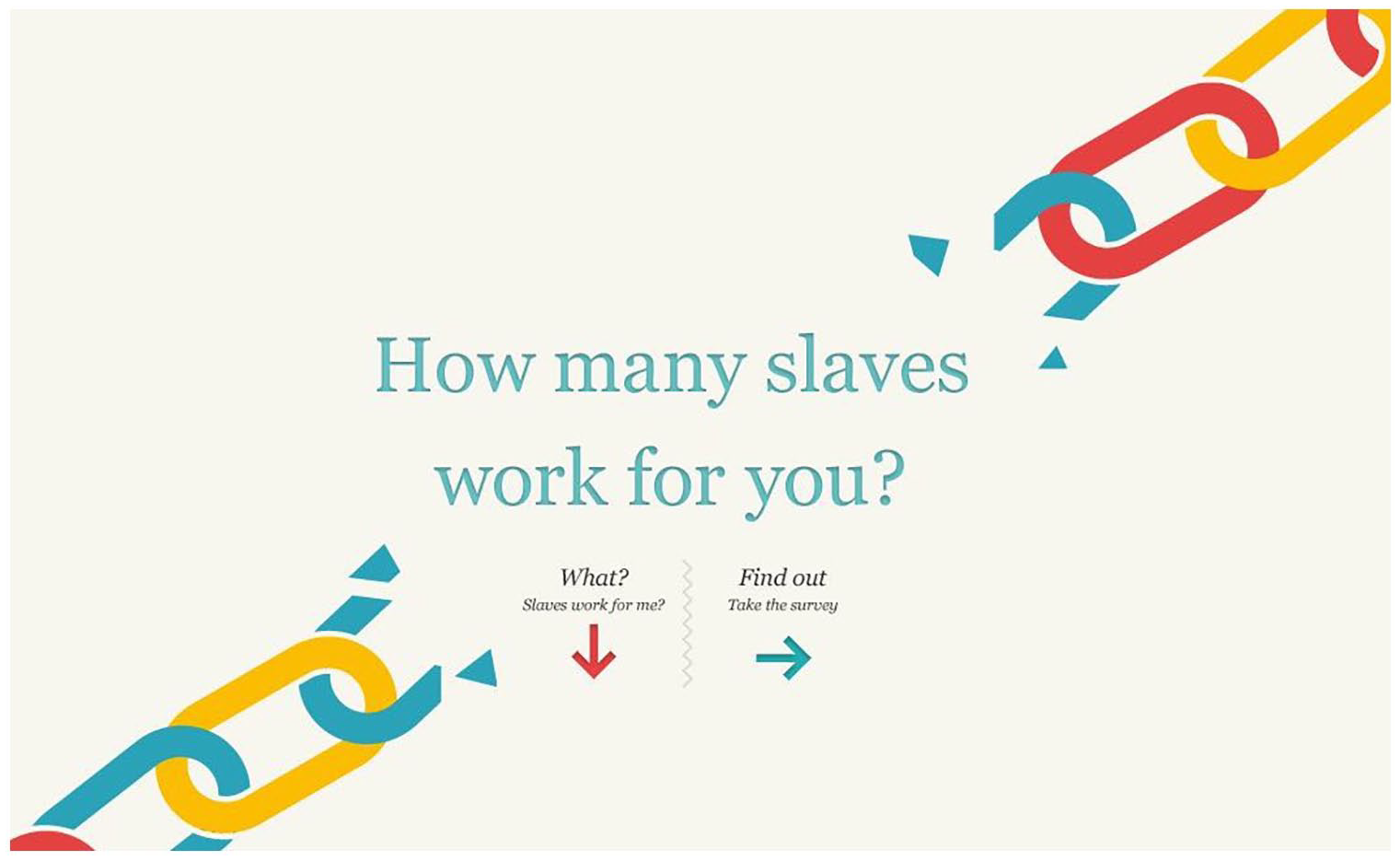
Image from Slavery Footprint website (retrieved June 29, 2020).
The solution we are left with at the end of our consumer journey is two-fold: “Encouraging companies to monitor and address slavery and child labor in their supply chains” and “Using our purchase power [sic] to reward those companies” (Slavery Footprint, n.d.). The website mediates our consumer-based awareness and action that allows us to proudly claim an abolitionist politic and subjectivity, and, in true empowering fashion, it follows the revelation that we employ multiple slaves by proclaiming: “You are a force for good and we are in this together!” So, while markets and consumption may produce exploitation, the key lesson is that they are also the solutions. The analogizing of slavery and trafficking “enables the racial project of naturalizing developmental progress,” as Hua (2018: 248) puts it, which entails naturalizing capitalist social relations. That Slavery Footprint was produced in collaboration with the US State Department reinforces the extent to which police, security, and foreign policy apparatuses work to sustain these ideologies.
The mediated abolitionist subject is marked by a particular form of neo-liberal authenticity that builds off the distinction between legitimate and illegitimate labor that we have been tracing, but it is also anchored in an imagined “outside” to the market. Online campaigns often promote a longing for a “true” relationship with sex and love beyond the market that reflects the “end demand” approach promoted by many anti-sex work movements. Ashton Kutcher and Demi Moore’s “Real Men Don’t Buy Girls” public service campaign is one example. It promoted a bro-friendly conception of masculinity that was yoked to a participatory social media campaign aimed at building networks of anti-trafficking subjects. Part of the campaign was an app that allowed users to literally join celebrity endorsers. Participants could upload photos of themselves that were then integrated into a shareable video ending with Jessica Biel giving a hetero and cis-normative gendered endorsement, either “[uploader’s name] is a real man” or “[uploader’s name, implicitly a woman] prefers a real man” (Steele and Shores, 2014: 266). The campaign offers us the ability to follow Kutcher in heroically doing something: “One minute of your time might be all a girl needs to save her from sex trafficking” (quoted in Kavner, 2011).
Other groups like Fight the New Drug or Men as Peacemakers, the latter a men’s violence against women organization, take a rigidly anti-sex work tack that echoes the common refrain against the commodification of sexual services that was also evident in Jada Pinkett Smith’s Don’t Sell Bodies, and that our research shows runs through much anti-trafficking rhetoric. Men as Peacemakers launched the “Don’t Buy It Project” under the slogan “People are not Products. Men are More than Consumers,” while Fight the New Drug’s key slogans (emblazoned on t-shirts available in their online store, of course) include “#stopthedemand” (echoing anti-sex work movements as well as signaling consumerist solutions), “porn kills love,” and “fight for love.” Both groups are thus explicitly critiquing a particular kind of consumerism, the commodification of bodies and sex, while legitimating consumerist solutions to perceived social problems. Love is what they designate as lying outside market society, and as that which needs to be kept innocent. As Mitchel (2018) contends, however, these moral panics around sex work miss the intrinsic role that love, and especially conceptions of romantic love, play in capitalist logics. Romantic love is a necessary compensation for capitalist deprivation and alienation, and so, in a move characteristic of melodrama as well, is posited as lying outside capitalism. By contrast, Mitchel argues, love in fact lies at the heart of commodity logics: “Human and sex trafficking gesture to the full extent of the paradoxical relationship between love and capitalism: that love is not something exterior to capitalism but rather, at the heart of it, animating every act of purchase” (268). Mitchel refuses the distinctions made in anti-trafficking campaigns, suggesting instead that the contradictory desire for an outside to capital “reveals a larger global economy of violence that recasts the stock roles, in which the savior is as culpable as the trafficker” (273).
That savior role is central to the social media-based campaigns around which much anti-trafficking branded activism now turns. Our social network analysis demonstrated the extent to which anti-trafficking campaigns generated dense networks linking NGOs with each other, with government, with police agencies, and with corporate and other institutional actors. Central to all of these campaigns is the generation of a sense of action, of participation, through online networking. Slavery Footprint provides one instance of a kind of activism that has often been derided as clicktivism or slacktivism. In other contexts, for example in relation to racial justice movements like Black Lives Matter, such campaigns may productively amplify in-person protest, community organizing, and activism (Kuo, 2018; Tynes et al., 2016), but much anti-trafficking branded activism is located almost solely online. The real-world interventions they enable are almost exclusively at the level of police, state security, and NGO rescue operations, thus systematically denying agency and engagement to those deemed trafficked.
Ashton Kutcher’s quote above stressing that action takes only “one minute of your time” foregrounds the limited nature of the participation being encouraged. Celebrity endorsements, branded merchandise, and especially the ability to claim an abolitionist subjectivity are all hooks that, as we have seen, connect people to anti-trafficking networks. Freedom United (n.d.), which bills itself as “the largest modern anti-slavery community in the world,” ups the ante by proclaiming on its homepage that “You can make a difference in under 30 seconds.” Actions include signing (clicking) petitions and donating money, with the site then tracking those micro-actions with “live” counters (over 18 million “actions taken” to date, 5.6 million Facebook fans, and 195 “countries joined” as of December 2020). This focus on metrics, on the click as the site of value, is fundamental to the political economy of social media and other platforms, and is precisely where Dean argues the logic of communicative capitalism acts to undercut the critical potential of online networks. At the same time, it is also a form of politics that is conducive to the construction of villains and heroes; to click is to save, and so we are effortlessly and continuously asked to perform the role of savior, of rescuer. Behind this purported rescue, however, and legitimized by it, lie the criminalization of various forms of labor, in particular sex work, and the legal, police, and border security apparatuses that enforce it.
Arguably the most significant example of such networked activism is the END IT Movement’s “Shine a Light on Slavery” Day, held every 7 February since 2012, which links participatory social media activism, suspect understandings of slavery, celebrity action, and the machinery of the state. END IT represents a coalition of 17 anti-trafficking NGOs, and boasts a significant political influence. The organization’s homepage sets the context for the campaign through a typically hyperbolic claim common in the anti-trafficking world: “There are more people trapped in slavery today than ever before in human history” (END IT Movement, n.d.). Building awareness of this supposed reality is proclaimed as the central goal, with people encouraged to participate through social media and other micro-actions. Celebrities play a key role in this respect, with Kristin Bell, Ashton Kutcher, and Carrie Underwood among those asking us to draw a red X on our hands on “Shine a Light on Slavery” Day, and then share photos of it on social media under the hashtag #enditmovement. This is self-branding as branded activism (Figure 4).

Image from END IT Movement website (retrieved June 29, 2020).
The red X evokes the earlier forms of physical branding under chattel slavery discussed by Browne. We might read the red X as echoing the SS (for “slave stealer”) famously branded on the hand of the white abolitionist Jonathan Walker in 1844 after being convicted of aiding the escape of seven runaway slaves. Walker’s action was rather different, however, taking place as it did under the aegis of a state-sanctioned regime of chattel slavery where, very much unlike saviors today, his actions placed him in direct legal jeopardy. The slavery-trafficking analogy is again more rhetorical than substantive. As is typical with these social media campaigns, results are compiled via metrics, with END IT claiming an astounding 2.7 billion red X social media impressions. These are visualized on a world map, which suggests that the impressions are concentrated in North America, Russia, Australia, and Europe. While this is undoubtedly due to the high levels of social media use in these regions, it is perhaps also a sign that in source countries for transnational low-wage labor migration, trafficking is not the framing that has the greatest traction (Figure 5).
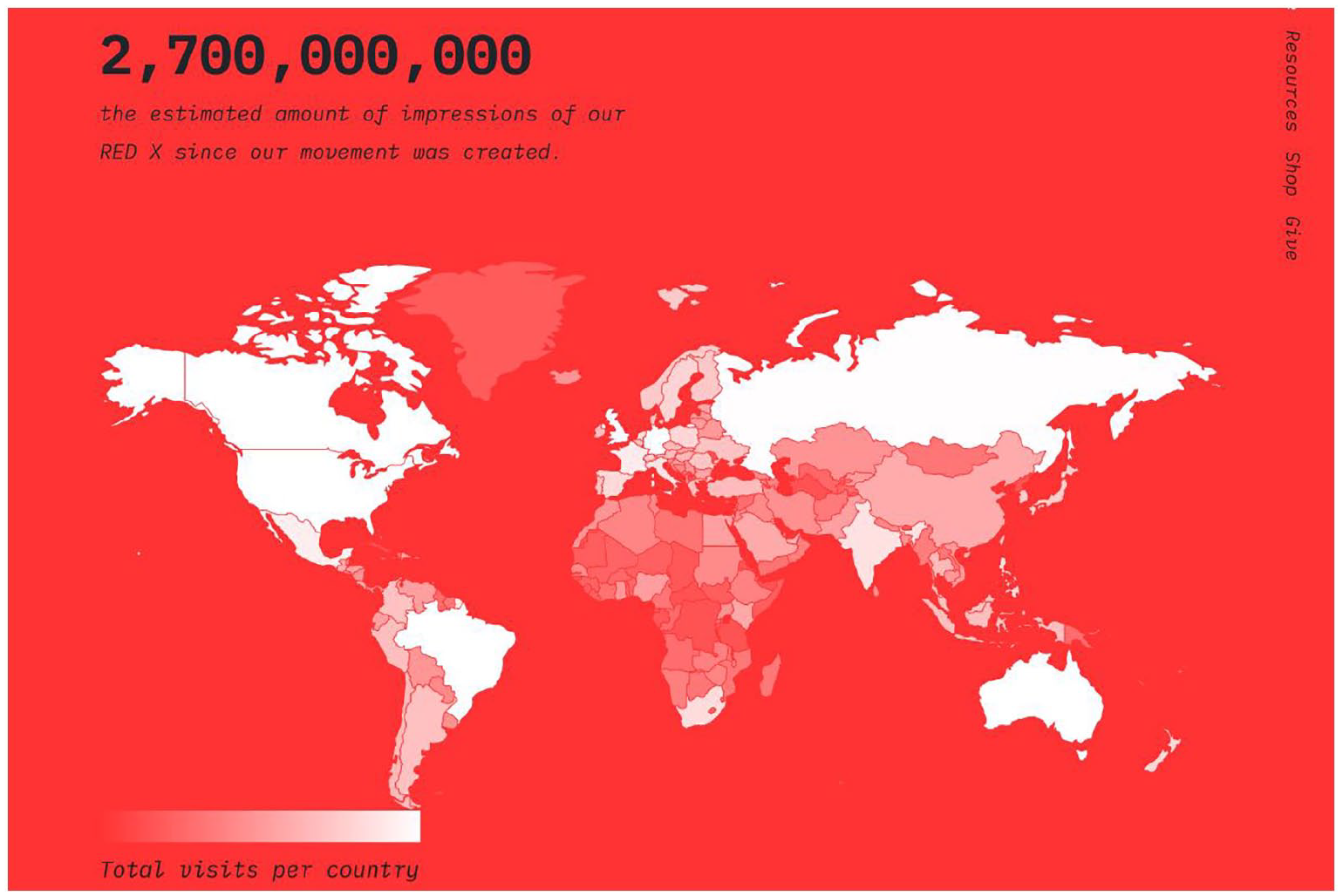
Image from END IT Movement website (retrieved June 29, 2020).
END IT provides a powerful example of the branded activism that we have been discussing, which it fosters by providing an Instagram-ready toolkit of images for users to share. The campaign appropriates hip culture jamming techniques, or what is sometimes called subvertising or brandalism (Harold, 2004; Lekakis, 2017), as part of their strategy, but whereas brandalism seeks to subvert the logic of branding and commodification, our argument suggests that the red X and other similar anti-trafficking campaigns work to strengthen it. In so doing, END IT has become a key node in the dense networks mapped in our research. In part it amplifies and legitimizes the work of anti-trafficking organizations, but the campaign and the red X appears in various legislative contexts as well. In 2017, for example, the US Senate unanimously passed a resolution proposed by Senator Bob Corker, chair of the Senate Foreign Relations Committee, to mark “Shine a Light on Slavery” Day, and to affirm an anti-trafficking consensus. The resolution referred to the fact that “individuals around the world join together to call for an end to modern slavery by symbolically drawing a red ‘X’ symbol on their hands to share the message of the END IT movement,” and resolved that the Senate “commends each individual who supported the END IT movement” (Senate, 2017). The resolution followed Senate Foreign Relations Committee hearings on 14 February 2017 that had featured Ashton Kutcher (who Corker also met for dinner along with Kutcher’s wife Mila Kunis). At those hearings Corker noted the red Xs worn by or written on the hands of various committee members and staffers, while Kutcher returned to his theme of having seen videos of the rape of a child as the catalyst for his action (Gangitano, 2017). Two years later, Congressman Hudson (2019) wore the red X to the 2019 National Prayer Breakfast in the aftermath of the passage of the bipartisan Put Trafficking Victims First Act that he had co-sponsored. The prayer Breakfast that year, which was attended by President Trump and Vice-President Pence, also featured a speech to mark “Shine a Light on Slavery” Day by the International Justice Mission’s founder Gary Haugen. Trump, who has made strong use of trafficking as a justification for the wall on US-Mexico border, praised Haugen as “truly doing the Lord’s work, rescuing people from the bondage of human trafficking” (quoted in Woodall, 2019). Here branded activism and its work in producing an anti-trafficking common sense is cementing concrete and often deeply harmful policies rooted in an evangelically-inflected politics.
Conclusion
Dean (2014), Banet-Weiser and Mukherjee (2012), and others stress that social media activism is unable to step outside the logic of capitalism, but in the case of most anti-trafficking organizations, this is never the goal. In fact, as we have suggested throughout this paper, anti-trafficking interventions work precisely to undercut challenges to the exploitation of labor in capitalist contexts by locating such exploitation only in limited cases of “slavery” that can then be tackled through criminalization, policing, and securitization. Focused primarily on sex trafficking, these interventions are built on a reductive notion of sex work as inherently exploitative, and an abolitionism that abstracts trafficking from a critical and systematic analysis of labor, capitalism, racism, and migration. The new forms of branded anti-trafficking activism, with their focus on empowerment and neo-liberal self-responsibilization, their integration of celebrity advocacy, their deployment of branded merchandising, and their integration into networks of communicative capitalism, mesh neatly with a cause-related marketing approach that systematically excludes the voices and autonomous participation of sex workers, migrants, and others who are ostensibly at risk of being trafficked.
In this era of predatory capitalism, where labor rights are systematically stripped away, the social safety net is under relentless assault, and attacks on migrants have become the new normal, the rise of branded activism provides a deeply reactionary response in the guise of social justice. As Hua (2018: 246) suggests of the policy implications: When the focus of human trafficking is on the subjects (consumers, criminal traffickers, “slaves”) rather than the terms through which subjects emerge, solutions tend to remain limited to either moving from subject position to subject position (making consumers rescuers, for example) or applying the proper actions to a subject (putting criminals in prison or freeing slaves).
These criminalizing and securitizing impulses are evident in many areas, but given the conflation of trafficking with sex work, it is in the international and domestic regulation of that labor sector that the most systematic and harmful impacts are arguably felt.
The elevation of celebrities as rescuers and policy experts is both symptom and cause of the changes wrought by the growth and transformation of the anti-trafficking movement. Mira Sorvino’s anti-sex work approach to trafficking is perhaps the most visible example of the ways in which a victim/rescuer dynamic rooted in racist global geographies enables security-based interventions (De Villiers, 2016), and so it is with that example that we now conclude. The profound racism underlying the witness-savior-expert trajectory is especially evident in one of Sorvino’s much-criticized journal postings of her time in Cambodia for CNN’s influential Freedom Project, which, echoing common anti-trafficking refrains, claims to be “shining a light on modern-day slavery.” Brought to Cambodia by the evangelical anti-trafficking NGO Agape International Missions, Sorvino (2013) encounters a group of men pointed out to her as traffickers. As the CNN cameras approach, the men, Sorvino writes, scatter “like roaches exposed to the light.” She is distressed over her inability to save the victims, lamenting: “we can’t get to them, can’t swoop in like guardian angels and pluck them out of harm’s way.” Setting aside whether or not walking away when confronted by CNN cameras is in fact evidence of being a trafficker, the racist dehumanization of alleged perpetrators as cockroaches and victims as passive and helpless, along with the sanctification of angelic saviors, cements the melodramatic anti-trafficking narrative. This is the narrative in which we are asked to participate, celebrity activism opening the door for much wider consumer and social media participation. Sorvino’s easy assuming of the mantle of abolitionist is increasingly available to any branded activist, the (white) savior defending victims against the evils of an implicitly or explicitly racialized perpetrator.
Footnotes
Funding
The author(s) disclosed receipt of the following financial support for the research, authorship, and/or publication of this article: This work is supported by the Social Sciences and Humanities Research Council of Canada (grant number 435-2019-0572).
