




Abstract
Amid fleeing audience from the state legacy news media to the varied and vociferous new media, the Chinese government launched a mobile news app The Paper (Pengpai) in 2014 in Shanghai as a pilot test of digital journalism to “regain lost influence.” This seemingly against-the-tide expensive news project makes one wonder: How did The Paper come about and what is its nature? As a government-funded digital media, what old and new strategies have its journalists used in its marketing and content-making to achieve the designated goal of regaining lost influence/win public trust? Through in-depth interviews, this article finds the following: (1)The Paper is a product of patron-clientelism based on a consensus among imperatives of the legitimacy-seeking Party, Confucian-minded and job-losing journalists, and the quality-information-hungry public; (2) as it operates, The Paper has learned to speak both digitally and differently; (3) much like a Janus, its news executives initially used different narratives to the Party and the public to curry favor from both; (4) The Paper used both old and new strategies to negotiate with the censors, most notably two new exceptionalist discourses of “regaining influence” and “doing new media.” The author suggests that, using this exceptionalism trope, The Paper and a score of its clones across China have led Chinese journalism into a phase of “influence-seeking Communist new media-ism (2014–now),” during which Chinese journalists, while honing their digital abilities to propagandize China, have produced some quality digital journalism in public interest with the Party paying the bill.
Keywords
Introduction
This article examines how aspiring journalists and new media initiatives survive in an increasingly complicated environment in China when mobile Internet has become mainstream and politics more uncertain and repressive. In contrast to the former scholarship pitting mainly print journalists’ adversarial stance against the state, this study focuses on journalists working together with the party-state to run a mobile news app to recover lost audience and on the strategies they use to woo the public and negotiate censorship. Using the news app as a prism, the study tries to unveil the intricacies of the slowly morphing journalists–party-state relations in a new era (thus a new model) characterized by news media and journalists wrought havoc by rampant social media and a party-state panicked at losing legitimacy. So this introduction section involves the political setting of the mobile news app The Paper (Pengpai), 1 its functions, and its influence, before raising the research questions.
On 2 November 2013, in his work report delivered at the 18th Central Committee of the Communist Party of China (CPC), Chinese President Xi Jinping noted that “in order to clean the online sphere, enhance the mainstream voice and display the positive energy,” “both hands” should be used and used forcefully: one to regulate so as to reduce the “noise” and the other to “guide” the public opinion (Wang, 2015).
The hand to “regulate” involves a long list of fresh moves including updating China’s Great Firewall (GFW) and anti–virtual private network (VPN) technologies (Simon, 2015), wider deployment of paid propagandists to muddle online public opinions (Chen, Wu, Srinivasan, & Zhang, 2013; “China’s Internet,” 2013), pillorying on national broadcaster China Central Television (CCTV) recalcitrant online opinion leaders with petty crime charges (F. Yang, 2014), uniting and re-educating CEOs of Internet giant companies (Wang, 2015), and strengthening public opinion monitoring practices that have fostered a whole industry in China since early 21st century (Walton, 2001). 2 This quick adaptation to the changing Internet (Sullivan, 2014) and systematic and closely coordinated measures were described in a special report by The Economist (“China’s Internet,” 2013) as the “authoritarian” state “setting an example for other repressive regimes.”
Alongside the draconian “regulating hand” is the strengthened “guiding hand.” On 18 August 2014, President Xi announced that, rather than tinkering with the existent outdated media system, “We need to build a few new media conglomerates with communicative power, public credibility and influence, so that a multifaceted, diverse and convergent modern communication system can be created” (“Xi Jinping,” 2014).
Prefiguring President Xi’s call, on 22 July 2014, Shanghai Propaganda Department launched a mobile-native news outlet: The Paper (Pengpai), aiming to make it, as its slogan says, “an internet platform focused on political news, ideas and thoughts.”
The Paper grew very fast. One year later when it had its first anniversary on 22 July 2015, it boasted of a workforce of 356 people—while its print parent newspaper The Oriental Morning Post, 3 launched in 2003, had a mere 104 (Fang, 2015)—and churned out 150 pieces of news and opinion articles every day. Its Breaking News department (yaowenbu) alone had more than 70 reporters, editors, and technology staff (“Shanghai Mayor Han,” 2015), publishing 24/7 through mobile phone app and major social media (Weibo and WeChat) accounts.
Soon after its launch, The Paper has turned out quite much impressive “watchdog journalism,” some of which were very controversial, sometimes to the degree of muckraking the Party, including the reporting on Chinese jail tortures, which was picked up by The New York Times (Piao & Ramzy, 2015), on Zhou Yongkang, China’s security and the highest ranking Party official to fall under corruption investigation, and on the secretive power empire of Ling Jihua, one-time top aide to former Chinese President Hu Jintao. In exposing the corruption of a Party secretary of a district disciplinary committee in Guangzhou, The Paper asked its readers bluntly, “How can we supervise and stop the corruption of a disciplinary committee Party secretary, who is supposed to supervise and stop corruptions?”
Because of these reporting, The Paper has gained impressive attention to itself, being acclaimed as a “phenomenally exemplary success” by its fellow journalists, media outlets, and propaganda officials. It has also inspired hundreds of research papers on its various aspects, expounding its exemplary significance to the news industry, the (in-)sustainability of its business model and its innovative news production workflow, and so on. 4 All these seem to indicate that The Paper within just 1 year has miraculously accomplished the mission set out by President Xi for the state-owned media to reclaim “communicative power, public credibility and influence.”
But The Paper has caused some controversy too. Some leftist ideologues pointed out it was a new media publication that had challenged the communist ideological and power monopoly by transgressing the bottom line, “crashing the Party’s rice bowl while eating out of it”; it was also despised by the liberals—a well-known media commentator Shen Yachuan remarked it was a new media outlet manned by “a bunch of young journalists who are naïve and ignorant, knowing only how to ingratiate themselves with the regime”; a The Economist comment piece titled Propaganda 2.0 saw it as merely an upgrade of propaganda of CPC in the mobile Internet age: “This is not the standard packaging of Communist Party propaganda. The party is still getting its message across, but in the style of America’s Huffington Post, a news and opinion site” (“Propaganda 2.0,” 2014).
For a long time, “new media innovations” by Chinese state-run media outlets have been laughingstock to many observers for their doomed failures rooted in ideological rigidness and bureaucracy. For this time, what is really The Paper and its fate? Is it a last-ditch effort of a few progressive journalists to defy the Party with Western-style watchdog journalism, which amounts to suicide, or the journalists’ coalescence with the Party to make the news media stay relevant with the people for the Party’s own survival? Or is it either of the two but something totally new? There are many questions to be asked about The Paper, but limited by space, this article focuses only on three research questions here:
RQ1. How did The Paper come about, what is its nature, and how its journalists see themselves?
RQ2. With the Party news media losing its credibility, what old and new strategies—apart from a mere change of medium from offline to mobile phones—has The Paper (and its journalists) used in both its marketing and content production to achieve the goal of regaining “communicative power, public credibility and influence” among the digital public?
RQ3. As an exemplary mobile news app across Chinese media, what implication does The Paper have for the future of Chinese journalism as compared with the country’s earlier news models?
Methodology
To answer the three research questions, the author used interviews, participatory observation, and document analysis methods. The main data for this article derive from in-depth interviews and small-group discussions the author conducted from July 2014 to July 2015, with a mix of 10 interviewees consisting of reporters and middle- and high-ranking executives of The Paper, The Shanghai Observer (Shanghai Guancha), and Jiefang Daily (update interviews were done in the fall of 2015). Each interview and small-group discussion ranges from 1.5 to 2 hours. Anonymity was promised. Before the interview, the author had thoroughly studied all the information available about The Paper, including extensive news reports about it, its internal speeches, and the guest lectures given by The Paper’s journalists at the school where the author works so as to learn about The Paper’s genesis, structure, proclaimed goals, and journalists’ views of them. Moreover, a lot of valuable information on The Paper was obtained from the WeChat public account of Shanghai United Media Group, as well as from those run by many “media watchers” (mostly former journalists). This content includes, among others, informative interview articles with Shanghai Mayor Han Zheng, Shanghai United Media Group executives, CEOs, and content directors of The Paper.
Literature review
Aiming to update relevant scholarship, this study examines the contestation strategies of journalists of a mobile news app in China and its long-term implication for the journalists–state relations in the country. As this is a relatively new topic, the researches reviewed here mostly belong to the print journalism era, when the Party was less worried about legitimacy loss with slower audience attention shift, and journalists were enjoying relatively higher social status, income, and self-esteem. Moreover, given the focus of this study, this literature review narrows down to the scholarship closely relevant to the research questions: journalist–party-state relation in China, particularly in Shanghai; journalists’ negotiating strategies with the censors, their self-conceptions, the discursive tools used in the process, and their concomitant models of journalism.
Journalists–party state relation in China: media innovations under patron-clientelism and guarded improvisation
All news media in China are “surnamed the Party,” 5 and most of them are at the same time market-oriented. This means all news media in China have to help retain and boost the Party’s legitimacy while trying to stay viable commercially, which calls for some professionalism and credibility on journalists (Zhao, 2000).
The Party’s legitimacy imperative has traditionally been seen as foreclosing the professional and social imperatives of journalists, as the latter can erode the former by challenging its authority. On the other hand, when the situation demands (e.g. when shifting audience attention threatens its legitimacy), the Party’s same legitimacy imperative can work as a factor to foster the latter two imperatives. This means-and-end symbiosis connection usually happens via a kind of patron–client relationship between a helm-steering high-ranking propaganda official and some adventurous media executives (Lee, He, & Huang, 2007).
Hallin and Papathanassopoulos (2002) define clientelism as “a pattern of (particularistic and asymmetrical) social organization in which access to social resources is controlled by patrons and delivered to clients in exchange for deference and various kinds of support.” They point out clientelism may discourage the growth of media professionalism (Hallin & Mancini, 2011) that is assumed to take an analytical and even critical approach to the power structure. Furthermore, under the clientelist system, job performance does not correlate significantly with material reward or promotion, so it demoralizes journalists.
This negative effect of clientelism is particularly true in Shanghai (Lee et al., 2007), which is at once a “big city” and yet a “small place”: a resource-rich city governed by one layer of power authority; hence, the distance from the epicenter of power to various media organizations is so short and direct as to make media control through clientelism very effective and powerful. So professional respectability of the Shanghai media is considered not commensurate with their coveted financial wealth (Lee et al., 2007). Except for some occasional attempts of deviation from the Party line, “most of the time, Shanghai’s media have played up to the mantra of social stability.” It is more timid than its sibling cities such as Beijing and Guangzhou (Lee et al., 2007).
However, clientelism can serve as a protection shield to some bold media executives who are willing to not only innovate but also hesitate at the risks inherent in innovations (Hallin & Mancini, 2011; Hallin & Papathanassopoulos, 2002). This may explain why bounded media innovations (Pan, 2005a) have increased in Shanghai in recent years
6
—Shutting down a few chronically money-losing newspapers, merging the two mostly identical press groups in the city into a new Shanghai United Media Group, and launching The Paper to stem audience loss are the latest examples. This indicates that the Party’s legitimacy imperative, the credibility of the commercialized media, and the professional imperative of journalists can co-exist and be mutually enhancing, only that they, in a time of common pressure, work in the patron–clientele mechanism so that the Party can contain the perceived risks embedded in media innovations:
What’s vital is for the top media managers to cultivate cordial ties and communicate constantly with the Party authorities so if misunderstanding should arise it can be smoothed over. A member of the “in” group may make a mistake, but the motive is not suspected. (Lee et al., 2007)
In a similar line, Daniela Stockmann (2013) proposes that by marketization since the late 1970s, the Chinese party-state has retreated from the totalitarian position of the 1970s and successfully maintained and even strengthened its control over news and public information by allowing journalists a certain, limited range of variance in topic choice, particularly in the popular press. This means that market mechanisms are adopted when they are to the advantage of the authorities. Stockmann analyzes Chinese reporting on labor law issues and the United States and finds space for news reporting is selectively opened and closed, depending on how controversial they are at the moment.
In a recent engaging research on media politics in China, Maria Repnikova (2017) coins the term “guarded improvisation” to portray the engagement between critical journalists and central officials, in which Party officials “grant journalists an ambiguous consultative role, while journalists align their political and professional agenda to that of the central state.” The two actors, according to Repnikova, make ad hoc adjustments in response to one another, but the party-state consistently directs the process and the scope of this creative maneuvering. This is how some critical journalism is produced in a political context proverbially known as authoritarian—an “ironical” and also an “understandable” situation (G. Yang, 2017). Compared to the more static and long-term patron-clientelism and strategic marketization, the “guarded improvisation” model rightly underscores the more dynamic and short-term aspect in the official–journalist relation. In the fast-changing China where Party-imperative-diminishing news breaks even faster and reaches far, a more efficient, improvised, and micro-coordinated relation between the two actors is mandated.
Journalist’s strategies to negotiate with state censors
However, when the Party feels its legitimacy imperative is being threatened by the journalists’ pursuit of professionalism, it will tighten news censorship and reprimand journalists, sometimes depriving them of their jobs and even pursuing criminal charges against them (Westcott, 2015).
To report news in public interest while also staving off the entailed risks, commercial media outlets have been engaged in a process of implicit negotiation with the government, pushing the boundaries of what it is permissible to report (Huang, 2007).
Chinese journalists’ risk-avoiding strategies include “double coding”—to convey criticisms between the lines of censored media texts while the audience can skillfully decode these messages by subversive reading (Ma, 2000); playing the policy edge-ball (da cabianqiu)—to leverage the policy loopholes, for example, trying to release a negative story before the pressure reaches them to kill it (Lee et al., 2007); and aiming to depoliticize stories and discuss individual rather than systemic issues in order to decrease the perceived harm to CCP rule (Stockmann, 2013). The emergence and popularity of social media such as Weibo (2009) and WeChat (2011) have made these skirmishes develop faster and harder to contain, with stories breaking and reported online and spreading virally (“Xi Jinping Emphasizes,” 2013). There are also journalists who would take news stories that cannot see the light at their own media to other news organizations or just publish them on their own social media accounts.
These negotiating practices of the journalists have made some observers remark over-optimistically that, rather than an appendage to the party-state, Chinese journalists have become actors in contentious politics (Hassid, 2008) with the state. Rosen (2010) argues that these developments in sum have effectively eliminated the state’s monopoly on information.
Chinese journalists’ self-conceptions and discursive tools
Through “discursive formation,” “interpretive community,” or “discourse community,” many scholars (Fish, 1980; Foucault, 2012; Porter, 1986) have posited that communities are produced around discourses and the existence of communities is predicated upon the way in which network of texts is able to signify meaning to the community. More relevant to this article, researching journalistic discourse in two key public events—Watergate and McCarthyism—Zelizer (1993) suggests journalists as members of an interpretive community have generated collective interpretations of both events by capitalizing on the double temporal position they occupy in regard to them. This situation of “doing double time” allows journalists to interpret an event at the time of its unfolding as well as at the time of its retelling. Thus, Zelizer underscores the need for alternative frames (beyond the notion of “profession”) through which to conceptualize American journalist community in all its complexities.
How do Chinese journalists as members of interpretative community interpret themselves and the job they do? Regarding Chinese journalists’ frame/discourse, in line with Zhao’s (2000) notion of “three imperatives,” Lee (2005) has summarized three models of journalism in China:
Confucian liberalism (1900s–1940s), when the role of the media is that of Enlightenment;
Maoism (1949–present), the media was used for mobilization and propaganda;
Communist capitalism (after the 1980s, especially after 1992), the media has played dual roles of ideological correctness and commercial profit.
Lee remarks that this classification is made in terms of China’s historical background and “the conceptions of journalism, journalist and audience” and that the three components co-exist with each other, with one of them more salient than the rest two at each of the three stages. These mixed models or conceptions about themselves, journalism, and their relation to audience have eventually led them to develop four discourses on how their think about their job: Party journalism, Confucianism, market viability, and journalistic professionalism (Pan, 2005a). Zhongdan Pan (2005a) does not state specifically the order of importance among these four discourses, but for the purpose of demonstration here, we can put them on a continuum illustrating their relations, with Party journalism at one pole, market viability at the other, and the rest two in between, as shown in Image 1.

Chinese journalists’ four discourses on a pole.
In this diagram, the Chinese journalism history from the 1980s onward can be seen as a vacillation between the two poles: the government’s censoring (Party line) of the envelope-pushing journalists who were brought up right in the process of government-pushed marketization of news media (Communist Capitalism). And between these two poles, the Confucius and the Professional in journalists drag them toward one of the two poles, resulting in a fragile balance in the middle.
The literature reviewed above has been very useful in that they provide an analytical framework for this study. But they can be criticized for the following reasons. First, they concentrate predominantly on the print press. In recent years, the Internet, especially the mobile Internet, has profoundly affected the consumption of news in China and eroded the monopoly over the dissemination that the government enjoyed. In the light of the increasing sophistication of mobile devices and telecommunications, new user-generated content (UGC)-based platforms like Weibo and WeChat can report, disseminate, and develop on incidents as they occur, giving the government little or no time to respond a priori. In the fast news-breaking era of mobile communication, governmental regulation of news is thought as needing to be faster, more frequent, improvisation-oriented, and micro-coordinated. The mobile Internet has also created more opportunity structures for journalists to negotiate censorship. These are all new facets of the media politics in China and have caused new questions for us to answer.
Second, what impact has this changed ecology of news had on journalists is an important matter to consider. In recent years, ferocious expansion of new media companies has terrorized Chinese journalists with increased work pressure, reduced income and social status, rampant content piracy, and deteriorating news quality. Working as journalistic cheap labor or “hamsters on wheels” (Schudson, 2015) without job security anymore, 7 what kind of psychological status are Chinese journalists in? How have the changed news ecology and their psychology affected their relation with the state? This research tries to answer these questions unasked in the earlier literature.
Findings
The Paper: a web-native media based on patron-clientelism and a three-party consensus
The patron–client nature between the propaganda officials (central and local) and The Paper can be seen from official news reports (“Xi Jinping,” 2014). This reports explicitly pointed out that The Paper was “under the attention and support of the Central Propaganda Department,” evidenced by inspection visits from the Department Chief Liu Qibao and then cyber Tzar Lu Wei, both accompanied by Shanghai Mayor Han Zheng, the master patron of The Paper. In one story on The Paper about these visits, one photo showed Lu Wei seated in The Paper’s newsroom, poring over The Paper’s website on a computer screen, surrounded by a group of staff and journalists.
This patron–client relationship is even more obviously reflected in Shanghai Party Secretary Han Zheng’s role in guiding the new media reforms in Shanghai United Media Group (SUMG) that has The Paper as its showcase and poster child. For example, on an inspection visit on 7 May 7 2015 to key news and propaganda outlets in Shanghai, Han said it was important to handle well the relationship between occupying the market (to make profits) and propagandizing to guide the public opinion. He even made a list of tasks of media reforms in their order of priority: propaganda, content creativity, audience engagement, and journalists retaining.
As mentioned earlier, clientelism can foreclose or foster innovations. In the case of The Paper, it has provided a rare “special zone”
8
to pilot-test with some bold creativity under the sanction and protection of the patron. Clientelism, to one’s amazement, has even been used by The Paper as a market gimmick. For example, it was rumored that The Paper was directly patronized by Chinese President Xi Jinping, who had been the Shanghai Party Secretary in 2007. One reporter interviewee (Z) said,
To my knowledge, we don’t have any big-deal official support, but my boss won’t deny nor confirm some people’s speculation that we do, and he even seems to prefer to be seen that way, as Hu Shuli did. It has been rumored that Wang Qishan, Chinese vice premiere and chief of CPC’s Central Commission for Discipline Inspection (CCDI) was the patron of the progressive biweekly magazine Caijing, but Hu, its long-time editor in chief, never denied nor confirmed that. We did the same to use that public perception to report on topics (anti-corruption cases or those revealing corruptions of officials at local levels) that we couldn’t otherwise do.
Ironically, while strategically remaining ambiguous on its own political patron-clientelism to the public (or to some officials, who were bent on derailing The Paper’s anti-corruption reporting), that its reporting is officially sanctioned, The Paper has showed its story-telling creativity to expose the patron-clientelism of the targeted corrupt officials. For example, The Paper used social network analysis to unpack the corrupt empire of patron-clientelism of Ling Jihua, the former vice chairman of China’s top political advisory body.
Of course, these have all been done with the news executives’ assurance to the patron that everything is “safe and controllable.” As one interviewee (C) said, The Paper had gone out of its way to make sure the patron’s trust was worthwhile:
We have never crossed the bottom line, neither has we lost our “background color”—we have always been “red” (meaning loyal to the Party). The message we want to send to the authorities (patron) is that The Paper is one of the family, so please treat us as is, and use us however you want.
What should be noted here is the patron–client relation reflected in The Paper, though in many ways still a heritage from the 1980s, seems somewhat different from their earlier forms. In contrast with its more precarious precedents, the one behind The Paper is more consensus-based among the Party, the journalists, and the public. In the interviews, a question was asked of journalists why they were willing to transfer from the relatively better-faring Oriental Morning Post and other traditional media to the uncertain job at The Paper. Quite a few of the interviewees gave answers similar to this:
Well, let’s not pretend the journalistic idealism as the only reason here (laugh). You know, print newspapers are dying, and the new media holds the future. But as a person who wants do some serious journalism while still young, I hesitate to go to Sina, Sohu or Netease, or BAT (Baidu, Alibaba and Tencent). What they do is not journalism. I think The Paper entered the market right in time for me and many other reporters like me. As a new media news organization—I know it is Party-owned, but what media is not in China?—It offers me a rare opportunity to recreate myself—telling news stories that are serious, digital and get a passable and stable payment. At the Paper, I can do what I enjoy doing and learn new media skills and experience that are good for me even if I quit doing journalism in the future. So why not (come to work for the Paper)?
This quote corroborates a much up-voted online comment by a former journalist that the emergence of the Paper is “the Noah” for legacy media journalists who had seen their hope dashed repeatedly by relentless new media deluge (Bai Xiaoci, 2014). On the other hand, The Paper is welcomed by the public too. According to the latest data, The Paper mobile phone app had had 69 million downloads by February 2017, with 5 million active users daily (Zhongguo Xinwenchubanguangdian Bao, 2017), indicating The Paper’s popularity with news-hungry public. This shows that The Paper is stably based on the Party-journalists–the public consensus, and its existence will very likely continue so long as the consensus stays.
Marketing gimmicks to appear independent and professional
Party money in guise of market investment
When the author interviewed for this article, The Paper hires 356 personnel and churns out 150 news products (news stories, graphics, animations, interactive content, videos) every day. Led by a well-paid “technology director from Japan,” its new media production team consists of video journalists, data journalists, animation editors, interactive social media editor, product managers, and iOS developers. It also pays well to invited opinion writers. Obviously, running The Paper is very expensive, causing a well-known Shanghai media analysts Wei Wuhui to remark on Weibo:
No real news start-ups have ever dreamed of being able to create so much content for the public as Paper’s. I think it’s sure a good thing for it to have a lot of money to burn, but it is even better if it tries to use the money more wisely and steadily.(Wei, 2015, quoted in Xie, 2015)
This has intrigued the public to wonder who has been paying the bill for The Paper, to which The Paper has on many occasions just answered, “We have a unique mixed investment structure to pay for it.”
According to Qiu Xin, publisher of the SUMG, The Paper had investments from the SUMG, Oriental Morning Post, a real estate development company, and a venture capital company and personal funds from The Paper’s core management team, with a total investment of 580 million yuan (Z. Qiu, 2014).
In addition, in upbeat business terminology rarely seen in Chinese journalist-officials, Qiu Xin offered his theory of the business model of The Paper. He said,
SUMG will take full advantage of its core assets such as social capital, information, and public credibility to create vertical value chain so that our readers can be turned into service buyers. This will create an inexhaustible gold mine for us. The Paper will aim to aggregate users’ attention. It will become a value creator rather a value diminisher in SUMG. (Zhongguo Chuanmei Keji, 2014)
Qiu Xin’s optimism was supported by a well-known media consultant-cum-professor, who put forth his Adam Smithian thesis that “all achievements in politics is predicated upon achievements in economics. For any news media, there will be no political success without market success” (G. Yu, 2014, quoted in Gao, 2014). The professor was apparently referring to The Paper as a possible successful example of news media in China that was in for both market and political successes.
But this high-sounding optimism, offered evasively, did not convince some watchers. Questions were raised, such as the following: Will the traditional advertising model still be viable on a mobile phone app like The Paper’s, which is devoted to political news and thoughts? Will these ads be enough to support The Paper’s expensive journalism? (Zhu & Zhang, 2014). How could The Paper be so sure it had a viable business model while the rest of the world’s news industry has been on the brink of dying out? These are tough but necessary questions for The Paper and its “investors” (if there were any real ones).
Later on, The Paper phased out the we-have-a-viable-business-model trope and did not even bother trying to hide the fact anymore—it’s government-funded. On 28 December 2016, The Paper was infused with an extra 610 million yuan by six state-owned enterprises in Shanghai, confirming that it is government-paid and thus making capital a distant concern for The Paper.
But why at its early stage did The Paper choose to say to the public, in a seemingly business-savvy fashion, that it was on its own feet financially? One speculation is that The Paper used it as a marketing strategy to help it keep a distance not only from the trite/irrelevant money-losing legacy media but also from the power-wielding Party government itself, thus making it appear more professional (than the legacy media) and independent (of the government) so as to gain credibility from the public. Later on, the executives of The Paper did not stick to that argument as from the right beginning it sounded untenable and even stupid. This is because, first, The Paper could not possibly make money from the “business model” as it had envisioned; second, The Paper’s later reception of governmental funds was big news itself, making that argument self-conflicting; and, third, publicizing governmental fund infusion into The Paper could itself boost the already downtrodden morale of journalists-cum-propagandists who had seen their status and influence eclipsed long by the estranged public and blazing new media companies.
Selling the 1980s idealism: double talk to the party and the public
Since its official launch on 22 July 2014, The Paper’s CEO and Editor-in-Chief Qiu Bing has created an expectation in the public that he, as the public face of The Paper, would on any red-letter days of The Paper infallibly publish editorial essays to make the outlet a magnate of attention nationwide. These essays, avidly read, talked about, and retweeted by the interested public, would infallibly enhance the image and news market share of The Paper even more.
In the prologue of one of the two most influential essays “My Heart Swells Emotionally As It did Yesterday” (woxin penpai ruzuo), Qiu, a student at the prestigious Fudan University School of Journalism in Shanghai in the 1980s, said explicitly that he wanted to “dedicate his words and this online product (The Paper) to the 1980s,” an era “we have been so unwilling to say goodbye to”(B. Qiu, 2014).
In the essay, Qiu told of his internship at the then progressive China Youth Daily in Beijing in 1989 before the Tiananmen Square student protests. He said he admired so much of the first generation of Chinese investigative journalists there at CYD; that listening to them at newsroom meetings “made me wonder what a miraculous profession it was to be a journalist. The passion of these journalists expelled my sorrows.” He then quoted his passionate roommate to say that “people all said idealism had been buried in the 1980s, but I found it had actually not.”
Here, Qiu Bing was apparently trying to paint a Confucian image of himself and thus of The Paper as “a person/media clinging to his/its truthful ideal despite possible severe repercussions” (renru fuzhong), an image quite common in the long history of repression of the right to speech in China. Also, by keeping alluding to the 1980s, he was appropriating the theme of “the 1980s” for his own purpose—winning public trust for The Paper.
For contemporary Chinese, the 1980s held special significance for the iconoclastic and nihilistic tendencies of the younger “me generation” after the Cultural Revolution. The college students were crazy over Sartre, Freud, and Nietzsche to “fight the oppression of humanity and human desires by both traditional culture and Maoist morality” (Xu, 2002, p. 230). Against this cultural backdrop, the 1980s was also an era of news media innovations, the most influential of which was the World Economic Herald based in Shanghai. “One of the best-known Chinese newspapers in the world,” WEH was regarded as “an independent newspaper in a socialist country” for its pro-democracy report (Shen, 1995) and was shut down by the CPC before the Tiananmen incident in 1989. That year, however, the 72-year-old editor-in-chief of World Economic Herald (WEH), Qin Benli, was named by Press Review as the “International Editor of the Year.”
Wu Jiaxiang, a freelancing scholar with 760,000 followers on Sina Weibo, immediately got the message Qiu Bing was signaling. In a Weibo post, he commented on Qiu Bin’s editorial: “Will The Paper re-sound the voice of the World Economic Herald in the 1980s? If yes, The Paper would need an editor-in-Chief as visionary as that of the WEH.”
Qiu’s 1980s idealistic message was explicit, emphatic, well-targeted, and highly successful in attention-grabbing and public trust winning. But to one’s astonishment, the purpose of such strong messages was played down and framed merely as a “very successful marketing gimmick.” At an inner meeting to celebrate The Paper’s 1-year anniversary on July 2015 and to summarize the achievements The Paper had made so far, Sun Xiang, product director of The Paper, put “Qiu Bing’s essays” under the category of “Brand Marketing of The Paper” and cited those essays as having played “a vital role” to enhance its brand, stimulated its app downloads by “100–200 thousands,” and saved handsome marketing expenses. “This proves the value Qiu Bing’s essays have created from The Paper,” Sun said (Fang, 2015).
What’s more perplexing to observers is, on another occasion, when asked by a journalist how he would respond to the criticism that The Paper had used the 1980s idealism merely for commercial gains, Sun Xiang got back to the idealistic trope, knowing that he was on record, and to the public. He said he liked the editorial essays because they “highlighted the characteristics of The Paper team—aiming to do something idealistic.” “I hope people can evaluate us on what content we will produce, rather than what editorial we have written” (Zhou, 2014).
Old and new approaches on the mobile app to negotiate censorship
As a mobile news app rising out of a traditional newspaper, The Paper has used both old and new strategies to negotiate censorship.
The “playing the edge-ball heritage” goes on in The Paper
Playing the policy edge-ball or to leverage the policy loophole (da cabianqiu) has not been new to Chinese media in a restrained reporting milieu. Li et al. (J. Li, 2000) show that even the top official organs, including Xinhua News Agency and the People’s Daily, were testing the state limits to exploit national sentiments over the downing of the US spy plane for market advantage. In their interview with media executives of Shanghai in 2007, Lee et al. (2007) found that “intensified business pressure sometimes defy the political logic.” They cited an executive in Oriental Morning Post who acknowledged that his paper hires “old comrades” to look for “gray areas” in Party documents that can be exploited for market opportunities. He said since the rules of the game are vague in China, and although most media workers exercise self-censorship to avoid trouble, there are still those who struggle to wedge the media space a bit wider by “playing the edge ball,” for example, trying to release a negative story before the pressure reaches them to kill it.
In The Paper, with one-third of its 300-odd journalists from The Oriental Morning Post (which stopped publishing since 1 January 2017) known for its watchdog reports of the milk powder contamination in 2008, the “playing the edge ball” legacy has been passed along. For example, in February 2015, military conflicts broke out in Kokang on the China–Myanmar border. As Xinhua News Agency is the only authorized new media in China to cover international news into China, “we were hesitating on going to the conflict zone. My boss (editor-in-chief) just told us, ‘before censors come, you just go!’” said one interviewee (Z) to this author. Another interviewee (C) was more expressive:
In our practice, on some topics, before a censorship order comes, we will just rush ahead. When the order catches up with us, we just retreat. As they say, what is not prohibited in the law is allowable, and this is what we do. We have been tactical. In such a political atmosphere, an upfront adversarial stance with the authorities will have you shut down within 6 months of operation.
He compares The Paper’s dealing with the censors to Shanghai’s dealing with Beijing:
Like Shanghai when dealing with Beijing—The Paper is persistent, resilient, and flexible and don’t mind taking a detour. When the atmosphere is good, we will run ahead, when it is not, we just stay down. You can call this wisdom or shrewdness. For any news story, if we can’t publish it, we don’t publish it. We won’t even argue with the censoring leader(s) about it. We will never fight for one story at the expenses of the whole (daju). What’s the whole? It is to survive.
Another often-used strategy of The Paper’s journalists is to first deliberately transgress into the restricted zone but, when got caught by propaganda officials, to quickly acknowledge their wrongness and submit a written self-criticism letter (jiantao shu) to the presiding authority. The “earnestness of remorse” in such letters is very much emphasized by the officials, which can only be shown after a few ritual-like rounds of letter revisions. This strategy is far from new in Chinese news media. According to one veteran news executive, 9 such remorse letters have been in so frequent demands at a Shanghai media outlet that the retirement of “old comrade”—an experienced in-house ghost writer of these letters—was deliberately postponed for his valuable skills news executives could not find in less-assimilated younger journalists.
This practice is epitome of a larger China Communist “self-criticism culture” that dates back to Mao’s era—In theory, the Party press is required to engage in criticism of other Party and governmental institutions through its news coverage and in self-criticism of its own mistakes in response to criticism from readers (Chu, 1982). The legacy was reasserted by President Xi in 2013, comparing self-criticism to “taking a shower to clean oneself” (“Xi Jinping Emphasizes,” 2013). What’s new at The Paper is, as an unprecedented digital news project teemed with trials and errors, it has inadvertently created more opportunities for journalists to employ this fail-often-and-say-sorry-fast strategy without causing serious repercussion. “Just some more reprimands and (writing) a few more remorse letters. It’s no big deal,” one interviewee said.
Besides the above-mentioned skirmish tactics, merely being a mobile-native media has emboldened and facilitated some journalists’ edge-ball playing on otherwise easily censored topics, although this play is not always successful. The case in point is The Paper’s multi-media and multi-part reporting on the long censored topic of the social and environmental impact of the Three Gorges Dam construction. There had been a speculation among some media practitioners that “for any censored topics, online coverage usually faces less censorship than the traditional news media.” The Paper proved this speculation wrong. Its dam story was ordered to be removed only 7 hours after it saw light online (“The Paper Had to Delete,” 2015).
Pan (2005b) interprets insightfully the two parties of the edge-ball playing as two co-conspirators playing out their roles. One (journalists) improvises to exploit the cracks in the institutional rules and arrangement; the other (officials) tries to contain such “out-of-frame” activities and improvises ways to co-opt the impetus for change into its control orbit. Along the way, some institutional stipulations are formulated and the two sides meet halfway from where they each started. “Improvisation is a micro and subtle approach to institutional changes under the overarching constraints of the Party-press ideology.” At The Paper, the edge-ball playing is still going on. What’s news is, The Paper as a Party-financed mobile news app has offered journalists more “cracks” to take advantage of in an uncharted area where a richer discursive opportunity structure exists in a matrix of various variables (old/new, print/mobile, Oriental Morning Post/The Paper, national/local, central/Shanghai). Based on a three-party consensus, this edge-ball playing is less risky than before, as they can be framed as bounded innovations in a new setting.
Cross-regional supervision revived on a mobile news app
“Supervision by the media” (meijie jiandu) was a key reformist argument in debates leading to the 1989 pro-democracy movement (Zhao, 1998), and it was heightened in the mid-1990s and in the early years of the first decade of 21st century, although this reporting has also been described by some observers as existing only cross-regionally—“news media only flap on flies in town, but sometimes beat big tigers out of town.”
(Cross-)regional supervision by the media cuts both ways. While it projects a caring and humane image and symbolically affirms the leadership’s commitment to the people, thus enhancing the Party’s legitimacy, if carried too far, it can also stir up rows among different regions, undermine people’s confidence in the Party, and hurt its legitimacy. Therefore, cross-regional supervision by the media was prohibited by the Central Propaganda Department since 2004 (X. Li, 2014).
For mobile-native app The Paper, however, cross-regional media supervision has been silently revived on smartphones for both its nationwide online reach and informants’ network. One interviewee (L) said,
When reading The Paper on the app or Wechat, users can easily retweet news to their friends. This can make the news reach numerous people within seconds. We have learned from our analytics that any news with over 5000 reads on Wechat will definitely go viral everywhere online. Previously with traditional media, news does things to the audience; now on a mobile phone, users can do things easily to the news (retweet/comment) and this has impacted the public enormously.
This dynamics of news flow facilitated by smartphones has seemed to bring back the cross-regional reporting. The Paper now boasts of a large network of informants made up of low-level civil servants across China, who for various reasons have been willing to break to The Paper the latest political news leads in their regions. The same interviewee said,
These deep-throats, via Wechat, can send us terse text message like “Our bureau chief haven’t shown up for a few months by now” or “My leader just jumped off the building,” etc. These are all vital leads to important political news. On such tips, we would make phone calls or send reporters in the field there to verify. This network of informants has made The Paper the nation’s first to break important news many times.
One may ask, “Don’t these informants fear that their WeChat communication was being monitored by the government?” Yes, but compared to breaking it on the open microblogging platform Weibo or by phone calls to a journalist, WeChatting to The Paper, which has so far been known as a reliable and professional media, is much easier and seemingly safer to the informants. An interviewee (W) told us,
We (The Paper) usually respond to our informants quickly. If their lead was verified accurate, the news will hit the page in a dozen minutes. Gradually they have developed a trust with us and would break to us more in the future. This has gradually helped The Paper build an image among low-ranking civil servants in other regions as a “responsible” news media that is different and uncontrolled by their local censors. Of course, this trust has made us try to be more responsible to these informants.
He said some informants even volunteered to be string reporters for free for The Paper. For example, a civil servant in Shandong Province admired The Paper so much so that he would write news story emulating The Paper style and send it to its editor.
What effect does this cross-regional supervision have on the people it is meant to supervise? It is hard to know exactly, but such reporting has caused regional propaganda officials to call The Paper, requesting it to “show mercy” and stop further reporting on them. Alternatively, they would call the Shanghai Propaganda Department asking the latter to order The Paper to stop. To such requests, a Shanghai propaganda official (personal communication, 2015) told this author that they could only offer diplomatic explanations to the requester, such as since the cases were rare and unprecedented, the Shanghai Propaganda Department did not know what to do (read: unwilling to) to stop The Paper from reporting on other regions. The official took pride in this case as he thought it showed that the Shanghai-located The Paper had become so influential across the country as to have caused complaints from propaganda bodies in other provinces.
“To regain influence is all that we are concerned about now”
Commenting on China’s media organizations, Li et al. (Lee, He, & Huang, 2006) put forth a term “Party Publicity Inc.,” a single quasi-business Party press conglomerate that seeks to make huge profits through its subsidiary tabloids selling gossip, scoops, and opinion (Esarey, 2005) while using the profits to sustain its money-losing propaganda newspapers. Having existed for three decades, however, this “dual personality model” is being changed. For one thing, the tabloids started losing money too; for another, this model has only sustained the existence of trite “political news.” Far from interesting the public in political news (so that ideological indoctrination can still possibly effect), it has estranged the public further away from it. The Party has realized that long-time over-commercialization of the media, while having somewhat reduced its financial burden, has also exerted a centrifugal force on its grip on power. So if the Party had wanted the public to look away from political news and at the infotainment in the past decades, now it, in fear of being rendered into full irrelevance, wants the public to look back at its political news so that the Party can still set the public agenda. If this attention reclaiming means paying huge bills, so be it. In other words, just like “freedom is not free,” the Party has realized that “the Party ideological control should be paid for.” An interviewee (C) said,
(Shanghai) Mayor Han Zheng has offered us a dialectics of market and “occupying the battlefield” (zhendi): Only when we have the
As indicated earlier, apparently Mayor Han knew The Paper was doing political news, so what he suggested by the word of “market” in the quote was more of “the market of ideas” than of the market in monetary sense. He was as good as saying, “you occupy the market of ideas first, then do the propaganda (to guide the public opinion).”
So while the claim was made to the public that The Paper had a “viable news business model” as mentioned earlier in this article, at numerous internal meetings of The Paper, the talks was all about “regaining influence” instead of “making profits.” One of the interviewees (Z) said,
We actually don’t care much about turning from red into black. The early words we had about business models were either pipe dream or just PR words. Now no one talks about it or are concerned about it anymore. We are concerned mostly with how to be more influential among the public, so as to prove to the higher-up leadership that we are not only worthy of its propaganda money, but also worthier of this money than if it is invested in the moribund traditional media.
It is nothing new that the Chinese government pays for propaganda in the form of news. What’s notable here is this question: How can the publishing of traditionally highly censored and audience-repelling political news be expected all of a sudden to be attractive and influential to the public so that it can “occupy the battlefield”? Setting the public agenda is predicated upon maintaining the public attention first. Obviously, this latter feat cannot be achieved by a mere change of medium from print to a mobile app as The Paper. Here, we have reason to surmise that the Party, weighting between the two evils (the imminent legitimacy loss due to plummeting audience attention and the risks ensued from granting media like The Paper some journalistic autonomy and professionalism), has eventually decided to go with the latter, tasking The Paper with a mission to be “interest the public in Party interest.”
“A friend in need is a friend to be controlled.” The mutual needs between the Party and the journalists have given the latter extra discursive tools to negotiate for permissible reporting topics. After all, it is “influence (quality audience attention)” that the Party wants at the moment, as a senior reporter (C) said,
What we (The Paper) want is influence, and what the central leadership wants is to lead the public opinion. So we each have what the other wants.
Another interviewee (L) said,
The so-called market is not the real market, because we don’t aim to make money from it. To obtain influence is all that we are concerned about now. If we want more influence, we got to think how we can get more influence, and what topics tend to be influential. If we think we can
When asked what were the topics that could bring The Paper “influence,” this interviewee said they usually were the ones that they think the public is most concerned with, such as those on anti-corruption, social injustice, and environmental damages.
“What we are doing is the latest mobile media. We are different”
The Paper has also been using the narrative of “doing new media” as a tactic to resist some governmental interference with its reporting. At the center of contemporary discourse on technology—or the digital discourse—is the assertion that network technology ushers in a new phase of capitalism which is more democratic, participatory, and de-alienating for individuals (Fisher, 2010). As one of the most visible proponents of the digital discourse, Clay Shirky bashed legacy media leadership for being unable to think innovatively like digiterati:
When reality is labeled unthinkable, it creates a kind of sickness in an industry. Leadership becomes faith-based, while employees who have the temerity to suggest that what seems to be happening is in fact happening are herded into Innovation Departments, where they can be ignored en masse … One of the effects on the newspapers is that many of their most passionate defenders are unable, even now, to plan for a world in which the industry they knew is visibly going away. (Shirky, 2009)
This digital discourse has been translated in Chinese news sector into phrases like “we need to do things with the Internet mentality” (hulianwang siwei) or “We have to adopt the Internet gene,” meaning it is necessary for media reformers to discard the old centralized, bureaucratic and top-down decision-making that is associated with the state-run traditional media system. The phrase “Internet mentality,” supposedly put forth first by Chinese search engine company Baidu’s CEO Robin Li in 2013, was actually nothing but a different way to describe the ideas embodied by Web 2.0-style Internet, such as user-centered, always beta-test, collective intelligence, long-tail effects, emphasis on design, participatory culture, and so on. But in March 2015, in an “Al Gorean” work report of Premier Li Keqiang, the term took off even higher, in which Li declared that China would promulgate a national plan he called “Internet +,” which would involve boosting a mesh between mobile Internet, cloud computing, big data, Internet of things, and nearly all the material and service industries.
As for The Paper, in Premier Li’s spirit, Shanghai Mayor Han Zhen required The Paper journalists to be conversant about using new media such as big data and interactive technologies to tell better stories so as to “lead public opinions.”
Besides these official spurs, The Paper itself, which has inherited many journalists from the print Oriental Morning Post, was particularly vigilant against the rigid print media culture and its entailed tight ideological control, which many journalists and journalism scholars blamed for the failures of earlier new media projects. Therefore, The Paper resolved to avoid repeating those earlier failures by implanting in itself the “Internet gene.” Sun Xiang, news director of The Paper, said, when The Paper was still in incubation, they learned from the Google way of R&D:
We gave us some time to play and have fun on the mobile Web, without setting any specific goals, so that we could know how to play by the rules of the Internet: How to design, operate, market, upgrade, etc. During this process, our content team learned enormously from our tech team, who had kept abreast with the latest mobile Web trends.
The Paper was mindful of the audience’s interest by using user surveys proactively to canvass feedback on the app’s fonts, design, and channel configuration (He, 2014). The Internet mentality was also reflected in its content production. The same news director Sun said,
We initially wanted to tell what we think our audience need to know, but as we move on, we have learned to tilt more towards giving what they want to know. The Paper has been able to beat other media outlets in three ways: to be the first to report on important news, to report them with more details, and to provide more perspectives about them by integrating various sources. (Zhou, 2014)
Occasionally, in the name of experimenting with digital story-telling, some sensitive topics were touched upon and reported in an engaging way—for example, the projects on the Three Gorges Dams and on the corrupt governmental official Ling Jihua. One interview (Z) said,
What we are doing is the latest mobile media. We are The Paper. We are different. That’s why we can put so much resources into the production of an interactive news package, say that on Ling Jihua. That’s why we always interact with our readers and reflect their concerns in our reporting. We need to do things differently, and we can do things differently.
Mainly due to the many successes in regaining influence with attractive digital reporting, the journalists at The Paper has become more ambitious when they talked about The Paper and themselves. In their examination of news media practices in Shanghai, Lee et al. (2007) cited a top media executive in Shanghai as emphatically arguing:
Shanghai should not compete for national leadership. National leadership belongs to the central authorities in Beijing. I don’t see why Shanghai must be No. 1. Let the People’s Daily, not the Jiefang (Liberation) Daily, take the lead. We shouldn’t carry the (sensitive) story unless Xinhua News Agency has carried it.
Then, Lee et al. quoted this informant as going on to say that political safety is of overriding importance. If Beijing has power, Shanghai can have money. He disapproved of the aggressive press “adventurism” in Guangdong as “making trouble.”
For this article, however, an executive interviewee (Z) made the following argument, which seems to indicate a much bolder positioning of Shanghai media than as told by the media executive in Lee’s research:
The Paper can be understood as a breakthrough of Shanghai news media through new media after they had been eclipsed by the Southern news media (nanfangxi). We are definitely not central-level media like the People’s Daily. If you will, you can call us “ordinary-folk official media.” The Paper is just like Shanghai in China. Shanghai is not Beijing, but would like to have a say in China’s politics. The Paper is not People’s Daily, but would like to play a part in China’s media landscape.
Conclusion and discussion
A consensus-based project among Party-journalists–public imperatives
This research, based on in-depth interviews, participatory observation, and document analysis about a recently launched mobile news app The Paper, tries to answer three research questions—RQ1: How did The Paper come about and what is its nature? RQ2: What old and new strategies—besides a change of medium from offline to the mobile phone—has The Paper (and its journalists) used in both its marketing and content-making to achieve the goal of regaining “communicative power, public credibility and influence” among the digital public Chinese President Xi had tasked it with? RQ3: As an exemplary mobile news app across Chinese media, what implication does The Paper have for the future of Chinese journalism as compared with earlier news models?
For RQ1, the author finds that The Paper is a new media outlet “invested” by a few designated state-owned enterprises. It is fully of the Party, by the Party, and is meant for the Party as a new tool to regain lost audience attention as a precondition to lead the public opinion to retain its legitimacy. Specifically, it is a product of a patron-clientelism between Shanghai high-ranking officials and media executives to President Xi’s call.
The Paper’s journalists have used the patron–client relation strategically, successfully creating a perception among its readers and targeted officials that its anti-corruption exposes were backed by the central leaders (shangfang baojian) such as Wang Qishan, head of the CPC Central Commission for Discipline Inspection, or even President Xi, who had worked briefly in Shanghai.
But The Paper also exists as a consensus/compromise among the (1) state legitimacy imperative (which now can only be achieved by building some media credibility among the public), (2) the job security and professional imperative of Confucianism-minded journalists (who are faced with mounting newspaper job downsizing and harbor a strong grudge against the profit-seeking and content-pirating new media companies), and (3) the information imperative of the public (who, on the one hand, has long been disappointed by the increasingly irrelevant traditional Party media and, on the other, been bombarded by the glut of coarse online content).
This author believes that three factors have contributed to the forming of this Party-journalists–public consensus undergirding The Paper. First, an increasingly localized version of journalistic professionalism has emerged in China. This is because, on the one hand, the idea of journalistic professionalism functioning as fourth estate is situated within the nexus of liberal democracy (Hanitzsch, 2007), which depicts journalists as taking an outspoken and adversarial watchdog role to the power that be (Hanitzsch & Berganza, 2012). This role of journalism, however, is difficult to find among news-workers in the Confucianism-China and other Asian countries, where the cultures prefer consensus and harmony. On the other hand, for many Chinese journalists, it is hard to deny the fact that China under the rule of Chinese Communist Party does have become a better country to live in, with obvious improvements in most aspects of life, making now following the Party line not as intolerable as it was before.
Second, media commercialization has incurred problems such as media corruption and content vulgarization (Curran, Douglas, & Whannel, 1980; Curran & Park, 2005; Curran & Seaton, 2009). After more than 30 years of practice, due to rampant commercialization, China has been judged as “the most probable society” to have newspapers which would publish news for cash, followed by Saudi Arabia, Vietnam, Bangladesh, and Pakistan (Ristow, 2010; Tsetsura, 2015). This may have made some aspiring Chinese journalists hesitant to embrace the market wholeheartedly as their predecessors did.
Third, with the ever-expanding new media companies (Baidu, Alibaba, Tencent, Sina, etc.) sucking up contents, ads, talents, and funds from traditional media, aspiring journalists (mostly print journalists) may have seen these companies as merely profit-driven and morally corrupting exploiters unmindful of public interest.
In sum, a better-faring Party, the Confucius-intellectual mentality of the journalists, over-commercialization of media, and rampant new media erosion have colluded to create the three-party consensus rarely seen before, embodied by The Paper.
Therefore, as a patron-clientelism- and consensus-based project, The Paper has locked the Party and the journalists in mutual needs. “Friends in need are friends indeed.” This author believes that so long as the three imperatives (needs) overlap with each other (though in a dynamic way), The Paper will survive within the domain permitted by the Party, with its journalists improvising with officials under the guard of the Party (Repnikova, 2017). With increasing journalistic commendations, The Paper’s journalists have also started to see it as one with “Shanghai characteristics” and want it to air a unique voice in China’s media landscape that is different from their counterparts in Beijing and Guangzhou.
A Janus ambivalent in its early positioning in uncharted mobile web water
The weight of this article is more on RQ2. As with all new media innovations, the early days of The Paper were teemed with trials and errors, envelope-pushing, and improvisations—“an answer seeking a question.” Hell-bent on gaining influence, but not sure how to position The Paper financially to the public in the beginning, with apparent second from the Party, news executives first painted the outlet with a façade of a mixed investment structure “from the wide society,” while internally right from the start The Paper was fully government-funded by design. Later, the executives, feeling they could not nor need not hide that fact, decided to let it go public. In another case, Qiu Bing, The Paper’s CEO and editor-in-chief, endowed with trust from the patron–client relation and, in a seeming conspiracy with the censors, exploited the 1980s idealism. His act (mis)led the public to associate The Paper with a repressed progressive media outlet in that era and The Paper’s journalists, with the Confucian intellectuals bent on serving the bridge role between the ruler and the public. Internally, however, Qiu’s acts were played down as mere marketing gimmicks.
Stockmann (2013) analyzes the credibility of different categories of Chinese media. She argues that non-official papers are often deemed by the Chinese public as more credible, not necessarily because of tone or content of news but because of the brand itself. Stockmann points out that this means that consumption of non-official newspapers exceeds that of official newspapers by far. And in terms of directing public opinion, it means that often non-official newspapers are more influential than official newspapers, especially in cases where news challenged deeply held beliefs. In Stockmann’s view, the credibility of media outlets can be enhanced through the fact that it is perceived as being somewhat distanced from the State. Given this backdrop and its strong desire to “regain influence” to direct public opinion, it is not surprising at all that The Paper tried to create a public perception that it was distanced from the State. With these practices, The Paper has turned itself into a double-faced animal, alternating between using different narratives to the Party and to the public, very much like the Janus, the ancient Roman God of duality.
But one caveat here is that we cannot be 100% percent sure of the nature of the Janus behaviors of The Paper. Those acts probably were real marketing gimmicks, but they could have also initially been authentic paradigm-shifting attempts of some progressive journalists, only to be signaled as a transgression, and were brought back into the censors’ control orbit. Later, these acts were reframed by the journalists to the Party as mere market gimmicks to stave off repercussions. Either way, these moves seemed successful for The Paper’s image by making it appear somewhat independent and professional to the public.
Being digital creates opportunities. As a newly launched mobile-native news organization, The Paper has an experimental nature in uncharted water both for journalists and for censors and a perceived repercussion proof in the eyes of its informants. This allows it to preempt on some censored topics and to do some cross-regional supervision media reports that had been prohibited among traditional media since 2004. Operating via mobile phones, a reliable network of news informants has been created due to The Paper’s fast response to the informants and the speed with which to report on the leads they provided. With a seemingly infinite amount of governmental money to burn, The Paper has also been able to experiment with a wide range of digital news story-telling genres.
A new model of Chinese journalism: influence-seeking Communist new media-ism (2014–now)
By now, we are able to answer RQ3, which can be seen as a summation of the answers for RQ 1 and RQ2: As an exemplary mobile news app across Chinese media, what implication does The Paper have for the future of Chinese journalism as compared with earlier news models?
In this research, the author finds, while allowing some room for media innovations under the patron-clientelism protection, the Party’s need for The Paper to regain lost influence by launching a mobile news app has at the same time inadvertently created for the journalist two discursive tools to negotiate censorship: “If you want us to regain influence, so permit us to do more topics that interest the public” and “Since we are doing new media, we shall do things differently.” This finding enriches the four existent discourses used by Chinese journalists (Pan, 2005). We may say Chinese journalists now have six discourses on their job: Party journalism, Confucianism, market viability, journalistic professionalism, regaining influence, and doing new media.
Due to these changed discourses, the author proposes the following model (“a discursive battlefield” for Chinese journalists) to illustrate the implications The Paper has for Chinese journalism in its relations with the state, market, new media, Chinese culture, and journalism professionalism (Image 2).
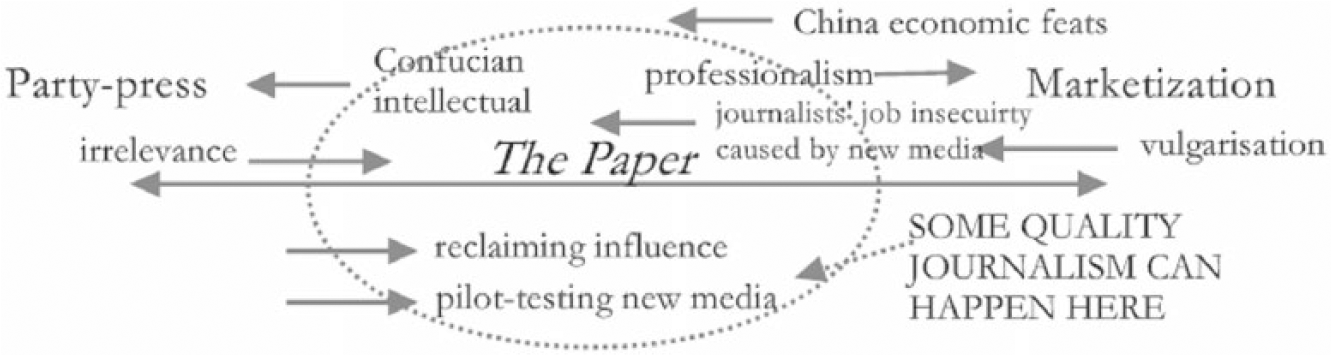
The Paper as a space of compromise for various discourses.
As shown earlier, in the past four decades, Chinese journalists have developed a love–hate relation with the two polarized forces: Party ideology and the market erosion. To avoid being divulged by either of it, they resorted to a Sinicized version of Western idea of journalistic professionalism tinged with Confucianism. These different factors seemed to have hung in balance for quite long until the new media impact became tectonic, causing the Party to lose its agenda-setting ability of the public through legacy media and journalists to work overtime, underpaid, and in the constant fear of job loss. Thus enters The Paper, which has unintentionally created in the field two extra exceptionalist discursive tools for journalists to tip the balance more toward their professional pursuit. It is right in this newly emerging and narrow space, the author argues, that some quality journalism may happen. And as this research shows, The Paper did have produced some quality journalism that has won itself some public credibility and influence.
Moreover, in line with the afore-mentioned three models of journalism in China summarized by Lee (2005)—Confucian liberalism for Enlightenment, Maoism for mobilization and propaganda, and Communist capitalism for dual roles of ideological correctness and commercial profit—this author also argues that Chinese journalism is now witnessing a new model/paradigm since 2014, which can be named as “the era of the Influence-seeking Communist new Media-ism,” where the Chinese governments at various levels, determined to regain lost influence, infuse funds handsomely into projects like The Paper to produce attractive digital products to report/propagandize China to home and abroad. And this has given Chinese journalists new discursive tools to negotiate censorship based on an exceptionalism of regaining influence and doing new media. These developments indicate some subtle but significant changes. This means, on the one hand, in a spell of 40 years, driven by its legitimacy imperative, the party-state has shifted its media policy from a fully government-subsidized model, to rampant marketization, to strategic marketization (Stockmann, 2013), and to a now fully government-paid new media offensive in appearance of better journalism; on the other hand, journalists’ negotiation with censorship has not stopped but has taken different and newer forms in the mobile news era. But all in all, the journalists–state relation in China is a fluid, state-dominated partnership characterized by continuous improvisation (Repnikova, 2017).
This research is limited in the possible insufficient representativeness of the interviewees at The Paper. One may also wonder how much agency have The Paper’s journalists had in an increasingly draconian Party-press structure (the answer is actually “Not much,” as evidenced by what they told me prior to the heightened media manipulation prior to the 19th Party Congress that convened on 18 October 2017). Furthermore, uncertainty entailed as Qiu Bing, The Paper’s CEO and editor-in-chief, later left it to lead a VOX-like video news outlet to replicate The Paper model “all in videos.” Obviously, further studies are needed to overcome these limitations or consider new developments, but the author believes the mixed changes (albeit with continuities) in Chinese journalism embodied by The Paper in the period this article covers are salient and their implication far-reaching. Depending on how one sees it, what The Paper has been doing can be called better propaganda or better journalism for China, and so long as the Party-media–public consensus exists, it will survive along with its Janus role-playing and discursive skirmishes for more reporting leeway.
Footnotes
Acknowledgements
The author wishes to thank the two anonymous reviewers for their very insightful and specific comments and Professors Zhongdang Pan, Guobin Yang, and Lu Wei for their invaluable support along the way. Without their roles, this paper would not be possible.
1.
The news app gave itself a Chinese name which consisted of two characters pengpai, meaning swelling tides or when one’s (say a progressive journalist’s) heart is filled with strong aspiring emotion. These two Chinese characters were chosen also because they sound similar to the English word “paper,” thus the outlet’s English name—The Paper. The care the founders took in naming the outlet shows they intended it to continue the heritage of legacy newspaper. Its English name The Paper is used throughout this article.
2.
Obviously, these measures had existed long before President Xi’s 2 November 2013 speech, but they got strengthened, systemized, and more closely coordinated after the speech. It should also be noted that usually many such governmental regulatory measures in China would have been deployed effectively for a while before they were officially announced (if at all). Here, the references are cited more to provide a context for than to prove the existence of such measures.
3.
This newspaper, whose many journalists had hailed from Nanfangzhoumo in Guangzhou, ceased publishing since 1 January 2017 to reinvent itself digitally on The Paper, “making Shanghai the first city in China to shutdown state-owned newspapers,” as one Hong Kong journalists commented.
4.
A search for “The Paper” on China’s academic and news database China Knowledge Index (CNKI) results 157 entries since its launch on 22 July 2014, although it should be noted that the CNKI database includes both research papers and some general magazine reports.
5.
So exclaims a welcome poster at China national broadcaster China Central Television (CCTV) to show its loyalty to President Xi when he was inspecting the outlet. The poster apparently compares Chinese news media’s relationship to the Party to that of a son and father.
6.
One of the other reasons for these recent flurries of bold moves may be the fact that Xi Jinping, before becoming Chinese President in 2013, had served briefly as Shanghai Party Secretary in 2007, during which he paid a few inspection visits to major media organizations in the city (see  ). Later in his presidency, he promoted Shanghai Party official Xu Lin to be Deputy Chief of the Publicity Department of the Communist Party of China (CPC), Director of the Central Internet Information Office, and Director of the Office of the Central Leading Group of Cyber Affairs. These appointments might have created a patron–clientele relation that has made Shanghai a viable choice for media innovations, including a pilot test like The Paper.
7.
According to a survey conducted by China Institute of Journalism and Publishing Development in late 2016, during 2012–2016, 1934 quit “willingly” their jobs out of the 21,102 journalists in 144 surveyed traditional news organizations nationwide. Journalists’ monthly income differs with regional economic development level. It is between 5000 and 10,000 yuan in Beijing, Shanghai, and Chongqing and between 3000 and 5000 in northeastern and western China, while in Beijing and Shanghai, 1 m2 of housing sells between 50,000 and 100,000 yuan (see China Institute of Journalism and Publishing Development, 2017).
8.
Setting up “a special zone” is a heritage passed along since Deng Xiaoping’s era, who in 1978 hand-picked Shenzhen as China’s first “economic special zone” to experiment with the market economy “with Chinese characteristics” and later the now Pudong New District for another site of opening up in 1992. Shanghai Mayor Han Zheng once compared the Shanghai Observer (Shanghai Guancha), a mobile app for Party news, to the “Shanghai Free Trade Zone” for Party newspapers in China, meaning that the Shanghai Observer is a pilot test serving as an example for all the Party newspapers.
9.
From personal conversation with a retired senior news executive of a major press group in Shanghai in 2016.