




Abstract
Through the analysis of the online discourses about Weibo in the past and present, this article examines how the platform has taken part in the shaping of Chinese networked publics and public participation as it has been undergoing three stages of development itself: collective witness, ideological contention, and networks of expertise. The three stages reflect a major transformation of social media and digital culture in China, from the civic-minded public engagement and activism to the celebration of individual online fame and monetization of content creation. This transformation is taking place at the tightening state control of digital media, suggesting a blurring boundary between corporate and public interests under such circumstance.
Weibo was launched in August 2009 as the micro-blogging service of Sina.com, one of China’s leading technology companies. It has since played an essential part in the public life of the Chinese people, reflecting China’s socio-political transition in the post-Olympics decade. Although Weibo is often referred to as “Chinese Twitter” by scholars and Western journalists, this term does not fully do justice to Weibo, a social media platform growing out of specific social tensions and Internet culture in Chinese society, making unique contribution to the Chinese social media landscape, the public life, and participatory culture. Despite the abundance of research based on data collected from Weibo, the platform itself has not been systematically examined. This article examines Weibo with a temporal dimension to understand the formation of “networked publics” (boyd, 2010), through the analysis of online discourses about Weibo as a public platform over time.
As this study shows, over its 8 years of operation, Weibo has gone through three major stages to date: collective witness, ideological contention, and networks of expertise. Each of these three stages represents a distinctive mode of online public participation. These changing stages could tell us how the platform actively negotiates its space of survival and growth within intertwined political, corporate, and public interests, contributing to a vibrant space for Chinese public life. We need to note that, however, the three stages are not mutually exclusive, nor should we consider them as in linear progression. In fact, all three modes of public participation exist over time, but each stage is defined by a dominant mode. The three stages of Weibo imply a larger trend of how social media platforms are undergoing major transformation in the changing socio-political circumstances in China today: from emphasizing public engagement, empowerment, and activism to the embracing of “monetization” and online fame of individuals, reflecting how corporate and public interests are at constant negotiation and yet their boundaries are getting blended. The following questions will be addressed in this study: How have the roles and meanings of Weibo changed over the 8 years? What are the characteristics of Weibo during its three stages of development that contribute to the formation of networked publics and different modes of participatory culture? What does the transformation of Weibo over these years suggest on the changing power relations in this platform and the larger social media and digital culture?
The transformation of Weibo: past and present
Weibo as “networked publics”—both a public space and collectives (boyd, 2010)—have amplified the visibility and social impact of public events, and enabled individuals to gather on this public “square” to participate. In the current literature, Weibo has a central place in producing public opinions on a variety of topics related to public issues (e.g. Feng & Yuan, 2015). It has been viewed as a strategic tool in social movements, especially for the empowerment of grassroots advocacy (Huang & Sun, 2014; Liu, 2015). While Weibo has successfully exposed scandals and mobilized opinions that challenge the power abuse or non-transparency of the officials, the government is also using Weibo in the service of its own purposes (Sullivan, 2014). Weibo is also seen as a contentious space between official authorities and individuals (Nip & Fu, 2016).
Focusing on the discursive formation about Weibo as a public and commercial platform, my study contributes to the burgeoning platform studies. While most of the current platform studies focus on Western media platforms, such as YouTube, Facebook, and Twitter (e.g. Burgess, 2015; Gillespie, 2010), I present an in-depth case study of a non-Western social media platform. My study of Weibo shows a more complicated, historically sensitive picture of the dynamics of social media platforms.
Like its Western counterparts, Weibo as a platform is a cultural intermediary that affords “opportunity to communicate, interact or sell” (Gillespie, 2010, p. 351), and strategically presents itself to multiple audiences: users, professional content producers, and advertisers, meeting their expectations and its own goal of profitability (Gillespie, 2010). Platforms are essentially commercial, with affordances supporting innovation and creativity, but the profit-driven corporate interests also constrain participation (Plantin, Lagoze, Edwards, & Sandvig, 2016, p. 5). This study, focusing on the discursive formation of Weibo as a platform, will address the complexity of users and corporate interests it maintains over time during changing socio-political circumstances, with the highlight of its “publicness” during the three stages of its development.
According to Burgess (2015), major social media platforms (Facebook, Twitter, YouTube, etc.) have all gone through the transformation from the earlier stage when new technology is still taking shape that allows “interpretive flexibility” to a sociotechnical stability and cultural normalization (van Dijck, 2013). Both Facebook and Twitter have undergone a transformation from inviting people to share personal, self-centered messages (status), to focusing on external information such as news and public issues (Burgess, 2015). At the same time, the business model has changed: with more collaboration with corporate partnership, the user data generated from these platforms aggregated and sold to marketers and advertisers (Puschmann & Burgess, 2013).
Weibo is constantly adapting itself to the changing ecology in the “government-regulated commercial space” (Jiang, 2010). It is moving toward stabilization and normalization, which is often viewed as a “decline.” This “decline,” according to Benny and Xu (2017), suggests larger trends in Chinese social media: the state’s pervasive presence and manipulation of the contents, and the platform’s turn to catering to individual interests instead of the public. Rather than Twitter/Facebook’s move from personal to informational sharing, Weibo’s transformation is more complicated. It started as an information and news platform while encouraging people to share personal status (“share what’s new around you anytime, anywhere” was the tagline). Now rather than relying on the influential users such as journalists and outspoken celebrities for the pursuit of attention in public events, it features users and topics that could generate both public attention and also commercial interests for the platform and the users who contributed their contents, such as “grassroots celebrities” with expertise in certain fields that could aggregate followers, fans, and subscribers. Similar to Twitter and Facebook, Weibo is also seeking for collaboration with other corporations to maximize its commercial value of user data. 1 My study problematizes the discourse of Weibo’s “decline” by examining its transformation over time: from the emphasis of “empowerment” to “entertainment,” from a “news platform” to “networks of expertise,” and from the potential of activism to monetization.
Unlike the disappeared websites that live in the memory narratives (Yang & Wu, 2017), Weibo is still evolving and new features keep emerging, while the memories about it are also being produced and shared. Our memories of particular events are inseparable from how events are covered by particular media platforms (Olick, 2014). Just like “new media events” (Chan and Qiu, 2011) and “Internet events” (Yang, 2009) are the ones that primarily shared and scaled through the Internet (new media platforms), the public events mainly being told and scaled on Weibo granted the platform authority. As an event-oriented platform (Han, 2016), Weibo’s history and how people remember its past are inseparable from significant public events and people involved in those events. The operation team of Weibo is also playing a significant part in archiving and presenting well documented past narratives about the platform.
Research methods
This study analyzes Weibo with a temporal perspective, with materials generated from a multi-year online participant observation and the analysis of texts produced during major public events on Weibo. The posts and conversations analyzed in this study are not necessarily originally published on Weibo; however, through Weibo, they have achieved wider range of circulation and exposure, and thus present more opportunities to be discussed with new meanings added.
I have become a registered Weibo user since March 2010, and since then, I started this research with some initial observations. The systematic participant observation and data collection process began after the March 11 earthquake hit Japan in 2011 and the formal data collection period ended in January 2013, with at least 6 hours of online participation daily. However, I did not “exit” the field, but continued with a more flexible daily schedule, with specific focus on public events and how new meanings of Weibo were created. I chose to focus on events and selected users and hashtag topics that are most relevant to the discussion of Weibo itself.
In the summer of 2012, I conducted interviews with four Weibo employees from the operation and data teams, with more in-depth account of how certain topics were getting promoted; how Weibo is maintaining the delicate balance of corporate, public, and political interests; and their views about Weibo’s future. While these interviews were conducted at the time when Weibo was still seen to be ascending despite some signs of its “decline,” they still provide very valuable insider’s view that is relevant for understanding the present situation of Weibo and how the transformation takes place. Since I did not begin my formal research process until March 2011, I was not able to systematically collect data of incidents that happened earlier. Therefore, memory narratives play an essential part in my research about Weibo’s earlier stage. My interviews of four journalists who reported those incidents and actively participated in Weibo during that time helped me to get a better picture of its past.
The participatory culture of Web 2.0 complicates the authorship of social media texts, as the contents can be produced by multiple participants, either simultaneously or independently (Androutsopoulos, 2011, pp. 281–282). The boundaries between multiple sources of authorities also have become blurred: “user-generated” contents can be as credible and informative (or even more so) as “official” ones (KhosarviNik & Unger, 2016). All these complexities have been found in Weibo posts, with the attached multi-media contents and reposts by multiple users, which could add new layers of meanings to the original post.
A public social media post can have influence (both spatial and temporal) reaching farther than its original intention, as it can be reposted, copied, modified, and shared with unexpected recipients, as a result of its technological affordances of publicness (boyd, 2010). Even though tracking the flow of information (who reposted it or how it was spread) is not the main goal of this study, we should consider each post as “public” (unless the author or the administrator sets limits for viewing) and permanent (unless it is deleted by the author or by Weibo’s administrator under official guidelines). Older posts can still be found and reposted to make a statement and interpretation about present issues. Due to the multi-authorship of Weibo posts as a result of reposting and the blurring boundary of personal and institutional posts, identifying the unit of analysis is very challenging. Thus, in this study, I consider a single Weibo post (original or reposted the first time I captured it) as the starting point of the analysis.
The analysis of texts includes the following types of Weibo posts: (1) posts from Weibo’s operation team members about the role of Weibo (both in major public events and at Weibo’s significant moments, such as anniversary, initial public offering (IPO), the release of quarterly financial report, and annual awarding ceremonies and summits organized by Weibo (such as “Nights of Weibo” and V-Summit conferences), (2) posts during major public events that mentioned the role of Weibo, (3) posts during Weibo’s significant moments (except for those coming from the operational team), and (4) official speeches or media reports about Weibo that have been quoted/reposted on Weibo. Among these posts, I differentiate between those posted on personal behalf or as members of the Weibo operation team (or other institutional accounts); however, oftentimes, that boundary is unclear due to the platform’s Web 2.0 features, as discussed previously. By looking at some official speeches and articles published by Party-affiliated media, which were also circulated on Weibo, we can see how the official take on Weibo has changed across the years, and how state control of the platform has evolved. The posts of Weibo administrators, particularly the operation management team, reflect how the platform is moving in new directions to ensure market success, while maintaining its proper position within the complicated power structure.
The transformation of Weibo: collective witness, ideological contention, and networks of expertise
Weibo has been evolving alongside the Chinese Internet culture and the changing social circumstances, contributing to the formation of Chinese networked publics. Over these years, despite the mounting anxiety about its “decline,” Weibo has been constantly producing new meanings in response to the changing Internet ecology, political atmosphere, and social contentions. I will analyze the three stages of development of Weibo in the past few years, each with distinctive mode of public participatory culture, reflecting the changing dominant discourses, styles of contention, and power relations over time. The three modes are not mutually exclusive or in linear progression, but co-exist and overlap and may also recur over time.
Collective witness
The first phase of Weibo is “collective witness” or Weiguan, which literally means to surround and watch (or to spectate). The term Weiguan suggests a highly engaged and concerned watch as responsible citizens, who were not merely watching, but were gathering and using digital tools in hand to post live updates and connect with media users (journalists or media organizations) in the hope that those more influential users could help spreading the message further. Weiguan gives the users a feeling of empowerment: as “nobody,” the spectating public would be able to propel the development of an event and eventually change history, that is, to hold those in power accountable, make a more transparent society, press the local authorities to disclose information on a timely manner and bring back social justice from the bottom up. This “empowerment” discourse is often linked to the imagery of “fermentation,” which means that a single, spontaneous incident could have the potential to grow big and explode into great social impact with the collaborative efforts made by the spectating publics.
At this stage, the major contentions were between the “grassroots” and the “powerful institutions.” Weibo’s involvement in several high-profile public incidents, which were first reported on the platform and drew media attention and exposed larger social issues, was highly celebrated. A prime example was the “Yihuang Incident” in September 2010, with two sisters fighting against local officials to protect the house of their family. 2 As they posted the updates to Weibo, with the help of reposts from journalists, the local dispute soon received nationwide attention. The wide range of spectating and instantaneous live updates put a huge amount of pressure on the local officials, who eventually had to stop pushing the family and come to negotiation, as recalled by a journalist who happened to participate in this incident together with his on-site colleague (personal communication, July 28, 2012). Since then, the name of that small town—Yihuang—has become famous nationwide, and the sisters got verified Weibo identity (@zhongrujiu, @zhongruqin) and became a symbol of the ordinary citizen resisting the abuse of official power.
With such “exposures” and “fermentations,” Weibo users were generally very optimistic about this new platform at the time, with an enthusiasm of citizen participation and practices of citizen journalism. Later in July 2011, one remarkable event pushed this mode to its climax. A China High-speed Railway (CHR) train accident in the city of southeast China killed 40 people and injured over 200. It was regarded as the “first major disaster in the Weibo era” (@lianyue, July 28, 2011),
3
as commented by a columnist. We could almost use this accident to define “Weibo era,” as it was first reported by passengers crying for help on Weibo, and later exposed the railway authorities’ hasty decision about burying the train wreckage without a thorough search for survivors, and the disrespectful speech and callous word in the press conference. Bottom-up mobilization and empowerment were celebrated as a victory of the grassroots over those in power. The following Weibo posts are examples, calling for Weibo to continue speaking for social justice and for the powerless:
@wanglifen//@leiyi … Breaking any kind of monopoly//@youmiwang Before, only the government had camera and the right to broadcast. For all the events, no other people can have a medium to voice their opinions. Now that everyone has DV, cellphones and Weibo, there is no way that someone could monopolize the recording of history. Quoted from @leiyi: Weibo makes it impossible for historical truth to be monopolized [link attached] (January 27, 2011)
4
The transportation peak [of the Lunar New Year] is upon us. [While traveling home], please take a snapshot of your train ticket when you board the high-speed train and/or flight. Post them to Weibo. Should there be an accident, Weibo can save your life. When you arrive home, please tell your hometown folks that [a Chinese brand of milk] can cause cancer, and [certain “imported” brands of] milk powders are fake products made in China. Tell them that school bus is really dangerous and they should watch their children closely. Tell them not to risk their lives fighting against forced house demolition (land seizure). Teach them how to use Weibo, and tell them not to believe Xinwen Lianbo (Chinese National TV’s prime time news) … (@zuoyeben, January 10, 2012, italics added by author)
The two posts quoted above celebrated Weibo’s potential in changing the Chinese society by empowering and enlightening the grassroots. The first one praised Weibo as a technological invention that has the potential of reversing the power hierarchy and social control: ordinary Chinese people now have their own channel for speaking out and pushing for social changes, a situation they considered unprecedented. For the second one, by summarizing major public events (mostly disasters and scandals) in the past year (2011) that Weibo was deeply involved—including the Wenzhou High-Speed Train accident that killed 40 people in July, the scandals of fake imported formula, and a series of school bus accidents in rural China, and so on—it views Weibo as a progressive force and “enlightenment” to the public: Weibo is seen as an alternative source for ordinary people to be better informed about what is really going on in their daily lives, and it is essential as life saver in crisis. More importantly, this post also suggests that Weibo had not reached the majority of people, and therefore, those who benefited from it first (namely, the urban and more educated people, who are supposedly to have more privilege) should take the opportunity of the Lunar New Year homecoming to teach people in their hometowns, who were supposed to be less privileged, to learn how to use Weibo to get more credible information for a better life. The Xinwen Lianbo and Weibo present a sharp contrast in credibility. The “official” sources are not trustworthy, but Weibo is portrayed as an alternative that better informs the public.
The “collective witness” mode that mainly featured confrontation between the “grassroots” and powerful institutions has gradually changed its shape as the official media began to take a significant step into Weibo. The official Weibo account of the People’s Daily (@renminribao), the Communist Party Central Committee’s mouthpiece, is a prime example. The launch of the Weibo account @renminribao was a remarkable event in the history of the platform. Now an account with 55 million followers (as of December 2017), it posted the first Weibo in an early morning when Beijing was struck by a thunderstorm accompanied by a deadly flooding that killed 77 people the night before (July 22, 2012). This incident was an important turning point of Weibo, not only as one that “saved Weibo from diminishing” (personal communication, July 25, 2012), but also an opportunity for official media like People’s Daily to step in the realm of social media. In that very first Weibo post, @renminribao called for mutual assistance among citizens:
Beijing thunderstorm, a sleepless night. The official Weibo account of People’s Daily is here watching together with you. Pray for everyone who has not safely arrived home yet. Salute to everyone who is still working hard at the front line of rescuing. Beijing, fighting! (@renminribao, July 22, 2012)
This very first Weibo post by @renminribao used words that are encouraging and hopeful. It showed a different face from the printed version of the newspaper that represents the Communist authority, and appeared to be quite down to earth. The next day (July 23) happened to be the 1-year anniversary of the Wenzhou high-speed train accident that killed 40 people, and Weibo played a central role in sharing the firsthand witnesses and processing the public grief. @Renminribao thus connected the two incidents, acknowledging Weibo’s role:
July 23, a year ago, a tragic high-speed train accident made us realize the power of Weibo. July 21, this year, Weibo has played an even greater role in the thunderstorm this year. Small as Weibo is, it witnessed the [solidarity of] Chinese people, as blood thicker than water, and also the progress made in information transparency and social governance. Morning, China! (Attached a picture of four hands holding together). (@renminribao, July 23, 2012)
This post, calling the exposure of issues in governance and transparency as a “progress,” emphasizes the positive aspect of the tragedy: “the people” working together in a difficult time, without questioning too much about why there were so many deaths. This post particularly mentioned Weibo’s contribution to the “progress” being made, and the solidarity of Chinese people. Since then, the presence of official media on Weibo has become a norm. They quickly adapted to the platform’s user culture and the language, and began to act as a major source of authority on the platform.
The “collective witness” mode has far-reaching impact on the later development of Weibo. Having a Weibo account and being able to post at the center of an ongoing public event to share individual experiences is an essential part of an event narrative; more importantly, it is an indicator of how much freedom one has to publicly discuss related issues.
In June 2015, a cruise ship accident along the Yangtze River killed over 400 people, but in the aftermath, “there were over 400 people being killed, but no family members [of the victims] opened a Weibo account,” a user commented (June 7, 2015). 5 Certainly, this does not mean the families did not use Weibo daily; but there were no Weibo users who identified themselves as the victims’ family members speaking up during that time. Such a statement suggests that the communication about the incident was highly controlled by the authorities and that the family members of the victims were not allowed to speak out. “Having a Weibo account” indicates the possibility of direct and free communication between victims and the public, a connection between the “grassroots” and more privileged users who could amplify their voices, and that the officials/media could no longer monopolize the information. The absence of Weibo means the silencing of an alternative channel of expression.
Overall, during the “collective witness” stage, Weibo was regarded as an alternative discursive space for the public, particularly those who did not have such a channel to speak out before. The firsthand, instantaneous witness and personal accounts challenge the authority of traditional media and official institutions. Opinions and narratives different from the mainstream media could be shared and further spread, being publicly visible before intervention came from the higher authority. Weibo was also seen as a platform for practices of citizen journalism, as everyone can be at the center of news reporting, contributing to the making of history with their digital devices, pressuring those in power to respond and mainstream media to follow up. It seemed to empower the grassroots as they could voice their grievances in an unprecedented way and thus challenge the existing power hierarchy. However, Weibo is not a real horizontal network in which everyone’s voice has the same chance to be heard—it always requires the connection with more influential users as the first step (journalists, for example, and many other opinion leaders, “Big V” users who have large number of followers).
The spectating publics at this stage were highly connected and engaged, with a generally optimistic view about Weibo that could fundamentally change China. Over the years, although the witnessing mode is still there when public events take place, the spectating publics, however, are gradually losing the power to be actively engaged in pushing forward social changes. Most people are simply enjoying what they see, but they are not able to take any meaningful actions, reflecting a changing socio-political circumstance. The state authorities have further stepped into the daily interactions of social media with more sophisticated means of steering public opinions and controlling information flow. At the same time, the platform is also turning away from the centrality of news and information, which will be discussed in detail later.
Ideological contention
This stage can be summarized as two ideological positions that lead to the polarization of public opinions: the “universal values” are associated with keywords like democracy, constitutionalism, press freedom, and human rights; the “Chinese characteristics,” on the other hand, are mainly associated with the anti-West nationalism, and regard the Western mode as only one local variation of modernization. This polarizing public opinion formation has also been captured by Lei (2017) in the analysis of top opinion leaders and their connections on Weibo: the political liberals who support constitutionalism and universal values, political conservatives who oppose these ideas, and others who have no views. The key issues of the contention between “Chinese characteristics” and “universal values” supporters mainly focus on (1) press freedom and information transparency, (2) historical memories about China’s searching for modernization over the past 150 years of social turmoil and transition, and (3) nationalism, particularly the role of the West in China’s seeking for modernization (Han, 2016). We should note that this simple dichotomy on Weibo does not completely reflect the complexity of the ideological spectrum in Chinese social media and society in general, nor does it present a complete picture of the dynamics of public participation on Weibo. For example, it does not really take into account the varieties of grassroots charity activism (e.g. Yu, 2017), as well as the debates about feminism, which cannot be categorized into the two ideological positions. However, the split of “Chinese characteristics” and “universal values” did capture the polarization of networked publics with escalated contentions and the party-state’s more aggressive taking over of social media.
Weibo enhanced public visibility of both sides of the ideological contention (“universal values” versus “Chinese characteristics”). The split in public opinion is more visible among the users with verified identities on Weibo, most of whom have large number of followers and thus with an opinion leader status. Particularly, as a platform primarily featured news and information, it opened up spaces for the media to participate, enabling the direct interactions between media professionals and other participating individuals. Although Chinese media are under state control, they still maintain variations on the ideological spectrum, along with different levels of commercialization. The media were not only incorporating Weibo in news production but were also taking the lead in debates about more fundamental issues related to the prospects of the nation. For example, Global Times, a commercial newspaper affiliated with People’s Daily, and its editor-in-chief (Weibo ID @huxijin) represent the “Chinese characteristics” side. By contrast, the newspapers in the Southern Media Group (often referred to as “nanfangxi”) are regarded as “liberal leaning,” representing the “universal values” camp. Although there are no fundamental differences among those media, on Weibo, they have much more flexibility in expressing their different ideological stances.
A significant event during this time was the “Southern Weekend Incident” in January 2013. Southern Weekend (Nanfang Zhoumo, one of the nanfangxi newspapers), an outspoken commercial newspaper, found its New Year editorial in 2013 themed on “constitutionalism” was censored before it went to print. Weibo became a major venue where the liberal-leaning media and journalists were mobilized to protest. The incident is significant as “constitutionalism” and press freedom were core ideas in the ideological contentions on this platform.
Weibo was a highly contentious and censored battlefield during the incident. Journalists and the editorial board, as well as many former Southern Weekend employees, were all posting on Weibo the latest updates and pleas for public support of their protests. The protesting journalists kept updating about how they suffered from this act of censorship, despite their posts were quickly deleted. At the same time, all media outlets were required to reprint an editorial of Global Times, which accused the Southern Weekend supporters for advocating the “Western route,” that is, constitutional democracy, which is considered as unsuitable for China. The editor-in-chief of Global Times also responded on Weibo later on personal behalf, emphasizing the “complexity of China” that is often used by the newspaper to oppose the “universal values” (@huxijin, January 10, 2013). 6 His Weibo post received large number of reposts and comments, and was fiercely criticized by the liberal-leaning “universal values” supporters as “countercurrent” and “evil,” and the reprinting of the editorial as “contamination” of other media (e.g. @tujiayefu, 7 @yuanli, 8 January 10, 2013). As no media coverage of the Southern Weekend incident was allowed, Weibo was the only platform where the public discussion of the incident took place, even though the posts supporting Southern Weekend and constitutionalism were quickly deleted.
However, the visibility and wide-range participation of such conflicts did not often lead to rational debates that benefit the public interests, but further polarized the networked publics. The participants labeled their opponents as “public/citizen intellectuals” (gongzhi) and “fifty cents” (wumao). The two labels, gongzhi (public intellectuals) and wumao (50 cents), are terms that existed long before the Weibo era, and acquired new meanings on Weibo over time.
During the past few years, gongzhi—the “public/citizen intellectuals”—who are critical of the current political system and advocate the embracing of “universal values,” gradually became a derogatory term. On the other hand, Wumao, originally referred to “paid online commentators” in support of the regime, together with its multiple variations, has recently acquired more positive connotation in the cyberspace. The shifting meanings of the two terms reflect the changing power relation on this platform. In the earlier stage, when liberal-leaning journalists, scholars, and lawyers (those who often being labeled as “gongzhi”) took the lead in public opinion, “wumao” and its major variation, “ziganwu,” or voluntary 50-cent, named after their voluntary and unpaid positive comments (Han, 2015), were highly despised. Later, with the official media’s presence and deep involvement in steering public opinion on Weibo, and the top official’s endorsement of “ziganwu,” they now have been as powerful and influential as “gongzhi,” attacking the pro-West ideas of democracy, constitutionalism, and press freedom, and the critical views about China’s political and social reality.
For example, two bloggers and online commentators, Zhou Xiaoping (@zhouxiaopingtongzhi) and Hua Qianfang (@huaqianfang), received President Xi Jinping’s endorsement for their “positive energy”-themed writings in the year 2014 (Caijing.com.cn, 2014) and became a center for ideological contentions on Weibo. Most of their writings are nationalistic, themed on the celebration of China’s rising status and the inevitability of the demise of the West, particularly the United States. In those writings, “gongzhi” groups were accused of spreading rumors to criticize China and were thus doomed to fail. 9 These writers were being mocked and attacked by the “gongzhi” groups. The official endorsement was regarded as an “intentional humiliation of intellectuals and all those who have integrity and the ability to tell right and wrong” (@wangyichao, October 16, 2014). 10
It was also around the same time (November 2014) that Guangming Daily, one of the mainstream national newspapers, published an op-ed about “ziganwu,” which highly praised their genuine love of their motherland, and the spread of “positive energy”:
[Ziganwu] … refers to netizens who are voluntarily praising the “positive energy” in society, and cheering for China’s development. They obey the law and discipline. They love their country and work hard. They are hoping for a wealthy and prosper nation, a just and uncorrupted society, as well as “liberty and democracy” (quotation marks added by the author) … [Attached an image of the newspaper page and link to the original article]. (Guangming Daily, 2014; reposted by @nanfangdushibao,
11
November 15, 2014)
As part of the “fifty cents,” “ziganwu” is no longer viewed as a group being indoctrinated by the Communist ideology and nationalism and unable to make independent choices but to submit to the state power. Instead, their support of the regime and love of the nation is considered to be genuine and voluntary, and they are praised as model citizens in every aspect of life. As the official media are taking over the discursive space of Weibo, they are able to alter the meaning of the once derogatory labels created during the time when the liberal-leaning “public intellectuals” were taking the lead in public opinion formation on Weibo. Interestingly, this excerpt of Guangming Daily was reposted on Weibo by a liberal-leaning commercial newspaper, a gesture to invite debates and criticism.
In the official discourse, Weibo was blamed for encouraging the spread of Western ideas that will endanger the socialist project and legitimacy of the Communist leadership. The platform was seen as mainly serving the interests of the gongzhi group, who actively promote “universal values” which are, according to the official authorities, merely “Western ideology” in disguise, and would be potentially subversive. For example, a user verified as part of a cadre of the Party’s local bureau of propaganda (see Note 5) department quoted from an article published in the Communist Party’s bi-weekly journal, which emphasized the dangers of Weibo as a platform freely spreading “Western values and standards” that “negate the leadership of our Party and the socialist system” and cause a “public crisis of faith [in Communist leadership]” (@laolachenxiang, February 24, 2016). 12 As the most influential users on Weibo, the “Big V” users are also blamed for utilizing Weibo to “oppose the Party.” For example, a real-estate mogul (also a Party member himself), Ren Zhiqiang (@renzhiqiang), has been the target of the official media for his explicit critics of the flaws in the current political structure multiple times. In early 2016, Ren posted to Weibo criticizing the further control of media by the Party, upon seeing the national media outlets expressing loyalty to the Party leadership. These posts made him the target of attacks from individuals (e.g. @dianfengjuanke), news organizations (e.g. @zhongqingwang), and academic institutions on Weibo (e.g. @sixianghuoju), for using Weibo to express “anti-Party” thoughts. Eventually, his Weibo account was permanently deleted by Sina, “according to the law,” explained by Cyberspace Administration of China (CAC), “the cyberspace is not a lawless place. No one should use the Internet to spread unlawful messages” (Sina News, 2016). In the name of “law,” which refers to the kind of messages that are tolerated, the authority can legitimate its action of wiping out the unfavorable users in social media platforms. Although this incident happened in 2016, when Weibo has already been going through its major transformation, it shows that Weibo is still a highly contentious space that the Party and state authorities are always trying to take hold of, and the “Big V” 13 users and “gongzhi” groups are still regarded as the major ideological threat and should thus be silenced. Weibo’s publicness and large number of active users are still what the authorities mostly fear about, for the subversive potential it can bring to the platform through the influential users.
The stepping in of official media and their active engagement in Weibo and the official endorsement of “positive energy” writers/bloggers (the so-called “ziganwu”) eventually marginalize gongzhi and the “Big V” users. The latter have gradually fallen out of favor on the platform, as having a large number of them actively debating about politically sensitive topics would certainly put Weibo at risk. The “universal values” versus “Chinese characteristics” conflict gradually faded, but it still left its mark on Weibo’s history, producing highly contentious and polarized networked publics.
Networks of expertise, monetization, and nostalgia
The third and most recent phase of Weibo celebrates content production of individual users, particularly the rise of “experts” in multiple fields of interest, together with the expansion of market territories of the platform and its monetization potential. While the interest-based connections also existed in the previous stages, it is the celebration of monetization that makes this current stage distinctive. While Weibo’s insiders (administrators and operation team) are celebrating its “revival,” the lingering discourse of its “decline” leads to mounting anxiety among its loyal users, and a nostalgic feeling about its past.
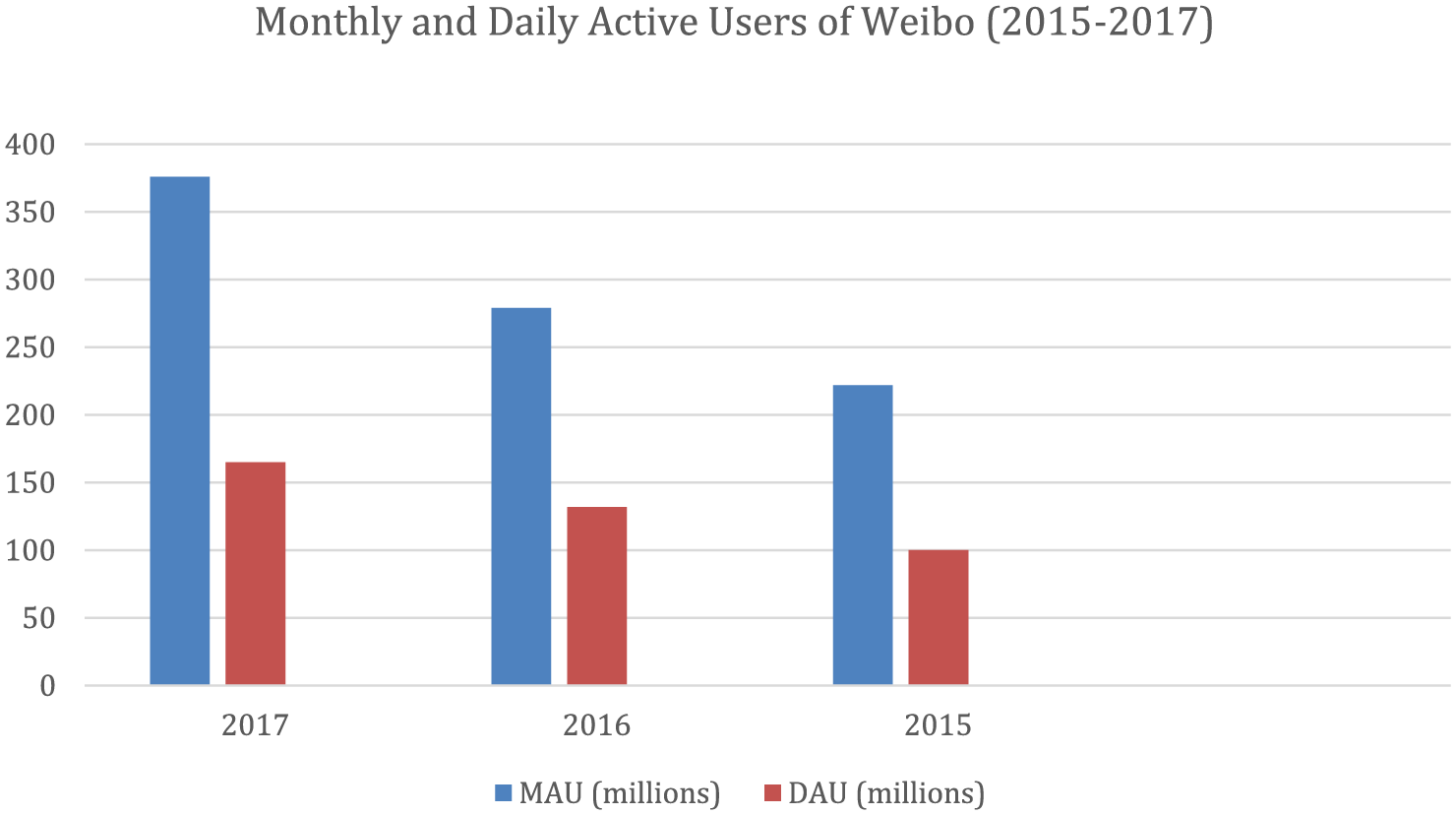
As early as 2012, the discourse of Weibo’s “decline” had emerged at the rise of WeChat, its main competitor, and the tightening state control. The operation team at that time reluctantly admitted the platform’s “decline,” but still maintained that this “decline” only meant “going back to a normal status.” Being “normal” here means sharing personal status and everyday life as the primary contents, like Facebook and Twitter during that time. The unprecedented explosion of so many public events and social issues on Weibo after the first 2 or 3 years was regarded as an “abnormal” status by the operation team because such an explosion was mainly due to the lack of similar media channels in China (personal communication, July 25, 2012). The operation team and administrators of Weibo have since been fighting with Weibo’s “decline” by moving away from the centrality of public influence. In recent years, the routinely published quarterly financial reports and user data such as monthly active users (MAUs), together with the celebration of the company’s significant steps such as Weibo IPO, are used as evidence of Weibo’s revival and better performance in the market, and to promote the platform’s new business model. As the chart shows, over the past 3 years, there is a steady growth of MAUs and daily active users of Weibo, based on the third quarter user report in each year (as of September 30) made by Weibo Data Center.
Source: data.weibo.com/report.
This move is the result of a long-time struggle among public, political, and corporate interests. It “removed the Damocles’ Sword, and put on the golden-silk armor” (@touziyuqing, December 11, 2015, 14 reposted by @caozenhui, Weibo’s vice president). 15 “Damocles’ Sword” here refers to the impending danger of engaging too much in news and public affairs, while the “golden-silk armor” refers to its new direction (Alibaba, the No.1 Chinese e-commerce platform, became Weibo’s largest shareholder at that time). In this post, Weibo’s transition was described as moving from the era of Laochen to that of Jack Ma. “Laochen” is the Weibo ID of the former director of Sina News, Chen Tong, who is a founding figure of Weibo. This name represents its former business model that promoted Weibo as a news platform and a medium, which would facilitate communication, transparency, and awareness of public interests through its business. This model indeed helped Weibo to accumulate sufficient resources it needed in the beginning, such as users and web traffic, and thus the public influence, but did not bring market success to Weibo (personal communication, July 25, 2012). “Jack Ma,” as the chief executive officer (CEO) of the e-commerce platform Alibaba, represents a new business model focused on the monetization potential of Weibo. What is interesting here is that Damocles’ Sword is from Western myth, while “golden-silk armor” is a weapon in Chinese martial fictions—suggesting that the author thinks the latter is apparently more suitable for the Chinese reality.
Weibo has become “vertical” networks of expertise to “accumulate fans capital, and monetize more efficiently and in greater varieties of methods” (@caozhenghui, May 12, 2016, italics added by author). 16 In each “vertical” network, there are some influential users who have expertise in that particular area that have their identities verified, for example, career development, entrepreneurship, finance, technology, education, medicine, and physical exercises. These influencers are promoted as experts within their specialty (the “vertical” connection), unlike the “Big V” users whose opinions have horizontal influence across the platform. The vertical relationship, based on specialty, suggests a tighter connection through shared interests and the deeper digging into a specific area. These “experts” can achieve a celebrity status on Weibo by their content production.
Weibo’s turn to vertical connection and networks of expertise shows that it is after all a commercial platform that constantly seeks for new models for profitability. The concern for public interests is not the major source by which the company monetizes the platform. As a business, Weibo’s ultimate goal is profitability and market share, but it was initially placed underneath the talk of “public influence” and “ideal of journalism” at its earlier stage, during which the management team of Weibo prioritized its relationship with journalists, lawyers, scholars, and some outspoken celebrities, in order to bring more hot topics to the platform (personal communication, July 25, 2012). Their presence and concerns about public issues eventually made Weibo a platform with a reputation of public influence, but this could also mean more political risks for the platform. Therefore, the later transformation of Weibo is a gradual distancing from those active and influential users and its public interests concern.
However, publicness and social impact are still quite relevant in the platform’s self-branding and an essential part of memory narratives of Weibo. In the annual “V-Summit Conference” and “Night of Weibo,” and other significant moments of Weibo, its public influence is always highlighted as its major contribution to the society.
On April 17, 2014, Weibo was listed at Nasdaq. While this day marked Weibo’s step into the global market, posts on the platform under the hashtag #WEIBOIPO# were still addressing its social impact, as shown in the two examples from people who were at the event in New York:
Sina and Weibo cannot be measured by their market value. Over the past two decades, they have made invaluable contributions to enlightening the Chinese people and making a more transparent society. In this sense, no other internet services can even be compared to Weibo … (@zhangxiangdong, April 17, 2014)
17
… For other internet companies, the listing [on the global stock market] is merely an activity [driven by] economic interests. Weibo is different, because it is so closely tied to the progress of China. (@fengxincheng, April 17, 2014)
18
Overall, Weibo’s significance has been connected to “enlightenment” and “progress” of China, as a recorder of the social changes that took place in China. At the same time, for Weibo’s loyal users, in the face of the discourse of Weibo’s “decline” and WeChat’s sweeping popularity, there seemed to be an obligation to defend Weibo. WeChat is seen as a tool that is “easier to fool the people” (@tanrenwei, October 5, 2014). 19 “Compared with Weibo’s diversity and [its ability to maintain] checks and balances [of diverse opinions], WeChat is very much homogenous and easy to spread rumors” (@zhaixingshou010, December 18, 2014). 20 Weibo is “a medium far from outdated and can never be replaced by WeChat” and the “decline of Weibo is only a false impression created by the violence and iron fist [of censorship]” (@pancaifu, March 2, 2014), 21 commented by a columnist, after 30 people were killed in an act of terrorism by what was officially labeled as “Xinjiang separatists” at Kunming railway station in southwest China. Due to the politically sensitive nature of this tragic event—the involvement of ethnicity and religious issues—the mainstream media failed to process the excessive anger and sorrow of the public but only provided reports of facts, and large amount of unverified and overly sensational information was circulating through WeChat. His response, therefore, suggests a unique role of Weibo in public life: it provides firsthand updates, and compared to WeChat’s semi-closed structure, Weibo’s public affordances enable sharing and debating among a wide range of participants, which would help verifying key issues and details that will eventually lead the public closer to the truth. Weibo is still regarded as a platform that could better serve the public interests by making the public better informed than WeChat.
Weibo’s market success is viewed by its loyal users as well-deserved precisely because of the great social impact it has made before. Particularly for users who had experienced Weibo’s previous stages, the social impact is still what they cherish. They did so by frequently referring to its glorious past. It is quite common for veteran Weibo users to express their nostalgia for Weibo’s past and to continue pushing for its public influence.
During 2015’s “Night of Weibo,” the annual awarding ceremony and evening gala to recount major public events and topics on Weibo over the past year, outspoken actress Yao Chen, who has got a nickname “Queen of Weibo,” posted, “It’s been over five years. I’m glad that Weibo is still here.” (@yaochen, December 9, 2015). 22 As a veteran user with the largest number of followers, she has been vocal in almost all major public events over the past years, and represents what has been called Weibo’s golden age. At that time, she said to Southern People Weekly in a cover story interview, which was later posted to Weibo, “… when I opened Weibo, I found the entire screen was filled with so many inequities … I think it is because there were so few places for Chinese people to speak out” (@nanfangrenwuzhoukan, August 20, 2011). This concern for social justice in major public events was what made Weibo a vibrant space and also brought fame to a large number of Weibo users as public opinion leaders, and became part of the memories about Weibo’s “golden age.” “… Citizen Han Han, 23 ‘Queen of Weibo’, two familiar names … It’s just been two or three years, but feels like long time ago” (@lianpeng, August 26, 2015). 24
Weibo has not been shut down or dead after all, but the above examples suggest no excitement or a sign of relief at all. While Weibo experienced periodical silence, it is still a go-to place at times of social crisis, and the previous patterns of witnessing, debating, and sharing emotions such as anger, fear, and sorrow all resurfaced. Even the operation team has to initiate platform-wide activities that encourage users to participate in end-of-year summarizing of major public events, to use the public memories of those events to promote Weibo.
However, due to the migration and silencing of outspoken users, as well as other methods of control, these periodical resurgences were much briefer than previously experienced. A real-estate mogul posted his interview by Sina on Weibo: “It’s been five years, and it is not easy [for Weibo] to survive.” (@panshiyi, January 16, 2015), 25 which was echoed in an investigative journalist’s repost, “it’s not easy to survive!” (@wangkeqin, January 16, 2015). 26 The remembering of Weibo’s “golden age” is thus also a lament of Weibo’s current “decline” in public influence and the expression of anxiety about its future, which is very common among users who were previously punished for their outspokenness over the past years.
Weibo’s social impact has made officials very cautious; but recently, the official authority has adopted a different strategy, acknowledging Weibo’s “positive” influence on society. For example, Weibo is regarded as “three apparatuses”: “the social stabilizer during breaking news, a conglomeration of positive contents, and catalyst for charity activities” (@guangzhouribao, December 9, 2015). 27 This quote is excerpted from a speech by an official from CAC, the governmental organization overseeing all Internet-related affairs, during “V-Summit” 2015, an annual event to celebrate Weibo’s public influence. A year later, at the same event, another official from CAC made a similar speech, praising Weibo as “an indispensable platform consolidating the social consensus, an indispensable bridge promoting social governance, and an indispensable power developing philanthropic and charitable activities” (The Paper, 2016, October 26). These statements represent official endorsement of Weibo’s “indispensable” (bukehuoque) contribution to Chinese society. As we can see, all these attributions to Weibo reflect official expectations of the platform. The words used here suggest that Weibo should benefit the existing social order by promoting consensus rather than facilitating debates or contentions, spreading positive rather than negative views (“positive energy”). Weibo can indeed serve public interests, but only in the direction that the state would tolerate, and only with the endorsement of officials can Weibo live longer for its corporate interests.
Conclusion
At the earlier stages, attached to “Weibo,” we find keywords associated with public interests and social change, such as enlightenment, democracy, transparency, justice, and “change China.” At later stages, the set of language used to describe Weibo mainly comes from the realm of business, such as monetization and market success. Weibo’s economic values are highlighted; “fans,” followers, and individual talents all become Weibo’s assets and capital. Throughout the three stages, Weibo has always been struggling with corporate and public interests, “publicness,” and “profitability. Over the past 8 years, we can see a shrinking space for public engagement and further disintegrated publics under the tightening state control of media, with three distinctive modes of public participation.
“Collective witness” emphasizes bottom-up empowerment, celebrating the collaborative power of the ordinary people, that the “nobody” that can change history if they stand together. The on-site witnesses (or the victims) were at the core of an incident; they have firsthand information that can become headline news. In doing so, they need more influential, civic-minded opinion leaders to spread these raw materials to call for public attention and further actions. This is seen as the potential of holding those in power accountable, mainly through the practices such as citizen journalism and collective mobilization.
“Ideological contention” is an era when participants take on two polarizing ideological positions, particularly at the issues of press freedom, historical memories, and nationalism. The ideological contention also reflects the state has taken a firm standing on Weibo, and is able to steer public opinion, promoting discourses of nationalism and Weibo’s “positive” contribution to governance, but at the same time, it also sees Weibo as a major ideological threat to the legitimacy and stability of the regime, and takes further steps in cracking down contents and users that are deemed subversive.
The third and most current stage (“networks of expertise”) puts an end to the era of “Big Vs” and “public intellectuals” (gongzhi), but features online “experts” and their content production in certain fields of interests, with an emphasis on the “vertical” rather than a platform-wide connection. Monetization and market success of the platform and the individual fame on the platform are highly celebrated.
The changing sources of authority across the three stages suggest the shifting focus of the public life of Chinese people. The turn to a more individualized, expertise, and interest-based public reflects a tightening media control that makes cross-platform mobilization and direct contention of the powerful institutions more difficult and risky. From empowering the grassroots to enabling individual fame and monetization, there is a significant shift of the centrality in social media. Previously, the grassroots individuals got fame on Weibo for their practices of citizen journalism and witnessing. Their “fame” is connected with news events and attention of public issues, but this attention did not bring profits to the platforms. Now, individuals get their fame for their expertise and the digital contents they create, and the huge number of fans and amount of profits they bring to the platform as well as themselves.
Weibo serves and reflects nearly a decade of social transition and the formation of Chinese networked publics. With a temporal dimension, this study enables us to view this platform with much more complexities. At each stage of the platform, there are different modes of public participation and how the state power steps in. While the public interest concern is on the way of retreating, at each stage, the platform has always been stirred by major public events and topics. The memory narratives over these years about Weibo also draw a clear line between “now and then,” mainly to lament the “decline” of the platform in its public influence. The management team, however, creates a different set of discourse on this “decline,” that is, a “transformation” and a “new opportunity” under the circumstance of the state’s tightening grip of the digital media space, and the competition from newly emerging social media platforms.