



Abstract
With the spread of monetization features like tipping and paid subscriptions, social media increasingly incorporates financial transactions and blurs the boundaries between social and parasocial relationships. While research documents how creators and audiences navigate economic interactions, there has been little attention to the role of platforms, particularly outside of Western contexts. We leverage the case of Pocket48, the custom mobile application for Chinese pop idol girl group SNH48, to investigate how platforms infrastructure asymmetrical relationships and the implications for both cultural production and online sociality. Based on an ethnographically-informed walkthrough analysis, we argue that the app employs two primary strategies for channeling fan-idol relationships: underclassifying interactions and invoking the aesthetics of intimacy. To do so, we first expose how Pocket48's policies ambivalently construct the user and the relationship between idols and fans. Next, we show how the app's design cultivates an intimate environment and unobtrusively incorporates transactions. Finally, we discuss how idols customize app infrastructure and moderate transactional functions to guide fans toward desired affective states. We conclude by introducing the concept of parasocial media, defined as platforms that feature (1) asymmetrical relationships between different classes of users, (2) tiered access to content and/or communication, and (3) tools to directly monetize relationships. Parasocial media platforms infrastructure relational work, helping media personas facilitate and financially exploit intimacy with their fans. Yet, as the case of Pocket48 attests, monetizing fan support is compatible with and can even strengthen the position of traditional industry actors.
Keywords
Fans of SNH48, a Chinese pop idol girl group, have plenty of opportunities to interact with the more than 200 members that make up the group, including near-daily live performances at the Star Dream Theater in Shanghai, handshake events, and virtual engagements across social media platforms and the custom mobile application Pocket48. SNH48 is an adaptation of the “idols you can meet” concept from Japanese producer Yasushi Akimoto, founder of the highly successful AKB48 girl group franchise (Kiuchi, 2017). Compared to typical idol groups, the size of SNH48 facilitates more “personal and intimate interactions with fans” (Tu and Xie, 2022: 90). Fans are encouraged to invest in specific members through paid popularity votes known as “general elections” that determine which idols appear on TV or receive prominent spots on stage (Kiuchi, 2017). In this “new generation of fandom” where the status of idols heavily depends on cultivating fans (Yan and Yang, 2021: 2594), the “idols you can meet” concept takes the “sense of intimacy to a completely new level” (Tu and Xie, 2022: 93), blurring the boundaries between social and economic interactions and between social and parasocial relationships.
The structuring tensions of fan-idol interactions are not exclusive to SNH48 and instead reflect more general developments in celebrity culture and platformization – what some have described as a “sociocultural shift in power within new media platforms” (Drenten and Psarras, 2023). Early social media platforms expanded opportunities for interactions between celebrities and fans (Marwick and Boyd, 2011), while more recent developments provide ways to monetize fan interactions through tipping and paid subscriptions. Such opportunities manifest through the integration of new features on existing social media platforms, the emergence of “patronage platforms” like Patreon or OnlyFans (Bonifacio and Wohn, 2020), and custom-built platforms for fan-celebrity interaction like Pocket48. Although there are substantial differences between the business strategies of independent creators (Guarriello, 2019), reality TV stars selling custom videos on Cameo (Drenten and Psarras, 2023), and the increasing platformization of the tightly managed idol industries (Park et al., 2023), they together attest to new sources of revenue for cultural production beyond advertising and retail.
The rise of monetizable interactions between media personalities and fans challenges established understandings of social media. In their highly influential article, Boyd and Ellison define social network sites as “web-based services that allow individuals to (1) construct a public or semi-public profile within a bounded system, (2) articulate a list of other users with whom they share a connection, and (3) view and traverse their list of connections and those made by others within the system” (2007: 211). While Boyd and Ellison's emphasis on the public articulation of relationships aligned with developments in web design and computer-mediated communication in the early 2000s, industry and academic focus has shifted. Addressing some of these changes, they added the ability to “consume, produce, and/or interact with streams of user-generated content” to the definition in 2013 (Ellison and Boyd, 2013). However, commercial elements of contemporary platforms – from data-driven advertising to features for direct monetization – are notably absent. Additionally, the broad category of “relationships” can obscure significant differences between symmetrical and asymmetrical ties (John and Katz, 2023), just as the category of “interaction” can obscure differences between social and commercial exchanges (Hair, 2021). The concepts of social network sites and social media (Bhandari and Bimo, 2022) have struggled to keep up with contemporary developments in interactive platforms.
Monetization carries more than just conceptual baggage. On patronage platforms, creators are expected to engage in parasocial relational work that “reframes a purely monetary payment into a show of caring social support between two closely-tied parties” (Hair, 2021: 204). Similar tactics of cultivating intimacy while incentivizing economic transactions apply to livestreaming (Guarriello, 2019; Lin and De Kloet, 2019) and adult camming platforms (Van Doorn and Velthuis, 2018), constituting a key skill for the creator economy. On the other side of the equation, fans struggle to define the meaning of these relationships, evaluate their authenticity, and push the boundaries of the influence they exert in return (Yan and Yang, 2021; Zhang and Negus, 2020). For all actors involved, digital platforms play an important role in infrastructuring new relationships, posing problems and establishing “preferred paths” toward their resolution (Hallinan and Gilmore, 2021). Yet there has been little attention to the role of platforms in shaping these relationships, particularly outside of Western contexts.
We leverage the case of Pocket48, a custom-built application that situates commercial exchanges within the visual scripts of social media, to investigate how platforms infrastructure asymmetrical relationships and the implications for both cultural production and online sociality. Based on an ethnographically-informed walkthrough analysis (Light et al., 2018), we argue that the design of Pocket48 facilitates consumption and conditions affective responses by adopting the aesthetics of intimacy and underclassifying interactions between fans and idols. To do so, we first expose how Pocket48's official communications and policies ambivalently construct the app's user and define the relationships between idols and fans. Next, we show how the app's design cultivates an intimate environment for users that unobtrusively incorporates transactions. Finally, we examine how idols customize app infrastructure and moderate transactional functions to guide fans toward desired affective states. To set up our argument, we situate the development of Pocket48 within a broader trajectory of the platformization of celebrity culture and lay out the industrial basis of the “idols you can meet” concept.
Platform capture of parasocial relationships
The concept of parasocial relationships, broadly understood as asymmetrical relationships with media personalities, has long functioned as a diagnostic for social transformations brought about by media technologies. Indeed, Horton and Wohl's foundational article on parasociality opens with the following claim: “One of the striking characteristics of the new mass media – radio, television, and the movies – is that they give the illusion of a face-to-face relationship with the performer” (1956: 215). The illusion of intimacy is cultivated through performance techniques (e.g., directly addressing the audience), aesthetic practices (e.g., close-up shots), and industrial logics (e.g., regular programming). It is also increasingly fostered through interactive media technologies (Barker, 2022). Modern audiences can vote for their favorite contestant on a reality TV competition via text message (Enli, 2012; Kjus, 2009), follow celebrity accounts on social media (Ellcessor, 2012; Marwick and Boyd, 2011), and financially support creators on patronage platforms (Bonifacio and Wohn, 2020; Drenten and Psarras, 2023).
Media producers have long successfully exploited parasocial relationships. For early broadcasters, fan letters provided insight into audience preferences (Razlogova, 2011) and host-audience interactions have long cultivated loyalty (Enli, 2012). The rise of technological solutions to process audience voting facilitated new forms of participation and new sources of revenue (Enli, 2012; Kjus, 2009). Yet the exploitation of parasocial relationships is not limited to corporations. Social media platforms offer celebrities channels to interact with their fans (and vice versa), building the celebrity's public image and providing opportunities for commercial sponsorship (Marwick and Boyd, 2011). This has been followed by “important sociocultural shifts in celebrity access” involving the rise of direct monetization mechanisms (Drenten and Psarras, 2023: 3351; see also Guarriello, 2019; Partin, 2020), prompting media personas to engage in “parasocial relational work,” or the cultivation of asymmetrical relationships with their audiences (Hair, 2021).
In providing tools to monetize parasocial relationships, platforms “capture” economic value by taking a portion of the revenue. According to Partin, platform capture is a process where platforms crowd out market competition by creating features to replace third-party tools and services (2020). In the current marketplace for fan-celebrity interactions, features for monetization include direct donation tools on social media platforms like Twitch (Partin, 2020), YouTube (Bonifacio and Wohn, 2020), and Kuaishou (Lin and De Kloet, 2019). These features exist alongside the development of designated platforms for fan-celebrity interaction through subscription SMS services (Fischer, 2022), online communities (Stevens, 2004), mobile applications (Chokshi, 2019), and digital patronage platforms that support both project-driven and subscription-driven funding (Bonifacio and Wohn, 2020; Hair, 2021). Such platforms play a complementary role in the broader platform ecosystem even as they are not typical “complementors” that directly interface with a specific platform (Nieborg and Poell, 2018). While emerging research on digital patronage platforms suggests a disruption of traditional media industries in favor of individual creators, the platformization of fan-celebrity relationships in the idol industry shows how platform capture can also strengthen the power of traditional media corporations.
The East Asian industrial production of pop idol groups consists of national industries (K-pop, J-pop, C-pop) with distinct organizational structures and distribution strategies (Shin, 2017). Scholars have documented how K-pop, the most global of the three, has actively invested in new technologies to monetize interactions with fans (Keith, 2023; Park et al., 2023). The “platformization of K-pop” (Park et al., 2023) simultaneously allows idol management companies to build and capitalize on a global fan base (Keith, 2023; King-O’Riain, 2021). Such platformization includes the “proliferation of start-ups and digital platforms connecting agencies and artists to fans” (Keith, 2023: 33), providing access to exclusive livestreamed events, behind-the-scenes content, and paid interactions with idols. VLive, a “paid live-streaming and fan-community platform,” was launched by idol management group Naver Entertainment in 2015 (Park et al., 2023). Its success inspired competitors to launch custom platforms, including Lysn from S.M. Entertainment in 2018, WeVerse from HYBE in 2019, and Universe from NCSoft in 2021 (De Luna, 2022; Stitch, 2021), which have since undergone significant consolidation. These platforms cultivate passionate fans (King-O’Riain, 2021) and have notable reach, including 113 million downloads for WeVerse and 2.3 million active subscribers on the idol messaging app Dear U Bubble (Kyung-min, 2024).
The platformization of idol industries reflects mutually reinforcing shifts in cultural production and platformization. For idols, the use of custom industry platforms increases dependency on entertainment companies (Park et al., 2023). For entertainment companies, custom platforms offer greater control and more favorable revenue models (Keith, 2023) compared to mainstream social media. Yet custom platforms complement rather than replace mainstream social media, with most idols maintaining a cross-platform presence and most fans engaging across an “ecology of platforms” (King-O’Riain, 2021: 2823). Accordingly, idol platforms represent an important component of the rise of alternative social media platforms beyond the advertising-supported services of “mainstream social media platforms” like Instagram or YouTube offered by major technology corporations (van Dijck et al., 2023), even as they lack the valence of political opposition typical to platforms like Gab or Bitchute (Rogers, 2020) or the democratizing promise associated with alternative music streaming platforms like Bandcamp (Hesmondhalgh et al., 2019). Instead, idol platforms constitute an alternative to mainstream social media by virtue of their ownership, business model, market niche, and, to a lesser degree, their comparative lack of academic research. Greater attention to idol platforms thus participates in the goal of expanding the cultural and industrial contexts of platform studies (Park et al., 2023) and offers a way to analyze the “global, local, and regional” logics at work in platformization (Steinberg, 2020: 8).
Yet the field of platform studies also offers essential theoretical resources for making sense of how alternative idol platforms structure social relationships. As Van Dijick argues, platforms should be understood as a “set of relations that constantly needs to be performed” (2013: 26). Meanwhile, Bucher contends that “the configuration of friendship online is fundamentally technologically driven and commercially motivated,” necessitating attention to the infrastructures shaping sociality (2013: 480). If sociality is “programmed,” so too is parasociality. Initial research suggests that idol platforms draw heavily from the scripts of mainstream social media. For example, the idol messaging service DearU Bubble provides exclusive content to fans in a simulated chatting environment that creates the feeling of a “private conversation” with “the idol as a friend” (Zhang, 2022: 1120). Beyond this preliminary account, there has been little attention to how platforms navigate the fundamental tensions associated with asymmetrical commercial interactions (Guarriello, 2019; Hair, 2021; Lin and De Kloet, 2019; Van Doorn and Velthuis, 2018). The rise of custom-built applications for idol-fan interactions thus raises questions about how such relationships are infrastructured, since, as Karasti and colleagues remind us, “Infrastructures are engines of ontological change. They stand between people and technology and nature and in so doing reconfigure each simultaneously” (2018, pp. 270–271). To answer these questions, we turn to the case of Pocket48, the mobile application for C-pop idol girl group SNH48.
Digging deep into Pocket48
SNH48 was founded in Shanghai in 2012 as a franchise of the “48” girl group format developed by Japanese producer Akimoto (Kiuchi, 2017). The original group, AKB48, was founded in 2005 in the Akihabara area of Tokyo. In the years since, the franchise expanded with “sister projects” in other Japanese cities and international locations (Kiuchi, 2017). Although SNH48 parted ways with the Japanese franchise in 2016, it maintains the “idols you can meet” concept that prioritizes “personal and intimate interactions with fans” (Tu and Xie, 2022: 90). By 2023, SNH48 had become a mega idol group composed of over 200 young girls, 18 to 28 years old, divided into 11 different teams. Despite minor changes in marketing strategy over the years, its core business model of cultivating idols has remained steady (Yan and Yang, 2021). In the cultivation model, production companies recruit and train talent from a young age and enlist fans as participants through regular popularity votes that shape group membership. In so doing, the cultivation model emphasizes building relationships between fans and idols rather than perfecting the idol's appearance and performance on stage.
The Pocket48 mobile application, launched in 2015, plays a key role in idol cultivation. The app is the main channel for direct idol interaction and targets veteran fans who want to witness the development of idols’ personalities and careers (Tu and Xie, 2022). The idea of a direct messaging application was initially adopted from AKB48's SNS mail service. However, AKB48's service is based on a broadcast model of communication and does not include any interactive mechanisms. Pocket48, on the other hand, allows fans to send messages to idols and engage with idols’ updates, thus fostering interactions between idols and fans beyond the temporal context of weekly shows and the spatial context of Shanghai. 1 Although Pocket48 was removed from mainland app stores in 2021 as part of the Chinese government's “Qinglang Movement,” a regulatory initiative that targets online fandom activities for their corrupting capitalist culture (Wang and Bao, 2023), fans can still download the app from SNH48's official website or the overseas IOS app store. And by all accounts, they have continued to do so, with more than 520,000 fans active on the app at the beginning of 2023. 2
Moreover, the way Pocket48 channels communication between idols and fans is critical to the industry's profit mechanism. Although SNH48 idols maintain accounts on multiple platforms, including short messaging platform Sina Weibo and video streaming platform Bilibili (Tu and Xie, 2022), these official accounts are updated less frequently and idols barely interact with fans on these platforms. This gives Pocket48 a functional monopoly on online idol-fan interactions, setting it apart from platforms like Weibo, where C-pop fans monitor public discussions and strategically engage with the platform to get their idols featured on landing pages like Weibo Super Topic (Yin and Xie, 2024). Pocket48, in contrast, operates as a separate online sphere largely inaccessible to outsiders. Unlike traditional social media platforms, which have long invoked neutrality and the importance of free speech (Gillespie, 2010), Pocket48 has a clear mission: to foster relationships between idols and fans, embed monetization mechanisms into the communication process, and profit from idol-fan interactions.
To understand how the platform realizes these goals through policy and design, we employed the walkthrough method, “engaging directly with an app's interface to examine its technological mechanisms and embedded cultural references to understand how it guides users and shapes their experiences” (Light et al., 2018: 882). A salient aspect of infrastructures is that they need to be learned by outsiders, but when the learning process is finished, they tend to disappear into the background (Star, 1999). To set up the application's “environment of expected use” (Light et al., 2018: 889), the first author began with a thorough review of Pocket48's policy documents, focusing on “About Us,” “Recharge Agreement,” and “Terms of Use.” Next, he conducted a “technical walkthrough” of the app's interfaces, functions, icons, and texts (Light et al., 2018: 891), systematically engaging with its features while cross-referencing observations with the claims of the policy documents. Although the walkthrough method usually does not include collecting user content directly, the interface of Pocket48 makes this unavoidable — many key texts and background pictures of the app are customized by idols. Therefore, we were also interested in how idols construct and navigate the affective mechanisms of the infrastructure, namely, how they modify the custom features of their channels like names, icons, and background pictures to shape fans’ experiences. To do so, the first author opened the app every day throughout April 2024 to check new messages left by idols and fans to become familiar with the tone and manner of their posts. He also drew upon ethnographic fieldwork within the fan community of SNH48 in Shanghai in 2021 to contextualize the interpretive context of fans. After completing the walkthrough, both authors collaboratively discussed the interpretation of findings, ensuring that the analysis accounted for both the app's infrastructure and the nuances of its design as experienced by users.
Idol, member, streamer: The triple vision of Pocket48's users
For anyone who looks at the “Pocket48: About Us” document, the application seems to be a mishmash. Aiming to “create a social platform for members and Juju to communicate with each other, play games together, and express themselves,” 3 it provides “a platform for members to showcase themselves, including livestreaming of theater performances, member livestreaming channels, member radio channels, etc,” and at the same time, an online space where “Juju can interact closely with members through various methods such as Juju rooms, member flipping cards, and live barrage” (Pocket48: About Us). Despite attempting to nail down the purpose of the app in a single document, many questions remain: What is a “Juju room”? What are “member flipping cards”? And most importantly, who are the “members” and who are the “Juju”?
The problem of how Pocket48 defines the users of its platform only gets more complicated when we look at other policy documents. For example, the Pocket48 Drumsticks Recharge Agreement, which regulates the platform's official virtual currency “Drumsticks” and thus all transactions made on the platform, addresses users in its first rule: You can use “Drumsticks” to purchase virtual gifts and other products or services available on this platform (for specific purchasable products and services, please refer to the respective product or service page descriptions). You can also use these virtual gifts to reward streamers or content creators. (Pocket48 Drumsticks Recharge Agreement)
According to the Recharge Agreement, the relationship between idols and their fans is not significantly different from other livestreaming platforms—the idols are platform workers (the “streamers” or “content creators”) that create content for “you” (the fans) to consume. Whatever you pay is a “reward” for their hard work. This is a relationship between service providers and customers. Yet the “About Us” document for the idol group tells a different story:
This document lays out a grand project for fans of SNH48: making the best contemporary idols of Greater China to represent the nation's youth and positivity in the eyes of the world. Pocket48, therefore, is an important link in the matrix of “innovative technologies” that will facilitate the great star-making project. While it is hard to construct a unified picture from these three documents, they reveal a triple vision of the platform's users and their respective roles. Both the cold legal definition of service provider-customer and the positive prospect of a national idol-making project are downplayed in the description of Pocket48. Rather than claiming the third vision occupies a “middle ground,” it might be better to call it a strategy of deliberate obfuscation of fan-idol relationships that seems fuzzy to outsiders and requires a learning process.
First and foremost, the app description defines idols and fans as “members” and “Juju” respectively — both terms are insider jargon. “Members” highlights the vulnerability of the idols’ current status as “unfinished.” Under the cultivation model, they are supposed to be “idols” one day but are currently “members” of the idol-making project who need your support (Yan and Yang, 2021). Meanwhile, “Juju” has a double meaning. Officially, it is “聚聚”, which means togetherness — you are equally together in this project with the idol-members. Juju is also a homophone of “巨巨,” which literally means “hugeness” and is Chinese Internet fandom slang for influential actors in the fan community such as famous fanfiction writers or fan artists. Therefore, the conventional power relationships between fans and idols are reversed in the idol-making project of Pocket48: while members are yet to be true idols, the fans share the power to make them so.
Despite the inversion of power, the app's description begins with a discussion of “members” as the primary users who “showcase themselves” on the app. While “members” are employees of the idol agency and occupy the position of workers in the Recharge Agreement, they are framed as equal to others. “Juju” comes second, here to “interact closely with members” and “support the same members.” Their interactions, meanwhile, are deliberately described with defamiliarizing language: “Juju rooms” are chat rooms fans share with idols and “member flipping cards” are personal messages sent to idols with money attached, which idols receive if they choose to respond. At the expense of confusing outsiders, such defamiliarization covers the economic qualities of the platform so that “the environment of expected use” (Light et al., 2018: 889) is joyful and devoid of market-related concerns.
Someone you like: The affective conditioning of the front page
The front page is uninformative but attractive — while a first-time visitor will likely feel lost among the various functions, icons, and pictures, the atmosphere encourages them to feel welcome. From top to bottom, the front page holds news about idols, primary navigation icons (for “Members,” “Show,” “Show Stamps,” “(Idols’) Schedules”), information about trending dance shows, upcoming livestreams, and posts from idols if you scroll down (Figure 1(d)). For a platform that aims at “allowing everyone to know the members of SNH48 Group more comprehensively, quickly, and conveniently” (Pocket48: About Us), the front page fails in terms of functionality. Despite the intimate aesthetics (the lavender theme, pictures of girls staring at each other romantically, etc.), if you have no idea what you are looking for, the dazzling images and icons provide little information about the various idols.
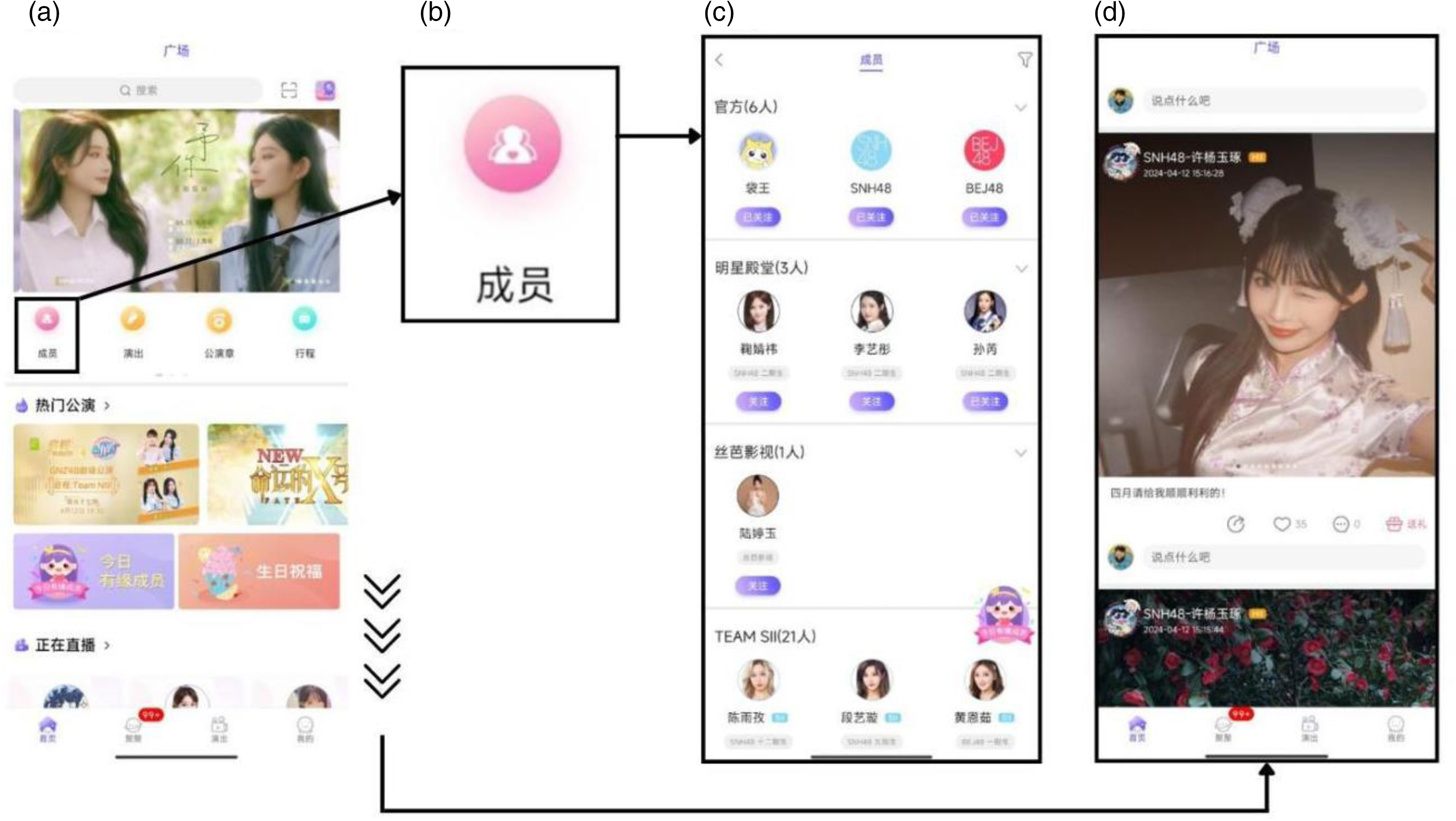
The front page “square” (a, d) and the “Members” Page (b, c).
However, there is a possible lead. Among the four icons, the first one is “Members” (Figure 1(b)), which is supposed to be the most important according to the platform's stated vision. The pink icon stands out against the app's lavender theme. Zooming in, the icon features three people standing next to each other. The figure in the front is solid white with a pink heart and the other two fade into the background like shadows. It hints at an adventure for fans to seek out a special idol among the group's many “members.” Although all idols are equal members of the group, they should not be equal to fans: one should catch your “heart” as the others fade into the background. However, if you press the “Members” icon and open the Members Page (Figure 1(c)), the same dizziness hits you again. With hundreds of idols roughly divided into the teams they perform in showing only their names and profile pictures, it is difficult to tell the members apart without individually tapping each idol for more details.
While the front page fails to provide useful information about the idols, it provides an affective switch the moment fans log into the app. Here, we should notice the other part of the story to see how the front page functions for fans in their everyday use of the app. While the walkthrough method “renders visible aspects of the interface that may otherwise blend into the background of everyday use” (Light et al., 2018: 892), this slowed-down examination does not necessarily reveal how an infrastructure operates in practice. When people create shortcuts by hopping over a fence or ignoring traffic signals, the fence or traffic signal means something else: a gust of nervousness, a feeling of liberation, or a sense of guilt. These are moments when an affective relation is activated between people and the built environment.
The same is true for experienced fans, the primary users of the Pocket48 app (Tu and Xie, 2021). Although outsiders may find the platform front page hard to navigate, once fans have become attached to certain idols, which often happens in other contexts like live theater shows, they can follow the idols from the Members Page. Thus, almost every time someone presses the “members” icon, they search for the girl who has made their heart beat, the function of the icon reinforcing its symbolic meaning. After this, fans typically check the chat rooms featuring their idols. As a result, the front page only stays on their screens for a moment, like a billboard you pass on the highway. In these daily situations, the posts and pictures on the front page, like girls looking at each other romantically (Figure 1(a)) or a girl cutely staring at you (Figure 1(d)), pre-condition the users for how they should feel next. The psychic message is: whatever you do — in most cases, checking messages in chat rooms or watching a livestream — do it gently, and with a touch of love.
Entering idol bedrooms and sending gifts
The icon for the Juju page is a message bubble that displays the number of unread messages in the corner (see the bottom of Figure 2(a)). The page's format looks like a typical social media platform, with a list of friends (idols in this case) on the left, and the idol's personal page on the right, consistent with other fan-idol interaction apps (Zhang, 2022).

The “juju” page (a), the Idols’ “Bedroom” Page (b, c).
When you click the first column on the idol's personal page (Figure 2(a), circled by a black frame), it brings you to the idol's Bedroom, a carefully designed chat room for the idol and her fans. A common practice for Chinese online chat software is naming the group chat function after “Group” (群组qunzu) or “Chatroom” (聊天室liaotianshi). However, Pocket48 names this function after “Bedroom” (房间fangjian). In the Chinese context, girls’ bedrooms are closely connected with boudoirs (闺房guifang), which are highly private and secret. Therefore, online interactions and conversations are marked with a sense of intimacy that invites feelings of mutual trust.
One unique feature of the Bedroom is its dual message display. Upon entering, it initially appears like a standard private messaging page (Figure 2(b)), showing only messages between you and the idol. While the idol mainly shares updates about her daily life, she occasionally replies to other fans’ messages (see the box in Figure 2(b)). This is when you realize you're not alone (cf. Zhang, 2022). When you swipe left on the same page, the Bedroom becomes a public message board where you can see all the messages from fans, including your own (see the box in Figure 2(c)). Interestingly, there is no icon or button to remind users of this separation — they must discover this through use. While chat rooms are inherently public spaces, using different screens to divide the user from other fans creates a temporary separation between the private and the public, or more cruelly, creates a sense of privacy when privacy does not really exist. However, this separation “operate(s) on the level of fantasy and desire” (Larkin, 2013: 333), offering a sense of intimate co-presence that prevents disruption to the flow of affects and fosters the users’ capacity to act and, more importantly, to consume.
In the lower right corner of both the Bedroom and the livestreaming page is the gift button, represented by a colorful gift box icon (Figures 3(a) and (b)). Positioned next to the emoji button and input box, this icon plays a communicative role, particularly in the Bedroom. Like emojis and text messages, gifts are meant to express emotions rather than serve their legal function as an economic reward for platform workers (Pocket48 Drumsticks Recharge Agreement).
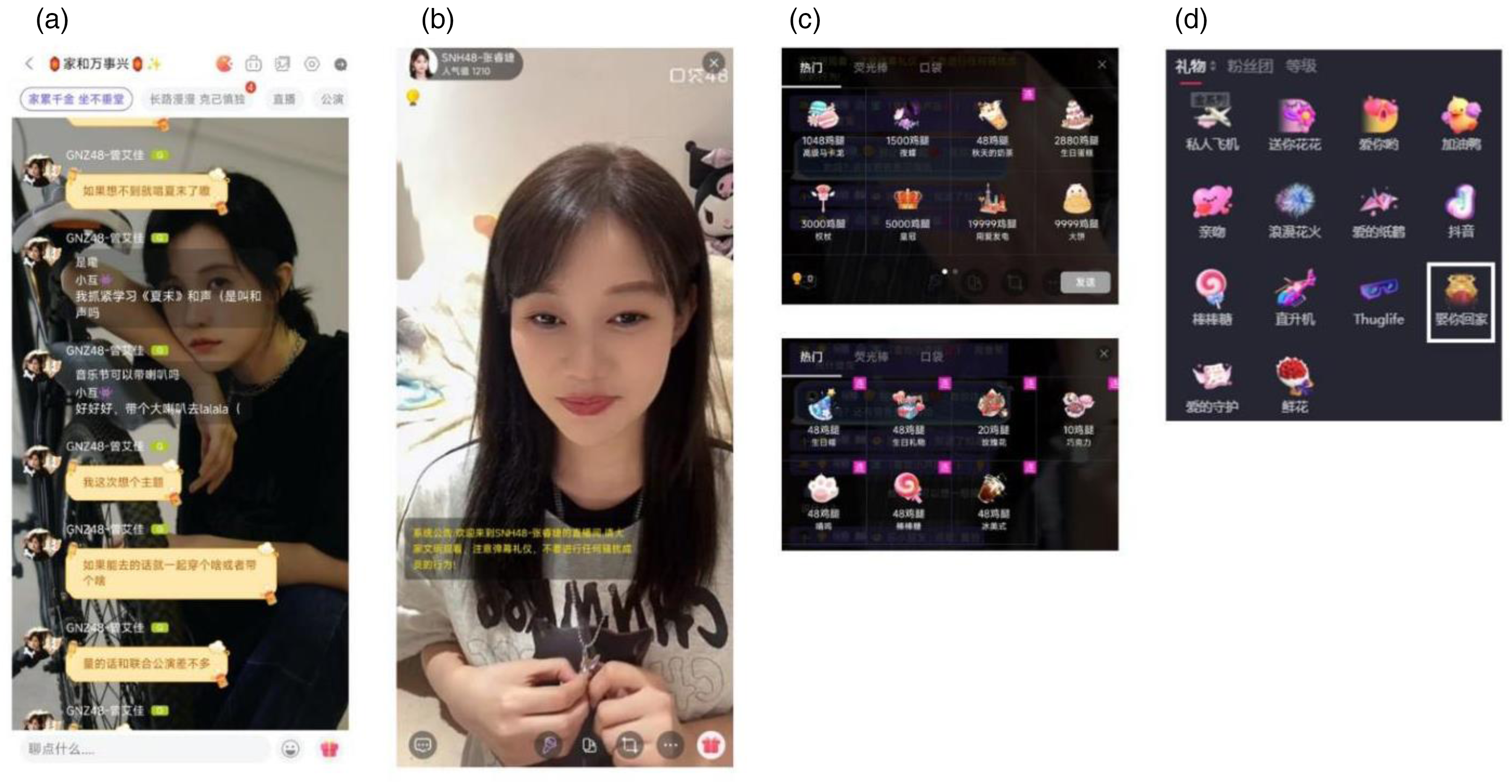
The gift icon (a, b), the Gifts on Pocket48 (c), the Gifts on Douyin (d).
Moreover, each of the 20 gifts in the virtual gift system has an icon and name. Unlike the “placemaking bricolage of pleasurable elements” of virtual gift systems on most Chinese livestreaming platforms (Momin, 2023: 234), virtual gifts on Pocket48 display a pattern of classic symbols of intimacy tied to romantic gift-giving (Wang et al., 2021), such as “Chocolate” and “Rose” (Figure 3(c)). However, the symbols are not as explicitly gendered as other cultural industries featuring women's platform labor. In their study of the livestreaming industry, Dong and Ye (2021) noted that virtual gifts on Douyin are highly gendered, sometimes even overtly sexual. For example, the gift “Marry You Home” (娶你回家qunihuijia, see the box in Figure 3(d)) directly indicates an intention to establish a romantic relationship. In contrast, the naming of virtual gifts on “Pocket 48” is more ambiguous and spans a broader range of relationships, from “Chocolate” worth 10 “Drumsticks” to “Generating Power with Love” (用爱发电yongaifadian) worth 19,999 “Drumsticks.” The relative openness of the meaning of virtual gifts, which imply rather than directly indicate a certain kind of intimate relationship, allows fans to flexibly interpret interactions with their idols.
While other scholars have looked at “how the gift logic is subsumed under the commodity logic and, specifically, how the gift form of online exchange has been ‘hijacked’ or co-opted for the purpose of profit maximization on China's live streaming platform” (Zhang et al., 2019: 344), we find the opposite. By framing the virtual gift system as an array of under-defined symbols and embedding them in an affective infrastructure that aims to provide a sense of privacy and intimacy, Pocket48 tries to restore virtual gifts to their relational and communicative functions. Having accompanied the SNH48 Group since 2014, this model is more sustainable even though it may drive fewer profits in the short term. As a “negative atmosphere of strife, jealousy, hierarchy, and distrust” (Zhang et al., 2019: 349) commonly exists on many of China's livestreaming platforms, intimate idol-fan interactions and relationships in the idol industry would not survive such desperately competitive atmospheres in the long term.
Differentiated monetization through infrastructural customization
While the infrastructure of Pocket48 keeps relations and emotions open to fans’ interpretations, it's also important to consider how idols engage with and leverage this infrastructure. As company employees, idols are motivated to use the platform to monetize their fans. They do this by customizing the platform's monetization functions and utilizing various methods to showcase their personalities and their relationships with fans.
An important case of a differentiated monetization feature is the threshold to the Members’ Room (see the box in Figure 4(a)), which is more exclusive than the Bedroom as users have to meet set requirements to enter. Since each idol sets the threshold for entry, it serves as a customizable standard to claim virtual community membership.
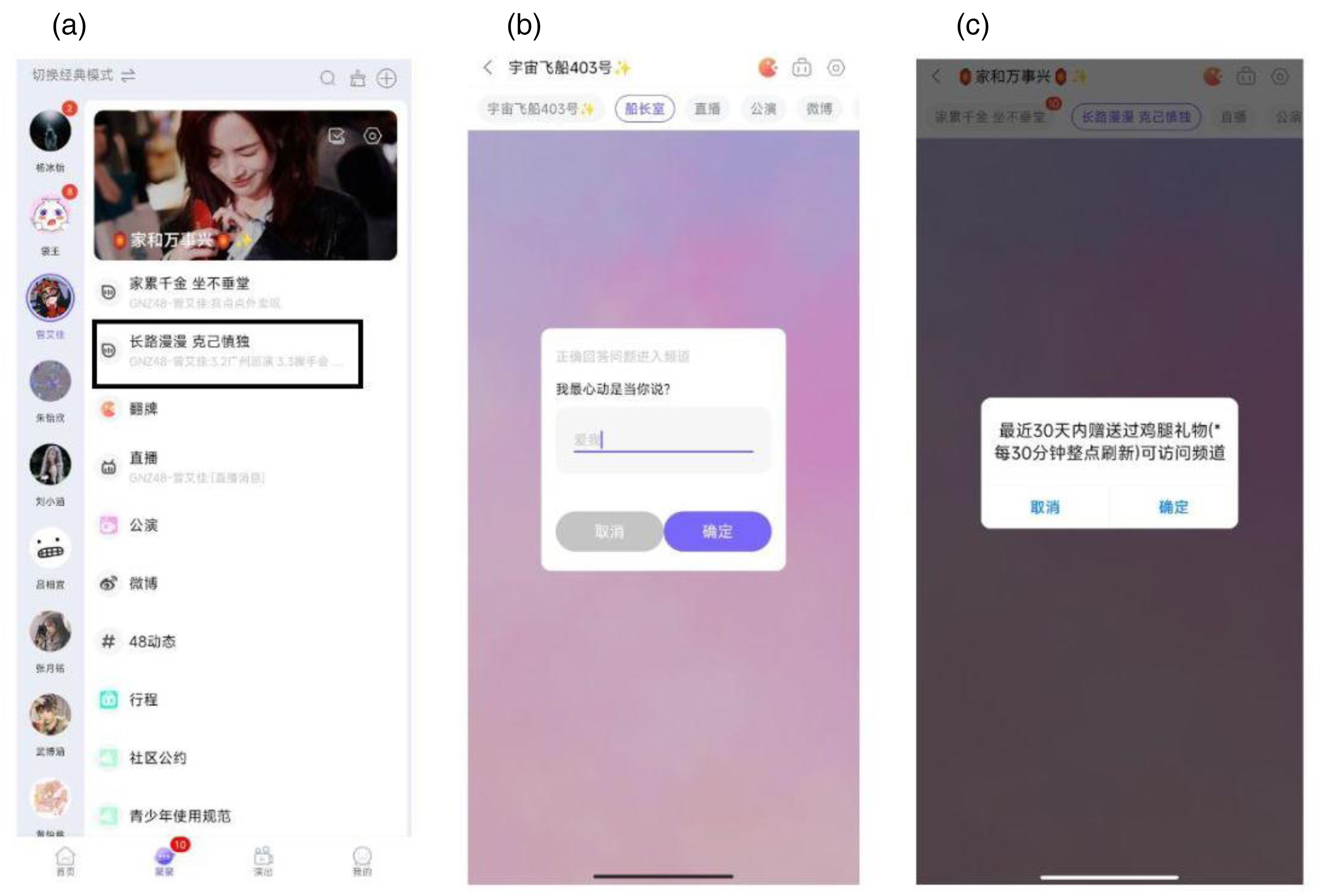
The members’ room (a), Two Kinds of Thresholds (b, c).
This threshold can be used for monetization. On Pocket48, it is free to follow and interact with any idol. Charging users for differentiated updates from idols would look like a subscription service, making the transactional nature of the platform more explicit. Since the platform generally tries to downplay any overtly economic transactions, the threshold function is usually set to only allow Juju who have sent gifts to the idol in the past 30 days to enter the channel (Figure 4(c)).
However, the threshold can also be set as a question. The question can be informative, like “Which city in South Korea did I perform in last year?” that requires extra attention or research to know the answer. Another common practice is to set the question as both affective and exclusive, like “The moment that my heart pounds is when you say?” (Figure 4(b)). It is a completely random question that an outsider would have no clue about. This forces the user to get in touch with the idol's fan community to learn what to do. Meanwhile, the answer is “I love you,” which gives the threshold another layer of affective meaning—the entry to a more private channel requires you to confirm your love and loyalty to the idol, albeit in an indirect way.
Other important monetization functions open to idol customization on Pockt48 include the flipping cards and photo album feature hidden behind the “flipping card” button on the idols’ profile page (see the green frame in Figure 5(a)). The icon for the button is an orange stick figure face, reminiscent of Pac-Man from the famous 1980s video game. Despite being a paid message function, this symbol suggests giving the idol a snack — a little reward. Inside the “flipping card” page (Figure 5(b)), fans can send idols a message in 200 words and choose what kind of response they want to receive from the idol. The first category concerns form: a text message, a voice message, or a video message. The second category deals with privacy settings: public to all fans and posted in the idol's Bedroom, public but anonymous, or a private direct message.

Flipping card function (a, b), Photo Album Function (c, d).
The idol can set the price for each kind of message. However, the function cannot be fully shut down. If she does not want to respond to a particular type of message, she will set an absurdly high price for it to convey her attitude. The price of different messages signals what kind of messages are welcomed and, thus, how idols imagine their relationships with fans. For example, public messages are typically more welcomed by idols with a big fan base who tend to think of their relationships as a community of equals with nothing to hide. Meanwhile, private messages are welcomed by idols who want to cultivate a more intimate and exclusive relationship with their fans, as private messages allow idols to give differentiated responses without causing widespread jealousy within the community.
The photo album function also serves as a flexible monetization tool for idols. As sexually provocative pictures and messages are strictly forbidden on the platform, most idols put a price on their daily photos (Figure 5(c)). However, it is also common to put photos with special meanings, like photos of childhood (Figure 5(d)), at quite a low price. The meaning conveyed is not “lowering profit margins and increasing sales.” Rather, it implies a non-economic attitude towards monetization where special photos are only for those who care about the idol in a particular, often parental, way (Yan and Yang, 2021).
From social media to parasocial media
Pocket48 extends the opportunity to interact with idols beyond the geographic and temporal constraints of the Star Theater, allowing fans to enter the virtual bedrooms of idols whenever they feel like from the comfort of their mobile phones. In doing so, the application plays a key role in taking the “sense of intimacy” between idols and fans of SNH48 “to a completely new level” (Tu and Xie, 2022: 93). Yet, the mass production of intimacy faces inherent challenges, given that particularity is a defining trait of intimate relations. As economic sociologist Viviana Zelizer explains, “We can think of relations as intimate to the extent that interactions within them depend on particularized knowledge received, and attention provided by, at least one person — knowledge and attention that are not widely available to third parties” (2010: 268). Furthermore, the introduction of financial transactions is often perceived as something that corrupts intimacy, despite the mutual imbrication of social and economic relationships in all domains of life (Zelizer, 2010; see also Hair, 2021). While Pocket48 cannot fully resolve either the inherent asymmetries between the idol and her crowd of fans or the competing associations of social and economic interactions, our analysis reveals the mobile application employs two primary strategies to mitigate tensions: underclassifying interactions and invoking the aesthetics of intimacy.
First, Pocket48 redefines the user's role through fandom-specific terminology like “Juju” and “members,” which inverts the hierarchical associations of fans and idols. It also downplays the financial nature of transactions through the implementation of a virtual currency that temporally separates the moment of payment from the moment of exchange. Even the name of the currency, “drumsticks,” calls upon semantic associations of support, which originally comes from a popular Chinese Internet terminology. Member-idols can further blur the meaning of interactions by customizing the requirements to access particular content and communication, appealing to the dedication of Juju-fans alongside more overtly commercial criteria. While the ambiguous design of social media can be a point of frustration (Hallinan and Brubaker, 2021) and explicit classifications can validate user experiences (Blackwell et al., 2017), Pocket48 strategically exploits symbolic ambiguity to create space for fans to imaginatively interpret their interactions with idols and, along the way, generate profit.
Second, Pocket48 invokes the aesthetics of intimacy through familiar aesthetic codes of social media and interpersonal relationships. Similar to other fan-idol applications (Zhang, 2022), Pocket48 mimics the design of social media, featuring posts from members, chatrooms, and livestreaming. Although there are many familiar features, Pocket48 is decidedly not “algorithmic,” in the sense of providing a stream of diverse content surfaced by recommendation systems (Bhandari and Bimo, 2022). Instead, interests on Pocket48 are determined more narrowly, organized around the network logic of particular individuals (Narayanan, 2023). Fans go to the app to see updates from specific idols, recalling the early days of social networking sites (Boyd and Ellison, 2007) more than contemporary content-oriented ecosystems (Bhandari and Bimo, 2022; Ellison and Boyd, 2013). This structure fosters a sense of closeness, providing fans direct and personal access to their favorite idols and emphasizing the importance of user control in navigating interactions on the app, allowing fans to interpret the voluntary choice to read updates and post responses as a form of love and devotion. The enclosed environment of the mobile application, cut off from the platforms that drive “data traffic stars” (Zhang and Negus, 2020), also offers fans a respite from the pressure to strategically engage with social media to support their idols (Yin and Xie, 2024). The aesthetic codes of close interpersonal relationships and girls’ bedrooms are a bit more obvious but still play an important role in shaping how users interpret their interactions on the app. As Larkin argues, infrastructures “store within them forms of desire and fantasy and can take on fetish-like aspects that sometimes can be wholly autonomous from their technical function” (2013: 329). Accordingly, the design of Pocket48 acts beyond the material realm, conditioning the psychic and bodily reactions of users.
By underclassifying relationships and invoking the aesthetics of intimacy, Pocket48 cultivates and financially exploits parasocial relationships between fans and idols. Despite an initial definition as “one-sided” (Horton and Wohl, 1956), parasocial relationships are now typically recognized as asymmetrical, especially in the interactive context of social media (McLaughlin and Wohn, 2021), and can be both affectively intense and socially significant. For example, Tu and Xie argue that the members of SNH48 present “quasi-realistic relationships and interactions to the extent that fans feel a reciprocal relationship with their idols that is equivalent to, or even more valuable than, real-life acquaintances” (2022: 109). Similarly, Yan and Yang propose the concept of “parakin” as a new interaction model of “fantasized kinships between fans and idols” based on the common practice of Chinese fans identifying as “mother fans,” “brother fans,” and various other familial roles (2021: 2594). Relationships between fans and idols are both imagined and performed, with online interactions “displayed and shared between fans instead of merely working to fantasize a dyadic communion of the individual fan and specific celebrity” (Hills, 2015: 479). These “multisocial” interactions among fans can help manage the asymmetry of attention from members of SNH48 (Hills, 2015), even as such interactions are harder to monetize. Accordingly, the design of Pocket48 prioritizes the pairing of fan and idol: no Juju has a bedroom on the platform where other fans might gather and the flow of virtual “gifts” bought with “drumsticks” only goes towards member-idols.
Building on this analysis, we conceptualize Pocket48 as a form of parasocial media, defined as platforms that feature (1) asymmetrical relationships between different classes of users, (2) tiered access to content and/or communication, and (3) tools to directly monetize relationships. Parasocial media platforms infrastructure relational work, helping media personas facilitate and financially exploit intimacy with their fans. As a category, parasocial media encompasses custom applications for fan-celebrity interaction like Pocket48 and Dear U Bubble (Zhang, 2022), along with patronage platforms like Patreon and OnlyFans (Bonifacio and Wohn, 2020). However, the functionality of parasocial media is also built into livestreaming platforms like Twitch and Kuaishou and increasingly incorporated into “classic” social media platforms like Facebook, which contains different “sub-platforms” that correspond to different configurations of sociality (Navon and Noy, 2023), including symmetrical “friend” relationships and asymmetrical followers. Despite variations in scale and branding, these platforms all build in different classes of users (e.g., idol-fan, broadcaster-audience, page-follower), offer customizable mechanisms of access-control to create exclusivity (Reynolds and Hallinan, 2021), and include opportunities for direct monetization, whether through first or third-party tools (Partin, 2020). Just as parasocial relationships exist alongside social – or in the terminology of Horton and Wohl “ortho-social” (1956) – relationships, the configurations of parasocial media exist alongside attributes of social media, with significant implications for cultural production and online sociality.
Parasocial media exploits fans as a new, direct revenue stream, leading some to celebrate a broader revolution in cultural production. For example, Wohn and colleagues define the digital patron economy as “a new era where people directly support content creators who are their own media entities through new online financial systems and form communities around the creators” (2019: 100; see also Drenten and Psarras, 2023). While crowd patronage can reduce creator dependency on or even cut out traditional intermediaries like advertisers, television broadcasters, and record labels, platforms operate as new intermediaries that take a variable share of all revenue (Bonifacio and Wohn, 2020; Partin, 2020). Furthermore, the platformization of the idol industry reveals that fan revenue is compatible with and can even strengthen the position of traditional industry actors like entertainment companies (Park et al., 2023). Custom-built applications like Pocket48 represent a subcategory of alternative platforms that position themselves as distinct from massive, multiple-purpose social media platforms oriented toward mainstream consumers (Hesmondhalgh et al., 2019; Rogers, 2020; van Dijck et al., 2023). However, they serve a complementary role in the platform ecosystem, existing alongside other avenues for interaction. Similarly, fan funding mechanisms represent an alternative revenue source for cultural production that can support creative entrepreneurship (Guarriello, 2019) just as easily as formal institutions, complementing rather than replacing existing revenue streams like advertising and retail. That the same tools can serve such different business models and organizational structures demonstrates the importance of looking at platforms in context and the value of incorporating idols into broader discussions of the creator economy.
The spread of parasocial media features across platforms simultaneously spreads the experience of “parasocial relational work” (Hair, 2021), resulting in a situation where all social media users, even those who don’t think of themselves as creators or fans, increasingly have to navigate tensions around asymmetrical relationships and economic transactions. Both the integration and segregation of parasocial relationships on platforms pose significant challenges. When parasocial relationships are integrated as one category of interaction among many, the heavy reliance on engagement-oriented recommendation systems makes visibility a prerequisite for other goals and provides “indirect pressure to create certain kinds of content, which can even blur into pressures to be a certain kind of person” (Hallinan and Brubaker, 2021: 1565). Conversely, when parasocial relationships are segregated off on separate environments like Pocket48, the design of the platform can foreclose opportunities for non-monetizable interactions, including the array of multisocial connections among fans typical to Weibo or the platform formerly known as Twitter (Hills, 2015). Of course, no platform exists in isolation and future work should examine how users navigate the tradeoffs among different scales of interaction within the broader “ecology of platforms” (King-O’Riain, 2021).
Finally, our investigation of parasocial media challenges the politics of classification and monetization. As digital platforms engage with broader social categorization systems, shaping what users desire and how advertisers profit (Bivens and Haimson, 2016), complications arise when the prevailing social categories do not adequately serve business interests. Existing definitions of friendship, kinship, or market relationships are insufficient to address the parasocial relationships emerging on these platforms. In response, we suggest that the strategy of under-classification provides a way for platforms to capture diverse user motivations and may even enable platforms to sidestep social taboos around gender and sexuality (Wang and Bao, 2023). Furthermore, while popular livestreaming platforms are often criticized for contributing to hyper-competitive, cutthroat ecosystems (Momin, 2023; Zhang et al., 2019), Pocket48 suggests that integrating monetization systems within an algorithmically-isolated and affectively-charged environment, rich with communicative and cultural symbolic associations, can provide a more sustainable way to generate long-term profits.
Footnotes
Acknowledgements
The authors wish to thank Rebecca Scharlach for her supportive feedback on the manuscript and Alma Kalisky for the clutch reading recommendation. Xinyue Shen would also like to thank Qinwen Ge for her love and passion in discussing idols, and Blake Hallinan for their warm and unwavering support. Two anonymous reviewers and the editor at Platforms & Society contributed significantly to the development of the article.
Author's contribution
Xinyue Shen developed the methodology and conducted the analysis of the research subject. Blake Hallinan designed the theoretical framework and critically revised the manuscript. Both authors contributed to the writing of the manuscript.
Declaration of conflicting interests
The authors declared no potential conflicts of interest with respect to the research, authorship, and/or publication of this article.
Ethics declarations
Ethical approval was not sought for this study as no human subjects were involved.
Funding
The authors received no financial support for the research, authorship, and/or publication of this article.
