




Abstract
The research on naïve realism suggests that people have a tendency of impugning opponents’ cognitive biases and interacting with them in conflict-escalating approaches. Taking this to be a basic intrapersonal process in interpersonal deliberation, an experiment was conducted to examine potential rectifying effects of the epistemic motive of the need for openness on such perceptions of bias so as to improve individuals’ deliberation preparedness. Results show that the tendency of imputing greater bias to others based upon self-other opinion incongruence is mitigated by the induced need for openness. This study also finds that participants are better prepared to partake in a group discussion with another person whose opinion is congruent rather than incongruent with theirs, and this relationship is through perceptions of bias in the opinion incongruent other. But this indirect path is weakened when participants are induced to have an elevated epistemic motive of the need for openness.
Conceiving deliberative democracy in epistemic terms, democratic theorists view deliberation as a process through which citizens with diverse perspectives work together to address differences and formulate shared objectives via exchanging arguments based on the intersubjective standards of validity (e.g. Steiner, 2012; Talisse, 2010). However, in everyday practices, we often encounter situations where deliberation could be obstructed due to individuals’ psychological limitations, including a tendency of impugning opponents’ motives and cognitive biases in forming their beliefs, but failing to recognize similar biases in their own reasoning. Such perceptual disparities of imputing stronger biases and self-serving motives to others often lead to conflict escalation in group discussions (Kennedy & Pronin, 2008).
In this article, I argue that such perceptual disparities result in part from individuals’ tendency of quickly forming a judgment on another person based on limited information such as perceived disagreements with the person. More broadly, it is part of a common feature of the lay epistemic processes whereby individuals form knowledge and understanding of their everyday world. As Kruglanski (1989) explains in his lay epistemic theory (LET), often times, when forming knowledge about the world, individuals are compelled by the need to have a firm answer or a clear structure quickly as a way to ease anxieties associated with uncertainty or ambivalence. The need toward a firm structure is called the need for closure (NFC; Roets, Kruglanski, Kossowska, Pierro, & Hong, 2015).
But under certain circumstances, at least some people may resist the urge for cognitive closure. They may be more tolerant of uncertainty, strive to keep their minds open, and pursue a richer and more accurate understanding of the world. Exploring this possibility, this study is aimed to address the following question: How may people be motivated to mitigate their inferential biases and the effects on their inclination toward an anticipated discussion with other people? As I will explicate later in the article, I call this inclination “deliberation preparedness” and consider it a critical state for fruitful group discussions. Toward this end, I conducted an experiment to examine (1) the varying magnitude of the effects of self-other opinion incongruence (OIC) on individuals’ perceptions of bias in another person under either the condition of a heightened NFC or that of a heightened need for openness (NFO) and (2) the potential consequences of the heightened NFO on individuals’ deliberation preparedness, as indicated by their preference to discuss with another person, expectation of the person’s deliberativeness, and intent on using deliberative strategies in an anticipated discussion with the person.
I situate the study of the intrapersonal processes that are consequential to interpersonal interactions in the context of democratic deliberation based on two considerations. First, I contend that democratic deliberation is essentially a type of group discussions configured with normative values (e.g. Burkhalter, Gastil, & Kelshaw, 2002). Second, agreeing with Goodin and others (Goodin, 2000; Goodin & Niemeyer, 2003), making democratic deliberation work requires us to better understand individuals’ cognitive limitations and effective ways of addressing them via forum designs (Fung, 2011; MacKenzie & Warren, 2013).
Perceptions of others in preparation for deliberation
The central tenet of the deliberative theories of democracy states that people need to form their opinions via open deliberation and be convinced by the force of arguments, instead of compliance to power or coercive imposition of others’ preferences or interests (Habermas, 1992/1998). Following this line of thoughts, disagreement is, and should be, a point of departure for productive dialogs that are aimed to clarify shared values, find common goals, or choose a course of action (e.g. Gutmann & Thompson, 1996).
Such normatively prescribed deliberation does not come about easily (Ryfe, 2005). To induce citizen communication that comes closer to such a normative model, individuals must be prepared at different levels in a variety of ways before starting any communicative engagement. The characteristics of preparedness for deliberation may foretell outcomes of deliberation. In other words, to a large extent, the success or failure of a deliberative discussion is rooted in how well citizens are prepared to act in compliance with “deliberative virtues” (Talisse, 2005).
As Goodin (2003) has articulated in his “deliberation within” proposal, deliberation consists of an “internal reflective” component that could start even before any interpersonal interaction begins. That is, the process of assessing reasons and deciding what position to take may even precede occurrence of any “external collective” discursive activity (Goodin & Niemeyer, 2003). In addition to cognitive preparation concerning a specific issue, deliberation, as a form of small face-to-face group communication (Burkhalter et al., 2002), also requires people to develop a representation of deliberation partners with whom they might be interacting in the forthcoming discussion and, accordingly, prepare a course of action in response to the discussion.
In many real-world situations, people may enter a deliberative situation with some preliminary perceptions of a prospective deliberation partner who might hold views different from or similar to theirs. Such perceptions might be formed on a basis of some readily available cues, including the person’s point of view. Such a quick judgment, while shaky, might start an impetus for people to form an inclination toward the anticipated discussion with the person. For example, people may decide, based on their quickly formed perceptions, how much they prefer to discuss a given topic with the person, out of their desire to avoid conflict or to get something done. They may also develop expectations of how likely the person is to act cooperatively or competitively in the anticipated discussion (e.g. Burgoon, Le Poire, & Rosenthal, 1995), and on this basis, form their intent to employ cooperative or competitive responses in the discussion with the person (Burgoon & Le Poire, 1993; De Dreu & Nijstad, 2008). These tendencies, as I will explicate fully in the next section, converge to form a proclivity that can be characterized as “deliberation preparedness.”
While people often utilize a person’s expressed opinion on a topic as a cue to form a broader judgment on the person, research has shown that such a perception formation process could be treacherous. People tend to perceive those who hold views different from theirs as likely victims of biased sources or being biased by their cognitive limitations or self-serving motives (Pronin, Lin, & Ross, 2002). The phenomenon of seeing others as being more likely to be biased or biased to a greater degree than self is a part of the lay epistemic phenomenon known as naïve realism (Ross & Ward, 1996). It comprises individuals’ tendency of assuming that the world they perceive is authentic; others with the same inferential capacity and goodwill should share their views; and if others perceive and react to the world differently, they must suffer from one of the three potential problems: (1) lack of information that one has, (2) laziness and irrationality in inference, or (3) susceptibility to biasing influences such as ideology, self-interest, and religious belief.
This formulation does not imply that people’s perceptions of bias in others are always inaccurate. Instead, it simply states that standards for objectivity are often lacking and that people’s views tend to be colored by distorting individual constraints, including their bias blind spot where they fail to see their own biases that they readily detect in others. It does not imply that people are unable to be aware of their own biases in reasoning. In reality, people often recognize and are willing to admit that their unique experiences and identities play a role in shaping their views. But they tend to feel that their own experiences and identities are sources for more enlightened rather than biased insights on the issue, helping them to see the truth, whereas other people’s personal experiences and identities sway their views away from justice (Ehrlinger, Gilovich, & Ross, 2005).
As a consequence, such biased perceptions of others’ proneness to bias may create barriers to successful interpersonal and group communications (Pronin, 2007; Ross & Ward, 1996). First, such biased inferences may obstruct people from engaging in a discussion with others who hold views different from theirs. Specifically, if people believe that the others who disagree with them are motivated by a variety of egocentric factors such as the pursuit of self-interest, rather than benevolent factors such as the pursuit of fairness or equality in forming an opinion on a public issue, they may feel less worthwhile to talk with those people. This perception-based process may partly account for individuals’ general tendency of avoiding contentious discussions with disagreeing others in everyday social interactions (Eliasoph, 1998; Mutz, 2006).
Perceptions of bias in disagreeing others may also lead to a “bias-perception conflict spiral” (Pronin, 2007). That is, in a dyadic or group discussion, the biased inferences of bias in self versus others may shape communicative strategies that individuals choose, which in turn may shape not only the contour but also the outcome of such a discussion (e.g. Drake & Donohue, 1996). In a series of studies, for example, Kennedy and Pronin (2008) find that pre-existing disagreement on an issue may give rise to escalated conflict, and that such an effect is mediated by individuals’ perceptions of bias in others whose opinions are incongruent with theirs. In specific, they find that people are more likely to take a conflict-escalating competitive approach over conflict-deescalating cooperative approach in an anticipated or an actual discussion with an adversary than with an ally, and such an effect is mediated by their perceptions of greater degrees of bias in the adversary.
But these perceptual limitations in people’s intuitive inferences could also be reduced. Under some specific conditions, it may be possible to improve individuals’ recognition that their own opinions, just like those of others, might be distorted by a variety of biased sources. It may also be possible to mitigate individuals’ imputation of biases and self-serving motives to others, especially disagreeing others. The study focuses on the second approach. Built on the insights from the LET that I will articulate next, I posit that heightening individuals’ epistemic motive (EM) of the NFO can be an effective venue toward reducing bias in perceptions of bias.
Epistemic motives and rectification of biased perceptions
Epistemic motives in knowledge formation
As Kruglanski (1989) has articulated, how individuals make judgments and draw inferences can be viewed as an epistemic process of knowledge formation. The following are the two basic factors that shape the process: (1) individuals’ cognitive ability to generate alternative hypotheses and (2) their epistemic motivation toward a structure that propels them to terminate or resume epistemic activities. The NFC refers to individuals’ desire to attain and maintain a firm judgment and aversion to ambiguity. It could be induced by various ways that increase perceived benefits in halting epistemic activities. These ways include increasing time pressure, creating environmental noise, and causing mental fatigue. The motivational force toward an opposite direction is the NFO. It refers to individuals’ desire for ambiguity, uncertainty, and judgment uncommitment. It could arise from individuals perceiving benefits in gaining a richer understanding or arriving at an accurate judgment (Kruglanski, Peri, & Zakai, 1991). It may also arise if individuals expect validating evaluations by others (De Dreu, Beersma, Stroebe, & Euwema, 2006). In brief, EMs direct individuals’ epistemic activities toward the implicit or explicit end state that they desire to achieve, with the NFC engendering a force toward a closure end, while the NFO propelling people toward an opening end.
Different EMs thus lead individuals to engage in different epistemic activities. Instilling a sense of urgency in individuals to attain a firm judgment (Kruglanski & Webster, 1996), the heightened NFC may prompt them to “seize” a judgment quickly based on flimsy evidence, intuitive reasoning, or cognitive shortcuts. Once an initial judgment is formed, the NFC may produce a force for permanence, impelling individuals to be committed to the judgment. Operating under such a force, individuals may curtail further informational search (Choi, Koo, Choi, & Auh, 2008; Kruglanski et al., 1991; Van Hiel & Mervielde, 2002), seek for evidence selectively in support of their initial judgment, and reject the information that may jeopardize the epistemic closure (Hart, Adams, Alex Burton, Shreves, & Hamilton, 2012; Kruglanski & Webster, 1996).
In contrast, the NFO may trigger intensive information search and analytical thinking. People with a heightened NFO spend more time searching for information from diverse sources before making a judgment (Scholten, Knippenberg, Nijstad, & De Dreu, 2007); they are more likely to analyze the information in an effortful and systematic manner (De Dreu, 2003; De Dreu & Carnevale, 2003) and are more ready to consult information that challenges rather than supporting their initial judgment (Hart et al., 2012).
Epistemic motives in interpersonal communication
The EMs also have substantial implications for communication activities. In social interactions, people’s judgments on their interaction partners might be biased in varying degrees by the information that is salient to them and inferences off the top of their heads, such as a prevailing stereotype (De Dreu, Yzerbyt, & Leyens, 1995). Such biased judgments may result in negative responses toward others. But heightening the NFO may rectify the effects of such biased inferences and foster positive outcomes of group discussions. In negotiations, for example, stereotypes may exert a weaker effect on individuals’ impressions of their negotiation partners under the NFO condition compared with the NFC condition (De Dreu, 2003). In addition, people motivated by the NFO, compared with those motivated by the NFC, are more likely to accept opponents’ views, exhibit an empathic concern for and have a higher level of trust in the opponents, and be more willing to make concessions in an anticipated negotiation with others (De Dreu et al., 2006; Nelson, Klein, & Irvin, 2003). In brief, heightening the NFO may induce not only the intrapersonal process of more systematic and open-minded information processing but also the interpersonal process of more constructive social interactions.
Built upon the LET literature, we expect that individuals’ tendency of drawing broader inferences about others based on flimsy information be moderated by people’s EMs. More specifically, those who have a heightened NFO may feel less willing to draw an inference of bias or self-serving motives about a person until they know more about the person; they may be less certain or rigid on their initial inference based simply on the person’s opinion on a specific issue. Consequently, it stands to reason, they may be more open to, and even willing to seek for, more information about and from the person. In contrast, those who are motivated by the NFC may be inclined to seize a quick judgment based on minimal information and intuitive reasoning. Even if they engage in further information seeking, they may be more likely to adopt a selective approach by seeking the information that is consistent rather than inconsistent with their initial judgment.
Effects on deliberation preparedness
This line of arguments leads to the central proposition of this study; that is, heightening the NFO may rectify the undesirable effects of biased perceptions of biases in others on people’s preparation for a constructive discussion. While such preparation is likely to be instigated by the recognition of one’s difference, real or perceived, in beliefs or opinions with another person on an issue that they are both confronting, it is likely based on one’s inferences on how much the other person is biased and motivated by self-serving goals. Therefore, the first hypothesis is formulated based on the central tenets of naïve realism:
H1. Participants tend to impute more bias to a prospective deliberation partner whose opinion is incongruent (vs congruent) with theirs.
As articulated in the earlier discussion on the “bias-perception conflict spiral” (Pronin, 2007), it is on such an other-perception basis that individuals form a readiness or inclination to act in a forthcoming discussion with the other person. I call this inclination or potentiality to act deliberation preparedness. It includes one’s assessment of how much he or she is willing or prefers to have a discussion with another person, how he or she expects the other may act in such a discussion, and how he or she might or could engage the person in response. It is my contention that such preparedness does not necessarily lead to actual discussion with the other person, but it is necessarily involved if any actual discussion is to take place. Built on this line of arguments and the evidence in the extant literature (e.g. Kennedy & Pronin, 2008), the second hypothesis is set up for this study:
H2. Participants’ perceived bias in their prospective deliberation partner mediates the relationship between their OIC with the partner and deliberation preparedness in that levels of perceived bias in a prospective deliberation partner are negatively related to (1) preference to have a discussion with the partner, (2) expectancy of the partner’s deliberativeness, and (3) intent to use cooperative rather than competitive strategies in discussion with the partner.
While these are the hypotheses built primarily on the literature of naïve realism, the above discussion on the LET suggests that the NFO may be heightened to mitigate these effects. It leads me to hypothesize that
H3a. The relationship between OIC and perceived bias in one’s deliberation partner is weakened by the induced NFO.
H3b. The mediated relationship stated in H2 is also mitigated by the induced NFO.
The H3a and H3b highlight the potential deliberative benefits of heightening the NFO. The logical reference condition, following the experimental studies testing the core predictions of the LET, is the heightened NFC. But, conceptually, the NFC is the central construct in the LET, and it captures “the fundamental motivational base of knowledge construction” through which other motivational variables may operate to engender “the need to avoid closure” (Kruglanski, Orehek, Dechesne, & Pierro, 2010, p. 941). Such an understanding, then, points to “the need for closure” being a “default” state that varies in degrees among individuals. This recognition is especially pertinent to studying deliberation in that, as a normatively prescribed form of communication, deliberation requires individuals’ deliberate efforts to overcome their familiar routines and comfortable habits (Ryfe, 2005). To explore the empirical implications of these arguments, therefore, this study is also set up to compare the experimentally induced NFC and control conditions to address the following research question:
RQ1. Is there any difference between the induced NFC and the control conditions in terms of the relationship between self-other OIC and perceptions of bias in the deliberation partner and the indirect relationship between self-other OIC and deliberation preparedness via perceptions of bias in the deliberation partner?
This study also incorporates a feature to explore the possibility that the heightened NFO indeed will incite certain deliberation-fostering epistemic activities. More specifically, it explores how much individuals with the heightened NFO may consult available information on their deliberation partner as a way to bolster the validity of their judgment. As shown by the evidence in the extant literature (e.g. Hart et al., 2012; Mayseless & Kruglanski, 1987), individuals with a stronger NFO tend to express lower levels of confidence in their initial judgment of a target and, when opportunities are present, tend to consult more information, especially the information that might be diagnostic of their reasoning that leads to a judgment. Based on such results, this study sets up opportunities for participants to read more about their prospective deliberation partner before they report their judgment on the person. Some of the information items are cued as confirming that the person is biased, while others are cued as showing that the person is unbiased. Incorporating this feature enables me to explore the following research question in this study:
RQ2. Do participants in the NFC and NFO conditions differ in the amount of information they choose to consult and in their selective patterns in information exposure?
Method
Participants
A total of 216 undergraduate students (mean age 20.7 years, 67.6% females) were recruited from communication and journalism classes to participate in a “person perception” study for a small course credit in the spring semester of 2014. The controversies over genetically modified food (GMF) were chosen as the issue context for this study. Prior to the study, a survey was conducted to assess opinions on a series of controversial issues in the same undergraduate student population. It showed that the students were evenly split in their opinion on GMF and moderately interested in the issue. A 2 × 3 (pro-GMF other vs anti-GMF other × NFC vs NFO vs control) between-subject experiment was conducted.
Procedure and materials
Participants completed the study individually in a computer lab. After reading the consent form, they first completed a baseline survey that contained measures of their dispositional characteristics and their opinion on the GMF issue. The pre-programmed protocol then randomly assigned each participant to one of the three EM conditions. All participants were presented with an opinion profile on GMF, attributed to a fellow student who allegedly had participated in an earlier study. From this point on, this fellow student served as the focal point of the study in terms of both the information that the participants were given and the perceptual evaluations that they were asked to render. Reflecting this design feature, I will refer to this fellow student as “the deliberation partner” thereafter.
Before reading the deliberation partner’s opinion profile, participants read an instruction on the alleged purpose of the study and what they must attend to. Following the lead of Kruglanski et al. (1991), the NFO (n = 76) was induced with an instruction that emphasized on achieving accuracy. It stated that this study was designed to find out whether ordinary people would perceive and evaluate other people in an open-minded way based on the information made available to them. They were instructed to read as many information items about the deliberation partner as they felt necessary to make an accurate judgment on the person. For the NFC (n = 76), the commonly utilized time pressure emphasis (Kruglanski & Freund, 1983) was adopted. Under this condition, participants were told that this study was aimed to examine people’s ability to quickly form first impression of another person based on available information. For those under the control condition (n = 64), their instruction was simply to read the deliberation partner’s opinion profile and then to answer questions about the person.
Following the EM manipulation, participants were shown an opinion profile of a fellow student in the form of a screenshot that had the same layout as that the participants encountered in the baseline survey. The pro-GMF profile showed a choice of 4 on an 11-point scale (−5 = strongly disagree and 5 = strongly agree), while the anti-GMF profile showed a rating of −4 on the same scale. After inspecting the opinion profile, the participants in the control condition went directly to answer person perception questions. Participants under the NFC or the NFO condition were told that they had an opportunity to read more information about the deliberation partner.
The information about the deliberation partner was placed in two categories, represented by buttons labeled “Objective” and “Biased,” respectively. Participants were instructed to choose information from a category by clicking the corresponding button. Three information items in the “Objective” category described the deliberation partner as having a tendency to form opinions analytically, such as systematically evaluating evidence or assessing the validity of opposing arguments appreciatively. The three items in the “Biased” category described the deliberation partner as having a tendency to form opinions in some biased fashion, such as being driven by self-interest or impulsion. 1 After reading each information item, participants were given an opportunity to choose whether they wanted to “read more information” or “answer evaluation questions” by clicking the corresponding button. Upon selecting the latter, participants were directed to the same person perception questions across all three conditions. This procedure created the possibility of differences in not only the amount of information consultation but also selective tendency toward objective or biased information in such consultation between the NFO and NFC conditions.
Measures
Self-other OIC
Two items were used in the baseline survey to measure participants’ own opinion on GMF: “I support the development of genetically modified food in general” and “Genetically modified corn, soybeans, rice and vegetables should be developed and mass-produced in the US.” Participants indicated their agreement to each using an 11-point scale (−5 = strongly disagree and 5 = strongly agree). An index of participant’s own opinion on GMF was created by averaging two items (M = −.05, standard deviation (SD) = 2.36, Cronbach’s α = .85). Those who scored above 0 were classified as pro-GMF participants, while those who scored below 0 were classified as anti-GMF participants, and 30 participants who scored exactly 0 were considered neutral on GMF and they were excluded from the analyses. Crosstabulating this index with the opinion profile that participants read, if the self and other opinions were on the same side (oppose or support the development of GMF), the participants were said to be in the opinion congruence condition (coded as 0, n = 106); if the two opinions were on the opposing sides, the participants were classified to be in the condition of opinion incongruence (coded as 1, n = 80).
Perceptions of bias in the deliberation partner
A total of 10 items were developed to measure perceptions of bias in the deliberation partner. Each item asked participants to rate (1 = “not at all” and 7 = “very much”) how much the opinion of the deliberation partner on GMF might be influenced by various factors. These items reflected two differentiable dimensions. The objective influence dimension included five items of the deliberation partner being influenced by factors such as careful consideration of facts, logical analysis, evaluation of evidence, comparison with other options, and consideration of needs of all affected parties. An index was created by averaging across the five items (M = 4.59, SD = 1.30, Cronbach’s α = .84). The biased influence dimension consisted of three items that depicted the deliberation partner as being influenced by factors such as political affiliation, conformity to social norms, and uncritical acceptance of media appeals. The items were averaged to form an index with lower but acceptable reliability (M = 3.97, SD = 1.23, Cronbach’s α = .57). 2 Participants’ perceptions of bias in the deliberation partner were assessed by the difference scores of the two indices (subtracting the objective from the biased influence). For convenience in data analysis and interpretation, the difference scores were rescaled to set the minimum at 0 and larger numbers indicating participants having attributed a greater degree of biased influence to the deliberation partner (M = 5.39, SD = 2.00, range: from 0 to 10.2).
Deliberation preparedness
After the person perception measures, participants were asked to imagine a scenario where they were invited to participate in a group discussion about the GMF issue. Three sets of measures were placed at this stage to assess participants’ deliberation preparedness. On Partner Preference, participants were asked to indicate how much (1 = “not at all” and 7 = “very much”) they would prefer to be placed in the same group with the deliberation partner in the discussion (M = 4.49, SD = 1.48).
Participants were also asked to imagine, if they were placed in the aforementioned discussion on GMF with the deliberation partner, “how much” (1 = not at all and 7 = very much) they would expect the person to perform a series of 12 acts in the discussion. These are either cooperative or competitive acts. A principal component analysis (PCA) with an oblique rotation on these items revealed two factors explaining 57.96% of the variance. The first factor included seven competitive acts (i.e. interrupting frequently, ridiculing discussion partners, using hot-tempered language, discontinuing participation, listening to different views (reverse coded), accommodating alternative points (reverse coded), moderating her or his position (reverse coded)). Averaging across these items resulted in an index of expectancy of the deliberation partner acting in some competitive approach (M = 3.42, SD = 1.02, Cronbach’s α = .85). The second factor included four items of cooperative acts (i.e. being comfortable with open debate, introducing a new perspective, offering logical and reasonable arguments, responding to criticism with reasons). Averaging across these four items (M = 4.45, SD = 1.11, Cronbach’s α = .81) led to an index of expectancy of the deliberation partner acting in a cooperative manner. An index of Deliberative Expectancy was created by subtracting competitive from cooperative indices. The index was rescaled to set the minimum at 0 (M = 4.61, SD = 1.91, range: from 0 to 9.57).
The Cooperative Approach was measured by asking the participants to indicate on the same 7-point scale “how much” they would be willing to use each of the 13 strategies in the anticipated discussion with the deliberation partner on GMF. The items were adapted in part from Kennedy and Pronin (2008). After some exploratory analyses, a two-factor model was adopted. 3 The first factor included five items showing participants’ inclination to use competitive strategies (i.e. doing everything to win the debate, dominating discussion, pushing my view, repeating arguments, and speaking loudly). An index based on these items yielded a good internal consistency (Cronbach’s α = .83). The second factor had eight items indicating participants’ inclination to use cooperative strategies (i.e. offering compelling arguments, providing logical explanations, presenting factual information, using information from valid sources, refining own arguments, assessing my drawbacks, admitting I might have gone off topic, and changing my views). The index reflecting this factor was also shown to be reliable (Cronbach’s α = .85). Then, the cooperative approach index was created by subtracting the competitive from the cooperative scores and then rescaled to set the minimum at 0 (M = 3.32, SD = 1.41, range: from 0 to 7.26).
Information consultation
Two variables were developed based on the unobtrusive measures of information consultation available only to the participants in the NFC or NFO condition. The amount of information consulted was assessed by the total number of information items that participants selected to read (M = 2.31, SD = 1.51, range: from 1 to 6). Selectivity toward objective information was assessed by first subtracting the number of the information items from the “Biased” category that participants selected from that of the information items in the “Objective” category and then dividing it by the total amount of information consulted (M = .10, SD = .66, range: from −1 to 1).
Results
Randomization and manipulation check
Before testing the hypotheses, the success of randomization and manipulation procedures was checked. First, a series of F-tests via one-way analysis of variance (ANOVA) were carried out to check whether the three groups of EM differed in a set of dispositional characteristics measured in the baseline survey, including people’s general discussion orientation (two dimensions: to persuade vs. to understand, scale items based in part on Rojas, 2008), tolerance for disagreement (items adapted from Teven, McCroskey, & Richmond, 1998), and dispositional NFC (items adapted from Roets & Van Hiel, 2011). Results showed that the only significant between-group difference was that those in the NFC condition had a higher level of discussion orientation toward persuasion (M = 4.53, SD = 1.24) than those in the NFO condition (M = 4.09, SD = 1.13, F(2, 213) = 3.95, p < .05). In the following analyses, this variable was included as a covariate.
Manipulation check was conducted in two approaches. First, right after the EM manipulation, participants were asked to assess on a 7-point scale how much they were expected to behave when completing the study (i.e. trying to incorporate different information, considering as much as possible information provided, answering questions quickly (reverse coded), and forming a judgment based on the first impression (reverse coded)). An index of EM was created by averaging across the four items (M = 4.54, SD = 1.20, range: from 1 (closed) to 7 (open), Cronbach’s α = .71). As expected, participants under the NFO condition reported the highest level of expected openness than those under the other conditions (F(2, 213) = 36.25, p < .001). In addition, since inducing the NFO may prompt people to spend more time on completing a task (e.g. Amichai-Hamburger, Fine, & Goldstein, 2004), the manipulation check was also conducted by comparing the amount of time that participants spent on completing the study between groups from the point when they received the manipulation. 4 An independent t-test showed that participants in the NFC condition (M = 305.73, SD = 88.78) spent significantly less time on completing the study than those under the NFO condition (M = 352.76, SD = 112.17, t(215) = 8.22, p < .01). Together, such results indicate that the manipulation was successfully received by the participants.
Perceptions of bias in the deliberation partner
To assess the effect of self-other OIC on perceptions of bias in the deliberation partner, a series of independent samples t-tests were conducted. In line with the arguments of naïve realism, participants reported a greater degree of bias in the deliberation partner with an incongruent opinion (M = 5.94, SD = 2.13) than in the one with a congruent opinion (M = 4.95, SD = 1.87, t(184) = 3.39, p < .01). H1 was supported.
This result led to the central question, that is, whether the effect of OIC was moderated by the EM. As a first test, a 2 × 3 between-subject analysis of covariance (ANCOVA) was conducted. The results showed a significant interaction effect of EM and OIC on perceptions of bias in the deliberation partner (F(2, 179) = 3.56, p < .05) (Figure 1). Specifically, participants under the control condition reported a higher level of bias in the deliberation partner with an incongruent opinion (M = 6.79, SD = 2.05) than the one with a congruent opinion (M = 5.13, SD = 1.84, b = 1.59, standard error (SE) = .53, p < .01). The same pattern was observed under the NFC condition where participants reported a higher level of bias in the deliberation partner who held an incongruent opinion (M = 5.95, SD = 2.36) than the one with a congruent opinion (M = 4.56, SD = 1.81, b = 1.38, SE = .51, p < .01). Under the NFO condition, however, there was no significant difference between the deliberation partner with an incongruent (M = 5.08, SD = 1.58) and that with a congruent opinion (M = 5.20, SD = 1.93, b = −.34, SE = .52, p = .51) in terms of perceptions of bias in the person.
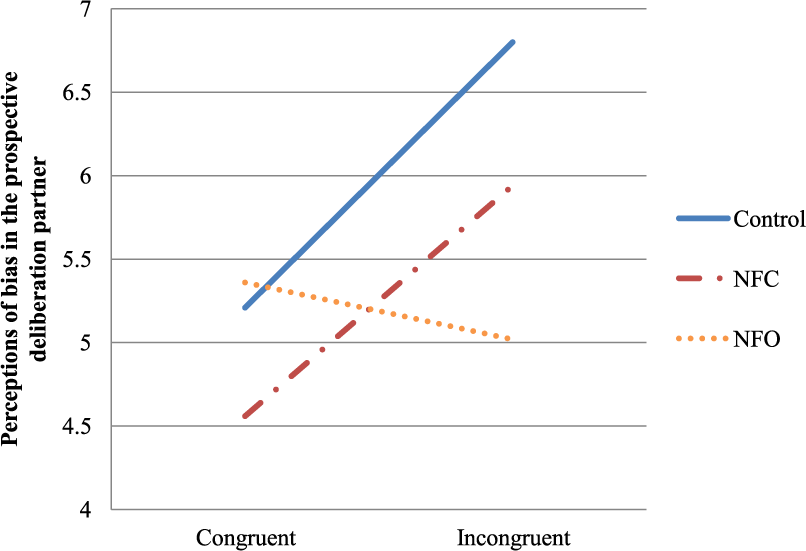
Estimated marginal means of perceptions of bias in the deliberation partner by opinion incongruence and epistemic motives (N = 186).
In order to test whether such differences between each pair of the EM conditions were statistically significant, the interaction term between OIC and EM was decomposed. A series of 2 × 2 ANCOVA models (i.e. EM: each pair of the EM conditions × OIC: incongruent vs congruent) showed the magnitude of the effect of OIC to be significantly smaller under the NFO condition than under the NFC condition (b = −1.61, SE = .70, t(125) =− 2.28, p < .05) or under the control condition (b = −1.78, SE = .74, t(112) = −2.43, p < .05). In addition, there was no significant difference between the latter two conditions (b = −.25, SE = .73, t(120) = −.34, p = .73). The findings lent a clear support for H3a, which predicted that the induced NFO mitigate the effect of OIC on individuals’ perceptions of bias in a deliberation partner.
Mediation by perceptions of bias
Built upon the findings on the effect of OIC on perceptions of bias in the deliberation partner, the next step was to examine the consequences of such perceptions of bias on the deliberation preparedness in an anticipated discussion. A mediation model was specified with the OIC as a predictor, the perceptions of bias in the deliberation partner as a mediator and each of the deliberation preparedness variables as an outcome variable. The mediation analyses were conducted with Mplus version 7.3 (Muthén & Muthén, 1998–2012), using maximum likelihood estimation procedures. Indices of goodness-of-fit of the mediation model showed a desirable fit (χ2 = 6.00, p = .11, comparative fit index (CFI) = .98, Tucker–Lewis index (TLI) = .91, root mean square error of approximation (RMSEA) = .07, standardized root mean square residual (SRMR) = .03).
The results showed the OIC to have a significant positive effect on the perceptions of bias in the deliberation partner (b = .97, SE = .29, p < .001), which in turn had negative effects on each of the deliberation preparedness variables. Specifically, respondents reporting higher levels of perceptions of bias in the deliberation partner reported lower levels of preference to be put in the same group with the person (b = −.20, SE = .05, p < .001), lower levels of expectancy that the person would act cooperatively (b = −.42, SE = .05, p < .001), and lower levels of intent to use cooperative rather than competitive strategies in the discussion with the person (b = −.14, SE = .05, p < .01). Lending a strong support for H2, the OIC exhibited negative indirect effects via perceptions of bias in a deliberation partner on the levels of partner preference (b = −.19, SE = .07, p < .01), deliberative expectancy (b = −.41, SE = .13, p < .01), and cooperative approach (b = −.14, SE = .06, p < .05).
The moderated mediation effects of the EM
The next step in the data analysis was to test H3b, which predicted that the negative indirect effects of OIC on deliberation preparedness be weakened by the induced NFO. A moderated mediation model was estimated using Mplus with maximum likelihood estimation procedures (Figure 2). Because the moderator variable EM included three conditions, a group needed to be identified as a baseline group and two code variables, each representing a contrast between the baseline group and each of the other groups, needed to be included in the model for the coefficients to be interpretable (Aguinis, 2004).
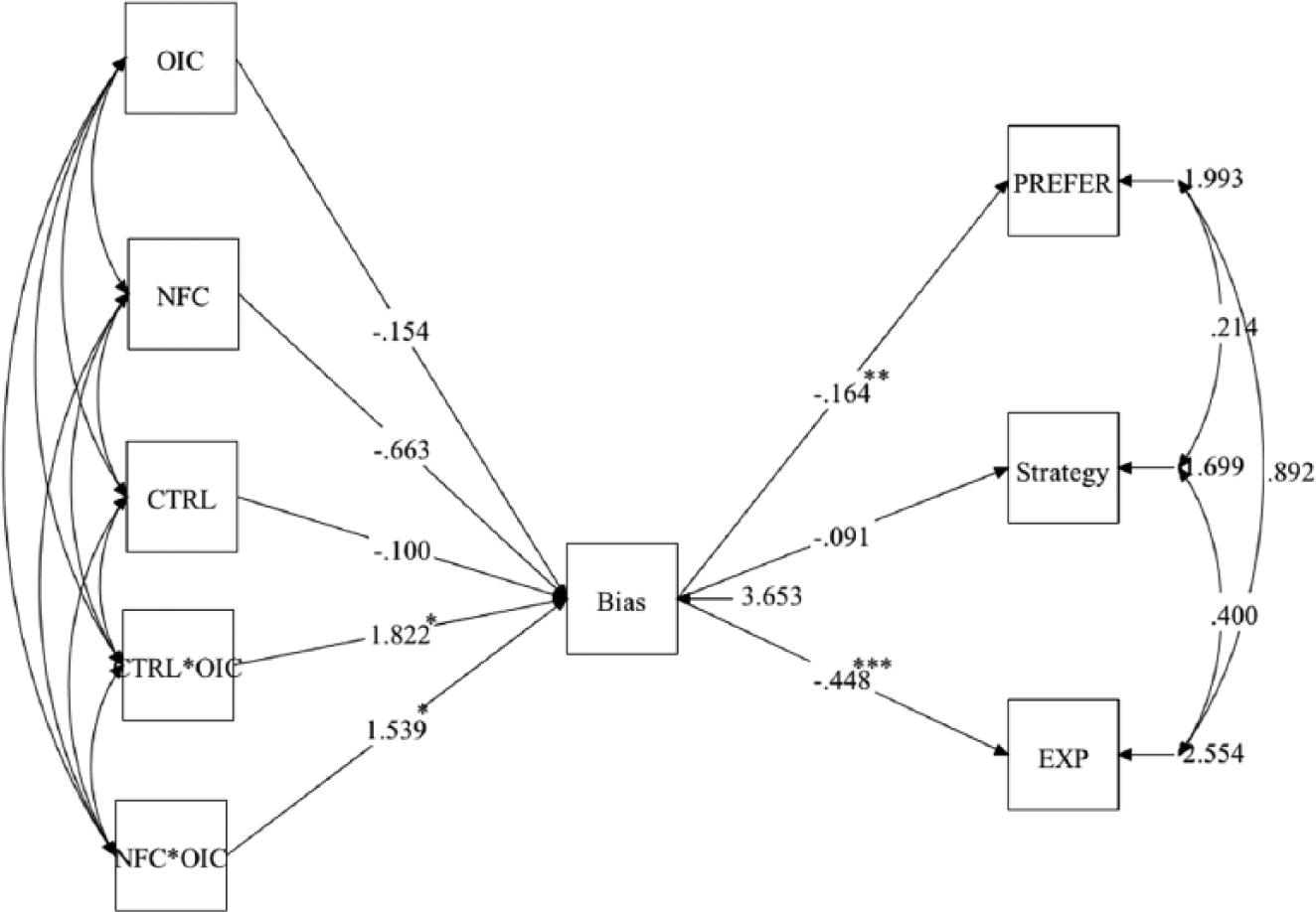
Moderated mediation model predicting deliberation preparedness.
Since evidence reported above showed participants in the NFO condition to be different from those in each of the other conditions, the NFO condition was first chosen as the baseline group and then two code variables (i.e. control and NFC) were created via dummy coding, each code variable representing the contrast between the NFO group and the control or NFC group. Moreover, the product terms between each of the code variables and OIC were also included in the model, representing the interaction between OIC and EM. The coefficients of each product term referred to the differences between the NFO group and the control group or the NFC group in terms of the effects of OIC on a variety of outcome variables. The moderated mediation model provided desirable indices of goodness-of-fit (χ2 = 16.85, p = .33, CFI = .99, TLI = .97, RMSEA = .03, p = .73, SRMR = .03).
The moderated mediation model replicated findings in support of H3a by showing the mitigating effect of the NFO on the relationship between OIC and perceptions of bias in the deliberation partner. But the focal concern at this analytical step was how much the moderating effect would get transmitted further down to the deliberation preparedness, as stated in H3b. Results showed that the moderating effects of the EM were not consistent across the three deliberation preparedness variables (see Table 1). Specifically, the negative indirect effects of OIC on each of the deliberation preparedness variables under the control condition were reduced to a nonsignificant level under the NFO condition. However, the differences between the two conditions were only significant for partner preference (b = −.30, SE = .15, p < .05) and deliberative expectancy (b = −.81, SE = .34, p < .05), but not for cooperative approach (b = −.17, SE = .11, p = .13). The findings were similar in the contrasts between the NFC condition and the NFO condition. That is, the negative indirect effects of OIC on each of deliberation preparedness variables observed under the NFC condition were not found under the NFO condition. However, only the difference in terms of deliberative expectancy between the two conditions was significant (b = −.69, SE = .32, p < .05). A series of contrasts between the NFC condition and the control condition showed no significant difference between the two conditions across each of the deliberation preparedness variables (all p > .60). 5 Overall, the findings lent partial support for H3b which stated that the negative indirect effects of the OIC on deliberation preparedness under the control and the NFC conditions be mitigated by the heightened NFO. But the findings showed that while such rectifying effects of the NFO may be robust on partner preference and deliberative expectancy, they were less so on people’s own intent to use cooperative rather than competitive strategies in a to-be-held discussion.
Moderated mediation models predicting conditional indirect effects of opinion incongruence at different levels of epistemic motive on deliberation preparedness (N = 186).
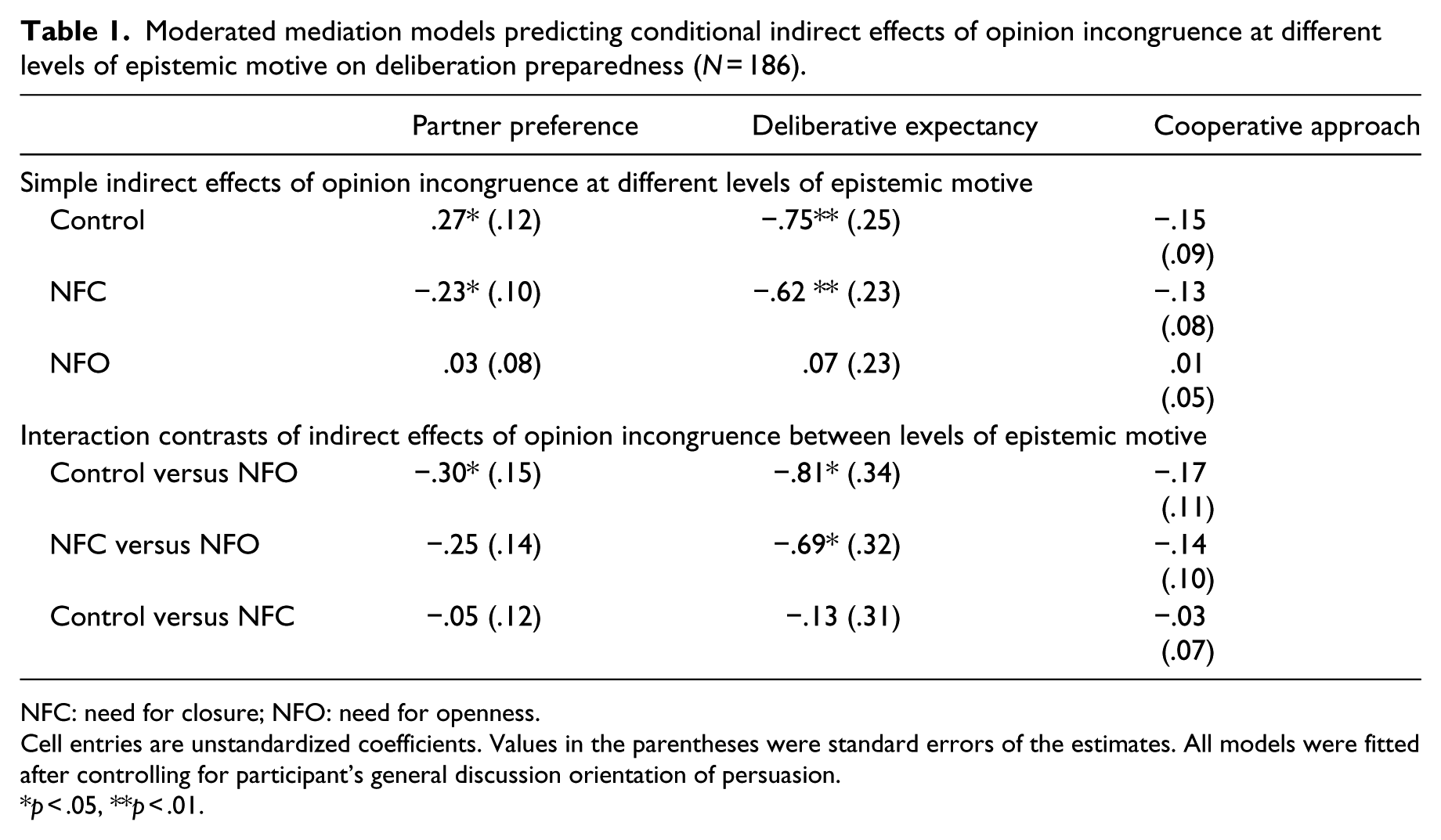
NFC: need for closure; NFO: need for openness.
Cell entries are unstandardized coefficients. Values in the parentheses were standard errors of the estimates. All models were fitted after controlling for participant’s general discussion orientation of persuasion.
*p < .05, **p < .01.
The findings that involved comparisons across the three EM conditions also provided a clear answer to RQ1. They showed that the NFC condition was mostly similar to the control condition, and the mitigating effect of the NFO was obtained by comparing it with either the NFC or control condition.
Information consultation
The extant literature on the LET suggests that the heightened NFO could reduce bias in perceptions of bias because it compels more open and systematic information processing. One indication is that individuals under such a condition would consult more information about the target of judgment or consult information that might be inconsistent with their initial judgment (e.g. Hart et al., 2012). This possibility led to RQ2. To address this question, analyses were conducted on the records of information consultation by the participants in the NFC and the NFO conditions. First, an independent sample t-tests showed that those in the NFO condition (M = 2.67, SD = 1.71), compared with those in the NFC condition (M = 1.95, SD = 1.19), consulted more information items (t(150) = 9.20, p < .01). A between-subject ANCOVA revealed that this effect was not contingent upon the levels of OIC; the interaction of EM (NFO vs NFC) and OIC (incongruent vs congruent) on the number of information items that people consulted was nonsignificant (b = .52, SE = .54, p = .34).
Next, a series of independent sample t-tests and between-subject ANCOVA analyses were carried out to compare the NFO and NFC conditions in the tendency of selectivity in information consultation. Neither the main effects of the OIC or the EM nor the interaction between them on selective tendency was found (all ts(150) < 1.00, ps > .40).
Conclusion and discussion
This study starts with a view that we engage in interpersonal or group discussions with our epistemic imperfection (Kruglanski et al., 2010; Talisse, 2010). One of the manifestations of such imperfection is our inability to recognize our own defects. Confronting disagreement, a defining feature of the public life in a pluralist society, signals a possibility that our own views might be limited and/or we might have made some error in reasoning. From a normative perspective, it ought to instigate a process for us to check on our own thinking for epistemic improvement (Christensen, 2007). Unfortunately, operating in our lay epistemology, we tend to perceive our own beliefs to be formed through reliable reasoning and based on trustworthy evidence. We tend to caricature those who disagree with us based simply on the belief that, if they were equally informed and followed the same reliable ways of reasoning as we have, they would have reached the same conclusion as we do (Ross & Ward, 1996). This epistemic tendency is especially salient when we do not know much about our opponents and their reasoning process.
Research on naïve realism (Kennedy & Pronin, 2008; Ross & Ward, 1996) has revealed that such disparagement of others’ cognitive inadequacy when forming their opinions combined with blindness to one’s own defects in reasoning might lead to conflict escalation. This study aims to go beyond this body of findings by examining possible interventions—that is, inducing epistemic openness in this case—to improve individuals’ deliberation preparedness by rectifying the default tendency of rushing into some broad-stroked inferences about others based only on opinion disagreement.
The study, in support of the expectation, revealed potential rectifying effects of the EM of the NFO on perceptions of bias in the deliberation partner. That is, consistent with the tenets of naïve realism, participants motivated by the NFC perceived a higher level of bias in the person who disagreed (vs agreed) with them, similar to those who were placed under the control condition that, arguably, mimicked an everyday default condition. However, such an effect of the OIC was mitigated by a manipulation that heightened people’s NFO. The finding is consistent with the extant literature on the effects of individuals’ EMs on biased inferences (e.g. De Dreu, 2003). It shows that the bias in individuals’ perceptions of bias, which often arises as people rely on minimal information and cognitive heuristics to make quick judgments, may be reduced by inducing a heightened state of the NFO. The finding does not imply that heightening the NFO will remove the effect of the OIC on people’s perceptions of bias in another person; rather, it indicates that, motivated by the NFO, people will not have their inferences about another person’s opinion and reasoning dictated by the person’s disagreement with them.
Such a rectifying effect of the NFO on perceptions of bias in a disagreeing other may be helpful for individuals to get prepared for engaging in democratic deliberation. In line with the findings reported in Kennedy and Pronin’s (2008) article, this study found that participants would be prepared to partake in a group discussion with a prospective deliberation partner if the person agreed with them rather than disagreeing with them and this relationship was through the influence of OIC on participants’ perceptions of bias in the person. But this study went beyond this point. It provided supportive evidence for the expectation that the connection between OIC and deliberation preparedness be mitigated by elevating individuals’ NFO. When participants were instructed to take into consideration of all information available to them and to make an accurate judgment on their deliberation preparedness, at least in terms of partner preference and expectations that the deliberation partner would be cooperative, the perceptual entrapment of one’s OIC with a deliberation partner was eased significantly. The findings are in line with those in negotiation studies showing that elevating the NFO could lead to more cooperative discussions with and more readiness to make concessions to opponents (De Dreu et al., 2006; Nelson et al., 2003). In addition, the findings from this study make it clear that such effects on deliberative preparation were through the process of the induced NFO prompting individuals to tame their tendency to attribute bias to a disagreeing other.
The study also explored the potential mechanisms underlying the mitigating role of the NFO. Admittedly, this exploration was limited to consulting some simple informational items voluntarily. Results showed that people who were motivated to make an accurate judgment consulted more additional information before making a judgment about the deliberation partner than those who were motivated to make a quick judgment. This finding suggests that it is possible to slow down people’s rush to make judgments when encountering disagreement. It is also possible that some doubts on one’s own existing beliefs may go a long way toward fostering a more deliberative atmosphere.
Theoretical implication
One of the central values in deliberative theories of democracy is openness. Relative to other democratic theories, the deliberative theories put greater demands on citizens’ epistemic virtues in the communicative process of decision-making (Burkhalter et al., 2002). This feature of the theories is built upon the presumed possibility that citizens will critically re-examine and even change their pre-existing judgments and preferences during the course of deliberation with those they disagree. In this sense, deliberators need to keep their minds open throughout the course of deliberation, being alert of all incoming evidence and arguments and adjusting their initial preferences in response to new evidence and arguments. In social interactions, however, the extent to which individuals may accept an argument is contingent upon how much they perceive the person who provides such an argument to be reasonable, fair, and trustworthy. If rashly attributing a person’s opinion to moral impurity simply based upon the opinion disagreement or even perceived disagreement with the person, individuals will be less likely to seriously consider the arguments that the person offers and thus less likely to accept the solution that the person proposes which they perceive to be unfair (Ross & Ward, 1996). Such a phenomenon is common in many real-world situations. My study suggests that to a certain degree, people could be motivated to open their mind, suspend pre-mature judgment, and rectify cognitive biases in making a judgment on disagreeing others. Such epistemic openness could go a long way to prepare individuals to become better deliberators.
This study builds its arguments on Goodin’s (2000) idea of “deliberation within” and focuses on individuals’ deliberation preparedness. It is based upon the recognition that a large portion of deliberation takes place in individuals’ mind and that such an intrapersonal process may occur even before any interpersonal interaction starts (Goodin & Niemeyer, 2003). Based on such premises, it is expected that how well individuals’ preparation complies with deliberative principles may foreshadow the likelihood that the forthcoming discussion will progress to a desired direction. Deliberation is more likely to end up with a conflict escalation if individuals start a discussion with a hostile or confrontational inclination. In contrast, an inclination toward an empathic and gracious recognition of others’ legitimate differences and cooperation may place people in a more constructive and rewarding discussion.
This does not mean that people who are well prepared for an anticipated discussion will invariably act in accordance to their inclination. It is entirely possible that, during deliberation, people may find some deliberation partners to be aggressive, stubborn, and absurd, and thus, they respond to them in the same manner even if they were not prepared to do so. The focus on deliberation preparedness simply suggests that the breakdown of a deliberative discussion may in part result from its participants’ reluctance or disinclination to act in compliance with deliberative principles. As research on naïve realism (Kennedy & Pronin, 2008) has shown, such disinclination may be a consequence of people’s moral condemnation of disagreeing others’ opinions.
The focus on deliberative preparation also means that, despite our cognitive defects, deliberation among us is not destined to fail. The findings of this study suggest that disagreement could be kept from being escalated to irreconcilable conflict if we could develop a more benevolent perception about our opponents and their beliefs. This understanding has both theoretical and political significances. The contemporary society is becoming increasingly polarized, and some moral conflicts are so intricate that they could hardly be resolved by simply providing reliable information or exchanging arguments. But, disagreement is a fact of life and it is both the starting point of and an impetus for more deliberation (Huckfeldt, Mendez, & Osborn, 2004). The findings from this study suggest that meaningful deliberation under the condition of disagreement is possible and even, I would venture to postulate, fruitful with some intervention to encourage people to maintain epistemic openness and to put off making broad-stroked inferences on others based simply on whether they agree or disagree with us.
To sum up, this study is motivated by the normative conviction that democratic deliberation is an indispensible and normatively desirable process for democratic governance. Although studies of cognitive psychology have suggested that deliberation may lead to suboptimal outcomes due to, in part, defects in individuals’ reasoning and that it might be impossible to completely remove deeply ingrained cognitive fallacies and biases, the theory of lay epistemics (Kruglanski, 1989) may offer us insights into practical ways to rectify such inferential defects via improving forum designs (Fung, 2011; MacKenzie & Warren, 2013). More specifically, findings from this study suggest that how to create conditions for people to reflect on their preformed judgments and to know more about discussion partners may be an important route to take in designing deliberation forums. Beyond reporting its findings, this study is also meant to suggest that more empirical inquiries aimed at building practical deliberation forums are needed.
Limitations and future research
Despite the far-reaching theoretical implications, this study has several limitations. Although participants in different conditions of EM in this study not only differed in their motivation but also in information they acquired about the deliberation partner, the study did not allow us to separate the effect of motivation from that of information consultation. In addition, the control group was treated as a default condition where people did not receive any instruction related to motivation and where people were forced to make a judgment without consulting additional information. Therefore, in exploring information consultation as a potential mechanism of the effects of EM, participants in the control condition were excluded. The reduction in sample size might have reduced power to detect potential relationship resulting in a risk of type II error. More importantly, there was no opportunity to explore patterns of information consultation under the condition where people were not impelled via experimental induction. In the future study, participants may be allowed to decide freely whether they would want to read additional information under various conditions of EMs.
In addition, using the topic of GMF as the issue context for this study might limit the applicability of its results. Participants’ attitudes toward the topic of GMF were not strong (M = 5.95, SD = 2.36 on an 11-point scale). It is likely that people with a weaker opinion on an issue are more likely to give credence to a disagreeing other’s opinion on the issue. Admitting the person’s objectivity in reasoning may not jeopardize individuals’ self-concept since they are not highly committed to the opinion. On the contrary, when people hold a strong opinion on an issue, admitting the merit of a disagreeing other’s opinion on the same issue might pose a considerable challenge to their own beliefs. In that case, the naturally arising defensive mechanism might compromise the effect of the NFO. Future research should extend the inquiry on the roles of EMs to other issues on which people have strong attitudes and examine whether the effects of EM on perceptions of bias in others and in turn on deliberation preparedness that were observed in the study would be contingent upon the strength of their opinions on the issue.