




Abstract
Taking different views into account is considered a virtue of democratic citizens. However, disagreement is often a barrier to deliberation. One reason is that individuals tend to impute biases to their adversaries and, on this basis, prepare for deliberation in less than optimal ways. Two experiments were conducted with results that supported this proposition. Specifically, encountering an incongruent opinion from another person led people to infer more bias in that person’s reasoning and consequently, to be less willing to engage in subsequent discussion with that person, and to be less inclined of using deliberative strategies if they found themselves in the discussion. Furthermore, these deliberative choices were directly predicted by individuals’ expectancy of their discussion partner’s likely deliberativeness based on their perceptions of bias in the partner’s reasoning. Together, the evidence suggests the operation of a cognitive bias blind spot that is likely to undermine individuals’ preparation for deliberative engagement.
Collective reasoning through open dialogue is a central process in deliberative democracy (e.g. Fishkin, 1995; Gutmann & Thompson, 1996). Its necessary ingredient is that people who disagree on issues of public concern consider and engage one another so that better-informed and reasoned judgments can emerge (Gastil & Black, 2008). However, in practice, an open exchange of diverse views does not always engender normatively desired processes or outcomes (Sunstein, 2003). Crosscutting talks may, for example, discourage political participation (e.g. Mutz, 2002), harden prior conviction (e.g. Mendelberg & Oleske, 2000), or increase individuals’ opinion extremity and group polarization (e.g. Sunstein, 2003; Wojcieszak & Price, 2010).
What is important to note is that the prospect for such less desirable outcomes may start to take shape even before any actual deliberative discussion takes place. That is, when encountering a prospective discussion partner, individuals may readily draw attributions, form expectations, and develop behavioral inclinations based on very limited information. The eventual deliberation encounter with the partner is likely tilted by the perceivers’ conceptions of self, their own opinions, their construal of how they have come to these opinions, and their projection of others in a discussion, some just like them while others different. This egocentric tendency of individuals utilizing the self as a source of knowledge (Krueger, Alicke, & Dunning, 2005) could prepare a person to move toward a direction that might be normatively problematic for democratic deliberation.
One particular stream of such a tendency is known as naïve realism (Ross & Ward, 1996). A manifestation is individuals’ tendency of attributing biases to those who disagree with them and seeing others as being more susceptible to common cognitive and motivational biases than they are themselves. Because of this self–other asymmetry, individuals’ inferences of bias in others holding incongruent views are likely also biased (Pronin, 2006). Still, under this logic, individuals imagine a prospective encounter with others, size up the prospect of engaging with them over an issue of contention, and mentally rehearse how to interact with them in such an encounter. In other words, before any actual discussion takes place, people may have already started on a trajectory of conflict.
Arguments along this line suggest that examining a predeliberation mental preparation must be an integral part of empirical research on democratic deliberation if we aim to create conditions conducive to a truly open dialogue among people with different views. This study is our first step toward that direction. In this article, we develop a perception-based model of deliberation preparation, describe a simple experimental design for testing key predictions from this model, and report findings from two studies. With these findings, we make the case that, for individuals who are on the path to engaging in open and civil deliberation, hurdles may start to grow at the moment when people are getting prepared for an anticipated deliberative engagement. Thus, understanding how individuals prepare for deliberation may shed light on how to design fruitful public dialogues with a heterogeneous and ideologically charged polity (Fung, 2011; Goodin & Dryzek, 2006).
Opinion incongruence and perceptions of bias
Researchers have documented the tendency that people see themselves differently from how they see others (Jones & Nisbett, 1972; Pronin, 2008). We are naïve realists in that we tend to believe that we see the world as it is and that reasonable others with normal cognitive facilities will share our conceptions and accept them as reasonable reflections of reality (Pronin, Gilovich, & Ross, 2004; Ross & Ward, 1995, 1996). Deeply rooted in this conviction, we tend to readily impute bias in others when facing disagreement while failing to recognize our own susceptibility to similar biases. This tendency reveals what has been called a perceptual “bias blind spot” (Pronin, Lin, & Ross, 2002).
To make matters worse, we often readily draw inferences of bias based on skimpy information (Pronin, 2006). Pertinent to practices of democratic deliberation is the evidence that individuals would find it sufficient to draw inferences about others based primarily or even only on their opinions of a contentious issue. Based simply on opinions, partisans in a contention tend to see differences with their adversaries greater than they actually are (Sherman, Nelson, & Ross, 2003), infer their adversaries as being more biased than those who agree with them (Frantz, 2006; Kennedy & Pronin, 2008), and evaluate their assertive or competent adversaries more negatively than the allies with the same attributes (Mills, Cooper, & Forest, 2002). Such evidence is compatible with the more general theoretical proposition that individuals often take themselves as the vantage point when perceiving others and making self–other comparisons. Following this perceptual path, individuals easily generate self-favoring perceptions and judgments (Dunning & Hayes, 1996; Karniol, 2003; Krueger, 2003; Krueger et al., 2005).
Anticipating discussion with perceptions of bias in others
Individuals’ perceptions of bias in others are often a basis to interact with those others even though these perceptions are likely biased or at least questionable in their foundation. Consequently, people may get swirled in a “bias-perception spiral” (Kennedy & Pronin, 2008). That is, while an actual disagreement with other people may not be so serious that an open and civil deliberation would be prohibitive, people may perceive such differences unbridgeable due to the others’ inability to see their own bias and to overcome it. Such perceptions may shape their preparation for a deliberative engagement, including their cognitive as well as attitudinal posture toward the anticipated discussion, their calculations of how they might move in the discussion, and their assessments of feasible communication strategies.
This process of internal preparation may produce what is akin to the “expectancy effect” that has been widely noted in interpersonal and group interactions (e.g. Burgoon, Stern, & Dillman, 1995; Le Poire & Yoshimura, 1999; Neuberg, 1996; Olson, Roese, & Zanna, 1996; Rosenthal, 1994). It is a process in which interpersonal flow of information interfaces with intrapersonal cognitive activities. More specifically, in a deliberation context, upon being exposed to information that is presumably diagnostic of a discussion partner’s reasoning on a controversial issue, individuals undertake an anticipatory rehearsal for the upcoming engagement. This mental preparation may comprise a chain of cognitive moments that individuals go through, including their expectancy of how the prospective partner may act, their willingness to talk with the person, and if a discussion takes place, what communication strategies they are prepared to utilize. In this article, we use “deliberation preparation” to represent this logically sequential intrapersonal process. We argue that, before any actual discussion, whether it is an informal social encounter or a formal deliberation, individuals undergo a process of this kind. In this process, they form expectancies of a forthcoming interaction and a corresponding behavioral posture based on the information of self–other distinctions (Stapel & Koomen, 2001).
Critically, such preparation is marred by individuals’ perceptions of bias based solely on very limited information. That is, under most circumstances, individuals do not need much information to draw inferences about other people, to impute bias, or even to attach exterior motives to them (Kruger & Gilovich, 1999). Often, with regard to a well-known controversial issue—an issue on which people have already formed a view or they can readily find available partisan positions (Claassen & Highton, 2009)—individuals may overweigh a person’s expressed opinion on the issue as an informative cue in comparison with other kinds of relevant information and inscribe positive or negative attributes to the person, such as imputing varying degrees of bias or susceptibility to the person (DiDonato, Ullrich, & Krueger, 2011; Gramzow, Gaertner, & Sedikides, 2001). In other words, an opinion statement may be sufficient for people to form their initial expectations of the opinion holder and develop inclinations toward an anticipated interaction with that person. Therefore, we pose the following basic hypotheses for the empirical investigation of this article:
H1. Individuals tend to attribute more bias and less objectivity to a person whose opinion is incongruent with their own than someone whose opinion is congruent with their own.
H2. Individuals are less inclined to engage in a discussion with a person whose opinion is incongruent with their own than with someone whose opinion is congruent with their own.
H3. Perceptions of bias in a prospective discussion partner mediate the effect of opinion incongruence on individuals’ inclinations to engage with the partner in future deliberation.
Study 1
Rationale
We wanted to explore the feasibility of examining perception-based biases in the process of deliberation preparation in an experimental setting. For this purpose, we developed the first study to test the three basic hypotheses and assessing the measures of perceptions of others and deliberation preparation. The design had three features. First, it was set in the context of two controversial issues: legalizing marijuana and adopting speech codes to restrict hate speech on campus. Both issues were selected based on the result of a small instrument-develop survey that asked participants’ opinion about nine controversial issues. 1 The survey employed a sample from the study population. Each of the two issues selected on this basis revealed an evenly dispersed pro and con opinion distribution and was regarded as relevant to the study population. In the experiment, participants’ opinions on legalizing marijuana and adopting speech codes were measured again in the baseline survey. Next, they were presented with the two issues in a random order. For each issue, participants were randomly assigned to read a pro or con opinion attributed to an anonymous fellow student. Then, they were asked to rate how much the opinion holder had been influenced by various biasing or objective factors. Finally, participants were told about a follow-up study that would involve a group discussion, which would include as a discussion partner the person whose opinion they had just learned about. They were asked to indicate how they would expect to interact with that partner when completing a task that would require integration of their points of view.
Methods
Participants
Undergraduate students (N = 222; age range = 19–29; 54% men) were recruited to take part in the study for course credit. 2 In a 2 × 2 mixed design, exposure to a pro or con opinion on an issue was the between factor, while the two issues comprised the within factor. For the legalizing marijuana issue, the “pro condition” had 107 participants who received an opinion in support of legalization; and for the adopting speech code issue, the “pro condition” had 115 participants receiving an opinion advocating more policy restrictions on hate speech.
Measures
Opinion incongruence
In the baseline survey, participants were asked to indicate their stand on each of the six opinion statements using a 6-point Likert-scale (1 = strongly disagree and 6 = strongly agree). 3 On each issue, an index was created by taking the average of the three respective items (M = 3.71, SD = 1.48, α = .86 for legalizing marijuana; M = 4.08, SD = 1.21, α = .78 for adopting speech code). Then, we created the opinion incongruence variable for each issue by multiplying the corresponding index of participant’s own opinion by the experimental condition variable representing the prospective partner’s opinion on each issue.
Perceptions of prospective partner
On each issue, after participants read the opinion statement attributed to “a fellow student who participated in our study last semester,” they were instructed to assess the extent to which that prospective partner might have been influenced by various factors when forming the opinion (1 = little influence and 7 = major influence). The items were adapted from the measures used in the extant bias perceptions studies (e.g. Kennedy & Pronin, 2008). For each issue, perceived biased reasoning was measured by the single item on how much the prospective partner’s opinion was influenced by his/her general ideological orientation (M = 5.32, SD = 1.27 for legalizing marijuana; M = 5.83, SD = 1.14 for adopting speech code); perceived objective reasoning was an index (M = 4.04, SD = 1.33, α = .75 for legalizing marijuana; M = 4.17, SD = 1.19, α = .69 for adopting speech code), created by averaging across three items (“established facts,” “weighing of all relevant factors,” and “consideration of all sides”).
Expectancy of deliberative engagement
Within each issue context, following the perception measures, participants were told about a follow-up study in which they would work with the prospective partner to write a short column article that would reflect their shared views on the issue. They were asked, if they were invited to participate in the study, how much they would be willing to be paired with the prospective partner (1 = very unwilling and 7 = very willing), how likely they would find common ground with him or her (1 = very unlikely and 7 = very likely), how easily they would find the common ground (1 = very uneasily and 7 = very easily), how enjoyable the collective work experience would be (1 = very little and 7 = very much), and how much that partner would be open to challenges to his/her view (1 = very little and 7 = very much). By taking the average across these items, an index of discussion expectancy was created (M = 4.40, SD = 1.35, α = .88 for marijuana use; M = 4.68, SD = 1.14, α = .86 for speech code).
Results and discussion
A set of ordinary least squares (OLS) regression analyses were conducted for each issue, with experiment condition, participants’ own issue opinion, and opinion incongruence included as predictors, controlling for sex (1 = female), age, race (1 = Caucasian and 0 = others), ideological orientation, and opinion strength. 4 The results are shown in Table 1. For each outcome, the key coefficients are the ones associated with self–other opinion incongruence, which was represented by the interaction between a participant’s own opinion and the prospective partner’s opinion on each issue. Partially supporting H1, participants were found to attribute less objective reasoning to the prospective partner when the person’s opinion was incongruent with their own (β = −.317, p < .001 for legalizing marijuana; β = −.188, p < .01 for adopting speech code), but they did not attribute more bias to that person. Supporting H2, self–other opinion incongruence was related to less positive expectancy of deliberative engagement with the prospective partner (β = −.527, p < .001 for legalizing marijuana; and β = −.227, p < .001 for adopting speech code).
Effects of opinion incongruence on perceptions of objectivity, perceptions of bias, and deliberative expectancy (Study 1).
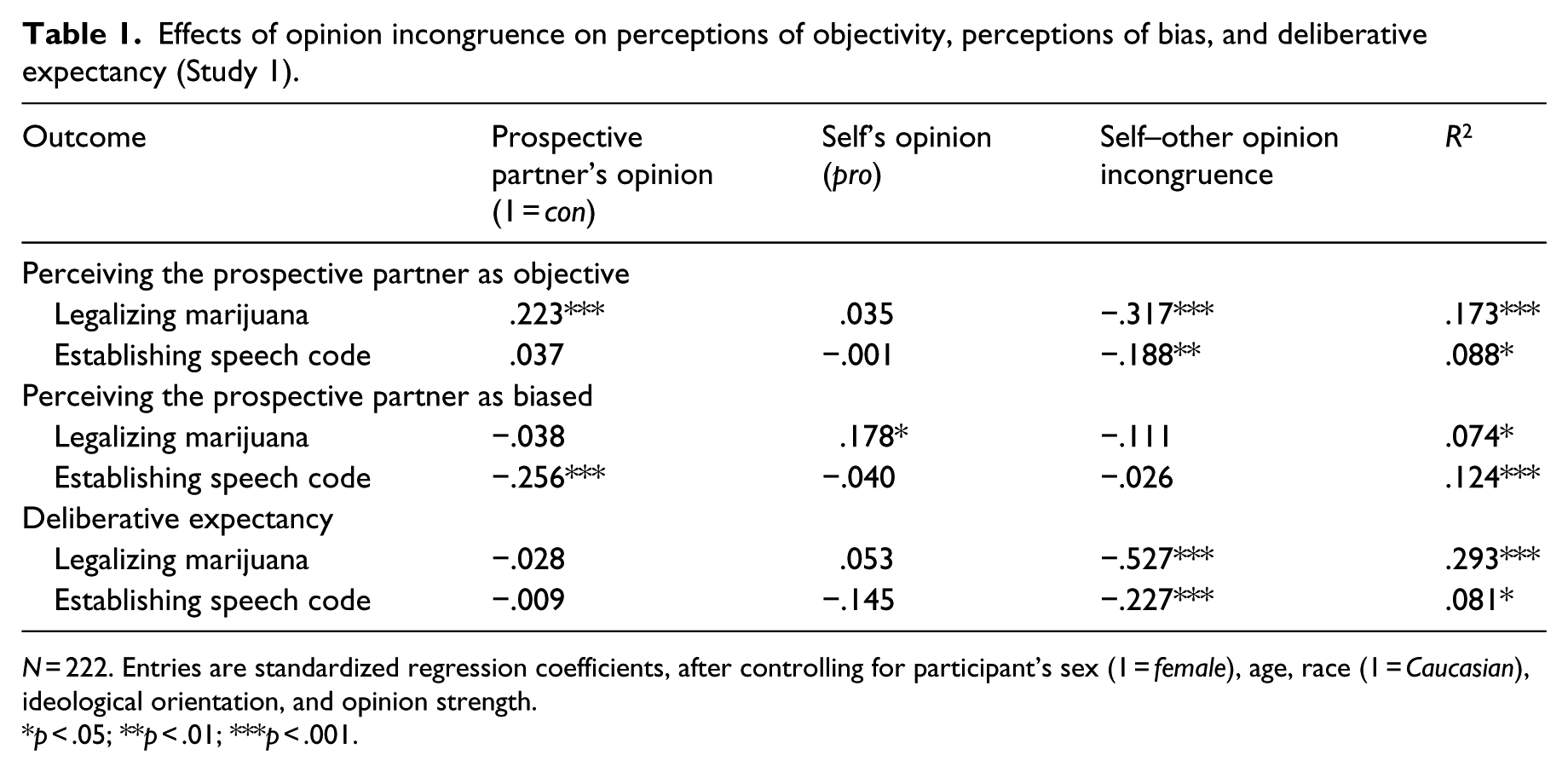
N = 222. Entries are standardized regression coefficients, after controlling for participant’s sex (1 = female), age, race (1 = Caucasian), ideological orientation, and opinion strength.
p < .05; **p < .01; ***p < .001.
To test H3, a mediation analysis was conducted by employing Hayes’ “PROCESS Macro” (2013) in SPSS, with perceived objectivity of the prospective partner as the mediating factor between self–other opinion incongruence and deliberative expectancy. Participants’ own opinion, the prospective partner’s opinion, as well as demographics and opinion strength were treated as covariates. For both issues, the test clearly suggested a negative indirect effect of perceived objectivity in partner (B = −.08, t(221) = −3.04, CI = (−.14, −.04), p < .01 for legalizing marijuana; B = −.04, t(221) = −2.02, CI = (−.10, −.01), p < .05 for adopting speech code). That is, self–other opinion incongruence led participants to perceive less objectivity in the prospective partner, which in turn led to a lower deliberative expectancy about future deliberation. Across the two issues, about 15.7% and 18.4%, respectively, of the estimated total effect of self–other opinion incongruence on deliberation expectancy went through perceived objectivity in partner. 5
These results provided an initial support for our three basic hypotheses. They showed that before an actual deliberative encounter, the intrapersonal process of perceiving others and forming expectancies on this basis could send individuals down on a path anchored in their own opinion, limited by their “bias blind spot,” and contrary to the normative expectations of deliberative citizens.
Obviously, these results were very tentative. While we were encouraged, however, by our observation that the design seemed to be feasible and our cover story was credible enough, we also recognized three flaws in this study. First, the future deliberative task that we asked participants to envision was not a “typical” kind engaged by democratic citizens in public policy and opinion formation (see Gastil & Levine, 2005 for various deliberative innovations). At the best, it probably represented a limited type of citizens’ deliberative engagements with regard to a controversial issue—something students could be asked to do as an assignment. Second, the measures on perceptions of others could be improved. In our study, the perceived biased reasoning in the prospective partner did not yield the expected significant effect. And third, the deliberative expectancy scale, although internally coherent as assessed by Cronbach’s alpha, included elements that could and should be differentiated. In essence, a more careful explication of each construct is necessary in order to devise more fully developed measures. These empirically based considerations informed us in designing Study 2.
Study 2: testing a process model of deliberation preparation
Rationale and hypotheses
Built upon the gains from the Study 1, we developed this study. It adopted the same design template but was aimed at better capturing the process of individuals preparing themselves for a forthcoming deliberative task. Figure 1 depicts this process schematically and highlights two major advances that we hope to make in Study 2. First, as in Study 1, we postulate two sets of perceived influences on prospective partner’s reasoning, one being positive (influences of objective factors) and the other negative (influences of biasing factors). In order to clarify the observation from Study 1 that perceived biases in the prospective partner did not play a significant role in the relationship between self–other incongruence and deliberation expectancy, we aim to improve the measures and in the path model, postulate both sets of perceived influences as mediators in the relationship between self–other opinion incongruence and deliberative outcomes; but we expect them to operate in opposite directions.
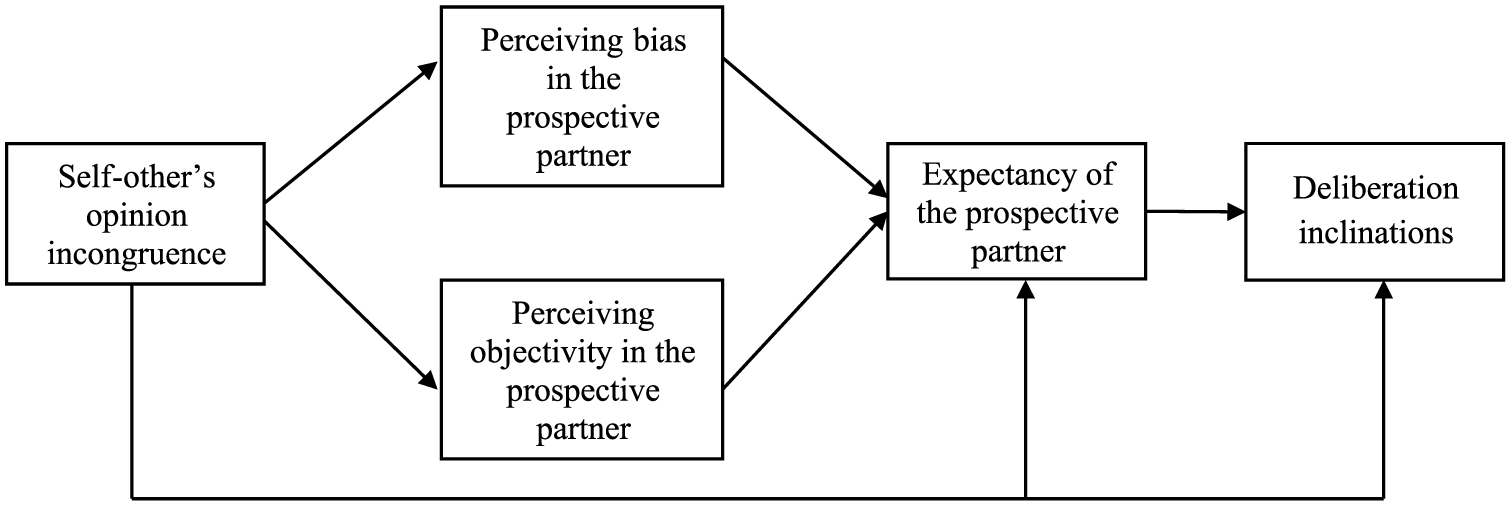
A process model of deliberation preparation.
Second, we make a clearer conceptual differentiation among the possible outcomes of self–other incongruence and perceptions of others. We conceive these outcomes as a set of potentially sequential preparation steps that individuals are likely to go through when anticipating a forthcoming deliberation encounter. In Study 1, we lumped them together as “deliberation expectancy.” Based on the expectancy literature in psychology (e.g. McCabe & Balota, 2007; Rosenthal, 1994) and interpersonal communication (e.g. Burgoon & Le Poire, 1993; Burgoon et al., 1995), we recognize that deliberation expectancy, while capturing individuals’ preinteraction beliefs about the likely forthcoming occurrences, is only one distinct step in the process of deliberation preparation. It will be more firmly grounded in the extant literature if we conceive it as expectancy of how deliberative one’s prospective partner is likely to be. It is part of a likely sequence of preinteraction judgments and inferences that may be set in motion by encountering the opinion of a prospective discussion partner. The other two elements capture individuals’ behavioral inclinations toward an anticipated deliberation encounter: their willingness to engage in such a discussion, and, if being in the discussion, their preference for deliberative over argumentative approaches. We postulate that, entrapped in the general cognitive blind spot, without any other interference, individuals are likely to go through the sequence of deliberation preparation under the influence of self–other opinion congruence or incongruence. If the self–other opinion is incongruent, the preparation sequence will be titled toward the direction of less deliberativeness than if the self–other opinion is congruent. Thus, built upon the evidence for H1, we can restate H2 as follows:
H4. Individuals encountering an opinion incongruent with their own tend to show lower levels of expected deliberativeness of the opinion holder, less willingness to participate in such a discussion, and if being in such a discussion, a weaker preference for deliberative over argumentative strategies.
Considering the positive- and negative-mediating venues simultaneously, we can restate the mediation hypothesis of H3 in a more fully developed fashion as follows:
H5. The effects of opinion incongruence on deliberation preparation are mediated by individuals’ perceptions of the prospective discussion partner such that,
H5a. perceiving biased reasoning in the prospective partner is related to lower levels of expected deliberativeness of the opinion holder, less willingness to participate in such a discussion, and if being in such a discussion, a weaker preference for deliberative over argumentative strategies, and
H5b. perceiving objective reasoning in the prospective partner is related to higher levels of expected deliberativeness of the opinion holder, greater willingness to participate in such a discussion, and if being in such a discussion, a stronger preference for deliberative over argumentative strategies.
The above arguments for deliberation preparation as a temporal sequence suggest that expectancy of how one’s prospective partner may behave is likely to be a conduit between one’s perceptions of the partner and preferences to interact with the person in a certain way. Therefore, we hypothesize,
H6. Individuals’ expectancy of deliberativeness of the opinion holder as a prospective discussion partner further mediates the influence of perceptions of bias in the person by enhancing their willingness to participate in discussion and preference of deliberative over argumentative strategies in such a discussion.
Methods
Participants
In all, 276 undergraduate students, recruited from introductory communication and journalism classes (age range = 19–30 years; 26.8% men), completed the study for course credit in March 2010. The issue was the abortion debate triggered by the controversial Super Bowl ad featuring the then college football superstar Tim Tebow and his Mom, which had been shown shortly before this study began.
Materials and procedure
After completing the baseline survey, participants read a short news article reporting on the controversy that the Super Bowl ad ignited. The news report was written to have a carefully balanced representation of both pro-life and pro-choice points of view with regard to the news event. Participants were instructed to read the article carefully and to write a short paragraph to elaborate their own views on both the news event and the issue of abortion immediately afterward. After that, participants were randomly exposed to either a pro-life or a pro-choice opinion profile. The opinion profile was presented as a screen shot. The participants were told that what they saw was an opinion profile from a fellow student who had participated in an earlier study just like this one. And bound by our pledge to protect each study participant’s anonymity, we could only label the fellow student as “Student A.” The screen shot contained two parts, similar to the opinion measure screen that the participants encountered in this study when reporting their own opinion: The upper half showed the Student A’s opinion on a same 11-point scale used in the present study and the lower half showed a short paragraph of the person’s “open-ended elaboration” of that opinion. Using the screen shot as the manipulation stimulus was to increase the credibility of our cover story and depict Student A’s opinion clearly in direction as well as intensity. Following exposure to the opinion profile, participants answered a set of questions concerning their perceptions of the opinion holder.
Following the opinion exposure and the perception questionnaire, participants were told about an ongoing citizen forum organized by a local Public Broadcasting Service (PBS) station. They were then told that the organizers wished to have more students participate in the forums. Working in collaboration with them, we designed the study as a necessary step to recruit students with different viewpoints to participate in the public forums on the controversy ignited by the Tebow ad. Placed in this context, participants were asked, if Student A was their prospective discussion partner, how much they would expect this person to be deliberative in such a forum, how much they would be willing to be placed in the same forum with the person if they were invited to participate, and if they found themselves in the same forum with that person, how much they would prefer using various communication strategies.
Measures
Opinion on the abortion issue
As part of the baseline survey, participants were asked to indicate their views on abortion using an 11-point scale (−5 = strongly disagree, 5 = strongly agree, and 0 = feel neutral). Three items were used: (1) Abortion is terminating life (reverse coded); (2) Abortion should only be legal under the condition of saving a mother’s life (reverse coded); and (3) Under no circumstance should women’s right to choose be compromised. A pro-choice opinion index was created by taking the average of these items (M = 1.30, SD = 2.88, α = .77).
Perceptions of prospective partner
After reading Student A’s opinion profile, participants were asked to first report their perception of where the person stood on the abortion issue and then assess the extent to which the person had been influenced by various factors (1 = little influence, 7 = major influence) in forming that opinion. Similar to the approach adopted in the naïve realism literature (Kennedy & Pronin, 2008; Pronin, Kennedy, & Butsch, 2006), the measures included both negative factors (political ideology and biased perspective on the issue) and positive factors (careful consideration of facts, logical analysis of costs and benefits, evaluations of available scientific evidence, and an objective perspective on the issue). An exploratory factor analysis of these items revealed two clear-cut factors, accounting for 62.11% of the variance. The items for each factor were then averaged into perceived bias (M = 4.98, SD = 1.32, α = .64) and perceived objectivity (M = 3.76, SD = 1.25, α = .75). The perceived bias index has less than satisfactory reliability, suggesting that our estimates of its relationships with other variables in the analysis are likely attenuated by measurement error.
Expectancy of partner’s deliberativeness
Participants were asked to imagine themselves being in the aforementioned forum with Student A as a discussion partner and indicate how likely (1 = not likely at all and 7 = extremely likely) they would expect that person to be deliberative in the discussion. An average of seven items (e.g. receptive of different points of view; willing to listen to different points of views; open to facts that contradict his/her own view, etc.) yielded an index of expectancy of partner’s deliberativeness (M = 3.33, SD = 1.27, α = .92).
Discussion strategy preferences
Participants were asked to indicate how much they would prefer (1 = not at all prefer and 7 = very much prefer) to use each of 10 discussion strategies in their envisioned discussion with the prospective partner. These items were developed based on the approach to measure cooperative versus competitive actions in Kennedy and Pronin’s (2008) study. An exploratory factor analysis revealed two factors that accounted for 52.52% of the total variance. Averaging across the items for each of the two factors resulted in two indices of discussion strategy preferences. The deliberative strategy index consists of items such as having a reasoned discussion on both sides of the issue, offering compelling arguments for each point of view, providing rational explanations, presenting factual information, and acknowledging the merit of each side (M = 4.98, SD = 1.22, α = .88). The argumentative strategy index includes items like telling the prospective partner not to be dogmatic, pointing out to the person that it would be close-minded if he/she insisted on his/her own opinion, convincing the prospective partner to go along with the majority, making intense emotional appeals, and invoking authoritative figures to influence discussion (M = 3.22, SD = .96, α = .56). As our explication of deliberation preparation focuses on relative preference between the two types of strategies, we subtracted the score of preference for argumentative strategies from that of preference for deliberative strategies to create a variable of relative preference for deliberative over argumentative strategies (M = 1.76, SD = 1.40).
Willingness to be teamed up with the prospective partner
Finally, the participants were asked to indicate, if they were to be invited to participate in one of the forums that we were organizing, whether they would be willing to be placed in the same group with Student A (1 = yes, 0 = no). Most of the participants (66.7%) indicated that they would be willing to team up with the person to discuss the abortion issue.
Results and discussion
Randomization and manipulation checks
Comparing the baseline measures of participants’ opinions on abortion, the two conditions of being exposed to a pro-choice or pro-life opinion profile showed no significant mean differences. Further, the two groups showed no significant differences in gender or racial/ethnic composition, average age, or ideological orientation. However, our sample tilted significantly toward pro-choice (t = 7.48, p < .001, one-sample t-test with 0 as the criterion) and toward the liberal end in ideological orientation regarding social issues (M = 4.88, SD = 1.66, t = 8.80, p < .001, one-sample t-test with 4 as the criterion). Therefore, we included a wide range of control variables in the main portion of the analysis.
The experimental stimulus was successfully perceived by the participants since they perceived the prospective partner as more supportive of legalized abortion (M = 3.96, SD = 2.37) if they were exposed to a pro-choice opinion profile than if they were exposed to the pro-life opinion profile (M = −3.64, SD = 2.14, t = 27.85, p < .001).
Model specification and assessment
Two path models were specified based on the conceptual model depicted in Figure 1. As presented in Figures 2 and 3, the two models differ in the kinds of behavioral inclinations that each focuses on. While strategy preference is the focus in the model depicted in Figure 2 (Model 1), willingness to be teamed up with Student A is the focus in the model depicted in Figure 3 (Model 2). Treating them in two separate path models is because of two reasons: First, we have no theoretical basis to specify the causal order between them; second, they were measured by different types of scale, consequently, different estimations were needed. To streamline the model estimation and presentation, a partial correlation matrix with standard deviations of the major variables was obtained (Table 2), controlling for participants’ age, sex, race, liberal orientation on social issues, and opinion strength on the abortion issue. Each model was then fitted to the partial covariance matrix.
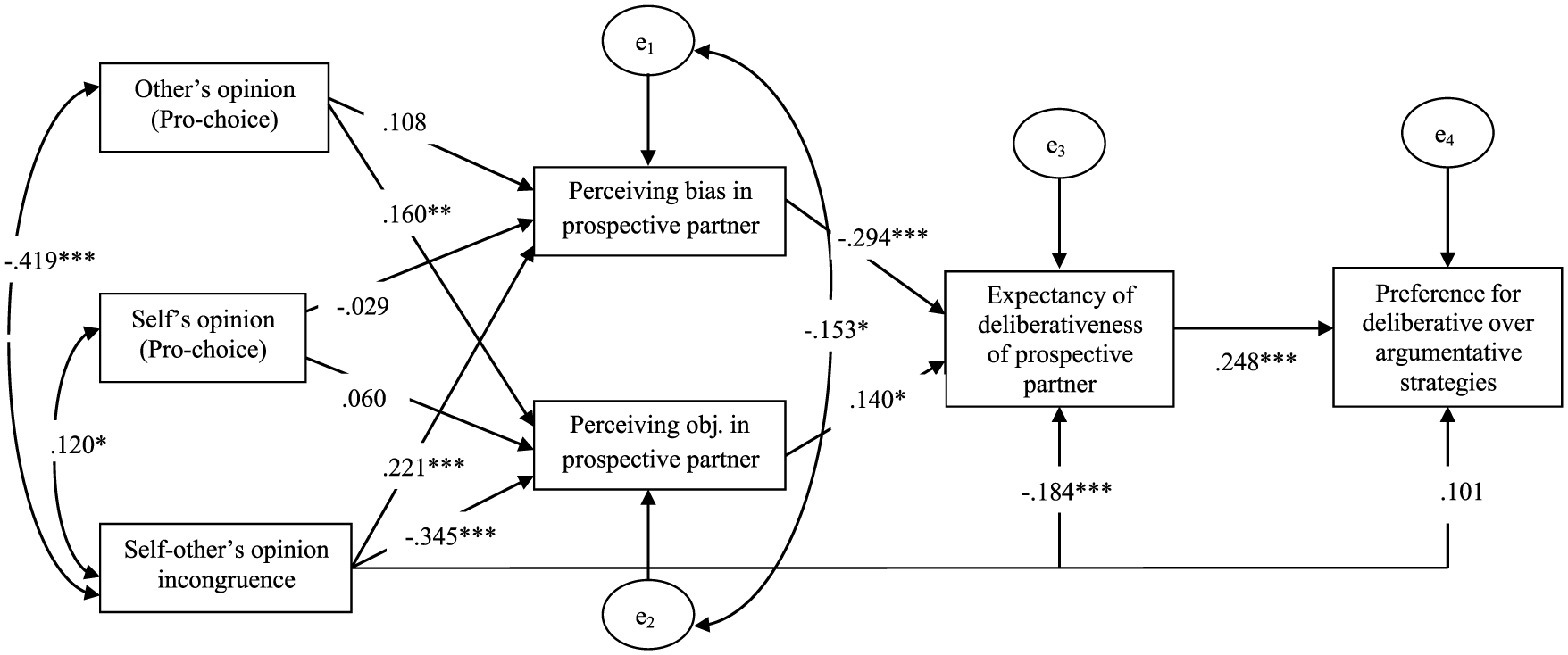
Effect of opinion incongruence on preferred discussion strategies mediated by perceptions of the prospective partner and expectancy of deliberativeness of this person (Model 1).
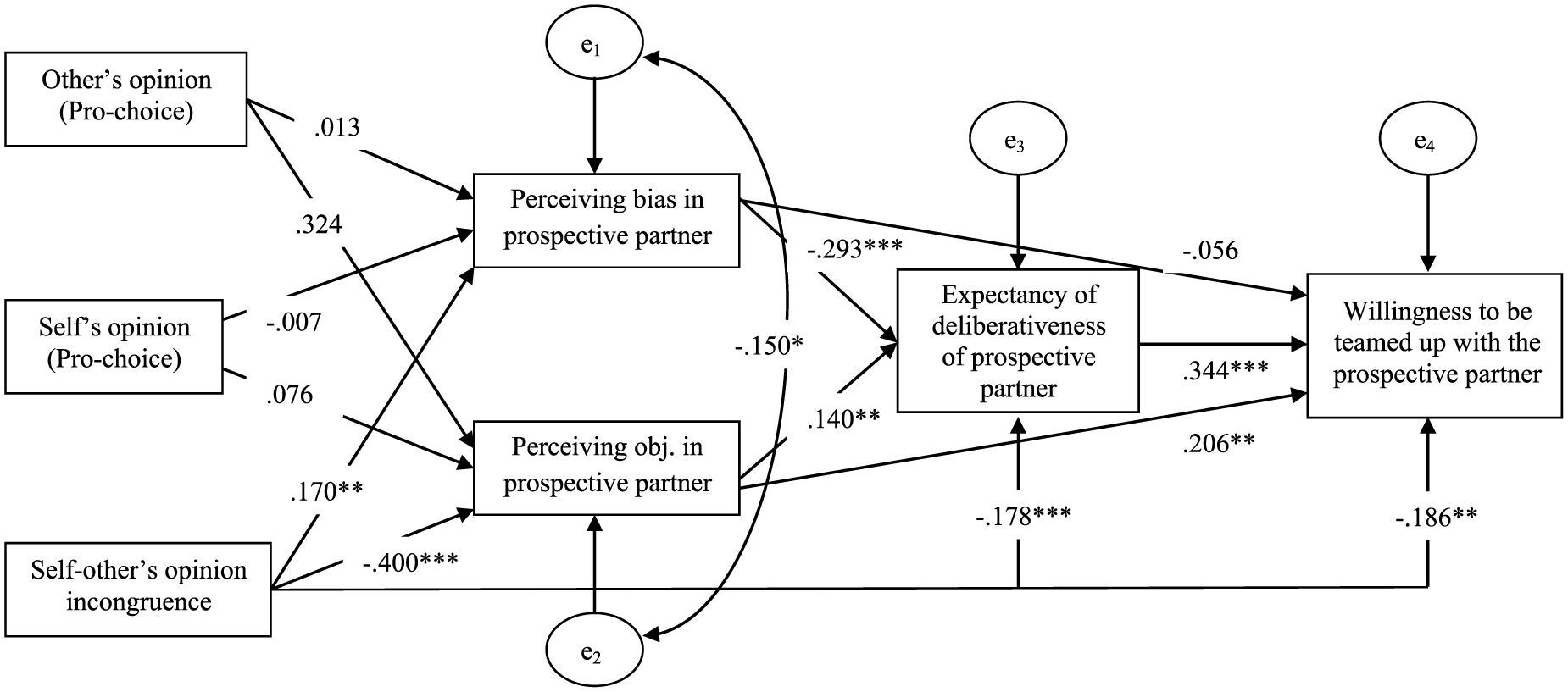
Effect of opinion incongruence on willingness to discuss mediated by perceptions of the prospective partner and expectancy of deliberativeness of this person (Model 2).
Partial correlation coefficients and standard deviations for the variables under analysis in Study 2.
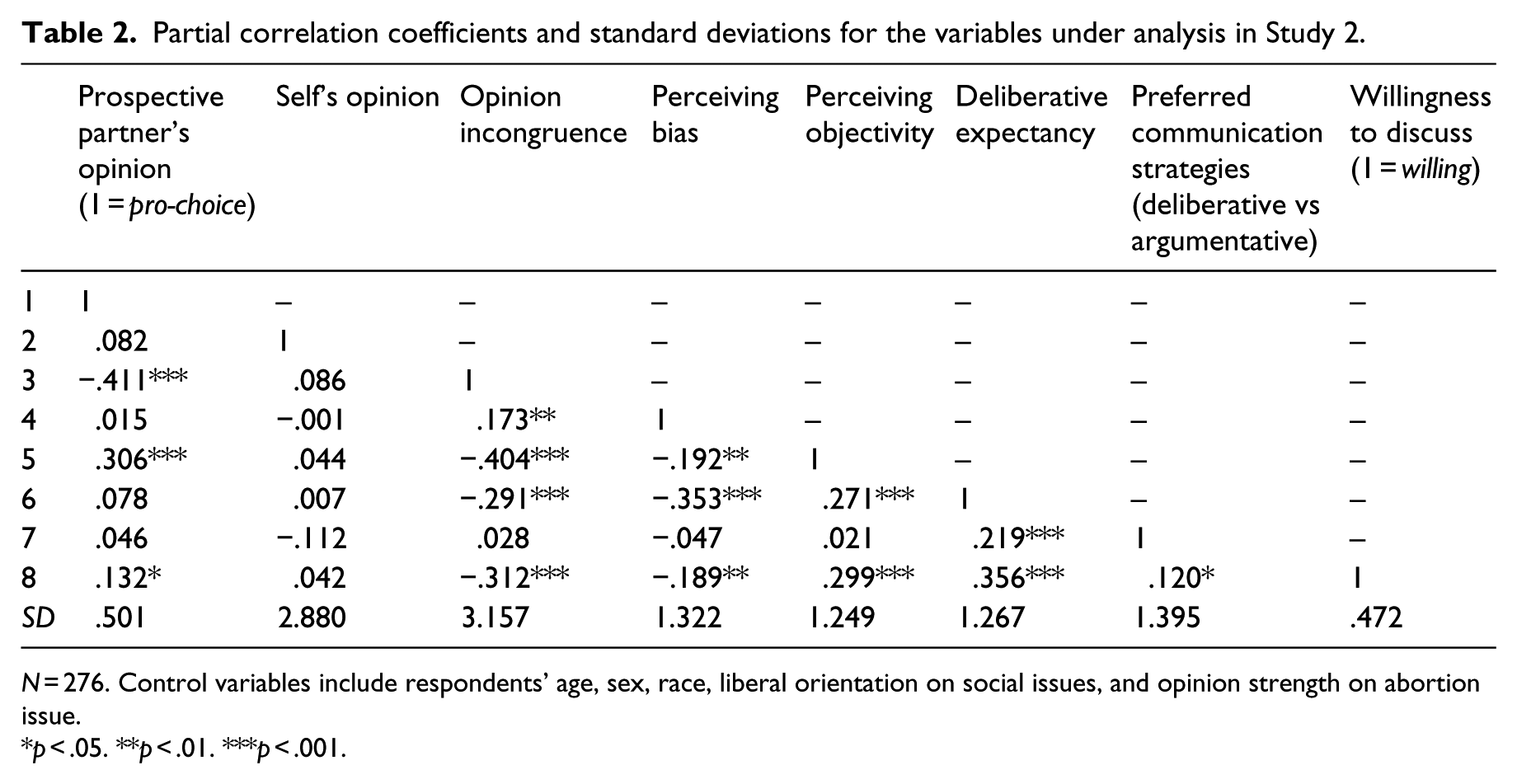
N = 276. Control variables include respondents’ age, sex, race, liberal orientation on social issues, and opinion strength on abortion issue.
p < .05. **p < .01. ***p < .001.
In Model 1, the final outcome, relative preference for deliberative over argumentative strategies, is measured on a continuous scale. It was feasible to estimate it in AMOS 17.0 using the maximum likelihood estimation. But in Model 2, the final outcome, willingness to be teamed up with the prospective partner, is a binary variable. We estimated it in MPlus 7 with WLSMV (weighted least squares means and variance adjusted) estimation (Muthén, 1993). Slight differences produced by different estimators would not change the substantive inferences to be drawn from the results. The two figures depict the final accepted models. 6 The fit statistics presented below each model suggest that both models fit the data very well. Table 3 presents the parameter estimates from the two final models, with both direct and indirect effects for each variable.
Total, direct, and indirect standardized estimates for the path models.
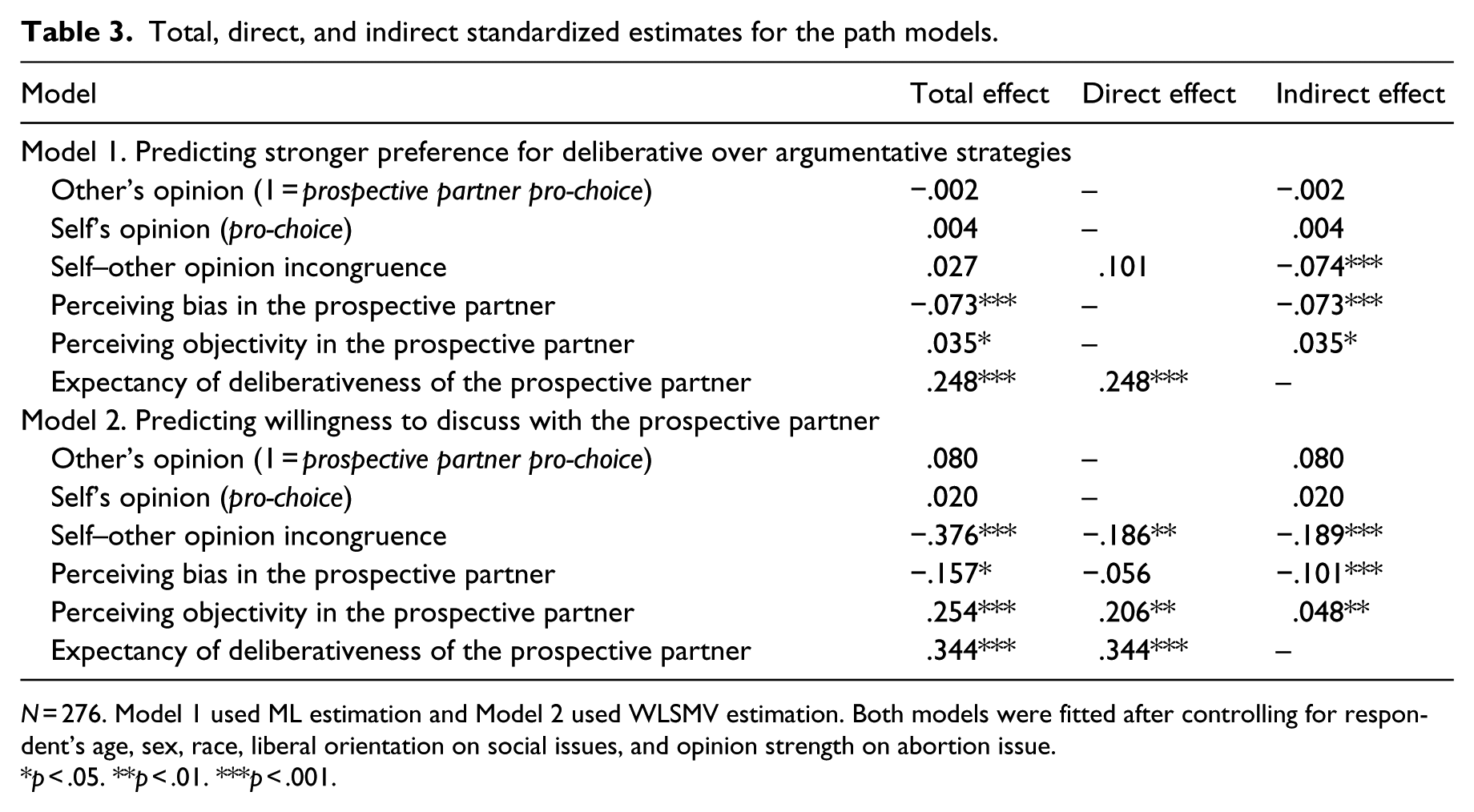
N = 276. Model 1 used ML estimation and Model 2 used WLSMV estimation. Both models were fitted after controlling for respondent’s age, sex, race, liberal orientation on social issues, and opinion strength on abortion issue.
p < .05. **p < .01. ***p < .001.
Effects of opinion incongruence
The path analysis results showed significant direct effects of opinion incongruence between self and the prospective partner on participants’ perceptions of the opinion holder. Individuals tended to make less benign attributions of objectivity in the person’s reasoning if participants did not share his or her view (β ranged from −.345 to −.400, p < .001). Conversely, the knowledge that the prospective partner held an opinion incongruent to their own would lead individuals to infer more bias in that person’s reasoning (β ranged from .170 to .221, p < .001). The results provided a robust support for H1.
The direct effects of self–other opinion incongruence also extended to individuals’ expectancy of their partner’s deliberativeness in a forthcoming discussion. The two models yielded slightly different estimates (β = −.184, p < .01 from Model 1 and β = −.178, p < .001 from Model 2) due to different estimation procedures. Furthermore, as shown in Figure 3, opinion incongruence would also directly reduce participants’ willingness to join the prospective partner to discuss the issue of their disagreement (standardized Probit coefficient = −.186, p < .01). In terms of direct effects of opinion incongruence on deliberation preparation, the findings produced clear support for two of the three effects hypothesized in H4. The component concerning the effect of opinion incongruence on strategy preference was not supported (Figure 2, β = .101, n.s.).
Mediation by perceptions of others
Hypothesis 5 stated that individuals’ perceptions of the opinion holder as being biased (H5a) or objective (H5b) would mediate the effects of self–other opinion incongruence on expectancy of deliberativeness of the person, willingness to be in the same discussion forum with the person, and preferences for deliberative over argumentative strategies, if in a discussion with the person. As shown in both Figures 2 and 3, perceptions of one’s discussion partner mediated the effects of self–other opinion incongruence on expectancy of the partner’s likely deliberativeness. A detailed calculation based on ML estimates in Figure 2 showed that the two perception variables mediated about 38% of the estimated total effect of opinion incongruence on expectancy (Total indirect effect = −.113, p < .001). Perceptions of bias or objectivity in a prospective partner each contributed about half of that mediating effect. It seemed that while perceiving a person as being objective in reasoning contributed to a stronger expectancy of that person being deliberative in discussion, learning that the person held an opinion incongruent with one’s own would lower the perceived objectivity. This same person would be viewed as being more biased in his/her reasoning and such a perception would lower the expectancy of the person’s tendency of deliberativeness. The results shown in the figures also made it clear that the two perception variables functioned as significant mediating venues for the effects of self–other opinion incongruence to pass along to strategy preference and willingness measures and their mediating roles were in the predicted direction. 7 Both H5a and H5b were thus supported.
Mediation by expectancy
Hypothesis 6 predicted that participants’ expectancy of deliberativeness of the opinion holder would further mediate the effects of perceptions of the person on their willingness to discuss with the person and on their relative preference for deliberative over argumentative strategies. Both elements of the hypothesis were supported. Figure 2 shows that expecting greater degrees of deliberativeness in a prospective partner would enhance participants’ preference for deliberative over argumentative strategies in an anticipated discussion with the person (β = .248, p < .001). Furthermore, participants’ expectancy of the prospective partner fully mediated the estimated total effects of perceptions of the other on communication strategy preference. Also consistent with H6, as shown in Table 3, the indirect effects of two perceptions operated in opposing directions (β = −.073, p < .001 for perceptions of bias; β = .035, p < .05 for perceptions of objectivity).
Figure 3 shows that expecting the prospective partner to be deliberative led to a greater willingness to have the person as their discussion partner in a forthcoming forum (standardized Probit coefficient = .344, p < .001). In addition, such expectancy also operated as a significant gateway for the effects of perceptions of the prospective partner. But different from Model 1, as shown in Table 3, expectancy did not mediate all the effect of perceived bias (standardized Probit coefficient = −.101, p < .001, 64% of the estimated total effect) and the effect of perceived objectivity (standardized Probit coefficient = .048, p < .01, 19% of its estimated total effect). Thus, a considerable portion of the effect of perceiving the prospective partner as being objective went directly to individuals’ increased willingness to be in the same discussion forum with that person (standardized Probit coefficient = .206, p < .01).
By estimating the two path models, we showed that self–other opinion incongruence would generate causal impacts on a series of moments of cognitive preparation to shape internal posture for an anticipated deliberative encounter. Perceptions of the opinion holder and derived expectancy of that person in an anticipated discussion functioned as key gateways for such an impact to pass along. These findings are likely more robust than what are shown in our study because in our study, neither perceptions of bias in others nor preference for argumentative strategies were measured with desirable levels of reliability. Based on the findings, we could imagine how partisans, entrapped in their bias blind spot, might choose to act in ways that would amplify their differences, harden their respective resolves, and enlarge the divide between them. Our results also indicate that these interpersonal and aggregate-level outcomes (see Sunstein, 2003) likely flow through the gateway of partisans’ intrapersonal perceptual construal of one’s prospective discussion partner. Clearly, such inferences based simply on the partner’s opinion are likely unwarranted and need corrections with the aid of some external mechanisms.
General conclusion and discussion
The impetus for this article was to join the efforts toward connecting the normative and empirical literatures on deliberation (e.g. Chambers, 2005; Thompson, 2008). Such efforts have led to burgeoning research on the effects of everyday talk, deliberation forums, social network characteristics, and other “intervention” or “input” variables that are inspired by the theory of deliberative democracy on a wide range of democratic outcomes (Barabas, 2004; Huckfeldt, Johnson, & Sprague, 2004; McClurg, 2006; Mutz, 2006; Stromer-Galley & Muhlberger, 2009; Sulkin & Simon, 2001; Wyatt, Katz, & Kim, 2000). Even though empirical research so far has shown promising evidence that individuals’ deliberative engagement produces cognitive and civic virtues (Burkhalter, Gastil, & Kelshaw, 2002), it has also demonstrated that obstacles for democratic deliberation are rampant and that the democratic outcomes in either more enlightened policies or competent citizenry are far from certain (Mendelberg, 2002; Mutz, 2006; Ryfe, 2005). Deeply rooted conflicts could easily derail a well-intended deliberative exercise and exacerbate rifts between different ideological camps (Mendelberg & Oleske, 2000; Sunstein, 2003; Wojcieszak & Price, 2010).
If, however, as James Bohman (2003) contends, “conflict is exactly what deliberation is about” (p. 87), then empirical studies on deliberation processes must pay particularly close attention to how conflicts may operate and how to incorporate them into the institutional designs to prepare individuals for discussions with those who are holding different views, guard the core democratic values, and preserve genuine pluralism and diversity (Bohman, 2007; Fung, 2011; Goodin & Dryzek, 2006). With this in mind, we designed these studies. Different from most studies in the extant literature, ours focused on the process before actual deliberation took place.
Furthermore, we proposed a perception-based model of an intrapersonal process through which individuals prepare themselves for a deliberative encounter. This is a process built upon the theoretical insights of naïve realism. It postulates that individuals’ correct decoding of a person’s opinion may be a start of a potentially treacherous path. This path is egocentric in nature in that it is built on individuals’ biased construal of self and others in a comparative framework. Paraphrasing Pronin, Puccio, and Ross (2002), such “biases fuel enmity” (p. 636). That is to say, colored by their biased construal of biases, individuals’ preparation for an anticipated deliberation is likely to fall far below the normative expectations of being open-minded, being ready to change one’s existing opinions in light of new information and/or better arguments, assessing facts and reasons with some known and shared standard, and communicating with others with respect and fairness.
Our results show that, without the assistance of any information from one’s social network, such as social closeness and affective affiliation (Mutz, 2006), someone’s openly stated opinion could be sufficient for individuals to infer how biased or objective the opinion holder is. Such speediness in drawing inferences is not new; it has long been recognized as a trademark of our much-warranted reliance on our intuitions (see Kahneman, 2011). However, we demonstrate that such inferences color their expectancies of, or more broadly, readiness for, an anticipated deliberation with that person. Worse, according to the logic of naïve realism, individuals tend to be unaware of their own biases and their own susceptibility to various biases they readily impute to others (Ross & Ward, 1996). These results here demonstrate that such a “bias blind spot” could be a tenacious cognitive entrapment. Moreover, freeing oneself from this entrapment would require extraordinary efforts; presumably, individuals may only get better through repeated positive experiences from participating in deliberation. This is particularly the case in situations where a controversy is historically entrenched and emotionally charged (e.g. Mendelberg & Oleske, 2000). Our studies also provide theoretically telling evidence on how to gain more freedom from such an entrapment: a minimum degree of positive inferences about others not only is possible but also can go a long way for deliberative engagement.
Viewed in this light, the findings from our studies suggest that, beyond correctly decoding different viewpoints, a much more demanding task involved in “hearing the other side” (Mutz, 2006) is for us to be self-reflexive in appreciating others’ perspectives and reasoning as well as recognizing our own bias and susceptibility to various biases in common perceptions and inferences. We need to assume that most others, including our adversaries, are as reasonable and logical as ourselves in forming their opinions. And when they respond to the world in ways that differ from us, we should, and need to be able to, suspend the presumptions that others are not as fair, objective, and well intended as we are, and that having their life experiences inform their opinions is less valid than it is undoubtedly the case in our own opinion formation. This is a critical ingredient in Bohman’s (2003) arguments for a “deliberative conception of toleration.” It is also a critical element in what Knops (2006) calls a “reflexive mechanism” to realize the “emancipatory potentials” of democratic deliberation. Our study presents evidence that such normatively desired orientation does not arise naturally for individuals. Thus, aside from systemic constraints that sociologically inclined scholars have pointed out (e.g. Parkinson & Mansbridge, 2012), democratic deliberation will also be limited by the extent to which we as citizens recognize and act upon our own fallibility and corrigibility. As a practical matter, future research needs to examine what kinds of intervention and education programs may help induce such reflexivity.
Limitations
There are several considerations we want to highlight in order to place our findings in a more nuanced theoretical context. First, both our studies are based on small experiments with undergraduate student participants operating in a highly contrived laboratory setting. That being said, we believe that our design and methodology are suitable to fulfill our goal of testing the psychological mechanisms that underwrite the effects of opinion incongruence on deliberation preparation. A demographically representative sample of individuals acting as citizens in a real deliberation forum would necessarily reveal a more complex picture. Yet, it is likely that the basic mechanisms that connect self-anchored perceptions, expectancies, and behavioral preferences will underlie such a real-world picture. 8
Second, it is possible that in real-world discussions, participants might know more about their discussion partner in addition to that person’s opinion on an issue. Nevertheless, the way we set up our experiments represents a possible scenario that is characterized by minimal amount of shared information, as it is often the case in real-world deliberation situations or in the kind imagined for large-scale democracy (e.g. Fishkin, 2009). In such situations, fellow citizens who are strangers to one another come to a discussion forum where self–other opinion differences may loom larger than warranted in affecting individuals’ readiness for future deliberation. Having said that, we recognize that our study design does not fully capture a carefully orchestrated deliberation forum (e.g. Fung, 2011) or even most social interactions where far more information on discussion partners, tasks for discussion, settings, and so on is readily available. Therefore, we cannot speak to how other kinds of information might impact the inferences that individuals draw about their discussion partners and how they would form expectations of discussion with their partners. Clearly, future research should address these issues. Furthermore, we also recognize that without data on individuals’ performance in actual deliberation, we are not able to render any judgment about how the bias blind spot will interact with other factors in shaping the dynamics of an actual deliberative discussion or whether biased perceptions of bias will be perpetuated in the discussion process. However, in our view, this should not vitiate the connection we draw between perceptual bias and deliberation, unless someone is holding a narrow conception of deliberation and questioning the value of studying predeliberation process. Being focused on this predeliberation phase, our investigation is meant to start a programmatic effort toward examining how the self-referent process of drawing inferences about others and forming expectations would play out in and shape deliberation dynamics.
Third, while we focused on the cognitive aspect of individuals’ perceptions of bias in others, past research suggests that seeing others as being biased also involves the widely documented self-enhancement motive (Kwan, John, Kenny, Bond, & Robins, 2004). The cognitive and motivational processes could operate jointly to shape individuals’ perceptions of others and deliberative expectancy. To complicate the matter further, it is possible that being motivated by good intentions may not be sufficient for people to overcome cognitive shortcomings (Kruger & Gilovich, 2004). Thus, future research also needs to examine the potential interaction between the cognitive process of egocentric reasoning and that of the self-enhancing motive. We also recognize that under certain conditions, people can be motivated to open to disagreement and to see others in the same light as themselves (Cohen et al., 2007) even though the process is difficult and the end result often inadequate (Epley, Keysar, van Boven, & Gilovich, 2004). In other words, the tenacity of the bias blind spot as a barrier to deliberation could be mitigated to a consequential degree.
Finally, the way we set up and estimated the causal models in Study 2 has been partly built into the study design. For example, we hypothesized and showed that individuals’ expectancy of the prospective partner’s deliberativeness mediated the effects of perceptions on their willingness to deliberate and the potential strategies they would prefer more. These hypotheses did not imply that it is only possible for such expectancy to be a pathway to willingness or strategy preference. It is entirely possible—and might be actually be the case—that there are other unobservable mediating mechanisms that have been missing from our analysis, which challenge the results of our study. Despite the fact that we implemented statistical controls, without experimentally manipulating the mediating variable, interference from unobservable factors could not be eliminated (Bullock, Green, & Ha, 2010). We also fully recognize that in real-life situations, the different factors specified in our models are likely to occur in a simultaneous and intertwined fashion reinforcing one another. What we presented in our models only depicted one particular mechanism that could happen in reality. As Bullock et al. have argued, the best inference about mediating mechanism can only be derived from a cumulative set of research projects. We take our study as a start to this process.
While these nuances and obvious limitations in our studies resulted from homogenous samples, laboratory settings, and less-than-satisfactory measures, the results have nevertheless pointed out an important area that future research on democratic deliberation should not ignore. The perceptual processes through which individuals render inferences about themselves and others, and the resulting attributions they make about themselves and others are indispensable ingredients in individuals’ mental milieu that shapes their deliberative practices. A better understanding of them can shed light on our endeavor to bring people into more open, inclusive, and fruitful deliberation.
Footnotes
Acknowledgements
The authors wish to thank Zhongdang Pan for his feedback on the design of the materials and helpful comments on the article.