




Abstract
While we so commonly frame our public/civic wounds as past (or passed), we are used to talking about healing and mending existing wounds. This language also affects how we conduct deliberative discourse around current crises. However, I am more curious about the wound’s future. Specifically, I want to explore the wound’s future as it emerges in two different types of deliberation: prescriptive deliberation and descriptive deliberation. Rather than seeing the wound (only) as something that has already happened, or even as something that lingers on into the present, I want to address the wound’s future: a tactical future-oriented rhetoric that creates a broader deliberative practice.
“I love ignorance of the future.”
Sometimes it is hard not to notice how much public discourse sounds like the language of a sidewalk psychic, complete with predictions and prognostications about the future. While psychics read your palm and tell you about a new love on the horizon, contemporary public rhetoric tends to read the global landscape and rattle off predictions about future publics on the horizon. Ever since Aristotle first described the future as a commonplace of fact, we have come to see future-oriented topoi as serving a number of rhetorical purposes. Importantly, Aristotle identifies the future as the primary concern of deliberative discourse, practiced by assemblymen and politicians: “The political orator is concerned with the future: it is about things to be done hereafter that he advises, for or against.” Deliberative discourse calls upon the future as a response to present political crisis.
While they are not typically grouped together, a good psychic is every bit as rhetorically skilled as a political orator. The professional psychic’s use of “Barnum statements” involves particular techne, as the seer crafts statements that sound specific to one individual though the statement could apply to almost anyone: You have experienced some significant changes in your life. There’s a particular person you felt very close to as a child. You tend to be fairly social, but you also have moments when you withdraw into yourself. Then again, even the best psychics get misses sometimes. Maybe the reader gets a little cocky and goes out on a limb: You recently got some bad health news. You recently changed jobs. When met only with a blank stare, a good psychic recovers with the help of timely topoi: This will probably make more sense to you in the near future, so watch for it to come true. And just like that, the future is captured in service of the present. The future is a psychic’s ultimate tool.
Skilled psychics also dabble in the past, which rhetoricians categorize as the judicial realm. As she lays down your cards, a reader sees how past traumas explain your present or even your future. Of course, we usually associate these types of readings with psychotherapists more than storefront psychics. About once a week, my shrink helps me see certain habituations that took root quite early in my life. These are the habits that Past Jenny started and Present Jenny continues. Like the professional psychics whose readings cost almost as much as my therapy co-pay, I am capturing the future in service of the present.
Therapists, psychics, and political orators are strange bedfellows, bound together through a common concern for the past and the future. Yet, they are also bound together through another common concern. In their own ways, these figures are interested in wounds of various kinds, whether personal, psychic, or civic. Wounds themselves possess an interesting relationship to time, though we tend to largely frame wounds as past. We glibly toss off the phrase “Time heals all wounds,” and, indeed, wound tissue eventually turns into scars (as long as it doesn’t turn necrotic). After enough time, we pronounce the wound healed. The wound is often narrated as past (or passed), even when not necessarily referring to linear time.
However, the wound is more than a commonplace. Perhaps more than any other writer, Georges Bataille (2004) ponders the wound in its communicative potential. The wound speaks, according to Bataille. Or, more to the point, the wound allows for speech. He describes Christ’s mortal wounds, for example, as that which tore open an exposure between God and humans. “It looks as if creatures couldn’t communicate with their Creator except through a wound that lacerates integrity,” he writes. Indeed, “‘communication’ can’t take place without wounding . . . our humanity.” Yet, even in Bataille’s writing, the wound is already past. As Michael Greene (1995) remarks, “To read Bataille is to have a feel for what it is like to be dealt a mortal wound, or more precisely, to be struck by an already mortal wound” (p. 102). Although communication begins with the wound’s rupture, at least for Bataille, the wound always references a wounding that has passed.
Because we so commonly frame the wound as past (or passed), we are used to talking about healing and mending existing wounds. However, I am more curious about the wound’s future. Specifically, I want to explore the wound’s future as it emerges in two different types of deliberation: prescriptive deliberation and descriptive deliberation. Although I have elsewhere made a case for sensational prescription (see “Pathologia”), what follows here takes a different approach to prescription and description where the wound is concerned. Rather than seeing the wound (only) as something that has already happened, or even as something that lingers on into the present, I want to address the wound’s future: a tactical future-oriented rhetoric that creates a broader deliberative practice.
An ethics of the future
There is a solid distinction to be made between “things to be done hereafter” and discourse that merely calls upon the future as a topos. In “Toward an Ethics of the Future,” Jerome Binde (2000) argues that “an ethics of the future is not an ethics in the future” (p. 56; my emphasis). Binde is particularly concerned with the efficacy (and ethics) of short-term fixes to public problems versus long-term thinking that looks beyond immediate consequences. “Devising any durable response to human problems such as environmental ones requires looking at a situation from a distance and thinking in terms of the future,” he writes (p. 52). For Binde, an ethics of the future requires us to stretch our present deliberations in ways that consider how current (in)actions will affect the future.
An ethics of the future means no more kicking the can down the road. No more plans to talk now, act later. Binde (2000) calls for us to adopt “an attitude of mind that consists in viewing the future not as a hidden reality that could be discovered through the use of appropriate scientific methods, but rather as either the deliberate or the unintentional result of our actions” (p. 55). In other words, the future must be wrestled away from fortune tellers who claim to see an already written future. As Binde (2000) argues, “An ethics of the future, if it remains an ethics in the future, is an injustice committed against all generations, present and future. To paraphrase a common saying, the future delayed is the future denied” (p. 57).
Binde’s ethics of the future underscores the importance of how we talk and deliberate about the future. Speaking about futures directs our rhetorical energies, making certain scenarios vivid while others fade into the background. As Dick Hebdige puts it: If we are to begin really exploiting the actively performative (not just referential) functions of communication, then the various ways in which different futures are imagined will themselves be something we must think about. We shall have to explore how particular discursive strategies open up or close down particular lines of possibility; how they invite or inhibit particular identifications for particular social fractions at particular moments. (qtd. in Dunmire, 275)
Likewise, Patricia Dunmire (2005) argues that we must pay attention to “the efforts of dominant political actors and institutions to project their assumptions and visions of the future as universal and as grounded in common sense,” as well as “the ways in which ‘the public’ is implicated in these projections of the future and in the discursive and material processes by which they are realized” (p. 482). When institutions define a vision of the future, we should be relentless in asking what this vision invites or fails to invite.
Although Dunmire downplays contemporary religious discourse, Christian evangelical discourse illustrates her point particularly well. Constant references to “future glory” instruct evangelical believers on how to act in the present. Environmental disaster is likely to seem a limited threat if Christ is indeed returning soon. And those who suffer now—perhaps through famine or wars—will ultimately be rewarded in Heaven, making their suffering almost a virtue. Our inaction on earth is not a crisis if our “earthly home” is only temporary.
Binde, Hebdige, and Dummire thus warn against ideologies that come preloaded in certain versions of the future. Yet, there remains a more pervasive ideology at work even in these critical future-oriented discourses. We might note how rhetorical topoi of the future are strongly rooted in ideologies of progress and predictability. This seems especially to be the case where civic wounds—points of political crisis and exigencies—are concerned. The future becomes interchangeable with a vision of progress; what is broken now will eventually be healed (if we do the right things). As Gina Ercolini and Pat Gehrke (2013) write, such discursive framework narrates “the future [as] an extension of the present-progressive,” expanding the now into a modified form (p. 159). The future is simply now+.
More significantly, this framework assumes two things about wounds. First, a present-progressive account assumes that we (can) fully comprehend the exact nature of our wounds; we can account for the extent of our own woundedness as it exists right now. Second, a present-progressive account assumes what the state of that wound will be in the future. That is, claims about the future imagine that the wound will eventually be healed, at least enough for future publics to reflect on the wound from a distance. Arguably, while such discourse works from a commonplace of “the future,” it remains what Felicitas Meifert-Menhard (2013) calls a “Past Narrative,” or discourse that narrates the future as it has already happened, much like a science fiction story set in the future but narrated in past tense. Past Narratives frame a present wound in the future—as what will be healed, as what will be resolved. They narrate a future that has already been (in some ways) written.
In contrast to Past Narratives, however, Meifert-Menhard (2013) poses Future Narratives, which “do not (necessarily) consider the future as a topic; they do, however, structurally stage the future as a space of possibility” (p. 2). Future Narratives frame the future as an unwritten space of pure potential. Indeed, rather than imagining the future as the (after)effects of our present causal actions, Future Narratives begin from the premise that futures are shaped by accidents, chance, and the indeterminable. They embrace a version of futures that Elizabeth Grosz (1998) describes as “the capacity of any future eruption, any event, any reading, to rewrite, resignify, reframe the present, to accept the role that the accidental, chance, or the undetermined plays in the unfolding of time” (“Thinking the New” 18). Consequently, Future Narratives evade rhetorics of the future that imagine an unbroken chain of temporal progression.
Writing scripts
Binde insists that his ethics of the future should not fool us into thinking we can control the future. He writes that an ethics of the future “involves neither foretelling nor prescribing the future, but preparing for it” (p. 65). Although Binde distances himself from a prescriptive ethics, I would argue that prescription is often central to our future-oriented discourses. To better understand exactly how prescriptive narratives shape our practices of deliberation, it is worth spending just a bit more time with this very idea of prescription.
In med-speak shorthand, prescriptions are “scripts,” a term that suggests some interesting connotations. The etymology behind prescription, or pre-scribere can be interpreted as “a writing before.” Delving a bit deeper, a pseudo-etymology might also highlight the way this word suggests a pre-scripted dimension: that which is written before this moment. In pre-scripted media scenes, for example, the lines, blocking, and narrative trajectory are all determined in advance. As any longtime “reality show” viewer can tell you, the overly determined episodes reflect the ways that the story’s beginning, middle, and end have already been scripted. The narrative is prescribed.
More than just etymological punning, however, the pre-scripted nature of prescriptions is serious business. In medicine, for example, researchers study how a doctor’s prescription can shape a patients’ experiences of their own symptoms. One dramatic instance of this phenomenon is reflected in the staggeringly high percentage of misdiagnoses in bipolar patients. According to one National Institutes of Health (NIH) study, patients with bipolar disorder are misdiagnosed close to 40%, and on average, it can take 7.5 years for them to be correctly diagnosed once they seek help for their issues. Quite often, bipolar patients are initially diagnosed with clinical depression and are treated with medication meant for people experiencing non-bipolar symptoms.
One explanation for this misdiagnosis is that doctors tend to only witness a patient’s depressive episodes, rather than their accompanying manic symptoms. Another contributing factor, however, is that bipolar patients themselves are eager to find hope in their doctor’s diagnosis, leading many of them to fit their symptoms to match the prescription’s target. This might mean downplaying manic episodes (They don’t happen that often; they aren’t really that extreme), or attributing manic behavior to other causes (The extremes mostly happen when I’m drinking or using drugs). Meanwhile, the symptoms targeted by the medication are overemphasized (I am withdrawn; I have been feeling sad). In other words, the prescription itself becomes a script that a patient follows, for better or worse.
Our tendency to fit symptoms to match a prescription is shockingly effective. Indeed, professional psychics rely almost exclusively on our ability to follow scripts. The well-known techniques of cold reading and Barnum statements are themselves forms of prescriptions: diagnoses in search of symptoms, which we eagerly supply. Just consider this reading I got after I turned over three tarot cards: death, sun, and the fool: Be prepared today for an event that might be rather painful. The card of Death, even when it’s moderated by the benign influence of the Sun, indicates the inevitability of a temporary separation or a breakup. You will have no other choice but to turn the page and close a chapter in order to sort out the affairs of the heart and get on the road to happiness. It does look as if there was no other solution. Maybe it’s best therefore to accept this transition and look to a brighter future. As far as work goes, the union of the Fool and Death seems to indicate that a contract or an important project is coming to an end, though you may not know what will follow it. You’re troubled by this uncertainty about the future, and find it difficult to imagine how you’ll bounce back. Instead of wallowing in doubt, regroup and look to the future with confidence!
None of this bodes well for me. But without much effort on my part, I can easily imagine what separation or breakup the cards foresee. I immediately know what chapter is about to close, though I do not look forward to it. There are changes coming from many different directions, as I am about to sell my house to move, become chair of my department, complete a book manuscript, plus more that I probably should not share here. All of this causes me great anxiety about the uncertain future.
And yet. I pause for a moment to reflect on the way this reading could apply to almost anyone. So many things can be read as the closing of a chapter or transition. Projects all come to an end eventually. All of us are uncertain about the future. This reading is little more than well-crafted Barnum statements that seem unique to me, though they are generic in all senses of the word. Regardless, the script scripts me (though perhaps only for a moment, before my inner skeptic steps up). Being scripted is particularly insidious, however, when we confuse the script for the future as it exists as pure potentiality. Pre-scriptions thus limit how we read both the future and the present.
Where physical, psychic, and civic wounds are concerned, we have good reason to track the ways that prescription works to shape our discourse and deliberations. I am particularly interested in how deliberative rhetorics themselves often act as forms of public or civic prescription. In the remainder of this short essay, I want to draw a distinction between prescriptive deliberation and descriptive deliberation. The discourse that I call prescriptive deliberation is familiar enough: a well-defined problem is articulated and various normative standards for the problem’s remedy are offered. Or, to put it more plainly: X is a problem, so let’s do Y or Z to fix it. I do not mean to suggest in any way that prescriptive deliberations are misguided or wrong, yet I do wish to call attention to the ways in which prescriptive deliberation is limited, especially in the case of civic wounds. One such limitation stems from the ways in which this discourse depends on an assumed “ownership” of the wound. That is, different publics position themselves as the authentic site of damage or pain. Consequently, when a public claims ownership of a wound, the prescriptions that follow tend to focus only on the problem as it has been articulated, defined, and narrated. Yet, following the Kenneth Burkism that “A way of seeing is also a way of not seeing—a focus upon object A involves a neglect of object B,” we should also note those dimensions of civic woundedness that remain un(der)articulated in such prescriptive deliberations
As an alternative to prescriptive deliberation, therefore, I want to explore the notion of descriptive deliberation. This deliberative process purposefully resists reading our civic wounds in any conclusive way. Instead, descriptive deliberation seeks to articulate and attune to different impacts that emerge from wound sites. In place of a tight problem/solution model that assumes causal progression, descriptive deliberation traces the effects, fissures, pressure points, or eruptions of a civic wound. Such acts of tracing have the potential to change what we invite and fail to invite in the future.
Descriptive deliberation can also potentially shift our sense of pathology as rhetorical method. While the wound is often articulated as a static site of injury, the rich etymology of pathology actually suggests woundedness as movement. Amelie Oksenberg Rorty (1984) argues that Aristotelian pathos should be defined as that which produces change in a body that would not otherwise experience such a change. Rorty (1984) writes, “Pathe proper are not qualities (poiotetes): they are relatively impermanent alternations in a thing, whose causal explanation usually lies primarily outside its nature” (p. 526). Our bodies (physical and civic) thus undergo temporary changes that manifest themselves in palpable ways. Pathe are the enactment of change. By describing and tracking temporary changes to our bodies—again, both physical and civic—we have the potential to identify points of rupture and emergence without necessarily scripting their past, present, or future. Description strategically forestalls conclusive prescription: we withhold from saying what the wound means and instead mark where the wound’s impacts and pressure points erupt.
By way of illustration, I briefly examine the deliberative discourse surrounding Supreme Court Justice Brett Kavanaugh’s congressional hearings. Specifically, I examine how certain public responses to Dr Christine Blasey Ford’s accusation of sexual assault acted as a form of prescriptive deliberation. Without undermining the importance of these responses, I argue that these prescriptive deliberations muted and erased other significant dimensions of this civic wound. To highlight the differences between acts of prescription and description, I also want to sketch one way in which descriptive deliberation can interrupt the scripts and invent new deliberative strategies.
Testimonial wounds
In the days leading up to Supreme Court nominee Brett Kavanaugh’s confirmation hearings, public discourse was saturated with talk about Dr Christine Blasey Ford’s accusation that Kavanaugh had sexually assaulted her years earlier. Ford testified in great detail about the attack she suffered at his hands. Her testimony was moving, and women across the country found her story resonating with their own experiences. When Ford’s accusations became public, the wound was framed quite differently by various publics. For some, the events were yet another incantation of rape culture, which normalizes violence against women and girls. Ford’s story became yet another testimony in the #metoo movement shaking up public life. For many women watching the Kavanaugh events, Ford’s treatment on social media (and by the President himself) was a reminder of old wounds still unhealed.
And then there were those who identified in the Kavanaugh case a very different sort of wound. His supporters angrily complained that Ford’s accusations were an unfair attack on Kavanaugh’s career. His reputation took a hit, a bash, a gash. Yet, it was not only Kavanaugh’s wound; his public attack witnessed the “woundedness” of all men, any man. This fed the belief that men and boys are being wounded from overzealous and “unfair” (to use the President’s preferred terminology) groups of angry women.
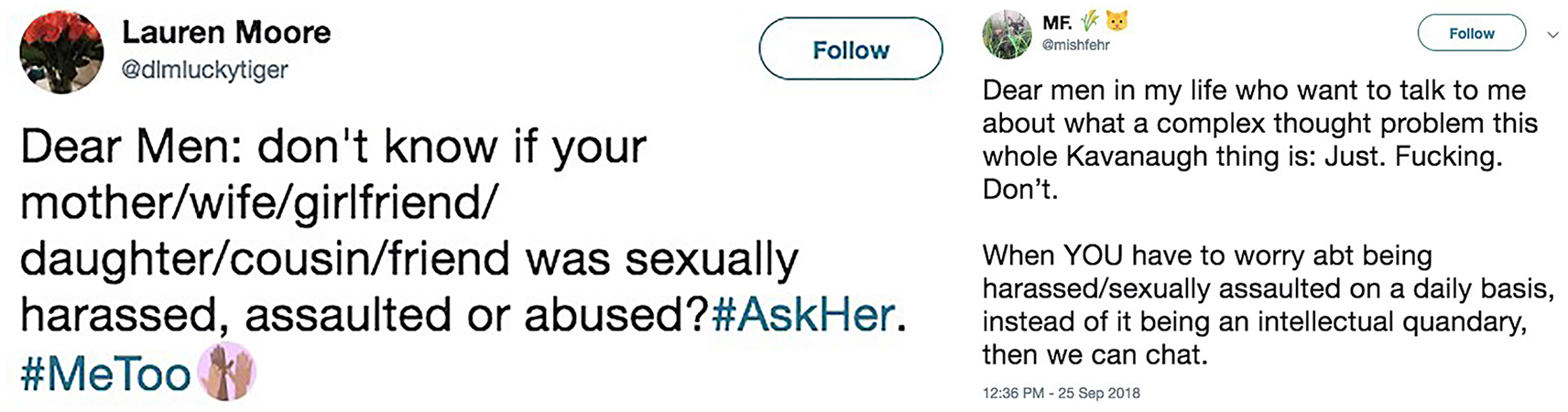
Not surprisingly, the ensuing discourse shaking out from all sides shifted from judicial discourse (Is he guilty of sexual assault? Does Ford actually remember these events?) to deliberative discourses (What do we do about a culture that enables sexual violence? How can men and boys protect themselves from unfair accusations?). As these conversations appeared in social media, however, they were often framed less as questions than as pedagogically oriented sets of prescriptions. For example, some writers who saw Ford’s accusation as simply one example of pervasive misogyny responded with social media posts instructing men and boys on how to address these issues. Online posts like Lisa O’Neill’s “Dear Men Who Wish to Be Allies to Women: 12 Things You Need to Know” provided recommendations for men in the moment of #metoo and the Kavanaugh hearing: Think about the space you take up. Don’t ask women to educate you on these issues. Ask women to share their stories with you. Countless “Dear men” social media posts similarly followed suit. Some called for men to ask women to share their stories of sexual violence, while other writers rejected this as a particularly toxic suggestion. Posts argued that men should listen more than they talk, hold themselves accountable, call out the bad culture, and “Just. Fucking. Don’t.”
On the other side, too, deliberations around the Kavanaugh hearings overwhelmingly deployed lists of “fixes” for male woundedness. Posts repeatedly instructed women on the “proper” ways to handle their sexual assault cases, including documenting with evidence and immediately reporting their attack to law enforcement. Meanwhile, Andrew Sullivan (2018) weighed in with a suggestion to simply curtail the #metoo movement. “The act of anonymously disseminating serious allegations about people’s sex lives as a means to destroy their careers and livelihoods has long gone by a simple name,” Sullivan (2018) writes. “It’s called McCarthyism . . . But I’ll tell you what’s also brave at the moment: to resist this McCarthyism” (“It’s Time). Echoing Sullivan, many posts similarly instructed women to stop publicly talking about their harassers. The consensus seemed to be that women are in need of some prescription.
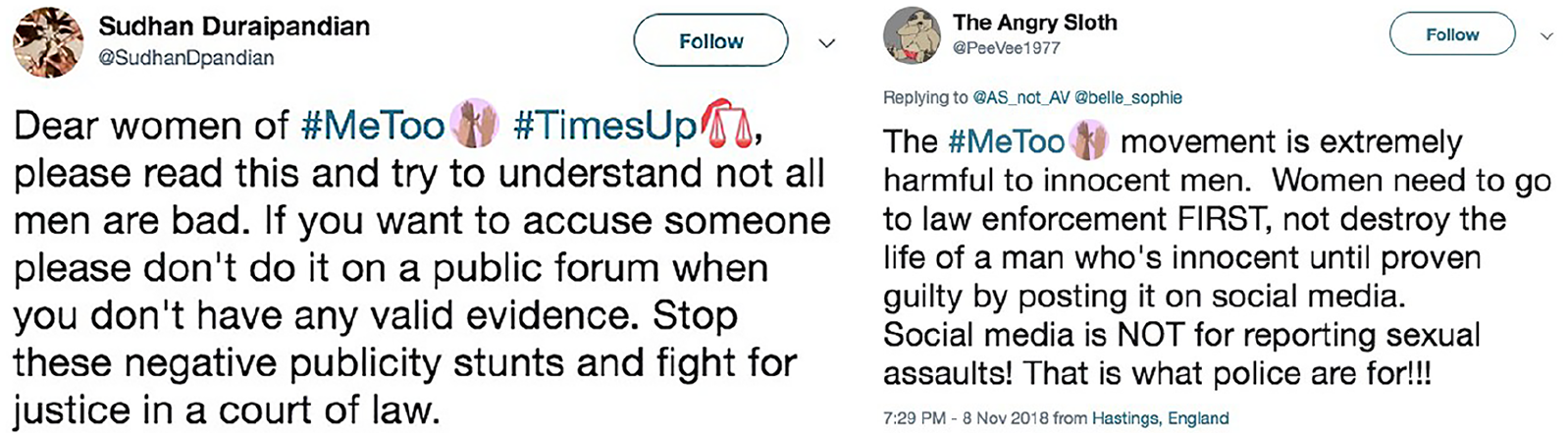
Although the “Dear Men” and “Dear Women” positions are worlds apart in terms of ideologies, they engage in a similar rhetorical practice that begins (and ends) with the articulation of a single, well-defined problem. It emerges from a singular focus on the wound. The scope of rhetorical deliberation is consequently limited to finding a remedy for this particular problem as it has been articulated. Once we identify that remedy, we have effectively written the future as past. We know (or we think we know) how the story ends. This is, of course, how we usually think of deliberation, and I do not want to suggest that we do not need prescriptive discourse in response to serious exigencies. However, by writing the future as past, we limit the potential for inventing new ways of seeing our sites of woundedness. Our deliberations contract rather than expand. Consequently, I want to offer the contrast of a descriptive deliberation. Whereas the goal of prescriptive deliberation is to find solutions or fixes for the wound, descriptive deliberation attunes to the impacts that emerge from wound sites. In such a process, we do not begin from a fully fully articulated or defined wound, but instead begin in the middle of an unstructured—or unscripted—experience of public woundedness.
For example, the Kavanaugh hearings clearly ripped open an infected fissure in the civic body. As we saw above, the wound was framed most often in terms of misogyny and toxic masculinity. That is, the problem is a system that supports sexism and the fix is, well, a number of things. Yet, pulsations of woundedness surrounding the hearings are not limited to this particular articulation. Consider how wounded pulsations occurred when a flier appeared on several college campuses depicting images of Kavanaugh surrounded by villainous caricatures of Congress members, all with the Star of David painted on their foreheads. The large text reads: “Every time some anti-white, anti-American, anti-freedom event takes place, you look at it, and it’s Jews behind it.” Ford’s image barely even appears on the flier, crowded out by the “evil Jews” who are clasping their hands greedily. The flier was produced and circulated by supporters of The Daily Stormer, an online white supremacist website. A Daily Stormer essay titled “Evil Jews Transformed the Kavanaugh Confirmation Hearing Into a Disgusting Circus,” spells out in greater detail what the flier is meant to signal. “From start to finish,” writes the author, Jews have been at the very center of this smear campaign against Kavanaugh. It is very important that people understand this. Anybody who is outraged over what happened to Kavanaugh should be directing their outrage at the parasitical Jewish race. (Rogers)

At the same time, President Trump aimed his hardline defense of his Kavanaugh directly at those who believed Ford’s accusations of sexual assault. Trump tweeted that the protesters who supported Ford are “paid professionals only looking to make Senators look bad” (October 8, 2018). When asked the obvious question of who was paying, Trump responded matter-of-factly that the protests were “paid for by Soros and others.” Trump’s mention of George Soros recalls a familiar anti-Semitic trope whereby certain Jewish names—the Rothschilds, for example—become code words for “Jews.” As Washington Post columnist Richard Cohen puts it, Trump’s comments may not have been “anti-Semitism by intent, but it is anti-Semitism nonetheless.” Moreover, Cohen continues, while Trump may not understand that he’s engaging in a long-standing anti-Semitic dogwhistle, “It matters not. Others do.”
Although I am someone who has researched and written about anti-Semitic rhetoric, I must admit that sudden appearance of white supremacist discourse felt at first like whiplash. We were talking about sexual assault and structural sexism—how did the Jews get dragged into this? The whiplash feeling quickly wore off, however, and was soon replaced with a different sense altogether. I cannot quite find the right vocabulary to describe this new sense, but if I had to invent a word that gets close, it would be “yokedness.” Sexism and white supremacy and me and them and us—we are yoked together. Both The Daily Stormer and Trump erased women’s visibility as subjects by using the tools of anti-Semitism. It was not Ford who was bringing forth allegations; it was the Jews. It wasn’t women who were genuinely angry with an oppressive system; it was the Jews.
In his insistence that the protesters were paid shills, Trump pointed to the “professionally made identical signs” that the groups of women (and some men) displayed. “Don’t fall for it!,” he writes in one tweet. The signs are “paid for by Soros and others. These are not signs made in the basement from love!” (October 5, 2018). Here is yet another eruption at the site of civic woundedness: women without the right kind of materials, the correct kind of documents to be taken seriously. Ford’s testimony was seen as worthless by many since, as one conservative blogger bluntly stated: “She has no facts, no corroboration, no medical report, no police report. There is nothing but a claim from a woman with a bad memory . . .” (Hawkins, “Five”). Alongside Ford’s dismissal, alongside the protesters’ dismissal, women responding to the #metoo movement by speaking out about their own experiences with sexual assault and harassment are regularly met with questions about documentation. Where are the records? Where are the notes? Where are the diaries? Where are the documents? At the same time, questions of documentation cut across the civic body in many ways. Undocumented migrants are left exposed because they have no “papers” to show. Undocumented women can no longer safely get help for sexual assault or domestic violence because laws protecting them have been rolled back in the Trump administration. These sites of woundedness reverberate and pulse across and between their own static contexts.
These various eruptions—white supremacy and weaponized bureaucracy—are certainly not the only ways to talk about the woundedness surrounding the Kavanaugh/Ford scene. Quite the opposite. They are merely two eruptions (among many others) flaring up on the civic body. In noting these two flare ups, I want to call attention to the ways that we cannot ever fully account for the wound as it has emerged or is emerging. We have no language (yet) to talk about what impacts these wounds will have. We do not know all the edges and emergences of this wound—even as it exists in the present. Because we do not and cannot completely account for the civic wound, therefore, our attempts to narrate what its “healing” entails is also likely to be insufficient. For example, by framing the Kavanaugh/Ford wound exclusively as a matter of rape culture or toxic masculinity, our deliberative energies are pre-scribed in certain directions. The script is delivered in advance.
Rather than fighting for ownership or issuing prescriptions, however, we might instead turn to the task of tracking the points of eruption across the entire civic body. What would happen if we approach civic wounds from the premise that we cannot fully comprehend the wound? What would it look like to engage in deliberative practices aimed at tracking, feeling, and describing symptoms without necessarily pre-scribing answers? Such expansive deliberation jettisons the script in favor of deliberative practices that do not determine exactly which elements are most important now—or will be important in the future. Again, this is not an argument in favor of somehow not deliberating about social exigencies. Neither it is an argument against trying to improve upon justice, equality, and the like. Rather, I merely wish to offer descriptive deliberation as a tactic, a rhetorical tool, for unscripting the wound’s future. May we follow Nietzsche in his declaration, “I love ignorance of the future.” It is only in the active process of encountering such ignorance that allows the future to exist at all.
