



Abstract
Nuanced studies have scrutinized the facilitative role of digital media in fostering political deliberation and in contributing to the prospect of democratization in (semi-) authoritarian societies. This study illuminates a less-explored facet of non-democratic contexts’ digital politics by shedding light on discourse quality in cyberspace. Guided by Gastil and Black’s analytical–social framework of deliberation, we propose an integrated analytical model comprising seven dimensions and employ a case study approach combined with supervised machine learning to analyze Chinese netizens’ digital engagement with the public policy of “delaying retirement age” on the popular Q&A platform. The findings reveal deliberative virtues—topic relevance, rationality, and civility—alongside a low presence of political alienation and minimal institutional alignment, suggesting generally strong analytical performance. In contrast, the social dimension, represented by argument reciprocity and transpositional consideration, remains weak, reflecting a lack of sustained interaction. Based on these empirical results, we coin the concept of the “solo of deliberator” to describe a pattern of online deliberation where analytical reasoning prevails while social engagement is subdued. Implications for deliberative democracy in non-democratic nations are discussed.
Introduction
From a normative perspective, deliberation has long been regarded as a cornerstone of democratic legitimacy and a well-functioning public sphere. Grounded in ideals such as reason-giving, mutual respect, and inclusive participation, deliberation is believed to foster civic learning, enhance collective decision-making, and support the development of informed publics (e.g. Fishkin, 1991; Gastil & Black, 2007; Gutmann & Thompson, 1996; Habermas, 1962/1989). Yet, its centrality has been increasingly recontextualized amid the proliferation of alternative forms of civic engagement, exemplified by hashtag activism, meme politics, and AI-enabled expressions like deepfakes (Halversen & Weeks, 2023; Wang, 2021). While these expressive modes provide immediacy and emotional resonance as meaningful forms of digital participation, their appeal often stems from technological accessibility and algorithmic amplification, tending to foreground affective engagement over sustained reasoning. In this light, deliberation remains distinctive for reinforcing the cognitive foundations of civic learning and enabling norm-guided dialogue within a media ecology fraught with misinformation, polarization, and hateful narratives (Landemore, 2017; Luskin et al., 2002).
An institutional perspective on deliberation foregrounds formal and structured mechanisms—such as citizen juries, deliberative polls, and mini-publics—that provide procedural safeguards and normative rigor (e.g. Fishkin, 1991; Mansbridge et al., 2012). At the same time, scholars have long recognized the deliberative potential of informal online discussions within digital spaces (Graham & Witschge, 2003). Despite their informality, such discussions may exhibit key deliberative features such as inclusiveness, reason-giving and argument reciprocity, particularly within issue-centered communities or participatory platforms (Dahlberg, 2001). Moreover, technological affordances of social media—such as interactivity, visibility, and asynchronous engagement—create new opportunities for deliberation-like processes to emerge, even under non-democratic settings (Freelon, 2013). These features allow users to exchange diverse viewpoints, perform issue-based argumentation, and engage in reflexive dialogue that approximates deliberative ideals.
Specific, in semi-authoritarian contexts, such as China, where formal political participation—such as voting, protests, and petitions—is either absent or suppressed, deliberation in digital spaces becomes one of the few viable avenues for political engagement. In thus, discussing political issues in online sphere “configures” rather than “complements” participatory democracy. It offers citizens the opportunity to comprehend political affairs and public policy, enables the public to detect and form “authentic” preferences in their everyday communication practices (Esau et al., 2020), as well as exerts pressure on the government to be responsive and accountable. However, to truly assess the effectiveness of these digital spaces in fostering deliberation, it is crucial to evaluate the nature of political discussions that occur within them. Without a detailed analysis of the quality of online discourse, it remains uncertain whether digitally-empowered participation might devolve into chaos, disorder, and extremism. If so, such decline could intertwine with decades-long propaganda and censorship in China, leading to further deteriorated communication ecology. Conversely, there is the possibility that such public discussion well act as an emerging “marketplace of viewpoints,” where the virtues of deliberative democracy are nurtured and valued.
While classical measures of discourse quality often assume a liberal-democratic environment where expression is relatively unconstrained, deliberation in semi-authoritarian regimes operates under distinct structural conditions. Public discourse is shaped not only by institutional constraints but also by citizens’ adaptive value orientations and moral reasoning formed within these systems. To capture these dynamics, this study builds upon Gastil and Black’s (2007) analytical-social framework and introduces seven indicators that better reflect how deliberation unfolds in such contexts. In addition to conventional dimensions—topic relevance, argument reciprocity, transpositional consideration, rationality, and civility—two context-sensitive supplements are incorporated: political alienation and institutional alignment, both reflecting how the political environment shapes citizens’ value orientations in public discussion and, in turn, influences the quality and meaning of deliberation. Together, these dimensions provide a more contextually grounded approach to assessing discourse quality beyond liberal democracies. Drawing on online discussions surrounding China’s “delayed retirement age” policy on a popular Q&A platform Zhihu, the study empirically examines how these dimensions manifest in practice.
Deliberation Theory: From Normative Ideals to Analytical–Social Processes
As a cornerstone of democratic communication, deliberation provides a mechanism through which citizens exchange reasons, negotiate values, and collectively form judgments about public affairs. Over the past decades, it has been theorized through multiple traditions, each illuminating distinct normative, institutional, and psychological dimensions of collective reasoning (e.g. Fishkin, 1991; Gutmann & Thompson, 1996; Habermas, 1962/1989; Mansbridge et al., 2012; Mercier & Landemore, 2012). More specific, at the normative–moral foundation, Habermas (1962/1989) and Gutmann and Thompson (1996) conceptualized deliberation as a communicative and ethical practice oriented toward reason-giving, reciprocity, and mutual respect. This ideal of communicative rationality defines what deliberation ought to achieve in democratic life, yet its realization depends on institutional preconditions that may not be universally attainable. To address this limitation, Fishkin (1991) and Mansbridge et al. (2012) shifted the focus toward institutional and systemic processes. Fishkin’s procedural model operationalizes political equality and informed participation through deliberative polling, while Mansbridge reconceptualized deliberation as a distributed communicative function that spans citizens, media, and institutions. Extending this logic beyond institutional settings, Mercier and Landemore (2012) reframed deliberation as a cognitive mechanism of social reasoning, proposing that argumentative interaction enables epistemic learning when diversity and disagreement are present.
Building on this cognitive–communicative turn, this study follows the analytic–social paradigm of deliberation proposed by Gastil and Black (2007), which bridges the cognitive and relational foundations of public reasoning. In this framework, deliberation comprises two interdependent dimensions: an analytic process that centers on reasoning and evaluation, and a social process that emphasizes communicative ethics and mutual respect. The analytic dimension involves creating an information base, identifying relevant values, generating and weighing alternative solutions, and arriving at reasoned judgments. The social dimension concerns the interactional norms that sustain inclusive participation and mutual understanding, including equal speaking opportunities, attentive listening, and recognition of others as sincere and competent interlocutors. These dimensions operate in tandem, ensuring that deliberation remains both epistemically rigorous and socially cohesive.
The intertwined analytic and social processes also provide a conceptual foundation for evaluating deliberative quality. Empirical studies have operationalized these ideals through a set of norms and elements, including inclusiveness, reciprocity, exposure to disagreement, reason-giving, respect, and tolerance (e.g. Cappella et al., 2002; Coe et al., 2014; Friess et al., 2021; Thiele & Turnšek, 2022), and examined their realization in online environments. Some studies suggest that digital platforms expand opportunities for encountering diversity and mutual understanding, whereas others highlight the prevalence of incivility and homophily that may undermine deliberative exchange. Furthermore, to systematically capture how these deliberative features emerge across different communicative settings, a range of frameworks has been developed, such as the Discourse Quality Index (Steenbergen et al., 2003) and the Index of Quality of Deliberation (Klinger & Russmann, 2015).
Index of Deliberation Quality in the Non-Democratic States
Existing indices on deliberation have provided valuable tools for assessing both the rational–argumentative and the interactive–relational dimensions of public discourse. However, most of these frameworks were developed within democracies, and their applicability to semi-authoritarian environments remains underexplored. In such contexts, where formal channels of participation are constrained, online discussions often become one of the few spaces in which citizens articulate opinions, negotiate values, and engage in collective reasoning. At the same time, deliberation in semi-authoritarian contexts may exhibit distinctive features not captured by existing indices, reflecting the influence of institutional constraints on citizens’ reasoning and interaction. To address this gap, the present study develops the Index of Deliberation Quality in the Non-democratic States, drawing on Gastil and Black’s (2007) analytic–social framework to capture both cognitive evaluation and social coordination. We identify seven interrelated indicators that extend existing measures of deliberative quality to account for the distinct dynamics of semi-authoritarian contexts (see Table 1).
Operationalization of Gastil and Black’s (2007) Deliberative Processes in China.

The analytical process concerns how individuals reason through issues and make evaluative judgments. Within this dimension, topic relevance corresponds to Gastil and Black’s (2007) notion of creating an information base, capturing the extent to which participants ground their discussion in issue-related knowledge. Rationality aligns with identifying and weighing solutions, reflecting the logical coherence and evidence-based evaluation of competing arguments. Two additional indicators—political alienation and institutional alignment—extend Gastil and Black’s element of prioritizing key values to the semi-authoritarian context. Political alienation denotes the detachment from public value engagement, representing a weakened sense of collective responsibility in political reasoning. Institutional alignment refers to the over-internalization of state-sanctioned values, indicating that participants’ moral and evaluative standards are constrained by institutional legitimacy rather than pluralistic deliberation. Together, these two negative features reveal how value prioritization can be distorted in semi-authoritarian settings, either through disengagement or conformity.
The social process dimension captures the relational quality of interaction: argument reciprocity corresponds to mutual comprehension, reflecting dialogic responsiveness and the effort to understand opposing arguments; transpositional consideration parallels consideration, indicating the ability to take others’ perspectives; and civility aligns with respect, measuring participants’ adherence to norms of politeness and mutual recognition.
Indicator 1: Topic Relevance
Topic relevance is the first dimension under the analytic process of deliberation. Normatively, it signifies the cognitive discipline that underpins analytic deliberation. It reflects participants’ capacity to construct and share factual understanding, forming the informational base required for reasoned public dialogue.
We recognize that in some deliberative environments, digressive or tangential remarks may perform critical or reflective functions by broadening the interpretive horizon of discussion. However, this potential is seldom realized in China’s online sphere. The internet in the Chinese context is often theorized to function as a “safety valve” (MacKinnon, 2011), a digital domain for dissipating public dissent on issues like income disparity or corruption, thereby mitigating social unrest (e.g. King et al., 2013). Consequently, public discussions do not invariably adhere to the topic. A subset of individuals may exploit social media platforms as outlets for expressing generalized discontent, demonstrating minimal cognitive engagement with the specific issues under discussion. In this context, maintaining topical focus becomes a positive and necessary analytic quality, as tangential discourses detract from the primary focus and actively hinder the “creation of an information base” that Gastil and Black (2007) identify as essential for the emergence of serious, focused, and constructive deliberation.
Indicator 2: Rationality
Following the establishment of an information base (topic relevance), the analytical process moves to what Gastil and Black (2007) identified as its evaluative core: “identifying and weighing solutions.” This stage requires participants to do more than just state opinions; they must “brainstorm the solutions,” “recognize limitations,” and “weigh pros/cons.” Our second indicator, rationality, measures this observable behavior through which participants engage in this weighing process: rational argumentation. Rational argumentation is the cornerstone of this process, defined as “the provision of reasons for one’s claims rather than simply asserted” (Dahlberg, 2001). To “weigh solutions” in a deliberative sense, participants must justify why one solution is preferable, what its consequences are, or why a problem exists in the first place. Therefore, we operationalize this concept using Stromer-Galley’s (2007) approach, where rationality is measured by the presence of justification for an opinion. These justifications are the specific argumentative tools participants use, such as providing a solution to the problem, a consequence, an example, or further explanation. Following Stromer-Galley, our focus is on the presence of justification itself, not its quality or factual accuracy. 1 The presence of such rationality signals a move from simple assertion to a more solid (Stromer-Galley, 2007) and analytical deliberative act.
Indicator 3: Political Alienation
Gastil and Black (2007) identified “prioritizing key values” as another critical dimension of the analytical process, requiring participants to “explore the underlying public concerns” and “consider diverse concerns. (p. 8)” We contend that this dimension, being the framework’s most context-sensitive element, fractures into two opposing, non-deliberative poles within the semi-authoritarian context: political alienation and institutional alignment.
Political alienation directly operationalizes the absence of the “prioritizing key values” process, which is commonly linked with sentiments of inefficacy, powerlessness, and apathy (Thompson & Horton, 1960). When participants feel their actions are futile and they cannot influence socio-political outcomes (Finifter, 1970), they do not engage in the analytical work of “exploring underlying public concerns” or “considering diverse concerns” as Gastil and Black’s framework requires. Instead, they withdraw. Knobloch (2011) similarly identified these conditions—such as powerlessness and social isolation—as significant deterrents to deliberative democracy precisely because they “affect individuals’ knowledge and interactions” within the political process (p. 25). While political efficacy refers to a citizen’s perceived capacity to influence politics, “political alienation” encompassed not only this cognitive dimension (a sense of powerlessness) but also the crucial affective and motivational dimensions of apathy and disengagement (i.e. a lack of willingness to participate).
This “absence” of value engagement is particularly salient in China’s cyberspace. In a state where institutional channels for public engagement remain at a minimum level, individuals can feel great difficulty in exercising their political rights or exerting practical influence. This context fosters the widespread senses of powerlessness, inefficacy, and disengagement observed on China’s internet (Tang & Bhattacharya, 2011). As Shao and Liu (2019) illustrated, this alienation leads to a “politically indifference mass.”
Indicator 4: Institutional Alignment
In contrast to the absence of value engagement seen in political alienation, institutional alignment represents its monopolization. This indicator captures another primary distortion of the “prioritizing key values” process. Instead of participants “considering diverse concerns” (Gastil & Black, 2007) in a pluralistic manner, this dimension reflects the over-internalization of state-sanctioned values. In other words, institutional legitimacy, stability, or national obligation becomes the dominant or sole criterion for judgment, effectively silencing other public concerns. This alignment manifests in two primary forms. First, it can be a product of “manipulated consent,” where the state employs commentators (the “fifty-cent army”) or social bots to insert pro-regime content, artificially shaping the opinion climate. Second, it can be a genuine reflection of a solid mass base, as seen in the “voluntary fifty-cent army” (Han, 2015) or a “responsibility-oriented populist belief” (Guan & Yang, 2021), which emphasizes the individual’s obligation to the state.
Regardless of its origin—whether as genuine belief or strategic manipulation—institutional alignment fundamentally subverts the “prioritizing key values” process. It represses individuals’ critical reflections on diverse public concerns by promoting a singular, institutional value, which misleads the direction of public discourse and prevents the critical weighing of competing values that Gastil and Black (2007)’s analytical framework demands.
Indicator 5: Argument Reciprocity
The next section turns to the social process dimension, which captures the relational quality of the interaction. The three indicators in this dimension assess how participants engage with each other. The fifth indicator, argument reciprocity, corresponds to Gastil and Black’s (2007) concept of “mutual comprehension”. This initial stage of the social process requires participants to reflect dialogic responsiveness and “seek clarification on confusing issues or arguments,” rather than simply talking past one another. We define argument reciprocity, therefore, as the observable, dialogic act of one participant replying directly to another participant’s specific claims. While political deliberation is inherently defined by disagreement (Mutz, 2006; Price et al., 2002), and exposure to contrary perspectives is crucial for enhancing knowledge and tolerance (Gutmann & Thompson, 1996), these benefits are contingent on how individuals engage with opposing views.
To clarify, this indicator is not intended to measure the analytical quality of the reply (a function of the “rationality” indicator). Rather, it is purely a social process measure that gauges the presence of a dialogic link, whereas its absence signals a series of disconnected monologues. This interactive dynamic, where participants attentively listen and reply to one another (Estlund & Landemore, 2018), serves as the necessary behavioral evidence that Gastil and Black’s (2007) “effort to understand” is being made.
Indicator 6: Transpositional Consideration
While argument reciprocity measures the presence of a dialogic link, transpositional consideration assesses the quality of that engagement. It corresponds to Gastil and Black’s concept of “consideration,” which requires participants to “take seriously arguments from all perspectives” and “avoid tuning out or ruminating on counterarguments before considering what they say. (p. 8)” This indicator examines how disagreements are treated. Specifically, the normative expectation is not agreement or acceptance, but rather a demonstrated cognitive effort to understand the underlying rationale of opposing perspectives—an act of perspective-taking. Ideally, this process enhances awareness of the reasoning behind alternative perspectives (Scheufele et al., 2006), prompting individuals to reflect upon their own opinions. Thus, Transpositional Consideration measures whether participants are genuinely considering opposing views (even if they ultimately rebut them) or merely dismissing them, a behavior that violates the social process Gastil and Black describe.
Indicator 7: (In)civility
The final indicator of (in)civility deals with the manner people participate in online discussions, echoing with Gastil and Black (2007)’s framework of “respect”. As an indispensable element of deliberation, civility is usually understood as a social norm and a standard “of behavior based on widely shared beliefs about how individual group members ought to behave in a given situation” (Fehr & Fischbacher, 2004, p. 185). Put simply, civility defines the kinds of behavior that persons can rightfully expect from others and acknowledge their unique experience and perspective. Coe and colleagues (2014) defined incivility as “features of discussion that convey an unnecessary disrespectful tone towards the discussion forum, its participations, or its topics” (p. 660). Uncivil discourses are claims that are deliberately disrespectful and insulting or those presented in a hyperbolic nature (Goovaerts & Marien, 2020; Sobieraj & Berry, 2011). A civil discussion ecology can create a more benign, tolerant, and accepting environment for citizens to engage in politics. When citizens discuss issues of concern with civility, they can learn alternative views, work out differences, and find common ground for mutual benefits (Gastil, 2018). By contrast, exposure to incivility undermines deliberative potentials, including weakening political trust, increasing the perception of polarization, and decreasing expectations about deliberation (Hwang et al., 2014).
Papacharissi (2004) put forward the categorization of uncivil discourses, including (1) assigned stereotypes; (2) threatening other individuals’ rights; (3) name-calling; (4) accusing others of lying or using hyperbole; and (5) signaling non-cooperation, using vulgarity. We followed previous studies on discourse quality in which researchers often measure the presence of uncivil expressions and, thus, the absence of incivility is labeled as civility.
Integrating the aforementioned dimensions, the first research question is as follows:
RQ1: What is the discourse quality regarding issues of politics and public policy in China’s digital sphere, from aspects of (a) analytical process (topic relevance, rationality, political alienation, and institutional alignment); and (b) social process dimension (argument reciprocity, transpositional consideration, and civility)?
In addition, we examined the impact of discourse quality on subsequent discussions. As previous studies have demonstrated that online comments that are written in a civil and rational way could trigger more civility, politeness and argumentation in the subsequent discussions in various contexts, such as in the United States and Germany (Friess et al., 2021; Sukumaran et al., 2011), we enquired whether such “spiral of deliberativeness” would also exist in (semi-) authoritarian nations such as China. Our second research question is as follows:
RQ2: Will comments containing deliberative virtues stimulate high-quality discussion?
Case Study: Delay Retirement Age
To examine the quality of online discussions in China’s digital sphere, we used a case study approach, selecting public debate regarding a controversial policy of the “delay retirement age”. Presently, the official retirement age in China is 60 for men and 55 for women, depending on occupation. In response to China’s demographic shifts, economic imperatives, and the imperative to ensure the long-term sustainability of its pension system, the Chinese state has proposed an adjustment to the age at which citizens can retire (since 2022). The proposal has ignited a vigorous online discussion, reflecting diverse sentiments and opinions. Net users articulate concerns about the potential adverse impact on job opportunities for younger generations and contend that an extended working life can exacerbate unemployment challenges. Moreover, there is a palpable sense of anger and discontent, with some viewing the policy as a departure from traditional expectations regarding the post-employment phase of life. Social media platforms have become arenas for passionate exchanges, where citizens voice their grievances, share personal experiences, and mobilize collective sentiments against what they perceive as an unwarranted intrusion into their retirement plans.
Method
Using manual and computational content analysis, we analyzed a dataset of 9602 user posts and comments to address the research questions. The comments were collected from Zhihu, a Quora-like platform. Adopting a top-question-answer structure to organize its content, Zhihu creating an online public sphere for ordinary users to express opinions and exchange viewpoints. 2
Sampling and Data Collection
The Zhihu posts analyzed in this study were collected in April 2024. The comments were collected and sampled in a two-step procedure. First, we set a keyword of “delay retirement age (延迟退休)” in Zhihu’s search engine, and we selected the three questions that had the highest number of users answering. The reason is that the most popular questions are easier to engage public participants to express, thus also reflecting diverse viewpoints around this controversial policy. Next, the answers following these questions were collected using Python puppeteer. In this process, we collected the total posts that appear on the first “level” of a discussion, which are the users writing an answer directly based on the question, not including the subsequent replies on the next level. In addition, we collected further information about each post, such as user ID, reply numbers, likes numbers, and published time. The final dataset included 4512 user answer posts and 5090 sub-level comments.
Variables
Each post was treated as the unit of analysis and was dichotomously coded (0 = not present, 1 = present) for the seven indicators derived from our theoretical framework. These indicators operationalize the two key dimensions—the analytical process and the social process—adapted from the work of Gastil and Black (2007). The seven indicators are (1) Topic Relevance, (2) Rationality, (3) Political Alienation, (4) Institutional Alignment, (5) Argument Reciprocity, (6) Transpositional Consideration, and (7) (In)civility. A comprehensive codebook, which details the specific operational definitions, coding criteria, and illustrative examples for each of these seven indicators, is provided in Supplemental Appendix A.
Manual and Computational Content Analyses
There are two coding steps to measure the variables: (1) manual approach: training human coder reliability to label gold standard data; and (2) computational analysis: building and evaluating the machine learning models. Figure 1 shows the overall coding steps.

Overall coding steps.
Manual Coding
This research entailed two steps for manual coding gold standard posts. First, the two authors established the codebook based on related literature and selected 100 posts to clarify the details and typical examples. During repeated discussions and revision, the authors achieved total agreement and confirmed the coding rules of each variable. Second, we recruited and trained three postgraduates as coders to label a total of 1200 posts. For the sample set, these coders labeled each post with seven indicators. We tested intercoder reliabilities for the pretest dataset and retrained the coders intensively for the lower indicators until their Krippendorff’s alpha values were > .7 (shown in Table 2). Thus, we believe that there was an acceptable standard among coders, and each comment was scored by all three coders.
Manual Coding and Supervised Machine-Learning Model Performance.

Note. Precision is the ratio of true positives to the total predicted positive observations. Recall is the ratio of true positives to all observations in the actual case. F score is the weighted average of prediction and recall.
Computational Coding
To predict all indicators for total user answer posts, a pre-trained language model is required, which is trained on a large corpus of texts, such as for general natural language understanding. Google BERT is the most common model available for pre-training. BERT is pre-trained on large-scale text corpora and can then be easily applied to different downstream tasks through fine-tuning, such as text classification and named entity recognition. The objective function formula pre-trained by the BERT model is as follows, in which Chinese text length is n, and Wi represents the i word in the natural language text:

The training set was used for training the machine learning models, and the test set was used to evaluate predictive performance. The gold standard data were split into training and test sets on a near 70:30 basis. To measure the seven indicators in this research, we added a classifier to fine-tune downstream tasks based on the pre-trained BERT model (as shown in Figure 1). The principal formulas of the classifier are as follows, where FC stands for fully connected layers:

The performance of the seven models is detailed in Table 2. To rigorously evaluate the model performance on unbalanced data, we reported the precision, recall, and F1-scores. As shown in the table, all metrics for the seven models were within highly acceptable ranges, demonstrating the strong robustness of our classifiers. Thus, we applied these validated models to automatically code the entire dataset of 9602 user posts and comments.
Results
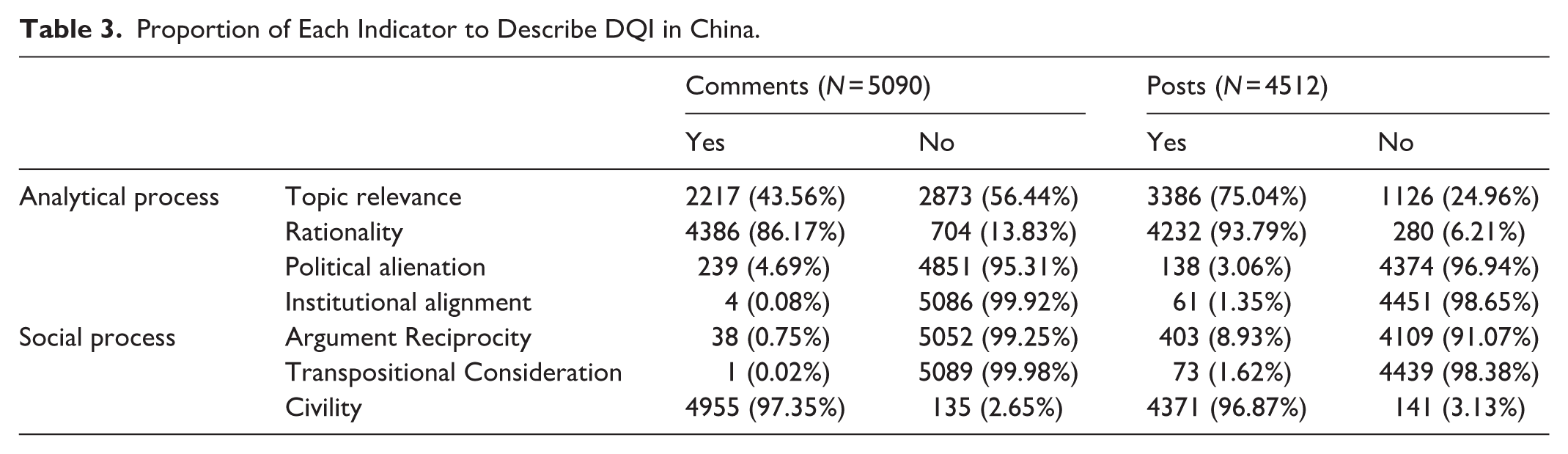
RQ1 investigated the discourse quality of the Chinese online public sphere regarding seven aspects. Through computational coding, we summarized the proportion of each indicator, as shown in Table 3. Among these dimensions, three indicators, topic relevance (75.04%), rationality (93.79%), and civility (96.87%), exhibited a predominant proportion of “yes,” while the remaining four indicators, argument reciprocity (8.93%), transpositional consideration (1.62%), political alienation (3.06%), and institutional alignment (1.35%), demonstrated a prevalence of “no.” Meanwhile, the similar distribution of each indicator also emerged within comment, in which the characteristics of “argument reciprocity,” “transpositional consideration,” “political alienation,” “institutional alignment” also showed a prevalence of “no.” However, the proportion of “topic relevance” was nearly balanced within the comments.
Proportion of Each Indicator to Describe DQI in China.
To address RQ2, we employed a multilayer logistic model to forecast the deliberative characteristics of comments using the R package lme4. Given that the dependent variables were dichotomously coded, we established a multilevel structure wherein comments (level 1) were nested within posts (level 2 units). Subsequently, we computed seven multilevel logistic regression models. Among these, three models predicting “argument reciprocity,” “transpositional consideration,” and “institutional alignment” did not incorporate significant variables, while the remaining four models are presented in Table 4. In the modeling process, we initially constructed null models comprising solely the multilevel structure, encompassing random effects of the posts/level 2 (ICC topic relevance = 0.321, ICC rationality = 0.443, ICC civility = 0.809, ICC political alienation = 0.692). Following this, we integrated the seven indicators (“topic relevance,” “argument reciprocity,” “transpositional consideration,” “rationality,” “civility,” “political alienation,” “institutional alignment”) of the posts (level 2) into the models.
Multilevel Logistic Regression Predicting the Characteristics of the Comments from of the Deliberative Characteristics of Posts.

Note. SE: standard error; ICC: intra-class coefficient; AIC: Akaike information criterion. Calculations based on 5,090 comments and 4,512 posts.
p < .001, **p < .01, *p < .05.
As displayed in Table 4, the results revealed that the “topic relevance” of the post was positively predicted by the “topic relevance” (b = 1.349, SE = 0.145, p < .001) and “rationality” (b = 0.832, SE = 0.142, p < .001) of comments, but was negatively associated with the “political alienation” of comments (b = -0.605, SE = 0.227, p < .01). Furthermore, a positive correlation was found between “argument reciprocity” of posts and “rationality” of comments (b = 0.378, SE = 0.163, p < .05), as well as between “transnational consideration” of the posts and “topic relevance” of the comments (b = 0.508, SE = 0.212, p < .05). Finally, “political alienation” of the posts was positively associated with comments (b = -1.167, SE = 0.413, p < .01), negatively associated with “civility” of the comments (b = 0.838, SE = 0.363, p < .05).
Discussion: The “Solo of Deliberator” in China’s Digital Public Sphere
As some political communication scholars call for a pragmatic approach that examines how citizens in semi-authoritarian societies adopt digital channels to participate in issues they care about without democratization as the end goal (e.g. Stockmann et al., 2019), we responded to the academic appeal by shedding light on the norms and manners they engage in deliberation. Our analysis revealed the high quality of political discourses regarding public debates on the controversial public policy, which is embodied through the realization of a series of civic norms including topic adherence, reasoned justification, respect, political integration, and minimum institutional alignment. From this perspective, ideal citizenship armed with deliberative virtues emerges in China’s cyberspace, at least on the platform of Zhihu.
We explained this benign phenomenon from both the platform side and the user side. First, defining its core mission as “to enable people to share knowledge, experience, and insights better, and to find their answers,” Zhihu actively builds community convention to remind users to offer authoritative content, diversified and comprehensive viewpoints, and trusted resources. We suggest that an evidence-based orientation, to a large extent, also curtails the possibility of government-paid pro-regime commenters or social bots since such content often presents in a short yet emotional way, which lacks convincing logical and argumentation support (e.g. Han, 2015). Second, from a social learning lens (Bandura, 1963), users tend to see other users who perform norms (e.g. civility, rationality) as examples and behave in a deliberative manner. Bakken (2000) characterized Chinese society as an “exemplary society” (a society governed through examples) and indicated that “morality” in China is a social form based largely upon the gaze of the other. Yang (2018) also examined the role of model netizens in educating the masses and civilizing the internet in the Chinese context, arguing that modeling civilized websites and civilized netizens (e.g. launching a national competition of “China Good Netizens”) represents a common method to teach moral lessons to the public. Users from Zhihu, as they are exposed to respectful, rational, and evidence-supported content and critical stances, might have experienced a social atmosphere in which deliberative behavior in cyberspace is acceptable, encouraged, and should be followed.
However, our analysis also showed inadequate interactions among the public. Measured by argument reciprocity, the results indicated a lack of “substantive interactivity” within China’s political discussion arena. Although Zhihu, like most other platforms, offers design options that allow individuals to easily reply to other comments to enhance interaction and keep threads organized, reciprocal comments that reply, address, and refer to other users or their posts are scarce. Thus, it is the logic of “exposure, expression but not exchange.” Furthermore, for the dimension of transpositional consideration, our study added empirical support to previous research that investigates the undesirable dynamics of online discussions in China, especially regarding their network homophily (Medaglia & Yang, 2017).
Based on the empirical results, we coin the concept of the “solo of deliberator” to describe a pattern of online deliberation where analytical reasoning prevails while social engagement is subdued. Specific, the analytical dimension of deliberation—comprising topic relevance, rationality, political alienation, and institutional alignment—demonstrates generally positive performance, indicating that participants engage in cognitively disciplined, well-reasoned, and normatively aware expression. In contrast, the social dimensions of argument reciprocity and transpositional consideration reveal considerable deficiencies in interactivity and perspective-taking. This imbalance implies that Chinese netizens have largely developed the analytical virtues of deliberation while falling short in the social practices that sustain collective reasoning. The concept of the “solo of deliberator,” therefore, describes a form of one-way deliberation: individuals articulate thoughtful, civil, and evidence-based arguments but seldom enter reciprocal dialogue or mutual justification. Such a pattern reflects how deliberation, under semi-authoritarian and high-context cultural conditions, privileges cognitive self-discipline and normative restraint over social exchange and argumentative diversity.
The question about the democratic consequence of the “solo of deliberator” remains unanswered. As digital platforms (social networking sites, blogs, and discussion boards) can be viewed largely as an “asynchronous” forum where interactions are often delayed, nuanced evidence has proven that online discussions tend to promote self-centered expressions and feature only little argumentative interaction between participants (Wyss & Beste, 2017). Furthermore, it is suggested that the lack of interpersonal exchange does not necessarily undermine the civic potential of digital public sphere. For instance, Goodin (2000) proposed the concept of deliberation-within to state that deliberation can take place within one’s mind through contemplation and imagination, and the asynchronous forum cultivates high-quality deliberation as it allows individuals to spend more time to reflect others’ statements. Our analysis results, echoing Goodin’s idea, demonstrate that high-quality deliberation-within indeed occurs in China’s cyberspace, embodied by relevant, civil, and reasoned arguments and political integration. Considering the asynchronous nature of online discussions, as well as the Chinese traditional culture of seeking harmony and conflict avoidance, some may ask whether or not such a “solo of deliberator” already presents as realistically optimal for Chinese people’s political engagement?
However, the opposite viewpoint sheds more light on the “collective” and “publicity” aspects of deliberation. Mercier and Landemore (2012) coined the concept of “argumentative theory of reasoning,” asserting that reasoning works best when people express their arguments to as diverse as possible an array of people, and suggesting that publicity enables the emergence of “feedback loops,” allowing individuals to recognize flaws in their personal reasoning and ensure that they consider the vantage points of fellow discussants. Following this suggestion, scholars have developed methods to encourage interactivity and openness of online discussion, for instance by involving human moderators and artificial facilitators (Wyss & Beste, 2017). We acknowledge the involvement of the facilitator has the potential to spur the virtue of reciprocity, yet also feel cautious of the over-facilitation, especially in China’s context where the state is accustomed to exercising information control and propaganda under the name of promoting a “clean and civil cyberspace” (Jiang & Esarey, 2018).
The Wane of Social Base in an Optimism-Deficit Era
We added the dimension of “institutional alignment” to the discourse quality index, yet empirical results proved the minimum presence of pro-state voice under the topic of the retirement age delay. While we have explained the lack of government-manipulated regime defenders from the perspective of the platform feature of Zhihu, here we would like to discuss the vanishing public support and erosion of semi-authoritarian resilience.
The “Chinese puzzle” in the communication field, which refers to the coexistence of dramatic developments in digital technologies and the Chinese Government’s resilience, has attracted scholars” attention. In the reform and post-reform era, trust and satisfaction are largely attributed to the economic boom and continuously improved living standards, which are viewed as providing a solid social base for the implementation of China’s information control and propaganda mechanism (Roberts, 2020). However, as China’s economy was in deep dive following the trade war with the US and the pandemic, this “economic performance-driven” adaption is now facing a great challenge. Dissent and pessimistic emotions on social media are on the rise. Moreover, economic downturn goes hand in hand with the increasing income gap. This “horizontal inequality” between social groups is potentially a trigger of political conflict (Acemoglu & Robinson, 2006). Both economic pessimism and public anger toward the income gap are widely observed within the discussion regarding the retirement age delay, reflecting the increasing importance of semi-authoritarian resilience in today’s optimism-deficit era. The worries about job stability and dissent towards the pension gap between China’s public and nonpublic sectors also represent the Chinese people’s view on distributive justice—“inadequacy poses no worry, but uneven distribution does” (不患寡而患不均).
However, our results also demonstrate that the optimism deficit does not necessarily or directly result in political alienation. While critiques of the policy arise and the use of political satire can be observed now and then, the discussions often lead to reason-given, constructive proposals for potential solutions rather than feelings and expressions of isolation or alienation. We can possibly explain the political integration from the perspective of user features from Zhihu. According to the Research Report on the Characterization of Zhihu Users, as China’s most influential and diverse knowledge-sharing platform, young people with high educational backgrounds and income constitute its primary user group. For this demographic group, relatively higher digital literacy and political efficacy empower them to engage in politics in a way of behaving rationally, insightfully, and meaningfully.
Furthermore, our results echo the findings of extant research on the “spiral of deliberativeness” (e.g. Friess et al., 2021; Sukumaran et al., 2011), which means that high-quality comments were related to an increased quality in the subsequent discussions. This finding bears practical implications for understanding the civic potential of digital media in non-democratic societies. Both newsrooms and social media platforms could highlight and reward high-quality public engagement to promote further virtue spirals. While studies on digital politics in semi-authoritarian regimes predominately focus on its conflict-laden characteristics and revolutionary consequences, we suggest that the significance, mechanism and approaches to cultivate “communicative citizenship” and deliberative norms deserve specific attention, as they could play a long-term, benign role in democratizing those contexts.
Conclusion
While some inquire about the policy impact of civic discussions in China, by conceptualizing the public sphere as a “problematization process” (Chen & Jacobson, 2022) and proposing the concepts like “consultative authoritarianism” (Truex, 2017), “deliberative citizenship” and “deliberative governance” (He, 2018), an important pre-condition is that the public discourses are sufficiently high quality to be considered. Through empirical examination, we found features of relevant, rational, respectful, integrative, critical yet less-reciprocal discussions. However, it remains premature to ascertain the extent to which these features influence China’s overarching digital politics, whether towards a positive or negative trajectory.
This study represents one of the pioneer studies focusing on public discourse quality in (semi-) authoritarian contexts. While our research is specifically focused on China, it is plausible that the methodologies and conceptual lens employed possess a degree of applicability across diverse cultural contexts. First, when examining deliberative democracy in non-democratic contexts, this study calls for specific investigations on the communicative manners, cognitive paths, expressive ways, and emotional/rational orientations individuals understand and discuss socio-political issues, moving away from shedding light on the state-society dynamics from a vertical, top-down/bottom-up perspective. Discourse qualities on politics and public policy produce equally, if not more, important impact (than state-conducted censorship or propaganda) on determining the prospect of the public sphere, and on cultivating cherished civic norms and deliberative citizenship (e.g. Esau et al., 2020; Friess et al., 2021). Second, the Index of Deliberation Quality in the Non-Democratic States we proposed, through adding dimensions of political alienation and institutional alignment, better captures the features of public discourses in non-democratic societies, where lack of constitutional ways of political participation (e.g. voting and petition) and opacity of political decision-making may lead to feelings and expressions of powerlessness and normlessness, and the governments are skilled in manipulating consent and triumph to mislead the direction of public debates.
This study is not without limitations. First, we took a classic concept of deliberation and integrated normative elements with some additional features in (semi-)authoritarian contexts, but did not include factors that may also play a role in an individual’s political expressions such as emotion, storytelling, and humor (e.g. Esau et al., 2020). A more tolerant framework has the potential to provide a more nuanced understanding of the quality and characteristics of deliberative democratization in either China or other non-democratic societies’ cyberspace. Second, we took a Q&A platform Zhihu as the research case, and platform variation regarding the discourse’s quality was not examined in the current investigation. As Van Dijck (2013) emphasized, platform architectures differ across platforms, depending on the goals, cultures, and business models of the specific corporations, it is expected that the discourse quality of political discussions would show some differences among various online sites. Since Stockmann et al.’s (2019) study found that Weibo facilitates political expressions while WeChat inhabits them. Future studies could investigate whether certain platforms better cultivate deliberative norms through rules that regulate undesirable interactions, or by developing an environment that values civic virtues.
Supplemental Material
sj-docx-1-sms-10.1177_20563051261419385 – Supplemental material for The “Solo of Deliberator”: Political Deliberation and Discourse Quality in China’s Cyberspace
Supplemental material, sj-docx-1-sms-10.1177_20563051261419385 for The “Solo of Deliberator”: Political Deliberation and Discourse Quality in China’s Cyberspace by Tianru Guan and Xiaotong Chen in Social Media + Society
Footnotes

Funding
The authors received no financial support for the research, authorship, and/or publication of this article.
Declaration of conflicting interests
The authors declared no potential conflicts of interest with respect to the research, authorship, and/or publication of this article.
Supplemental material
Supplemental material for this article is available online.
Notes
Author biographies
References
Supplementary Material
Please find the following supplemental material available below.
For Open Access articles published under a Creative Commons License, all supplemental material carries the same license as the article it is associated with.
For non-Open Access articles published, all supplemental material carries a non-exclusive license, and permission requests for re-use of supplemental material or any part of supplemental material shall be sent directly to the copyright owner as specified in the copyright notice associated with the article.
